LIFE SCIENCES GRADE 11 CAPS STRUCTURED CLEAR PRACTICAL
- Slides: 76
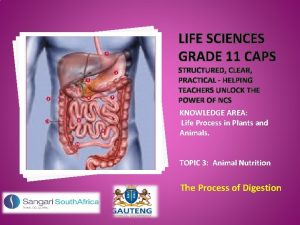
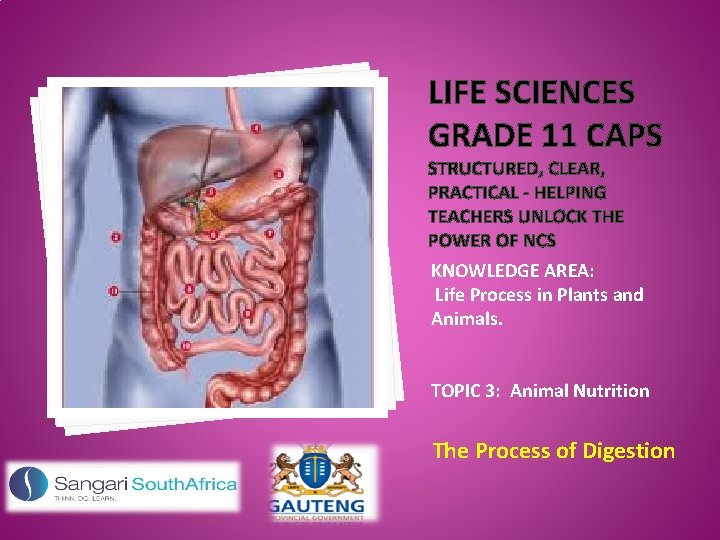
LIFE SCIENCES GRADE 11 CAPS STRUCTURED, CLEAR, PRACTICAL - HELPING TEACHERS UNLOCK THE POWER OF NCS KNOWLEDGE AREA: Life Process in Plants and Animals. TOPIC 3: Animal Nutrition The Process of Digestion
SUMMARY OF PRESENTATION Introduction Need for digestion Types of Digestion Role of water in Digestion Absorption Egestion
INTRODUCTION: �Nutrition is the process of taking in and using food molecules. Nutrition occurs through the following processes: 1. Ingestion 2. Digestion 3. Absorption 4. Assimilation 5. Egestion
INTRODUCTION: 1. � 2. � 3. � Ingestion: This is the intake of food. Food is taken in as large complex substances. Digestion: This is the conversion of large complex food molecules into smaller, simpler, soluble particles. This occurs inside the body. Absorption: This occurs when the digested food is taken into the blood stream.
INTRODUCTION: 4. � 5. � Assimilation: This when the soluble food from the blood stream is taken into the cells. In the cells they are used for many purposes. Egestion: This is the removal of undigested and indigestible food from the body.
THE NEED FOR DIGESTION: � � � Food contains large amounts of energy. The food must be absorbed and transported to release energy. However the food we eat is made up of complex molecules that are insoluble in water. Digestion must occur so that these large insoluble complex molecules can be broken down into smaller, simpler soluble substances. These simpler, smaller, soluble particles then can be absorbed ad transported.
TYPES OF DIGESTION: � There are 2 types of digestion. � These are: 1. Mechanical digestion 2. Chemical digestion Mechanical Digestion: � This is a physical process. � The physical process might be chewing or action of the muscles. � During mechanical digestion, large pieces of food is broken down into smaller pieces of food.
TYPES OF DIGESTION: � Mechanical digestion is necessary to expose a large surface area for enzyme action. Chemical Digestion: � This involves the chemical breakdown of food. � During this process insoluble complex nutrients are broken down into smaller, simples soluble nutrients. � Chemical digestion occurs by the process of hydrolysis.
TYPES OF DIGESTION: � Hydrolysis is the process during which large, insoluble complex nutrients are broken down into simpler, smaller, soluble nutrients with the chemical addition of water. � In order for hydrolysis to occur enzymes are required. � These enzymes maybe categorized in 3 groups. They are: 1. Proteases: they breakdown (hydrolyse) proteins into amino acids.
TYPES OF DIGESTION: 2. Carbohydrases: these enzymes breakdown (hydrolyse) carbohydrates into simple sugars for example glucose. 3. Lipases: these are enzymes that are involved in fat digestion. They breakdown (hydroylse) the fats into fatty acids and glycerol.
ROLE OF WATER IN DIGESTION: � Water has many functions during digestion. � We are only looking at 1 function that is its role in the movement of food along the alimentary canal. � Water helps in the movement of food along the alimentary canal in 2 ways: These 2 ways are: 1. It makes the food more liquid, so that it can move more easily along the alimentary canal. 2. It keeps the surrounding tissues of the alimentary canal soft and pliable. This also allows for free movement.
ROLE OF WATER IN DIGESTION: This water comes from the following sources: 1. Taken in with the food we eat 2. It is an added component of the following secretions: saliva gastric juice pancreatic juice intestinal juice bile
DIGESTION: Path of Food along the Alimentary Canal and Mechanical Digestion: Mastication: � Mechanical digestion begins in the mouth. � Here food is chewed into a fine pulp. mastication Another word for chewing is. � During mastication the food is also mixed with salvia. � The purpose of mastication is… 1. To increase the surface area that comes into contact with the enzymes. 2. Food is mixed with saliva to allow for easy swallowing and passage through the oesophagus.
DIGESTION: � The lining of the mouth is able to tell when the food is ready for swallowing. � Then the palate and the tongue roll the food into a small ball is called the bolus. � Once the bolus is formed the food is ready for swallowing. � This Swallowing: � Swallowing is a reflex action of the tongue, palate, pharynx and glottis.
DIGESTION: � During swallowing the tongue moves back and up, pulling the trachea up against the epiglottis. � This closes the glottis and prevents the food from going down the trachea. � This prevents choking. Peristalsis: � The bolus now enters the oesophagus. � The food travels along the oesophagus by the process of peristalsis.
DIGESTION: Peristalsis: � The bolus now enters the oesophagus. � The food travels along the oesophagus by the process of peristalsis. �Peristalsis is the rhythmical contraction and relaxation of the muscles of the oesophagus. � Peristalsis is an involuntary action.
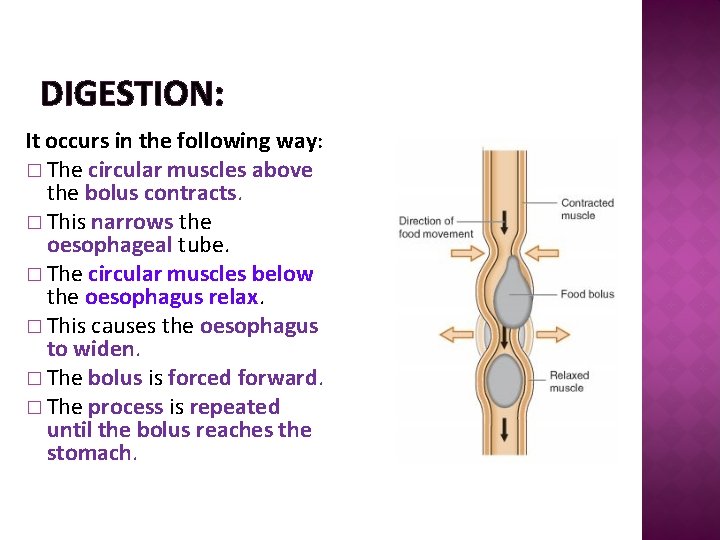
DIGESTION: It occurs in the following way: � The circular muscles above the bolus contracts. � This narrows the oesophageal tube. � The circular muscles below the oesophagus relax. � This causes the oesophagus to widen. � The bolus is forced forward. � The process is repeated until the bolus reaches the stomach.
DIGESTION: Peristalsis in the Stomach: � The food enters the stomach through the cardiac sphincter. � The cardiac sphincter controls the movement of the bolus into the stomach. � Peristalsis in the stomach occurs in many different directions. � This ensures that the food is broken down into smaller pieces. � It also ensures that the food is mixed thoroughly with the digestive juices of the stomach.
DIGESTION: � The food is now partially digested. � The pyloric sphincter then opens allowing the food to move into the small intestine. Peristalsis in the Small Intestine: � Peristalsis here is similar to the one that occurred in the oesophagus. � It moves the food along the small intestine. � Peristalsis also ensures that the food is mixed thoroughly with the digestive enzymes.
DIGESTION: � The food is finally moved into the large intestine by peristalsis. � It finally enters the rectum, where egestion will occur.
DIGESTION: Chemical Digestion: Saliva: � In the mouth saliva plays a role in chemical digestion. � Remember the salvia is secreted by the salivary glands. Saliva is important because: 1. It contains water to soften the food and help with chewing. 2. It also contains mucous. The mucus lubricates the food and helps with chewing.
DIGESTION: 3. 4. It creates a slightly alkaline medium for the enzymes that are found in the mouth. The enzyme carbohydrase is a part of the salvia. This enzyme plays a role in the digestion of cooked starch. Gastric Juices: � When the stomach detects protein it secretes a hormone. � � � This hormone is called gastrin. Gastrin is secreted by the stomach walls. The gastrin is secreted into the blood vessels.
DIGESTION: � When the blood passes through the stomach lining, the gastrin stimulates the cells to secrete gastric juice. Gastric juices assists digestion in the following way: 1. 2. It contains the enzyme protease, which plays a role in the digestion of proteins. It also has water. The water keeps the food fluid to allow for easy movement along the alimentary canal.
DIGESTION: It has mucin. The mucin combines with water to form a thick protective lining on the inside of the stomach. This protects the stomach from the action of the enzymes. 4. Hydrochloric acid is present to provide an acid medium for the enzymes found in the stomach. It also acts as an antiseptic. It destroys the germs that maybe taken in with the food. 3. Digestive Juices in the Small Intestine: � When the food from the stomach enters the duodenum the enzyme secretin is secreted. � This hormone is secreted by the duodenal walls.
DIGESTION: � The secretin is secreted into the blood stream. � As the blood passes through the pancreas, the secretin stimulates cells of the pancreas to secrete pancreatic juice. Pancreatic juice plays the following role in digestion: 1. It contains water to keep the food fluid enable easy movement through the alimentary canal. 2. The food coming from the stomach is called acid chyme. It is very acidic. The enzymes that make up a part of the pancreatic juice cannot work in this medium. Therefore pancreatic juices contains sodium bicarbonate. This sodium bicarbonate neutralizes this acid chyme so that the enzymes of the pancreas is able to function.
DIGESTION: 3. There are 3 enzymes that are found in the pancreatic juice. They are: carbohydrases: they digest carbohydrates proteases: they digest proteins lipases: they digest lipids or fats Intestinal Juice: � These are the secretions of the small intestine. � The walls of the small intestine contain glands. � These glands secrete mucus. � mucus The forms a protective layer, protecting the lining of the small intestine against the acid chyme coming from the stomach.
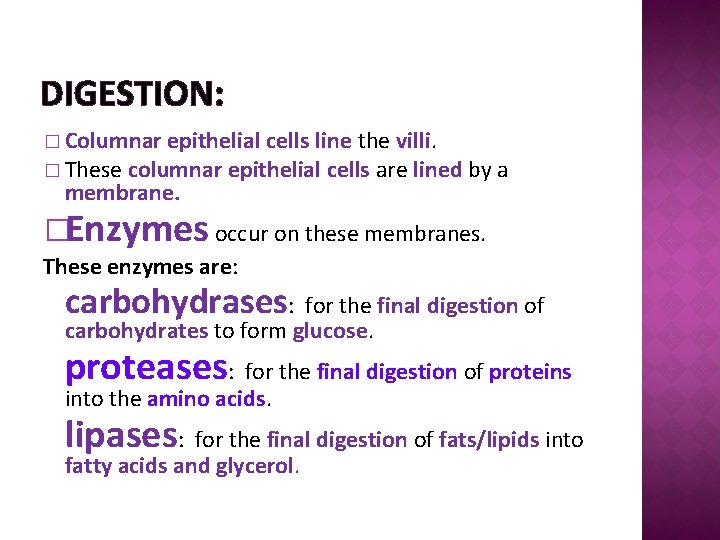
DIGESTION: � Columnar epithelial cells line the villi. � These columnar epithelial cells are lined by a membrane. �Enzymes occur on these membranes. These enzymes are: carbohydrases: for the final digestion of carbohydrates to form glucose. proteases: for the final digestion of proteins into the amino acids. lipases: for the final digestion of fats/lipids into fatty acids and glycerol.
DIGESTION: � The final hydrolysis of nutrients occurs on the cell membranes or within the columnar epithelial cells. What type of digestion is this?
SOLUTION: INTRACELLULAR DIGESTION because… Digestion occurs within the cells.
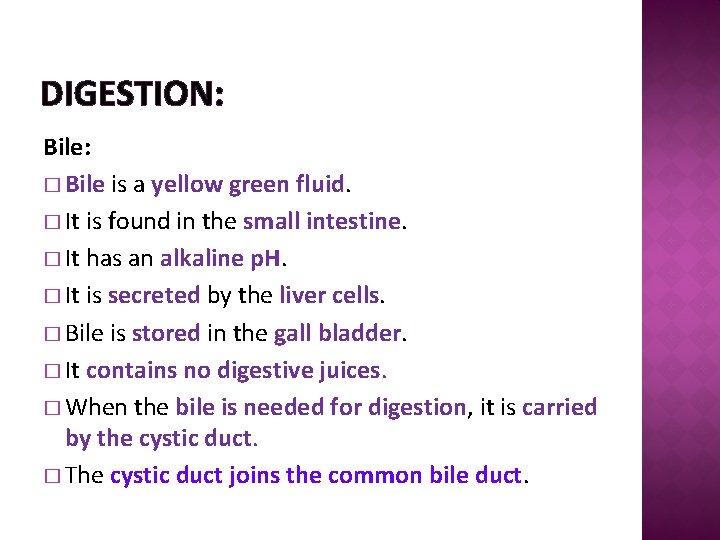
DIGESTION: Bile: � Bile is a yellow green fluid. � It is found in the small intestine. � It has an alkaline p. H. � It is secreted by the liver cells. � Bile is stored in the gall bladder. � It contains no digestive juices. � When the bile is needed for digestion, it is carried by the cystic duct. � The cystic duct joins the common bile duct.
DIGESTION: � The common bile duct joins the pancreatic duct to form the hepato-pancreatic duct. � The hepato-pancreatic duct carries the bile to the small intestine. The bile has the following functions: water 1. The present in the bile keeps the food fluid enabling easy movement of the food along the alimentary canal. 2. The neutralize the acid chyme coming from the stomach. alkaline bile salts
DIGESTION: 3. 4. 5. 6. The bile salts also emulsify fats. This means it breaks up the fats into droplets. This increases the surface area for enzyme action. Bile salts assists in the absorption of fats. Bile salts also help in the absorption of the fat soluble vitamins. These are vitamins D, E, A and K. Bile salts are also slightly antiseptic. Thus preventing decomposition of the food in the small intestine.
ABSORPTION: � Absorption occurs in the following parts of the alimentary canal: 1. Stomach 2. Small intestine 3. Large intestine � The greatest amount of absorption occurs in the small intestine. � Once the food is absorbed it is carried by the blood (transport system) to all parts of the body. � Now lets look at absorption in the above organs.
ABSORPTION: Absorption in the Stomach: � The following substances are absorbed by the stomach in small amounts: 1. Glucose 2. Ions of organic salt 3. Alcohol Absorption in the Small Intestine: � The following substances are present in the small intestine: 1. Glucose 2. Amino acids 3. Fatty acids and glycerol
ABSORPTION: 4. 5. 6. � Vitamins Minerals Water Some undigested and indigestible material is also present.
SOMETHING FOR YOU TO DO: Can you differentiate between undigested and indigestible material?
SOLUTION: � The undigested food/material is food that can be digested but it was not digested because it was not required by the body. � The indigestible material/food refers to the food that cannot be digested, that is the body does not have the ability to do so.
ABSORPTION: � The above mentioned substances are absorbed in the following way: Absorption of Glucose: � Glucose is formed as a result of carbohydrate digestion. � It is the simplest form of a carbohydrate. � Therefore it is an example of a monosaccharide. � The glucose is absorbed by the villi. � It absorbed against a concentration gradient. � This means that it is absorbed actively.
ABSORPTION: � That is energy is required to absorb the glucose. � Carrier molecules are used to carry the glucose across the concentration gradient. � The glucose then enters the blood capillaries of the villi. Absorption of Amino Acids: � Amino acids are formed as a result of protein digestion in the small intestine. � The amino acids are absorbed actively against the concentration gradient. � Carrier molecules are also used. � The amino acids enter the blood capillaries of the villi.
ABSORPTION: Absorption of Fatty acids and Glycerol: � Fatty acids and glycerol are the end result of lipid digestion. � They occur in small intestine. � Bile salts emulsify these fatty acids and glycerol so that they are more soluble in water. � They � Here then enter the villi by diffusion. the fatty acids and glycerol are absorbed by the lacteal.
ABSORPTION: Absorption of Vitamins: � Two types of vitamins are present in the small intestine. � They are fat soluble vitamins and water soluble vitamins. � The fat soluble vitamins are absorbed passively. � Examples of fat soluble vitamins are D, E, A and K. � Water soluble vitamins can be absorbed passively or actively by carrier molecules. � Some examples of water soluble vitamins are B and C.
ABSORPTION: Absorption of Minerals: � Mineral ions maybe absorbed either passively or actively. � Some examples of mineral ions that maybe absorbed this way are sodium, potassium, magnesium and calcium. Absorption of Water: � Almost all the water is absorbed in the small intestine and a small amount of water is absorbed in the large intestine. � The water is absorbed by the process of osmosis.
ABSORPTION: Absorption in the Large Intestine: � Water and some ions and vitamins are absorbed in the large intestine. Adaptations of the Alimentary canal for Efficient Absorption: 1. The alimentary canal is very long to ensure that food remains in the small intestine for a long period of time to ensure maximum absorption occurs. 2. There are millions of villi found in the small intestine, this increases the surface area for maximum absorption.
ABSORPTION: 3. 4. 5. 6. The walls of the villi are thin since they are made up of only a single layer of columnar epithelial cells, this allows for easy absorption. There are lacteals and blood capillaries present to transport the absorbed food away quickly. The columnar epithelial cells of the villi have micro-villi to further increase the surface area for maximum absorption. The columnar epithelial cells have a large number of mitochondria to provide the energy needed for active transport.
TRANSPORT AND ASSIMILATION: � Fatty acids and glycerol enter the lacteals of the villi. � The larger lymph vessel transports the fatty acids and glycerol to the left thoracic duct. � The left thoracic duct then opens into the blood system. � Glucose, amino acids, vitamins, minerals ions and water enter the blood capillaries of the villi. � These capillaries join to form venules, then larger veins. � These larger veins then pour into the hepatic portal vein.
TRANSPORT AND ASSIMILATION: � The hepatic portal vein then carries the nutrients to the liver. � In the liver the excess glucose is converted into glycogen by the insulin. � It is then stored. � The excess amino acid is de-aminated to form urea. � The urea is excreted by the kidneys. � The rest of the nutrients, including the glucose and amino acids are carried out of the liver by hepatic vein. � The hepatic vein join the inferior vena cava. � The inferior vena cava then carries this nutrient rich blood to the heart. � The heart then pumps this blood to the lungs.
TRANSPORT AND ASSIMILATION: � In the lungs the blood is oxygenated. � This blood is then sent back to the heart and from here it is pumped to all parts of the body.
EGESTION: � Egestion is also known as defecation. � Defecation or egestion is the removal of undigested and indigestible food out of the body through the anus. � In order for egestion to occur the diet must contain roughage. � Roughage is food that has a high fibre content. � Fibre is the indigestible part of food. � This means that the body cannot digest it. � It is made up of cellulose and lignin.
EGESTION: � Fruit and vegetables contain roughage. � Roughage is not a nutrient. However it has many important functions. These are: 1. It adds bulk to the material in the colon, allowing the colon to stretch so that peristalsis can occur, thus moving the faeces toward the rectum, finally the anus so that defaecation can occur. 2. The cellulose in the roughage enable the faeces to absorb and retain water. This prevents the faeces from drying out.
EGESTION: The fibres react with the poisonous substances in the faeces, therefore preventing them from being absorbed by the bloodstream. � If the diet lacks roughage then constipation occurs. � Constipation is when defaecation slows down or stops altogether. Constipation occurs because: 1. Material in the colon lacks bulk causing peristalsis to stop. 2. The faeces dry out because of the absence of cellulose. 3.
TERMINOLOGY: � Nutrition: is the process of taking in and using food molecules. � Ingestion: is the intake of food, as large complex substances. � Digestion: is the conversion of large complex food molecules into smaller, simpler, soluble particles. � Absorption: occurs when the digested food is taken into the blood stream. � Assimilation: is when the soluble food from the blood stream is taken into the cells. � Egestion: is the removal of undigested and indigestible food from the body.
TERMINOLOGY: � Mechanical digestion: occurs when large pieces of food is physically broken down into smaller pieces of food. � Chemical digestion: occurs when insoluble complex nutrients are broken down into smaller, simples soluble nutrients. � Hydrolysis: is the process during which large, insoluble complex nutrients are broken down into simpler, smaller, soluble nutrients with the chemical addition of water. � Proteases: are enzymes that breakdown (hydrolyze) proteins into amino acids.
TERMINOLOGY: � � � Carbohydrases: are enzymes that breakdown (hydrolyse) carbohydrates into simple sugars for example glucose. Lipases: these are enzymes that breakdown (hydroylse) the fats into fatty acids and glycerol. Mastication: is another word for chewing. Bolus: is a ball of food. Peristalsis: is the rhythmical contraction and relaxation of the muscles of the oesophagus. Gastrin: is an enzymes secreted by the stomach walls and it stimulates the cells of the stomach wall to secrete gastric juice.
TERMINOLOGY: � � Secretin: is a hormone that is secreted by the duodenal walls to stimulates cells of the pancreas to secrete pancreatic juice. Intracellular digestion: is digestion that occurs within the cells. Undigested food/material: is food that can be digested but it was not digested because it was not required by the body. Indigestible material/food: refers to the food that cannot be digested, that is the body does not have the ability to do so.
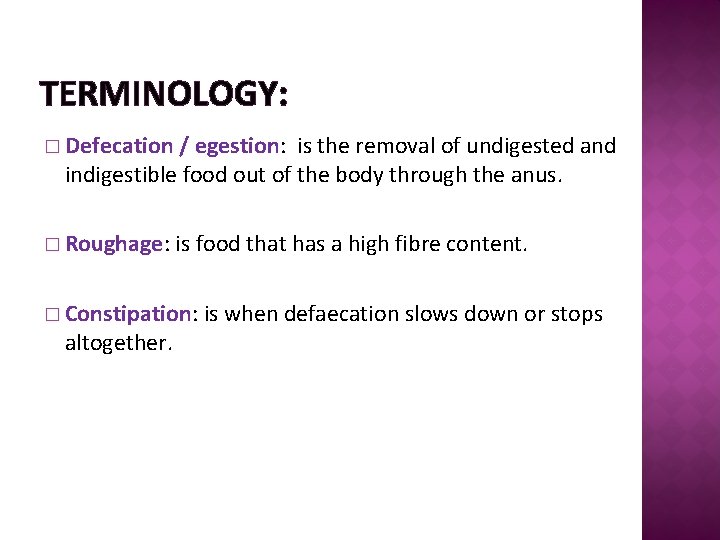
TERMINOLOGY: � Defecation / egestion: is the removal of undigested and indigestible food out of the body through the anus. � Roughage: is food that has a high fibre content. � Constipation: altogether. is when defaecation slows down or stops
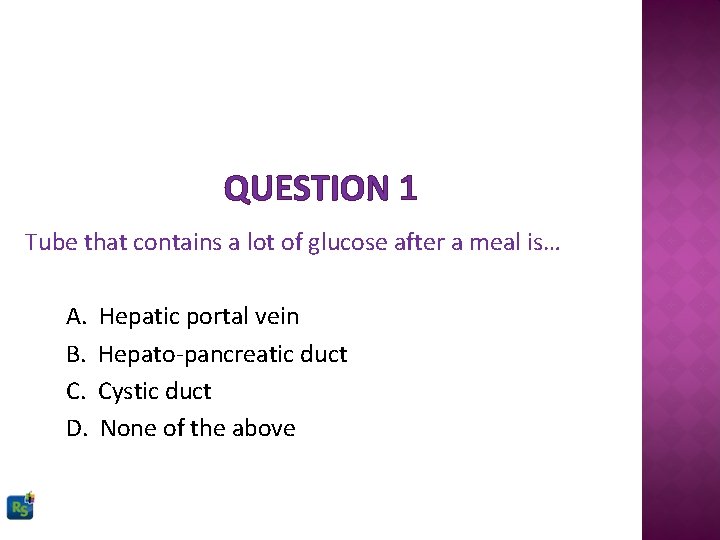
QUESTION 1 Tube that contains a lot of glucose after a meal is… A. B. C. D. Hepatic portal vein Hepato-pancreatic duct Cystic duct None of the above
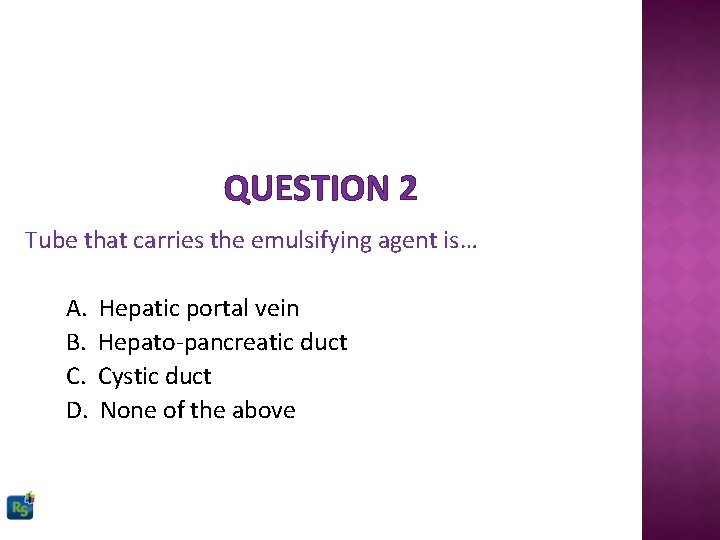
QUESTION 2 Tube that carries the emulsifying agent is… A. B. C. D. Hepatic portal vein Hepato-pancreatic duct Cystic duct None of the above
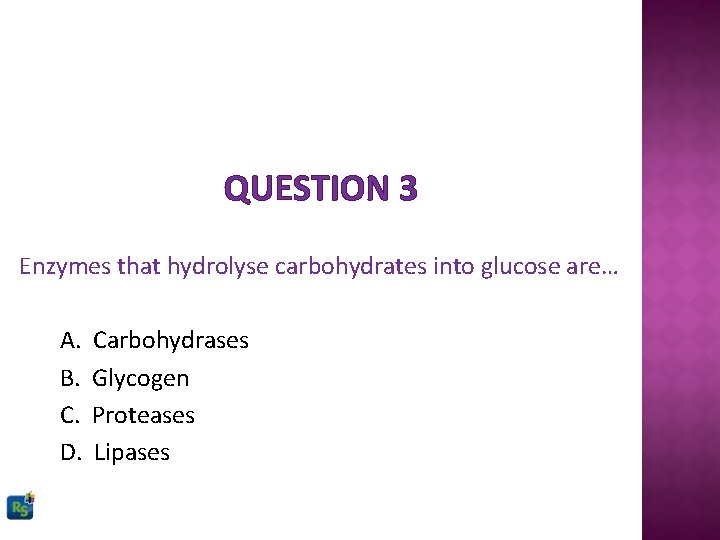
QUESTION 3 Enzymes that hydrolyse carbohydrates into glucose are… A. B. C. D. Carbohydrases Glycogen Proteases Lipases
QUESTION 4 Enzymes that hydrolyse fats into fatty acids and glycerol are… A. B. C. D. Carbohydrases Glycogen Proteases Lipases
QUESTION 5 Enzymes that hydrolyse proteins into amino acids are… A. B. C. D. Carbohydrases Glycogen Proteases Lipases
QUESTION 6 Blood vessel that carries lipids to the inferior vena cava is the… A. B. C. D. Right lymphatic duct Left thoracic duct Hepatic veins Hepatic portal veins
QUESTION 7 Substance that is absorbed by osmosis mostly in the small intestine is… A. B. C. D. Fats Carbohydrates Glucose Water
QUESTION 8 The substance that is transported by the lacteals of the villi is. . . A. B. C. D. Amino acids Glucose Fatty acids and glycerol Lipids
QUESTION 9 Absorption that involves carrier molecules and energy is known as… A. B. C. D. Active transport Passive transport Both A and B None of the above
QUESTION 10 Digestive juice that contains no enzymes is… A. B. C. D. Bile Gastric juice Intestinal juice Pancreatic juice
QUESTION 11 Digestive juice that is secreted by the gastric pits are… A. B. C. D. Intestinal juice Pancreatic juice Gastric juice Bile
QUESTION 12 Gland that secretes both hormones and digestive juice is known as… A. B. C. D. Liver Pancreas Salivary gland Both B and C
QUESTION 13 Exocrine gland involved in digestion of carbohydrate… A. B. C. D. Liver Pancreas Salivary gland Both B and C
QUESTION 14 The cardiac valve controls… A. B. C. D. Entry of food into the stomach Entry of food into the small intestine Entry of food into the large intestine None of the above
QUESTION 15 Peristalsis occurs in the oesophagus because of… A. B. C. D. Circular muscles Longitudinal muscles A lack of muscles None of the above
QUESTION 16 Acid food coming form the stomach is called… A. B. C. D. Acid chyme Bolus Glucose Lipids
QUESTION 17 The following substances have antiseptic properties… A. B. C. D. HCl and bile Bile and pancreatic juice HCl and pancreatic juice Insulin and glucagon
QUESTION 18 Plays a role in swallowing… A. Tongue, palate, pharynx B. Tongue and palate only C. Tongue, palate, pharynx and glottis D. Tongue, palate, pharynx, glottis & epiglottis
QUESTION 19 Leaf shaped cartilage found at the opening of the trachea… A. B. C. D. Called epiglottis Protects against choking Covers the glottis during swallowing All of the above
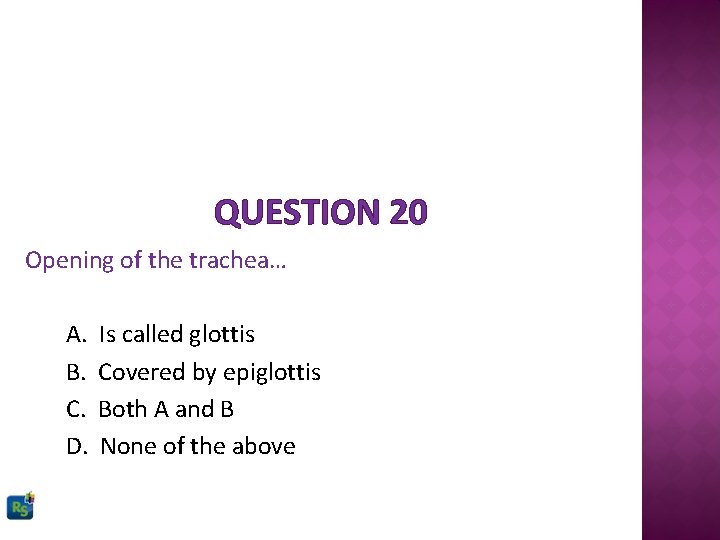
QUESTION 20 Opening of the trachea… A. B. C. D. Is called glottis Covered by epiglottis Both A and B None of the above
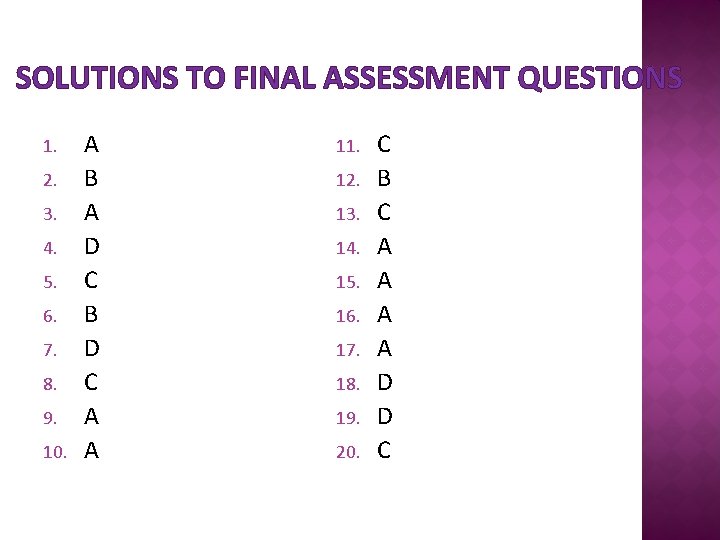
SOLUTIONS TO FINAL ASSESSMENT QUESTIONS 1. 2. 3. 4. 5. 6. 7. 8. 9. 10. A B A D C B D C A A 11. 12. 13. 14. 15. 16. 17. 18. 19. 20. C B C A A D D C