
BLUETOOTH Overview I am King Harold Bluetooth who

BLUETOOTH Overview I am King Harold Bluetooth who unified warring Viking Tribes in the 10 th Century. In the 21 st Century a wireless Bluetooth network is named after me. Where are my shoes? Spanakis Manolis Computer Science Department CS-532
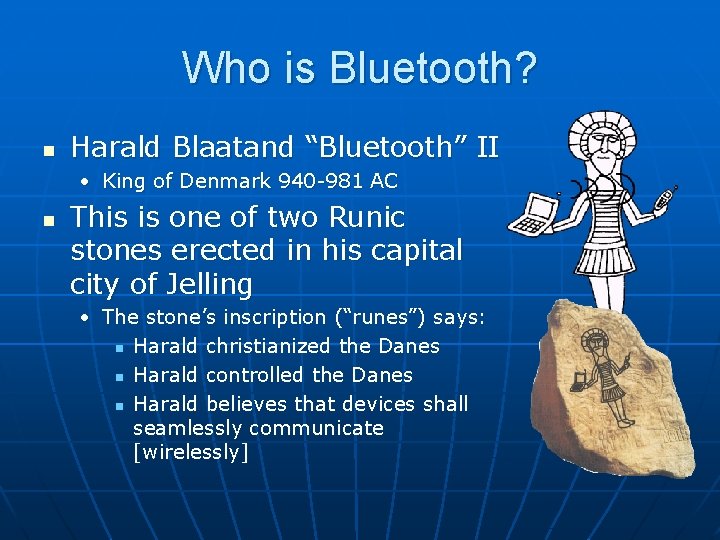
Who is Bluetooth? n Harald Blaatand “Bluetooth” II • King of Denmark 940 -981 AC n This is one of two Runic stones erected in his capital city of Jelling • The stone’s inscription (“runes”) says: n Harald christianized the Danes n Harald controlled the Danes n Harald believes that devices shall seamlessly communicate [wirelessly]

What does Bluetooth do for you? Landline Cable Replacement Data/Voice Access Points Personal Ad-hoc Networks
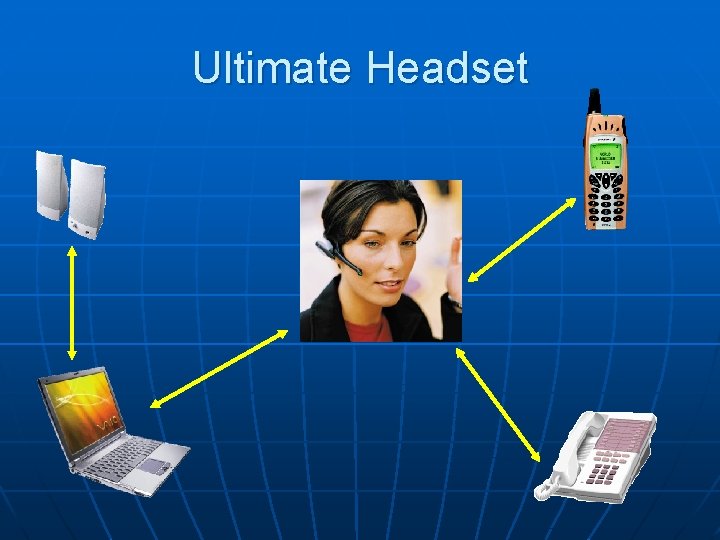
Ultimate Headset
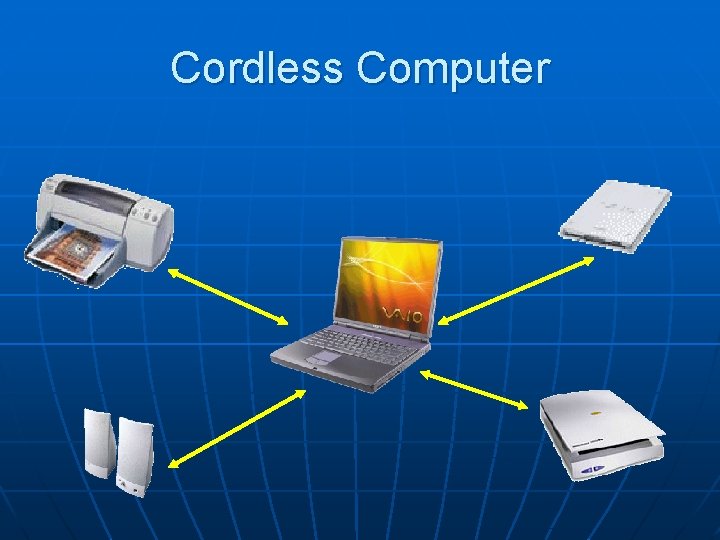
Cordless Computer
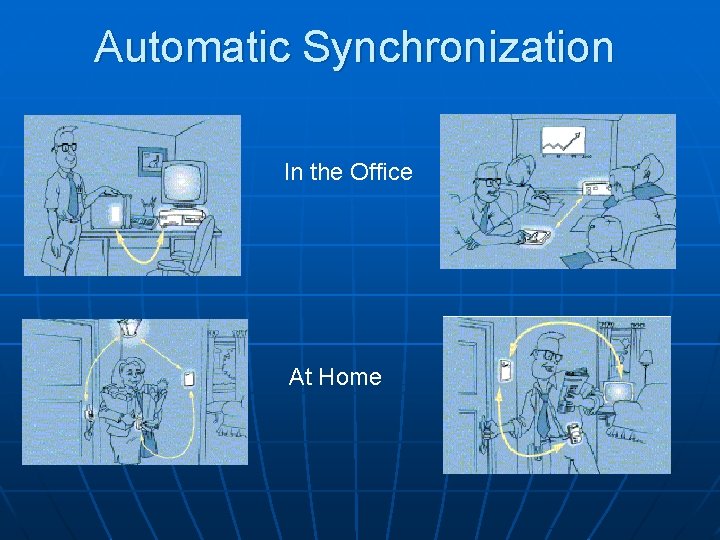
Automatic Synchronization In the Office At Home
Bluetooth SIG -- more n n n February 1998: The Bluetooth SIG is formed • promoter company group: Ericsson, IBM, Intel, Nokia, Toshiba May 1998: The Bluetooth SIG goes “public” July 1999: 1. 0 A spec (>1, 500 pages) is published December 1999: ver. 1. 0 B is released December 1999: The promoter group increases to 9 • 3 Com, Lucent, Microsoft, Motorola February 2000: There are 1, 500+ adopters • adopters "enjoy" royalty free use of the Bluetooth technology n products must pass Bluetooth certification
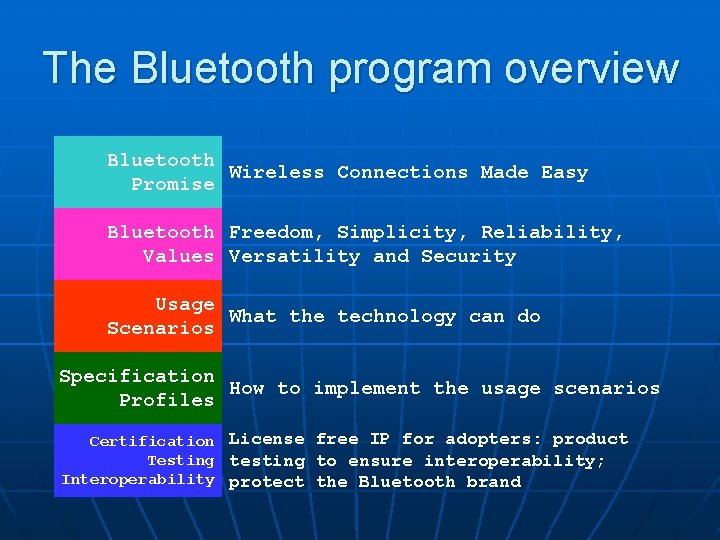
The Bluetooth program overview Bluetooth Wireless Connections Made Easy Promise Bluetooth Freedom, Simplicity, Reliability, Values Versatility and Security Usage What the technology can do Scenarios Specification How to implement the usage scenarios Profiles Certification License free IP for adopters: product Testing to ensure interoperability; Interoperability protect the Bluetooth brand
General Description n n n A cable replacement technology Operates in the unlicensed ISM band at 2. 4 GHz Frequency Hopping scheme (1600 hops/sec) 1 Mb/s symbol rate Range 10+ meters Single chip radio + baseband Key features: n n Robustness low complexity low power, and low cost.
General Description (2) n Bluetooth supports • Synchronous & asynchronous data channels. n n Three simultaneous synchronous voice channels, or One channel, with asynchronous data and synchronous voice • Each voice channel supports 64 kb/s in each direction. • The channel can support maximal 723. 2 kb/s asymmetric (and still up to 57. 6 kb/s in the return direction), or 433. 9 kb/s symmetric. n Bluetooth provides • point-to-point connection (only two Blue. Tooth units involved), or • point-to-multipoint connection.
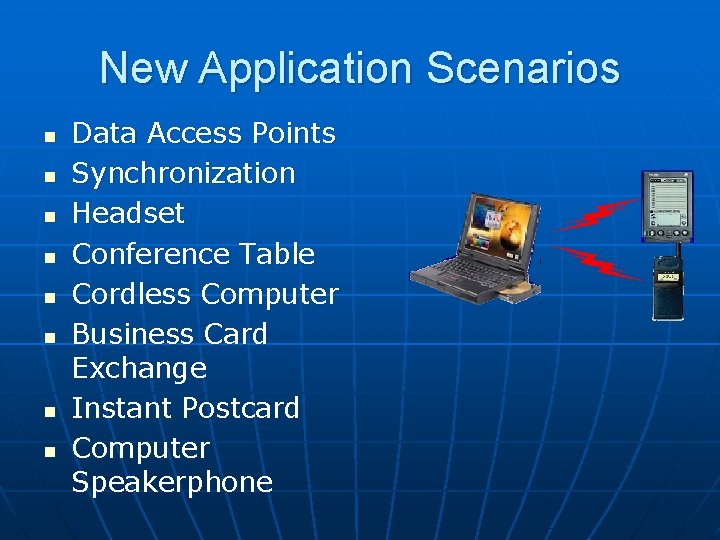
New Application Scenarios n n n n Data Access Points Synchronization Headset Conference Table Cordless Computer Business Card Exchange Instant Postcard Computer Speakerphone
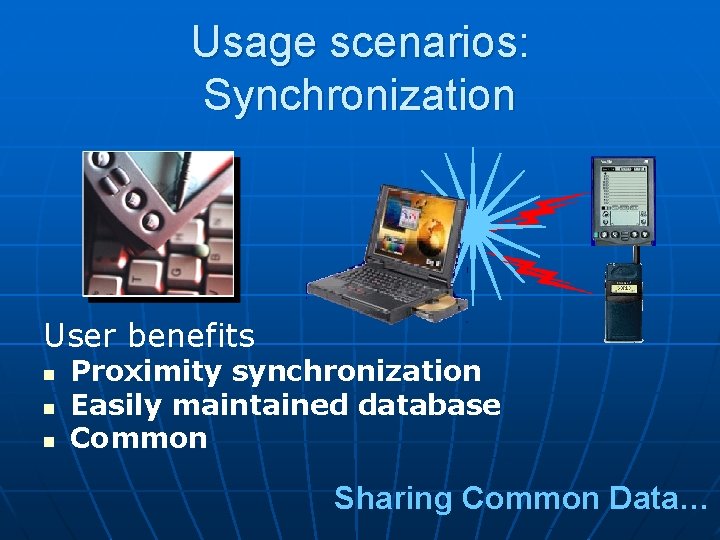
Usage scenarios: Synchronization User benefits n n n Proximity synchronization Easily maintained database Common Sharing Common Data…
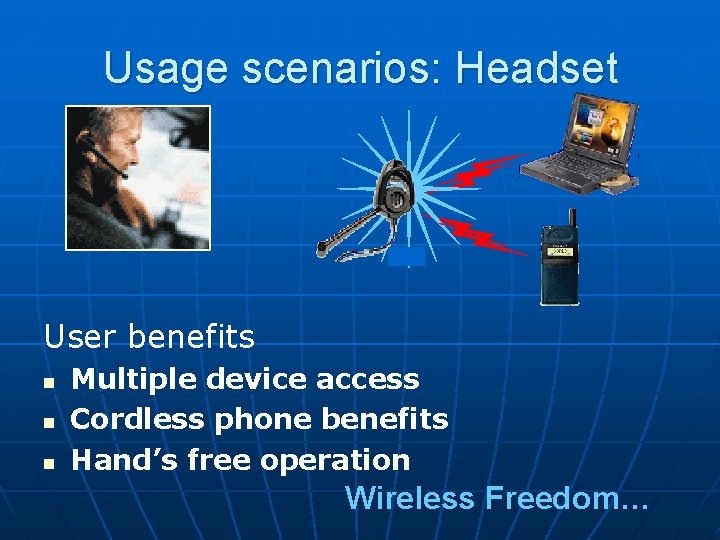
Usage scenarios: Headset User benefits n n n Multiple device access Cordless phone benefits Hand’s free operation Wireless Freedom…
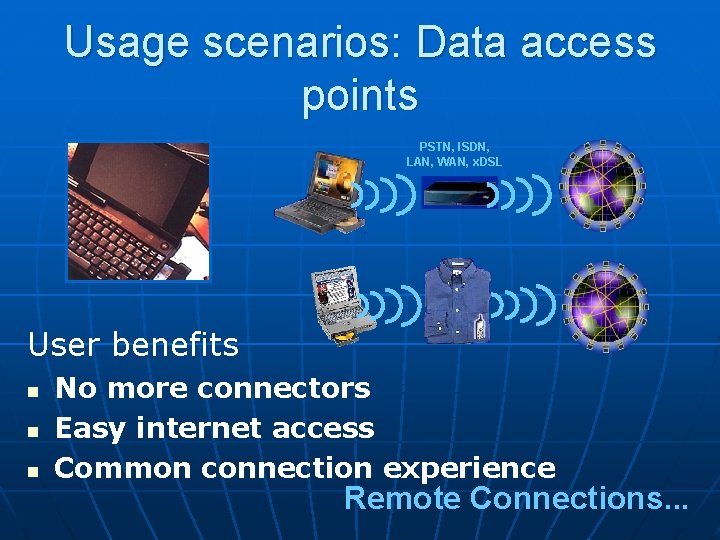
Usage scenarios: Data access points PSTN, ISDN, LAN, WAN, x. DSL User benefits n n n No more connectors Easy internet access Common connection experience Remote Connections. . .
Bluetooth Specifications
Technical Overview
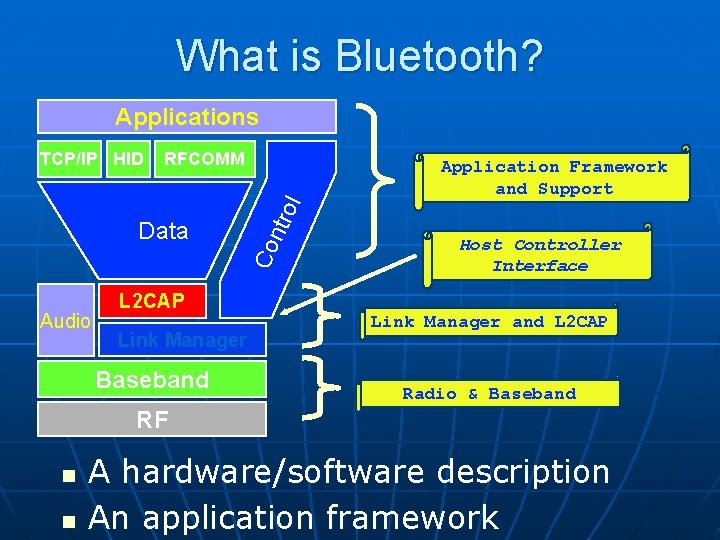
What is Bluetooth? Applications RFCOMM Audio ol ntr Data Application Framework and Support Co TCP/IP HID L 2 CAP Link Manager Baseband Host Controller Interface Link Manager and L 2 CAP Radio & Baseband RF n n A hardware/software description An application framework
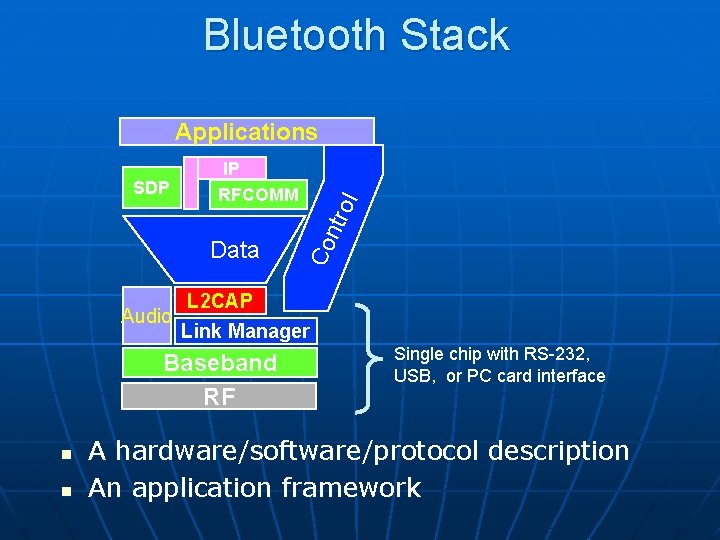
Bluetooth Stack Applications Audio n ol L 2 CAP Link Manager Baseband RF n ntr Data Co SDP IP RFCOMM Single chip with RS-232, USB, or PC card interface A hardware/software/protocol description An application framework
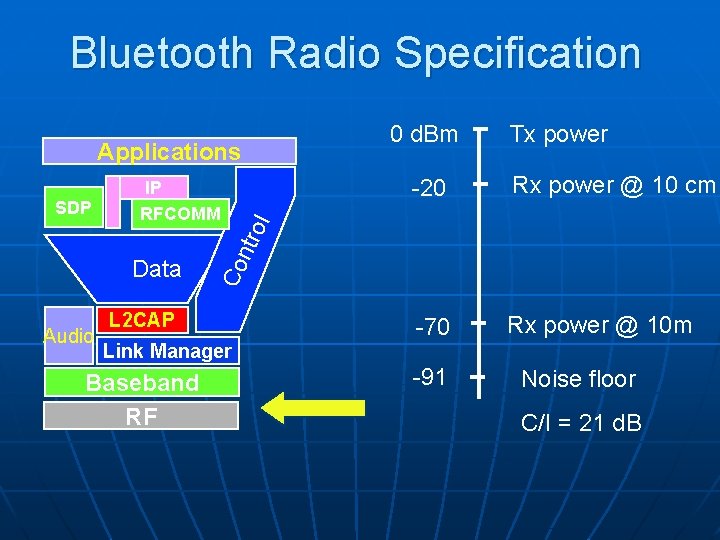
Bluetooth Radio Specification Data Audio -20 Rx power @ 10 cm -70 Rx power @ 10 m Co nt SDP IP RFCOMM Tx power rol Applications 0 d. Bm L 2 CAP Link Manager Baseband RF -91 Noise floor C/I = 21 d. B
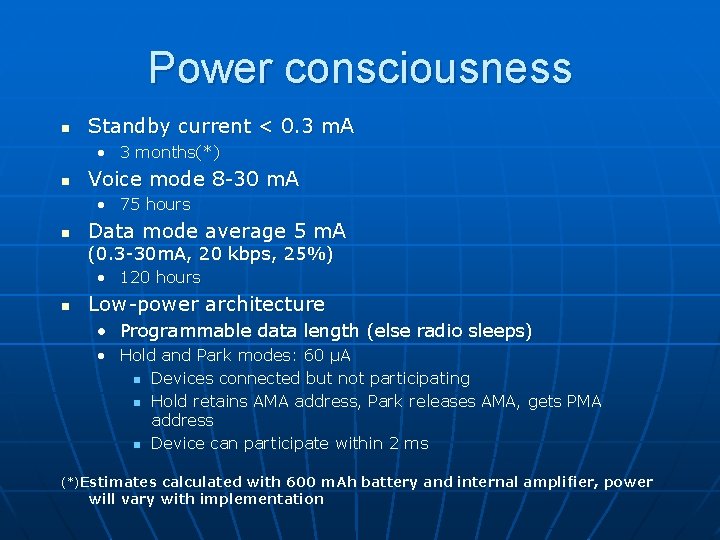
Power consciousness n Standby current < 0. 3 m. A • 3 months(*) n Voice mode 8 -30 m. A • 75 hours n Data mode average 5 m. A (0. 3 -30 m. A, 20 kbps, 25%) • 120 hours n Low-power architecture • Programmable data length (else radio sleeps) • Hold and Park modes: 60 µA n Devices connected but not participating n Hold retains AMA address, Park releases AMA, gets PMA address n Device can participate within 2 ms (*)Estimates calculated with 600 m. Ah battery and internal amplifier, power will vary with implementation
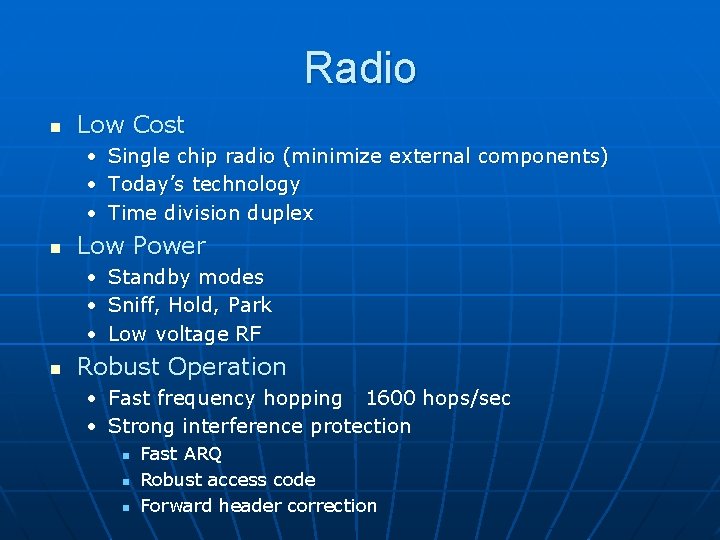
Radio n Low Cost • • • n Low Power • • • n Single chip radio (minimize external components) Today’s technology Time division duplex Standby modes Sniff, Hold, Park Low voltage RF Robust Operation • Fast frequency hopping 1600 hops/sec • Strong interference protection n Fast ARQ Robust access code Forward header correction
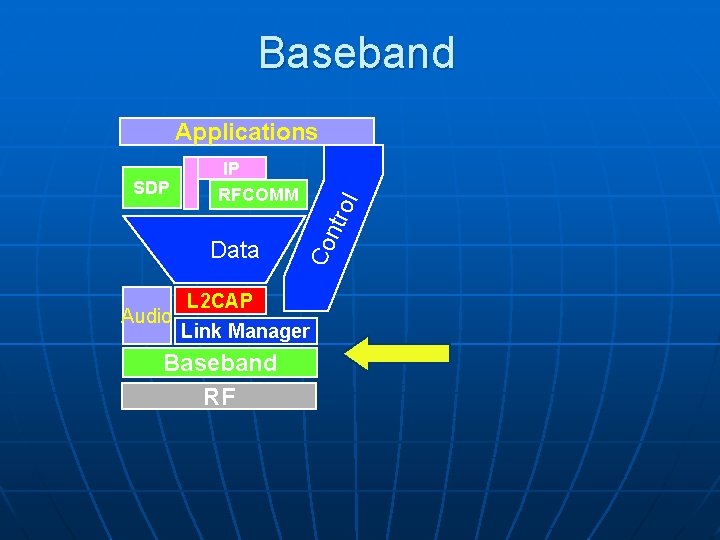
Baseband Applications Audio ol ntr Data Co SDP IP RFCOMM L 2 CAP Link Manager Baseband RF
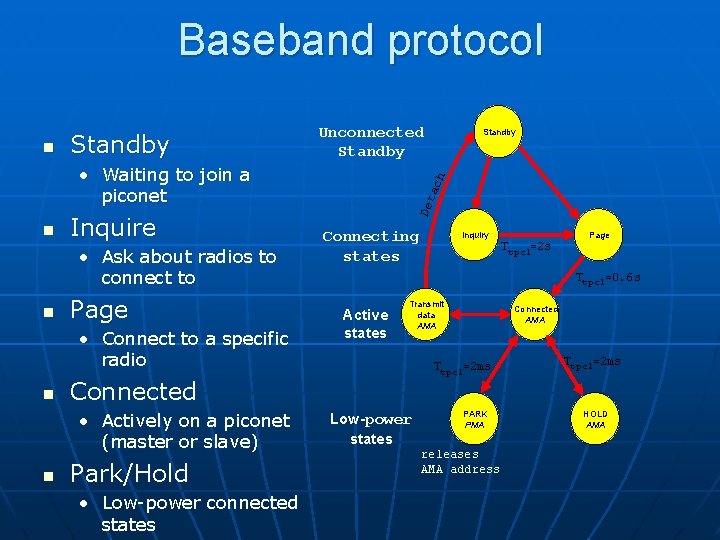
Baseband protocol n Standby Unconnected Standby n • Ask about radios to connect to n Page • Connect to a specific radio n Connecting states Park/Hold • Low-power connected states Inquiry Page Ttpcl=2 s Ttpcl=0. 6 s Active states Transmit data AMA Connected AMA Ttpcl=2 ms Connected • Actively on a piconet (master or slave) n Det Inquire ach • Waiting to join a piconet Standby Low-power states PARK PMA releases AMA address Ttpcl=2 ms HOLD AMA
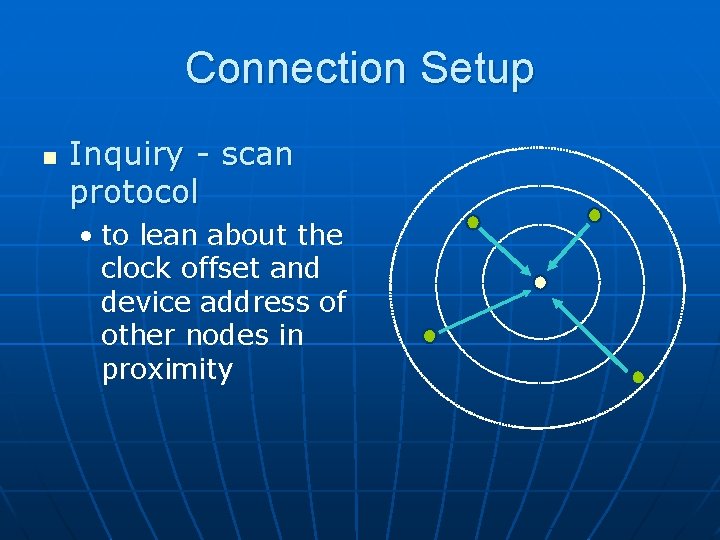
Connection Setup n Inquiry - scan protocol • to lean about the clock offset and device address of other nodes in proximity
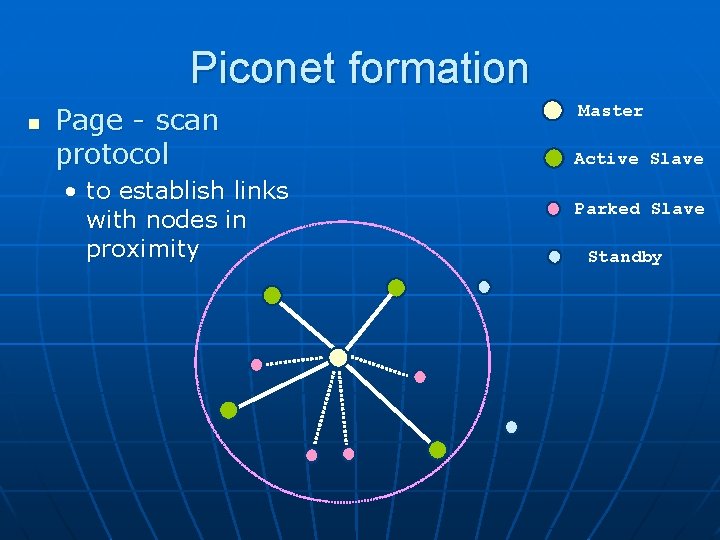
Piconet formation n Page - scan protocol • to establish links with nodes in proximity Master Active Slave Parked Slave Standby
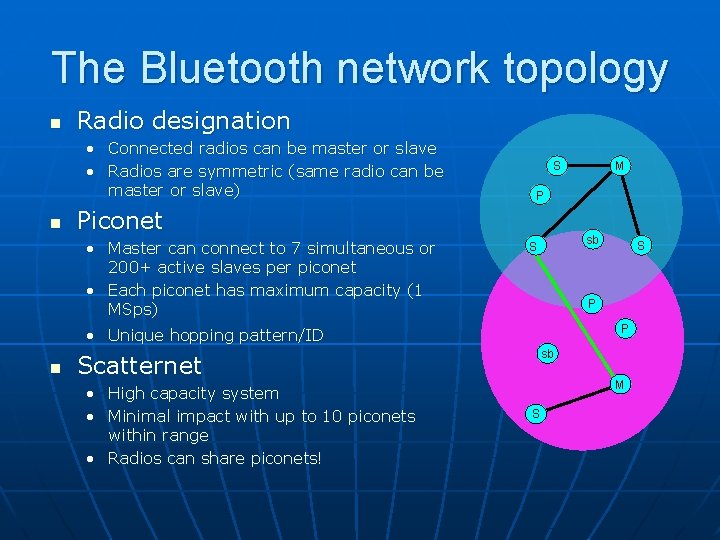
The Bluetooth network topology n Radio designation • Connected radios can be master or slave • Radios are symmetric (same radio can be master or slave) n S P Piconet • Master can connect to 7 simultaneous or 200+ active slaves per piconet • Each piconet has maximum capacity (1 MSps) sb S P sb Scatternet • High capacity system • Minimal impact with up to 10 piconets within range • Radios can share piconets! S P • Unique hopping pattern/ID n M M S
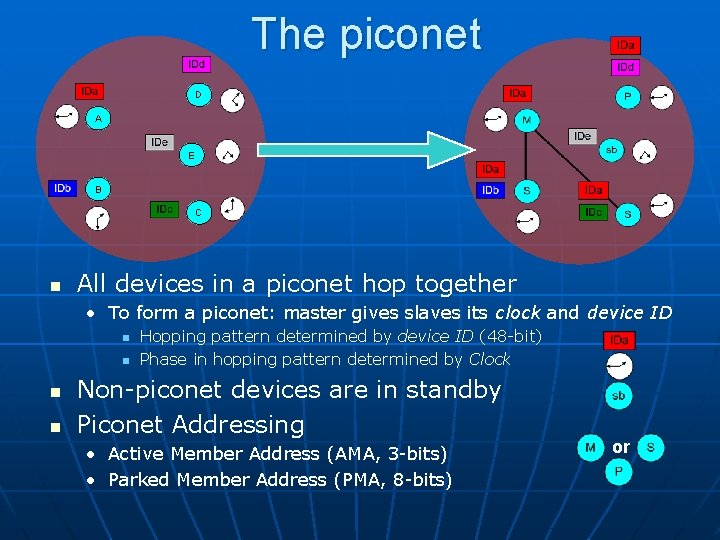
The piconet D A E B C n All devices in a piconet hop together • To form a piconet: master gives slaves its clock and device ID n n Hopping pattern determined by device ID (48 -bit) Phase in hopping pattern determined by Clock Non-piconet devices are in standby Piconet Addressing • Active Member Address (AMA, 3 -bits) • Parked Member Address (PMA, 8 -bits) or
Piconet n n One unit acts as the master of the Piconet, whereas the others acts as slaves. Up to seven slaves can be active. More slaves can be synchronized & locked to the master in parked state. The channel access for all the slaves in a piconet is controlled by the master.
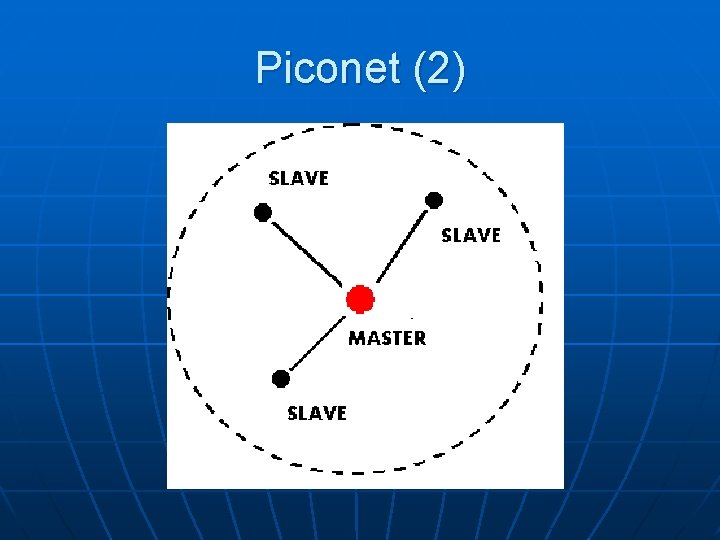
Piconet (2)
Scatternet n n n Scatternet is formed by multiple Piconets with overlapping coverage areas. Each Piconet can only have a single master Slaves can participate in different Piconets on a time-division multiplex basis. A master in one Piconet can be a slave in another Piconet. Each Piconet has its own hopping channel in a Scatternet.
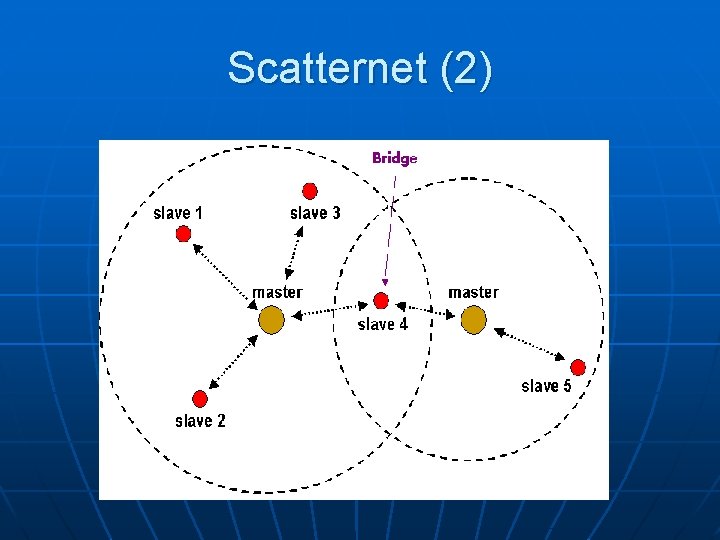
Scatternet (2)
Addressing n n n Bluetooth device address (BD_ADDR) • 48 bit IEEE MAC address Active Member address (AM_ADDR) • 3 bits active slave address • all zero broadcast address Parked Member address (PM_ADDR) • 8 bit parked slave address
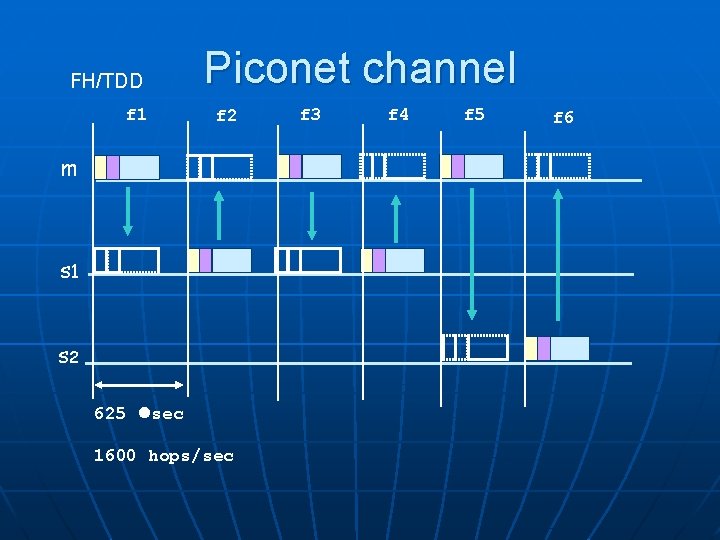
FH/TDD f 1 Piconet channel f 2 m s 1 s 2 625 sec 1600 hops/sec f 3 f 4 f 5 f 6
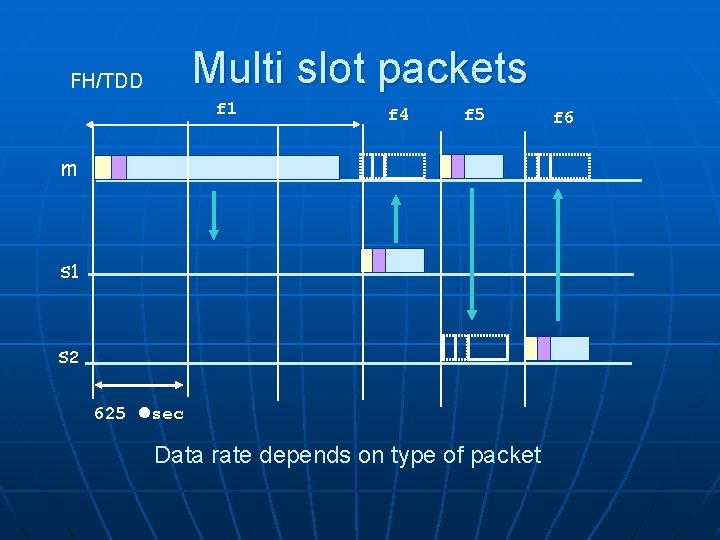
Multi slot packets FH/TDD f 1 f 4 f 5 m s 1 s 2 625 sec Data rate depends on type of packet f 6
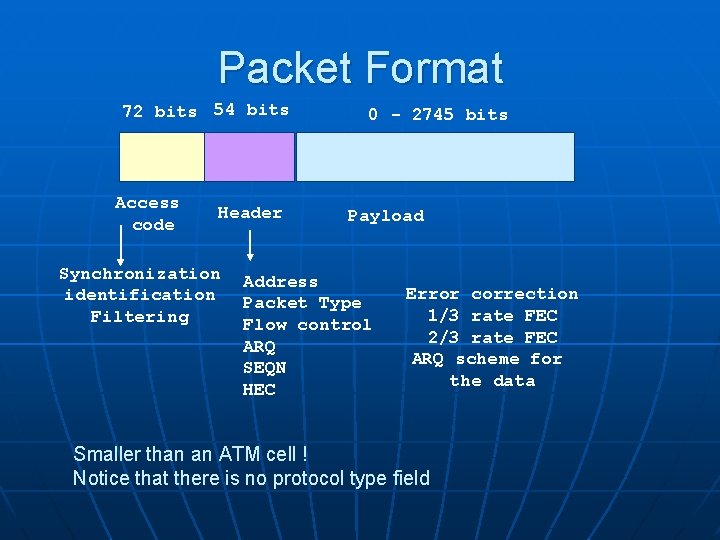
Packet Format 72 bits 54 bits Access code Header Synchronization identification Filtering 0 - 2745 bits Payload Address Packet Type Flow control ARQ SEQN HEC Error correction 1/3 rate FEC 2/3 rate FEC ARQ scheme for the data Smaller than an ATM cell ! Notice that there is no protocol type field
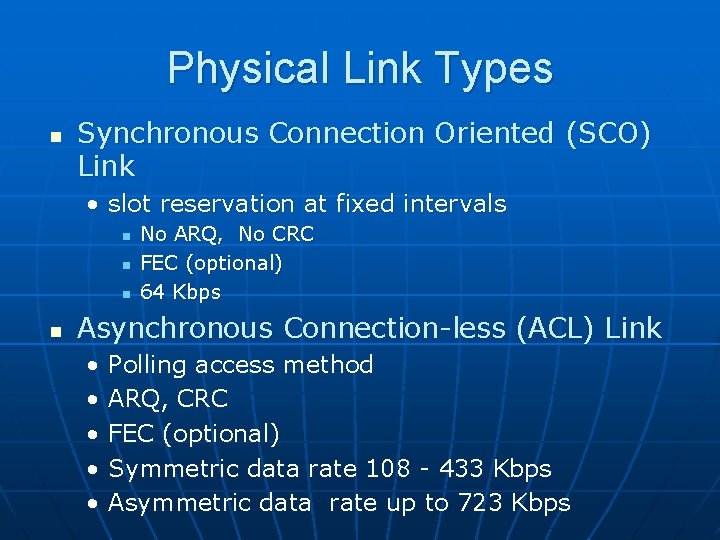
Physical Link Types n Synchronous Connection Oriented (SCO) Link • slot reservation at fixed intervals n n No ARQ, No CRC FEC (optional) 64 Kbps Asynchronous Connection-less (ACL) Link • • • Polling access method ARQ, CRC FEC (optional) Symmetric data rate 108 - 433 Kbps Asymmetric data rate up to 723 Kbps
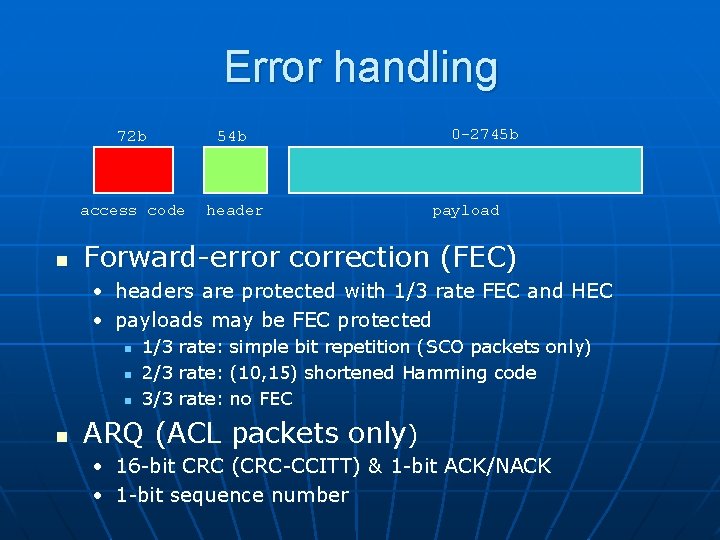
Error handling n 72 b 54 b access code header 0 -2745 b payload Forward-error correction (FEC) • headers are protected with 1/3 rate FEC and HEC • payloads may be FEC protected n n 1/3 rate: simple bit repetition (SCO packets only) 2/3 rate: (10, 15) shortened Hamming code 3/3 rate: no FEC ARQ (ACL packets only) • 16 -bit CRC (CRC-CCITT) & 1 -bit ACK/NACK • 1 -bit sequence number
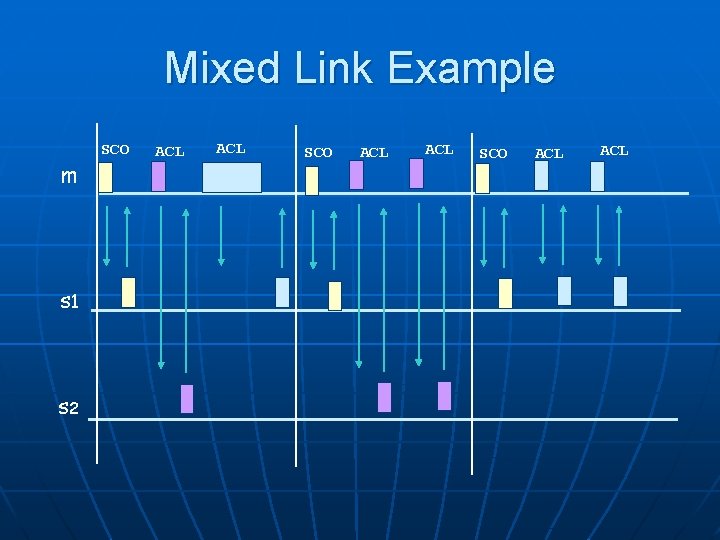
Mixed Link Example m s 1 s 2 SCO ACL ACL SCO ACL
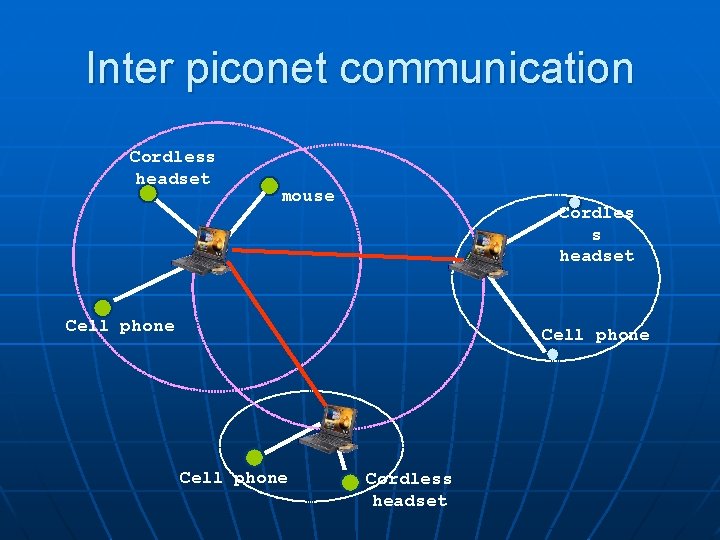
Inter piconet communication Cordless headset mouse Cordles s headset Cell phone Cordless headset
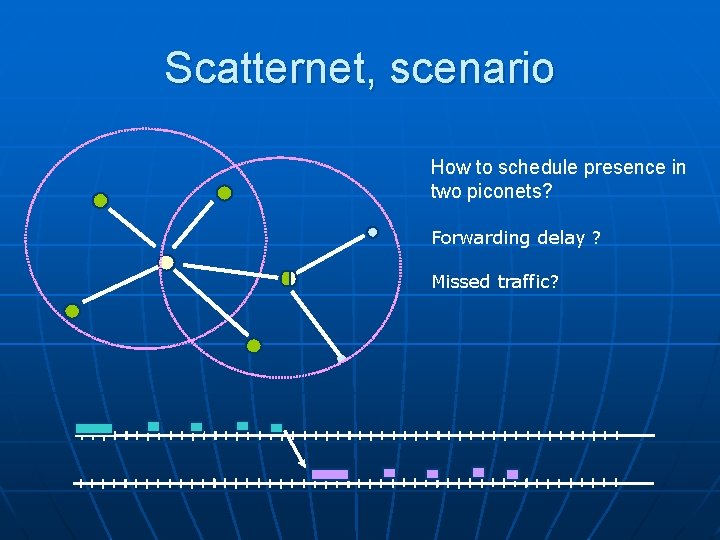
Scatternet, scenario How to schedule presence in two piconets? Forwarding delay ? Missed traffic?
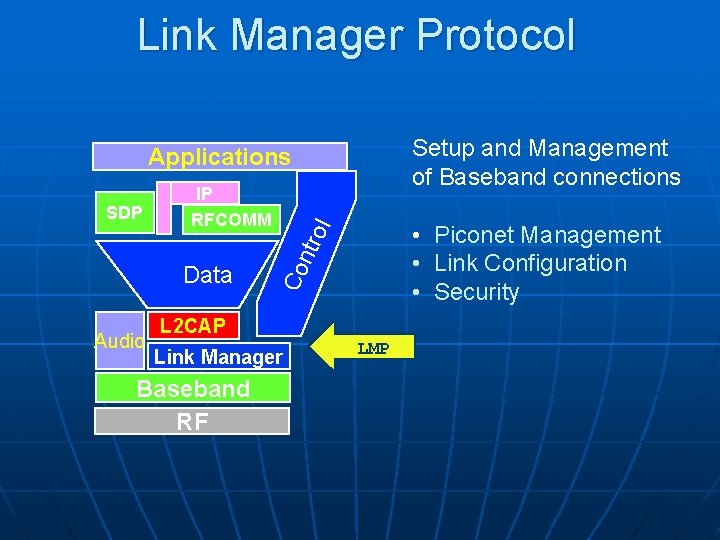
Link Manager Protocol Setup and Management of Baseband connections Applications Data Audio rol • Piconet Management • Link Configuration • Security Co nt SDP IP RFCOMM L 2 CAP Link Manager Baseband RF LMP
Link Manager Protocol n n n Piconet Management • Attach and detach slaves • Master-slave switch • Establishing SCO and ACL links • Handling of low power modes ( Sniff, Hold, Park) Link Configuration • packet type negotiation • power control Security functions • Authentication • Encryption
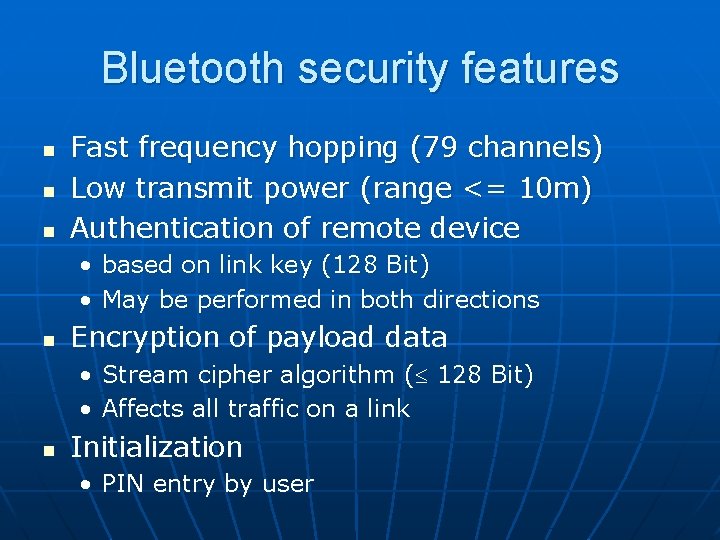
Bluetooth security features n n n Fast frequency hopping (79 channels) Low transmit power (range <= 10 m) Authentication of remote device • based on link key (128 Bit) • May be performed in both directions n Encryption of payload data • Stream cipher algorithm ( 128 Bit) • Affects all traffic on a link n Initialization • PIN entry by user
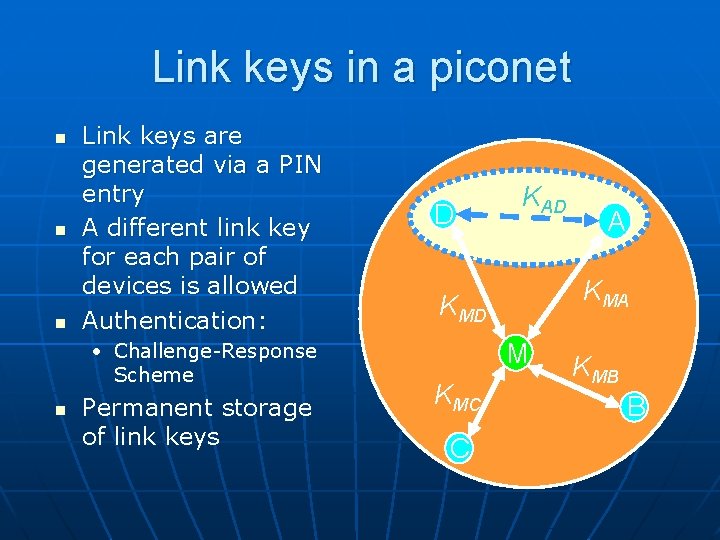
Link keys in a piconet n n n Link keys are generated via a PIN entry A different link key for each pair of devices is allowed Authentication: • Challenge-Response Scheme n Permanent storage of link keys D KAD KMA KMD M KMC C A KMB B
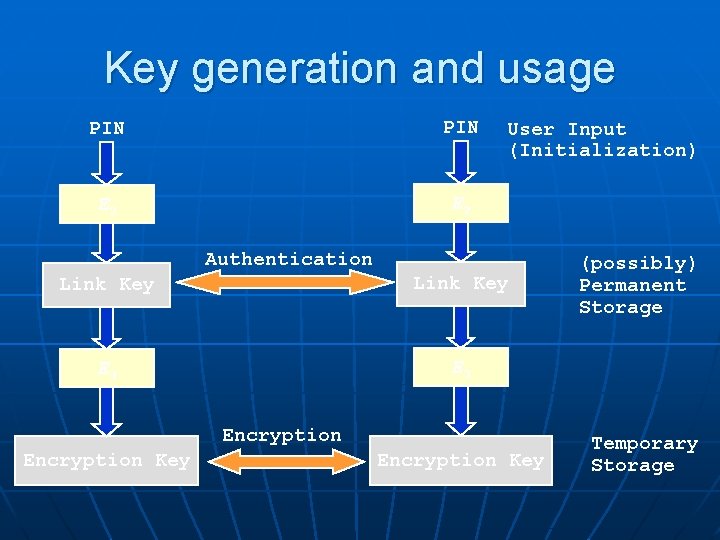
Key generation and usage PIN E 2 User Input (Initialization) Authentication Link Key E 3 Encryption Key (possibly) Permanent Storage Temporary Storage
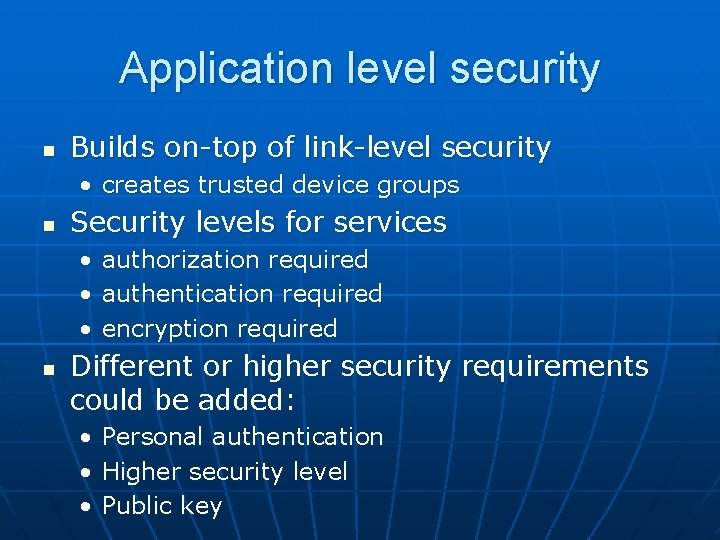
Application level security n Builds on-top of link-level security • creates trusted device groups n Security levels for services • • • n authorization required authentication required encryption required Different or higher security requirements could be added: • • • Personal authentication Higher security level Public key
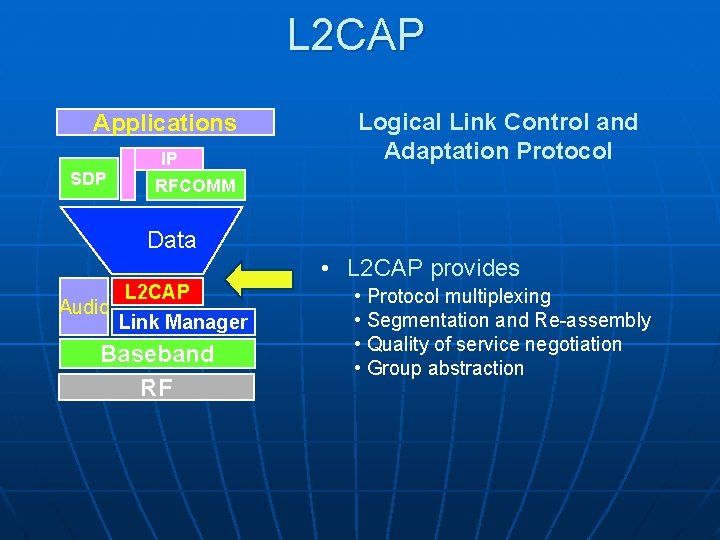
L 2 CAP Applications SDP IP RFCOMM Logical Link Control and Adaptation Protocol Data Audio L 2 CAP Link Manager Baseband RF • L 2 CAP provides • Protocol multiplexing • Segmentation and Re-assembly • Quality of service negotiation • Group abstraction
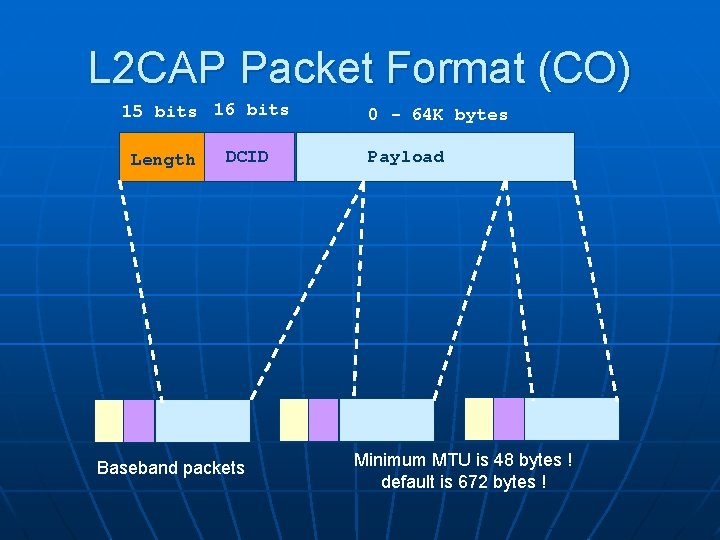
L 2 CAP Packet Format (CO) 15 bits 16 bits Length DCID Baseband packets 0 - 64 K bytes Payload Minimum MTU is 48 bytes ! default is 672 bytes !
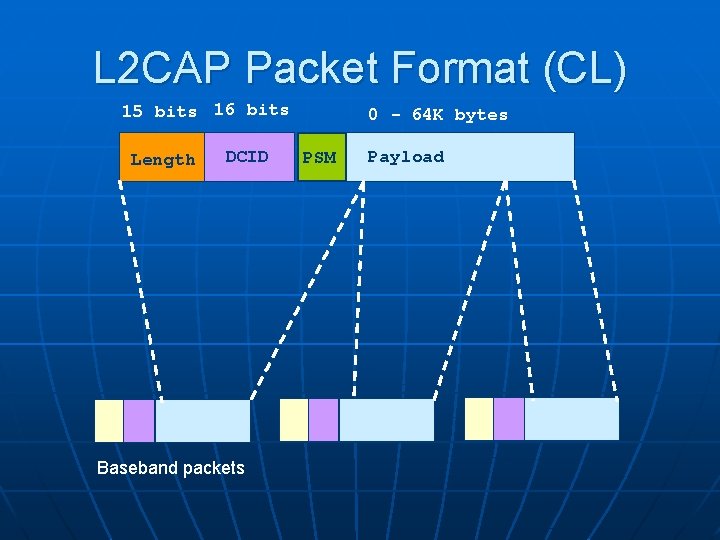
L 2 CAP Packet Format (CL) 15 bits 16 bits Length DCID Baseband packets 0 - 64 K bytes PSM Payload
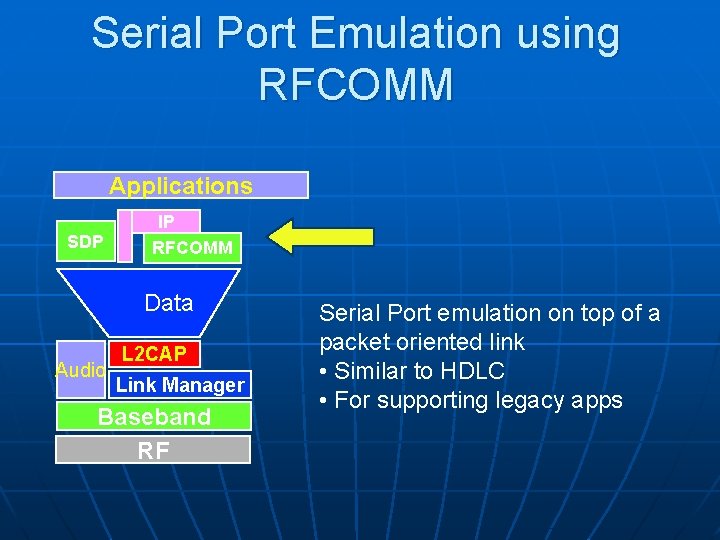
Serial Port Emulation using RFCOMM Applications SDP IP RFCOMM Data Audio L 2 CAP Link Manager Baseband RF Serial Port emulation on top of a packet oriented link • Similar to HDLC • For supporting legacy apps
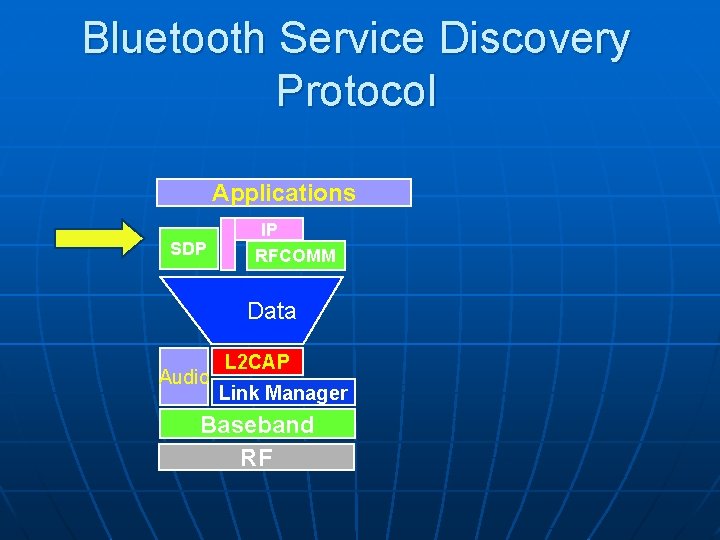
Bluetooth Service Discovery Protocol Applications SDP IP RFCOMM Data Audio L 2 CAP Link Manager Baseband RF
Usage of SDP n n Establish L 2 CAP connection to remote device Query for services • search for specific class of service, or • browse for services n n Retrieve attributes that detail how to connect to the service Establish a separate (non-SDP) connection to user the service
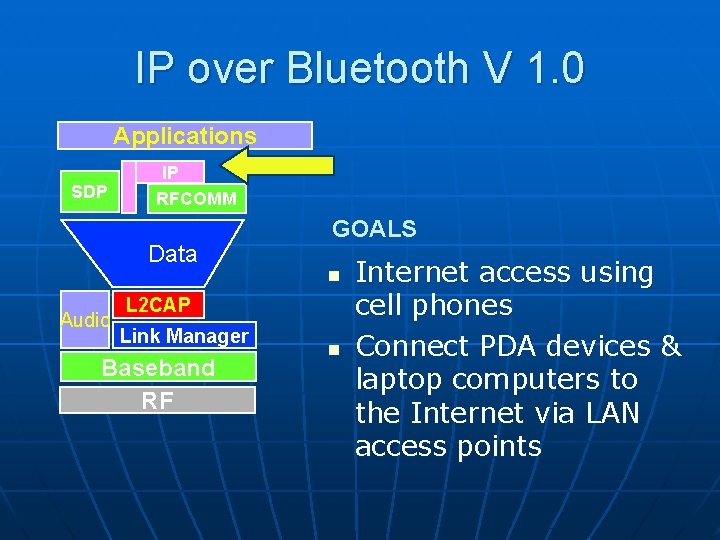
IP over Bluetooth V 1. 0 Applications SDP IP RFCOMM Data Audio GOALS n L 2 CAP Link Manager Baseband RF n Internet access using cell phones Connect PDA devices & laptop computers to the Internet via LAN access points
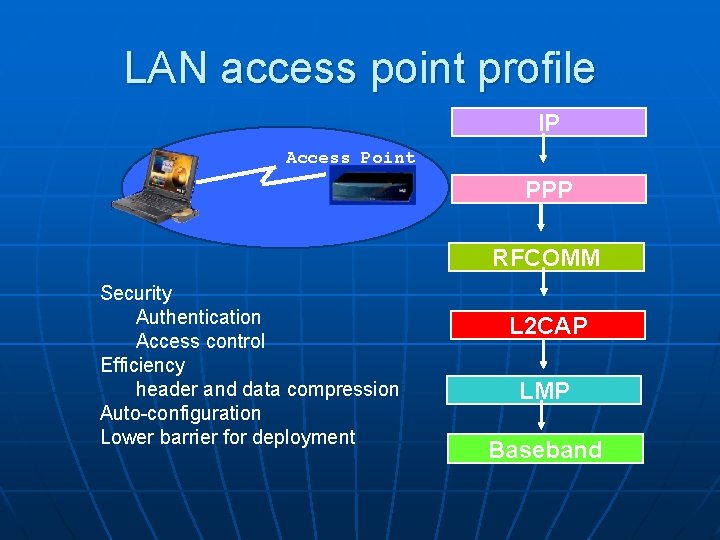
LAN access point profile IP Access Point PPP RFCOMM Security Authentication Access control Efficiency header and data compression Auto-configuration Lower barrier for deployment L 2 CAP LMP Baseband
Software architecture goals n n n Support the target usage scenarios Support a variety of hardware platforms Good out of box user experience • Enable legacy applications • Utilize existing protocols where possible
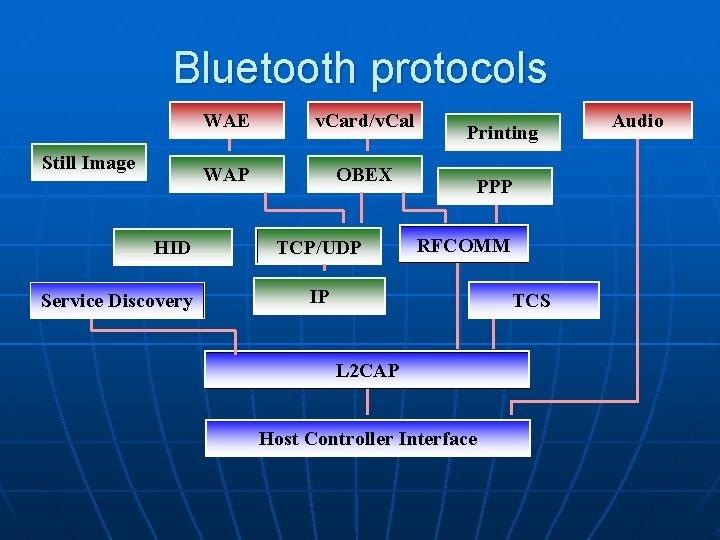
Bluetooth protocols Still Image HID Service Discovery WAE v. Card/v. Cal WAP OBEX TCP/UDP Printing PPP RFCOMM IP TCS L 2 CAP Host Controller Interface Audio
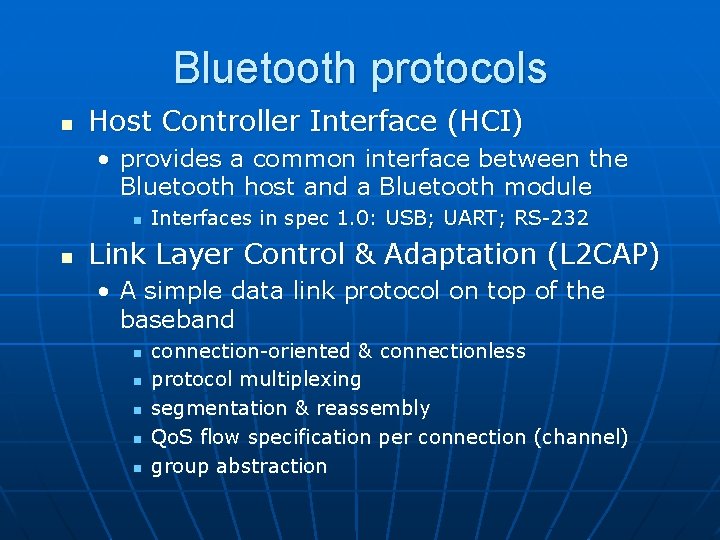
Bluetooth protocols n Host Controller Interface (HCI) • provides a common interface between the Bluetooth host and a Bluetooth module n n Interfaces in spec 1. 0: USB; UART; RS-232 Link Layer Control & Adaptation (L 2 CAP) • A simple data link protocol on top of the baseband n n n connection-oriented & connectionless protocol multiplexing segmentation & reassembly Qo. S flow specification per connection (channel) group abstraction
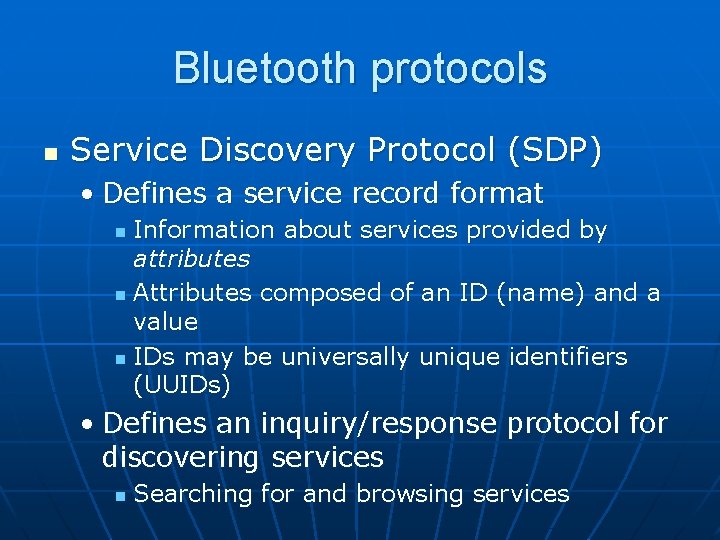
Bluetooth protocols n Service Discovery Protocol (SDP) • Defines a service record format Information about services provided by attributes n Attributes composed of an ID (name) and a value n IDs may be universally unique identifiers (UUIDs) n • Defines an inquiry/response protocol for discovering services n Searching for and browsing services
Bluetooth protocols n RFCOMM (based on GSM TS 07. 10) • emulates a serial-port to support a large base of legacy (serial-port-based) applications • allows multiple “ports” over a single physical channel between two devices n Telephony Control Protocol Spec (TCS) • call control (setup & release) • group management for gateway serving multiple devices n Legacy protocol reuse • resuse existing protocols, e. g. , Ir. DA’s OBEX, or WAP for interacting with applications on phones
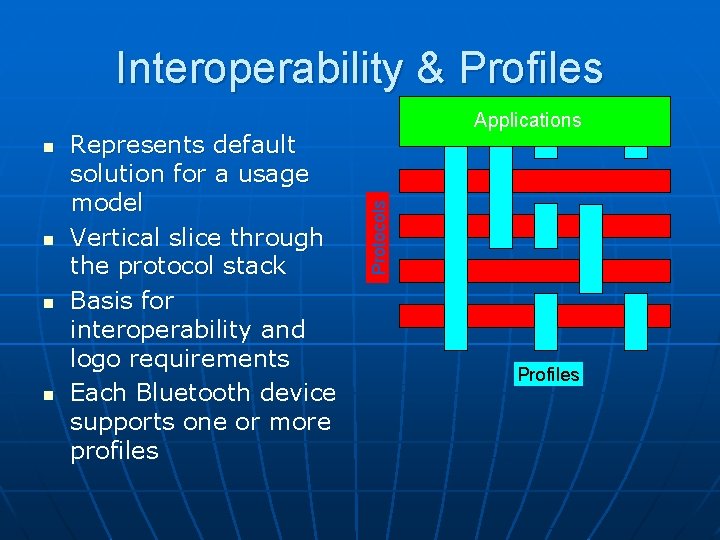
Interoperability & Profiles n n n Represents default solution for a usage model Vertical slice through the protocol stack Basis for interoperability and logo requirements Each Bluetooth device supports one or more profiles Protocols n Applications Profiles
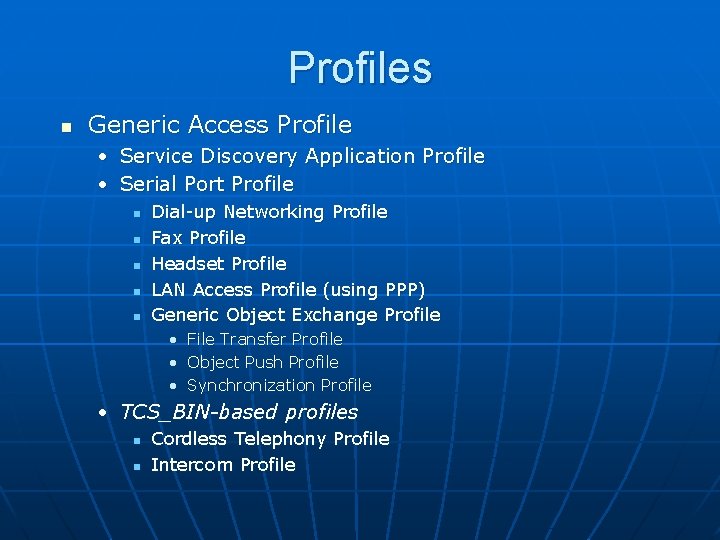
Profiles n Generic Access Profile • Service Discovery Application Profile • Serial Port Profile n n n Dial-up Networking Profile Fax Profile Headset Profile LAN Access Profile (using PPP) Generic Object Exchange Profile • • • File Transfer Profile Object Push Profile Synchronization Profile • TCS_BIN-based profiles n n Cordless Telephony Profile Intercom Profile
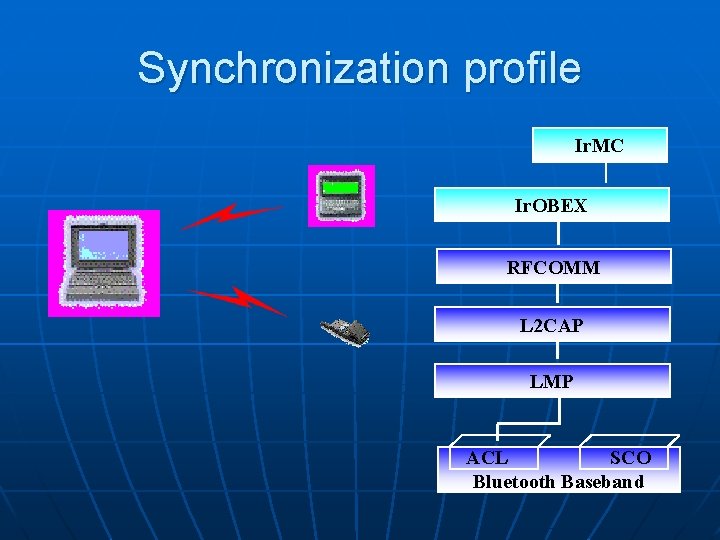
Synchronization profile Ir. MC Ir. OBEX RFCOMM L 2 CAP LMP ACL SCO Bluetooth Baseband
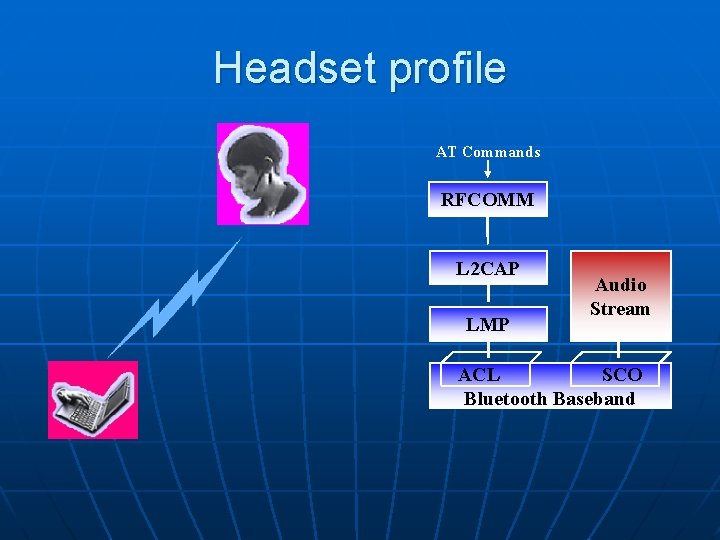
Headset profile AT Commands RFCOMM L 2 CAP LMP Audio Stream ACL SCO Bluetooth Baseband
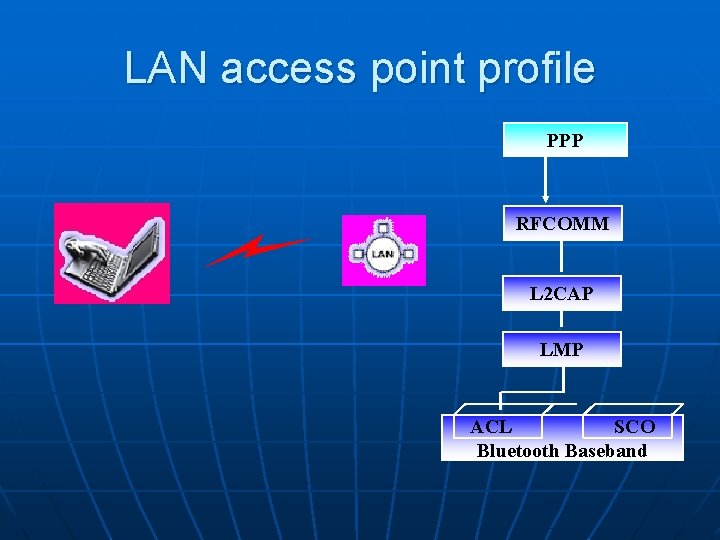
LAN access point profile PPP RFCOMM L 2 CAP LMP ACL SCO Bluetooth Baseband
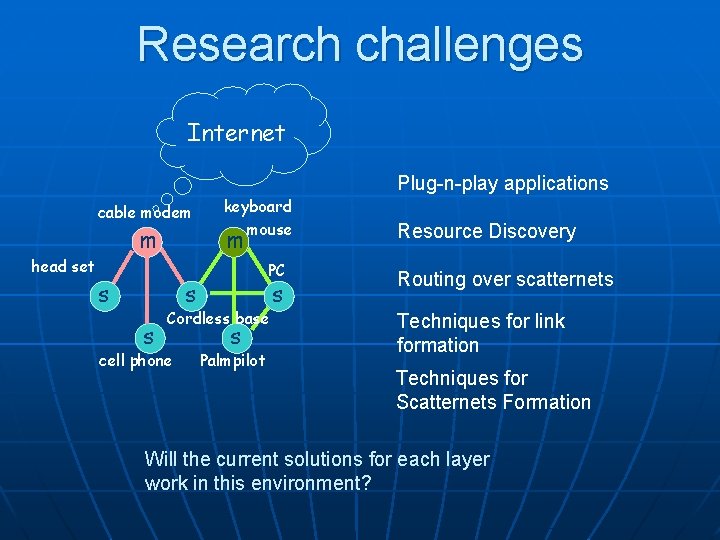
Research challenges Internet cable modem head set m s keyboard mouse sm PC s s Cordless base cell phone s Palmpilot sm Plug-n-play applications Resource Discovery Routing over scatternets Techniques for link formation Techniques for Scatternets Formation Will the current solutions for each layer work in this environment?
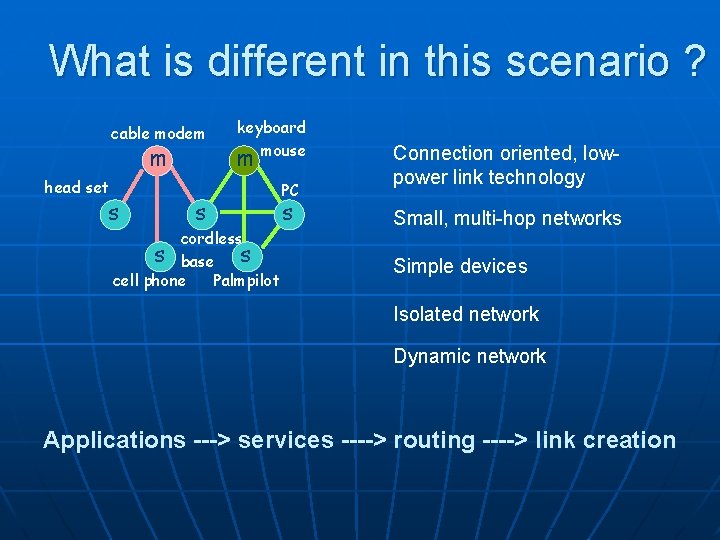
What is different in this scenario ? cable modem m head set s s keyboard mouse sm cordless s base s cell phone Palmpilot PC sm Connection oriented, lowpower link technology Small, multi-hop networks Simple devices Isolated network Dynamic network Applications ---> services ----> routing ----> link creation
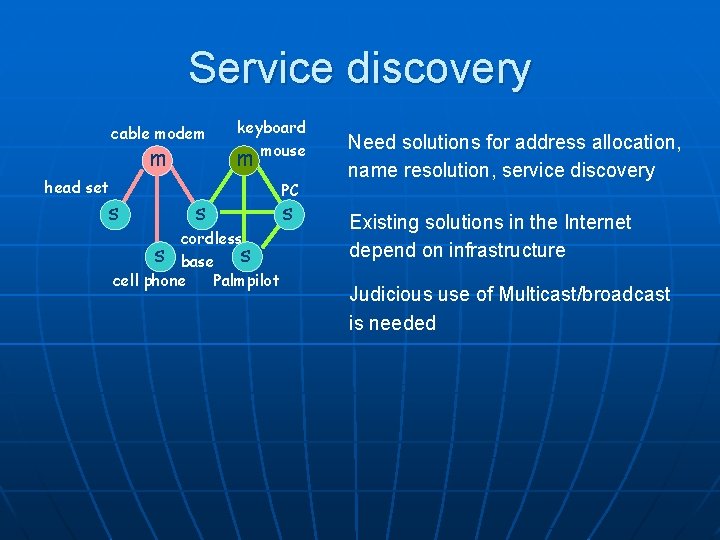
Service discovery cable modem m head set s s keyboard mouse sm cordless s base s cell phone Palmpilot PC sm Need solutions for address allocation, name resolution, service discovery Existing solutions in the Internet depend on infrastructure Judicious use of Multicast/broadcast is needed
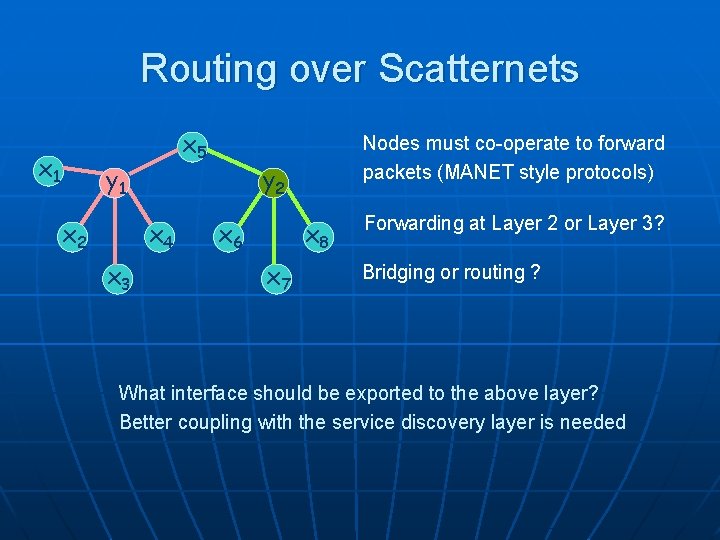
Routing over Scatternets x 1 x 5 y 1 x 2 x 4 x 3 Nodes must co-operate to forward packets (MANET style protocols) y 2 x 6 x 8 x 7 Forwarding at Layer 2 or Layer 3? Bridging or routing ? What interface should be exported to the above layer? Better coupling with the service discovery layer is needed
Summary n Bluetooth is a global, RF-based (ISM band: 2. 4 GHz), short-range, connectivity technology & solution for portable, personal devices • it is not just a radio • create piconets on-the-fly (appr. 1 Mbps) n n piconets may overlap in time and space for high aggregate bandwidth The Bluetooth spec comprises • a HW & SW protocol specification • usage case scenario profiles and interoperability requirements n n 1999 Discover Magazine Awards finalist To learn more: http: //www. bluetooth. com
- Slides: 69