Keep your eye on the donut not on


- Slides: 55
Keep your eye on the donut, not on the hole
Introduction to Community Health The Science of Nursing in the Community N 5290 Jill Gallin, CPNP Assistant Professor of Clinical Nursing Columbia University School of Nursing
Student Experience?
Brief History of Community Health Mc. Kenzie et al, An Introduction to Community Health (2002)
500 B. C. -A. D. 500 • Greeks – Exercise in physical games of strength • Romans – Aqueducts – Sewer system – Refuse removal – hospital
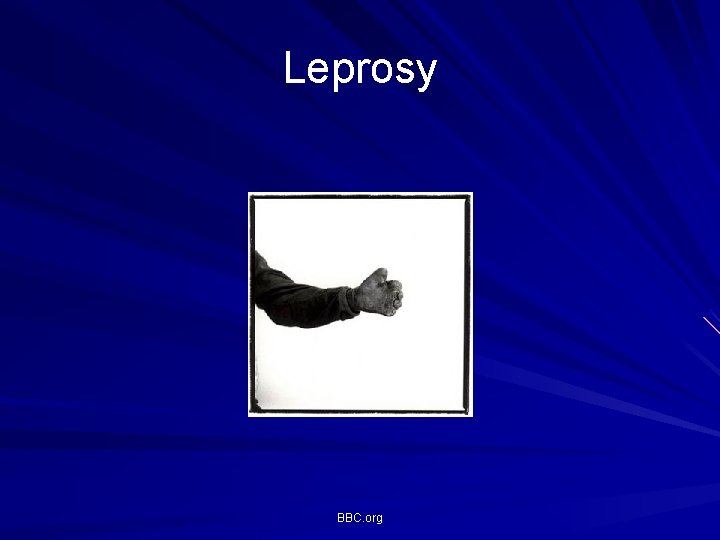
A. D. 500 - 1500 Spiritual era of public health • Belief of disease from supernatural causes • Spread of communicable diseases – Leprosy – Plague (half the population of London, France 1 in 10 survived)
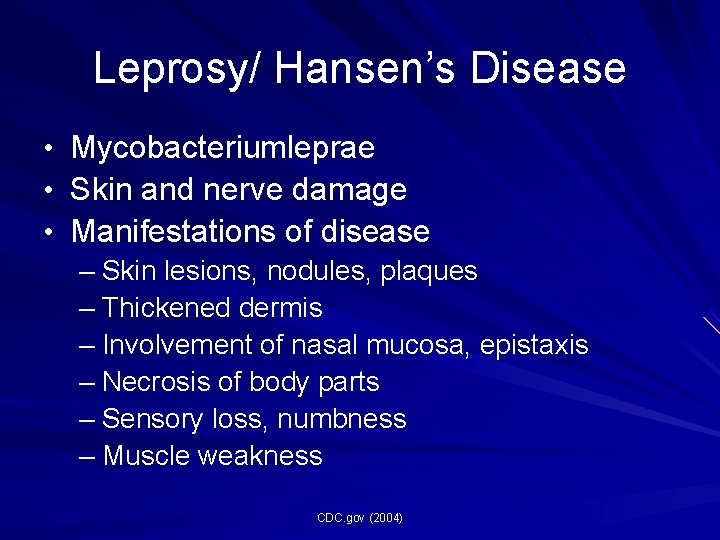
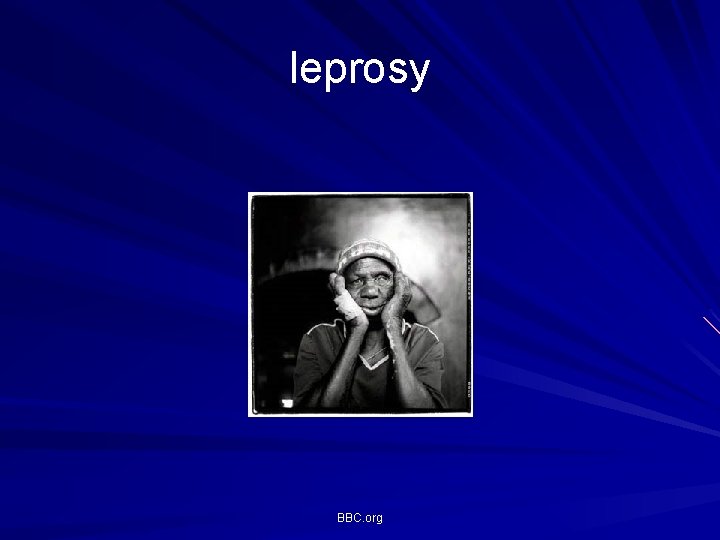
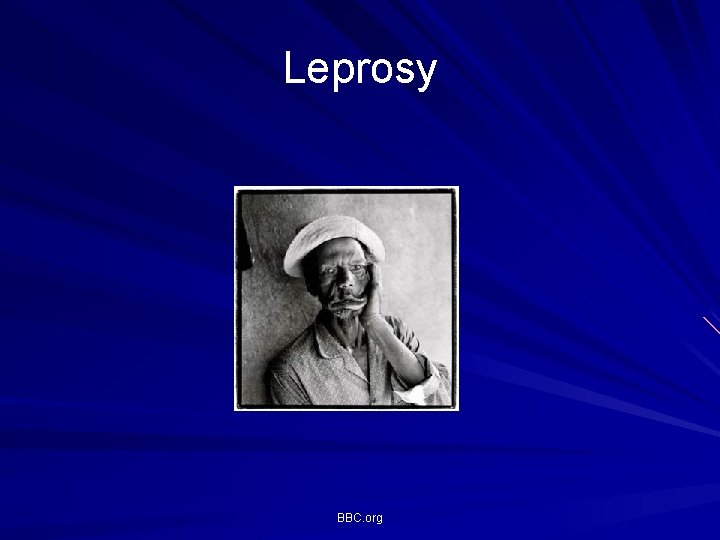
Leprosy/ Hansen’s Disease • • • Mycobacteriumleprae Skin and nerve damage Manifestations of disease – Skin lesions, nodules, plaques – Thickened dermis – Involvement of nasal mucosa, epistaxis – Necrosis of body parts – Sensory loss, numbness – Muscle weakness CDC. gov (2004)
leprosy BBC. org
Leprosy BBC. org
Leprosy BBC. org
Bubonic Plague • Usually result of a bite from an infected rodent flea, or by handling infected animals • Does NOT usually spread person to person • Symptoms – high fever – enlarged, tender lymph nodes, often in the groin • Incubation period: 2 -10 days • Treatment: antibiotics CDC. gov (2004)
Pneumonic Plague • Result of sufficient dose of bacterial organisms is inhaled; a small percentage of bubonic cases develop pneumonic plague • Can be spread person to person • Incubation period: 2 -3 days • Bacillus viable one hour after attack CDC. gov (2004)
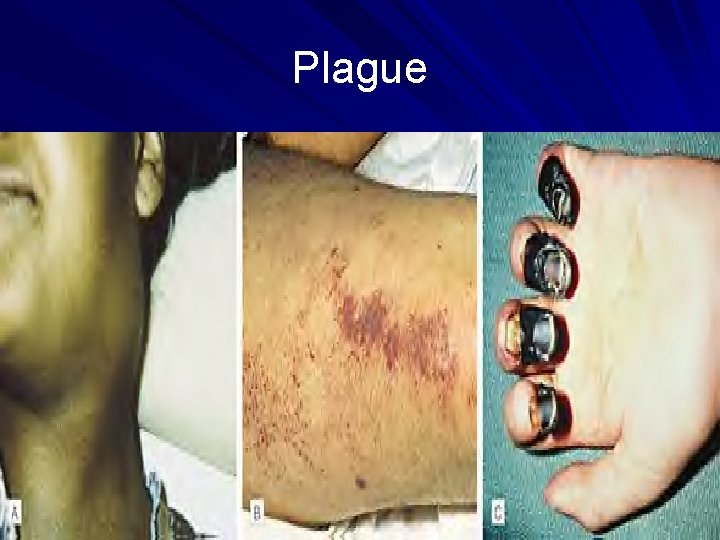
Plague • Signs and Symptoms – Acute fulminate pneumonia with high fever – dyspnea – cough w/ blood tinged or purulent sputum – cutaneous manifestations: livid cyanosis ecchymosis necrosis of digits and nose CDC. gov(2004)
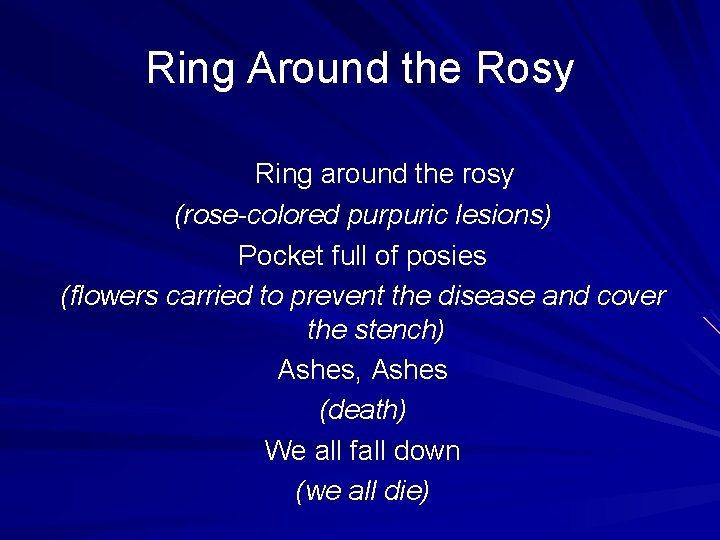
Ring Around the Rosy Ring around the rosy (rose-colored purpuric lesions) Pocket full of posies (flowers carried to prevent the disease and cover the stench) Ashes, Ashes (death) We all fall down (we all die)
Plague
A. D. 1500 -1700 Renaissance and Exploration • Plague killed saints and sinners alike • Environment played a role in disease
Eighteenth Century • Overcrowded cities • Poor water supply • Poor sanitation • Unsafe workplace
Eighteenth Century communicable disease • Small pox • Cholera • Typhoid fever • Yellow fever • Average of death: 29
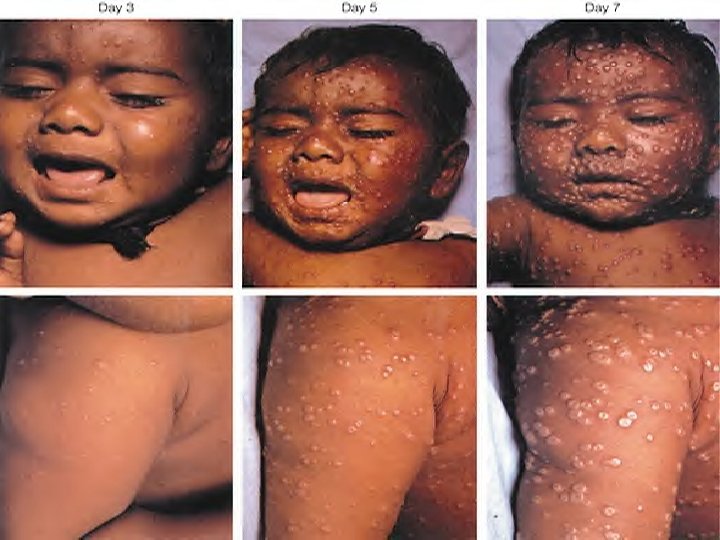
Smallpox • Orthopoxvirus family, (variola major) • Can spread from person to person, aerosolized • Signs and symptoms – flu-like beginning with high fever – maculopapular rash usually starts on face and hands – – – then forearms and trunk and legs become vesicular and pustular (embedded in dermis) all lesions occur at same level of development leave pitted scar after separation from skin
Cholera • Infection of small intestine by Vibrio cholerae, ingesting contaminated food and water • watery diarrhea • Severe dehydration – Review symptoms
Typhoid • Infection by salmonella typhi in • • • contaminated food, water Diarrhea Systemic disease, high fever, weakness, fatigue, delirium Rash “rose spots” abdomen and chest
Yellow Fever • Virus transmitted by mosquitoes • Fever, jaundice, generally ill • 15% progress to intoxication period – Kidney failure, hemorrhage, brain dysfunction, seizures, coma, death
Eighteenth Century Advances • 1790 George Washington ordered the first US • • • census (done every ten years since) 1796 Edward Jenner demonstrated vaccine against small pox by injecting a boy with cowpox. 1798 Marine health center (will become US Public Health Service) 1799 Municipal boards of health in major cities
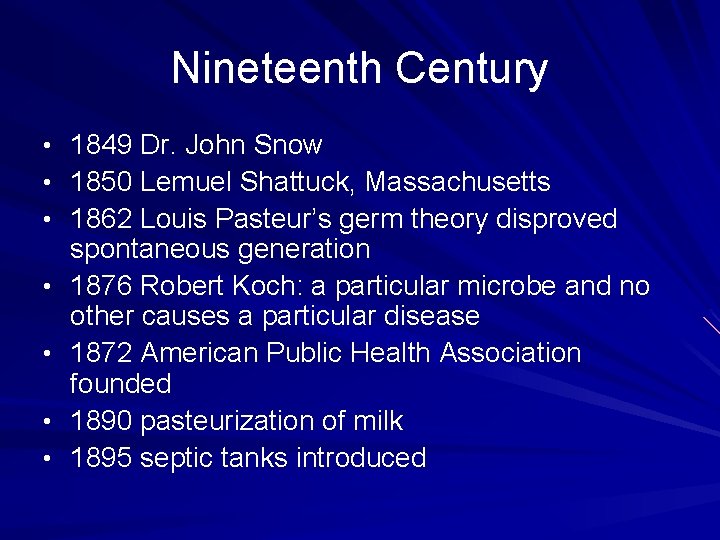
Nineteenth Century • • 1849 Dr. John Snow 1850 Lemuel Shattuck, Massachusetts 1862 Louis Pasteur’s germ theory disproved spontaneous generation 1876 Robert Koch: a particular microbe and no other causes a particular disease 1872 American Public Health Association founded 1890 pasteurization of milk 1895 septic tanks introduced
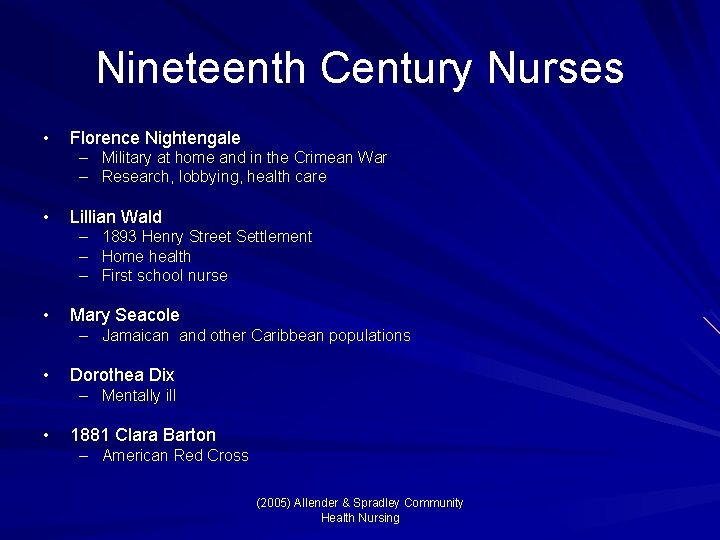
Nineteenth Century Nurses • Florence Nightengale – Military at home and in the Crimean War – Research, lobbying, health care • Lillian Wald – 1893 Henry Street Settlement – Home health – First school nurse • Mary Seacole – Jamaican and other Caribbean populations • Dorothea Dix – Mentally ill • 1881 Clara Barton – American Red Cross (2005) Allender & Spradley Community Health Nursing
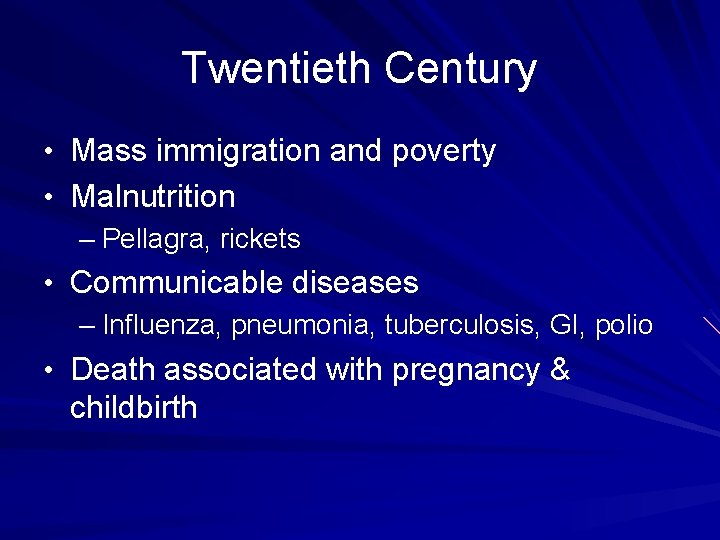
Twentieth Century • Mass immigration and poverty • Malnutrition – Pellagra, rickets • Communicable diseases – Influenza, pneumonia, tuberculosis, GI, polio • Death associated with pregnancy & childbirth
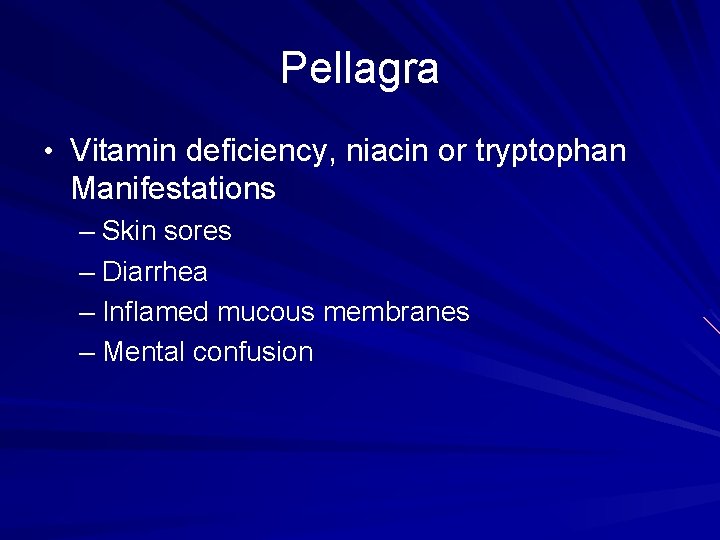
Pellagra • Vitamin deficiency, niacin or tryptophan Manifestations – Skin sores – Diarrhea – Inflamed mucous membranes – Mental confusion
Rickets • Vitamin D deficiency, phosphate • Manifestation – Soft bones, bow legs, spinal deformities, fractures – Dental deformities – Bone pain
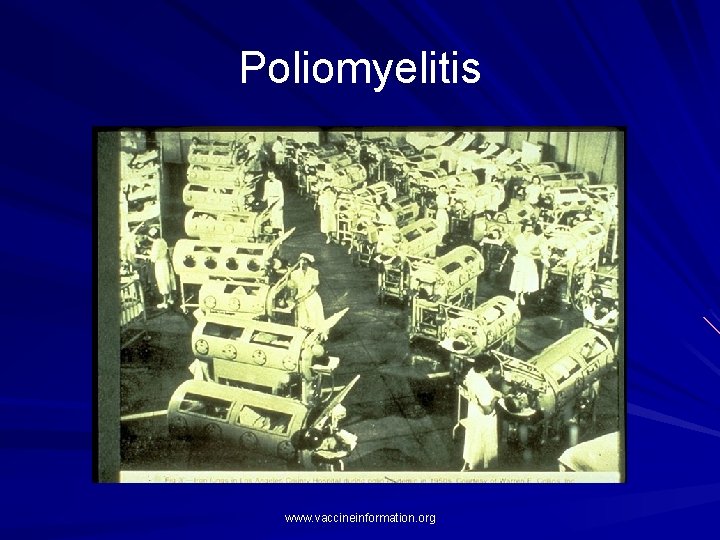
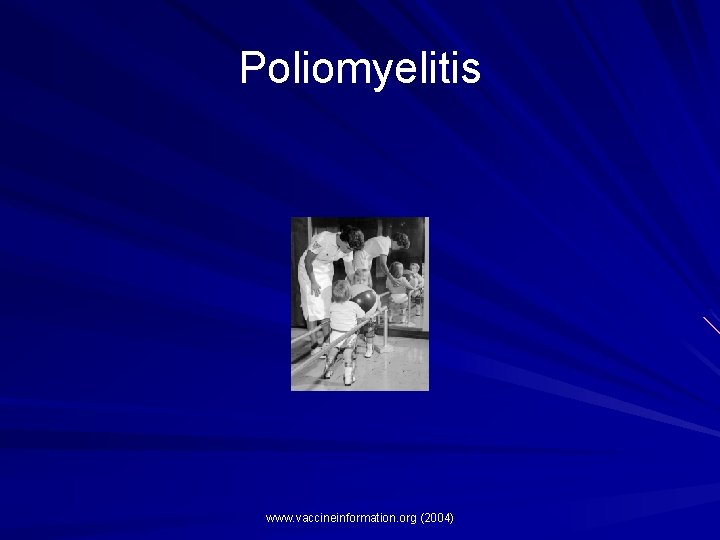
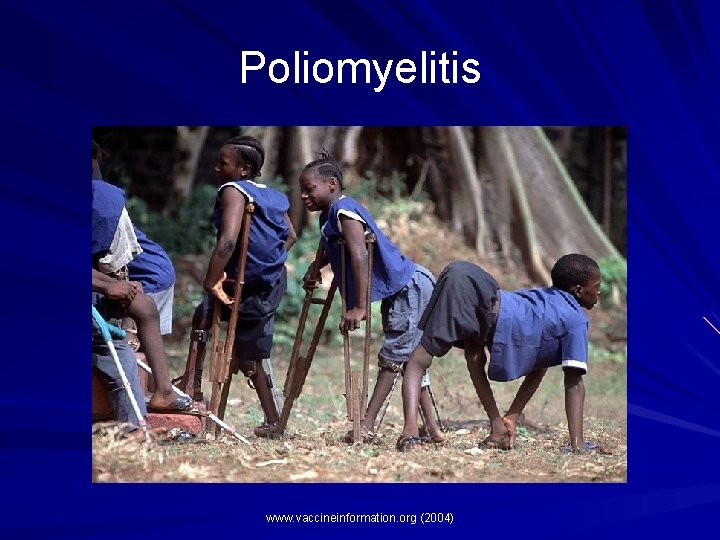
Poliomyelitis • Poliovirus, person to person contact by • • infected secretions of nose or mouth, feces Worldwide epidemic 1840 -1950’s Sub-clinical (95% cases) Non-paralytic Paralytic – Brain and spinal cord involvement
Poliomyelitis www. vaccineinformation. org
Poliomyelitis www. vaccineinformation. org (2004)
Poliomyelitis www. vaccineinformation. org (2004)
Twentieth Century Advances • Results of immigrant conditions – 1906 Pure Food and Drug Act – 1910 Workman’s compensation • 1902 Rochester City Hospital School for Nurses • 1918 Johns Hopkins School of Public Health • Prohibition
Twentieth Century Advances Roosevelt & WWII • 1935 Social Security Act • 1937 National Cancer Institute • Penicillin: pneumonia, RF, syphilis, strepp • DDT: malaria • CDC, Atlanta
Twentieth Century Advances Post war (1950’s) • Polio Vaccine • Eisenhower’s heart attack
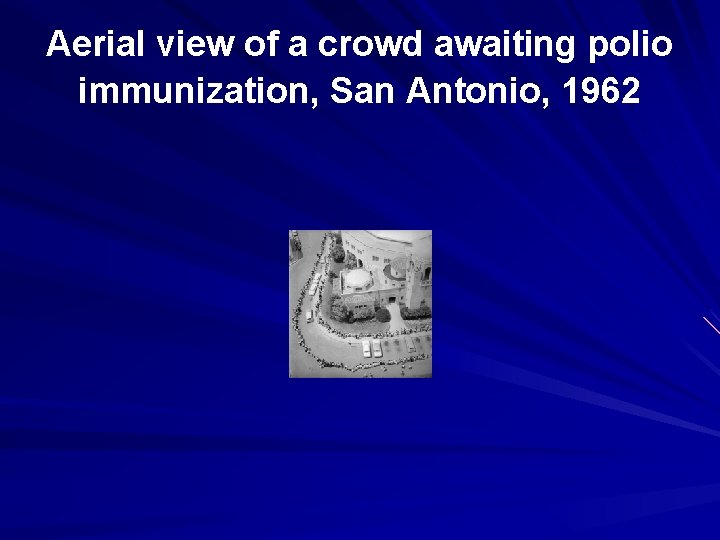
Aerial view of a crowd awaiting polio immunization, San Antonio, 1962
Twentieth Century Advances 1965 • Medicare • Medicaid
Twentieth Century Advances 1980 Eradication of smallpox
Twentieth Century Advances 1970 - present The period of Health Promotion and Disease Prevention • Diseases due to one’s lifestyle or health behavior • Global Health
In Summary • What have we accomplished from a community and public health perspective? • How & Where is our work cut out for us in the future?
Break
Organizations in Community Health
Governmental Agencies • International • National • State • Local
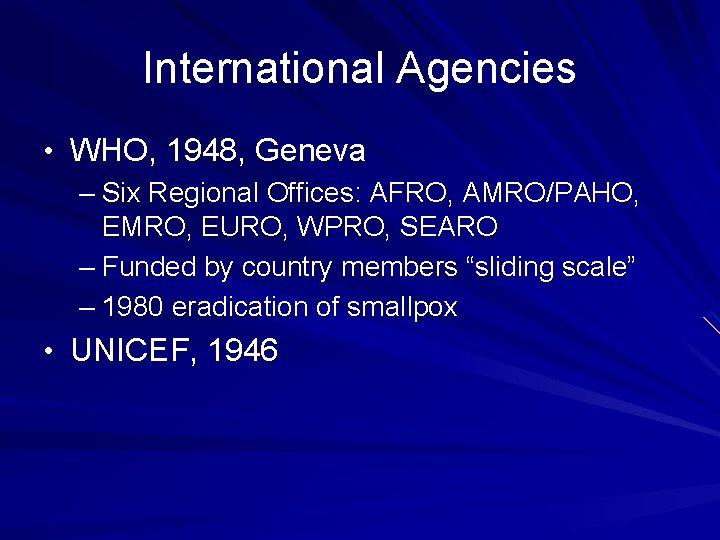
International Agencies • WHO, 1948, Geneva – Six Regional Offices: AFRO, AMRO/PAHO, EMRO, EURO, WPRO, SEARO – Funded by country members “sliding scale” – 1980 eradication of smallpox • UNICEF, 1946
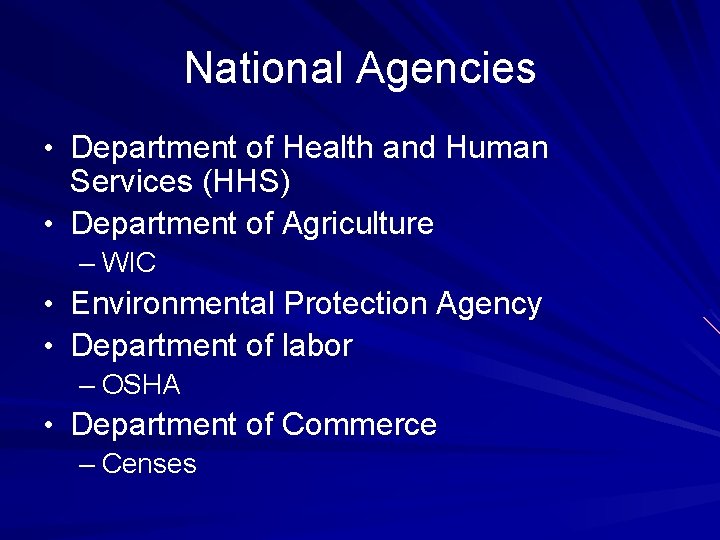
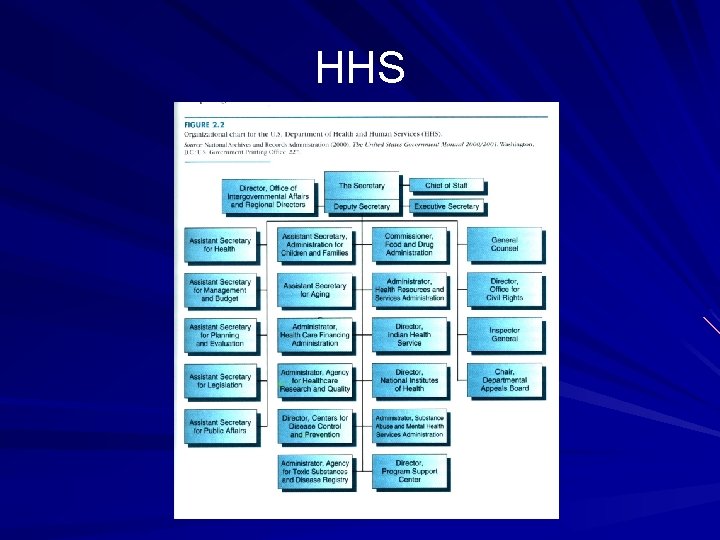
National Agencies • Department of Health and Human Services (HHS) • Department of Agriculture – WIC • Environmental Protection Agency • Department of labor – OSHA • Department of Commerce – Censes
HHS
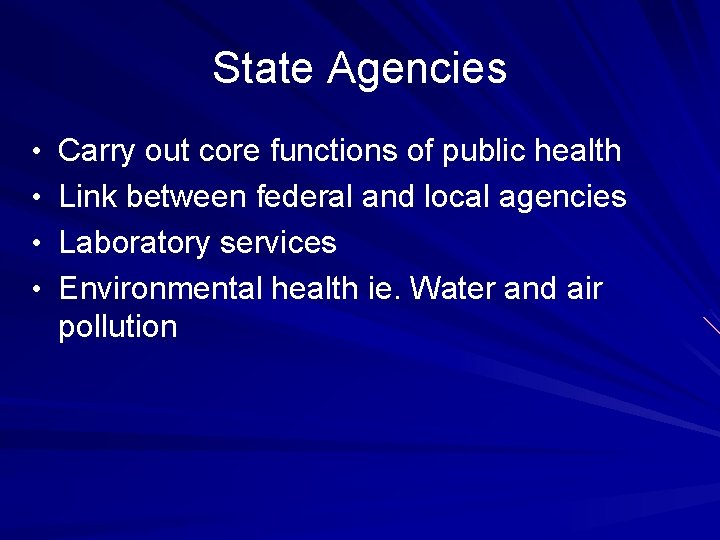
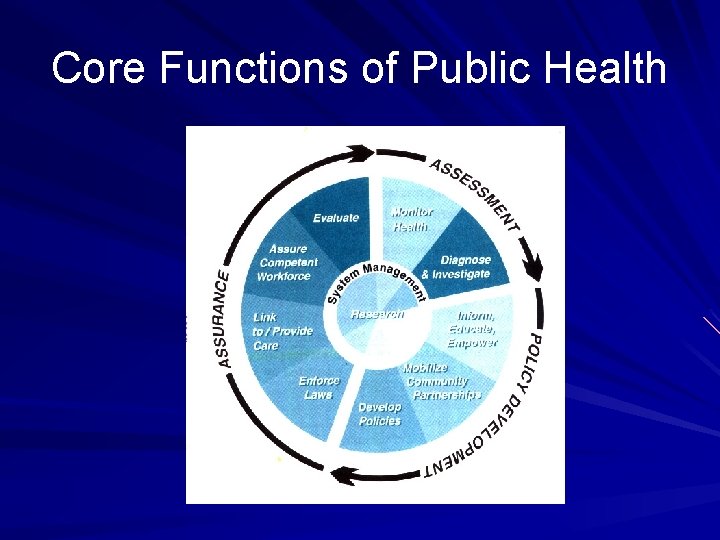
State Agencies • Carry out core functions of public health • Link between federal and local agencies • Laboratory services • Environmental health ie. Water and air pollution
Core Functions of Public Health
Local Agencies • City or County Health Department • School Health Program
Quasi Governmental Health Organizations • American Red Cross – Federal responsibilities – Voluntary contributions
Non-governmental Health Agencies • Voluntary Agencies – MADD, SADD • Professional Health Organizations – American Nursing Association • Philanthropic Foundations – Rockefeller, Robert Wood Johnson, Kaiser, Kellogg, Doris Duke • Service, Social and Religious organizations – Rotary
Questions? Remember to sign up for community assessment presentations