Integrated Service in the Internet Architecture RFC 1633
- Slides: 37
Integrated Service in the Internet Architecture RFC 1633
Introduction The Internet only offers simple Qo. S (quality of service)—best effort Real-time applications do not work well across the Internet because of: n n Variable queueing delays Congestion losses The Internet infrastructure must be modified to support real-time Qo. S
Introduction Real-time Qo. S is the issue for a next generation of traffic management in the Internet The term integrated services(IS) for an Internet service model includes: n n n Best-effort service Real-time service Controlled link sharing
Elements of the Architecture The fundamental service model of the Internet—best effort has been unchanged for 20 years Change the service model of the Internet is a major undertaking New components will supplement but not replace the basic IP service Only to extend the original architecture
Integrated Service Model Two sorts of service targeted towards real-time traffic: n n Guaranteed service Predictive service It integrate with controlled link-sharing The resources (e. g. , bandwidth) must be explicitly managed
The arguments against resource guarantees Bandwidth will be infinite n In the future, the bandwidth will be so abundant, ubiquitous, and cheap? Simple priority is sufficient n Simply giving higher priority to real-time traffic is enough? Applications can adapt
Integrated Service Model There is an inescapable requirement for routers to be able to reserve resources Provide special Qo. S for specific user packet streams, or flows Use the existing internet-layer protocol (e. g. , IP or CLNP) for real-time data
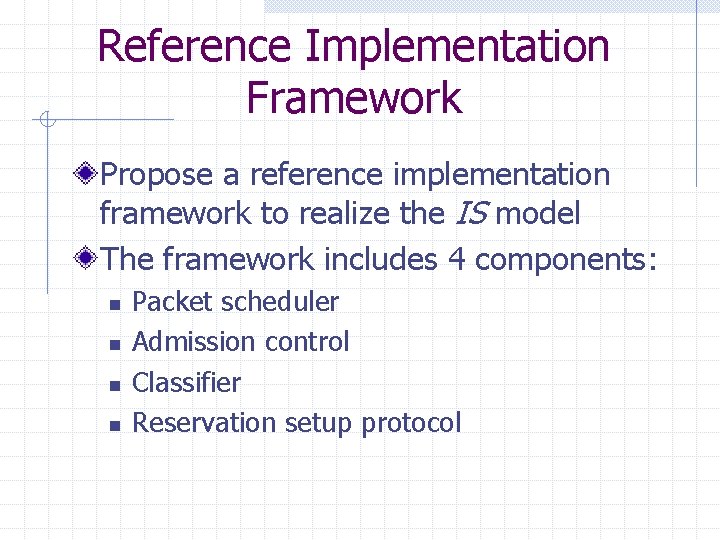
Reference Implementation Framework Propose a reference implementation framework to realize the IS model The framework includes 4 components: n n Packet scheduler Admission control Classifier Reservation setup protocol
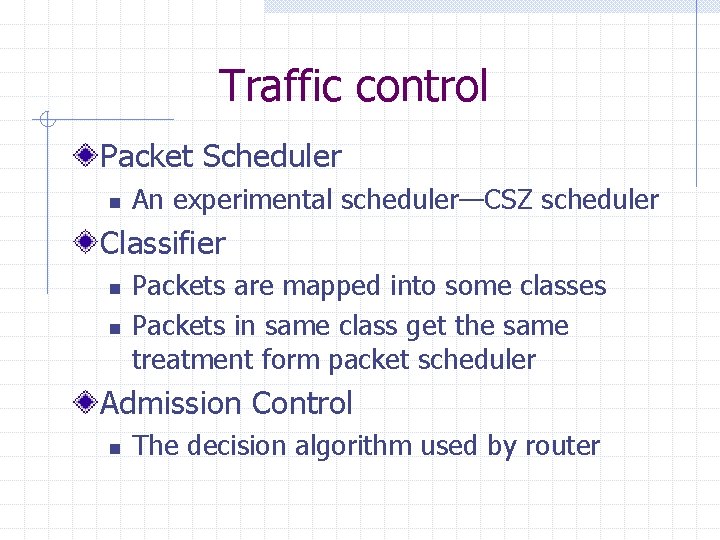
Traffic control For integrated services, a router must implement an appropriate Qo. S for each flow The router function that creates different qualities of service is called “traffic control” Implemented by: the packet scheduler, the classifier and admission control
Traffic control Packet Scheduler n An experimental scheduler—CSZ scheduler Classifier n n Packets are mapped into some classes Packets in same class get the same treatment form packet scheduler Admission Control n The decision algorithm used by router
th 4 The component— reservation setup protocol Create and maintain flow-specific state in the endpoint hosts and in routers along the path of a flow RSVP (Re. Ser. Vation Protocol) is used to reserve the resource
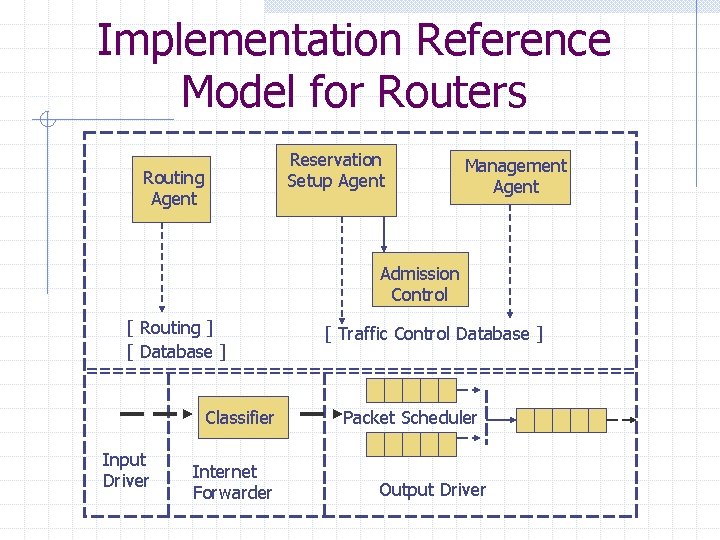
Implementation Reference Model for Routers Reservation Setup Agent Routing Agent Management Agent Admission Control [ Routing ] [ Traffic Control Database ] [ Database ] ===================== Classifier Input Driver Internet Forwarder Packet Scheduler Output Driver
Implementation Reference Model for Routers The forwarding path is divided into 3 sections : n Input driver, internet forwarder, output driver Internet forwarder interprets the internetworking protocol header (e. g. , IP header for TCP/IP) The output driver implements the packet scheduler
Implementation Reference Model for Routers In routers, integrated service will require changes to both the forwarding path and the background functions The forwarding path may depend upon hardware acceleration for performance —difficult and costly to change
Quality of Service Requirements Per-packet delay is the central quantity about which the network makes Qo. S commitments Real-time applications n Need the data in each packet by a certain time, or the data will be worthless Elastic applications n Always wait for data to arrive
Real-time applications Playback applications n n The source takes some signal, packetizes it, and then transmits over the network Receiver has to buffer the incoming data and then replay the signal at some fixed offset delay form the original departure time The performance is measured by n Latency and fidelity
Real-time applications Delay can affect the performance of playback applications in two ways: n n The value of the offset delay The delays of individual packets can decrease the fidelity of the playback by exceeding the offset delay
Real-time applications Intolerant applications n n n Must use a fixed offset delay Set the upper bound on max delay Be called as guaranteed service Tolerant applications n n n Can tolerate some late packets Vary offset delays according to the experience in the recent past Be called as predictive service
Elastic applications Always wait for data to arrive Example applications: n n n Interactive burst — Telnet Interactive bulk burst — FTP Asynchronous bulk transfer — E-mail An appropriate service model for these applications is to provide as-soon-aspossible service (i. e. , best-effort service)
Resource-sharing requirements Multi-entity link-sharing n When the link is underloaded, any one of the entities could utilize all idle bandwidth Multi-protocol link-sharing n Prevent one protocol family from overloading the link Multi-service sharing n Limit the amount real-time traffic to avoid preempting elastic traffic
Other remarks Packet dropping n n Some of the packet within a flow could be marked as preemptable Router use this mark to drop packets Usage feedback n Prevent abuse of network resources Reservation model n Describe how an application negotiates for a Qo. S level
Traffic Control Mechanisms Basic functions: n n Packet scheduling Packet dropping Packet classification Admission control An example: The CSZ scheme
Packet scheduling Reorder the output queue One approach is a priority scheme n n Packets are ordered by priority Highest priority packets leave first An alternative scheme is round-robin n Gives different classes of packets access to a share of the link
Packet dropping A router must drop packets when its buffers are all full Dropping the arriving packet is simple but may cause undesired behavior In real-time service, dropping one packet will reduce the delay of all the packet behind it Dropping and scheduling must be coordinated
Packet classification The classifier implementation issues are complexity and processing overhead One approach is to provide a flow-id field in the Internet-layer packet header n Reduce the overhead of classification Engineering is required to choose the best design of this concept
Admission control—the design about resource availability The router has to understand the demands that are currently being made on its assets A recent proposal is to program the router to measure the actual usage by existing packet flows, then use this information for the admitting of new flow
The CSZ scheme At the top level, CSZ node use WFQ to separate guaranteed flows for each other Predictive and best-effort service are separated by priority Inside each predictive sub-class, FIFO queueing is used to mix the traffic
The CSZ scheme Within the best-effort class, WFQ is used to provide link sharing Within each link share of the best-effort class, priority is used to permit more time-sensitive elastic traffic The CSZ node uses both WFQ and priority in an alternating manner to build the mechanism
Reservation Setup Protocol Requirements for the design of a reservation setup protocol: n n n designed for a multicast environment accommodate heterogeneous service needs can add/delete one sender/receiver to an existing set robust and scale well to large multicast groups advanced reservation of resources, and for the preemption
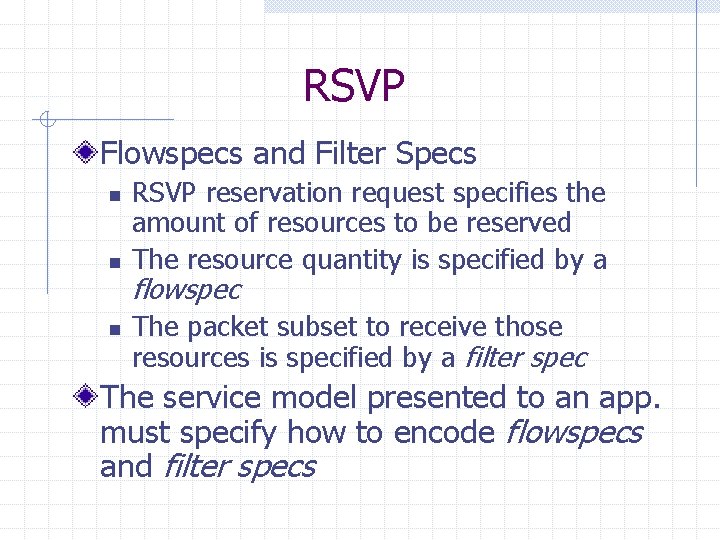
RSVP Flowspecs and Filter Specs n n n RSVP reservation request specifies the amount of resources to be reserved The resource quantity is specified by a flowspec The packet subset to receive those resources is specified by a filter spec The service model presented to an app. must specify how to encode flowspecs and filter specs
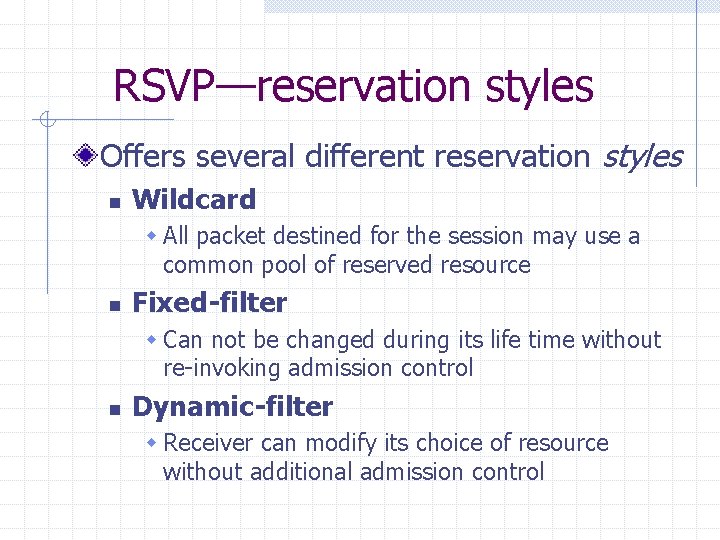
RSVP—reservation styles Offers several different reservation styles n Wildcard w All packet destined for the session may use a common pool of reserved resource n Fixed-filter w Can not be changed during its life time without re-invoking admission control n Dynamic-filter w Receiver can modify its choice of resource without additional admission control
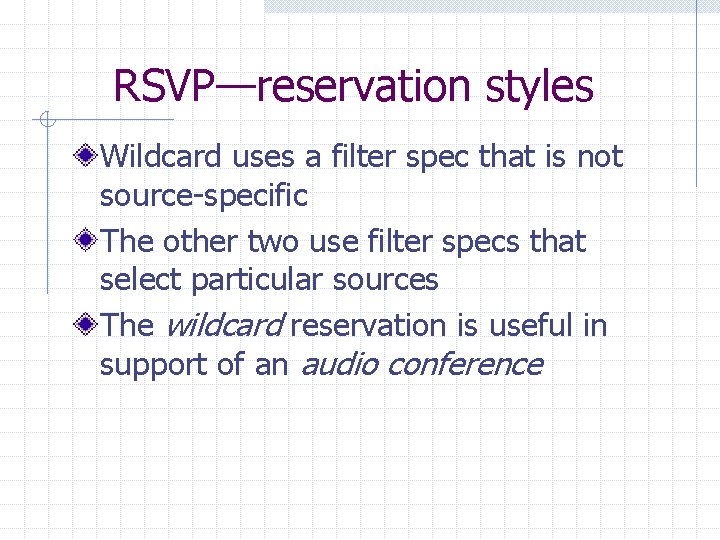
RSVP—reservation styles Wildcard uses a filter spec that is not source-specific The other two use filter specs that select particular sources The wildcard reservation is useful in support of an audio conference
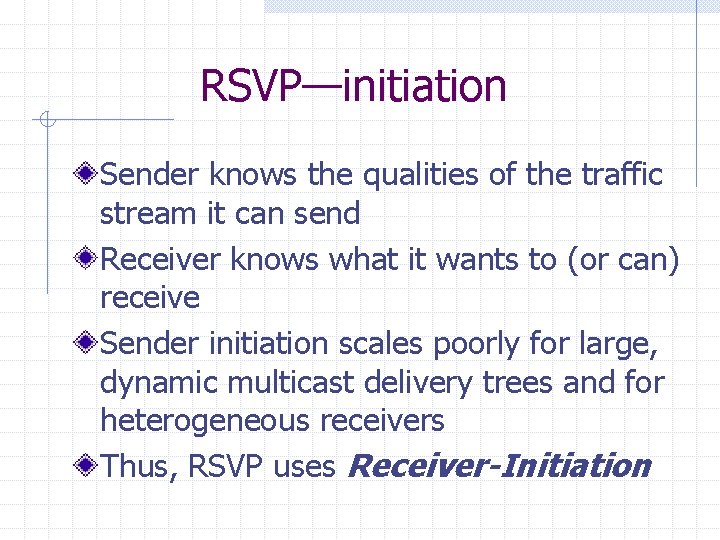
RSVP—initiation Sender knows the qualities of the traffic stream it can send Receiver knows what it wants to (or can) receive Sender initiation scales poorly for large, dynamic multicast delivery trees and for heterogeneous receivers Thus, RSVP uses Receiver-Initiation
RSVP—initiation Receiver Initiation n n Natural choice for multicast sessions But may appear weaker for unicast sessions Except real-time app. will have its higher-level signalling and protocol Then this protocol can be used to signal the receiver to initiate a reservation
RSVP—states Hard state approach n Connection-oriented Soft state approach n Connectionless RSVP takes the Soft State approach n Regards the reservation as cached information that is installed and periodically refreshed by the end hosts
RSVP—routing issues Find a route that support resource reservation Find a route that has sufficient unreserved capacity for new flow Adapt to a route failure Adapt to a route change (without failure) The last issue is provide by mobile hosts
Conclusion The Integrated services framework has four main components : n n Packet scheduler Admission control Classifier Reservation setup protocol RSVP is used to reserve the resource for the session belongs to high class level