Instructional Coaching Principles Practices Jim Knight University of





















- Slides: 98
Instructional Coaching: Principles & Practices Jim Knight University of Kansas Center for Research on Learning Jimknight@mac. com www. instructionalcoach. org
What questions will we explore? l What is the challenge we face in schools? l What are the components of coaching? l How do successful programs take a paradoxical approach to change? l What is the partnership approach? www. instructionalcoach. org
www. instructionalcoach. org
But first… Why we came to study Instructional Coaching… a little back ground information www. instructionalcoach. org
What is the Center for Research on Learning? Founded in 1978 Mission: Dramatically improve the performance of at-risk students in grades 4 -12 through research-based interventions l $80+ million dollars of contracted R&D l International Professional Development Network l 275, 000 teachers in 3, 500 school districts www. instructionalcoach. org
The Strategic Instruction Model (SIM) CRL SIM is an integrated model of research-validated practices to address many of the needs of diverse learners. It has been under development for 25 years at the University of Kansas-Center for Research on Learning. These research-validated practices revolve around improving academic achievement through the implementation of Content Enhancement Routines to help teachers promote greater understanding, remembering, and use of critical content and The Learning Strategies Curriculum to increase student learning. www. instructionalcoach. org
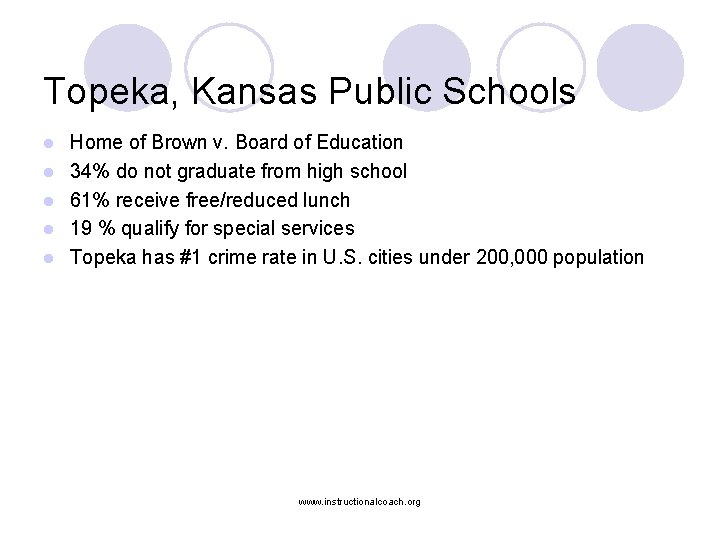
Topeka, Kansas Public Schools l l l Home of Brown v. Board of Education 34% do not graduate from high school 61% receive free/reduced lunch 19 % qualify for special services Topeka has #1 crime rate in U. S. cities under 200, 000 population www. instructionalcoach. org
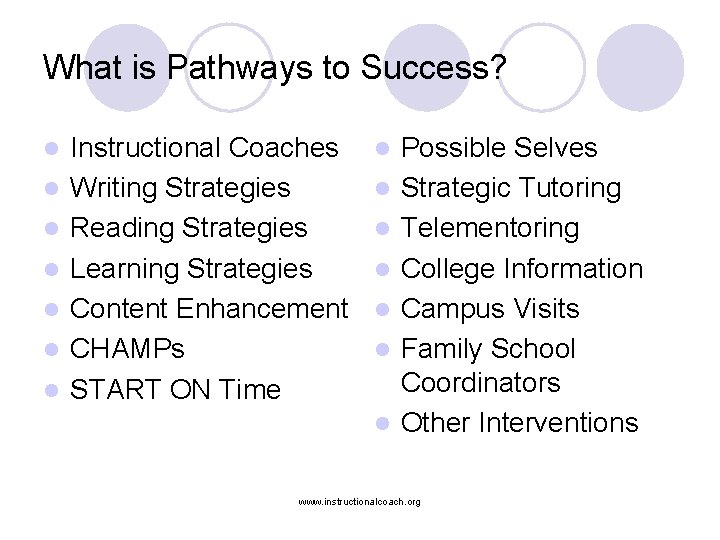
What is Pathways to Success? l l l l Instructional Coaches Writing Strategies Reading Strategies Learning Strategies Content Enhancement CHAMPs START ON Time l l l l Possible Selves Strategic Tutoring Telementoring College Information Campus Visits Family School Coordinators Other Interventions www. instructionalcoach. org
What is the challenge we all face? www. instructionalcoach. org
There is urgent political pressure to improve instruction www. instructionalcoach. org
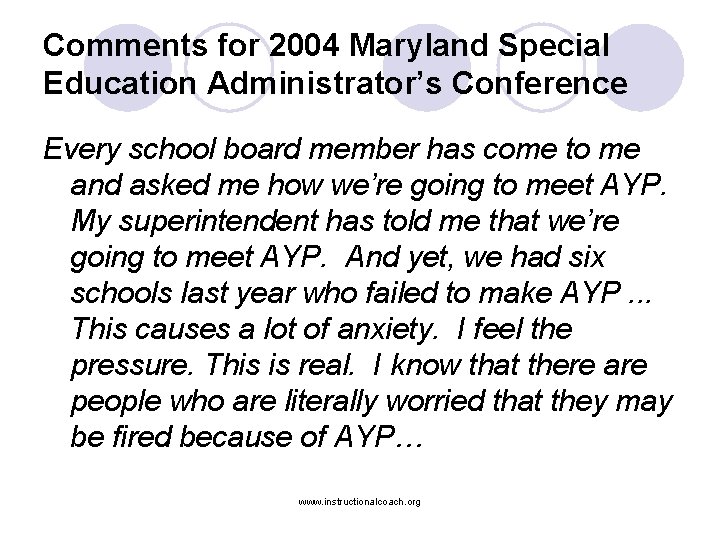
Comments for 2004 Maryland Special Education Administrator’s Conference Every school board member has come to me and asked me how we’re going to meet AYP. My superintendent has told me that we’re going to meet AYP. And yet, we had six schools last year who failed to make AYP. . . This causes a lot of anxiety. I feel the pressure. This is real. I know that there are people who are literally worried that they may be fired because of AYP… www. instructionalcoach. org
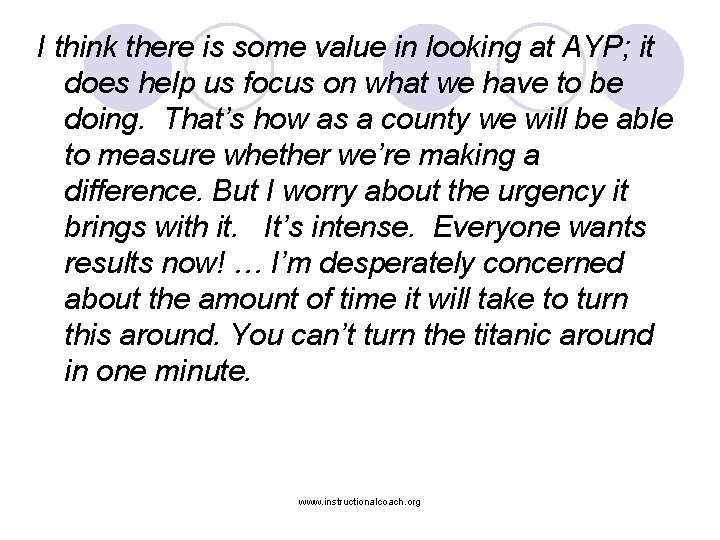
I think there is some value in looking at AYP; it does help us focus on what we have to be doing. That’s how as a county we will be able to measure whether we’re making a difference. But I worry about the urgency it brings with it. It’s intense. Everyone wants results now! … I’m desperately concerned about the amount of time it will take to turn this around. You can’t turn the titanic around in one minute. www. instructionalcoach. org
There is moral pressure to improve instruction www. instructionalcoach. org
A closer look at word level reading… www. instructionalcoach. org
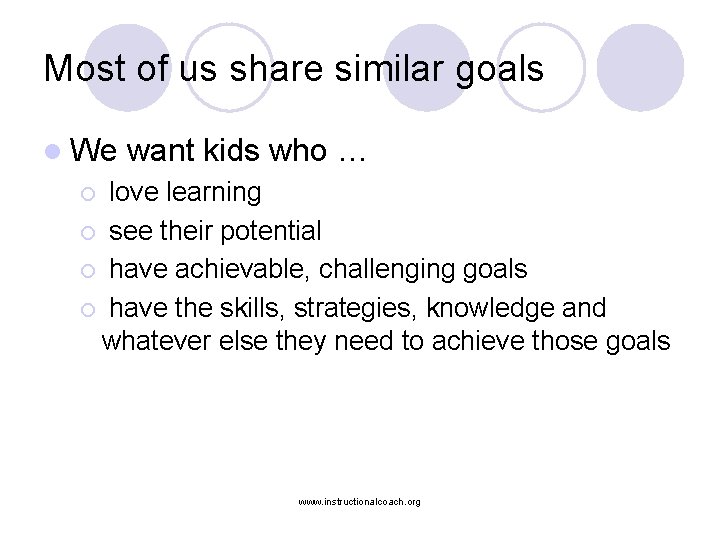
Most of us share similar goals l We want kids who … love learning ¡ see their potential ¡ have achievable, challenging goals ¡ have the skills, strategies, knowledge and whatever else they need to achieve those goals ¡ www. instructionalcoach. org
There is pressure to improve the way we interact with each other www. instructionalcoach. org
We have never wanted to be alone. But today, we are alone. We are more fragmented and isolated from one another than ever before. Archbishop Desmond Tutu describes it as “a radical brokenness in all of existence. ” Meg Wheatley, Turning to one another www. instructionalcoach. org
But change personally and professionally is difficult. www. instructionalcoach. org
personal And the experience of change is complicated www. instructionalcoach. org
Let’s talk about change l Identify: ¡ A change that you have experienced (personally or ¡ externally motivated) that successful A change that you have experienced (personally or was not successful ¡ What are the reasons why one succeeded and one didn’t externally motivated) that ¡ Discuss your reasons with others and identify 1 -3 common themes across all of your experiences www. instructionalcoach. org
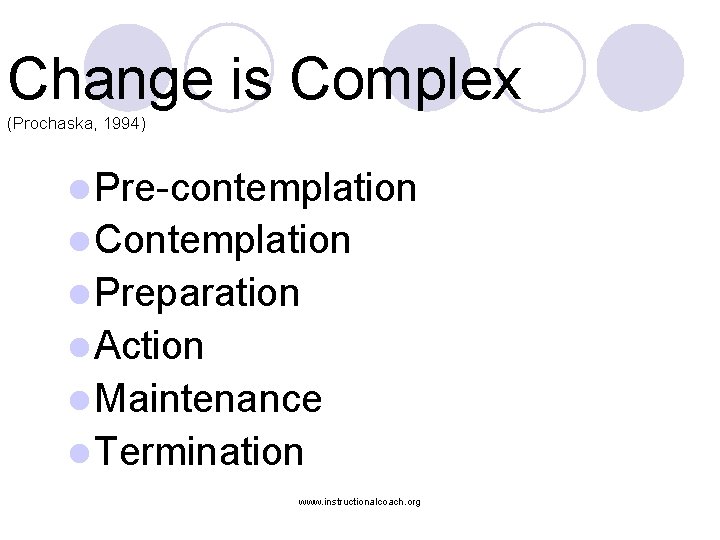
Change is Complex (Prochaska, 1994) l Pre-contemplation l Contemplation l Preparation l Action l Maintenance l Termination www. instructionalcoach. org
I’ve interviewed more than 150 people regarding professional development in schools from more than ten states in a wide variety of schools www. instructionalcoach. org
School culture can stop change dead in its tracks! www. instructionalcoach. org
Moving/Stuck Schools (Rosenholtz, 1991) www. instructionalcoach. org
There are other common reasons why change is difficult www. instructionalcoach. org
irrational l. Decisions can be made poorly l. Personalities can get in the way l People can be l State, district, school, classroom be l out of alignment Any change can be goals can difficult to accept www. instructionalcoach. org
Schools engage in self- destructive behavior www. instructionalcoach. org
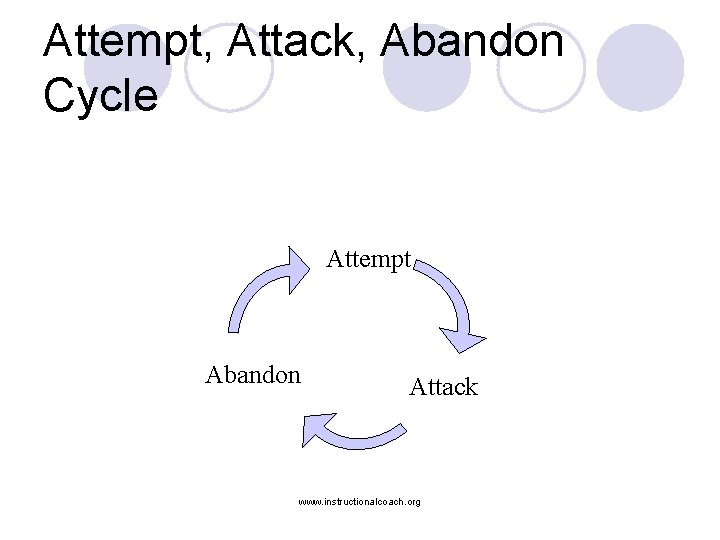
Attempt, Attack, Abandon Cycle Attempt Abandon Attack www. instructionalcoach. org
l “as the number of changes multiplies, and as the time demands increase, people approach a dysfunction threshold, a point where they lose the capacity to implement changes” --Darryl Conner, Managing at the speed of change www. instructionalcoach. org
What are the barriers to change you are experiencing in your school(s)? www. instructionalcoach. org
Leading change is like herding cats www. instructionalcoach. org
www. instructionalcoach. org
Instructional Coaching addresses both the personal and professional complexities www. instructionalcoach. org
How do we define Instructional Coach? www. instructionalcoach. org
What is an Instructional Coach? an on-site professional developer who partners with educators to identify and assist with implementation of proven teaching methods www. instructionalcoach. org
An Instructional Coach l Is on site l Is a professional developer l Partners l Identifies l Proven teaching practices (researchbased) l Assists www. instructionalcoach. org
What is an instructional coach? l Please watch this clip and consider two questions ¡ 1. What behaviors (if any) does he exhibit that are appropriate for interactions with the teachers you know? ¡ 2. What behaviors (if any) does he exhibit that are not appropriate for interactions with the teachers you know? www. instructionalcoach. org
What Are the Components of Instructional Coaching? www. instructionalcoach. org
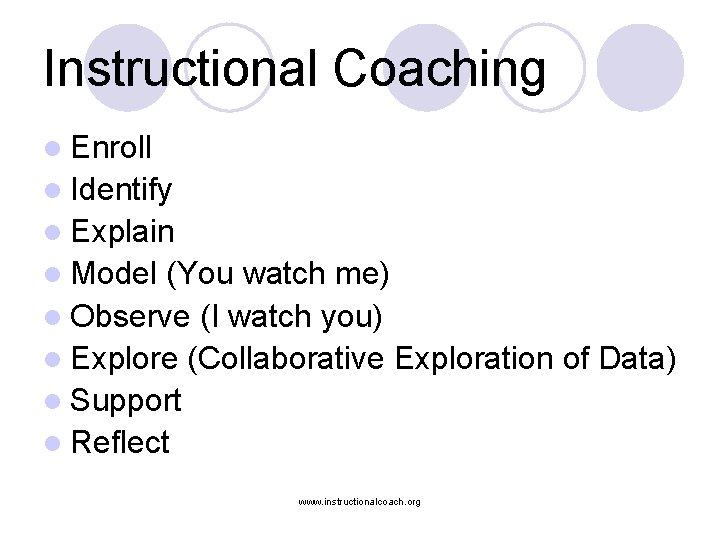
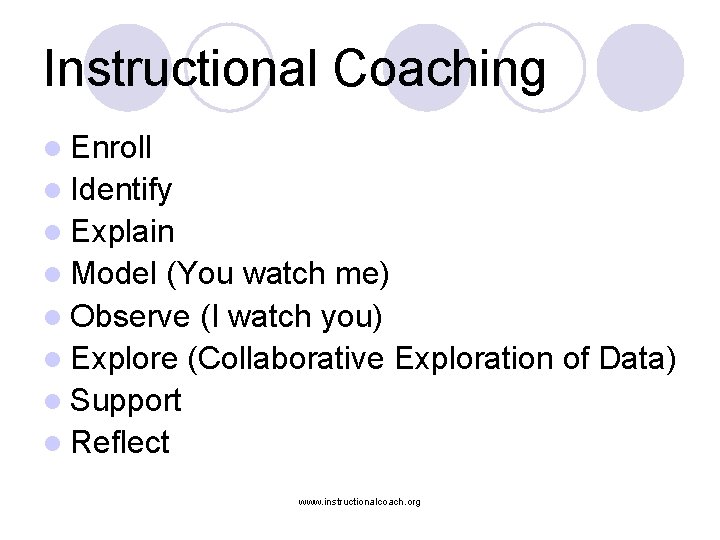
Instructional Coaching l Enroll l Identify l Explain l Model (You watch me) l Observe (I watch you) l Explore (Collaborative Exploration of Data) l Support l Reflect www. instructionalcoach. org
Your learning experience Periodically, we’ll stop so that you can check your understandings with your group l Also with your group, identify strategies, tactics, methods or other ideas that a coach might use to be more effective when implementing this practice l Write down what you have learned on a “post -it” note and add the “post-it” to the appropriate flip chart l www. instructionalcoach. org
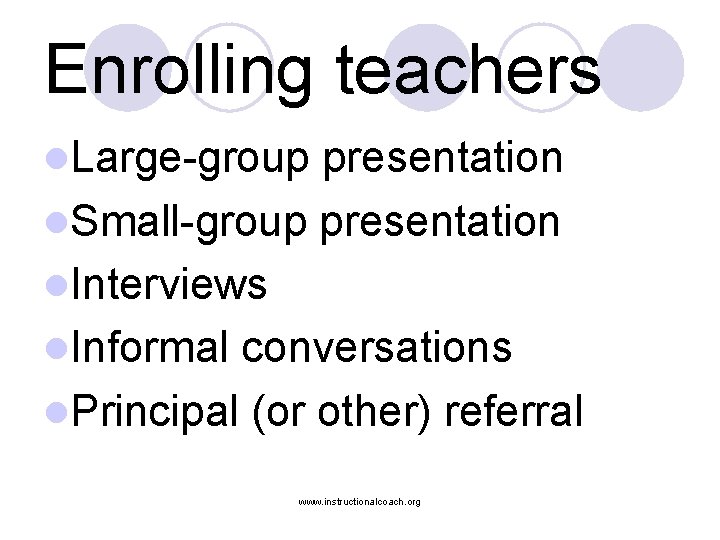
Enrolling teachers l. Large-group presentation l. Small-group presentation l. Interviews l. Informal conversations l. Principal (or other) referral www. instructionalcoach. org
Identify Teaching Practices l Through ¡Teacher-coach conversation (either formal or informal) ¡Coach observation ¡Referral www. instructionalcoach. org
Big Four l Behavior l Content Knowledge l Instruction l Formative Assessment l Questions we use to shape our thinking, not questions we ask our collaborating teachers. www. instructionalcoach. org
Explaining Interventions l Read, re-read, read again l Underline, mark with post-its l Take notes, draw mind maps l Write scripts, presentations l Use stories, analogies, punchy phrases, www. instructionalcoach. org
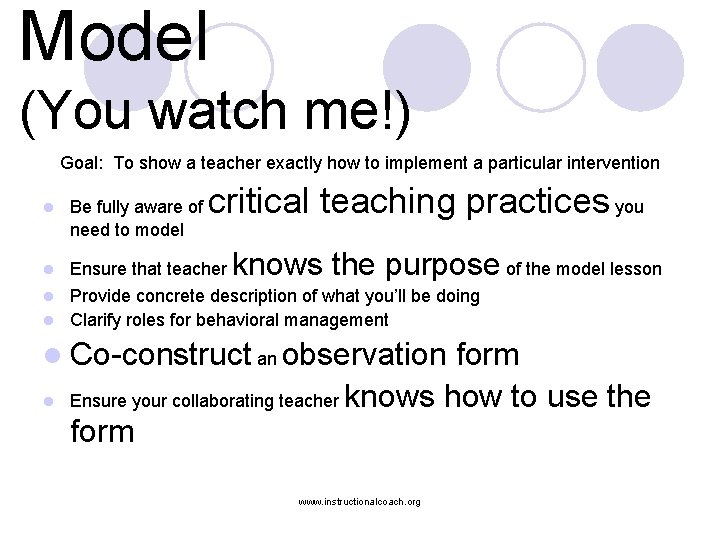
Model (You watch me!) Goal: To show a teacher exactly how to implement a particular intervention l Be fully aware of need to model critical teaching practices you knows the purpose of the model lesson Ensure that teacher l Provide concrete description of what you’ll be doing l Clarify roles for behavioral management l l Co-construct an observation l form Ensure your collaborating teacher knows how to use the form www. instructionalcoach. org
www. instructionalcoach. org
www. instructionalcoach. org
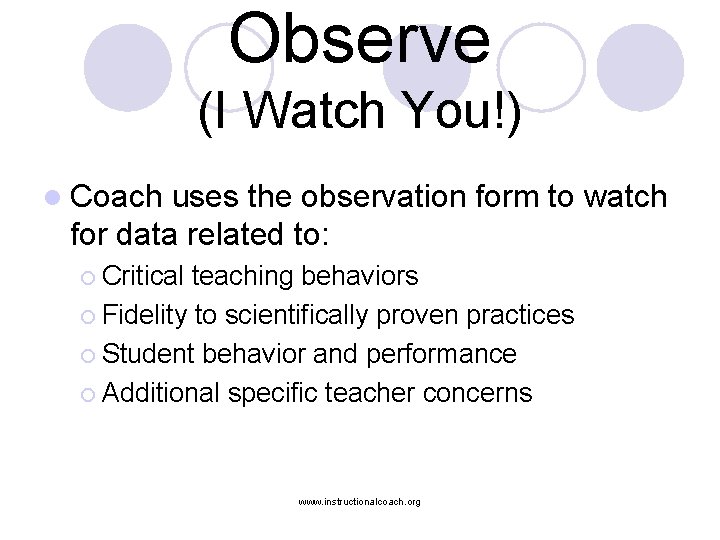
Observe (I Watch You!) l Coach uses the observation form to watch for data related to: ¡ Critical teaching behaviors ¡ Fidelity to scientifically proven practices ¡ Student behavior and performance ¡ Additional specific teacher concerns www. instructionalcoach. org
www. instructionalcoach. org
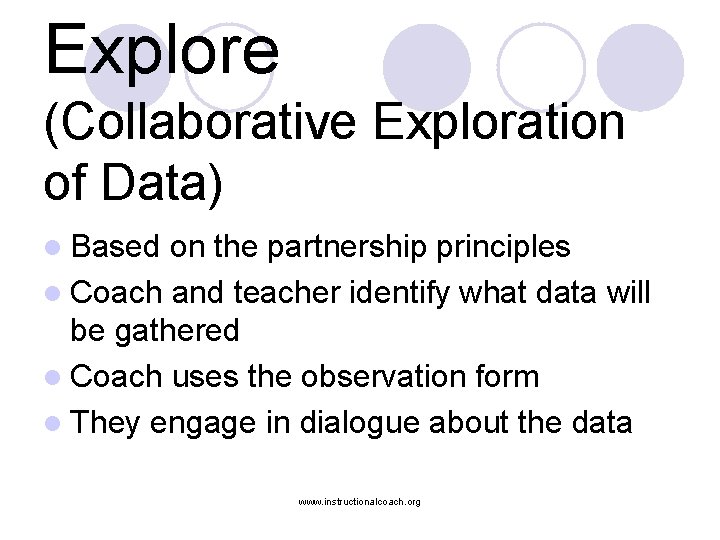
Explore (Collaborative Exploration of Data) l Based on the partnership principles l Coach and teacher identify what data will be gathered l Coach uses the observation form l They engage in dialogue about the data www. instructionalcoach. org
Many a relationship has been damaged and a work setting poisoned by perfectly delivered constructive feedback… “The helping hand strikes again!” How the way we talk can change the way we work (Kegan & Lahey, p. 128) www. instructionalcoach. org
Top-down Feedback www. instructionalcoach. org
Assumptions behind top-down feedback The first is that the perspective of the feedback giver (let’s call him the supervisor) – what he sees and thinks, his feedback-is right, is correct. An accompanying assumption is that there is only one correct answer. What you put these two assumptions together, they amount to this: the supervisor has the one and only correct view of the situation. (We call this “the super vision assumption”; that is, the supervisor has super vision. ) (p. 128) www. instructionalcoach. org
Partnership Feedback (C. E. D. ) Reinke, (2005) www. instructionalcoach. org
Support l Observations, data, feedback may turn the collaboration in a new direction l Coach’s goal is to provide as much support as necessary, but no more www. instructionalcoach. org
Reflection l What was supposed to happen? l What happened? l What accounts for the difference? l What should be done differently next time? www. instructionalcoach. org
Instructional Coaching l Enroll l Identify l Explain l Model (You watch me) l Observe (I watch you) l Explore (Collaborative Exploration of Data) l Support l Reflect www. instructionalcoach. org
What Does The Research Say? www. instructionalcoach. org
Instructional Coaching (Knight, 2005) (n = 82) www. instructionalcoach. org
Table one: Teachers’ perceptions of the value of observing Instructional Coaches modeling practices (n = 107) Do teachers think watching a coach model practices made it easier to implement? 6. 51 Do teachers think watching a coach model practices increased their fidelity to instructional practices? 6. 4 Do teachers think watching a coach model practices made them more confident about implementing? 6. 22 Do teachers think they learned other teaching strategies while watching a coach model? 6. 13 Do teachers think coaches have enough content knowledge to model all the instruction in teachers’ classes. 3. 18 www. instructionalcoach. org
Teacher Interviews l 13 teachers were interviewed in 2004 -05 l Each teacher identified modeling as a central part of their learning with the coach www. instructionalcoach. org
Time to reflect Identify one idea you want to act on: What do you feel? What do you think? What are you going to do? www. instructionalcoach. org
So how do we make it happen? www. instructionalcoach. org
Take a paradoxical approach to adaptive change www. instructionalcoach. org
Effective change is paradoxical l Top-down AND bottom-up l Easy AND powerful l Self-organizing AND tightly managed l Gaining commitment by not demanding commitment www. instructionalcoach. org
Top-down & Bottom-up www. instructionalcoach. org
Top down, by itself, doesn’t work “the direct approach of naming the goal and mobilizing to achieve it does not, and cannot work in something as complex as change agentry” Michael Fullan www. instructionalcoach. org
Our theory “There is nothing quite as practical as a good theory” Kurt Lewin www. instructionalcoach. org
We take a partnership approach l Our work embodies the principles of equality, choice, voice, reflection, dialogue, praxis, and reciprocity “We want to be just like any other teacher in the school” www. instructionalcoach. org
But… l Bottom-up alone is not sufficient Teachers may choose not to change when they need to improve ¡ Strategies may not get cued in additional classrooms ¡ There may be a lack of coherence in what is implemented in schools ¡ www. instructionalcoach. org
So the principal … l Remains the instructional leader (through partnership) l Assesses teachers’ use of interventions l Leads teachers to put interventions in their personal development plans l Applies pressure, but respects teachers’ professional discretion www. instructionalcoach. org
How should coaches coach principals? l l l Work from the partnership perspective Establish weekly one-to-one meetings with principals Draw up a weekly agenda addressing your most pressing issues Educate principals about interventions each week Discuss individual teachers and teams Encourage school-wide implementation of interventions www. instructionalcoach. org
Discuss with your partner What can you do next week to start turning this paradoxical idea into an action? www. instructionalcoach. org
Easy and Powerful www. instructionalcoach. org
Interventions that are embraced are powerful & easy ideas, values, technologies that do the job with the least demand on psychic energy will survive. An appliance that does more work with less effort will be preferred Mihalyi Csikszentmihalyi -this also applies to knowledge transfer in schools; interventions that are powerful and easy to use are going to be adopted by teachers www. instructionalcoach. org
How do we ensure they’re powerful? l Using scientifically based interventions that achieved socially significant results l Targeting standards l Targeting teachers’ most pressing needs l Using checklists, in-class demonstrations, and feedback to ensure that teachers learn research-based practices www. instructionalcoach. org
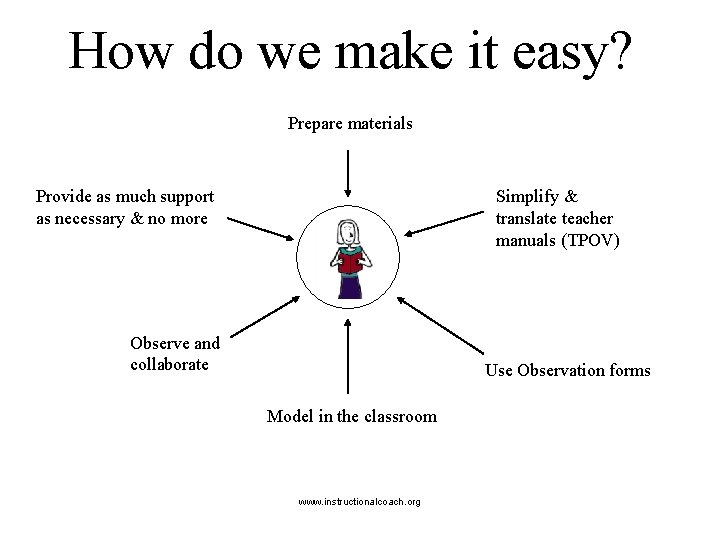
How do we make it easy? Prepare materials Provide as much support as necessary & no more Simplify & translate teacher manuals (TPOV) Observe and collaborate Use Observation forms Model in the classroom www. instructionalcoach. org
Discuss with your partner What can you do next week to start turning this paradoxical idea into an action? www. instructionalcoach. org
Self-organizing & highly organized www. instructionalcoach. org
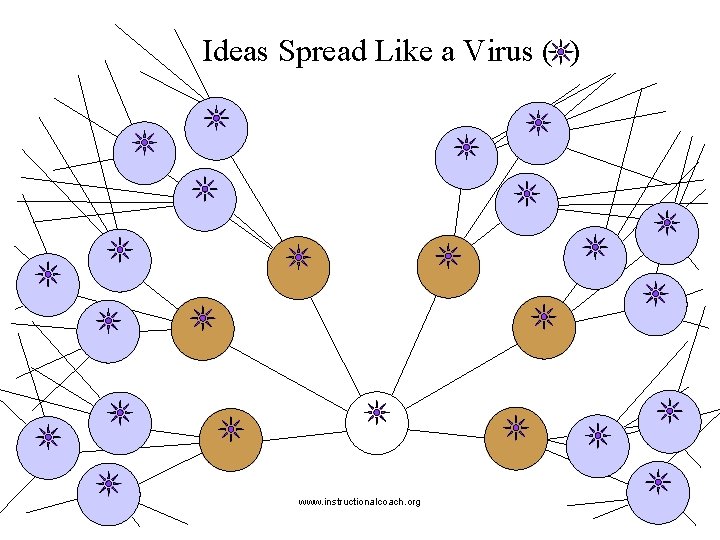
Ideas Spread Like a Virus ( ) www. instructionalcoach. org
How do coaches spread healthy viruses in schools? Make sure that your first collaborations are extremely well done (easy, powerful, validating) l Partner with the principal to apply pressure and support respectfully l Communicate successes widely through the use of newsletters and other forms of communication l Identify teachers with informal power in the school l www. instructionalcoach. org
How do coaches identify teachers with informal power? l Talk with principal and other leaders in the school l Talk with other teachers l Observe interactions in ¡ Staff lounge ¡ Team meetings ¡ Informal settings www. instructionalcoach. org
How do Instructional Coaches build coherence? l Build coherence after there is a critical mass of support for teachers l Work towards Institutionalizing changes ¡ Teaching interventions across teams ¡ Creating leadership teams ¡ Incorporating interventions into School Improvement Teams ¡ www. instructionalcoach. org
Discuss with your partner What can you do next week to start turning this paradoxical idea into an action? www. instructionalcoach. org
Not demanding commitment to get commitment www. instructionalcoach. org
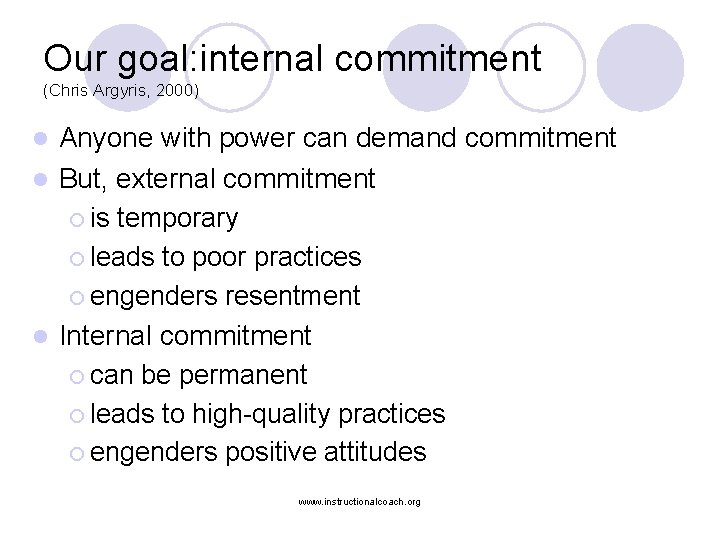
Our goal: internal commitment (Chris Argyris, 2000) Anyone with power can demand commitment l But, external commitment ¡ is temporary ¡ leads to poor practices ¡ engenders resentment l Internal commitment ¡ can be permanent ¡ leads to high-quality practices ¡ engenders positive attitudes l www. instructionalcoach. org
Discuss with your partner What can you do next week to start turning this paradoxical idea into an action? www. instructionalcoach. org
Partnership Principles The theory behind coaching www. instructionalcoach. org
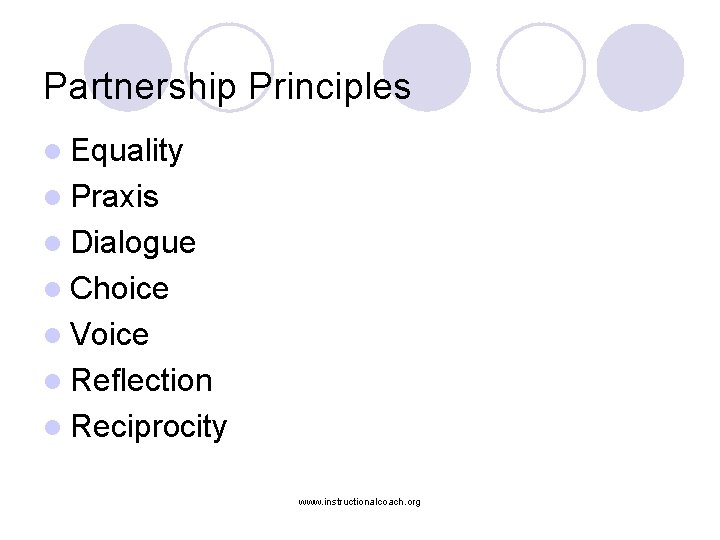
Partnership Principles l Equality l Praxis l Dialogue l Choice l Voice l Reflection l Reciprocity www. instructionalcoach. org
Principles “The principles you live by create the world you live in; if you change the principles you live by, you will change your world. ” Blaine Lee, The Power Principle www. instructionalcoach. org
But what about the research? I’m so glad you asked! www. instructionalcoach. org
Design www. instructionalcoach. org
Engagement Form www. instructionalcoach. org
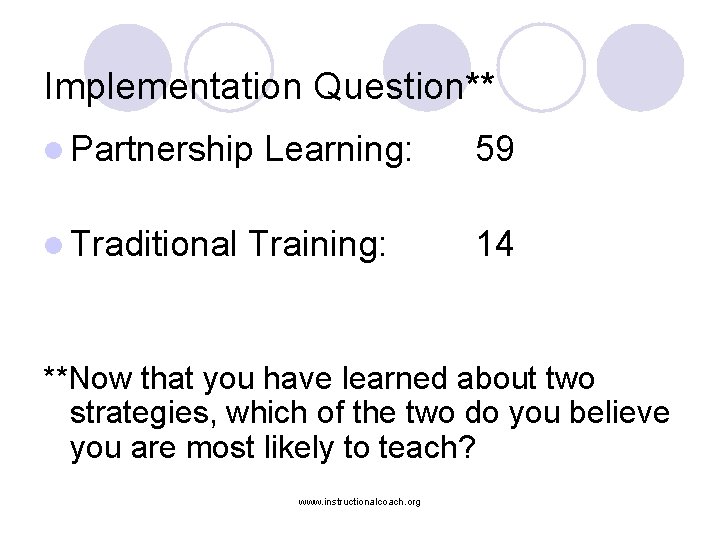
Implementation Question** l Partnership l Traditional Learning: Training: 59 14 **Now that you have learned about two strategies, which of the two do you believe you are most likely to teach? www. instructionalcoach. org
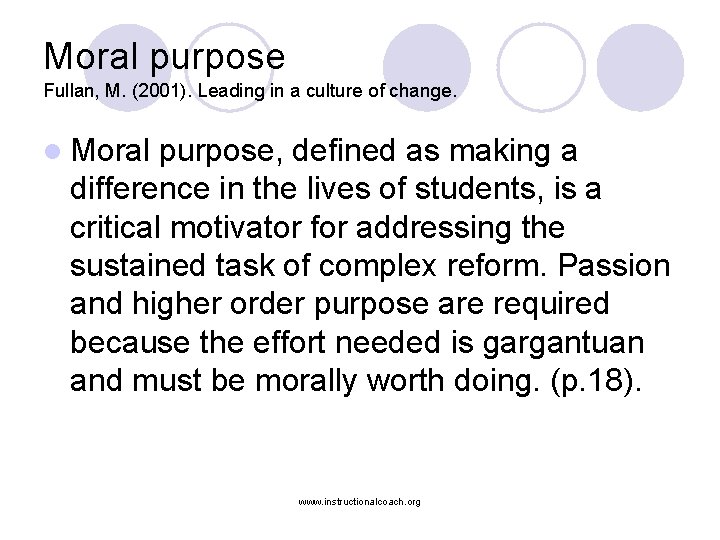
Moral purpose Fullan, M. (2001). Leading in a culture of change. l Moral purpose, defined as making a difference in the lives of students, is a critical motivator for addressing the sustained task of complex reform. Passion and higher order purpose are required because the effort needed is gargantuan and must be morally worth doing. (p. 18). www. instructionalcoach. org
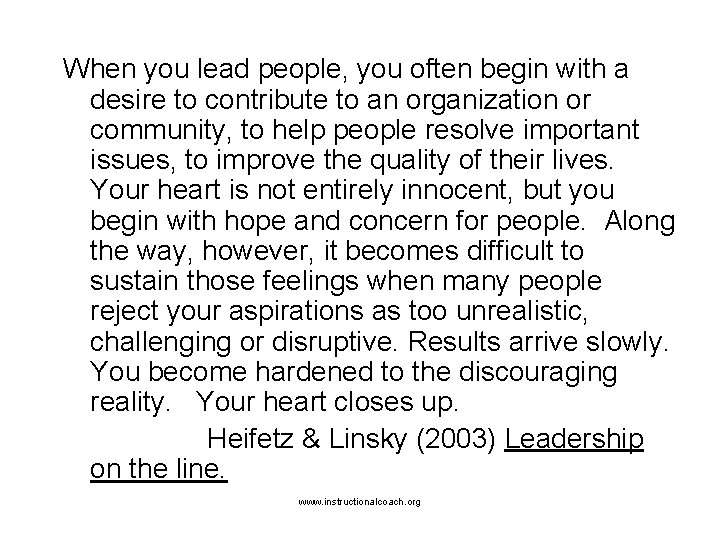
When you lead people, you often begin with a desire to contribute to an organization or community, to help people resolve important issues, to improve the quality of their lives. Your heart is not entirely innocent, but you begin with hope and concern for people. Along the way, however, it becomes difficult to sustain those feelings when many people reject your aspirations as too unrealistic, challenging or disruptive. Results arrive slowly. You become hardened to the discouraging reality. Your heart closes up. Heifetz & Linsky (2003) Leadership on the line. www. instructionalcoach. org
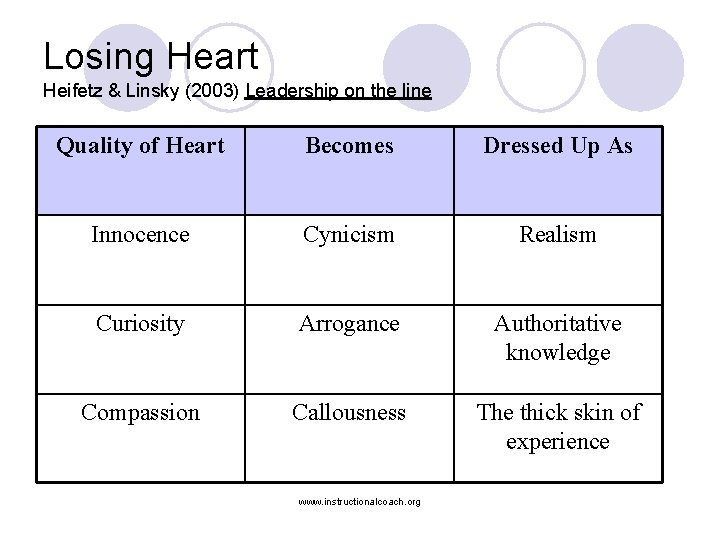
Losing Heart Heifetz & Linsky (2003) Leadership on the line Quality of Heart Becomes Dressed Up As Innocence Cynicism Realism Curiosity Arrogance Authoritative knowledge Compassion Callousness The thick skin of experience www. instructionalcoach. org
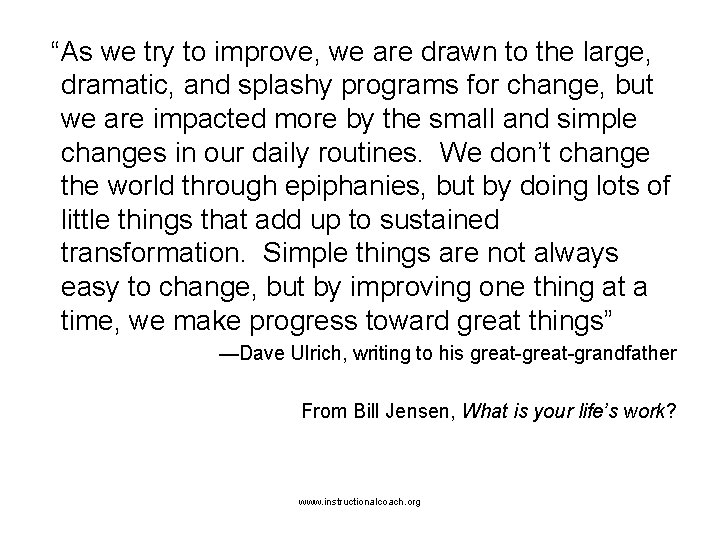
“As we try to improve, we are drawn to the large, dramatic, and splashy programs for change, but we are impacted more by the small and simple changes in our daily routines. We don’t change the world through epiphanies, but by doing lots of little things that add up to sustained transformation. Simple things are not always easy to change, but by improving one thing at a time, we make progress toward great things” —Dave Ulrich, writing to his great-grandfather From Bill Jensen, What is your life’s work? www. instructionalcoach. org