
Chapter 11 INSTRUCTIONAL METHOD Instructional Strategy Definition Is

- Slides: 52
Chapter 11 INSTRUCTIONAL METHOD
Instructional Strategy Definition Is the overall plan that for teaching and learning experience that involves used of one or several method ofd instructions to achieve the desired learning outcomes (Rothwell & Kazans 2004)
Instructional Methods Definition • Techniques or approaches that the teacher uses to bring the learner in contact with the content to be learned The way information is thought that bring the learner in contact with the content to be learned
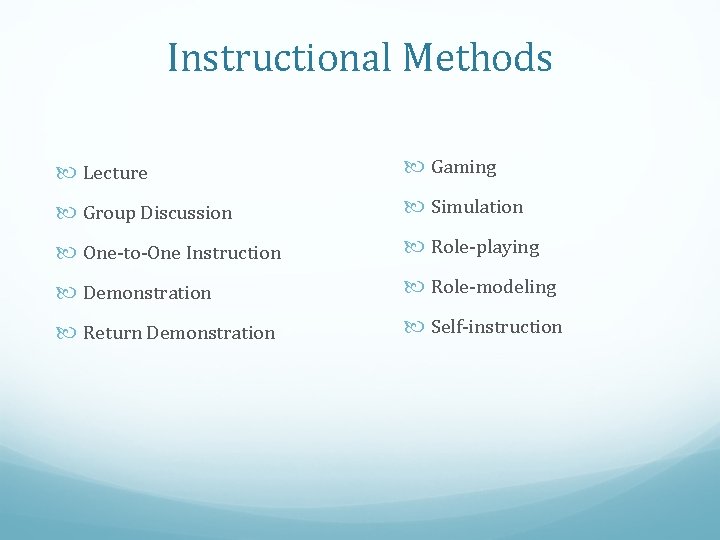
Instructional Methods Lecture Gaming Group Discussion Simulation One-to-One Instruction Role-playing Demonstration Role-modeling Return Demonstration Self-instruction
Is there one perfect Instructional Method to teach all learners in all settings?
Decision about which method to use must be based on consideration of such major factors as: Audience characteristics Learning Style Educator expertise Objectives of learning Potential for achieving learning outcomes Cost effectiveness Instructional setting Evolving technology
Lecture Definition An instructional method in which the teacher verbally transmits information directly to groups of learners for the purpose of education. It is highly structured.
Components of Lecture Introduction Body Conclusion
Lecture Presentation of the lecture must be adher to the follwing general guideline (Evans 2000) Do not put al; l content on the slide , but include only the key concepts Use large font possible Do not exceed 25 words per slide
Choose colors that provide a high level of contrast between background and text Use graphics for presenting large amount of numerical data Do not overdue the use of action figures, which can distract the audience Make sure that all audiovisual material is functional
Lecture Advantages Cost effective Targets large groups Useful for cognitive domain learning Limitations Not individualized Passive learners
Group Discussion Definition An instructional method in which learners are together to exchange information, feelings, and opinions with each other and the teacher to achieve educational objectives
Group Discussion Advantages Limitations Stimulates sharing of ideas and emotions Active learners Useful for cognitive and affective domains of learning Shy member does not participate Dominant member overwhelms the group Highly diverse groups may have difficulty interacting
One-to-One Instruction Definition An instructional method in which the teacher delivers personally designed instruction to a learner.
One-to-One Instruction Advantages Active learner Tailored to individual’s needs and goals Useful for all three learning domains Limitations Can be expensive because it is labor intensive Isolates learner
Demonstration Definition An instructional method in which the learner is shown by the teacher how to perform a particular skill
Demonstration Advantages Previews exact skill for the learner Useful for psychomotor domain learning Limitations May be expensive because all learners need to easily visualize skill. This requires use of technology or small groups.
Return Demonstration Definition An instructional method in which the learner attempts to perform a skill with cues from the teacher as needed
Return Demonstration Advantages Active learner Individual guidance Useful for psychomotor domain learning Limitations Viewing individual performance is labor intensive
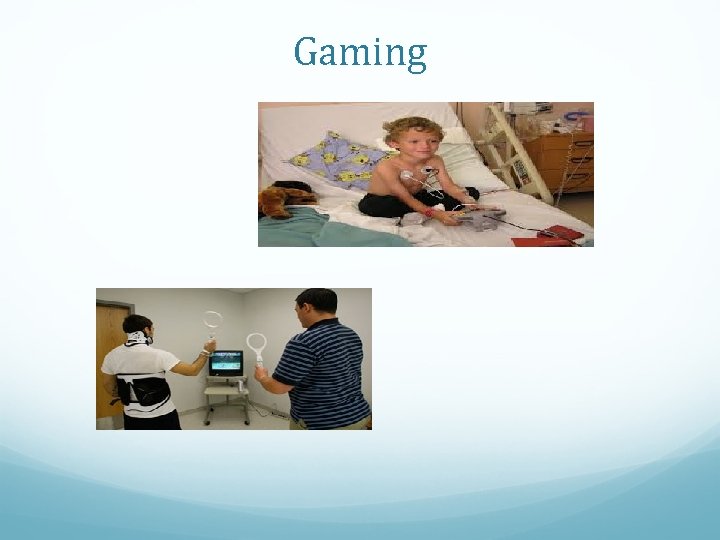
Gaming
Definition Gaming An instructional method requiring the learner to participate in a competitive activity with preset rules to achieve an educational objective
Gaming Games can be simple or they can be more complex to challenge the learner’s ability to use higher order problem-solving and critical thinking strategies
Gaming The goal is for the learners to win a game by applying knowledge and rehearsing skills previously learned.
Gaming Advantages Active learner Perceived as “fun” by many learners Useful for all three domains of learning Limitations Too competitive for some learners
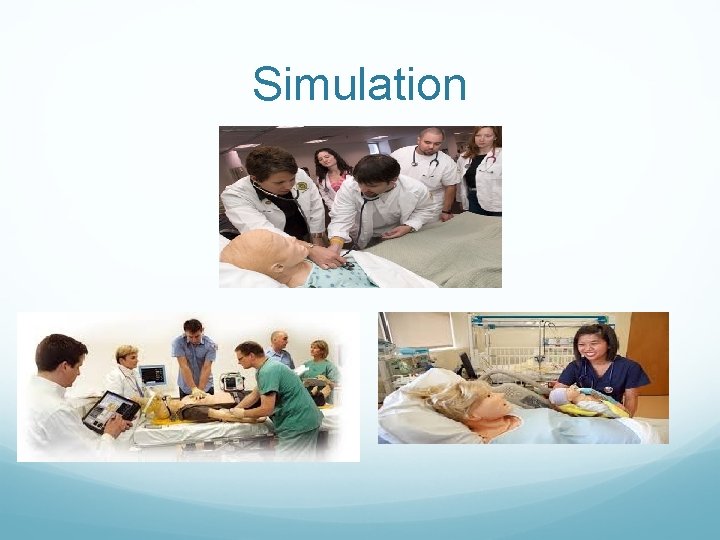
Simulation
Simulation Definition A trial-and-error method of teaching requiring creation of a hypothetical or artificial experience to engage the learner in an activity that reflects real-life conditions without the risk-taking consequences of an actual situation
Types of Simulation Written simulation e. g case studies Clinical simulation e. g mock caediac arrest Model simulation Computer simulation
Simulation Advantages Active learners Practice “reality” in a safe setting Useful for cognitive and psychomotor domains of learning Limitations Labor intensive Costs of equipment
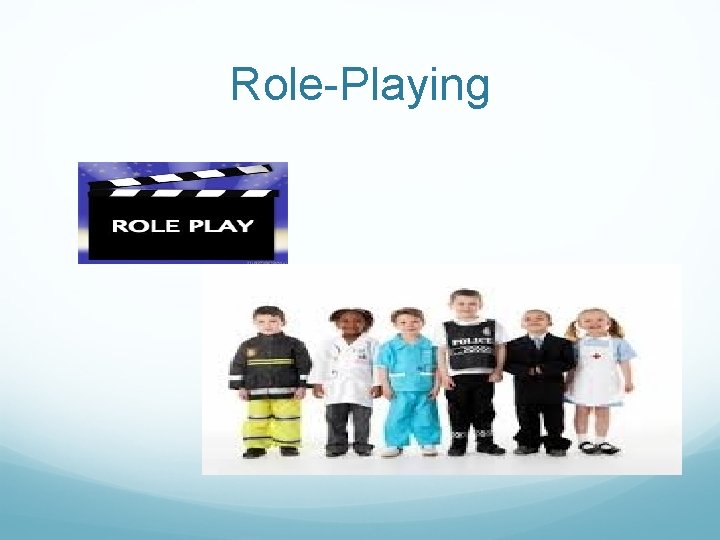
Role-Playing
Role-Playing Definition An instructional method where learners participate in an unrehearsed dramatization to elicit their feelings to achieve affective domain objectives
Role-Playing The responsibility of the teacher is to design a situation with enough information for learners to be able to assume the role of some one else without actually giving them a script to follow
Role-Playing For role playing to be employed effectively, the teacher must be sure that the group has attained a comfort level that allows each member to feel secure enough to participate in a dramatization
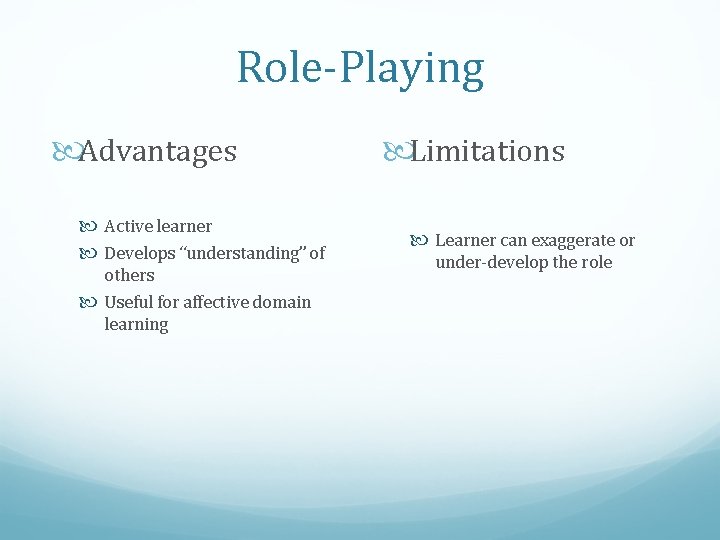
Role-Playing Advantages Active learner Develops “understanding” of others Useful for affective domain learning Limitations Learner can exaggerate or under-develop the role
Role-Modeling
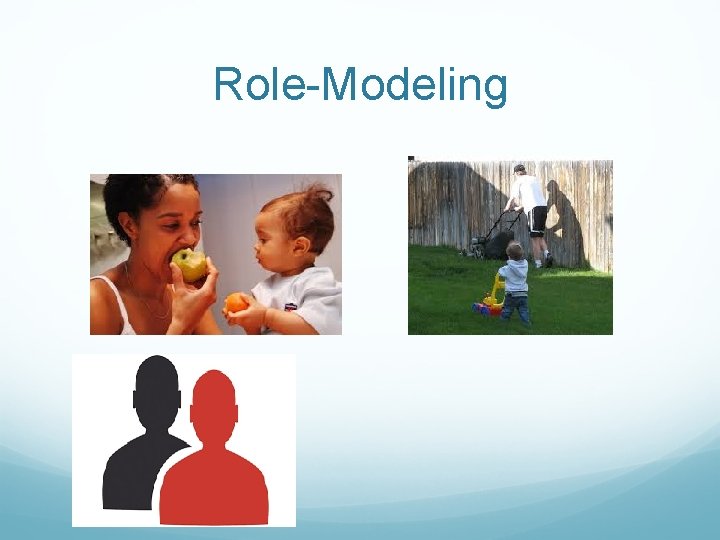
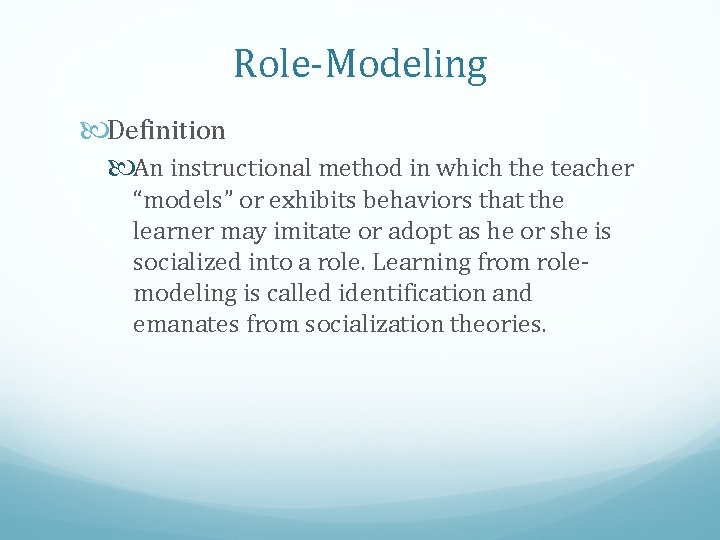
Role-Modeling Definition An instructional method in which the teacher “models” or exhibits behaviors that the learner may imitate or adopt as he or she is socialized into a role. Learning from rolemodeling is called identification and emanates from socialization theories.
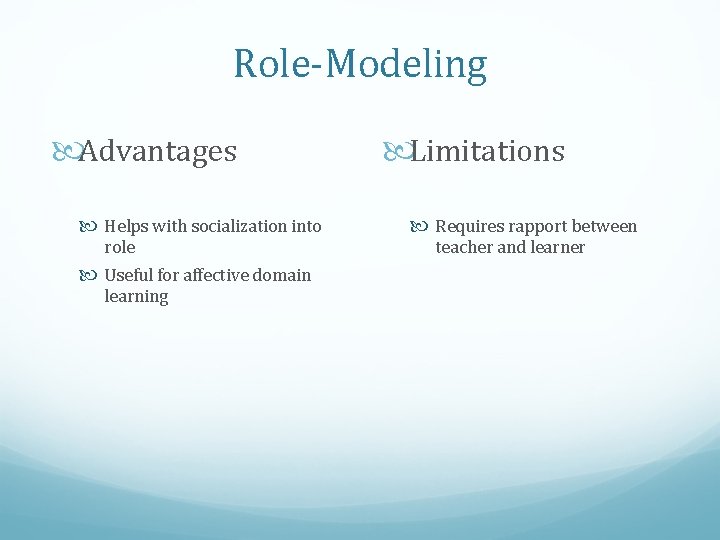
Role-Modeling Advantages Helps with socialization into role Useful for affective domain learning Limitations Requires rapport between teacher and learner
Self-Instruction
Self-Instruction Definition An instructional method to provide activities that guide the learner in independently achieving the educational objectives Such as self instructional package, individualized activities , programmed instruction
Self-Instruction Each self -instruction module need to contain the following elements: An introduction and statement of propose A list of pre-requisite skills A list of behavioral objectives A pretest
Self-Instruction An identification of learning resources and learning activities Periodic self-asesement A posttest
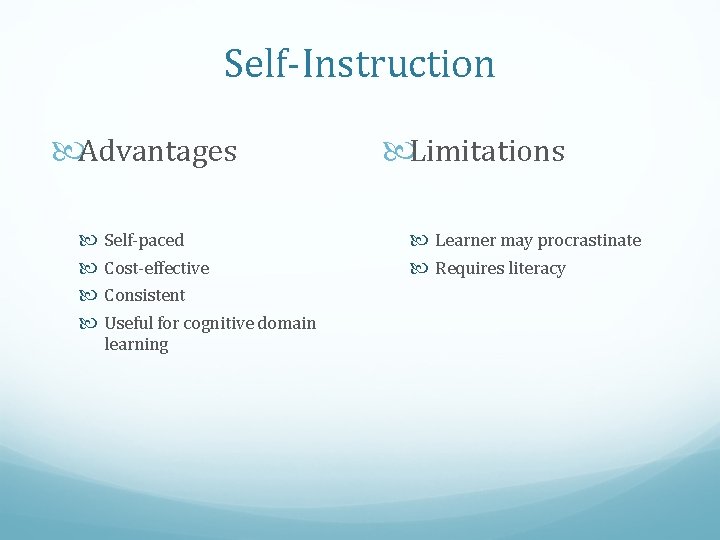
Self-Instruction Advantages Self-paced Cost-effective Consistent Useful for cognitive domain learning Limitations Learner may procrastinate Requires literacy
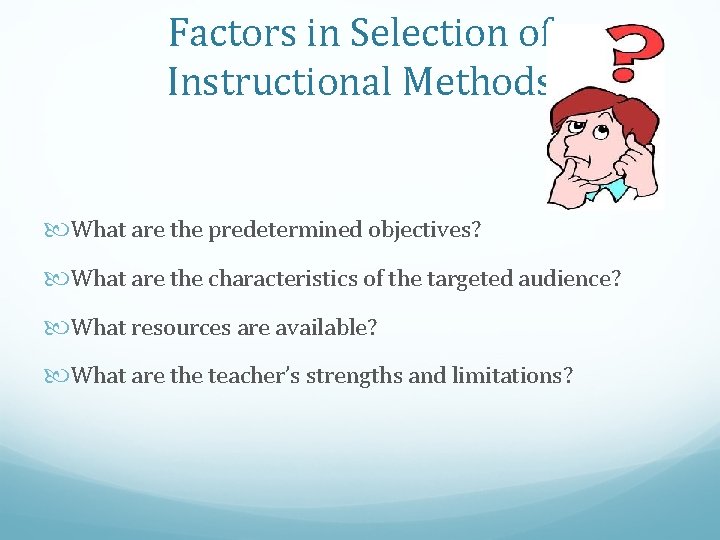
Factors in Selection of Instructional Methods What are the predetermined objectives? What are the characteristics of the targeted audience? What resources are available? What are the teacher’s strengths and limitations?
Evaluation of Instructional Methods
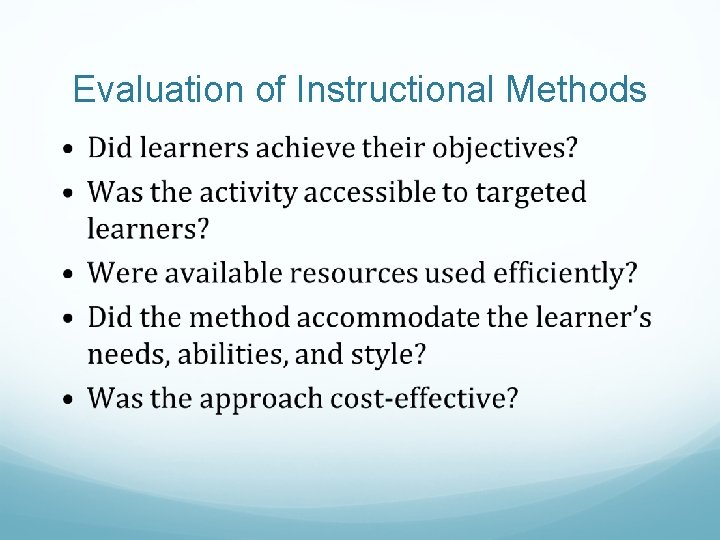
Evaluation of Instructional Methods
Creative Techniques to Enhance Verbal Presentations
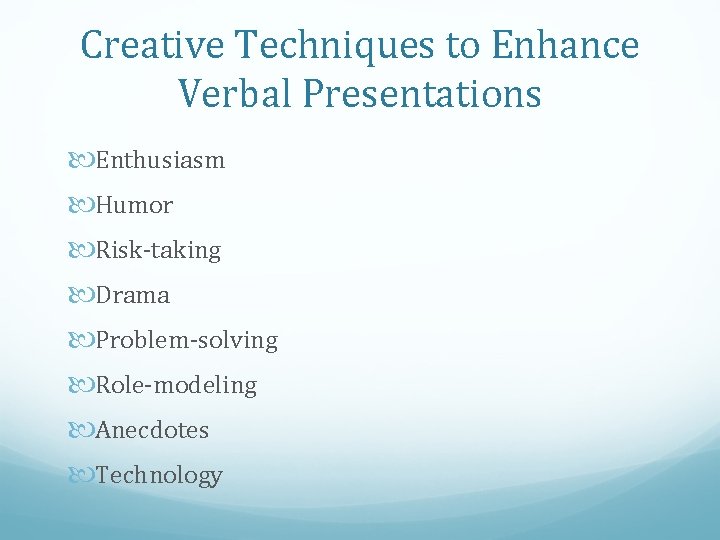
Creative Techniques to Enhance Verbal Presentations Enthusiasm Humor Risk-taking Drama Problem-solving Role-modeling Anecdotes Technology
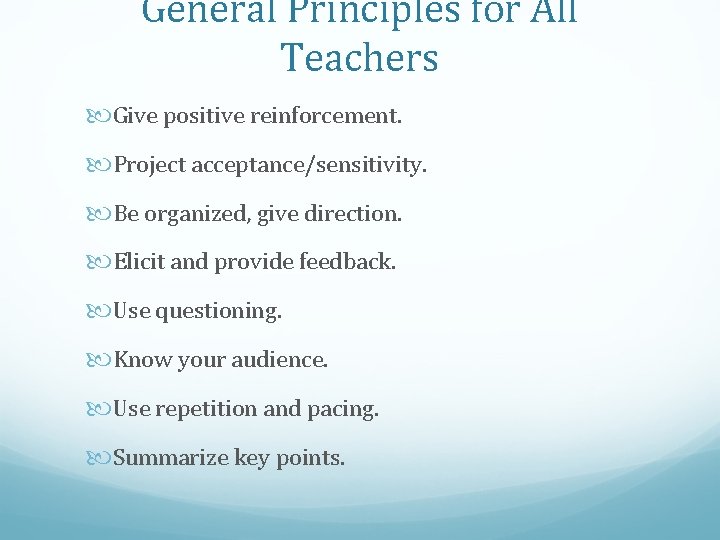
General Principles for All Teachers Give positive reinforcement. Project acceptance/sensitivity. Be organized, give direction. Elicit and provide feedback. Use questioning. Know your audience. Use repetition and pacing. Summarize key points.
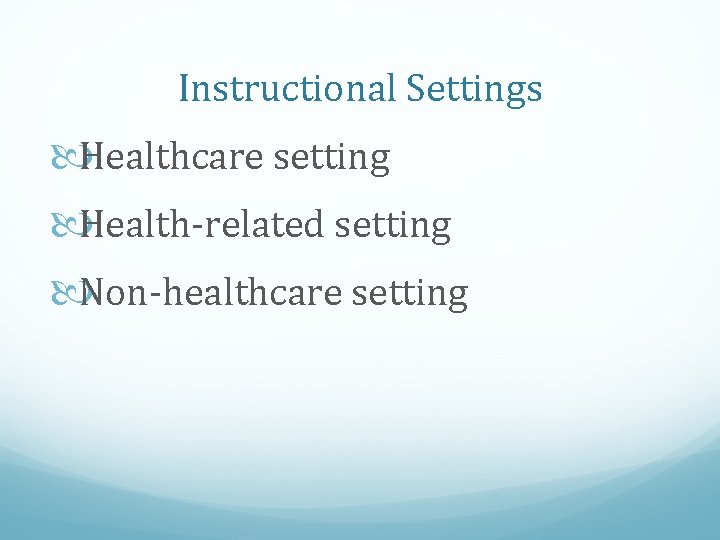
Instructional Settings Healthcare setting Health-related setting Non-healthcare setting
Sharing Resources Nurses in each of the setting types can establish a health education committee to coordinate health education programming, ensure effective use of resources, and avoid duplication of efforts.
Summary Instructional Methods and Settings module has presented in-depth review of the various instructional methods and compared the advantages and limitations of each approach
Summary As a nurse educator you have the responsibility to select proper methods that match the learner characteristics , behavioral objectives , teacher characteristics and available recourses