Improving and Maintaining Voice Quality Cisco Networking Academy


- Slides: 89
Improving and Maintaining Voice Quality Cisco Networking Academy Program IP Telephony © 2005 Cisco Systems, Inc. All rights reserved. Cisco Public 1
IP Qo. S Mechanisms IP Telephony © 2005 Cisco Systems, Inc. All rights reserved. Cisco Public 2
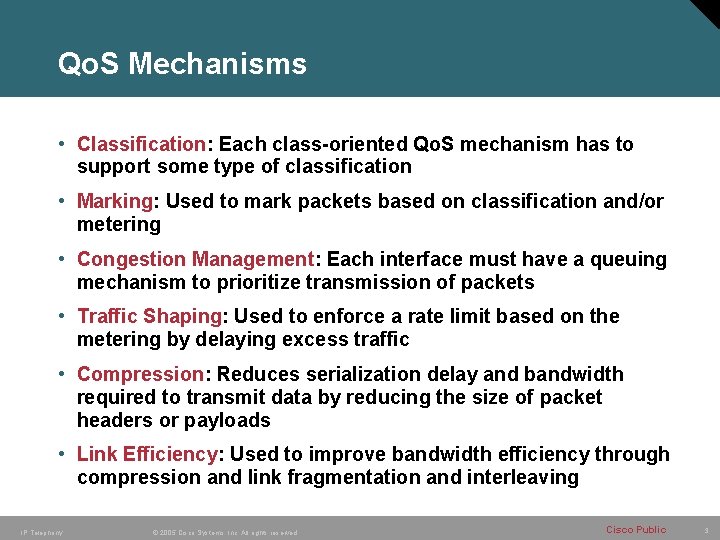
Qo. S Mechanisms • Classification: Each class-oriented Qo. S mechanism has to support some type of classification • Marking: Used to mark packets based on classification and/or metering • Congestion Management: Each interface must have a queuing mechanism to prioritize transmission of packets • Traffic Shaping: Used to enforce a rate limit based on the metering by delaying excess traffic • Compression: Reduces serialization delay and bandwidth required to transmit data by reducing the size of packet headers or payloads • Link Efficiency: Used to improve bandwidth efficiency through compression and link fragmentation and interleaving IP Telephony © 2005 Cisco Systems, Inc. All rights reserved. Cisco Public 3
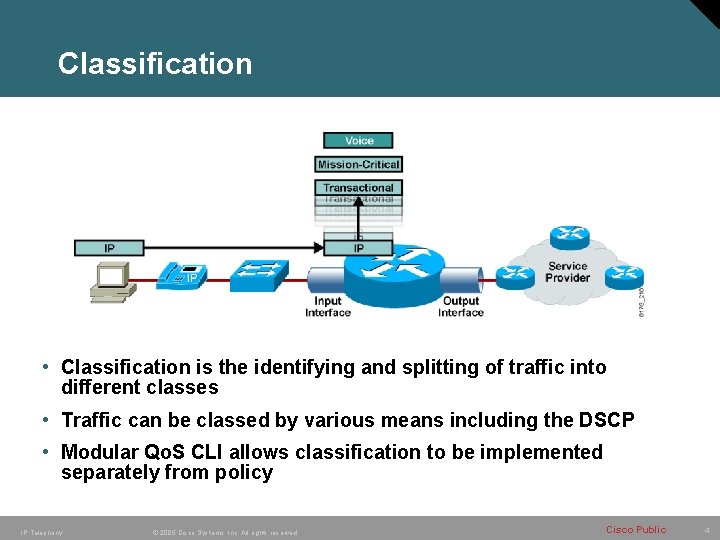
Classification • Classification is the identifying and splitting of traffic into different classes • Traffic can be classed by various means including the DSCP • Modular Qo. S CLI allows classification to be implemented separately from policy IP Telephony © 2005 Cisco Systems, Inc. All rights reserved. Cisco Public 4
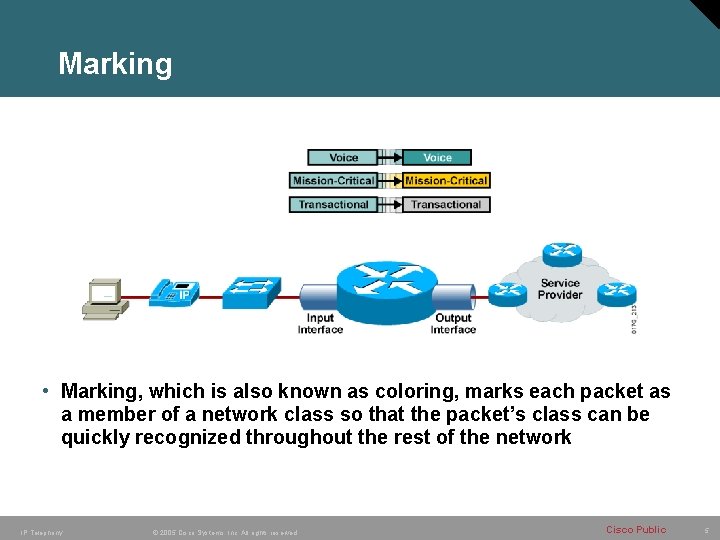
Marking • Marking, which is also known as coloring, marks each packet as a member of a network class so that the packet’s class can be quickly recognized throughout the rest of the network IP Telephony © 2005 Cisco Systems, Inc. All rights reserved. Cisco Public 5
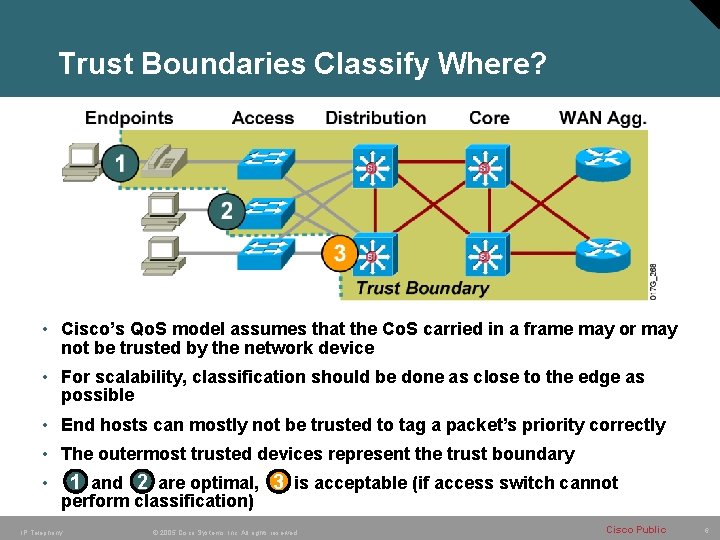
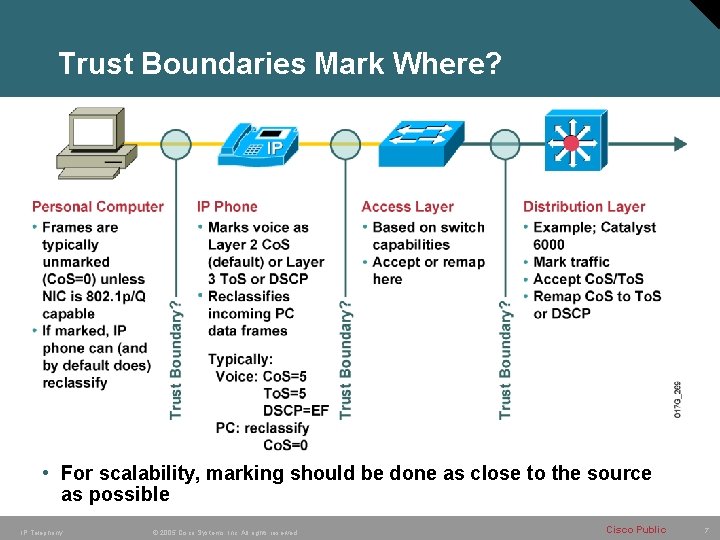
Trust Boundaries Classify Where? • Cisco’s Qo. S model assumes that the Co. S carried in a frame may or may not be trusted by the network device • For scalability, classification should be done as close to the edge as possible • End hosts can mostly not be trusted to tag a packet’s priority correctly • The outermost trusted devices represent the trust boundary • 11 and 22 are optimal, 3 is acceptable (if access switch cannot perform classification) IP Telephony © 2005 Cisco Systems, Inc. All rights reserved. Cisco Public 6
Trust Boundaries Mark Where? • For scalability, marking should be done as close to the source as possible IP Telephony © 2005 Cisco Systems, Inc. All rights reserved. Cisco Public 7
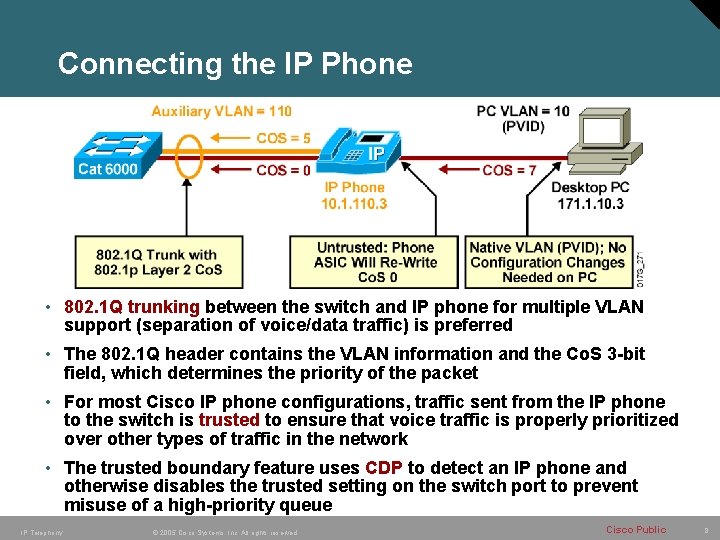
Connecting the IP Phone • 802. 1 Q trunking between the switch and IP phone for multiple VLAN support (separation of voice/data traffic) is preferred • The 802. 1 Q header contains the VLAN information and the Co. S 3 -bit field, which determines the priority of the packet • For most Cisco IP phone configurations, traffic sent from the IP phone to the switch is trusted to ensure that voice traffic is properly prioritized over other types of traffic in the network • The trusted boundary feature uses CDP to detect an IP phone and otherwise disables the trusted setting on the switch port to prevent misuse of a high-priority queue IP Telephony © 2005 Cisco Systems, Inc. All rights reserved. Cisco Public 8
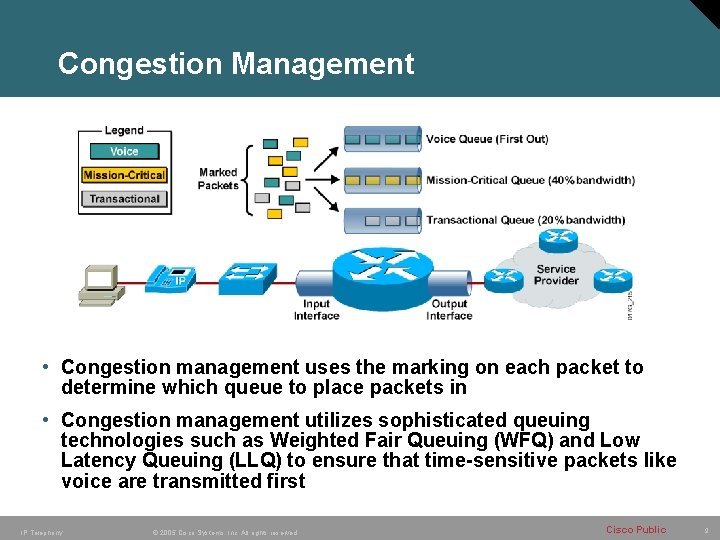
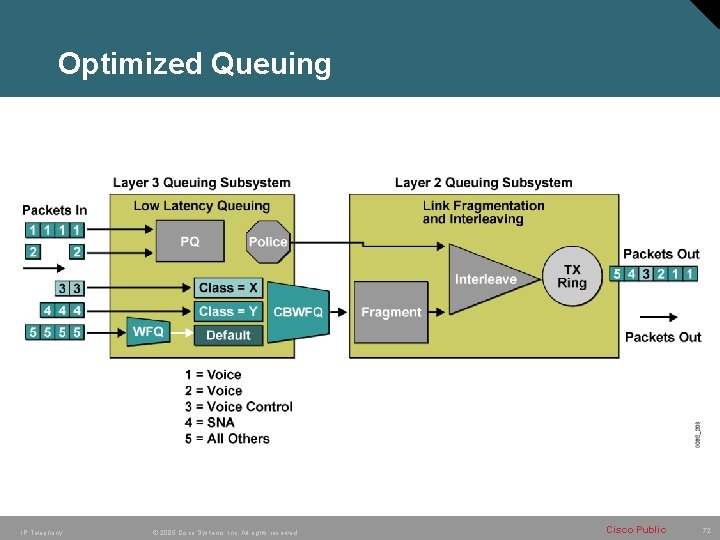
Congestion Management • Congestion management uses the marking on each packet to determine which queue to place packets in • Congestion management utilizes sophisticated queuing technologies such as Weighted Fair Queuing (WFQ) and Low Latency Queuing (LLQ) to ensure that time-sensitive packets like voice are transmitted first IP Telephony © 2005 Cisco Systems, Inc. All rights reserved. Cisco Public 9
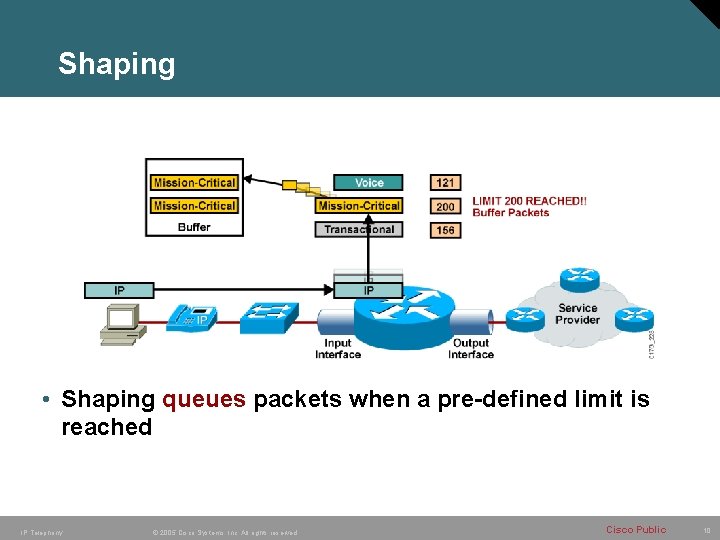
Shaping • Shaping queues packets when a pre-defined limit is reached IP Telephony © 2005 Cisco Systems, Inc. All rights reserved. Cisco Public 10
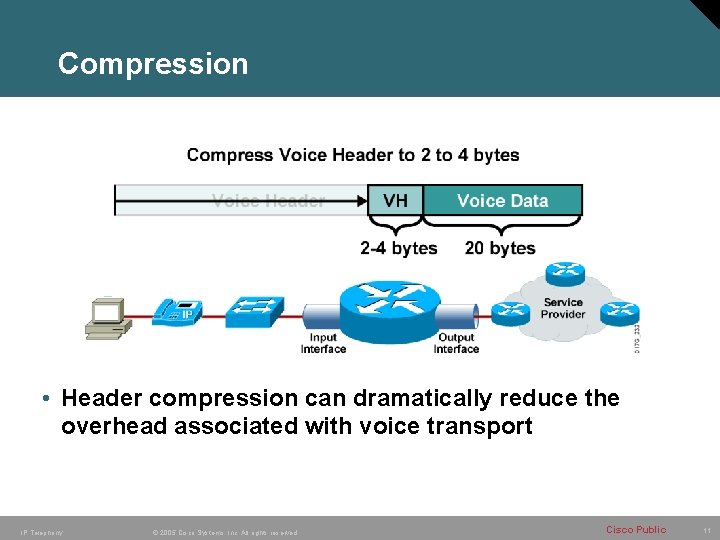
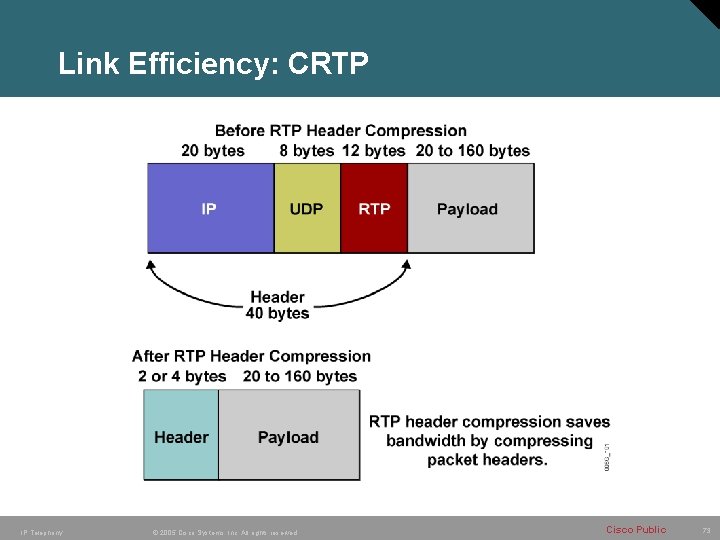
Compression • Header compression can dramatically reduce the overhead associated with voice transport IP Telephony © 2005 Cisco Systems, Inc. All rights reserved. Cisco Public 11
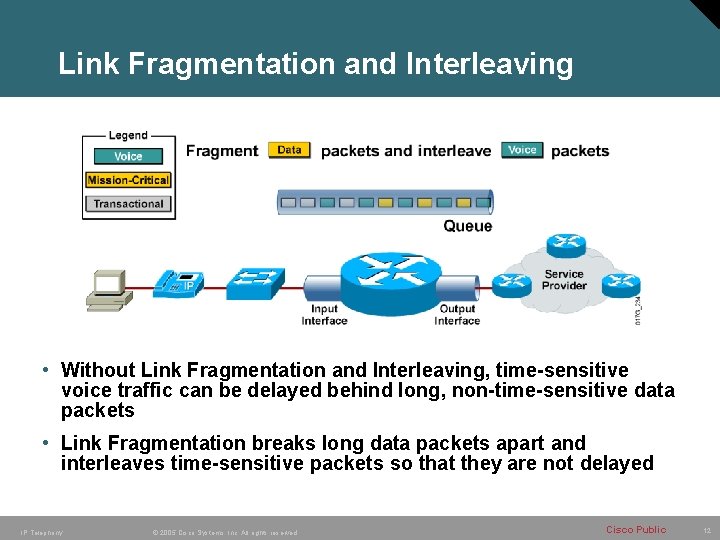
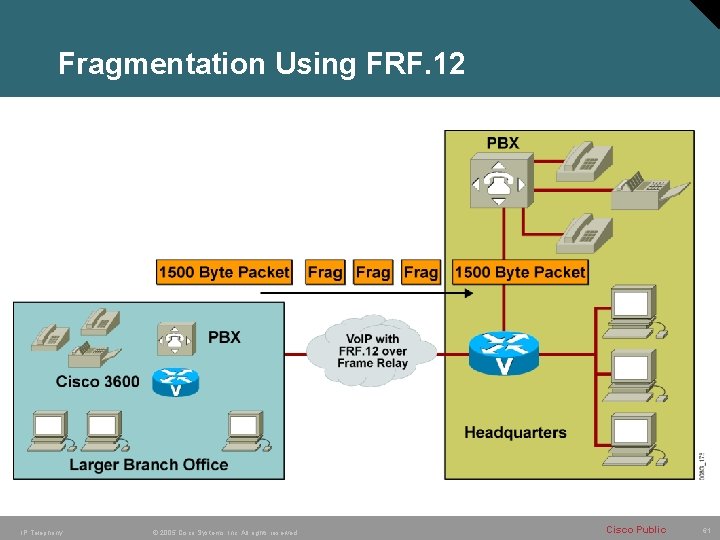
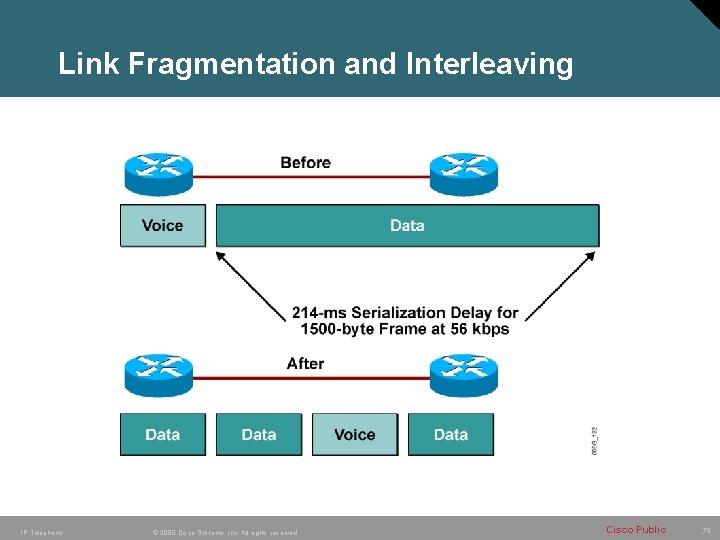
Link Fragmentation and Interleaving • Without Link Fragmentation and Interleaving, time-sensitive voice traffic can be delayed behind long, non-time-sensitive data packets • Link Fragmentation breaks long data packets apart and interleaves time-sensitive packets so that they are not delayed IP Telephony © 2005 Cisco Systems, Inc. All rights reserved. Cisco Public 12
Implementing Auto. Qo. S IP Telephony © 2005 Cisco Systems, Inc. All rights reserved. Cisco Public 13
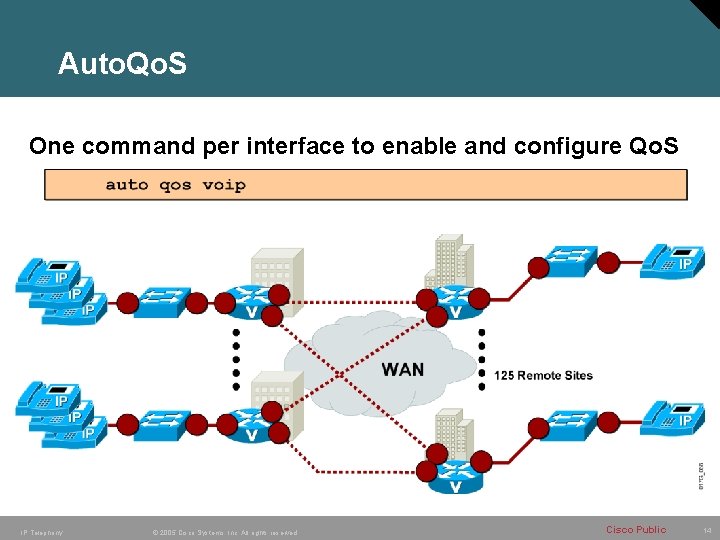
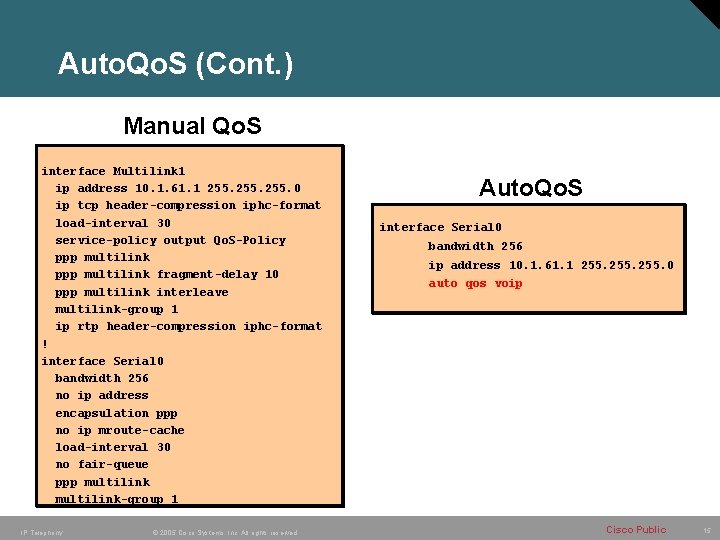
Auto. Qo. S One command per interface to enable and configure Qo. S IP Telephony © 2005 Cisco Systems, Inc. All rights reserved. Cisco Public 14
Auto. Qo. S (Cont. ) Manual Qo. S interface Multilink 1 ip address 10. 1. 61. 1 255. 0 ip tcp header-compression iphc-format load-interval 30 service-policy output Qo. S-Policy ppp multilink fragment-delay 10 ppp multilink interleave multilink-group 1 ip rtp header-compression iphc-format ! interface Serial 0 bandwidth 256 no ip address encapsulation ppp no ip mroute-cache load-interval 30 no fair-queue ppp multilink-group 1 IP Telephony © 2005 Cisco Systems, Inc. All rights reserved. Auto. Qo. S interface Serial 0 bandwidth 256 ip address 10. 1. 61. 1 255. 0 auto qos voip Cisco Public 15
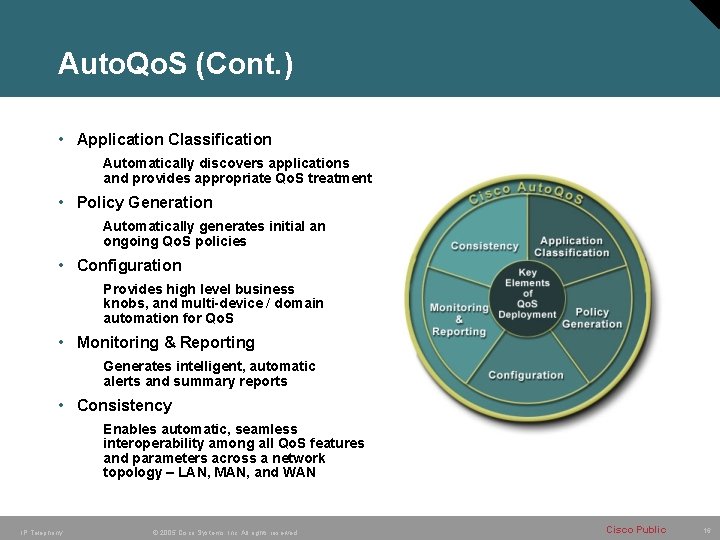
Auto. Qo. S (Cont. ) • Application Classification Automatically discovers applications and provides appropriate Qo. S treatment • Policy Generation Automatically generates initial an ongoing Qo. S policies • Configuration Provides high level business knobs, and multi-device / domain automation for Qo. S • Monitoring & Reporting Generates intelligent, automatic alerts and summary reports • Consistency Enables automatic, seamless interoperability among all Qo. S features and parameters across a network topology – LAN, MAN, and WAN IP Telephony © 2005 Cisco Systems, Inc. All rights reserved. Cisco Public 16
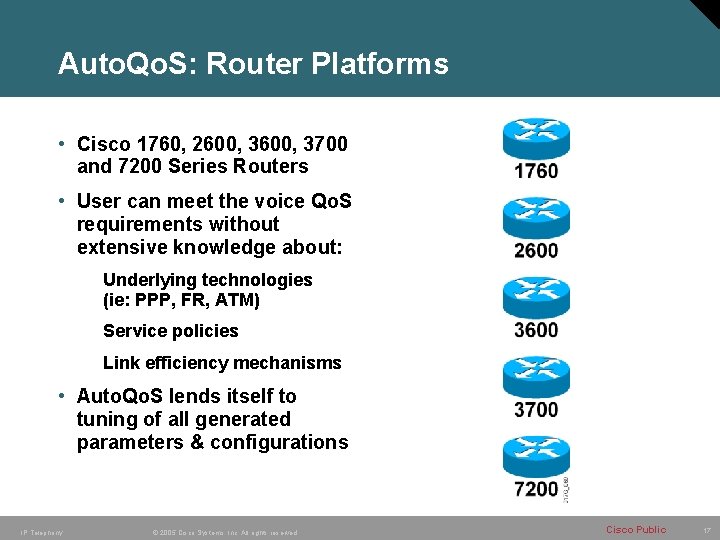
Auto. Qo. S: Router Platforms • Cisco 1760, 2600, 3700 and 7200 Series Routers • User can meet the voice Qo. S requirements without extensive knowledge about: Underlying technologies (ie: PPP, FR, ATM) Service policies Link efficiency mechanisms • Auto. Qo. S lends itself to tuning of all generated parameters & configurations IP Telephony © 2005 Cisco Systems, Inc. All rights reserved. Cisco Public 17
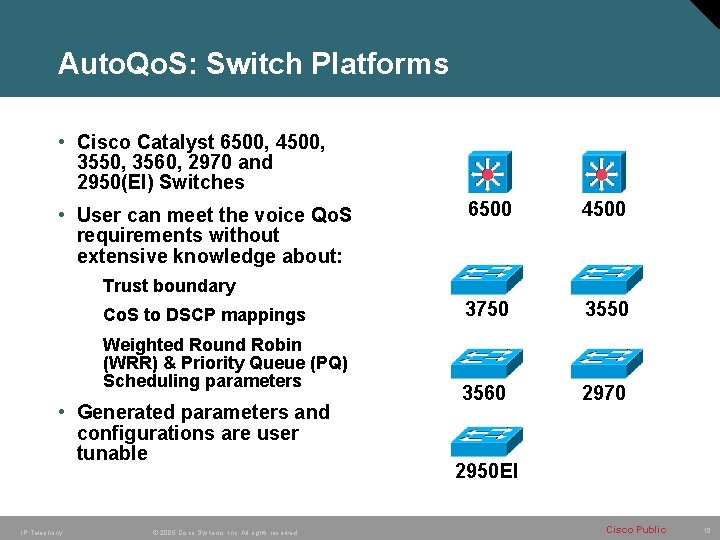
Auto. Qo. S: Switch Platforms • Cisco Catalyst 6500, 4500, 3550, 3560, 2970 and 2950(EI) Switches • User can meet the voice Qo. S requirements without extensive knowledge about: 6500 4500 3750 3560 2970 Trust boundary Co. S to DSCP mappings Weighted Round Robin (WRR) & Priority Queue (PQ) Scheduling parameters • Generated parameters and configurations are user tunable IP Telephony © 2005 Cisco Systems, Inc. All rights reserved. 2950 EI Cisco Public 18
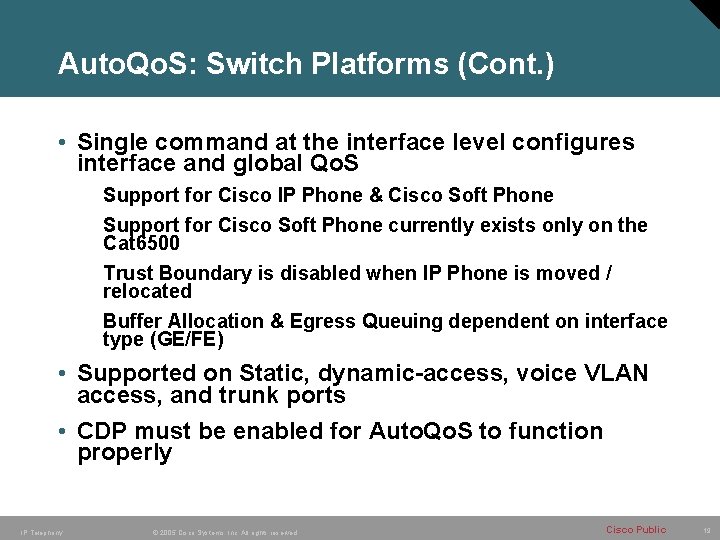
Auto. Qo. S: Switch Platforms (Cont. ) • Single command at the interface level configures interface and global Qo. S Support for Cisco IP Phone & Cisco Soft Phone Support for Cisco Soft Phone currently exists only on the Cat 6500 Trust Boundary is disabled when IP Phone is moved / relocated Buffer Allocation & Egress Queuing dependent on interface type (GE/FE) • Supported on Static, dynamic-access, voice VLAN access, and trunk ports • CDP must be enabled for Auto. Qo. S to function properly IP Telephony © 2005 Cisco Systems, Inc. All rights reserved. Cisco Public 19
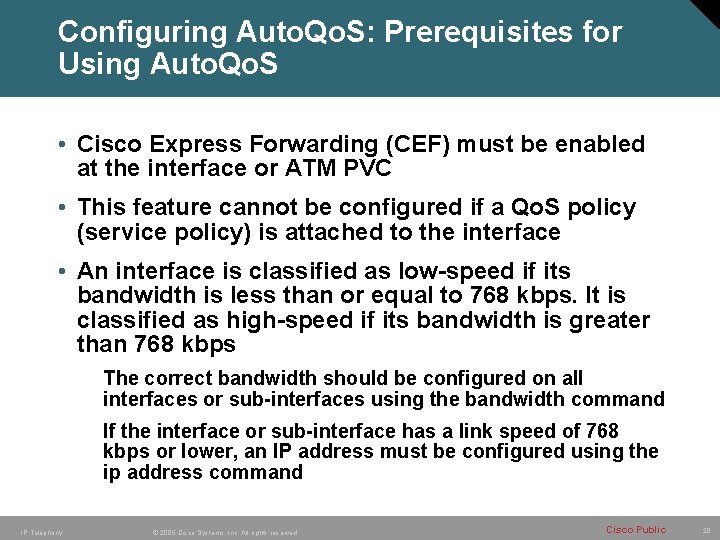
Configuring Auto. Qo. S: Prerequisites for Using Auto. Qo. S • Cisco Express Forwarding (CEF) must be enabled at the interface or ATM PVC • This feature cannot be configured if a Qo. S policy (service policy) is attached to the interface • An interface is classified as low-speed if its bandwidth is less than or equal to 768 kbps. It is classified as high-speed if its bandwidth is greater than 768 kbps The correct bandwidth should be configured on all interfaces or sub-interfaces using the bandwidth command If the interface or sub-interface has a link speed of 768 kbps or lower, an IP address must be configured using the ip address command IP Telephony © 2005 Cisco Systems, Inc. All rights reserved. Cisco Public 20
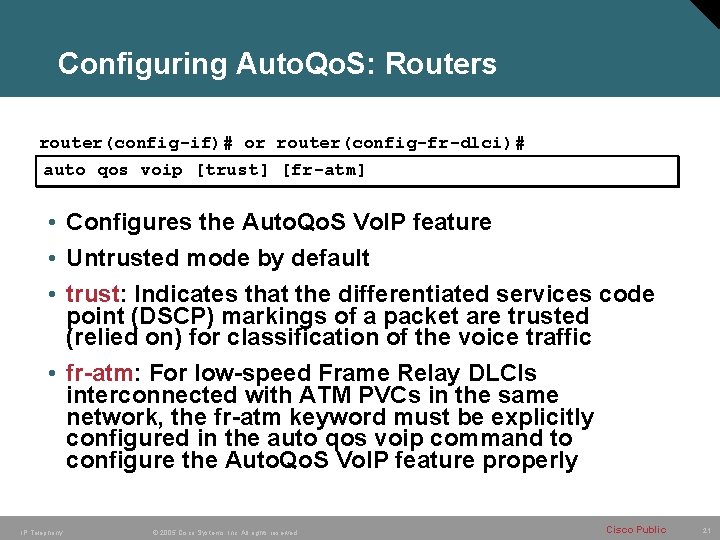
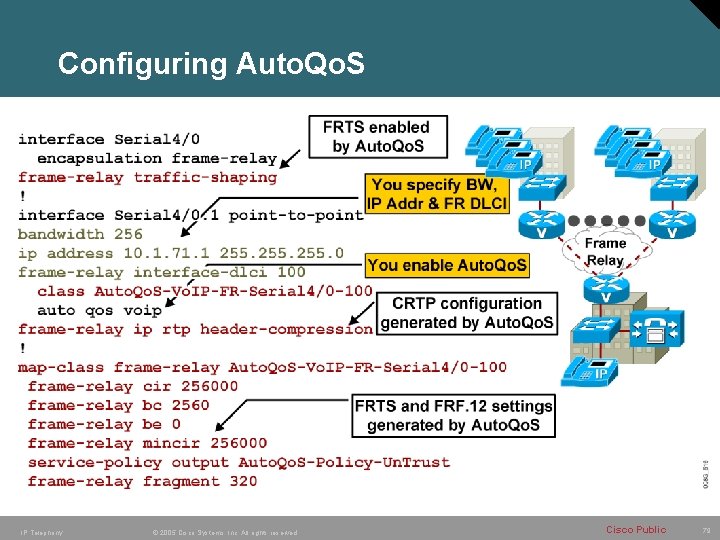
Configuring Auto. Qo. S: Routers router(config-if)# or router(config-fr-dlci)# auto qos voip [trust] [fr-atm] • Configures the Auto. Qo. S Vo. IP feature • Untrusted mode by default • trust: Indicates that the differentiated services code point (DSCP) markings of a packet are trusted (relied on) for classification of the voice traffic • fr-atm: For low-speed Frame Relay DLCIs interconnected with ATM PVCs in the same network, the fr-atm keyword must be explicitly configured in the auto qos voip command to configure the Auto. Qo. S Vo. IP feature properly IP Telephony © 2005 Cisco Systems, Inc. All rights reserved. Cisco Public 21
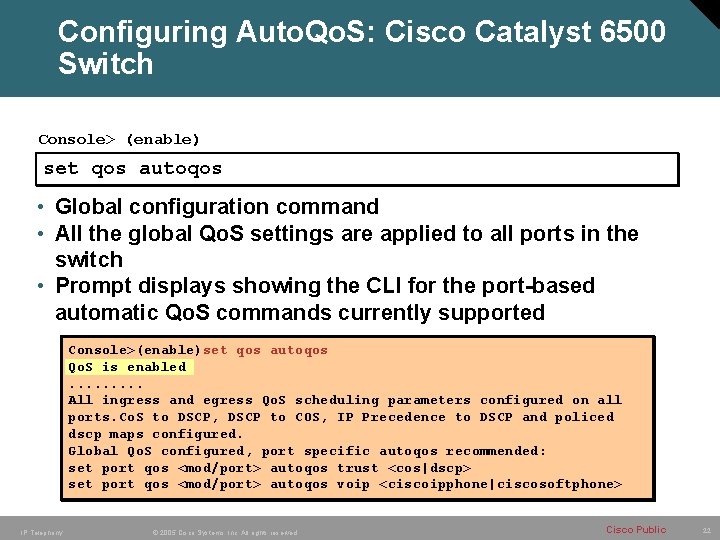
Configuring Auto. Qo. S: Cisco Catalyst 6500 Switch Console> (enable) set qos autoqos • Global configuration command • All the global Qo. S settings are applied to all ports in the switch • Prompt displays showing the CLI for the port-based automatic Qo. S commands currently supported Console>(enable)set qos autoqos Qo. S is enabled. . All ingress and egress Qo. S scheduling parameters configured on all ports. Co. S to DSCP, DSCP to COS, IP Precedence to DSCP and policed dscp maps configured. Global Qo. S configured, port specific autoqos recommended: set port qos <mod/port> autoqos trust <cos|dscp> set port qos <mod/port> autoqos voip <ciscoipphone|ciscosoftphone> IP Telephony © 2005 Cisco Systems, Inc. All rights reserved. Cisco Public 22
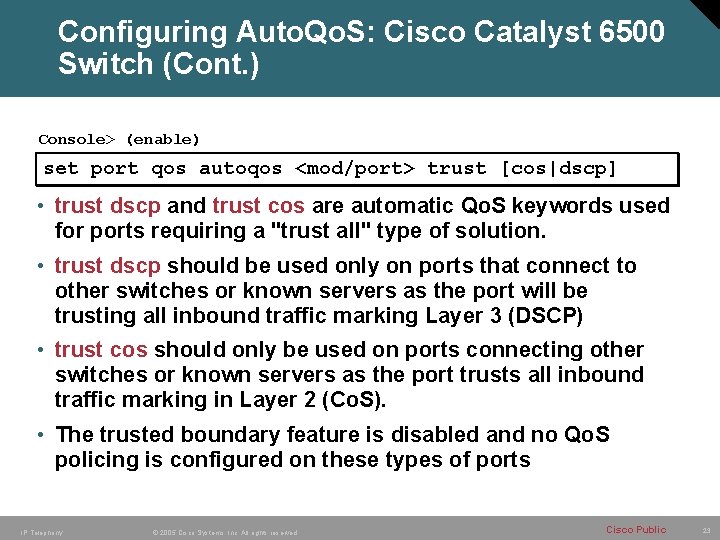
Configuring Auto. Qo. S: Cisco Catalyst 6500 Switch (Cont. ) Console> (enable) set port qos autoqos <mod/port> trust [cos|dscp] • trust dscp and trust cos are automatic Qo. S keywords used for ports requiring a "trust all" type of solution. • trust dscp should be used only on ports that connect to other switches or known servers as the port will be trusting all inbound traffic marking Layer 3 (DSCP) • trust cos should only be used on ports connecting other switches or known servers as the port trusts all inbound traffic marking in Layer 2 (Co. S). • The trusted boundary feature is disabled and no Qo. S policing is configured on these types of ports IP Telephony © 2005 Cisco Systems, Inc. All rights reserved. Cisco Public 23
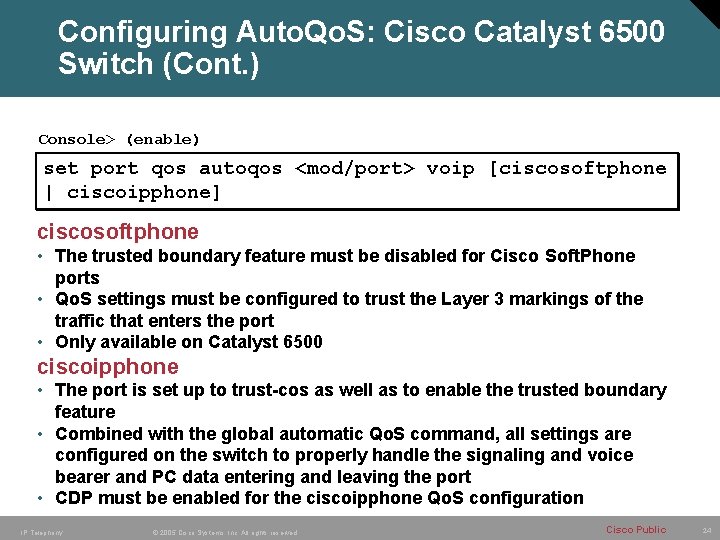
Configuring Auto. Qo. S: Cisco Catalyst 6500 Switch (Cont. ) Console> (enable) set port qos autoqos <mod/port> voip [ciscosoftphone | ciscoipphone] ciscosoftphone • The trusted boundary feature must be disabled for Cisco Soft. Phone ports • Qo. S settings must be configured to trust the Layer 3 markings of the traffic that enters the port • Only available on Catalyst 6500 ciscoipphone • The port is set up to trust-cos as well as to enable the trusted boundary feature • Combined with the global automatic Qo. S command, all settings are configured on the switch to properly handle the signaling and voice bearer and PC data entering and leaving the port • CDP must be enabled for the ciscoipphone Qo. S configuration IP Telephony © 2005 Cisco Systems, Inc. All rights reserved. Cisco Public 24
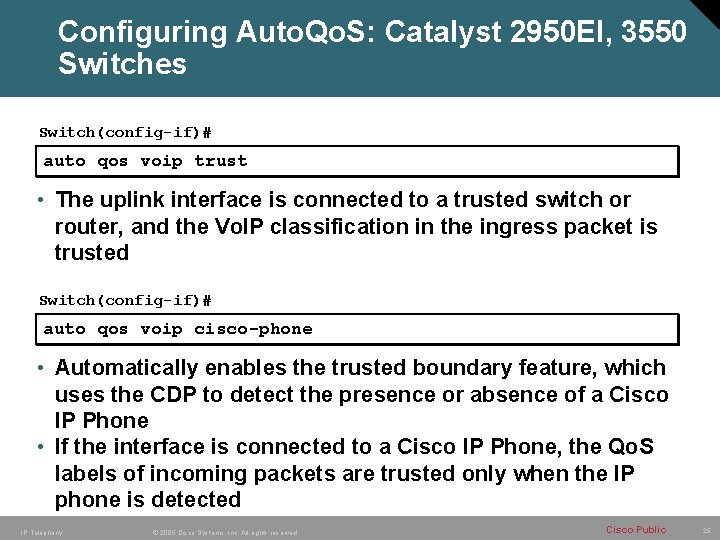
Configuring Auto. Qo. S: Catalyst 2950 EI, 3550 Switches Switch(config-if)# auto qos voip trust • The uplink interface is connected to a trusted switch or router, and the Vo. IP classification in the ingress packet is trusted Switch(config-if)# auto qos voip cisco-phone • Automatically enables the trusted boundary feature, which uses the CDP to detect the presence or absence of a Cisco IP Phone • If the interface is connected to a Cisco IP Phone, the Qo. S labels of incoming packets are trusted only when the IP phone is detected IP Telephony © 2005 Cisco Systems, Inc. All rights reserved. Cisco Public 25
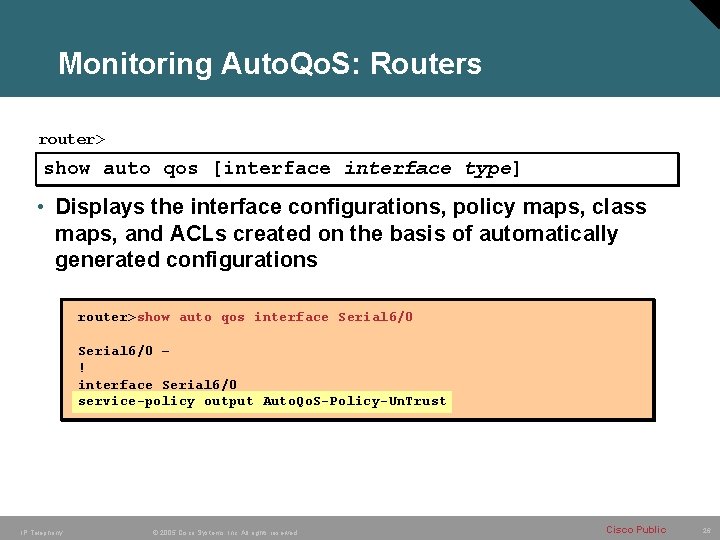
Monitoring Auto. Qo. S: Routers router> show auto qos [interface type] • Displays the interface configurations, policy maps, class maps, and ACLs created on the basis of automatically generated configurations router>show auto qos interface Serial 6/0 – ! interface Serial 6/0 service-policy output Auto. Qo. S-Policy-Un. Trust IP Telephony © 2005 Cisco Systems, Inc. All rights reserved. Cisco Public 26
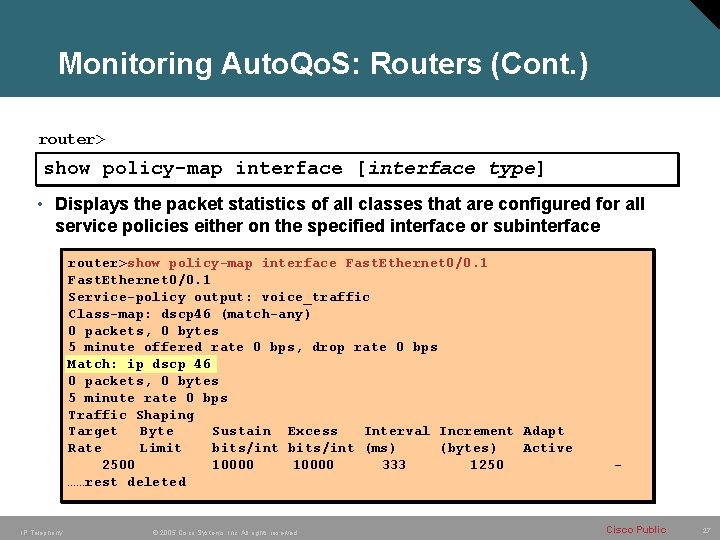
Monitoring Auto. Qo. S: Routers (Cont. ) router> show policy-map interface [interface type] • Displays the packet statistics of all classes that are configured for all service policies either on the specified interface or subinterface router>show policy-map interface Fast. Ethernet 0/0. 1 Service-policy output: voice_traffic Class-map: dscp 46 (match-any) 0 packets, 0 bytes 5 minute offered rate 0 bps, drop rate 0 bps Match: ip dscp 46 0 packets, 0 bytes 5 minute rate 0 bps Traffic Shaping Target Byte Sustain Excess Interval Increment Adapt Rate Limit bits/int (ms) (bytes) Active 2500 10000 333 1250 - ……rest deleted IP Telephony © 2005 Cisco Systems, Inc. All rights reserved. Cisco Public 27
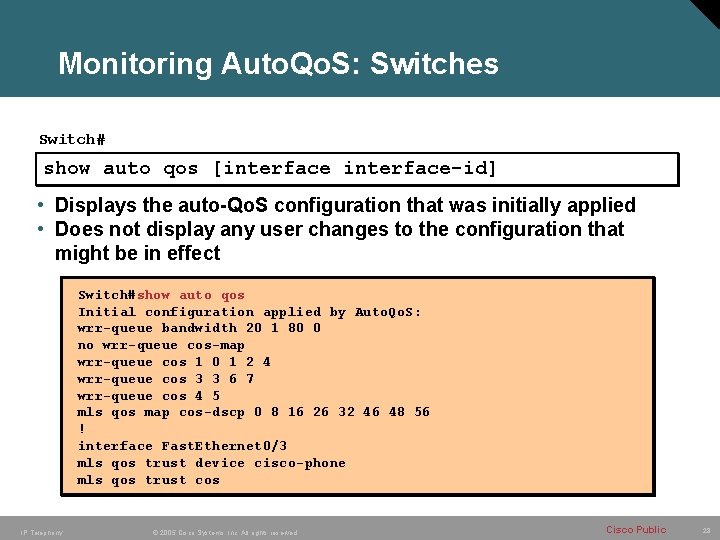
Monitoring Auto. Qo. S: Switches Switch# show auto qos [interface-id] • Displays the auto-Qo. S configuration that was initially applied • Does not display any user changes to the configuration that might be in effect Switch#show auto qos Initial configuration applied by Auto. Qo. S: wrr-queue bandwidth 20 1 80 0 no wrr-queue cos-map wrr-queue cos 1 0 1 2 4 wrr-queue cos 3 3 6 7 wrr-queue cos 4 5 mls qos map cos-dscp 0 8 16 26 32 46 48 56 ! interface Fast. Ethernet 0/3 mls qos trust device cisco-phone mls qos trust cos IP Telephony © 2005 Cisco Systems, Inc. All rights reserved. Cisco Public 28
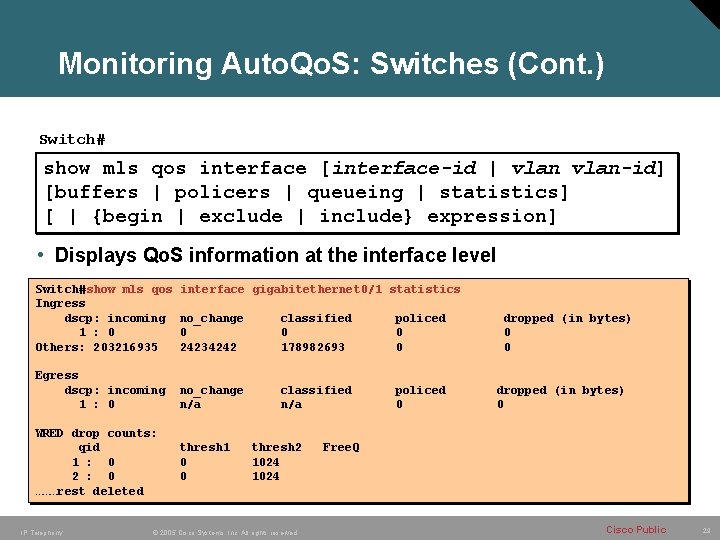
Monitoring Auto. Qo. S: Switches (Cont. ) Switch# show mls qos interface [interface-id | vlan-id] [buffers | policers | queueing | statistics] [ | {begin | exclude | include} expression] • Displays Qo. S information at the interface level Switch#show mls qos interface gigabitethernet 0/1 statistics Ingress dscp: incoming no_change classified policed dropped (in bytes) 1 : 0 0 0 0 Others: 203216935 24234242 178982693 0 0 Egress dscp: incoming no_change classified policed dropped (in bytes) 1 : 0 n/a 0 0 WRED drop counts: qid 1 : 0 2 : 0 ………rest deleted IP Telephony thresh 1 0 0 thresh 2 1024 © 2005 Cisco Systems, Inc. All rights reserved. Free. Q Cisco Public 29
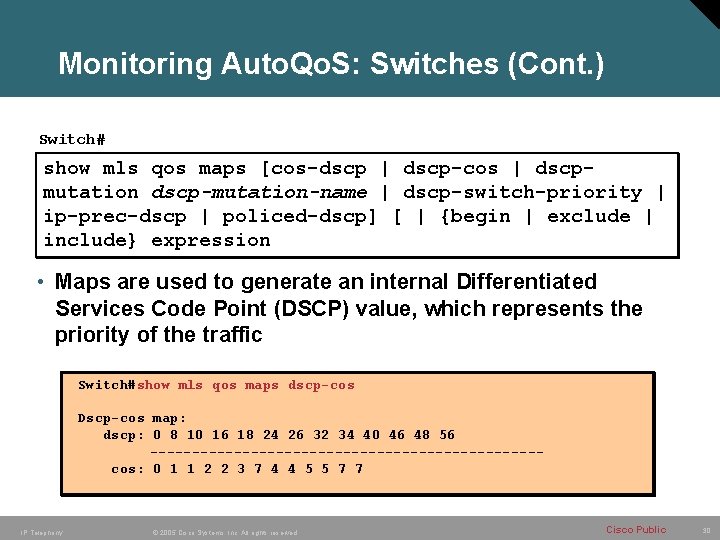
Monitoring Auto. Qo. S: Switches (Cont. ) Switch# show mls qos maps [cos-dscp | dscp-cos | dscpmutation dscp-mutation-name | dscp-switch-priority | ip-prec-dscp | policed-dscp] [ | {begin | exclude | include} expression • Maps are used to generate an internal Differentiated Services Code Point (DSCP) value, which represents the priority of the traffic Switch#show mls qos maps dscp-cos Dscp-cos map: dscp: 0 8 10 16 18 24 26 32 34 40 46 48 56 ----------------------- cos: 0 1 1 2 2 3 7 4 4 5 5 7 7 IP Telephony © 2005 Cisco Systems, Inc. All rights reserved. Cisco Public 30
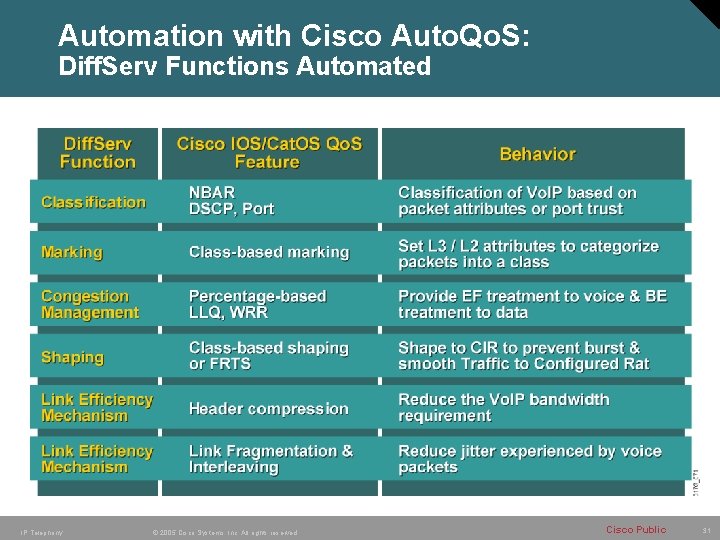
Automation with Cisco Auto. Qo. S: Diff. Serv Functions Automated IP Telephony © 2005 Cisco Systems, Inc. All rights reserved. Cisco Public 31
Comparing Voice Quality Measurement Standards IP Telephony © 2005 Cisco Systems, Inc. All rights reserved. Cisco Public 32
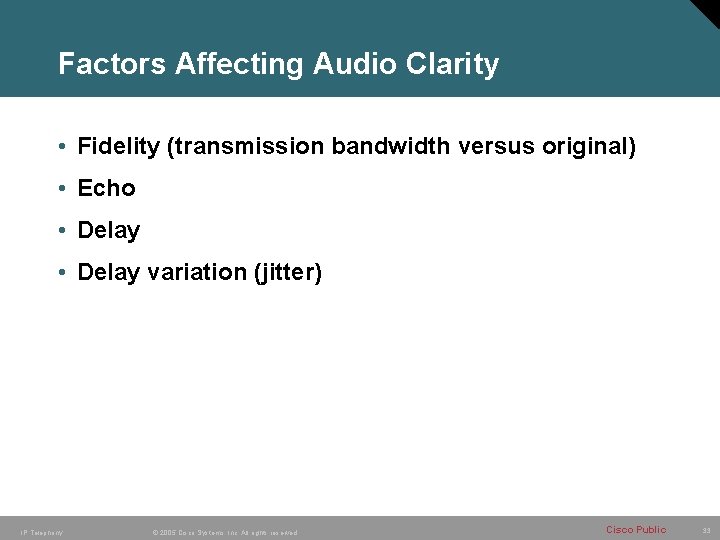
Factors Affecting Audio Clarity • Fidelity (transmission bandwidth versus original) • Echo • Delay variation (jitter) IP Telephony © 2005 Cisco Systems, Inc. All rights reserved. Cisco Public 33
Vo. IP Challenges IP Telephony © 2005 Cisco Systems, Inc. All rights reserved. Cisco Public 34
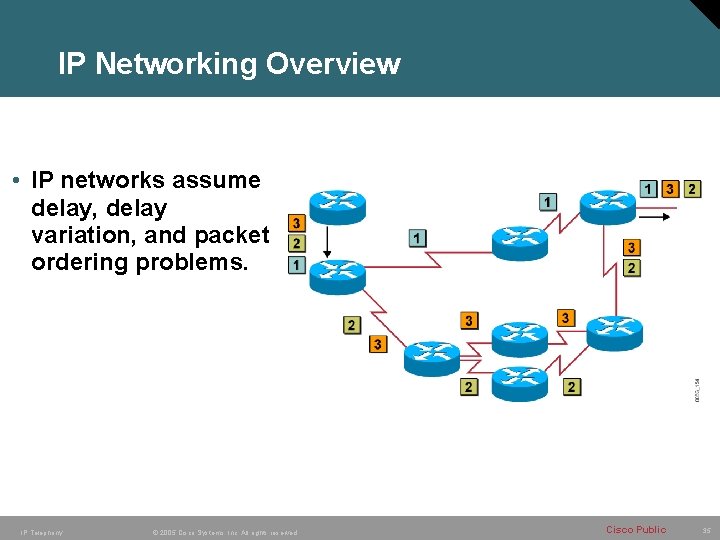
IP Networking Overview • IP networks assume delay, delay variation, and packet ordering problems. IP Telephony © 2005 Cisco Systems, Inc. All rights reserved. Cisco Public 35
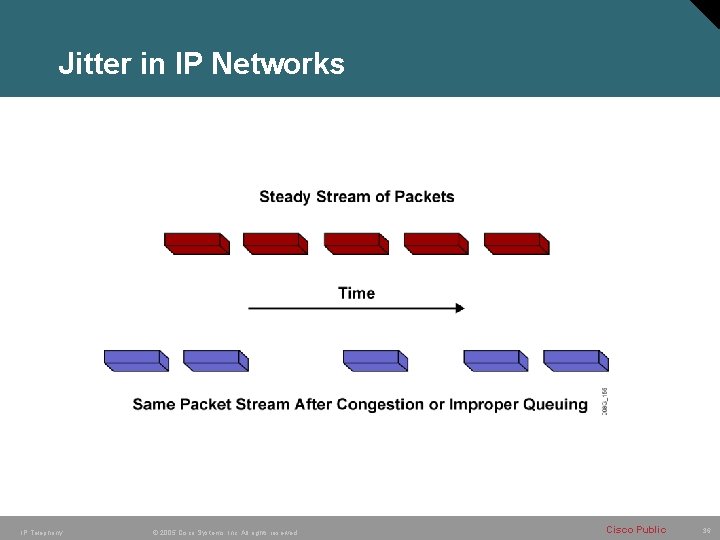
Jitter in IP Networks IP Telephony © 2005 Cisco Systems, Inc. All rights reserved. Cisco Public 36
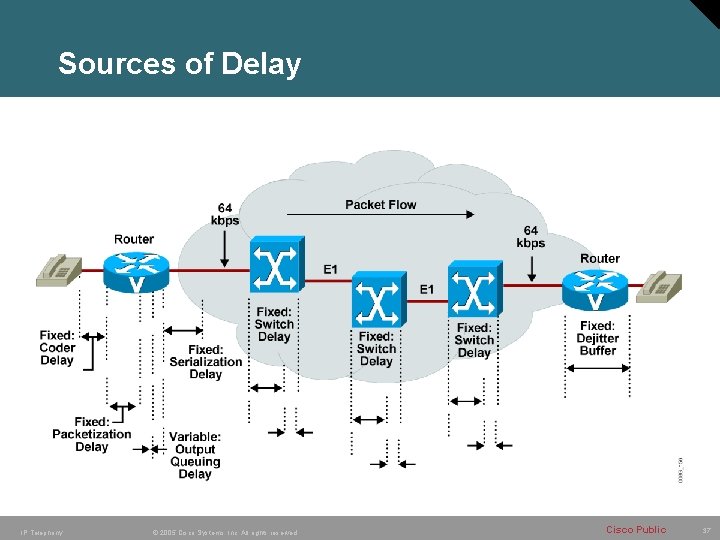
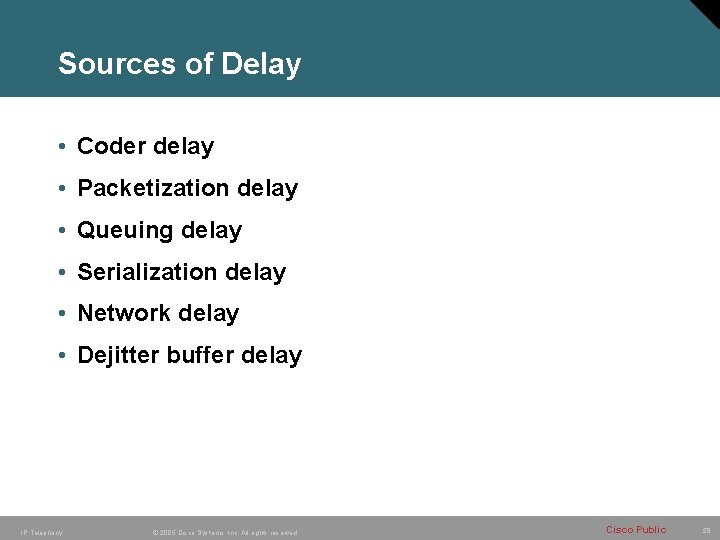
Sources of Delay IP Telephony © 2005 Cisco Systems, Inc. All rights reserved. Cisco Public 37
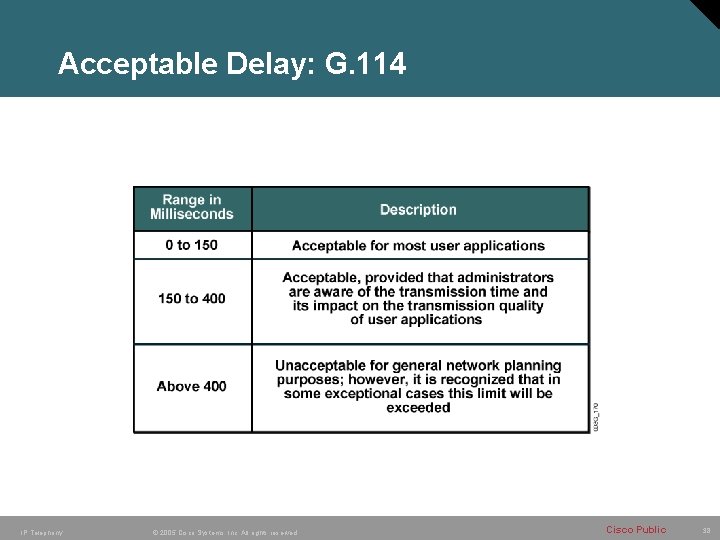
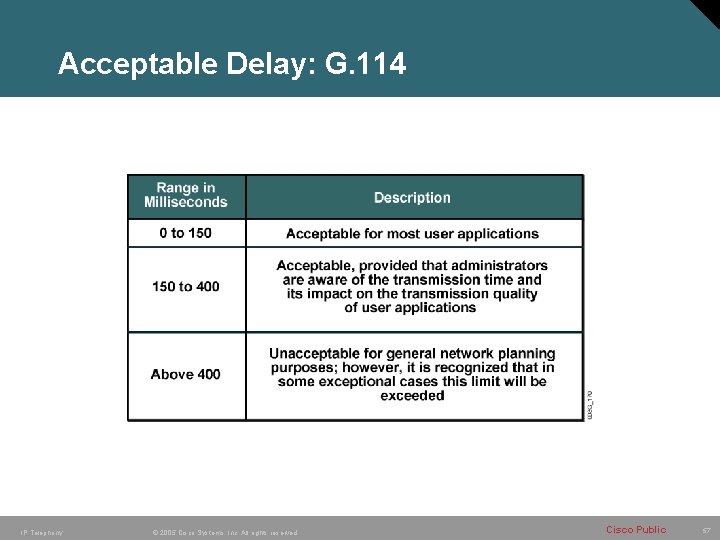
Acceptable Delay: G. 114 IP Telephony © 2005 Cisco Systems, Inc. All rights reserved. Cisco Public 38
Qo. S and Good Design IP Telephony © 2005 Cisco Systems, Inc. All rights reserved. Cisco Public 39
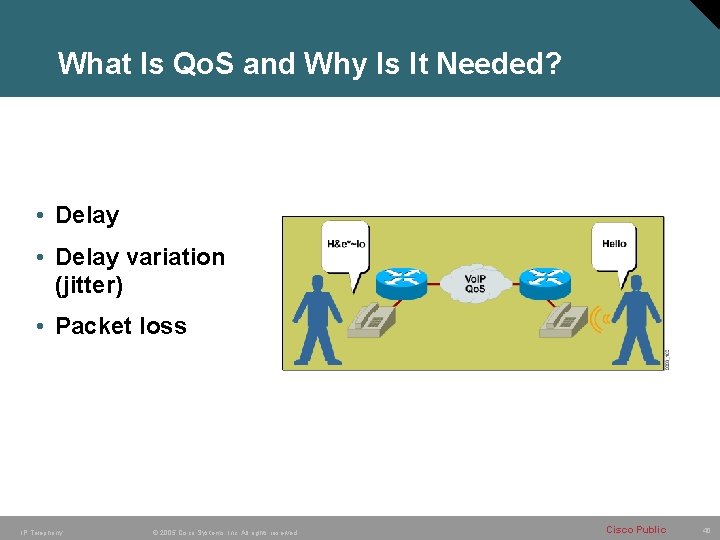
What Is Qo. S and Why Is It Needed? • Delay variation (jitter) • Packet loss IP Telephony © 2005 Cisco Systems, Inc. All rights reserved. Cisco Public 40
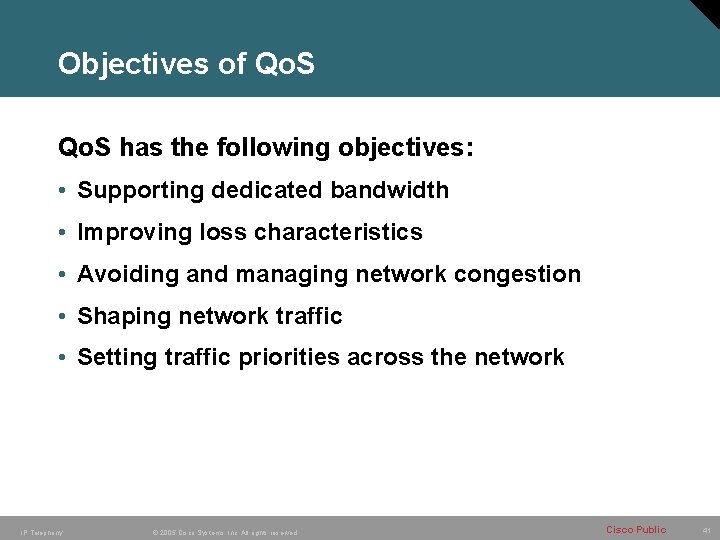
Objectives of Qo. S has the following objectives: • Supporting dedicated bandwidth • Improving loss characteristics • Avoiding and managing network congestion • Shaping network traffic • Setting traffic priorities across the network IP Telephony © 2005 Cisco Systems, Inc. All rights reserved. Cisco Public 41
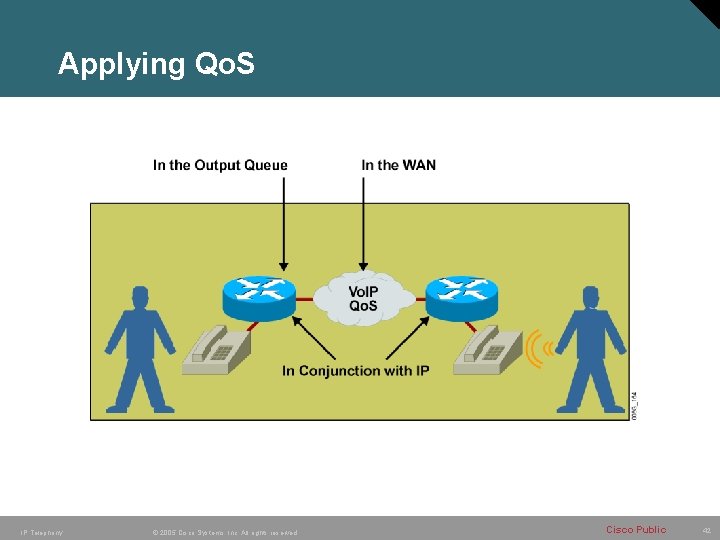
Applying Qo. S IP Telephony © 2005 Cisco Systems, Inc. All rights reserved. Cisco Public 42
Jitter IP Telephony © 2005 Cisco Systems, Inc. All rights reserved. Cisco Public 43
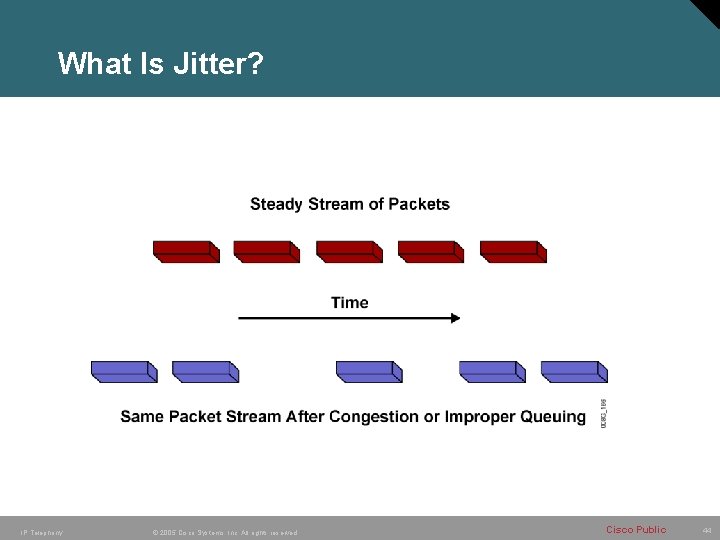
What Is Jitter? IP Telephony © 2005 Cisco Systems, Inc. All rights reserved. Cisco Public 44
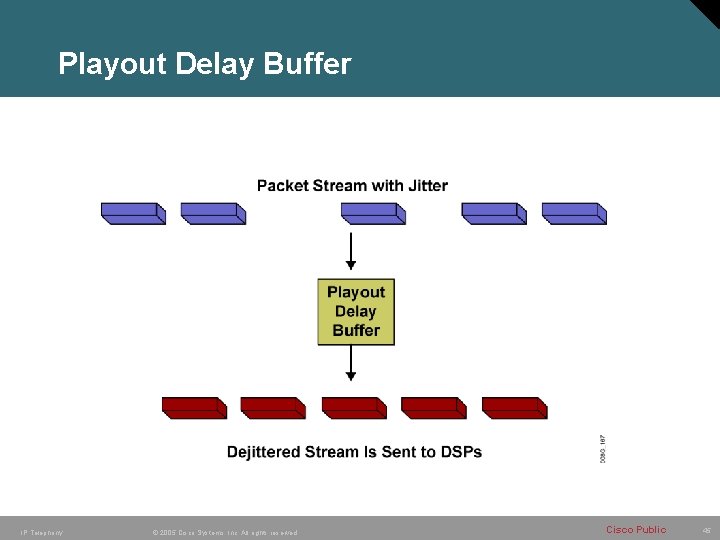
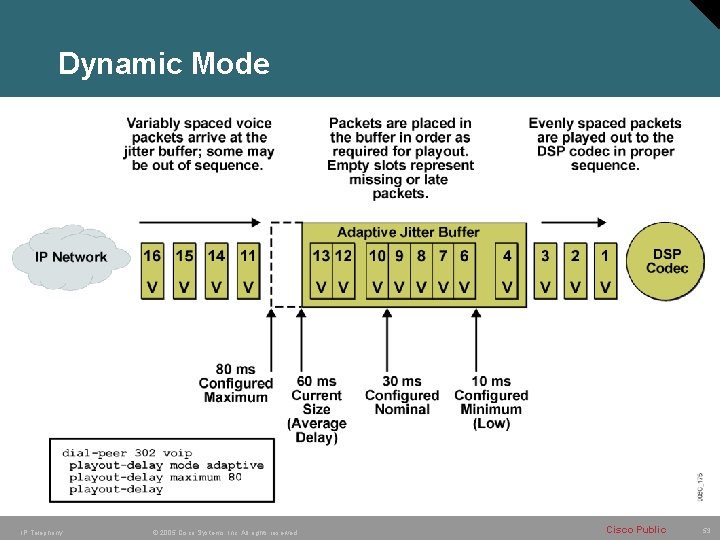
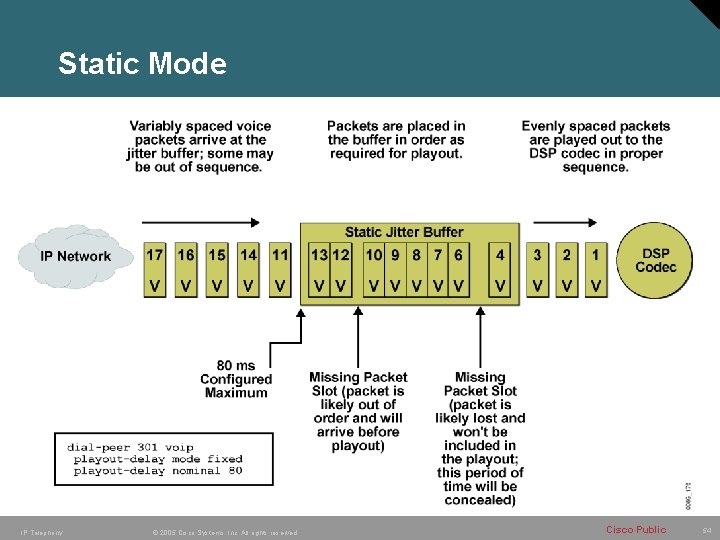
Playout Delay Buffer IP Telephony © 2005 Cisco Systems, Inc. All rights reserved. Cisco Public 45
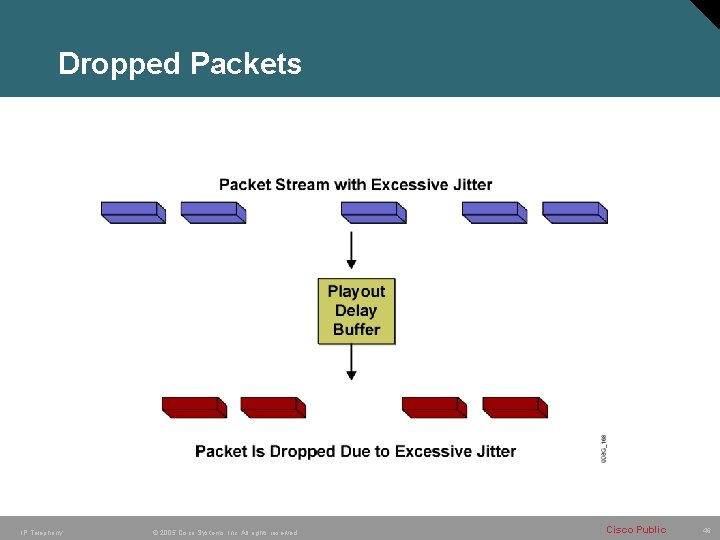
Dropped Packets IP Telephony © 2005 Cisco Systems, Inc. All rights reserved. Cisco Public 46
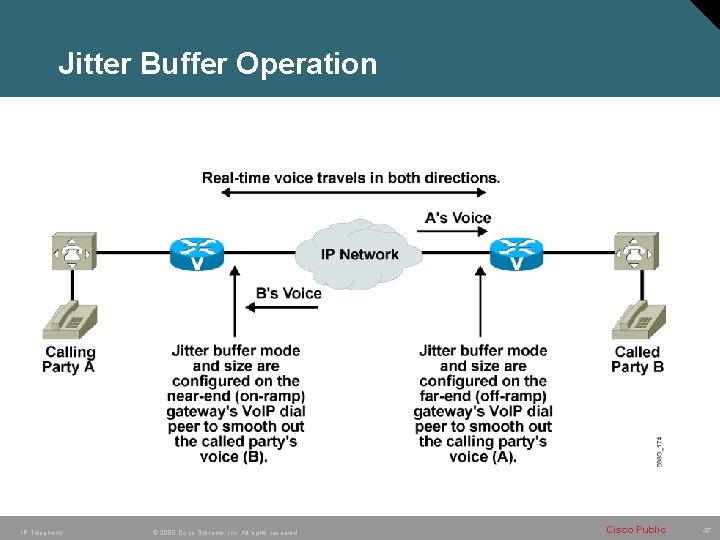
Jitter Buffer Operation IP Telephony © 2005 Cisco Systems, Inc. All rights reserved. Cisco Public 47
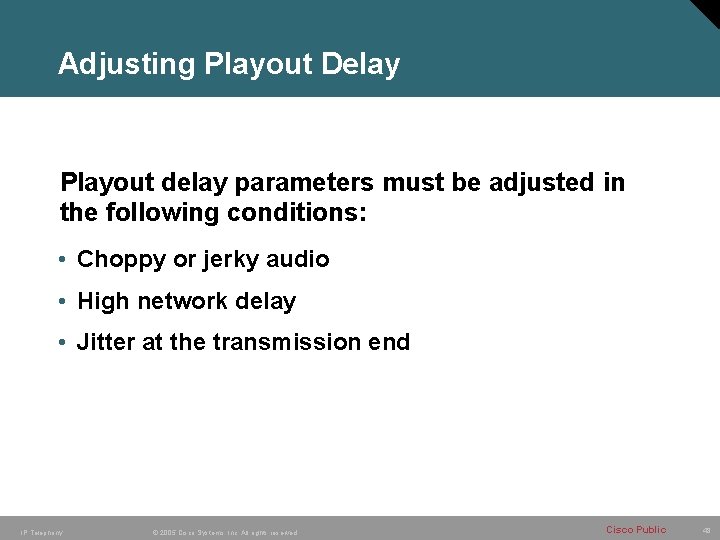
Adjusting Playout Delay Playout delay parameters must be adjusted in the following conditions: • Choppy or jerky audio • High network delay • Jitter at the transmission end IP Telephony © 2005 Cisco Systems, Inc. All rights reserved. Cisco Public 48
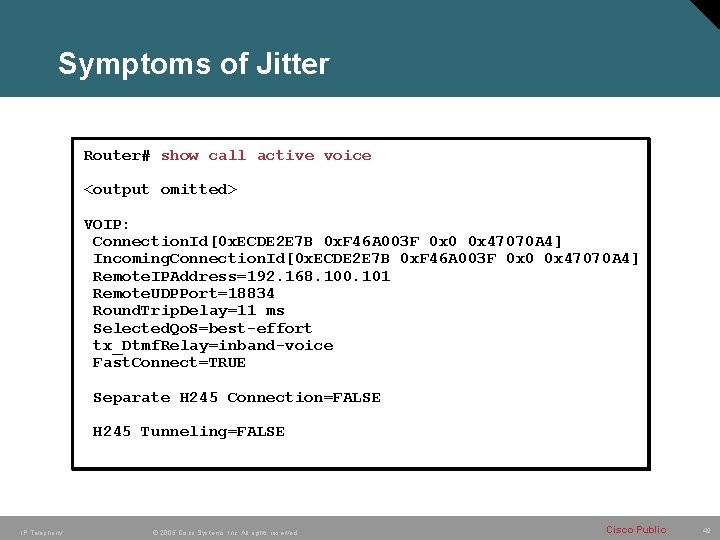
Symptoms of Jitter Router# show call active voice <output omitted> VOIP: Connection. Id[0 x. ECDE 2 E 7 B 0 x. F 46 A 003 F 0 x 0 0 x 47070 A 4] Incoming. Connection. Id[0 x. ECDE 2 E 7 B 0 x. F 46 A 003 F 0 x 0 0 x 47070 A 4] Remote. IPAddress=192. 168. 100. 101 Remote. UDPPort=18834 Round. Trip. Delay=11 ms Selected. Qo. S=best-effort tx_Dtmf. Relay=inband-voice Fast. Connect=TRUE Separate H 245 Connection=FALSE H 245 Tunneling=FALSE IP Telephony © 2005 Cisco Systems, Inc. All rights reserved. Cisco Public 49
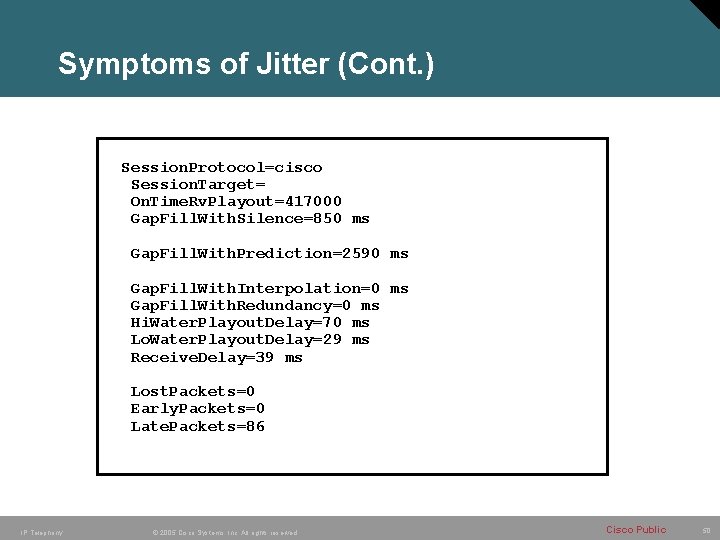
Symptoms of Jitter (Cont. ) Session. Protocol=cisco Session. Target= On. Time. Rv. Playout=417000 Gap. Fill. With. Silence=850 ms Gap. Fill. With. Prediction=2590 ms Gap. Fill. With. Interpolation=0 ms Gap. Fill. With. Redundancy=0 ms Hi. Water. Playout. Delay=70 ms Lo. Water. Playout. Delay=29 ms Receive. Delay=39 ms Lost. Packets=0 Early. Packets=0 Late. Packets=86 IP Telephony © 2005 Cisco Systems, Inc. All rights reserved. Cisco Public 50
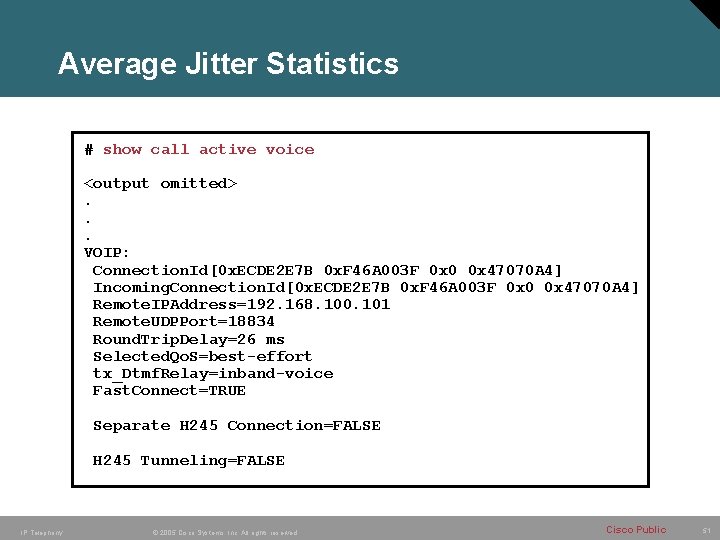
Average Jitter Statistics # show call active voice <output omitted>. . . VOIP: Connection. Id[0 x. ECDE 2 E 7 B 0 x. F 46 A 003 F 0 x 0 0 x 47070 A 4] Incoming. Connection. Id[0 x. ECDE 2 E 7 B 0 x. F 46 A 003 F 0 x 0 0 x 47070 A 4] Remote. IPAddress=192. 168. 100. 101 Remote. UDPPort=18834 Round. Trip. Delay=26 ms Selected. Qo. S=best-effort tx_Dtmf. Relay=inband-voice Fast. Connect=TRUE Separate H 245 Connection=FALSE H 245 Tunneling=FALSE IP Telephony © 2005 Cisco Systems, Inc. All rights reserved. Cisco Public 51
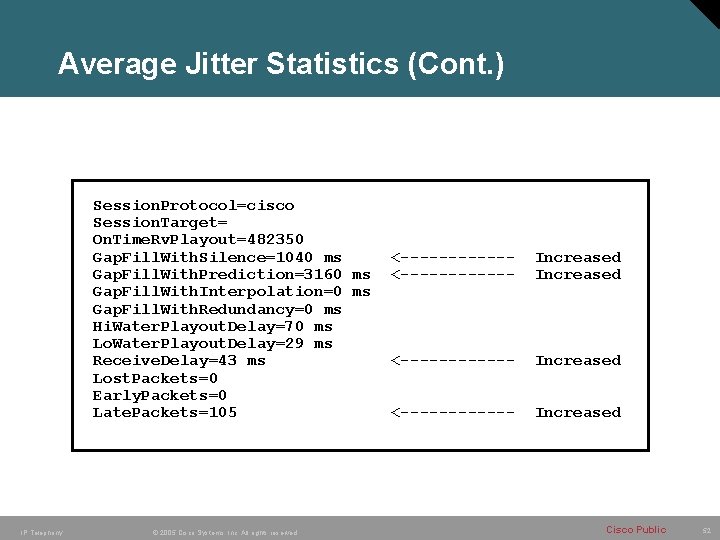
Average Jitter Statistics (Cont. ) Session. Protocol=cisco Session. Target= On. Time. Rv. Playout=482350 Gap. Fill. With. Silence=1040 ms <------ Increased Gap. Fill. With. Prediction=3160 ms <------ Increased Gap. Fill. With. Interpolation=0 ms Gap. Fill. With. Redundancy=0 ms Hi. Water. Playout. Delay=70 ms Lo. Water. Playout. Delay=29 ms Receive. Delay=43 ms <------ Increased Lost. Packets=0 Early. Packets=0 Late. Packets=105 <------ Increased IP Telephony © 2005 Cisco Systems, Inc. All rights reserved. Cisco Public 52
Dynamic Mode IP Telephony © 2005 Cisco Systems, Inc. All rights reserved. Cisco Public 53
Static Mode IP Telephony © 2005 Cisco Systems, Inc. All rights reserved. Cisco Public 54
Delay IP Telephony © 2005 Cisco Systems, Inc. All rights reserved. Cisco Public 55
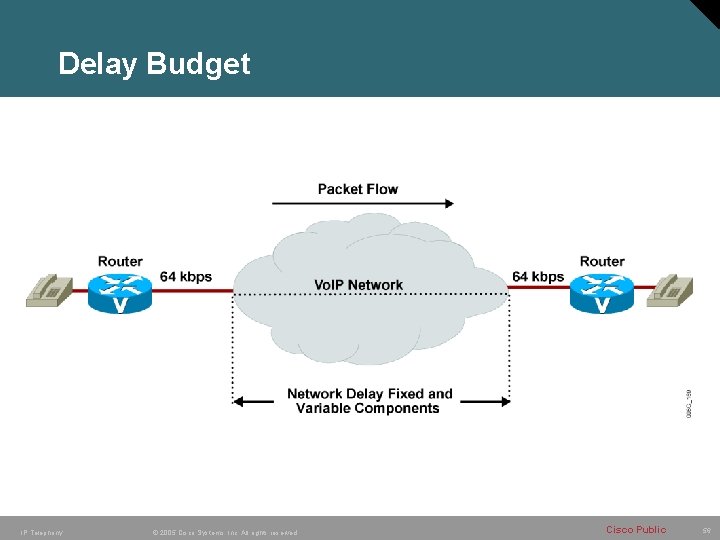
Delay Budget IP Telephony © 2005 Cisco Systems, Inc. All rights reserved. Cisco Public 56
Acceptable Delay: G. 114 IP Telephony © 2005 Cisco Systems, Inc. All rights reserved. Cisco Public 57
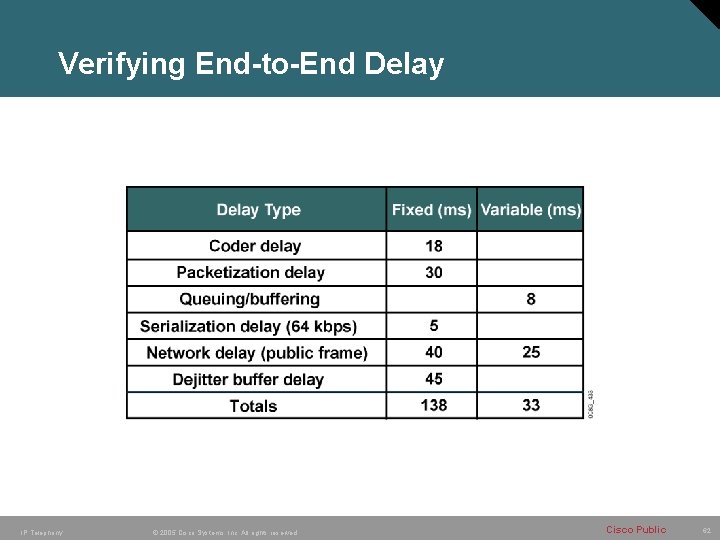
Sources of Delay • Coder delay • Packetization delay • Queuing delay • Serialization delay • Network delay • Dejitter buffer delay IP Telephony © 2005 Cisco Systems, Inc. All rights reserved. Cisco Public 58
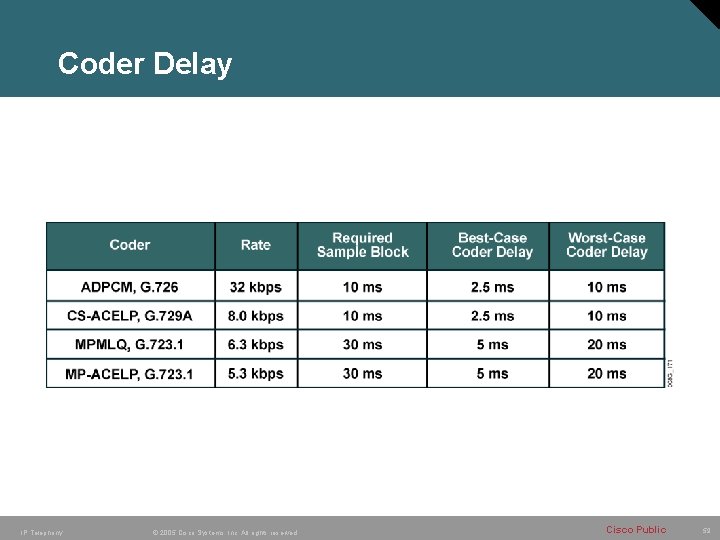
Coder Delay IP Telephony © 2005 Cisco Systems, Inc. All rights reserved. Cisco Public 59
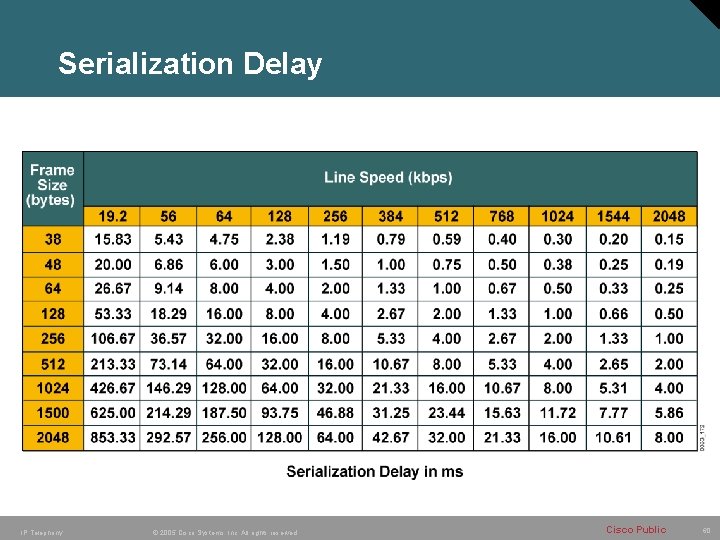
Serialization Delay IP Telephony © 2005 Cisco Systems, Inc. All rights reserved. Cisco Public 60
Fragmentation Using FRF. 12 IP Telephony © 2005 Cisco Systems, Inc. All rights reserved. Cisco Public 61
Verifying End-to-End Delay IP Telephony © 2005 Cisco Systems, Inc. All rights reserved. Cisco Public 62
Apply Qo. S in the Campus IP Telephony © 2005 Cisco Systems, Inc. All rights reserved. Cisco Public 63
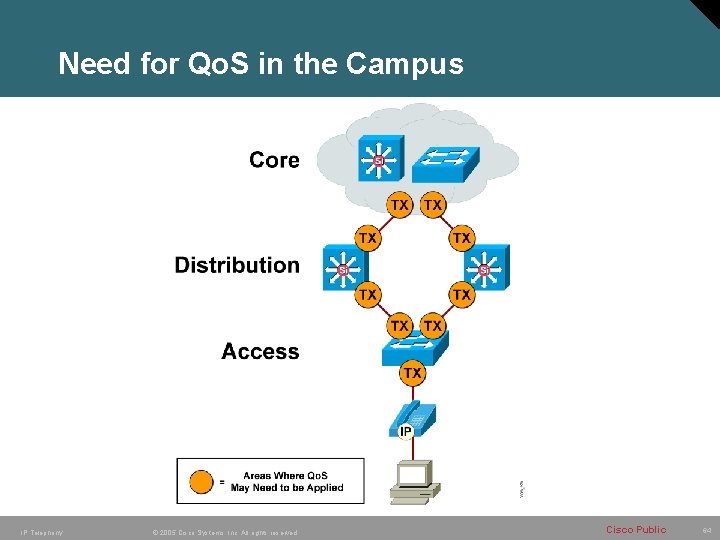
Need for Qo. S in the Campus IP Telephony © 2005 Cisco Systems, Inc. All rights reserved. Cisco Public 64
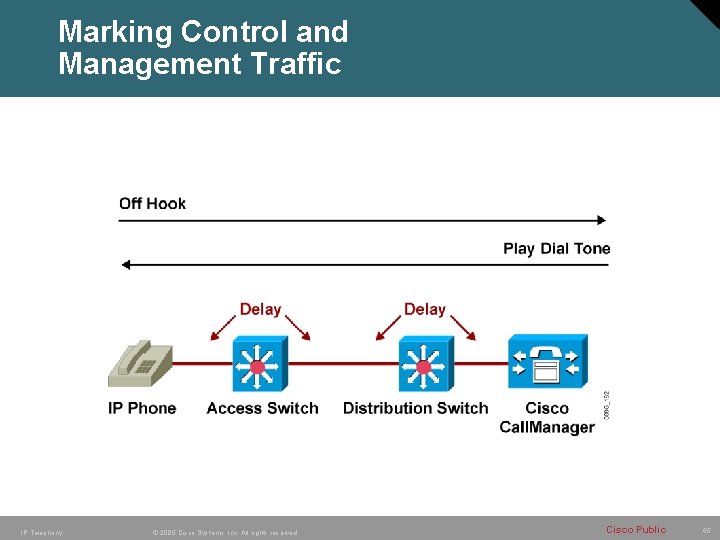
Marking Control and Management Traffic IP Telephony © 2005 Cisco Systems, Inc. All rights reserved. Cisco Public 65
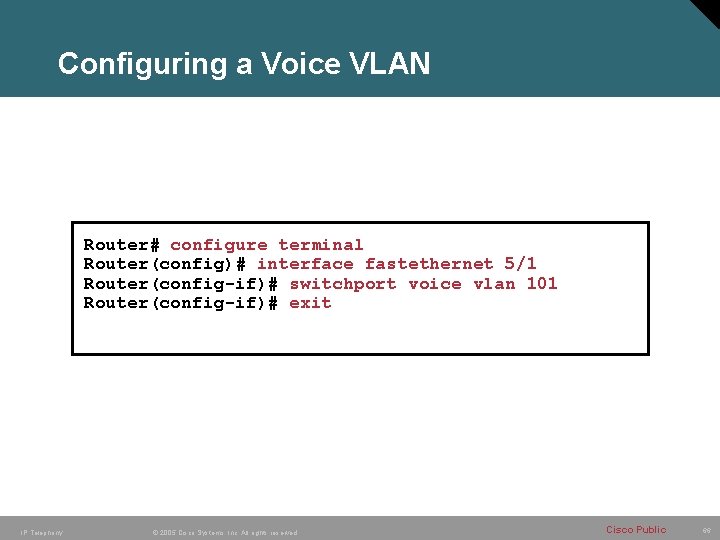
Configuring a Voice VLAN Router# configure terminal Router(config)# interface fastethernet 5/1 Router(config-if)# switchport voice vlan 101 Router(config-if)# exit IP Telephony © 2005 Cisco Systems, Inc. All rights reserved. Cisco Public 66
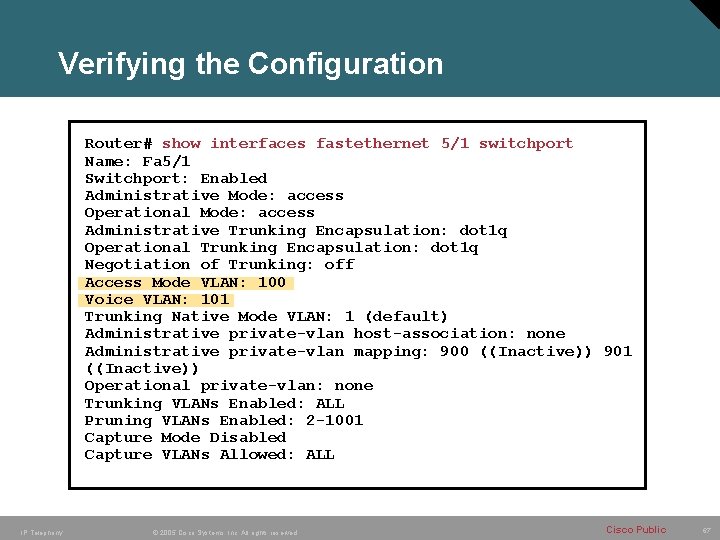
Verifying the Configuration Router# show interfaces fastethernet 5/1 switchport Name: Fa 5/1 Switchport: Enabled Administrative Mode: access Operational Mode: access Administrative Trunking Encapsulation: dot 1 q Operational Trunking Encapsulation: dot 1 q Negotiation of Trunking: off Access Mode VLAN: 100 Voice VLAN: 101 Trunking Native Mode VLAN: 1 (default) Administrative private-vlan host-association: none Administrative private-vlan mapping: 900 ((Inactive)) 901 ((Inactive)) Operational private-vlan: none Trunking VLANs Enabled: ALL Pruning VLANs Enabled: 2 -1001 Capture Mode Disabled Capture VLANs Allowed: ALL IP Telephony © 2005 Cisco Systems, Inc. All rights reserved. Cisco Public 67
Qo. S Tools in the WAN IP Telephony © 2005 Cisco Systems, Inc. All rights reserved. Cisco Public 68
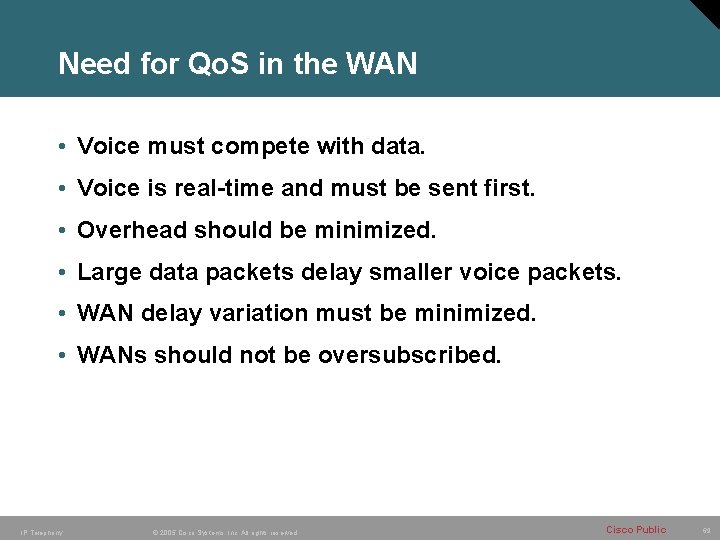
Need for Qo. S in the WAN • Voice must compete with data. • Voice is real-time and must be sent first. • Overhead should be minimized. • Large data packets delay smaller voice packets. • WAN delay variation must be minimized. • WANs should not be oversubscribed. IP Telephony © 2005 Cisco Systems, Inc. All rights reserved. Cisco Public 69
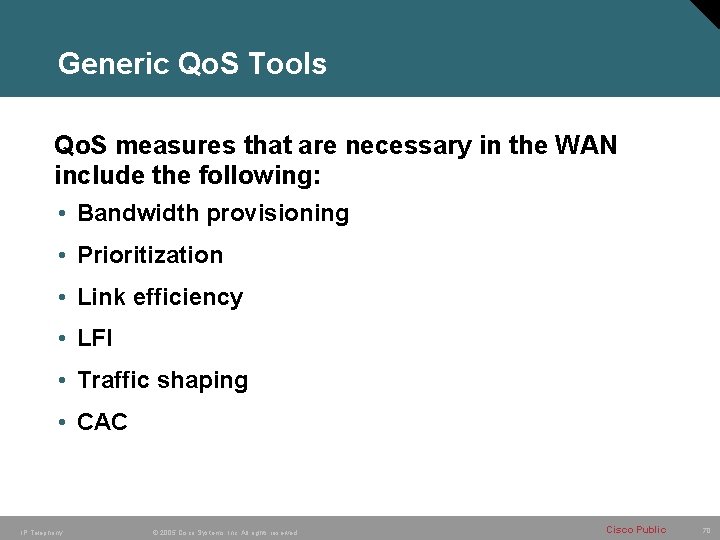
Generic Qo. S Tools Qo. S measures that are necessary in the WAN include the following: • Bandwidth provisioning • Prioritization • Link efficiency • LFI • Traffic shaping • CAC IP Telephony © 2005 Cisco Systems, Inc. All rights reserved. Cisco Public 70
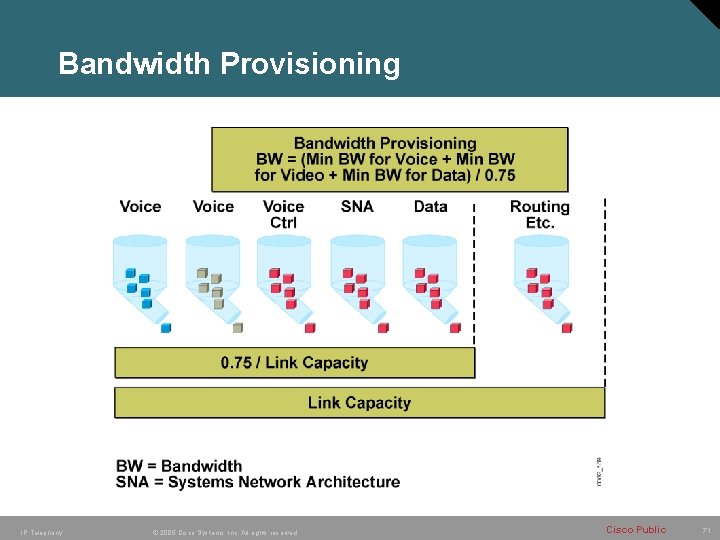
Bandwidth Provisioning IP Telephony © 2005 Cisco Systems, Inc. All rights reserved. Cisco Public 71
Optimized Queuing IP Telephony © 2005 Cisco Systems, Inc. All rights reserved. Cisco Public 72
Link Efficiency: CRTP IP Telephony © 2005 Cisco Systems, Inc. All rights reserved. Cisco Public 73
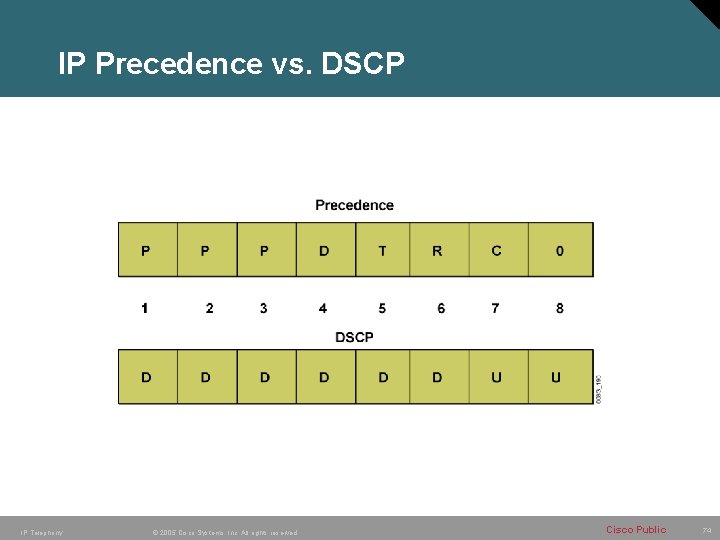
IP Precedence vs. DSCP IP Telephony © 2005 Cisco Systems, Inc. All rights reserved. Cisco Public 74
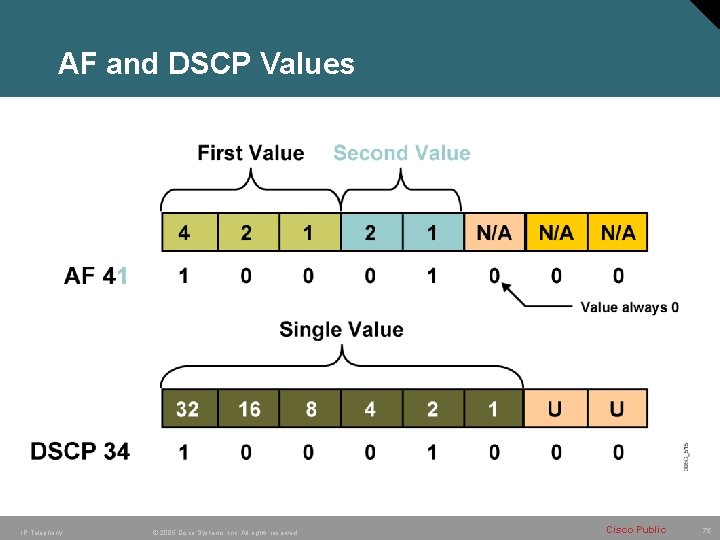
AF and DSCP Values IP Telephony © 2005 Cisco Systems, Inc. All rights reserved. Cisco Public 75
Link Fragmentation and Interleaving IP Telephony © 2005 Cisco Systems, Inc. All rights reserved. Cisco Public 76
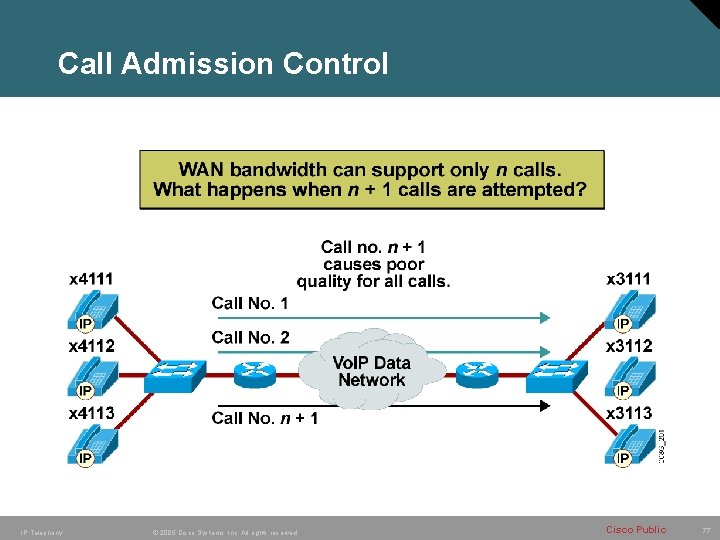
Call Admission Control IP Telephony © 2005 Cisco Systems, Inc. All rights reserved. Cisco Public 77
Configuring Qo. S in the WAN IP Telephony © 2005 Cisco Systems, Inc. All rights reserved. Cisco Public 78
Configuring Auto. Qo. S IP Telephony © 2005 Cisco Systems, Inc. All rights reserved. Cisco Public 79
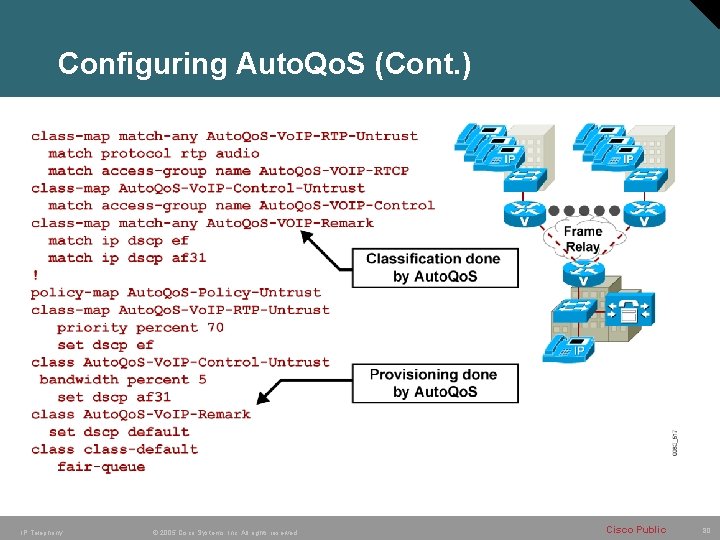
Configuring Auto. Qo. S (Cont. ) IP Telephony © 2005 Cisco Systems, Inc. All rights reserved. Cisco Public 80
Configuring CAC IP Telephony © 2005 Cisco Systems, Inc. All rights reserved. Cisco Public 81
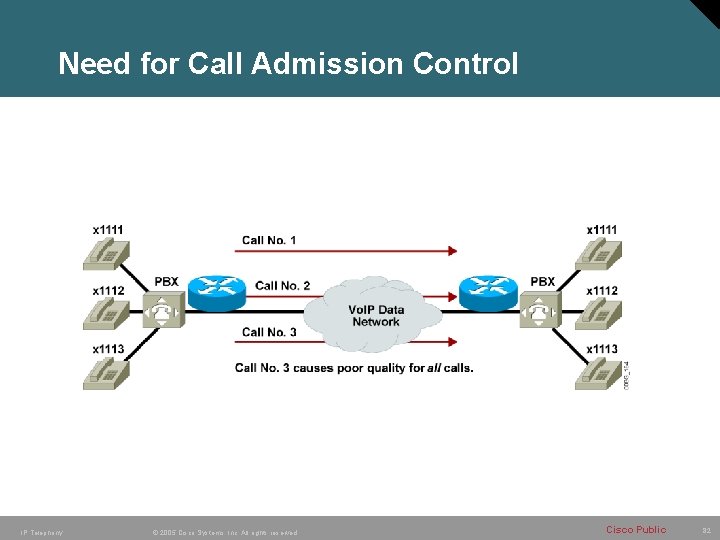
Need for Call Admission Control IP Telephony © 2005 Cisco Systems, Inc. All rights reserved. Cisco Public 82
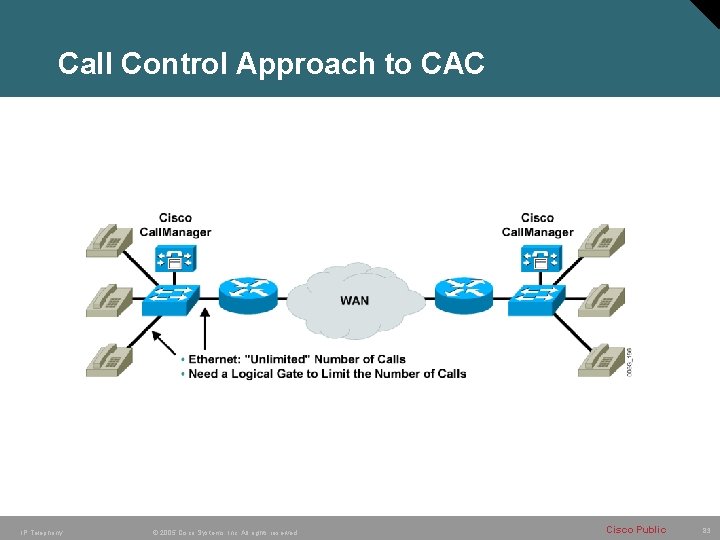
Call Control Approach to CAC IP Telephony © 2005 Cisco Systems, Inc. All rights reserved. Cisco Public 83
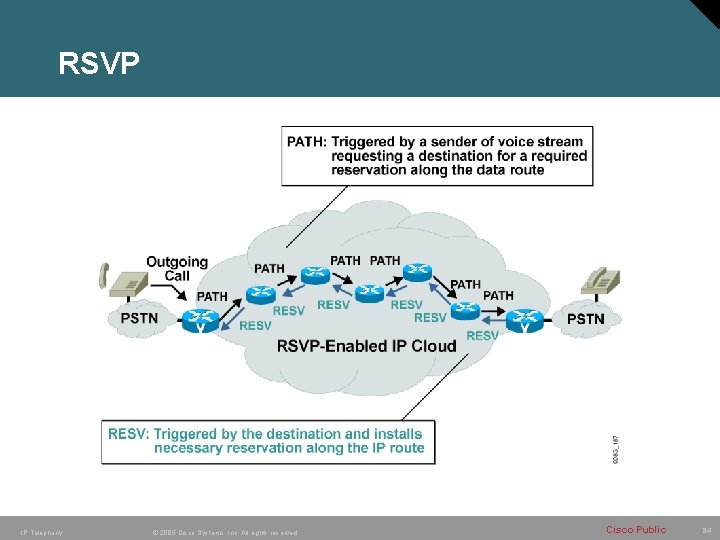
RSVP IP Telephony © 2005 Cisco Systems, Inc. All rights reserved. Cisco Public 84
Understanding CAC Tools • H. 323 CAC • SIP CAC • MGCP CAC • Call. Manager CAC IP Telephony © 2005 Cisco Systems, Inc. All rights reserved. Cisco Public 85
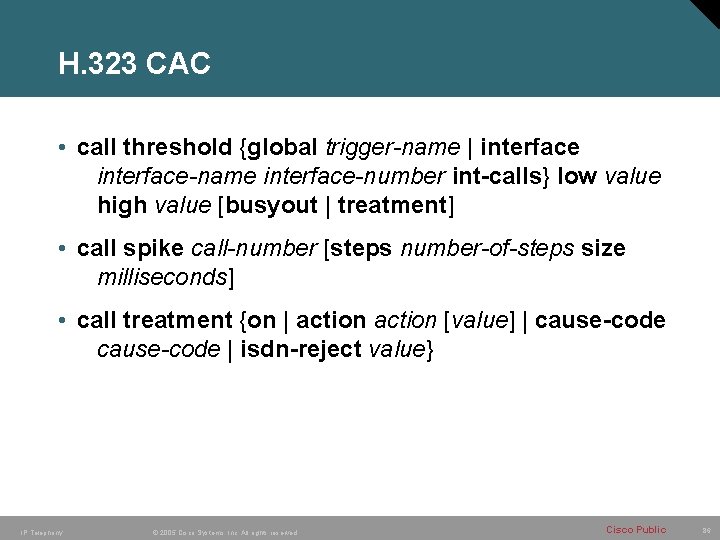
H. 323 CAC • call threshold {global trigger-name | interface-name interface-number int-calls} low value high value [busyout | treatment] • call spike call-number [steps number-of-steps size milliseconds] • call treatment {on | action [value] | cause-code | isdn-reject value} IP Telephony © 2005 Cisco Systems, Inc. All rights reserved. Cisco Public 86
Voice Bandwidth Engineering IP Telephony © 2005 Cisco Systems, Inc. All rights reserved. Cisco Public 87
Erlangs • The amount of traffic a trunk can handle in one hour. • Equals 60 call minutes 3600 call seconds 36 centum call seconds (CCS) IP Telephony © 2005 Cisco Systems, Inc. All rights reserved. Cisco Public 88
IP Telephony © 2005 Cisco Systems, Inc. All rights reserved. Cisco Public 89