
Grammar Lesson 4 Active vs Passive Voice Grammar



- Slides: 6
Grammar Lesson #4: Active vs. Passive Voice Grammar Lesson #1: Correct Word Usage Grammar Lesson #2: Comma Splices and Run-Ons Grammar Lesson #3: Punctuating Direct Quotations
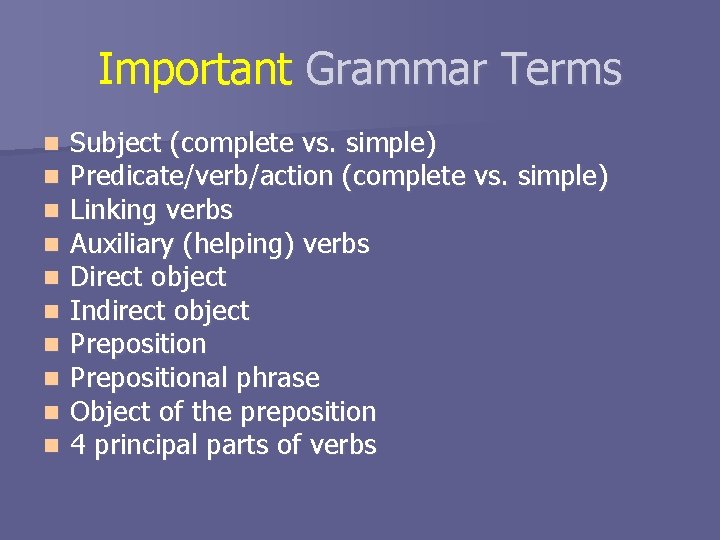
Important Grammar Terms n n n n n Subject (complete vs. simple) Predicate/verb/action (complete vs. simple) Linking verbs Auxiliary (helping) verbs Direct object Indirect object Prepositional phrase Object of the preposition 4 principal parts of verbs
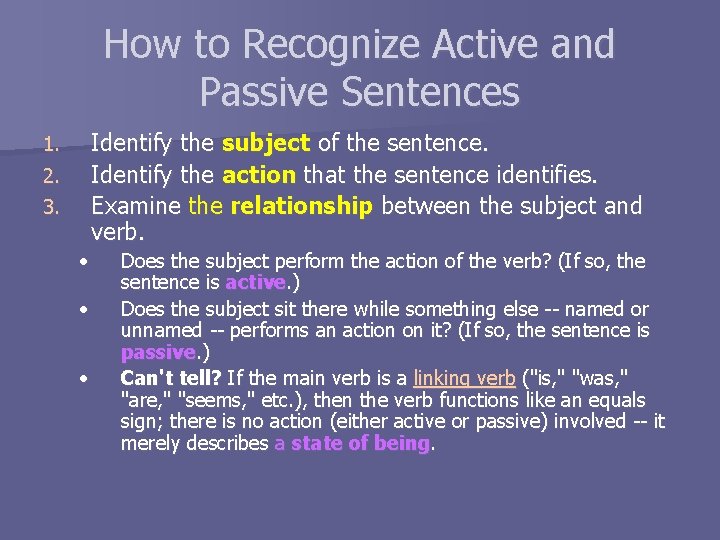
How to Recognize Active and Passive Sentences Identify the subject of the sentence. Identify the action that the sentence identifies. Examine the relationship between the subject and verb. 1. 2. 3. • • • Does the subject perform the action of the verb? (If so, the sentence is active. ) Does the subject sit there while something else -- named or unnamed -- performs an action on it? (If so, the sentence is passive. ) Can't tell? If the main verb is a linking verb ("is, " "was, " "are, " "seems, " etc. ), then the verb functions like an equals sign; there is no action (either active or passive) involved -- it merely describes a state of being.
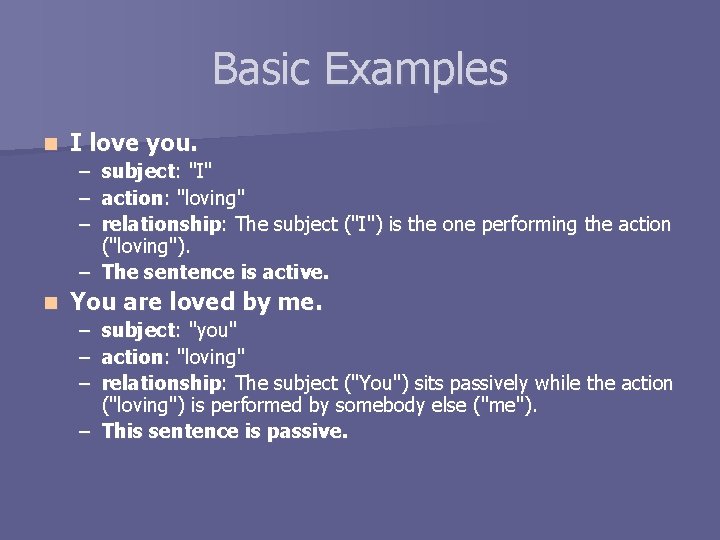
Basic Examples n I love you. – subject: "I" – action: "loving" – relationship: The subject ("I") is the one performing the action ("loving"). – The sentence is active. n You are loved by me. – – – subject: "you" action: "loving" relationship: The subject ("You") sits passively while the action ("loving") is performed by somebody else ("me"). – This sentence is passive.
Difference between Passive Voice and Past Tense n Many people confuse the Active Passive passive voice with the Voice past tense. The most I taught; I I was (have common passive Past learned. been) taught [by constructions also happen someone]; It was tense (has been) to be past tense (e. g. learned [by someone]. "I've been framed"), but "voice" has to do with Present I teach; I learn. I am [being] taught [by someone]; It is who, while "tense" has to Tense [being] learned [by someone]. do with when. Future Tense I will teach; I will learn. I will be taught [by someone]; It will be learned [by someone]. .
Imperatives: Active Commands n A command (or "imperative") is a kind of active sentence, in which "you" (the one being addressed) are being ordered to perform the action. (If you refuse to obey, the sentence is still active. ) – Get to work on time. – Insert tab A into slot B. – Take me to your leader.