
Storytelling Developing and using your voice effectively Objective
Storytelling: Developing and using your voice effectively Objective: To understand the keys to a good speaking voice. ü Relaxation ü Breath control ü Quality ü Pitch ü Volume ü Pause and Rate
Voice and Diction Vocabulary pg. 62 1. Quality 2. Resonance 3. Nasality 4. Pitch 5. Inflection 6. Monotone 7. Volume 8. Rate 9. Diction 10. Schwa 11. Voiceless 12. Voiced 13. Pronunciation
Relaxation-important in creating a powerful and beautiful voice. v. For correct speech and voice production you must have an open, relaxed throat, a flexible tongue and lips, and a relaxed lower jaw. v. A tense or tight throat will cause hoarseness when projecting your voice.
Get up and Move #1 -Relaxation Exercise: Jaw- head down, chin to chest, relax facial muscles, massage with fingertips. Throat-Yawn, deep breath, relax jaw, exhale, say “my name is…. ” Lips-May, Mee, Mi, Moo Tongue-mud, dud, mud, dud. Frill (trill the “r”) Da da, la la.

�Christmas Tongue Twister WAR
Breath Control-determines the carrying power and loudness of your voice. v. Less strain or damage to your voice when utilizing it over a long period of time. v. Controlled breathing is more helpful to an actor than deep breathing because it creates a sustained voice.
Get up and move #2 Breath Control Exercise: Inhale through your nose-out your mouth=relaxation breath Inhale through your mouth=more rapid intake ~hold ribcage, inhale, letter “s” as you exhale. ~Inhale, as you exhale practice counting/abc’s
Quality-The individual sound of your particular voice. Quality of your voice depends on your vocal resonance and the correct formation of vowel sounds. Resonance is the vibrant tone produced when sound waves strike the chambers of the throat, head, nose, and mouth.
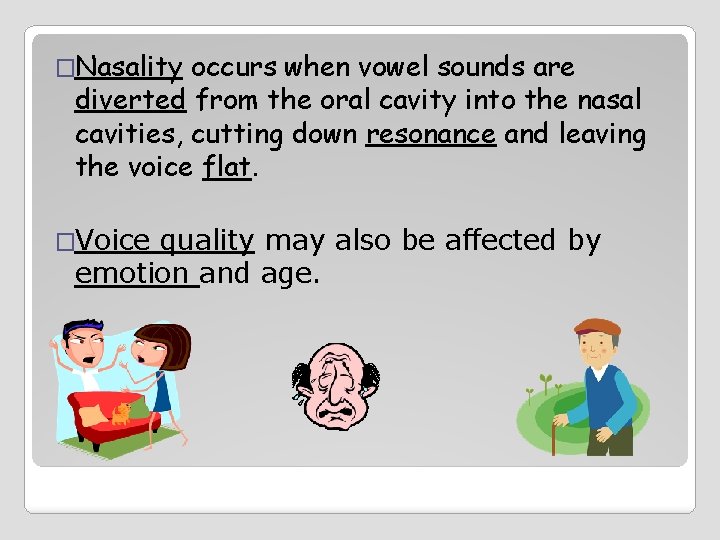
�Nasality occurs when vowel sounds are diverted from the oral cavity into the nasal cavities, cutting down resonance and leaving the voice flat. �Voice quality may also be affected by emotion and age.
With a partner, try out the voice quality exercises on pg 71, #1 -2 7 volunteers for #3 8 volunteers for #4 As a class for #5 Think of something you have experienced, a story you might share with a friend, family, teacher or classmate. Come up with two words that describe that particular memory.
Pitch-relative highness or lowness of the voice at any given time. �Determined by how rapidly the vocal folds vibrate. �The pitch of the voice gives meaning to speech. �Raise pitch on important words to emphasize them. (shows excitement, interest, enthusiasm) �Lower the pitch on unimportant words. (shows sadness, disinterest)

Inflection-variety in pitch. �Makes the voice musical and interesting. Gives life like qualities to the words/phrases you say. �Speaking in monotone: speaking continuously on one level. �Can be avoided if you acknowledge and learn to control the number, length, and direction of pitch changes.
Volume-the relative strength, force, or intensity with which sound is made. �Not just loudness, can include a “stage whisper” �Two types of force which create volume: ◦ Explosive-a sudden, sharp breath pressure. Useful in commands, shouts, loud laughter, and screams. ◦ Expulsive-breath pressure held steady and released gradually. Necessary in reading long passages and building to a dramatic climax.
Pause-a lull or stop in dialogue or action in order to sustain emotion. �Breathing pause: necessity to get the breath to speak �Logical and dramatic pauses: demand thought and feeling. Rely on the actor to work out the “thought grouping” of the dialogue.
Rate-The speed at which words are spoken. �We all have a characteristic rate of speech which is usually more rapid in conversation than in public speaking or dramatics. �Like quality, pitch, and volume, rate is an important means of suggesting ideas and emotional states.
Emphasis on interpretation. Read pg 80 -81 �The key words emphasized. �Identify emotional context. �Words can be emphasized by: ◦ Delivering words with greater force ◦ Holding for a longer period of time ◦ Lifting or lowering pitch ◦ Giving vowels a rich resonant quality and consonants a strong, crisp attack and finish.
� Storytelling Assignment BLUEPRINT: +25 pts 1. Analyze the story to establish vocal qualities you will use during the performance. Take it sentence by sentence and decide which word(s) will be emphasized to bring out the meaning of the text. On average, this should be at least 25+ words. Ø Make a list of the words you want to emphasize. Around 25+ words. (+10 pts) 2. Identify how and where in the story you will use the following vocal qualities: (+10 pts) Ø Pitch Ø Inflection Ø Volume Ø Pause Ø Rate 3. Establish characterization. What characters are in the story? How will you change your voice to establish a difference in your vocal qualities for each character? Ø List the characters and give details for each on what you plan to do with your voice to establish character traits and make the character unique. (+5 pts)
Camrin’s Change your Voice Game: �Everyone closes their eyes…One student will be chosen to stand behind the screen and read a selection provided by the teacher. The student must do a good job of creating a character and changing their voice so their classmates do not guess who is behind the screen.
�Choose a Christmas poem or short story. �Provide a photocopy or typed copy. �Identify words/phrases in each sentence to emphasize with vocal qualities. (Highlight) �Get in a group of 3 -4, choose ONE of the poems or short stories to share with the class and plan a scene to be acted out while one person narrates. *music, props and minor costumes allowed and encouraged. To be performed on December 20 th.
- Slides: 19