
Exploring Sound Waves and the Voice Lauren Brendel
Exploring Sound Waves and the Voice Lauren Brendel, AP Physics 1

Sound Wave Basics ● Sound is a mechanical, longitudinal wave with compressions and rarefactions… ● But it can be displayed as a transverse wave for clearer understanding of its properties
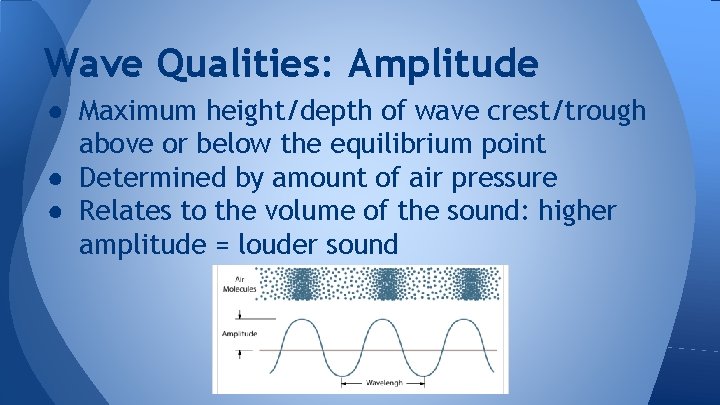
Wave Qualities: Amplitude ● Maximum height/depth of wave crest/trough above or below the equilibrium point ● Determined by amount of air pressure ● Relates to the volume of the sound: higher amplitude = louder sound
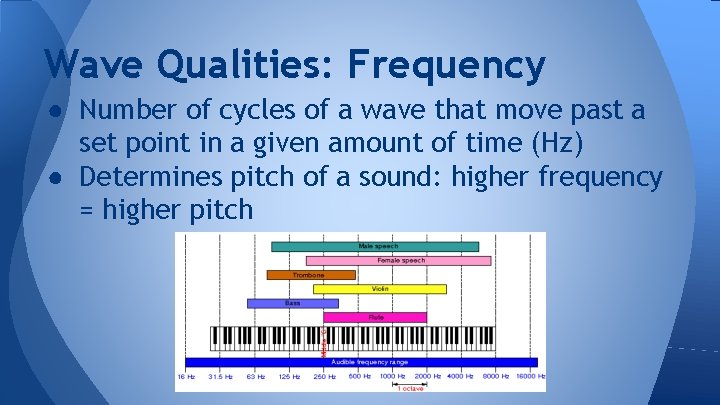
Wave Qualities: Frequency ● Number of cycles of a wave that move past a set point in a given amount of time (Hz) ● Determines pitch of a sound: higher frequency = higher pitch
Frequency and Harmony ● Intervals in music have specific frequency ratios- this is what makes them sound consonant (pleasant) or dissonant (unpleasant or “conflicting”) ● Common consonant interval ratios: § § Octave- 2: 1 (512 Hz and 256 Hz) Third- 5: 4 (320 Hz and 256 Hz) Fourth- 4: 3 (342 Hz and 256 Hz) Fifth- 3: 2 (384 Hz and 256 Hz)
Wave Qualities: Timbre ● The distinct character, or tone color, of an instrument or voice that distinguishes it from other sounds, even at the same pitch and volume ● Affected by two main factors: § § Harmonics- fundamental frequency, dominant frequency, overtones (partials and harmonics), etc. Envelope- attack time, decay, sustain, release
Exploring Timbre with the Voice ● Unique as one voice can produce a large variety of vocal qualities ● Professional “talkers” (actors, singers, radio hosts, public speakers, etc. ), whether consciously or not, try to produce a desired timbre or tone quality that is most pleasing to their listeners/is most appropriate for the job at hand
Estill Voice Training ● developed by voice specialist Jo Estill in 1988 ● based on “deconstructing the process of vocal production into control of specific structures of the vocal mechanism” ● combines methodical speech therapy techniques with artistry and creativity to produce consistent levels of vocal quality
Estill Figures for the Voice There are 13 Estill voice figures: ● True Vocal Folds: ● Onset/Offset Control ● ● False Vocal Cords Control ● ● True Vocal Folds: Body Cover Control ● ● Thyroid Cartilage Control ● ● Cricoid Cartilage Control ● ● Larynx Control ● Velum Control Tongue Control Aryepiglottic Spincter (AES) Control Jaw Control Lips Control Head and Neck Control Torso Control
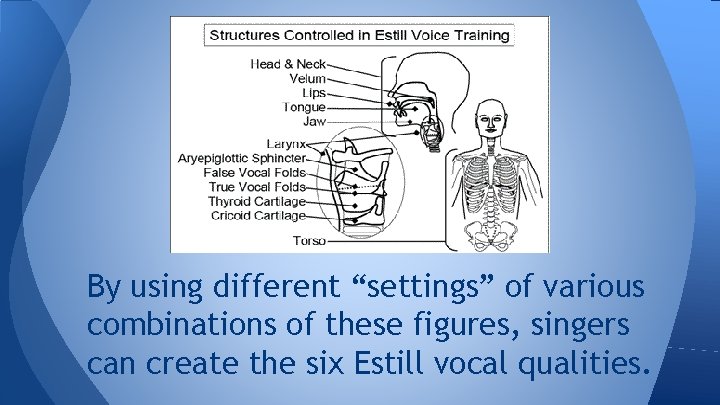
By using different “settings” of various combinations of these figures, singers can create the six Estill vocal qualities.
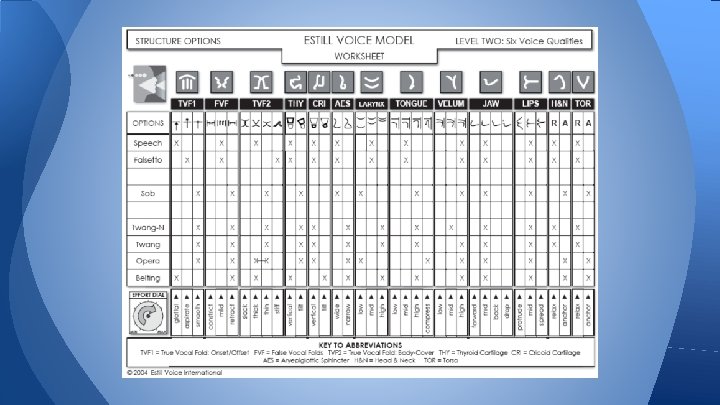
Estill Vocal Qualities: “Speech” ● exactly what it sounds like- “talking on pitch” ● found in styles of pop music, jazz, musical theatre (patter songs), etc. ● Set-up: glottal onset, thick vocal folds, middle larynx, relaxed head and torso
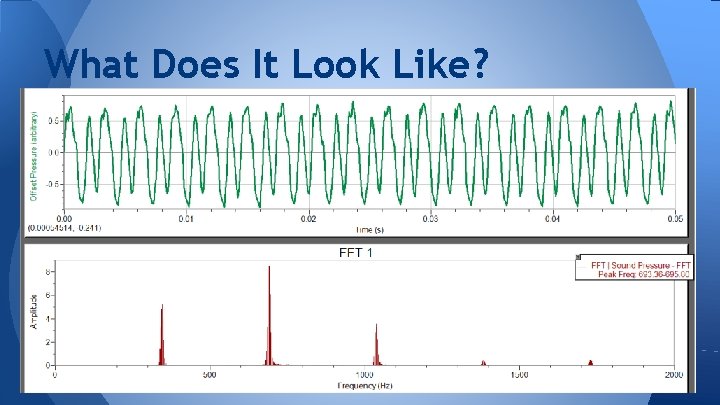
What Does It Look Like?
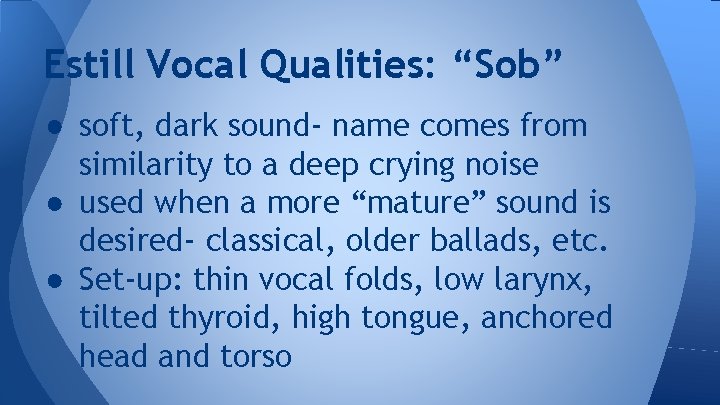
Estill Vocal Qualities: “Sob” ● soft, dark sound- name comes from similarity to a deep crying noise ● used when a more “mature” sound is desired- classical, older ballads, etc. ● Set-up: thin vocal folds, low larynx, tilted thyroid, high tongue, anchored head and torso
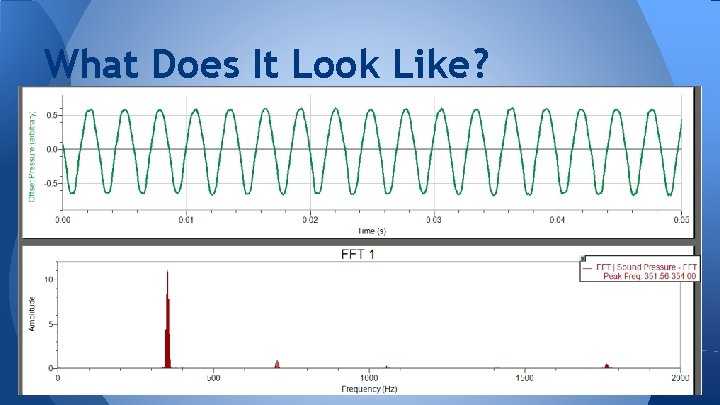
What Does It Look Like?
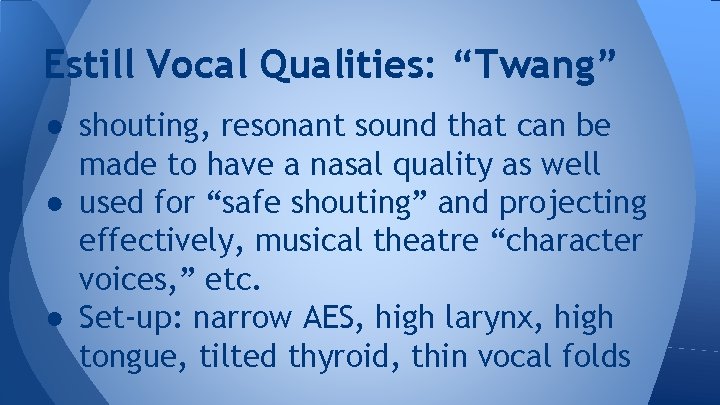
Estill Vocal Qualities: “Twang” ● shouting, resonant sound that can be made to have a nasal quality as well ● used for “safe shouting” and projecting effectively, musical theatre “character voices, ” etc. ● Set-up: narrow AES, high larynx, high tongue, tilted thyroid, thin vocal folds
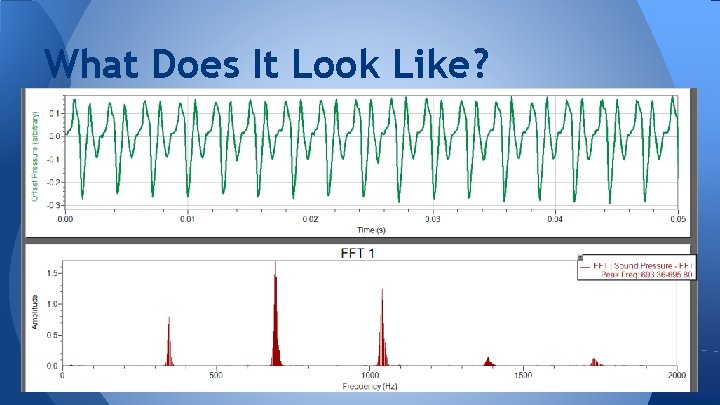
What Does It Look Like?
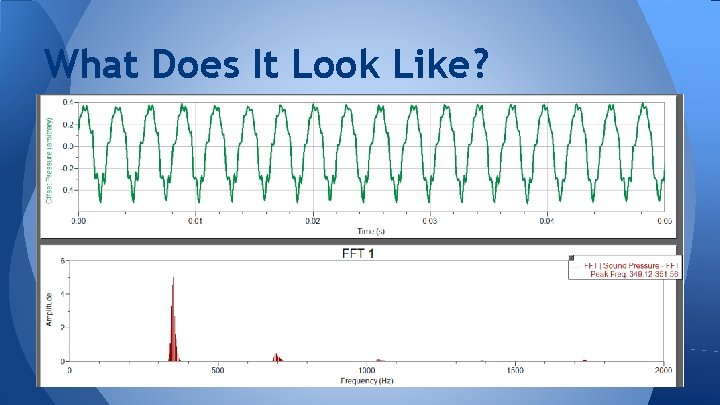
Estill Vocal Qualities: “Opera” ● achieves strong opera or classical sound while maintaining a lot of control ● set-up: combination of thin and thick folds, tilted thyroid, narrow AES, low larynx, compressed tongue, anchored head and torso
What Does It Look Like?
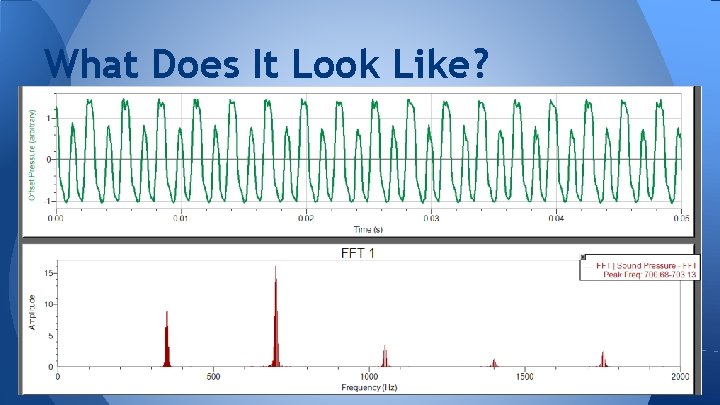
Estill Vocal Qualities: “Belt” ● extremely powerful sound used in pop, gospel, R&B, and musical theatre styles; can be extremely harmful to the vocal cords if done incorrectly ● set-up: glottal onset, thick vocal folds, tilted cricoid, narrow AES, high larynx, high tongue, anchored head and torso
What Does It Look Like?
Estill Vocal Qualities: “Falsetto” ● breathy, high-pitched singing; most commonly associated with men but, in Estill, can be achieved by both genders ● found in folk, jazz, pop, R&B, etc. ● set-up: stiff vocal folds with aspirate onset, middle larynx, relaxed head and torso
Notable Similarities ● high larynx versus low larynx: presence of overtones ● glottals and high larynx: “spikier” waves ● “Sob” and “Opera”: similar set-ups, very similar overtones/wave shape; “Sob” is more pure

Questions?
- Slides: 24