
Chapter 7 Maintaining state in Web applications Most

Chapter 7: Maintaining state in Web applications. • Most Web applications enable a browsing session, where a given http transaction might remember some data from a previous http transaction. • A common example of session-capable Web applications are those which maintain a shopping cart for you during the browsing session. • The Web server software (Apache, IIS, etc. ) will NOT keep track of data during a browsing session. • Rather, it is up to the Web application to maintain its own data between transactions in a session.
• The term state data refers to data which a Web application maintains to keep track of the state of your browsing session. • State data is temporary in that it is only relevant to a given surfing session. • Thus, state data is different from permanent data (your credit card number, address, etc. ) which may be kept in a database and is already available anytime you logon to a site for a new browsing session.
• Recall the food and pizza order programs from Chapter 6. They had only the following functionality. first http transaction print order form second http transaction process order/give summary page • The application logic involved two function calls, one for each of the two possible transactions. if($datastring eq "") { &print. Form; # print order form page } else { &process. Form; # print order summary page } • There was no notion of state data -- the submitted data was decoded into %form. Hash, then used to build the order summary page, and that was it.
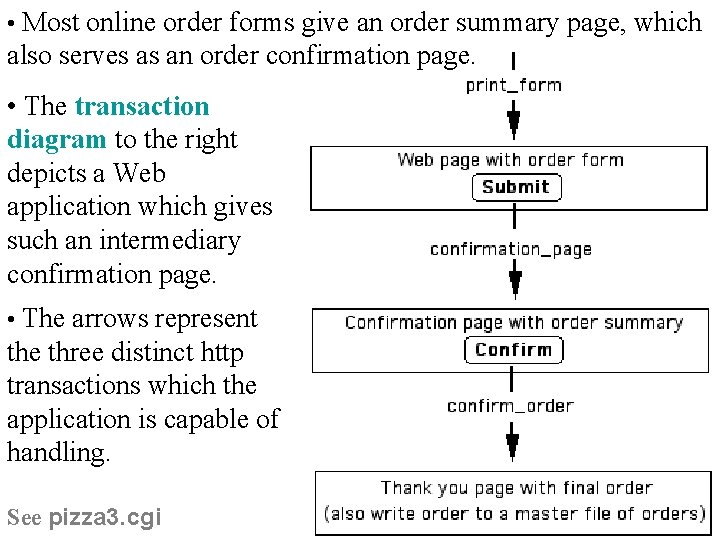
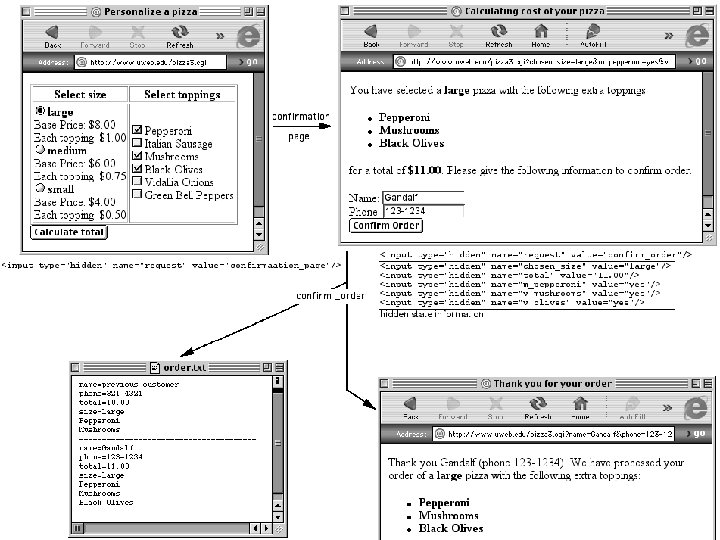
• Most online order forms give an order summary page, which also serves as an order confirmation page. • The transaction diagram to the right depicts a Web application which gives such an intermediary confirmation page. • The arrows represent the three distinct http transactions which the application is capable of handling. See pizza 3. cgi
Question: How does this pizza 3. cgi application coordinate which of its 3 different http transactions execute (i. e. which of the 3 HTML pages to send back)? Answer: Hidden form elements tell the application which page it should generate (i. e. which function should be called). • The order form contains <input type="hidden" name="request" value="confirmation_page"/> • The confirmation form contains <input type="hidden" name="request" value="confirm_order" />
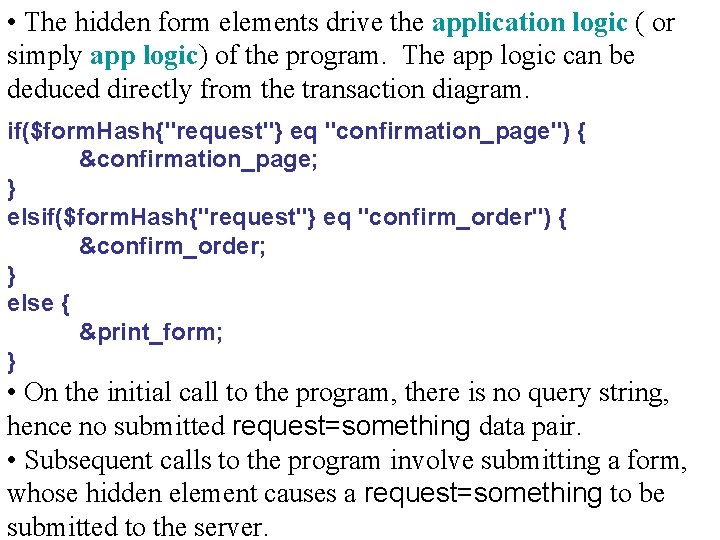
• The hidden form elements drive the application logic ( or simply app logic) of the program. The app logic can be deduced directly from the transaction diagram. if($form. Hash{"request"} eq "confirmation_page") { &confirmation_page; } elsif($form. Hash{"request"} eq "confirm_order") { &confirm_order; } else { &print_form; } • On the initial call to the program, there is no query string, hence no submitted request=something data pair. • Subsequent calls to the program involve submitting a form, whose hidden element causes a request=something to be submitted to the server.
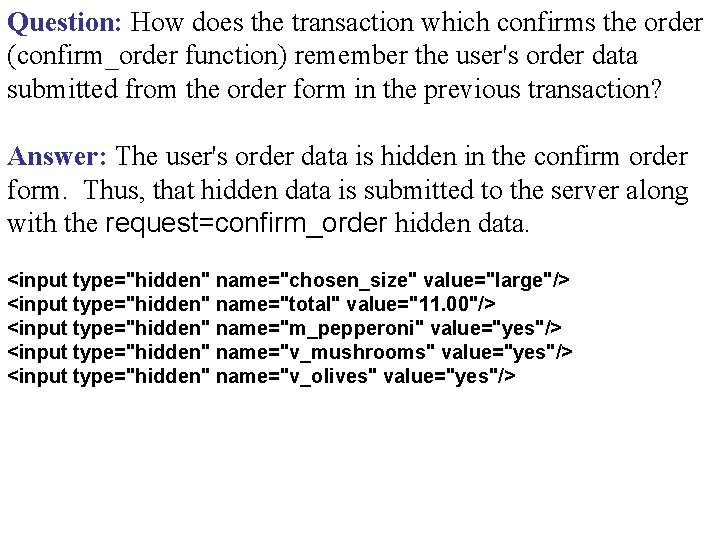
Question: How does the transaction which confirms the order (confirm_order function) remember the user's order data submitted from the order form in the previous transaction? Answer: The user's order data is hidden in the confirm order form. Thus, that hidden data is submitted to the server along with the request=confirm_order hidden data. <input type="hidden" name="chosen_size" value="large"/> <input type="hidden" name="total" value="11. 00"/> <input type="hidden" name="m_pepperoni" value="yes"/> <input type="hidden" name="v_mushrooms" value="yes"/> <input type="hidden" name="v_olives" value="yes"/>
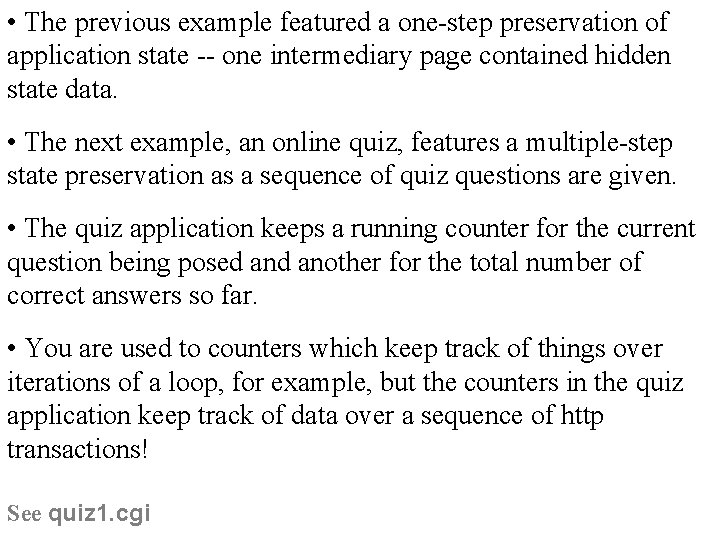
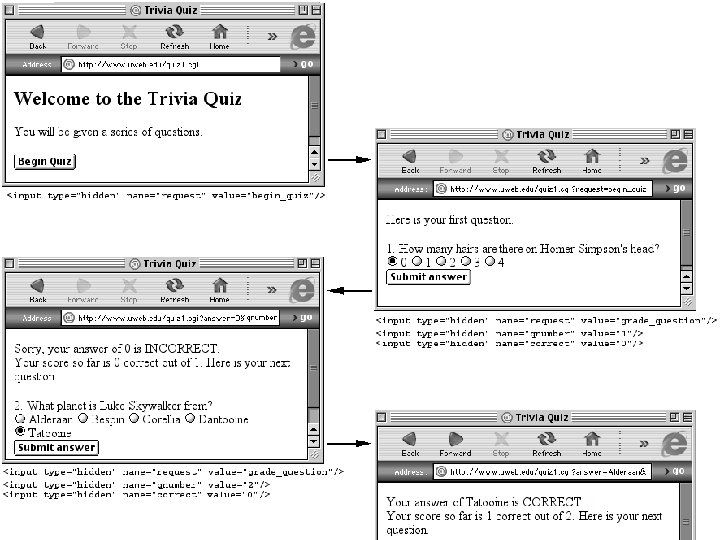
• The previous example featured a one-step preservation of application state -- one intermediary page contained hidden state data. • The next example, an online quiz, features a multiple-step state preservation as a sequence of quiz questions are given. • The quiz application keeps a running counter for the current question being posed another for the total number of correct answers so far. • You are used to counters which keep track of things over iterations of a loop, for example, but the counters in the quiz application keep track of data over a sequence of http transactions! See quiz 1. cgi
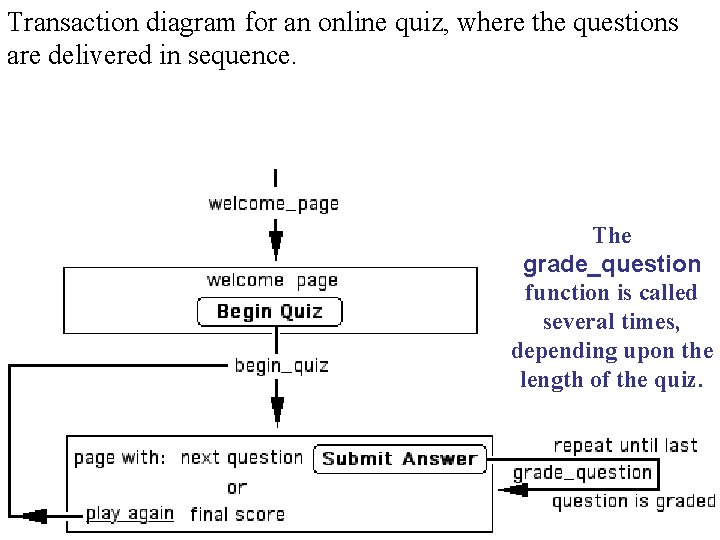
Transaction diagram for an online quiz, where the questions are delivered in sequence. The grade_question function is called several times, depending upon the length of the quiz.
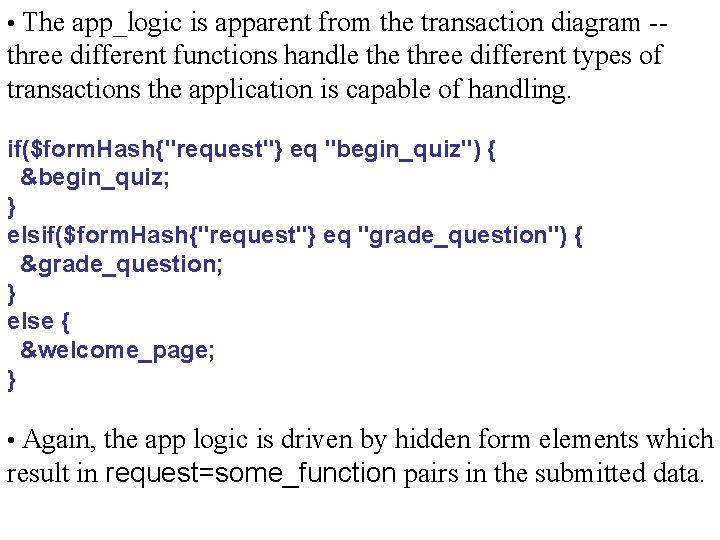
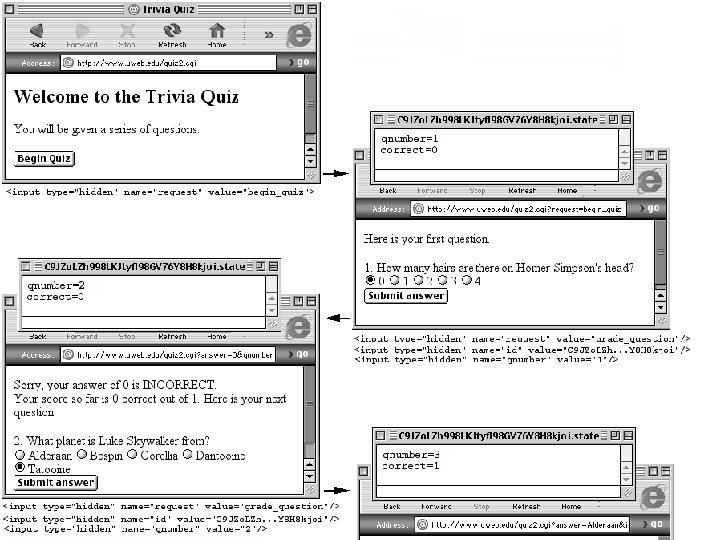
• The app_logic is apparent from the transaction diagram -- three different functions handle three different types of transactions the application is capable of handling. if($form. Hash{"request"} eq "begin_quiz") { &begin_quiz; } elsif($form. Hash{"request"} eq "grade_question") { &grade_question; } else { &welcome_page; } • Again, the app logic is driven by hidden form elements which result in request=some_function pairs in the submitted data.
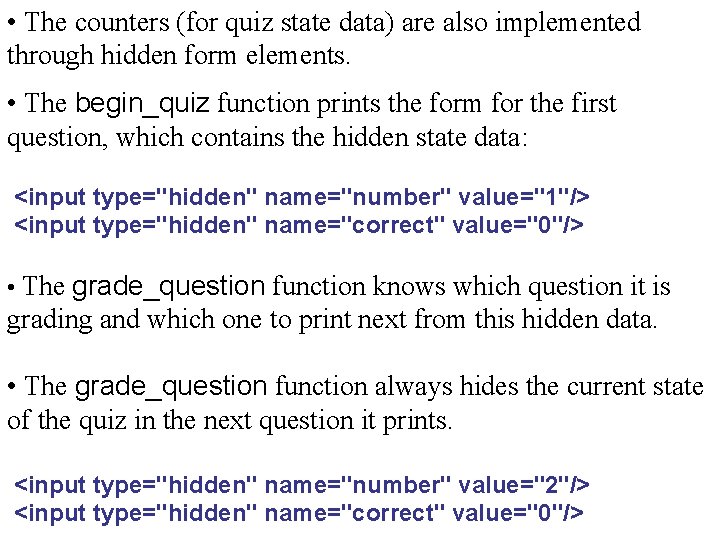
• The counters (for quiz state data) are also implemented through hidden form elements. • The begin_quiz function prints the form for the first question, which contains the hidden state data: <input type="hidden" name="number" value="1"/> <input type="hidden" name="correct" value="0"/> • The grade_question function knows which question it is grading and which one to print next from this hidden data. • The grade_question function always hides the current state of the quiz in the next question it prints. <input type="hidden" name="number" value="2"/> <input type="hidden" name="correct" value="0"/>
Major disadvantages of quiz 1. cgi 1. The user can cheat by hitting back on the browser and reanswering a question. (The state data is hidden in Web pages in the browser's cache. Hitting back on the browser effectively pulls up a previous state of the application. ) 2. The user can also cheat (in a more clever fashion) by manually changing the state data on the client. (Simply do a save as on the HTML source to grab the page containing the current quiz question, change the number of correct answers so far, load the changed page into a browser, and then submit the form with the altered state data. 3. The moral: If data is hidden in Web pages, it can be altered.
A better solution: • Create a text file on the Web server to store state data for a session. We call such a file a state file. • That is, each session that a Web application provides should have a corresponding state file to store state data during the session. • That way, the state data is kept on the server and can't be tampered with (at least not easily).
Some logistical hurdles that must be overcome in order to maintain state data in server-side state files. 1. A different state file must be maintained for each session so that data doesn't get mixed up. 2. The name of the state file must be hidden in pages generated by the application so that subsequent transactions in the session can access the same file. 3. A good format for storing state data in the file must be devised. 4. The state file names should be ensured to be unique so that a new session does not overwrite the state file for a session in progress. 5. Some contingency should be in place so that the number of state files created by the application does not grow without bound (seemingly) over time.
1. A different state file must be maintained for each session so that data doesn't get mixed up. • The application will randomly generate a 32 -character string, called the session ID, for each session. Example: C 9 Jzo. LZh 998 LKJtyfl 98 GV 76 Y 8 H 8 kjoi • The name of state file for the session will then be constructed using the session ID. C 9 Jzo. LZh 998 LKJtyfl 98 GV 76 Y 8 H 8 kjoi. state • The file will be created by the application in a call to open it for writing.
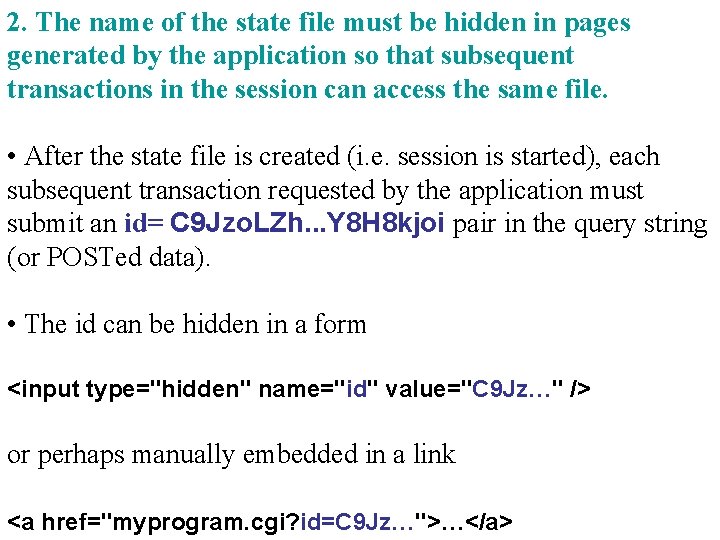
2. The name of the state file must be hidden in pages generated by the application so that subsequent transactions in the session can access the same file. • After the state file is created (i. e. session is started), each subsequent transaction requested by the application must submit an id= C 9 Jzo. LZh. . . Y 8 H 8 kjoi pair in the query string (or POSTed data). • The id can be hidden in a form <input type="hidden" name="id" value="C 9 Jz…" /> or perhaps manually embedded in a link <a href="myprogram. cgi? id=C 9 Jz…">…</a>
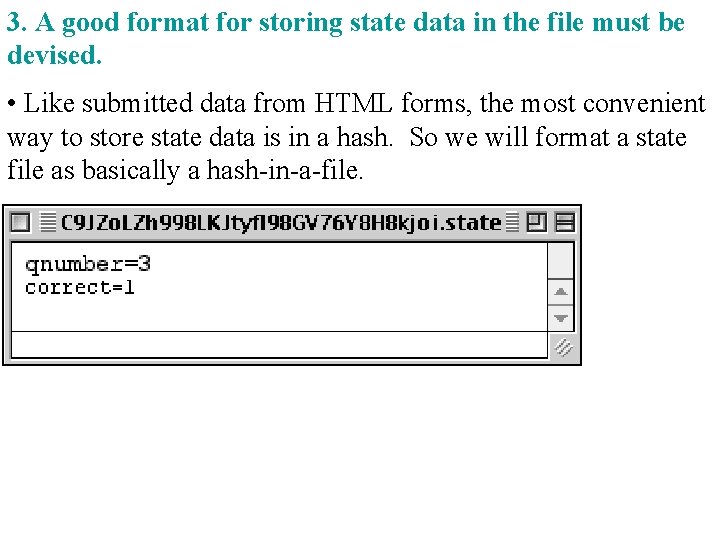
3. A good format for storing state data in the file must be devised. • Like submitted data from HTML forms, the most convenient way to store state data is in a hash. So we will format a state file as basically a hash-in-a-file.
• With the hash-in-a-file approach, the data easily can be read into a hash, say %state. Hash, in a CGI program. • When the state data in the file needs updated, it is a simple matter simply to write the %state. Hash back to the state file. NOTE: Major advantage of this storage format: The order in which the state data is stored in the file doesn't matter. All you need to know is the name (key) of a piece of state data and you can grab it. For example: $state. Hash{"correct"} Similarly, a new piece of state data can be added without any concern about its order among the existing state data.
4. The state file names should be ensured to be unique so that a new session does not overwrite the state file for a session in progress. • The session IDs are randomly generated from the characters 0 -9 , a-z , A-Z. That's 62 characters. • The probability of randomly generating a given 32 -digit session ID is 1/6232 = 2. 3 x 10 -57 • No way are you going to generate the same session ID twice in a lifetime. You're more likely to win several power-ball lotteries in a row.
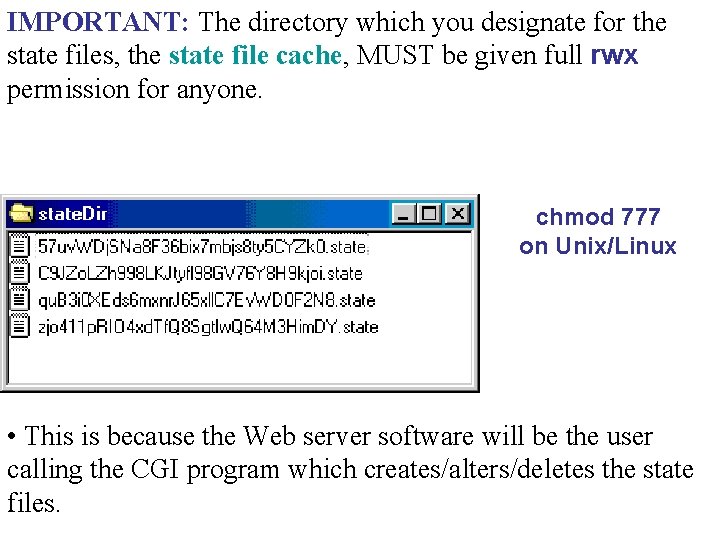
IMPORTANT: The directory which you designate for the state files, the state file cache, MUST be given full rwx permission for anyone. chmod 777 on Unix/Linux • This is because the Web server software will be the user calling the CGI program which creates/alters/deletes the state files.
5. (The final logistical hurdle). How to keep the state file cache from becoming over-populated over time. • That is, after thousands (or tens of thousands) of sessions, the state file cache would contain thousands of state files. • One solution is for a server administrator to clean out the cache periodically, perhaps weekly or monthly. Rather than doing that manually, one would want to use a shell script which deletes only those state files that have not been used (modified) lately. Otherwise, you could delete a file for a session in progress, effectively killing the session. • Our solution will be for the function which creates state files to also delete old ones periodically. We call that policing the state cache. (more on that later)
• Most programming environments made for building Web applications (PHP, ASP, JSP, etc. ) have built-in features which handle (for better or worse) management of state files. • We next offer some utility functions which will make using state files in PERL programs quite easy. You can copy these into your programs (or function library) straight from the source files provided on our Web site. • When you understand the principles behind the use and caching of server-side state files, the built in features of the other programming environments become readily understood. • In particular, some weaknesses of CGI. pm, a popular module (library) made to automate some CGI-related tasks, becomes apparent. (This is discussed in Chapter 9. )
&generate_random_string -- returns a session ID (of specified length) Example use: $session. ID = &generate_random_string(32); It's then easy to build the full name of a state file: $filename = "$session. ID. state"; See Chap 7 CGI. lib for source code.
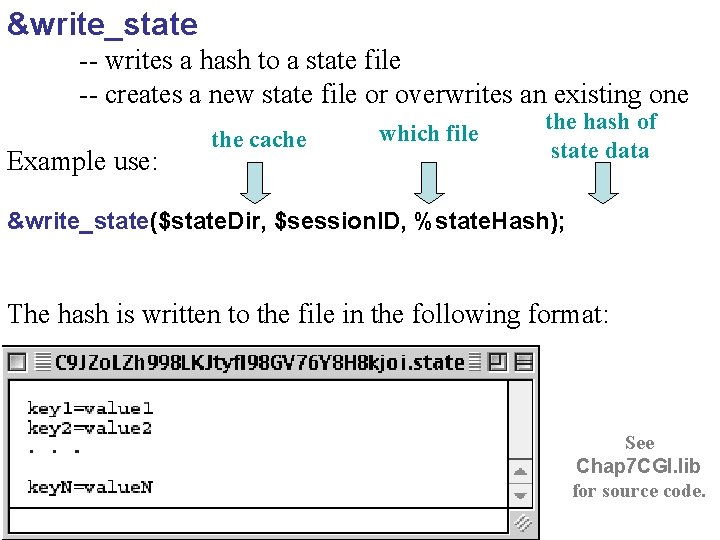
&write_state -- writes a hash to a state file -- creates a new state file or overwrites an existing one Example use: the cache which file the hash of state data &write_state($state. Dir, $session. ID, %state. Hash); The hash is written to the file in the following format: See Chap 7 CGI. lib for source code.
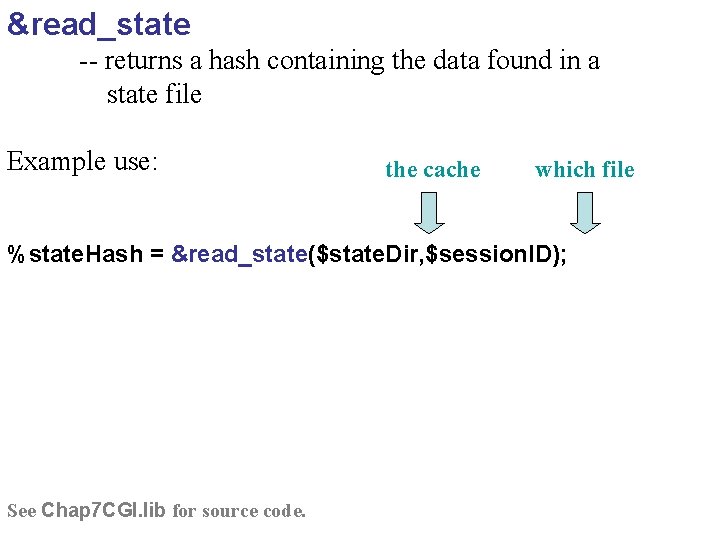
&read_state -- returns a hash containing the data found in a state file Example use: the cache which file %state. Hash = &read_state($state. Dir, $session. ID); See Chap 7 CGI. lib for source code.
NOTE: The state data is URL-encoded in the state file. • The &write_state function URL-encodes the state data before writing it to the file. • The &read_state function URL-decodes the state data as it builds the hash it returns. • One reason for this is to keep unwanted characters (like =) in the data from interfering with the structure (delimiting characters) of the state file. • Another reason is to circumvent a potential security risk which can arise from a cleverly placed n character in the state data. (This is discussed in detail in Section 13. 6).
Example: quiz 2. cgi appears exactly the same as quiz 1. cgi, but uses state files for the session data instead of hiding the state data in the forms. • The program simply updates the state file after each question is graded. • The session. ID is hidden in the form for each question to identify the proper state file when the question is submitted. • The current question number is also hidden in each quiz form to prevent cheating. If the user hits the back button and resubmits a question, the submitted question number won't match the one in the state file. Note: It is still necessary to hide the request=some_function data in each form in order to drive the app logic.
- Slides: 30