Human Health Physiology Defense Infectious Disease Muscles and















- Slides: 75
Human Health & Physiology Defense- Infectious Disease Muscles and Movement The Kidney Human Reproduction University of Pennslyvania http: //www. upenn. edu/pennnews/article. php? id=686 accessed 13. 10. 07
Defense- Infectious Disease A. Blood Clotting B. Basis of Immunity C. Active & Passive Immunity D. Vaccinations E. Monoclonal Antibodies National Geographic http: //science. nationalgeographic. com/science/wallpaper/smallpox-vaccination. html accessed 27. 08
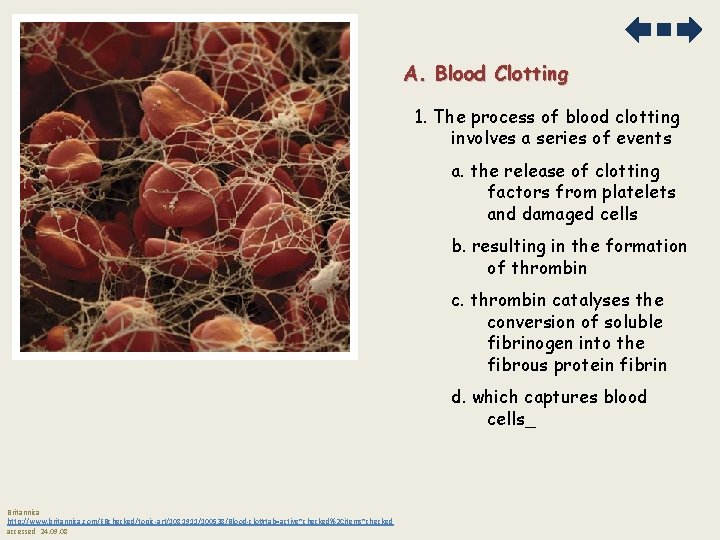
A. Blood Clotting 1. The process of blood clotting involves a series of events a. the release of clotting factors from platelets and damaged cells b. resulting in the formation of thrombin catalyses the conversion of soluble fibrinogen into the fibrous protein fibrin d. which captures blood cells_ Britannica http: //www. britannica. com/EBchecked/topic-art/1081911/100538/Blood-clot#tab=active~checked%2 Citems~checked accessed 24. 09. 08
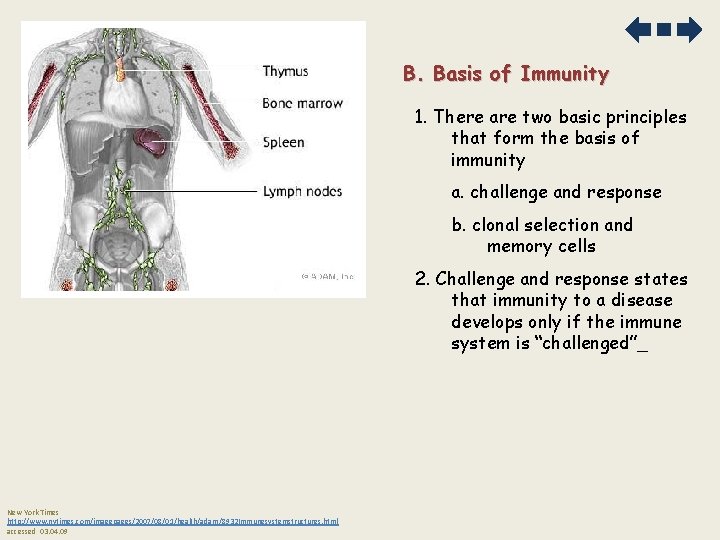
B. Basis of Immunity 1. There are two basic principles that form the basis of immunity a. challenge and response b. clonal selection and memory cells 2. Challenge and response states that immunity to a disease develops only if the immune system is “challenged”_ New York Times http: //www. nytimes. com/imagepages/2007/08/01/health/adam/8932 Immunesystemstructures. html accessed 03. 04. 09
3. Clonal selection and memory cells a. (this is intended to be a simple introduction to the complex topic of immunity- the idea of a polyclonal response can be introduced here)_ Nature http: //www. nature. com/nature/journal/v 421/n 6921/fig_tab/nature 01409_F 1. html accessed 03. 04. 09
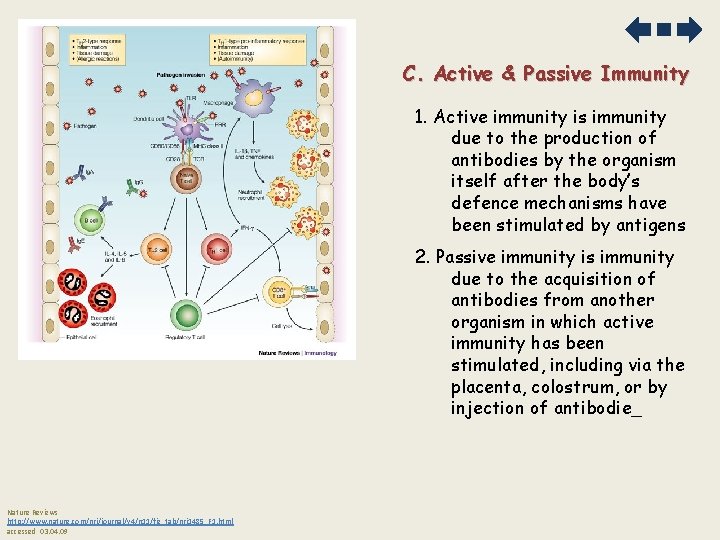
C. Active & Passive Immunity 1. Active immunity is immunity due to the production of antibodies by the organism itself after the body’s defence mechanisms have been stimulated by antigens 2. Passive immunity is immunity due to the acquisition of antibodies from another organism in which active immunity has been stimulated, including via the placenta, colostrum, or by injection of antibodie_ Nature Reviews http: //www. nature. com/nri/journal/v 4/n 11/fig_tab/nri 1485_F 1. html accessed 03. 04. 09
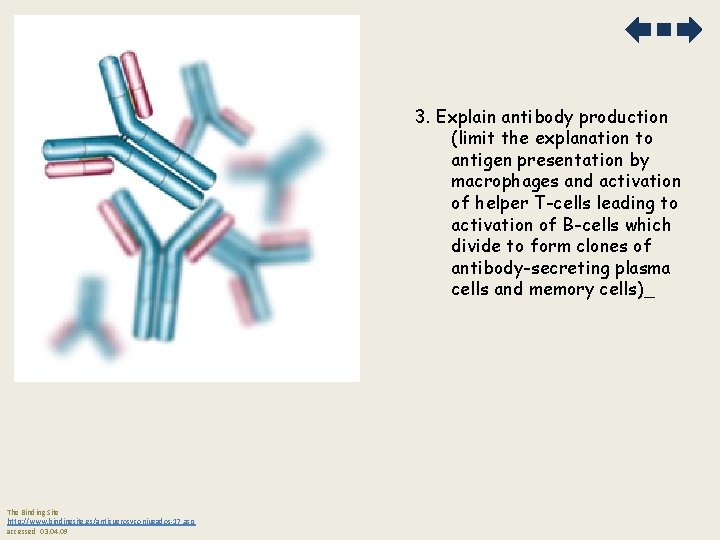
3. Explain antibody production (limit the explanation to antigen presentation by macrophages and activation of helper T-cells leading to activation of B-cells which divide to form clones of antibody-secreting plasma cells and memory cells)_ The Binding Site http: //www. bindingsite. es/antisuerosyconjugados-17. asp accessed 03. 04. 09
D. Vaccinations 1. The principle of vaccination involves a. the role of memory cells b. the primary and secondary responses can be clearly illustrated by a graph c. precise details of all the types of vaccine attenuated virus inactivated toxins_ Blacklisted News http: //www. blacklistednews. com/view. asp? ID=5725 accessed 03. 04. 09
Theory of Knowledge THIS IS AN AREA WHERE IT IS IMPORTANT TO ESTIMATE ACCURATELY THE SIZEthe OF RISKS, 2. Discuss benefits and USING GOOD SCIENTIFIC DATA. THE USE OF DOUBLE-BLIND TRIALS FOR VACCINESof ORvaccination FOR dangers DRUG TREATMENTS COULD BE DISCUSSED. THE PLACEBO EFFECT COULD ALSO BE the. AND benefits CONSIDERED, TOGETHER WITH THE COMPLEX INTERPLAY BETWEENa. MIND BODY IN should include total elimination FEELINGS OF ILLNESS AND HEALTH. DOES THE PATIENT OR THE DOCTOR DECIDE WHETHER THE PATIENT IS WELL OR NOT? of diseases, prevention THERE ALSO QUESTIONS ABOUT THE RELATIONSHIP BETWEEN THE SCIENTIFIC of pandemics and COMMUNITY AND THE GENERAL PUBLIC. HOW CAN THE GENERAL PUBLICepidemics, BE GIVEN decreased CLEAR INFORMATION ABOUT THE BENEFITS AND RISKS OF VACCINATION? WHAT WENT health-care costs and WRONG IN THE RECENT CASE OF MISPLACED FEARS ABOUT THE MEASLES, MUMPS AND prevention RUBELLA (MMR) VACCINE IN THE UK? THERE ARE ETHICAL QUESTIONS HERE ABOUT WHO of harmful of diseases. SHOULD DECIDE VACCINATION POLICY IN A COUNTRY, AND WHETHER IT ISside-effects ETHICALLY ACCEPTABLE TO HAVE A COMPULSORY VACCINATION PROGRAMME. b. the dangers should include the possible toxic effects of mercury in vaccines, possible overload of the immune system and possible links with autism_ Center for Disease Control http: //www. cdc. gov/malaria/features/index_022405. htm accessed 03. 04. 09 TOK
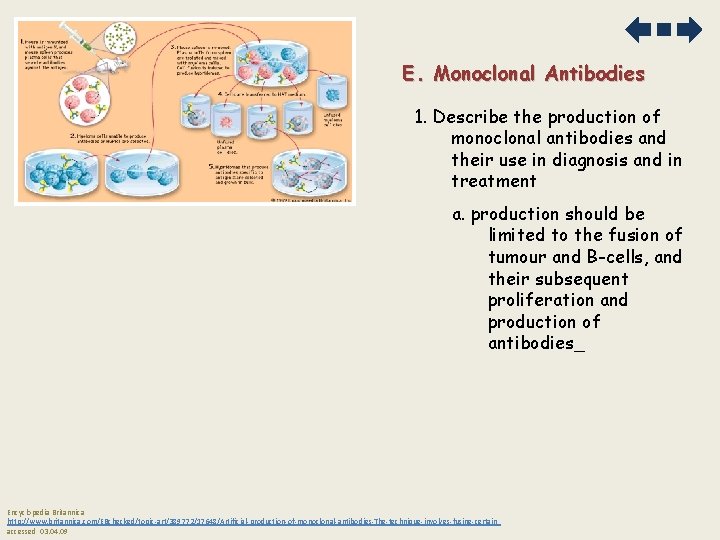
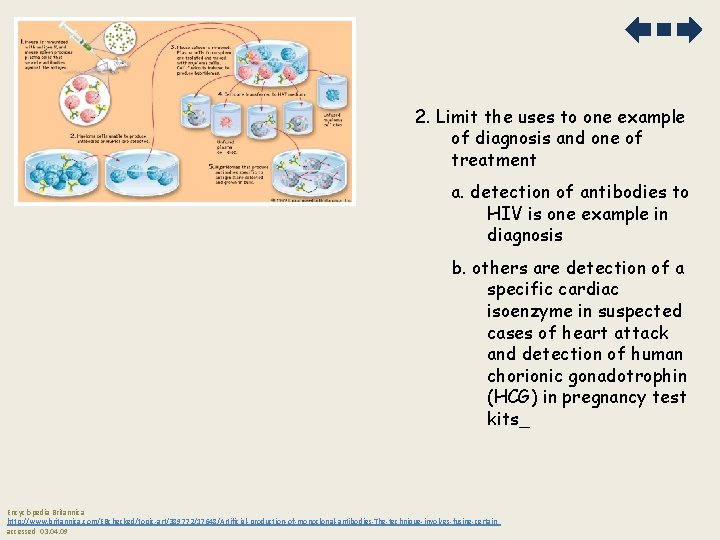
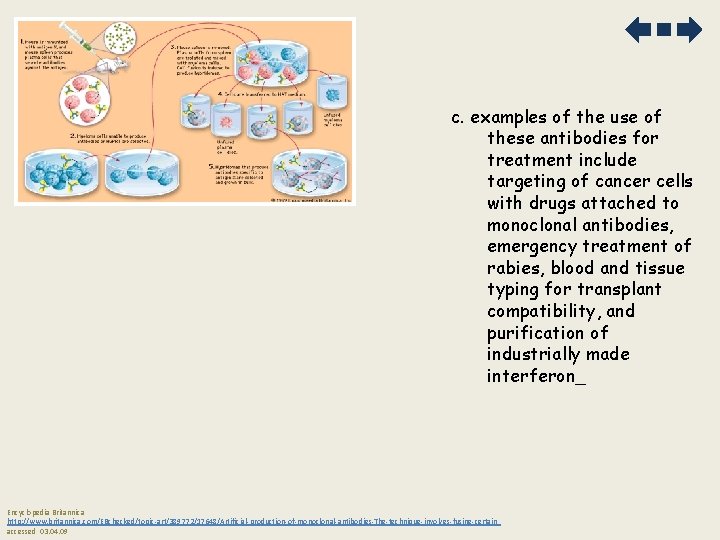
E. Monoclonal Antibodies 1. Describe the production of monoclonal antibodies and their use in diagnosis and in treatment a. production should be limited to the fusion of tumour and B-cells, and their subsequent proliferation and production of antibodies_ Encyclopedia Britannica http: //www. britannica. com/EBchecked/topic-art/389772/17648/Artificial-production-of-monoclonal-antibodies-The-technique-involves-fusing-certain accessed 03. 04. 09
2. Limit the uses to one example of diagnosis and one of treatment a. detection of antibodies to HIV is one example in diagnosis b. others are detection of a specific cardiac isoenzyme in suspected cases of heart attack and detection of human chorionic gonadotrophin (HCG) in pregnancy test kits_ Encyclopedia Britannica http: //www. britannica. com/EBchecked/topic-art/389772/17648/Artificial-production-of-monoclonal-antibodies-The-technique-involves-fusing-certain accessed 03. 04. 09
c. examples of the use of these antibodies for treatment include targeting of cancer cells with drugs attached to monoclonal antibodies, emergency treatment of rabies, blood and tissue typing for transplant compatibility, and purification of industrially made interferon_ Encyclopedia Britannica http: //www. britannica. com/EBchecked/topic-art/389772/17648/Artificial-production-of-monoclonal-antibodies-The-technique-involves-fusing-certain accessed 03. 04. 09
The End
Muscles and Movement A. Human Movement B. The Elbow Joint C. Hip and Knee Joints D. Muscle Fibers E. Muscles Community College of Rhode Island http: //faculty. ccri. edu/kamontgomery/anatomy_laboratory_resources. htm accessed 16. 09. 07 Play
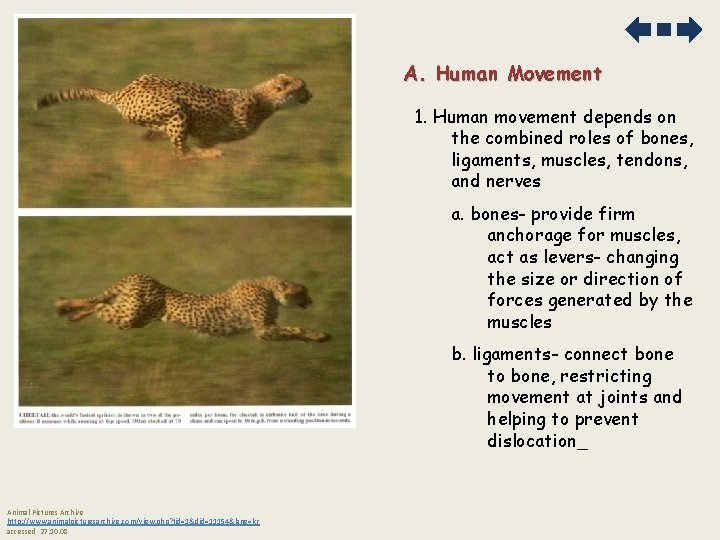
A. Human Movement 1. Human movement depends on the combined roles of bones, ligaments, muscles, tendons, and nerves a. bones- provide firm anchorage for muscles, act as levers- changing the size or direction of forces generated by the muscles b. ligaments- connect bone to bone, restricting movement at joints and helping to prevent dislocation_ Animal Pictures Archive http: //www. animalpicturesarchive. com/view. php? tid=1&did=11154&lang=kr accessed 27. 10. 08
c. muscles- provide the force needed for muscle contraction (they do this when they wish) d. nerves- stimulate muscles to contract at a precise time and extend, so the movement is coordinated e. tendons- attach muscles to bone_ P-world, R-world: The Blog http: //pworldrworld. com/blog/ accessed 27. 10. 08
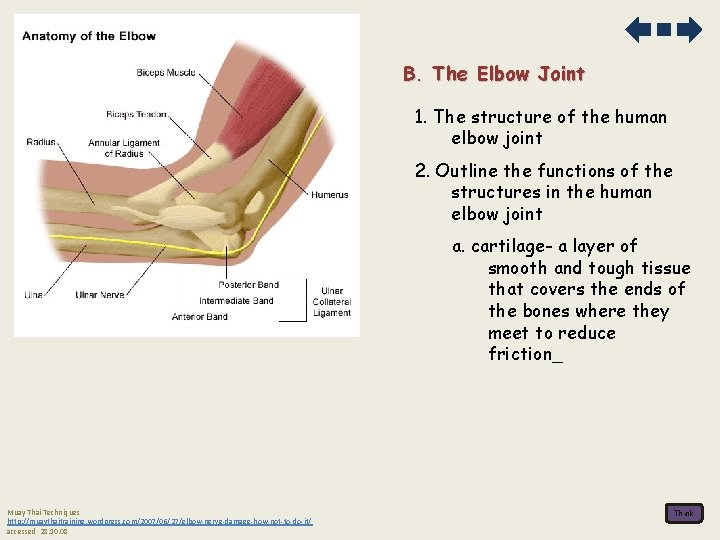
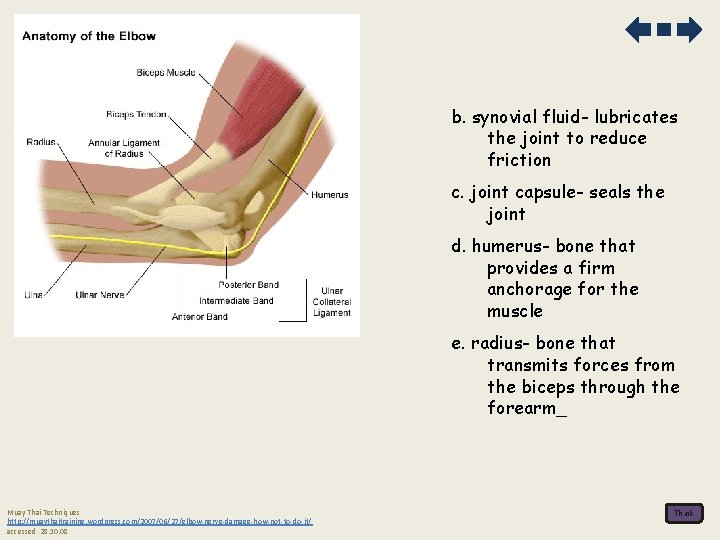
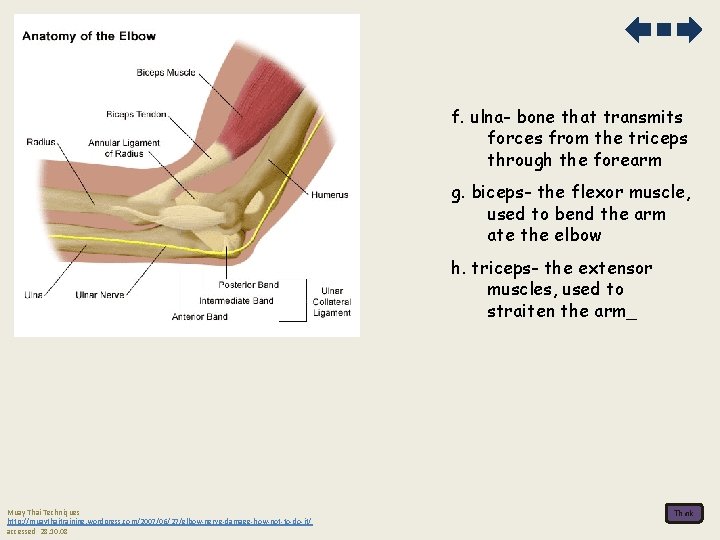
B. The Elbow Joint 1. The structure of the human elbow joint 2. Outline the functions of the structures in the human elbow joint a. cartilage- a layer of smooth and tough tissue that covers the ends of the bones where they meet to reduce friction_ Muay Thai Techniques http: //muaythaitraining. wordpress. com/2007/06/27/elbow-nerve-damage-how-not-to-do-it/ accessed 28. 10. 08 Think
b. synovial fluid- lubricates the joint to reduce friction c. joint capsule- seals the joint d. humerus- bone that provides a firm anchorage for the muscle e. radius- bone that transmits forces from the biceps through the forearm_ Muay Thai Techniques http: //muaythaitraining. wordpress. com/2007/06/27/elbow-nerve-damage-how-not-to-do-it/ accessed 28. 10. 08 Think
f. ulna- bone that transmits forces from the triceps through the forearm g. biceps- the flexor muscle, used to bend the arm ate the elbow h. triceps- the extensor muscles, used to straiten the arm_ Muay Thai Techniques http: //muaythaitraining. wordpress. com/2007/06/27/elbow-nerve-damage-how-not-to-do-it/ accessed 28. 10. 08 Think
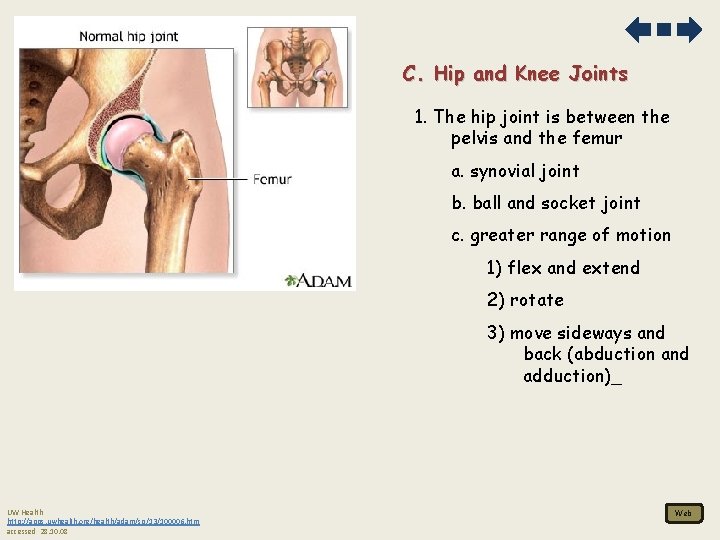
C. Hip and Knee Joints 1. The hip joint is between the pelvis and the femur a. synovial joint b. ball and socket joint c. greater range of motion 1) flex and extend 2) rotate 3) move sideways and back (abduction and adduction)_ UW Health http: //apps. uwhealth. org/health/adam/sp/13/100006. htm accessed 28. 10. 08 Web
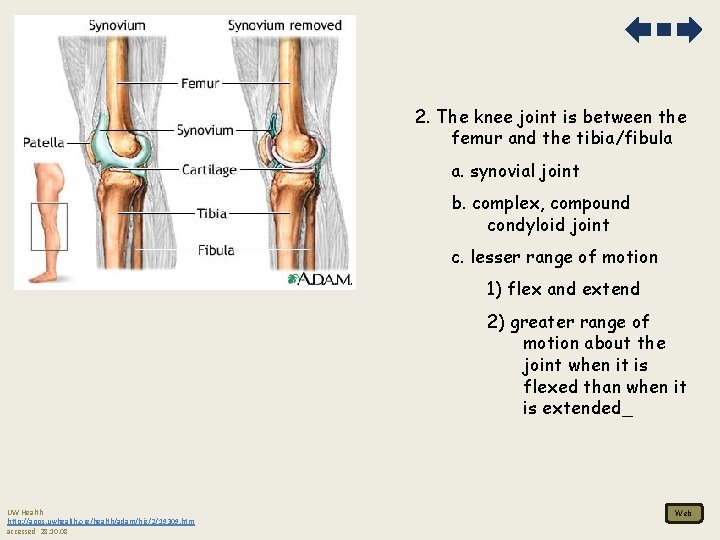
2. The knee joint is between the femur and the tibia/fibula a. synovial joint b. complex, compound condyloid joint c. lesser range of motion 1) flex and extend 2) greater range of motion about the joint when it is flexed than when it is extended_ UW Health http: //apps. uwhealth. org/health/adam/hie/2/19309. htm accessed 28. 10. 08 Web
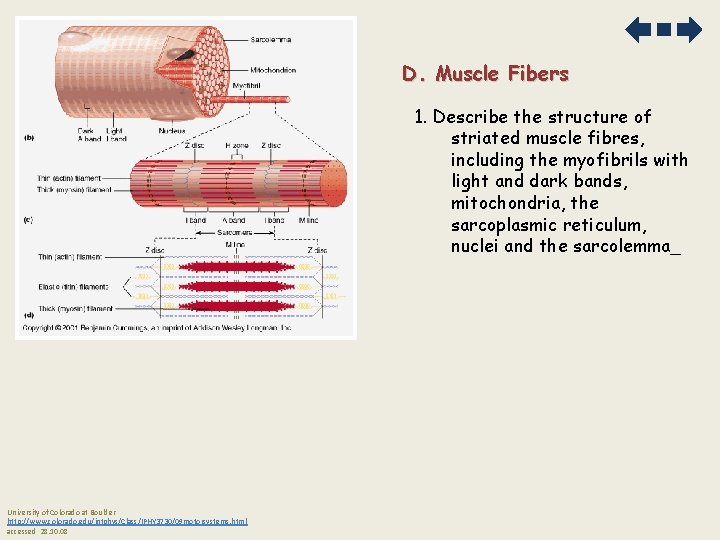
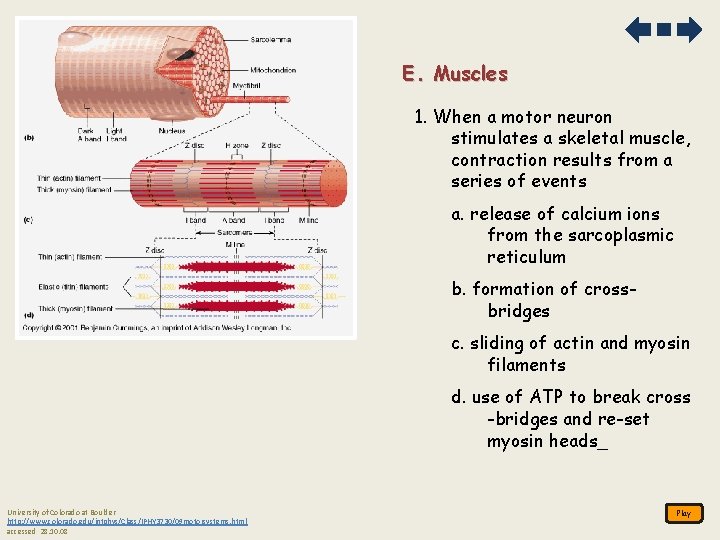
D. Muscle Fibers 1. Describe the structure of striated muscle fibres, including the myofibrils with light and dark bands, mitochondria, the sarcoplasmic reticulum, nuclei and the sarcolemma_ University of Colorado at Boulder http: //www. colorado. edu/intphys/Class/IPHY 3730/09 motorsystems. html accessed 28. 10. 08
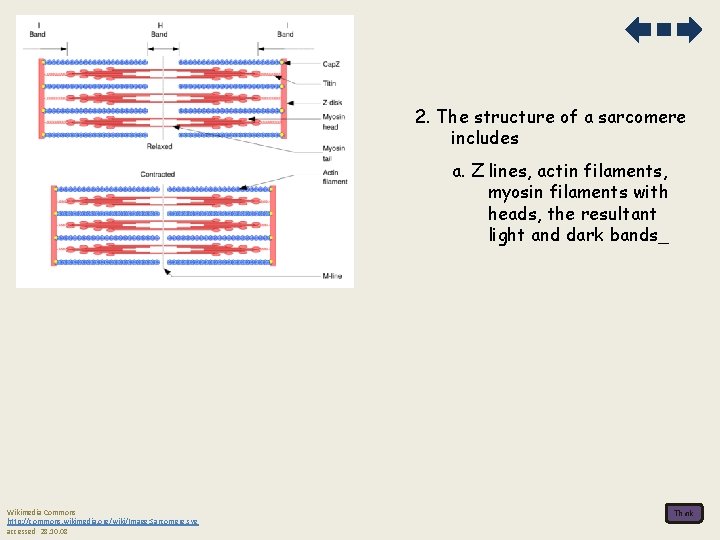
2. The structure of a sarcomere includes a. Z lines, actin filaments, myosin filaments with heads, the resultant light and dark bands_ Wikimedia Commons http: //commons. wikimedia. org/wiki/Image: Sarcomere. svg accessed 28. 10. 08 Think
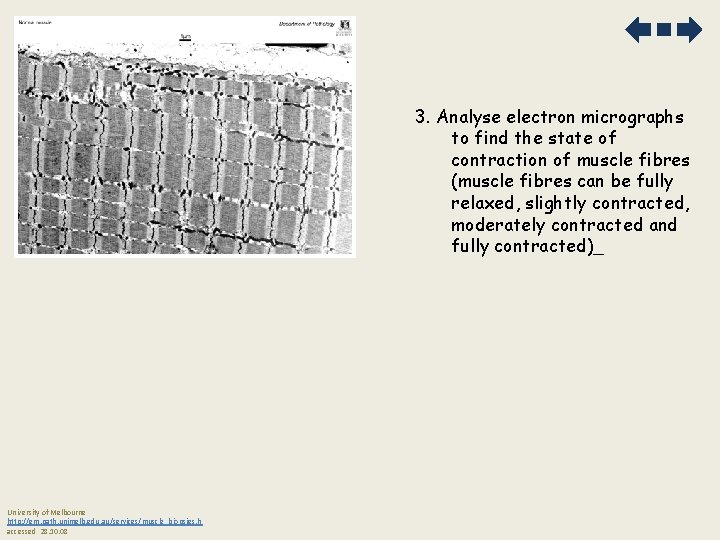
3. Analyse electron micrographs to find the state of contraction of muscle fibres (muscle fibres can be fully relaxed, slightly contracted, moderately contracted and fully contracted)_ University of Melbourne http: //em. path. unimelb. edu. au/services/muscle_biopsies. h accessed 28. 10. 08
E. Muscles 1. When a motor neuron stimulates a skeletal muscle, contraction results from a series of events a. release of calcium ions from the sarcoplasmic reticulum b. formation of crossbridges c. sliding of actin and myosin filaments d. use of ATP to break cross -bridges and re-set myosin heads_ University of Colorado at Boulder http: //www. colorado. edu/intphys/Class/IPHY 3730/09 motorsystems. html accessed 28. 10. 08 Play
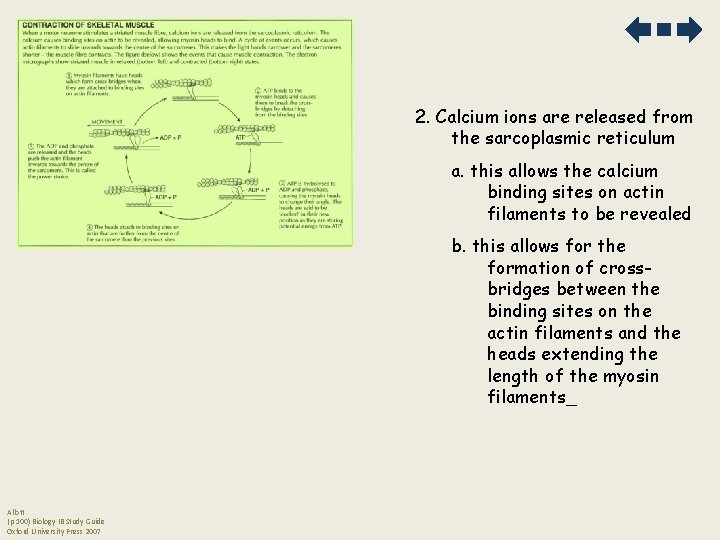
2. Calcium ions are released from the sarcoplasmic reticulum a. this allows the calcium binding sites on actin filaments to be revealed b. this allows for the formation of crossbridges between the binding sites on the actin filaments and the heads extending the length of the myosin filaments_ Allott (p 100) Biology IB Study Guide Oxford University Press 2007
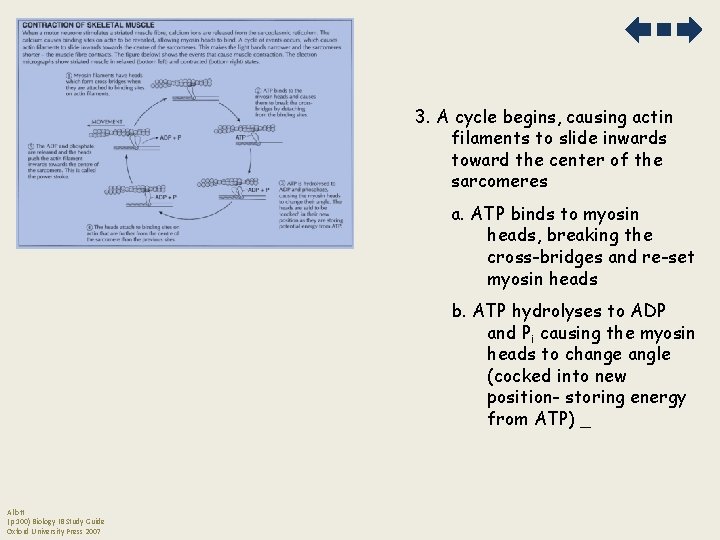
3. A cycle begins, causing actin filaments to slide inwards toward the center of the sarcomeres a. ATP binds to myosin heads, breaking the cross-bridges and re-set myosin heads b. ATP hydrolyses to ADP and Pi causing the myosin heads to change angle (cocked into new position- storing energy from ATP) _ Allott (p 100) Biology IB Study Guide Oxford University Press 2007
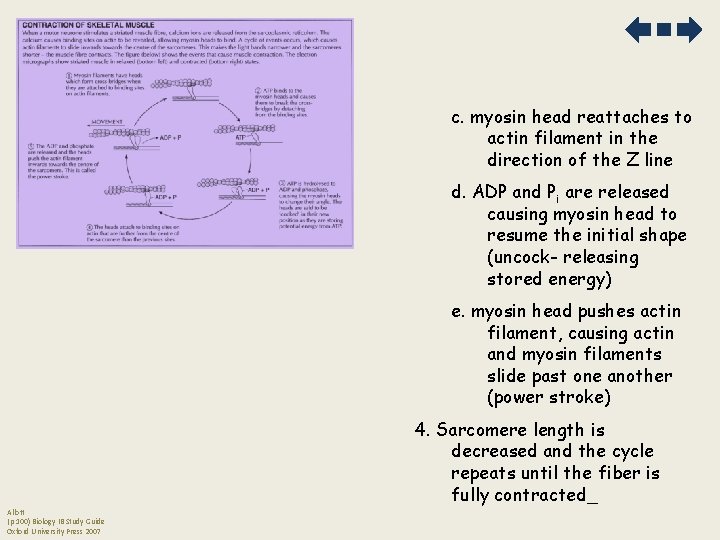
c. myosin head reattaches to actin filament in the direction of the Z line d. ADP and Pi are released causing myosin head to resume the initial shape (uncock- releasing stored energy) e. myosin head pushes actin filament, causing actin and myosin filaments slide past one another (power stroke) 4. Sarcomere length is decreased and the cycle repeats until the fiber is fully contracted_ Allott (p 100) Biology IB Study Guide Oxford University Press 2007
The End
The Kidney A. Excretion B. Kidney Structure C. Ultrafiltration D. Osmoregulation E. Reabsorption author unknown address unknown accessed unknown Play
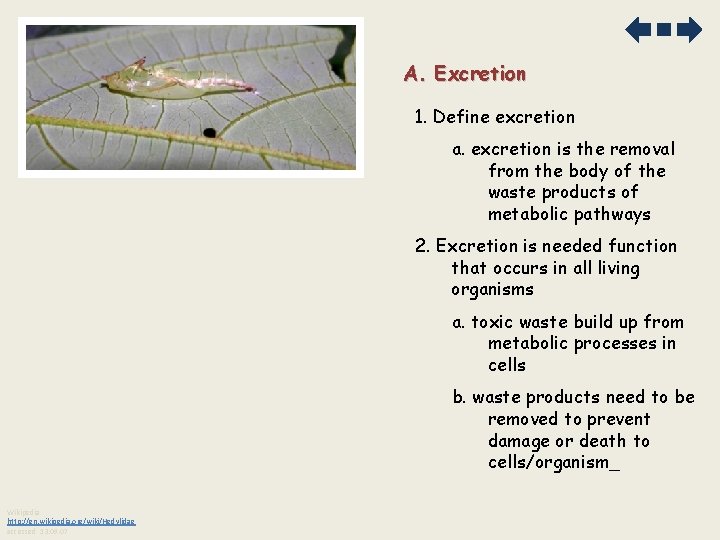
A. Excretion 1. Define excretion a. excretion is the removal from the body of the waste products of metabolic pathways 2. Excretion is needed function that occurs in all living organisms a. toxic waste build up from metabolic processes in cells b. waste products need to be removed to prevent damage or death to cells/organism_ Wikipedia http: //en. wikipedia. org/wiki/Hedylidae accessed 13. 09. 07
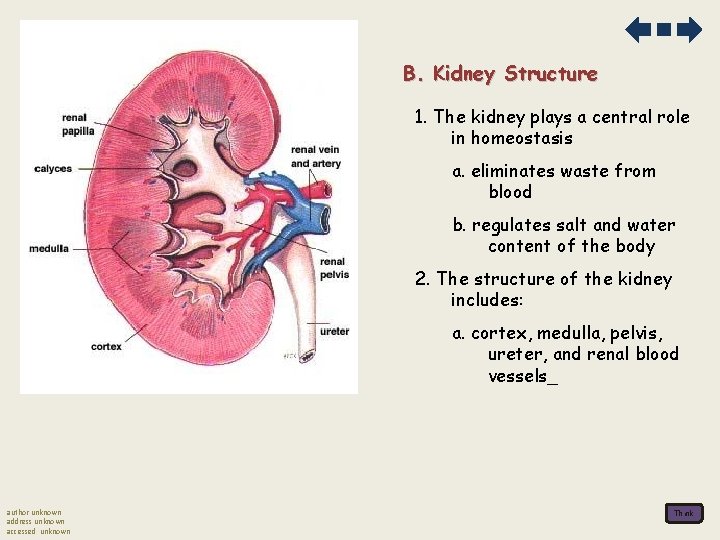
B. Kidney Structure 1. The kidney plays a central role in homeostasis a. eliminates waste from blood b. regulates salt and water content of the body 2. The structure of the kidney includes: a. cortex, medulla, pelvis, ureter, and renal blood vessels_ author unknown address unknown accessed unknown Think
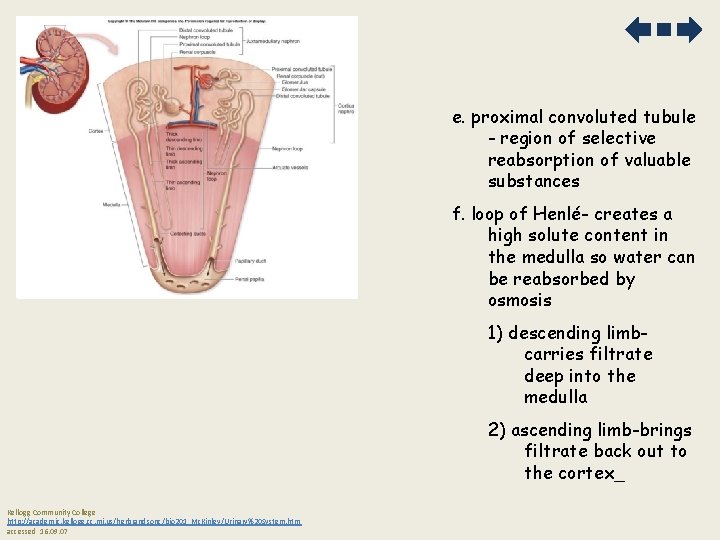
3. The basic unit of function of the kidney is the nephron (and associated glomerulus) a. afferent arteriole- brings blood in from renal artery b. efferent arteriolenarrow vessel leading out of glomerulus c. glomerulus- high pressure capillary bed that is the site of filtration Allott Biology IB Study Guide Oxford University Press 2007 Kellogg Community College http: //academic. kellogg. cc. mi. us/herbrandsonc/bio 201_Mc. Kinley/Urinary%20 System. htm accessed 16. 09. 07 d. Bowman’s capsule- collects the fluid filtered from the blood_ Click Play
e. proximal convoluted tubule - region of selective reabsorption of valuable substances f. loop of Henlé- creates a high solute content in the medulla so water can be reabsorbed by osmosis 1) descending limbcarries filtrate deep into the medulla 2) ascending limb-brings filtrate back out to the cortex_ Kellogg Community College http: //academic. kellogg. cc. mi. us/herbrandsonc/bio 201_Mc. Kinley/Urinary%20 System. htm accessed 16. 09. 07
g. distal convoluted tubevaries amount of water reabsorbed into the blood (osmoregualtion) h. collecting duct- carries filtrate back through cortex and medula to the renal pelvis (hormone ADH controls water reabsorbtion) i. capillaries- supply blood, absorbs fluid from the convoluted tube and loop of Henlé, and return blood back to renal vein_ Kellogg Community College http: //academic. kellogg. cc. mi. us/herbrandsonc/bio 201_Mc. Kinley/Urinary%20 System. htm accessed 16. 09. 07 Think
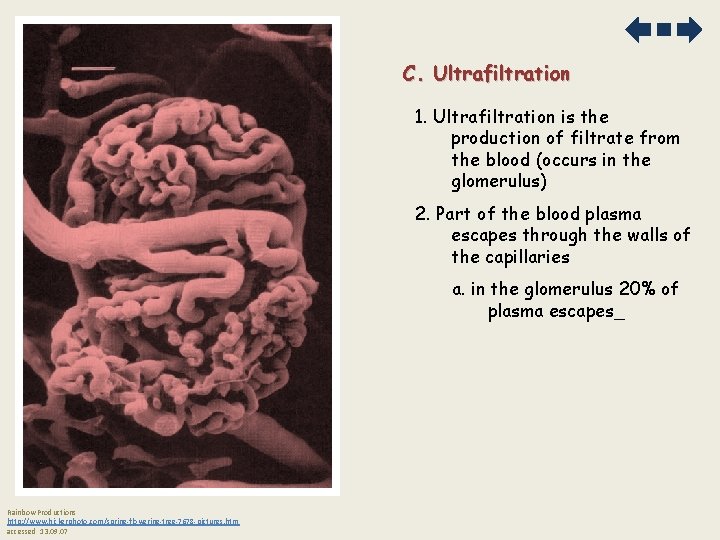
C. Ultrafiltration 1. Ultrafiltration is the production of filtrate from the blood (occurs in the glomerulus) 2. Part of the blood plasma escapes through the walls of the capillaries a. in the glomerulus 20% of plasma escapes_ Rainbow Productions http: //www. hickerphoto. com/spring-flowering-tree-7678 -pictures. htm accessed 13. 09. 07
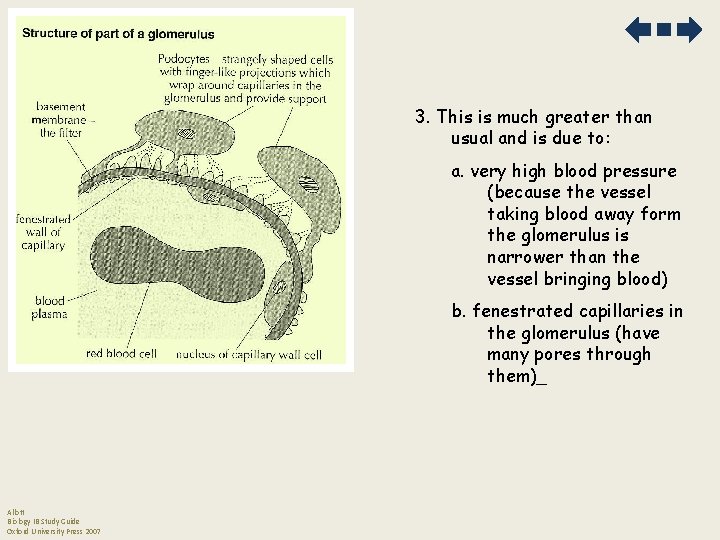
3. This is much greater than usual and is due to: a. very high blood pressure (because the vessel taking blood away form the glomerulus is narrower than the vessel bringing blood) b. fenestrated capillaries in the glomerulus (have many pores through them)_ Allott Biology IB Study Guide Oxford University Press 2007
4. The pores are large enough to allow any molecules through 5. On the outside of the capillary wall is the basement membrane which acts as filter a. only allows molecules with a molecular mass below 68, 000 to pass through b. lets all substances in the blood plasma through except plasma proteins_ Allott Biology IB Study Guide Oxford University Press 2007
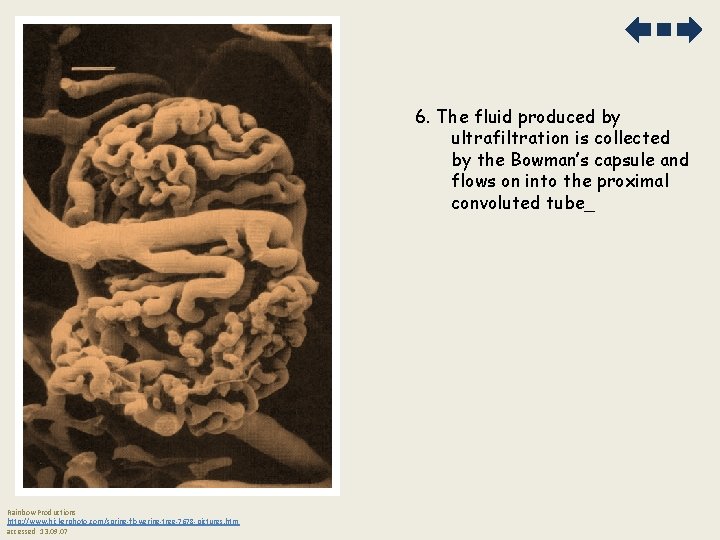
6. The fluid produced by ultrafiltration is collected by the Bowman’s capsule and flows on into the proximal convoluted tube_ Rainbow Productions http: //www. hickerphoto. com/spring-flowering-tree-7678 -pictures. htm accessed 13. 09. 07
D. Osmoregulation 1. Osmoregulation- control of the water balance of the blood, tissue or cytoplasm of a living organism_ Ming Kei College http: //www. cccmkc. edu. hk/~sbj-biology/CERT%20 BIO/Regulation%20 and%20 defence/ Homeostasis%20 in%20 mammals/Homeostasis%20 in%20 mammals%20 menu. htm accessed 16. 09. 07 Think
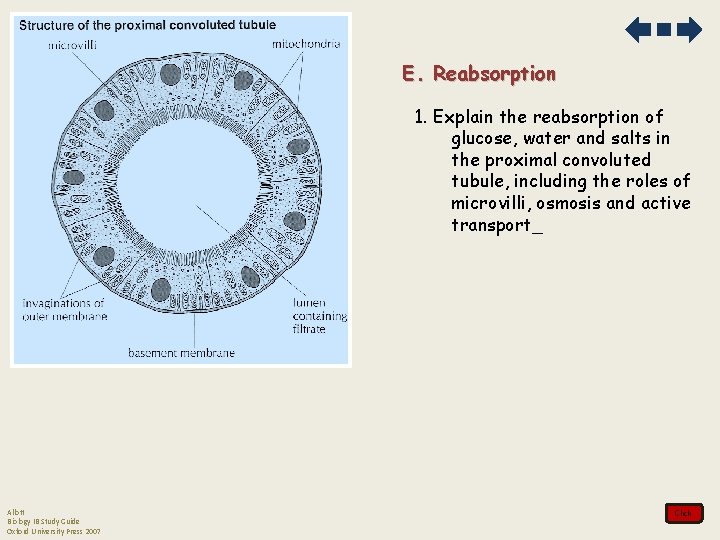
E. Reabsorption 1. Explain the reabsorption of glucose, water and salts in the proximal convoluted tubule, including the roles of microvilli, osmosis and active transport_ Allott Biology IB Study Guide Oxford University Press 2007 Click Play
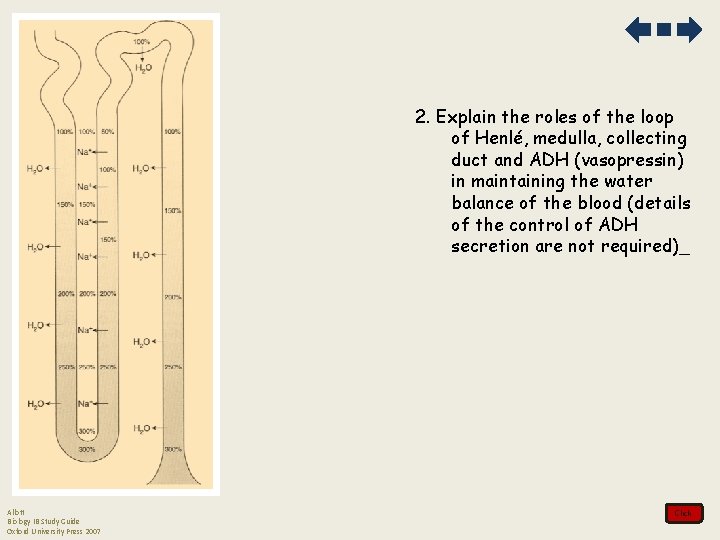
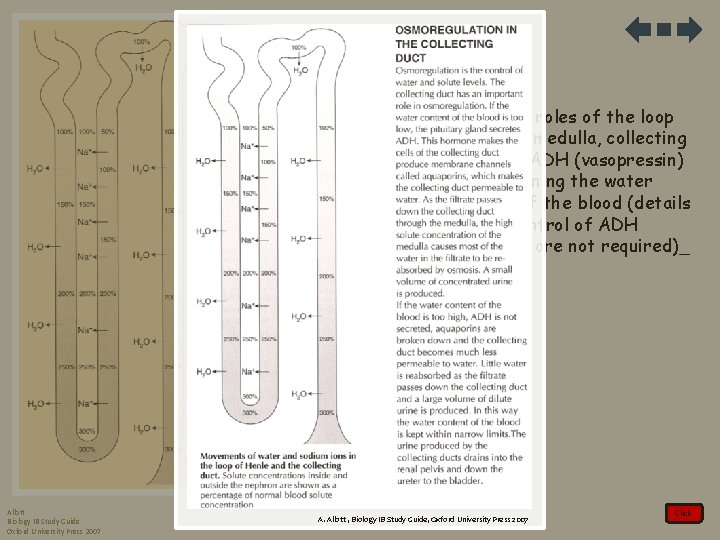
2. Explain the roles of the loop of Henlé, medulla, collecting duct and ADH (vasopressin) in maintaining the water balance of the blood (details of the control of ADH secretion are not required)_. Allott Biology IB Study Guide Oxford University Press 2007 Click Play
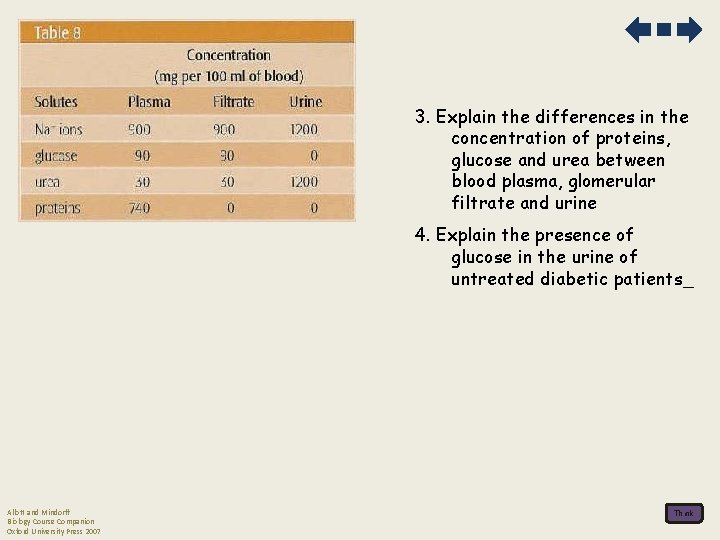
3. Explain the differences in the concentration of proteins, glucose and urea between blood plasma, glomerular filtrate and urine 4. Explain the presence of glucose in the urine of untreated diabetic patients_ Allott and Mindorff Biology Course Companion Oxford University Press 2007 Think
The End
E. Reabsorption 1. Explain the reabsorption of glucose, water and salts in the proximal convoluted tubule, including the roles of microvilli, osmosis and active transport_ A. Allott , Biology IB Study Guide, Oxford University Press 2007 Allott Biology IB Study Guide Oxford University Press 2007 Click
2. Explain the roles of the loop of Henlé, medulla, collecting duct and ADH (vasopressin) in maintaining the water balance of the blood (details of the control of ADH secretion are not required)_ Allott Biology IB Study Guide Oxford University Press 2007 A. Allott , Biology IB Study Guide, Oxford University Press 2007 Click
2. Explain the roles of the loop of Henlé, medulla, collecting duct and ADH (vasopressin) in maintaining the water balance of the blood (details of the control of ADH secretion are not required)_ Allott Biology IB Study Guide Oxford University Press 2007 A. Allott , Biology IB Study Guide, Oxford University Press 2007 Click
ANSWER QUESTIONS 1, 2, & 3 (BONUS 4 & 5) 3. Explain the differences in the concentration of proteins, glucose and urea between blood plasma, glomerular filtrate and urine 4. Explain the presence of glucose in the urine of untreated diabetic patients_ Allott and Mindorff Biology Course Companion Oxford University Press 2007 A. Allott and D. Mindorff, Biology Course Companion, Oxford University Press 2007 Think
Human Reproduction A. Spermatogenesis B. Oogenesis C. Fertilization D. Embryonic Development E. Birth Blogger http: //stephanierosebio 156. blogspot. com/ accessed 27. 08
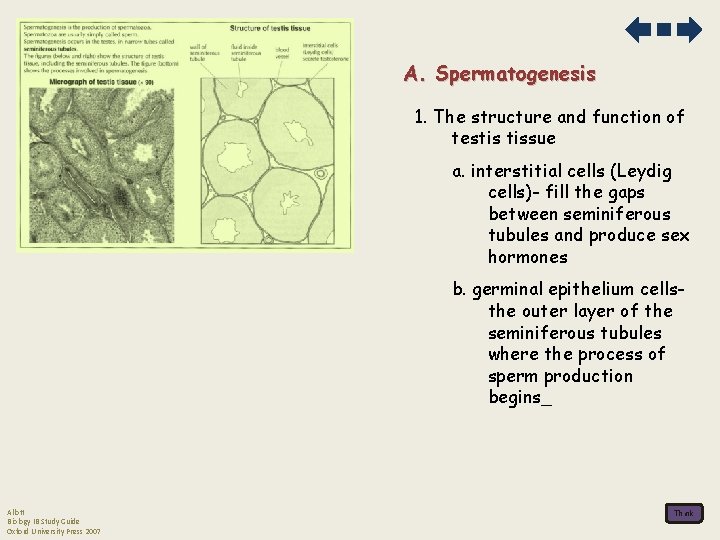
A. Spermatogenesis 1. The structure and function of testis tissue a. interstitial cells (Leydig cells)- fill the gaps between seminiferous tubules and produce sex hormones b. germinal epithelium cellsthe outer layer of the seminiferous tubules where the process of sperm production begins_ Allott Biology IB Study Guide Oxford University Press 2007 Think
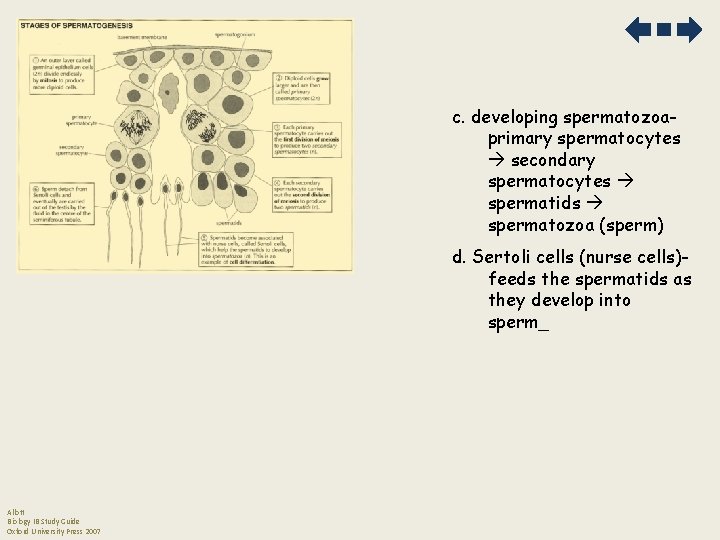
c. developing spermatozoaprimary spermatocytes secondary spermatocytes spermatids spermatozoa (sperm) d. Sertoli cells (nurse cells)feeds the spermatids as they develop into sperm_ Allott Biology IB Study Guide Oxford University Press 2007
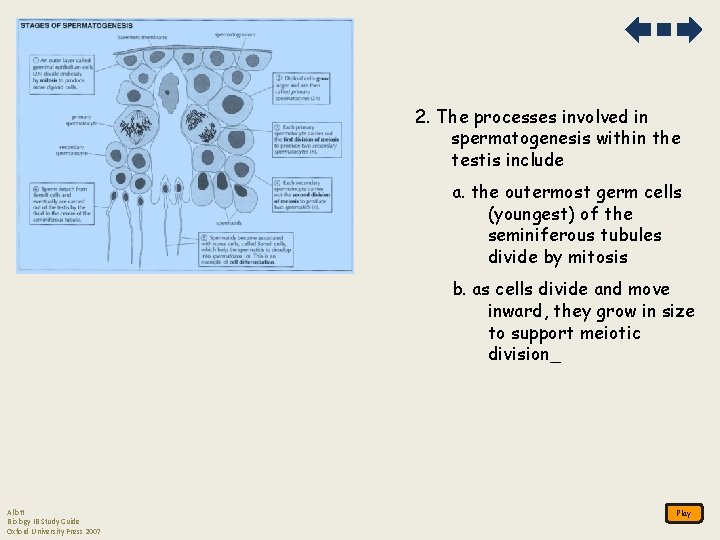
2. The processes involved in spermatogenesis within the testis include a. the outermost germ cells (youngest) of the seminiferous tubules divide by mitosis b. as cells divide and move inward, they grow in size to support meiotic division_ Allott Biology IB Study Guide Oxford University Press 2007 Play
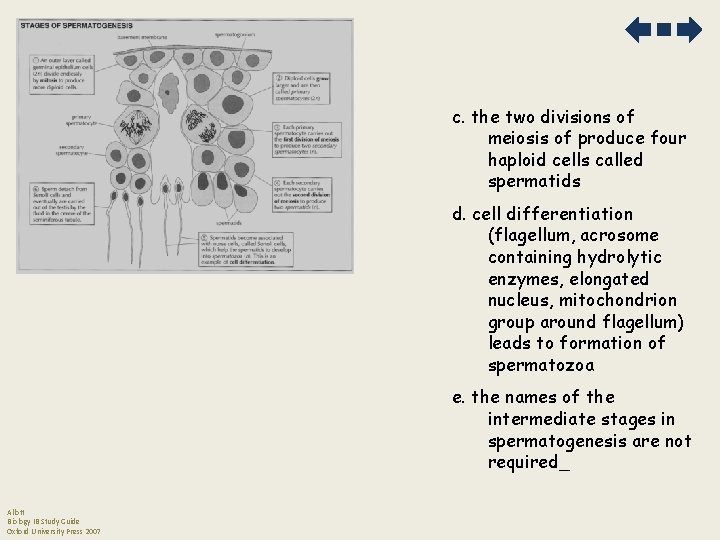
c. the two divisions of meiosis of produce four haploid cells called spermatids d. cell differentiation (flagellum, acrosome containing hydrolytic enzymes, elongated nucleus, mitochondrion group around flagellum) leads to formation of spermatozoa e. the names of the intermediate stages in spermatogenesis are not required_ Allott Biology IB Study Guide Oxford University Press 2007
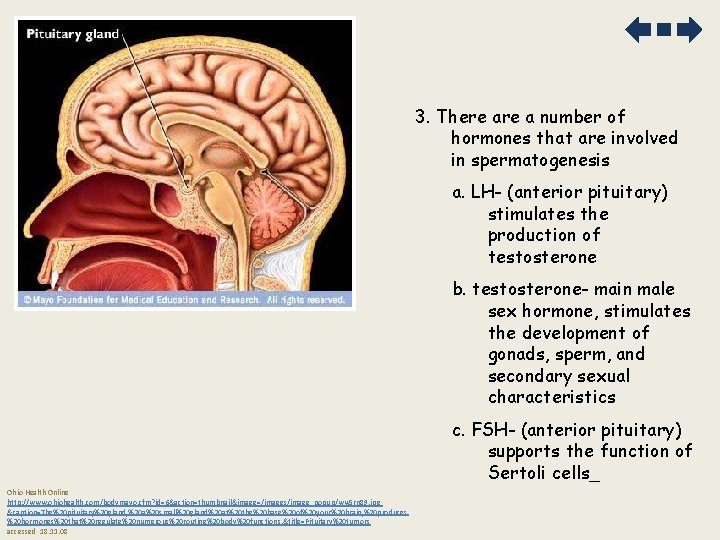
3. There a number of hormones that are involved in spermatogenesis a. LH- (anterior pituitary) stimulates the production of testosterone b. testosterone- main male sex hormone, stimulates the development of gonads, sperm, and secondary sexual characteristics c. FSH- (anterior pituitary) supports the function of Sertoli cells_ Ohio Health Online http: //www. ohiohealth. com/bodymayo. cfm? id=6&action=thumbnail&image=/images/image_popup/ww 5 rn 89. jpg &caption=The%20 pituitary%20 gland, %20 a%20 small%20 gland%20 at%20 the%20 base%20 of%20 your%20 brain, %20 produces %20 hormones%20 that%20 regulate%20 numerous%20 routine%20 body%20 functions. &title=Pituitary%20 tumors accessed 18. 11. 08
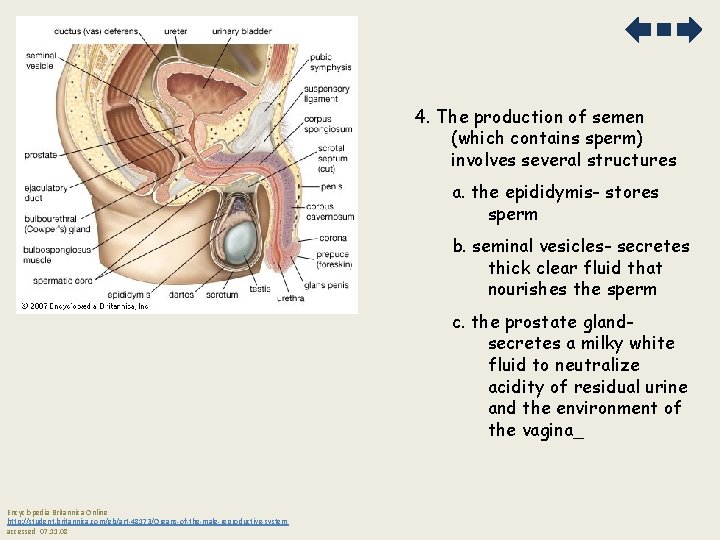
4. The production of semen (which contains sperm) involves several structures a. the epididymis- stores sperm b. seminal vesicles- secretes thick clear fluid that nourishes the sperm c. the prostate glandsecretes a milky white fluid to neutralize acidity of residual urine and the environment of the vagina_ Encyclopedia Britannica Online http: //student. britannica. com/eb/art-48173/Organs-of-the-male-reproductive-system accessed 07. 11. 08
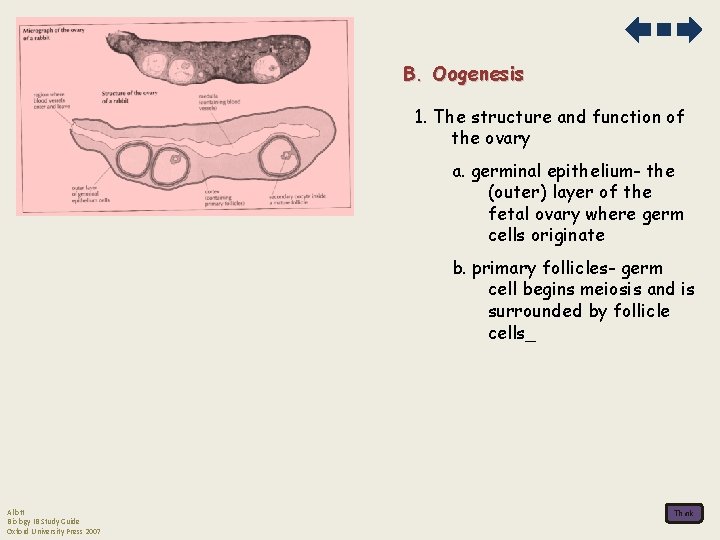
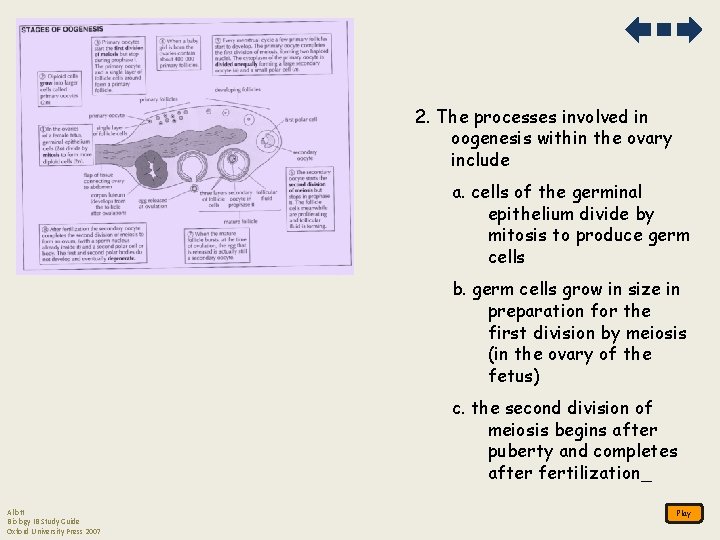
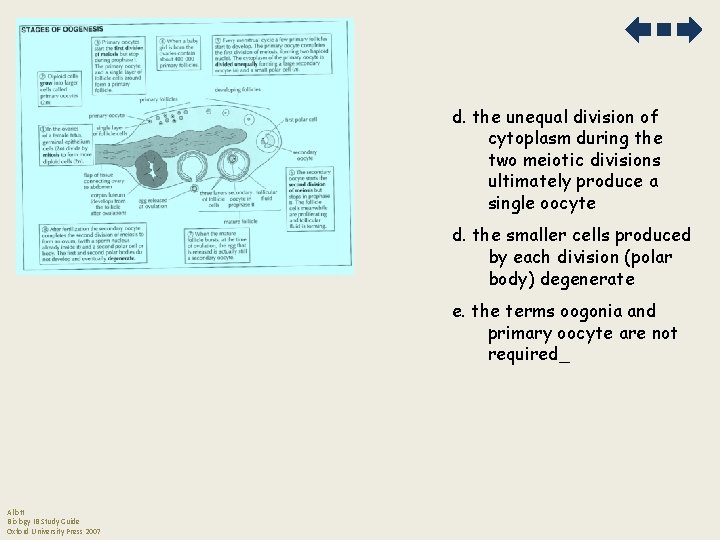
B. Oogenesis 1. The structure and function of the ovary a. germinal epithelium- the (outer) layer of the fetal ovary where germ cells originate b. primary follicles- germ cell begins meiosis and is surrounded by follicle cells_ Allott Biology IB Study Guide Oxford University Press 2007 Think
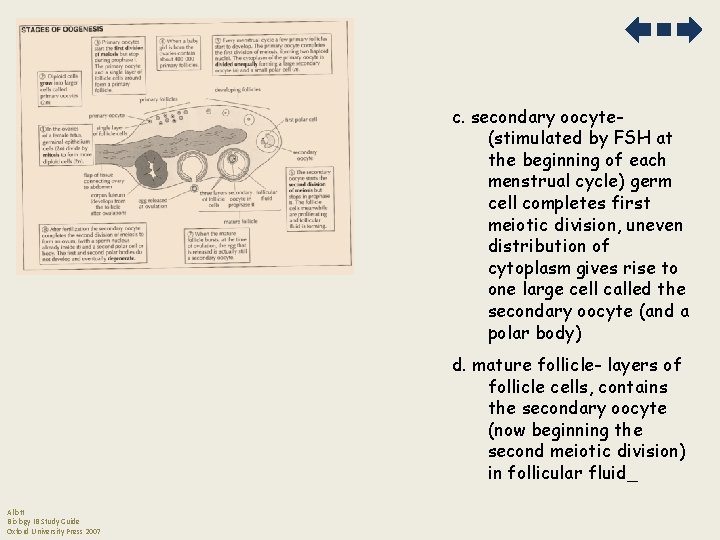
c. secondary oocyte(stimulated by FSH at the beginning of each menstrual cycle) germ cell completes first meiotic division, uneven distribution of cytoplasm gives rise to one large cell called the secondary oocyte (and a polar body) d. mature follicle- layers of follicle cells, contains the secondary oocyte (now beginning the second meiotic division) in follicular fluid_ Allott Biology IB Study Guide Oxford University Press 2007
2. The processes involved in oogenesis within the ovary include a. cells of the germinal epithelium divide by mitosis to produce germ cells b. germ cells grow in size in preparation for the first division by meiosis (in the ovary of the fetus) c. the second division of meiosis begins after puberty and completes after fertilization_ Allott Biology IB Study Guide Oxford University Press 2007 Play
d. the unequal division of cytoplasm during the two meiotic divisions ultimately produce a single oocyte d. the smaller cells produced by each division (polar body) degenerate e. the terms oogonia and primary oocyte are not required_ Allott Biology IB Study Guide Oxford University Press 2007
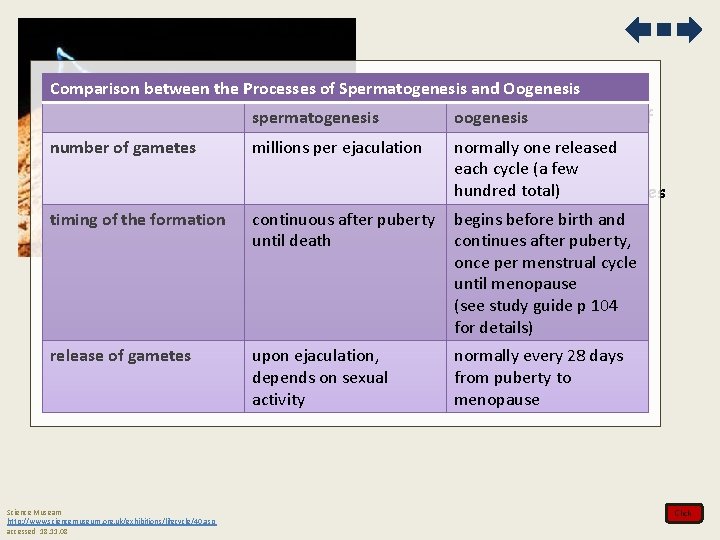
Comparison between the Processes of Spermatogenesis and Oogenesis 3. Compare the processes of oogenesis spermatogenesis and millions per ejaculation normally one released oogenesis each cycle (a few spermatogenesis number of gametes timing of the formation release of gametes Science Museam http: //www. sciencemuseum. org. uk/exhibitions/lifecycle/40. asp accessed 18. 11. 08 hundred total) of gametes a. the number continuous after puberty b. begins and the before timing birth of the until death continues after puberty, formation once per menstrual cycle c. release of gametes_ until menopause (see study guide p 104 for details) upon ejaculation, depends on sexual activity normally every 28 days from puberty to menopause Click Play
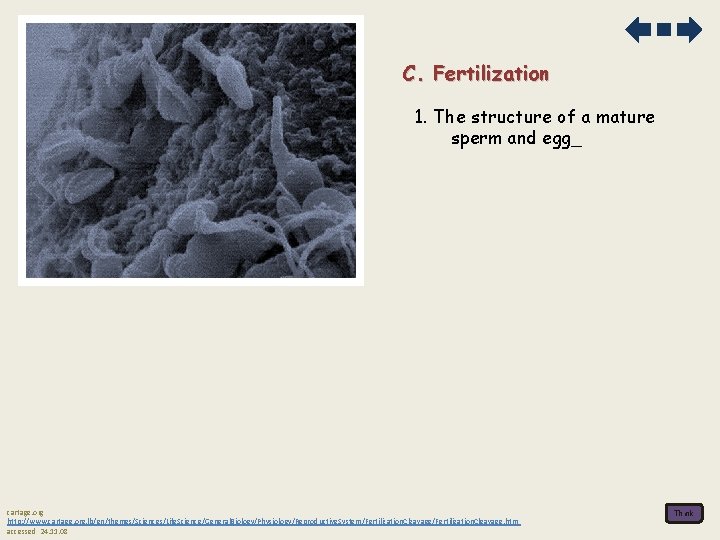
C. Fertilization 1. The structure of a mature sperm and egg_ cartage. org http: //www. cartage. org. lb/en/themes/Sciences/Life. Science/General. Biology/Physiology/Reproductive. System/Fertilization. Cleavage. htm accessed 24. 11. 08 Think
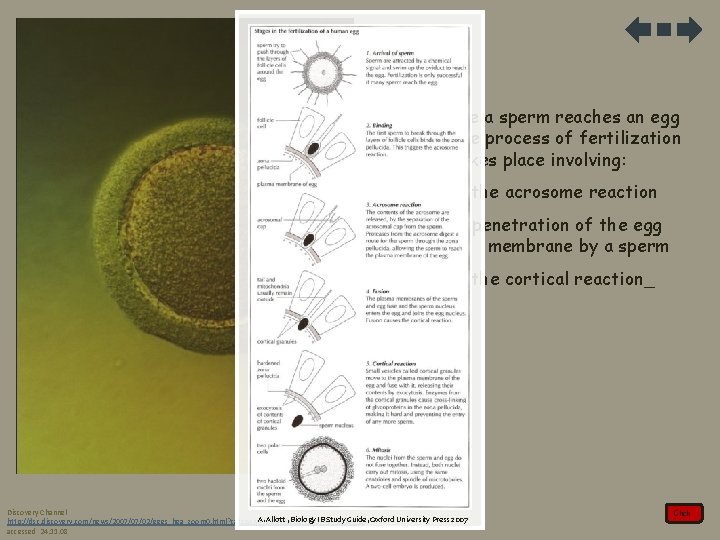
2. Once a sperm reaches an egg the process of fertilization takes place involving: a. the acrosome reaction b. penetration of the egg membrane by a sperm c. the cortical reaction_ Discovery Channel A. Allott , Biology IB Study Guide, Oxford University Press 2007 http: //dsc. discovery. com/news/2007/07/02/eggs_hea_zoom 0. html? category=health&guid=20070702120030 accessed 24. 11. 08 Click
3. The acrosome reaction a. the egg is surrounded by a coat of glycoproteins called the zona pellucida b. this is loosened by the release of enzymes contained in the acrosome located at the head of the sperm c. allows sperm to enter_ University of Verginia http: //web. virginia. edu/Heidi/chapter 34/chp 34. htm accessed 24. 11. 08 A. Allott , Biology IB Study Guide, Oxford University Press 2007 Click
4. Penetration of the egg membrane by a sperm a. membrane proteins on the tip of the sperm bind to the exposed portion of the egg membrane b. the membrane of the first sperm (that penetrates the zona pellucida) fuses with the membrane of the egg c. sperm nucleus enters the egg (the moment of fertilization)_ HHMI http: //www. hhmi. org/bulletin/feb 2008/chronicle/missiles. html accessed 24. 11. 08 A. Allott , Biology IB Study Guide, Oxford University Press 2007 Click
5. The cortical reaction (activation of the egg) a. thousands of cortical vesicles located near the egg membrane release their contents by exocytosis b. the chemicals react with the glycoproteins of the zona pellucida forming an impenetrable membrane called the fertilization membrane c. prevents further entry of sperm and protect the developing embryo_ author unknown address unknown accessed unknown A. Allott , Biology IB Study Guide, Oxford University Press 2007 Click
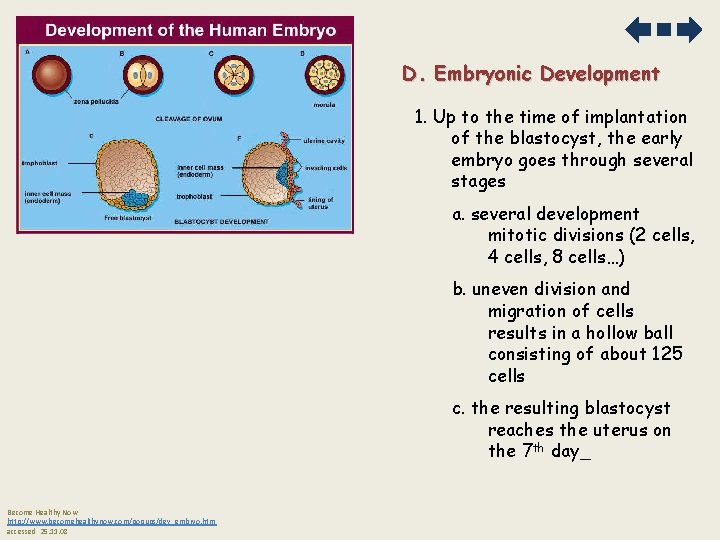
D. Embryonic Development 1. Up to the time of implantation of the blastocyst, the early embryo goes through several stages a. several development mitotic divisions (2 cells, 4 cells, 8 cells…) b. uneven division and migration of cells results in a hollow ball consisting of about 125 cells c. the resulting blastocyst reaches the uterus on the 7 th day_ Become Healthy Now http: //www. becomehealthynow. com/popups/dev_embryo. htm accessed 25. 11. 08
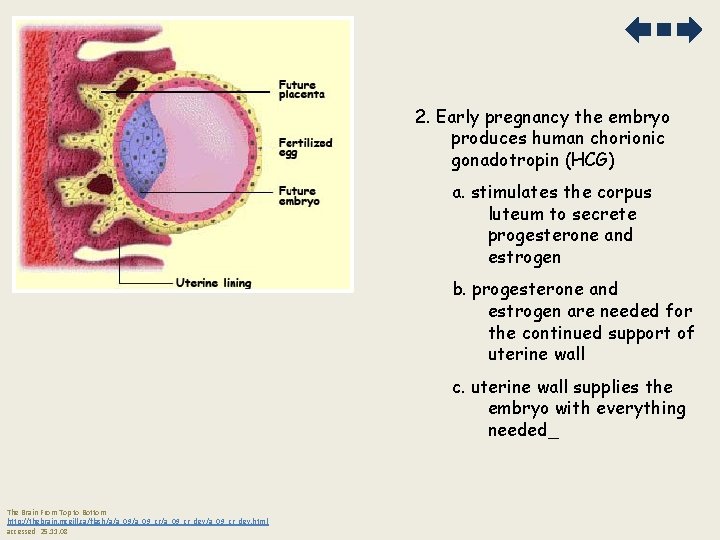
2. Early pregnancy the embryo produces human chorionic gonadotropin (HCG) a. stimulates the corpus luteum to secrete progesterone and estrogen b. progesterone and estrogen are needed for the continued support of uterine wall c. uterine wall supplies the embryo with everything needed_ The Brain From Top to Bottom http: //thebrain. mcgill. ca/flash/a/a_09_cr/a_09_cr_dev. html accessed 25. 11. 08
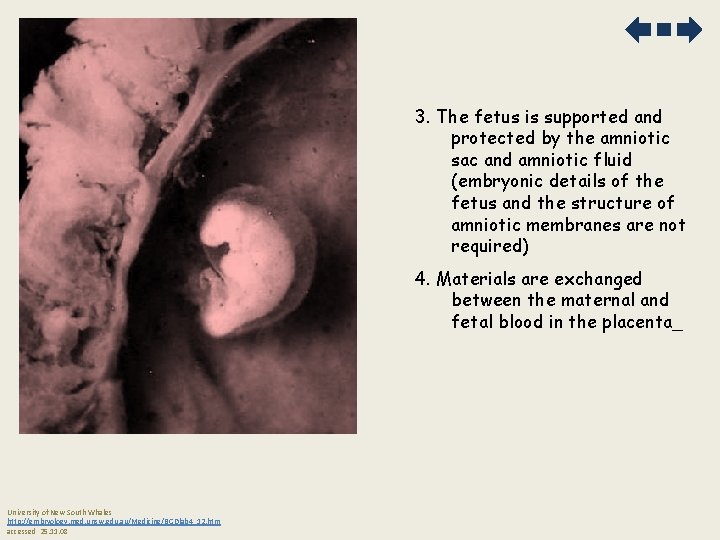
3. The fetus is supported and protected by the amniotic sac and amniotic fluid (embryonic details of the fetus and the structure of amniotic membranes are not required) 4. Materials are exchanged between the maternal and fetal blood in the placenta_ University of New South Whales http: //embryology. med. unsw. edu. au/Medicine/BGDlab 4_12. htm accessed 25. 11. 08
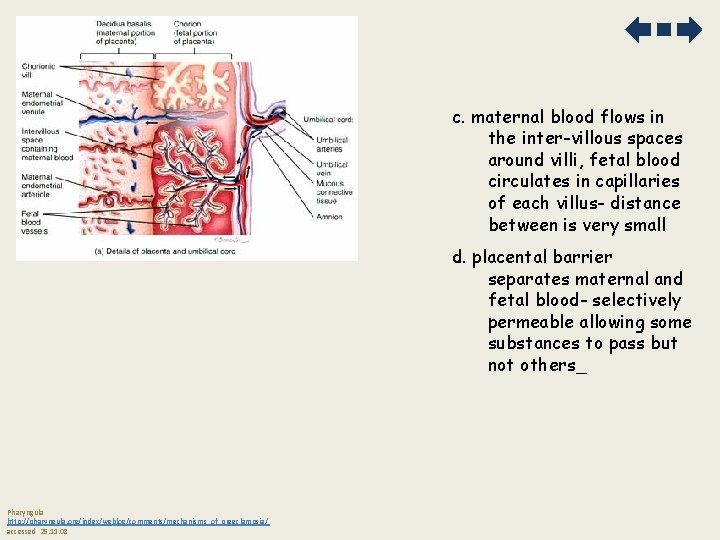
5. The structure of the placenta functions to maintain pregnancy (made from fetal tissue) a. secretes progesterone and estrogen- takes over the role of the corpus luteum b. the placental villus is the functional unit of the placenta- increased exchange demand from fetus and mother_ med. Gadget http: //medgadget. com/archives/2005/08/placentas_may_b. html accessed 25. 11. 08
c. maternal blood flows in the inter-villous spaces around villi, fetal blood circulates in capillaries of each villus- distance between is very small d. placental barrier separates maternal and fetal blood- selectively permeable allowing some substances to pass but not others_ Pharyngula http: //pharyngula. org/index/weblog/comments/mechanisms_of_preeclampsia/ accessed 25. 11. 08
e. microvilli on placental cells - increase surface area for diffusion f. umbilical vein- returns blood containing oxygen, and nutrients (free of excretory products) to the fetus_ University of Delaware http: //www. udel. edu/biology/Wags/histopage/colorpage/cfr. htm accessed 25. 11. 08
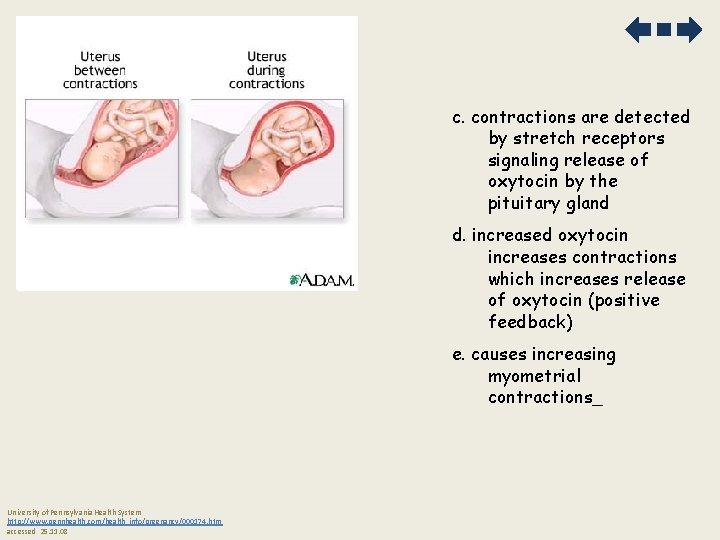
E. Birth 1. The process of birth is hormonally controlled a. during pregnancy progesterone inhibits secretion of oxytocin and the contraction of the wall of the uterus (myometrium) b. at the end of pregnancy, the fetus produces hormones that stop progesterone secretion and stimulates contraction of the uterine wall_ babble http: //www. babble. com/CS/blogs/strollerderby/archive/tags/pregnancy/default. aspx accessed 25. 11. 08
c. contractions are detected by stretch receptors signaling release of oxytocin by the pituitary gland d. increased oxytocin increases contractions which increases release of oxytocin (positive feedback) e. causes increasing myometrial contractions_ University of Pennsylvania Health System http: //www. pennhealth. com/health_info/pregnancy/000174. htm accessed 25. 11. 08
f. cervix muscle fibers relax causing dilation g. amniotic sac bursts as a result of uterine contraction (fluid passes) h. baby is gradually pushed through the cervix/vagina over hours of contraction i. umbilical cord is broken and baby takes first breath_ timsviews http: //timsviews. com/notyourfault. aspx accessed 25. 11. 08
The End