H in CMS A Particle Flow Analysis Colin

- Slides: 68
H ττ in CMS, A Particle Flow Analysis Colin Bernet (CERN, CRNS/LLR)
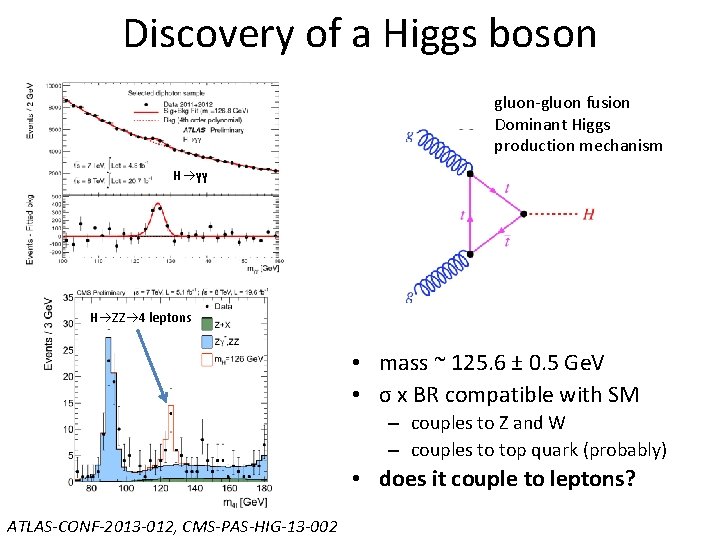
Discovery of a Higgs boson gluon-gluon fusion Dominant Higgs production mechanism H γγ H ZZ 4 leptons • mass ~ 125. 6 ± 0. 5 Ge. V • σ x BR compatible with SM – couples to Z and W – couples to top quark (probably) • does it couple to leptons? ATLAS-CONF-2013 -012, CMS-PAS-HIG-13 -002
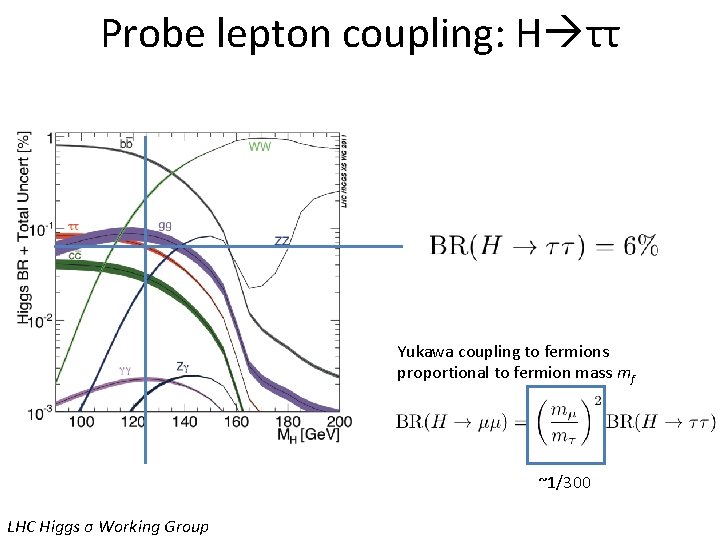
Probe lepton coupling: H ττ Yukawa coupling to fermions proportional to fermion mass mf ~1/300 LHC Higgs σ Working Group
Part I • Principles of the H ττ search – fighting the main background sources – need for high-performance physics objects • Particle flow reconstruction – What and why? – The algorithm – Physics object performance • The CMS H ττ analysis – specific techniques – results
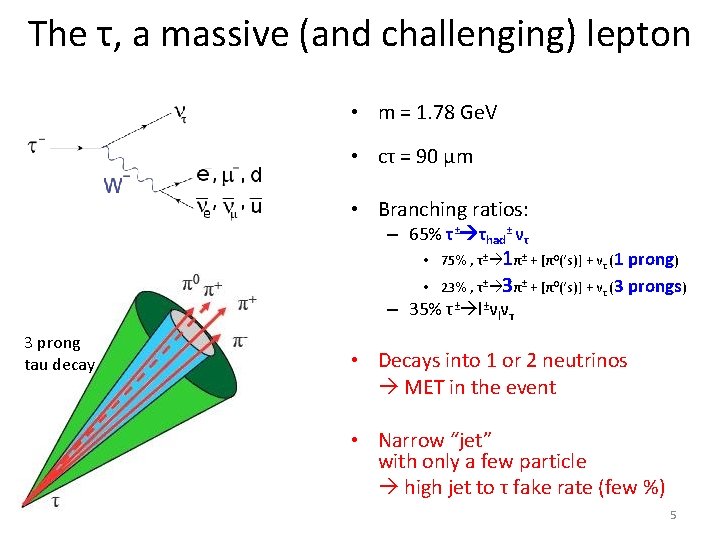
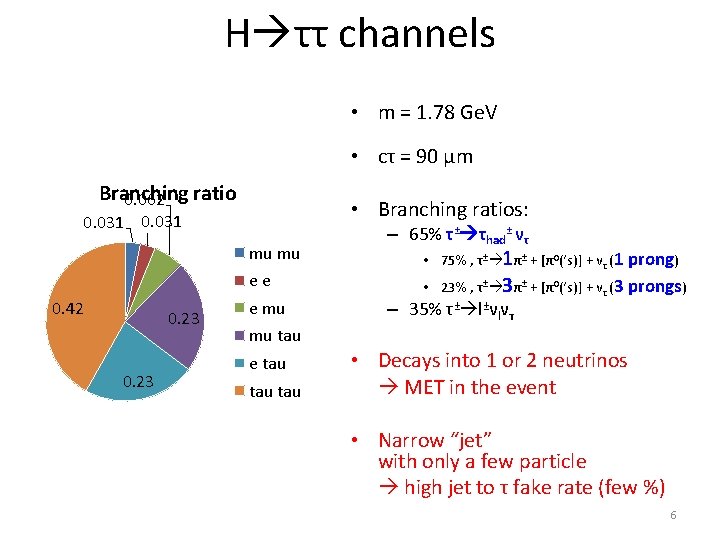
The τ, a massive (and challenging) lepton • m = 1. 78 Ge. V • cτ = 90 μm • Branching ratios: – 65% τ± τhad± ντ • 75% , τ± 1π± + [π0(‘s)] + ντ (1 prong) • 23% , τ± 3π± + [π0(‘s)] + ντ (3 prongs) – 35% τ± l±νlντ 3 prong tau decay • Decays into 1 or 2 neutrinos MET in the event • Narrow “jet” with only a few particle high jet to τ fake rate (few %) 5
H ττ channels • m = 1. 78 Ge. V • cτ = 90 μm Branching ratio 0. 062 • Branching ratios: 0. 031 mu mu e e 0. 42 0. 23 e mu – 65% τ± τhad± ντ • 75% , τ± 1π± + [π0(‘s)] + ντ (1 prong) • 23% , τ± 3π± + [π0(‘s)] + ντ (3 prongs) – 35% τ± l±νlντ mu tau e tau tau • Decays into 1 or 2 neutrinos MET in the event • Narrow “jet” with only a few particle high jet to τ fake rate (few %) 6
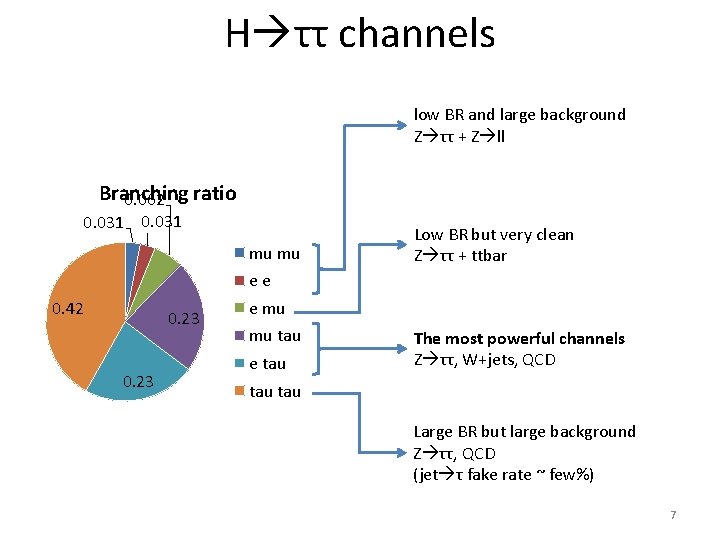
H ττ channels low BR and large background Z ττ + Z ll Branching ratio 0. 062 0. 031 mu mu Low BR but very clean Z ττ + ttbar e e 0. 42 0. 23 e mu mu tau e tau The most powerful channels Z ττ, W+jets, QCD tau Large BR but large background Z ττ, QCD (jet τ fake rate ~ few%) 7
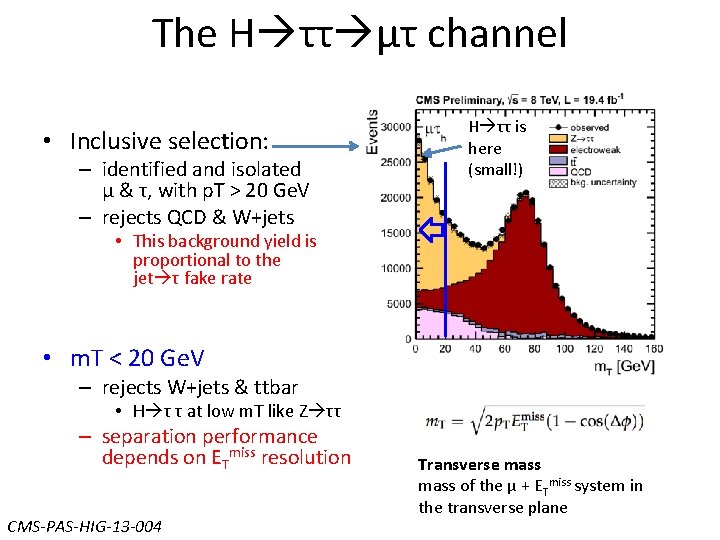
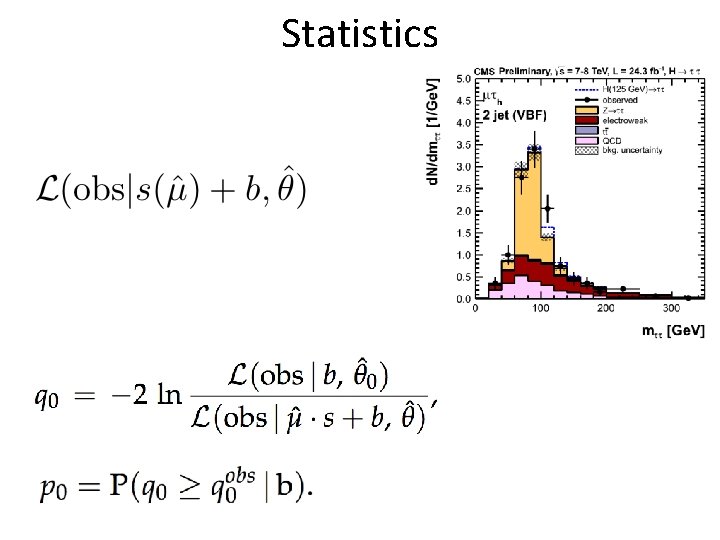
The H ττ μτ channel • Inclusive selection: – identified and isolated μ & τ, with p. T > 20 Ge. V – rejects QCD & W+jets H ττ is here (small!) • This background yield is proportional to the jet τ fake rate • m. T < 20 Ge. V – rejects W+jets & ttbar • H τ τ at low m. T like Z ττ – separation performance depends on ETmiss resolution CMS-PAS-HIG-13 -004 Transverse mass of the μ + ETmiss system in the transverse plane
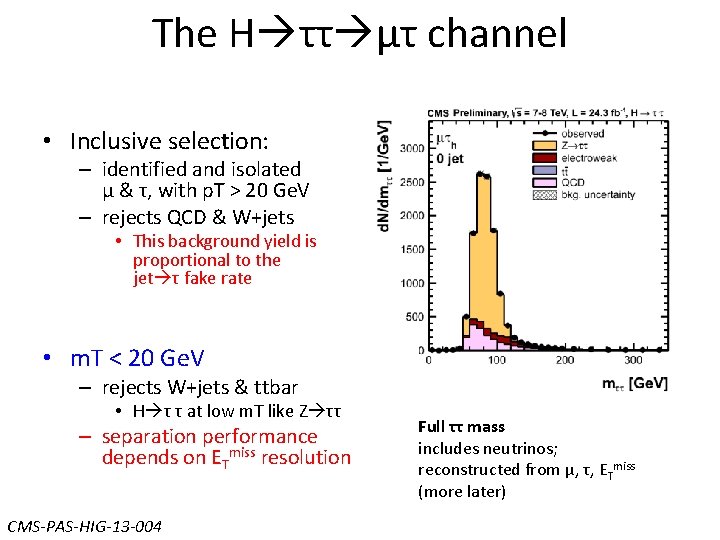
The H ττ μτ channel • Inclusive selection: – identified and isolated μ & τ, with p. T > 20 Ge. V – rejects QCD & W+jets • This background yield is proportional to the jet τ fake rate • m. T < 20 Ge. V – rejects W+jets & ttbar • H τ τ at low m. T like Z ττ – separation performance depends on ETmiss resolution CMS-PAS-HIG-13 -004 Full ττ mass includes neutrinos; reconstructed from μ, τ, ETmiss (more later)
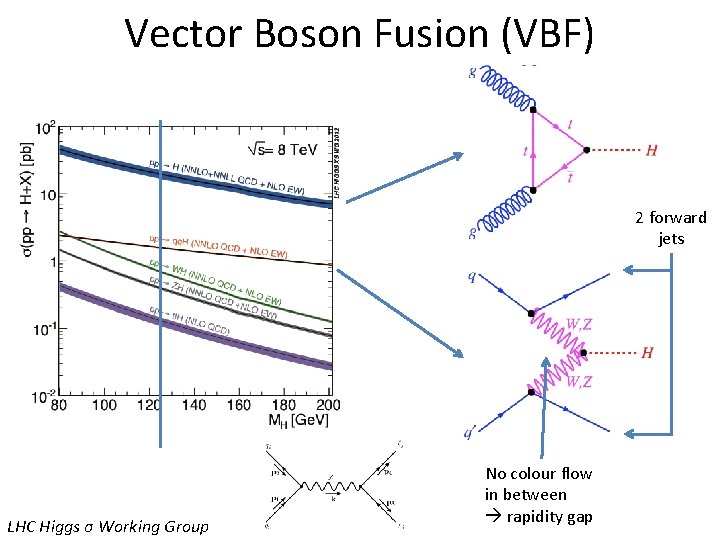
Vector Boson Fusion (VBF) 2 forward jets LHC Higgs σ Working Group No colour flow in between rapidity gap
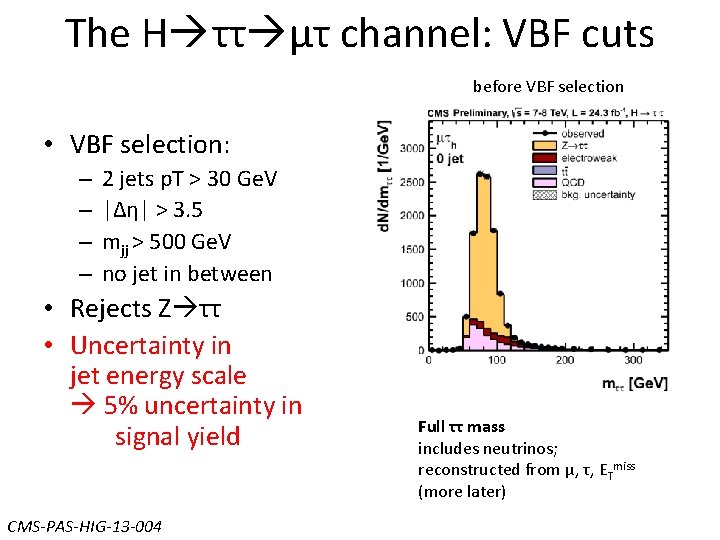
The H ττ μτ channel: VBF cuts before VBF selection • VBF selection: – – 2 jets p. T > 30 Ge. V |Δη| > 3. 5 mjj > 500 Ge. V no jet in between • Rejects Z ττ • Uncertainty in jet energy scale 5% uncertainty in signal yield CMS-PAS-HIG-13 -004 Full ττ mass includes neutrinos; reconstructed from μ, τ, ETmiss (more later)
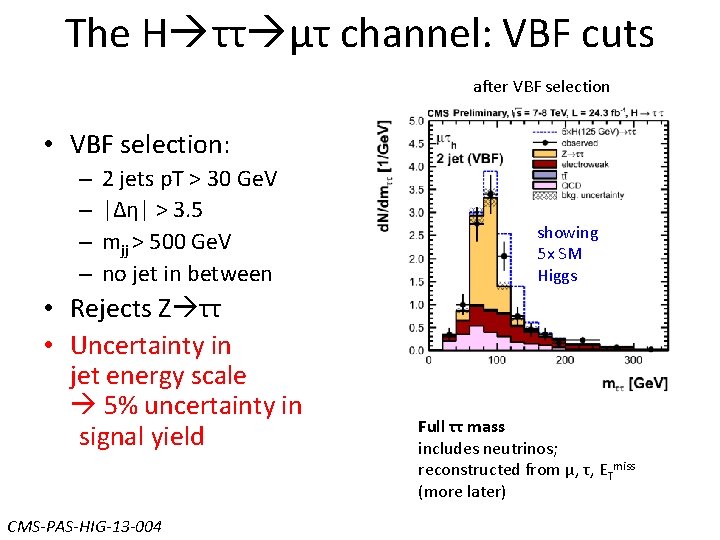
The H ττ μτ channel: VBF cuts after VBF selection • VBF selection: – – 2 jets p. T > 30 Ge. V |Δη| > 3. 5 mjj > 500 Ge. V no jet in between • Rejects Z ττ • Uncertainty in jet energy scale 5% uncertainty in signal yield CMS-PAS-HIG-13 -004 showing 5 x SM Higgs Full ττ mass includes neutrinos; reconstructed from μ, τ, ETmiss (more later)
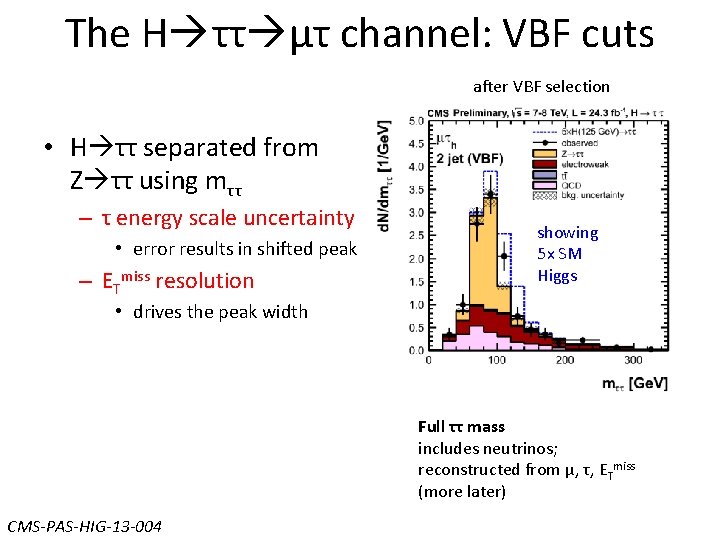
The H ττ μτ channel: VBF cuts after VBF selection • H ττ separated from Z ττ using mττ – τ energy scale uncertainty • error results in shifted peak – ETmiss resolution showing 5 x SM Higgs • drives the peak width Full ττ mass includes neutrinos; reconstructed from μ, τ, ETmiss (more later) CMS-PAS-HIG-13 -004
Part II • Principles of the H ττ search – fighting the main background sources – need for high-performance physics objects • Particle flow reconstruction – What and why? – The algorithm – Physics object performance • The CMS H ττ analysis - τ ID efficiency and fake rate - τ energy scale syst. uncertainty - ETmiss resolution - jet energy scale syst. uncertainty - and much more! – background estimation & main uncertainties – statistical procedure – results
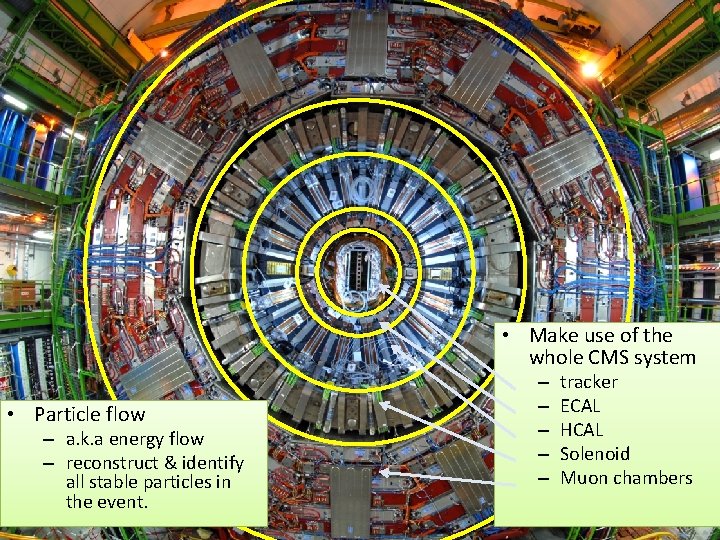
• Make use of the whole CMS system • Particle flow – a. k. a energy flow – reconstruct & identify all stable particles in the event. – – – tracker ECAL HCAL Solenoid Muon chambers 15
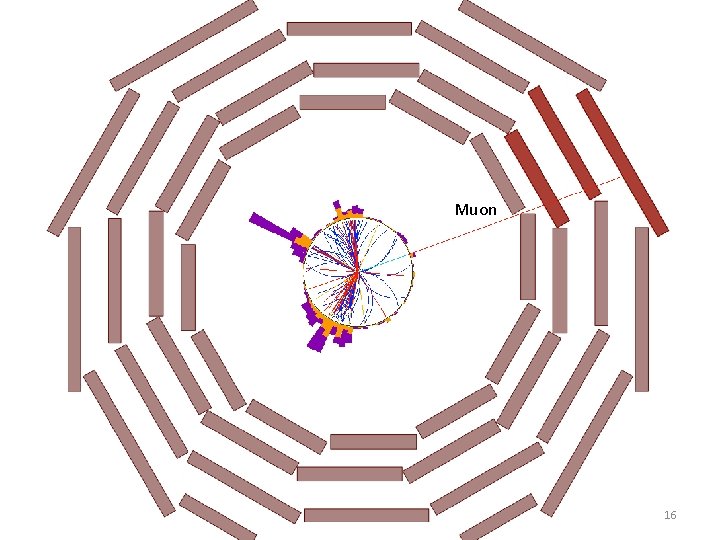
Muon 16
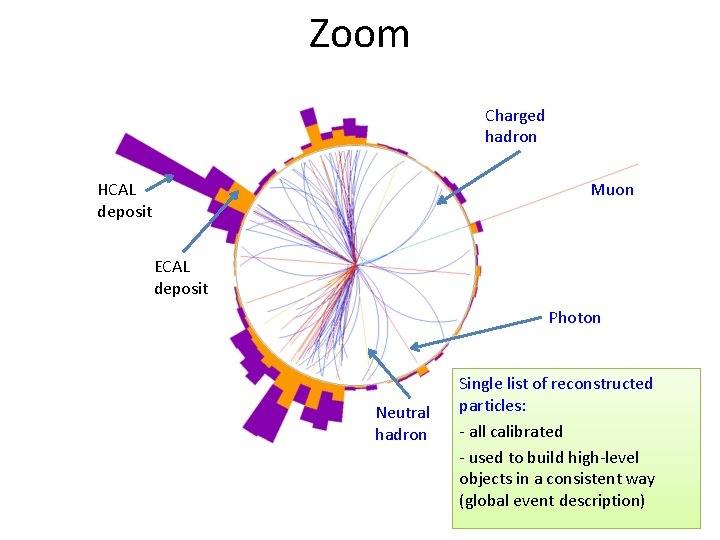
Zoom Charged hadron HCAL deposit Muon ECAL deposit Photon Neutral hadron Single list of reconstructed particles: - all calibrated - used to build high-level objects in a consistent way (global event description) 17
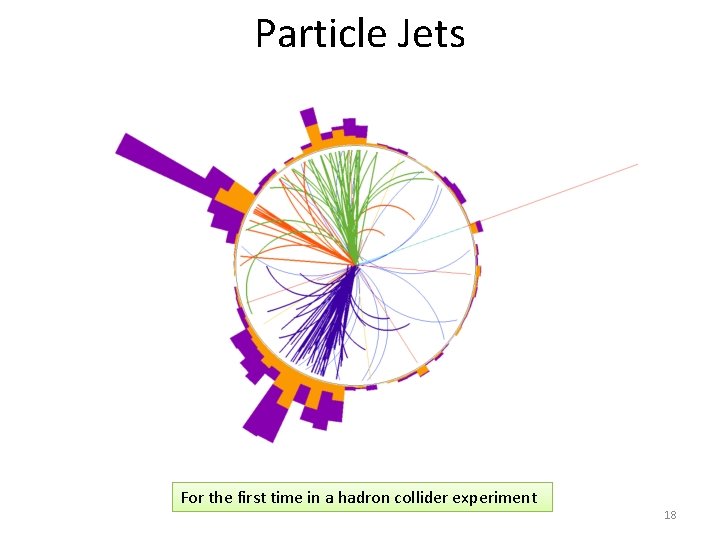
Particle Jets For the first time in a hadron collider experiment 18
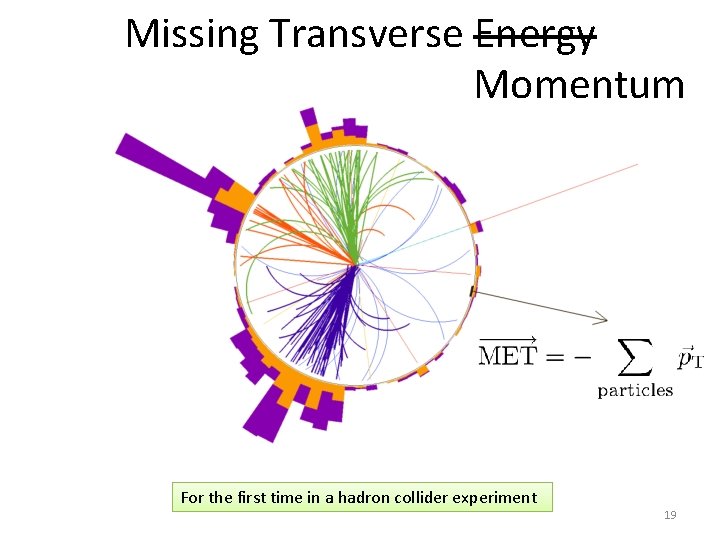
Missing Transverse Energy Momentum For the first time in a hadron collider experiment 19
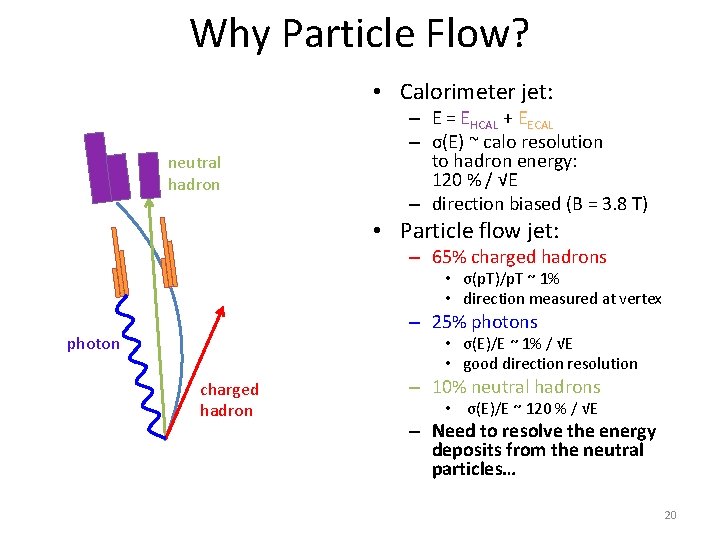
Why Particle Flow? • Calorimeter jet: neutral hadron – E = EHCAL + EECAL – σ(E) ~ calo resolution to hadron energy: 120 % / √E – direction biased (B = 3. 8 T) • Particle flow jet: – 65% charged hadrons • σ(p. T)/p. T ~ 1% • direction measured at vertex – 25% photons photon • σ(E)/E ~ 1% / √E • good direction resolution charged hadron – 10% neutral hadrons • σ(E)/E ~ 120 % / √E – Need to resolve the energy deposits from the neutral particles… 20
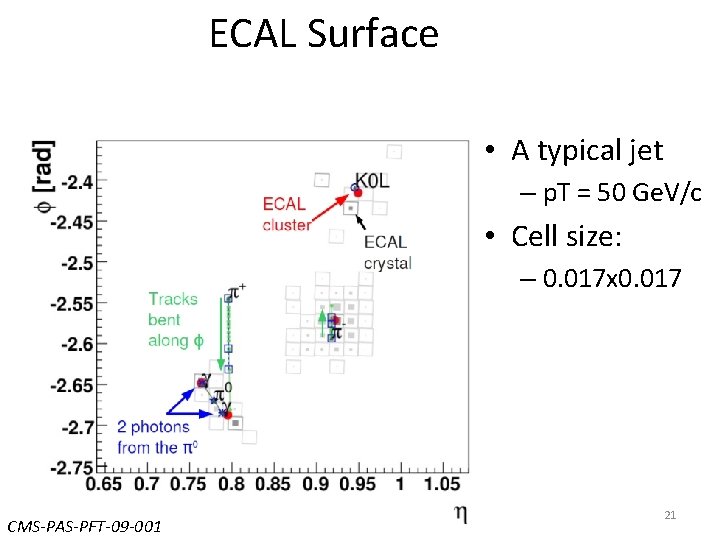
ECAL Surface • A typical jet – p. T = 50 Ge. V/c • Cell size: – 0. 017 x 0. 017 CMS-PAS-PFT-09 -001 21
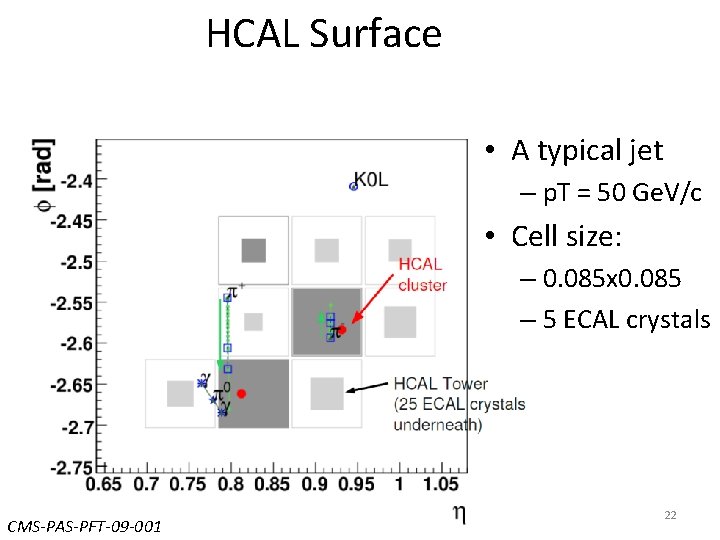
HCAL Surface • A typical jet – p. T = 50 Ge. V/c • Cell size: – 0. 085 x 0. 085 – 5 ECAL crystals CMS-PAS-PFT-09 -001 22
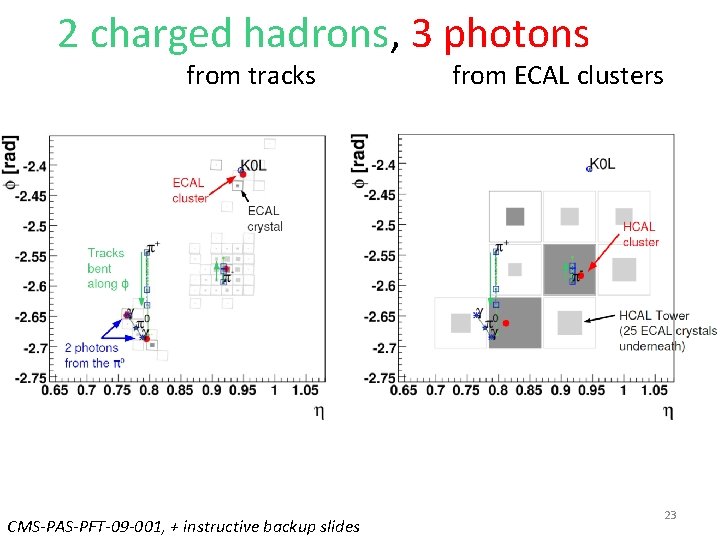
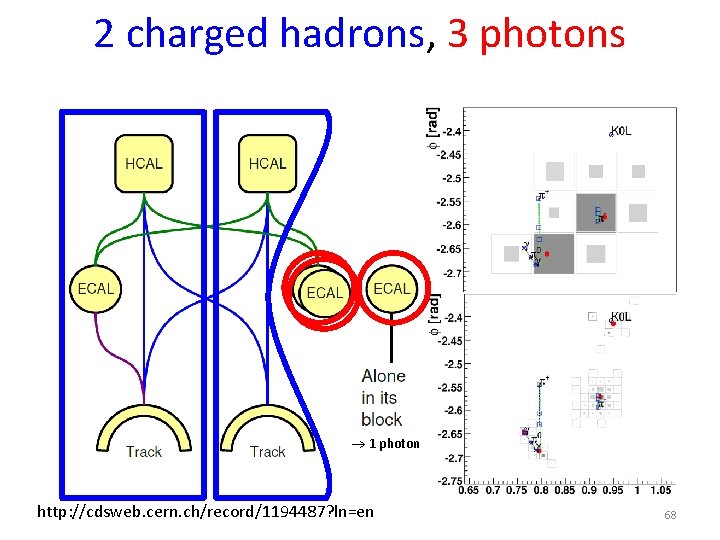
2 charged hadrons, 3 photons from tracks CMS-PAS-PFT-09 -001, + instructive backup slides from ECAL clusters 23
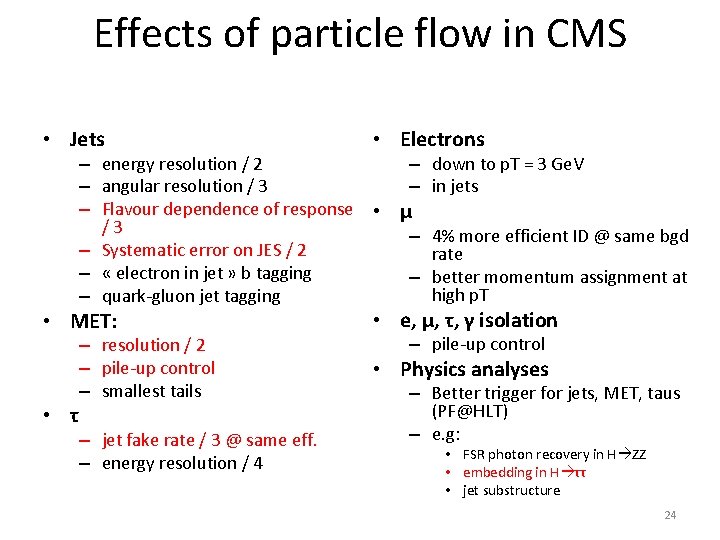
Effects of particle flow in CMS • Jets • Electrons • MET: • e, μ, τ, γ isolation – energy resolution / 2 – down to p. T = 3 Ge. V – angular resolution / 3 – in jets – Flavour dependence of response • μ / 3 – 4% more efficient ID @ same bgd – Systematic error on JES / 2 rate – « electron in jet » b tagging – better momentum assignment at high p. T – quark-gluon jet tagging • τ – resolution / 2 – pile-up control – smallest tails – jet fake rate / 3 @ same eff. – energy resolution / 4 – pile-up control • Physics analyses – Better trigger for jets, MET, taus (PF@HLT) – e. g: • FSR photon recovery in H ZZ • embedding in H ττ • jet substructure 24
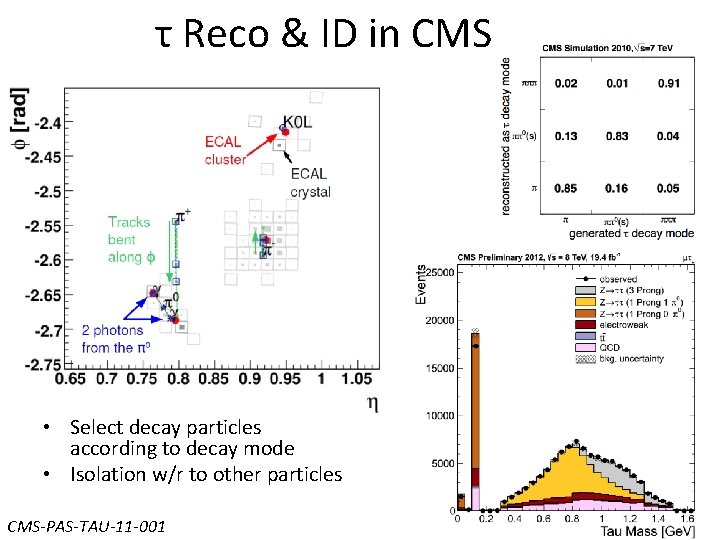
τ Reco & ID in CMS • Select decay particles according to decay mode • Isolation w/r to other particles CMS-PAS-TAU-11 -001 25
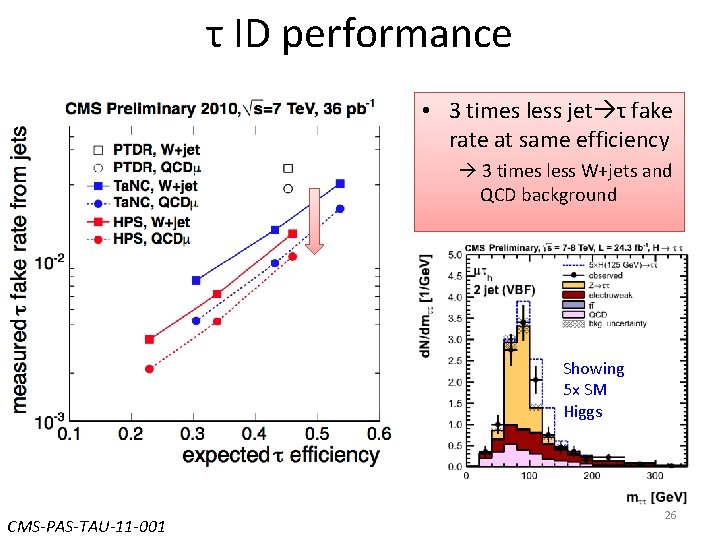
τ ID performance • 3 times less jet τ fake rate at same efficiency 3 times less W+jets and QCD background Showing 5 x SM Higgs CMS-PAS-TAU-11 -001 26
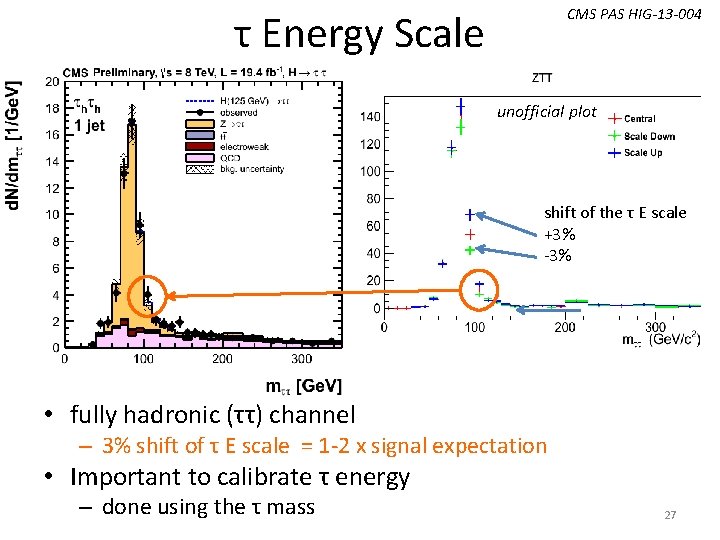
CMS PAS HIG-13 -004 τ Energy Scale unofficial plot shift of the τ E scale +3% -3% • fully hadronic (ττ) channel – 3% shift of τ E scale = 1 -2 x signal expectation • Important to calibrate τ energy – done using the τ mass 27
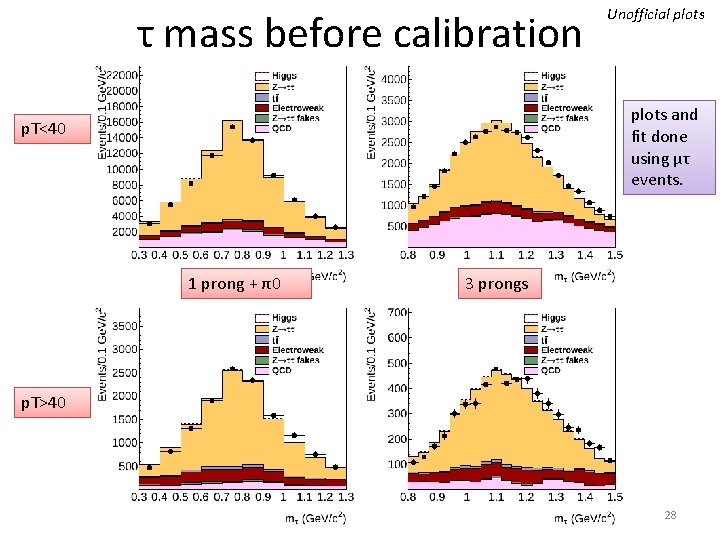
τ mass before calibration Unofficial plots and fit done using μτ events. p. T<40 1 prong + π0 3 prongs p. T>40 Weekly Higgs group meeting 28
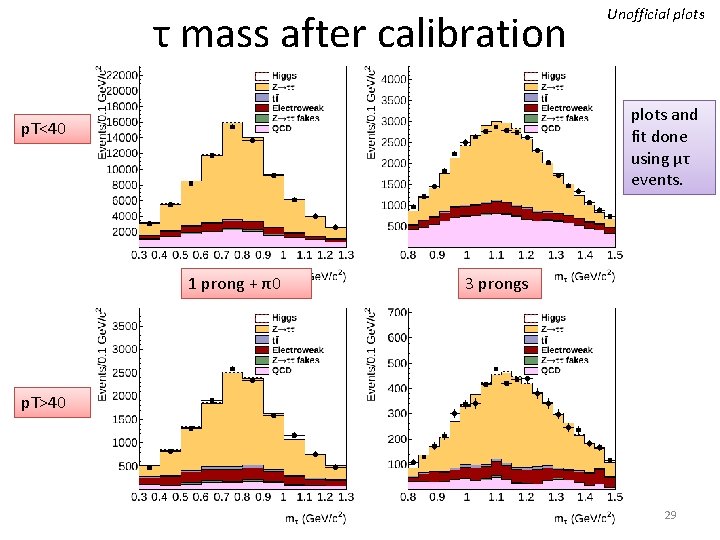
τ mass after calibration Unofficial plots and fit done using μτ events. p. T<40 1 prong + π0 3 prongs p. T>40 Weekly Higgs group meeting 29
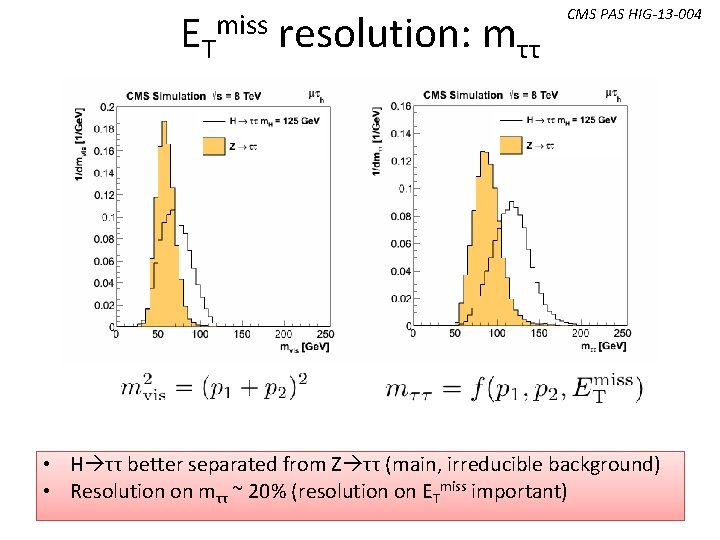
ETmiss resolution: mττ CMS PAS HIG-13 -004 • H ττ better separated from Z ττ (main, irreducible background) • Resolution on mττ ~ 20% (resolution on ETmiss important)
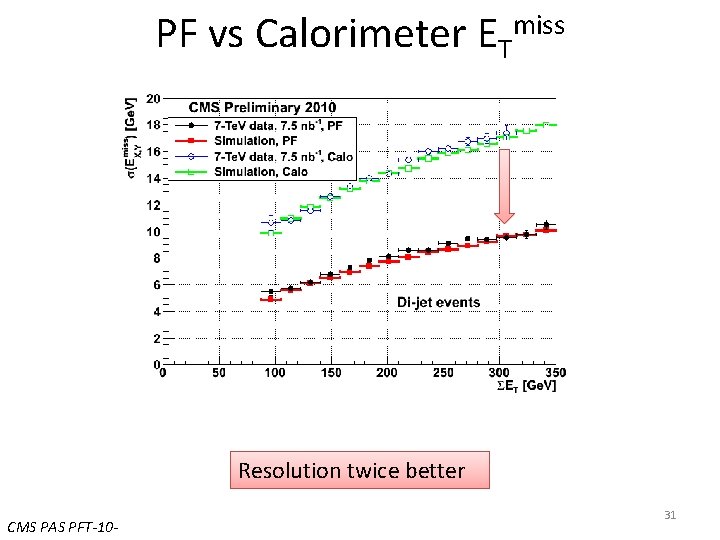
PF vs Calorimeter ETmiss Resolution twice better CMS PAS PFT-10 - 31
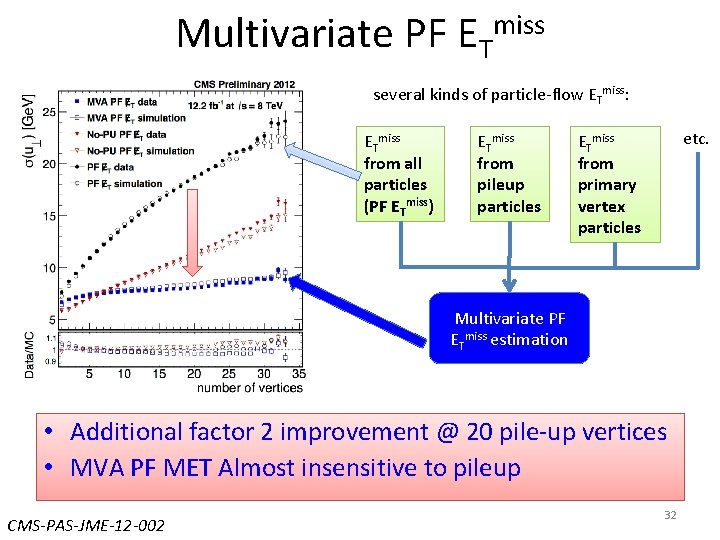
Multivariate PF ETmiss several kinds of particle-flow ETmiss: ETmiss from all particles (PF ETmiss) ETmiss from pileup particles etc. ETmiss from primary vertex particles Multivariate PF ETmiss estimation • Additional factor 2 improvement @ 20 pile-up vertices • MVA PF MET Almost insensitive to pileup CMS-PAS-JME-12 -002 32
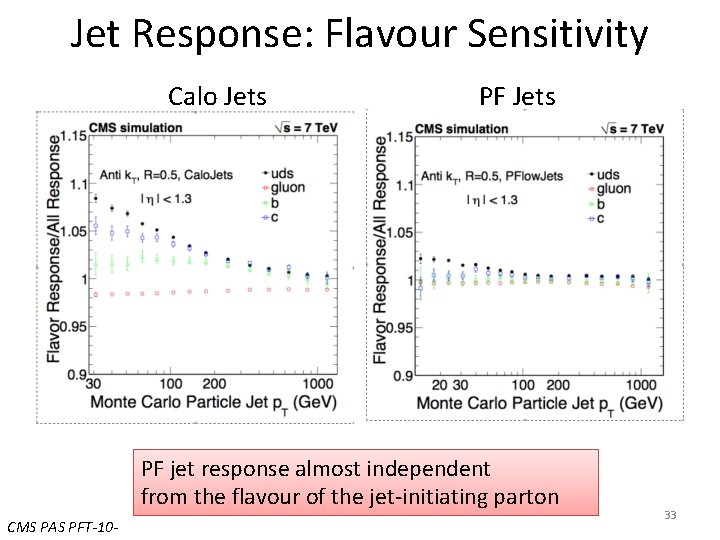
Jet Response: Flavour Sensitivity Calo Jets PF jet response almost independent from the flavour of the jet-initiating parton CMS PAS PFT-10 - 33
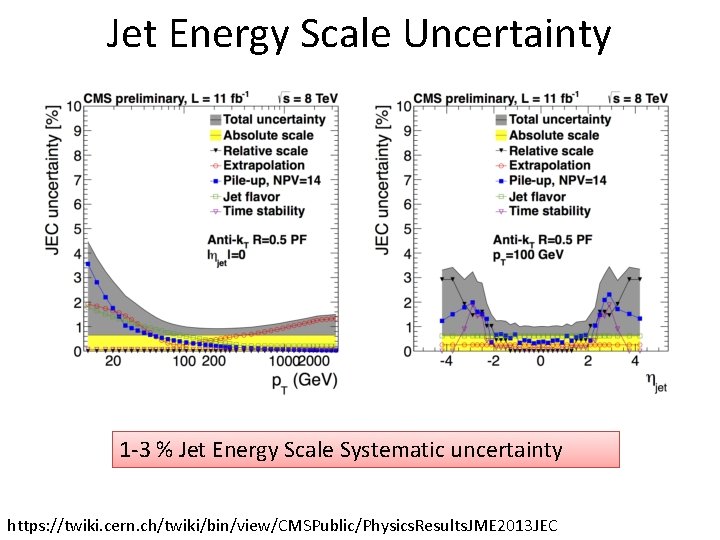
Jet Energy Scale Uncertainty 1 -3 % Jet Energy Scale Systematic uncertainty https: //twiki. cern. ch/twiki/bin/view/CMSPublic/Physics. Results. JME 2013 JEC
Part III • Principles of the H ττ search – fighting the main background sources – need for high-performance physics objects • Particle flow reconstruction – What and why? – The algorithm – Physics object performance • The CMS H ττ analysis - τ ID efficiency and fake rate - τ energy scale syst. uncertainty - ETmiss resolution - jet energy scale syst. uncertainty - and much more! – background estimation & main uncertainties – statistical procedure – results
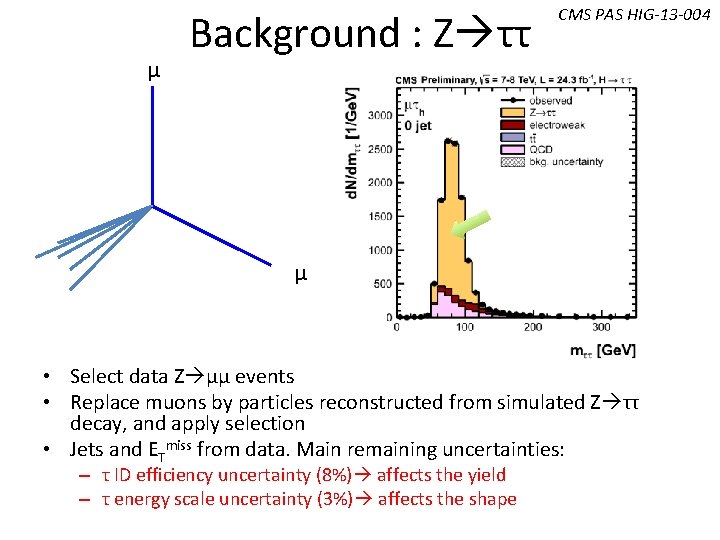
μ Background : Z ττ CMS PAS HIG-13 -004 μ • Select data Z μμ events • Replace muons by particles reconstructed from simulated Z ττ decay, and apply selection • Jets and ETmiss from data. Main remaining uncertainties: – τ ID efficiency uncertainty (8%) affects the yield – τ energy scale uncertainty (3%) affects the shape
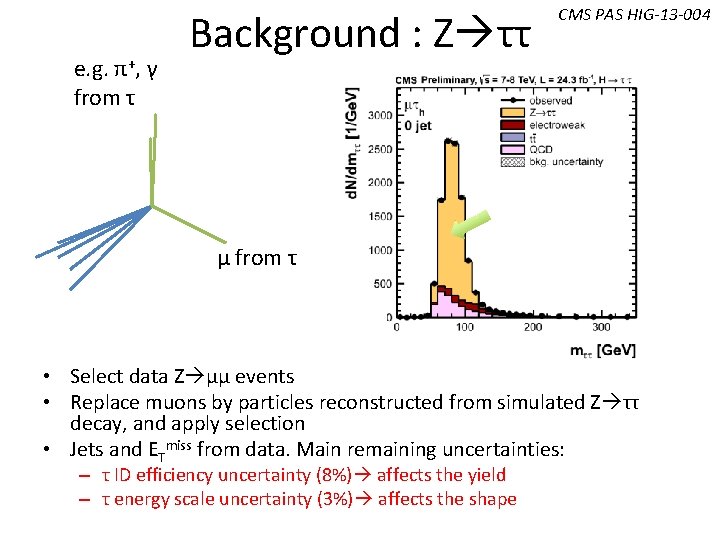
e. g. π+, γ from τ Background : Z ττ CMS PAS HIG-13 -004 μ from τ • Select data Z μμ events • Replace muons by particles reconstructed from simulated Z ττ decay, and apply selection • Jets and ETmiss from data. Main remaining uncertainties: – τ ID efficiency uncertainty (8%) affects the yield – τ energy scale uncertainty (3%) affects the shape
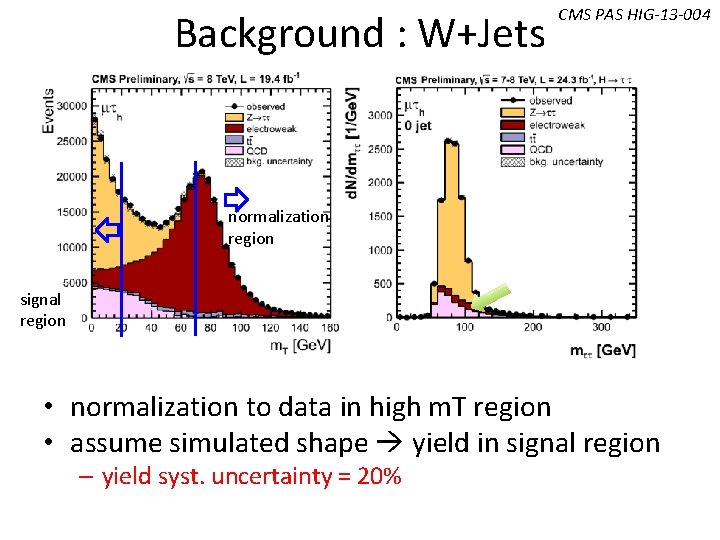
Background : W+Jets CMS PAS HIG-13 -004 normalization region signal region • normalization to data in high m. T region • assume simulated shape yield in signal region – yield syst. uncertainty = 20%
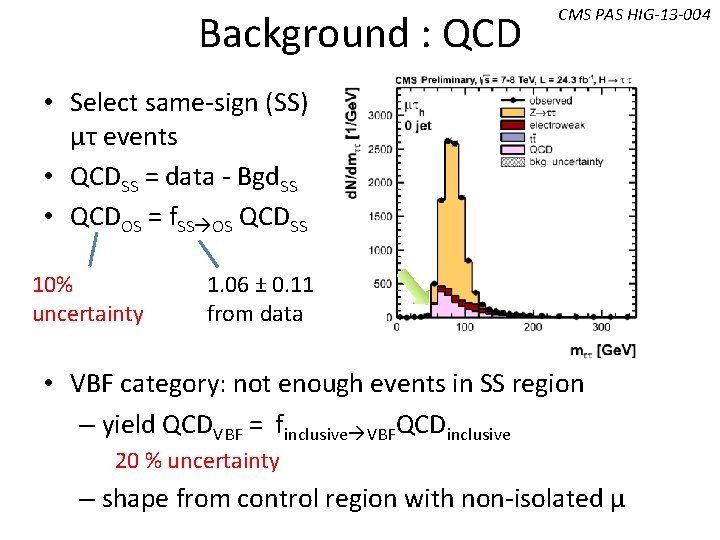
Background : QCD CMS PAS HIG-13 -004 • Select same-sign (SS) μτ events • QCDSS = data - Bgd. SS • QCDOS = f. SS OS QCDSS 10% uncertainty 1. 06 ± 0. 11 from data • VBF category: not enough events in SS region – yield QCDVBF = finclusive VBFQCDinclusive 20 % uncertainty – shape from control region with non-isolated μ
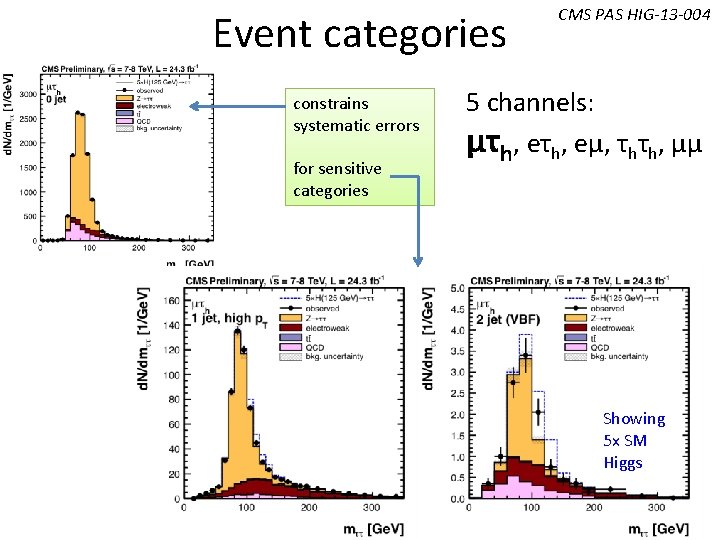
Event categories constrains systematic errors for sensitive categories CMS PAS HIG-13 -004 5 channels: μτh, eμ, τhτh, μμ Showing 5 x SM Higgs 40
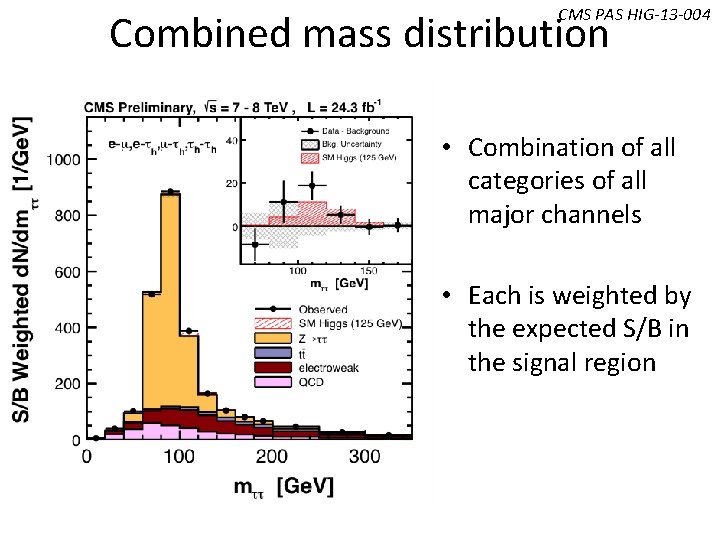
CMS PAS HIG-13 -004 Combined mass distribution • Combination of all categories of all major channels • Each is weighted by the expected S/B in the signal region
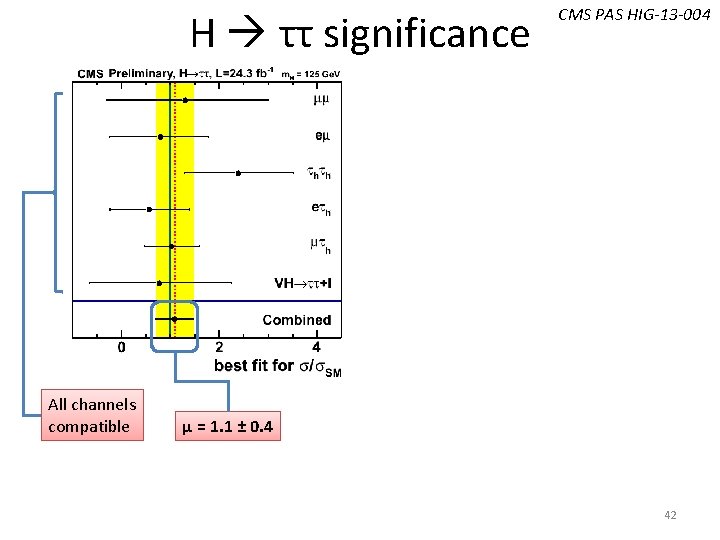
H ττ significance All channels compatible CMS PAS HIG-13 -004 μ = 1. 1 ± 0. 4 42
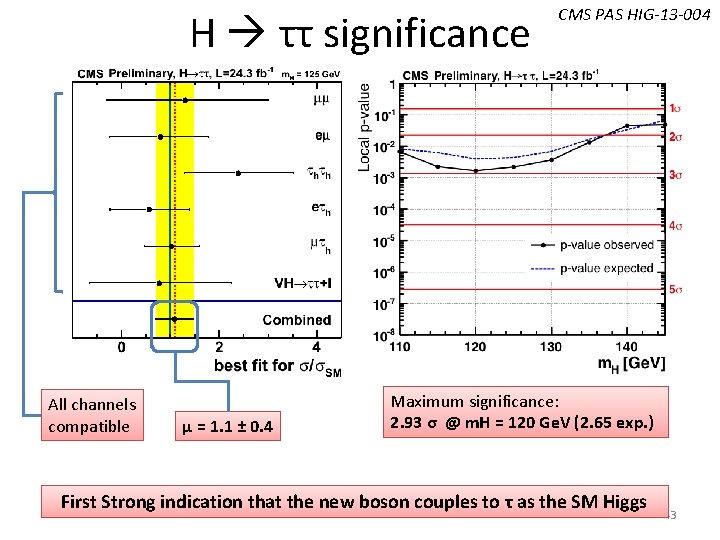
H ττ significance All channels compatible μ = 1. 1 ± 0. 4 CMS PAS HIG-13 -004 Maximum significance: 2. 93 σ @ m. H = 120 Ge. V (2. 65 exp. ) First Strong indication that the new boson couples to τ as the SM Higgs 43
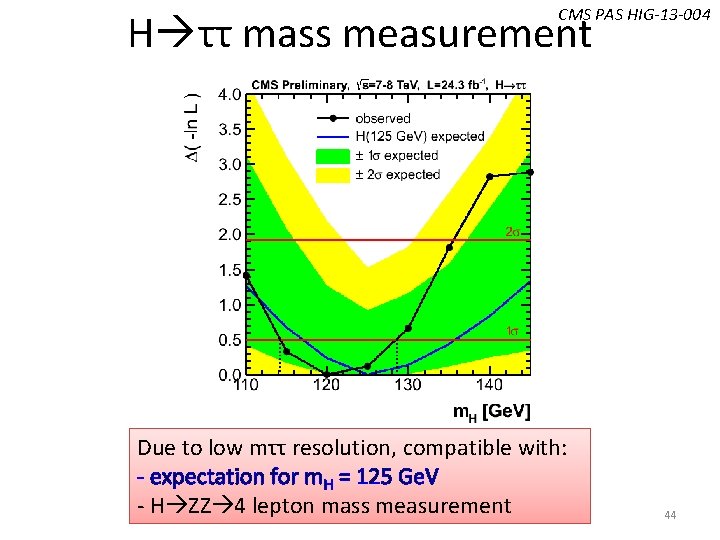
CMS PAS HIG-13 -004 H ττ mass measurement Due to low mττ resolution, compatible with: - expectation for m. H = 125 Ge. V - H ZZ 4 lepton mass measurement 44
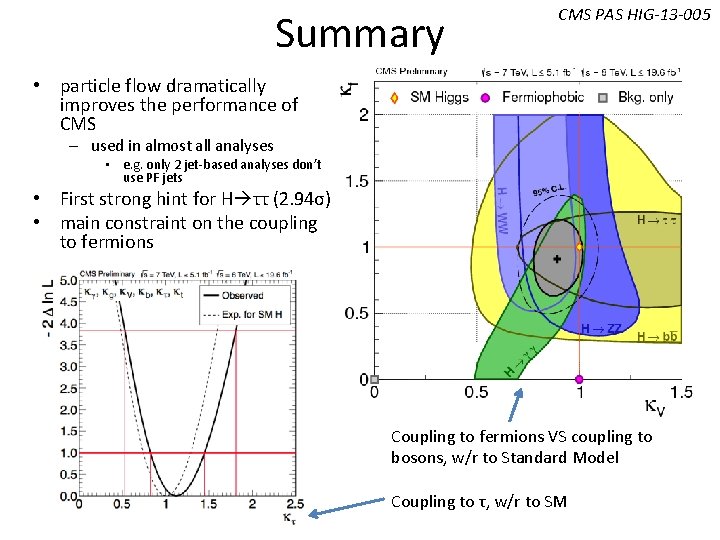
Summary CMS PAS HIG-13 -005 • particle flow dramatically improves the performance of CMS – used in almost all analyses • e. g. only 2 jet-based analyses don’t use PF jets • First strong hint for H ττ (2. 94σ) • main constraint on the coupling to fermions Coupling to fermions VS coupling to bosons, w/r to Standard Model Coupling to τ, w/r to SM
Back-up
Statistics
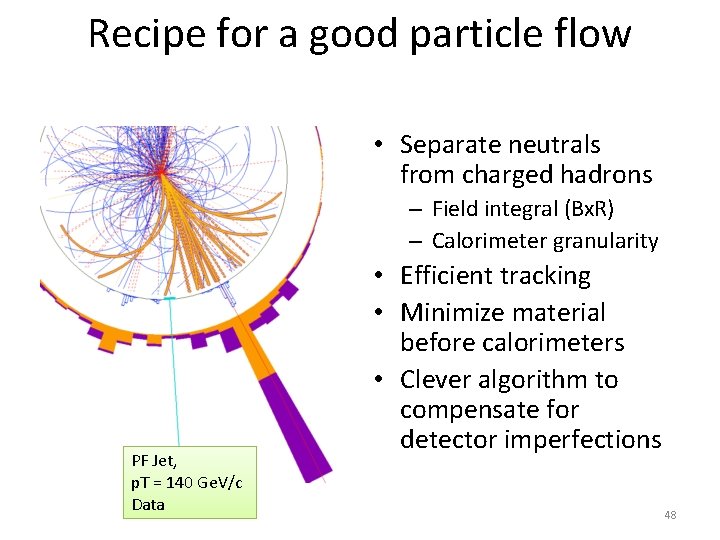
Recipe for a good particle flow • Separate neutrals from charged hadrons – Field integral (Bx. R) – Calorimeter granularity PF Jet, p. T = 140 Ge. V/c Data • Efficient tracking • Minimize material before calorimeters • Clever algorithm to compensate for detector imperfections 48
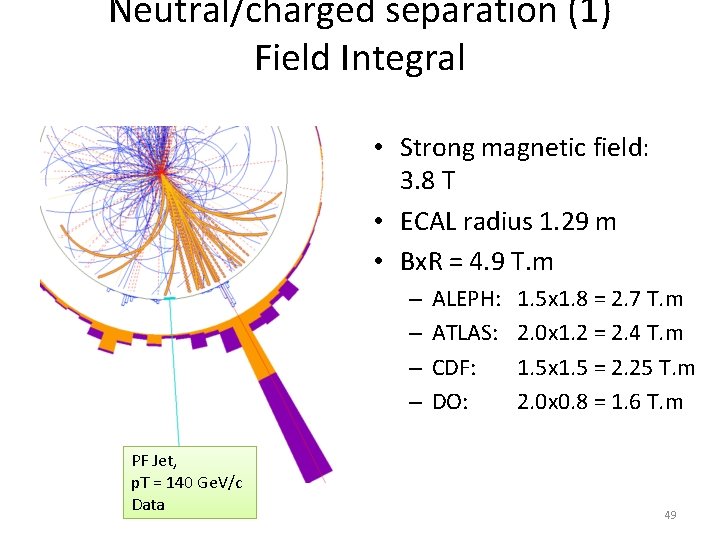
Neutral/charged separation (1) Field Integral • Strong magnetic field: 3. 8 T • ECAL radius 1. 29 m • Bx. R = 4. 9 T. m – – PF Jet, p. T = 140 Ge. V/c Data ALEPH: ATLAS: CDF: DO: 1. 5 x 1. 8 = 2. 7 T. m 2. 0 x 1. 2 = 2. 4 T. m 1. 5 x 1. 5 = 2. 25 T. m 2. 0 x 0. 8 = 1. 6 T. m 49
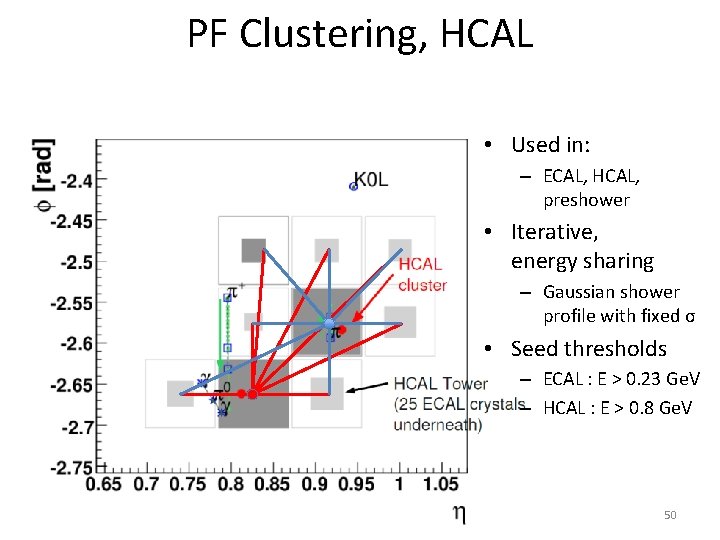
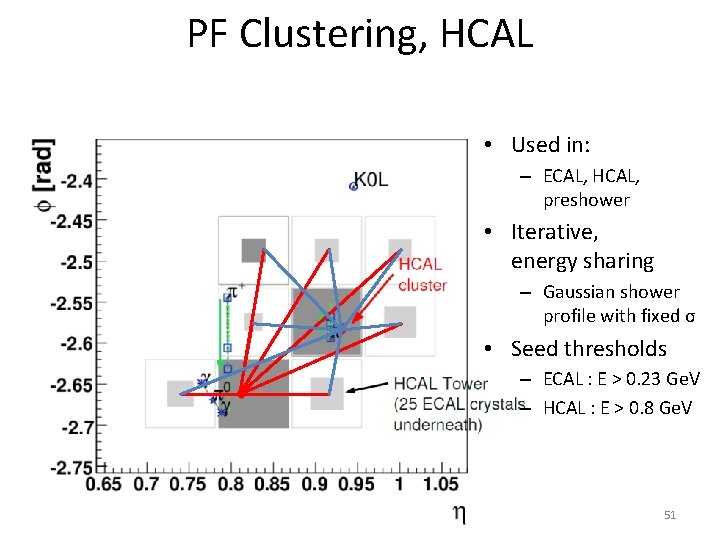
PF Clustering, HCAL • Used in: – ECAL, HCAL, preshower • Iterative, energy sharing – Gaussian shower profile with fixed σ • Seed thresholds – ECAL : E > 0. 23 Ge. V – HCAL : E > 0. 8 Ge. V 50
PF Clustering, HCAL • Used in: – ECAL, HCAL, preshower • Iterative, energy sharing – Gaussian shower profile with fixed σ • Seed thresholds – ECAL : E > 0. 23 Ge. V – HCAL : E > 0. 8 Ge. V 51
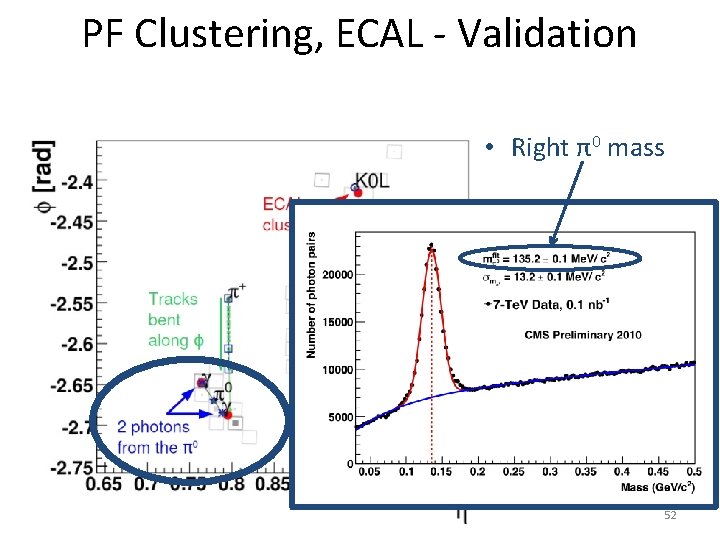
PF Clustering, ECAL - Validation • Right π0 mass 52
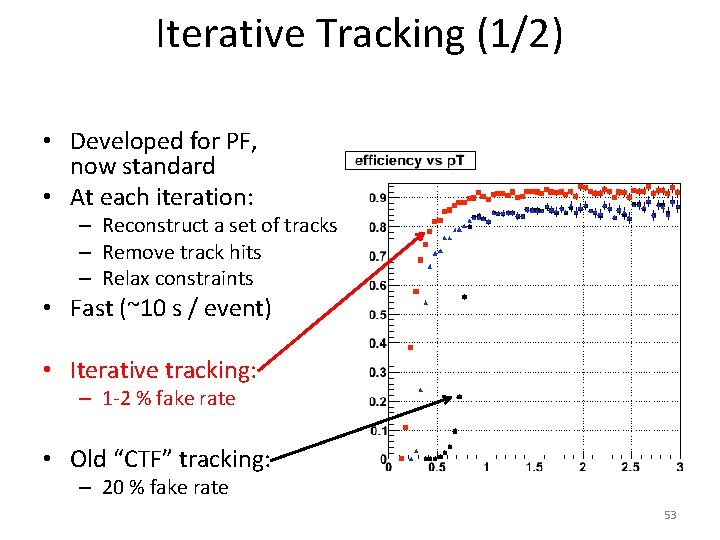
Iterative Tracking (1/2) • Developed for PF, now standard • At each iteration: – Reconstruct a set of tracks – Remove track hits – Relax constraints Pixel layers • Fast (~10 s / event) • Iterative tracking: – 1 -2 % fake rate Beam tube • Old “CTF” tracking: – 20 % fake rate 53
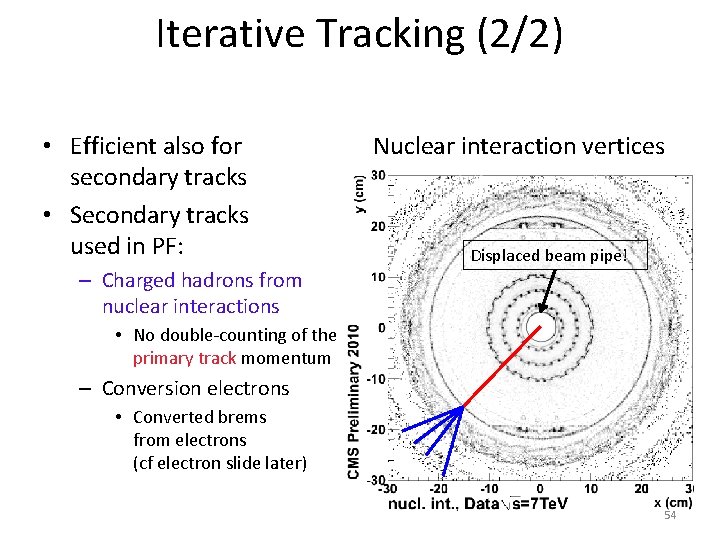
Iterative Tracking (2/2) • Efficient also for secondary tracks • Secondary tracks used in PF: – Charged hadrons from nuclear interactions Nuclear interaction vertices Displaced beam pipe! • No double-counting of the primary track momentum – Conversion electrons • Converted brems from electrons (cf electron slide later) 54
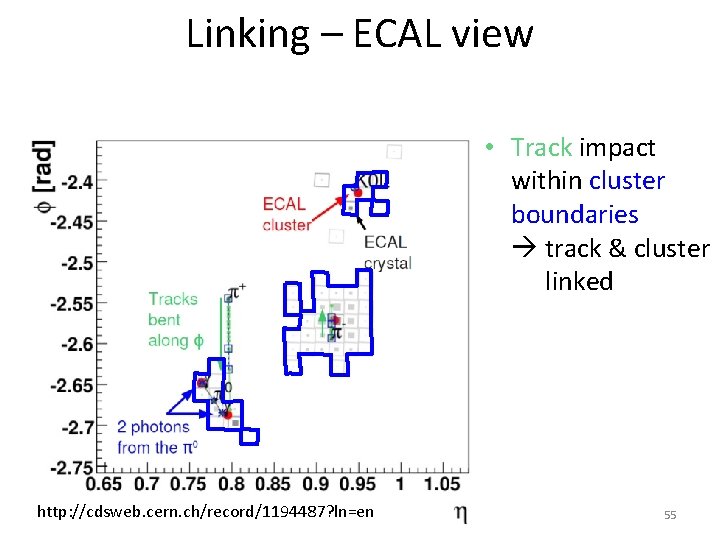
Linking – ECAL view • Track impact within cluster boundaries track & cluster linked http: //cdsweb. cern. ch/record/1194487? ln=en 55
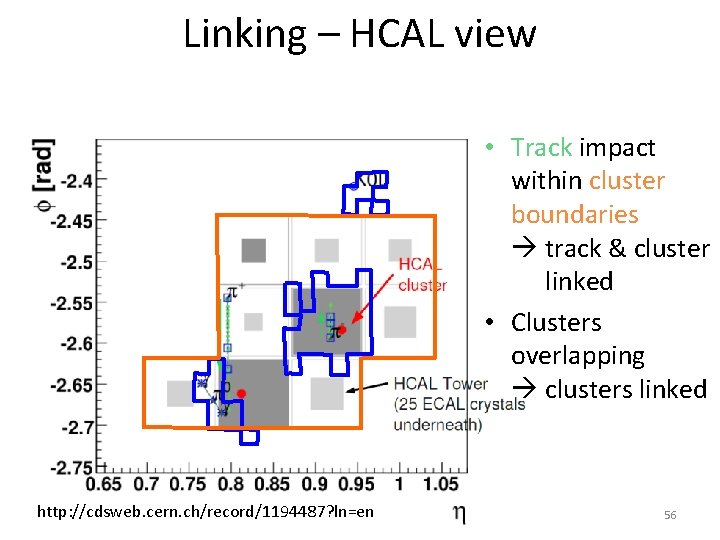
Linking – HCAL view • Track impact within cluster boundaries track & cluster linked • Clusters overlapping clusters linked http: //cdsweb. cern. ch/record/1194487? ln=en 56
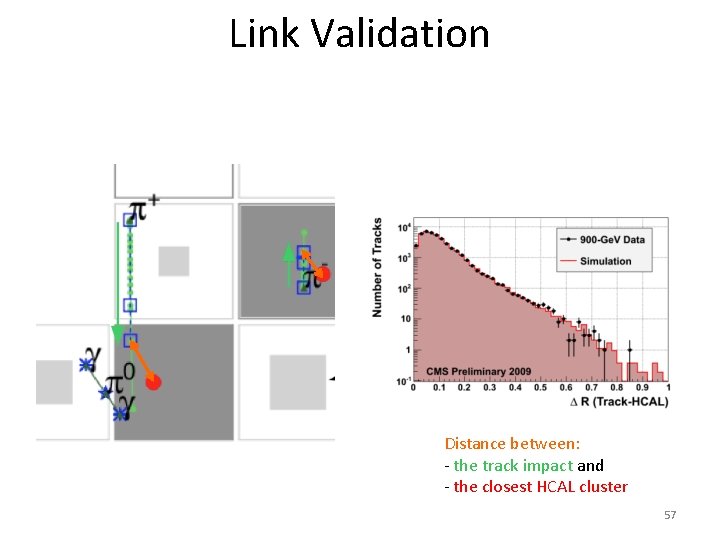
Link Validation Distance between: - the track impact and - the closest HCAL cluster 57
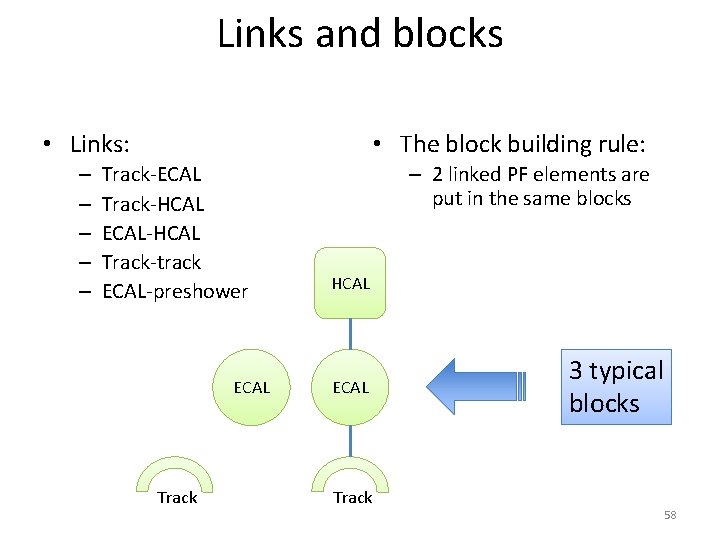
Links and blocks • Links: – – – • The block building rule: Track-ECAL Track-HCAL ECAL-HCAL Track-track ECAL-preshower ECAL Track – 2 linked PF elements are put in the same blocks HCAL ECAL Track 3 typical blocks 58
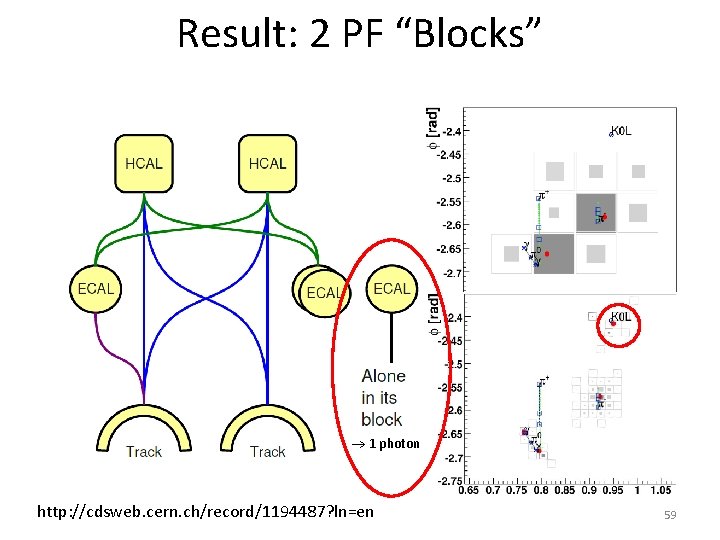
Result: 2 PF “Blocks” 1 photon http: //cdsweb. cern. ch/record/1194487? ln=en 59
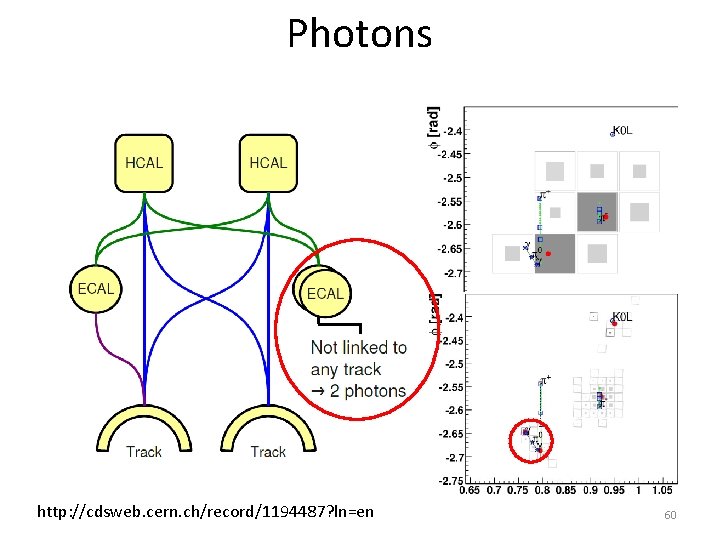
Photons http: //cdsweb. cern. ch/record/1194487? ln=en 60
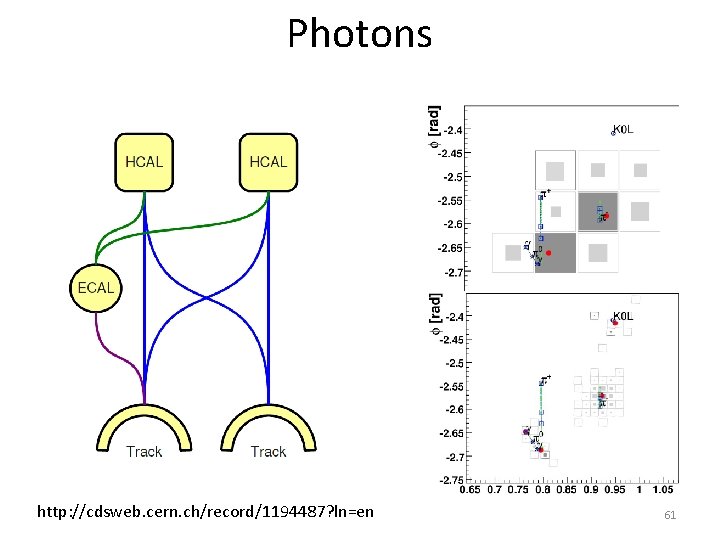
Photons http: //cdsweb. cern. ch/record/1194487? ln=en 61
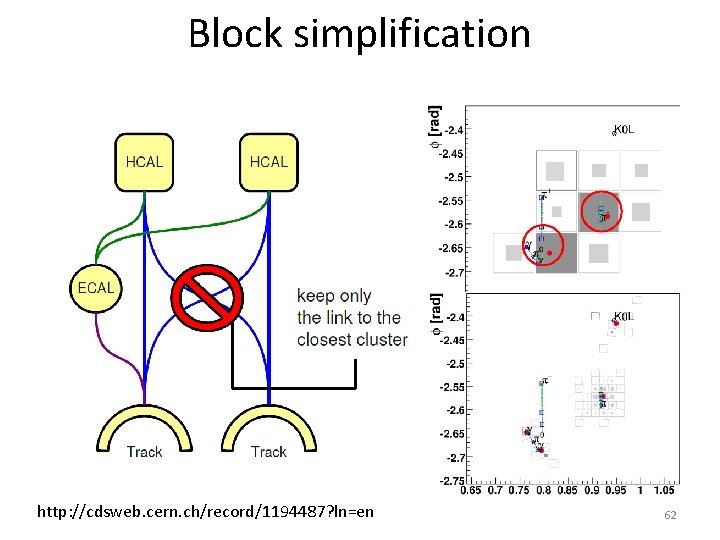
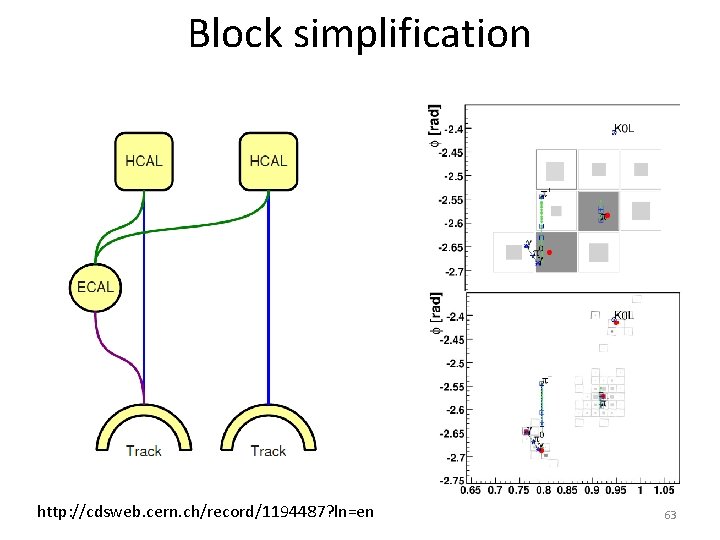
Block simplification http: //cdsweb. cern. ch/record/1194487? ln=en 62
Block simplification http: //cdsweb. cern. ch/record/1194487? ln=en 63
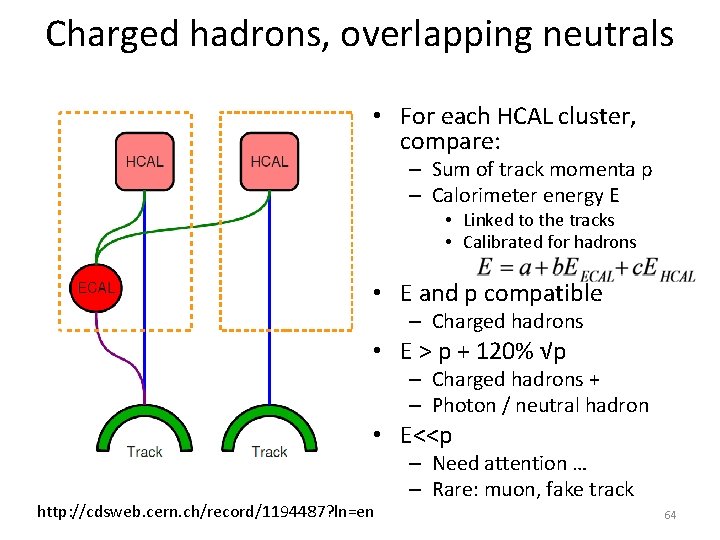
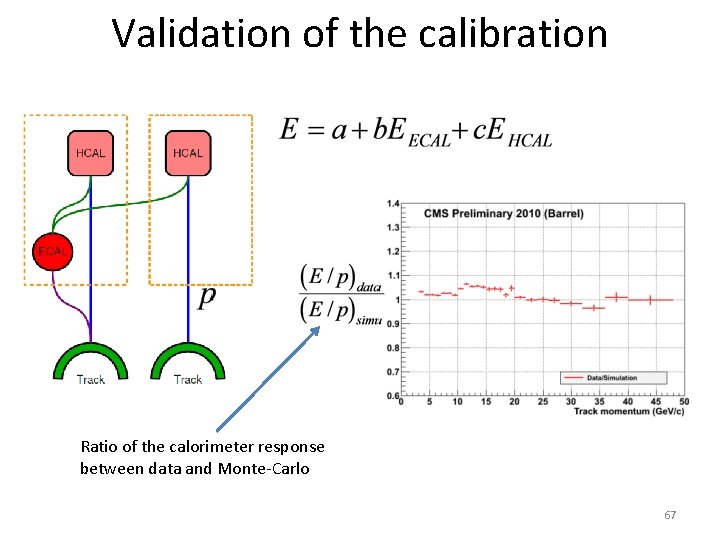
Charged hadrons, overlapping neutrals • For each HCAL cluster, compare: – Sum of track momenta p – Calorimeter energy E • Linked to the tracks • Calibrated for hadrons • E and p compatible – Charged hadrons • E > p + 120% √p – Charged hadrons + – Photon / neutral hadron • E<<p http: //cdsweb. cern. ch/record/1194487? ln=en – Need attention … – Rare: muon, fake track 64
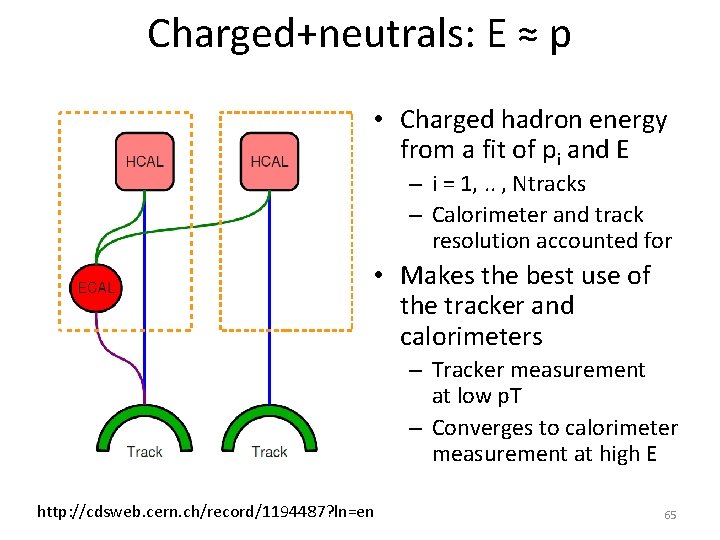
Charged+neutrals: E ≈ p • Charged hadron energy from a fit of pi and E – i = 1, . . , Ntracks – Calorimeter and track resolution accounted for • Makes the best use of the tracker and calorimeters – Tracker measurement at low p. T – Converges to calorimeter measurement at high E http: //cdsweb. cern. ch/record/1194487? ln=en 65
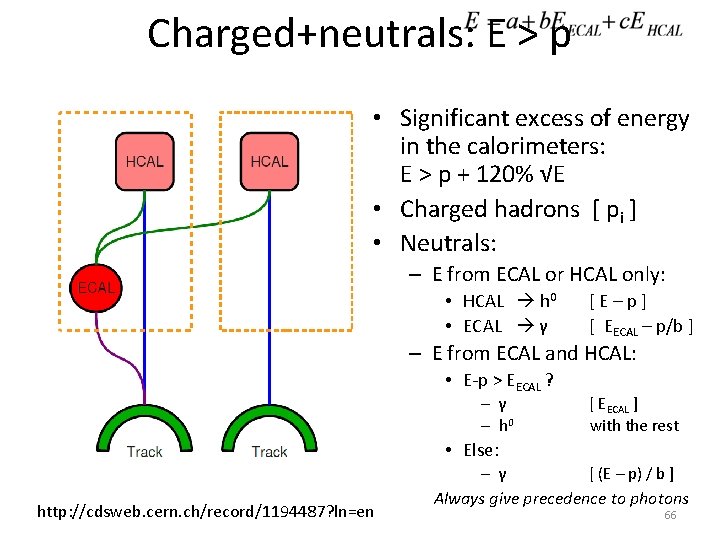
Charged+neutrals: E > p • Significant excess of energy in the calorimeters: E > p + 120% √E • Charged hadrons [ pi ] • Neutrals: – E from ECAL or HCAL only: • HCAL h 0 • ECAL γ [ E – p ] [ EECAL – p/b ] – E from ECAL and HCAL: • E-p > EECAL ? – γ [ EECAL ] – h 0 with the rest • Else: http: //cdsweb. cern. ch/record/1194487? ln=en – γ [ (E – p) / b ] Always give precedence to photons 66
Validation of the calibration Ratio of the calorimeter response between data and Monte-Carlo 67
2 charged hadrons, 3 photons 1 photon http: //cdsweb. cern. ch/record/1194487? ln=en 68