
Social class Joan Garrod Social class The Great
- Slides: 11
Social class Joan Garrod
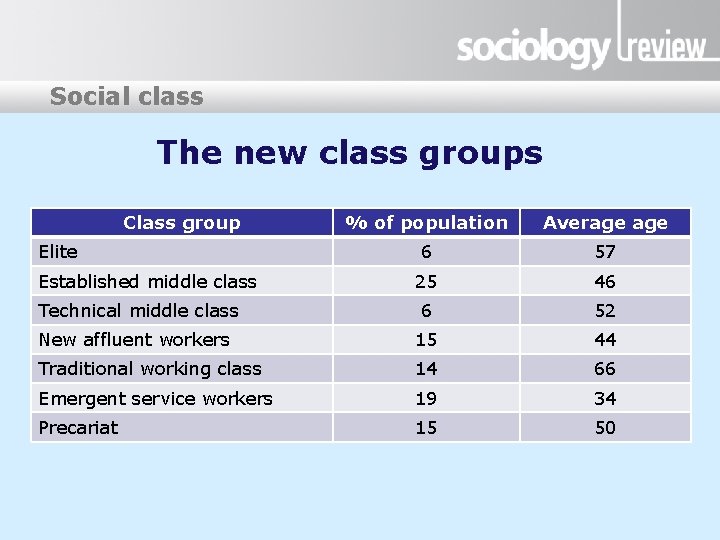
Social class The Great British Class Survey The revision Power. Point for Sociology Review Vol. 23 No. 2 on social class groupings referred to the results of the Great British Class Survey, published in April 2013. The survey determined social class using three variables: • economic capital • social capital • cultural capital The researchers identified seven social class groupings. As a reminder, these are shown on the next slide.
Social class The new class groups Class group % of population Average 6 57 25 46 Technical middle class 6 52 New affluent workers 15 44 Traditional working class 14 66 Emergent service workers 19 34 Precariat 15 50 Elite Established middle class
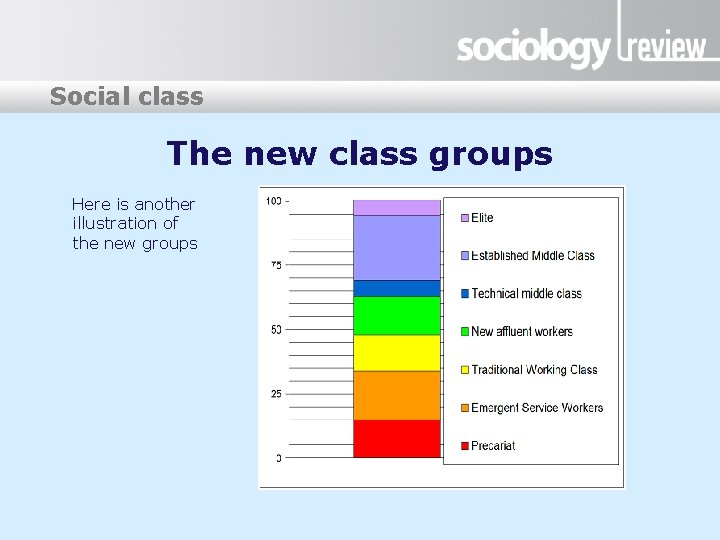
Social class The new class groups Here is another illustration of the new groups
Social class What do I need to know about this? The research generated a great deal of media coverage, but was not without its critics. The following slides outline some of the main criticisms. Knowledge of the rationale, methods and findings of the Great British Class Survey and the criticisms that have been made of it, show important sociological skills in answering exam questions about the nature of social class in modern Britain. As you look at the following slides, discuss with your teacher and classmates the extent to which you think that the criticisms are justified by the evidence.
Social class Professor Colin Mills (University of Oxford) has made the following points: There are obvious problems with a survey in which the respondents are selfselected. These problems may be even greater when the survey is online. To try to ensure that respondents understand the questions, these are likely to be ‘blunt instruments’, with a loss of subtlety or nuance. No checks can be made that the survey has been completed by the person claiming to do it, or that only one person has been involved. The nature of the process means that the respondents are likely to be ‘skewed’ and not representative of the population as a whole. For example, managers and professionals are vastly over-represented, while what one might call ‘the working class’ are vastly under-represented. Even if weighting is applied, the problem remains. For example, the working-class survey respondents are likely to be unrepresentative – after all, they chose to complete the online survey, and there is no way to know in what ways they might differ from other working-class people.
Social class Professor Colin Mills (University of Oxford) has made the following points: There is only a fifth of routine and technical craft workers in the GBCS sample as there should be, and only a third as many routine workers. Despite the fact that there were more than 160, 000 responses to the online survey, almost all the information used as the basis for the empirical claims comes from a ‘nationally representative’ quota sample of just 1, 026. Mills claims that nothing substantial is revealed about the details of this sample, just that the authors are satisfied that it is ‘nationally representative’. Question: What do you think of (a) the validity and (b) the reliability of a proposed new class system based on 1, 026 people?
Social class Professor Danny Dorling (University of Oxford) has made the following points: The GBCS rejects occupation as a means of assessing social class, but in the ‘social capital’ section, it uses the occupations of a person’s friends and acquaintances as a way of assessing the social capital element of their class. Clicking on the limited variety of occupations on offer, a person’s status rises if they ‘hobnob’ with people from the higher groups, but falls if they admit an acquaintance with those from the lower levels. You get a higher score if your acquaintances are drawn from a variety of occupations. The ‘cultural capital’ section divides people’s activities into ‘emerging’ (e. g. use of social media, going to the gym) and ‘highbrow’ (e. g. visiting museums, going to the opera). Dorling says that this reinforces existing stereotypes.
Social class Professor Danny Dorling (University of Oxford) has made the following points: The online social class calculator appears to show that if your household post-tax income is more than £ 100 k, you are bound to end up in the elite, whatever your other answers, and if it is below £ 25 k you will be in the precariat. Therefore the assessment of social class at the extremes of the model is essentially about income. The ‘true’ elite is almost certainly much smaller than 6% of the population. Dorling calculates those at ‘the very top’ as comprising around 0. 01%. Dorling quotes a journalist from the Daily Mirror as saying: ‘The rich and powerful, and employers with the ability to sack you are in a different league. They’re on the other side: always have been, always will be. They want to control, and exploit. That’s the real class issue, not your music tastes or TV viewing habits. ’
Social class Dorling makes the following comment: ‘Classes are all about comparisons. Classes exist only in relation to one another. People can only go hungry in a country as rich as Britain because others are not embarrassed about paying miserable wages or attacking risible levels of benefits. The Elite worry so much about whether they are elite because, even within that group, there are huge inequalities. Below the Elite the majority struggle and should be fearful because the wealthiest minority do not have their interests at heart. But if you believe all this, what class are you? ’ Questions: • • How would you define (and therefore measure) the elite? What are the problems with this concept? Were the researchers right to include social and cultural as well as economic capital?
Social class Over to you! This has been a very brief look at the findings of the Great British Class Survey and some criticisms that have been made of it. You should now do some research of your own. Using your preferred search engine, type in ‘The Great British Class Survey’ for more details of the research (and the online class calculator if you wish to see in what class you/your family are placed), and then type the phrase in again, followed by ‘Colin Mills’ and then ‘Danny Dorling’. You can then read their views in more detail. Further criticisms will be found if you type in ‘J. P. E. Harper-Scott’. Don’t forget to make brief notes to look back at when you are revising.