
Hard Probes of Heavy Ion collisions at the

Hard Probes of Heavy Ion collisions at the LHC Marco van Leeuwen, Nikhef and Utrecht University
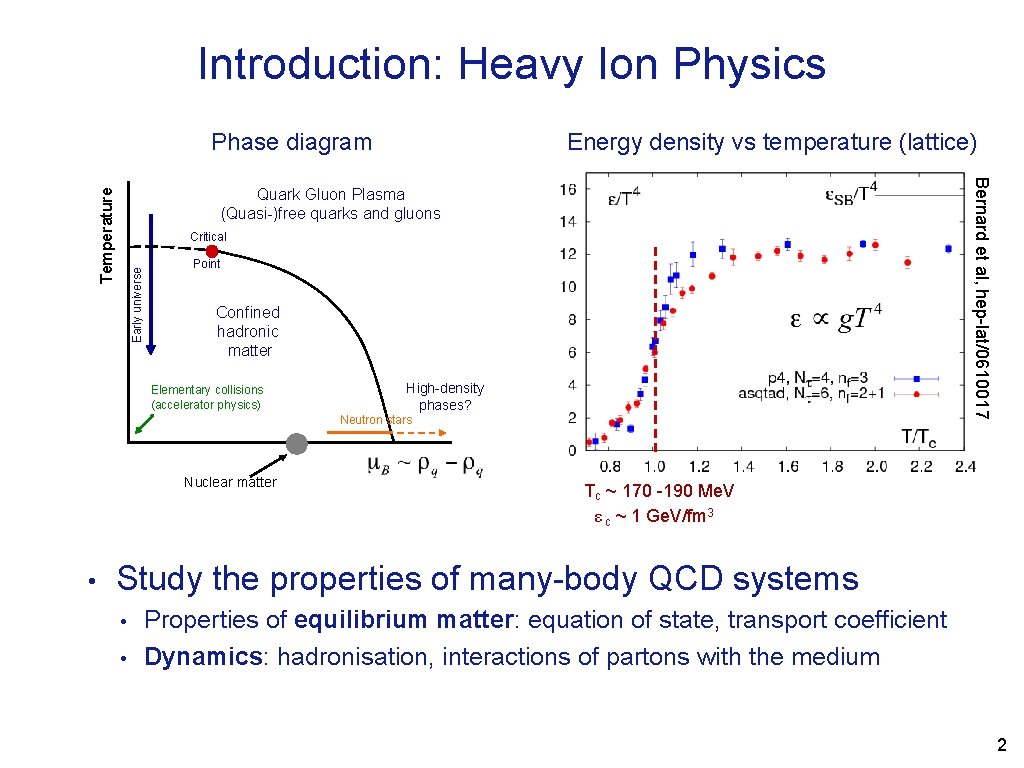
Introduction: Heavy Ion Physics Phase diagram Energy density vs temperature (lattice) Bernard et al, hep-lat/0610017 Temperature Quark Gluon Plasma (Quasi-)free quarks and gluons Early universe Critical Point Confined hadronic matter Elementary collisions (accelerator physics) High-density phases? Neutron stars Nuclear matter • Tc ~ 170 -190 Me. V ε c ~ 1 Ge. V/fm 3 Study the properties of many-body QCD systems • • Properties of equilibrium matter: equation of state, transport coefficient Dynamics: hadronisation, interactions of partons with the medium 2
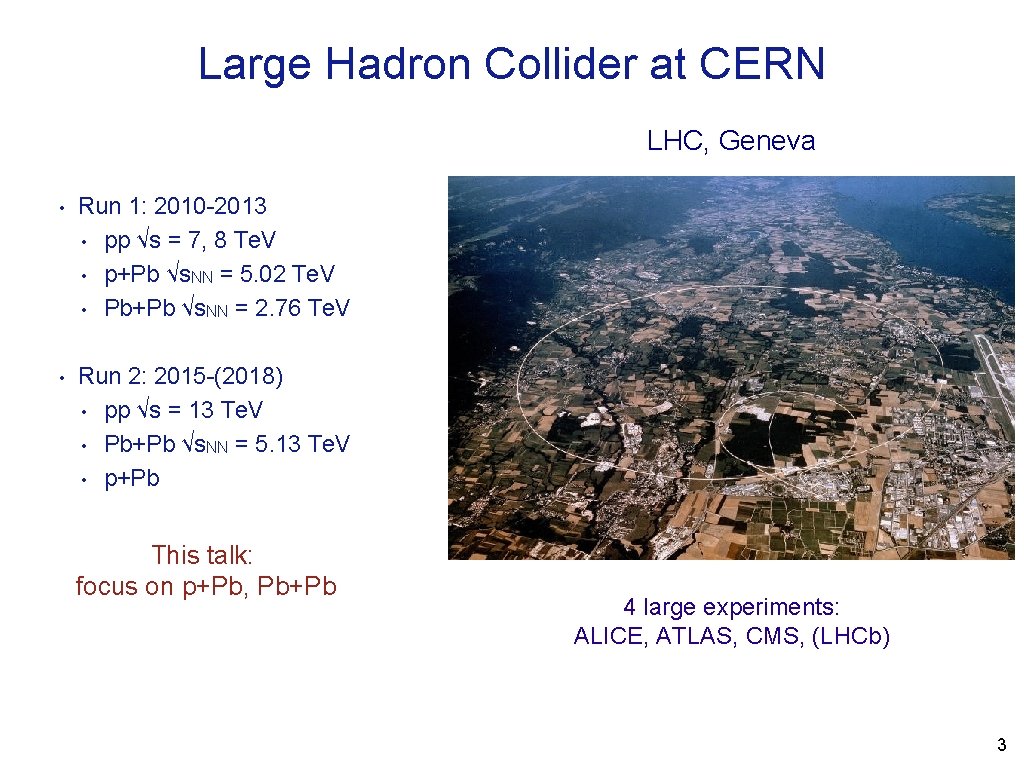
Large Hadron Collider at CERN LHC, Geneva • Run 1: 2010 -2013 • pp √s = 7, 8 Te. V • p+Pb √s. NN = 5. 02 Te. V • Pb+Pb √s. NN = 2. 76 Te. V • Run 2: 2015 -(2018) • pp √s = 13 Te. V • Pb+Pb √s. NN = 5. 13 Te. V • p+Pb This talk: focus on p+Pb, Pb+Pb 4 large experiments: ALICE, ATLAS, CMS, (LHCb) 3
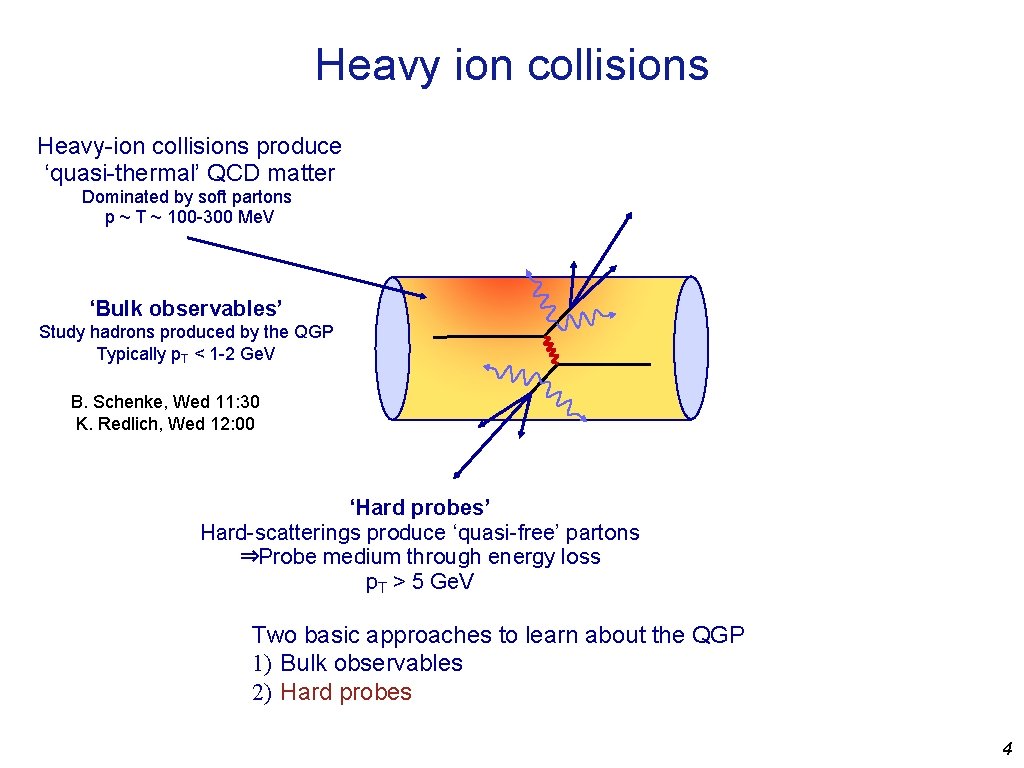
Heavy ion collisions Heavy-ion collisions produce ‘quasi-thermal’ QCD matter Dominated by soft partons p ~ T ~ 100 -300 Me. V ‘Bulk observables’ Study hadrons produced by the QGP Typically p. T < 1 -2 Ge. V B. Schenke, Wed 11: 30 K. Redlich, Wed 12: 00 ‘Hard probes’ Hard-scatterings produce ‘quasi-free’ partons ⇒Probe medium through energy loss p. T > 5 Ge. V Two basic approaches to learn about the QGP 1) Bulk observables 2) Hard probes 4
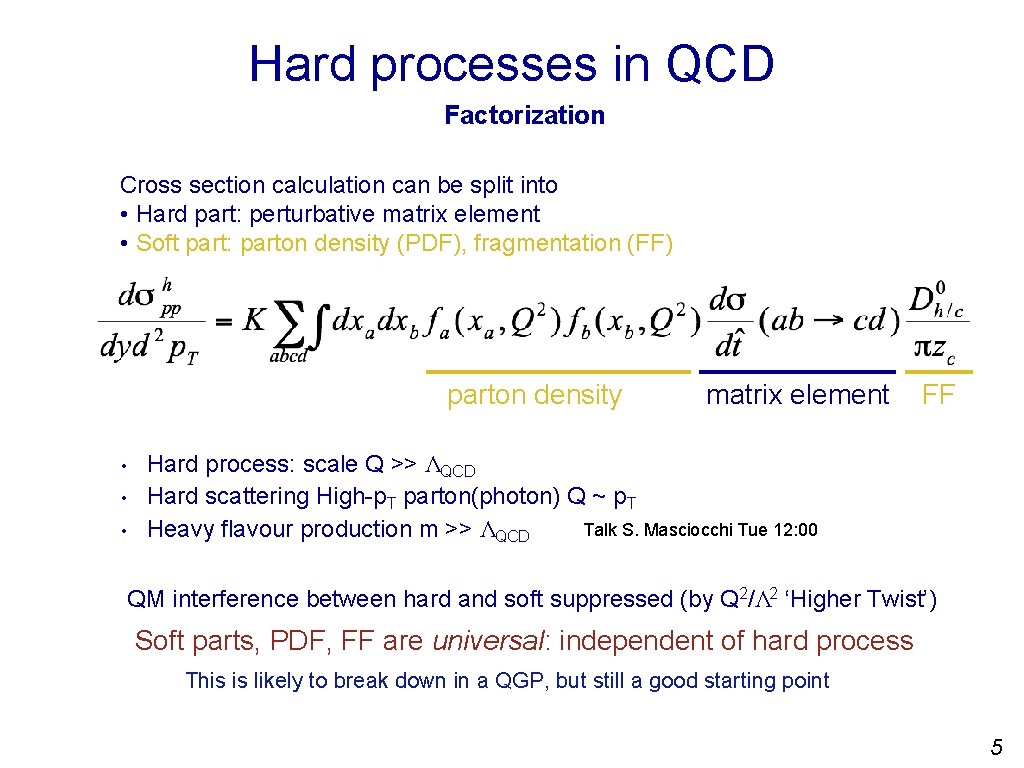
Hard processes in QCD Factorization Cross section calculation can be split into • Hard part: perturbative matrix element • Soft part: parton density (PDF), fragmentation (FF) parton density • • • matrix element FF Hard process: scale Q >> ΛQCD Hard scattering High-p. T parton(photon) Q ~ p. T Talk S. Masciocchi Tue 12: 00 Heavy flavour production m >> ΛQCD QM interference between hard and soft suppressed (by Q 2/Λ 2 ‘Higher Twist’) Soft parts, PDF, FF are universal: independent of hard process This is likely to break down in a QGP, but still a good starting point 5
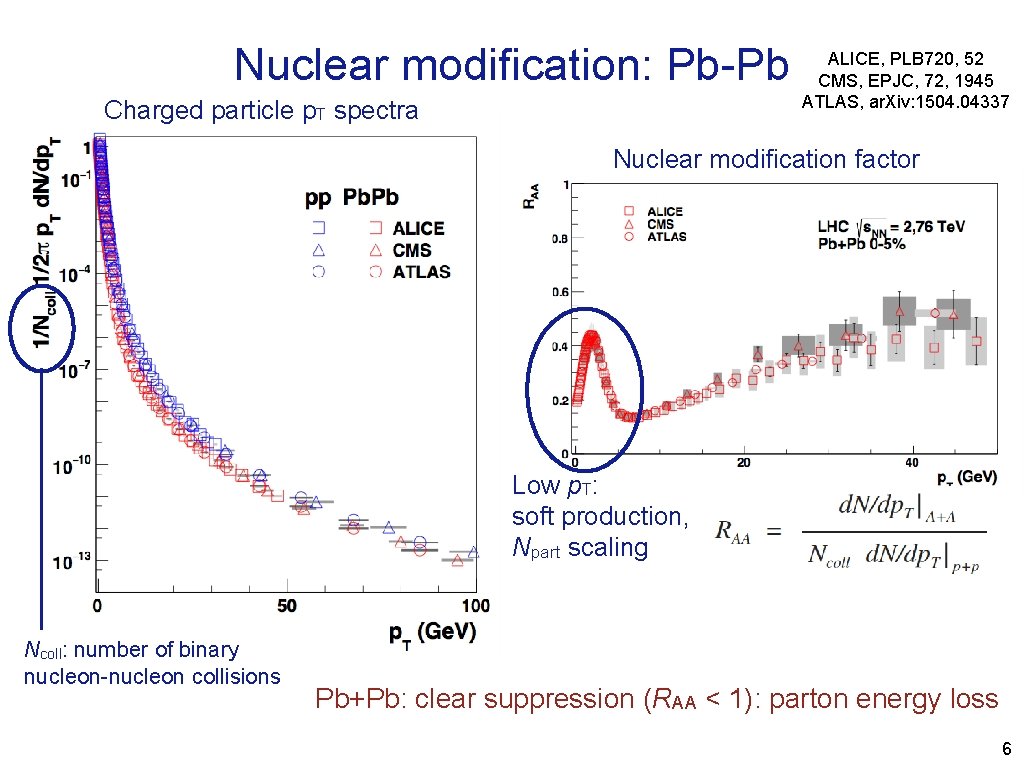
Nuclear modification: Pb-Pb Charged particle p. T spectra ALICE, PLB 720, 52 CMS, EPJC, 72, 1945 ATLAS, ar. Xiv: 1504. 04337 Nuclear modification factor Low p. T: soft production, Npart scaling Ncoll: number of binary nucleon-nucleon collisions Pb+Pb: clear suppression (RAA < 1): parton energy loss 6
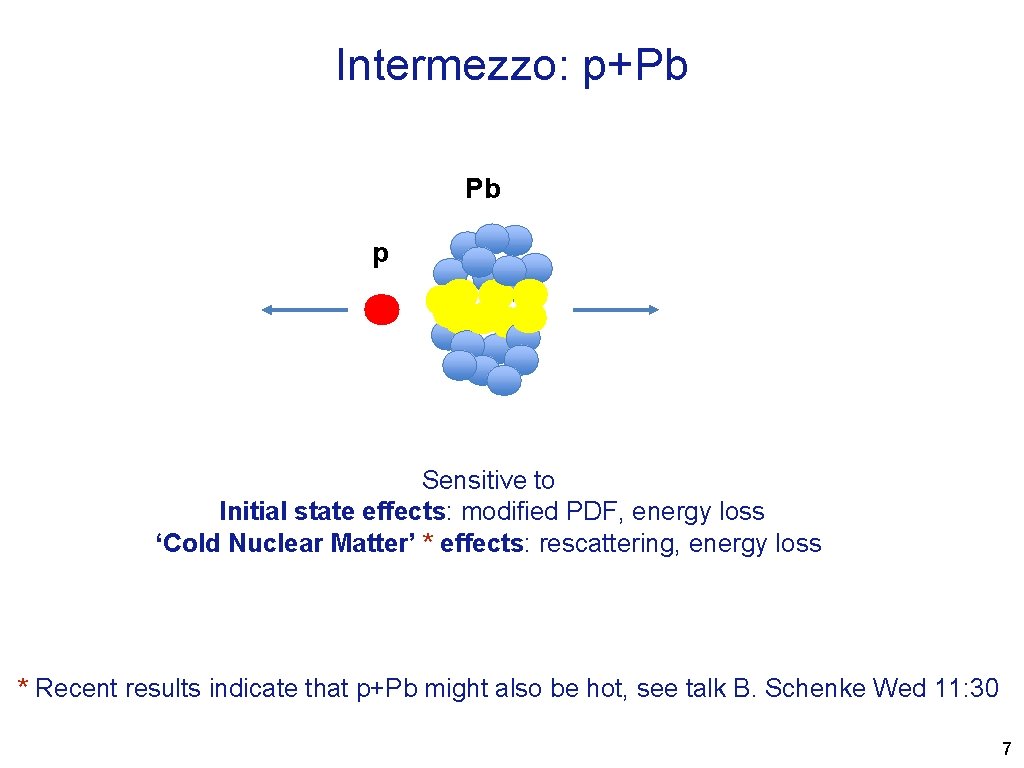
Intermezzo: p+Pb Pb p Sensitive to Initial state effects: modified PDF, energy loss ‘Cold Nuclear Matter’ * effects: rescattering, energy loss * Recent results indicate that p+Pb might also be hot, see talk B. Schenke Wed 11: 30 7
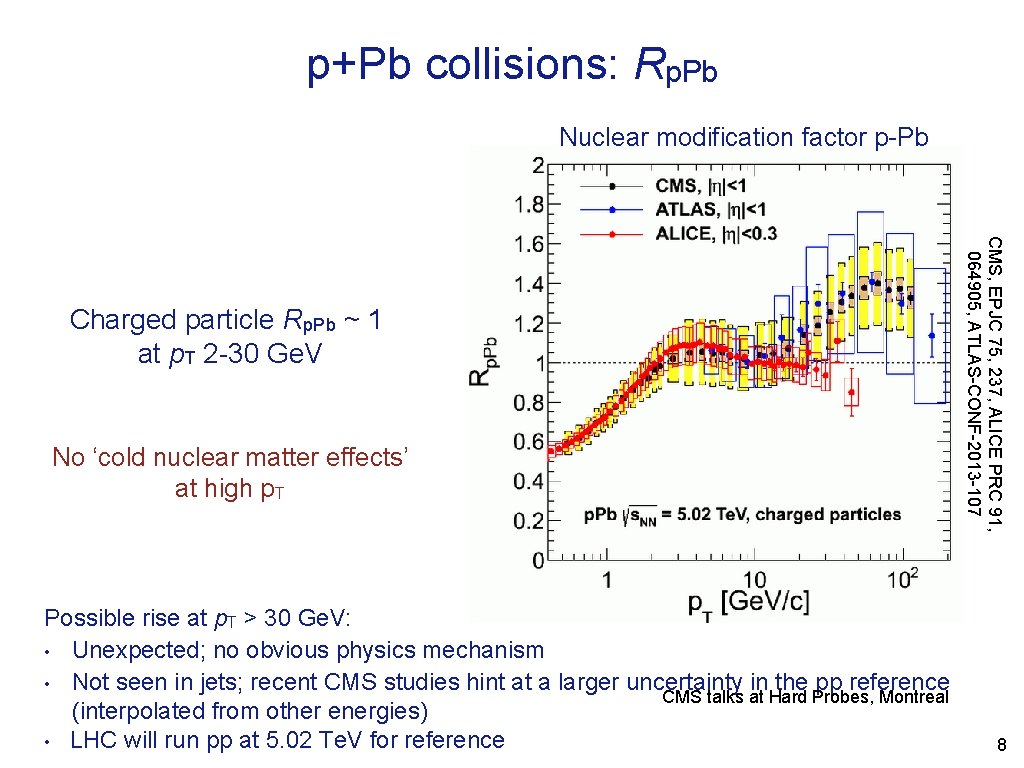
p+Pb collisions: Rp. Pb Nuclear modification factor p-Pb No ‘cold nuclear matter effects’ at high p. T Possible rise at p. T > 30 Ge. V: • Unexpected; no obvious physics mechanism • Not seen in jets; recent CMS studies hint at a larger uncertainty in the pp reference CMS talks at Hard Probes, Montreal (interpolated from other energies) • LHC will run pp at 5. 02 Te. V for reference CMS, EPJC 75, 237, ALICE PRC 91, 064905, ATLAS-CONF-2013 -107 Charged particle Rp. Pb ~ 1 at p. T 2 -30 Ge. V 8
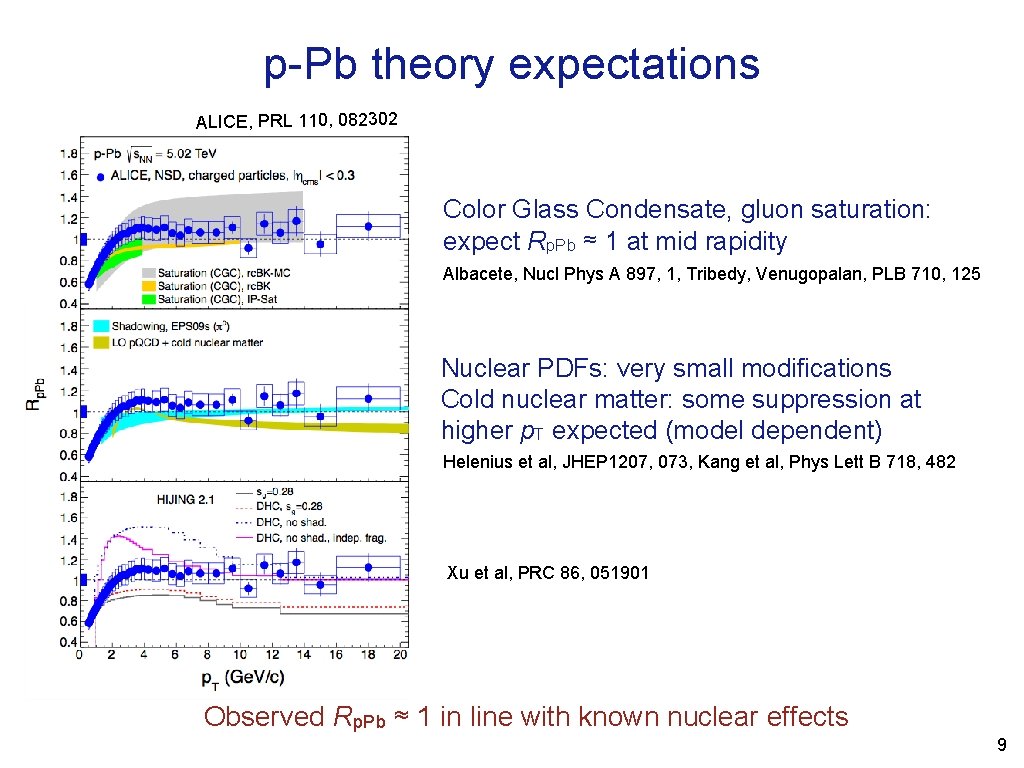
p-Pb theory expectations ALICE, PRL 110, 082302 Color Glass Condensate, gluon saturation: expect Rp. Pb ≈ 1 at mid rapidity Albacete, Nucl Phys A 897, 1, Tribedy, Venugopalan, PLB 710, 125 Nuclear PDFs: very small modifications Cold nuclear matter: some suppression at higher p. T expected (model dependent) Helenius et al, JHEP 1207, 073, Kang et al, Phys Lett B 718, 482 Xu et al, PRC 86, 051901 Observed Rp. Pb ≈ 1 in line with known nuclear effects 9
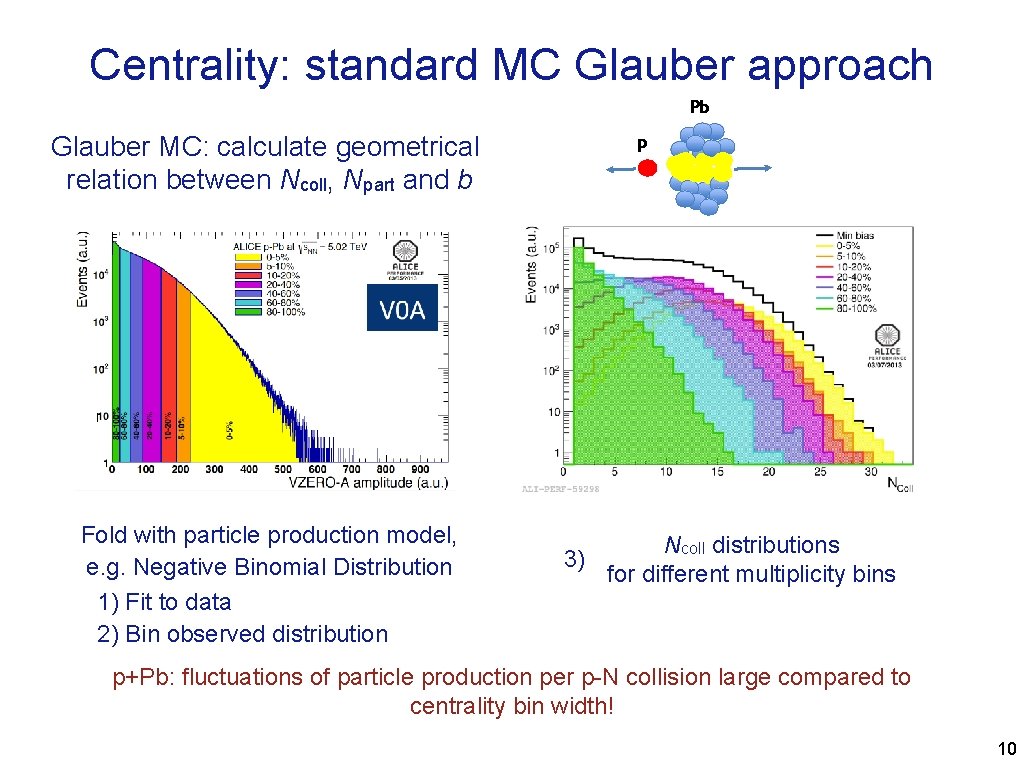
Centrality: standard MC Glauber approach Pb Glauber MC: calculate geometrical relation between Ncoll, Npart and b Fold with particle production model, e. g. Negative Binomial Distribution 1) Fit to data 2) Bin observed distribution p 3) Ncoll distributions for different multiplicity bins p+Pb: fluctuations of particle production per p-N collision large compared to centrality bin width! 10
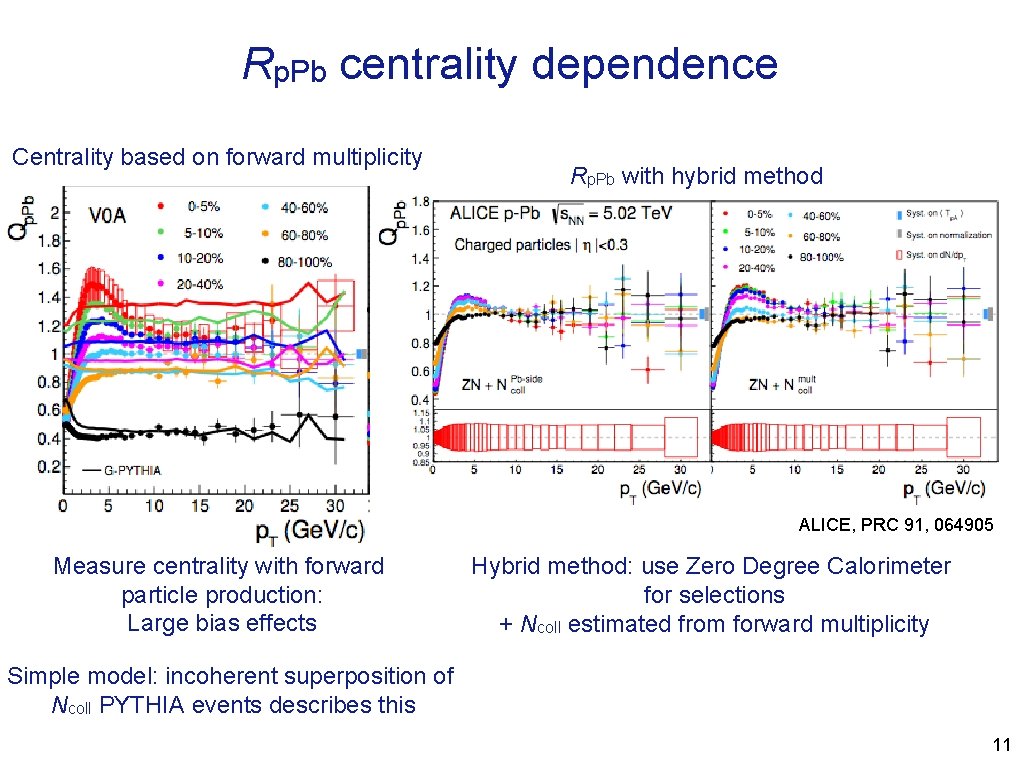
Rp. Pb centrality dependence Centrality based on forward multiplicity Rp. Pb with hybrid method ALICE, PRC 91, 064905 Measure centrality with forward particle production: Large bias effects Hybrid method: use Zero Degree Calorimeter for selections + Ncoll estimated from forward multiplicity Simple model: incoherent superposition of Ncoll PYTHIA events describes this 11
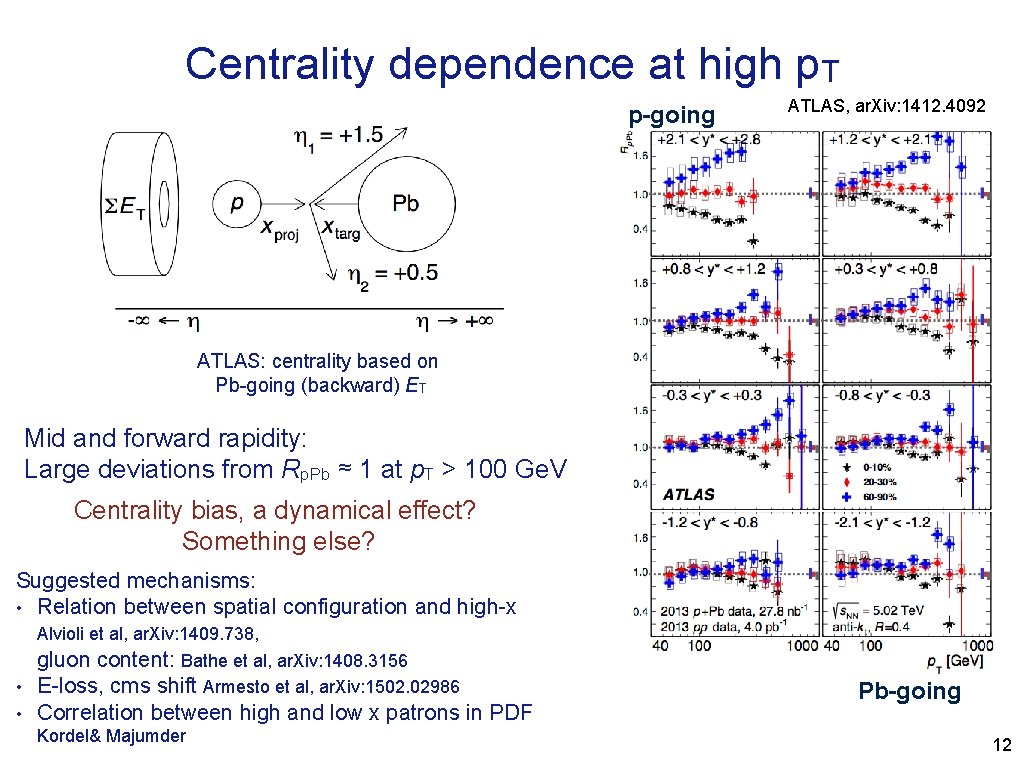
Centrality dependence at high p. T p-going ATLAS, ar. Xiv: 1412. 4092 ATLAS: centrality based on Pb-going (backward) ET Mid and forward rapidity: Large deviations from Rp. Pb ≈ 1 at p. T > 100 Ge. V Centrality bias, a dynamical effect? Something else? Suggested mechanisms: • Relation between spatial configuration and high-x Alvioli et al, ar. Xiv: 1409. 738, gluon content: Bathe et al, ar. Xiv: 1408. 3156 • E-loss, cms shift Armesto et al, ar. Xiv: 1502. 02986 • Correlation between high and low x patrons in PDF Kordel& Majumder Pb-going 12
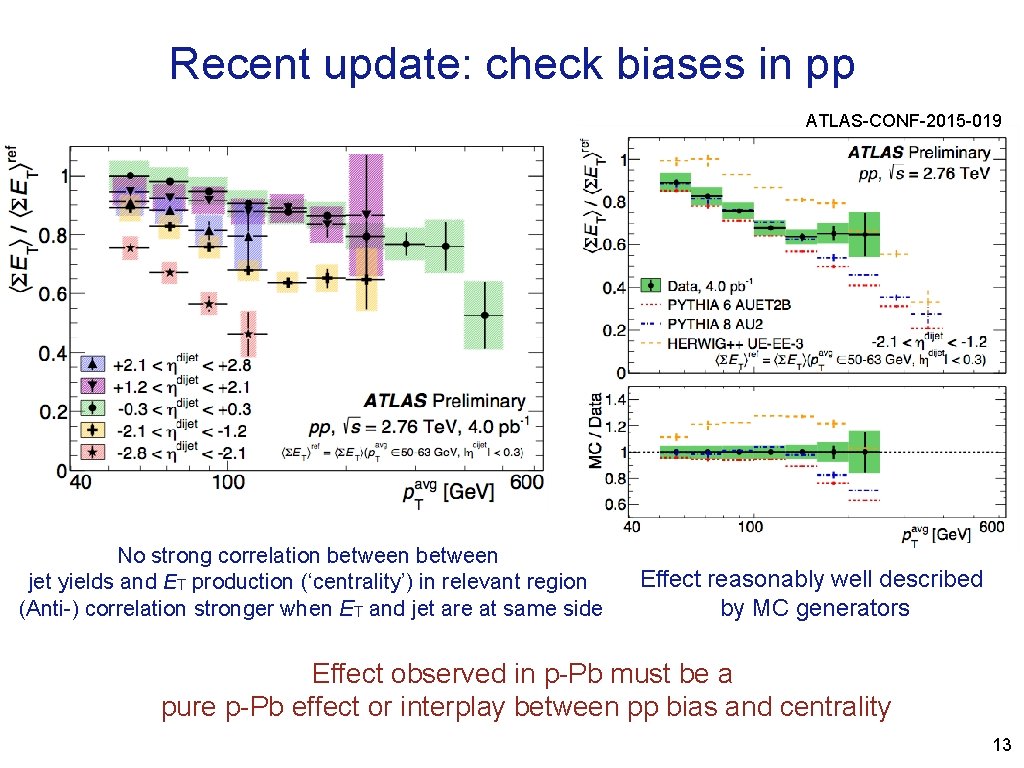
Recent update: check biases in pp ATLAS-CONF-2015 -019 No strong correlation between jet yields and ET production (‘centrality’) in relevant region (Anti-) correlation stronger when ET and jet are at same side Effect reasonably well described by MC generators Effect observed in p-Pb must be a pure p-Pb effect or interplay between pp bias and centrality 13
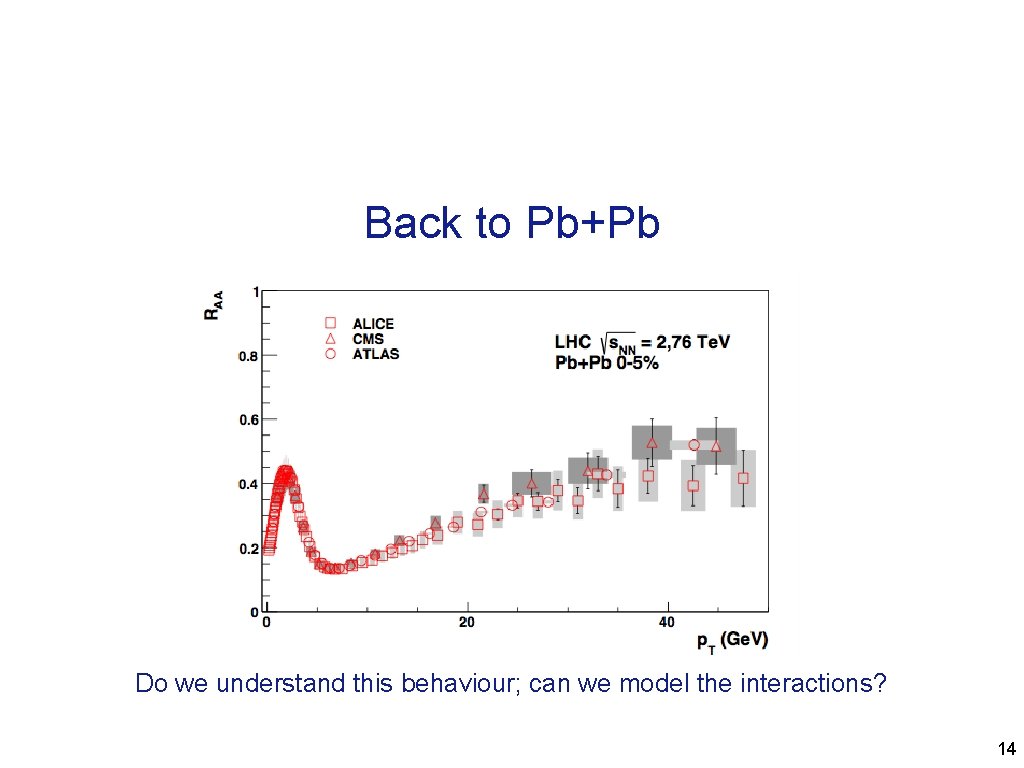
Back to Pb+Pb Do we understand this behaviour; can we model the interactions? 14
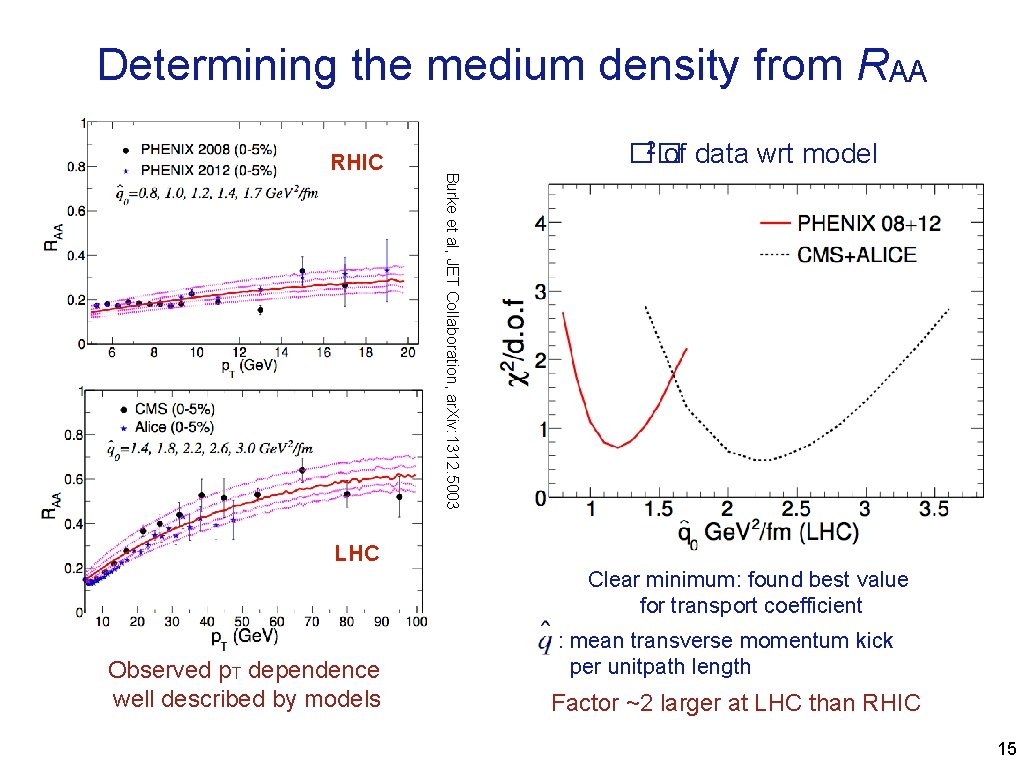
Determining the medium density from RAA Burke et al, JET Collaboration, ar. Xiv: 1312. 5003 RHIC 2 of data wrt model �� LHC Clear minimum: found best value for transport coefficient Observed p. T dependence well described by models : mean transverse momentum kick per unitpath length Factor ~2 larger at LHC than RHIC 15
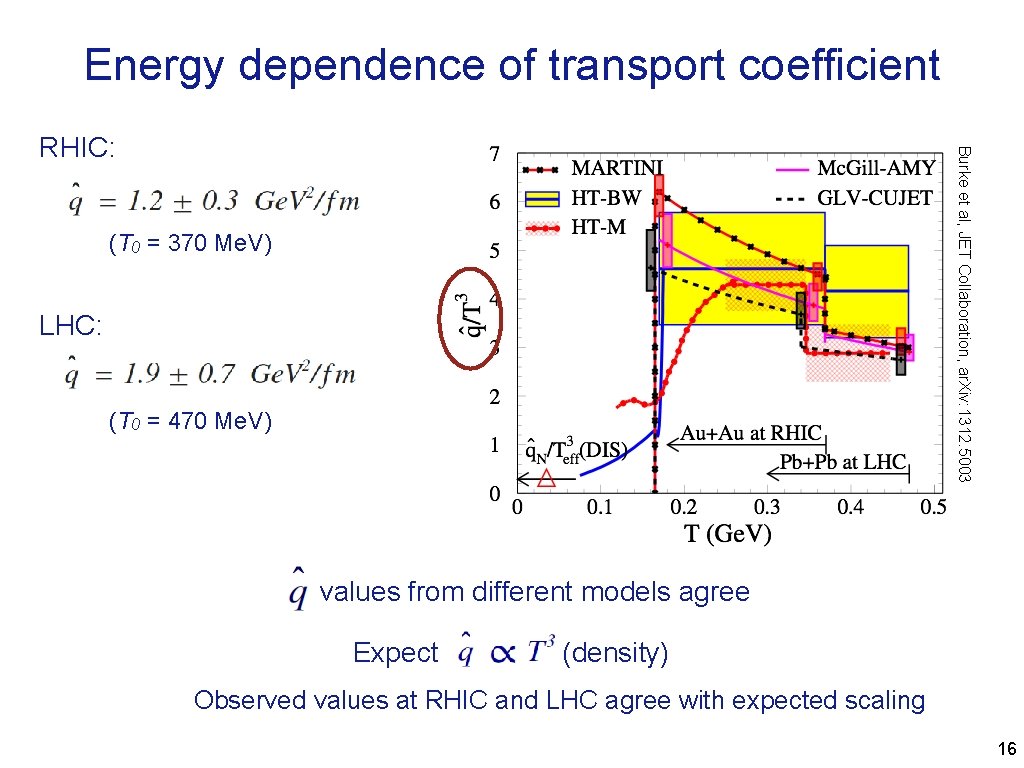
Energy dependence of transport coefficient Burke et al, JET Collaboration, ar. Xiv: 1312. 5003 RHIC: (T 0 = 370 Me. V) LHC: (T 0 = 470 Me. V) values from different models agree Expect (density) Observed values at RHIC and LHC agree with expected scaling 16
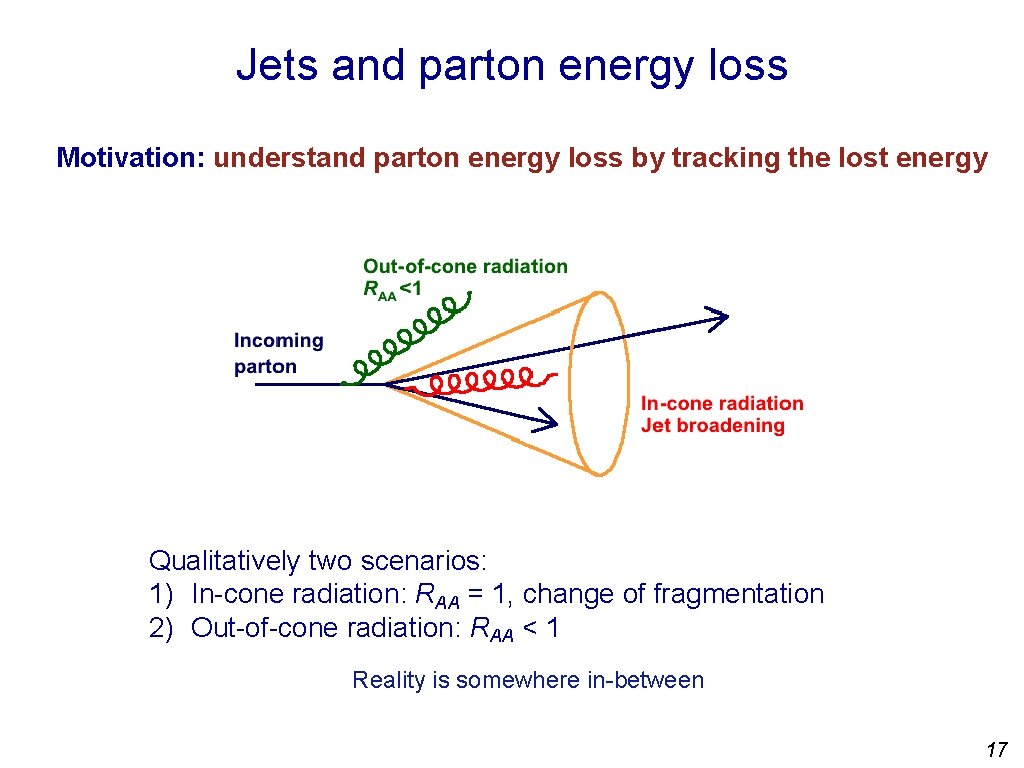
Jets and parton energy loss Motivation: understand parton energy loss by tracking the lost energy Qualitatively two scenarios: 1) In-cone radiation: RAA = 1, change of fragmentation 2) Out-of-cone radiation: RAA < 1 Reality is somewhere in-between 17
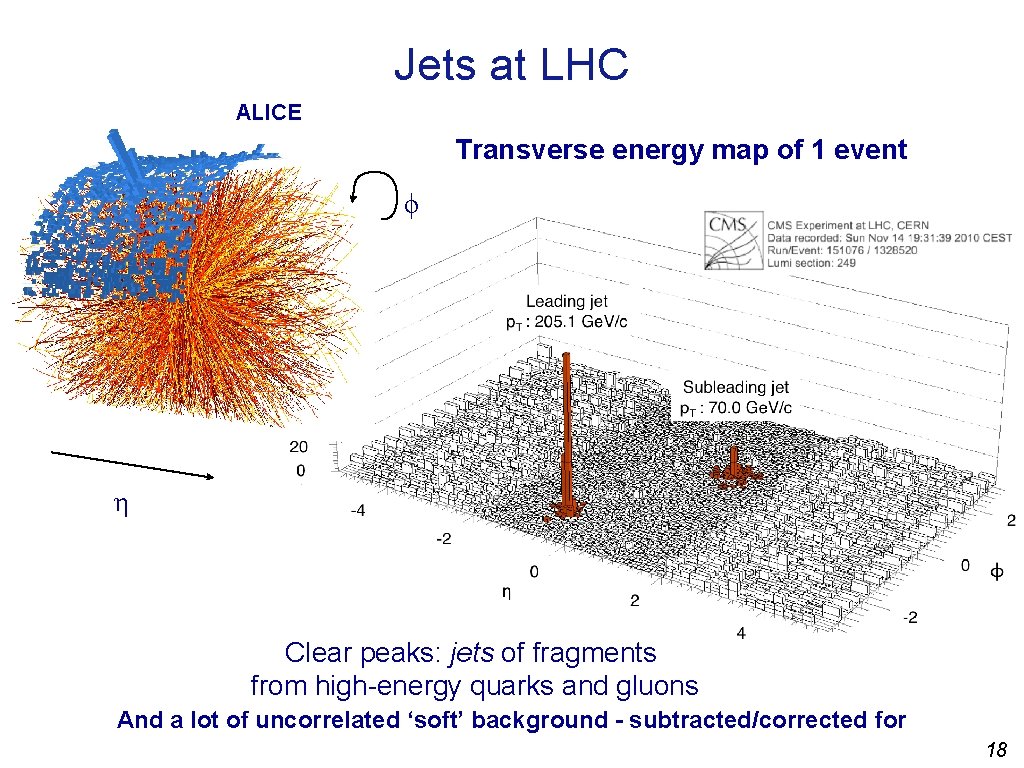
Jets at LHC ALICE Transverse energy map of 1 event ϕ η Clear peaks: jets of fragments from high-energy quarks and gluons And a lot of uncorrelated ‘soft’ background - subtracted/corrected for 18
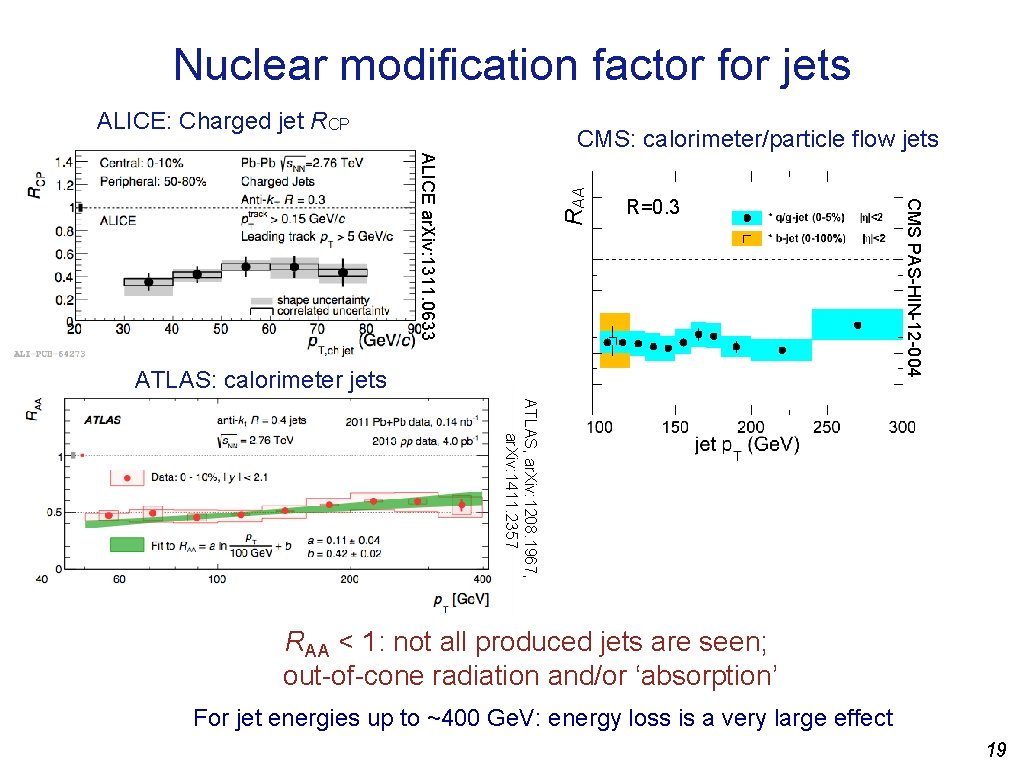
Nuclear modification factor for jets ALICE: Charged jet RCP CMS: calorimeter/particle flow jets RAA ATLAS: calorimeter jets CMS PAS-HIN-12 -004 ALICE ar. Xiv: 1311. 0633 R=0. 3 ATLAS, ar. Xiv: 1208. 1967, ar. Xiv: 1411. 2357 RAA < 1: not all produced jets are seen; out-of-cone radiation and/or ‘absorption’ For jet energies up to ~400 Ge. V: energy loss is a very large effect 19
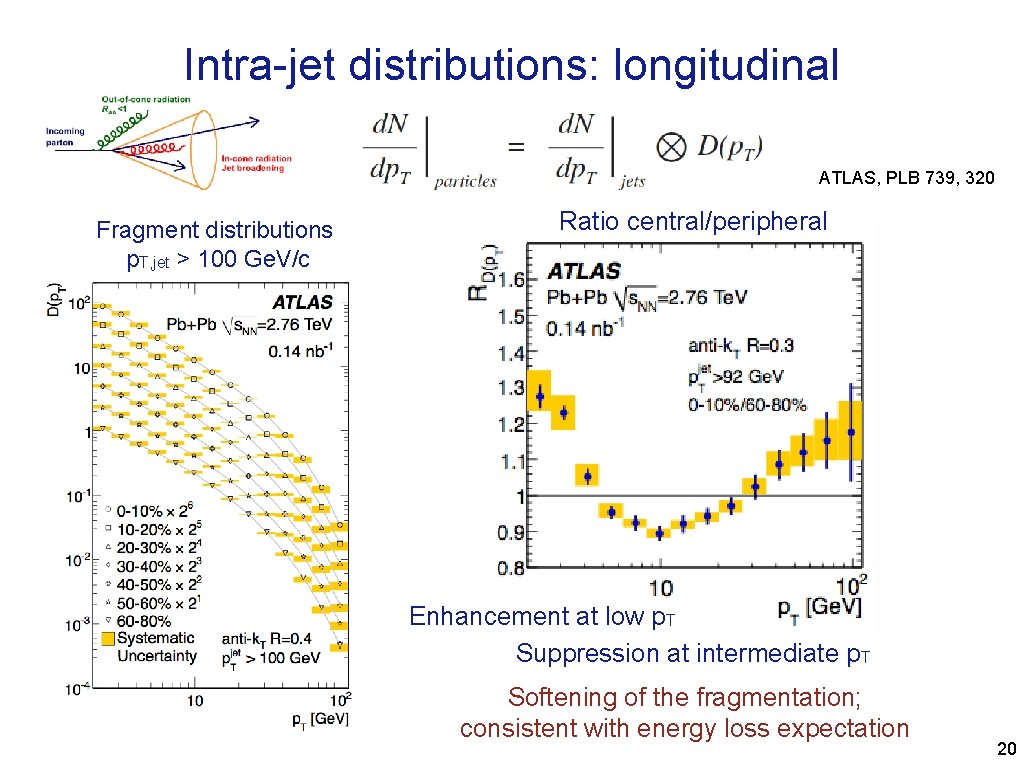
Intra-jet distributions: longitudinal ATLAS, PLB 739, 320 Fragment distributions p. T, jet > 100 Ge. V/c Ratio central/peripheral Enhancement at low p. T Suppression at intermediate p. T Softening of the fragmentation; consistent with energy loss expectation 20
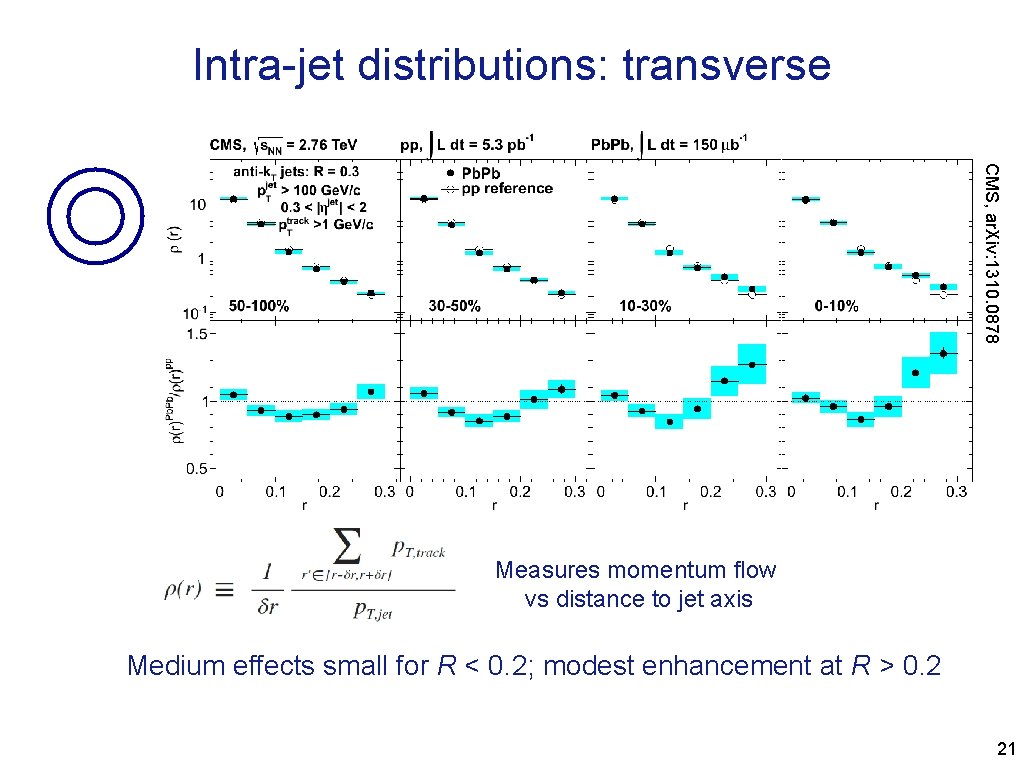
Intra-jet distributions: transverse CMS, ar. Xiv: 1310. 0878 Measures momentum flow vs distance to jet axis Medium effects small for R < 0. 2; modest enhancement at R > 0. 2 21
Connecting in-cone and out-of-cone momentum flow Where does the lost energy go? I) Jet RAA is not close to 1 • RAA ~ 0. 4 - 0. 6 for R < 0. 5 • 5 -10 Ge. V energy transported outside of cone Large energy loss � Out-of cone radiation II) Particle distributions in jets show only modest change • ~ 10 % at large momentum, small R • larger effects at small p. T, large R Small/modification of in-cone energy flow (My) naive expectation: Large redistribution O(10 Ge. V) outside cone �Large effects inside cone Not seen… Several caveats … Modelling ongoing Talk G. Milhano, Thu 10: 00 22
Summary • p+Pb • • As baseline for ‘cold nuclear effects’: probably understood/no surprises (Minimum bias collisions) Centrality: interplay between biases (picking out ‘special’ nucleon-nucleon collisions) and geometry • • • Possibly new effects ? Hot matter effects — not covered here: B. Schenke Pb+Pb: Clear suppression of high-p. T yields • • Magnitude of inclusive hadron suppression basically understood: parton energy loss Jets also suppressed (R < 0. 5) • • • Significant out-of-cone radiation In-cone distributions show some modification (redistribution of fragments) Theory/interpretation under development/discussion: G. Milhano 23

Extra slides 24
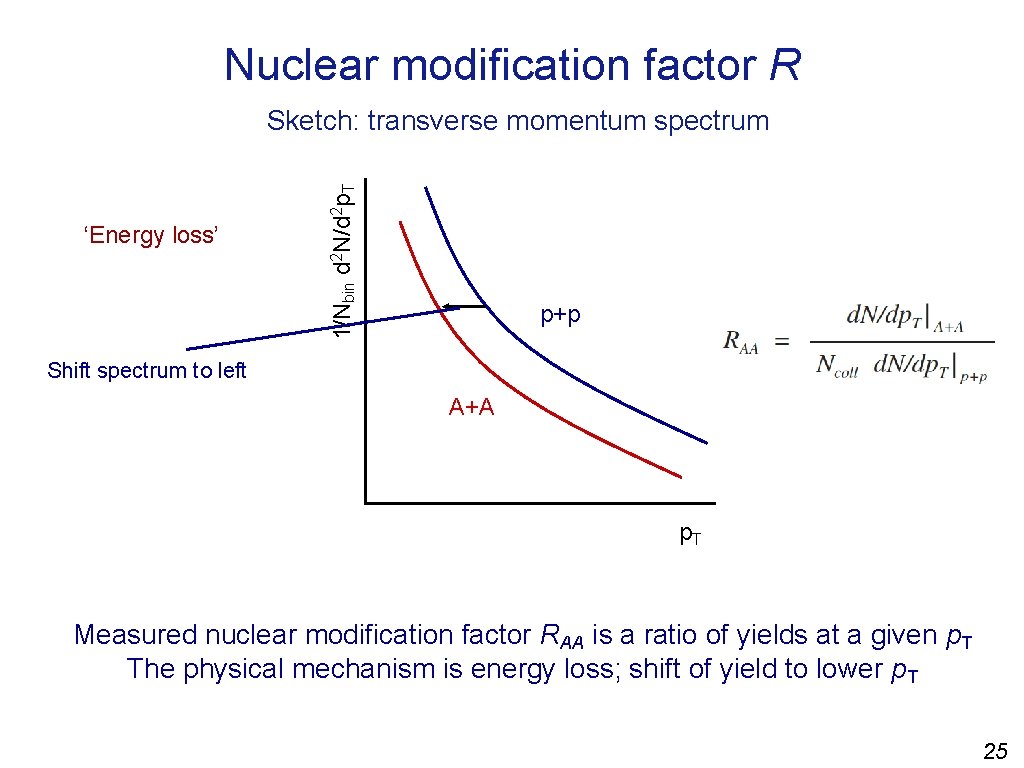
Nuclear modification factor R ‘Energy loss’ 1/Nbin d 2 N/d 2 p. T Sketch: transverse momentum spectrum p+p Shift spectrum to left A+A p. T Measured nuclear modification factor RAA is a ratio of yields at a given p. T The physical mechanism is energy loss; shift of yield to lower p. T 25
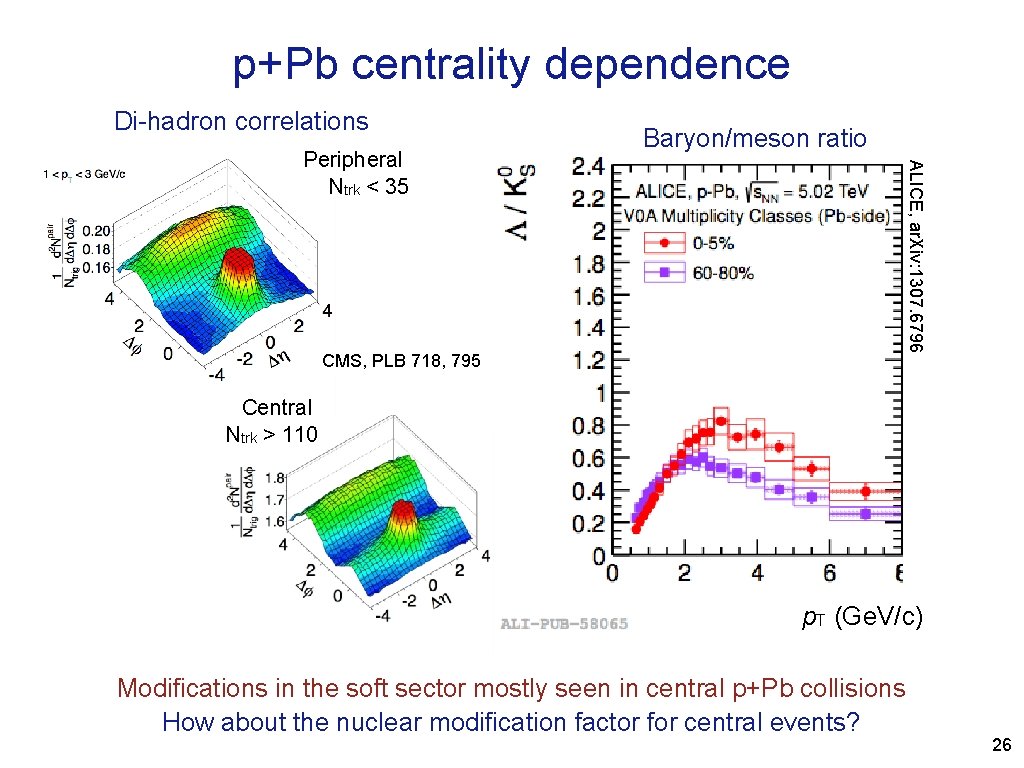
p+Pb centrality dependence Di-hadron correlations ALICE, ar. Xiv: 1307. 6796 Peripheral Ntrk < 35 Baryon/meson ratio CMS, PLB 718, 795 Central Ntrk > 110 p. T (Ge. V/c) Modifications in the soft sector mostly seen in central p+Pb collisions How about the nuclear modification factor for central events? 26
Biases: some remarks NB: bias and selection are almost synonyms Centrality selection purposefully biasing the sample • • So the question is rather: can we control the centrality selection/bias Distinguish: • • Geometrical biases/selections: b, Ncoll, Npart Dynamical biases caused by correlations in the particle production process, i. e. selecting ‘special’ nucleon-nucleon collisions 27
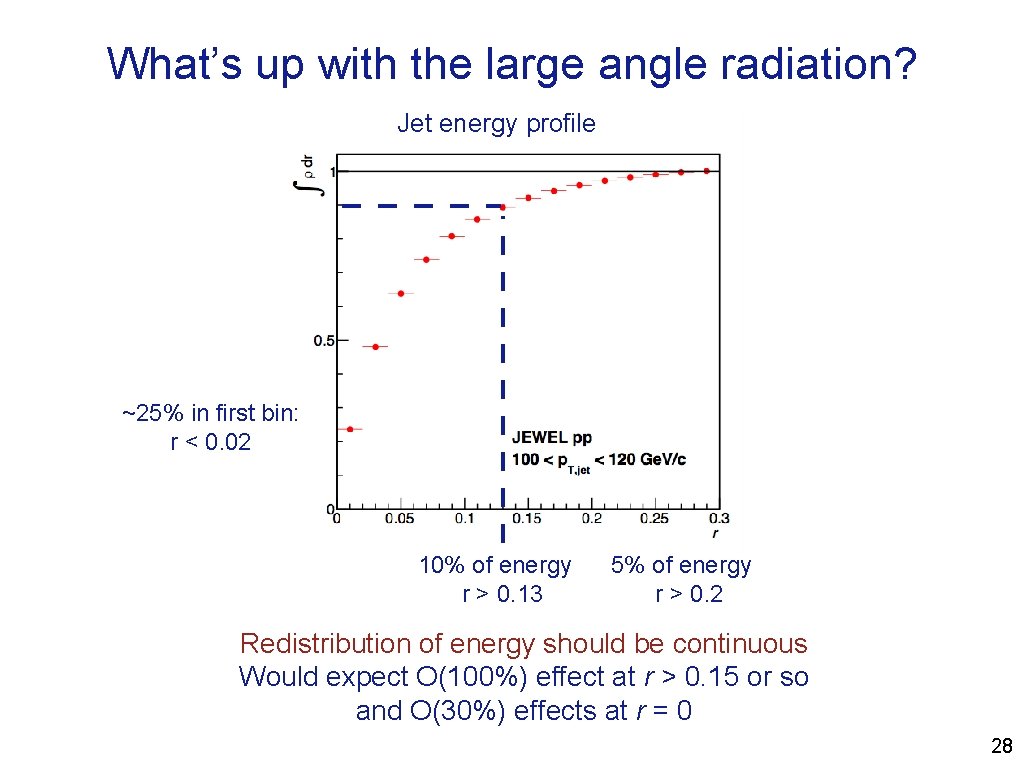
What’s up with the large angle radiation? Jet energy profile ~25% in first bin: r < 0. 02 10% of energy r > 0. 13 5% of energy r > 0. 2 Redistribution of energy should be continuous Would expect O(100%) effect at r > 0. 15 or so and O(30%) effects at r = 0 28
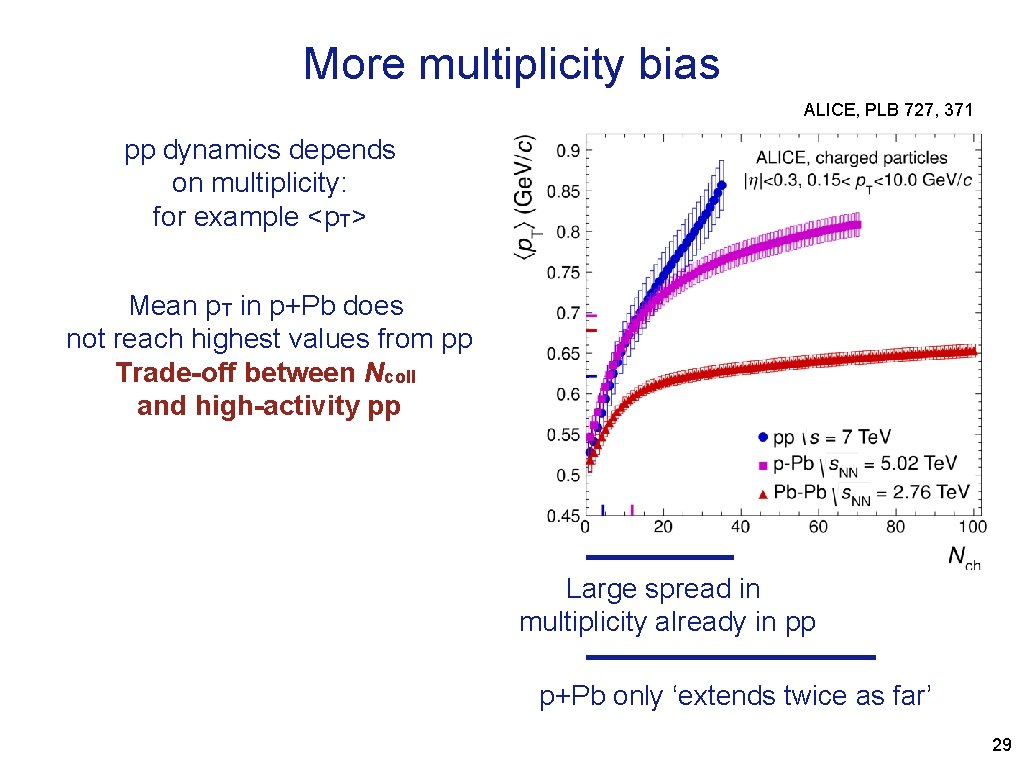
More multiplicity bias ALICE, PLB 727, 371 pp dynamics depends on multiplicity: for example <p. T> Mean p. T in p+Pb does not reach highest values from pp Trade-off between Ncoll and high-activity pp Large spread in multiplicity already in pp p+Pb only ‘extends twice as far’ 29
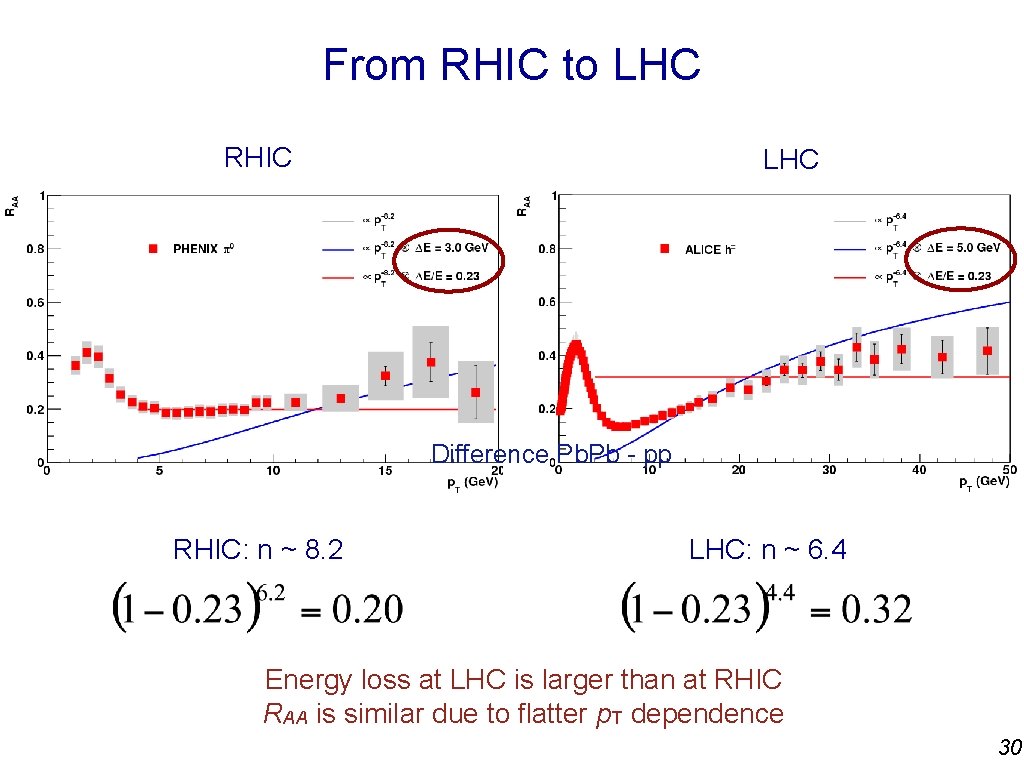
From RHIC to LHC RHIC LHC Difference Pb. Pb - pp RHIC: n ~ 8. 2 LHC: n ~ 6. 4 Energy loss at LHC is larger than at RHIC RAA is similar due to flatter p. T dependence 30
So, are we done? Not quite: discussed only one (type of) measurement so far; does not constrain theory/models Want to verify our understanding: • Color charge dependence of energy loss • • Path length dependence of energy loss • • • e. g. heavy flavour Expect L 2 for weak coupling, interference Different at strong coupling Azimuthal dependence, recoil measurements Distribution of radiation/energy loss • • • Radiative vs elastic loss Interference effects Dead cone effect Jets 31
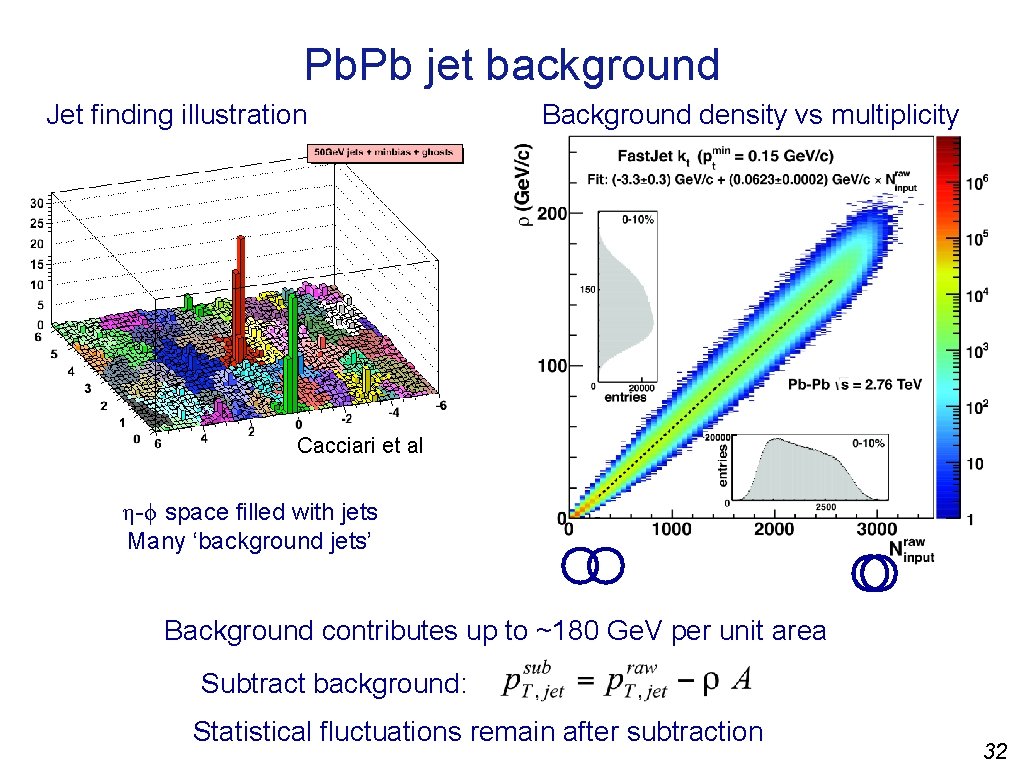
Pb. Pb jet background Jet finding illustration Background density vs multiplicity Cacciari et al η-ϕ space filled with jets Many ‘background jets’ Background contributes up to ~180 Ge. V per unit area Subtract background: Statistical fluctuations remain after subtraction 32
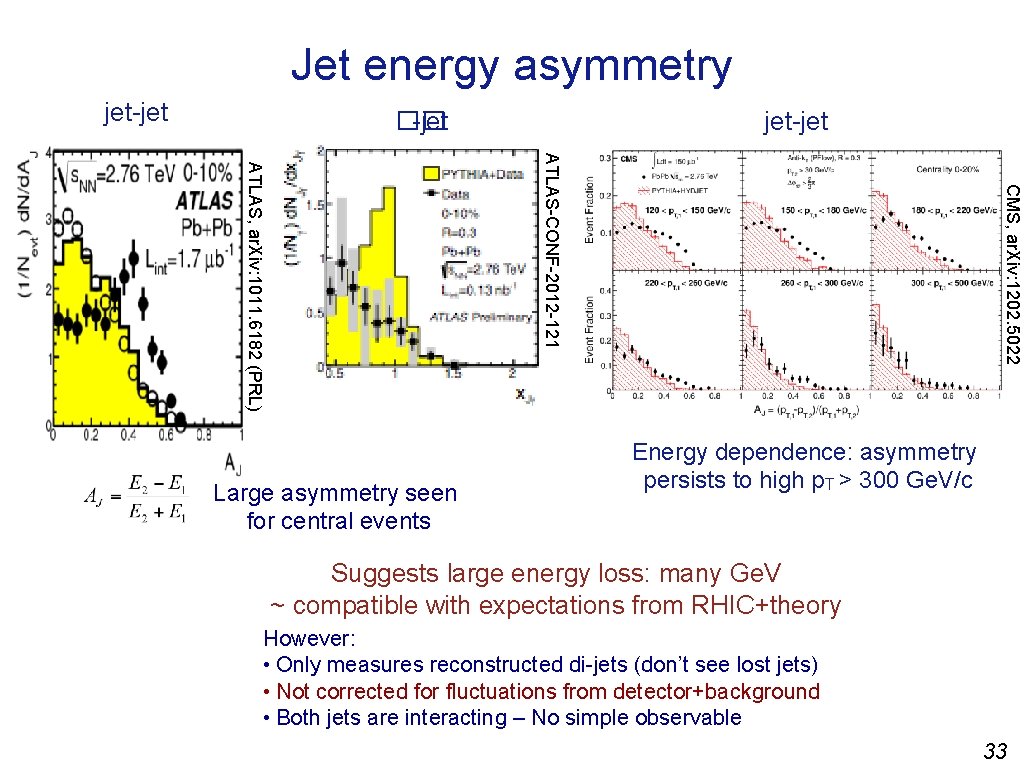
Jet energy asymmetry jet-jet �� -jet jet-jet CMS, ar. Xiv: 1202. 5022 ATLAS-CONF-2012 -121 ATLAS, ar. Xiv: 1011. 6182 (PRL) Large asymmetry seen for central events Energy dependence: asymmetry persists to high p. T > 300 Ge. V/c Suggests large energy loss: many Ge. V ~ compatible with expectations from RHIC+theory However: • Only measures reconstructed di-jets (don’t see lost jets) • Not corrected for fluctuations from detector+background • Both jets are interacting – No simple observable 33
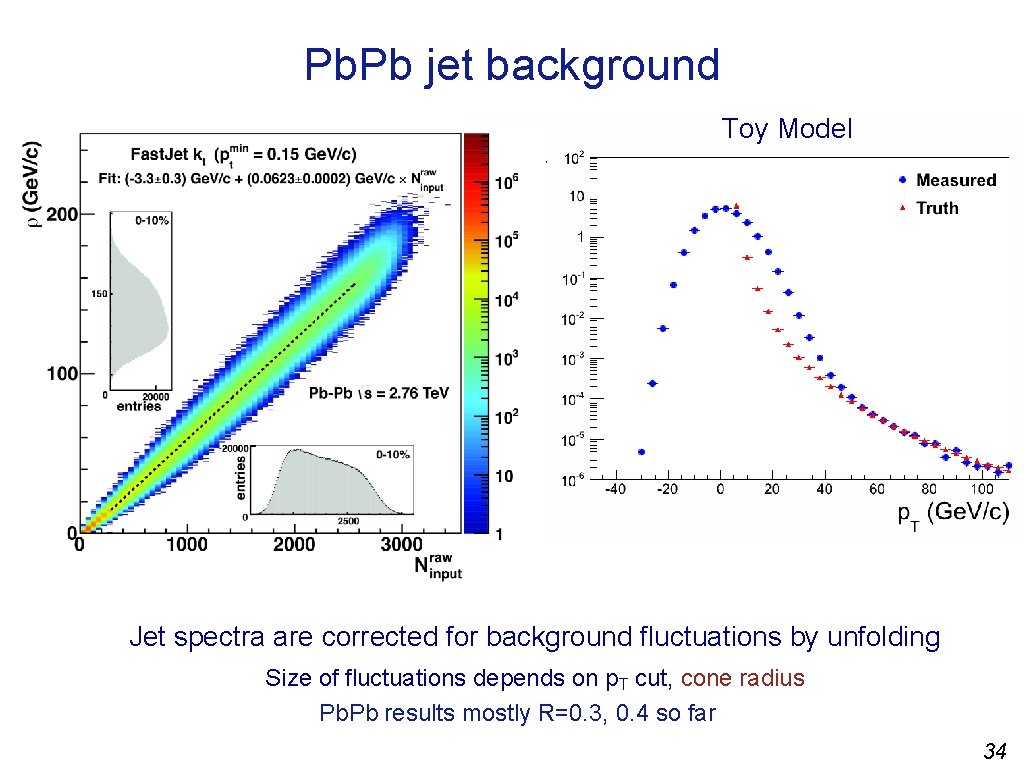
Pb. Pb jet background Toy Model Jet spectra are corrected for background fluctuations by unfolding Size of fluctuations depends on p. T cut, cone radius Pb. Pb results mostly R=0. 3, 0. 4 so far 34
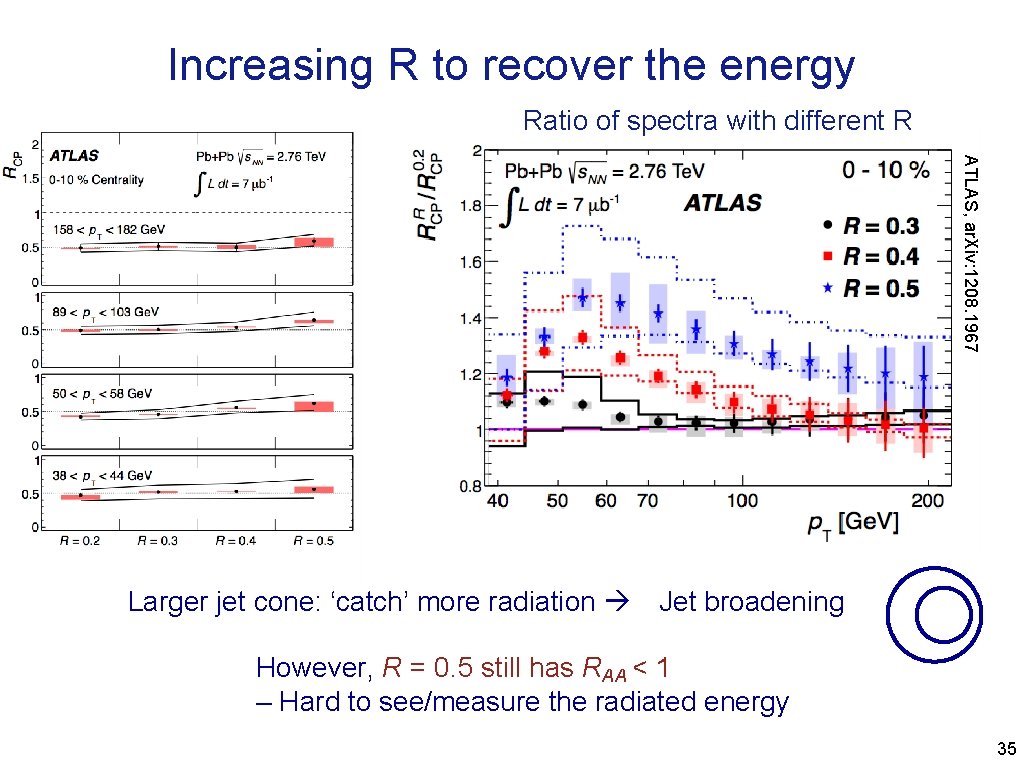
Increasing R to recover the energy Ratio of spectra with different R ATLAS, ar. Xiv: 1208. 1967 ATLAS, ar. Xiv: 1208. 1867 Larger jet cone: ‘catch’ more radiation Jet broadening However, R = 0. 5 still has RAA < 1 – Hard to see/measure the radiated energy 35
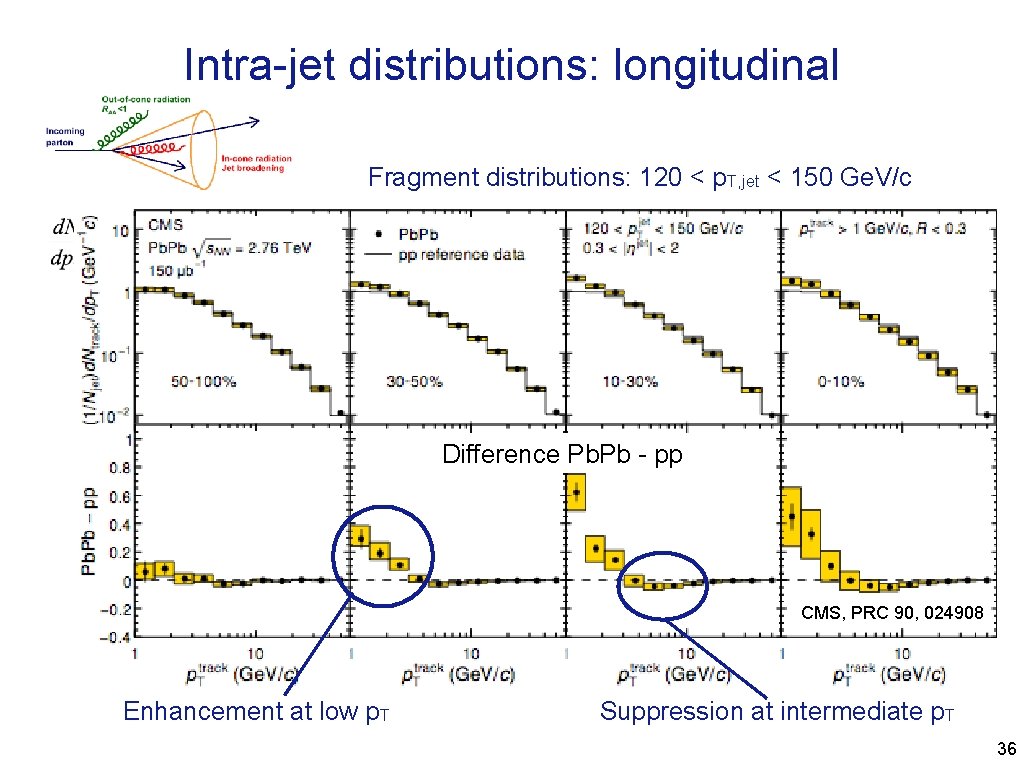
Intra-jet distributions: longitudinal Fragment distributions: 120 < p. T, jet < 150 Ge. V/c Difference Pb. Pb - pp CMS, PRC 90, 024908 Enhancement at low p. T Suppression at intermediate p. T 36
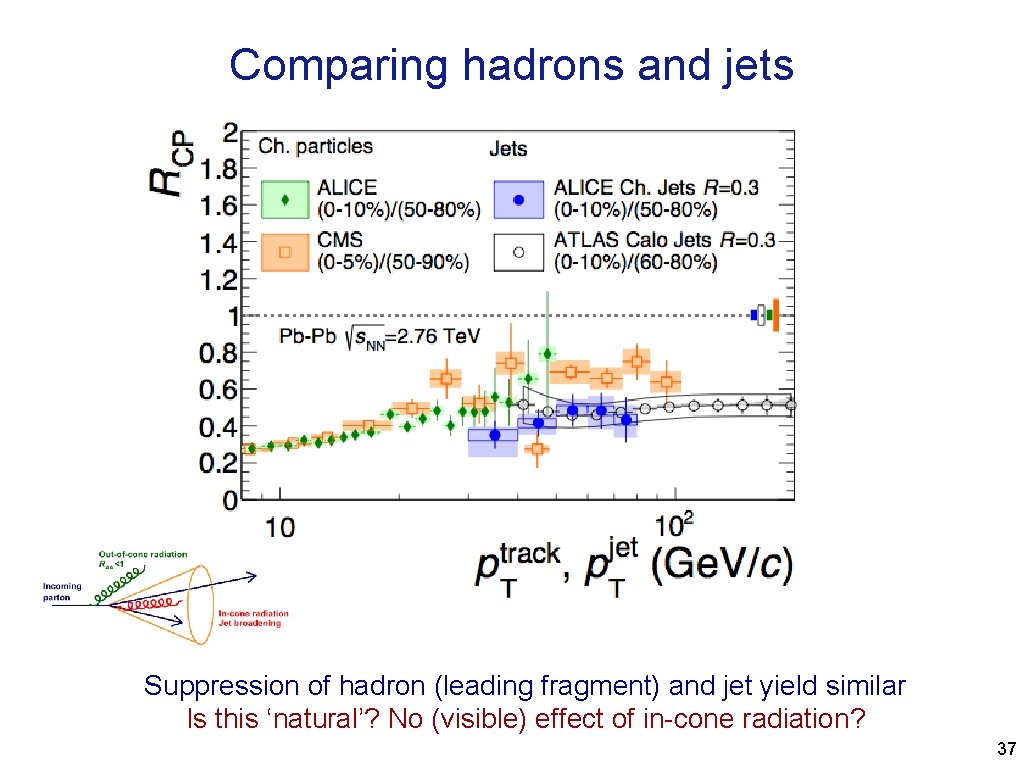
Comparing hadrons and jets Suppression of hadron (leading fragment) and jet yield similar Is this ‘natural’? No (visible) effect of in-cone radiation? 37
- Slides: 37