
OUTLINE Background Literature Why volatility is an inappropriate
OUTLINE Background Literature Why volatility is an inappropriate risk measure for real estate Appropriateness of volatility Underlying assumptions Presentation by Moritz Müller and Carsten Lausberg Empirical study Conclusion prepared for the 17 th Annual Conference of the European Real Estate Society, June 23 -26, 2010 in Milan/Italy © Carsten Lausberg 2008, p. 1
Motivation and approach for this study Background Motivation: - General motivation is to improve the current real estate risk measures Literature Appropriateness of volatility - This paper should contribute to this objective by assessing whether volatility is an appropriate measure for real estate risk Approach: Underlying assumptions - Overview of existent literature that deals with volatility as a real estate risk measure Empirical study - Assessment of the general appropriateness of volatility as a risk measure Conclusion - Empirical analysis of German real estate return distributions - Review whether volatility’s assumptions do apply in the real estate context - Comment about possible alternatives as real estate risk measures © Müller/Lausberg 2010, p. 2
History of volatility as a real estate risk measure Background Pioneering works: - Literature Appropriateness of volatility Underlying assumptions - Questioning of the normality assumption - Empirical study Conclusion - Application of downside risk measures - Forward looking approach - Friedmann (1971) Phyrr (1973) Webb/Rubens (1987) Firstenberg/Ross/Zisler (1988) Geltner (1989) Myer/Webb (1992/1994) Young/Graff (1995) Maurer/Rainer/Sebastian (2004) Young/Lee/Devaney (2006) Sivitanides (1998) Sing/Ong (2000) Hamelink/Hoesli (2004) Wheaton et al. (1999/2001 a/2001 b/ 2002) © Müller/Lausberg 2010, p. 3
Appropriateness of volatility as a risk measure Background Literature Appropriateness of volatility Underlying assumptions Empirical study Various sets of axioms exist to assess the general appropriateness of risk measures The most important set of axioms was defined by Artzner et al. (1997/1999) Definition of four axioms that a risk measure has to satisfy in order to be considered appropriate: - Subadditivity - Positive homogeneity - Translation invariance - Monotonicity Conclusion Volatility does not satisfy the axiom of monotonicity and therefore cannot be considered an appropriate risk measure © Müller/Lausberg 2010, p. 4
Underlying assumptions of volatility Background The use of historical volatility as a risk measure is generally based on several assumptions Literature The most important assumptions are: Appropriateness of volatility Underlying assumptions 1. 2. 3. 4. Normally distributed returns Significant data base Market efficiency and random-walk Definition of risk as the variation of returns Empirical study Conclusion Do these assumptions apply in a real estate context? © Müller/Lausberg 2010, p. 5
1. Normally distributed returns Background Normal distribution of real estate returns was not questioned until the early 1990 s Literature Based on empirical studies, various authors found evidence that real estate returns are likely to be not normally distributed, for example: Appropriateness of volatility - Underlying assumptions - Myer/Webb (1992/1994) King/Young (1994) Byrne/Lee (1997) Brown/Matysiak (2000) - Lizieri/Ward (2001) Maurer/Rainer/Sebastian (2004) - Young/Lee/Devaney (2006) Empirical study Normality has to be rejected for individual property returns and for most market indices Conclusion Only when longer holding period data is analyzed, it seems more likely for the returns to follow a normal distribution It is precarious to assume normality for real estate return distributions and to use volatility as a real estate risk measure © Müller/Lausberg 2010, p. 6
2. Significant data base Background Historical real estate return data has to be sufficient regarding quantity and quality Literature It is frequently argued that historical real estate return series do not cover a whole real estate cycle Appropriateness of volatility Smoothing occurs when appraisal-based data is used which leads historical volatility to understate the actual real estate risk Underlying assumptions No existing model to desmooth appraisal-based data is perfect Empirical study Liquidity risk is not captured when the volatility is calculated based on historical returns Conclusion Available data is another major problem when historical volatility is used as a risk measure © Müller/Lausberg 2010, p. 7
3. Market efficiency and random-walk Background Literature Using historical volatility as a proxy for real estate risk is based on the assumption that real estate markets are efficient and returns are not predictable Various studies reveal that real estate returns are partly predictable Appropriateness of volatility Due to autocorrelation of historical real estate returns, an increasing number of academics questions the random-walk hypothesis Underlying assumptions Real estate markets are–at best–weak form efficient since sufficient real estate data is rarely available and transactions occur infrequently on local markets Empirical study Conclusion It is questionable to use historical volatility as a risk measure since the random-walk hypothesis is unlikely to apply for real estate returns © Müller/Lausberg 2010, p. 8
4. Definition of risk as the variation of returns Background The definition of risk as a positive and negative deviation of an expected return is increasingly questioned Literature Investors are more concerned with the chance to sustain a loss rather than with the chance to realize excess profit of the same amount Appropriateness of volatility Due to psychological effects and explainable by the diminishing marginal utility Underlying assumptions Empirical study Conclusion Employing volatility as a risk measure that captures upside as well as downside potential is not in line with most investors’ intuition © Müller/Lausberg 2010, p. 9
Analysis of German RE return distributions Background Analysis–on property, portfolio, and index level–whether German real estate returns are normally distributed Literature Data: Appropriateness of volatility Underlying assumptions Empirical study - - Analyses: - Conclusion Individual property returns provided by two major German real estate portfolio managers (223 properties, well-diversified over sections and regions, total market value € 4. 7 bn. ) Market data provided by Bulwien. Gesa and IPD - Time-series analysis of individual properties returns Cross-sectional analysis of individual properties returns Analysis of German real estate market returns Approach - Estimation of skewness and kurtosis figures Calculation of Jarque-Bera (JB) statistics and further normality tests © Müller/Lausberg 2010, p. 10
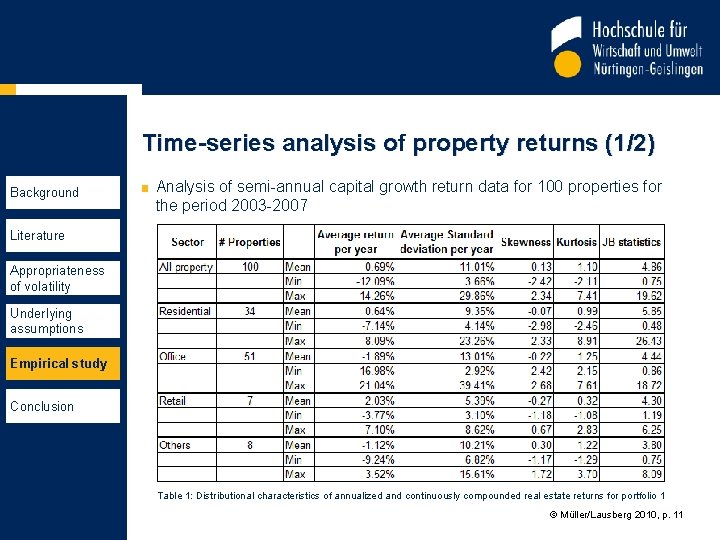
Time-series analysis of property returns (1/2) Background Analysis of semi-annual capital growth return data for 100 properties for the period 2003 -2007 Literature Appropriateness of volatility Underlying assumptions Empirical study Conclusion Table 1: Distributional characteristics of annualized and continuously compounded real estate returns for portfolio 1 © Müller/Lausberg 2010, p. 11
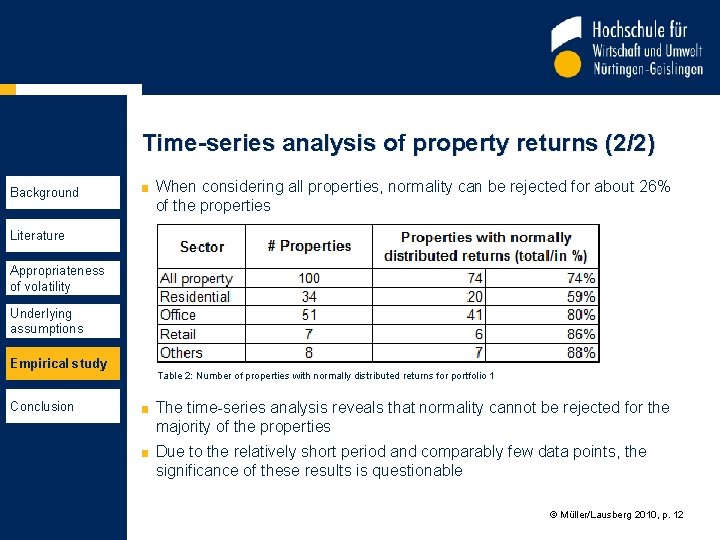
Time-series analysis of property returns (2/2) Background When considering all properties, normality can be rejected for about 26% of the properties Literature Appropriateness of volatility Underlying assumptions Empirical study Conclusion Table 2: Number of properties with normally distributed returns for portfolio 1 The time-series analysis reveals that normality cannot be rejected for the majority of the properties Due to the relatively short period and comparably few data points, the significance of these results is questionable © Müller/Lausberg 2010, p. 12
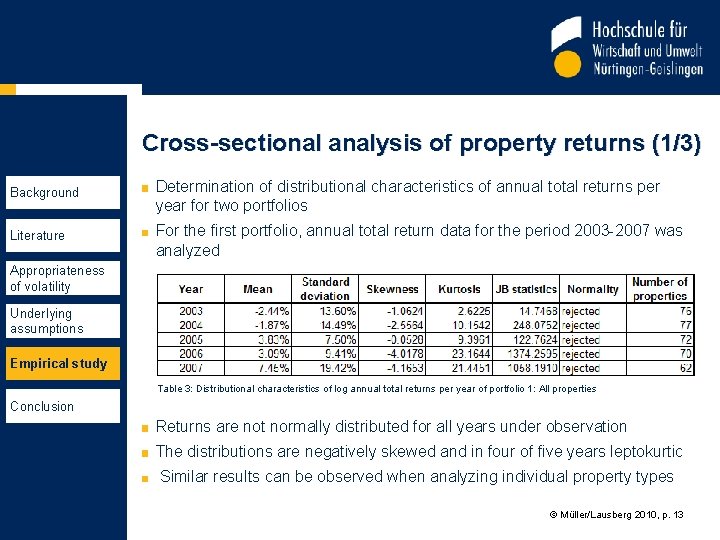
Cross-sectional analysis of property returns (1/3) Background Determination of distributional characteristics of annual total returns per year for two portfolios Literature For the first portfolio, annual total return data for the period 2003 -2007 was analyzed Appropriateness of volatility Underlying assumptions Empirical study Table 3: Distributional characteristics of log annual total returns per year of portfolio 1: All properties Conclusion Returns are not normally distributed for all years under observation The distributions are negatively skewed and in four of five years leptokurtic Similar results can be observed when analyzing individual property types © Müller/Lausberg 2010, p. 13
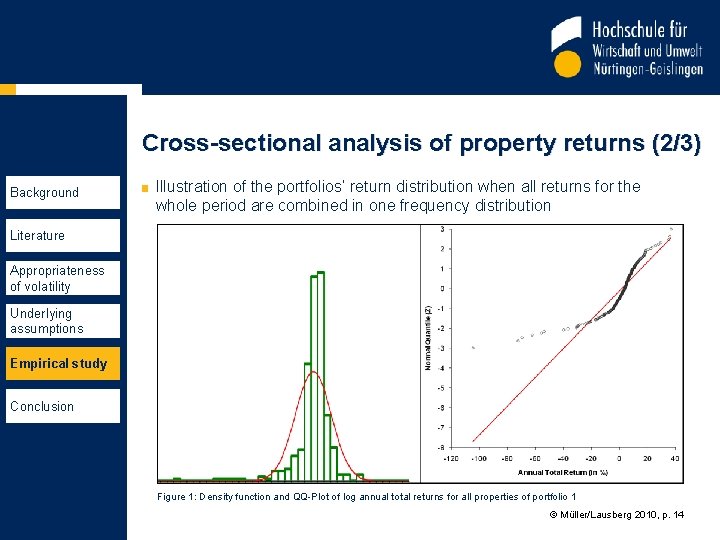
Cross-sectional analysis of property returns (2/3) Background Illustration of the portfolios’ return distribution when all returns for the whole period are combined in one frequency distribution Literature Appropriateness of volatility Underlying assumptions Empirical study Conclusion Figure 1: Density function and QQ-Plot of log annual total returns for all properties of portfolio 1 © Müller/Lausberg 2010, p. 14
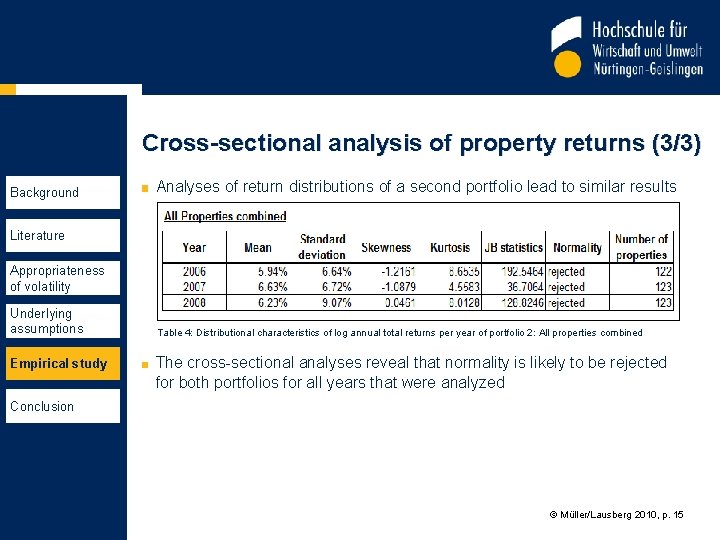
Cross-sectional analysis of property returns (3/3) Background Analyses of return distributions of a second portfolio lead to similar results Literature Appropriateness of volatility Underlying assumptions Empirical study Table 4: Distributional characteristics of log annual total returns per year of portfolio 2: All properties combined The cross-sectional analyses reveal that normality is likely to be rejected for both portfolios for all years that were analyzed Conclusion © Müller/Lausberg 2010, p. 15
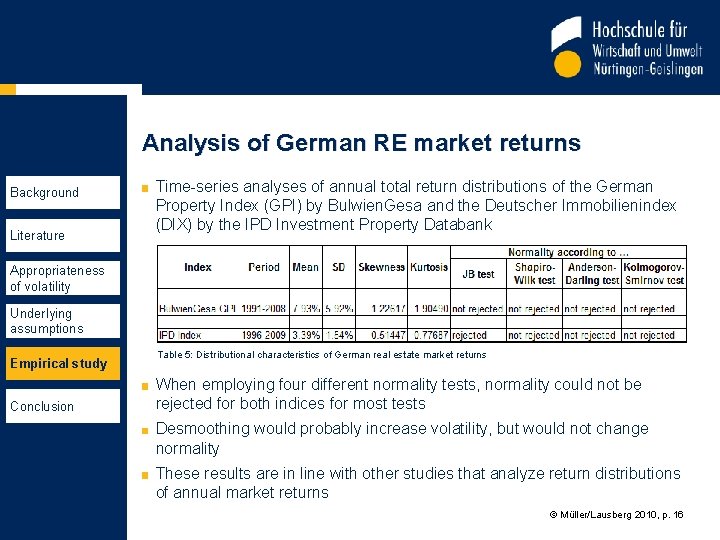
Analysis of German RE market returns Background Literature Time-series analyses of annual total return distributions of the German Property Index (GPI) by Bulwien. Gesa and the Deutscher Immobilienindex (DIX) by the IPD Investment Property Databank Appropriateness of volatility Underlying assumptions Empirical study Conclusion Table 5: Distributional characteristics of German real estate market returns When employing four different normality tests, normality could not be rejected for both indices for most tests Desmoothing would probably increase volatility, but would not change normality These results are in line with other studies that analyze return distributions of annual market returns © Müller/Lausberg 2010, p. 16
Results and limitations of our study Background Results - Annual property returns: normal Literature Appropriateness of volatility - Property returns using cross-sectional analysis: non-normal - Annual market returns: normal Underlying assumptions Limitations Empirical study - Only annual total returns Conclusion - Normality is more likely to be rejected when shorter holding periods for a longer overall given period are analyzed - Few data points - Further research is necessary to analyze German real estate return distributions © Müller/Lausberg 2010, p. 17
Conclusion Background Volatility is not an appropriate risk measure for real estate, at least not for individual properties Literature Alternatives: Appropriateness of volatility Underlying assumptions Empirical study Conclusion - A set of different risk and return measures - Downside risk measures, e. g. , value at risk, LPM, max. drawdown - Qualitative risk measures, e. g. , scores and rating grades, …ideally combined with quantitative measures State of the art: Real estate lending ratings that meet the criteria of the advanced approach of the Basel Accord. Example: - Quantitative: probability estimation derived from a Monte Carlo simulation of future cash flows - Quantitative: subjective opinion on the location quality of a property Our research shows that real estate industry does not meet this standard A lot of work ahead! © Müller/Lausberg 2010, p. 18

Many Thanks to… Background Bulwien. Gesa AG IPD Investment Property Databank Gmb. H Literature Appropriateness of volatility Underlying assumptions Empirical study Conclusion Kathrin Fuhrmann, Nürtingen-Geislingen University, Geislingen Patrick Krieger, Nürtingen-Geislingen University, Geislingen Two anonymus real estate asset management companies Questions or Comments?

Contact: Nuertingen-Geislingen University Real Estate Program Parkstr. 4 73312 Geislingen, Germany Moritz Müller moritz. mueller@ondos. de Dr. Carsten Lausberg, M. S. Professor of Real Estate Banking carsten. lausberg@hfwu. de

References (1/2) Background Literature Appropriateness of volatility Underlying assumptions Empirical study Outlook Conclusion Artzner et al. (1997): Artzner, Philippe et al. , Thinking Coherently, in: Risk Magazine, Vol. 10, No. 11, 1997, pp. 68– 71. Artzner et al. (1999): Artzner, Philippe et al. , Coherent Measures of Risk, in: Mathematical Finance, Vol. 9, No. 3, 1999, pp. 203 -228. Brown/Matysiak (2000): Brown, Gerald R. , Matysiak, George A. , Real Estate Investment - A Capital Market Approach, Harlow (UK) u. a. : Financial Times Prentice Hall, 2000. Byrne/Lee (1997): Byrne, Peter, Lee, Stephen L. , Real Estate Portfolio Analysis under Conditions of Non. Normality - The Case of NCREIF, in: Journal of Real Estate Portfolio Management, Vol. 3, No. 1, 1997, pp. 3746. Firstenberg/Ross/Zisler (1988): Firstenberg, Paul M. , Ross, Stephen A. , Zisler, Randall C. , Real estate: The whole story, in: Journal of Portfolio Management, Vol. 14, No. 3, 1988, pp. 22 -34. Friedman (1971): Friedman, Harris C. , Real Estate Investment and Portfolio Theory, in: Journal of Financial and Quantitative Analysis, Vol. 6, No. 2, 1971, pp. 861874. Geltner (1989): Geltner, David, Estimating Real Estate's Systematic Risk from Aggregate Level Appraisal-Based Returns, in: Real Estate Economics, Vol. 17, No. 4, 1989, pp. 463 -481. Gleißner (2006): Gleißner, Werner, Risikomaße, Safety. First-Ansätze und Portfoliooptimierung, in: Risiko Manager, No. 13, 2006, pp. 17 -23. Hamelink/Hoesli (2004): Hamelink, Foort; Hoesli, Martin, Maximum Drawdown and the Allocation to Real Estate, in: Journal of Property Research, Vol. 21, No. 1, 2004, pp. 529. Jarque/Bera (1987): Jarque, Carlos M. , Bera, Anil K. , A test for normality of observations and regression residuals, in: International Statistical Review, Vol. 55, No. 2, 1987, pp. 163 -172. King/Young (1994): King, Donald A. Jr. , Young, Michael S. , Why Diversification Doesn’t Work – Flaws in Modern Portfolio Theory turn Real Estate Portfolio Managers back to old-fashioned Underwriting, in: Real Estate Review, Vol. 24, No. 2, 1994, pp. 6 -12. Lizieri/Ward (2001): Lizieri, Colin, Ward, Charles, The Distribution of Commercial Real Estate Returns, in: Knight/Satchell (2001), pp. 47 -74. Maurer/Rainer/Sebastian (2004): Maurer, Raimond, Reiner, Frank, Sebastian, Steffen, Characteristics of German Real Estate Return Distributions: Evidence from Germany and Comparison to the U. S. and U. K. , in: Journal of Real Estate Portfolio Management, Vol. 10, No. 1, 2004, pp. 59 -76. © Müller/Lausberg 2010, p. 21
References (2/2) Background Literature Appropriateness of volatility Underlying assumptions Empirical study Outlook Conclusion Myer/Webb (1992): Myer, F. C. Neil, Webb, James R. , Return Properties of Equity REITs, Common Stocks, and Commercial Real Estate: A Comparison, in: Journal of Real Estate Research, Vol. 8, No. 1, 1992, pp. 87 -106. Myer/Webb (1994): Myer, F. C. Neil, Webb, James R. , Statistical Properties of Returns: Financial Assets versus Commercial Real Estate, in: Journal of Real Estate Finance and Economics, Vol. 8, No. 3, 1994, pp. 267 -282. Phyrr (1973): Phyrr, Stephen A. , A Computer Simulation Model to measure the Risk in Real Estate Investment, in: Journal of the American Real Estate & Urban Economics Association, Vol. 1, No. 1, 1973, pp. 48 -78 Sing/Ong (2000): Sing, Tien Foo, Ong, Seow Eng, Asset Allocation in a Downside Risk Framework, in: Journal of Real Estate Portfolio Management, Vol. 6, No. 3, 2000, pp. 213 -223. Sivitanides (1998): Sivitanides, Petros S. , A Downside. Risk Approach to Real Estate Portfolio Structuring, in: Journal of Real Estate Portfolio Management, Vol. 4, No. 2, 1998, pp. 159 -168. Webb/Rubens (1987): Webb, James R. , Rubens, Jack H. , How much in real estate? A surprising answer, in: Journal of Portfolio Management, Vol. 13, No. 3, 1987, pp. 10 -14. Wheaton et al. (1999): Wheaton, William C. et al. , Evaluating Risk in Real Estate, in: Real Estate Finance, Vol. 16, No. 2, 1999, pp. 15 -22. Wheaton et al. (2001 a): Wheaton, William C. et al. , Real Estate Risk: A Forward-Looking Approach, in: Real Estate Finance, Vol. 18, No. 3, 2001, pp. 20 -28. Wheaton et al. (2001 b): Wheaton, William C. et al. , Real Estate Risk: Evaluating Real Estate Risk: Debt Applications, in: Real Estate Finance, Vol. 18, No. 3, 2001, pp. 29 -41 Wheaton et al. (2002): Wheaton, William C. et al. : Real Estate Risk: Evaluating Real Estate Risk: Equity Applications, in: Real Estate Finance, Vol. 18, No. 4, 2002, pp. 7 -17. Young/Graff (1995): Young, Michael S. ; Graff, Richard A. : Real Estate Is Not Normal: A Fresh Look at Real Estate Return Distributions, in: Journal of Real Estate Finance and Economics, Vol. 10, No. 3, 1995, pp. 225 -259. Young/Lee/Devaney (2006): Young, Michael S. ; Lee, Stephen L. ; Devaney, Steven P. : Non-Normal Real Estate Return Distributions by Property Type in the UK, in: Journal of Property Research, Vol. 23, No. 2, 2006, pp. 109 -133 © Müller/Lausberg 2010, p. 22
- Slides: 22