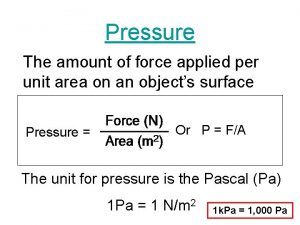
Gas Laws Pressure The force per unit area




- Slides: 36
Gas Laws
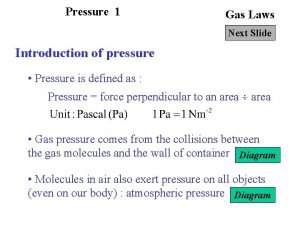
Pressure • The force per unit area on a surface • Standard Pressure = 1 atmosphere (atm. ) • Conversions: – 1 atmospheres (atm) – 760 millimeters of Mercury (mm. Hg) – 760 Torricelli's (torr) – 1. 01 x 105 Pascals (Pa) – 14. 7 pounds per square inch (psi)
Conversion Practice • Pressure 1) 350 mm. Hg = _____ psi 2) 345 Pa = ______ mm. Hg 3) 1. 2 atm = _____ torr
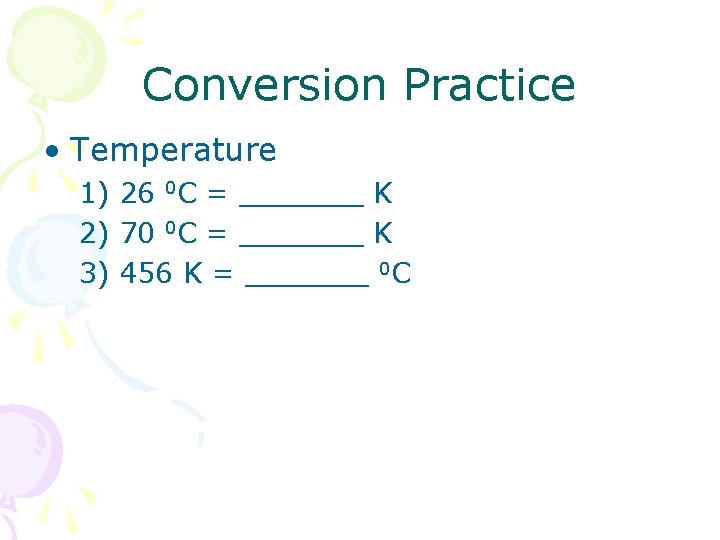
Temperature • Average kinetic energy of the particles in a sample of matter (***ALL TEMPERATURES MUST BE CONVERTED TO KELVIN***) • Standard Temp. = 0 0 C or 273 K • Conversions: o Kelvin = 0 C + 273 o Celsius = K – 273
Conversion Practice • Temperature 1) 26 0 C = _______ K 2) 70 0 C = _______ K 3) 456 K = _______ 0 C
Volume • The amount of space occupied by an object • Conversions: o 1 L = 1000 m. L
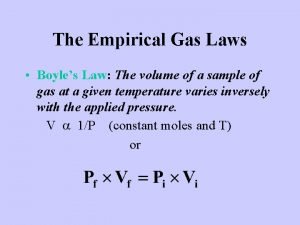
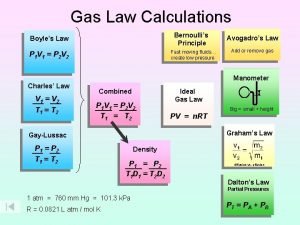
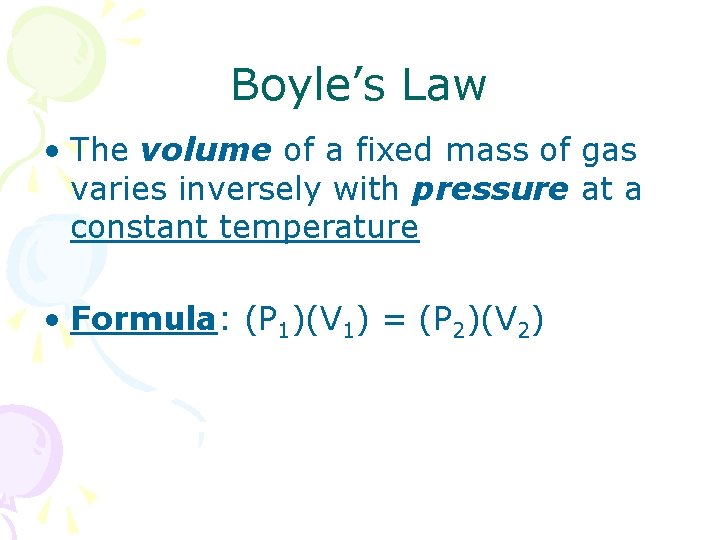
Boyle’s Law • The volume of a fixed mass of gas varies inversely with pressure at a constant temperature • Formula: (P 1)(V 1) = (P 2)(V 2)
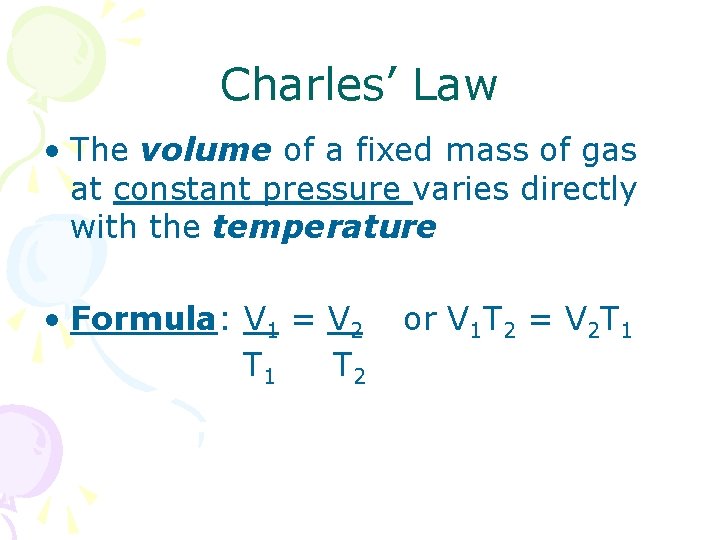
Charles’ Law • The volume of a fixed mass of gas at constant pressure varies directly with the temperature • Formula: V 1 = V 2 T 1 T 2 or V 1 T 2 = V 2 T 1
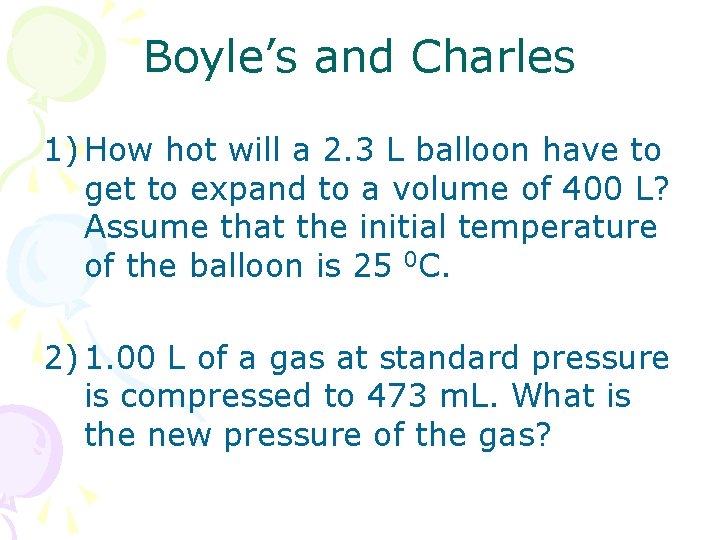
Boyle’s and Charles 1) How hot will a 2. 3 L balloon have to get to expand to a volume of 400 L? Assume that the initial temperature of the balloon is 25 0 C. 2) 1. 00 L of a gas at standard pressure is compressed to 473 m. L. What is the new pressure of the gas?
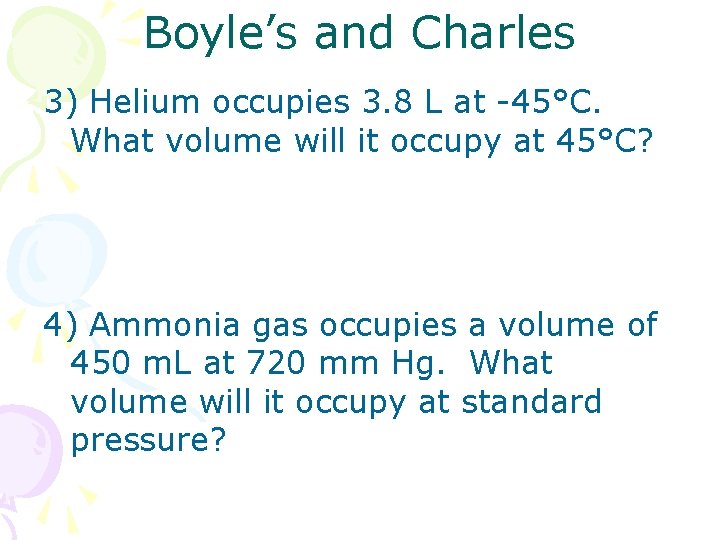
Boyle’s and Charles 3) Helium occupies 3. 8 L at 45°C. What volume will it occupy at 45°C? 4) Ammonia gas occupies a volume of 450 m. L at 720 mm Hg. What volume will it occupy at standard pressure?
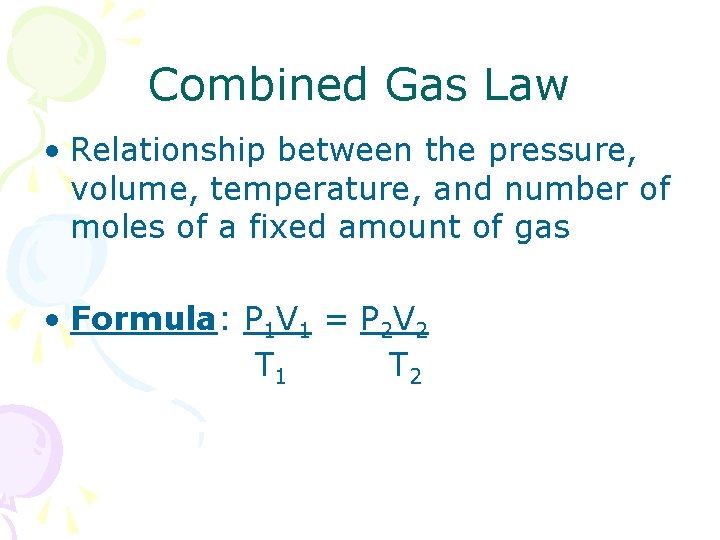
Combined Gas Law • Relationship between the pressure, volume, temperature, and number of moles of a fixed amount of gas • Formula: P 1 V 1 = P 2 V 2 T 1 T 2
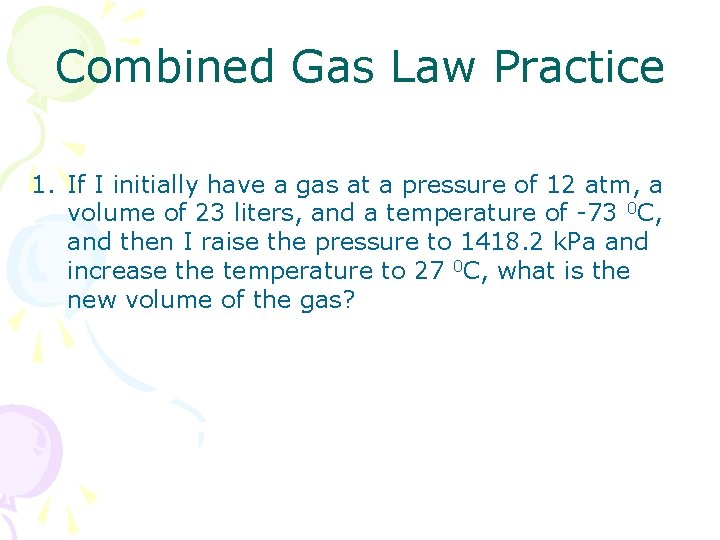
Combined Gas Law Practice 1. If I initially have a gas at a pressure of 12 atm, a volume of 23 liters, and a temperature of 73 0 C, and then I raise the pressure to 1418. 2 k. Pa and increase the temperature to 27 0 C, what is the new volume of the gas?
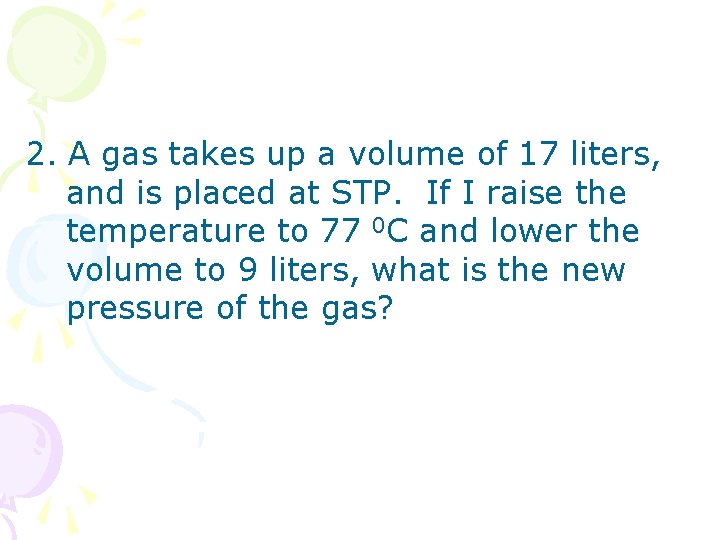
2. A gas takes up a volume of 17 liters, and is placed at STP. If I raise the temperature to 77 0 C and lower the volume to 9 liters, what is the new pressure of the gas?
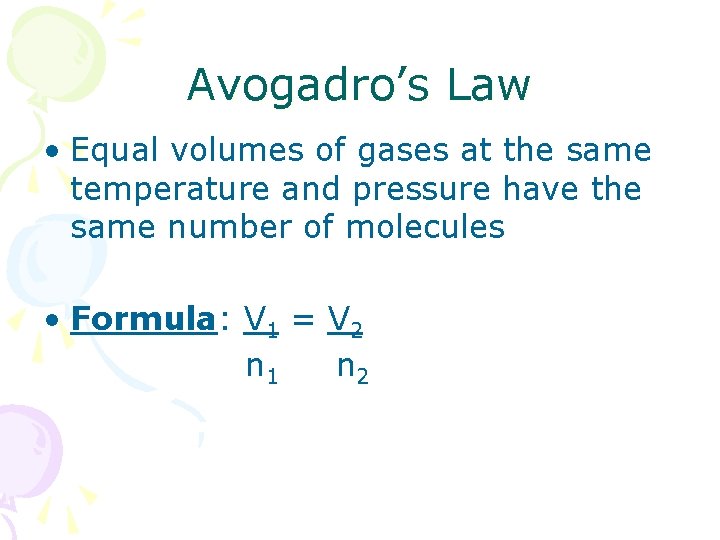
Avogadro’s Law • Equal volumes of gases at the same temperature and pressure have the same number of molecules • Formula: V 1 = V 2 n 1 n 2
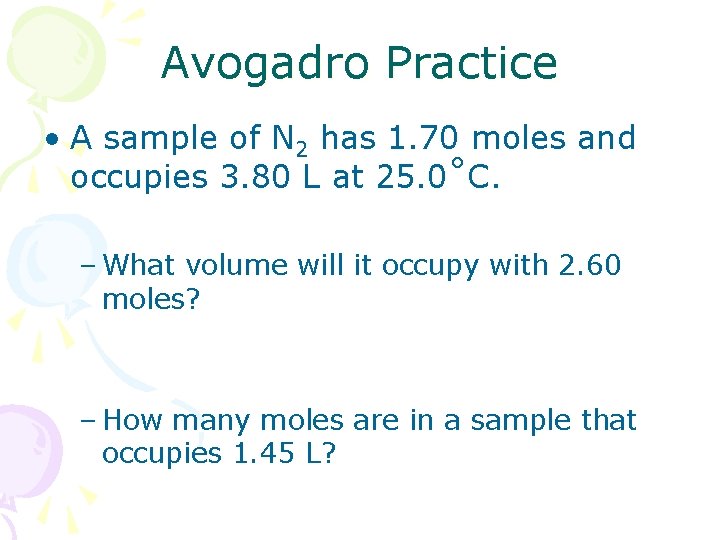
Avogadro Practice • A sample of N 2 has 1. 70 moles and occupies 3. 80 L at 25. 0˚C. – What volume will it occupy with 2. 60 moles? – How many moles are in a sample that occupies 1. 45 L?
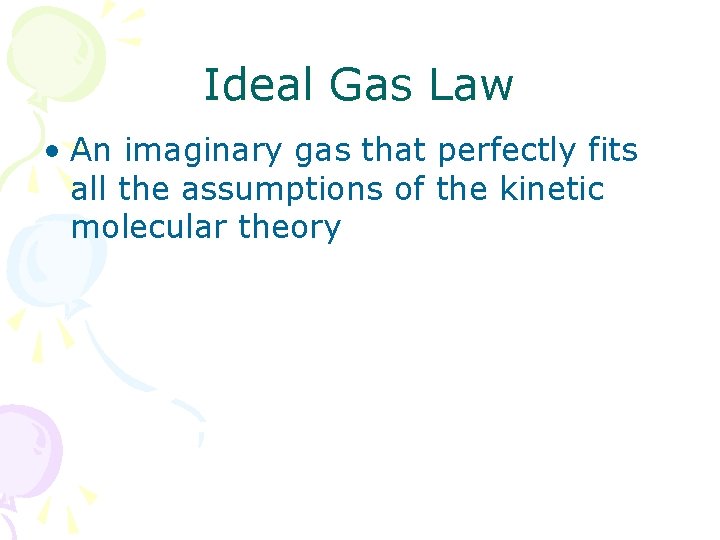
Ideal Gas Law • An imaginary gas that perfectly fits all the assumptions of the kinetic molecular theory
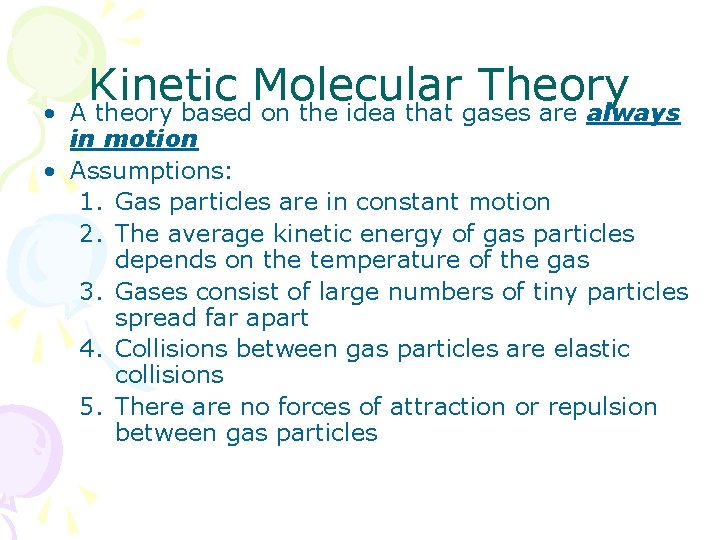
• Kinetic Molecular Theory A theory based on the idea that gases are always in motion • Assumptions: 1. Gas particles are in constant motion 2. The average kinetic energy of gas particles depends on the temperature of the gas 3. Gases consist of large numbers of tiny particles spread far apart 4. Collisions between gas particles are elastic collisions 5. There are no forces of attraction or repulsion between gas particles
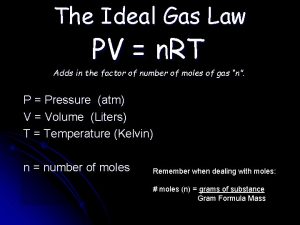
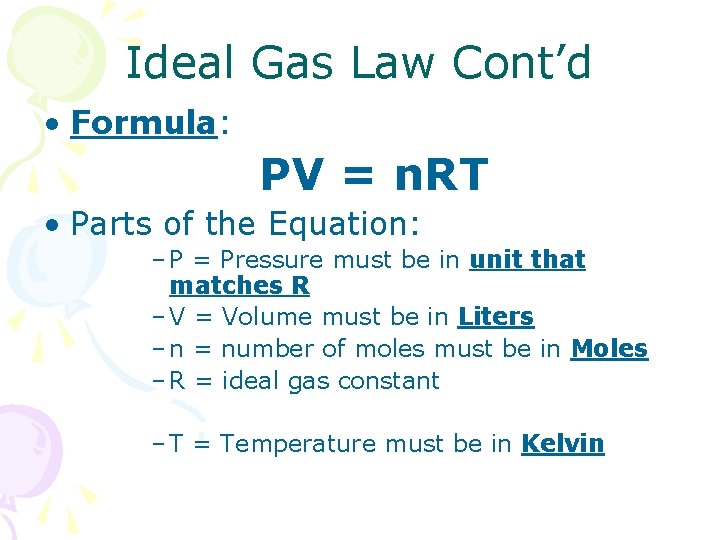
Ideal Gas Law Cont’d • Formula: PV = n. RT • Parts of the Equation: – P = Pressure must be in unit that matches R – V = Volume must be in Liters – n = number of moles must be in Moles – R = ideal gas constant – T = Temperature must be in Kelvin
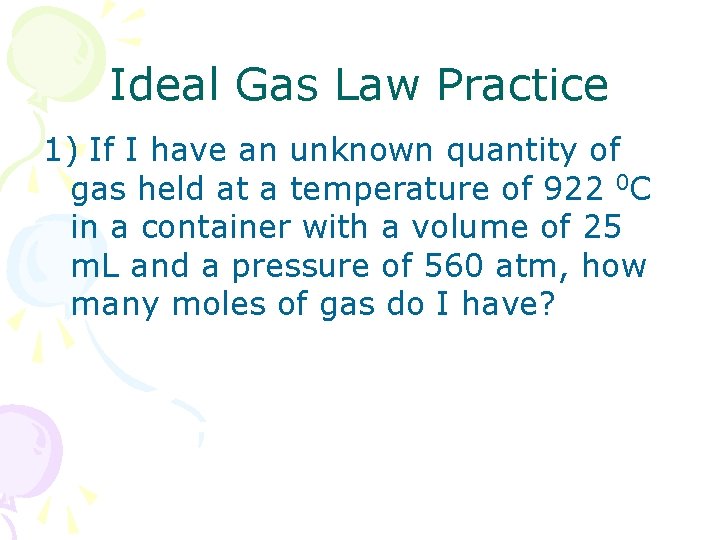
Ideal Gas Law Practice 1) If I have an unknown quantity of gas held at a temperature of 922 0 C in a container with a volume of 25 m. L and a pressure of 560 atm, how many moles of gas do I have?
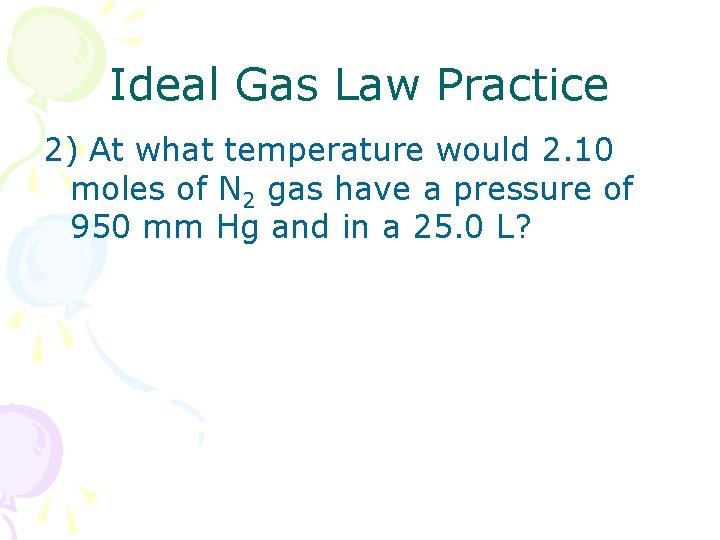
Ideal Gas Law Practice 2) At what temperature would 2. 10 moles of N 2 gas have a pressure of 950 mm Hg and in a 25. 0 L?
Starter (The faster you do this the better your day will become!!!) 1) Get out your homework and KEEP it on your desk! 2) Get out your lab notebook. 3) Have a calculator and something to write with.
(MW)PV = g. RT • If you had 14 liters of propane (C 3 H 8) under 3. 7 atmospheres of pressure, being stored at 50 degrees Celsius, how many grams of propane would you have?
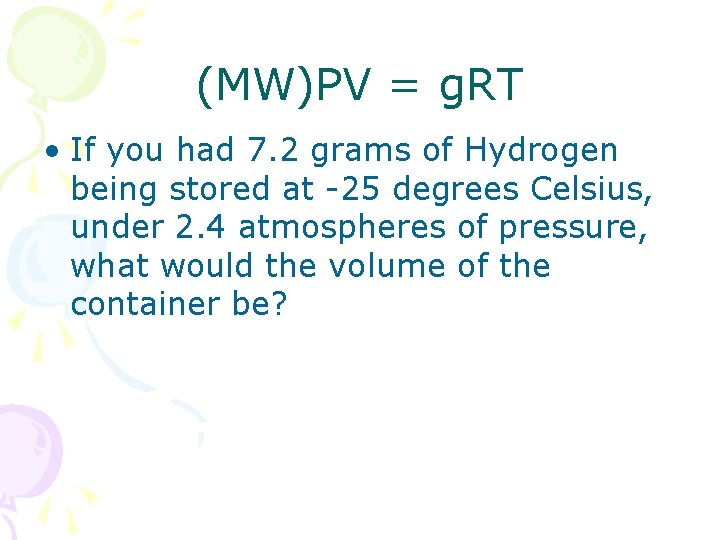
(MW)PV = g. RT • If you had 7. 2 grams of Hydrogen being stored at 25 degrees Celsius, under 2. 4 atmospheres of pressure, what would the volume of the container be?
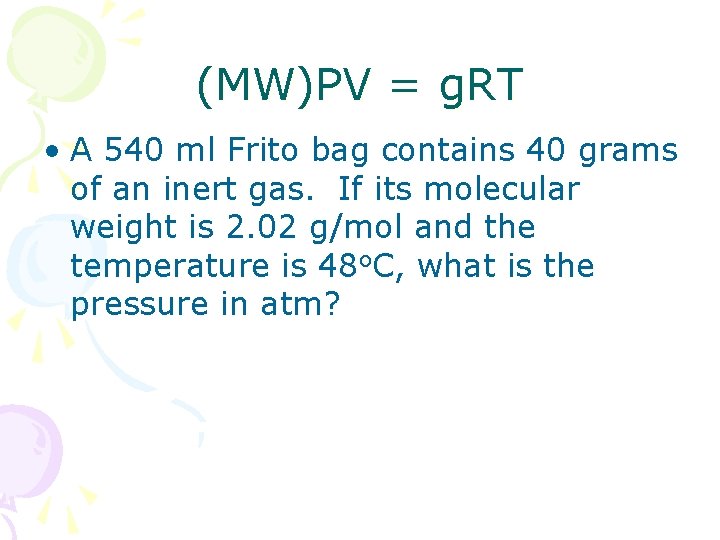
(MW)PV = g. RT • A 540 ml Frito bag contains 40 grams of an inert gas. If its molecular weight is 2. 02 g/mol and the temperature is 48 o. C, what is the pressure in atm?
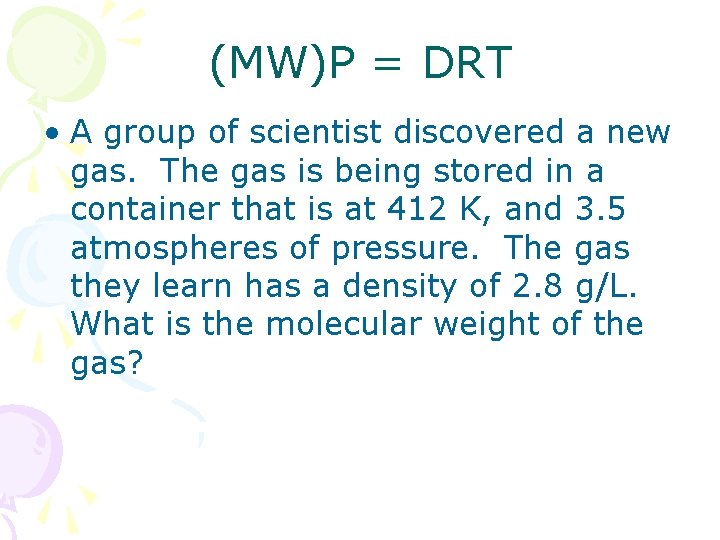
(MW)P = DRT • A group of scientist discovered a new gas. The gas is being stored in a container that is at 412 K, and 3. 5 atmospheres of pressure. The gas they learn has a density of 2. 8 g/L. What is the molecular weight of the gas?
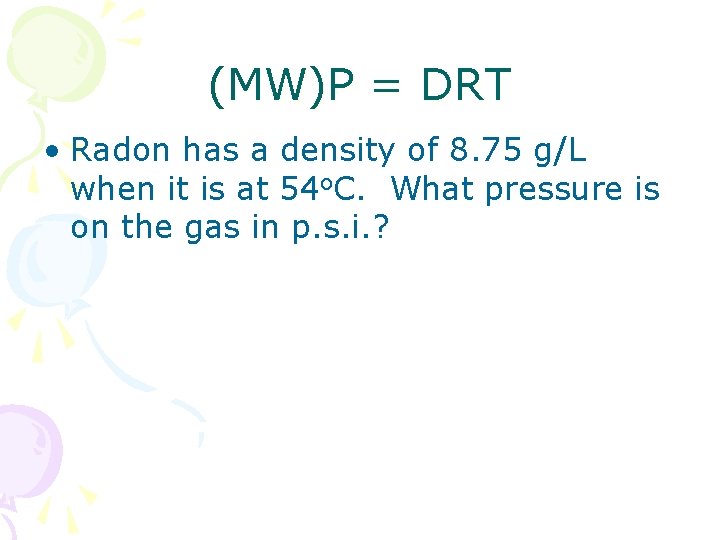
(MW)P = DRT • Radon has a density of 8. 75 g/L when it is at 54 o. C. What pressure is on the gas in p. s. i. ?
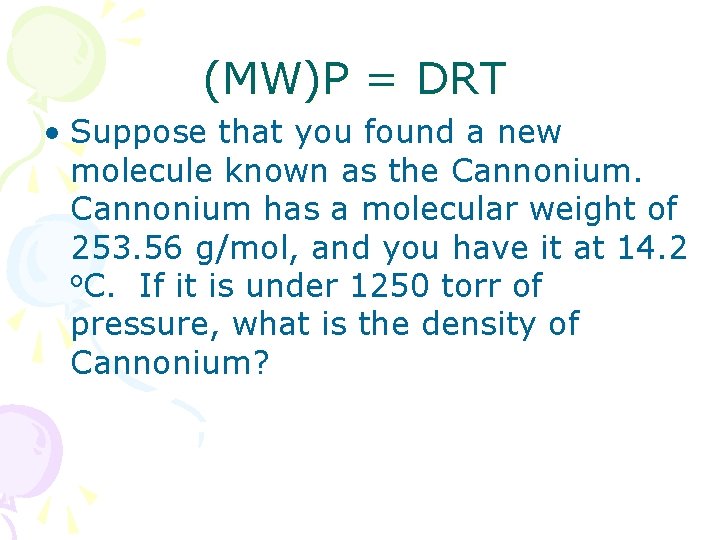
(MW)P = DRT • Suppose that you found a new molecule known as the Cannonium has a molecular weight of 253. 56 g/mol, and you have it at 14. 2 o. C. If it is under 1250 torr of pressure, what is the density of Cannonium?
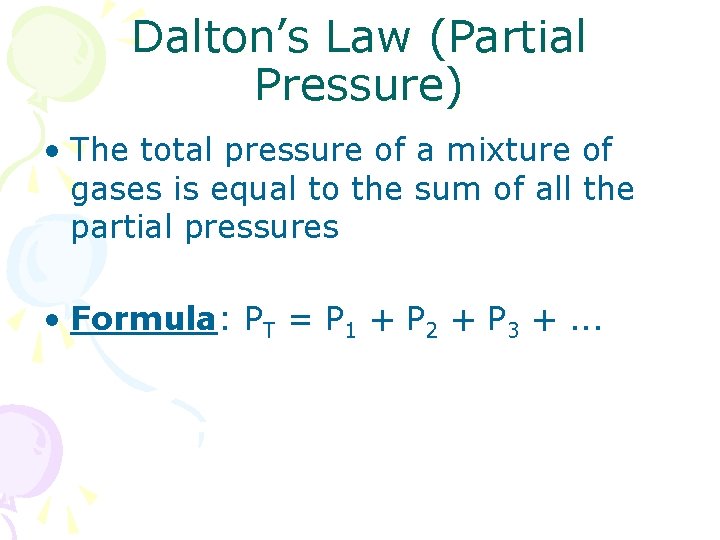
Dalton’s Law (Partial Pressure) • The total pressure of a mixture of gases is equal to the sum of all the partial pressures • Formula: PT = P 1 + P 2 + P 3 +. . .
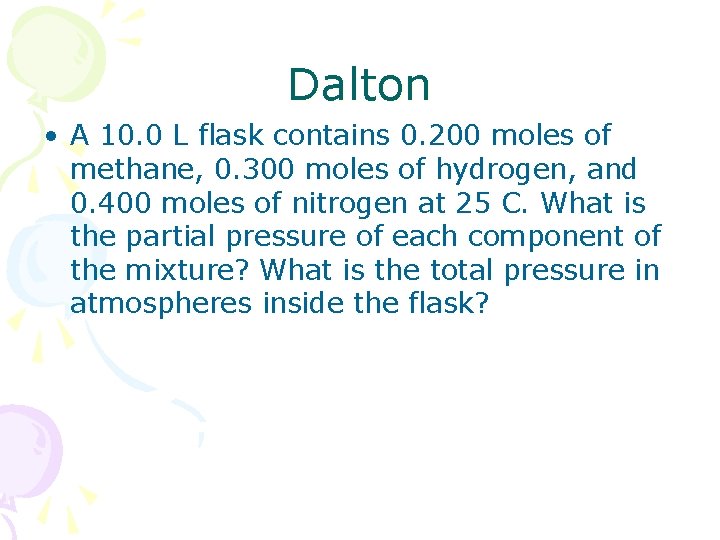
Dalton • A 10. 0 L flask contains 0. 200 moles of methane, 0. 300 moles of hydrogen, and 0. 400 moles of nitrogen at 25 C. What is the partial pressure of each component of the mixture? What is the total pressure in atmospheres inside the flask?
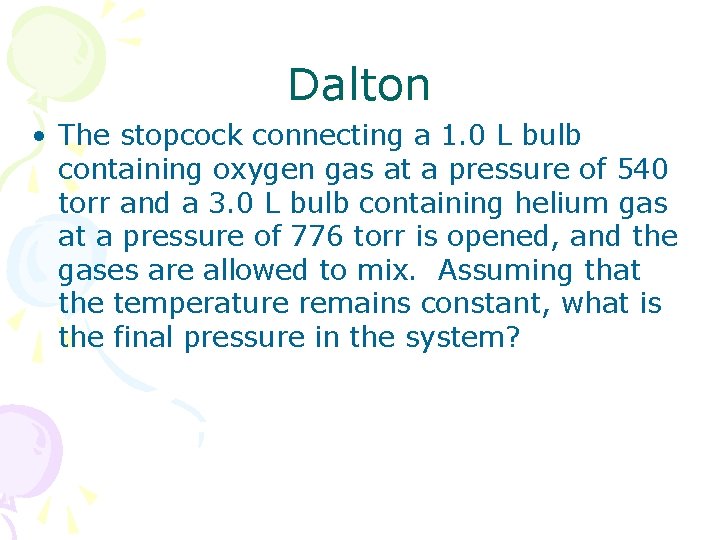
Dalton • The stopcock connecting a 1. 0 L bulb containing oxygen gas at a pressure of 540 torr and a 3. 0 L bulb containing helium gas at a pressure of 776 torr is opened, and the gases are allowed to mix. Assuming that the temperature remains constant, what is the final pressure in the system?
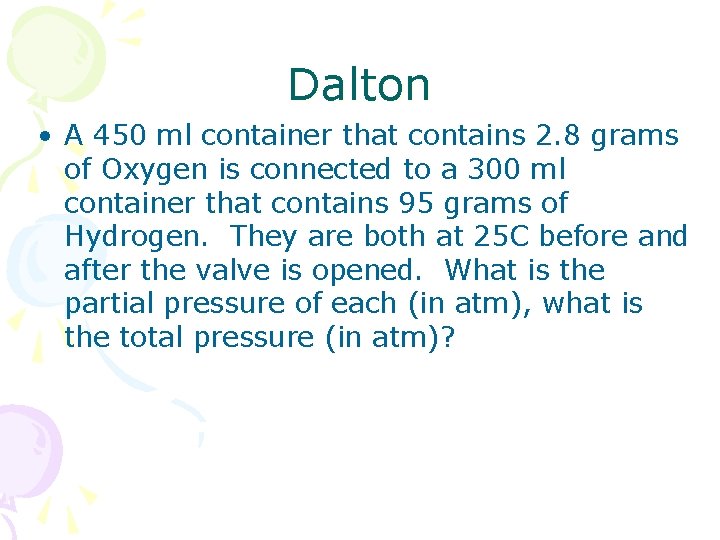
Dalton • A 450 ml container that contains 2. 8 grams of Oxygen is connected to a 300 ml container that contains 95 grams of Hydrogen. They are both at 25 C before and after the valve is opened. What is the partial pressure of each (in atm), what is the total pressure (in atm)?
GAS LAW STOICHIOMETRY
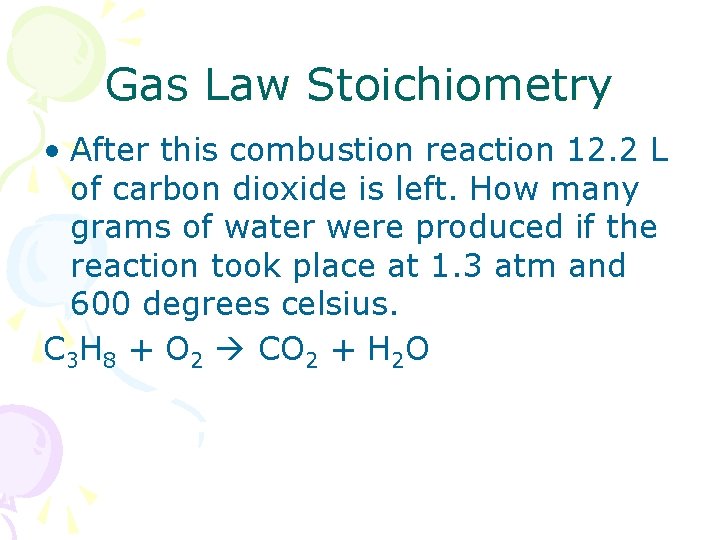
Gas Law Stoichiometry • After this combustion reaction 12. 2 L of carbon dioxide is left. How many grams of water were produced if the reaction took place at 1. 3 atm and 600 degrees celsius. C 3 H 8 + O 2 CO 2 + H 2 O
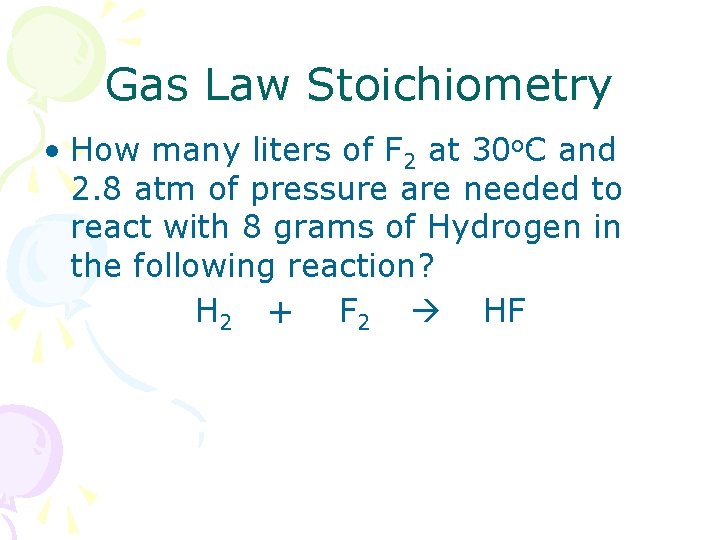
Gas Law Stoichiometry • How many liters of F 2 at 30 o C and 2. 8 atm of pressure are needed to react with 8 grams of Hydrogen in the following reaction? H 2 + F 2 HF
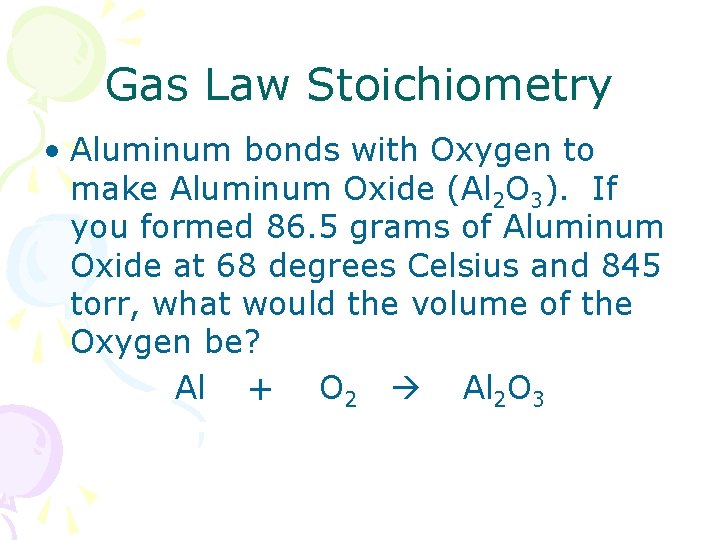
Gas Law Stoichiometry • Aluminum bonds with Oxygen to make Aluminum Oxide (Al 2 O 3). If you formed 86. 5 grams of Aluminum Oxide at 68 degrees Celsius and 845 torr, what would the volume of the Oxygen be? Al + O 2 Al 2 O 3
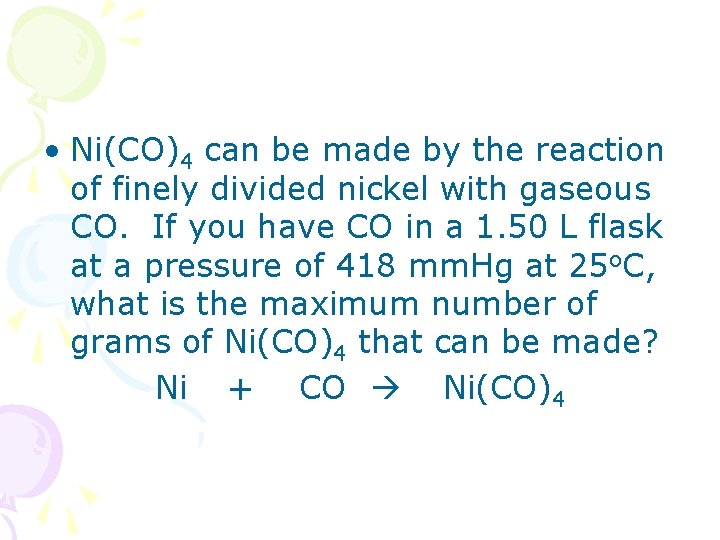
• Ni(CO)4 can be made by the reaction of finely divided nickel with gaseous CO. If you have CO in a 1. 50 L flask at a pressure of 418 mm. Hg at 25 o. C, what is the maximum number of grams of Ni(CO)4 that can be made? Ni + CO Ni(CO)4