
Gas Laws Unit Organizer 7 CURRENT UNIT LAST
- Slides: 2
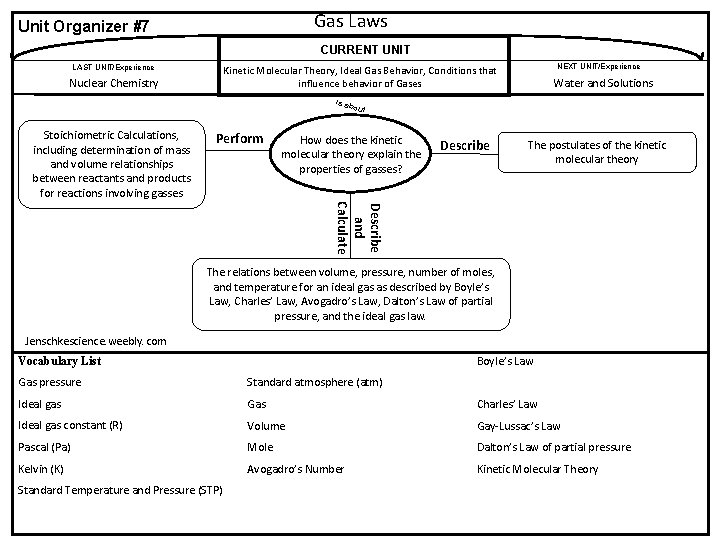
Gas Laws Unit Organizer #7 CURRENT UNIT LAST UNIT/Experience NEXT UNIT/Experience CURRENT UNIT Kinetic Molecular Theory, Ideal Gas Behavior, Conditions that influence behavior of Gases Nuclear Chemistry Water and Solutions is ab out. . . Stoichiometric Calculations, including determination of mass and volume relationships between reactants and products for reactions involving gasses Perform How does the kinetic molecular theory explain the properties of gasses? Describe The postulates of the kinetic molecular theory Describe and Calculate The relations between volume, pressure, number of moles, and temperature for an ideal gas as described by Boyle’s Law, Charles’ Law, Avogadro’s Law, Dalton’s Law of partial pressure, and the ideal gas law. Jenschkescience. weebly. com Boyle’s Law Vocabulary List Gas pressure Standard atmosphere (atm) Ideal gas Gas Charles’ Law Ideal gas constant (R) Volume Gay-Lussac’s Law Pascal (Pa) Mole Dalton’s Law of partial pressure Kelvin (K) Avogadro’s Number Kinetic Molecular Theory Standard Temperature and Pressure (STP)
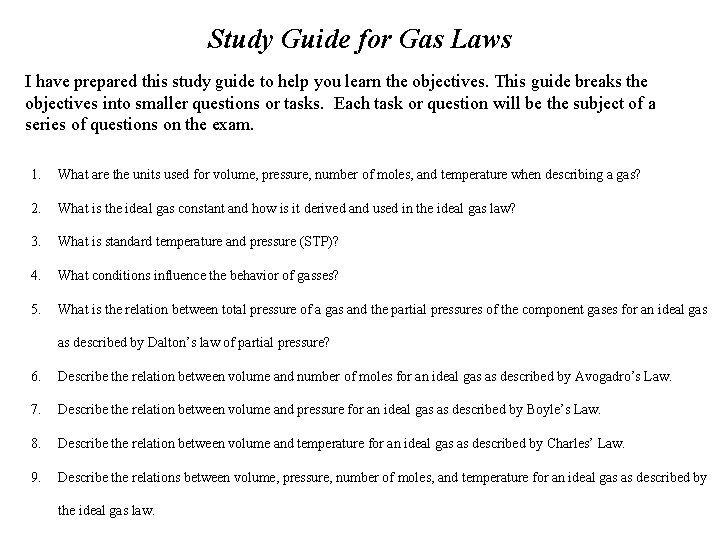
Study Guide for Gas Laws I have prepared this study guide to help you learn the objectives. This guide breaks the objectives into smaller questions or tasks. Each task or question will be the subject of a series of questions on the exam. 1. What are the units used for volume, pressure, number of moles, and temperature when describing a gas? 2. What is the ideal gas constant and how is it derived and used in the ideal gas law? 3. What is standard temperature and pressure (STP)? 4. What conditions influence the behavior of gasses? 5. What is the relation between total pressure of a gas and the partial pressures of the component gases for an ideal gas as described by Dalton’s law of partial pressure? 6. Describe the relation between volume and number of moles for an ideal gas as described by Avogadro’s Law. 7. Describe the relation between volume and pressure for an ideal gas as described by Boyle’s Law. 8. Describe the relation between volume and temperature for an ideal gas as described by Charles’ Law. 9. Describe the relations between volume, pressure, number of moles, and temperature for an ideal gas as described by the ideal gas law.