Family Planning Counseling and Service Provision STI Evaluation


- Slides: 91
Family Planning Counseling and Service Provision, STI Evaluation and Treatment, and HIV Counseling and/or Testing Module 3 - Session 2 STI and HIV Service Provision OPTIONAL SET
A Note about Slides for Training in STIs and HIV • The second component of the PAC model notes that If countries have STI or HIV prevalence and available human resources, STI evaluation and treatment and HIV counseling and testing or referral for testing should occur. This set of slides provides a summary of STI and HIV. Additional training time would be needed to provide full information on STI. A full set of slides for STI training is available as an optional slide set. 2
Module 3 - Session 2 Objectives At the end of this session, participants will be able to: 1. Describe the symptoms and complications of common STIs and HIV/AIDS 2. List the essential information that all postabortion clients must have about STIs before they leave the health facility 3. Explain how to evaluate, treat and follow up clients with STIs using the syndromic approach 4. Provide counseling within the context of STI/HIV risk 3
Sexually Transmitted Infections/Reproductive Tract Infections • Sexually transmitted infection (STI) refers to an infection that is passed from person to person by sexual contact. • STIs are part of a broader group of infections known as reproductive tract infections (RTIs). • Not all RTIs are sexually transmitted; some may be the result of an overgrowth of the bacteria and other organisms that normally live in the vagina. • While some RTIs can cause only mild discomfort, others can be very serious. 4
STIs/RTIs and HIV • The presence of any infection that causes irritation of the skin in and around the vagina increases the possibility of infection with HIV. • Though HIV is technically an STI, it is not a reproductive tract infection. • Hepatitis B and C are other examples of STIs that are not RTIs. 5
Presenting Symptoms • When a PAC client reports reproductive tract symptoms (pain, itching, swelling, sores, discharge), remember that not all infections of the genitals or reproductive tract are the result of sexual contact. • Telling a client he or she has a sexually transmitted infection can have serious negative consequences for the client and his or her sexual partners. Before doing so, be sure of the diagnosis. 6
Common STIs • Common infections that can be spread by sexual contact include: – Gonorrhea – Syphilis – HIV – Chlamydia – Trichomoniasis – Herpes – Human papillomavirus (genital warts and cervical dysplasia) 7
Presenting Symptoms (2) • Often, people infected with STIs, especially women, have no symptoms. • A woman often becomes aware of the presence of an STI during routine screening or if her partner is diagnosed. • Having symptoms does not necessarily mean the presence of an STI, so a thorough evaluation is critical. 8
Presenting Symptoms (3) Presenting Symptom Possible Causes Unusual vaginal discharge Bacterial vaginosis, chlamydia, gonorrhea, herpes, PID, trichomoniasis, yeast infection Penile discharge Chlamydia, gonorrhea, trichomoniasis Abnormal and/or heavy vaginal bleeding Chlamydia, gonorrhea, PID Bleeding after intercourse Chlamydia, gonorrhea, PID Burning or pain during urination Chlamydia, gonorrhea, herpes, trichomoniasis Pelvic pain (pain below umbilicus) Chlamydia, gonorrhea, PID 9
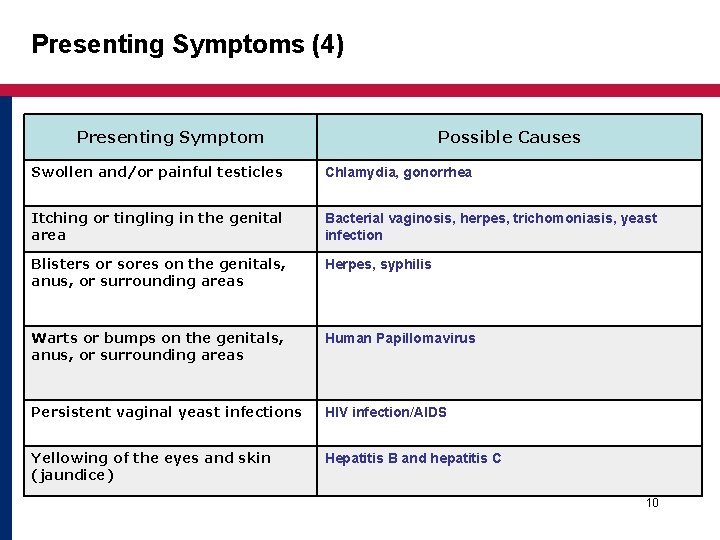
Presenting Symptoms (4) Presenting Symptom Possible Causes Swollen and/or painful testicles Chlamydia, gonorrhea Itching or tingling in the genital area Bacterial vaginosis, herpes, trichomoniasis, yeast infection Blisters or sores on the genitals, anus, or surrounding areas Herpes, syphilis Warts or bumps on the genitals, anus, or surrounding areas Human Papillomavirus Persistent vaginal yeast infections HIV infection/AIDS Yellowing of the eyes and skin (jaundice) Hepatitis B and hepatitis C 10
Cervical Infections • The cervix is the most common site of infection for gonorrhea and chlamydia. • Infections of the cervix are often asymptomatic. • Despite lack of symptoms, a cervical infection can be severe if it reaches the upper reproductive tract. • When cervical infection is suspected, treat for both gonorrhea and chlamydia. 11
Gonorrhea • • The bacteria that causes gonorrhea, Neisseria gonorrhea, grows in the: – Urethra – Cervix – Rectum – Throat (throat infection can occur following oral-genital sex with an infected partner) Symptoms: – Women: purulent vaginal discharge, or pain and burning on urination. About 50% have no noticeable signs or symptoms. – Men: cloudy or pus-like discharge from the penis, pain or burning with urination, or swollen and tender testicles. Some men have no symptoms. – Gonorrhea infections in the rectum often have no symptoms, but gonorrhea in the throat may cause a sore throat. 12
Gonorrhea Complications • Women: if untreated/inadequately treated—can spread into the pelvic area and infect the uterus, fallopian tubes and ovaries. • Men: can infect the epididymis (where sperm are stored). Epididymitis can lead to infertility. • In utero: can be passed from mother to baby during birth. Without prompt treatment, the infant’s eyes can be seriously damaged, even resulting in blindness. 13
Gonorrhea Treatment Gonorrhea treatment (choose ONE) Treatment of choice: • Ceftriaxone, 125 mg IM injection as a single dose, OR • Cefixime, 400 mg by mouth as a single dose Alternative treatment: • Ciprofloxacin, 500 mg tablet by mouth as a single dose (Do NOT give to pregnant or breastfeeding women), OR • Spectinomycin, 2 g IM injection as a single dose If woman is pregnant, breastfeeding or <16 years of age: • Ceftriaxone, 125 mg IM injection as a single dose, OR • Cefixime, 400 mg by mouth as a single dose 14
Gonorrhea Treatment (2) • Treatments that may not be useful in countries where the disease is not commonly resistant to these medications are: – Kanamycin, 2 g intramuscular injection as a single dose – Trimethoprim, 80 mg/sulphamethoxazole, 400 mg; 10 tablets by mouth daily for 3 days (Do NOT give to pregnant or breastfeeding women. ) Note: In most areas of the world, penicillin and tetracycline are no longer effective against gonorrhea: – Advise client to avoid sex until treatment is completed and symptoms are gone. Urge that sex partners(s) be treated. 15
Chlamydia • Caused by one of the most common STIs—especially among adolescents: – About 75% of women and up to 50% of men have no symptoms. – Left untreated, chlamydia can increase the risk of transmitting or acquiring HIV. • Symptoms: – Women: • Often have no symptoms of infection • Some notice an unusual vaginal discharge or bleeding after intercourse or between menstrual periods – Men: • Usually a clear discharge from the penis, and • Burning with urination, or • Swollen and tender testicles. • Many men have no symptoms 16
Lyphogranuloma Venereum • The same bacteria that cause symptoms of chlamydia can also cause another infection called LGV (lymphogranuloma venereum). • Symptoms in LGV: – Genital sores (ulcers) – Swollen lymph nodes (buboes) 17
Chlamydia Complications • Women: if untreated/inadequately treated, can spread into the pelvic area and infect the uterus, fallopian tubes and ovaries (PID). • Men: can affect the testicles and cause sterility. The symptoms of chlamydia are a discharge from the penis, pain or burning with urination, or swollen and tender testicles. Some men have no symptoms. • In utero: Chlamydia can pass from the mother to her baby during birth, infecting the baby’s eyes and possibly causing serious damage or even blindness. 18
Chlamydia Treatment of choice: • Azithromycin, 1 g by mouth as a single dose, OR • Doxycycline*, 100 mg by mouth 2 times daily for 7 days Alternative treatment: • Erythromycin 500 mg by mouth 4 times a day for 7 days, OR • Ofloxacin 300 mg by mouth twice a day for 7 days, OR • Tetracycline*, 500 mg by mouth 4 times daily for 7 days If woman is pregnant, breastfeeding or <16 years of age: • Erythromycin, 500 mg by mouth 4 times daily for 7 days, OR • Azithromycin, 1 g by mouth as a single dose, OR • Amoxicillin, 500 mg by mouth 3 times daily for 7 days * Do NOT give to pregnant or breastfeeding women. 19
Pelvic Inflammatory Disease (PID) • An infection of female internal organs, usually affecting the uterus, one or both fallopian tubes, the ovaries and surrounding pelvic tissues. These tissues become inflamed, irritated and swollen. • Causes of PID: – Several types of bacteria and other microorganisms – Chlamydia causes nearly half of all cases of PID; gonorrhea is the other cause of a large percentage of PID cases 20
Pelvic Inflammatory Disease (PID) Symptoms • The primary symptom is lower abdominal or pelvic pain, ranging from slight cramping (mild cases), to intense pain in severe cases. • Physical activity, especially sexual intercourse, may greatly increase the pain. • Abnormal vaginal bleeding (extremely heavy menstrual periods or bleeding or spotting between periods) is a very common symptom. • Abnormal vaginal discharge and fever may also be present. 21
Pelvic Inflammatory Disease (PID) Complications The complications of PID can be very serious. They include: Repeat PID: • Women who have had PID in the past are very likely to get it again if they are at risk of STIs. Pelvic abscess: • Local collection of pus in the pelvis formed by the breakdown of tissues; found in severe cases of PID and requires hospitalization, IV antibiotics and often, surgery. Chronic pelvic pain: • The scar tissue associated with PID may produce chronic pelvic pain or discomfort because of the distortion of the pelvic organs. Surgery may be required in severe cases. 22
Pelvic Inflammatory Disease (PID) Complications and Treatment Infertility: • When PID heals, scar tissue can form around the pelvic organs. • Scar tissue can cause blockage/distortion of the fallopian tubes. The result is that the egg cannot get through the tube and into the uterus. • After one episode of PID, a woman has an estimated 15% chance of infertility. After two episodes, the risk increases to approximately 35%, and after three, the risk is nearly 75%. Ectopic pregnancy: • An ectopic pregnancy occurs outside the uterus, most commonly in the fallopian tubes. Because PID can cause partial blocking of distortion of the fallopian tube, the chances of an ectopic pregnancy are greatly increased in a woman who has had PID. • An ectopic pregnancy is life-threatening and must be surgically removed. PID treatment: • Treat for gonorrhoea, chlamydia and trichomonas. 23
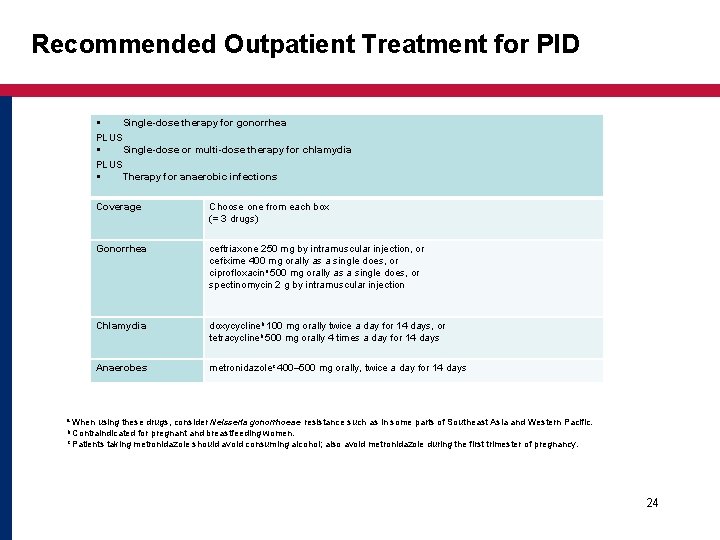
Recommended Outpatient Treatment for PID Single-dose therapy for gonorrhea PLUS Single-dose or multi-dose therapy for chlamydia PLUS Therapy for anaerobic infections Coverage Choose one from each box (= 3 drugs) Gonorrhea ceftriaxone 250 mg by intramuscular injection, or cefixime 400 mg orally as a single does, or ciprofloxacina 500 mg orally as a single does, or spectinomycin 2 g by intramuscular injection Chlamydia doxycyclineb 100 mg orally twice a day for 14 days, or tetracyclineb 500 mg orally 4 times a day for 14 days Anaerobes metronidazolec 400– 500 mg orally, twice a day for 14 days a When using these drugs, consider Neisseria gonorrhoeae resistance such as in some parts of Southeast Asia and Western Pacific. b Contraindicated for pregnant and breastfeeding women. c Patients taking metronidazole should avoid consuming alcohol; also avoid metronidazole during the first trimester of pregnancy. 24
Genital Ulcers • The most common genital ulcer diseases are: – Genital herpes – Chancroid – Syphilis • Differential diagnosis of genital ulcers using clinical features is often inaccurate, especially where several types of genital ulcer disease are common. • Clinical manifestations and patterns of genital ulcer disease may be different in people with HIV. 25
Genital Ulcers (2) • If the exam confirms the presence of genital ulcers, treat at the initial visit, if possible (per local guidelines): – For example, in areas where both syphilis and chancroid are prevalent, treat patients with genital ulcers for both conditions to ensure adequate therapy in case they do not return for follow-up. • Laboratory diagnosis of genital ulcer disease is rarely useful at the initial client visit and may even be misleading. • In areas of high prevalence of syphilis, a person may have a reactive serological test from a previous infection, even when chancroid or herpes is the cause of the present ulcer. 26
Syphilis • Caused by an organism called Treponema pallidum: – A curable infection – If not treated promptly or adequately, will progress through four stages with increasingly serious symptoms – A person infected with syphilis is also at a higher risk for transmitting or acquiring HIV • Symptoms: – Primary syphilis: • The first symptom is usually a small, painless sore in the area of sexual contact (penis, vagina, rectum or mouth) • Appears about 2– 6 weeks after exposure and disappears within a few weeks • Because the sores are painless, many people do not realize they are infected 27
Secondary Syphilis Symptoms Secondary syphilis: – After the sore of primary syphilis heals, symptoms of this phase appear. The infected person can develop a non-itchy rash on the entire body, especially the palms of the hand or soles of the feet; flat warts (condylomata lata); swollen lymph nodes; fever; or tiredness. These symptoms may last from 2– 6 weeks and will eventually clear, even without treatment. In the absence of treatment, the syphilis bacterium will remain and eventually enter the latent phase. 28
Latent and Tertiary Syphilis Latent syphilis: Is the period during which there are no visible signs or symptoms of the disease. This period can last from 2– 30 or more years after the client is infected. – A blood test (VDRL or RPR) is the only way to make a definite diagnosis during this period. Tertiary syphilis: Symptoms of this late stage of syphilis can occur from 2– 30+ years after the initial infection. Complications during this stage can include: Gummas (small bumps or tumors on the skin, bones, liver or other organs) Blindness Insanity Paralysis If treated during this period, gummas will usually disappear Though treatment at this phases will treat the disease and stop future damage, it cannot repair or reverse the damage that occurred before treatment. 29
Syphilis Complications • Untreated or inadequately treated syphilis can: – Produce symptoms from about 2 weeks up to 30 years or more as it progresses from early to late stages – While curable with antibiotics, complications in later stages cannot be reversed with treatment • Congenital syphilis: – Syphilis can be passed from mother to infant before/during birth – An infected newborn may suffer from blindness, other severe organ damage or death – Syphilis may also cause abortion or premature delivery 30
Syphilis Treatment Syphilis treatment for early disease: primary, secondary, or latent syphilis of 2 years or less (choose ONE) For anyone without penicillin allergy: • Benzathine penicillin C, 2. 4 million units total, in 2 intramuscular injections during 1 clinic visit; give 1 injection in each buttock • Aqueous procaine penicillin G, 1. 2 million units in 1 intramuscular injection once daily for 10 days Allergic to penicillin * (men and non-pregnant women only): • Doxycycline 100 mg by mouth 2 times daily for 14 days • Tetracycline 500 mg by mouth 4 times daily for 14 days Allergic to penicillin (pregnant women only): • Erythromycin 500 mg by mouth 4 times daily for 14 days. This treatment may not be effective. Urge these women to bring their babies within 7 days after birth for treatment for congenital syphilis. Urge client to ensure that their sex partner(s) also get treated. 31
Syphilis Treatment (2) Latent Syphilis or Latent Syphilis of Unknown Duration For anyone without penicillin allergy: • Benzathine penicillin G, 7. 2 million units total, administered as intramuscular injections in 3 doses of 2. 4 million units each at 1 week intervals Allergic to penicillin (men and non-pregnant women only): • Same as for early disease but treat for 4 weeks rather than 14 days Allergic to penicillin (pregnant women only): • Same as for early disease but treat for 4 weeks rather than 14 days 32
Congenital Syphilis Treatment (choose ONE) • Procaine penicillin G, 50, 000 units per kg of body weight, as one intramuscular injection daily for 10 days • Aqueous crystalline penicillin C, 100, 000 to 150, 000 U per kg of body weight per day, given as 50, 000 units/kg intravenously every 12 hours for the first 7 days of life and every 8 hours thereafter for the next 3 days If more than 1 day of treatment is missed, the entire course should be restarted. 33
Allergy to Penicillin • Symptoms of true allergy to penicillin: – Symptoms of anaphylaxis, including severe facial swelling, widespread itching and hives – Difficulty breathing and swallowing – Sudden drop in blood pressure – Weak and rapid pulse – Nausea – Vomiting – Abdominal cramps – Diarrhea – Confusion – Dizziness – Possible loss of consciousness • Symptoms: – Occur within 20 minutes after penicillin injection • Treatment: – Maintain the airway – Give oxygen – Give epinephrine 34
Chancroid • Chancroid is an STI caused by Haemophilus ducreyi: – Also called “soft chancre” – Common in countries where HIV prevalence is high – Chancroid ulcers are often confused with those of syphilis or herpes, so treatment for both is often given • Symptoms: – In men and women: soft, painful blisters or sores (ulcers) on the mouth, lips, genitals, anus or surrounding areas 35
Chancroid Complications • Treatment cures the infection and complications are rare • Untreated chancroid may lead to: – Swollen lymph glands in the groin area (buboes) that can rupture and drain pus – Scarring and fibrosis – Recto-vaginal fistula 36
Chancroid Treatment (choose ONE): • Azithromycin, 1 g by mouth as a single dose • Ceftriaxone, 250 mg intramuscular, injection as a single dose • Erythromycin, 500 mg by mouth 4 times daily for 7 days • Ciprofloxin, 500 mg by mouth 2 times daily for 3 days: – Do NOT give to pregnant/breastfeeding women or people <age 18 • Trimethoprim, 80 mg/sulphamethoxazole, 400 mg; 2 tablets by mouth 2 times daily for 7 days. (Use only in area where it has been proved effective against chancroid and its effectiveness can be regularly monitored. (Do NOT give to pregnant or breastfeeding women. ) • Re-examine in 3 to 7 days. Sex partner(s)—even those with no symptoms— should be treated if they had sex with patient within 10 days before patient’s symptoms started or since symptoms started. 37
Genital Herpes • Genital herpes (herpes simplex virus, type 2) is: – Transmitted through direct contact with the painful ulcers the infection causes – Can also be passed to a sexual partner even after the sores have healed or before an outbreak has occurred – Herpes can be transmitted between the genitals and the mouth during oral sex 38
Genital Herpes Symptoms • Herpes sores heal on their own after 1– 2 weeks, but the virus stays in the body after the sores are healed, causing outbreaks (outbreaks are when the sores return after healing; they can happen weeks, months or even years apart). • Symptoms: – In men and women: blisters or ulcers (sores) on the mouth, lips, genitals, anus or surrounding areas – Burning or pain during urination – Itching or tingling in the genital area 39
Genital Herpes Complications • There is no cure for herpes, but there are ways to relieve pain caused by the sores. • Some people experience repeated (often painful) outbreaks. • Can be transmitted to a baby during pregnancy and delivery. If infected, the baby can become very sick and possibly die. 40
Genital Herpes (HSV-2) Treatment • There is no cure available. The client should keep the infected area clean and try not to touch the sores. Antibiotic ointments may help. • Clients should not have sex when blisters are present—not even with a condom. Herpes can be spread even when no blisters are present, but a condom may provide some protection. • Duration of symptoms can be shortened if treatment begins early in an outbreak. If not started early, treatment may be ineffective. • Urge that sex partners be evaluated and counseled and, if they have symptoms, treated. 41
Genital Herpes (HSV-2) Treatment (2) • For first outbreak: – Give acyclovir, 200 mg by mouth 5 times a day for 7 days, OR – 400 mg 3 times a day for 7 days. • For recurrences of blisters: – Give acyclovir, 200 mg by mouth 5 times a day for 5 days. – If client has outbreaks > 6 times a year, treat with acyclovir, 400 mg by mouth 2 times a day for 1 year and then reassess. 42
Viral Infections: Human Papillomavirus • Human papillomavirus (HPV): – Is the most prevalent sexually transmitted infection in the world, occurring at some point in up to 75% of sexually active women – Are a group of more than 100 viruses – Are called papillomaviruses because certain types may cause warts, or papillomas, which are benign tumors – Some types of HPV are associated with certain types of cervical cancer 43
Human Papillomavirus (2) • Sexual contact with a person infected with some types of HPV may cause warts to appear on or around the genitals or anus. • Genital warts (condylomata acuminata) are most commonly associated with two HPV types, HPV– 6 and HPV– 11. • Warts may appear within several weeks after sexual contact with an HPV-infected person; or they may take months or years to appear, or may never appear. 44
Human Papillomavirus (3) Symptoms: • Men and women: genital and/or anal warts (HPV-6, HPV-11). • Many HPV infections do not cause any symptoms. Complications: • Some types cause abnormal changes in the cells of the cervix, which, if left untreated, can lead to cervical cancer. • The types of HPV that cause genital warts are different than the types that cause cancer. 45
HPV Treatment • Currently there is no treatment for HPV infection. • HPV can stay in the body even after genital warts are removed. • Once infected, a person is most likely infected for life. • An active infection is controlled by the immune system and with time becomes dormant. • It is not possible to predict whether or when the virus will become active again. • HPV can be transmitted to others if the virus is active (i. e. , the warts re-appear). 46
HPV Treatment (2) Treatment for anogenital warts (choose ONE): • Podophyllin 10– 25% in compound tincture of benzoin: – Apply carefully to the warts, avoiding normal tissue. – External genital and perianal warts should be washed thoroughly 1– 4 hours after application of podophyllin. – Allow treatment to dry before the speculum is removed. – Repeat treatment at weekly intervals. DO NOT use during pregnancy. • Trichloracetic acid (TCA) (80– 90%): – Apply carefully to the warts, avoiding normal tissue. – Follow by powdering of the treated area with talc or sodium bicarbonate to remove un-reacted acid. – Repeat application at weekly intervals. 47
HPV Treatment (3) • Genital warts can also be treated by cryotherapy, electro- surgery or surgical removal. • Selection of removal method will depend on the methods available and the anatomical location of the warts. • Advise all patients that warts often reappear even after treatment. 48
HPV and Cervical Cancer • HPVs are now recognized as the major cause of cervical cancer. • Nearly all cervical cancers are directly linked to previous infection with one or more types of HPV. • Cervical cancer strikes nearly half a million women each year worldwide, claiming a 250, 000 lives. • When possible, screen all women for cervical cancer. 49
Vaginal Infections • Vaginal infections (trichomoniasis, bacterial vaginosis and candidiasis): – Are very common in women of reproductive age – Are nearly always symptomatic – Rarely cause complications 50
Vaginal Infections (2) • Bacterial vaginosis and trichomoniasis can cause: – Preterm delivery – Premature rupture of membranes • If possible, providers should screen women with a history of spontaneous abortion or preterm delivery regardless of symptoms. 51
Trichomoniasis • Trichomonas vaginalis is a microscopic organism that causes trichomoniasis. • Symptoms: – Both men and women infected with Trichomonas: • May have no symptoms • Some people may carry the organism for months or years with no symptoms at all, or they may have had symptoms that have disappeared – Women who have symptoms may notice: • An unusual and increased vaginal discharge with an unpleasant odor • Itching, burning and/or soreness of the vulva • The discharge may be greenish in color and bubbly – Men who have symptoms may notice: • A discharge from the penis and burning with urination 52
Trichomoniasis Complications • There is currently no evidence that trichomoniasis leads to serious complications. • Recent evidence indicates that it may be associated with early delivery in pregnant women. • Trichomoniasis can cause irritation of the skin in and around the vagina. • The presence of damaged skin can increase the risk of HIV transmission. 53
Trichomoniasis Treatment Trichomoniasis treatment (choose ONE): Treatment of choice: • Metronidazole*, 2 g by mouth as a single dose • Metronidazole* 400 mg or 500 mg by mouth 2 times daily for 7 days Alternative treatment: • Tinidazole 2 g by mouth in a single dose • Tinidazole 500 mg orally twice a day for 7 days If woman is pregnant (after first trimester for metronidazole) or breastfeeding: • Clindamycin 300 mg orally twice a day for 7 days, OR • Metronidazole 200 or 250 mg by mouth 3 times a day for 7 days, OR • Metronidazole gel 0. 75%, one full applicator (5 g) intravaginally twice a day for 5 days *Do NOT give metronidazole to pregnant women before the 4 th month of pregnancy. 54
Trichomoniasis Treatment (2) • Advise patient to: – Not drink alcohol while taking metronidazole or tinidazole; it may cause nausea and vomiting – Have sex partner(s) be treated – Avoid sex until treatment is completed and symptoms are gone in both partners 55
RTIs That Are Not Considered STIs: Bacterial Vaginosis • • Bacterial vaginosis: – Is often referred to by a number of different names, such as Gardnerella and Haemophilus – Is an overgrowth of a variety of normally occurring bacteria in the vagina – Studies indicate that a woman with bacterial vaginosis has an increased chance of having other reproductive tract problems, so diagnosis and treatment are important Symptoms: – Vaginal discharge that is grey in color and has an unpleasant or fish -like odor – Discharge may or may not be accompanied by itching or irritation – Some women have no symptoms – Men usually do not have symptoms of this infection; it is unclear if they carry the bacteria 56
Bacterial Vaginosis Complications • Bacterial vaginosis: – May increase a woman’s chance of having other reproductive tract problems, such as other types of infections – Has also been associated with early delivery in pregnant women – Has been associated with low birth weight in newborns 57
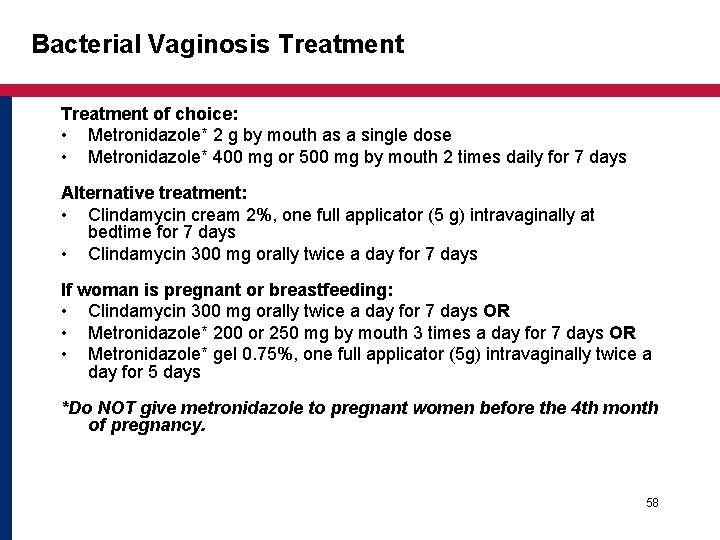
Bacterial Vaginosis Treatment of choice: • Metronidazole* 2 g by mouth as a single dose • Metronidazole* 400 mg or 500 mg by mouth 2 times daily for 7 days Alternative treatment: • Clindamycin cream 2%, one full applicator (5 g) intravaginally at bedtime for 7 days • Clindamycin 300 mg orally twice a day for 7 days If woman is pregnant or breastfeeding: • Clindamycin 300 mg orally twice a day for 7 days OR • Metronidazole* 200 or 250 mg by mouth 3 times a day for 7 days OR • Metronidazole* gel 0. 75%, one full applicator (5 g) intravaginally twice a day for 5 days *Do NOT give metronidazole to pregnant women before the 4 th month of pregnancy. 58
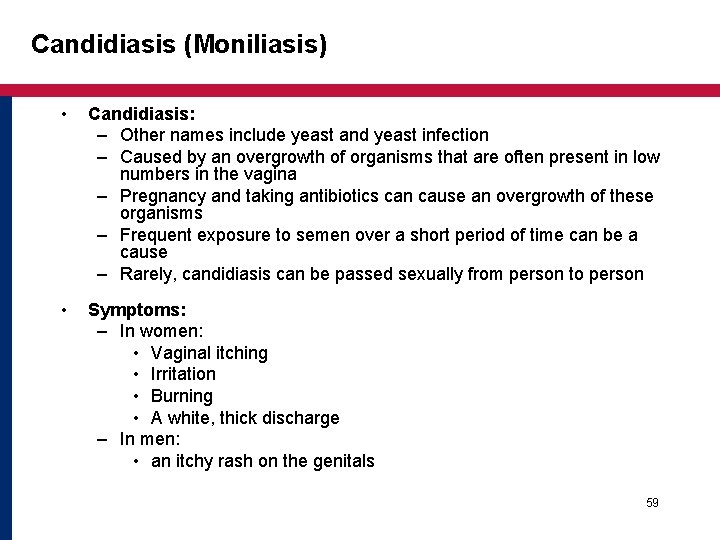
Candidiasis (Moniliasis) • Candidiasis: – Other names include yeast and yeast infection – Caused by an overgrowth of organisms that are often present in low numbers in the vagina – Pregnancy and taking antibiotics can cause an overgrowth of these organisms – Frequent exposure to semen over a short period of time can be a cause – Rarely, candidiasis can be passed sexually from person to person • Symptoms: – In women: • Vaginal itching • Irritation • Burning • A white, thick discharge – In men: • an itchy rash on the genitals 59
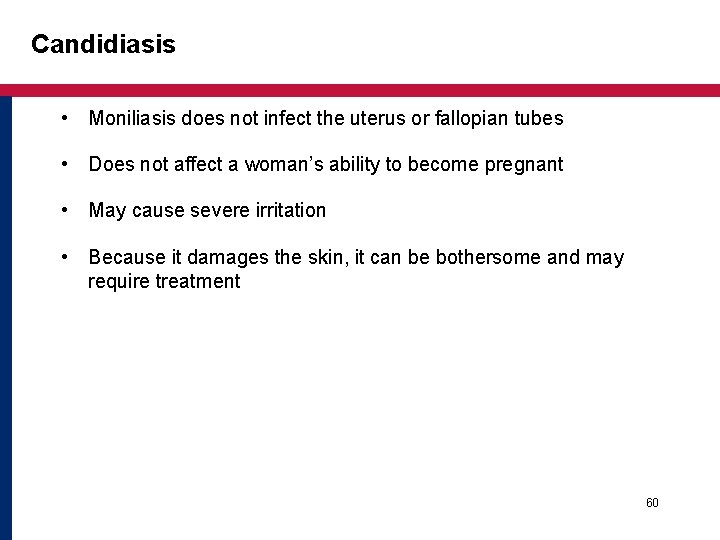
Candidiasis • Moniliasis does not infect the uterus or fallopian tubes • Does not affect a woman’s ability to become pregnant • May cause severe irritation • Because it damages the skin, it can be bothersome and may require treatment 60
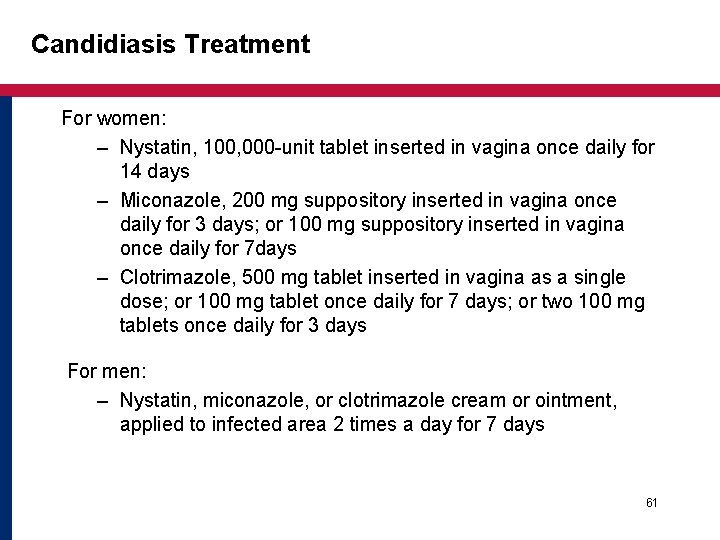
Candidiasis Treatment For women: – Nystatin, 100, 000 -unit tablet inserted in vagina once daily for 14 days – Miconazole, 200 mg suppository inserted in vagina once daily for 3 days; or 100 mg suppository inserted in vagina once daily for 7 days – Clotrimazole, 500 mg tablet inserted in vagina as a single dose; or 100 mg tablet once daily for 7 days; or two 100 mg tablets once daily for 3 days For men: – Nystatin, miconazole, or clotrimazole cream or ointment, applied to infected area 2 times a day for 7 days 61
Other STIs • There are many other infections that are sexually transmitted. • Common signs and symptoms of STIs and RTIs that require evaluation by a clinician include: – Sores – Growths – Ulcers or swollen lymph nodes in the genital area – Pain, burning or vaginal irritation • When clients complain of these symptoms, they may or may not have an STI, but they should see a clinician for evaluation as soon as possible. 62
Approaches to STI Diagnosis: Etiologic Diagnosis There are several possible approaches STI diagnosis. Follow local protocol or guidelines and use what is available and appropriate in your setting. Etiologic diagnosis: • The most traditional and accurate • Based on the results of microscope or lab tests such as cultures • Though the most reliable approach, disadvantages include that it: – Is expensive/time consuming – Requires 1– 6 days for incubation and culture/sensitivity, resulting in delay of treatment – Requires client to return for a second visit to collect lab results and receive treatment – Requires needles, syringes, centrifuge, lab facilities and person skilled in lab testing 63
Approaches to STI Diagnosis: Clinical Diagnosis • • Clinical diagnosis: – The least reliable of the three approaches. – Providers rely on their own clinical experience to make a diagnosis. This approach can be problematic because: – Previous treatment by another clinician (or traditional provider) may alter the signs and symptoms. – Experienced STI service providers can misdiagnose when relying only on their experience, especially since mixed infections can occur. – STIs can often vary in the way they appear upon examination (i. e. , they may not appear as a “textbook” case). – Requires provider skilled in speculum and pelvic exams, differential diagnosis and possibly basic lab skills (such as microscopy where available). – Requires supplies and equipment for conducting the exam. 64
Approaches to STI Diagnosis: Syndromic Diagnosis • Syndromic diagnosis: – In low-resource settings, syndromic management may be the best approach • Diagnosis is based on: – The identification of syndromes, which are combinations of symptoms the client reports and signs that the provider observes – The diagrams and management use groups of symptoms rather than symptoms for specific STIs • A main disadvantage is that it does not generally work well for cervical infections. 65
Working with Adolescents STIs and adolescents: • Youths have higher rate of STIs than older adults because youths: – Tend to have more partners and shorter relationships—more opportunity for STIs to spread – May find it difficult or embarrassing to use condoms – May find it difficult to refuse sex in some situations (within the family or in exchange for goods such as school supplies, food or clothes) – May not recognize situations and sexual partners where risk of infection is high 66
Working with Adolescents (2) STIs and adolescents: • Youths have higher rate of STIs than older adults because youths: – May lack knowledge about the symptoms of STIs and when to seek care – May feel uncomfortable using family planning or other reproductive health services for fear of critical or judgmental responses from staff – May not be aware of places to go for private and confidential services – May be unable to afford health services 67
Working with Adolescents (3) • Safer behaviors that should be encouraged for young people include: – Delaying onset of sexual activity – Learning how to use condoms consistently and correctly – Practicing dual protection to prevent unplanned pregnancy as well as STIs – Limiting number of partners – Avoiding high-risk sexual practices (especially unprotected vaginal or anal sex) with any partner – Recognizing symptoms of STI and seeking early treatment 68
HIV Counseling and Referral HIV prevention counseling should: • Focus on the client's unique circumstances and risk • Help the client set and reach an explicit, behavior-change goal to reduce the chance of acquiring or transmitting HIV counseling is usually, but not always, conducted in the context of HIV testing. 69
HIV Counseling: Role of the PAC Provider • To provide HIV/AIDS information and prevention counseling to all PAC clients (as appropriate) and refer to other services for testing/treatment unless client “opts out. ” • HIV services for a PAC patient are recommended based only on prevalence of the disease and availability of resources for counseling and testing. • The PAC client should have a follow-up appointment for HIV counseling and testing 1– 2 weeks after emergency PAC treatment. Depending on the resources of the facility, the client may need to be referred for HIV testing. • The provider should be familiar with facilities that offer these other services and related information such as cost. 70
HIV Counseling • Women with HIV are at a greater risk of having a miscarriage. During HIV counseling for PAC clients, providers should: – Counsel clients about HIV in a nonjudgmental way – Not impose guilt or disapproval; voicing disapproval rarely helps people deal responsibly with HIV or any STI – Help patients learn how to prevent transmission to others and to protect themselves from other future infections – Explain HIV and AIDS and the ways HIV is spread – Discuss ways to prevent the spread of HIV – Offer specific information on how to access testing and/or treatment 71
Facts about HIV Infection and AIDS What is HIV? • The human immunodeficiency virus (HIV) is the virus that causes AIDS: H: Human I: Immunodeficiency V: Virus • The HIV virus is found in the body fluids (particularly blood, semen and vaginal secretions) of infected persons. 72
Facts about HIV Infection and AIDS (2) • HIV breaks down the body's defense against infection and disease—the body's immune system—by infecting specific white blood cells, leading to a weakened immune system. • When the immune system becomes weak or compromised, the body loses its protection against illness. • As time passes, the immune system is unable to fight the HIV infection and the person may develop serious and deadly diseases, including other infections and some types of cancer. 73
Types of HIV • Types of HIV: – HIV-1 – HIV-2 • Both types are transmitted the same way and both are associated with similar opportunistic infections and AIDS. • HIV-1 is more common worldwide. HIV-2 is found predominantly in West Africa, Angola and Mozambique. 74
Differences between HIV-1 and HIV-2 • HIV-2 is: – Less easily transmitted than is HIV-1 – Less pathogenic, meaning that the period between initial infection and illness is longer • In some areas, a person may be infected with both HIV-1 and HIV-2. • While HIV-2 can be transmitted from an infected mother to her child, this appears to be rare. 75
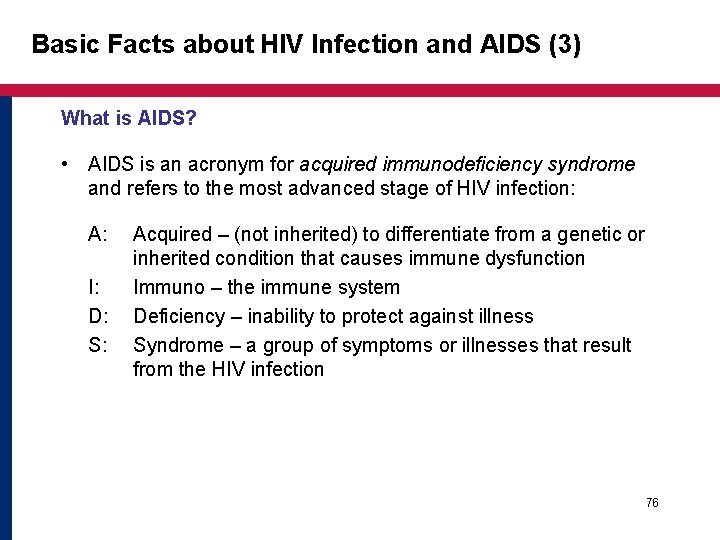
Basic Facts about HIV Infection and AIDS (3) What is AIDS? • AIDS is an acronym for acquired immunodeficiency syndrome and refers to the most advanced stage of HIV infection: A: I: D: S: Acquired – (not inherited) to differentiate from a genetic or inherited condition that causes immune dysfunction Immuno – the immune system Deficiency – inability to protect against illness Syndrome – a group of symptoms or illnesses that result from the HIV infection 76
AIDS • Almost all people who are HIV-positive: – Will ultimately develop HIV-related disease and AIDS, the end stage of HIV infection – Become susceptible to opportunistic infections as the disease progresses 77
Opportunistic Infections • An opportunistic infection is: – An illness caused by a germ: • The germ may not cause illness in a healthy person, but will cause illness in a person who has a weakened immune system. • An example is co-infection with tuberculosis (TB), which is very common in people infected with HIV. 78
Opportunistic Infections (2) • • People living with advanced HIV infection suffer from opportunistic infections of the: – Lung – Brain – Eyes – Other organs Other common opportunistic infections in persons diagnosed with AIDS are: – Pneumocystis carinii pneumonia (PCP) – Cryptosporidiosis – Histoplasmosis – Other parasitic, viral and fungal infections – Some types of cancers, such as Kaposi's sarcoma 79
Differences between HIV, HIV Infection and AIDS • HIV is the virus that causes infection. • The person who is HIV-infected may have no signs of illness but can still infect others. • Most people who are HIV-infected will develop AIDS after some time, which may be several months to more than 15 years. • AIDS is a group of serious illnesses and opportunistic infections that develop after a person is infected with HIV for a long period of time. • A diagnosis of AIDS is based on specific clinical criteria and laboratory test results. • Even if the symptoms of AIDS develop and then subside for a while, the virus that causes them is still present, and the infected person can still transmit the disease. 80
Basic Facts about HIV Infection and AIDS (4) How is HIV contracted? • Through sexual contact (vaginal, anal or oral intercourse) with an infected person, during which semen or vaginal fluids and sometimes blood come into contact with the penis, the lining of the vagina, the rectum or the mouth. HIV in these fluids can then get into the blood stream or enter the blood through open genital or oral sores, or cuts. • Through transfusions or treatments with infected blood products. • Through skin-piercing instruments that have been in contact with infected blood or body fluids and not properly disinfected. • In infants, from an infected mother during pregnancy, childbirth or breastfeeding. 81
Basic Facts about HIV Infection and AIDS (5) HIV is NOT contracted through: • Ordinary social contact • Insect bites • Sharing clothes • Tears • Touching or sharing food or dishes • Saliva • Kissing, hugging or shaking hands • Sweat • Toilet seats • Living with an infected person 82
Basic Facts about HIV Infection and AIDS: Symptoms What are the symptoms of HIV infections and AIDS? • Persons infected with HIV may be asymptomatic. It can take eight years or more between HIV infection and the diagnosis of AIDS. Once symptoms begin to develop, they may include: – – – – An unexplained 10% loss of body weight within one month Diarrhea for one month or more A white coating on the tongue Enlarged or sore glands in the neck and/or armpit A cough that persists for more than one month Persistent fever of unknown origin Persistent symptoms of vaginitis • These symptoms characterize other diseases, so a blood test must be done to confirm the presence of HIV. 83
Basic Facts about HIV Infection and AIDS: Who is at Risk? Who is at risk for HIV? High-risk clients include: • Commercial sex workers • Persons who have multiple sexual partners or whose sexual partners have had sexual relations with others • Users of intravenous drugs • Persons who have received unscreened blood products • Health care workers who have direct contact with infected blood 84
Basic Facts about HIV Infection and AIDS: Prevention Strategies • Blood-to-blood transmission: – Screen all blood and blood products for HIV • Follow universal precautions, which include: – Use of protective equipment – Safe use and disposal of sharps – Sterilization of equipment – Safe disposal of contaminated waste products 85
Prevention Strategies (2) Sexual contact: • Promote abstinence or being faithful to one uninfected partner • Provide instruction on the consistent and correct use of barrier methods • Male or female condoms for vaginal intercourse • Non-lubricated condoms for oral intercourse on a male • Dental dams, plastic wrap or latex panties for oral intercourse on a female • Condoms for anal intercourse • Prevent STIs, identify them early and treat them immediately • Provide access to HIV testing and counseling • Condoms provide protection from HIV transmission as well as other STIs when used correctly and consistently 86
Prevention Strategies (3) Drug use: • Educate about the risks of infection through drug use with contaminated needles and syringes. • Provide referral for treatment of drug dependence. 87
HIV Treatment • There is no known cure, but several different types of drugs exist to treat HIV infection. • These drugs attack various aspects of the process used by the virus to replicate itself. • Because HIV quickly mutates to become resistant to any single drug, patients must take a combination of drugs to achieve maximum suppression of HIV. 88
HIV Treatment: Antiretroviral Therapy • Combination anti-HIV therapy is known as antiretroviral therapy (ART). • ART: – Changes the natural course of HIV infection – Significantly extends the period between initial infection and the development of symptoms • To achieve these results, it is important to start therapy before AIDS symptoms develop. • However, even those who start ART after being diagnosed with AIDS often receive major, long-lasting health benefits. 89
HIV Treatment: Antiretroviral Therapy (2) • Although effective in slowing the progression of HIV-related disease, ART is not a cure. • In addition to treatments for HIV infection itself, therapies exist to prevent and/or treat many HIV-related opportunistic infections. 90
Contraceptive Methods and STIs/HIV/AIDS • Dual method protection for all clients is critical to protect against both STIs and pregnancy: – Condoms should be used with all methods. – When condoms are the primary method, a spermicide should also be used at all times. • A woman with chlamydia, gonorrhea, purulent cervicitis or PID should not have an IUD inserted until the infection is resolved. • A woman at very high risk of STIs should use an IUD only if: – A more appropriate contraceptive method is not available or not acceptable to her. – She plans to use condoms as well as the IUD. 91