
Sexually Transmitted Infections For use in Grade 8



- Slides: 30
Sexually Transmitted Infections For use in Grade 8 through CALM (10 -12) only. Although reasonable efforts were made to confirm the accuracy of the information contained in this presentation, Alberta Health Services does not make any representation or warranty, express, implied or statutory, as to the accuracy, reliability, completeness or applicability of such information. In no event will Alberta Health Services be responsible or liable for any error or consequence arising from the use of the information contained in this presentation. © 2012 Alberta Health Services
Ground Rules We respect: • That any question is OK • That it is OK to pass • That we all have different points of view • Each other by listening • The right to privacy • That we all need to be listened to 2
STDs vs. STIs What’s the difference? • Sexually Transmitted Infection (STI) has replaced the term Sexually Transmitted Disease (STD) Why? • STI is a more encompassing term that includes infections that are asymptomatic (show no symptoms) 3
What is an STI? Sexually Transmitted Infections are infections generally spread by close sexual contact and sexual intercourse. They can spread by contact with an infected partners: • Skin • Genitals • Body fluids • Mucous embranes eg. eyes, mouth 4
Why is it important to learn about STIs? • It helps one be able to take care of one's own body • Untreated STIs can cause problems for a person's health and future ability to have children • It helps a person to discuss STIs with a partner • It helps to identify myths like “It’s easy to tell if a person has a STI/HIV because they will look sick” that could prevent a person from using effective prevention methods or seeking needed treatments 5
What are some common STIs? • • • Chlamydia Genital herpes Genital warts (HPV) Human Papillomavirus Virus Gonorrhoea Hepatitis B/C (also a blood borne infection) HIV and AIDS (also a blood borne infection) Syphilis Pubic Lice (crabs) Scabies 6
Bacterial, Parasitic, or Viral STIs Bacterial/Parasitic: If bacteria or a parasite causes an infection, it can be treated with antibiotic or antimicrobial medication Viral: If a virus causes an infection, it is possible for it to remain “asymptomatic” for periods of time (meaning there are no symptoms). It is possible to have the virus and not know it, and it is possible to pass it to another person without either person knowing it. Viral STIs can be treated with medications; but not cured. 7
Which STIs are Bacterial? • Chlamydia • Gonorrhoea • Syphilis 8
Which STIs are Parasitic? • Pubic Lice (crabs) • Scabies 9
Which STIs are Viral? • • HIV and AIDS Genital Warts (HPV) Genital Herpes Hepatitis B and C 10
Which STIs are Blood-Borne? • HIV and AIDS • Hepatitis B and C 11
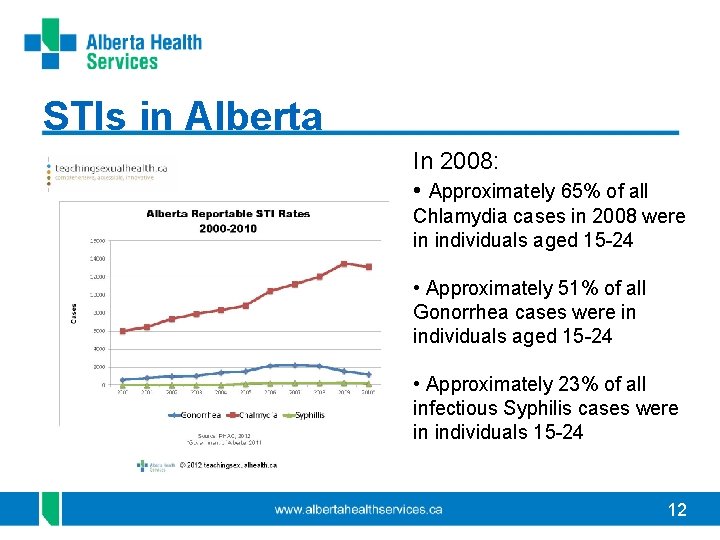
STIs in Alberta In 2008: • Approximately 65% of all Chlamydia cases in 2008 were in individuals aged 15 -24 • Approximately 51% of all Gonorrhea cases were in individuals aged 15 -24 • Approximately 23% of all infectious Syphilis cases were in individuals 15 -24 12
Blood Borne Infections Blood-borne infections are spread by contaminated blood. Some are also spread through body fluids (semen, vaginal secretions) and breast milk (HIV only). They can be transmitted by: • sharing needles • contaminated body piercing and tattooing equipment • helping an infected person who is bleeding without using gloves • sexual intercourse and close sexual contact with someone who is infected • an infected mother to her baby 13
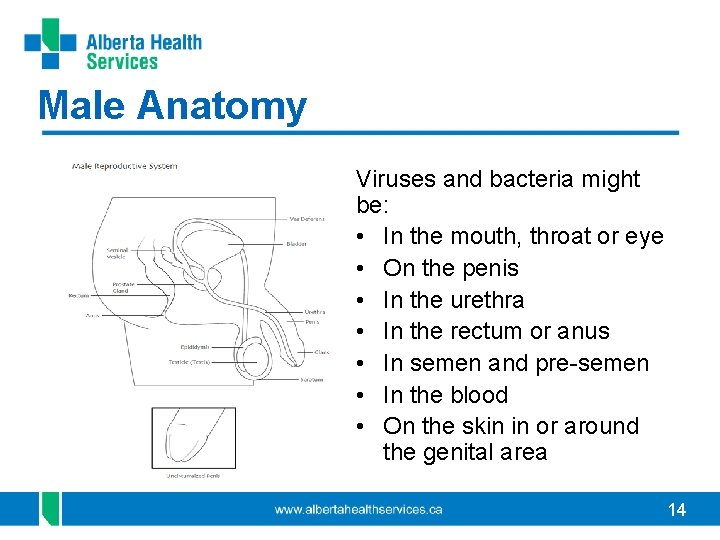
Male Anatomy Viruses and bacteria might be: • In the mouth, throat or eye • On the penis • In the urethra • In the rectum or anus • In semen and pre-semen • In the blood • On the skin in or around the genital area 14
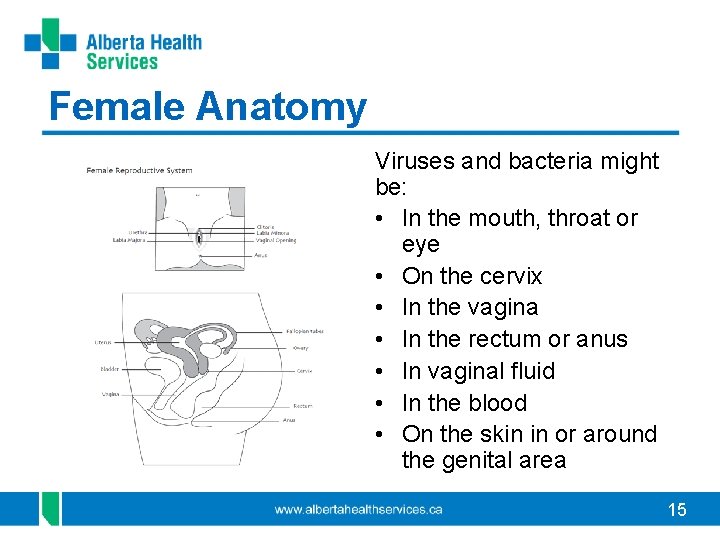
Female Anatomy Viruses and bacteria might be: • In the mouth, throat or eye • On the cervix • In the vagina • In the rectum or anus • In vaginal fluid • In the blood • On the skin in or around the genital area 15
What are common symptoms? • burning while urinating • itching • discharge (for females, different colour, amount or foul smell. For males, anything other than semen or urine) • sores, bumps or a rash on or around the genitals. 16
It is common to have NO SYMPTOMS at all! 17
Complications of STIs • • Infertility (male and female) Pelvic inflammatory disease (PID) in woman Epididymitis in men Urinary tract complications Cervical cancer Psychological impact Serious illness and death 18
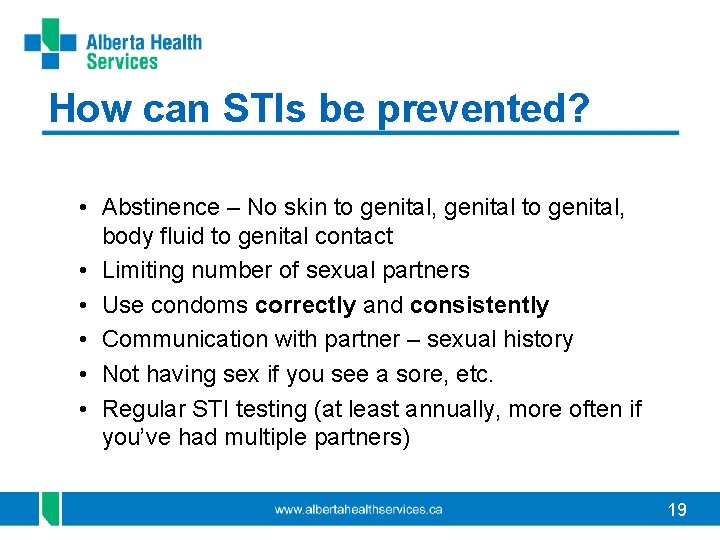
How can STIs be prevented? • Abstinence – No skin to genital, genital to genital, body fluid to genital contact • Limiting number of sexual partners • Use condoms correctly and consistently • Communication with partner – sexual history • Not having sex if you see a sore, etc. • Regular STI testing (at least annually, more often if you’ve had multiple partners) 19
When should I get tested? • Before you have sex with a new partner • If you or your partner have been sexually active and have never been tested • If you know your current or past partner has a STI • If you have been forced to have sex • If you have any STI symptoms • At least once a year if you are sexually active 20
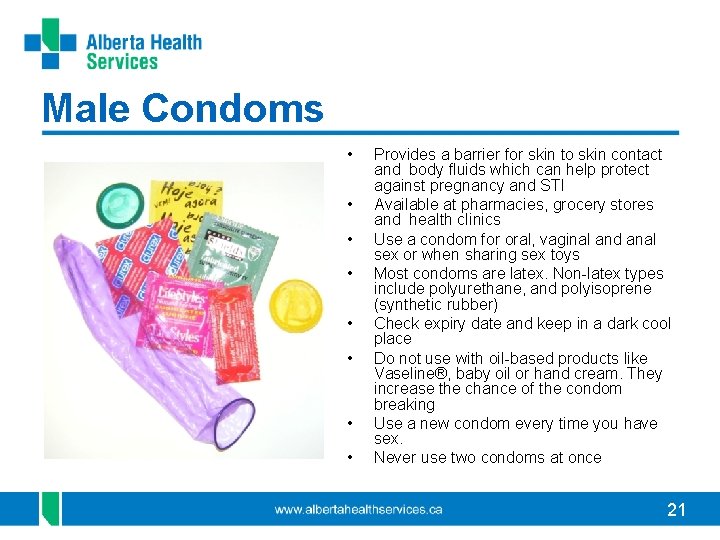
Male Condoms • • Provides a barrier for skin to skin contact and body fluids which can help protect against pregnancy and STI Available at pharmacies, grocery stores and health clinics Use a condom for oral, vaginal and anal sex or when sharing sex toys Most condoms are latex. Non-latex types include polyurethane, and polyisoprene (synthetic rubber) Check expiry date and keep in a dark cool place Do not use with oil-based products like Vaseline®, baby oil or hand cream. They increase the chance of the condom breaking Use a new condom every time you have sex. Never use two condoms at once 21
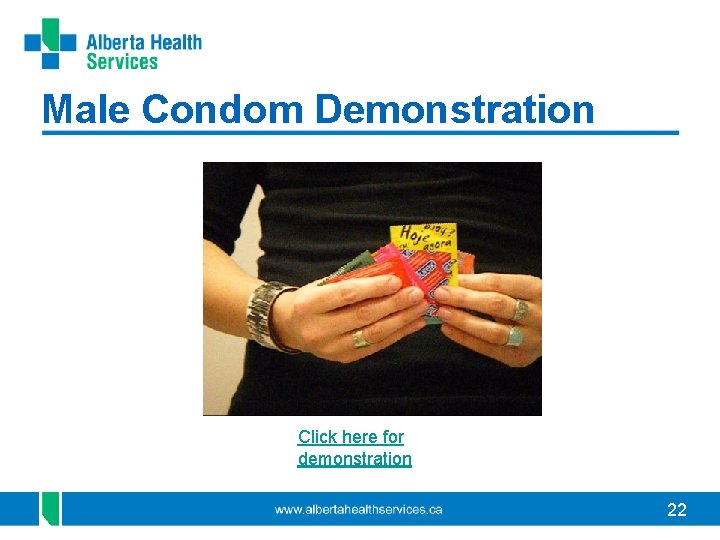
Male Condom Demonstration Click here for demonstration 22
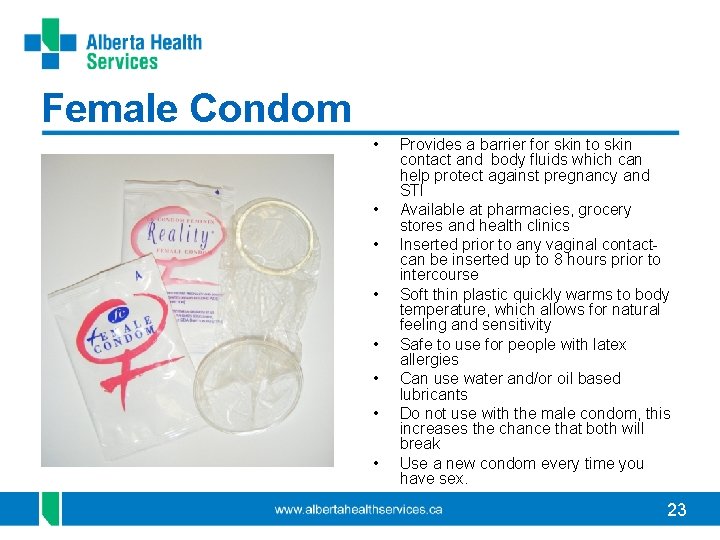
Female Condom • • Provides a barrier for skin to skin contact and body fluids which can help protect against pregnancy and STI Available at pharmacies, grocery stores and health clinics Inserted prior to any vaginal contactcan be inserted up to 8 hours prior to intercourse Soft thin plastic quickly warms to body temperature, which allows for natural feeling and sensitivity Safe to use for people with latex allergies Can use water and/or oil based lubricants Do not use with the male condom, this increases the chance that both will break Use a new condom every time you have sex. 23
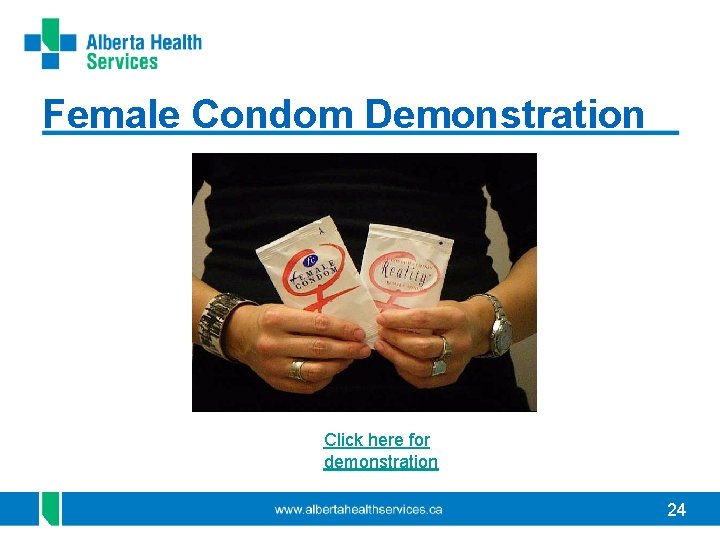
Female Condom Demonstration Click here for demonstration 24
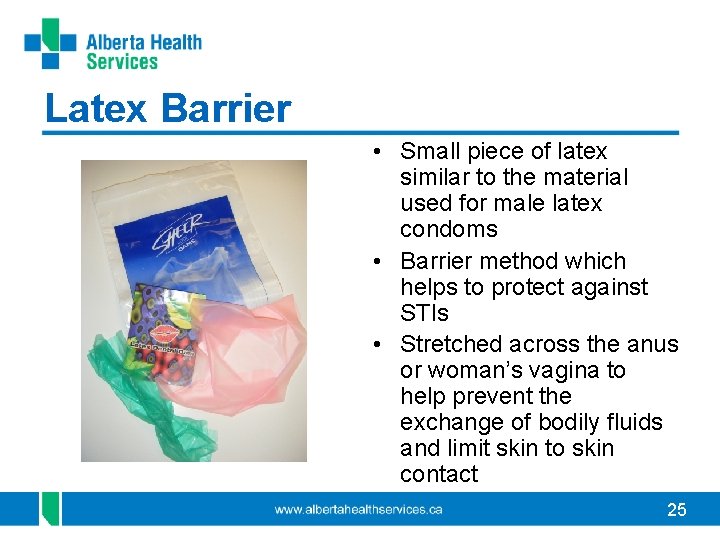
Latex Barrier • Small piece of latex similar to the material used for male latex condoms • Barrier method which helps to protect against STIs • Stretched across the anus or woman’s vagina to help prevent the exchange of bodily fluids and limit skin to skin contact 25
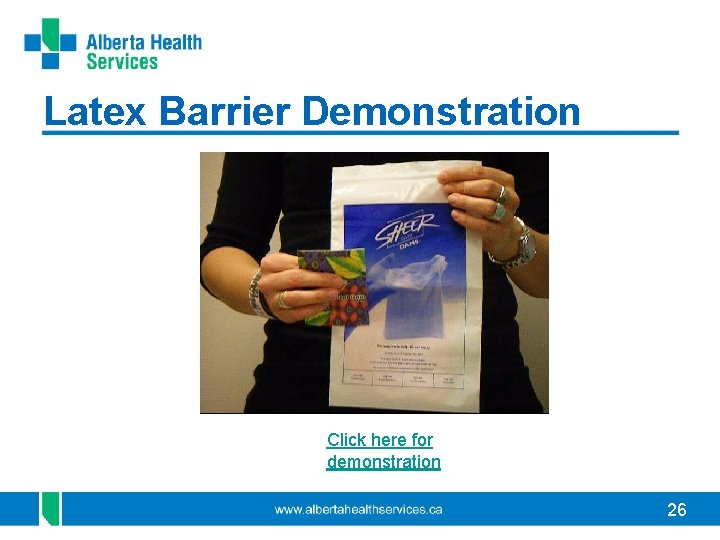
Latex Barrier Demonstration Click here for demonstration 26
Safer Sex Abstinence is the only 100% way to prevent the transmission of STIs If you choose to be sexually active: • Talk to your partner about your sexual health histories • Choose to protect yourself from both pregnancy and sexually transmitted infections (STIs) • Limit your number of partners • Get tested regularly for STIs • Get more information 27
Key Messages • Consistently and correctly use condoms • STIs often have NO symptoms • Communicate with your partner about protecting yourselves from STIs • If you are sexually active have regular testing for STIs 28
Where can I go for help? • • • School Counsellor Teacher School Nurse Walk in Clinic Family Doctor Sexual Health Clinic 29
For more information on STIs including HIV and AIDS Alberta STD Information Line 1 -800 -772 -2437 30