Exploring Quark Gluon Plasma using Photons Jets Heavy






- Slides: 68
Exploring Quark Gluon Plasma using Photons, Jets, & Heavy Quarks Dinesh K. Srivastava Variable Energy Cyclotron Centre Kolkata 700 064, India
Epilogue as a Prologue • Observation of Quark Gluon Plasma is one of the most spectacular confirmations of Quantum Chromo-Dynamics- theory of strong interactions. • It has led to the creation of the conditions of the Early Universe a few micro-seconds after The Big Bang. • It required the largest international effort ever mounted with several thousand engineers and scientists working in unison to build several accelerators and detectors costing billions of dollars and inventing computing techniques like grid computing to deal with the enormous bulk of the data generated. • It has also led to several questions which need to be answered.
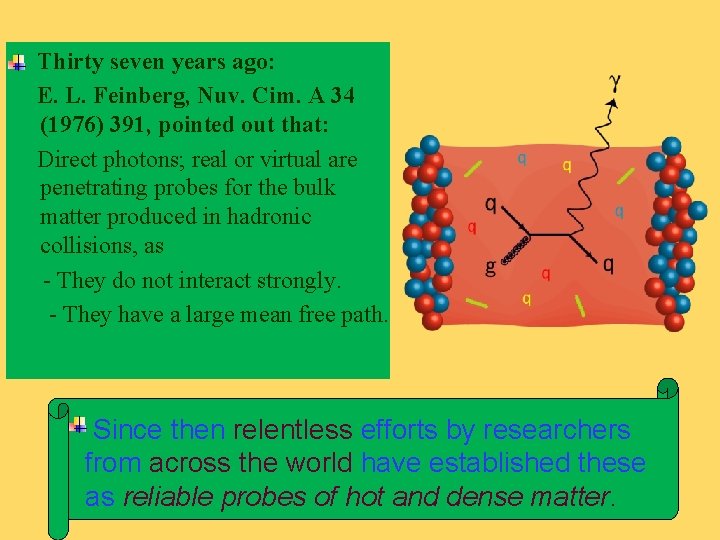
Thirty seven years ago: E. L. Feinberg, Nuv. Cim. A 34 (1976) 391, pointed out that: Direct photons; real or virtual are penetrating probes for the bulk matter produced in hadronic collisions, as - They do not interact strongly. - They have a large mean free path. Since then relentless efforts by researchers from across the world have established these as reliable probes of hot and dense matter.
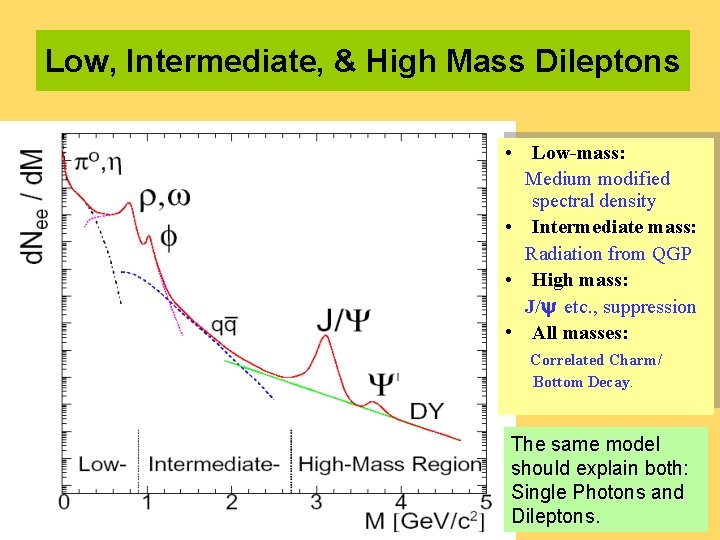
Low, Intermediate, & High Mass Dileptons • Low-mass: Medium modified spectral density • Intermediate mass: Radiation from QGP • High mass: J/y etc. , suppression • All masses: Correlated Charm/ Bottom Decay. The same model should explain both: Single Photons and Dileptons.
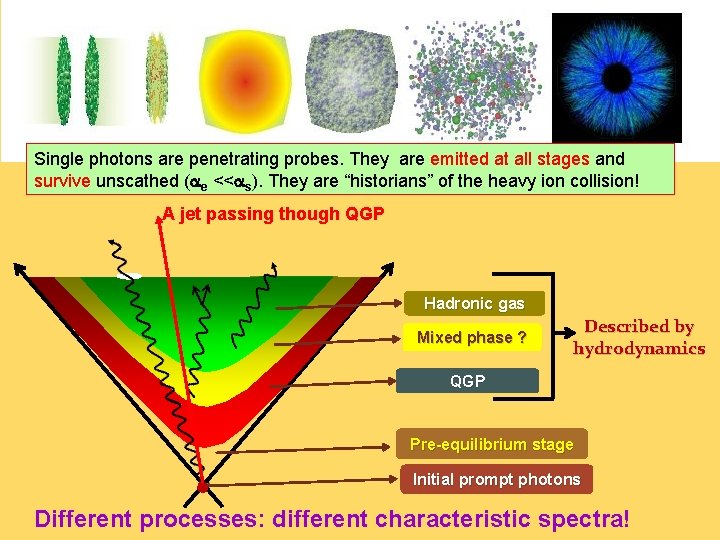
Single photons are penetrating probes. They are emitted at all stages and survive unscathed (ae <<as). They are “historians” of the heavy ion collision! A jet passing though QGP Hadronic gas Mixed phase ? Described by hydrodynamics QGP Pre-equilibrium stage Initial prompt photons Different processes: different characteristic spectra!
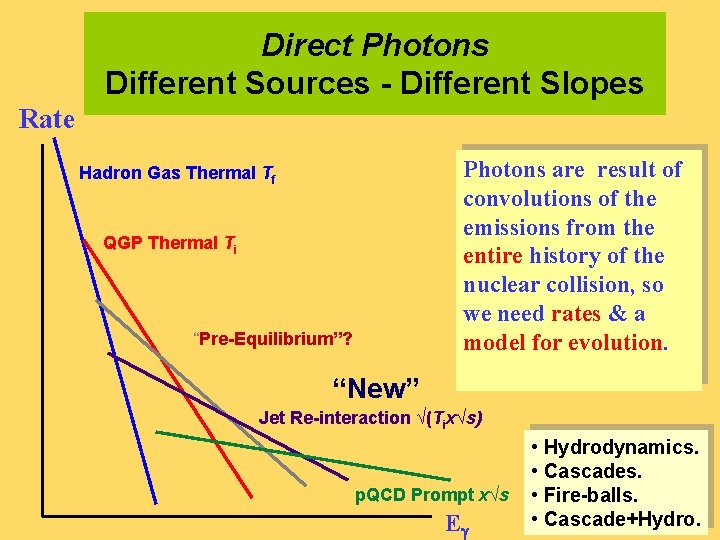
Direct Photons Different Sources - Different Slopes Rate Photons are result of convolutions of the emissions from the entire history of the nuclear collision, so we need rates & a model for evolution. Hadron Gas Thermal Tf QGP Thermal Ti “Pre-Equilibrium”? “New” Jet Re-interaction √(Tix√s) p. QCD Prompt x√s Eg • Hydrodynamics. • Cascades. • Fire-balls. • Cascade+Hydro.
Partonic Processes for Production of Prompt Photons in Hadronic Collisions Compton Annihilation Fragmentation Calculate using NLO p. QCD [with shadowing & scaling with T AA(b) for AA, partons remain confined to individual nucleons; do not forget the isospin! ] The quarks will lose energy before fragmenting if there is QGP; suppressing the fragmentation contribution. See e. g. , Jeon, Jalilian-Marian, Sarcevic, NPA 715 (2003) 795, “QM-2002”.
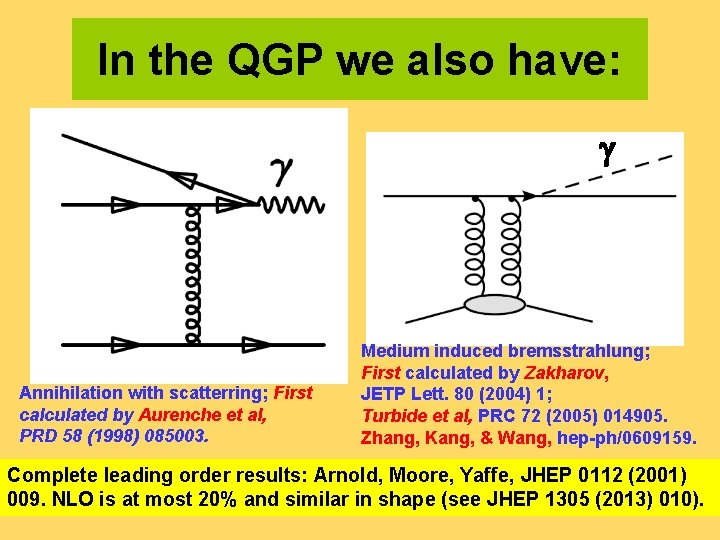
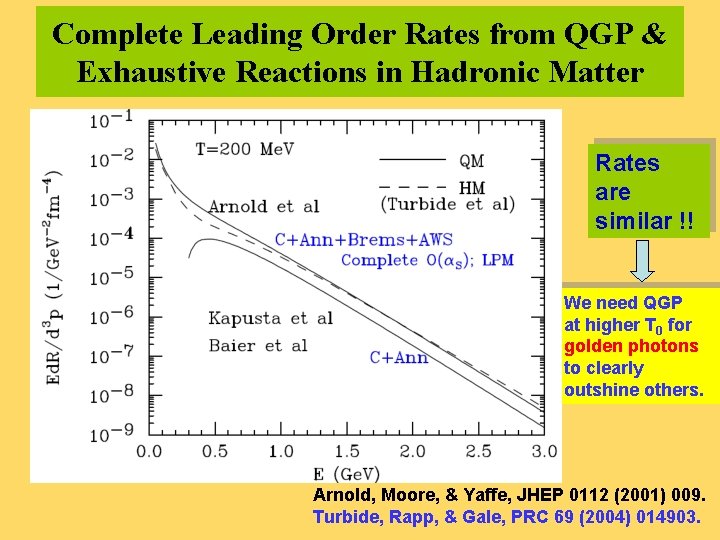
In the QGP we also have: g Annihilation with scatterring; First calculated by Aurenche et al, PRD 58 (1998) 085003. Medium induced bremsstrahlung; First calculated by Zakharov, JETP Lett. 80 (2004) 1; Turbide et al, PRC 72 (2005) 014905. Zhang, Kang, & Wang, hep-ph/0609159. Complete leading order results: Arnold, Moore, Yaffe, JHEP 0112 (2001) 009. NLO is at most 20% and similar in shape (see JHEP 1305 (2013) 010).
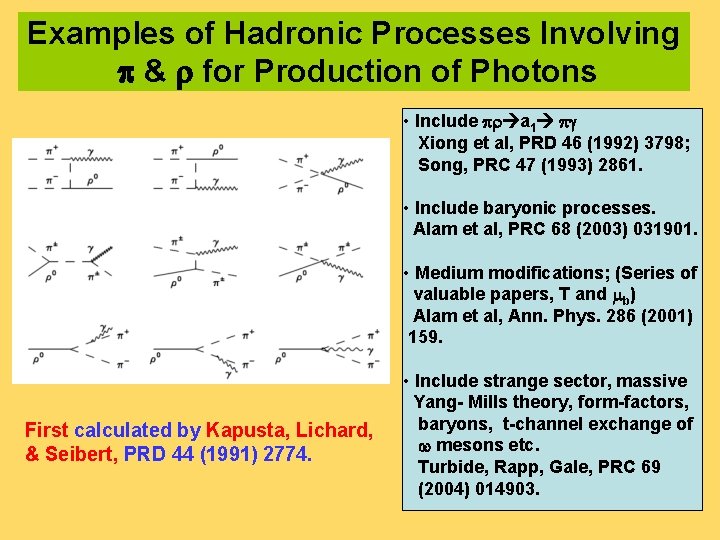
Examples of Hadronic Processes Involving p & r for Production of Photons • Include pr a 1 pg Xiong et al, PRD 46 (1992) 3798; Song, PRC 47 (1993) 2861. • Include baryonic processes. Alam et al, PRC 68 (2003) 031901. • Medium modifications; (Series of valuable papers, T and mb) Alam et al, Ann. Phys. 286 (2001) 159. First calculated by Kapusta, Lichard, & Seibert, PRD 44 (1991) 2774. • Include strange sector, massive Yang- Mills theory, form-factors, baryons, t-channel exchange of w mesons etc. Turbide, Rapp, Gale, PRC 69 (2004) 014903.
Complete Leading Order Rates from QGP & Exhaustive Reactions in Hadronic Matter Rates are similar !! We need QGP at higher T 0 for golden photons to clearly outshine others. Arnold, Moore, & Yaffe, JHEP 0112 (2001) 009. Turbide, Rapp, & Gale, PRC 69 (2004) 014903.
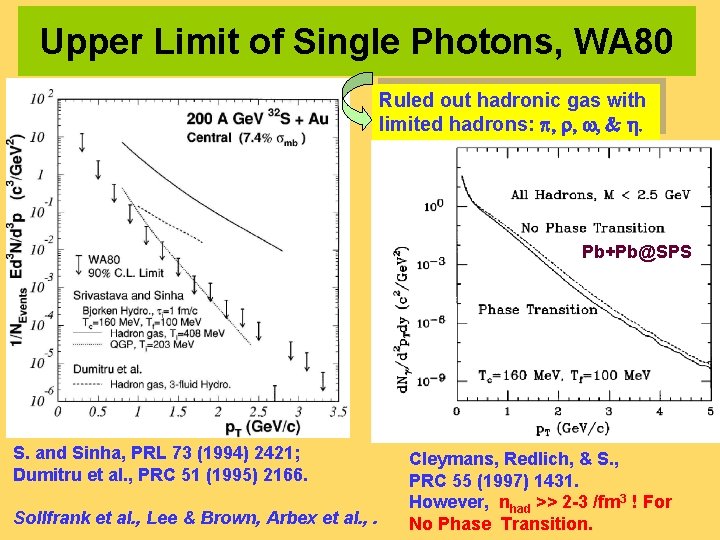
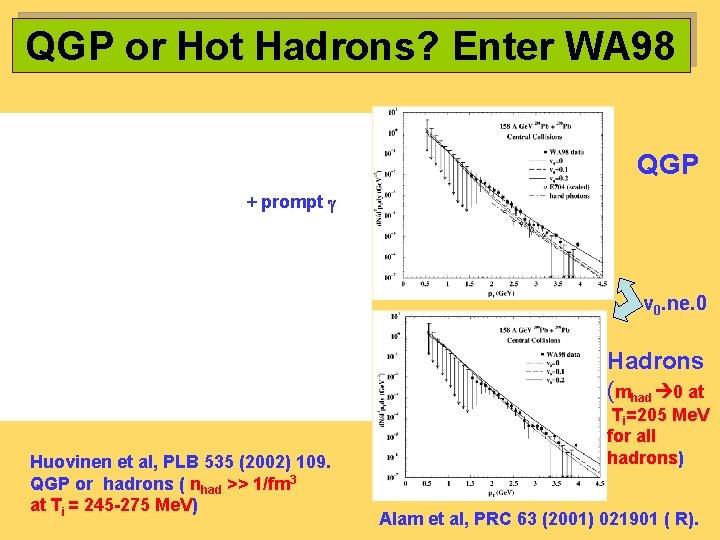
Upper Limit of Single Photons, WA 80 Ruled out hadronic gas with limited hadrons: p, r, w, & h. Pb+Pb@SPS S. and Sinha, PRL 73 (1994) 2421; Dumitru et al. , PRC 51 (1995) 2166. Sollfrank et al. , Lee & Brown, Arbex et al. , . Cleymans, Redlich, & S. , PRC 55 (1997) 1431. However, nhad >> 2 -3 /fm 3 ! For No Phase Transition.
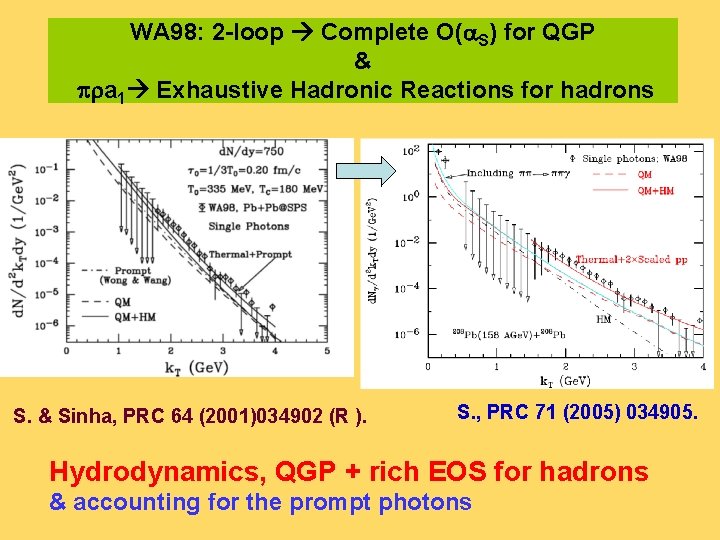
WA 98: 2 -loop Complete O(a. S) for QGP & pra 1 Exhaustive Hadronic Reactions for hadrons S. & Sinha, PRC 64 (2001)034902 (R ). S. , PRC 71 (2005) 034905. Hydrodynamics, QGP + rich EOS for hadrons & accounting for the prompt photons
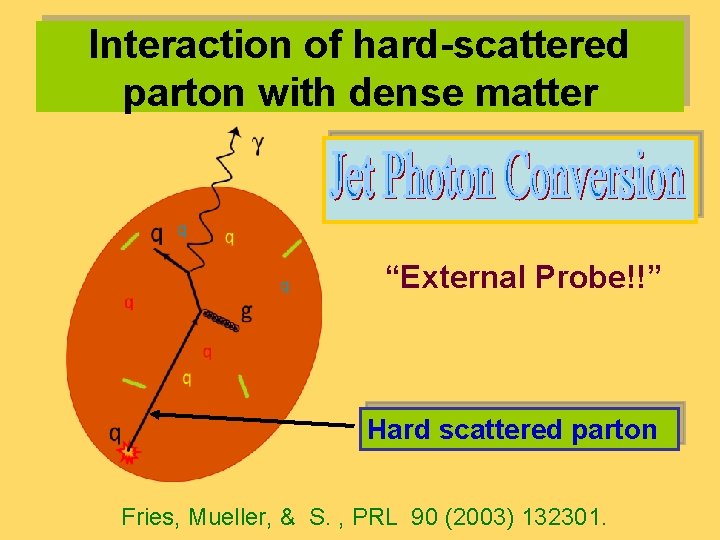
Interaction of hard-scattered parton with dense matter “External Probe!!” Hard scattered parton Fries, Mueller, & S. , PRL 90 (2003) 132301.
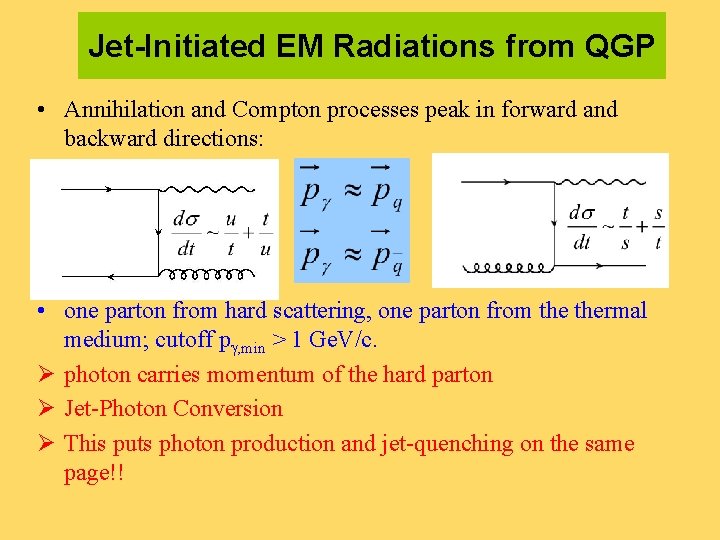
Jet-Initiated EM Radiations from QGP • Annihilation and Compton processes peak in forward and backward directions: • one parton from hard scattering, one parton from thermal medium; cutoff p , min > 1 Ge. V/c. Ø photon carries momentum of the hard parton Ø Jet-Photon Conversion Ø This puts photon production and jet-quenching on the same page!!
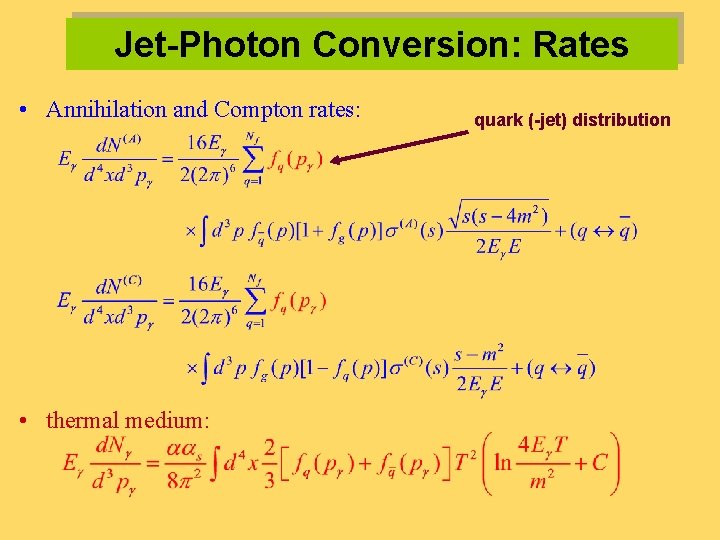
Jet-Photon Conversion: Rates • Annihilation and Compton rates: • thermal medium: quark (-jet) distribution
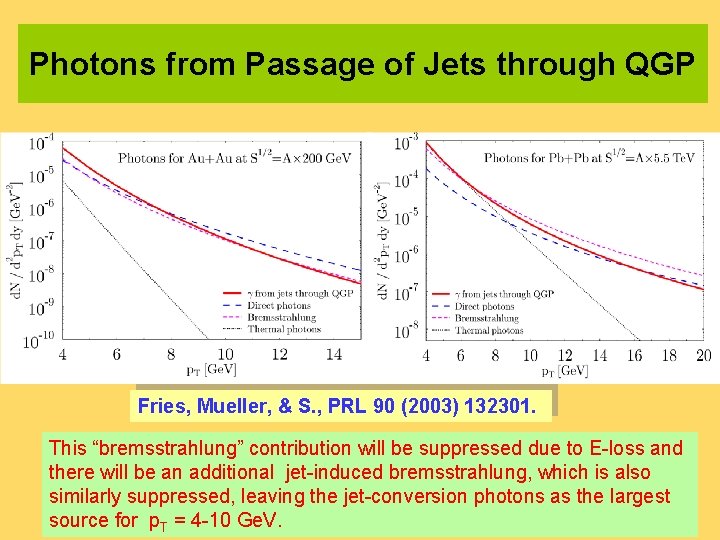
Photons from Passage of Jets through QGP Fries, Mueller, & S. , PRL 90 (2003) 132301. This “bremsstrahlung” contribution will be suppressed due to E-loss and there will be an additional jet-induced bremsstrahlung, which is also similarly suppressed, leaving the jet-conversion photons as the largest source for p. T = 4 -10 Ge. V.
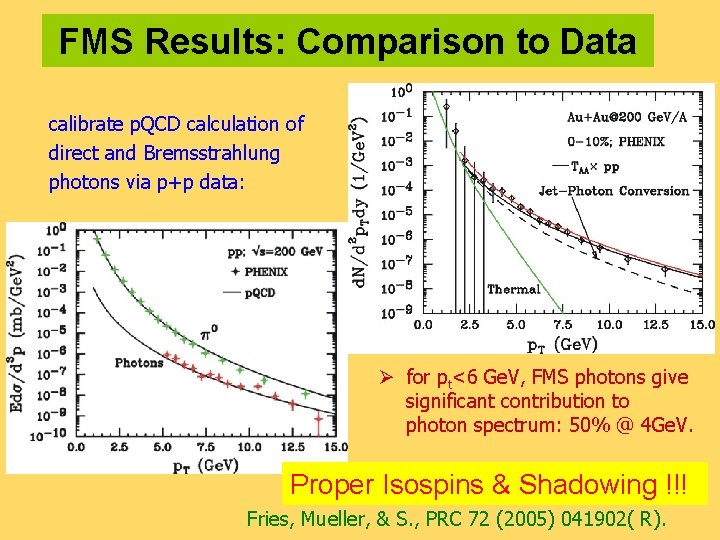
FMS Results: Comparison to Data calibrate p. QCD calculation of direct and Bremsstrahlung photons via p+p data: Ø for pt<6 Ge. V, FMS photons give significant contribution to photon spectrum: 50% @ 4 Ge. V. Proper Isospins & Shadowing !!! Fries, Mueller, & S. , PRC 72 (2005) 041902( R).
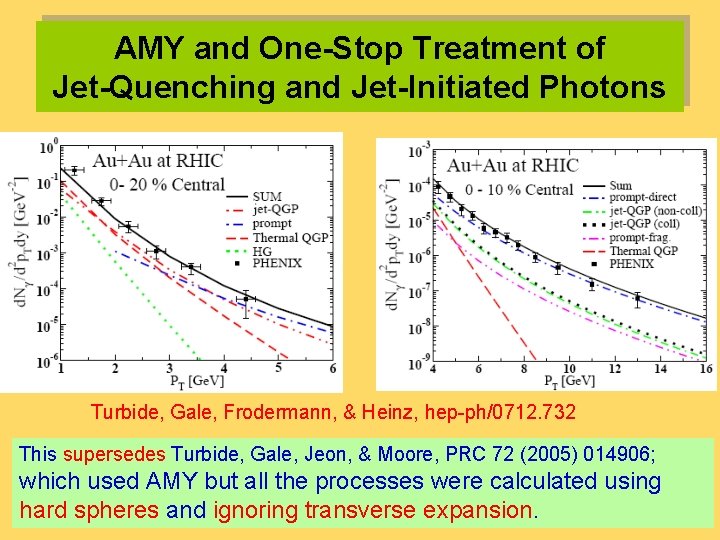
AMY and One-Stop Treatment of Jet-Quenching and Jet-Initiated Photons Turbide, Gale, Frodermann, & Heinz, hep-ph/0712. 732 This supersedes Turbide, Gale, Jeon, & Moore, PRC 72 (2005) 014906; which used AMY but all the processes were calculated using hard spheres and ignoring transverse expansion.
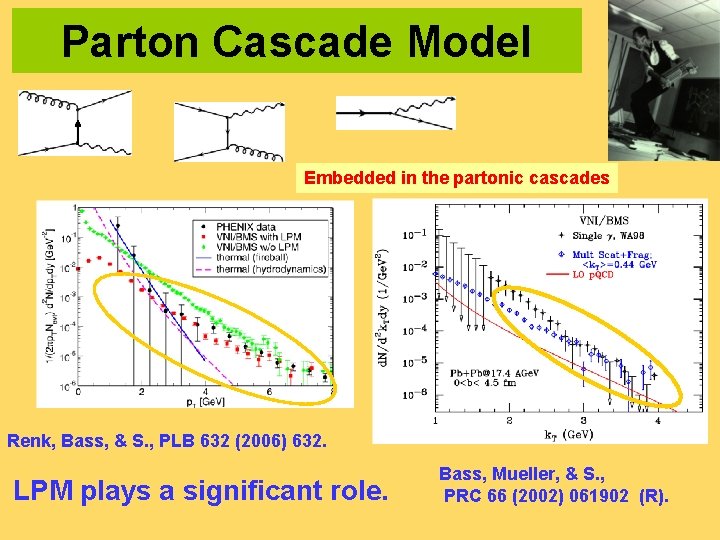
Parton Cascade Model Embedded in the partonic cascades Renk, Bass, & S. , PLB 632 (2006) 632. LPM plays a significant role. Bass, Mueller, & S. , PRC 66 (2002) 061902 (R).
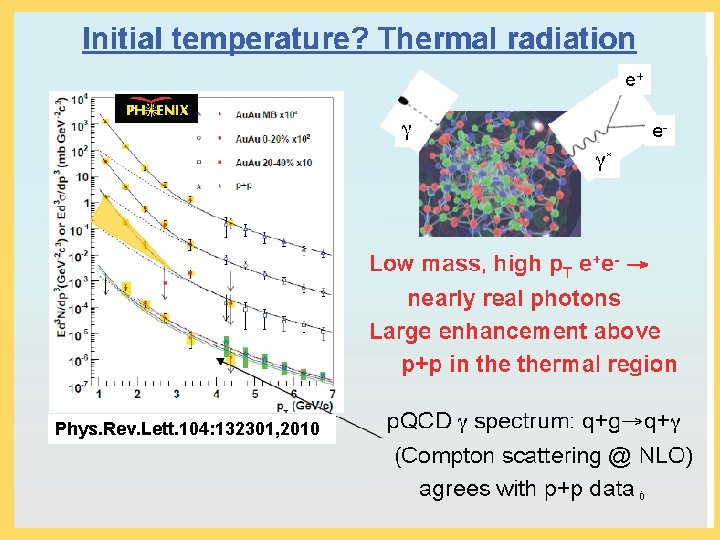
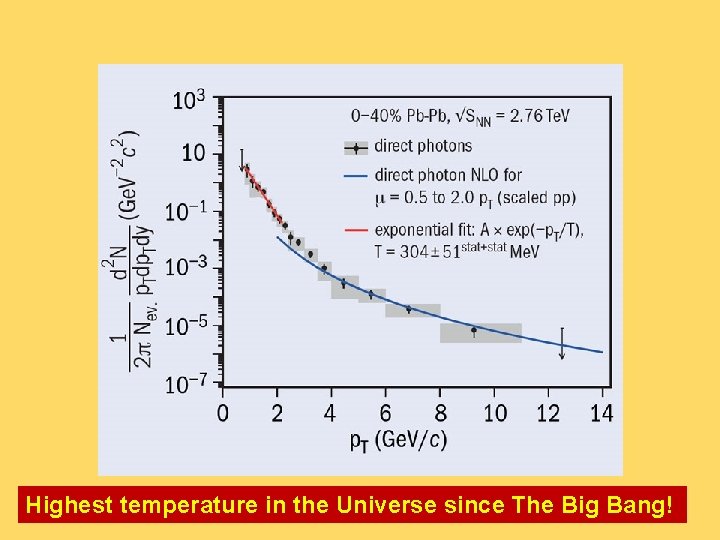
Phys. Rev. Lett. 104: 132301, 2010
Thermal photons from Au+Au@RHIC d’Enterria & Peressounko, EPJC 46 (2006) 451.
Highest temperature in the Universe since The Big Bang!
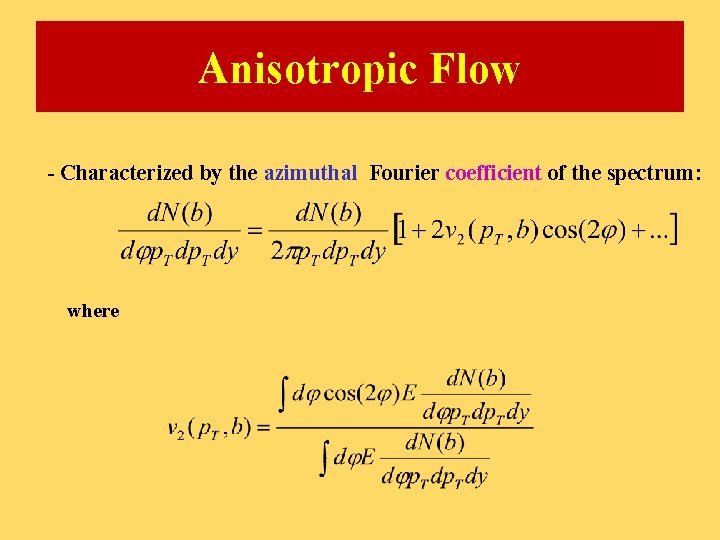
Anisotropic Flow - Characterized by the azimuthal Fourier coefficient of the spectrum: where
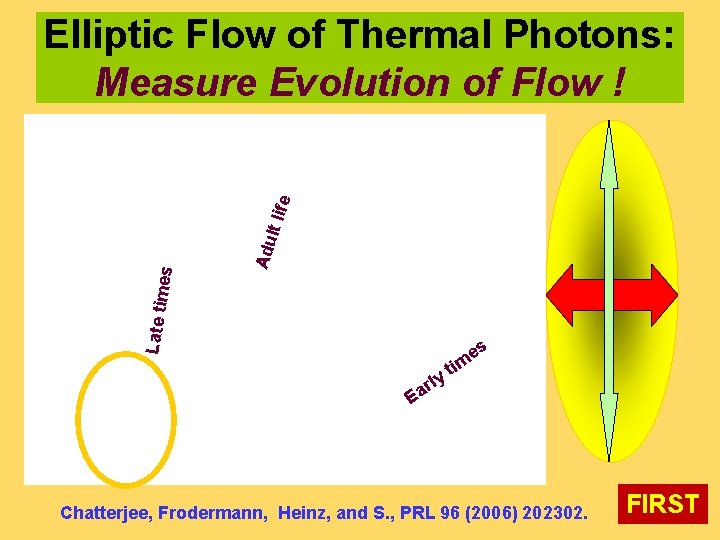
Adu lt lif Late tim es e Elliptic Flow of Thermal Photons: Measure Evolution of Flow ! es im t y l r Ea Chatterjee, Frodermann, Heinz, and S. , PRL 96 (2006) 202302. FIRST
Impact Parameter Dependence of v 2
Elliptic Flow of Thermal Dileptons: Measure Evolution of Flow ! Chatterjee, Heinz, Gale, & S. , PRC 75, 054909 (2007). FIRST
Elliptic flow of thermal photons Chatterjee et al.
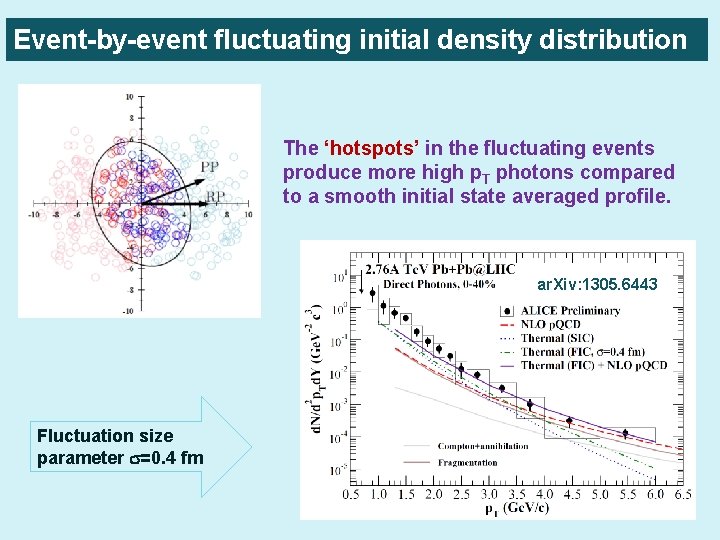
Event-by-event fluctuating initial density distribution The ‘hotspots’ in the fluctuating events produce more high p. T photons compared to a smooth initial state averaged profile. ar. Xiv: 1305. 6443 Fluctuation size parameter s=0. 4 fm
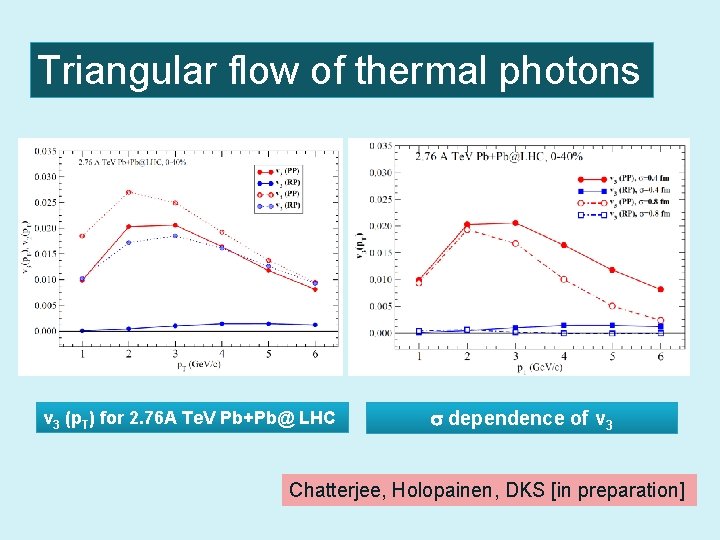
Triangular flow of thermal photons v 3 (p. T) for 2. 76 A Te. V Pb+Pb@ LHC s dependence of v 3 Chatterjee, Holopainen, DKS [in preparation]
Intensity Interferometry of Thermal Photons
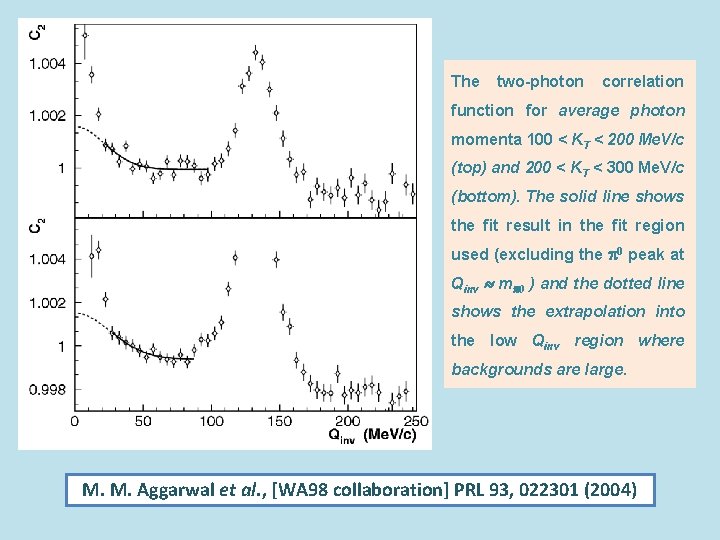
The two-photon correlation function for average photon momenta 100 < KT < 200 Me. V/c (top) and 200 < KT < 300 Me. V/c (bottom). The solid line shows the fit result in the fit region used (excluding the p 0 peak at Qinv mp 0 ) and the dotted line shows the extrapolation into the low Qinv region where backgrounds are large. M. M. Aggarwal et al. , [WA 98 collaboration] PRL 93, 022301 (2004)
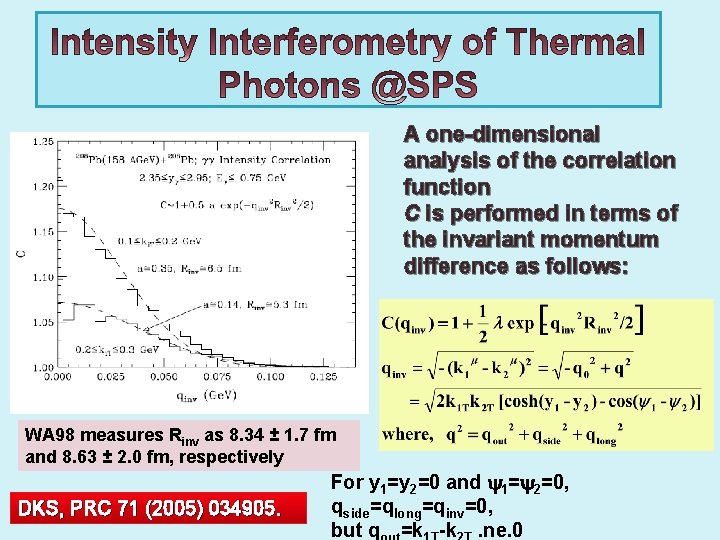
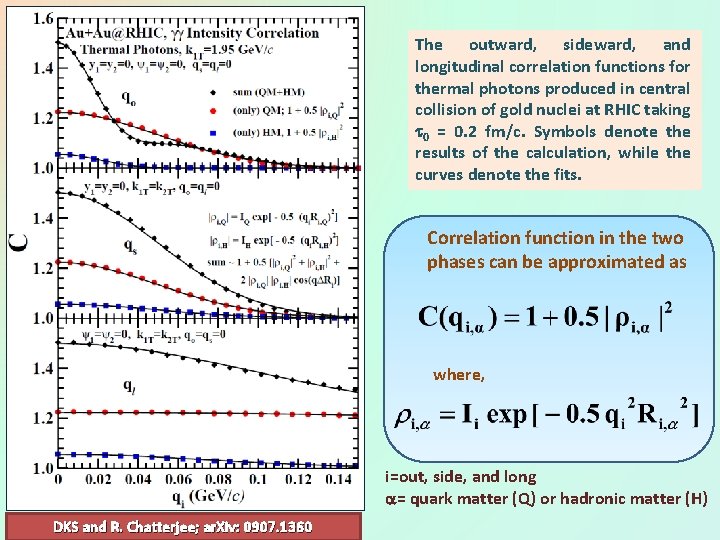
A one-dimensional analysis of the correlation function C is performed in terms of the invariant momentum difference as follows: WA 98 measures Rinv as 8. 34 ± 1. 7 fm and 8. 63 ± 2. 0 fm, respectively DKS, PRC 71 (2005) 034905. For y 1=y 2=0 and y 1=y 2=0, qside=qlong=qinv=0, but q =k -k. ne. 0
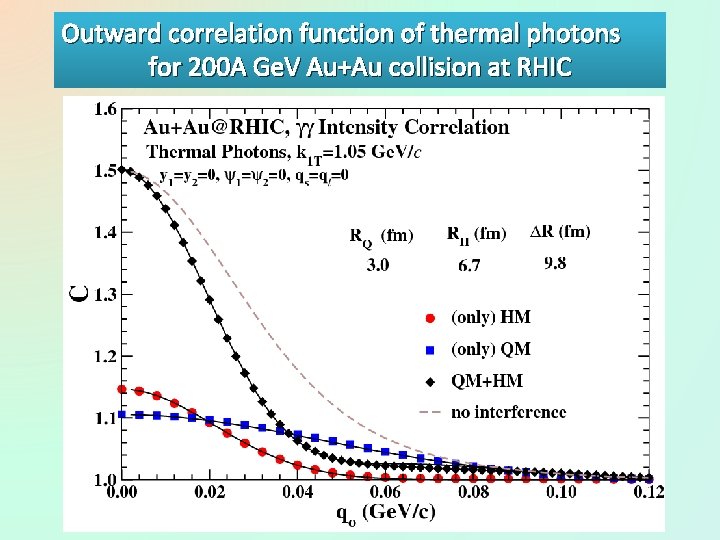
Outward correlation function of thermal photons for 200 A Ge. V Au+Au collision at RHIC
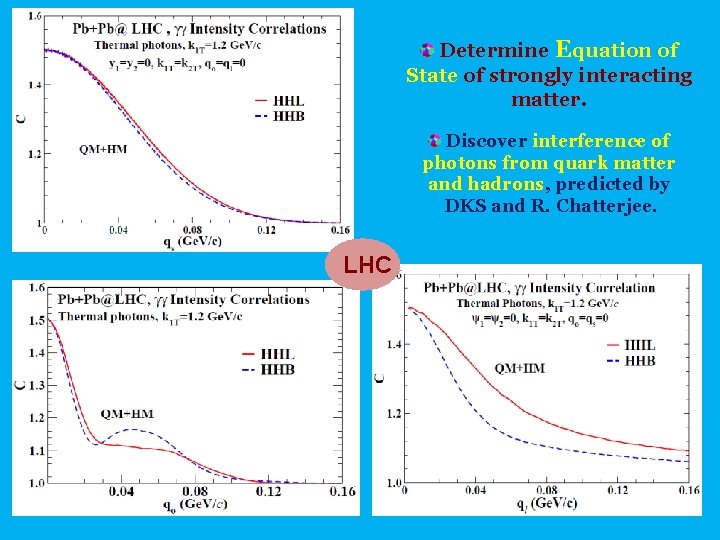
The outward, sideward, and longitudinal correlation functions for thermal photons produced in central collision of gold nuclei at RHIC taking t 0 = 0. 2 fm/c. Symbols denote the results of the calculation, while the curves denote the fits. Correlation function in the two phases can be approximated as where, i=out, side, and long a= quark matter (Q) or hadronic matter (H) DKS and R. Chatterjee; ar. Xiv: 0907. 1360
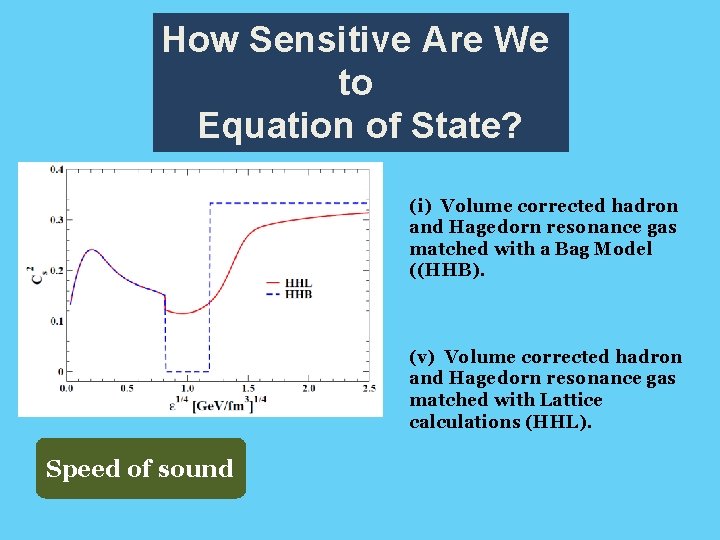
How Sensitive Are We to Equation of State? (i) Volume corrected hadron and Hagedorn resonance gas matched with a Bag Model ((HHB). (v) Volume corrected hadron and Hagedorn resonance gas matched with Lattice calculations (HHL). Speed of sound
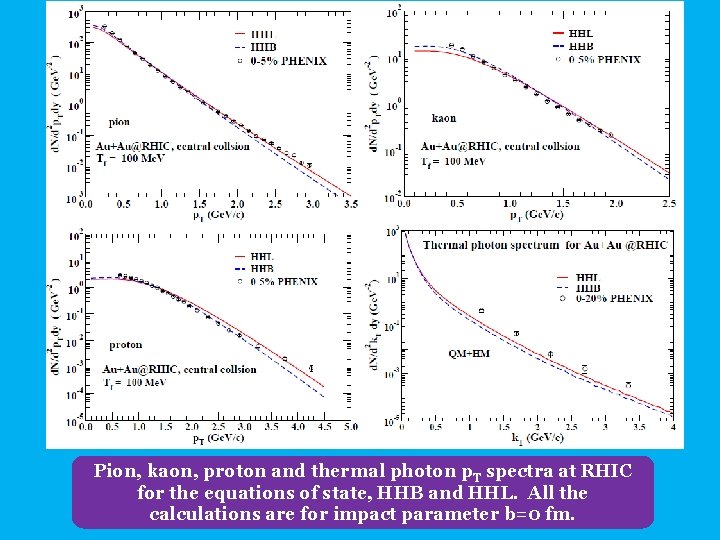
Pion, kaon, proton and thermal photon p. T spectra at RHIC for the equations of state, HHB and HHL. All the calculations are for impact parameter b=0 fm.
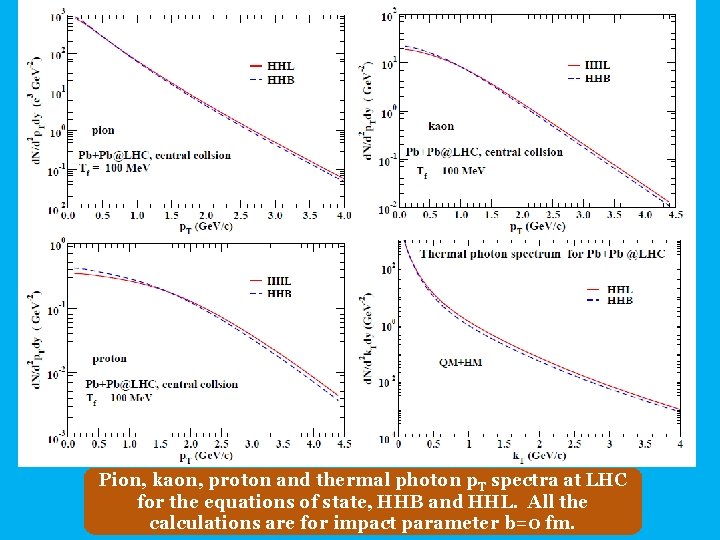
Pion, kaon, proton and thermal photon p. T spectra at LHC for the equations of state, HHB and HHL. All the calculations are for impact parameter b=0 fm.
Determine Equation of State of strongly interacting matter. Discover interference of photons from quark matter and hadrons, predicted by DKS and R. Chatterjee. LHC
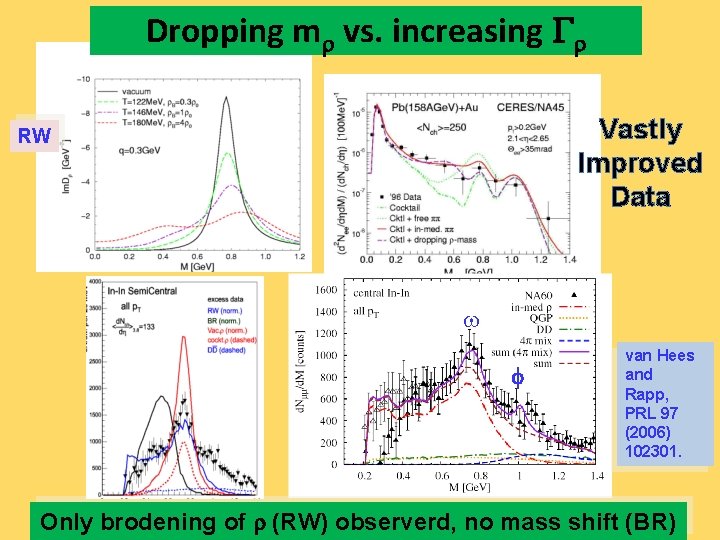
Dropping mr vs. increasing Gr Vastly Improved Data RW w f van Hees and Rapp, PRL 97 (2006) 102301. Only brodening of r (RW) observerd, no mass shift (BR)
Passage of Jets Through QGP
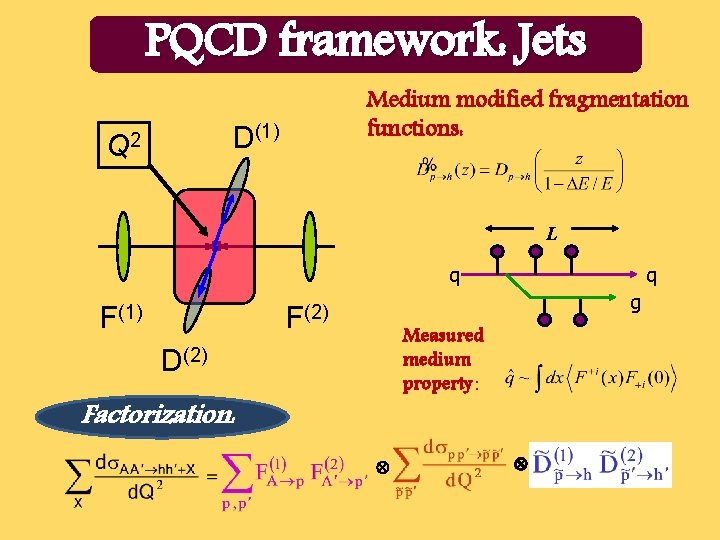
PQCD framework: Jets Medium modified fragmentation functions: D(1) Q 2 L q F(1) q g F(2) Measured medium property: D(2) Factorization:
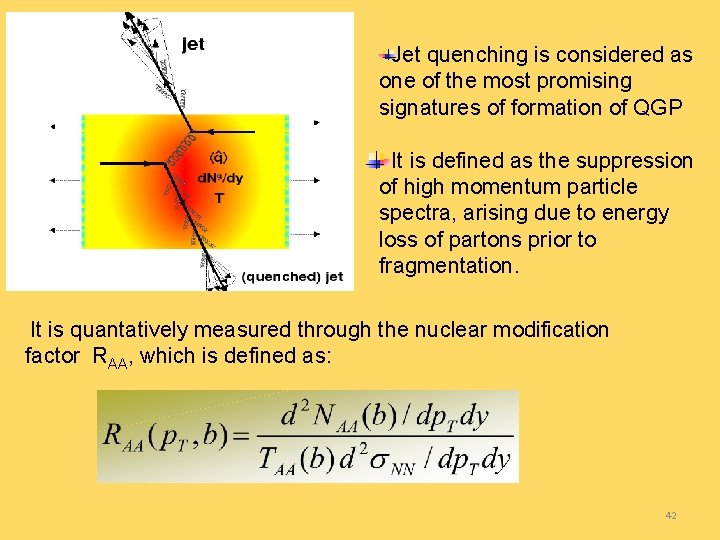
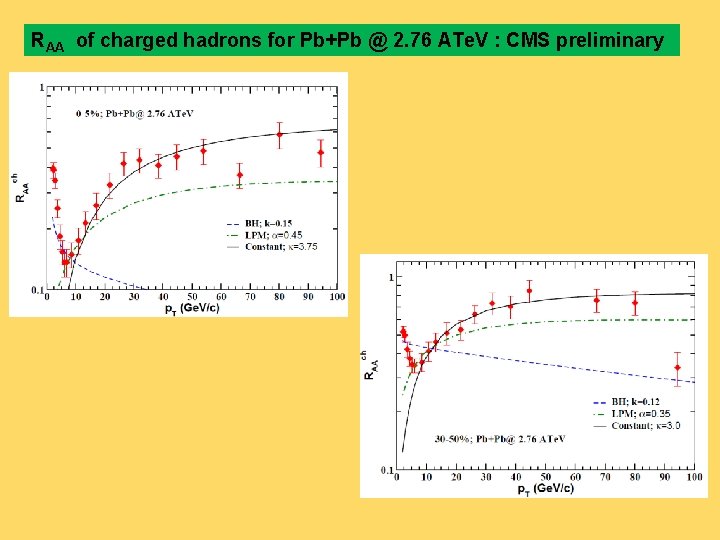
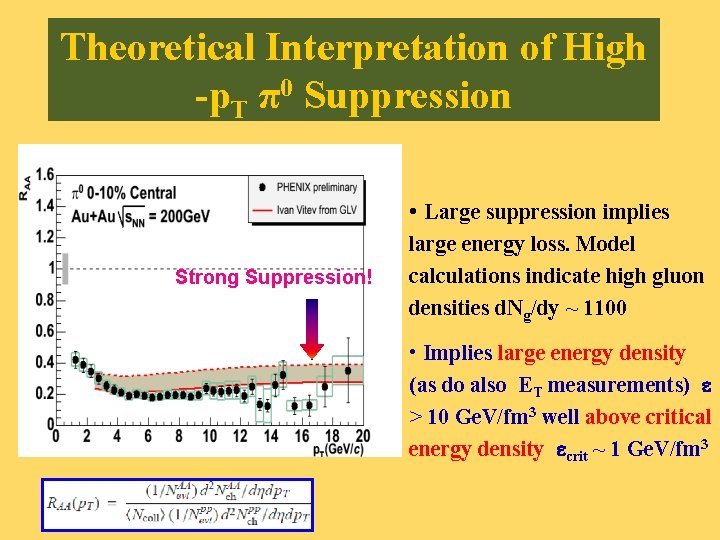
Jet quenching is considered as one of the most promising signatures of formation of QGP It is defined as the suppression of high momentum particle spectra, arising due to energy loss of partons prior to fragmentation. It is quantatively measured through the nuclear modification factor RAA, which is defined as: 42
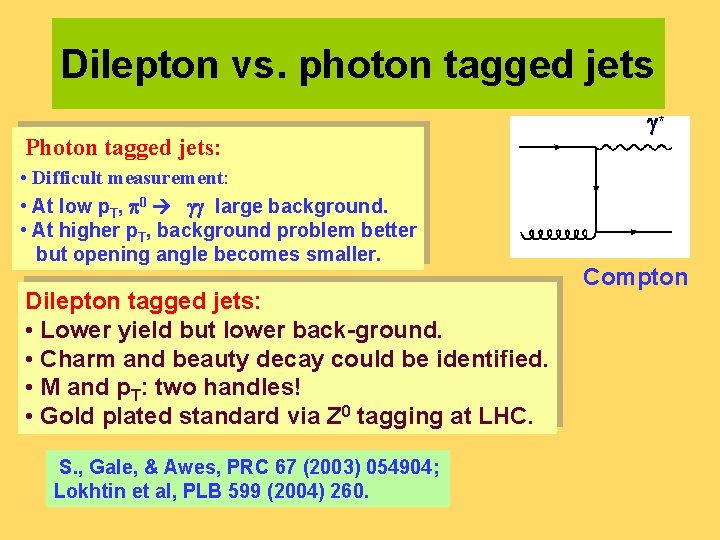
Dilepton vs. photon tagged jets Photon tagged jets: • Difficult measurement: • At low p. T, p 0 gg large background. • At higher p. T, background problem better but opening angle becomes smaller. Dilepton tagged jets: • Lower yield but lower back-ground. • Charm and beauty decay could be identified. • M and p. T: two handles! • Gold plated standard via Z 0 tagging at LHC. S. , Gale, & Awes, PRC 67 (2003) 054904; Lokhtin et al, PLB 599 (2004) 260. g* Compton
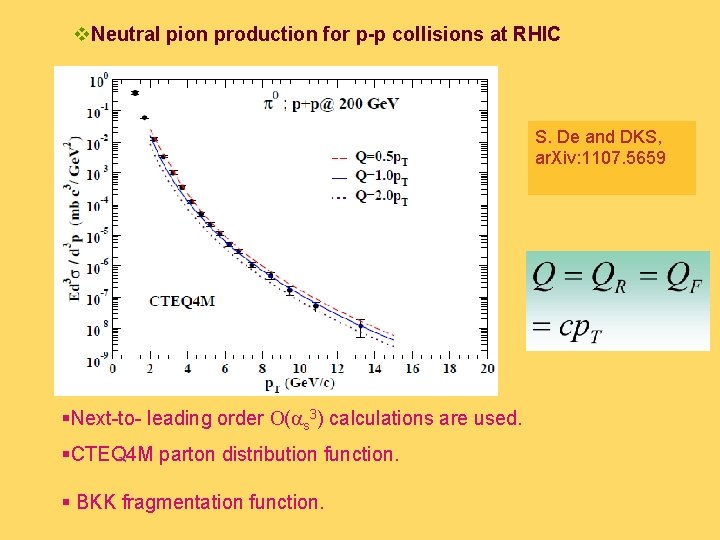
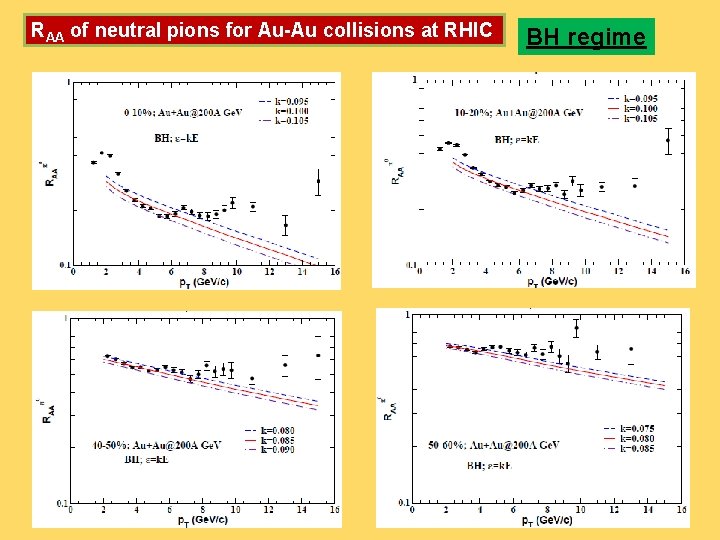
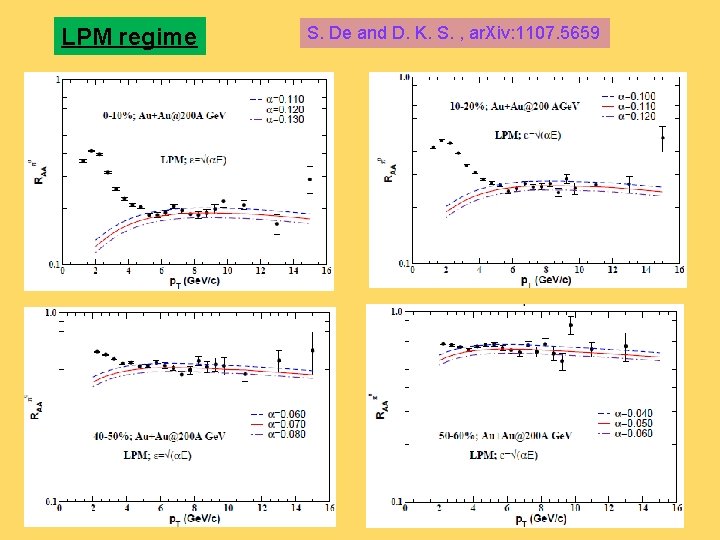
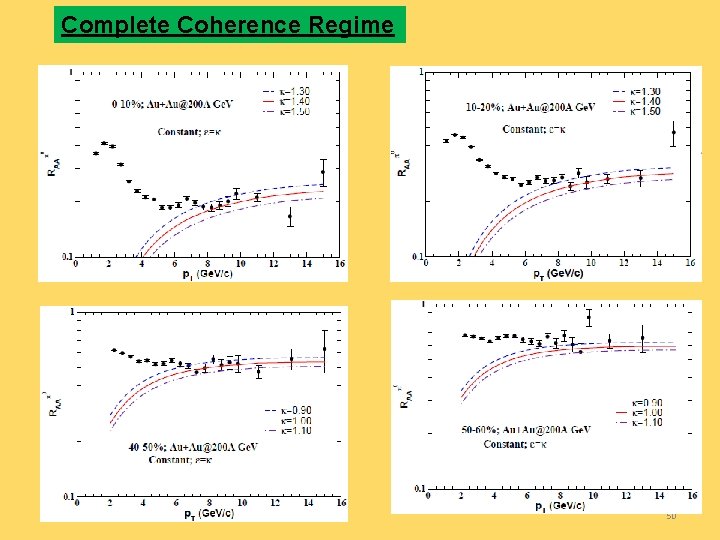
v. Neutral pion production for p-p collisions at RHIC S. De and DKS, ar. Xiv: 1107. 5659 §Next-to- leading order ( s 3) calculations are used. §CTEQ 4 M parton distribution function. § BKK fragmentation function.
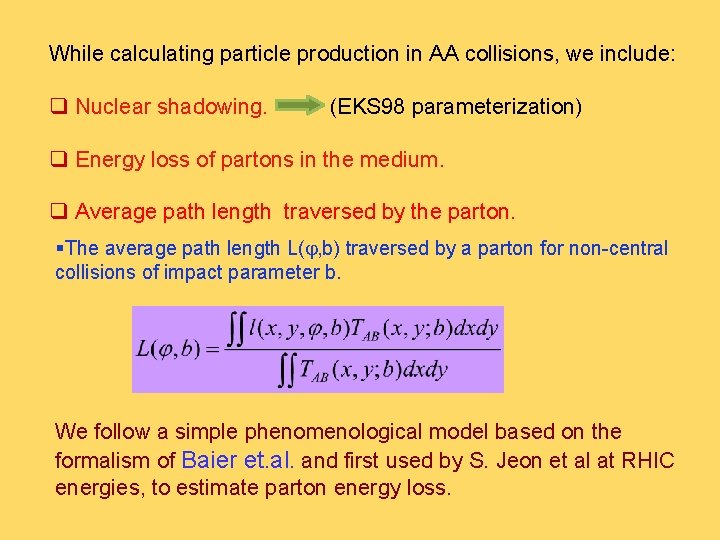
While calculating particle production in AA collisions, we include: q Nuclear shadowing. (EKS 98 parameterization) q Energy loss of partons in the medium. q Average path length traversed by the parton. §The average path length L( , b) traversed by a parton for non-central collisions of impact parameter b. We follow a simple phenomenological model based on the formalism of Baier et. al. and first used by S. Jeon et al at RHIC energies, to estimate parton energy loss.
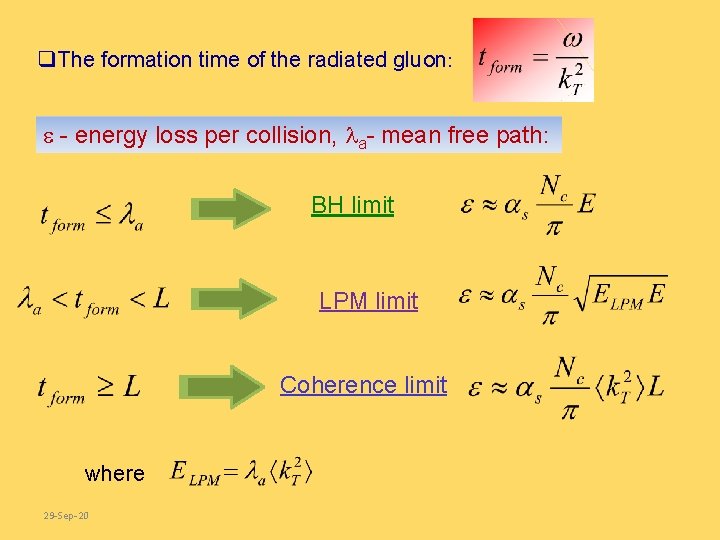
q. The formation time of the radiated gluon: - energy loss per collision, a- mean free path: BH limit LPM limit Coherence limit where 29 -Sep-20
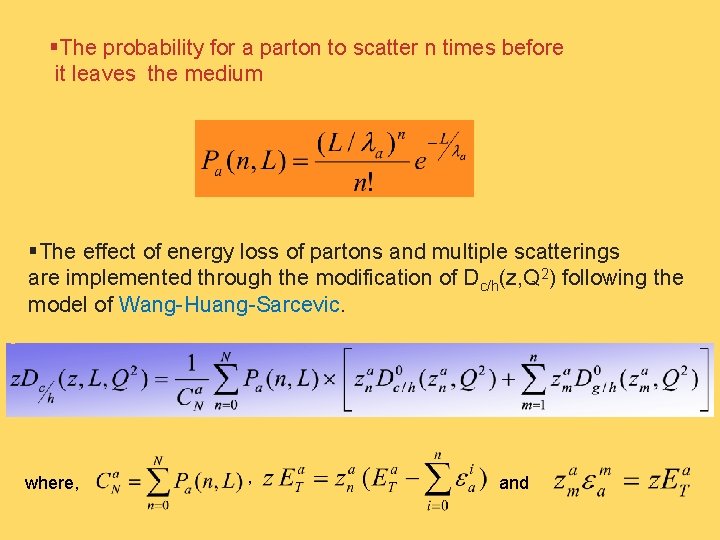
§The probability for a parton to scatter n times before it leaves the medium §The effect of energy loss of partons and multiple scatterings are implemented through the modification of Dc/h(z, Q 2) following the model of Wang-Huang-Sarcevic. where, , and
RAA of neutral pions for Au-Au collisions at RHIC 29 -Sep-20 BH regime 48
LPM regime 29 -Sep-20 S. De and D. K. S. , ar. Xiv: 1107. 5659 49
Complete Coherence Regime 29 -Sep-20 50
RAA of charged hadrons for Pb+Pb @ 2. 76 ATe. V : CMS preliminary
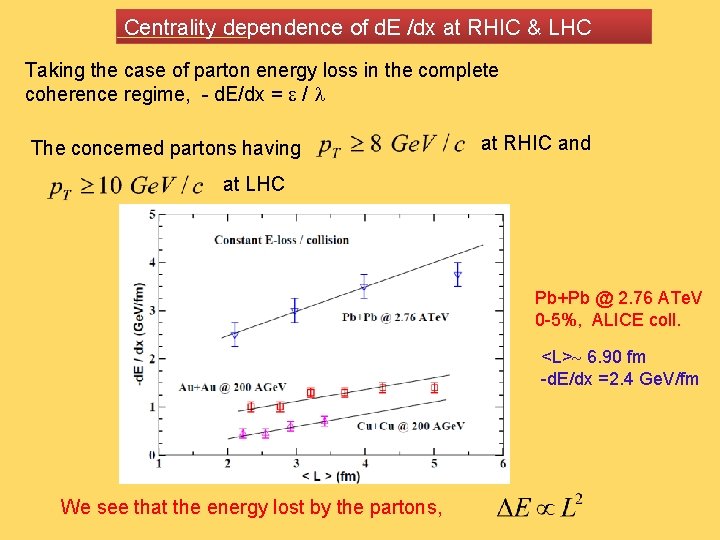
Centrality dependence of d. E /dx at RHIC & LHC Taking the case of parton energy loss in the complete coherence regime, - d. E/dx = / The concerned partons having at RHIC and at LHC Pb+Pb @ 2. 76 ATe. V 0 -5%, ALICE coll. <L> 6. 90 fm -d. E/dx =2. 4 Ge. V/fm We see that the energy lost by the partons,
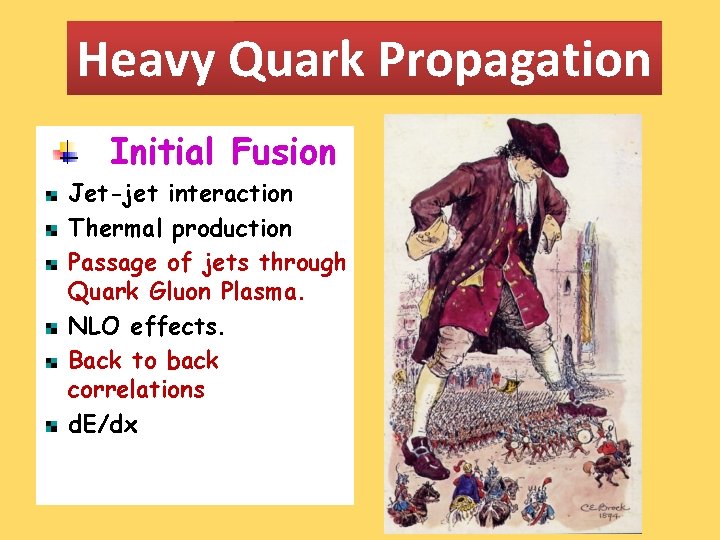
Heavy Quark Propagation Initial Fusion Jet-jet interaction Thermal production Passage of jets through Quark Gluon Plasma. NLO effects. Back to back correlations d. E/dx
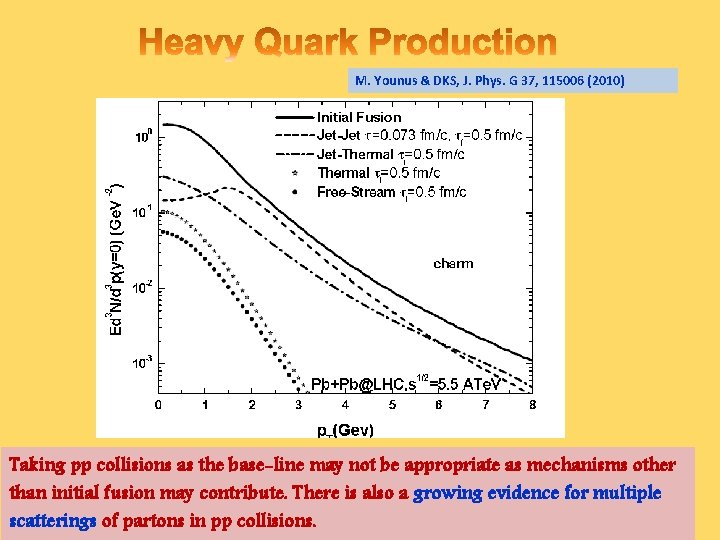
M. Younus & DKS, J. Phys. G 37, 115006 (2010) Taking pp collisions as the base-line may not be appropriate as mechanisms other than initial fusion may contribute. There is also a growing evidence for multiple scatterings of partons in pp collisions.
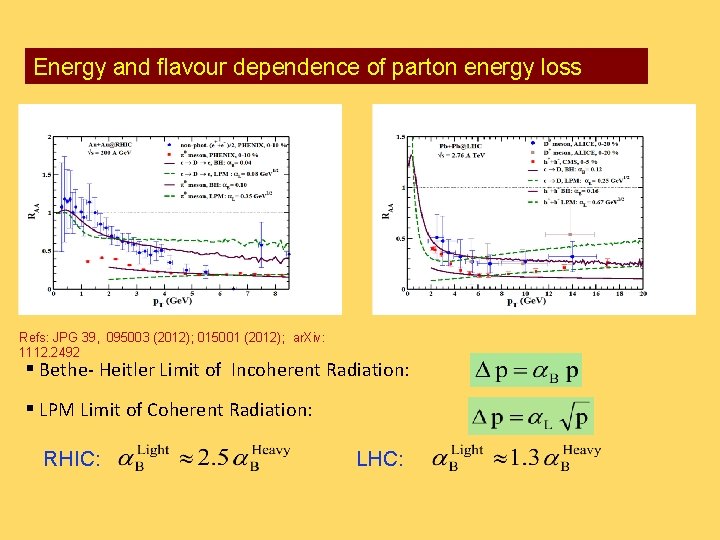
Energy and flavour dependence of parton energy loss Refs: JPG 39, 095003 (2012); 015001 (2012); ar. Xiv: 1112. 2492 § Bethe- Heitler Limit of Incoherent Radiation: § LPM Limit of Coherent Radiation: RHIC: LHC:
Conclusions • The discovery of quark gluon plasma has provided confirmation of one of the most spectacular predictions of QCD- theory of strong interactions. • Single photons, dileptons, jets, and heavy quarks provide interesting details of initial stage of the plasma and its dynamics. • The initial state in these collisions is hot ~300500 Me. V and dense, 20 -100 Ge. V/fm^3, similar to the matter in early universe.
THANK YOU
Back up slides
If I had more time: • Intensity Interferometry of direct photons • • D. K. Srivastava, PLB 307(1993)1. D. K. Srivastava and J. I. Kapusta, PRC 48 (1993) 1335. D. K. Srivastava, PRD 49 (1994) 4523. S. A. Bass, B. Muller, D. K. Srivastava, PRL 16 (2004) 162301; D. K. Srivastava, PRC 71 (2005) 034905. D. K. Srivastava & R. Chatterjee, PRC 80(2009) 054914. S. De, R. Chatterjee, D. K. Srivastava, J. Phys. G 37 (2010) 115004.
Most Reliable Historians of Ancient India ht. g i l A s ession r dig “A Record of Budhist Kingdoms”: Fa Hien (337 -422 AD): visited India during 399 -414 AD. “Journey to the Western World”: Huen Tsang (Yuoan Chwang) 603 -664 AD: visited India during 630 -645 AD. They traversed India like photons and dileptons and left most valuable records!!
Most Reliable Historians of Ancient India ht. g i l A s ession r dig “A Record of Budhist Kingdoms”: Fa Hien (337 -422 AD): visited India during 399 -414 AD. “Journey to the Western World”: Huen Tsang (Yuoan Chwang) 603 -664 AD: visited India during 630 -645 AD. They traversed India like photons and dileptons and left most valuable records!!
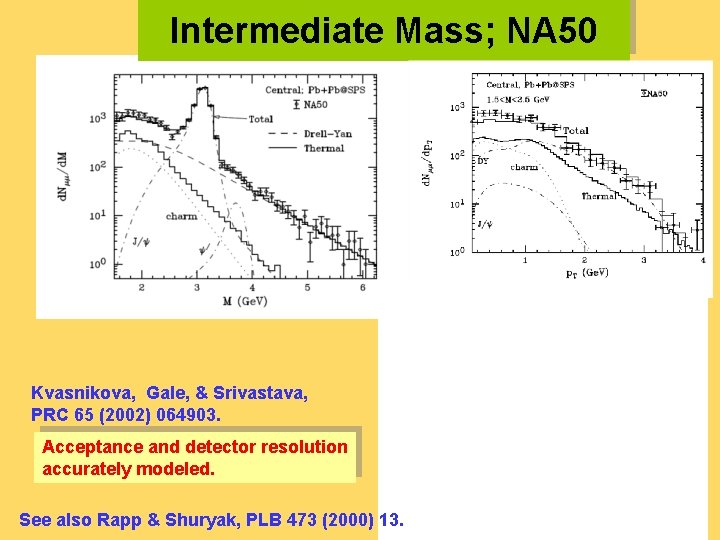
Intermediate Mass; NA 50 Kvasnikova, Gale, & Srivastava, PRC 65 (2002) 064903. Acceptance and detector resolution accurately modeled. See also Rapp & Shuryak, PLB 473 (2000) 13.
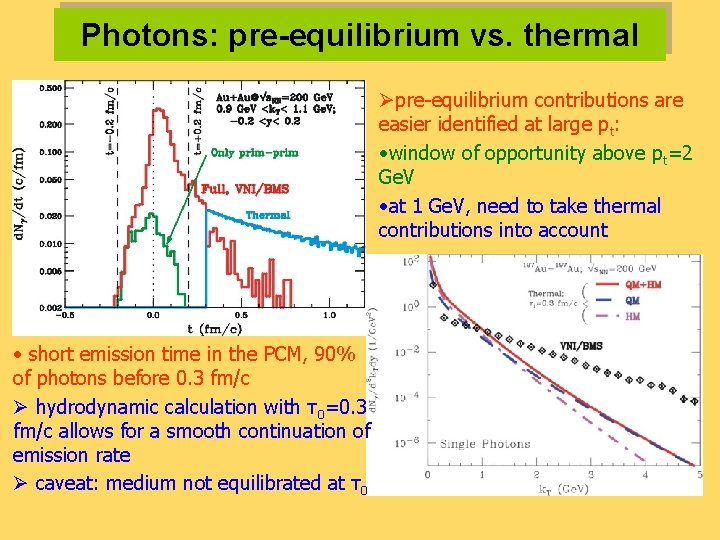
Photons: pre-equilibrium vs. thermal Øpre-equilibrium contributions are easier identified at large pt: • window of opportunity above pt=2 Ge. V • at 1 Ge. V, need to take thermal contributions into account • short emission time in the PCM, 90% of photons before 0. 3 fm/c Ø hydrodynamic calculation with τ0=0. 3 fm/c allows for a smooth continuation of emission rate Ø caveat: medium not equilibrated at τ0
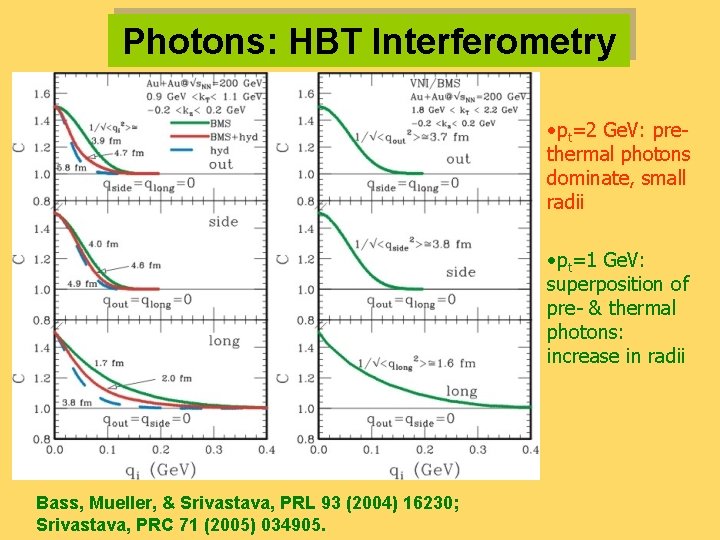
Photons: HBT Interferometry • pt=2 Ge. V: prethermal photons dominate, small radii • pt=1 Ge. V: superposition of pre- & thermal photons: increase in radii Bass, Mueller, & Srivastava, PRL 93 (2004) 16230; Srivastava, PRC 71 (2005) 034905.
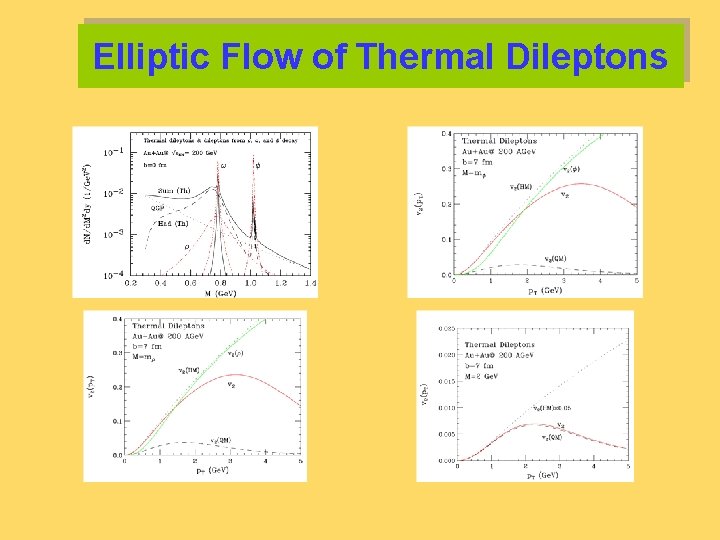
Elliptic Flow of Thermal Dileptons
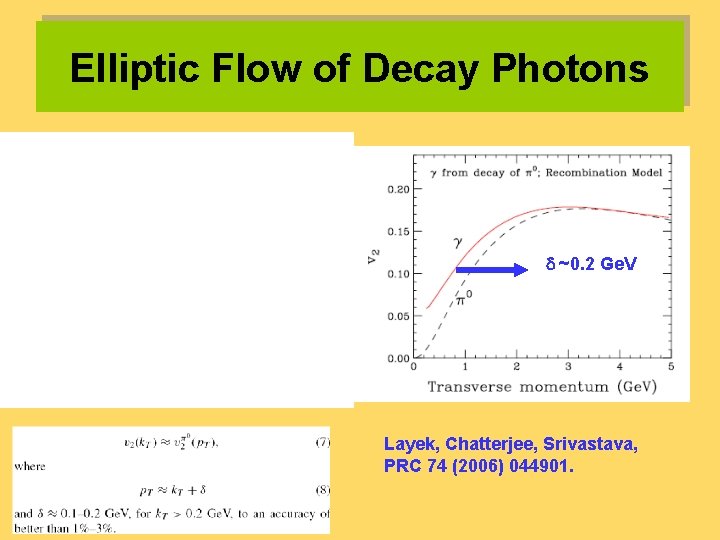
Elliptic Flow of Decay Photons d ~0. 2 Ge. V Layek, Chatterjee, Srivastava, PRC 74 (2006) 044901.
Theoretical Interpretation of High -p. T π0 Suppression • Large suppression implies Strong Suppression! large energy loss. Model calculations indicate high gluon densities d. Ng/dy ~ 1100 • Implies large energy density (as do also ET measurements) e > 10 Ge. V/fm 3 well above critical energy density ecrit ~ 1 Ge. V/fm 3
QGP or Hot Hadrons? Enter WA 98 QGP + prompt g v 0. ne. 0 Hadrons (mhad 0 at Huovinen et al, PLB 535 (2002) 109. QGP or hadrons ( nhad >> 1/fm 3 at Ti = 245 -275 Me. V) Ti=205 Me. V for all hadrons) Alam et al, PRC 63 (2001) 021901 ( R).