
The Facts of Light The Facts Of Light

- Slides: 14
The Facts of Light
“The Facts Of Light” • Light is electromagnetic (“EM”) radiation. • Light has both wave-like and particle-like properties. • Let’s consider some different types of waves….
Part 1: “The Facts Of Light” • Let’s “Do the Wave”! • Stadium-Style = Transverse Wave • Transverse Wave - A wave in which oscillations are perpendicular to the direction the wave travels. • Electromagnetic energy is a transverse wave.
“The Facts Of Light” • Let’s “Do the (other) Wave”! • Geek-Style = Longitudinal Wave • Longitudinal Wave - A wave in which oscillations are parallel to the direction the wave travels. • Acoustic energy is a longitudinal wave.
“The Facts Of Light” • Let’s consider the particle-like properties of light. • The smallest (particle or) unit of light is the photon. • Not all photons are equal!
“The Facts Of Light” • Some photons oscillate at relatively high rates. These are said to be of high energy. • High energy photons travel a short distance over the course of each oscillation, so they have short wavelengths. • Short-wave (i. e. , high energy) light typically appears blue-ish to most humans.
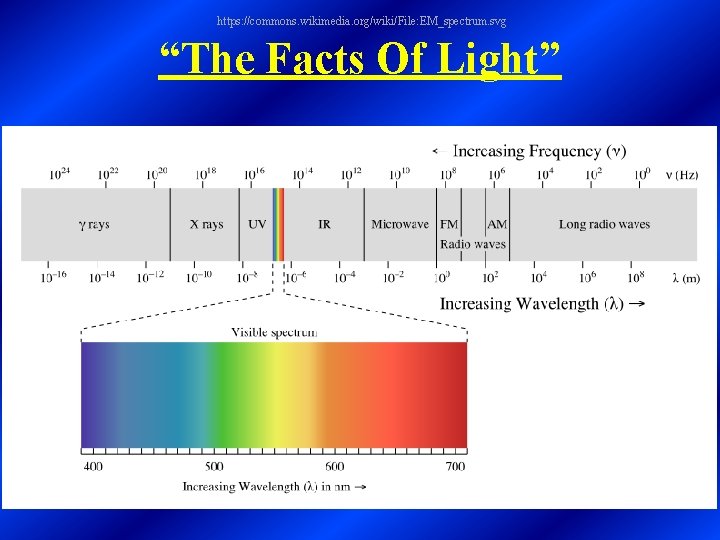
https: //commons. wikimedia. org/wiki/File: EM_spectrum. svg “The Facts Of Light”
“The Facts Of Light” • Some photons oscillate at relatively low rates. These are said to be of low energy. • Low energy photons travel a long distance over the course of each oscillation, so they have long wavelengths. • Long-wave (i. e. , low energy) light typically appears red -ish to most humans.
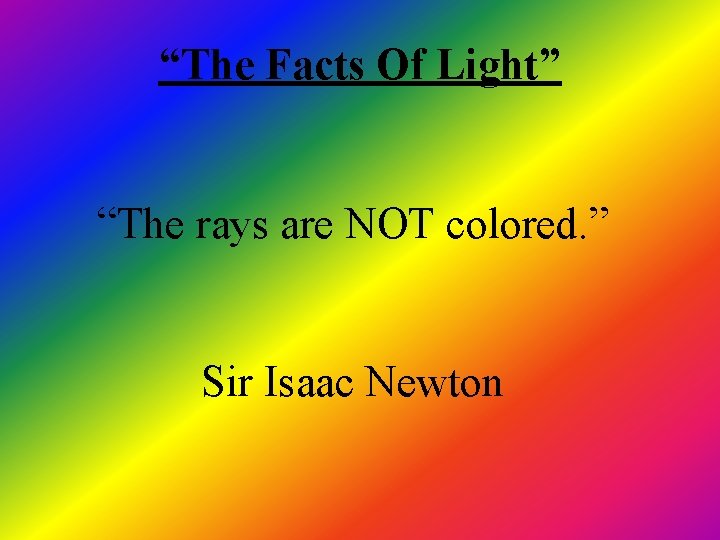
“The Facts Of Light” “The rays are NOT colored. ” Sir Isaac Newton
“The Facts Of Light” “The red’s in the head. ” Billy Wooten
“The Facts Of Light” • What are the evolutionary advantages of being sensitive to electromagnetic energy (versus, say, acoustic energy)? • Electromagnetic energy travels quickly, thereby conveying (almost) immediate information about distant objects, food, predators, potential mates, etc. . • Electromagnetic energy tends to move in straight lines, thereby preserving information about the shape of objects, food, predators, potential mates, etc. .
“The Facts Of Light” • What are the evolutionary advantages of being sensitive to 400700 nanometer wavelengths? • 400 -700 nanometer light is “bouncy”. – Unlike longer-wave energy, which passes through many opaque objects, 400 -700 nanometer light can be reflected (‘bounced’) off of objects, making them visible. 400 -700 nanometer light a better messenger. • On our planet, 400 -700 nm light is plentiful. By contrast, shorter-wave energy tends to be absorbed by our atmosphere (i. e. , by oxygen and nitrogen), and is less plentiful.
“The Facts Of Light” • Summary of evolutionary advantages to using light as the “messenger”. • Plenty fast. • Plenty straight. • Plenty bouncy. • And just-plain-old, PLENTY!