Effective gluon propagator from a Fourier transform of
- Slides: 32
Effective gluon propagator from a Fourier transform of the cot confinement potential Cliffor Benjamín Compeán Jasso UASLP XII Mexican Workshop on Particles and Fields (November 2009) Mazatlan, Sinaloa
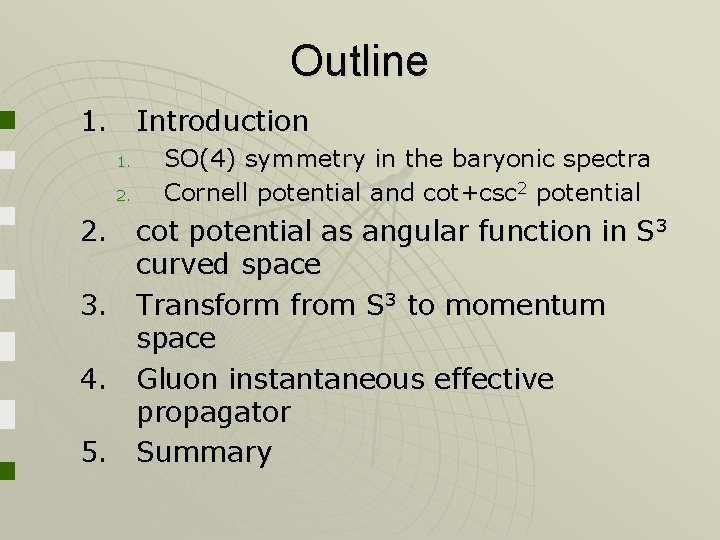
Outline 1. Introduction 1. 2. SO(4) symmetry in the baryonic spectra Cornell potential and cot+csc 2 potential 2. cot potential as angular function in S 3 curved space 3. Transform from S 3 to momentum space 4. Gluon instantaneous effective propagator 5. Summary
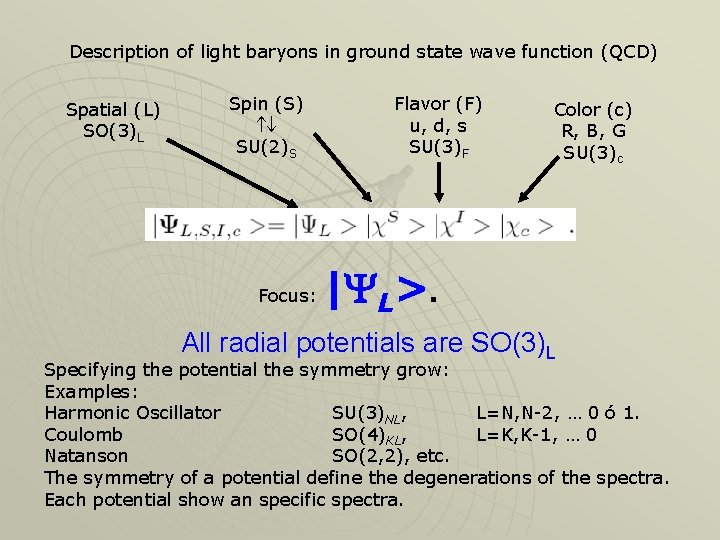
Description of light baryons in ground state wave function (QCD) Spatial (L) SO(3)L Spin (S) SU(2)S Focus: Flavor (F) u, d, s SU(3)F Color (c) R, B, G SU(3)c | L>. All radial potentials are SO(3)L Specifying the potential the symmetry grow: Examples: Harmonic Oscillator SU(3)NL, L=N, N-2, … 0 ó 1. Coulomb SO(4)KL, L=K, K-1, … 0 Natanson SO(2, 2), etc. The symmetry of a potential define the degenerations of the spectra. Each potential show an specific spectra.
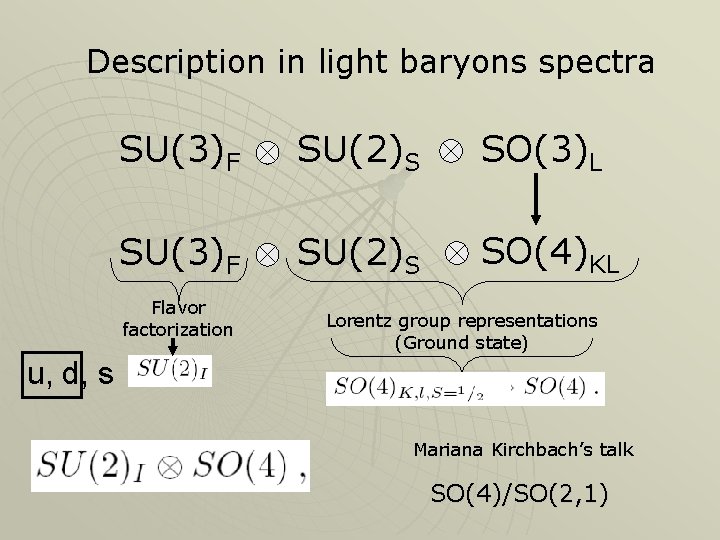
Description in light baryons spectra SU(3)F SU(2)S SO(3)L SU(3)F SU(2)S SO(4)KL Flavor factorization Lorentz group representations (Ground state) u, d, s Mariana Kirchbach’s talk SO(4)/SO(2, 1)
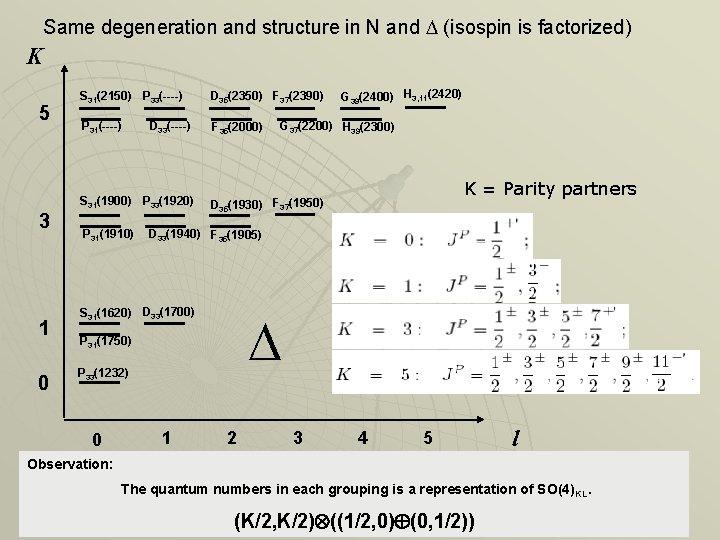
Same degeneration and structure in N and D (isospin is factorized) K 5 S 31(2150) P 33(----) D 35(2350) F 37(2390) P 31(----) F 35(2000) D 33(----) S 31(1900) P 33(1920) 3 1 0 P 31(1910) G 37(2200) H 39(2300) K = Parity partners D 35(1930) F 37(1950) D 33(1940) F 35(1905) S 31(1620) D 33(1700) D P 31(1750) P 33(1232) 0 G 39(2400) H 3, 11(2420) 1 2 3 4 5 l Observation: The quantum numbers in each grouping is a representation of SO(4) KL. (K/2, K/2) ((1/2, 0) (0, 1/2))
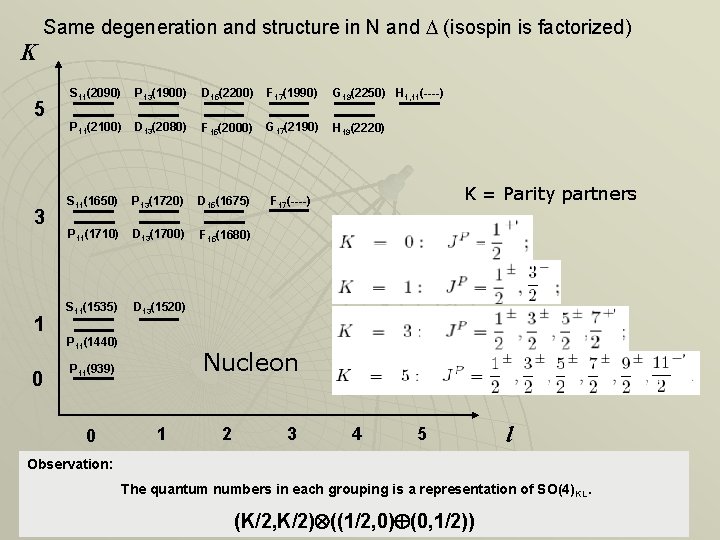
Same degeneration and structure in N and D (isospin is factorized) K 5 3 1 0 S 11(2090) P 13(1900) D 15(2200) F 17(1990) G 19(2250) H 1, 11(----) P 11(2100) D 13(2080) F 15(2000) G 17(2190) H 19(2220) S 11(1650) P 13(1720) D 15(1675) F 17(----) P 11(1710) D 13(1700) F 15(1680) S 11(1535) D 13(1520) P 11(1440) Nucleon P 11(939) 0 K = Parity partners 1 2 3 4 5 l Observation: The quantum numbers in each grouping is a representation of SO(4) KL. (K/2, K/2) ((1/2, 0) (0, 1/2))
u The idea is find a potential that reproduce the Nucleon and D spectra and the level separation that respect the SO(4) symmetry.
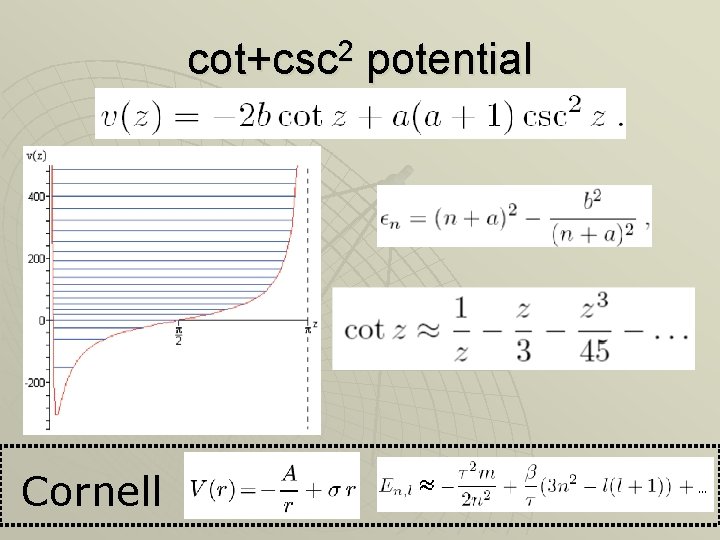
cot+csc 2 potential Cornell
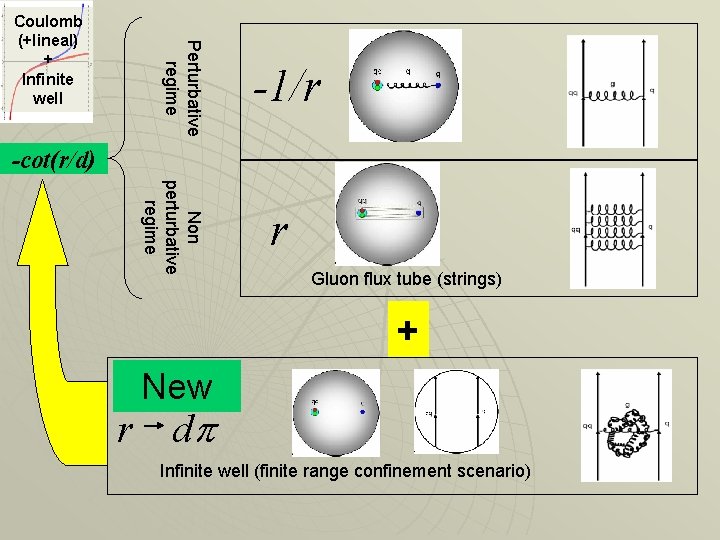
Perturbative regime Coulomb (+lineal) + Infinite well -1/r -cot(r/d) Non perturbative regime r Gluon flux tube (strings) + r New dp Infinite well (finite range confinement scenario)
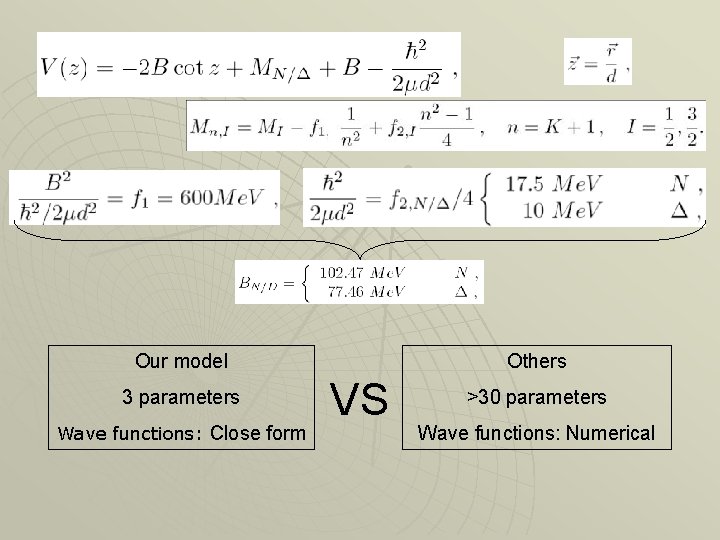
Our model 3 parameters Wave functions: Close form Others VS >30 parameters Wave functions: Numerical
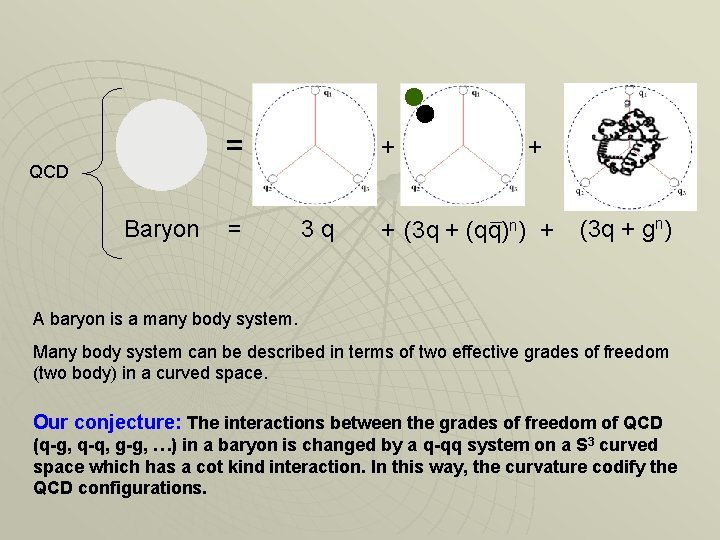
= QCD Baryon = + 3 q + + (3 q + (qq)n) + (3 q + gn) A baryon is a many body system. Many body system can be described in terms of two effective grades of freedom (two body) in a curved space. Our conjecture: The interactions between the grades of freedom of QCD (q-g, q-q, g-g, …) in a baryon is changed by a q-qq system on a S 3 curved space which has a cot kind interaction. In this way, the curvature codify the QCD configurations.
The Nucleon and D spectra was described in term of the SO(4) symmetry. u There was described the degeneration and level separations. u Cot potential reproduce the Nucleon and D spectra degeneration and the level separation and respect the SO(4) symmetry. u
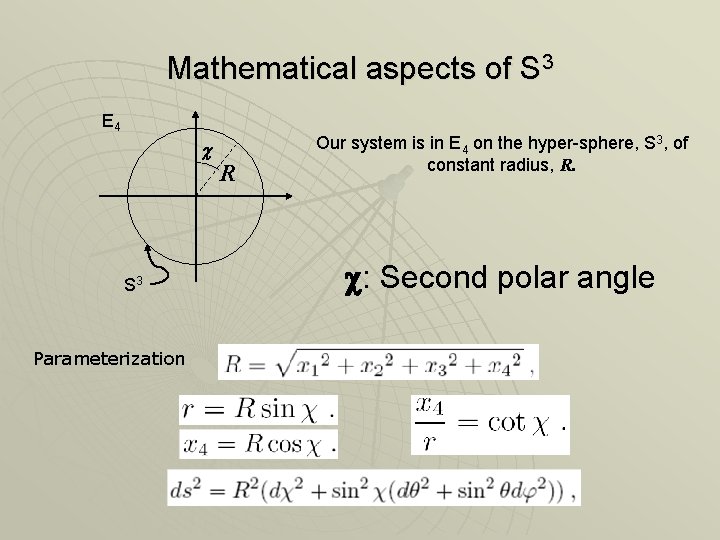
Mathematical aspects of S 3 E 4 R S 3 Parameterization Our system is in E 4 on the hyper-sphere, S 3, of constant radius, R. : Second polar angle
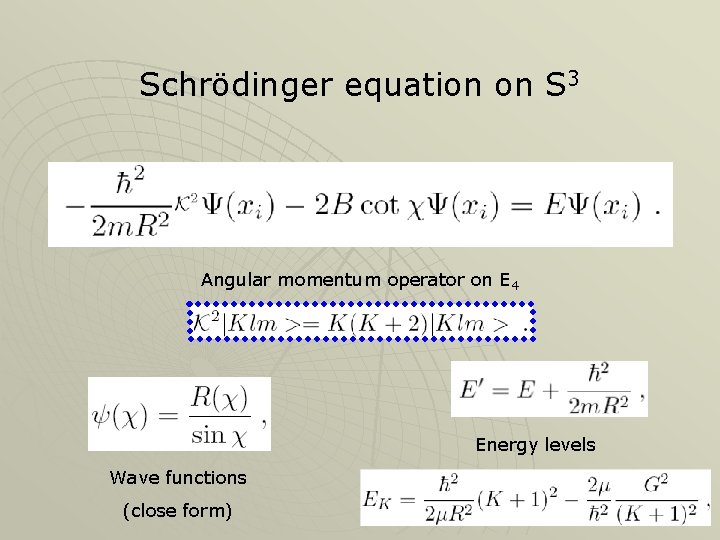
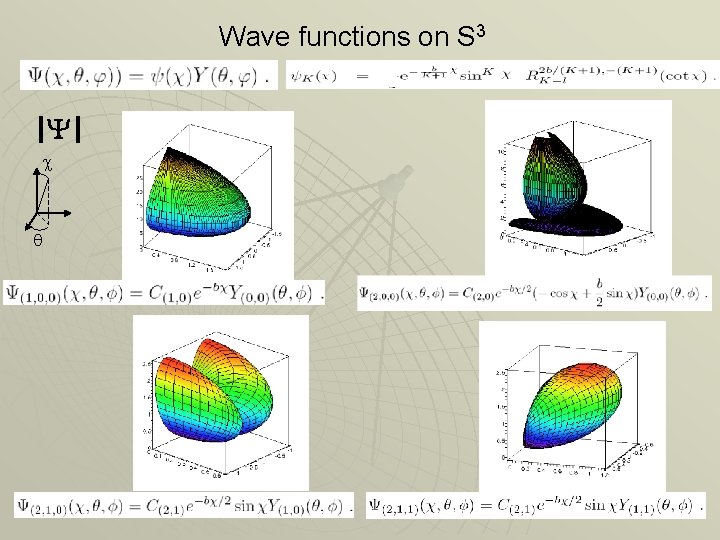
Schrödinger equation on S 3 Angular momentum operator on E 4 Energy levels Wave functions (close form)
Wave functions on S 3 | | q
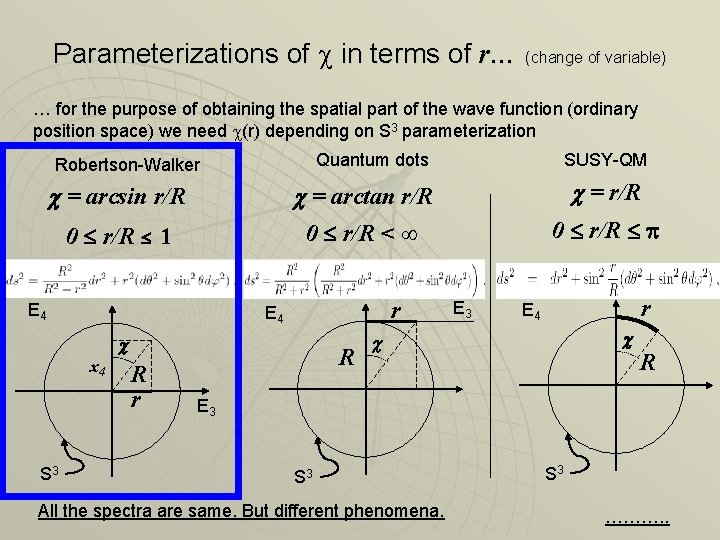
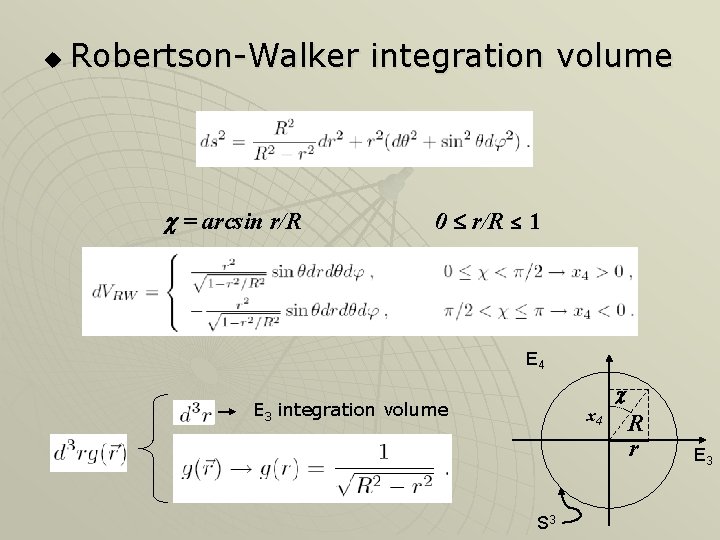
Parameterizations of in terms of r… (change of variable) … for the purpose of obtaining the spatial part of the wave function (ordinary position space) we need (r) depending on S 3 parameterization Quantum dots Robertson-Walker SUSY-QM = arcsin r/R = arctan r/R = r/R 0 r/R 1 0 r/R < 0 r/R p E 4 r E 4 x 4 S 3 R r R E 3 r E 4 R E 3 S 3 All the spectra are same. But different phenomena. S 3 ………. .
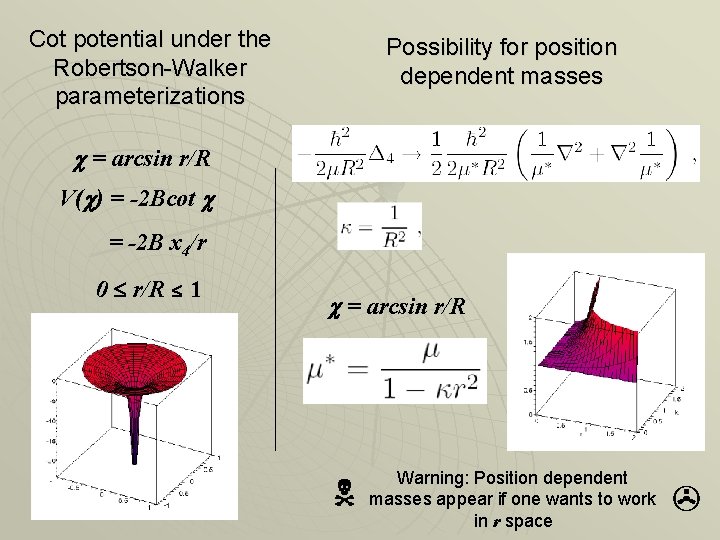
Cot potential under the Robertson-Walker parameterizations Possibility for position dependent masses = arcsin r/R V( ) = -2 Bcot = -2 B x 4/r 0 r/R 1 = arcsin r/R Warning: Position dependent masses appear if one wants to work in r space
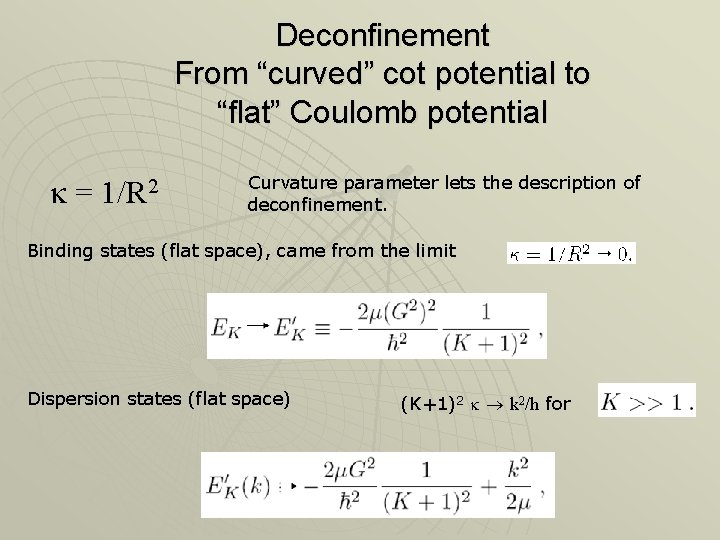
Deconfinement From “curved” cot potential to “flat” Coulomb potential k = 1/R 2 Curvature parameter lets the description of deconfinement. Binding states (flat space), came from the limit Dispersion states (flat space) (K+1)2 k k 2/h for
u Robertson-Walker integration volume = arcsin r/R 0 r/R 1 E 4 E 3 integration volume x 4 S 3 R r E 3
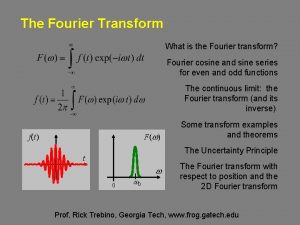
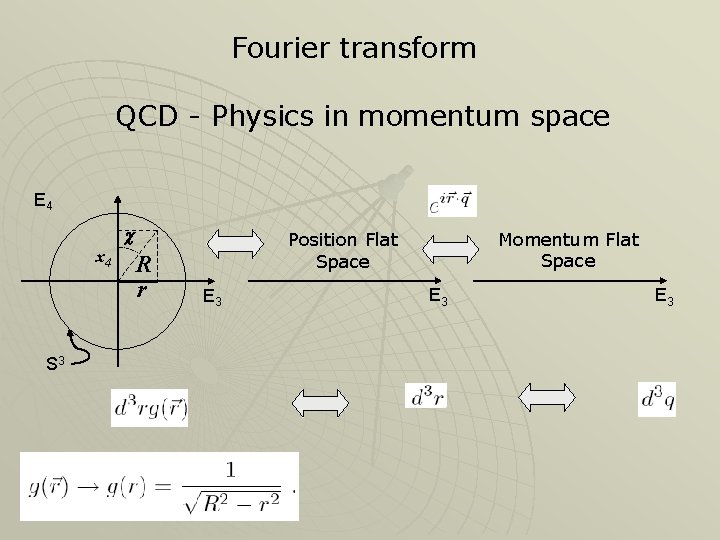
Fourier transform QCD - Physics in momentum space E 4 x 4 S 3 R r Momentum Flat Space Position Flat Space E 3 E 3
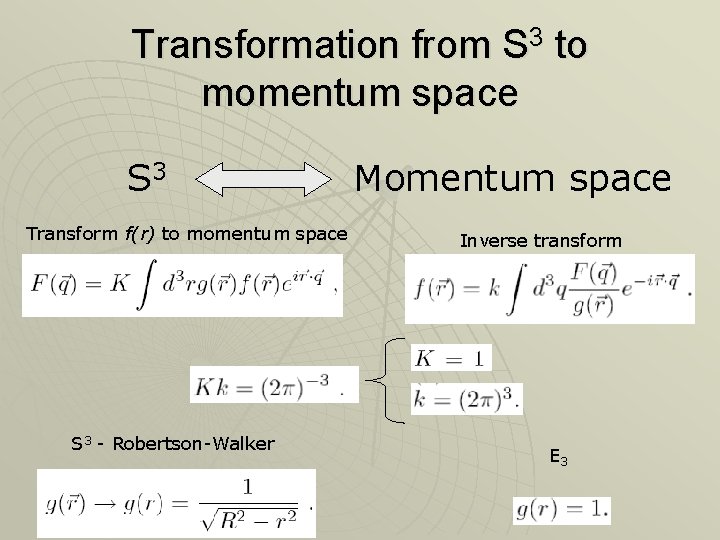
Transformation from S 3 to momentum space S 3 Transform f(r) to momentum space S 3 - Robertson-Walker Momentum space Inverse transform E 3
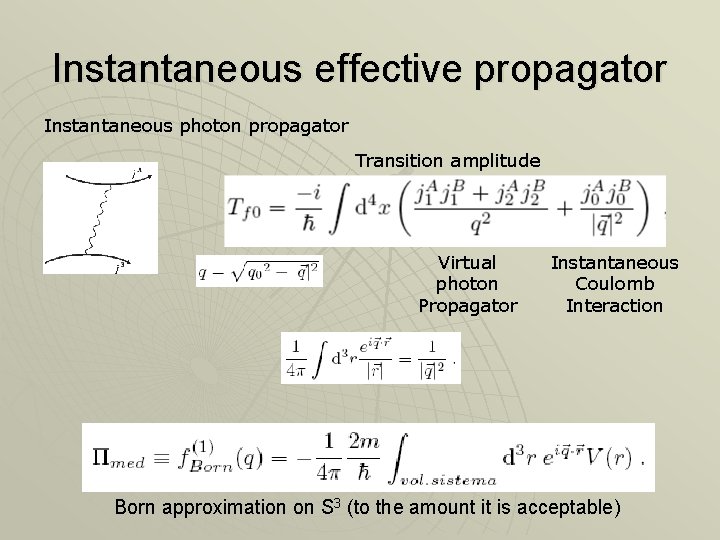
Instantaneous effective propagator Instantaneous photon propagator Transition amplitude Virtual photon Propagator Instantaneous Coulomb Interaction Born approximation on S 3 (to the amount it is acceptable)
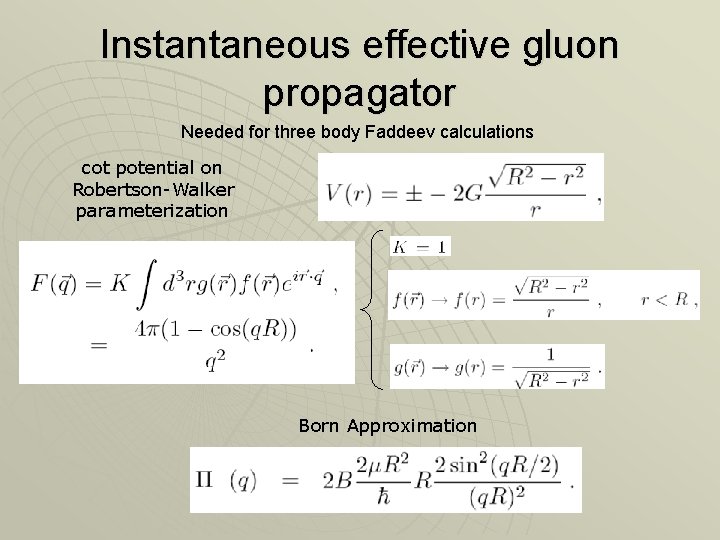
Instantaneous effective gluon propagator Needed for three body Faddeev calculations cot potential on Robertson-Walker parameterization Born Approximation
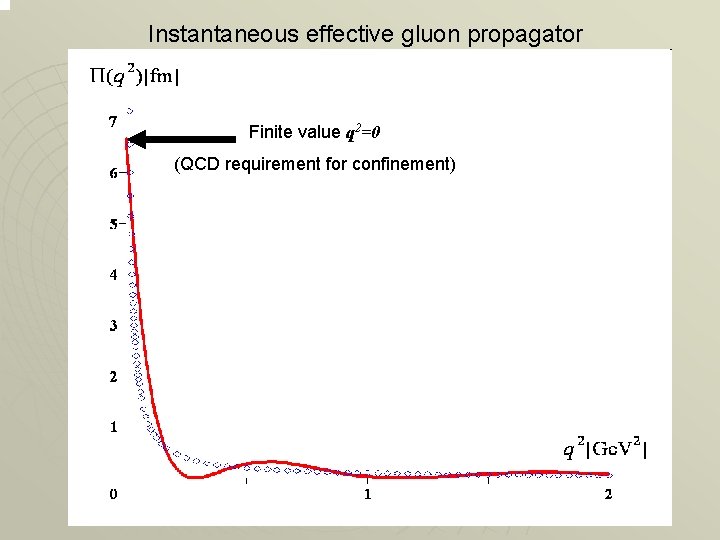
Instantaneous effective gluon propagator Finite value q 2=0 (QCD requirement for confinement)
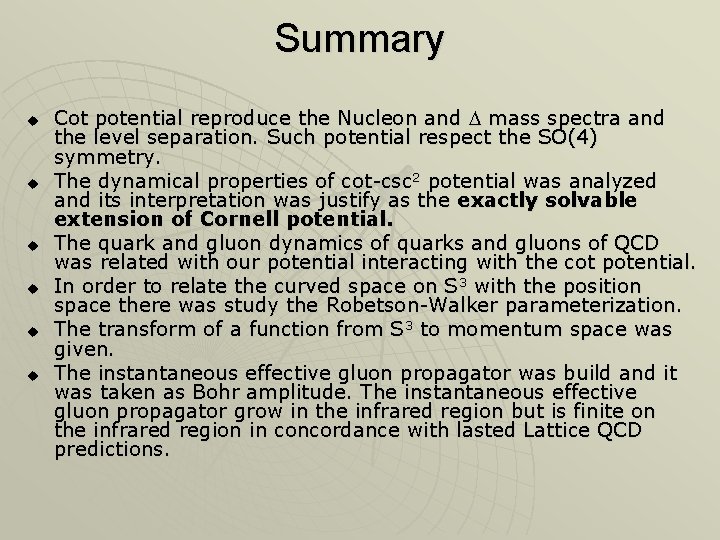
Summary u u u Cot potential reproduce the Nucleon and D mass spectra and the level separation. Such potential respect the SO(4) symmetry. The dynamical properties of cot-csc 2 potential was analyzed and its interpretation was justify as the exactly solvable extension of Cornell potential. The quark and gluon dynamics of quarks and gluons of QCD was related with our potential interacting with the cot potential. In order to relate the curved space on S 3 with the position space there was study the Robetson-Walker parameterization. The transform of a function from S 3 to momentum space was given. The instantaneous effective gluon propagator was build and it was taken as Bohr amplitude. The instantaneous effective gluon propagator grow in the infrared region but is finite on the infrared region in concordance with lasted Lattice QCD predictions.
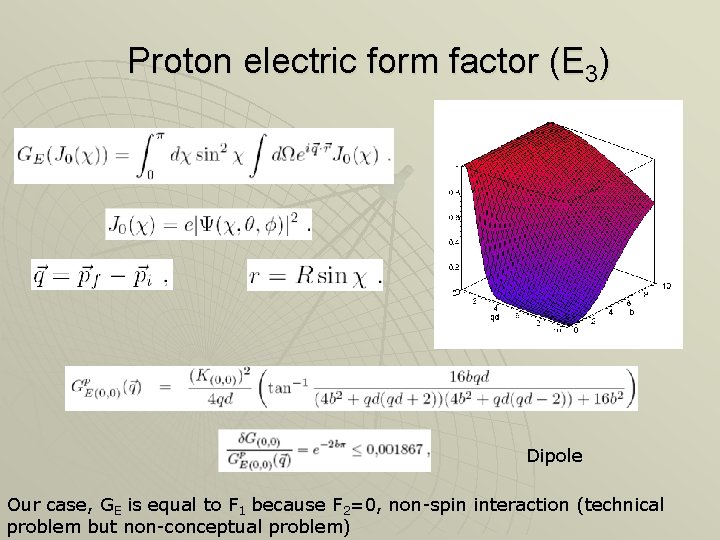
Proton electric form factor (E 3) Dipole Our case, GE is equal to F 1 because F 2=0, non-spin interaction (technical problem but non-conceptual problem)
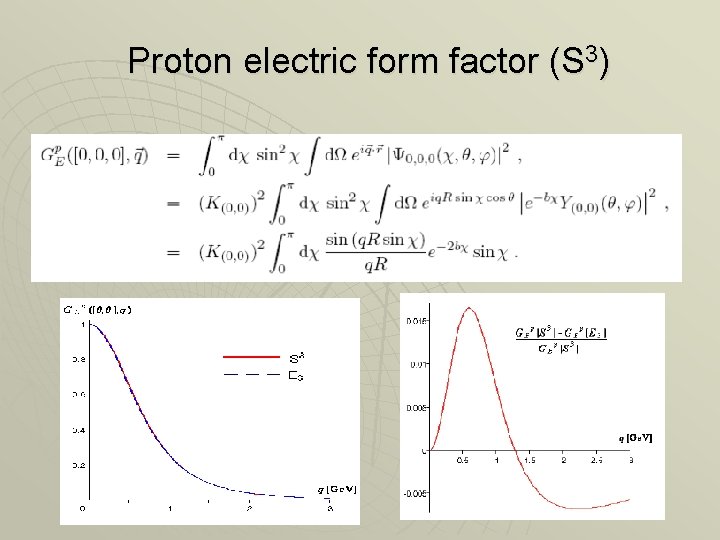
Proton electric form factor (S 3)
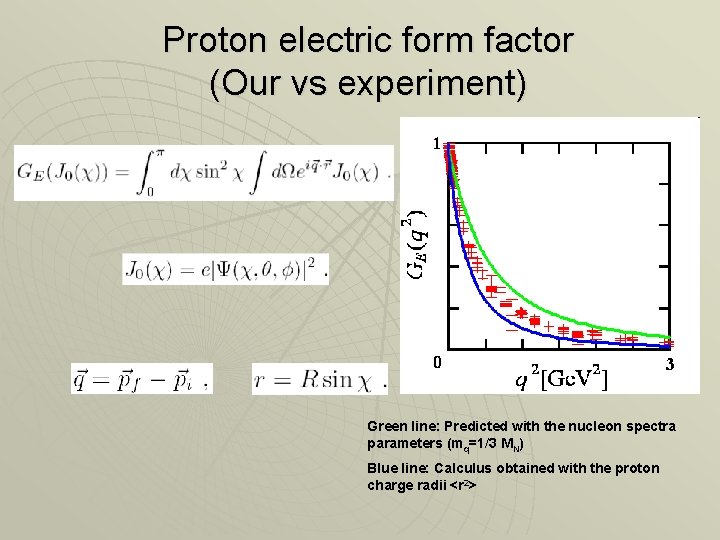
Proton electric form factor (Our vs experiment) Green line: Predicted with the nucleon spectra parameters (mq=1/3 MN) Blue line: Calculus obtained with the proton charge radii <r 2>
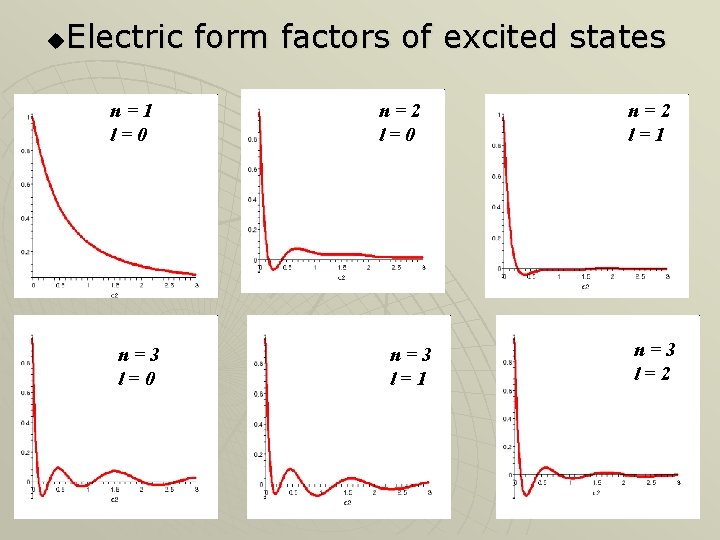
u Electric form factors of excited states n=1 l=0 n=3 l=0 n=2 l=0 n=3 l=1 n=2 l=1 n=3 l=2
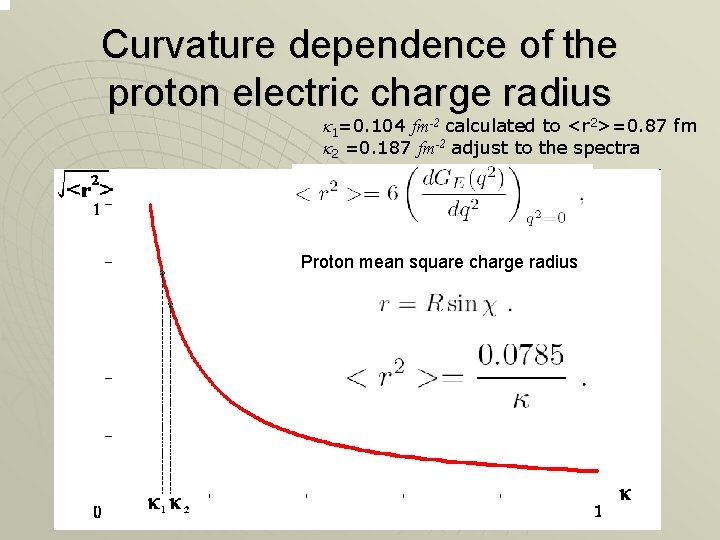
Curvature dependence of the proton electric charge radius k 1=0. 104 fm-2 calculated to <r 2>=0. 87 fm k 2 =0. 187 fm-2 adjust to the spectra Proton mean square charge radius
Summary (applications) We calculated the proton electric form factor which is in concordance with experimental data. u We has electric form factors of excited states. u Proton charge radii <r^2>1/2 is a function of curvature k from the hypersphere S 3. u
Tank you