
Detectors of single photons on the road to









- Slides: 32
Detectors of single photons (…on the road to nano) O. Haderka Regional Center for Advanced Technologies and Materials, Joint Laboratory of Optics, Palacký University, 17. listopadu 50 a, 772 07 Olomouc, Czech Republic.
Why to detect single photons? ¡ ¡ In classical optics – every photon is valuable (e. g. , in astronomy) In quantum optics/information l l l ¡ time-correlated photon counting (TCPC) some tasks benefit from single photons (QKD, QM) other tasks require single photons (LOQC) Other applications in particle physics, biomedical research, atmospheric pollution measurements, LIDAR etc.
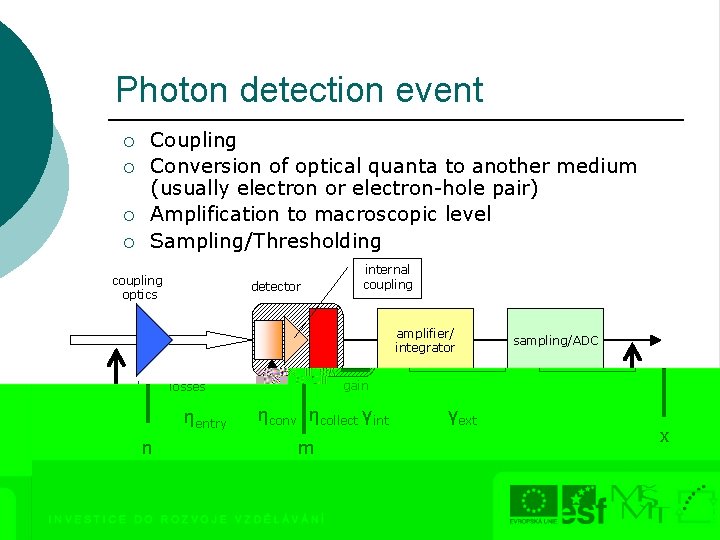
Photon detection event ¡ ¡ Coupling Conversion of optical quanta to another medium (usually electron or electron-hole pair) Amplification to macroscopic level Sampling/Thresholding coupling optics internal coupling detector amplifier/ integrator gain losses ηentry n sampling/ADC ηconv ηcollect γint m γext x
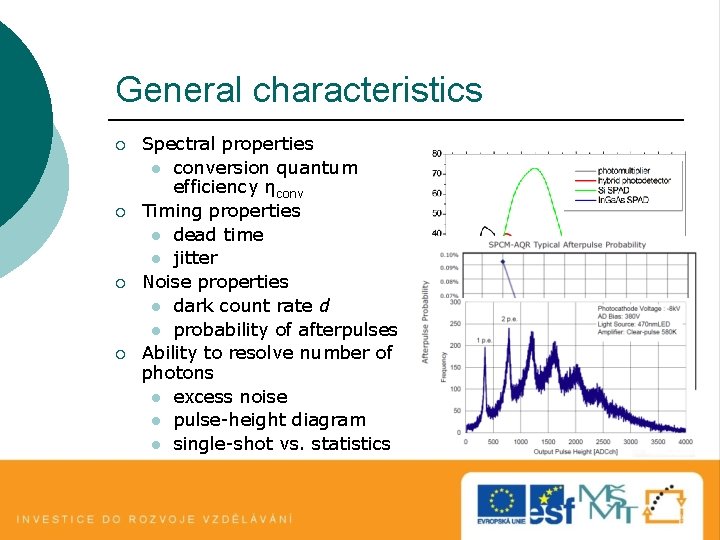
General characteristics ¡ ¡ Spectral properties l conversion quantum efficiency ηconv Timing properties l dead time l jitter Noise properties l dark count rate d l probability of afterpulses Ability to resolve number of photons l excess noise l pulse-height diagram l single-shot vs. statistics
Overview of current technologies ¡ ¡ ¡ ¡ ¡ Photomultiplier tubes Avalanche photodiodes Hybrid photodetectors Visible light photon counters Transition-edge sensors Frequency up-conversion Superconducting nanowires Quantum dots & defects Carbon nanotubes (? )
Hamamatsu Burle Photomultiplier tubes ¡ ¡ ¡ the oldest photon-counting detector (1949) large active areas ( > 10 mm) amplification excess noise can be lowered using first dynode from suitable material (Ga. P) η = 40% @ 500 nm (Ga. As. P) d ≈ 100 Hz, Δt ≈ 300 ps η = 2% @ 1550 nm (In. P/In. Ga. As @ 200 K), d ≈ 200 k. Hz
Single-photon avalanche photodiode (SPAD) ¡ ¡ ¡ ¡ Perkin-Elmer Micro Photon Devices id. Quantique photodiode reverse biased above breakdown (Geiger mode) avalanche stopped by quenching circuit Si: η = 70% @ 650 nm, d ≈ 25 Hz, Δt ≈ 400 ps, τ = 50 ns, high excess noise back-flashing d can be lowered to 8 x 10 -4 Hz by cooling to 78 K shallow-junction: Δt ≈ 40 ps In. Ga. As/In. P: η = 20% @ 1550 nm, d ≈ 10 k. Hz, Δt ≈ 400 ps, τ = 10 μs, high excess noise, gating necessary
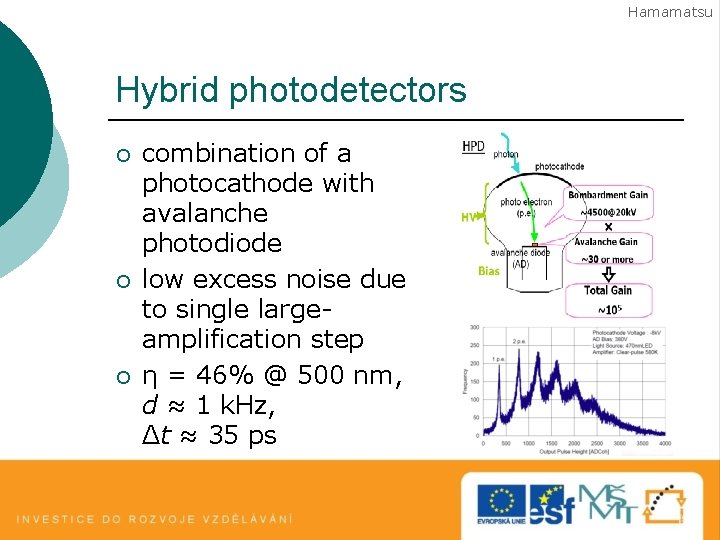
Hamamatsu Hybrid photodetectors ¡ ¡ ¡ combination of a photocathode with avalanche photodiode low excess noise due to single largeamplification step η = 46% @ 500 nm, d ≈ 1 k. Hz, Δt ≈ 35 ps
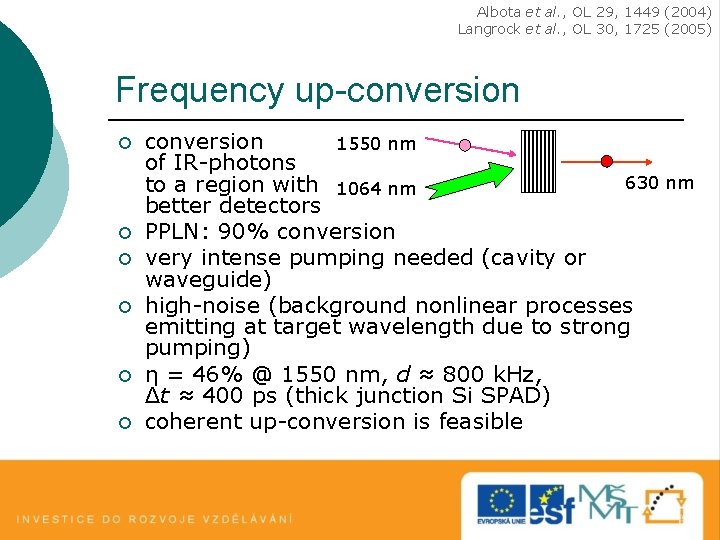
Albota et al. , OL 29, 1449 (2004) Langrock et al. , OL 30, 1725 (2005) Frequency up-conversion ¡ ¡ ¡ conversion 1550 nm of IR-photons 630 nm to a region with 1064 nm better detectors PPLN: 90% conversion very intense pumping needed (cavity or waveguide) high-noise (background nonlinear processes emitting at target wavelength due to strong pumping) η = 46% @ 1550 nm, d ≈ 800 k. Hz, Δt ≈ 400 ps (thick junction Si SPAD) coherent up-conversion is feasible
Kim et al. , APL 74, 902 (1999) Takeuchi et al. , APL 74, 1063 (1999) Visible-light photon counters (VLPC) ¡ ¡ controlled single-carrier multiplication process @ 6 K temperature avalanche triggered by a hole in As-doped region confined to 20 μm resolves up to 5 photons ηconv = 88% @ 694 nm (ηconv = 93% @ near IR), d ≈ 20 k. Hz, Δt ≈ 250 ps, τ = 100 ns Figure by Y. Yamamoto
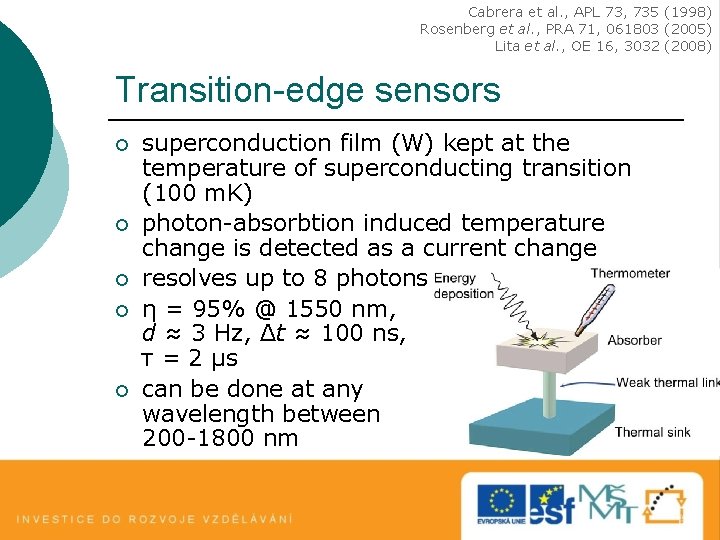
Cabrera et al. , APL 73, 735 (1998) Rosenberg et al. , PRA 71, 061803 (2005) Lita et al. , OE 16, 3032 (2008) Transition-edge sensors ¡ ¡ ¡ superconduction film (W) kept at the temperature of superconducting transition (100 m. K) photon-absorbtion induced temperature change is detected as a current change resolves up to 8 photons η = 95% @ 1550 nm, d ≈ 3 Hz, Δt ≈ 100 ns, τ = 2 μs can be done at any wavelength between 200 -1800 nm
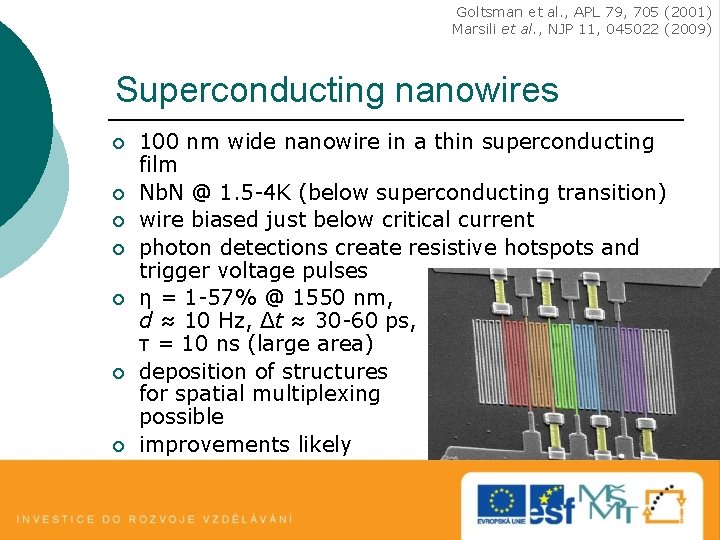
Goltsman et al. , APL 79, 705 (2001) Marsili et al. , NJP 11, 045022 (2009) Superconducting nanowires ¡ ¡ ¡ ¡ 100 nm wide nanowire in a thin superconducting film Nb. N @ 1. 5 -4 K (below superconducting transition) wire biased just below critical current photon detections create resistive hotspots and trigger voltage pulses η = 1 -57% @ 1550 nm, d ≈ 10 Hz, Δt ≈ 30 -60 ps, τ = 10 ns (large area) deposition of structures for spatial multiplexing possible improvements likely
Rowe et al. , APL 89, 253505 (2006) Kardynal et al. , APL 90, 181114 (2007) Blakesley et al. , PRL 94, 067401 (2005) Quantum dots or defects ¡ ¡ trapping of charge in defects heterostructures based on III-V compounds l l ¡ ¡ trapped charge alters conductance in a fieldeffect transistor (ηconv = 68% @ 805 nm, resolves up to 3 photons) alters tunneling probability in a resonant tunnel diode (ηconv = 12% @ 550 nm, d = 2 x 10 -3 Hz) 4 K temperature needed improvements likely
Ambrosio et al. , NIMPRA 617, 378 (2010) Carbon nanotubes (? ) ¡ ¡ multi-wall carbon nanotubes are grown (CVD) on p-doped silicon substrate structure behaves like a photodiode with η≈50%
Multichannel detectors [VLPC, HD, nanowires] ¡ Fiber-loops ¡ Solid state photomultipliers ¡ i-CCD cameras ¡ EM-CCD cameras ¡
Haderka et al. , EPJD 28, 149 (2004) Fitch et al. , PRA 68, 043814 (2003) Fiber loops
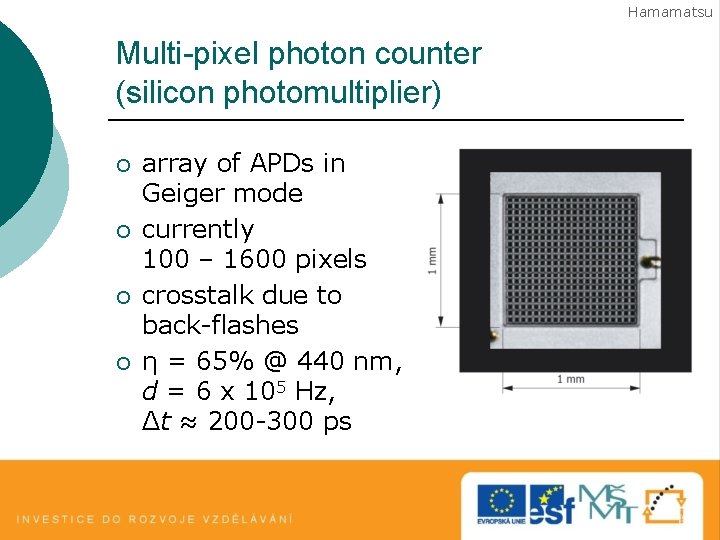
Hamamatsu Multi-pixel photon counter (silicon photomultiplier) ¡ ¡ array of APDs in Geiger mode currently 100 – 1600 pixels crosstalk due to back-flashes η = 65% @ 440 nm, d = 6 x 10⁵ Hz, Δt ≈ 200 -300 ps
Andor Roper Scientific Hamamatsu i. CCD cameras ¡ η = 25% @ 550 nm, d ~ 104 Hz, Δt ≈ 2 ns
Andor Roper Scientific Hamamatsu EM-CCD (L 3) cameras ¡ ¡ ¡ high η of backilluminated CCDs single photon sensitivity CIC noise ‘slow’ shutter η = 97% @ 550 nm
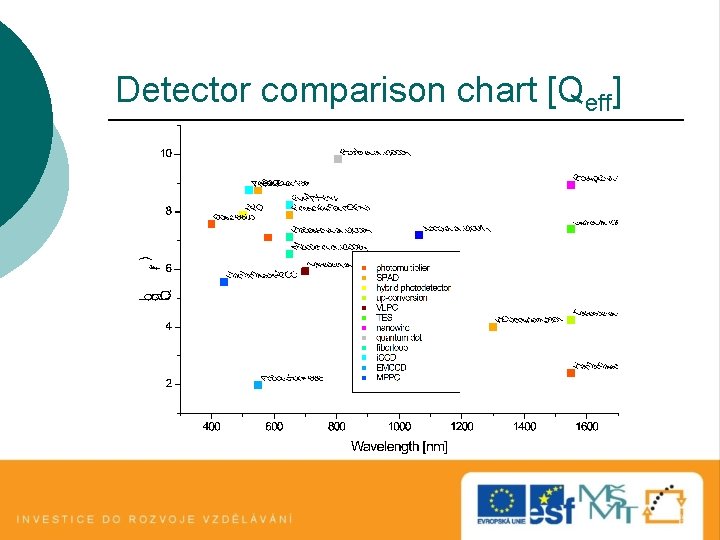
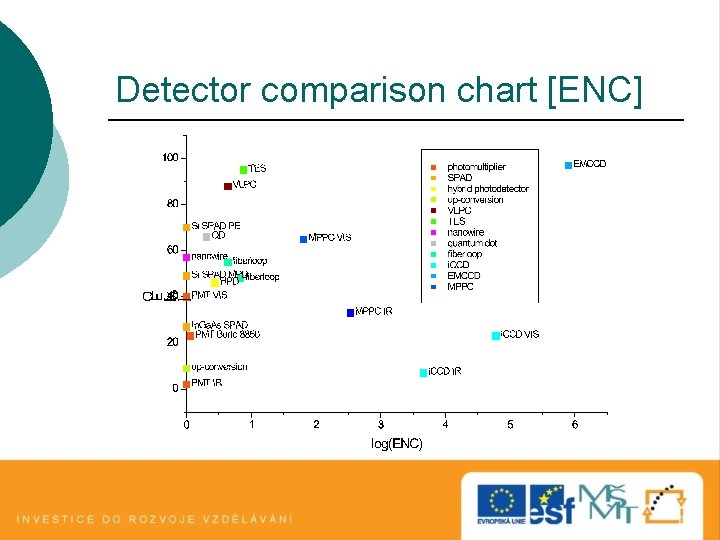
Figures of merit For binary detectors: efficiency factor Qeff For photon-number resolving detectors: peak-to-valley contrast number of resolvable peaks effective number of channels n-photon fidelity
Detector comparison chart [Qeff]
Detector comparison chart [ENC]
n-photon fidelity
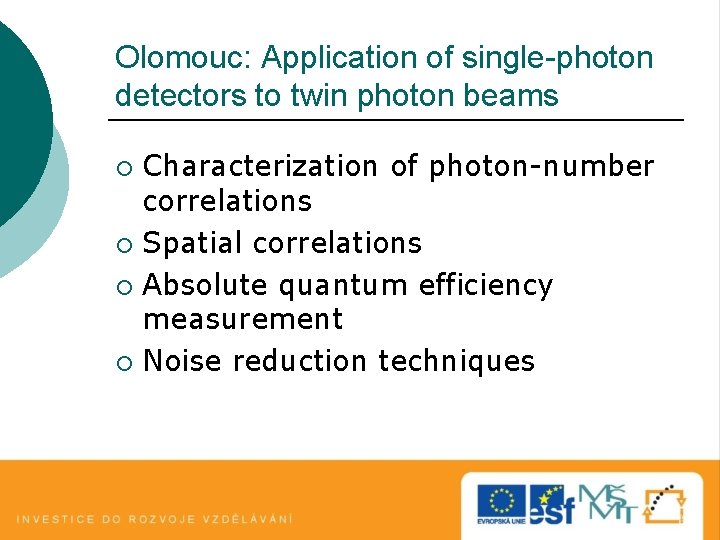
Olomouc: Application of single-photon detectors to twin photon beams Characterization of photon-number correlations ¡ Spatial correlations ¡ Absolute quantum efficiency measurement ¡ Noise reduction techniques ¡
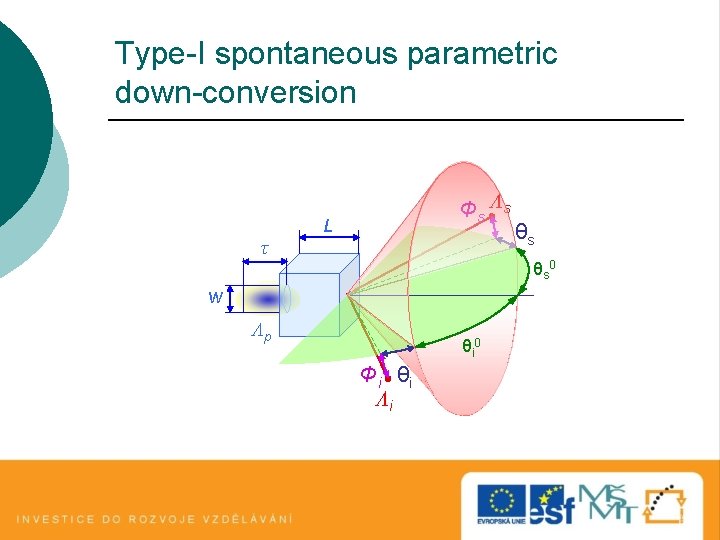
Type-I spontaneous parametric down-conversion Φ s Λs L τ θs θs 0 w Λp θi 0 Φ i θi Λi
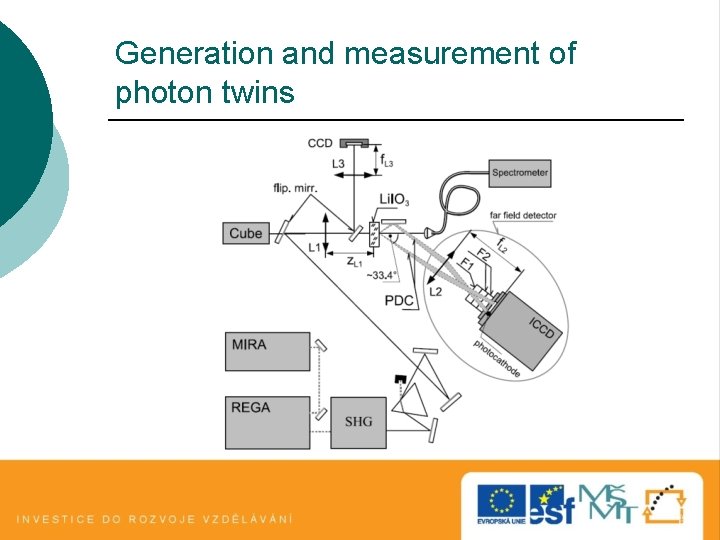
Generation and measurement of photon twins
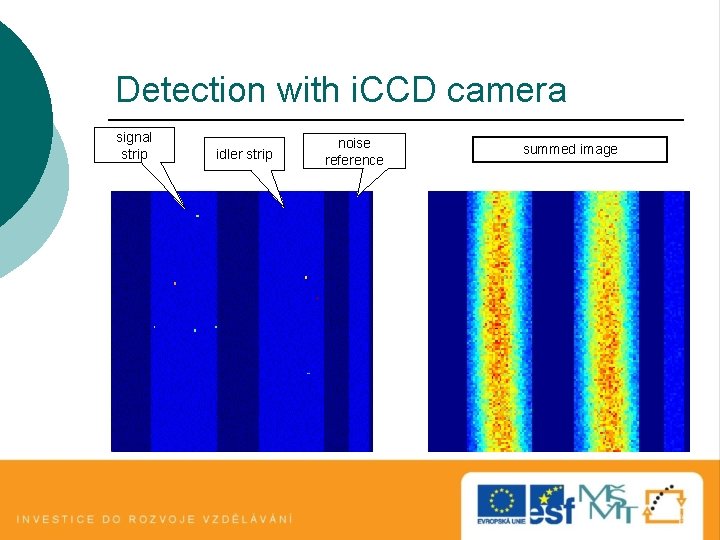
Detection with i. CCD camera signal strip idler strip noise reference summed image
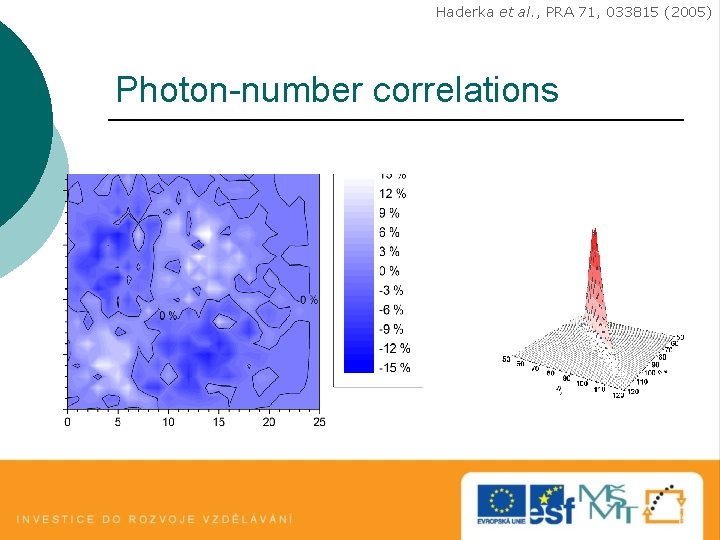
Haderka et al. , PRA 71, 033815 (2005) Photon-number correlations
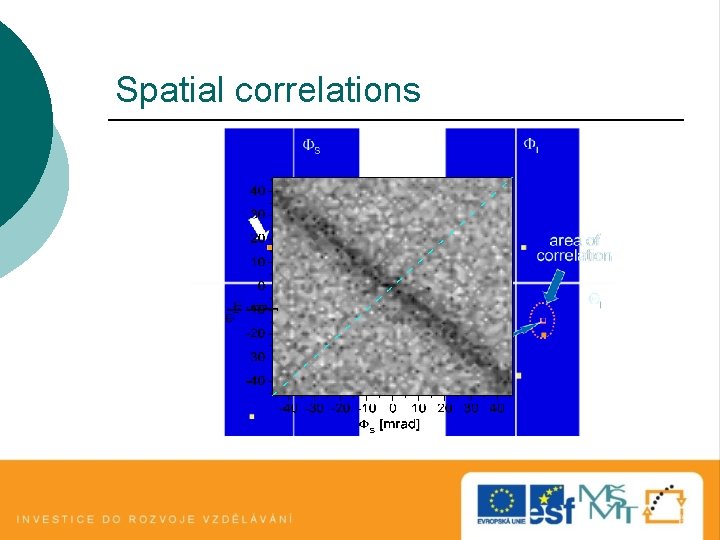
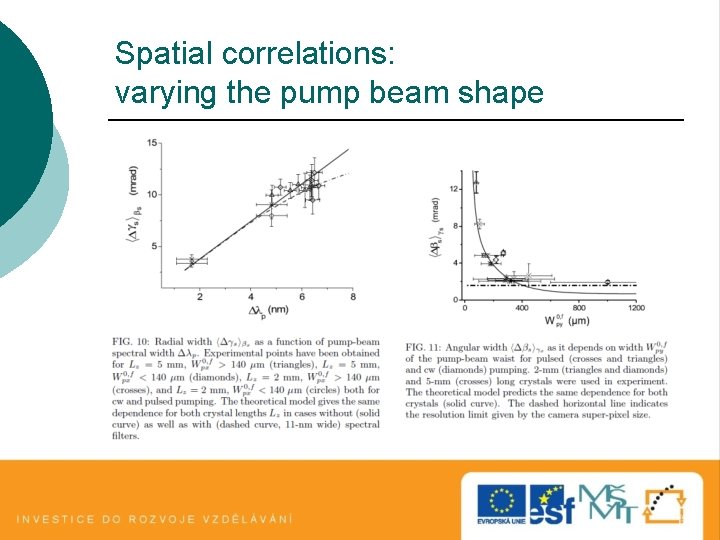
Spatial correlations
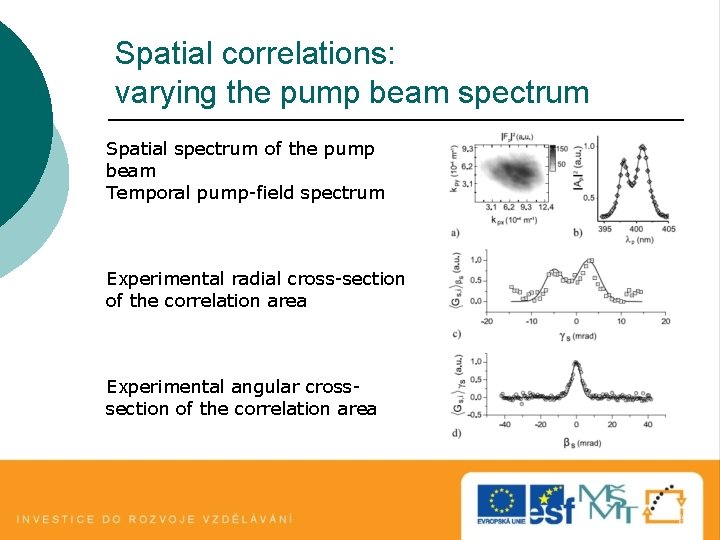
Spatial correlations: varying the pump beam spectrum Spatial spectrum of the pump beam Temporal pump-field spectrum Experimental radial cross-section of the correlation area Experimental angular crosssection of the correlation area
Spatial correlations: varying the pump beam shape
CONCLUSION ¡ ¡ Single photon detection technology makes big leaps Promising nanotechnologies appear Both intrinsic and multichannel photonnumber resolution improves This all should contribute to present & future quantum information systems