
Urine Formation by the Kidneys II Tubular Reabsorption
Urine Formation by the Kidneys II. Tubular Reabsorption and Secretion L 3 -L 4 -L 5 1
Objectives n To understand the principle of Clearance and its applications n To describe the mechanism of tubular reabsorption and secretion. n To follow up the reabsorption of glomerular filtrate along the tubules. n To understand the regulation of tubular reabsorption and secretion. 2
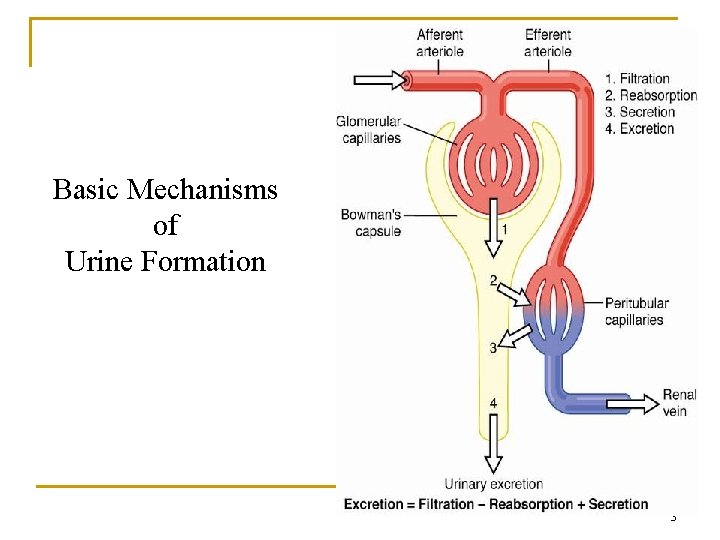
Basic Mechanisms of Urine Formation 3
Clearance • “Clearance” describes the rate at which substances are removed (cleared) from the plasma. • Renal clearance of a substance is the volume of plasma completely cleared of a substance per min by the kidneys. 4
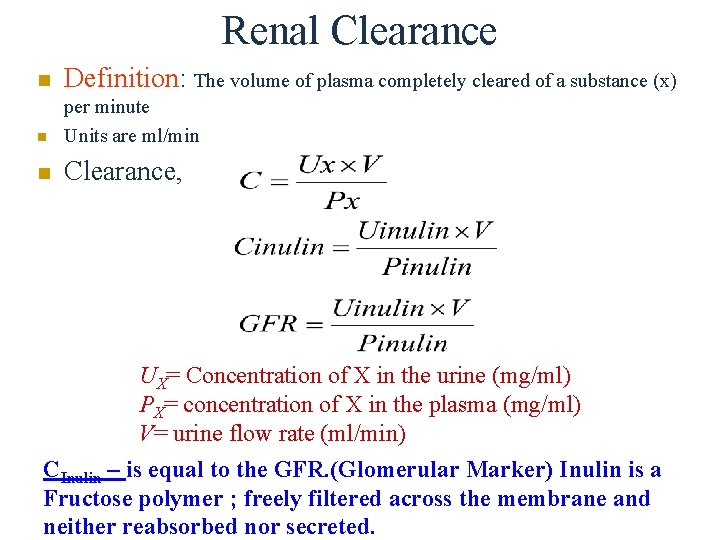
Renal Clearance n Definition: The volume of plasma completely cleared of a substance (x) n per minute Units are ml/min n Clearance, UX= Concentration of X in the urine (mg/ml) PX= concentration of X in the plasma (mg/ml) V= urine flow rate (ml/min) CInulin – is equal to the GFR. (Glomerular Marker) Inulin is a Fructose polymer ; freely filtered across the membrane and neither reabsorbed nor secreted.

Clearance Technique Renal clearance (Cs) of a substance is the volume of plasma completely cleared of a substance per min. Cs Where : Cs x Ps = Us x V = urine excretion rate s Ps Plasma conc. s Cs = clearance of substance S Ps = plasma conc. of substance S Us = urine conc. of substance S V = urine flow rate 6
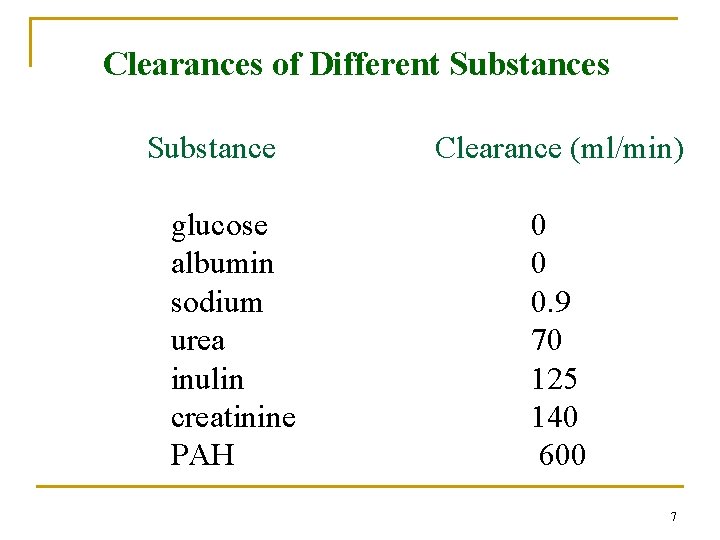
Clearances of Different Substances Substance glucose albumin sodium urea inulin creatinine PAH Clearance (ml/min) 0 0 0. 9 70 125 140 600 7
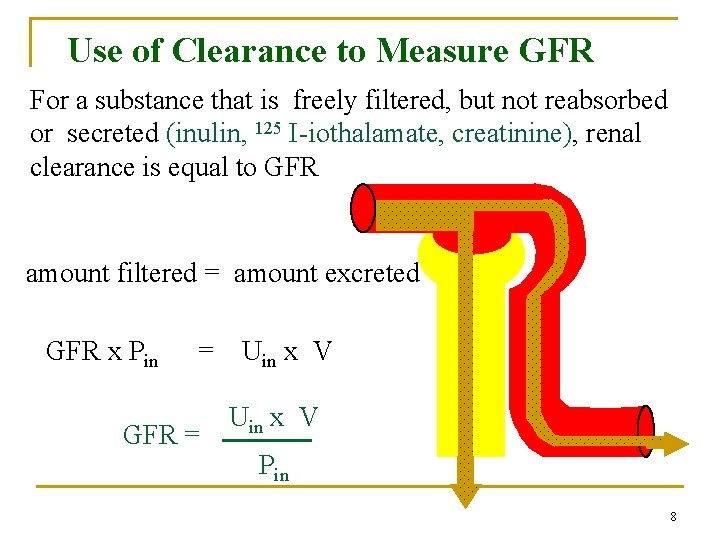
Use of Clearance to Measure GFR For a substance that is freely filtered, but not reabsorbed or secreted (inulin, 125 I-iothalamate, creatinine), renal clearance is equal to GFR amount filtered = amount excreted GFR x Pin = GFR = Uin x V Pin 8
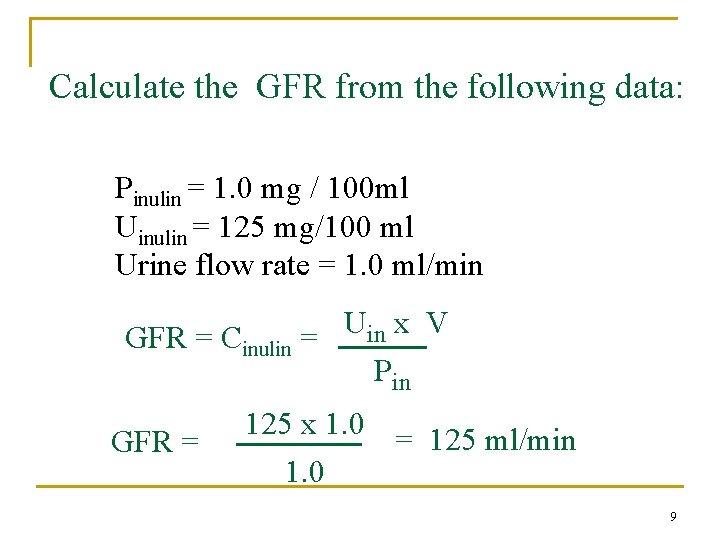
Calculate the GFR from the following data: Pinulin = 1. 0 mg / 100 ml Uinulin = 125 mg/100 ml Urine flow rate = 1. 0 ml/min U x V in GFR = Cinulin = Pin GFR = 125 x 1. 0 = 125 ml/min 1. 0 9
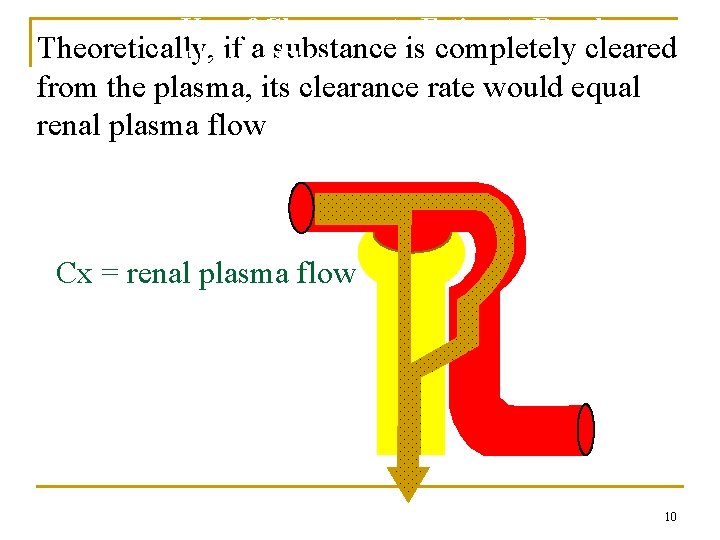
Use of Clearance to Estimate Renal Theoretically, if a substance is completely cleared Plasma Flow from the plasma, its clearance rate would equal renal plasma flow Cx = renal plasma flow 10
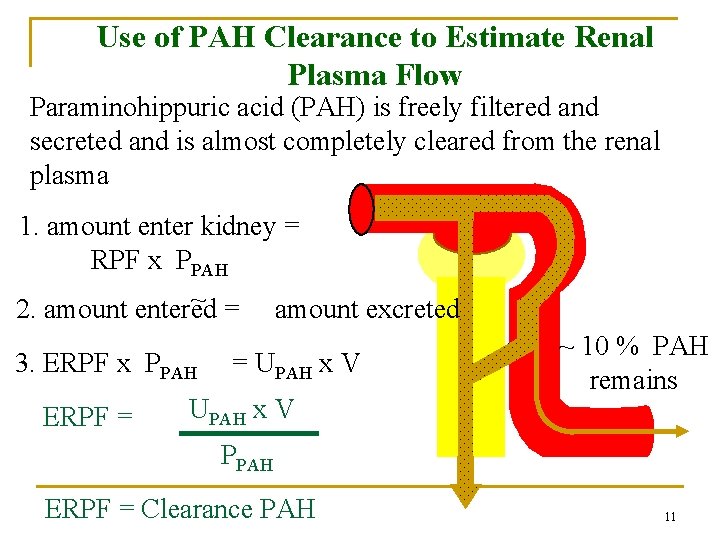
Use of PAH Clearance to Estimate Renal Plasma Flow Paraminohippuric acid (PAH) is freely filtered and secreted and is almost completely cleared from the renal plasma 1. amount enter kidney = RPF x PPAH ~ = amount excreted 2. amount entered 3. ERPF x PPAH ERPF = = UPAH x V ~ 10 % PAH remains PPAH ERPF = Clearance PAH 11
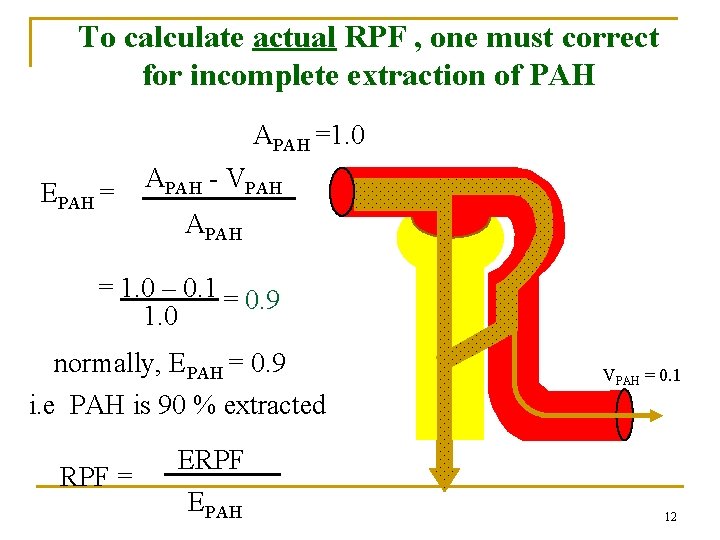
To calculate actual RPF , one must correct for incomplete extraction of PAH APAH =1. 0 EPAH = APAH - VPAH APAH = 1. 0 – 0. 1 = 0. 9 1. 0 normally, EPAH = 0. 9 i. e PAH is 90 % extracted RPF = VPAH = 0. 1 ERPF EPAH 12
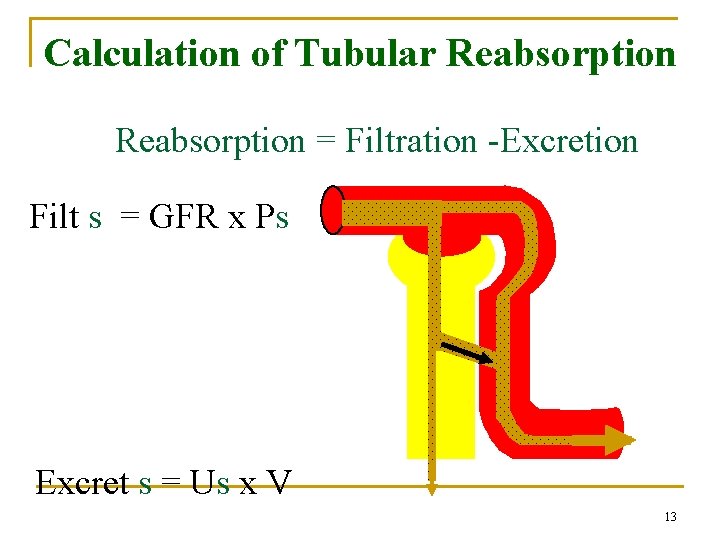
Calculation of Tubular Reabsorption = Filtration -Excretion Filt s = GFR x Ps Excret s = Us x V 13
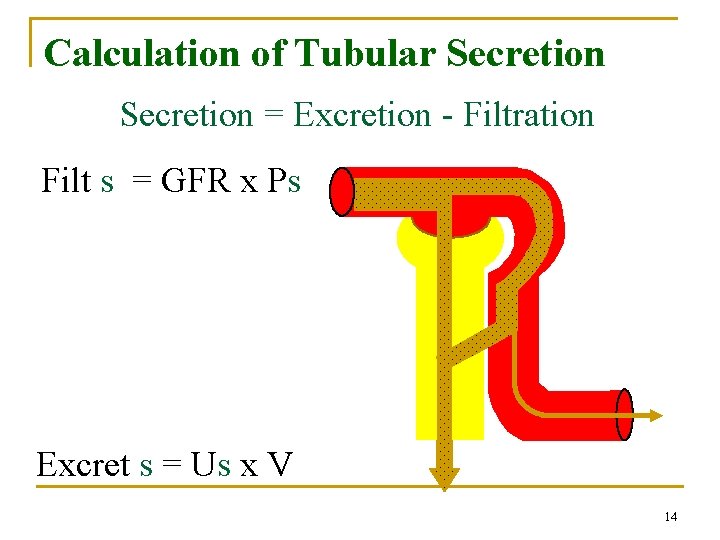
Calculation of Tubular Secretion = Excretion - Filtration Filt s = GFR x Ps VPAH = 0. 1 Excret s = Us x V 14
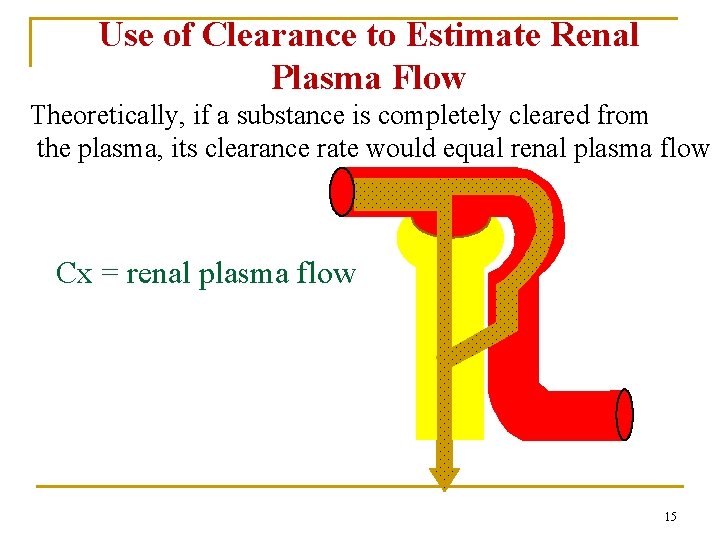
Use of Clearance to Estimate Renal Plasma Flow Theoretically, if a substance is completely cleared from the plasma, its clearance rate would equal renal plasma flow Cx = renal plasma flow 15
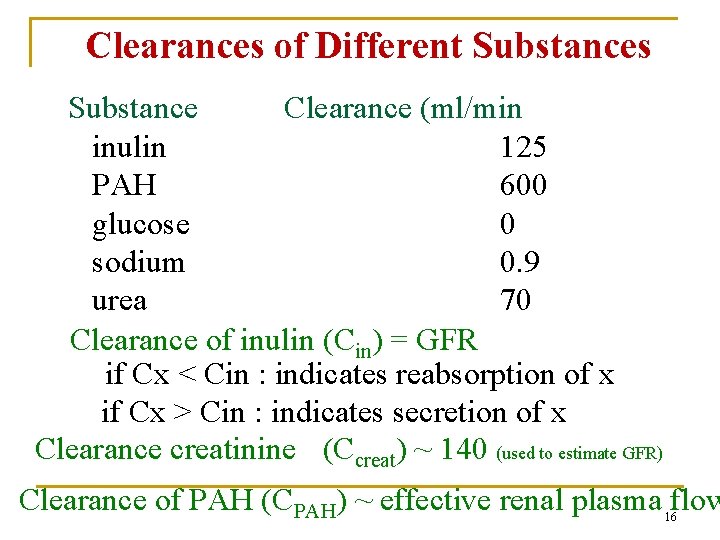
Clearances of Different Substances Substance Clearance (ml/min inulin 125 PAH 600 glucose 0 sodium 0. 9 urea 70 Clearance of inulin (Cin) = GFR if Cx < Cin : indicates reabsorption of x if Cx > Cin : indicates secretion of x Clearance creatinine (Ccreat) ~ 140 (used to estimate GFR) Clearance of PAH (CPAH) ~ effective renal plasma flow 16
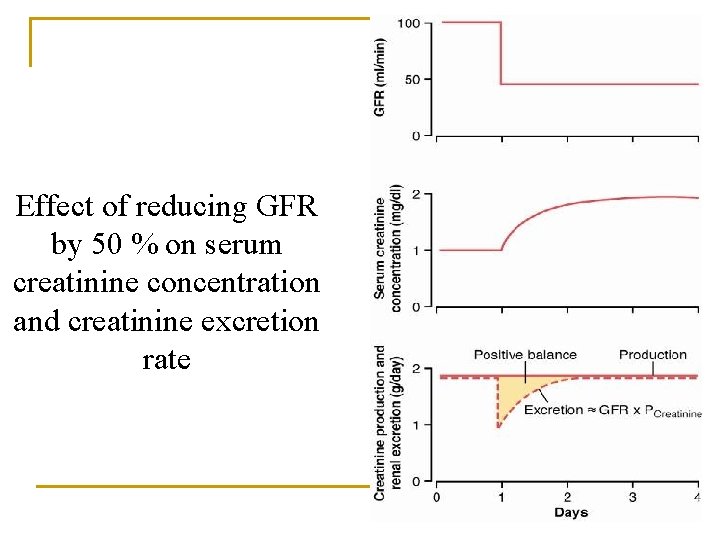
Effect of reducing GFR by 50 % on serum creatinine concentration and creatinine excretion rate 17
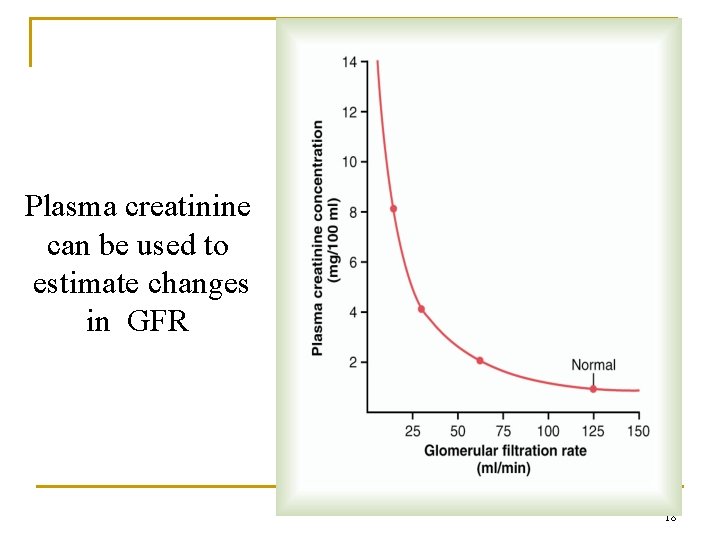
Plasma creatinine can be used to estimate changes in GFR 18
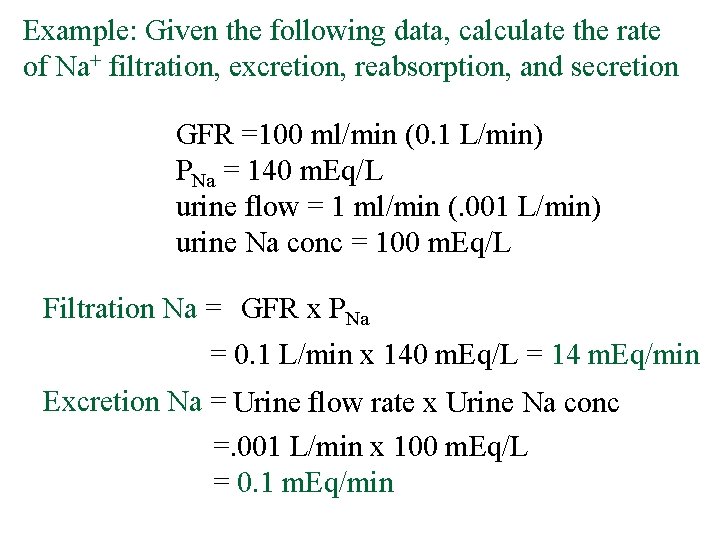
Example: Given the following data, calculate the rate of Na+ filtration, excretion, reabsorption, and secretion GFR =100 ml/min (0. 1 L/min) PNa = 140 m. Eq/L urine flow = 1 ml/min (. 001 L/min) urine Na conc = 100 m. Eq/L Filtration Na = GFR x PNa = 0. 1 L/min x 140 m. Eq/L = 14 m. Eq/min Excretion Na = Urine flow rate x Urine Na conc =. 001 L/min x 100 m. Eq/L = 0. 1 m. Eq/min 19
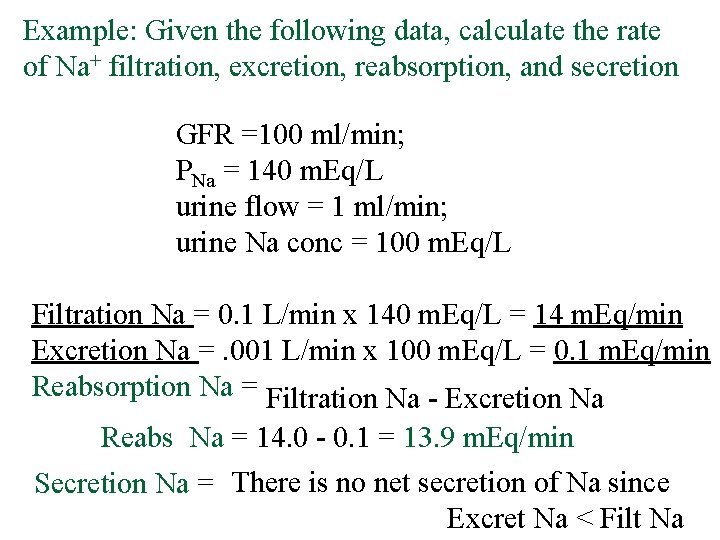
Example: Given the following data, calculate the rate of Na+ filtration, excretion, reabsorption, and secretion GFR =100 ml/min; PNa = 140 m. Eq/L urine flow = 1 ml/min; urine Na conc = 100 m. Eq/L Filtration Na = 0. 1 L/min x 140 m. Eq/L = 14 m. Eq/min Excretion Na =. 001 L/min x 100 m. Eq/L = 0. 1 m. Eq/min Reabsorption Na = Filtration Na - Excretion Na Reabs Na = 14. 0 - 0. 1 = 13. 9 m. Eq/min Secretion Na = There is no net secretion of Na since Excret Na < Filt Na 20
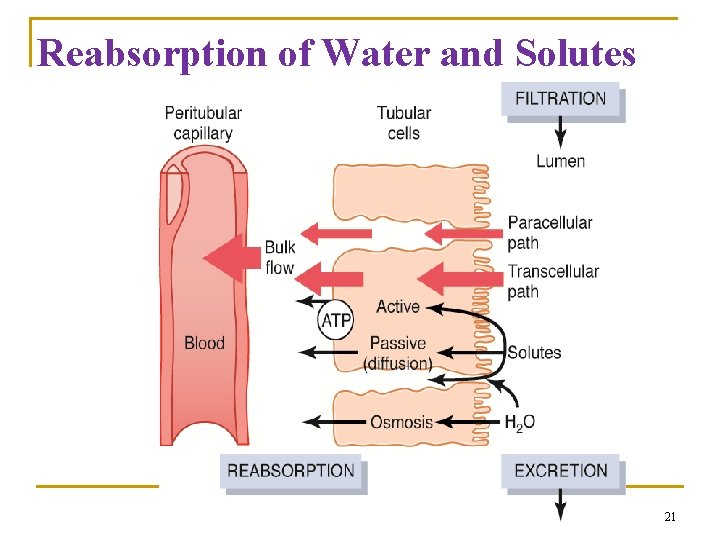
Reabsorption of Water and Solutes 21
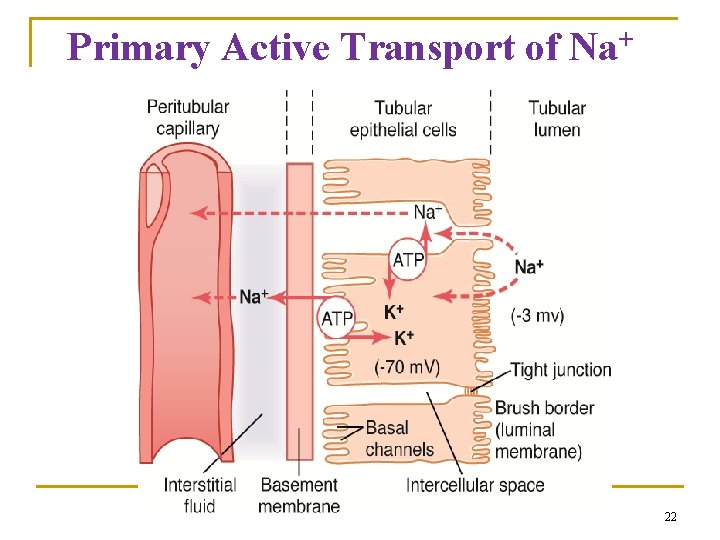
Primary Active Transport of Na+ 22
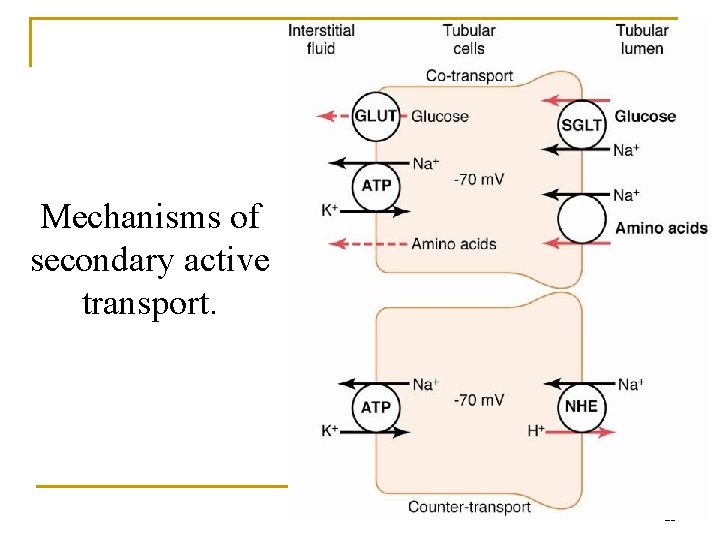
Mechanisms of secondary active transport. 23
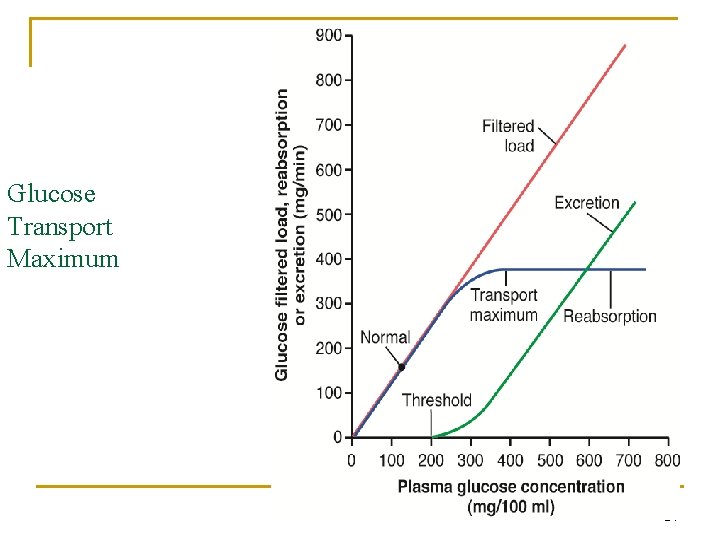
Glucose Transport Maximum 24
Transport Maximum Some substances have a maximum rate of tubular transport due to saturation of carriers, limited ATP, etc • Transport Maximum: Once the transport maximum is reached for all nephrons, further increases in tubular load are not reabsorbed and are excreted. • Threshold is the tubular load at which transport maximum is exceeded in some nephrons. This is not exactly the same as the transport maximum of the whole kidney because some nephrons have lower transport max’s than others. • Examples: glucose, amino acids, phosphate, sulphate 25
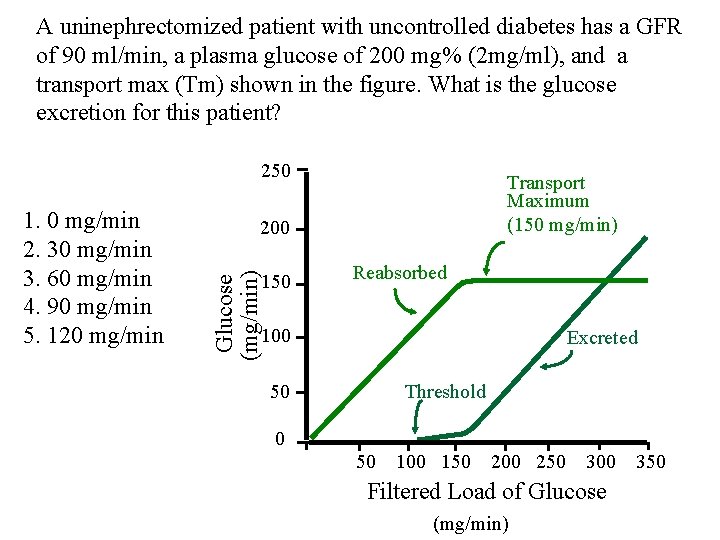
A uninephrectomized patient with uncontrolled diabetes has a GFR of 90 ml/min, a plasma glucose of 200 mg% (2 mg/ml), and a transport max (Tm) shown in the figure. What is the glucose excretion for this patient? 250 200 Glucose (mg/min) 1. 0 mg/min 2. 30 mg/min 3. 60 mg/min 4. 90 mg/min 5. 120 mg/min Transport Maximum (150 mg/min) 150 Reabsorbed 100 Excreted. Threshold 50 0 50 100 150 200 250 300 350 Filtered Load of Glucose (mg/min) 26
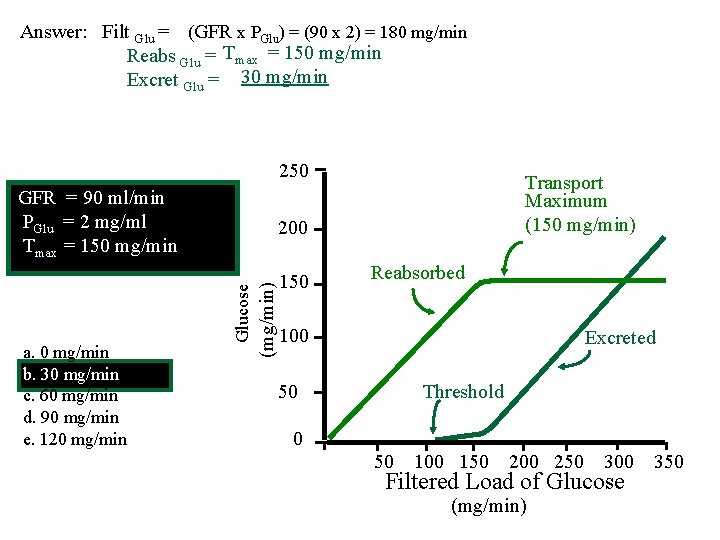
Answer: Filt Glu = (GFR x PGlu) = (90 x 2) = 180 mg/min Reabs Glu = Tmax = 150 mg/min Excret Glu = 30 mg/min 250 GFR = 90 ml/min PGlu = 2 mg/ml Tmax = 150 mg/min (mg/min) 200 Glucose a. 0 mg/min b. 30 mg/min c. 60 mg/min d. 90 mg/min e. 120 mg/min Transport Maximum (150 mg/min) 150 Reabsorbed 100 Excreted. Threshold 50 0 50 100 150 200 250 300 Filtered Load of Glucose (mg/min) 350 27
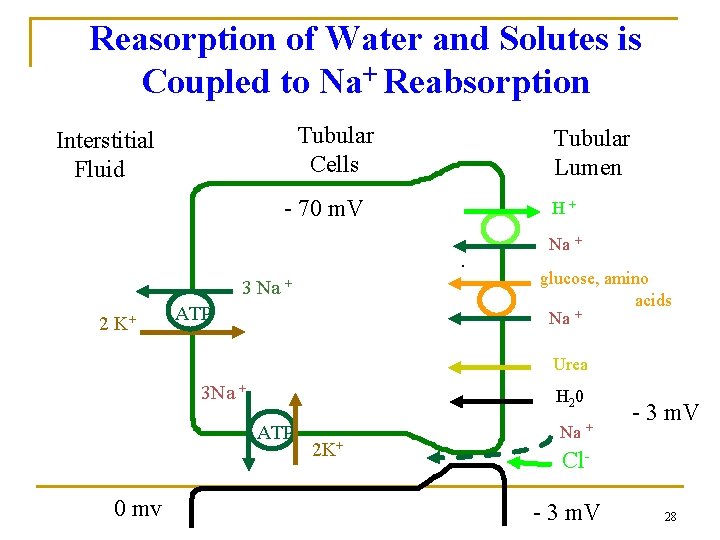
Reasorption of Water and Solutes is Coupled to Na+ Reabsorption Tubular Cells Interstitial Fluid - 70 m. V Tubular Lumen H+ Na + glucose, amino acids + Na 3 Na + 2 K+ ATP Urea 3 Na + H 2 0 ATP 0 mv 2 K+ Na + - 3 m. V Cl- 3 m. V 28
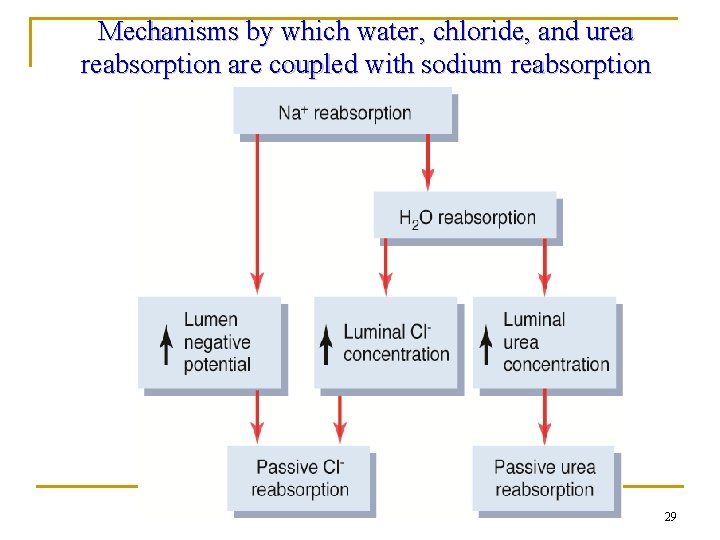
Mechanisms by which water, chloride, and urea reabsorption are coupled with sodium reabsorption 29
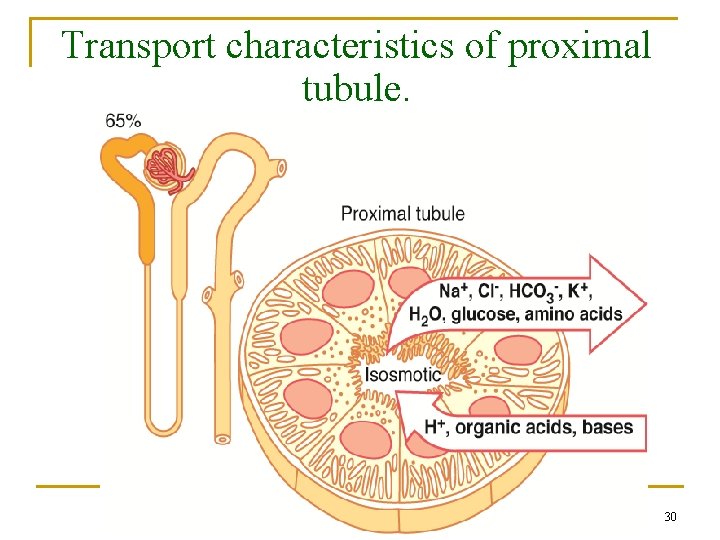
Transport characteristics of proximal tubule. 30
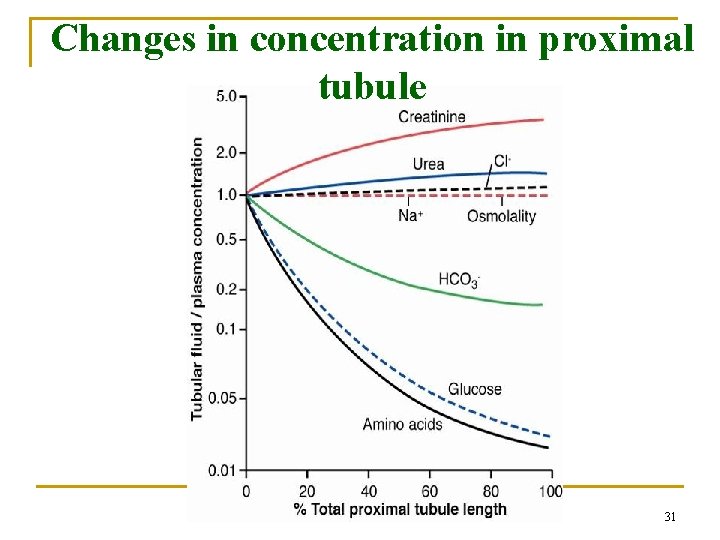
Changes in concentration in proximal tubule 31

Thank you 32
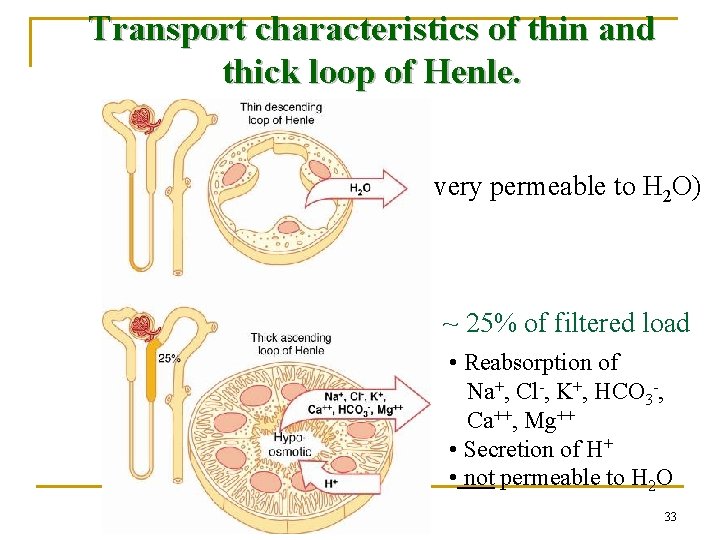
Transport characteristics of thin and thick loop of Henle. • very permeable to H 2 O) ~ 25% of filtered load • Reabsorption of Na+, Cl-, K+, HCO 3 -, Ca++, Mg++ • Secretion of H+ • not permeable to H 2 O 33
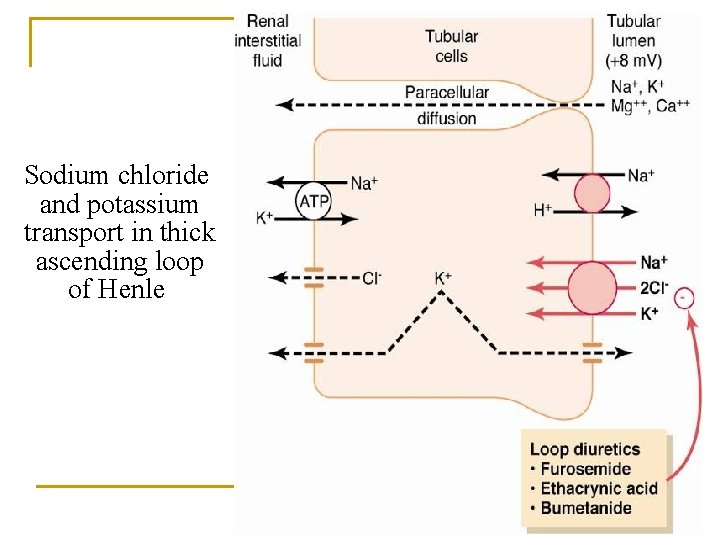
Sodium chloride and potassium transport in thick ascending loop of Henle 34
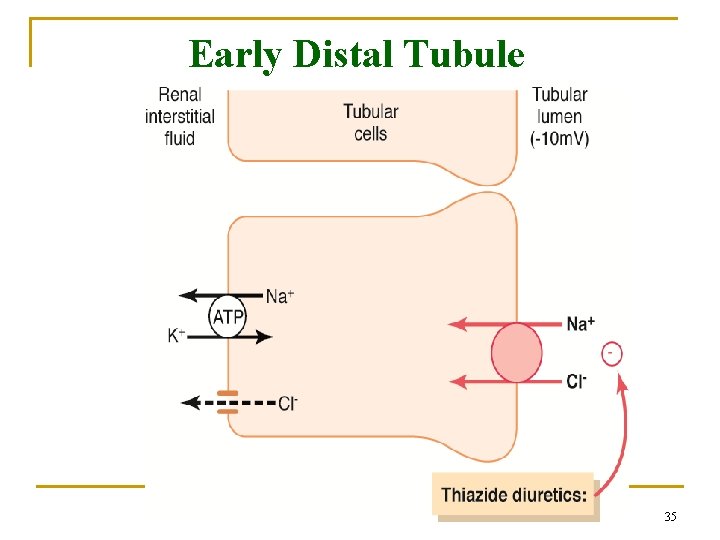
Early Distal Tubule 35
Early Distal Tubule • Functionally similar to thick ascending loop • Not permeable to water (called diluting segment) • Active reabsorption of Na+, Cl-, K+, Mg++ • Contains macula densa 36
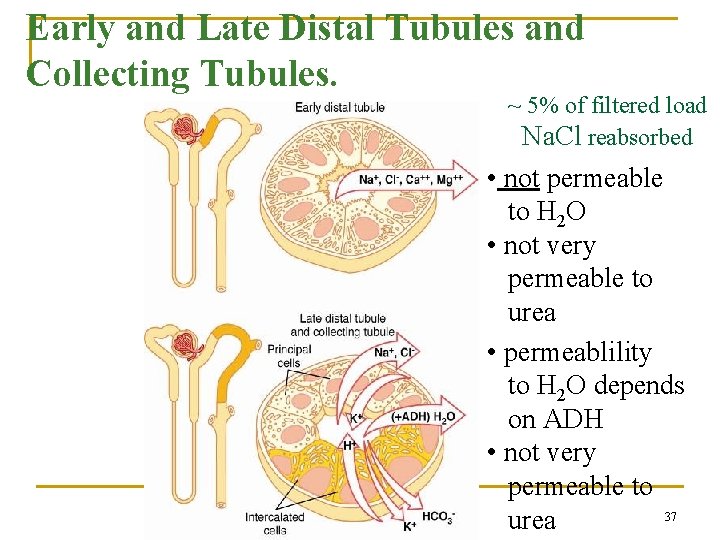
Early and Late Distal Tubules and Collecting Tubules. ~ 5% of filtered load Na. Cl reabsorbed • not permeable to H 2 O • not very permeable to urea • permeablility to H 2 O depends on ADH • not very permeable to 37 urea
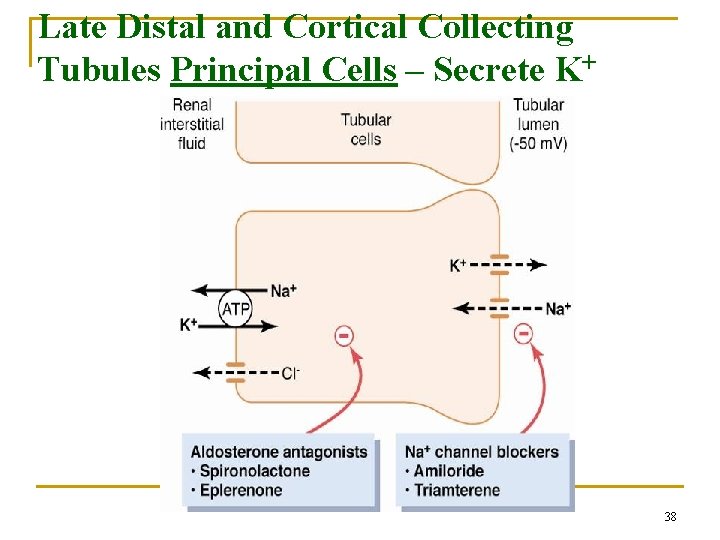
Late Distal and Cortical Collecting Tubules Principal Cells – Secrete K+ 38
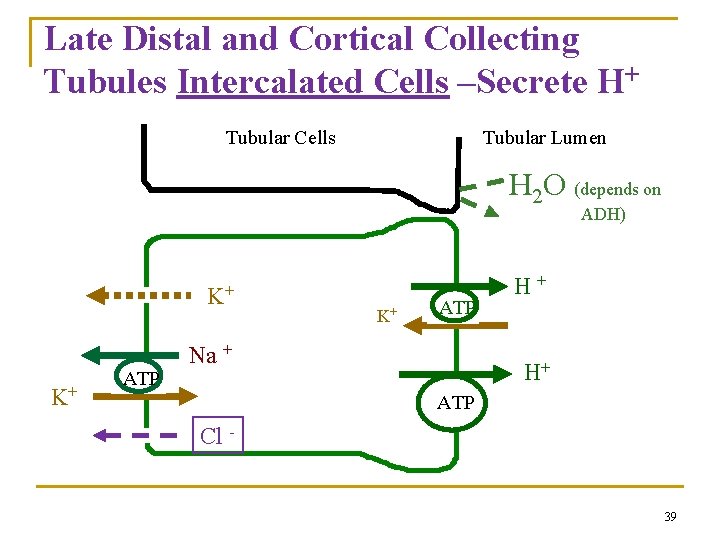
Late Distal and Cortical Collecting Tubules Intercalated Cells –Secrete H+ Tubular Cells Tubular Lumen H 2 O (depends on ADH) K+ K+ ATP ATP Na + H+ H+ ATP Cl - 39
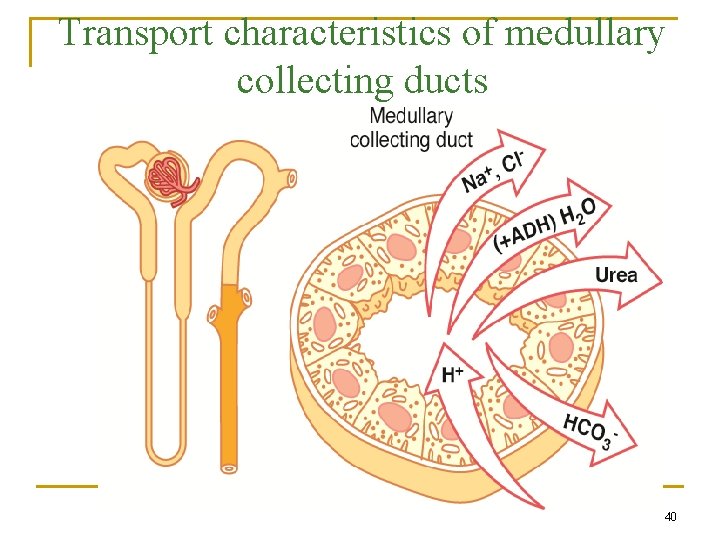
Transport characteristics of medullary collecting ducts 40
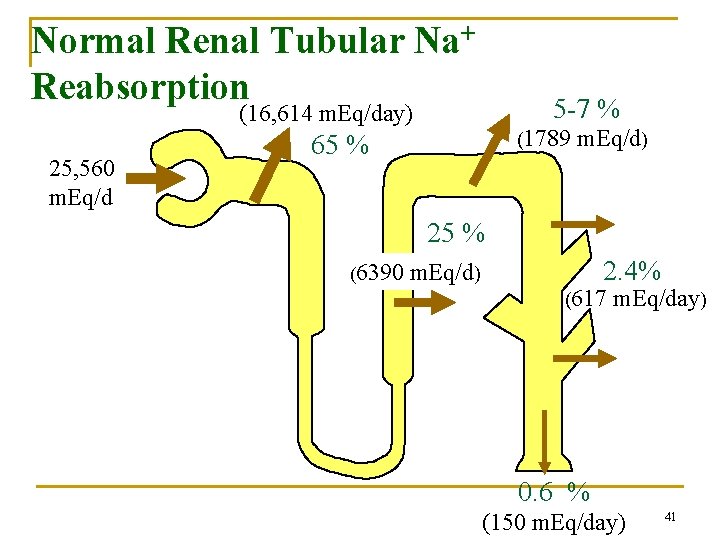
Normal Renal Tubular Na+ Reabsorption 5 -7 % (16, 614 m. Eq/day) 25, 560 m. Eq/d (1789 65 % m. Eq/d) 25 % (6390 m. Eq/d) 2. 4% (617 m. Eq/day) 0. 6 % (150 m. Eq/day) 41
Concentrations of solutes in different parts of the tubule depend on relative reabsorption of the solutes compared to water • If water is reabsorbed to a greater extent than the solute, the solute will become more concentrated in the tubule (e. g. creatinine, inulin) • If water is reabsorbed to a lesser extent than the solute, the solute will become less concentrated in the tubule (e. g. glucose, amino acids) 42
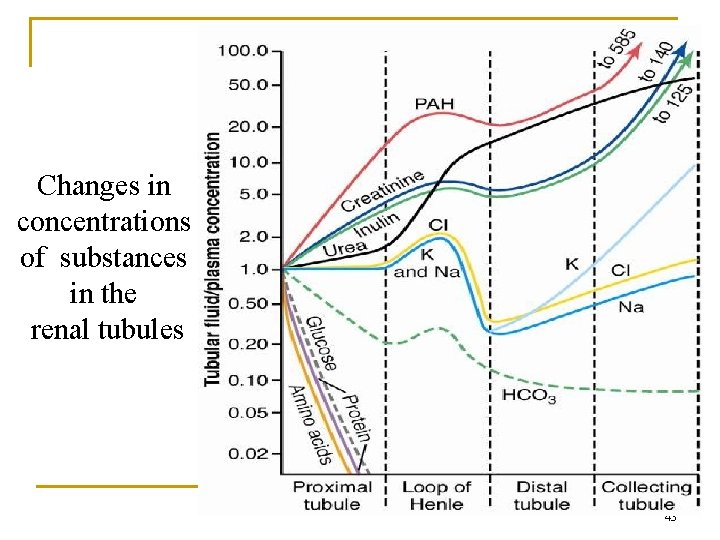
Changes in concentrations of substances in the renal tubules 43
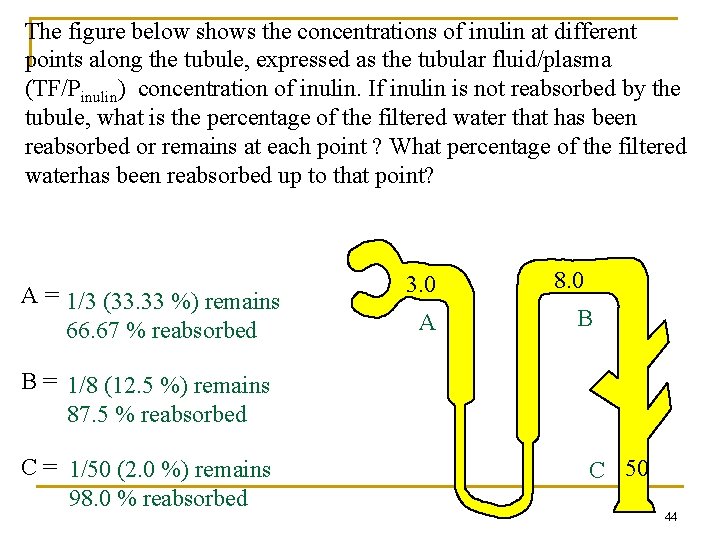
The figure below shows the concentrations of inulin at different points along the tubule, expressed as the tubular fluid/plasma (TF/Pinulin) concentration of inulin. If inulin is not reabsorbed by the tubule, what is the percentage of the filtered water that has been reabsorbed or remains at each point ? What percentage of the filtered waterhas been reabsorbed up to that point? A = 1/3 (33. 33 %) remains 66. 67 % reabsorbed 3. 0 A 8. 0 B B = 1/8 (12. 5 %) remains 87. 5 % reabsorbed C = 1/50 (2. 0 %) remains 98. 0 % reabsorbed C 50 44
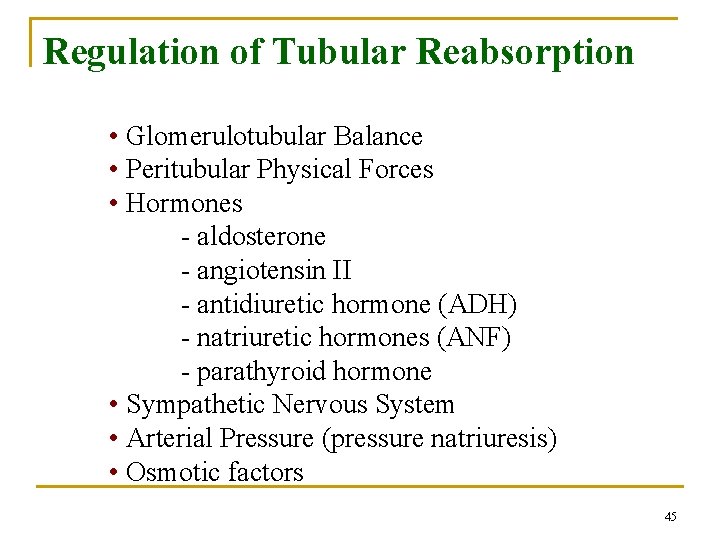
Regulation of Tubular Reabsorption • Glomerulotubular Balance • Peritubular Physical Forces • Hormones - aldosterone - angiotensin II - antidiuretic hormone (ADH) - natriuretic hormones (ANF) - parathyroid hormone • Sympathetic Nervous System • Arterial Pressure (pressure natriuresis) • Osmotic factors 45
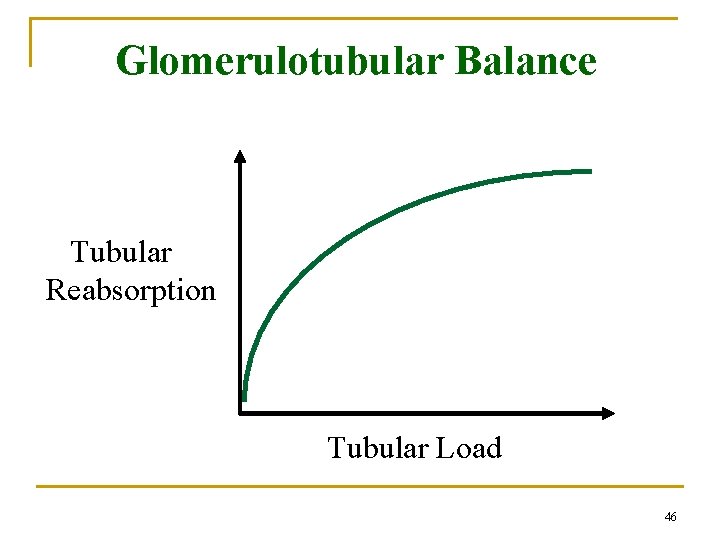
Glomerulotubular Balance Tubular Reabsorption Tubular Load 46
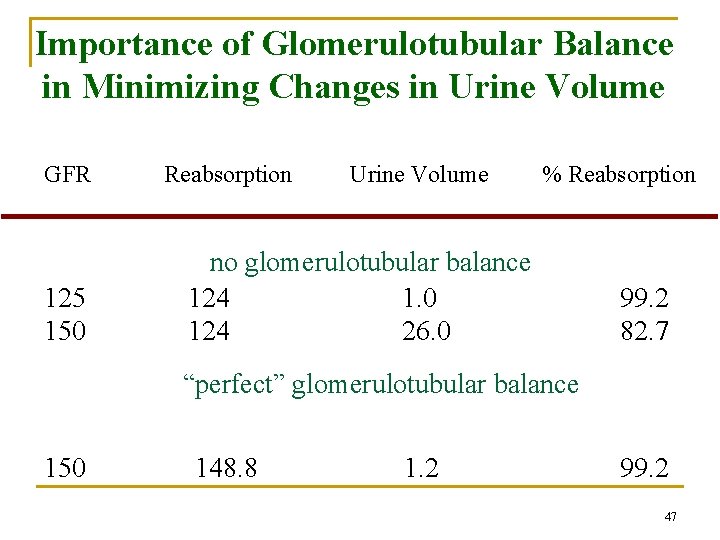
Importance of Glomerulotubular Balance in Minimizing Changes in Urine Volume GFR 125 150 Reabsorption Urine Volume % Reabsorption no glomerulotubular balance 124 1. 0 124 26. 0 99. 2 82. 7 “perfect” glomerulotubular balance 150 148. 8 1. 2 99. 2 47
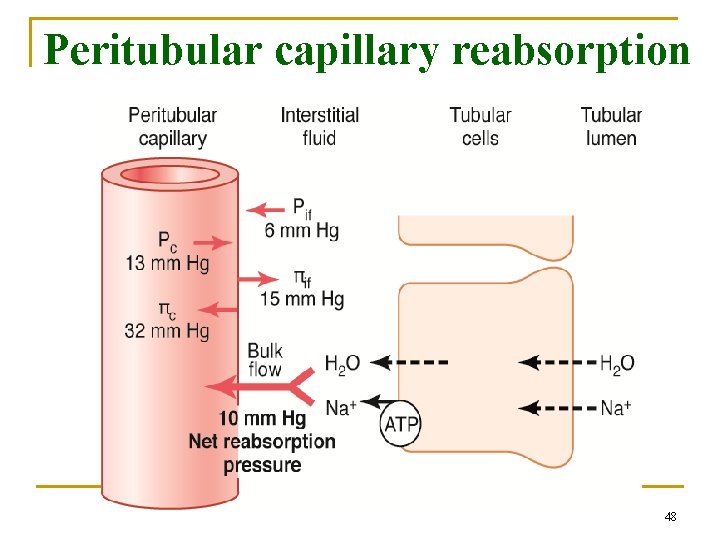
Peritubular capillary reabsorption 48
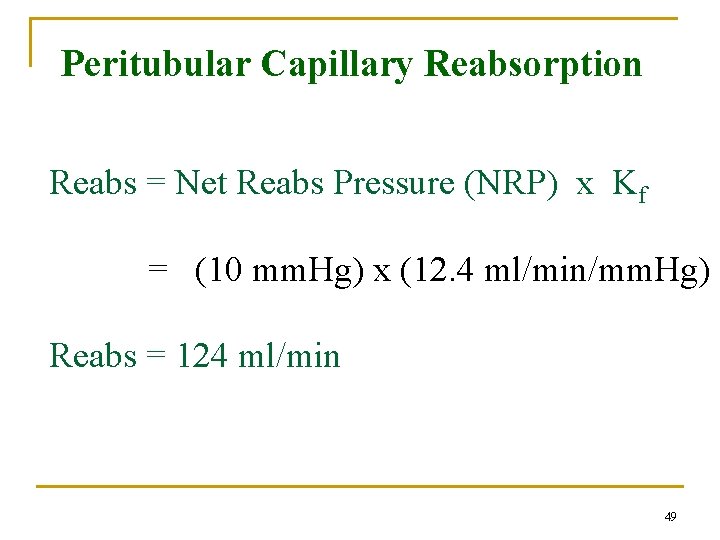
Peritubular Capillary Reabsorption Reabs = Net Reabs Pressure (NRP) x Kf = (10 mm. Hg) x (12. 4 ml/min/mm. Hg) Reabs = 124 ml/min 49
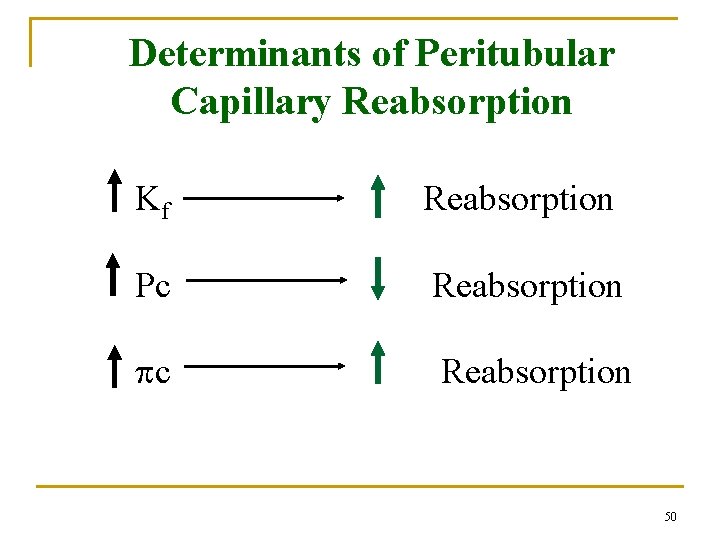
Determinants of Peritubular Capillary Reabsorption Kf Reabsorption Pc Reabsorption 50
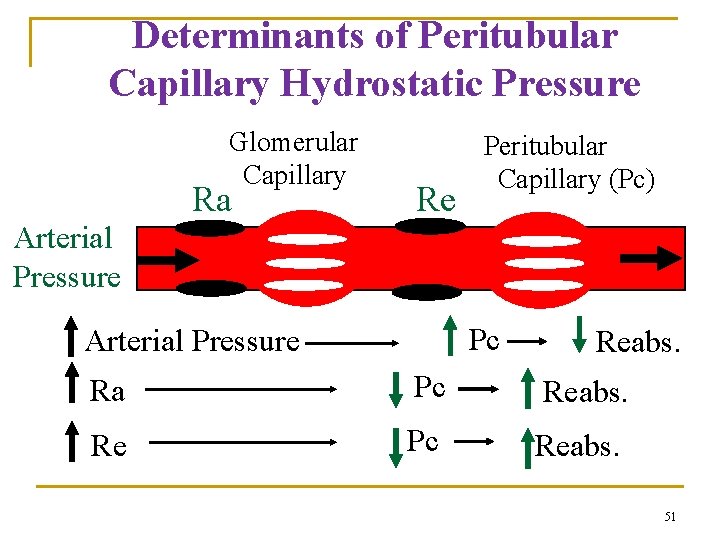
Determinants of Peritubular Capillary Hydrostatic Pressure Glomerular Capillary Ra Re Peritubular Capillary (Pc) Arterial Pressure Pc Arterial Pressure Reabs. Ra Pc Reabs. Re Pc Reabs. 51
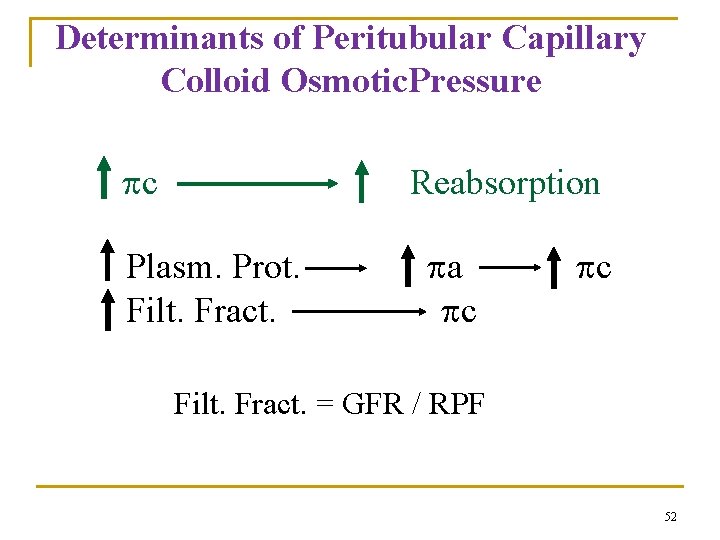
Determinants of Peritubular Capillary Colloid Osmotic. Pressure c Reabsorption Plasm. Prot. Filt. Fract. a c c Filt. Fract. = GFR / RPF 52
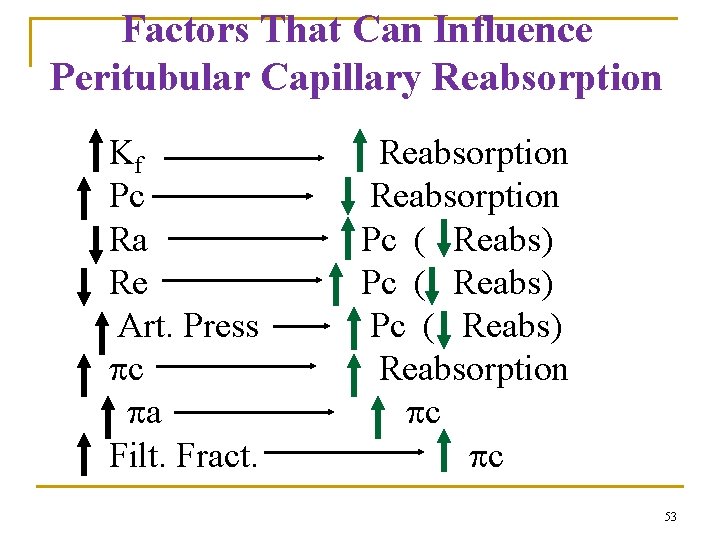
Factors That Can Influence Peritubular Capillary Reabsorption Kf Pc Ra Re Art. Press c a Filt. Fract. Reabsorption Pc ( Reabs) Reabsorption c c 53
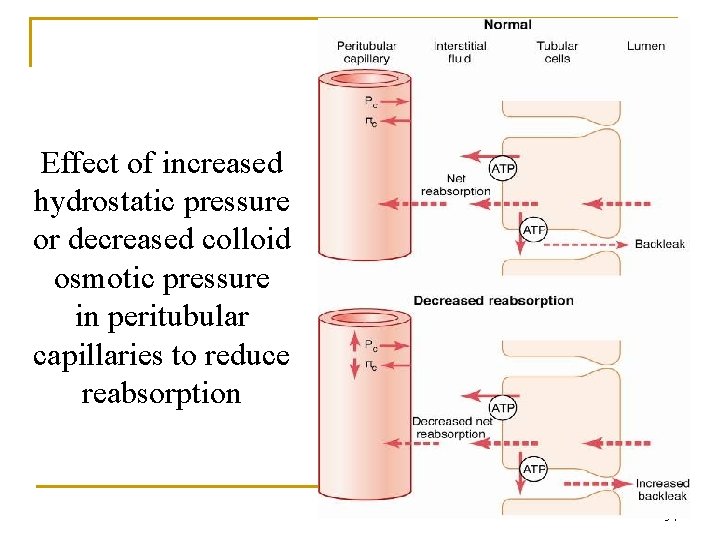
Effect of increased hydrostatic pressure or decreased colloid osmotic pressure in peritubular capillaries to reduce reabsorption 54
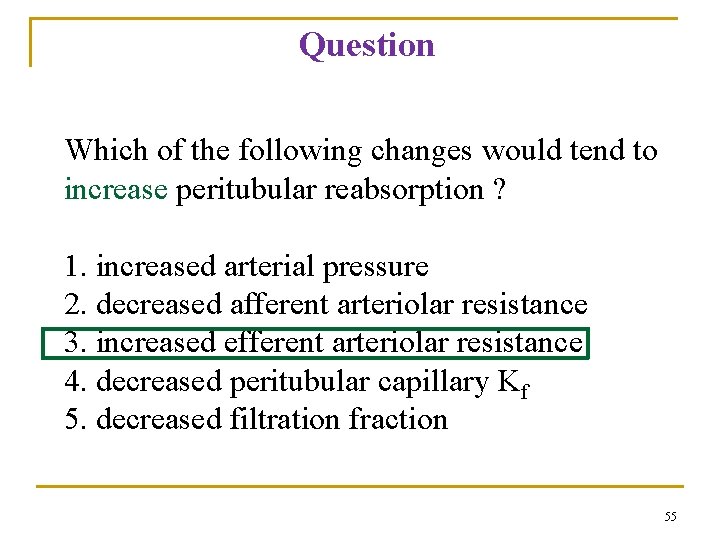
Question Which of the following changes would tend to increase peritubular reabsorption ? 1. increased arterial pressure 2. decreased afferent arteriolar resistance 3. increased efferent arteriolar resistance 4. decreased peritubular capillary Kf 5. decreased filtration fraction 55
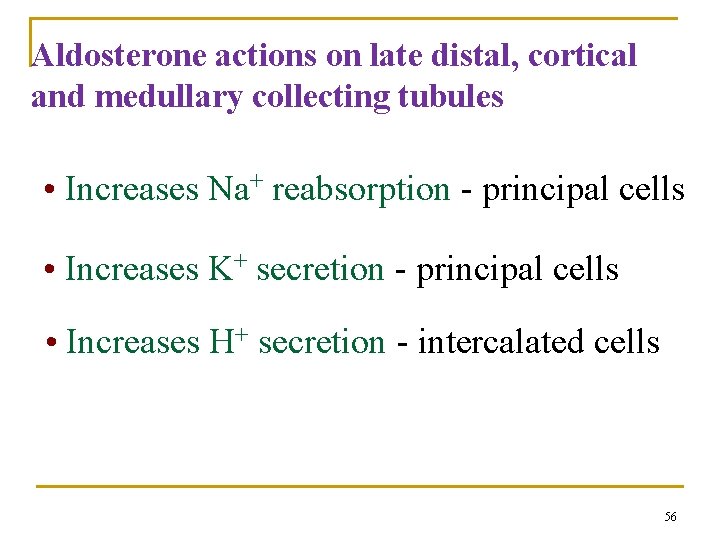
Aldosterone actions on late distal, cortical and medullary collecting tubules • Increases Na+ reabsorption - principal cells • Increases K+ secretion - principal cells • Increases H+ secretion - intercalated cells 56
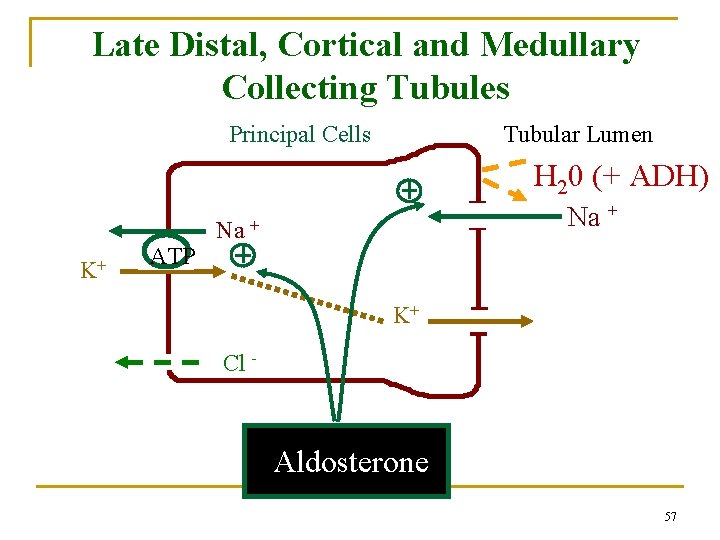
Late Distal, Cortical and Medullary Collecting Tubules Principal Cells Tubular Lumen H 20 (+ ADH) K+ ATP Na Na + + K+ Cl - Aldosterone 57
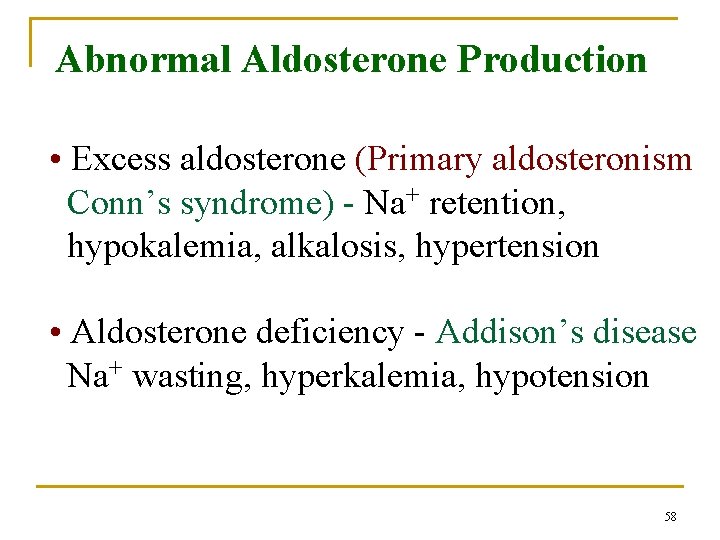
Abnormal Aldosterone Production • Excess aldosterone (Primary aldosteronism Conn’s syndrome) - Na+ retention, hypokalemia, alkalosis, hypertension • Aldosterone deficiency - Addison’s disease Na+ wasting, hyperkalemia, hypotension 58
Control of Aldosterone Secretion Factors that increase aldosterone secretion • Angiotensin II • Increased K+ • adrenocorticotrophic hormone (ACTH) (permissive role) Factors that decrease aldosterone secretion • Atrial natriuretic factor (ANF) • Increased Na+ concentration (osmolality) 59
Angiotensin II Increases Na+ and Water Reabsorption • Stimulates aldosterone secretion • Directly increases Na+ reabsorption (proximal, loop, distal, collecting tubules) • Constricts efferent arterioles - decreases peritubular capillary hydrostatic pressure - increases filtration fraction, which increases peritubular colloid osmotic pressure) 60
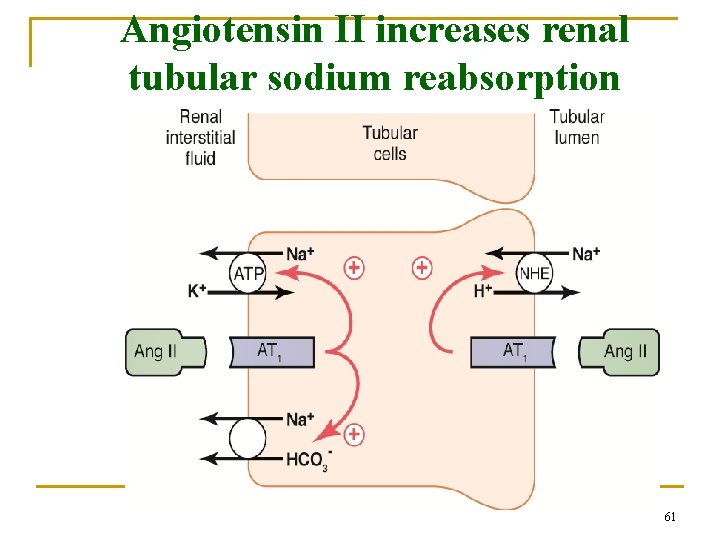
Angiotensin II increases renal tubular sodium reabsorption 61
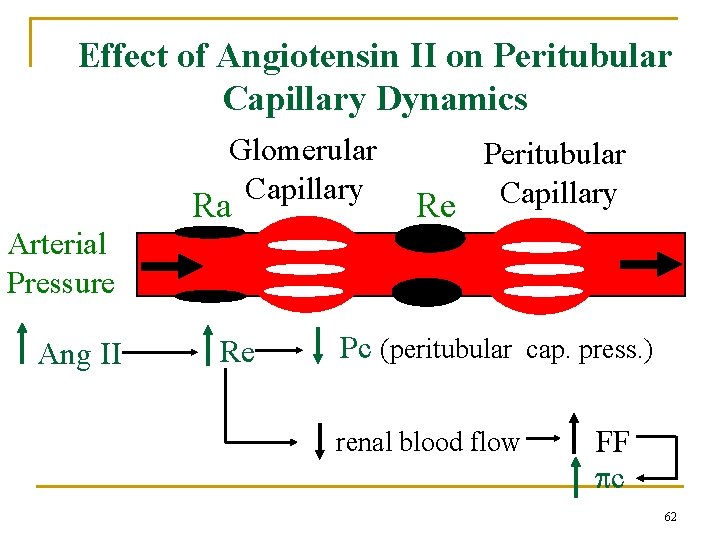
Effect of Angiotensin II on Peritubular Capillary Dynamics Glomerular Capillary Ra Peritubular Capillary Re Arterial Pressure Ang II Re Pc (peritubular cap. press. ) renal blood flow FF c 62
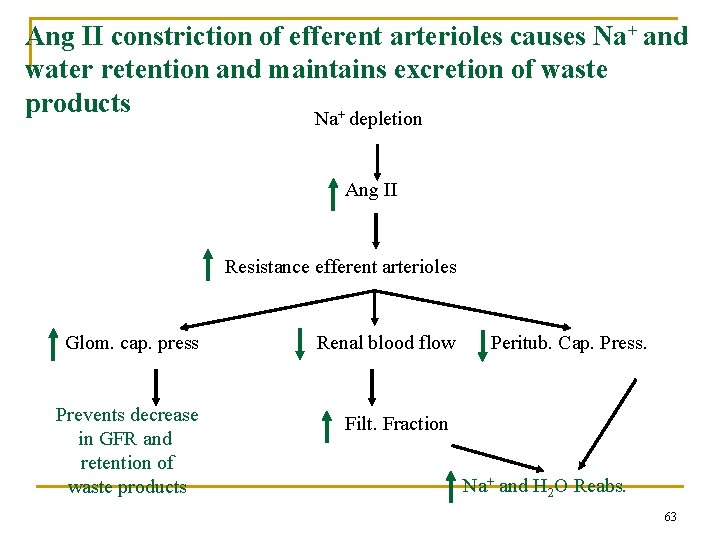
Ang II constriction of efferent arterioles causes Na+ and water retention and maintains excretion of waste products Na+ depletion Ang II Resistance efferent arterioles Glom. cap. press Prevents decrease in GFR and retention of waste products Renal blood flow Peritub. Cap. Press. Filt. Fraction Na+ and H 2 O Reabs. 63
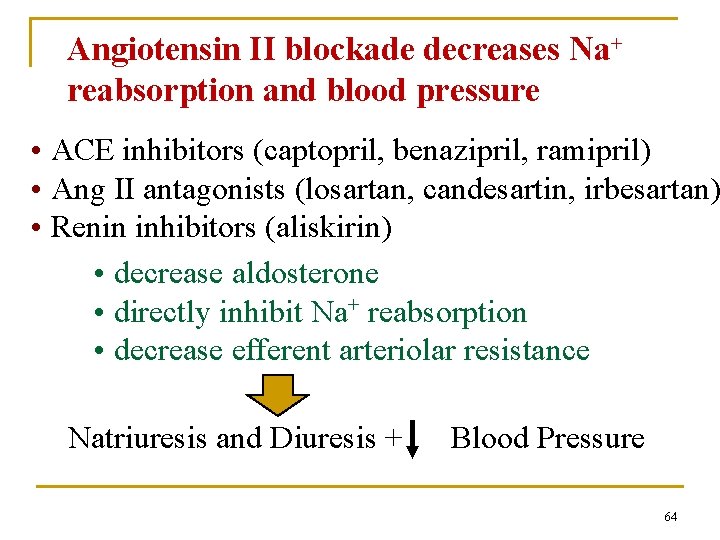
Angiotensin II blockade decreases Na+ reabsorption and blood pressure • ACE inhibitors (captopril, benazipril, ramipril) • Ang II antagonists (losartan, candesartin, irbesartan) • Renin inhibitors (aliskirin) • decrease aldosterone • directly inhibit Na+ reabsorption • decrease efferent arteriolar resistance Natriuresis and Diuresis + Blood Pressure 64
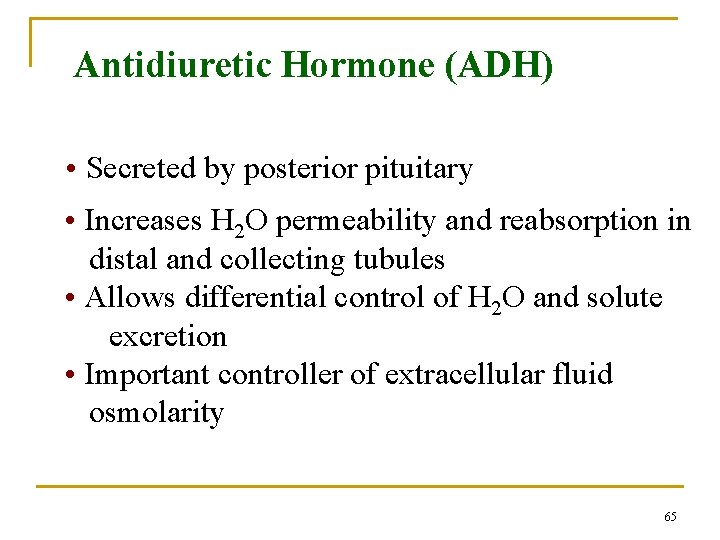
Antidiuretic Hormone (ADH) • Secreted by posterior pituitary • Increases H 2 O permeability and reabsorption in distal and collecting tubules • Allows differential control of H 2 O and solute excretion • Important controller of extracellular fluid osmolarity 65
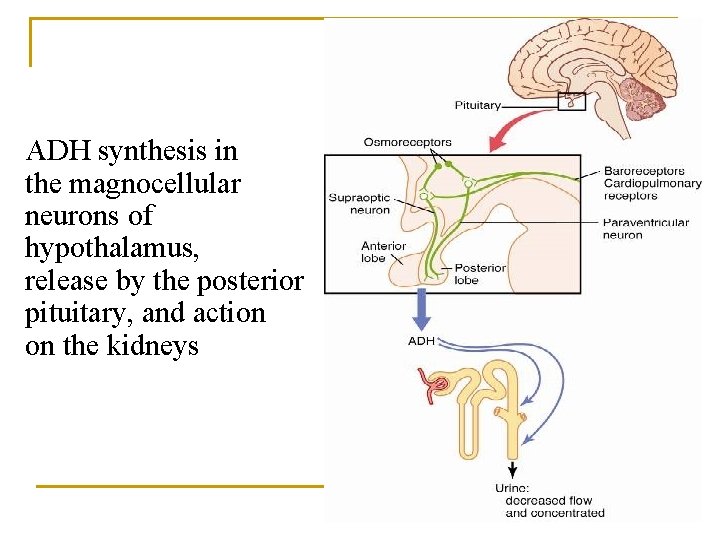
ADH synthesis in the magnocellular neurons of hypothalamus, release by the posterior pituitary, and action on the kidneys 66
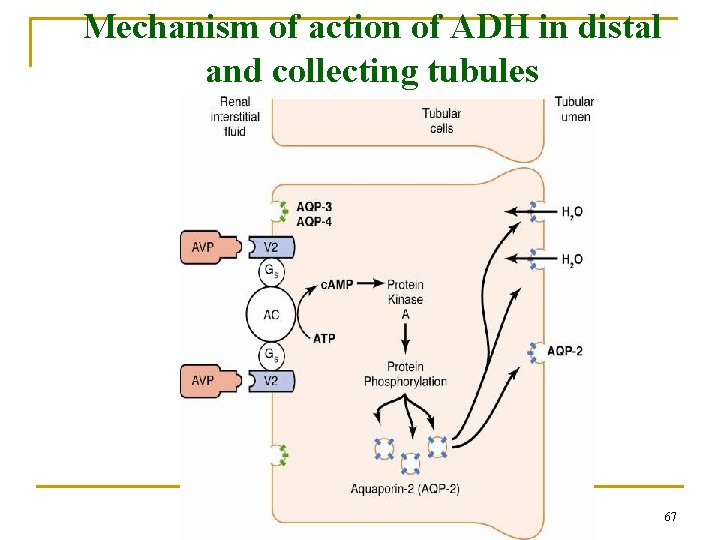
Mechanism of action of ADH in distal and collecting tubules 67
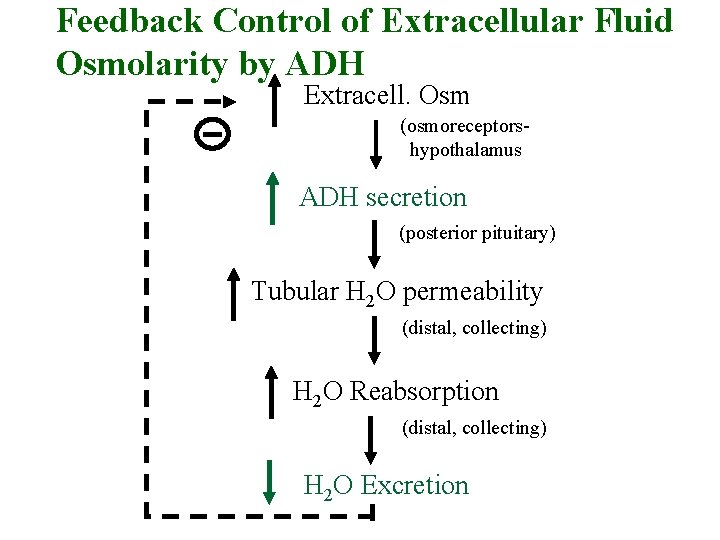
Feedback Control of Extracellular Fluid Osmolarity by ADH Extracell. Osm (osmoreceptorshypothalamus ADH secretion (posterior pituitary) Tubular H 2 O permeability (distal, collecting) H 2 O Reabsorption (distal, collecting) H 2 O Excretion
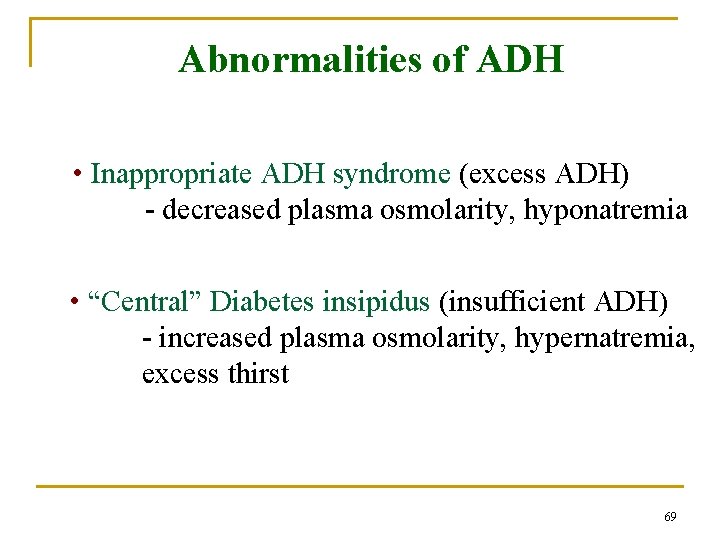
Abnormalities of ADH • Inappropriate ADH syndrome (excess ADH) - decreased plasma osmolarity, hyponatremia • “Central” Diabetes insipidus (insufficient ADH) - increased plasma osmolarity, hypernatremia, excess thirst 69
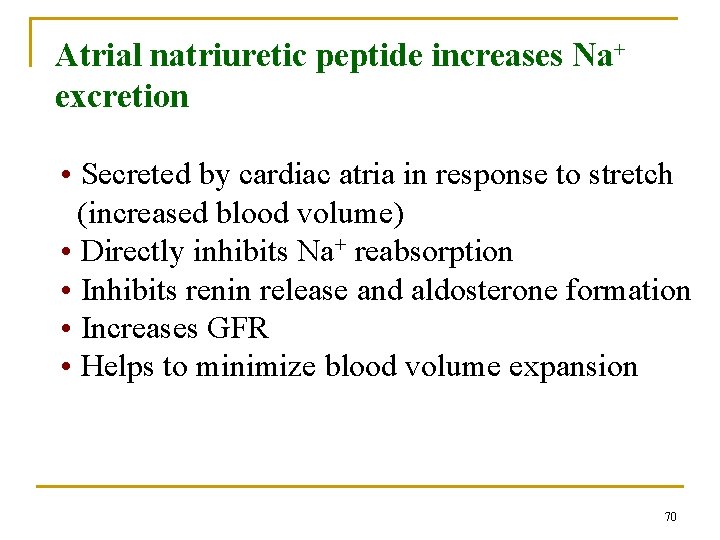
Atrial natriuretic peptide increases Na+ excretion • Secreted by cardiac atria in response to stretch (increased blood volume) • Directly inhibits Na+ reabsorption • Inhibits renin release and aldosterone formation • Increases GFR • Helps to minimize blood volume expansion 70
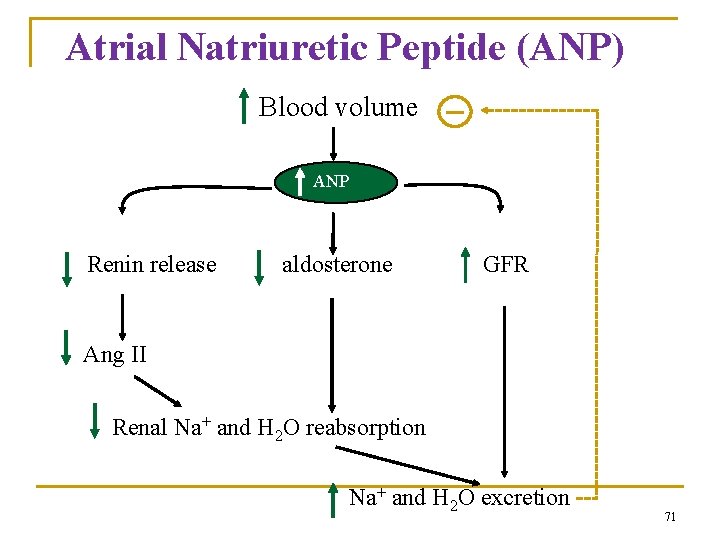
Atrial Natriuretic Peptide (ANP) Blood volume ANP Renin release aldosterone GFR Ang II Renal Na+ and H 2 O reabsorption Na+ and H 2 O excretion 71
Parathyroid hormone increases renal Ca++ reabsorption • Released by parathyroids in response to decreased extracellular Ca++ • Increases Ca++ reabsorption by kidneys • Increases Ca++ reabsorption by gut • Decreases phosphate reabsorption • Helps to increase extracellular Ca++ 72
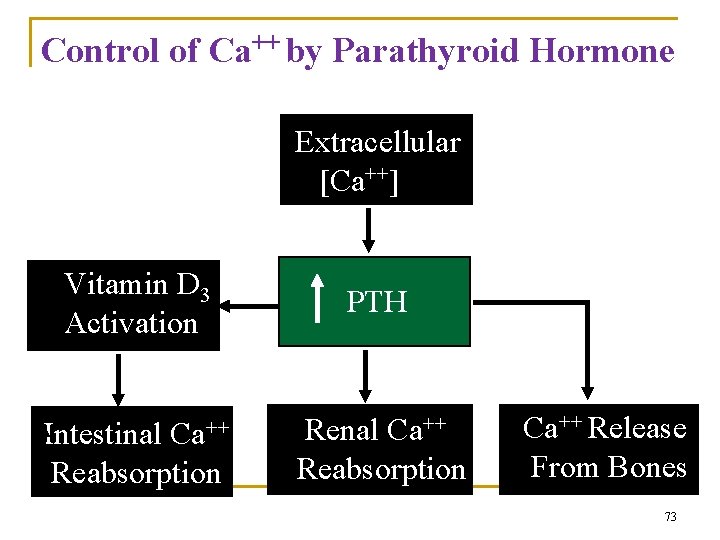
Control of Ca++ by Parathyroid Hormone Extracellular [Ca++] Vitamin D 3 Activation Ca++ Intestinal Reabsorption PTH Renal Ca++ Reabsorption Ca++ Release From Bones 73
Sympathetic nervous system increases Na+ reabsorption • Directly stimulates Na+ reabsorption • Stimulates renin release • Decreases GFR and renal blood flow (only a high levels of sympathetic stimulation) 74
Increased Arterial Pressure Decreases Na+ Reabsorption (Pressure Natriuresis) • Increased peritubular capillary hydrostatic pressure • Decreased renin and aldosterone • Increased release of intrarenal natriuretic factors - prostaglandins - EDRF 75
Osmotic Effects on Reabsorption • Water is reabsorbed only by osmosis • Increasing the amount of unreabsorbed solutes in the tubules decreases water reabsorption i. e. diabetes mellitus : unreabsorbed glucose in tubules causes diuresis and water loss i. e. osmotic diuretics (mannitol) 76
Abnormal Tubular Function : Increased Reabsorption • Conn’s Syndrome: primary aldosterone excess • Glucocorticoid Remediable Aldosteronism (GRA): excess aldosterone secretion due to abnormal control of aldosterone synthase by ACTH (genetic) • Renin secreting tumor: excess Ang II formation • Inappropriate ADH syndrome: excess ADH • Liddle’s Syndrome: excess activity of amiloride sensitive Na+ channel (genetic) 77
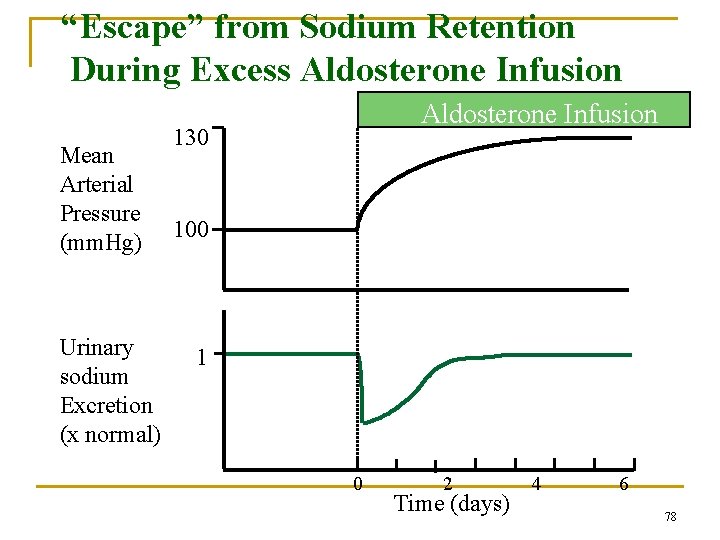
“Escape” from Sodium Retention During Excess Aldosterone Infusion Mean Arterial Pressure (mm. Hg) Urinary sodium Excretion (x normal) Aldosterone Infusion 130 100 1 0 2 Time (days) 4 6 78
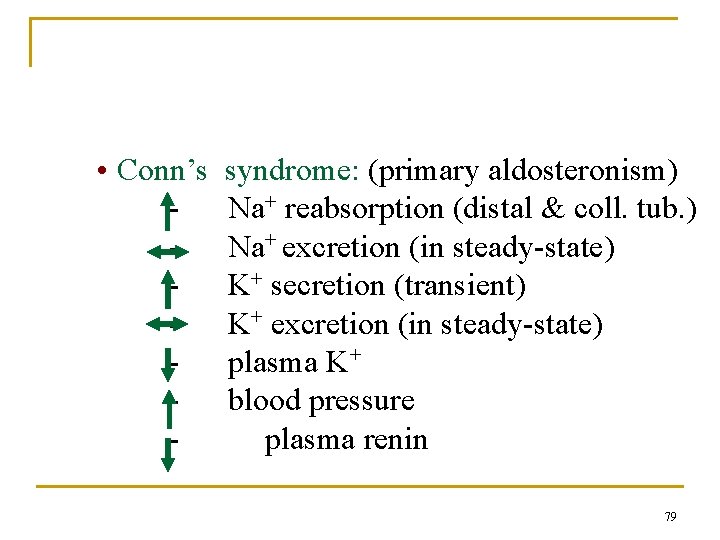
• Conn’s - syndrome: (primary aldosteronism) Na+ reabsorption (distal & coll. tub. ) Na+ excretion (in steady-state) K+ secretion (transient) K+ excretion (in steady-state) plasma K+ blood pressure plasma renin 79
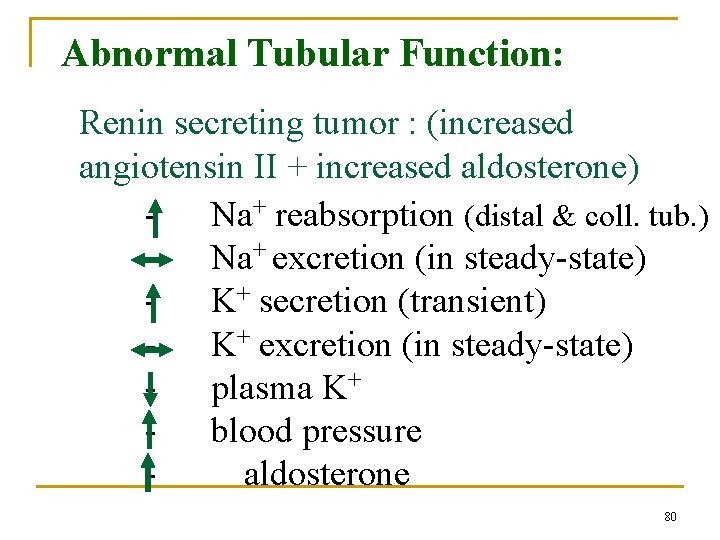
Abnormal Tubular Function: Renin secreting tumor : (increased angiotensin II + increased aldosterone) Na+ reabsorption (distal & coll. tub. ) Na+ excretion (in steady-state) K+ secretion (transient) K+ excretion (in steady-state) plasma K+ blood pressure aldosterone 80
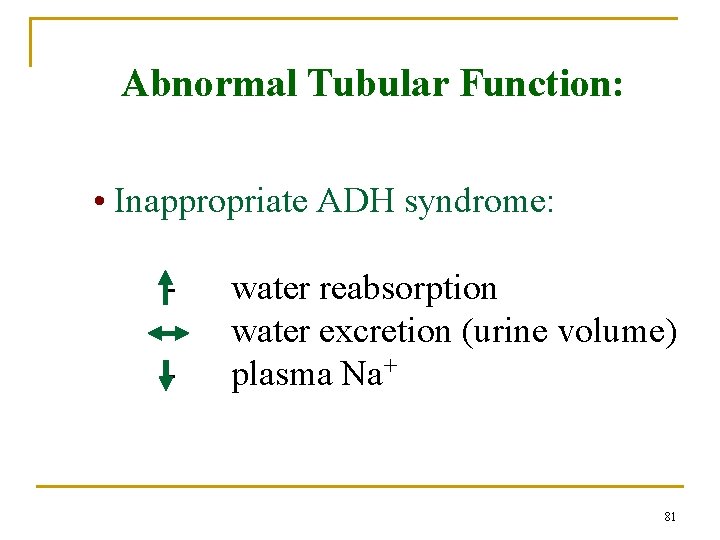
Abnormal Tubular Function: • Inappropriate ADH syndrome: - water reabsorption water excretion (urine volume) plasma Na+ 81
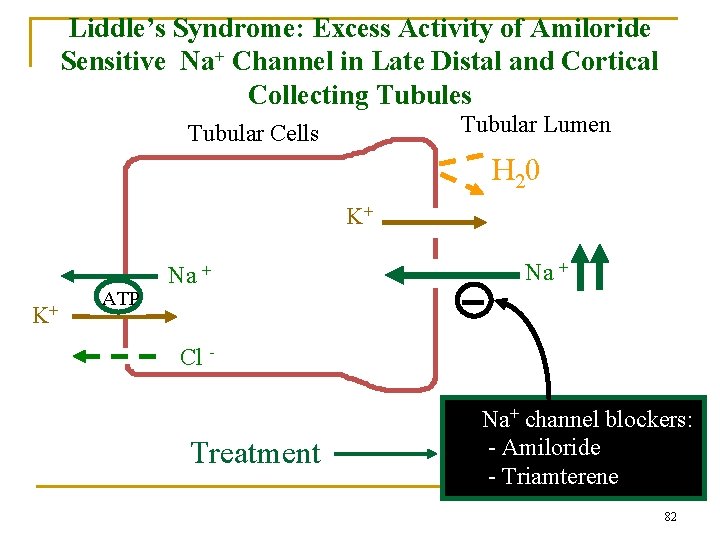
Liddle’s Syndrome: Excess Activity of Amiloride Sensitive Na+ Channel in Late Distal and Cortical Collecting Tubules Tubular Lumen Tubular Cells H 20 K+ K+ ATP Na + Cl - Treatment Na+ channel blockers: - Amiloride - Triamterene 82
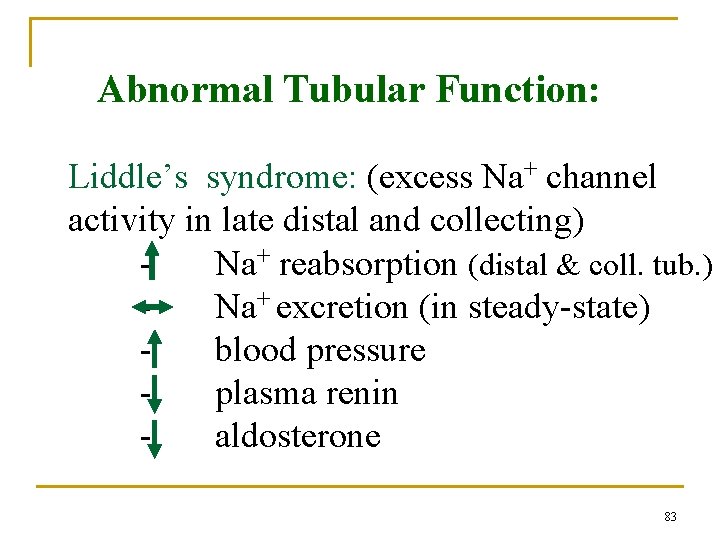
Abnormal Tubular Function: Liddle’s syndrome: (excess Na+ channel activity in late distal and collecting) Na+ reabsorption (distal & coll. tub. ) Na+ excretion (in steady-state) blood pressure plasma renin aldosterone 83
Assessing Kidney Function • Plasma concentration of waste products (e. g. BUN, creatinine) • Urine specific gravity, urine concentrating ability; • Urinalysis test reagent strips (protein, glucose, etc) • Biopsy • Albumin excretion (microalbuminuria) • Isotope renal scans • Imaging methods (e. g. MRI, PET, arteriograms, iv pyelography, ultrasound etc) • Clearance methods (e. g. 24 -hr creatinine clearance) • etc 84

Thank you 85
- Slides: 85