Ecosystem Dynamics of Ecosystem The various components of

- Slides: 35
Ecosystem
Dynamics of Ecosystem The various components of the ecosystem constitute an interacting system. They are connected by energy, nutrients and minerals. The nutrients and minerals circulate and recirculate between the abiotic and biotic factors of the ecosystem several times. Whereas, the flow of energy is one way, once used by the ecosystem, it is lost. Thus the continuous survival of the ecosystem depends on the flow of energy and the circulation of nutrients and minerals in the ecosystem.
Thus the dynamics (functions) of the ecosystem includes the following. 1. Energy 2. Primary production 3. Secondary production 4. Food chain 5. Trophic levels 6. Food web 7. Energy flow 8. Ecological pyramids 9. Biogeochemical cycles
1. Energy is the ability to do work. The main source of energy for an ecosystem is the radiant energy or light energy derived from the sun.
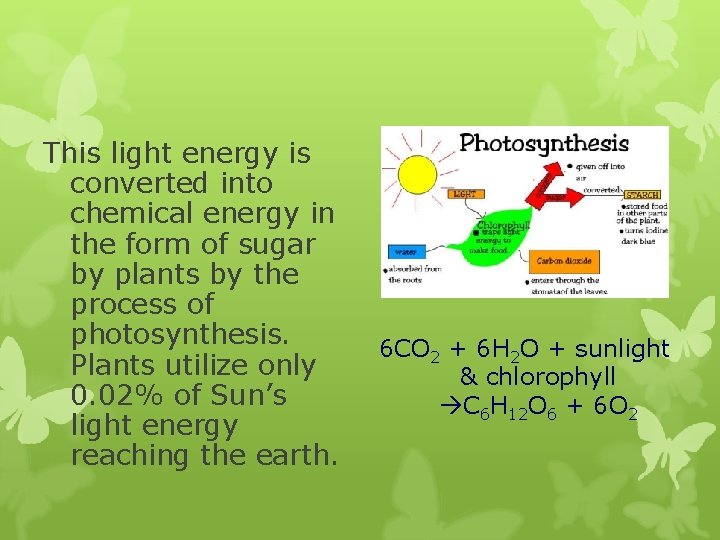
This light energy is converted into chemical energy in the form of sugar by plants by the process of photosynthesis. Plants utilize only 0. 02% of Sun’s light energy reaching the earth. 6 CO 2 + 6 H 2 O + sunlight & chlorophyll C 6 H 12 O 6 + 6 O 2
Plants use most of the energy they make for themselves. Consumers get their energy from the plants (producers).
2. Primary production The amount of light energy converted to chemical energy by plants during a given period of time per unit area is called primary productivity.
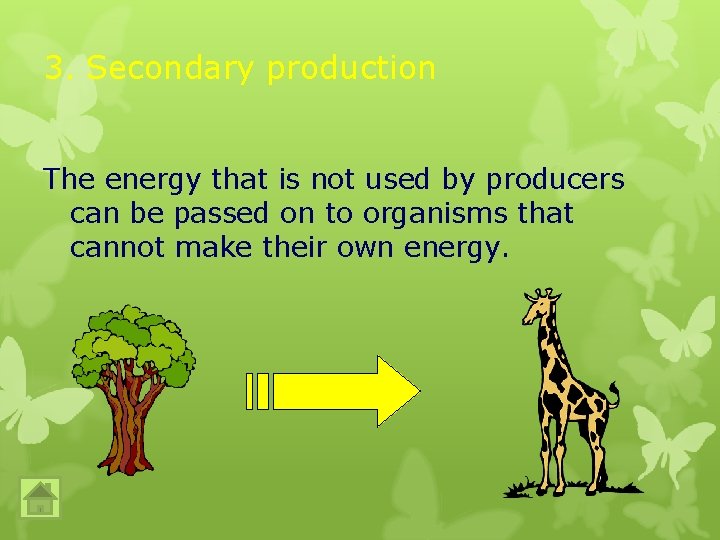
3. Secondary production The energy that is not used by producers can be passed on to organisms that cannot make their own energy.
The producers are directly consumed by the herbivores that are eaten by the primary carnivores that in turn are consumed by the secondary carnivores. The consumers store some amount of energy in their tissues. This energy, stored by the consumers, is called secondary production. Only about 10 to 20% of the primary production is converted into secondary production.
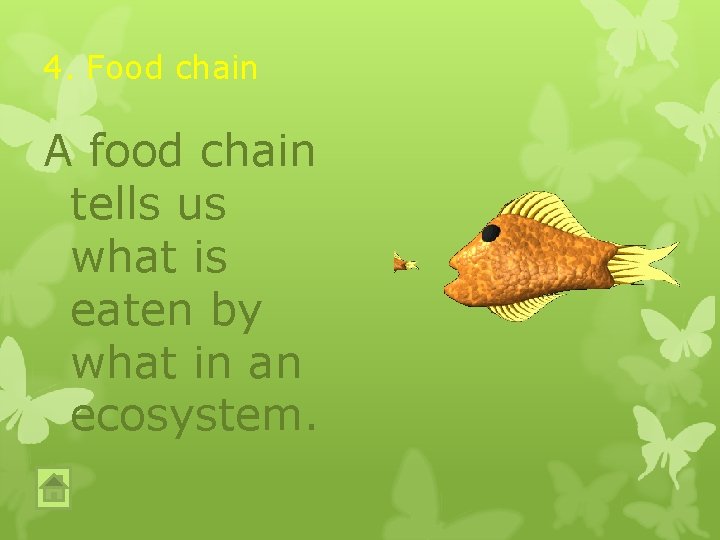
4. Food chain A food chain tells us what is eaten by what in an ecosystem.
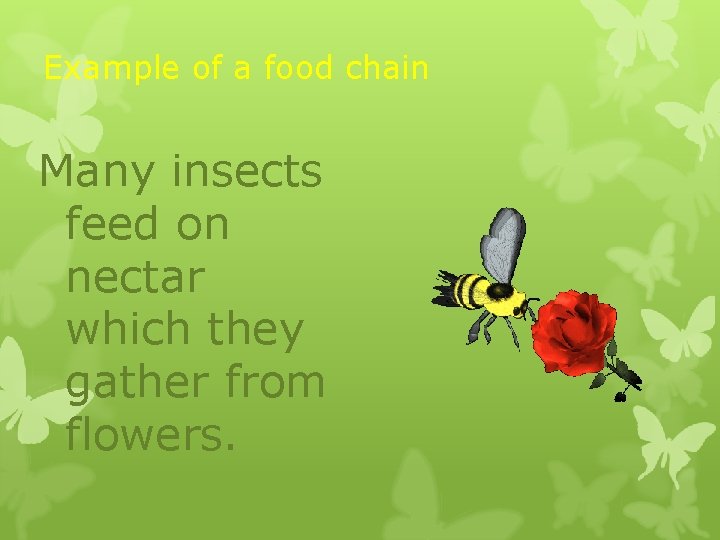
Example of a food chain Many insects feed on nectar which they gather from flowers.
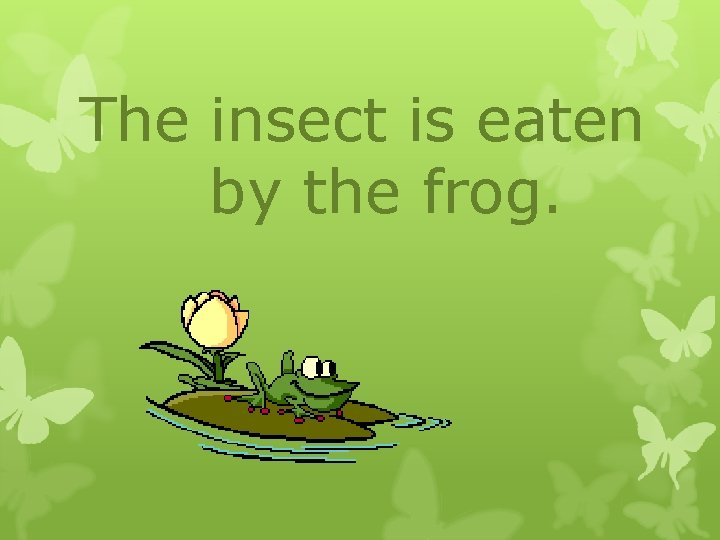
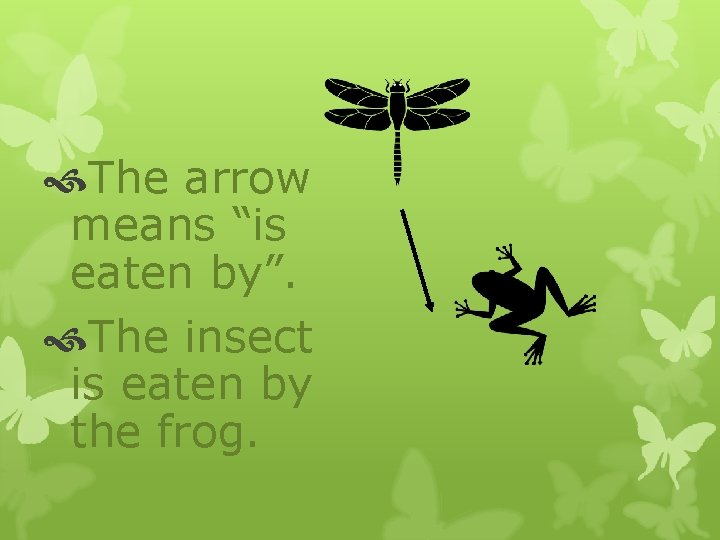
The insect is eaten by the frog.
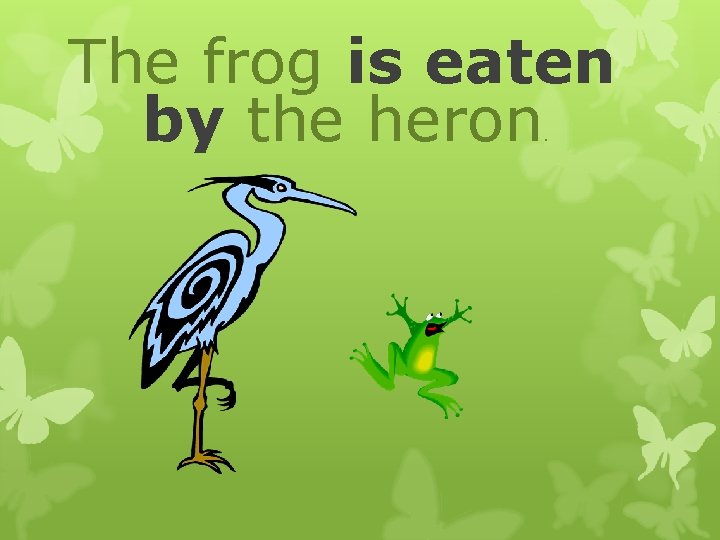
The frog is eaten by the heron.
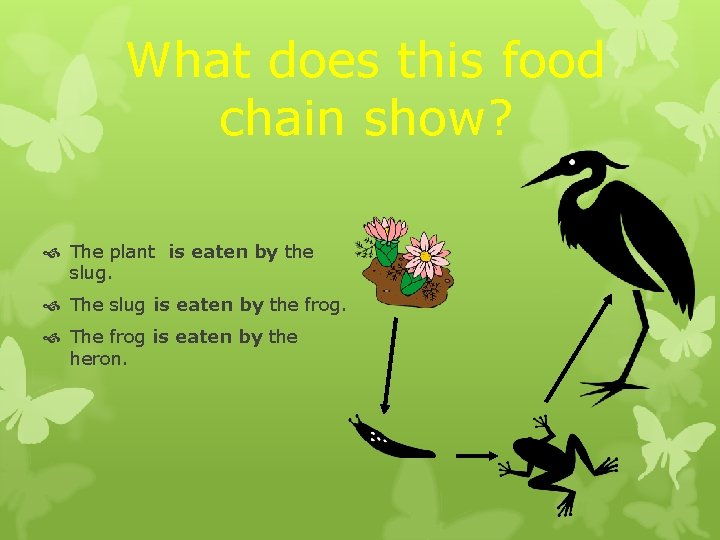
What does this food chain show? The plant is eaten by the slug. The slug is eaten by the frog. The frog is eaten by the heron.
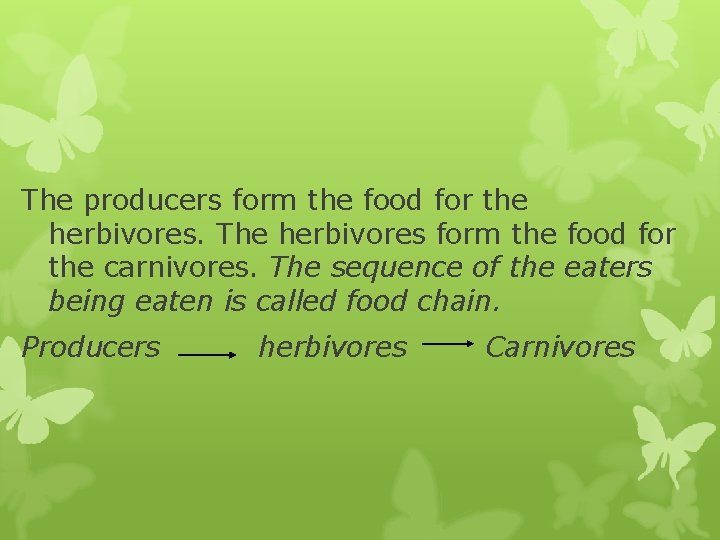
The producers form the food for the herbivores. The herbivores form the food for the carnivores. The sequence of the eaters being eaten is called food chain. Producers herbivores Carnivores
The arrow means “is eaten by”. The insect is eaten by the frog.
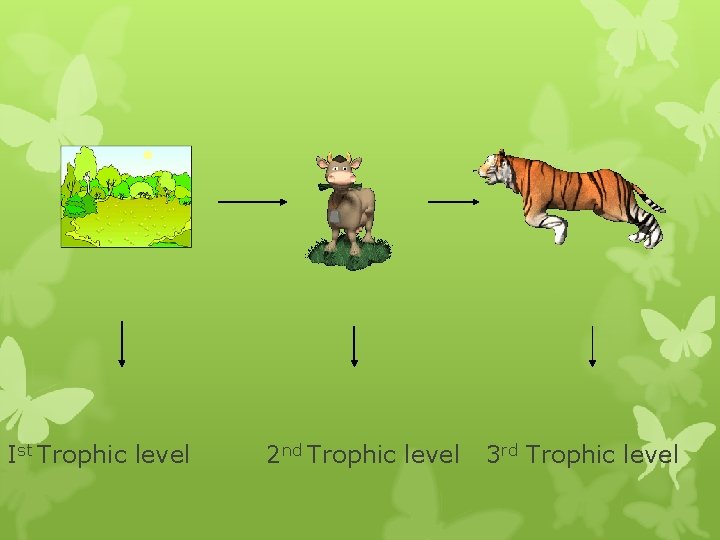
5. Trophic level Each food chain contains many steps like producers, herbivores, primary carnivores and so on. Each step of the food chain is called trophic level. The number of trophic levels in a food chain is always restricted to 4 or 5. But very often the chains are very much complicated with many trophic levels.
Ist Trophic level 2 nd Trophic level 3 rd Trophic level
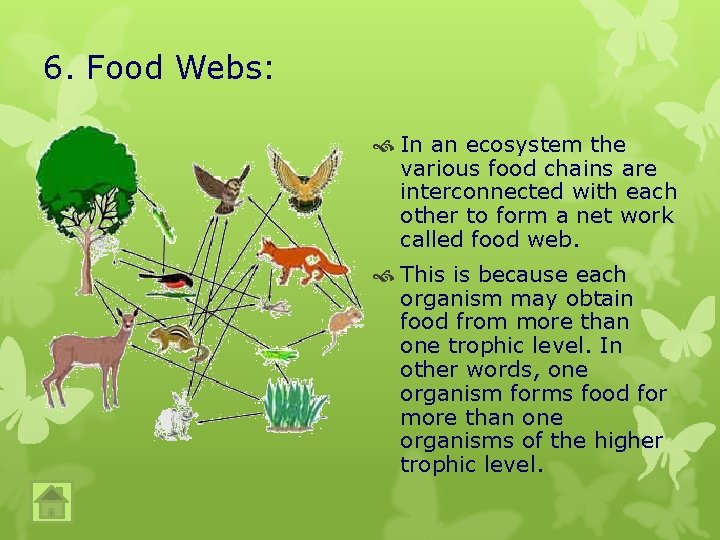
6. Food Webs: In an ecosystem the various food chains are interconnected with each other to form a net work called food web. This is because each organism may obtain food from more than one trophic level. In other words, one organism forms food for more than one organisms of the higher trophic level.
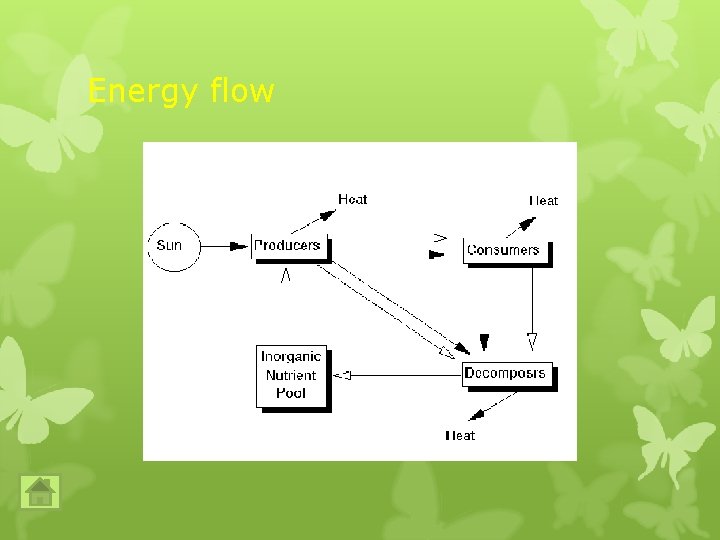
7. Energy flow Solar energy is trapped by the green plants, and converted into chemical energy and stored as carbohydrates. This happens during photosynthesis. A part of this chemical energy is used up by the green plants themselves. The major portion of the energy is consumed in the form of food by the consumers at different trophic level. Thus there is energy flow through the biotic components in an ecosystem.
The transfer of energy from one trophic level to another trophic level is called energy flow. -The flow of energy in an ecosystem is unidirectional. That is, it flows from the producer level to the consumer level and never in the reverse direction. Hence the energy can be used only once in the ecosystem.
Energy flow is unidirectional
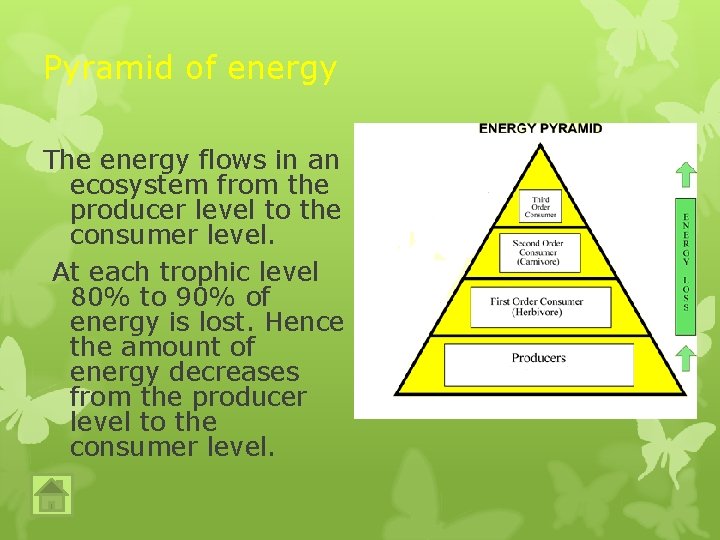
- But the minerals circulate and recirculate many times in the ecosystem. -A large amount of energy is lost at each trophic level. It is estimated that 80% to 90% of the energy is lost when it is transferred from one trophic level to another.
Energy flow
8. Ecological Pyramids The number, biomass, and energy of organisms gradually decrease from the producer to the consumer level. This can be represented by a pyramid called ecological pyramid. Ecological pyramid is the graphic representation of number, biomass, and energy of the successive trophic levels of an ecosystem.
Types of ecological pyramids 1. The pyramid of number 2. The pyramid of biomass 3. The pyramid of energy.
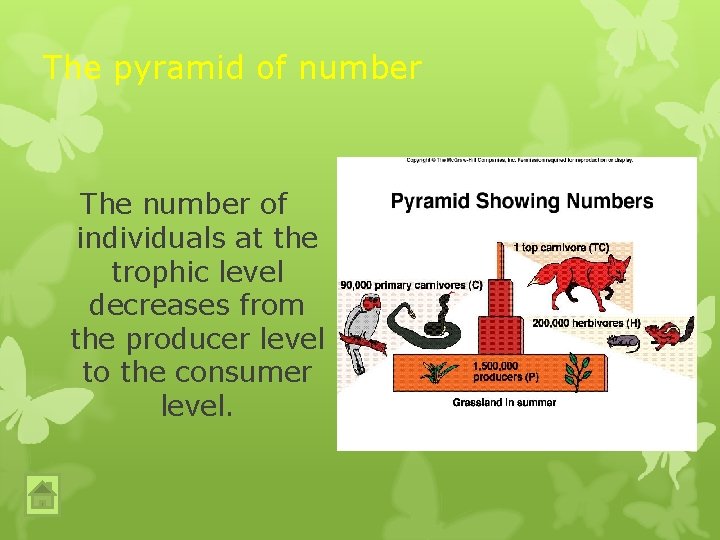
The pyramid of number The number of individuals at the trophic level decreases from the producer level to the consumer level.
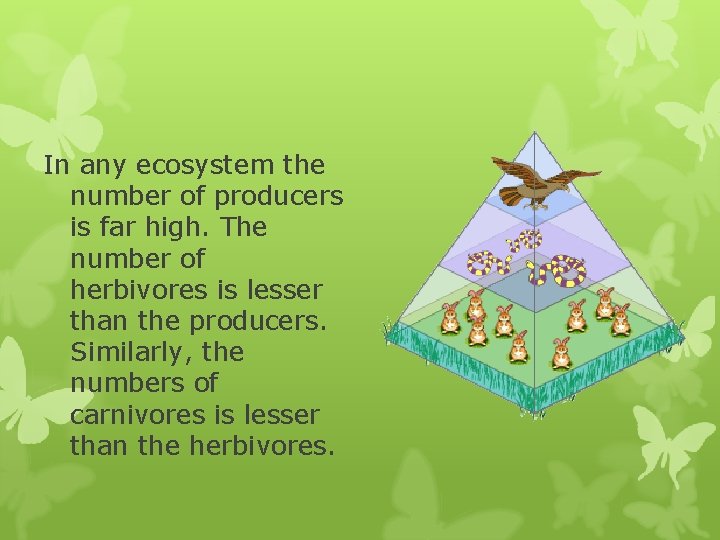
In any ecosystem the number of producers is far high. The number of herbivores is lesser than the producers. Similarly, the numbers of carnivores is lesser than the herbivores.
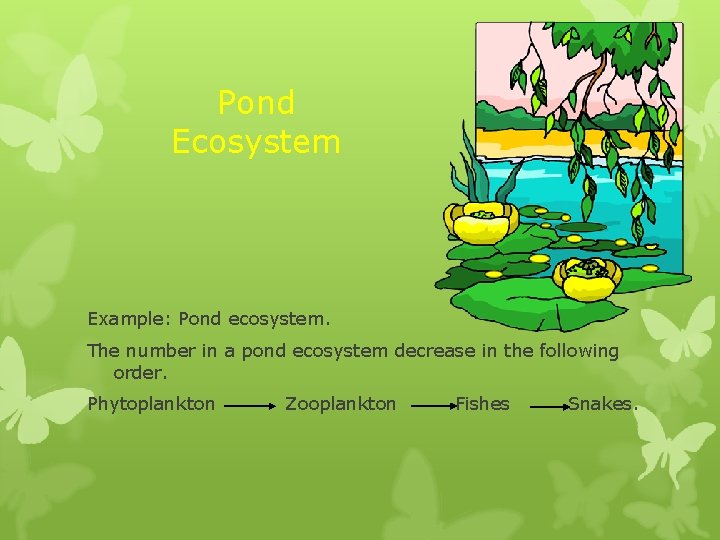
Pond Ecosystem Example: Pond ecosystem. The number in a pond ecosystem decrease in the following order. Phytoplankton Zooplankton Fishes Snakes.
The pyramid of biomass Biomass: Biomass refers to the total weight of living matter per unit area. In an ecosystem the biomass decreases from the producer level to the consumer level.
Pyramid of energy The energy flows in an ecosystem from the producer level to the consumer level. At each trophic level 80% to 90% of energy is lost. Hence the amount of energy decreases from the producer level to the consumer level.
According to the 2 nd Law of Thermodynamics, the energy is not transferred from one object/organism to the next with 100% efficiency Some of the energy is lost to the environment
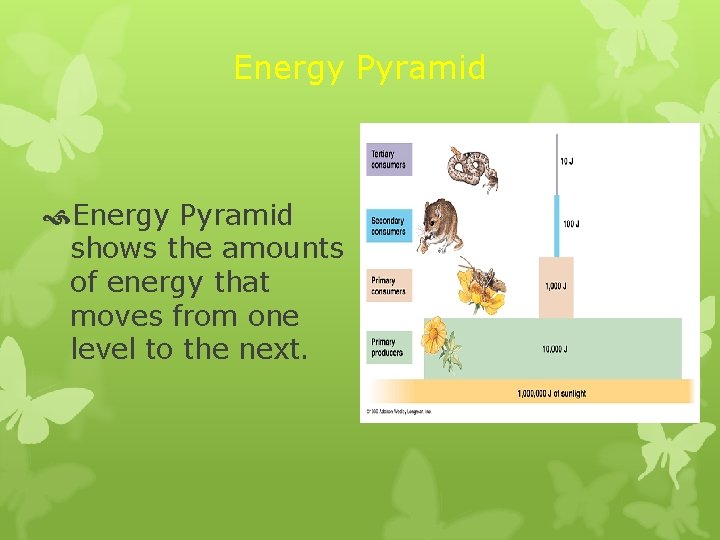
Energy Pyramid shows the amounts of energy that moves from one level to the next.
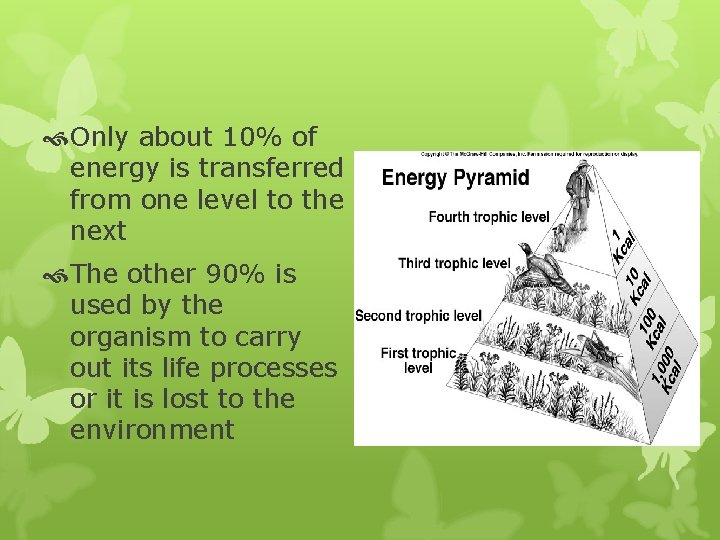
Only about 10% of energy is transferred from one level to the next The other 90% is used by the organism to carry out its life processes or it is lost to the environment
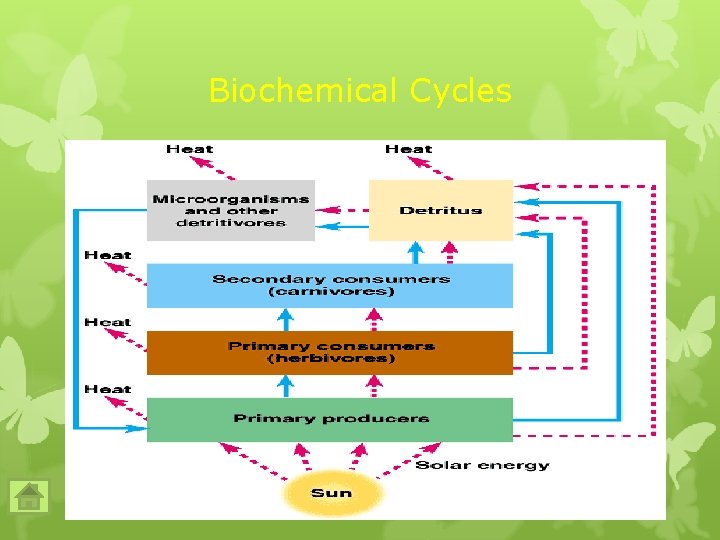
Biochemical Cycles