Duke Human Vaccine Institute Immunology Quality Assessment Cryopreservation

























- Slides: 55
Duke Human Vaccine Institute Immunology Quality Assessment Cryopreservation Proficiency Testing Program HPTN & IMPAACT Annual Meeting 2015 Presented by: Sarah Keinonen June 16, 2015 1
Overview Introduction to IQA Cryopreservation Proficiency Testing Program Overview of IQA Laboratory Performance Evaluation Overview of Participating Network Laboratory Workflow 2
Purpose of the IQA Cryopreservation PT Program • The use of cryopreserved Peripheral Mononuclear Blood Cells (PBMCs) for immunological assays has increased in recent years with the expansion and diversification of sites participating in DAIDS-supported network studies • The utility of cryopreserved PBMCs for efficient immunological assays is predicated by their viability and functional ability in vitro • The IQA Cryopreservation PT Program measures viability and viable recovery of the processed PBMC samples at participating DAIDS-supported laboratories on a quarterly basis to ensure sample integrity 3
Purpose of the IQA Cryopreservation PT Program 1. 2. 3. Assess a laboratory’s ability to consistently process, cryopreserve and ship viable PBMCs Reflect a laboratory’s ability to provide quality PBMCs for use in network protocols Troubleshoot and work with individual laboratories via email, conference calls, and site visits Communicate with the networks to verify each lab’s status and collaborate to determine necessary corrective action if needed IQA Cryopreservation PT Program Give laboratories sufficient opportunity to improve performance Provides incentive for laboratories to continue participation and high performance 4
IQA Global Laboratory Participants Enrolled in the Cryopreservation Proficiency Testing Program 66 labs in North America 10 in labs Central and South America 14 labs in Africa 93 participating laboratories 6 labs in Pacific Rim 5
Purpose of the IQA Cryopreservation PT Program • Cells collected in clinical trials may be frozen before analysis at other sites • The leadership of the AIDS Clinical Trials Group (ACTG) and the International Maternal Pediatric Adolescent AIDS Clinical Trials Group (IMPAACT) require laboratories that cryopreserve PBMCs for network protocols to participate in the IQA Cryopreservation PT Program administered quarterly • This is accomplished by an established quarterly timeframe 6
IQA Quarterly Timeframe 7
IQA Quarterly Timeframe • Each participating laboratory is contacted 5 weeks prior to the beginning of the quarterly Cryopreservation PT round: – Laboratories are asked to start the donor PBMC collection process – Detailed and specific instructions are included for the PT round – Instructions are also available on the IQA website • The IQA Cryopreservation PT process includes: – Collection of blood from 2 donors (HIV +/-) – Isolation and cryopreservation of PBMCs – Storage at the processing site for no more than 5 weeks and no less than 1 week – Shipment to the IQA laboratory before the final deadline • Each laboratory is required to submit two aliquots from two donors with each round of quarterly testing. 8
2015 IQA Cryo Calendar At the beginning of every year an IQA Cryopreservation calendar is prepared showing the important dates of the IQA Cryopreservation PT program Calendars are available to participating laboratories and on the IQA website Green = date of collection of Cryo samples from 2 donors Blue = date lab ships to the IQA Pink = date samples are to be received by IQA or considered late Red= date IQA is closed 9
IQA Laboratory Performance Evaluation 10
IQA Workflow Participating Labs ship 2 aliquots of cryopreserved PBMCS from 2 donors to the IQA Lab keeps 2 back up aliquots If score is <2, the second aliquot from the donor is analyzed by an automated and manual count The better of the two scores is used for the quarterly result report IQA receives the shipment If shipment is compromised the back up aliquots are requested IQA analyzes 1 aliquot from each donor using an automated count and issues a score 11
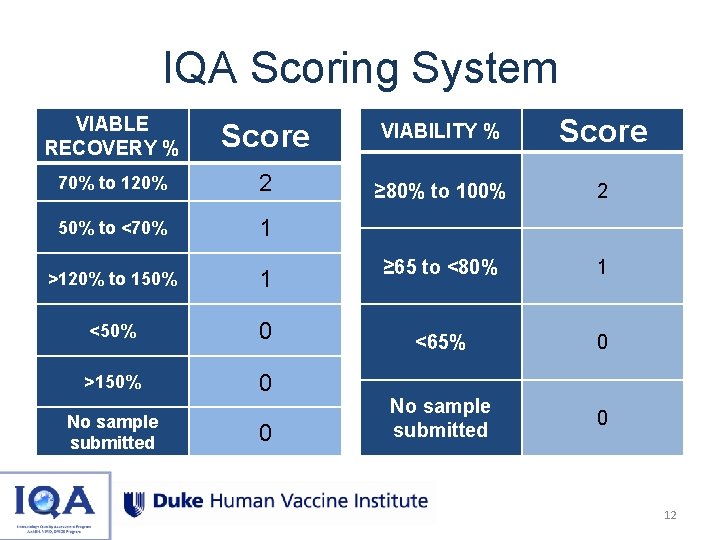
IQA Scoring System VIABLE RECOVERY % Score VIABILITY % Score 70% to 120% 2 ≥ 80% to 100% 2 50% to <70% 1 >120% to 150% 1 ≥ 65 to <80% 1 <50% 0 <65% 0 >150% 0 No sample submitted 0 12
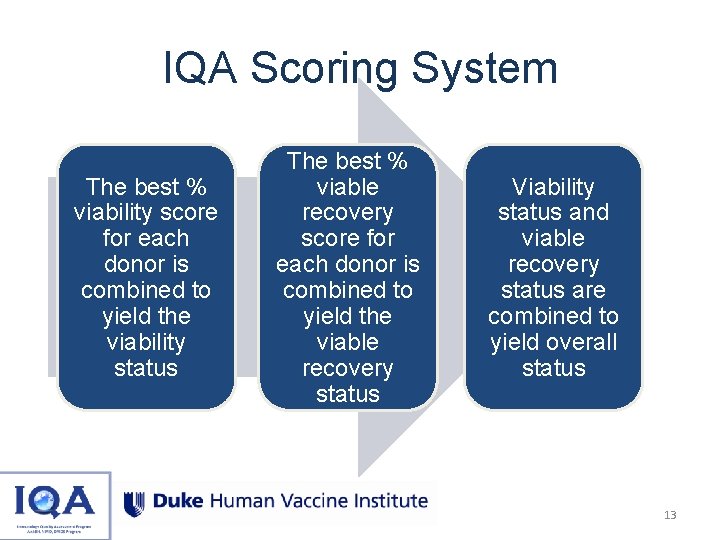
IQA Scoring System The best % viability score for each donor is combined to yield the viability status The best % viable recovery score for each donor is combined to yield the viable recovery status Viability status and viable recovery status are combined to yield overall status 13
IQA Combined Scoring System for Both Samples Combined % Viability Score (both samples) % Viability STATUS Combined % Viable Recovery Score (both samples) % Viable Recovery STATUS 3 -4 A 2 PA 0 -1 OP A: Approved PA: Provisionally Approved OP: On Probation OVERALL STATUS (both viability and viable recovery) Overall status is determined by the lower of the %viability/ %viable recovery statuses. Example: % Viability Status: A % Viable Recovery Status: PA Overall Status: PA 14
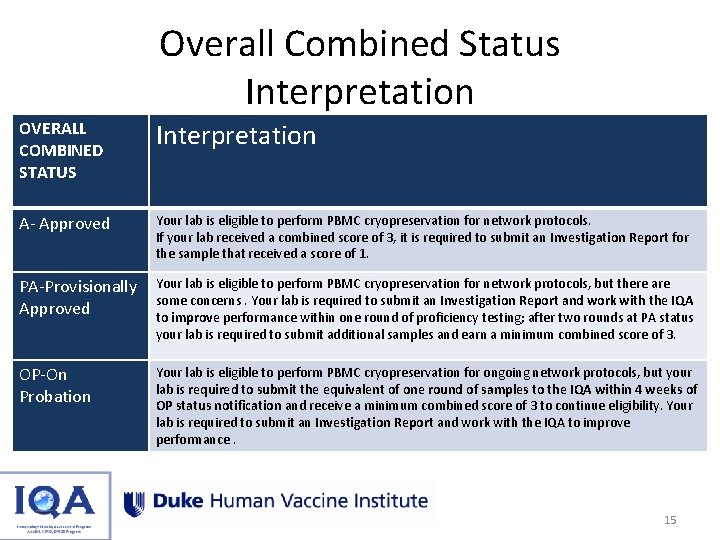
Overall Combined Status Interpretation OVERALL COMBINED STATUS Interpretation A- Approved Your lab is eligible to perform PBMC cryopreservation for network protocols. If your lab received a combined score of 3, it is required to submit an Investigation Report for the sample that received a score of 1. PA-Provisionally Approved Your lab is eligible to perform PBMC cryopreservation for network protocols, but there are some concerns. Your lab is required to submit an Investigation Report and work with the IQA to improve performance within one round of proficiency testing; after two rounds at PA status your lab is required to submit additional samples and earn a minimum combined score of 3. OP-On Probation Your lab is eligible to perform PBMC cryopreservation for ongoing network protocols, but your lab is required to submit the equivalent of one round of samples to the IQA within 4 weeks of OP status notification and receive a minimum combined score of 3 to continue eligibility. Your lab is required to submit an Investigation Report and work with the IQA to improve performance. 15
IQA Result Report 16
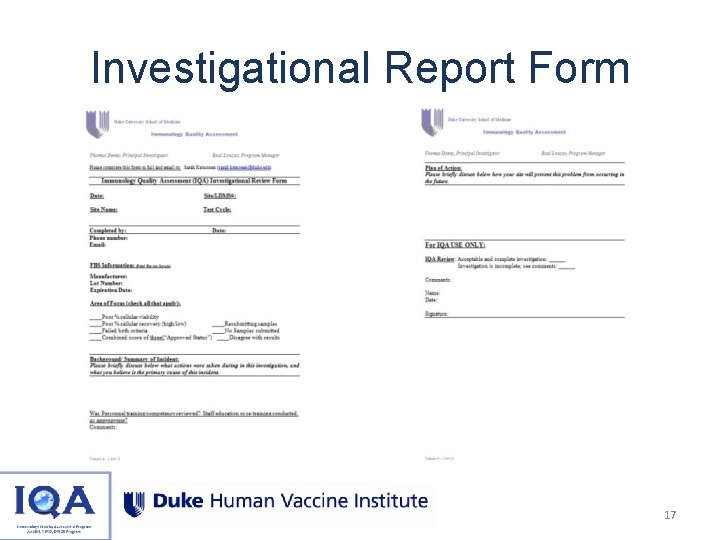
Investigational Report Form 17
Network Laboratory participation in Quarterly IQA Cryopreservation PT Program Labs must participate in the IQA Cryopreservation quarterly testing to stay certified in order to process for network protocols. Each network has a specific set of standards and guidelines. 18
Which Protocol to use? IMPAACT ACTG MTN HPTN HVTN 19
Alternating Protocols and Processing Technicians HANC (HIV/AIDS Network Coordination) has collaborated to put together an SOP for all the labs to follow pooling the guidelines from each network/protocol The use of the Cross-Network PBMC Processing SOP is required for the cryopreservation of all PBMCs for ACTG, HPTN, HVTN, IMPAACT, and MTN studies If the participating laboratory is enrolled in multiple studies, it is recommended to alternate between protocols during the IQA Cryopreservation quarters Laboratories should alternate processing technicians for each quarterly round 20
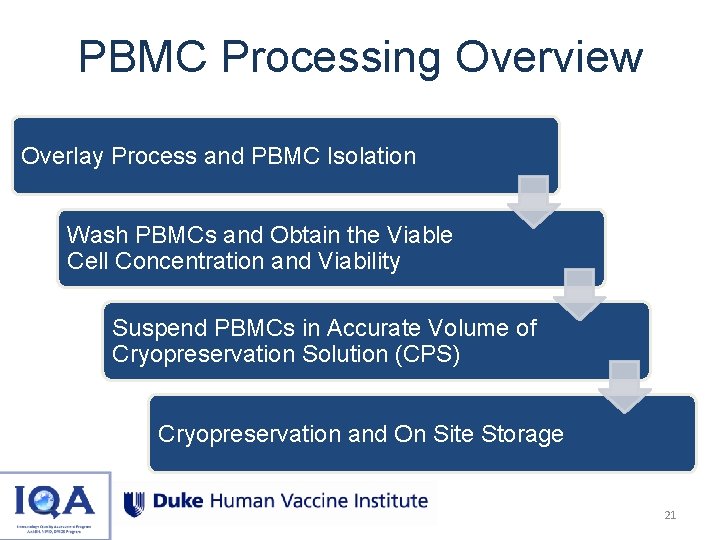
PBMC Processing Overview Overlay Process and PBMC Isolation Wash PBMCs and Obtain the Viable Cell Concentration and Viability Suspend PBMCs in Accurate Volume of Cryopreservation Solution (CPS) Cryopreservation and On Site Storage 21
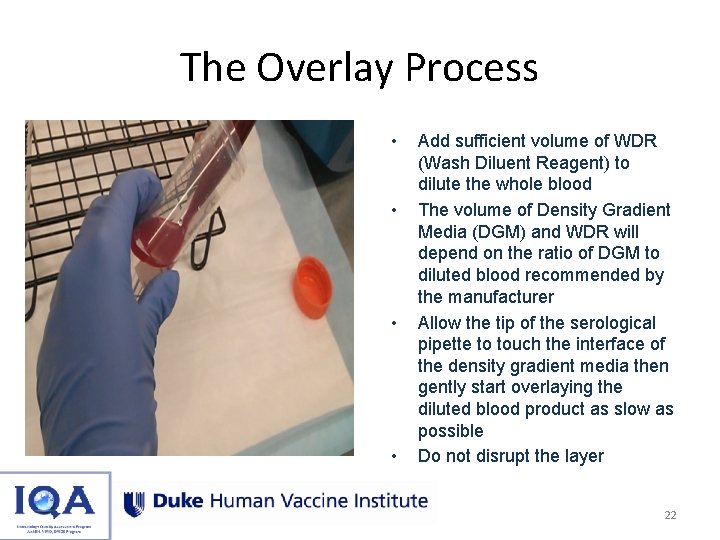
The Overlay Process • • Add sufficient volume of WDR (Wash Diluent Reagent) to dilute the whole blood The volume of Density Gradient Media (DGM) and WDR will depend on the ratio of DGM to diluted blood recommended by the manufacturer Allow the tip of the serological pipette to touch the interface of the density gradient media then gently start overlaying the diluted blood product as slow as possible Do not disrupt the layer 22
Hold the tubes in an upright position and gently transfer them to the centrifuge as not to disrupt the layers. 23
PBMC Density Centrifugation • The centrifuge brake must be turned OFF for the separation to be clean and to maximize retrieval of the PBMCs, if the brake is on it will disrupt the layers • Centrifuge at 400 x g for 30 minutes at 15°C to 30°C with the Brake OFF, or as outlined in the package insert that accompanies the DGM 24
Buffy Coat (PBMC Layer) Once the centrifuge has completely stopped carefully remove the layered tubes from the centrifuge as not to disrupt the layers and place in the BSC and proceed to buffy coat isolation followed by the required #of washes per the network protocol 25
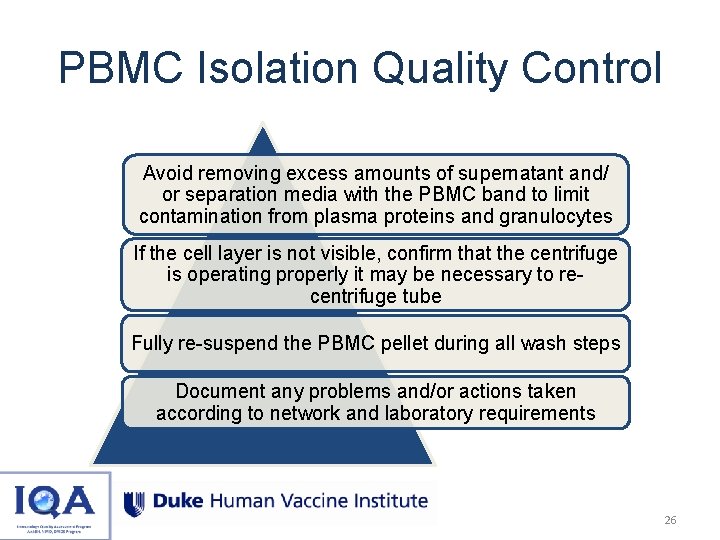
PBMC Isolation Quality Control Avoid removing excess amounts of supernatant and/ or separation media with the PBMC band to limit contamination from plasma proteins and granulocytes If the cell layer is not visible, confirm that the centrifuge is operating properly it may be necessary to recentrifuge tube Fully re-suspend the PBMC pellet during all wash steps Document any problems and/or actions taken according to network and laboratory requirements 26
Viable Cell Counting 27
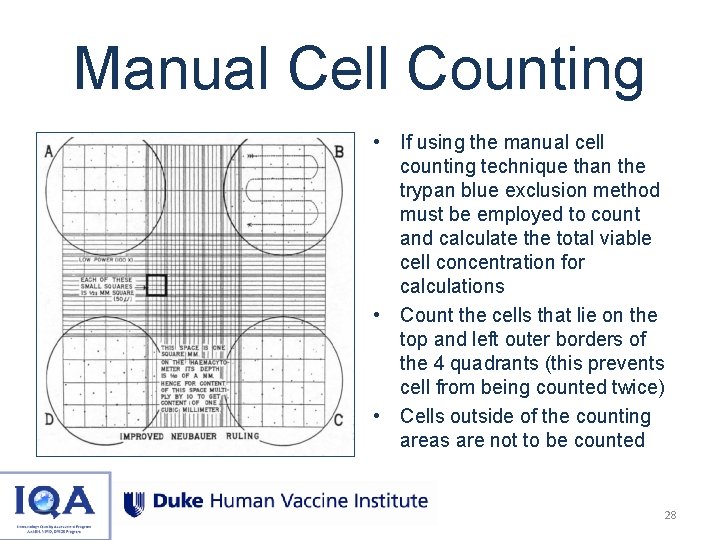
Manual Cell Counting • If using the manual cell counting technique than the trypan blue exclusion method must be employed to count and calculate the total viable cell concentration for calculations • Count the cells that lie on the top and left outer borders of the 4 quadrants (this prevents cell from being counted twice) • Cells outside of the counting areas are not to be counted 28
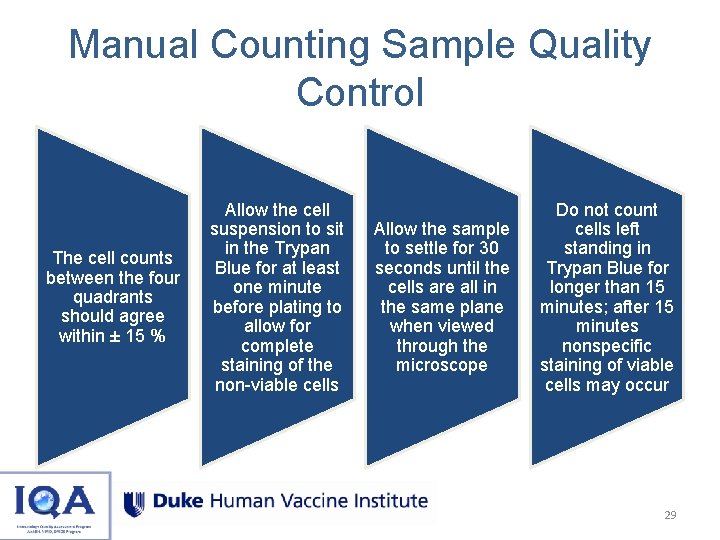
Manual Counting Sample Quality Control The cell counts between the four quadrants should agree within ± 15 % Allow the cell suspension to sit in the Trypan Blue for at least one minute before plating to allow for complete staining of the non-viable cells Allow the sample to settle for 30 seconds until the cells are all in the same plane when viewed through the microscope Do not count cells left standing in Trypan Blue for longer than 15 minutes; after 15 minutes nonspecific staining of viable cells may occur 29
Manual Counting Sample Quality Control Significant calculation errors can occur if the cell concentration is too low or too high Cells should be evenly distributed Overlapping or clumping cells indicates the need to re-dilute and recount Too few cells (< 50 cells per quadrant) indicates the need for a smaller dilution Too many cells (>200 cells per quadrant) indicates the need for a greater dilution This ensures the even distribution of cells throughout the hemacytometer and an accurate count of the total viable cells 30
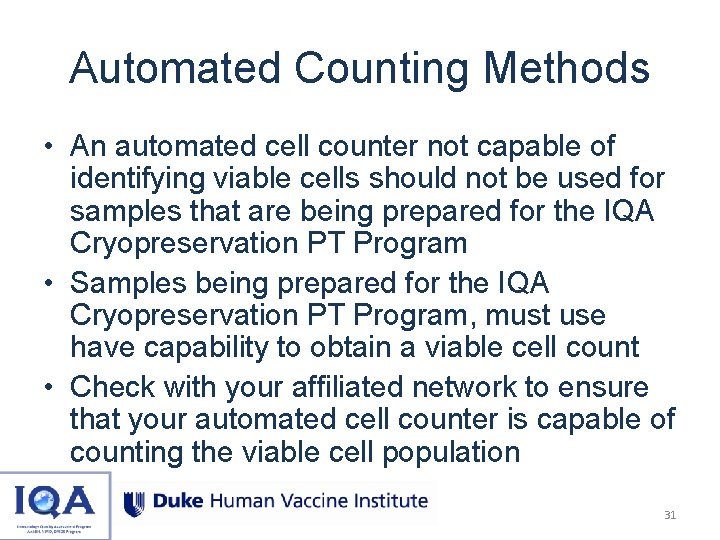
Automated Counting Methods • An automated cell counter not capable of identifying viable cells should not be used for samples that are being prepared for the IQA Cryopreservation PT Program • Samples being prepared for the IQA Cryopreservation PT Program, must use have capability to obtain a viable cell count • Check with your affiliated network to ensure that your automated cell counter is capable of counting the viable cell population 31
Viability and Viable Cell Calculations Samples prepared for the IQA Cryopreservation PT Program must be submitted with the viability and total viable cell concentration (cell/m. L) for each sample 32
Determining the Percent Viability Example: You have removed an aliquot to manually count. The 4 quadrants are counted: 400 viable cells + 10 non-viable cells = 410 total cells What is the percent viability? Answer : 400 viable cells/410 total cells x 100= 97. 5 % 33
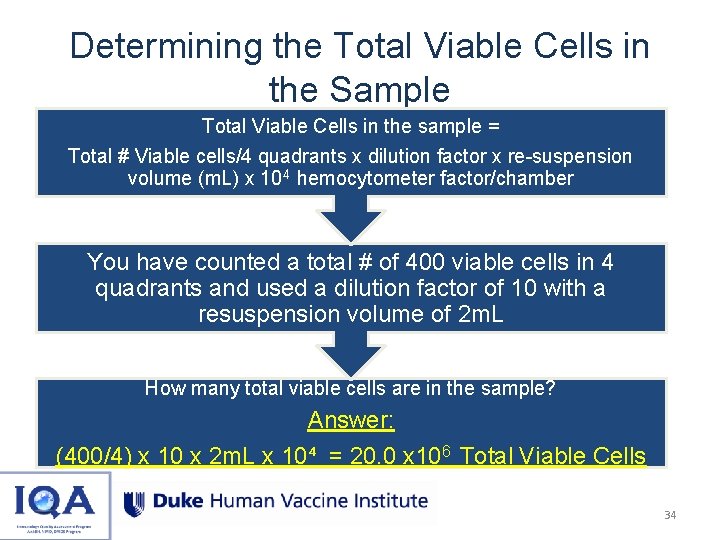
Determining the Total Viable Cells in the Sample Total Viable Cells in the sample = Total # Viable cells/4 quadrants x dilution factor x re-suspension volume (m. L) x 104 hemocytometer factor/chamber You have counted a total # of 400 viable cells in 4 quadrants and used a dilution factor of 10 with a resuspension volume of 2 m. L How many total viable cells are in the sample? Answer: (400/4) x 10 x 2 m. L x 10⁴ = 20. 0 x 106 Total Viable Cells 34
Cryopreservation Solution (CPS) and Cryopreservation of PBMCs 35
Preparing CPS • • DMSO helps dehydrate the cells prior to freezing preventing the formation of ice crystals that could cause cells to lyse FBS contains an abundance of proteins, which helps nourish the cells during the freezing and thawing processes when cells are deprived of nutrients – Do not refreeze FBS aliquots that have been stored at refrigerated temperatures – To use the frozen aliquots, thaw in the refrigerator overnight, or for several hours at room temperature – Once thawed the open FBS expiration date is one month, clearly label open/thawed FBS – Repeated freeze/thaw cycles may have an adverse effect on the quality of the FBS 90 % Fetal Bovine Serum (FBS) 10 % Dimethyl sulfoxide (DMSO) Cryopreservation Solution (CPS) 36
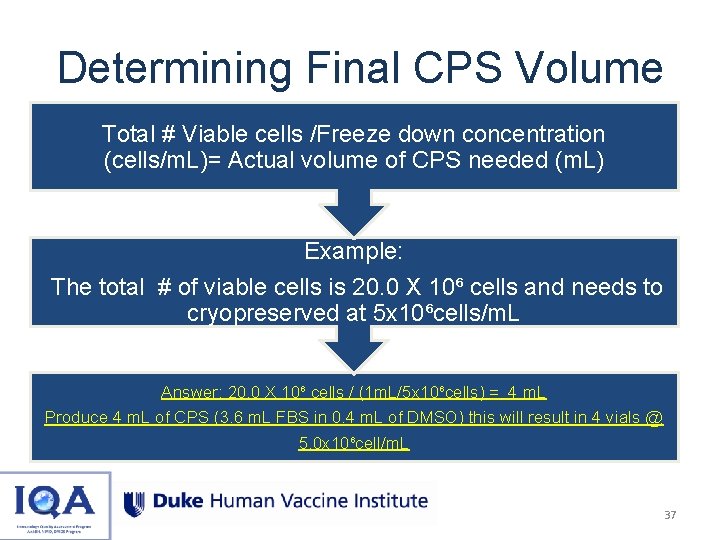
Determining Final CPS Volume Total # Viable cells /Freeze down concentration (cells/m. L)= Actual volume of CPS needed (m. L) Example: The total # of viable cells is 20. 0 X 10⁶ cells and needs to cryopreserved at 5 x 10⁶cells/m. L Answer: 20. 0 X 10⁶ cells / (1 m. L/5 x 10⁶cells) = 4 m. L Produce 4 m. L of CPS (3. 6 m. L FBS in 0. 4 m. L of DMSO) this will result in 4 vials @ 5. 0 x 10⁶cell/m. L 37
Network CPS Concentration Adjust the volume per cryovial according to the lab processing chart or protocol Most IMPAACT protocols will require viable PBMCs at 1. 0 x 107 cell/m. L and 5. 0 x 106 cell/vial it is requested that all PBMCs recovered be stored When PBMC recoveries are less than a targeted number: Add residual PBMCs less than 2. 0 x 106 cells to a vial with 5. 0 x 106 cells Aliquot residual cell numbers greater than 2. 0 x 106 cells but less than 5. 0 x 106 cells into a separate vial 38
Example of IMPAACT Network Final Cell Concentration IMPAACT Protocol Requirement Recovery Aliquot Preparation 10. 0 x 107 PBMCs in 2 vials 9. 3 x 10⁶ PBMCs Prepare one vial with 5. 0 x 106 PBMCs and another vial with 4. 3 x 10⁶ PBMCs 20. 0 x 107 million PBMCs 16. 5 x 10⁶ PBMCs Prepare two vials with 5 x 10⁶ PBMCs each and one vial with 6. 5 x 10⁶ PBMCs 39
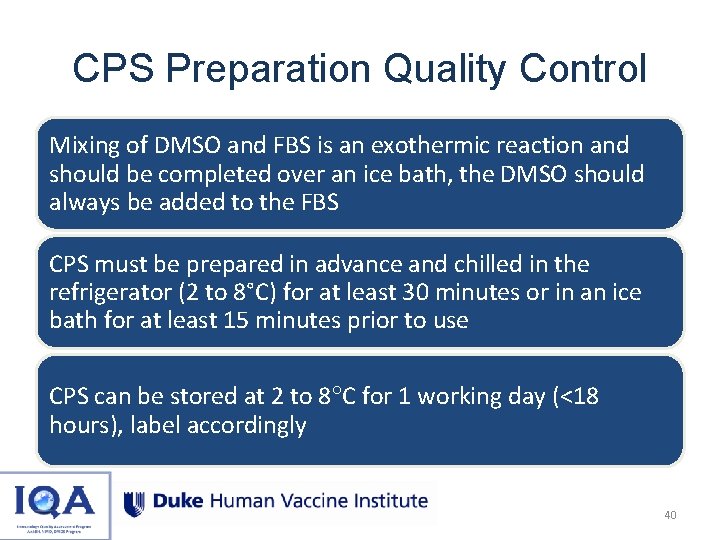
CPS Preparation Quality Control Mixing of DMSO and FBS is an exothermic reaction and should be completed over an ice bath, the DMSO should always be added to the FBS CPS must be prepared in advance and chilled in the refrigerator (2 to 8°C) for at least 30 minutes or in an ice bath for at least 15 minutes prior to use CPS can be stored at 2 to 8 C for 1 working day (<18 hours), label accordingly 40
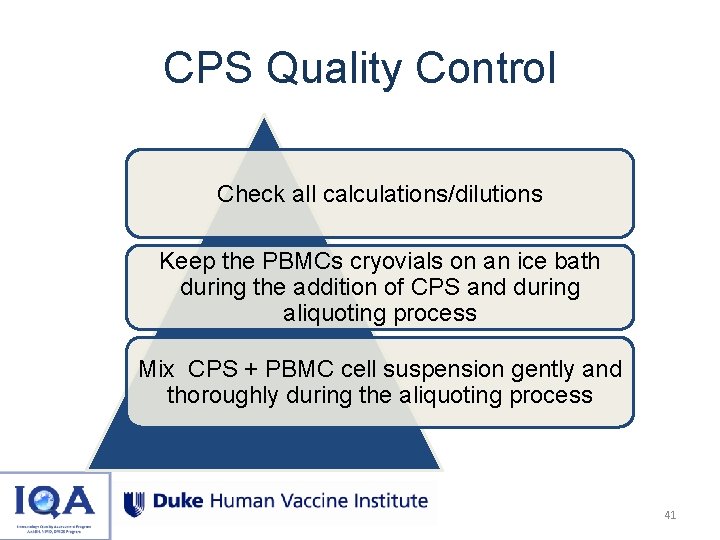
CPS Quality Control Check all calculations/dilutions Keep the PBMCs cryovials on an ice bath during the addition of CPS and during aliquoting process Mix CPS + PBMC cell suspension gently and thoroughly during the aliquoting process 41
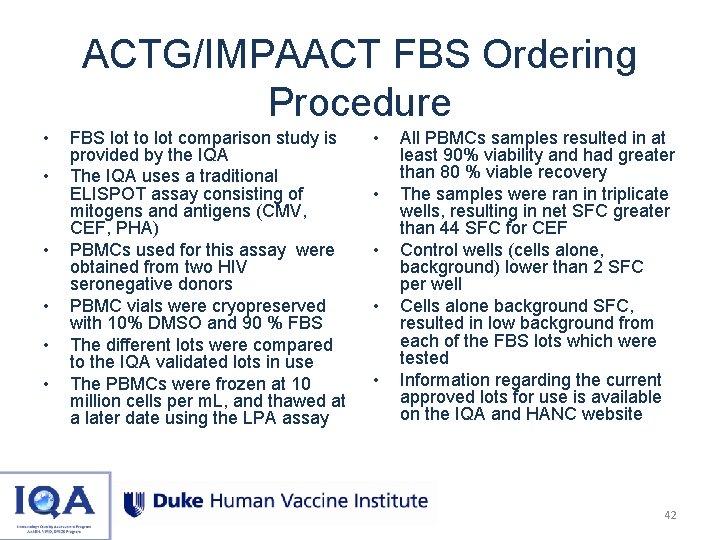
ACTG/IMPAACT FBS Ordering Procedure • • • FBS lot to lot comparison study is provided by the IQA The IQA uses a traditional ELISPOT assay consisting of mitogens and antigens (CMV, CEF, PHA) PBMCs used for this assay were obtained from two HIV seronegative donors PBMC vials were cryopreserved with 10% DMSO and 90 % FBS The different lots were compared to the IQA validated lots in use The PBMCs were frozen at 10 million cells per m. L, and thawed at a later date using the LPA assay • • • All PBMCs samples resulted in at least 90% viability and had greater than 80 % viable recovery The samples were ran in triplicate wells, resulting in net SFC greater than 44 SFC for CEF Control wells (cells alone, background) lower than 2 SFC per well Cells alone background SFC, resulted in low background from each of the FBS lots which were tested Information regarding the current approved lots for use is available on the IQA and HANC website 42
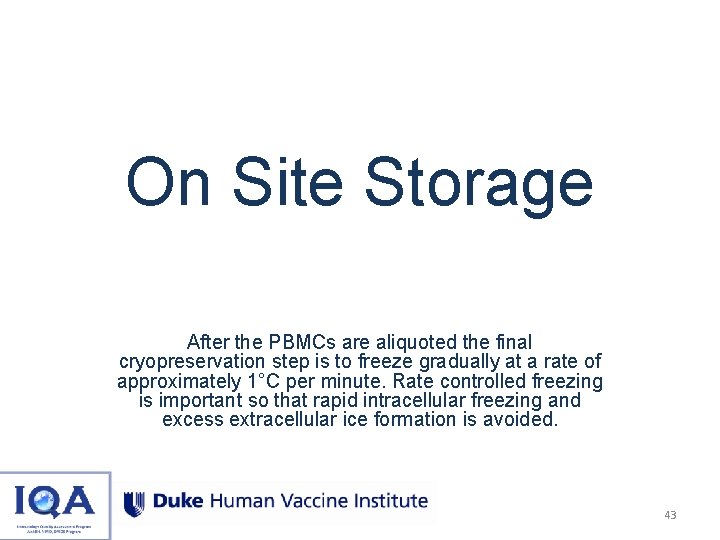
On Site Storage After the PBMCs are aliquoted the final cryopreservation step is to freeze gradually at a rate of approximately 1°C per minute. Rate controlled freezing is important so that rapid intracellular freezing and excess extracellular ice formation is avoided. 43
Freezing Containers Cryo. Med® Ratecontrolled freezer NALGENE ® Mr. Frosty Strata Cooler ® Biocision® Cool. Cell 44
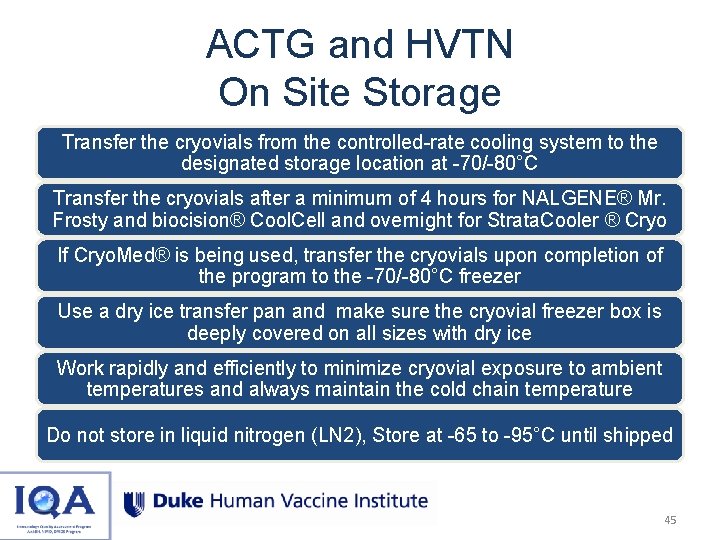
ACTG and HVTN On Site Storage Transfer the cryovials from the controlled-rate cooling system to the designated storage location at -70/-80°C Transfer the cryovials after a minimum of 4 hours for NALGENE® Mr. Frosty and biocision® Cool. Cell and overnight for Strata. Cooler ® Cryo If Cryo. Med® is being used, transfer the cryovials upon completion of the program to the -70/-80°C freezer Use a dry ice transfer pan and make sure the cryovial freezer box is deeply covered on all sizes with dry ice Work rapidly and efficiently to minimize cryovial exposure to ambient temperatures and always maintain the cold chain temperature Do not store in liquid nitrogen (LN 2), Store at -65 to -95°C until shipped 45
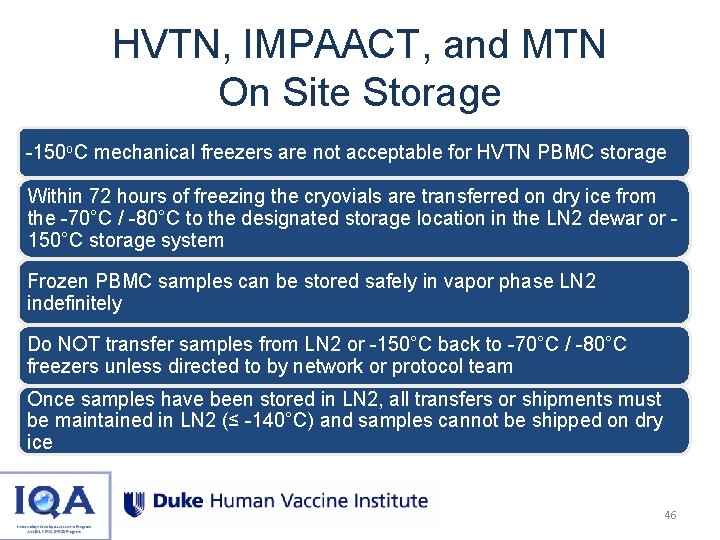
HVTN, IMPAACT, and MTN On Site Storage -150 o. C mechanical freezers are not acceptable for HVTN PBMC storage Within 72 hours of freezing the cryovials are transferred on dry ice from the -70°C / -80°C to the designated storage location in the LN 2 dewar or 150°C storage system Frozen PBMC samples can be stored safely in vapor phase LN 2 indefinitely Do NOT transfer samples from LN 2 or -150°C back to -70°C / -80°C freezers unless directed to by network or protocol team Once samples have been stored in LN 2, all transfers or shipments must be maintained in LN 2 (≤ -140°C) and samples cannot be shipped on dry ice 46
On Site Storage Quality Control Take care to ensure that the cold chain temperature is consistently maintained during the long/short term transfer process Keep freezing container in a secure location within the -70°C/-80°C freezer, away from door/possible temperature fluctuation Follow all laboratory and network guidelines and document any out of control incidences 47
Shipping Logistics 48
Shipments to the IQA International sites need to start the documentation process with the selected courier prior to PBMC processing to submit IQA submission samples in a timely manner The IQA and the affiliated network(s) should be notified if delays are expected so that a plan of action can take place Domestic sites should be aware of weather delays and plan accordingly, notify the IQA if delays are expected 49
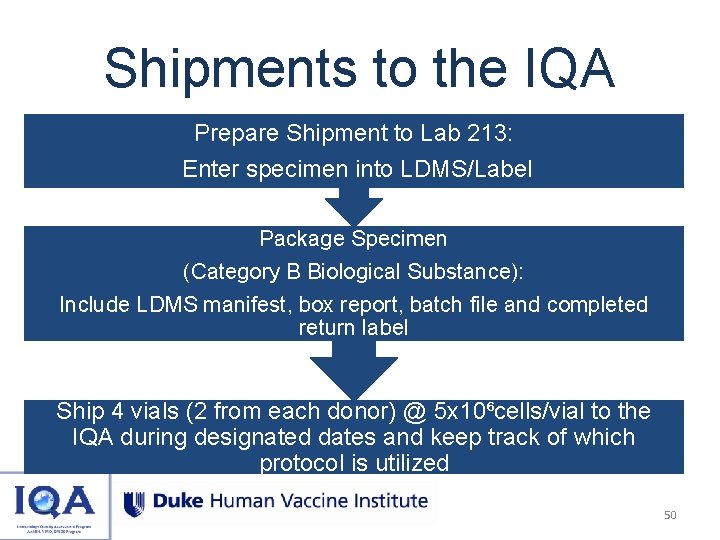
Shipments to the IQA Prepare Shipment to Lab 213: Enter specimen into LDMS/Label Package Specimen (Category B Biological Substance): Include LDMS manifest, box report, batch file and completed return label Ship 4 vials (2 from each donor) @ 5 x 10⁶cells/vial to the IQA during designated dates and keep track of which protocol is utilized 50
Challenges 51
Challenges Observed by the IQA Out of Range Viable Recovery and Viability Percentages Cellular Contamination Calculation errors Dilution errors Skipping final centrifugation CPS made incorrectly Poor mixing/ aliquoting Use of Expired Reagents Lack of Cold Chain Method 52
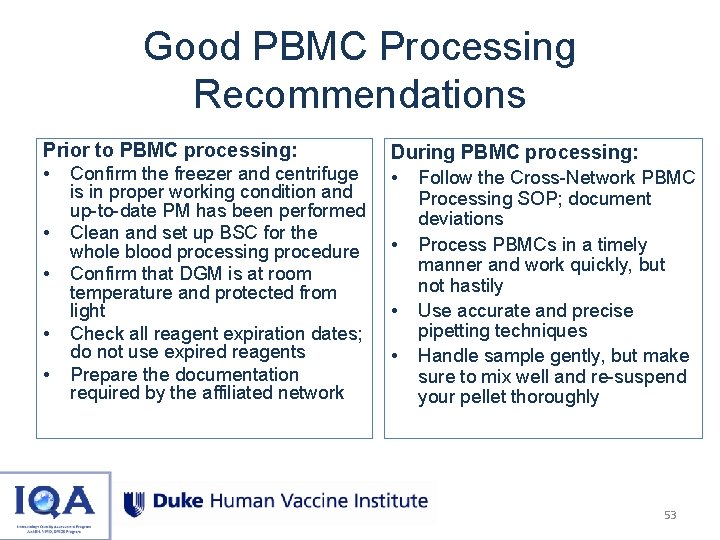
Good PBMC Processing Recommendations Prior to PBMC processing: • Confirm the freezer and centrifuge • • is in proper working condition and up-to-date PM has been performed Clean and set up BSC for the whole blood processing procedure Confirm that DGM is at room temperature and protected from light Check all reagent expiration dates; do not use expired reagents Prepare the documentation required by the affiliated network During PBMC processing: • Follow the Cross-Network PBMC • • • Processing SOP; document deviations Process PBMCs in a timely manner and work quickly, but not hastily Use accurate and precise pipetting techniques Handle sample gently, but make sure to mix well and re-suspend your pellet thoroughly 53
Acknowledgments • • • • • Daniella Livnat Tom Denny Raul Louzao Ambrosia Garcia Linda Walker John Wong Khalil Itani Meredith Carter William Tyson II Eric Brady Sara Brown Sylvia Hood Heidi Macht Todd De. Marco Laura Racz Ana Sanchez Christopher Todd Wes Roundtree John Bainbridge 54
Questions? Thank You! 55