CS 7643 Deep Learning Topics Computational Graphs Notation

- Slides: 84
CS 7643: Deep Learning Topics: – Computational Graphs – Notation + example – Computing Gradients – Forward mode vs Reverse mode AD Dhruv Batra Georgia Tech
Administrativia • No class on Tuesday next week (Sep 12) • HW 0 solutions posted (C) Dhruv Batra 2
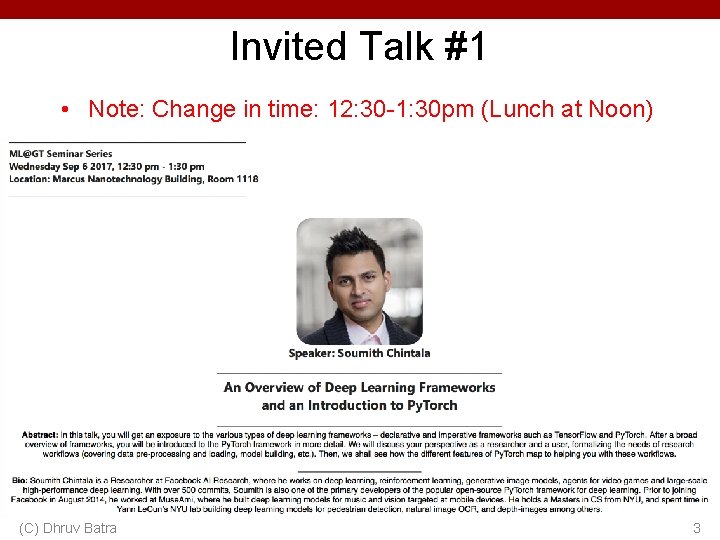
Invited Talk #1 • Note: Change in time: 12: 30 -1: 30 pm (Lunch at Noon) (C) Dhruv Batra 3
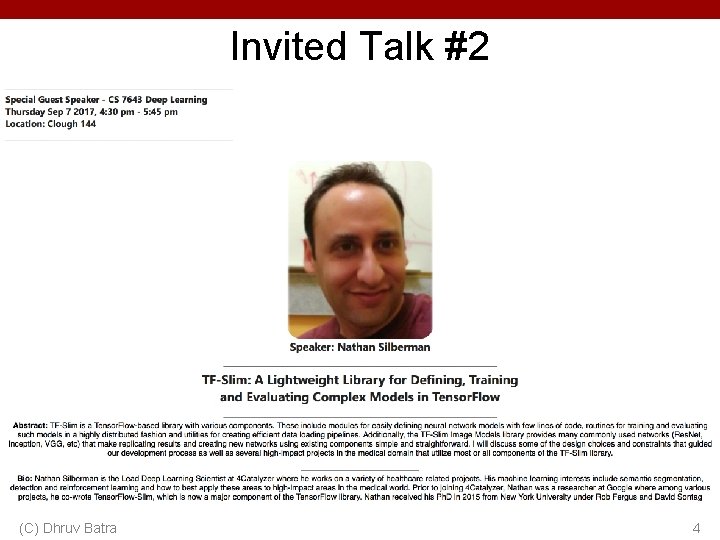
Invited Talk #2 (C) Dhruv Batra 4
Project • Goal – Chance to try Deep Learning – Combine with other classes / research / credits / anything • You have our blanket permission • Extra credit for shooting for a publication – Encouraged to apply to your research (computer vision, NLP, robotics, …) – Must be done this semester. • Main categories – Application/Survey • Compare a bunch of existing algorithms on a new application domain of your interest – Formulation/Development • Formulate a new model or algorithm for a new or old problem – Theory • Theoretically analyze an existing algorithm (C) Dhruv Batra 5
Project • Deliverables: – No formal proposal document due • Consider talking to your TAs – Final Poster Session – (tentative): Week of Nov 27. • Questions/support/ideas – Stop by and talk to TAs • Teaming – Encouraged to form teams of 2 -3. (C) Dhruv Batra 6
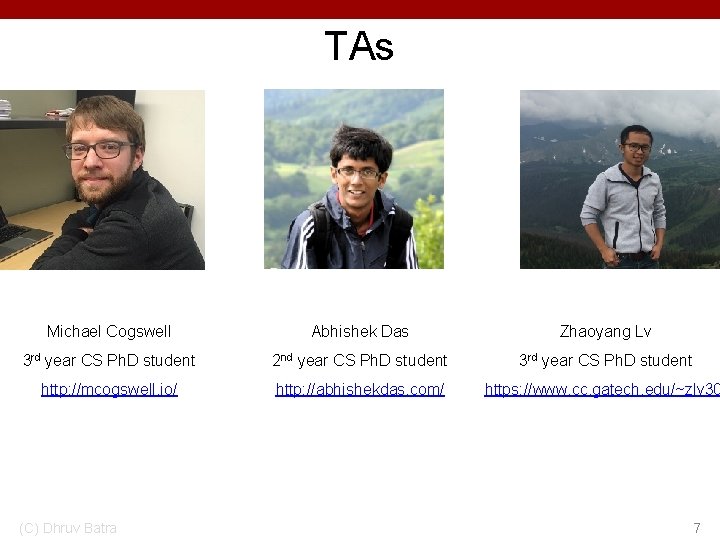
TAs Michael Cogswell Abhishek Das Zhaoyang Lv 3 rd year CS Ph. D student 2 nd year CS Ph. D student 3 rd year CS Ph. D student http: //mcogswell. io/ http: //abhishekdas. com/ https: //www. cc. gatech. edu/~zlv 30 (C) Dhruv Batra 7
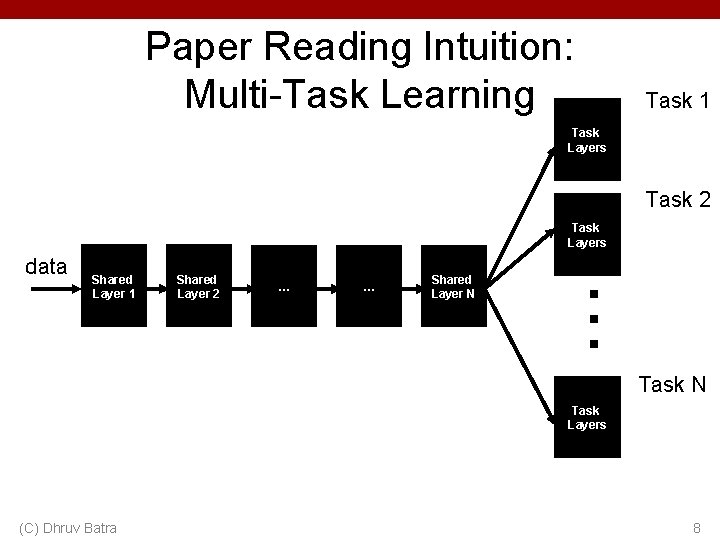
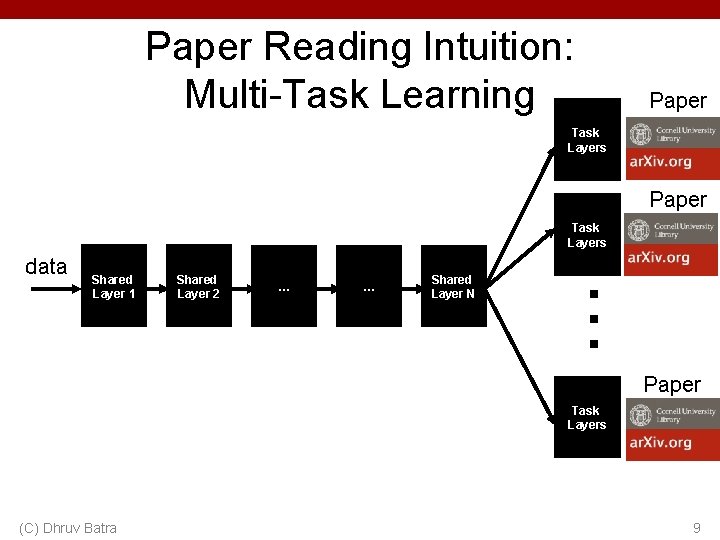
Paper Reading Intuition: Multi-Task Learning Task 1 Task Layers Task 2 data Shared Layer 1 Shared Layer 2 … … Shared Layer N . . . Task Layers Task N Task Layers (C) Dhruv Batra 8
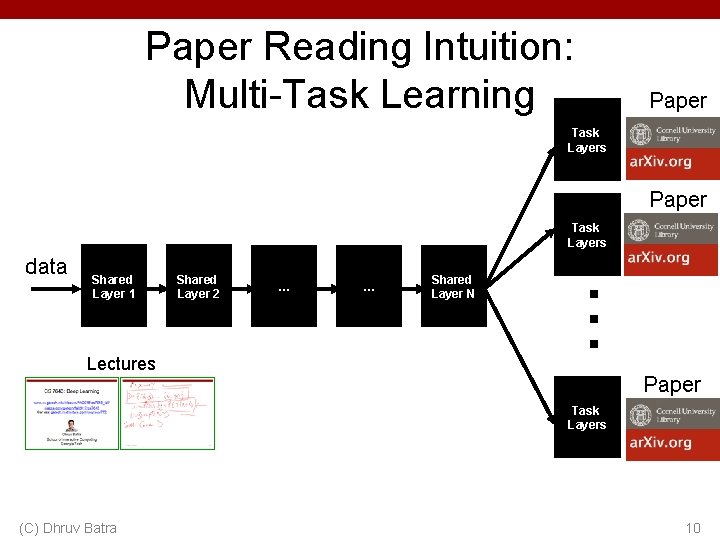
Paper Reading Intuition: Multi-Task Learning Task Layers data Shared Layer 1 Shared Layer 2 … … Shared Layer N Task Layers (C) Dhruv Batra Paper 2 . . . Task Layers Paper 1 Paper 6 9
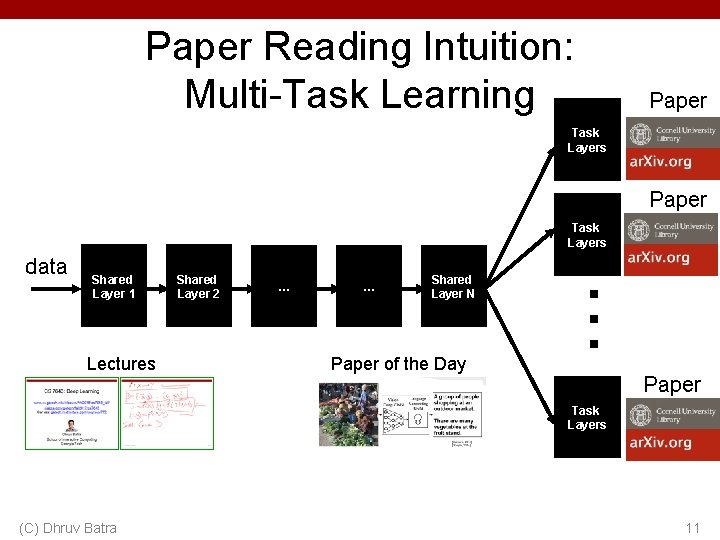
Paper Reading Intuition: Multi-Task Learning Task Layers data Shared Layer 1 Lectures Shared Layer 2 … … Shared Layer N Task Layers (C) Dhruv Batra Paper 2 . . . Task Layers Paper 1 Paper 6 10
Paper Reading Intuition: Multi-Task Learning Task Layers data Shared Layer 1 Lectures Shared Layer 2 … … Shared Layer N Paper of the Day Task Layers (C) Dhruv Batra Paper 2 . . . Task Layers Paper 1 Paper 6 11
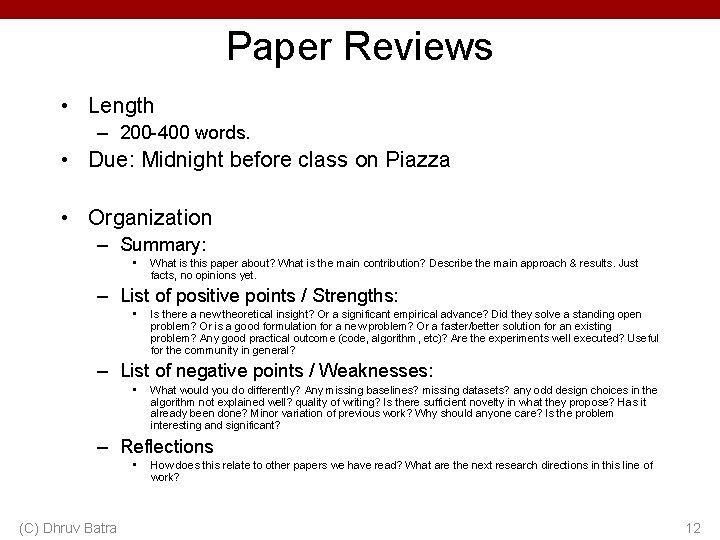
Paper Reviews • Length – 200 -400 words. • Due: Midnight before class on Piazza • Organization – Summary: • What is this paper about? What is the main contribution? Describe the main approach & results. Just facts, no opinions yet. – List of positive points / Strengths: • Is there a new theoretical insight? Or a significant empirical advance? Did they solve a standing open problem? Or is a good formulation for a new problem? Or a faster/better solution for an existing problem? Any good practical outcome (code, algorithm, etc)? Are the experiments well executed? Useful for the community in general? – List of negative points / Weaknesses: • What would you do differently? Any missing baselines? missing datasets? any odd design choices in the algorithm not explained well? quality of writing? Is there sufficient novelty in what they propose? Has it already been done? Minor variation of previous work? Why should anyone care? Is the problem interesting and significant? – Reflections • (C) Dhruv Batra How does this relate to other papers we have read? What are the next research directions in this line of work? 12
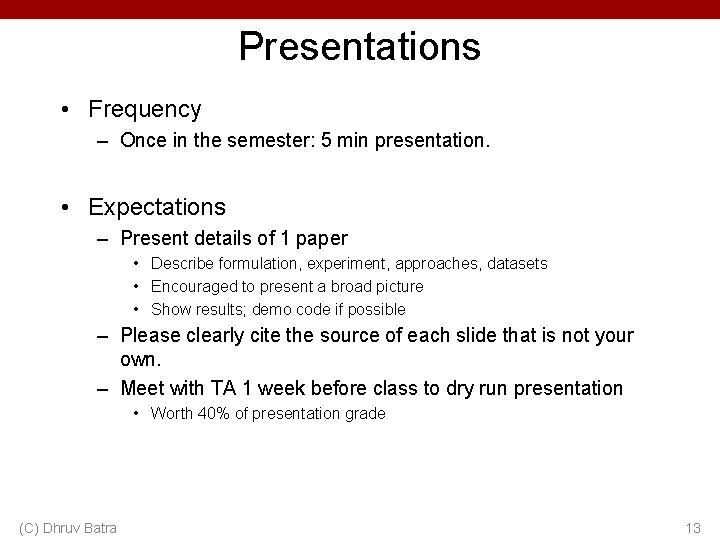
Presentations • Frequency – Once in the semester: 5 min presentation. • Expectations – Present details of 1 paper • Describe formulation, experiment, approaches, datasets • Encouraged to present a broad picture • Show results; demo code if possible – Please clearly cite the source of each slide that is not your own. – Meet with TA 1 week before class to dry run presentation • Worth 40% of presentation grade (C) Dhruv Batra 13
Recap of last time (C) Dhruv Batra 14
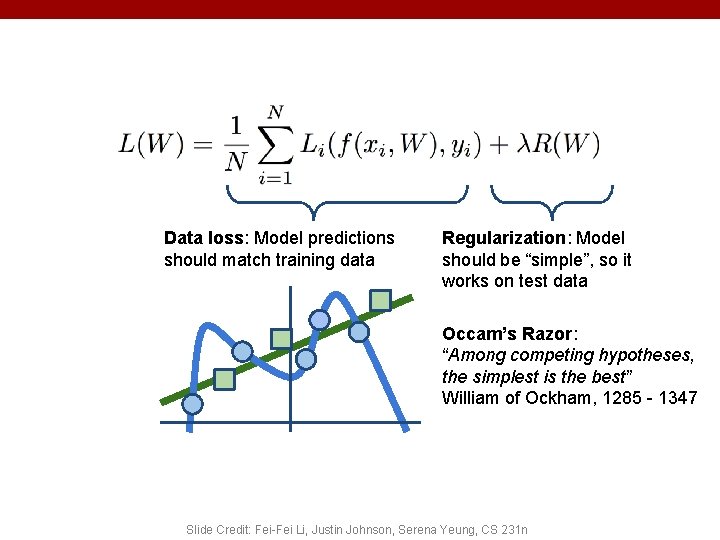
Data loss: Model predictions should match training data Regularization: Model should be “simple”, so it works on test data Occam’s Razor: “Among competing hypotheses, the simplest is the best” William of Ockham, 1285 - 1347 Slide Credit: Fei-Fei Li, Justin Johnson, Serena Yeung, CS 231 n
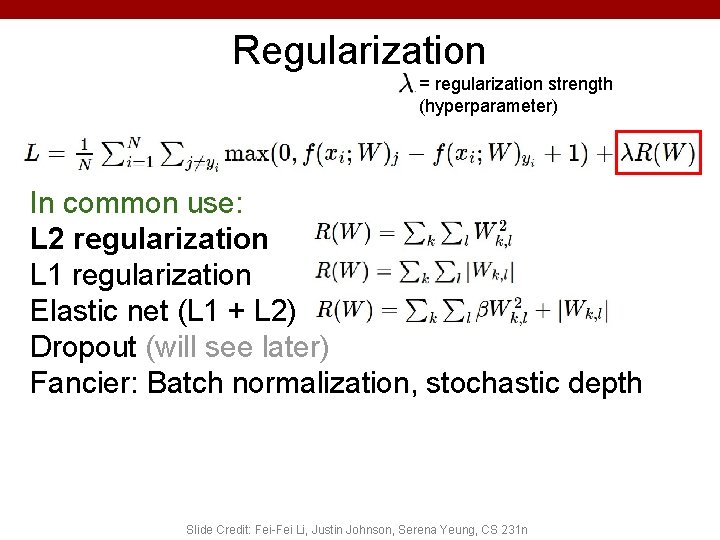
Regularization = regularization strength (hyperparameter) In common use: L 2 regularization L 1 regularization Elastic net (L 1 + L 2) Dropout (will see later) Fancier: Batch normalization, stochastic depth Slide Credit: Fei-Fei Li, Justin Johnson, Serena Yeung, CS 231 n
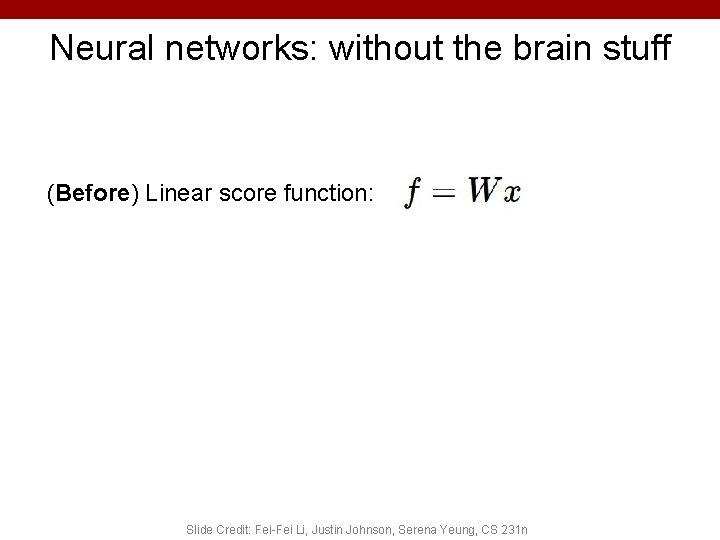
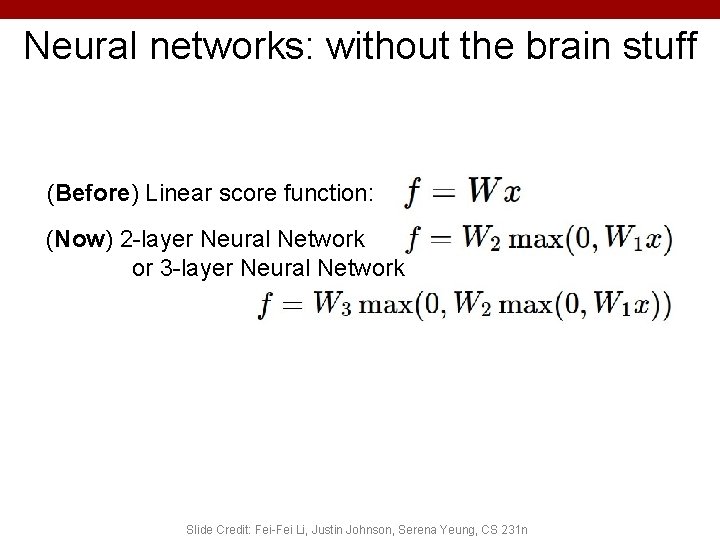
Neural networks: without the brain stuff (Before) Linear score function: Slide Credit: Fei-Fei Li, Justin Johnson, Serena Yeung, CS 231 n
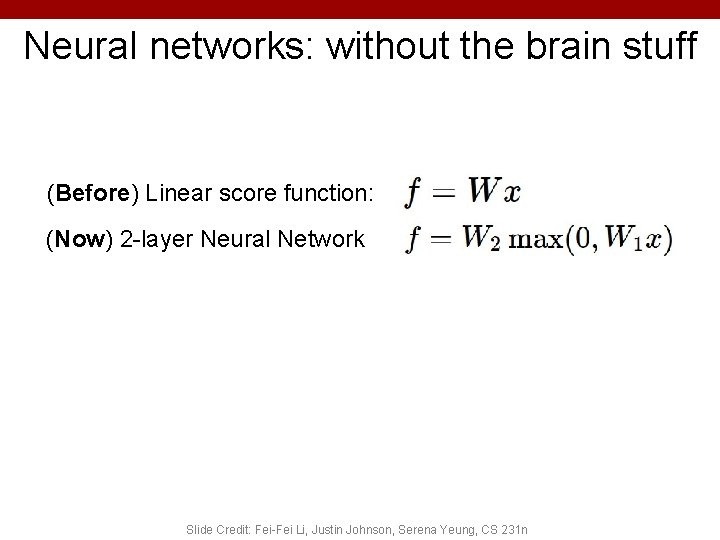
Neural networks: without the brain stuff (Before) Linear score function: (Now) 2 -layer Neural Network 18 Slide Credit: Fei-Fei Li, Justin Johnson, Serena Yeung, CS 231 n
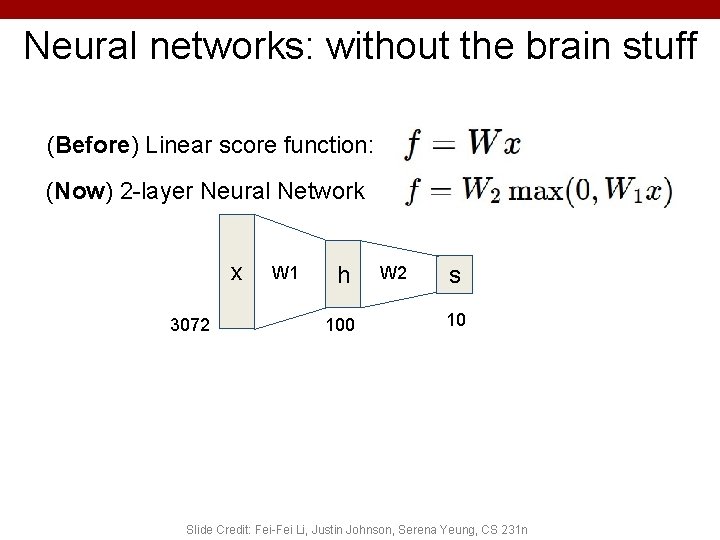
Neural networks: without the brain stuff (Before) Linear score function: (Now) 2 -layer Neural Network x 3072 W 1 h 100 W 2 s 10 19 Slide Credit: Fei-Fei Li, Justin Johnson, Serena Yeung, CS 231 n
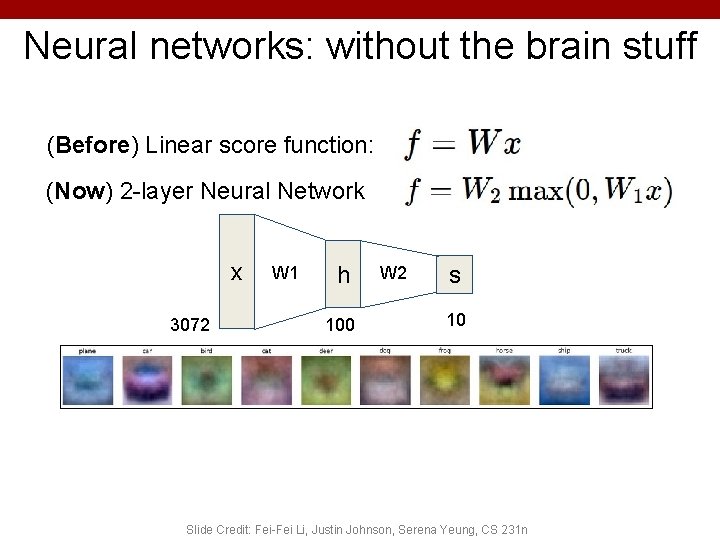
Neural networks: without the brain stuff (Before) Linear score function: (Now) 2 -layer Neural Network x 3072 W 1 h 100 W 2 s 10 20 Slide Credit: Fei-Fei Li, Justin Johnson, Serena Yeung, CS 231 n
Neural networks: without the brain stuff (Before) Linear score function: (Now) 2 -layer Neural Network or 3 -layer Neural Network 21 Slide Credit: Fei-Fei Li, Justin Johnson, Serena Yeung, CS 231 n
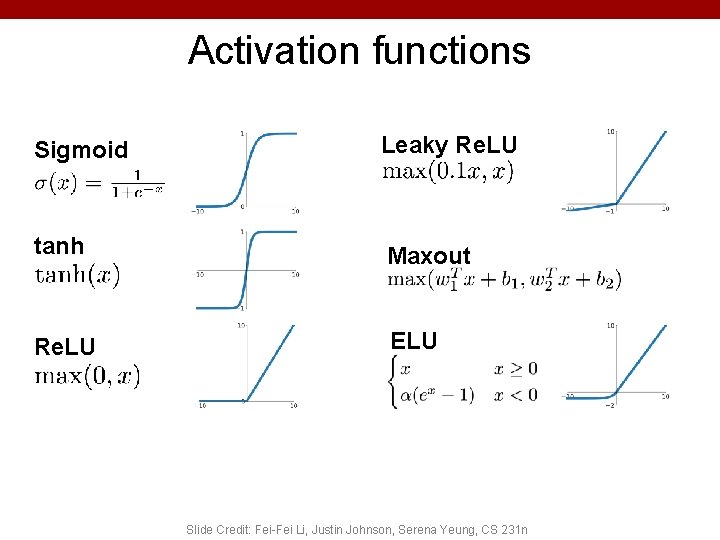
Activation functions Sigmoid Leaky Re. LU tanh Maxout Re. LU ELU Slide Credit: Fei-Fei Li, Justin Johnson, Serena Yeung, CS 231 n
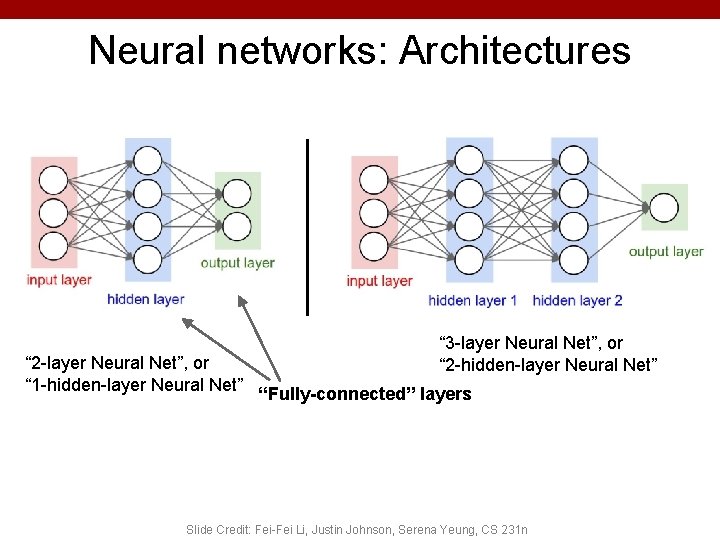
Neural networks: Architectures “ 2 -layer Neural Net”, or “ 1 -hidden-layer Neural Net” “ 3 -layer Neural Net”, or “ 2 -hidden-layer Neural Net” “Fully-connected” layers Slide Credit: Fei-Fei Li, Justin Johnson, Serena Yeung, CS 231 n
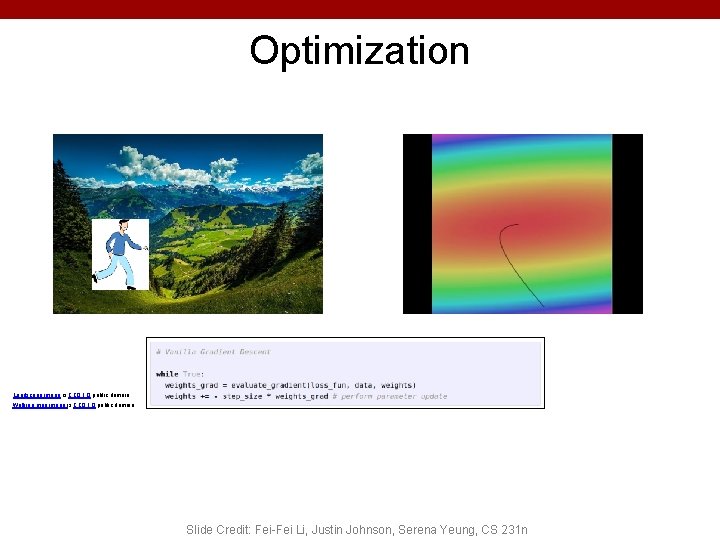
Optimization Landscape image is CC 0 1. 0 public domain Walking man image is CC 0 1. 0 public domain Slide Credit: Fei-Fei Li, Justin Johnson, Serena Yeung, CS 231 n
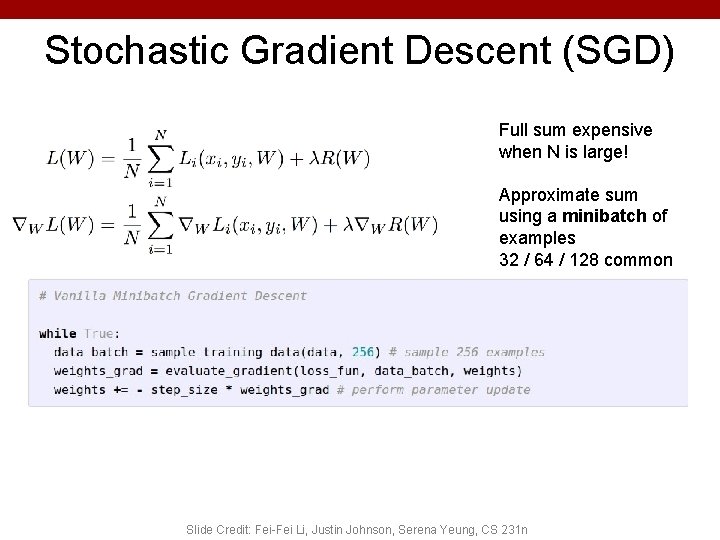
Stochastic Gradient Descent (SGD) Full sum expensive when N is large! Approximate sum using a minibatch of examples 32 / 64 / 128 common Slide Credit: Fei-Fei Li, Justin Johnson, Serena Yeung, CS 231 n
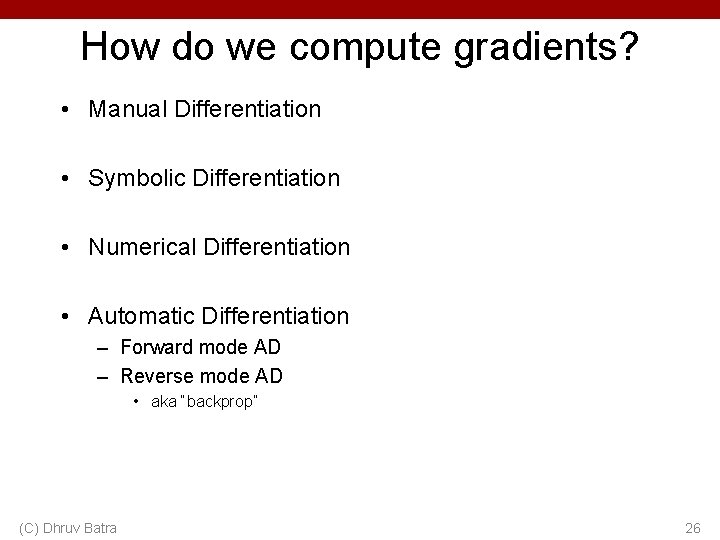
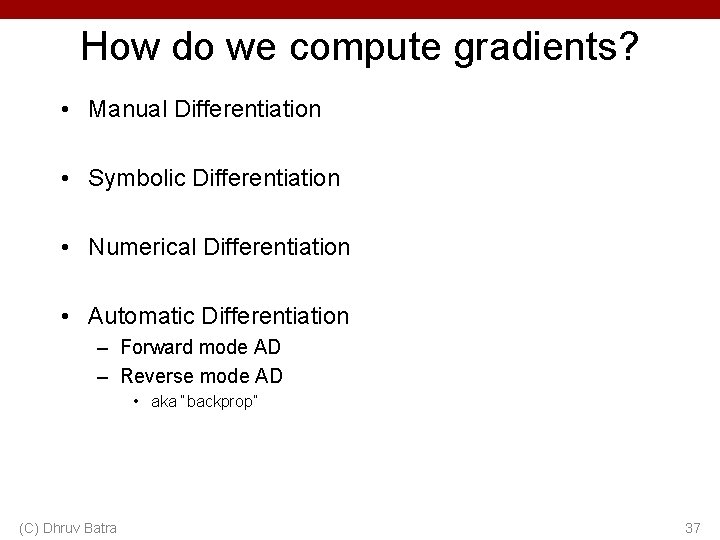
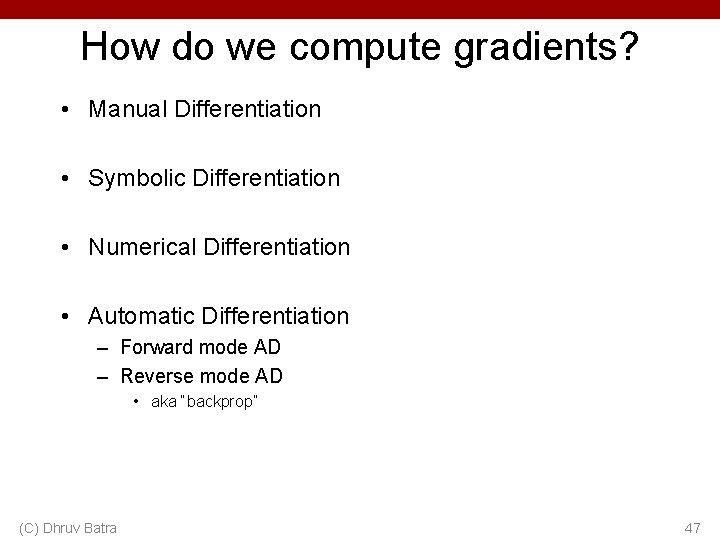
How do we compute gradients? • Manual Differentiation • Symbolic Differentiation • Numerical Differentiation • Automatic Differentiation – Forward mode AD – Reverse mode AD • aka “backprop” (C) Dhruv Batra 26
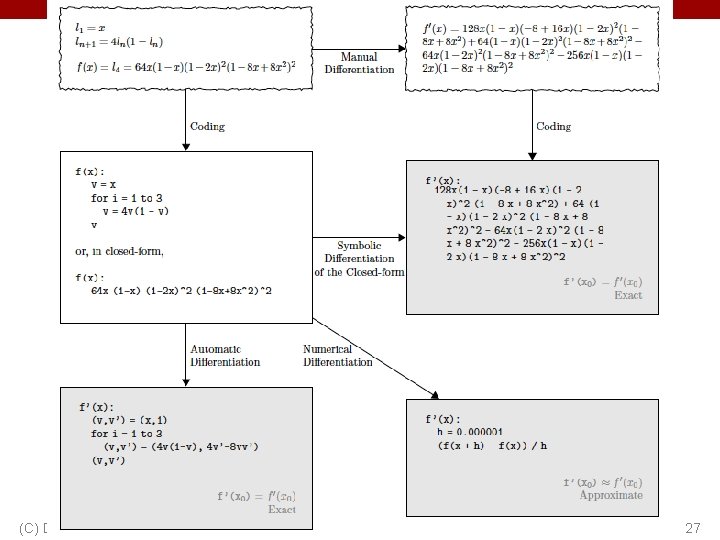
(C) Dhruv Batra 27
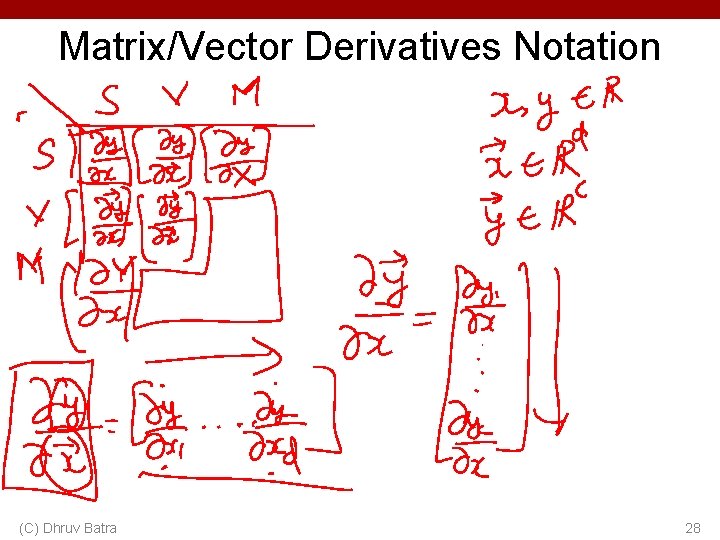
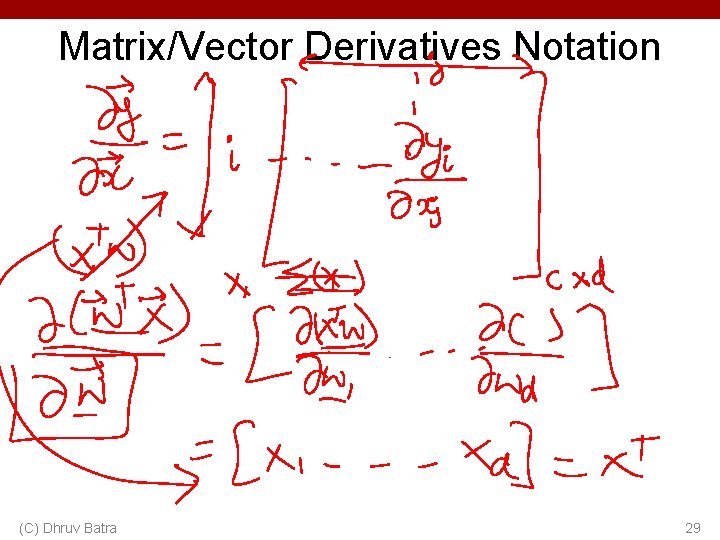
Matrix/Vector Derivatives Notation (C) Dhruv Batra 28
Matrix/Vector Derivatives Notation (C) Dhruv Batra 29
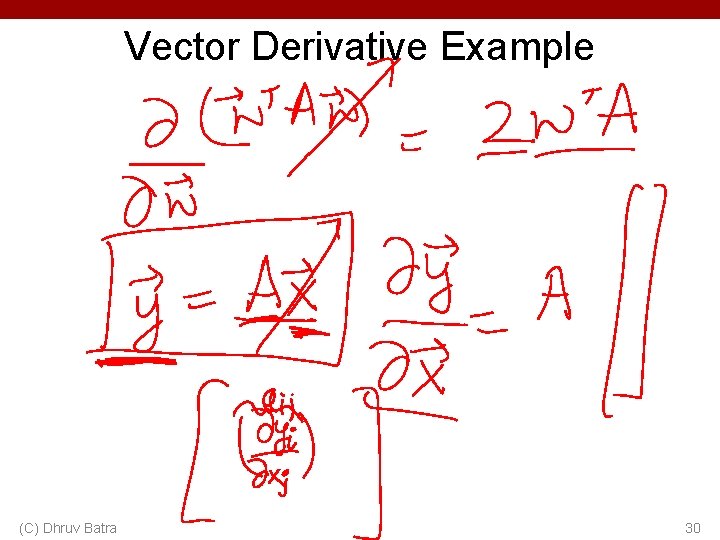
Vector Derivative Example (C) Dhruv Batra 30
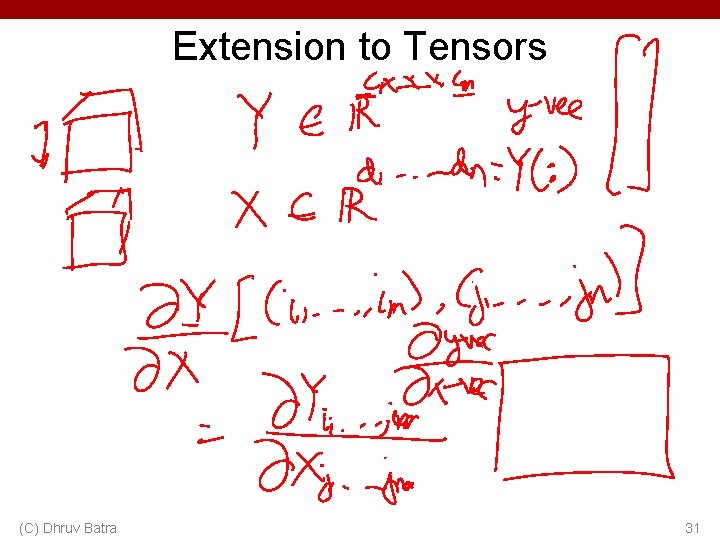
Extension to Tensors (C) Dhruv Batra 31
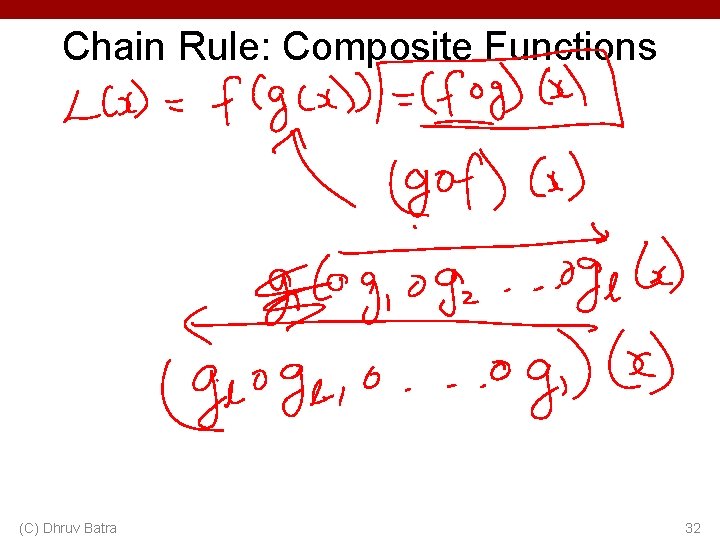
Chain Rule: Composite Functions (C) Dhruv Batra 32
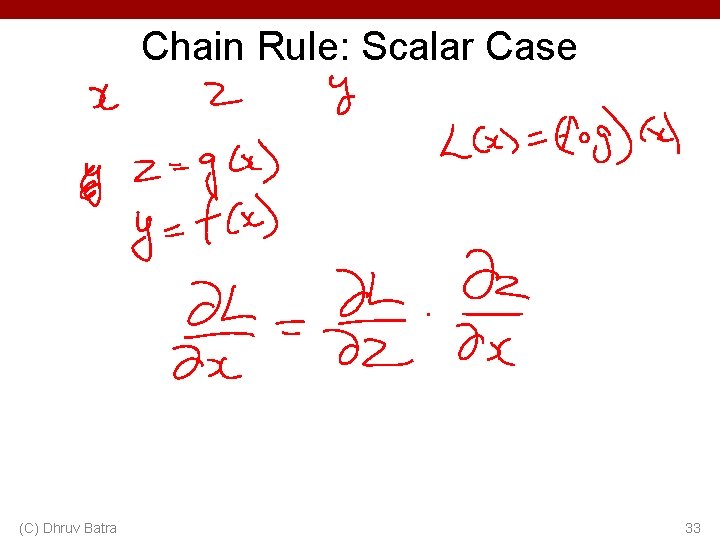
Chain Rule: Scalar Case (C) Dhruv Batra 33
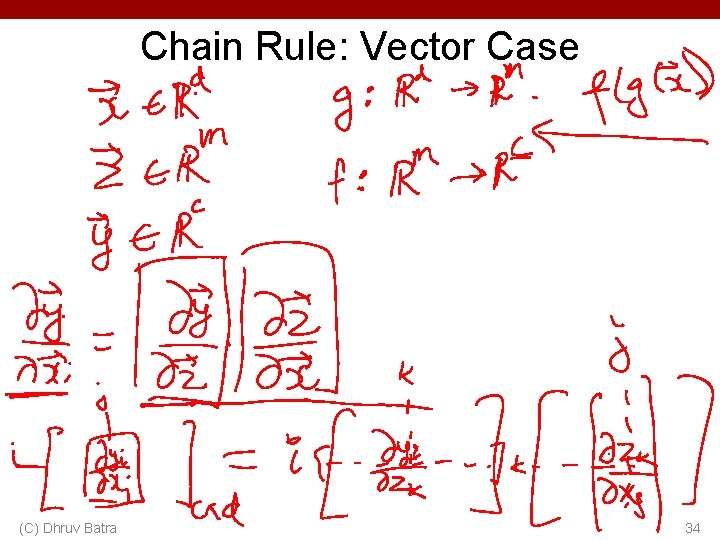
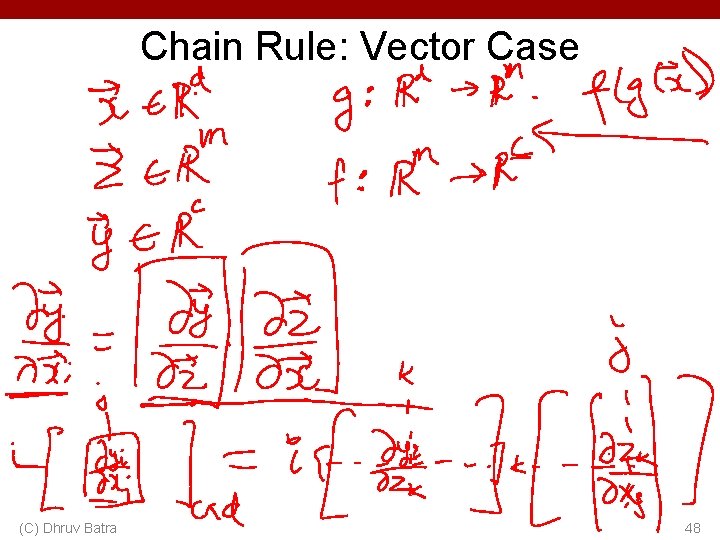
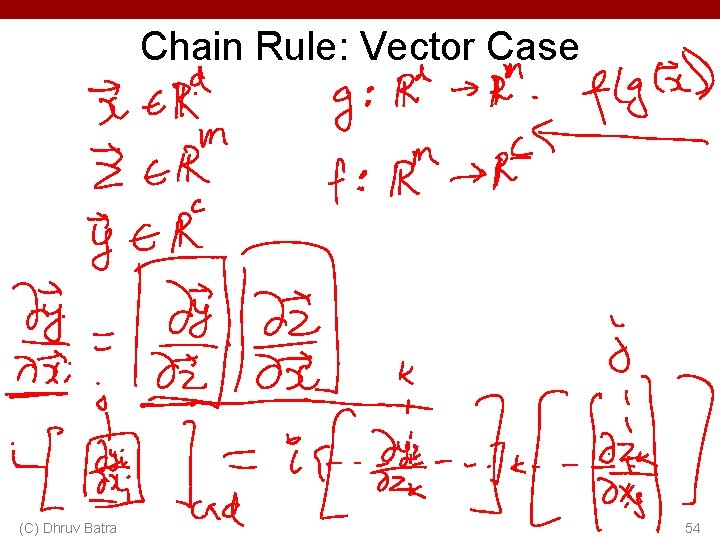
Chain Rule: Vector Case (C) Dhruv Batra 34
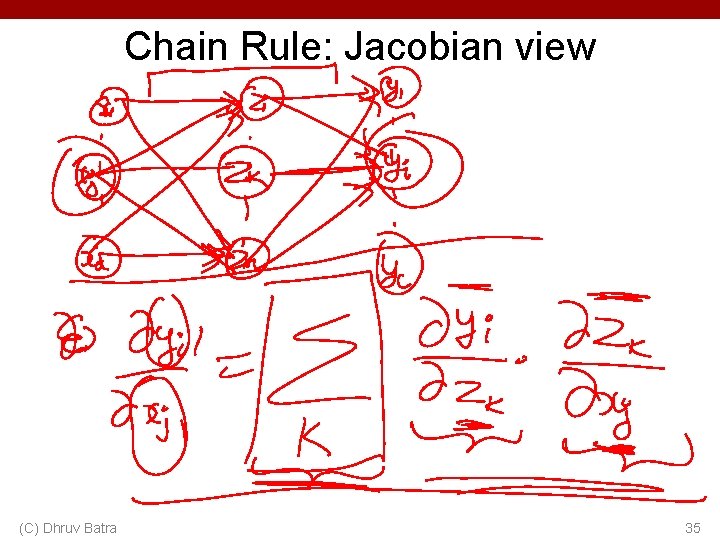
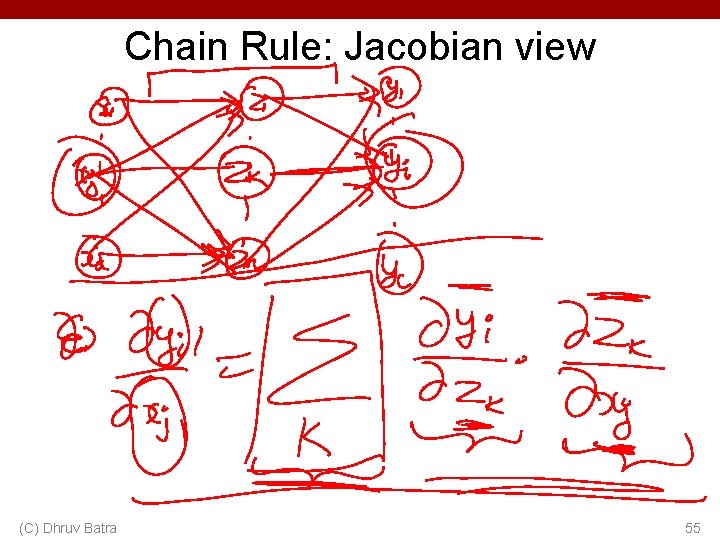
Chain Rule: Jacobian view (C) Dhruv Batra 35
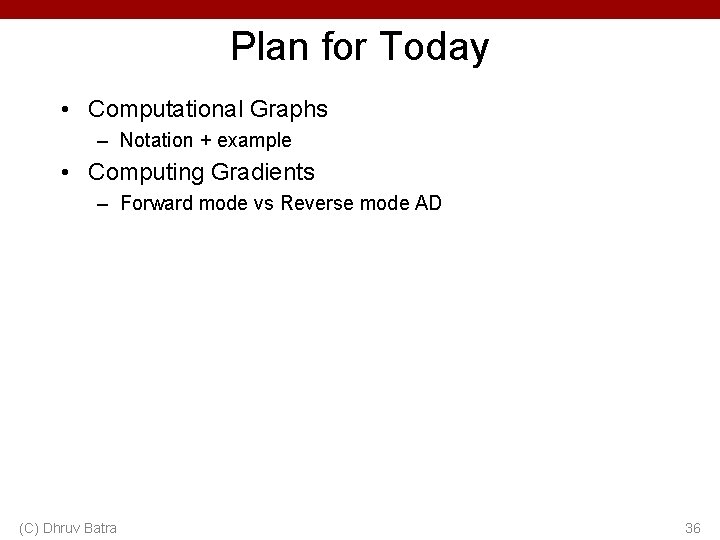
Plan for Today • Computational Graphs – Notation + example • Computing Gradients – Forward mode vs Reverse mode AD (C) Dhruv Batra 36
How do we compute gradients? • Manual Differentiation • Symbolic Differentiation • Numerical Differentiation • Automatic Differentiation – Forward mode AD – Reverse mode AD • aka “backprop” (C) Dhruv Batra 37
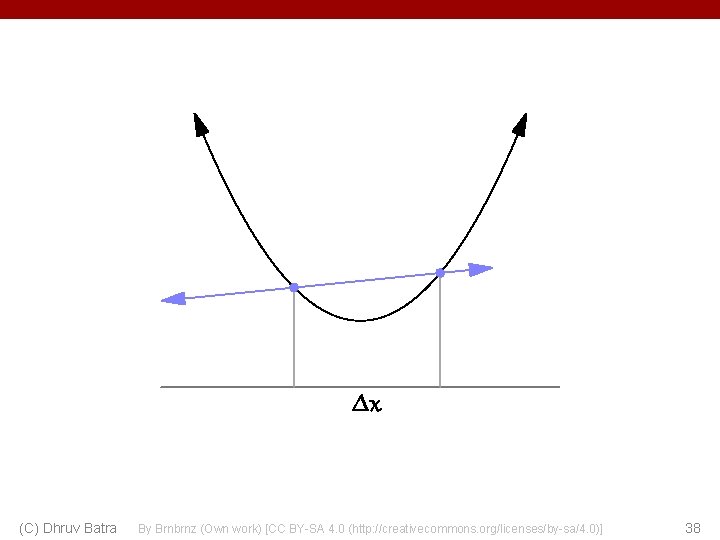
(C) Dhruv Batra By Brnbrnz (Own work) [CC BY-SA 4. 0 (http: //creativecommons. org/licenses/by-sa/4. 0)] 38
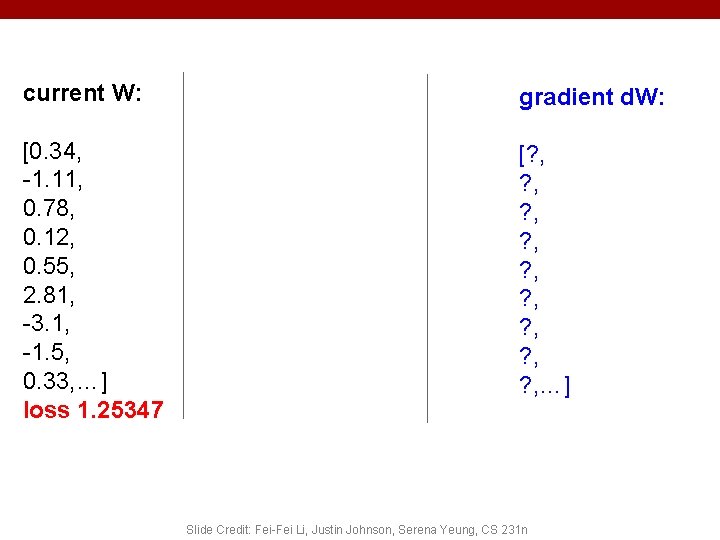
current W: gradient d. W: [0. 34, -1. 11, 0. 78, 0. 12, 0. 55, 2. 81, -3. 1, -1. 5, 0. 33, …] loss 1. 25347 [? , ? , ? , …] Slide Credit: Fei-Fei Li, Justin Johnson, Serena Yeung, CS 231 n
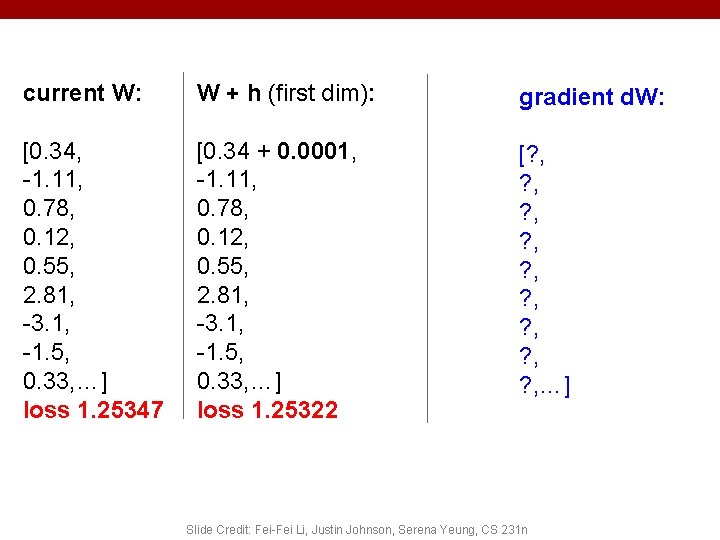
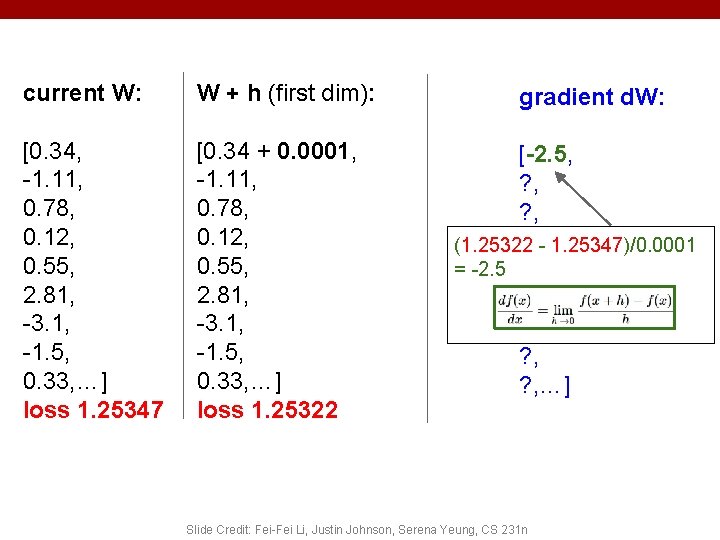
current W: W + h (first dim): gradient d. W: [0. 34, -1. 11, 0. 78, 0. 12, 0. 55, 2. 81, -3. 1, -1. 5, 0. 33, …] loss 1. 25347 [0. 34 + 0. 0001, -1. 11, 0. 78, 0. 12, 0. 55, 2. 81, -3. 1, -1. 5, 0. 33, …] loss 1. 25322 [? , ? , ? , …] Slide Credit: Fei-Fei Li, Justin Johnson, Serena Yeung, CS 231 n
current W: W + h (first dim): [0. 34, -1. 11, 0. 78, 0. 12, 0. 55, 2. 81, -3. 1, -1. 5, 0. 33, …] loss 1. 25347 [0. 34 + 0. 0001, -1. 11, 0. 78, 0. 12, 0. 55, 2. 81, -3. 1, -1. 5, 0. 33, …] loss 1. 25322 gradient d. W: [-2. 5, ? , ? , - 1. 25347)/0. 0001 (1. 25322 = -2. 5 ? , ? , ? , …] Slide Credit: Fei-Fei Li, Justin Johnson, Serena Yeung, CS 231 n
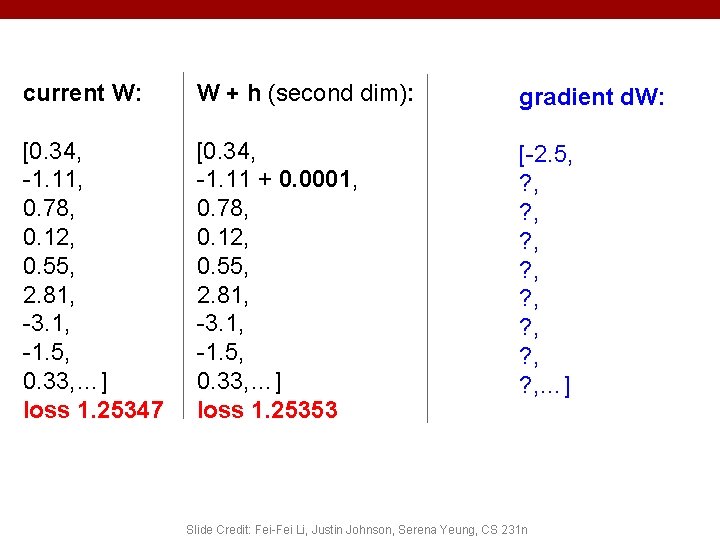
current W: W + h (second dim): gradient d. W: [0. 34, -1. 11, 0. 78, 0. 12, 0. 55, 2. 81, -3. 1, -1. 5, 0. 33, …] loss 1. 25347 [0. 34, -1. 11 + 0. 0001, 0. 78, 0. 12, 0. 55, 2. 81, -3. 1, -1. 5, 0. 33, …] loss 1. 25353 [-2. 5, ? , ? , …] Slide Credit: Fei-Fei Li, Justin Johnson, Serena Yeung, CS 231 n
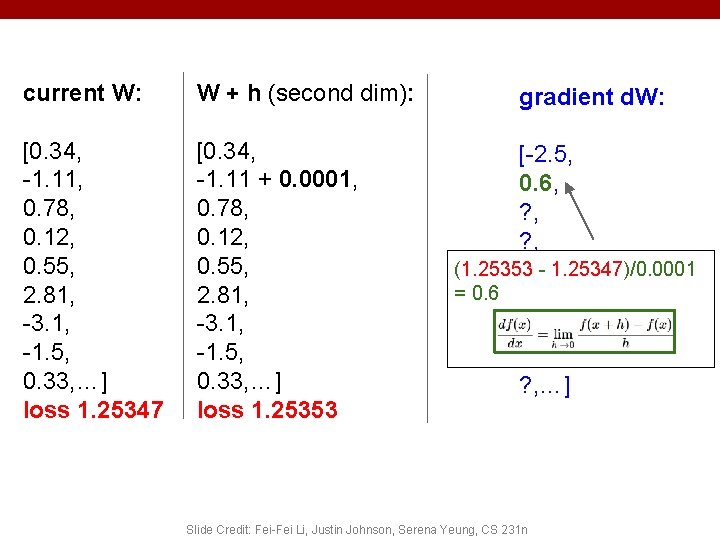
current W: W + h (second dim): [0. 34, -1. 11, 0. 78, 0. 12, 0. 55, 2. 81, -3. 1, -1. 5, 0. 33, …] loss 1. 25347 [0. 34, -1. 11 + 0. 0001, 0. 78, 0. 12, 0. 55, 2. 81, -3. 1, -1. 5, 0. 33, …] loss 1. 25353 gradient d. W: [-2. 5, 0. 6, ? , (1. 25353 ? , - 1. 25347)/0. 0001 = 0. 6 ? , ? , …] Slide Credit: Fei-Fei Li, Justin Johnson, Serena Yeung, CS 231 n
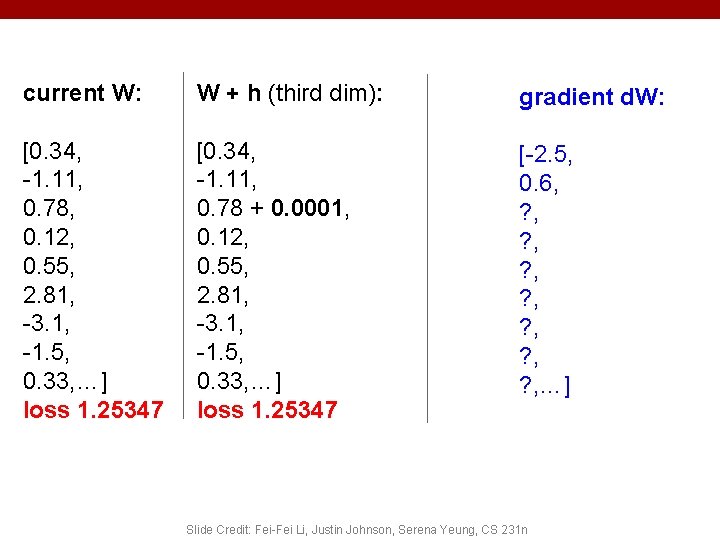
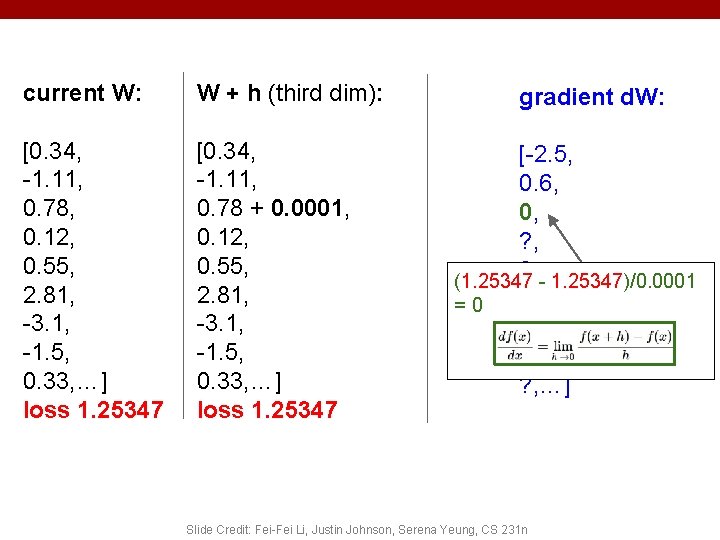
current W: W + h (third dim): gradient d. W: [0. 34, -1. 11, 0. 78, 0. 12, 0. 55, 2. 81, -3. 1, -1. 5, 0. 33, …] loss 1. 25347 [0. 34, -1. 11, 0. 78 + 0. 0001, 0. 12, 0. 55, 2. 81, -3. 1, -1. 5, 0. 33, …] loss 1. 25347 [-2. 5, 0. 6, ? , ? , …] Slide Credit: Fei-Fei Li, Justin Johnson, Serena Yeung, CS 231 n
current W: W + h (third dim): [0. 34, -1. 11, 0. 78, 0. 12, 0. 55, 2. 81, -3. 1, -1. 5, 0. 33, …] loss 1. 25347 [0. 34, -1. 11, 0. 78 + 0. 0001, 0. 12, 0. 55, 2. 81, -3. 1, -1. 5, 0. 33, …] loss 1. 25347 gradient d. W: [-2. 5, 0. 6, 0, ? , (1. 25347 - 1. 25347)/0. 0001 ? , =0 ? , ? , …] Slide Credit: Fei-Fei Li, Justin Johnson, Serena Yeung, CS 231 n
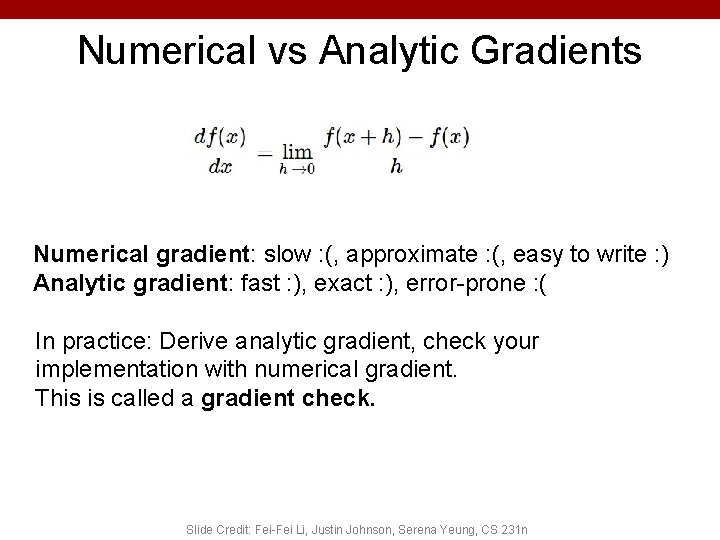
Numerical vs Analytic Gradients Numerical gradient: slow : (, approximate : (, easy to write : ) Analytic gradient: fast : ), exact : ), error-prone : ( In practice: Derive analytic gradient, check your implementation with numerical gradient. This is called a gradient check. Slide Credit: Fei-Fei Li, Justin Johnson, Serena Yeung, CS 231 n
How do we compute gradients? • Manual Differentiation • Symbolic Differentiation • Numerical Differentiation • Automatic Differentiation – Forward mode AD – Reverse mode AD • aka “backprop” (C) Dhruv Batra 47
Chain Rule: Vector Case (C) Dhruv Batra 48
(C) Dhruv Batra 49
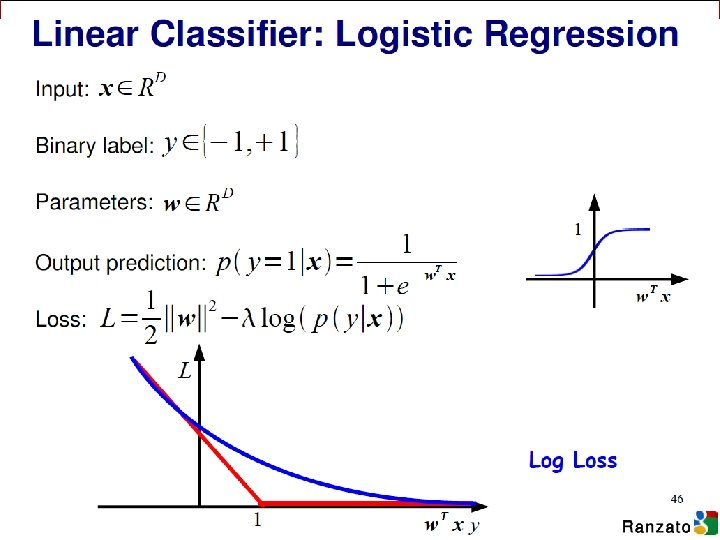
Logistic Regression Derivatives (C) Dhruv Batra 50
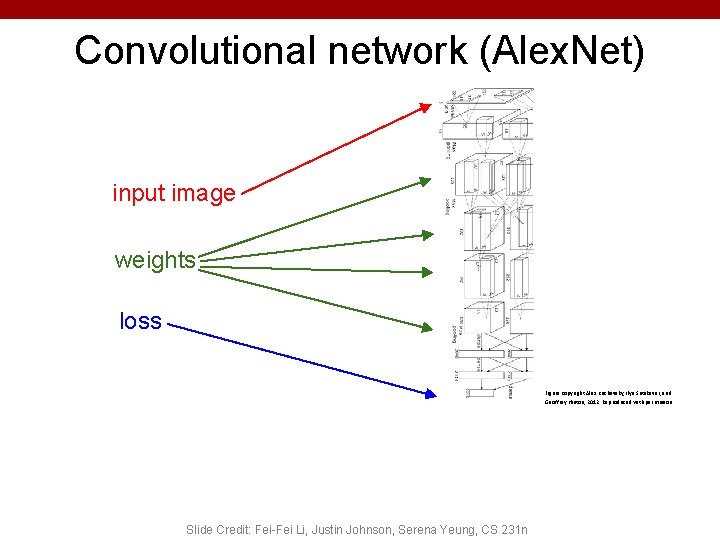
Convolutional network (Alex. Net) input image weights loss Figure copyright Alex Krizhevsky, Ilya Sutskever, and Geoffrey Hinton, 2012. Reproduced with permission. Slide Credit: Fei-Fei Li, Justin Johnson, Serena Yeung, CS 231 n
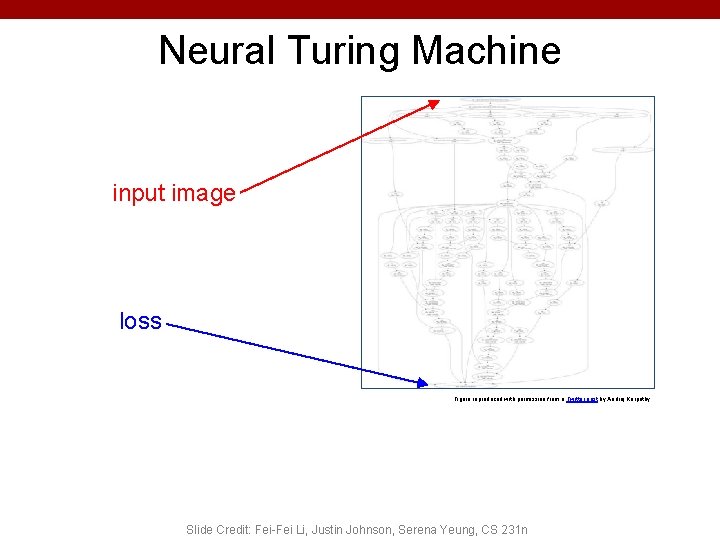
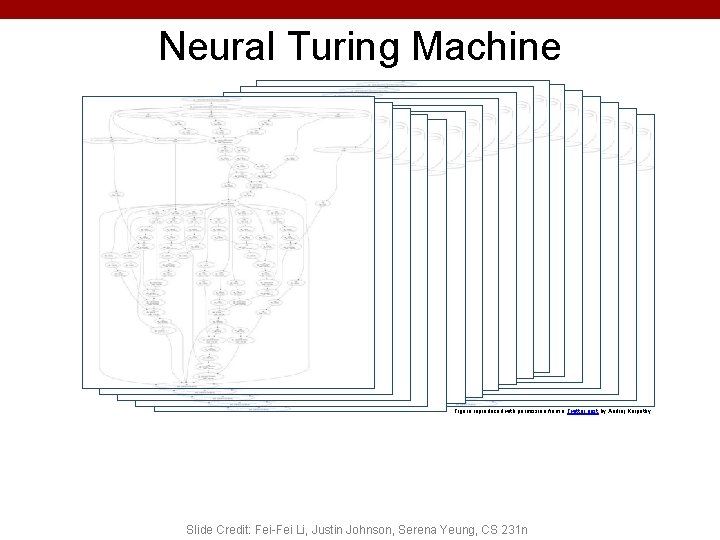
Neural Turing Machine input image loss Figure reproduced with permission from a Twitter post by Andrej Karpathy. Slide Credit: Fei-Fei Li, Justin Johnson, Serena Yeung, CS 231 n
Neural Turing Machine Figure reproduced with permission from a Twitter post by Andrej Karpathy. Slide Credit: Fei-Fei Li, Justin Johnson, Serena Yeung, CS 231 n
Chain Rule: Vector Case (C) Dhruv Batra 54
Chain Rule: Jacobian view (C) Dhruv Batra 55
Chain Rule: Long Paths (C) Dhruv Batra 56
Chain Rule: Long Paths (C) Dhruv Batra 57
Chain Rule: Long Paths (C) Dhruv Batra 58
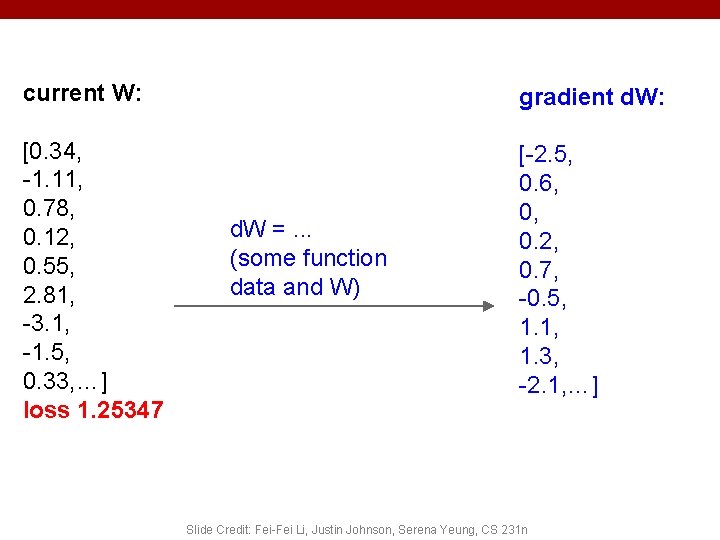
current W: gradient d. W: [0. 34, -1. 11, 0. 78, 0. 12, 0. 55, 2. 81, -3. 1, -1. 5, 0. 33, …] loss 1. 25347 [-2. 5, 0. 6, 0, 0. 2, 0. 7, -0. 5, 1. 1, 1. 3, -2. 1, …] d. W =. . . (some function data and W) Slide Credit: Fei-Fei Li, Justin Johnson, Serena Yeung, CS 231 n
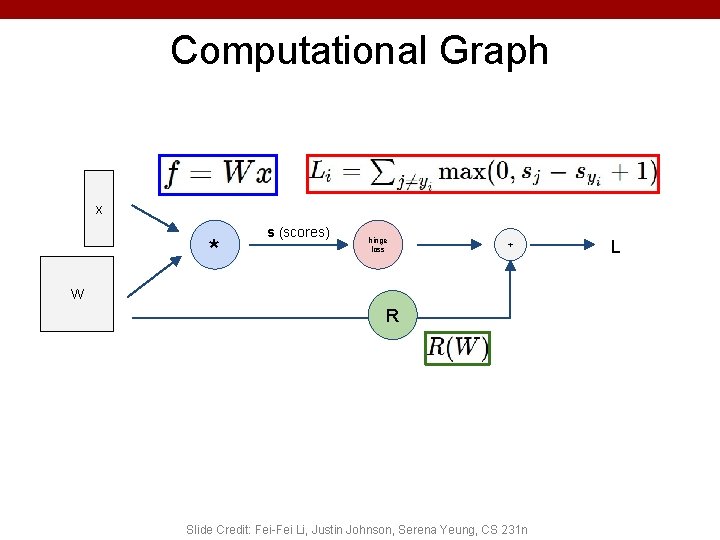
Computational Graph x * s (scores) hinge loss + W R Slide Credit: Fei-Fei Li, Justin Johnson, Serena Yeung, CS 231 n L
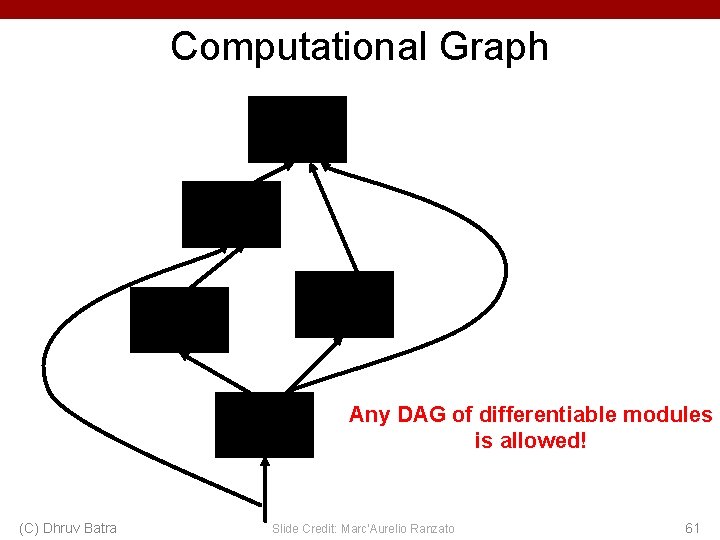
Computational Graph Any DAG of differentiable modules is allowed! (C) Dhruv Batra Slide Credit: Marc'Aurelio Ranzato 61
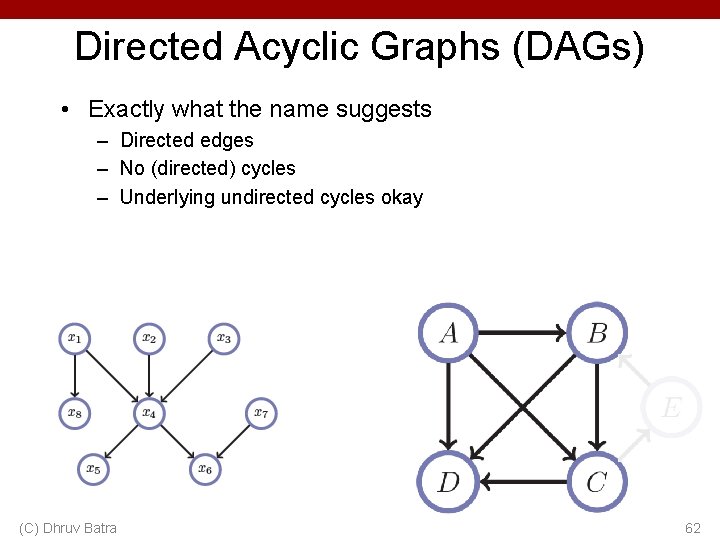
Directed Acyclic Graphs (DAGs) • Exactly what the name suggests – Directed edges – No (directed) cycles – Underlying undirected cycles okay (C) Dhruv Batra 62
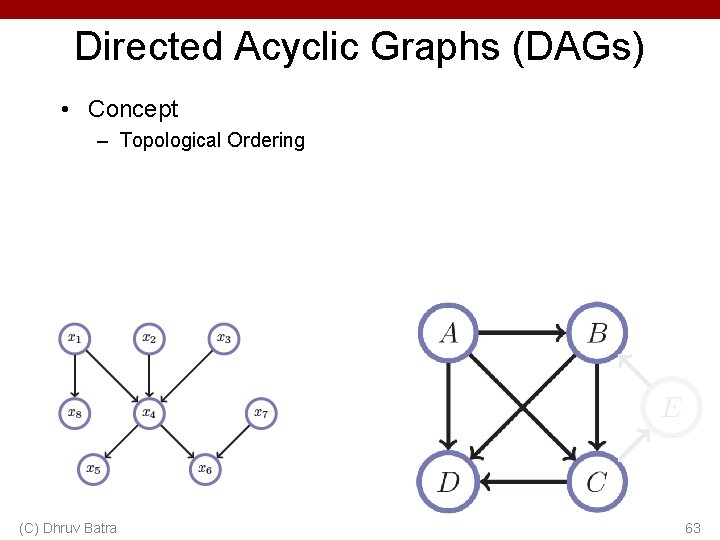
Directed Acyclic Graphs (DAGs) • Concept – Topological Ordering (C) Dhruv Batra 63
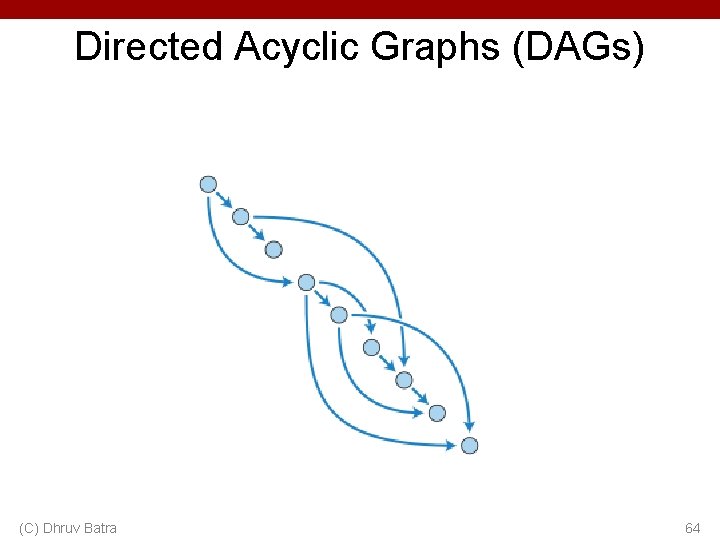
Directed Acyclic Graphs (DAGs) (C) Dhruv Batra 64
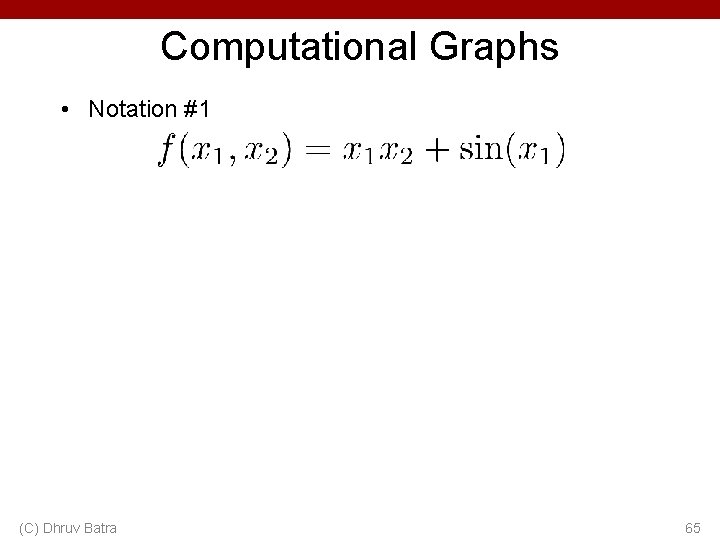
Computational Graphs • Notation #1 (C) Dhruv Batra 65
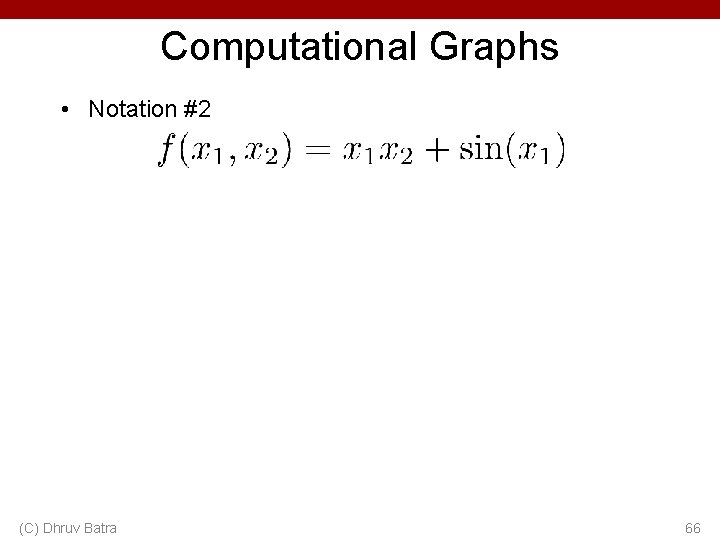
Computational Graphs • Notation #2 (C) Dhruv Batra 66
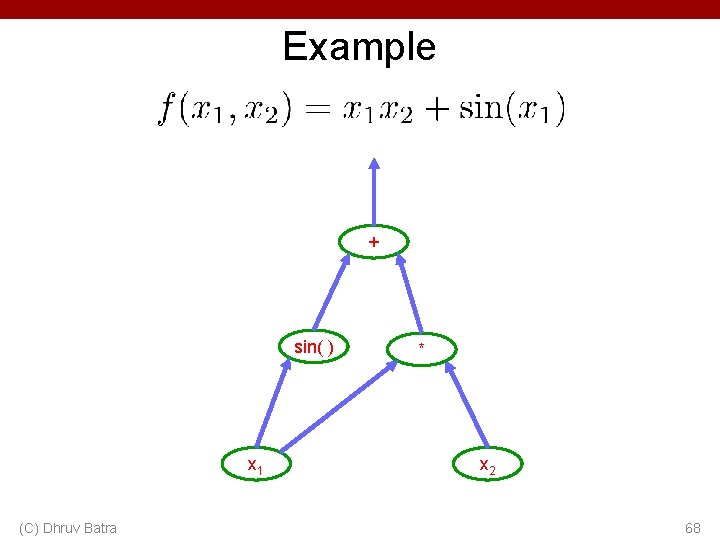
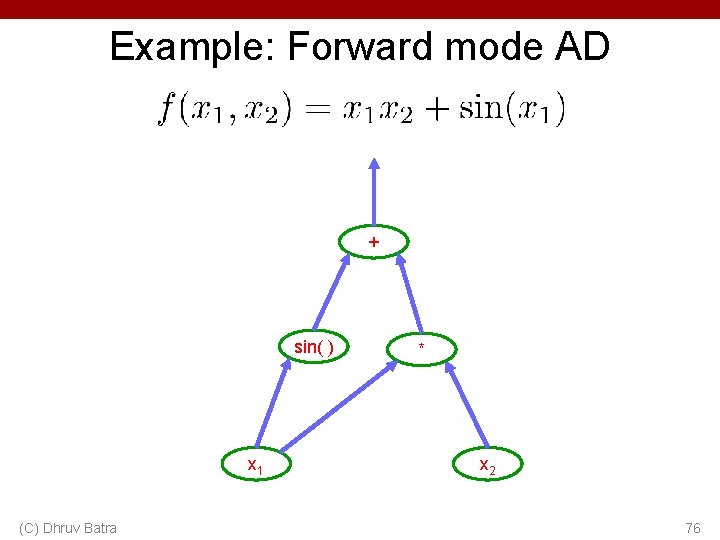
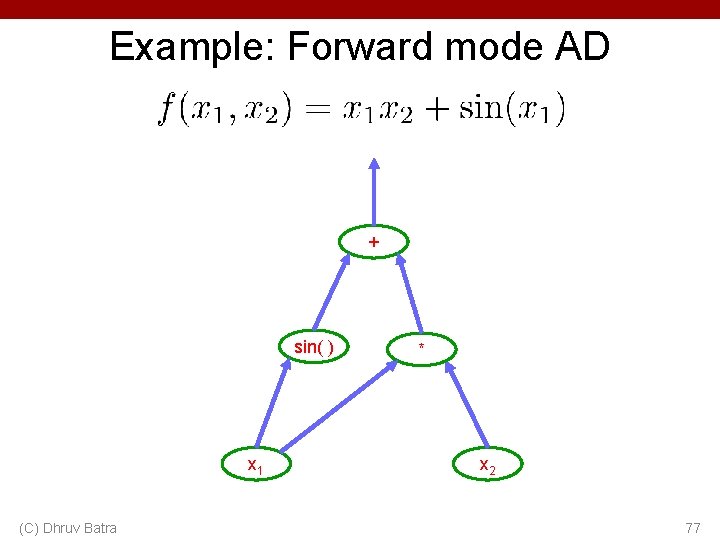
Example + sin( ) x 1 (C) Dhruv Batra * x 2 68
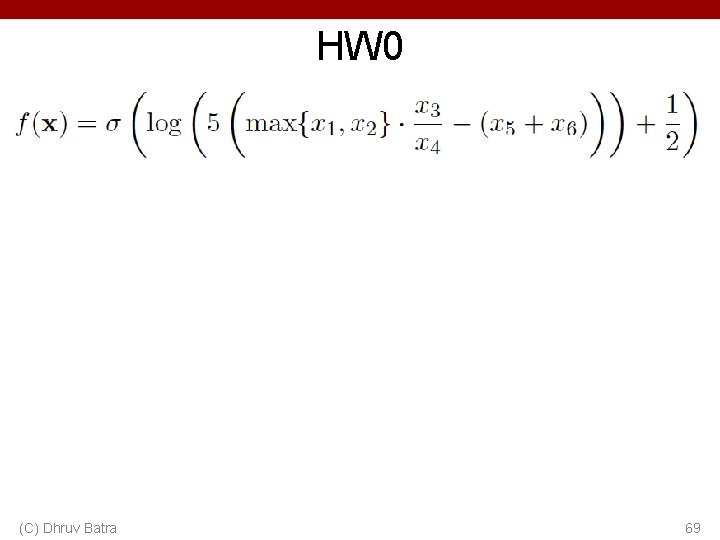
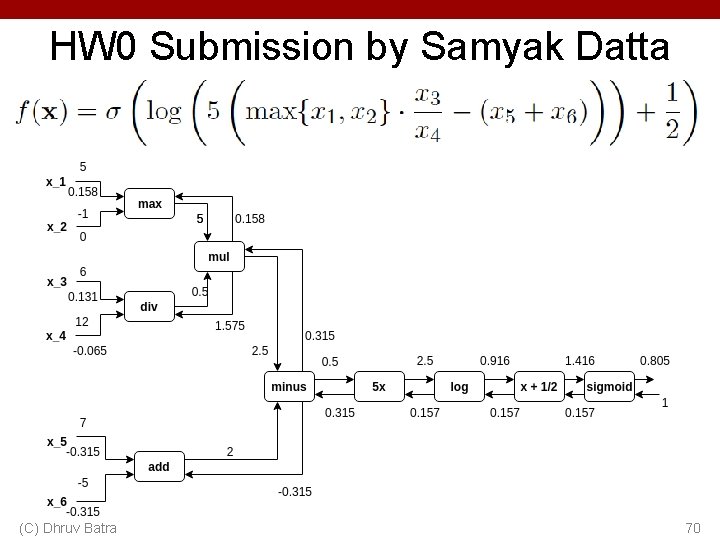
HW 0 (C) Dhruv Batra 69
HW 0 Submission by Samyak Datta (C) Dhruv Batra 70
(C) Dhruv Batra 71
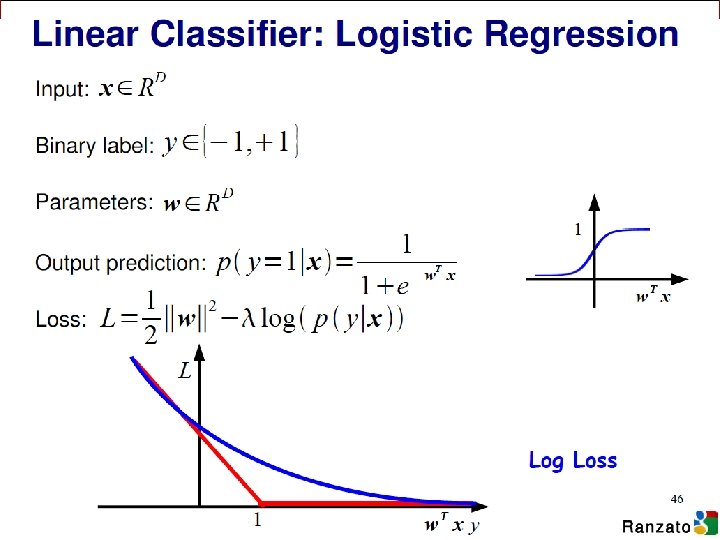
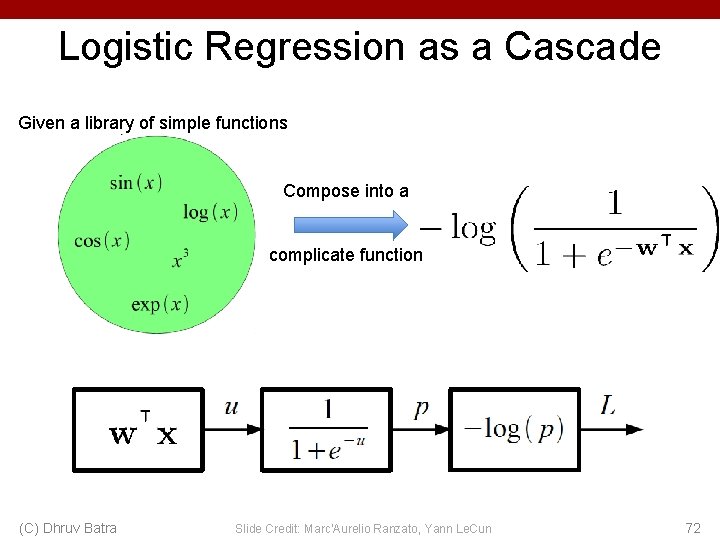
Logistic Regression as a Cascade Given a library of simple functions Compose into a complicate function (C) Dhruv Batra Slide Credit: Marc'Aurelio Ranzato, Yann Le. Cun 72
Forward mode vs Reverse Mode • Key Computations (C) Dhruv Batra 73
Forward mode AD g 74
Reverse mode AD g 75
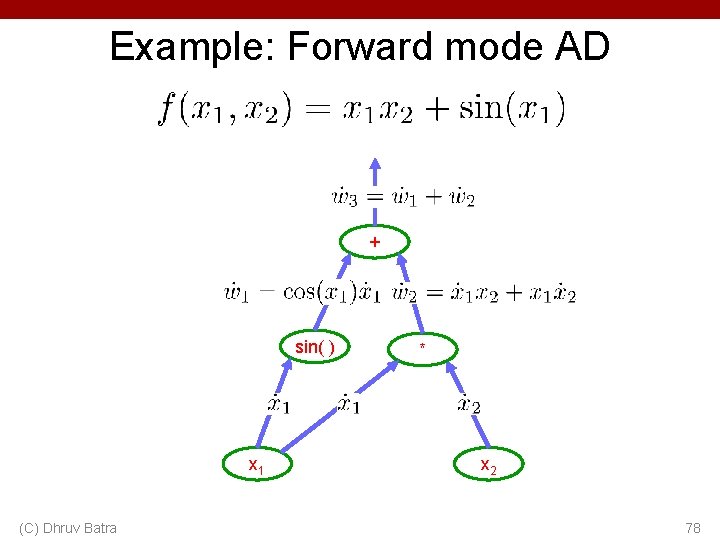
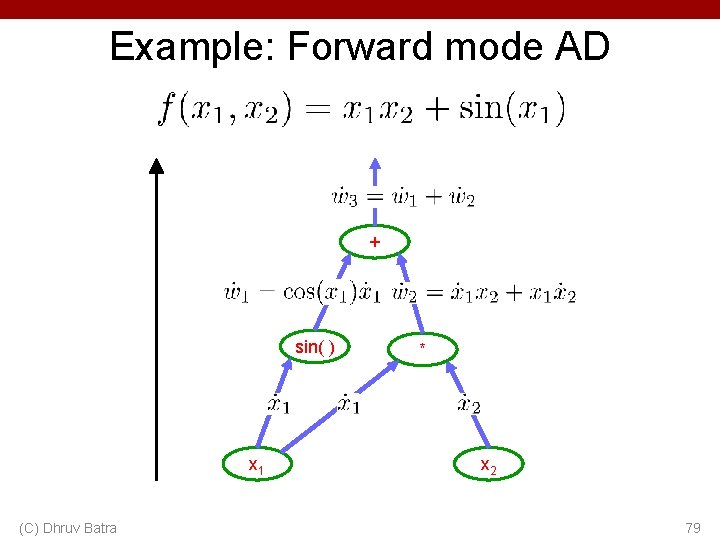
Example: Forward mode AD + sin( ) x 1 (C) Dhruv Batra * x 2 76
Example: Forward mode AD + sin( ) x 1 (C) Dhruv Batra * x 2 77
Example: Forward mode AD + sin( ) x 1 (C) Dhruv Batra * x 2 78
Example: Forward mode AD + sin( ) x 1 (C) Dhruv Batra * x 2 79
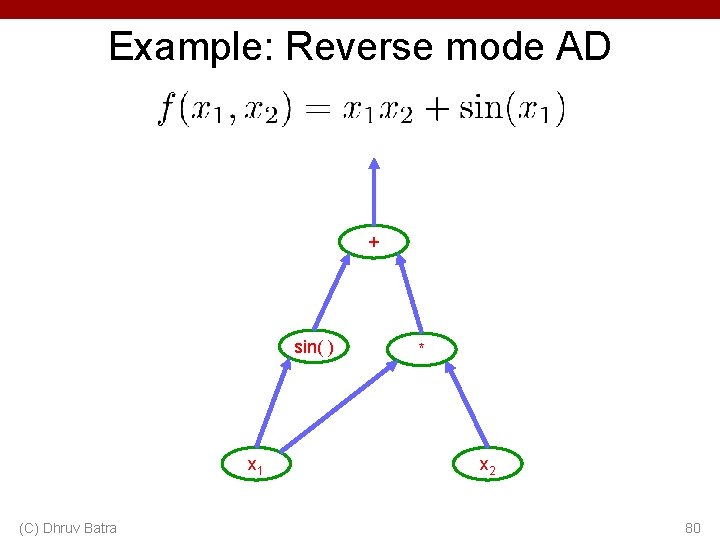
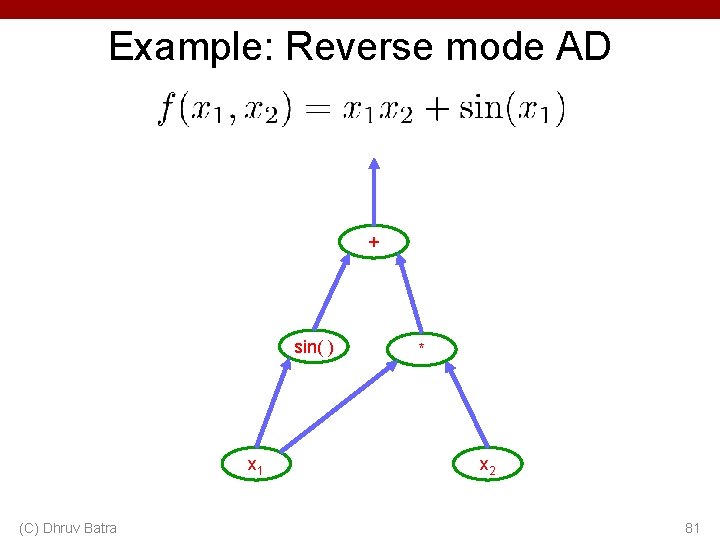
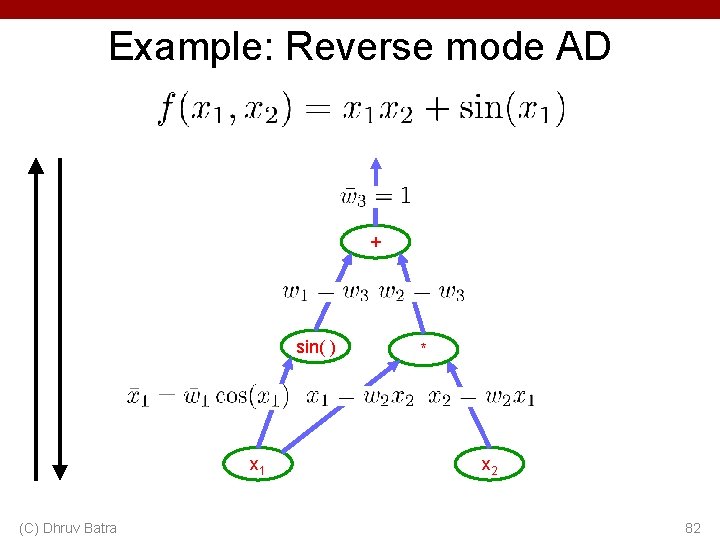
Example: Reverse mode AD + sin( ) x 1 (C) Dhruv Batra * x 2 80
Example: Reverse mode AD + sin( ) x 1 (C) Dhruv Batra * x 2 81
Example: Reverse mode AD + sin( ) x 1 (C) Dhruv Batra * x 2 82
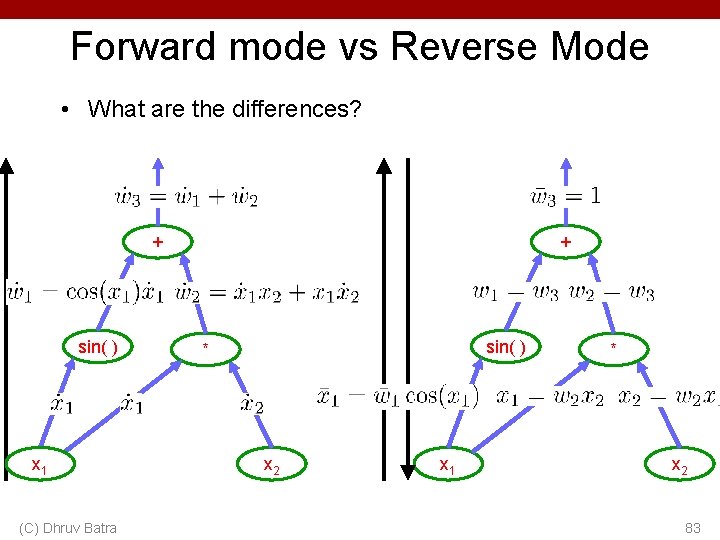
Forward mode vs Reverse Mode • What are the differences? + sin( ) x 1 (C) Dhruv Batra + sin( ) * x 2 x 1 * x 2 83
Forward mode vs Reverse Mode • What are the differences? • Which one is more memory efficient (less storage)? – Forward or backward? (C) Dhruv Batra 84
Forward mode vs Reverse Mode • What are the differences? • Which one is more memory efficient (less storage)? – Forward or backward? • Which one is faster to compute? – Forward or backward? (C) Dhruv Batra 85