CS 1352 Principles of Compiler Design Unit 2

- Slides: 117
CS 1352 Principles of Compiler Design — Unit - 2 — — Syntax Analysis— 3/8/2021 Unit-2 : Syntax Analysis 1
Syntax Analyzer • • Syntax Analyzer creates the syntactic structure of the given source program. This syntactic structure is mostly a parse tree. Syntax Analyzer is also known as parser. The syntax of a programming is described by a context-free grammar (CFG). We will use BNF (Backus-Naur Form) notation in the description of CFGs. • The syntax analyzer (parser) checks whether a given source program satisfies the rules implied by a context-free grammar or not. – If it satisfies, the parser creates the parse tree of that program. – Otherwise the parser gives the error messages. • A context-free grammar – gives a precise syntactic specification of a programming language. – the design of the grammar is an initial phase of the design of a compiler. – a grammar can be directly converted into a parser by some tools. 3/8/2021 Unit-2 : Syntax Analysis 2
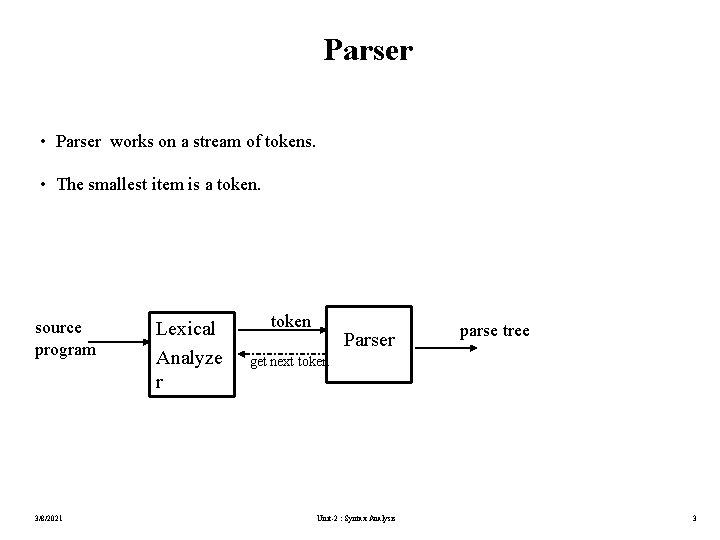
Parser • Parser works on a stream of tokens. • The smallest item is a token. source program 3/8/2021 Lexical Analyze r token Parser parse tree get next token Unit-2 : Syntax Analysis 3
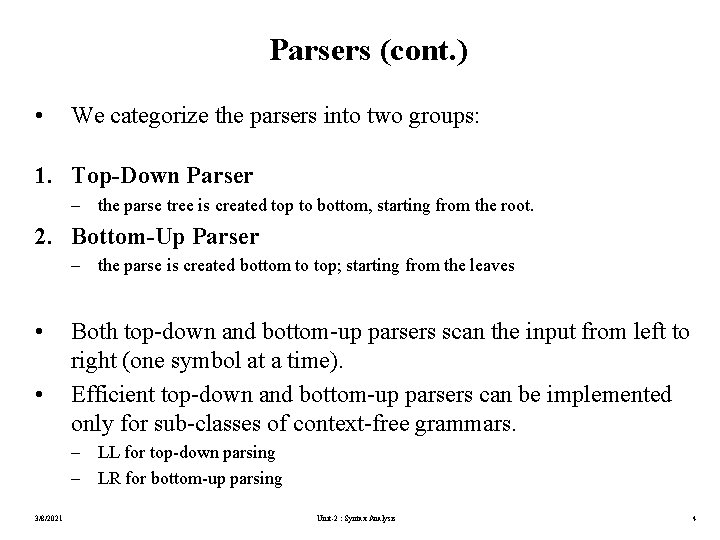
Parsers (cont. ) • We categorize the parsers into two groups: 1. Top-Down Parser – the parse tree is created top to bottom, starting from the root. 2. Bottom-Up Parser – the parse is created bottom to top; starting from the leaves • • Both top-down and bottom-up parsers scan the input from left to right (one symbol at a time). Efficient top-down and bottom-up parsers can be implemented only for sub-classes of context-free grammars. – LL for top-down parsing – LR for bottom-up parsing 3/8/2021 Unit-2 : Syntax Analysis 4
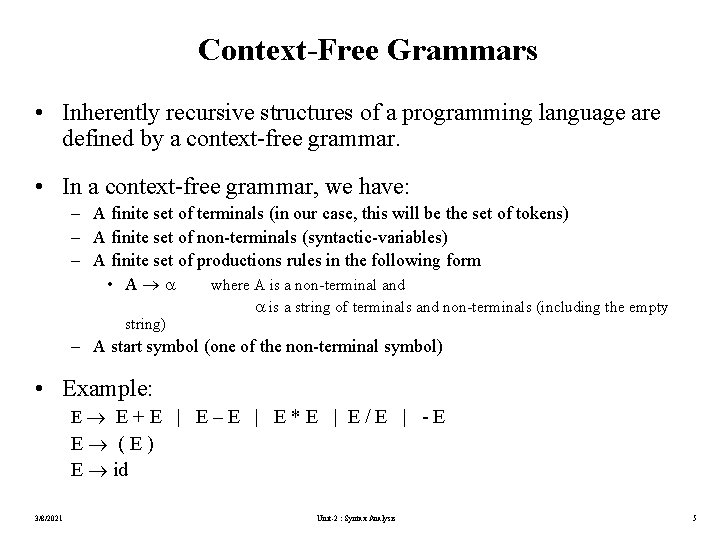
Context-Free Grammars • Inherently recursive structures of a programming language are defined by a context-free grammar. • In a context-free grammar, we have: – A finite set of terminals (in our case, this will be the set of tokens) – A finite set of non-terminals (syntactic-variables) – A finite set of productions rules in the following form • A where A is a non-terminal and string) is a string of terminals and non-terminals (including the empty – A start symbol (one of the non-terminal symbol) • Example: E E+E | E–E | E*E | E/E | -E E (E) E id 3/8/2021 Unit-2 : Syntax Analysis 5
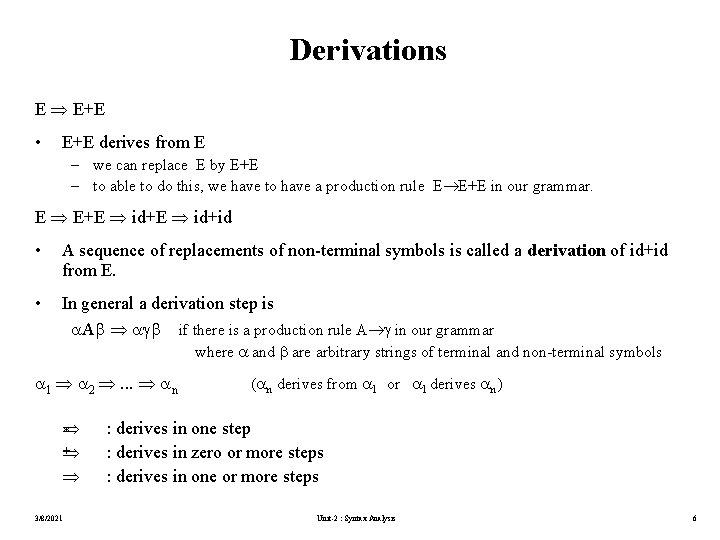
Derivations E E+E • E+E derives from E – we can replace E by E+E – to able to do this, we have to have a production rule E E+E in our grammar. E E+E id+id • A sequence of replacements of non-terminal symbols is called a derivation of id+id from E. • In general a derivation step is A if there is a production rule A in our grammar where and are arbitrary strings of terminal and non-terminal symbols 1 2 . . . n * + 3/8/2021 ( n derives from 1 or 1 derives n ) : derives in one step : derives in zero or more steps : derives in one or more steps Unit-2 : Syntax Analysis 6
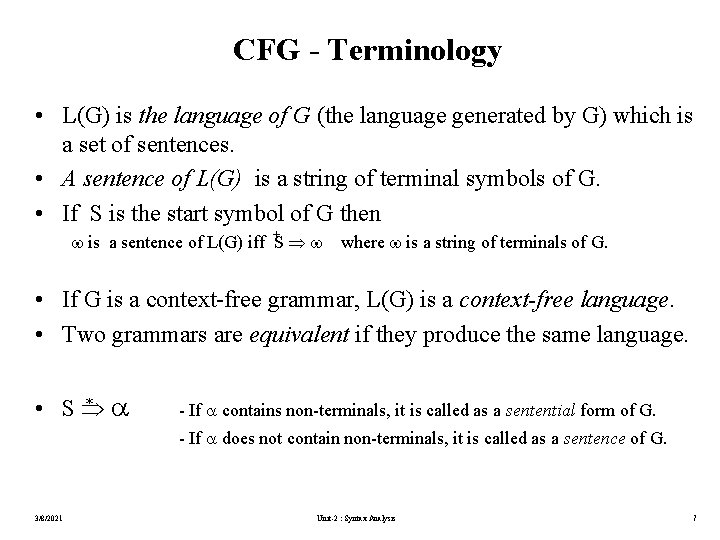
CFG - Terminology • L(G) is the language of G (the language generated by G) which is a set of sentences. • A sentence of L(G) is a string of terminal symbols of G. • If S is the start symbol of G then is a sentence of L(G) iff +S where is a string of terminals of G. • If G is a context-free grammar, L(G) is a context-free language. • Two grammars are equivalent if they produce the same language. * • S - If contains non-terminals, it is called as a sentential form of G. - If does not contain non-terminals, it is called as a sentence of G. 3/8/2021 Unit-2 : Syntax Analysis 7
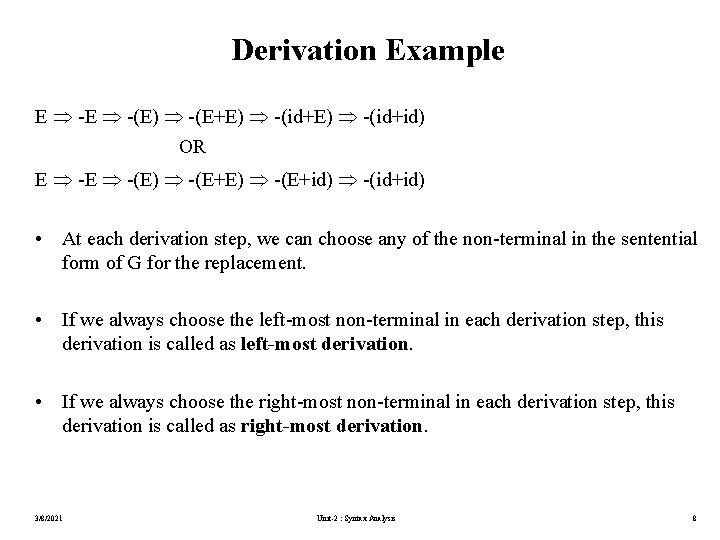
Derivation Example E -(E) -(E+E) -(id+id) OR E -(E) -(E+id) -(id+id) • At each derivation step, we can choose any of the non-terminal in the sentential form of G for the replacement. • If we always choose the left-most non-terminal in each derivation step, this derivation is called as left-most derivation. • If we always choose the right-most non-terminal in each derivation step, this derivation is called as right-most derivation. 3/8/2021 Unit-2 : Syntax Analysis 8
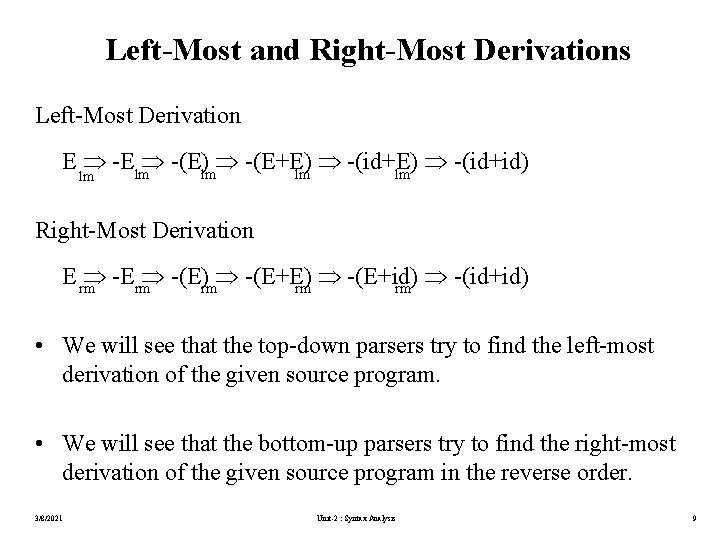
Left-Most and Right-Most Derivations Left-Most Derivation E -Elm -(E)lm -(E+E) -(id+id) lm lm lm Right-Most Derivation E rm -Erm -(E)rm -(E+E) -(E+id) -(id+id) rm rm • We will see that the top-down parsers try to find the left-most derivation of the given source program. • We will see that the bottom-up parsers try to find the right-most derivation of the given source program in the reverse order. 3/8/2021 Unit-2 : Syntax Analysis 9
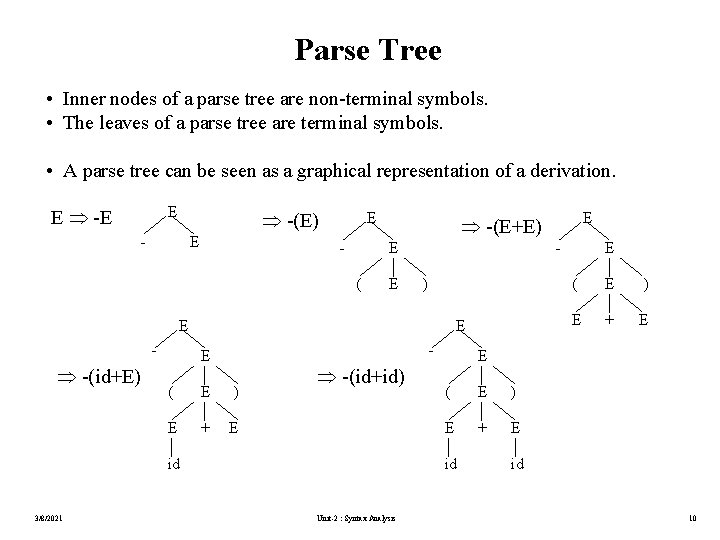
Parse Tree • Inner nodes of a parse tree are non-terminal symbols. • The leaves of a parse tree are terminal symbols. • A parse tree can be seen as a graphical representation of a derivation. E E -(E) - E E - E ( E ) E - -(id+E) E - E ( E ) E + E -(id+id) id 3/8/2021 E -(E+E) ( E ) E + E E ( E ) E + E id Unit-2 : Syntax Analysis E id 10
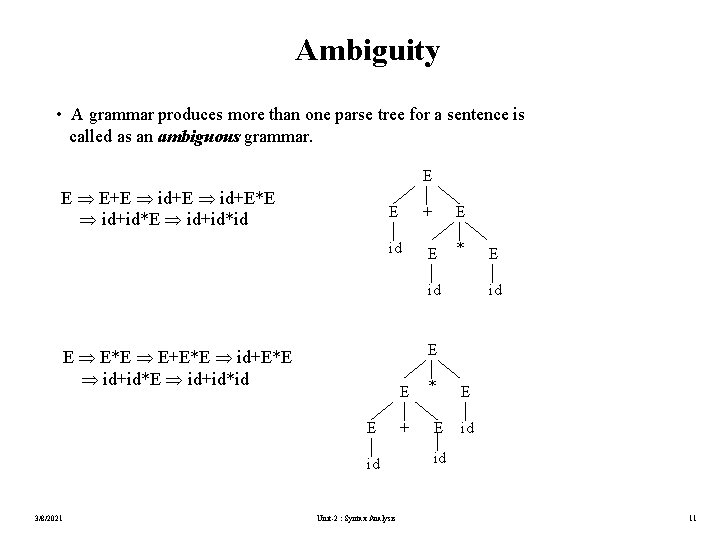
Ambiguity • A grammar produces more than one parse tree for a sentence is called as an ambiguous grammar. E E E+E id+E*E id+id*id E + id E E * id id E E E*E E+E*E id+id*E id+id*id E E id 3/8/2021 E Unit-2 : Syntax Analysis + * E E id id 11
Ambiguity (cont. ) • For the most parsers, the grammar must be unambiguous. • unambiguous grammar unique selection of the parse tree for a sentence • We should eliminate the ambiguity in the grammar during the design phase of the compiler. • An unambiguous grammar should be written to eliminate the ambiguity. • We have to prefer one of the parse trees of a sentence (generated by an ambiguous grammar) to disambiguate that grammar to restrict to this choice. 3/8/2021 Unit-2 : Syntax Analysis 12
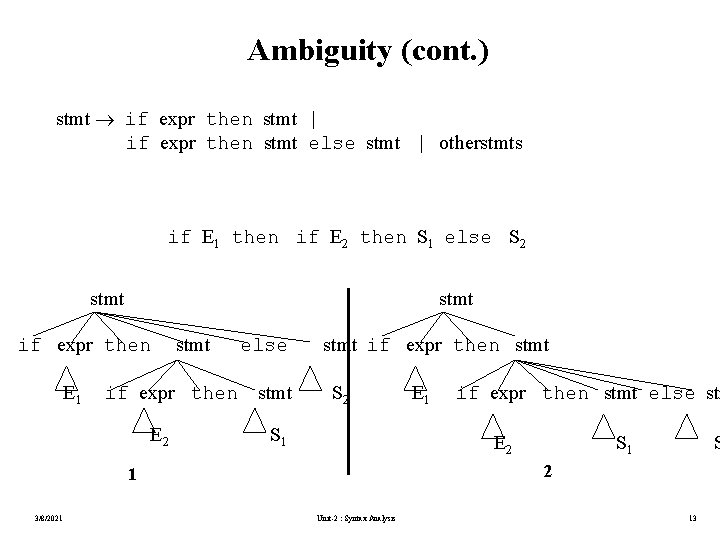
Ambiguity (cont. ) stmt if expr then stmt | if expr then stmt else stmt | otherstmts if E 1 then if E 2 then S 1 else S 2 stmt if expr then E 1 stmt if expr then E 2 else stmt if expr then stmt S 2 S 1 if expr then stmt else stm E 2 S 1 S 2 1 3/8/2021 E 1 Unit-2 : Syntax Analysis 13
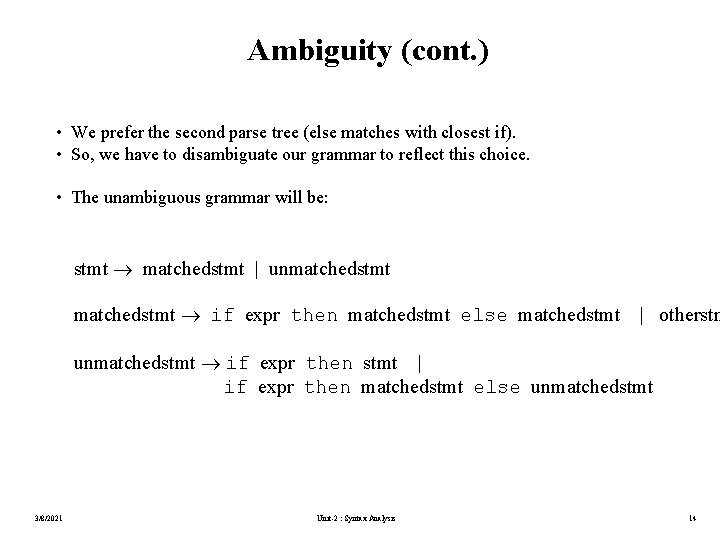
Ambiguity (cont. ) • We prefer the second parse tree (else matches with closest if). • So, we have to disambiguate our grammar to reflect this choice. • The unambiguous grammar will be: stmt matchedstmt | unmatchedstmt if expr then matchedstmt else matchedstmt | otherstm unmatchedstmt if expr then stmt | if expr then matchedstmt else unmatchedstmt 3/8/2021 Unit-2 : Syntax Analysis 14
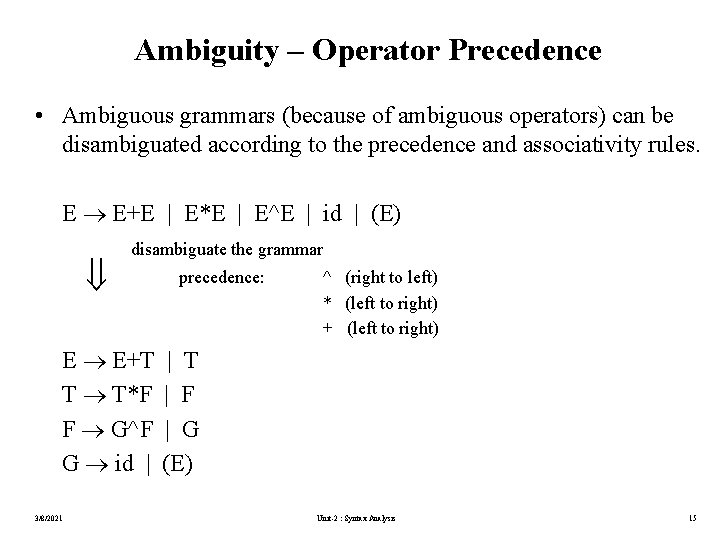
Ambiguity – Operator Precedence • Ambiguous grammars (because of ambiguous operators) can be disambiguated according to the precedence and associativity rules. E E+E | E*E | E^E | id | (E) disambiguate the grammar E E+T T T*F F G^F G id | 3/8/2021 precedence: ^ (right to left) * (left to right) + (left to right) | T | F | G (E) Unit-2 : Syntax Analysis 15
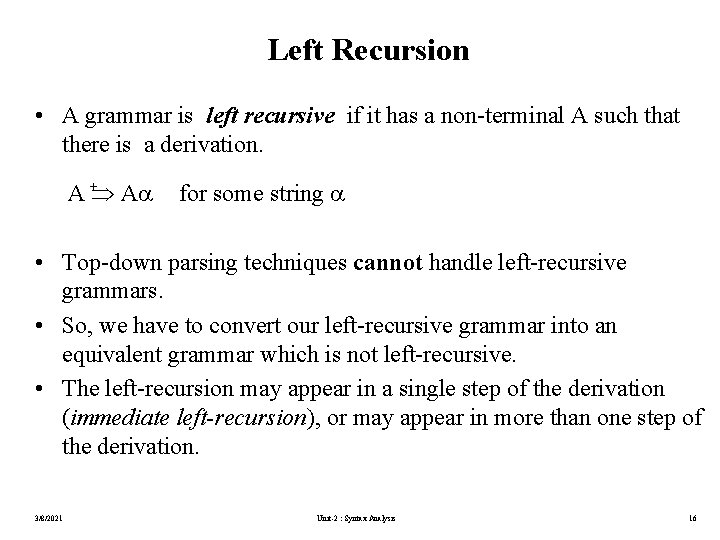
Left Recursion • A grammar is left recursive if it has a non-terminal A such that there is a derivation. A + A for some string • Top-down parsing techniques cannot handle left-recursive grammars. • So, we have to convert our left-recursive grammar into an equivalent grammar which is not left-recursive. • The left-recursion may appear in a single step of the derivation (immediate left-recursion), or may appear in more than one step of the derivation. 3/8/2021 Unit-2 : Syntax Analysis 16
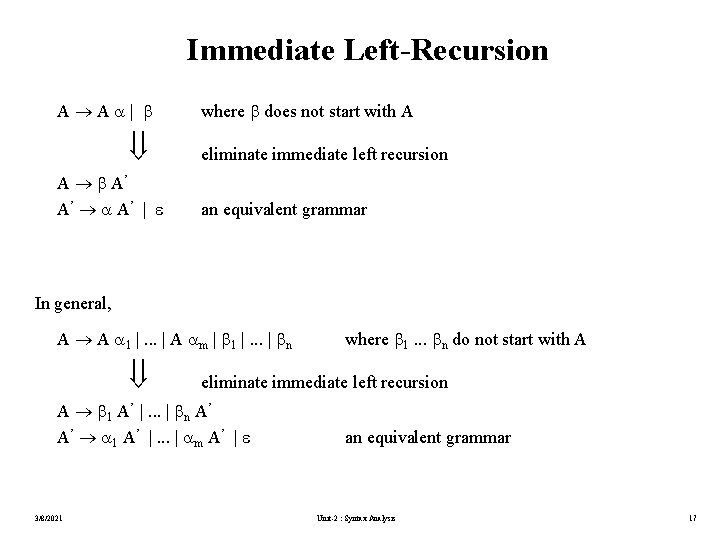
Immediate Left-Recursion A A | A A’ A’ A’ | where does not start with A eliminate immediate left recursion an equivalent grammar In general, A A 1 |. . . | A m | 1 |. . . | n eliminate immediate left recursion A 1 A’ |. . . | n A’ A’ 1 A’ |. . . | m A’ | 3/8/2021 where 1. . . n do not start with A an equivalent grammar Unit-2 : Syntax Analysis 17
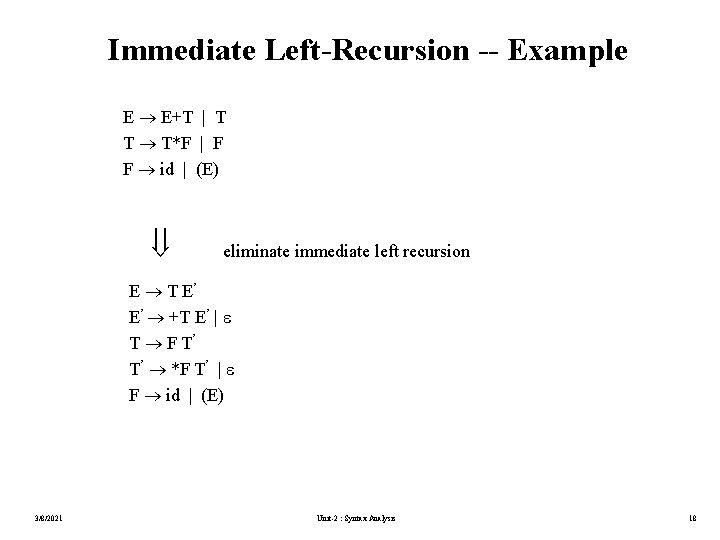
Immediate Left-Recursion -- Example E E+T | T T T*F | F F id | (E) eliminate immediate left recursion E T E’ E’ +T E’ | T F T’ T’ *F T’ | F id | (E) 3/8/2021 Unit-2 : Syntax Analysis 18
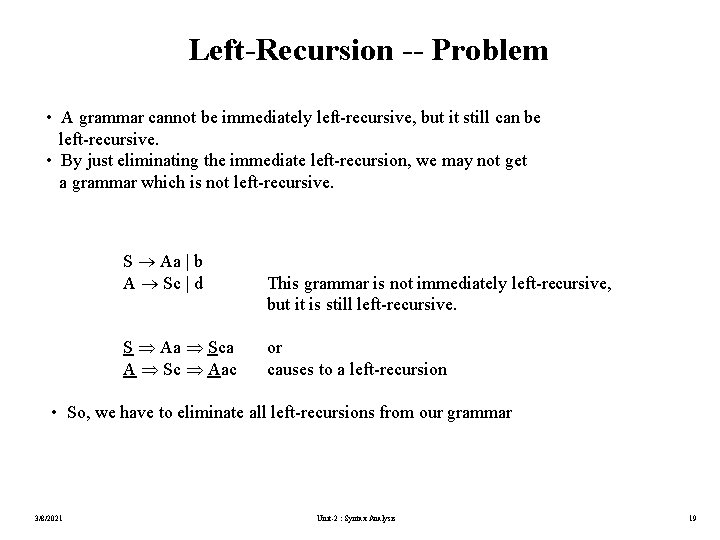
Left-Recursion -- Problem • A grammar cannot be immediately left-recursive, but it still can be left-recursive. • By just eliminating the immediate left-recursion, we may not get a grammar which is not left-recursive. S Aa | b A Sc | d S Aa Sca A Sc Aac This grammar is not immediately left-recursive, but it is still left-recursive. or causes to a left-recursion • So, we have to eliminate all left-recursions from our grammar 3/8/2021 Unit-2 : Syntax Analysis 19
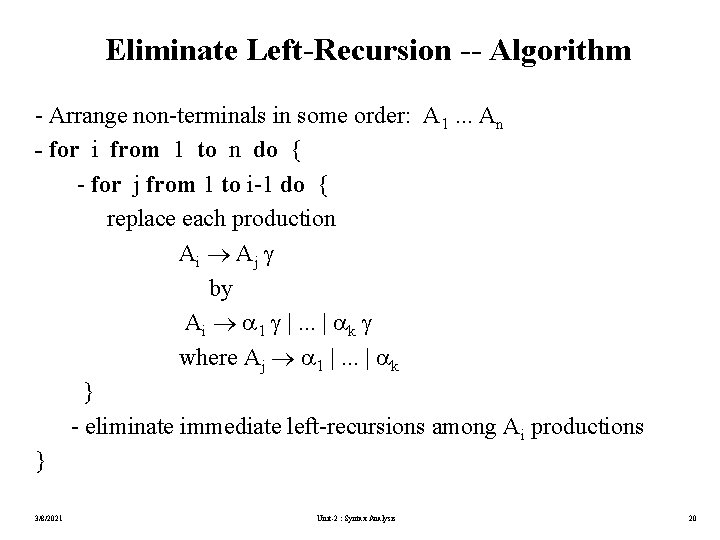
Eliminate Left-Recursion -- Algorithm - Arrange non-terminals in some order: A 1. . . An - for i from 1 to n do { - for j from 1 to i-1 do { replace each production Ai Aj by Ai 1 |. . . | k where Aj 1 |. . . | k } - eliminate immediate left-recursions among Ai productions } 3/8/2021 Unit-2 : Syntax Analysis 20
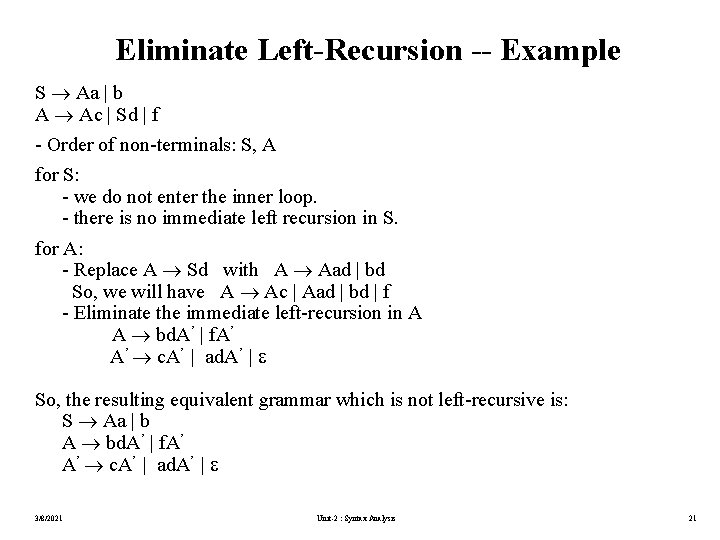
Eliminate Left-Recursion -- Example S Aa | b A Ac | Sd | f - Order of non-terminals: S, A for S: - we do not enter the inner loop. - there is no immediate left recursion in S. for A: - Replace A Sd with A Aad | bd So, we will have A Ac | Aad | bd | f - Eliminate the immediate left-recursion in A A bd. A’ | f. A’ A’ c. A’ | ad. A’ | So, the resulting equivalent grammar which is not left-recursive is: S Aa | b A bd. A’ | f. A’ A’ c. A’ | ad. A’ | 3/8/2021 Unit-2 : Syntax Analysis 21
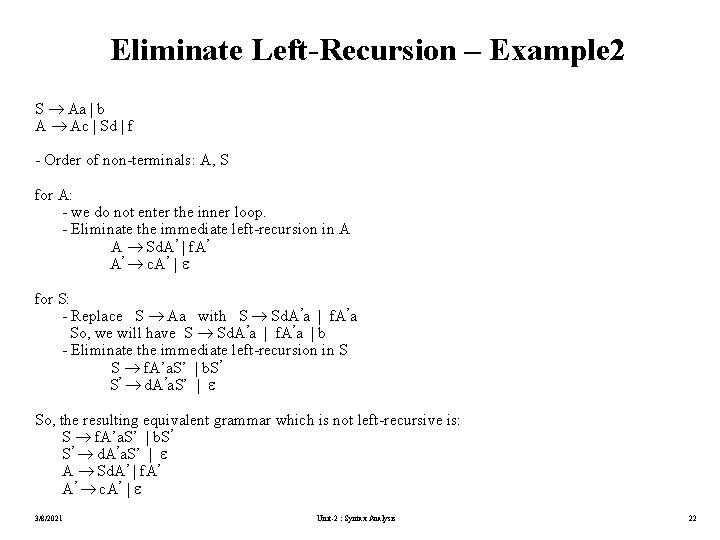
Eliminate Left-Recursion – Example 2 S Aa | b A Ac | Sd | f - Order of non-terminals: A, S for A: - we do not enter the inner loop. - Eliminate the immediate left-recursion in A A Sd. A’ | f. A’ A’ c. A’ | for S: - Replace S Aa with S Sd. A’a | f. A’a So, we will have S Sd. A’a | f. A’a | b - Eliminate the immediate left-recursion in S S f. A’a. S’ | b. S’ S’ d. A’a. S’ | So, the resulting equivalent grammar which is not left-recursive is: S f. A’a. S’ | b. S’ S’ d. A’a. S’ | A Sd. A’ | f. A’ A’ c. A’ | 3/8/2021 Unit-2 : Syntax Analysis 22
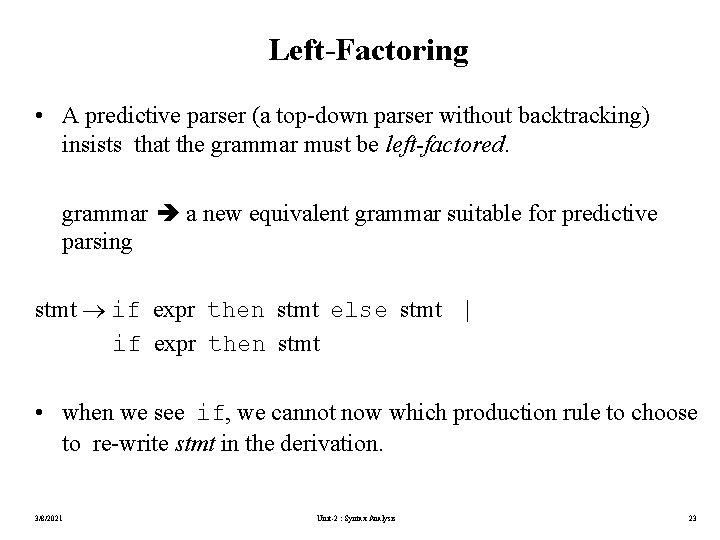
Left-Factoring • A predictive parser (a top-down parser without backtracking) insists that the grammar must be left-factored. grammar a new equivalent grammar suitable for predictive parsing stmt if expr then stmt else stmt if expr then stmt | • when we see if, we cannot now which production rule to choose to re-write stmt in the derivation. 3/8/2021 Unit-2 : Syntax Analysis 23
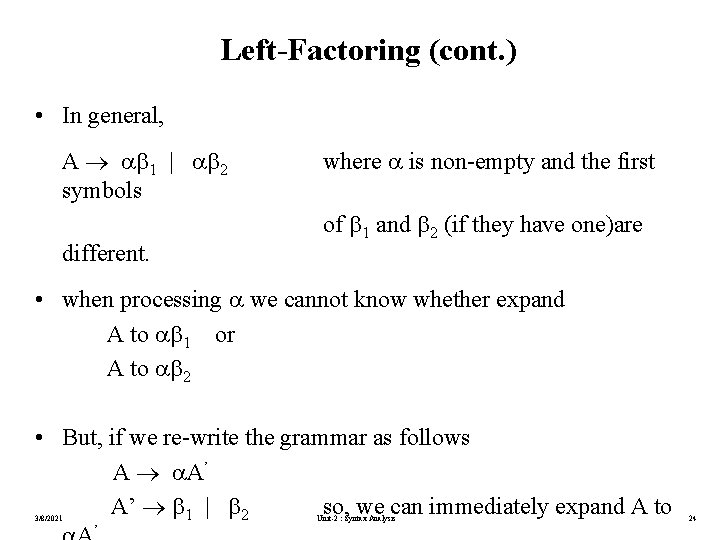
Left-Factoring (cont. ) • In general, A 1 | 2 symbols different. where is non-empty and the first of 1 and 2 (if they have one)are • when processing we cannot know whether expand A to 1 or A to 2 • But, if we re-write the grammar as follows A A’ A’ 1 | 2 so, we can immediately expand A to 3/8/2021 ’ Unit-2 : Syntax Analysis 24
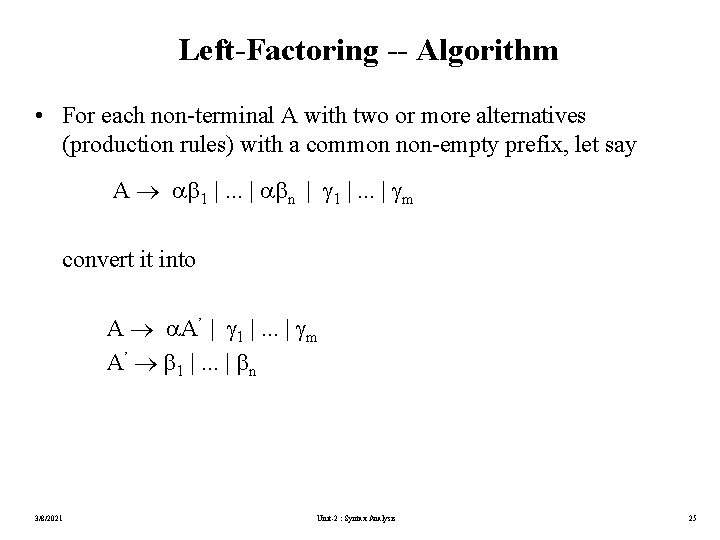
Left-Factoring -- Algorithm • For each non-terminal A with two or more alternatives (production rules) with a common non-empty prefix, let say A 1 |. . . | n | 1 |. . . | m convert it into A A’ | 1 |. . . | m A’ 1 |. . . | n 3/8/2021 Unit-2 : Syntax Analysis 25
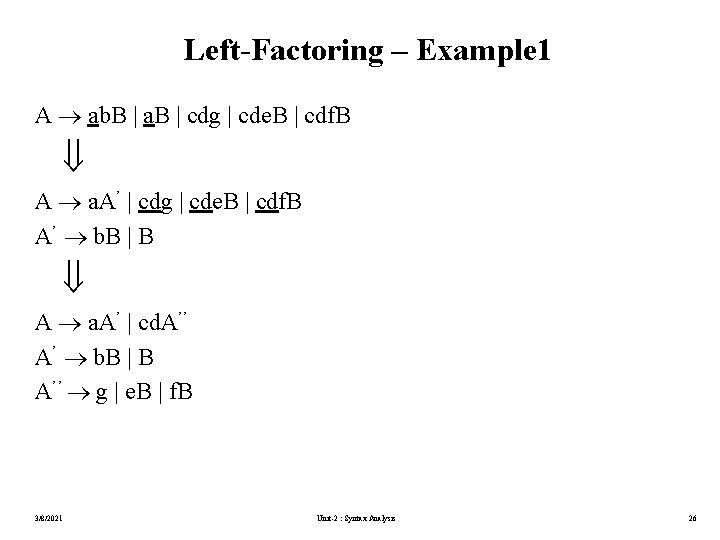
Left-Factoring – Example 1 A ab. B | a. B | cdg | cde. B | cdf. B A a. A’ | cdg | cde. B | cdf. B A’ b. B | B A a. A’ | cd. A’’ A’ b. B | B A’’ g | e. B | f. B 3/8/2021 Unit-2 : Syntax Analysis 26
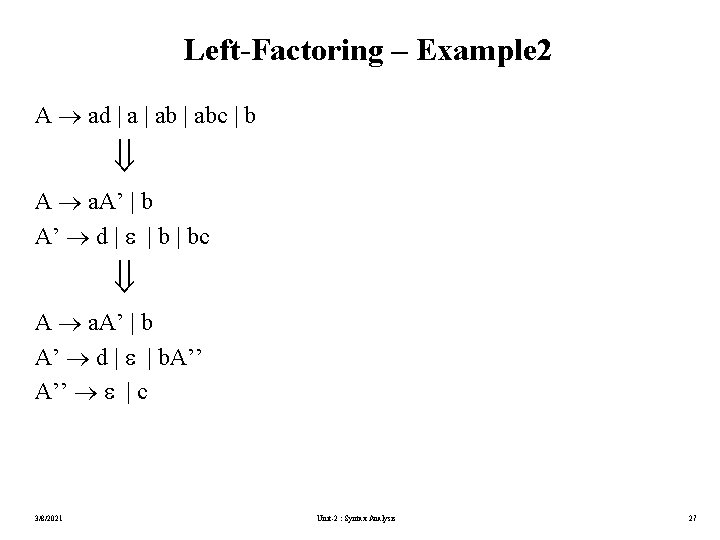
Left-Factoring – Example 2 A ad | abc | b A a. A’ | b A’ d | | bc A a. A’ | b A’ d | | b. A’’ | c 3/8/2021 Unit-2 : Syntax Analysis 27
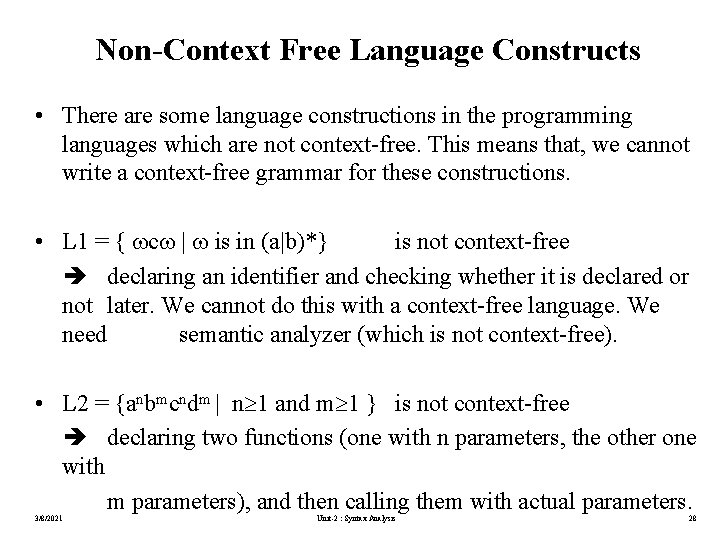
Non-Context Free Language Constructs • There are some language constructions in the programming languages which are not context-free. This means that, we cannot write a context-free grammar for these constructions. • L 1 = { c | is in (a|b)*} is not context-free declaring an identifier and checking whether it is declared or not later. We cannot do this with a context-free language. We need semantic analyzer (which is not context-free). • L 2 = {anbmcndm | n 1 and m 1 } is not context-free declaring two functions (one with n parameters, the other one with m parameters), and then calling them with actual parameters. 3/8/2021 Unit-2 : Syntax Analysis 28
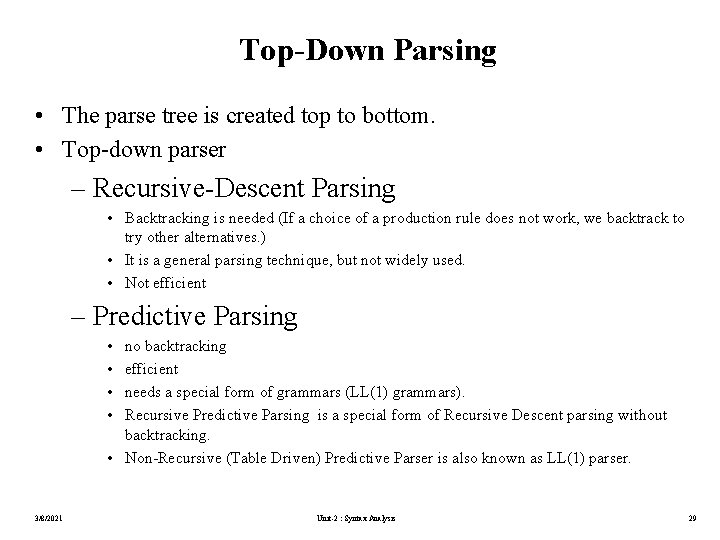
Top-Down Parsing • The parse tree is created top to bottom. • Top-down parser – Recursive-Descent Parsing • Backtracking is needed (If a choice of a production rule does not work, we backtrack to try other alternatives. ) • It is a general parsing technique, but not widely used. • Not efficient – Predictive Parsing • • no backtracking efficient needs a special form of grammars (LL(1) grammars). Recursive Predictive Parsing is a special form of Recursive Descent parsing without backtracking. • Non-Recursive (Table Driven) Predictive Parser is also known as LL(1) parser. 3/8/2021 Unit-2 : Syntax Analysis 29
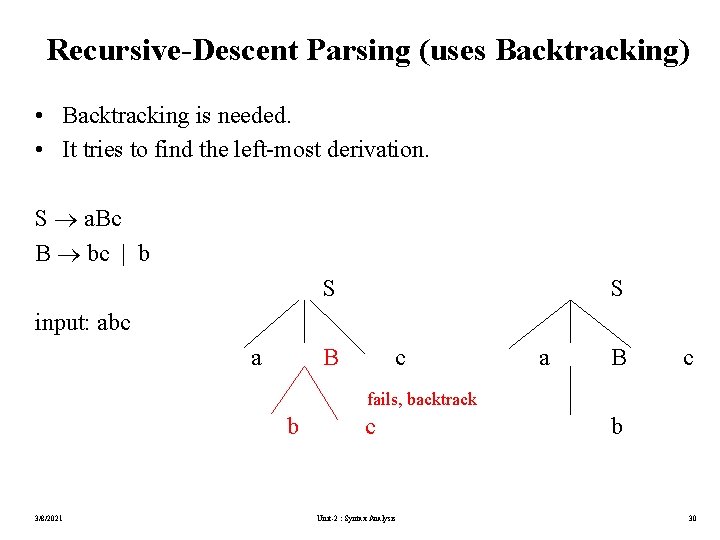
Recursive-Descent Parsing (uses Backtracking) • Backtracking is needed. • It tries to find the left-most derivation. S a. Bc B bc | b S S input: abc a B c fails, backtrack b 3/8/2021 c Unit-2 : Syntax Analysis b 30
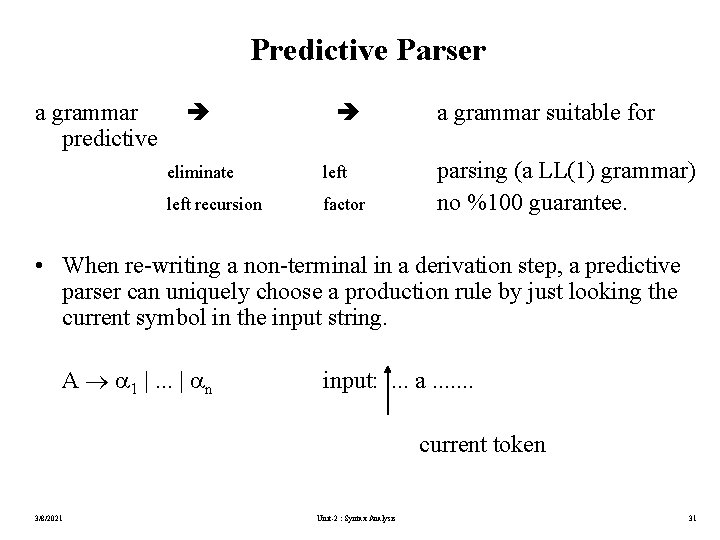
Predictive Parser a grammar predictive eliminate left recursion factor a grammar suitable for parsing (a LL(1) grammar) no %100 guarantee. • When re-writing a non-terminal in a derivation step, a predictive parser can uniquely choose a production rule by just looking the current symbol in the input string. A 1 |. . . | n input: . . . a. . . . current token 3/8/2021 Unit-2 : Syntax Analysis 31
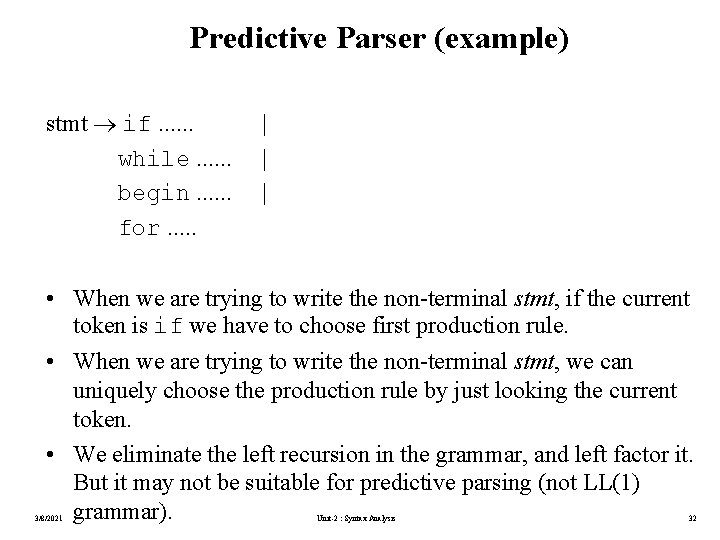
Predictive Parser (example) stmt if. . . while. . . begin. . . for. . . | | | • When we are trying to write the non-terminal stmt, if the current token is if we have to choose first production rule. • When we are trying to write the non-terminal stmt, we can uniquely choose the production rule by just looking the current token. • We eliminate the left recursion in the grammar, and left factor it. But it may not be suitable for predictive parsing (not LL(1) grammar). 3/8/2021 Unit-2 : Syntax Analysis 32
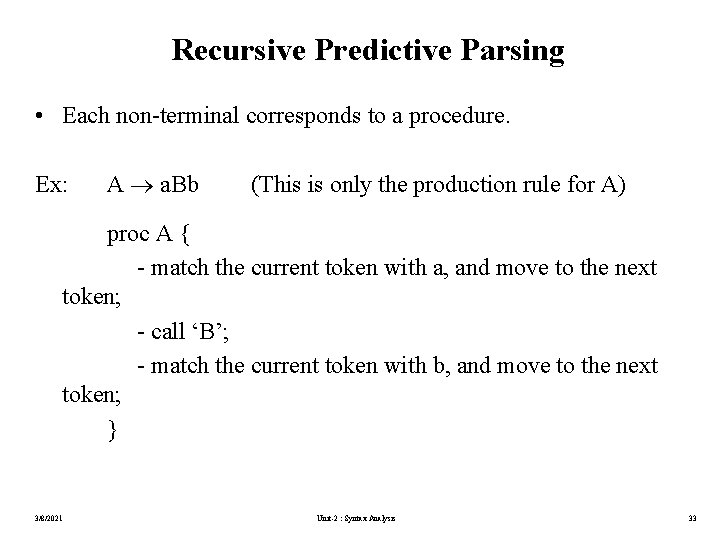
Recursive Predictive Parsing • Each non-terminal corresponds to a procedure. Ex: A a. Bb (This is only the production rule for A) proc A { - match the current token with a, and move to the next token; - call ‘B’; - match the current token with b, and move to the next token; } 3/8/2021 Unit-2 : Syntax Analysis 33
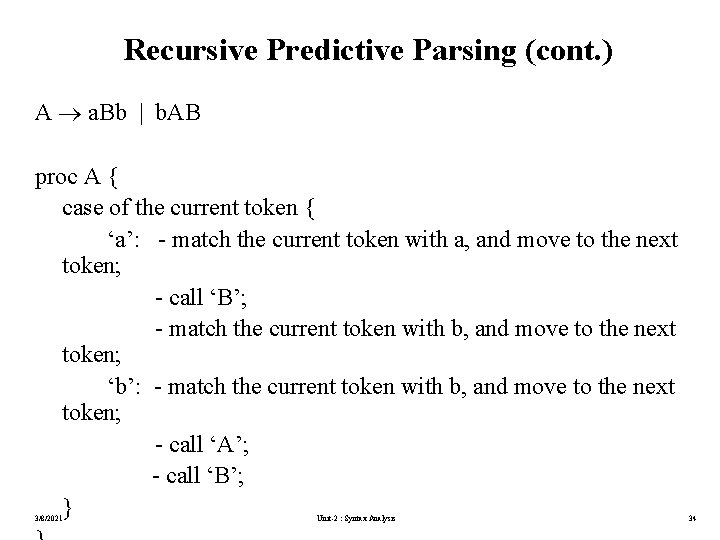
Recursive Predictive Parsing (cont. ) A a. Bb | b. AB proc A { case of the current token { ‘a’: - match the current token with a, and move to the next token; - call ‘B’; - match the current token with b, and move to the next token; ‘b’: - match the current token with b, and move to the next token; - call ‘A’; - call ‘B’; } 3/8/2021 Unit-2 : Syntax Analysis 34
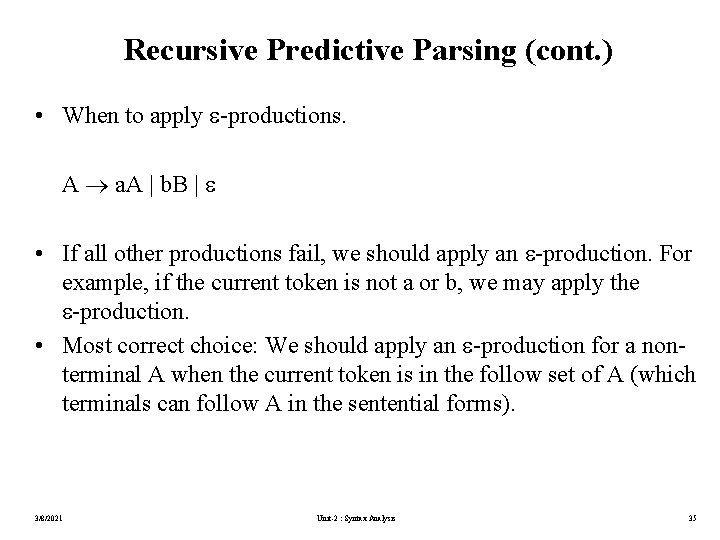
Recursive Predictive Parsing (cont. ) • When to apply -productions. A a. A | b. B | • If all other productions fail, we should apply an -production. For example, if the current token is not a or b, we may apply the -production. • Most correct choice: We should apply an -production for a nonterminal A when the current token is in the follow set of A (which terminals can follow A in the sentential forms). 3/8/2021 Unit-2 : Syntax Analysis 35
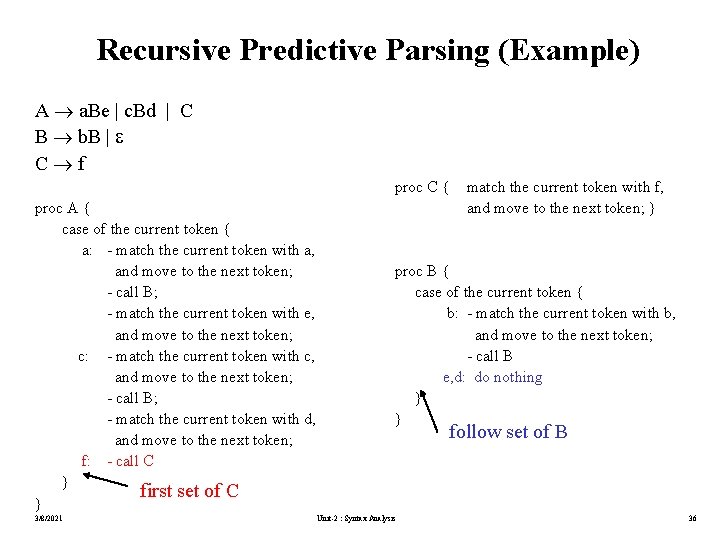
Recursive Predictive Parsing (Example) A a. Be | c. Bd | C B b. B | C f proc C { proc A { case of the current token { a: - match the current token with a, and move to the next token; - call B; - match the current token with e, and move to the next token; c: - match the current token with c, and move to the next token; - call B; - match the current token with d, and move to the next token; f: - call C } first set of C } 3/8/2021 match the current token with f, and move to the next token; } proc B { case of the current token { b: - match the current token with b, and move to the next token; - call B e, d: do nothing } } follow set of B Unit-2 : Syntax Analysis 36
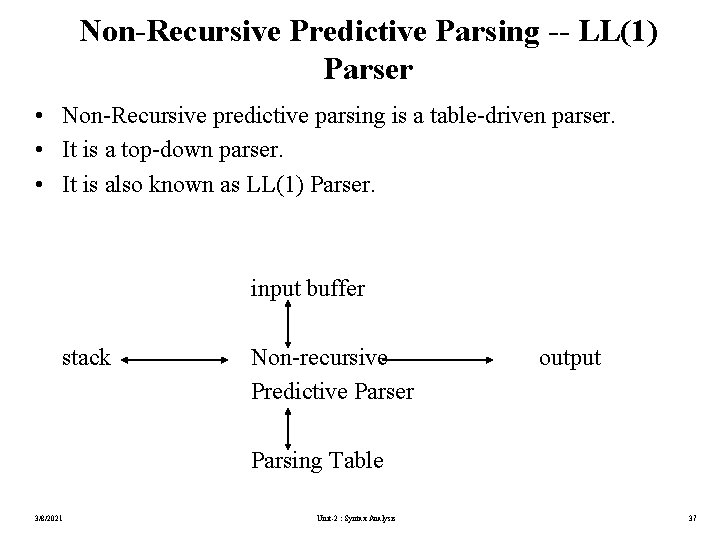
Non-Recursive Predictive Parsing -- LL(1) Parser • Non-Recursive predictive parsing is a table-driven parser. • It is a top-down parser. • It is also known as LL(1) Parser. input buffer stack Non-recursive Predictive Parser output Parsing Table 3/8/2021 Unit-2 : Syntax Analysis 37
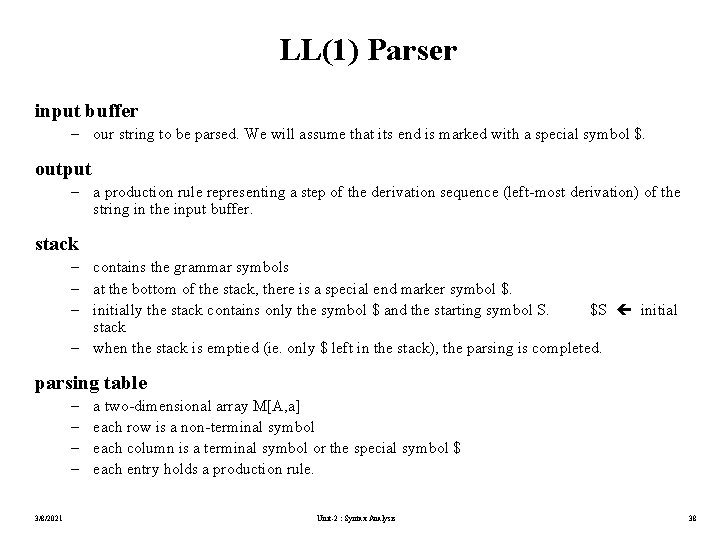
LL(1) Parser input buffer – our string to be parsed. We will assume that its end is marked with a special symbol $. output – a production rule representing a step of the derivation sequence (left-most derivation) of the string in the input buffer. stack – contains the grammar symbols – at the bottom of the stack, there is a special end marker symbol $. – initially the stack contains only the symbol $ and the starting symbol S. $S initial stack – when the stack is emptied (ie. only $ left in the stack), the parsing is completed. parsing table – – 3/8/2021 a two-dimensional array M[A, a] each row is a non-terminal symbol each column is a terminal symbol or the special symbol $ each entry holds a production rule. Unit-2 : Syntax Analysis 38
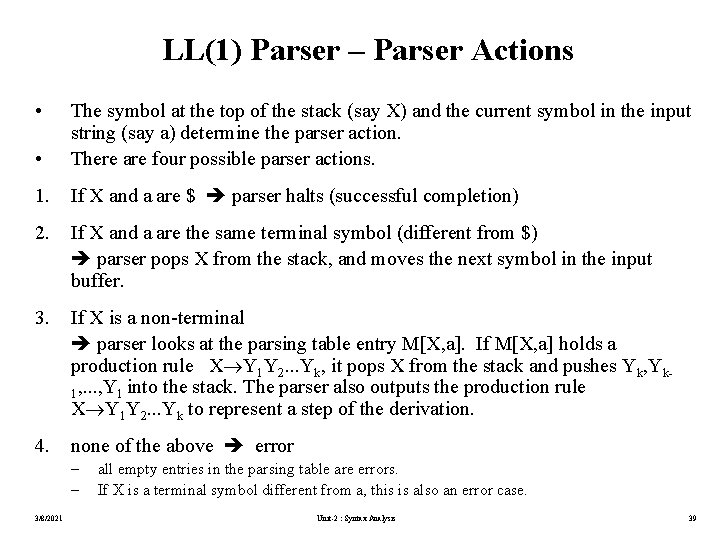
LL(1) Parser – Parser Actions • • The symbol at the top of the stack (say X) and the current symbol in the input string (say a) determine the parser action. There are four possible parser actions. 1. If X and a are $ parser halts (successful completion) 2. If X and a are the same terminal symbol (different from $) parser pops X from the stack, and moves the next symbol in the input buffer. 3. If X is a non-terminal parser looks at the parsing table entry M[X, a]. If M[X, a] holds a production rule X Y 1 Y 2. . . Yk, it pops X from the stack and pushes Yk, Yk 1, . . . , Y 1 into the stack. The parser also outputs the production rule X Y 1 Y 2. . . Yk to represent a step of the derivation. 4. none of the above error – – 3/8/2021 all empty entries in the parsing table are errors. If X is a terminal symbol different from a, this is also an error case. Unit-2 : Syntax Analysis 39
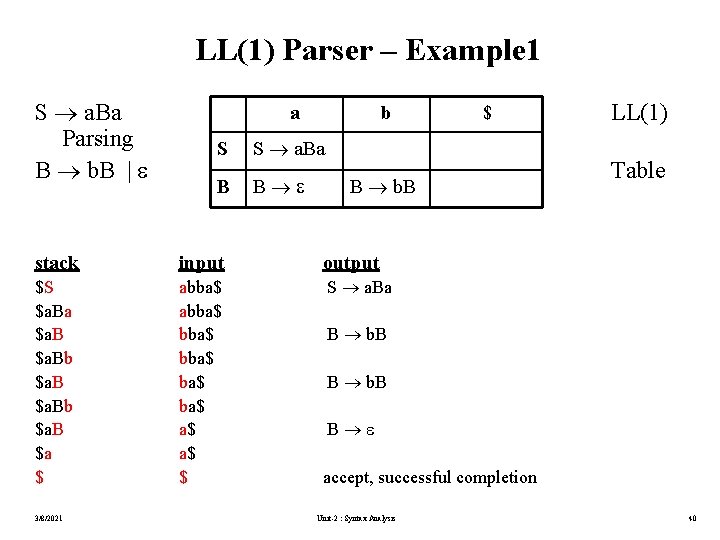
LL(1) Parser – Example 1 S a. Ba Parsing B b. B | a b S S a. Ba B B B b. B stack input output $S $a. Ba $a. Bb $a. B $a $ abba$ ba$ a$ a$ $ S a. Ba 3/8/2021 $ LL(1) Table B b. B B accept, successful completion Unit-2 : Syntax Analysis 40
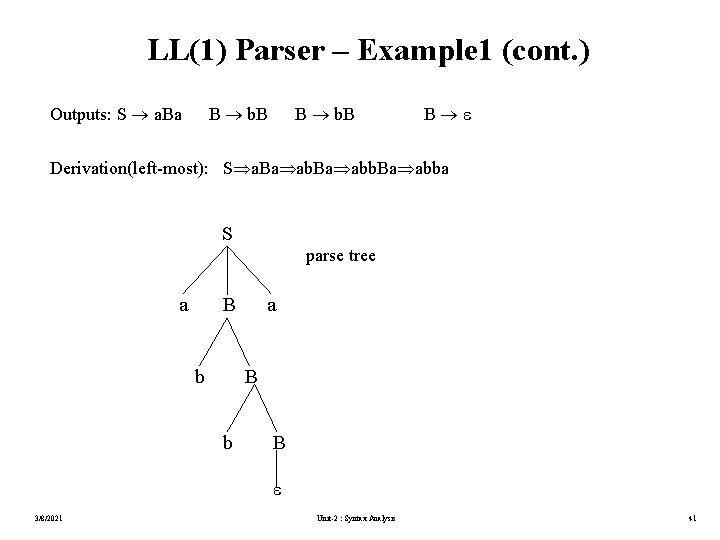
LL(1) Parser – Example 1 (cont. ) Outputs: S a. Ba B b. B B Derivation(left-most): S a. Ba abba S parse tree a B b B 3/8/2021 Unit-2 : Syntax Analysis 41
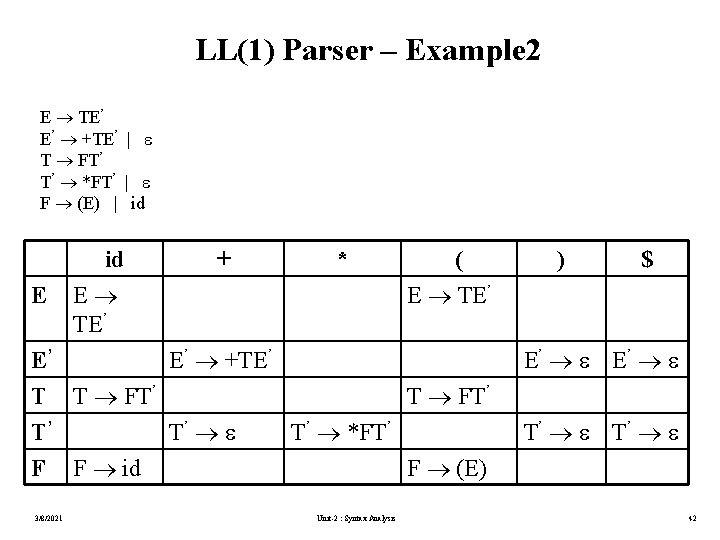
LL(1) Parser – Example 2 E TE’ E’ +TE’ | T FT’ T’ *FT’ | F (E) | id E TE’ + * ( E TE’ E’ E’ +TE’ T T FT’ T’ *FT’ F F id F (E) 3/8/2021 Unit-2 : Syntax Analysis ) $ E’ E’ T’ T’ 42
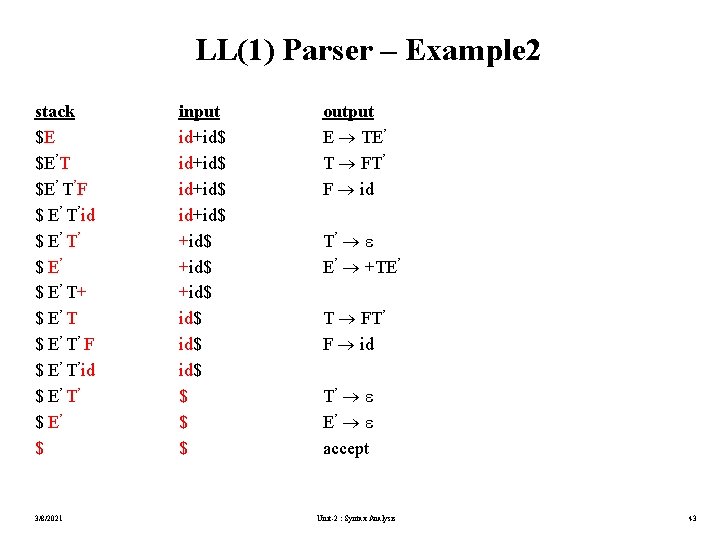
LL(1) Parser – Example 2 stack $E $E’T $E’ T’F $ E’ T’id $ E’ T’ $ E’ T+ $ E’ T’ F $ E’ T’id $ E’ T’ $ E’ $ 3/8/2021 input id+id$ +id$ id$ $ $ $ output E TE’ T FT’ F id T’ E’ +TE’ T FT’ F id T’ E’ accept Unit-2 : Syntax Analysis 43
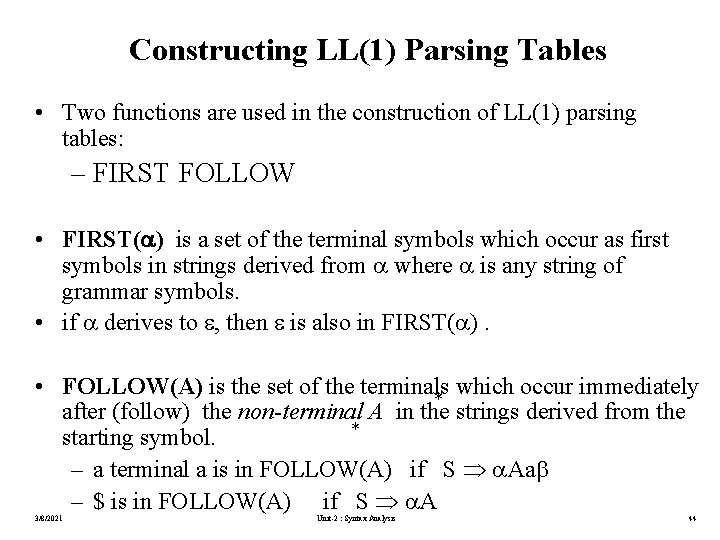
Constructing LL(1) Parsing Tables • Two functions are used in the construction of LL(1) parsing tables: – FIRST FOLLOW • FIRST( ) is a set of the terminal symbols which occur as first symbols in strings derived from where is any string of grammar symbols. • if derives to , then is also in FIRST( ). • FOLLOW(A) is the set of the terminals which occur immediately * after (follow) the non-terminal A in the strings derived from the * starting symbol. – a terminal a is in FOLLOW(A) if S Aa – $ is in FOLLOW(A) if S A 3/8/2021 Unit-2 : Syntax Analysis 44
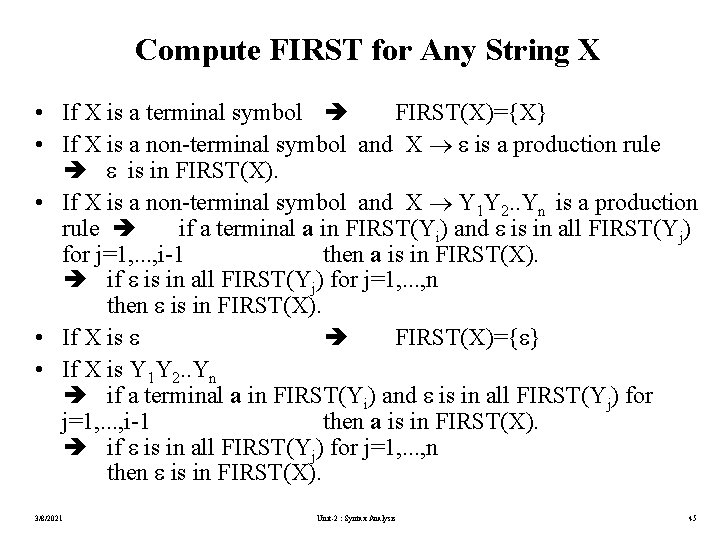
Compute FIRST for Any String X • If X is a terminal symbol FIRST(X)={X} • If X is a non-terminal symbol and X is a production rule is in FIRST(X). • If X is a non-terminal symbol and X Y 1 Y 2. . Yn is a production rule if a terminal a in FIRST(Yi) and is in all FIRST(Yj) for j=1, . . . , i-1 then a is in FIRST(X). if is in all FIRST(Yj) for j=1, . . . , n then is in FIRST(X). • If X is FIRST(X)={ } • If X is Y 1 Y 2. . Yn if a terminal a in FIRST(Yi) and is in all FIRST(Yj) for j=1, . . . , i-1 then a is in FIRST(X). if is in all FIRST(Yj) for j=1, . . . , n then is in FIRST(X). 3/8/2021 Unit-2 : Syntax Analysis 45
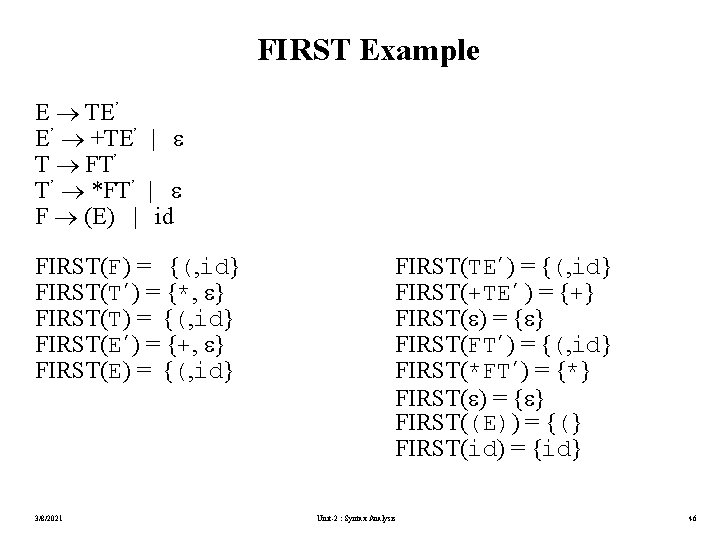
FIRST Example E TE’ E’ +TE’ | T FT’ T’ *FT’ | F (E) | id FIRST(F) = {(, id} FIRST(T’) = {*, } FIRST(T) = {(, id} FIRST(E’) = {+, } FIRST(E) = {(, id} 3/8/2021 FIRST(TE’) = {(, id} FIRST(+TE’ ) = {+} FIRST( ) = { } FIRST(FT’) = {(, id} FIRST(*FT’) = {*} FIRST( ) = { } FIRST((E)) = {(} FIRST(id) = {id} Unit-2 : Syntax Analysis 46
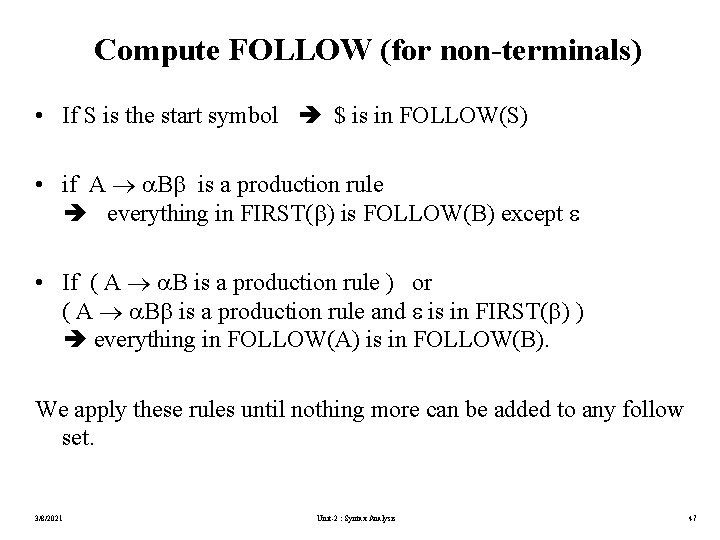
Compute FOLLOW (for non-terminals) • If S is the start symbol $ is in FOLLOW(S) • if A B is a production rule everything in FIRST( ) is FOLLOW(B) except • If ( A B is a production rule ) or ( A B is a production rule and is in FIRST( ) ) everything in FOLLOW(A) is in FOLLOW(B). We apply these rules until nothing more can be added to any follow set. 3/8/2021 Unit-2 : Syntax Analysis 47
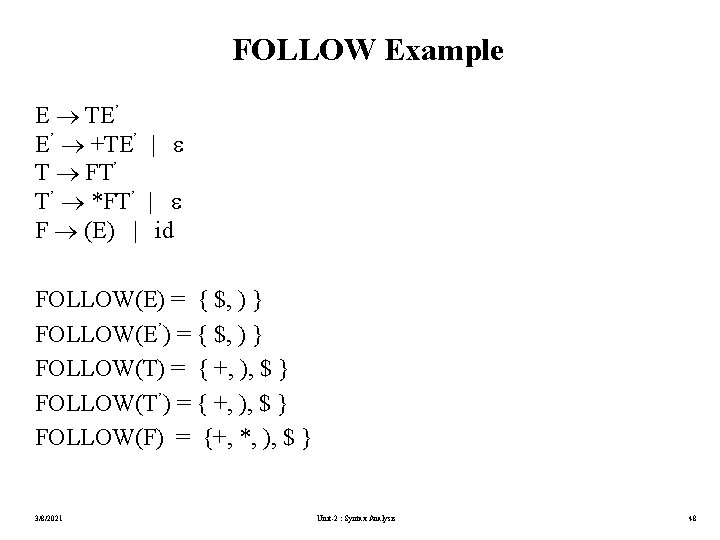
FOLLOW Example E TE’ E’ +TE’ | T FT’ T’ *FT’ | F (E) | id FOLLOW(E) = { $, ) } FOLLOW(E’) = { $, ) } FOLLOW(T) = { +, ), $ } FOLLOW(T’) = { +, ), $ } FOLLOW(F) = {+, *, ), $ } 3/8/2021 Unit-2 : Syntax Analysis 48
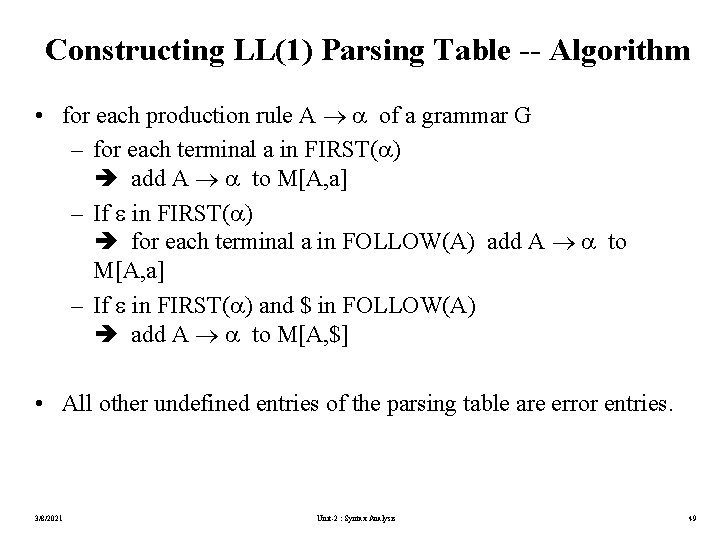
Constructing LL(1) Parsing Table -- Algorithm • for each production rule A of a grammar G – for each terminal a in FIRST( ) add A to M[A, a] – If in FIRST( ) for each terminal a in FOLLOW(A) add A to M[A, a] – If in FIRST( ) and $ in FOLLOW(A) add A to M[A, $] • All other undefined entries of the parsing table are error entries. 3/8/2021 Unit-2 : Syntax Analysis 49
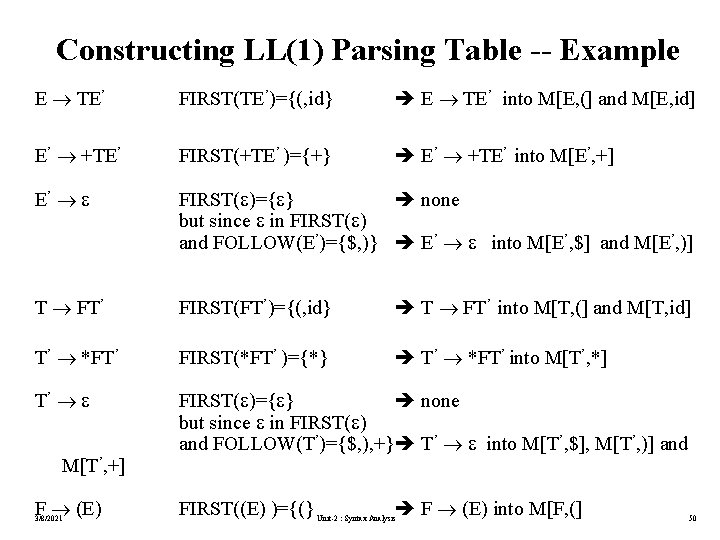
Constructing LL(1) Parsing Table -- Example E TE’ FIRST(TE’)={(, id} E TE’ into M[E, (] and M[E, id] E’ +TE’ FIRST(+TE’ )={+} E’ +TE’ into M[E’, +] E’ FIRST( )={ } none but since in FIRST( ) and FOLLOW(E’)={$, )} E’ into M[E’, $] and M[E’, )] T FT’ FIRST(FT’)={(, id} T FT’ into M[T, (] and M[T, id] T’ *FT’ FIRST(*FT’ )={*} T’ *FT’ into M[T’, *] T’ FIRST( )={ } none but since in FIRST( ) and FOLLOW(T’)={$, ), +} T’ into M[T’, $], M[T’, )] and M[T’, +] F (E) 3/8/2021 FIRST((E) )={(} F (E) into M[F, (] Unit-2 : Syntax Analysis 50
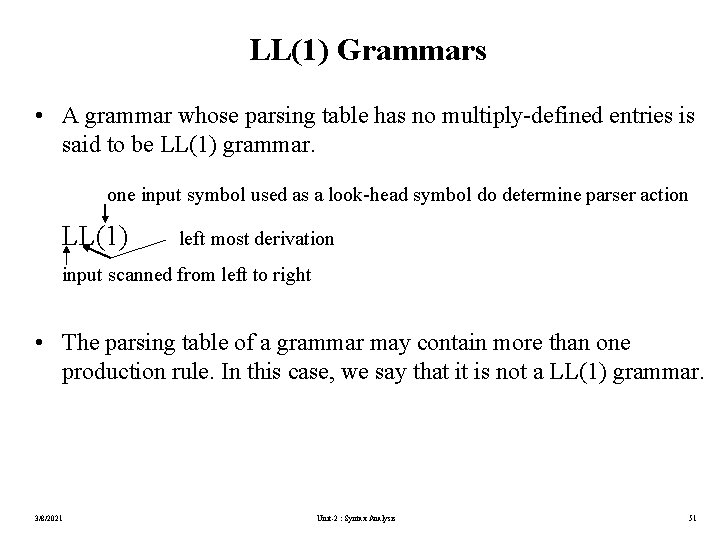
LL(1) Grammars • A grammar whose parsing table has no multiply-defined entries is said to be LL(1) grammar. one input symbol used as a look-head symbol do determine parser action LL(1) left most derivation input scanned from left to right • The parsing table of a grammar may contain more than one production rule. In this case, we say that it is not a LL(1) grammar. 3/8/2021 Unit-2 : Syntax Analysis 51
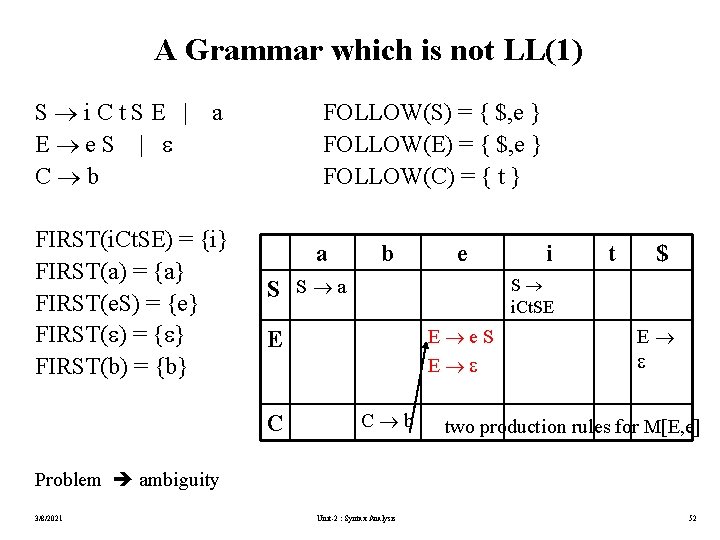
A Grammar which is not LL(1) S i. Ct. SE | E e. S | C b a FIRST(i. Ct. SE) = {i} FIRST(a) = {a} FIRST(e. S) = {e} FIRST( ) = { } FIRST(b) = {b} FOLLOW(S) = { $, e } FOLLOW(E) = { $, e } FOLLOW(C) = { t } a b e S S a t $ S i. Ct. SE E e. S E E C i C b E two production rules for M[E, e] Problem ambiguity 3/8/2021 Unit-2 : Syntax Analysis 52
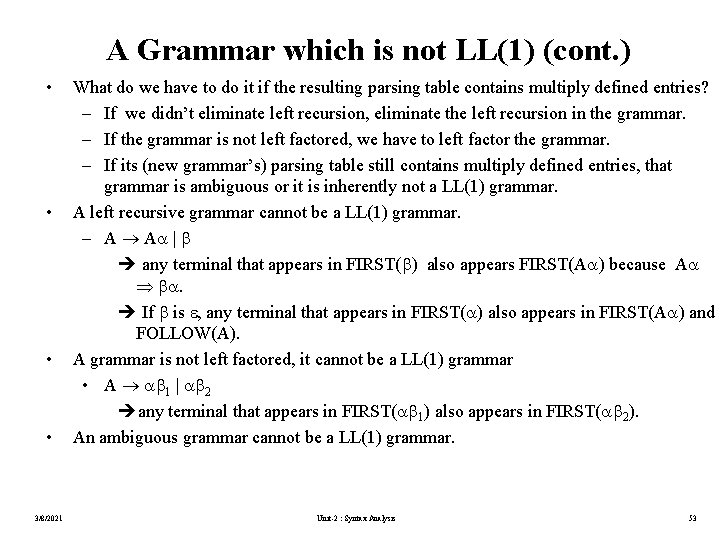
A Grammar which is not LL(1) (cont. ) • • 3/8/2021 What do we have to do it if the resulting parsing table contains multiply defined entries? – If we didn’t eliminate left recursion, eliminate the left recursion in the grammar. – If the grammar is not left factored, we have to left factor the grammar. – If its (new grammar’s) parsing table still contains multiply defined entries, that grammar is ambiguous or it is inherently not a LL(1) grammar. A left recursive grammar cannot be a LL(1) grammar. – A A | any terminal that appears in FIRST( ) also appears FIRST(A ) because A . If is , any terminal that appears in FIRST( ) also appears in FIRST(A ) and FOLLOW(A). A grammar is not left factored, it cannot be a LL(1) grammar • A 1 | 2 any terminal that appears in FIRST( 1) also appears in FIRST( 2). An ambiguous grammar cannot be a LL(1) grammar. Unit-2 : Syntax Analysis 53
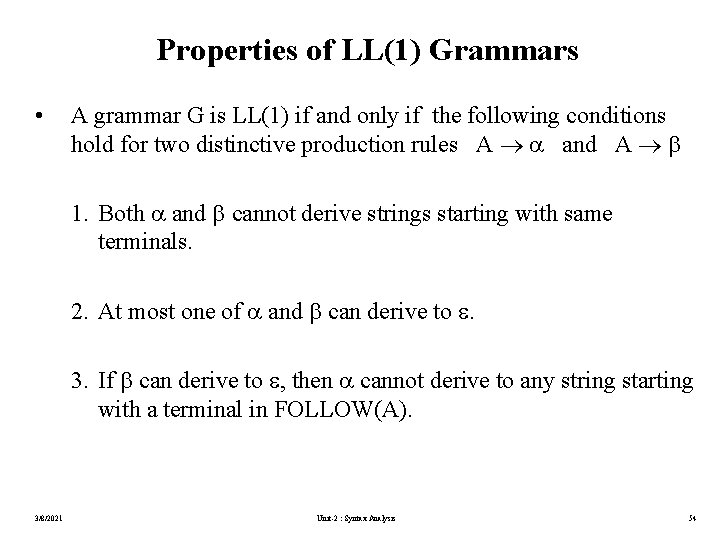
Properties of LL(1) Grammars • A grammar G is LL(1) if and only if the following conditions hold for two distinctive production rules A and A 1. Both and cannot derive strings starting with same terminals. 2. At most one of and can derive to . 3. If can derive to , then cannot derive to any string starting with a terminal in FOLLOW(A). 3/8/2021 Unit-2 : Syntax Analysis 54
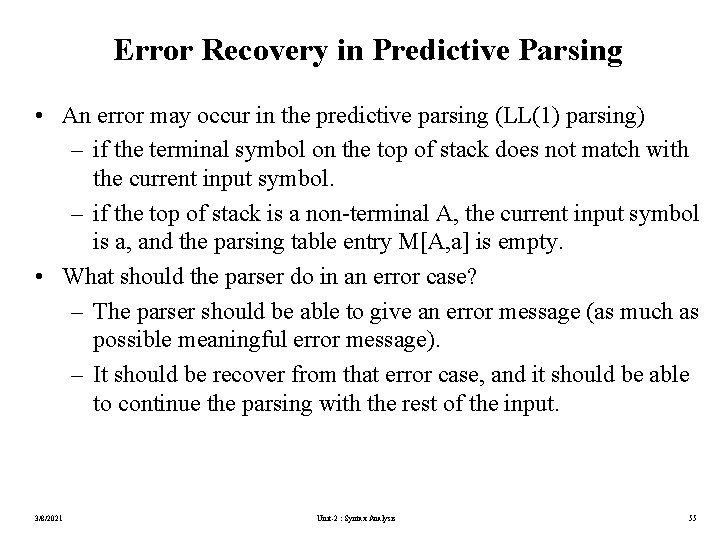
Error Recovery in Predictive Parsing • An error may occur in the predictive parsing (LL(1) parsing) – if the terminal symbol on the top of stack does not match with the current input symbol. – if the top of stack is a non-terminal A, the current input symbol is a, and the parsing table entry M[A, a] is empty. • What should the parser do in an error case? – The parser should be able to give an error message (as much as possible meaningful error message). – It should be recover from that error case, and it should be able to continue the parsing with the rest of the input. 3/8/2021 Unit-2 : Syntax Analysis 55
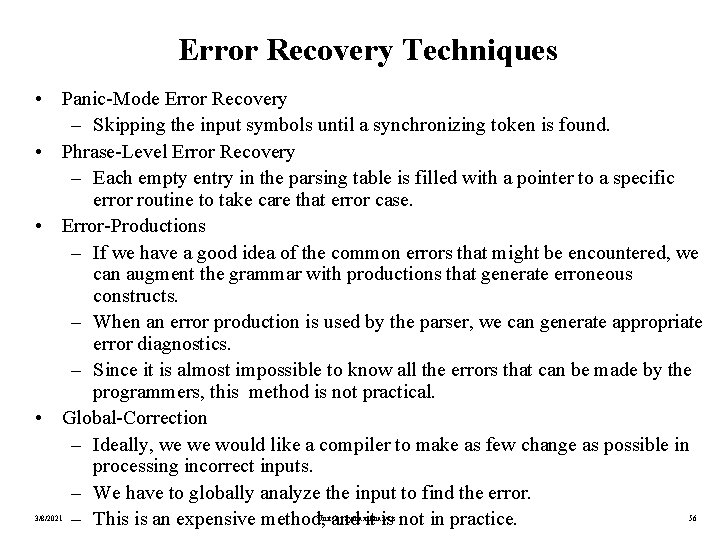
Error Recovery Techniques • Panic-Mode Error Recovery – Skipping the input symbols until a synchronizing token is found. • Phrase-Level Error Recovery – Each empty entry in the parsing table is filled with a pointer to a specific error routine to take care that error case. • Error-Productions – If we have a good idea of the common errors that might be encountered, we can augment the grammar with productions that generate erroneous constructs. – When an error production is used by the parser, we can generate appropriate error diagnostics. – Since it is almost impossible to know all the errors that can be made by the programmers, this method is not practical. • Global-Correction – Ideally, we we would like a compiler to make as few change as possible in processing incorrect inputs. – We have to globally analyze the input to find the error. – This is an expensive method, and it is not in practice. 3/8/2021 Unit-2 : Syntax Analysis 56
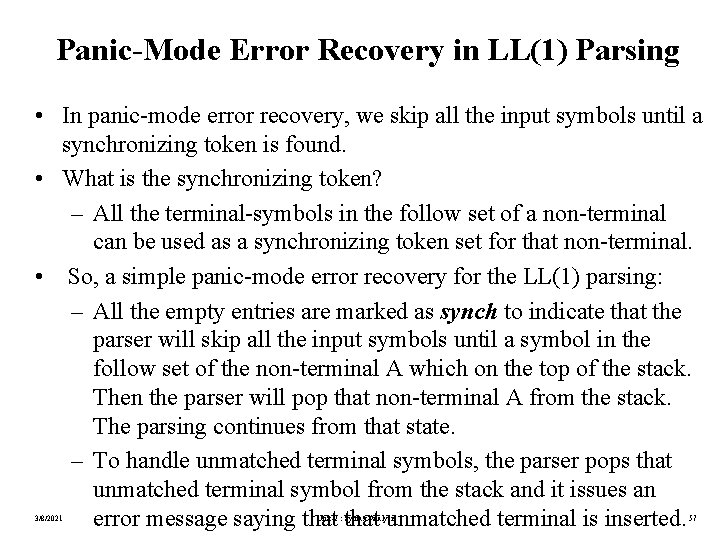
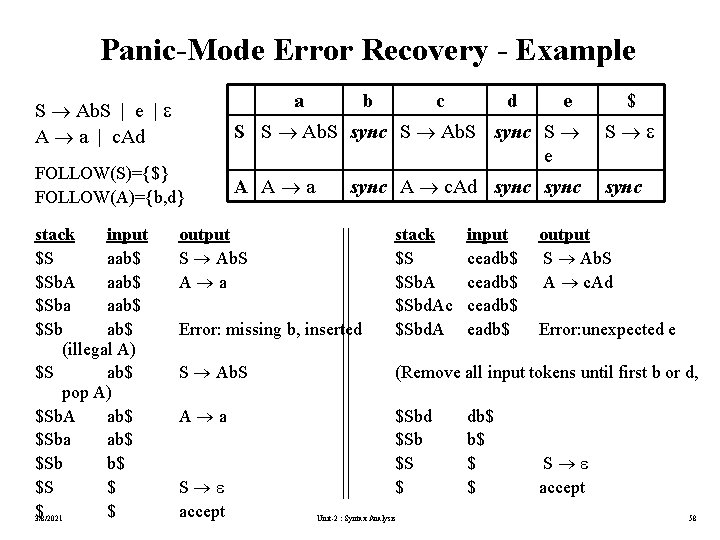
Panic-Mode Error Recovery in LL(1) Parsing • In panic-mode error recovery, we skip all the input symbols until a synchronizing token is found. • What is the synchronizing token? – All the terminal-symbols in the follow set of a non-terminal can be used as a synchronizing token set for that non-terminal. • So, a simple panic-mode error recovery for the LL(1) parsing: – All the empty entries are marked as synch to indicate that the parser will skip all the input symbols until a symbol in the follow set of the non-terminal A which on the top of the stack. Then the parser will pop that non-terminal A from the stack. The parsing continues from that state. – To handle unmatched terminal symbols, the parser pops that unmatched terminal symbol from the stack and it issues an error message saying that unmatched terminal is inserted. 3/8/2021 Unit-2 : Syntax Analysis 57
Panic-Mode Error Recovery - Example a S Ab. S | e | A a | c. Ad FOLLOW(S)={$} FOLLOW(A)={b, d} stack input $S aab$ $Sb. A aab$ $Sba aab$ $Sb ab$ (illegal A) $S ab$ pop A) $Sb. A ab$ $Sba ab$ $Sb b$ $S $ $ $ 3/8/2021 b c d e $ S S Ab. S sync S e S A A a sync A c. Ad sync output S Ab. S A a Error: missing b, inserted stack $S $Sb. A $Sbd. Ac $Sbd. A S Ab. S (Remove all input tokens until first b or d, A a $Sbd $Sb $S $ S accept Unit-2 : Syntax Analysis input ceadb$ db$ b$ $ $ output S Ab. S A c. Ad Error: unexpected e S accept 58
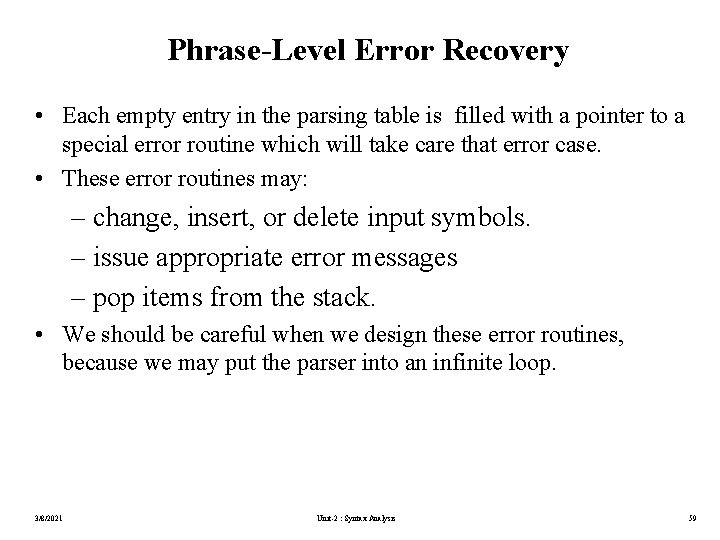
Phrase-Level Error Recovery • Each empty entry in the parsing table is filled with a pointer to a special error routine which will take care that error case. • These error routines may: – change, insert, or delete input symbols. – issue appropriate error messages – pop items from the stack. • We should be careful when we design these error routines, because we may put the parser into an infinite loop. 3/8/2021 Unit-2 : Syntax Analysis 59
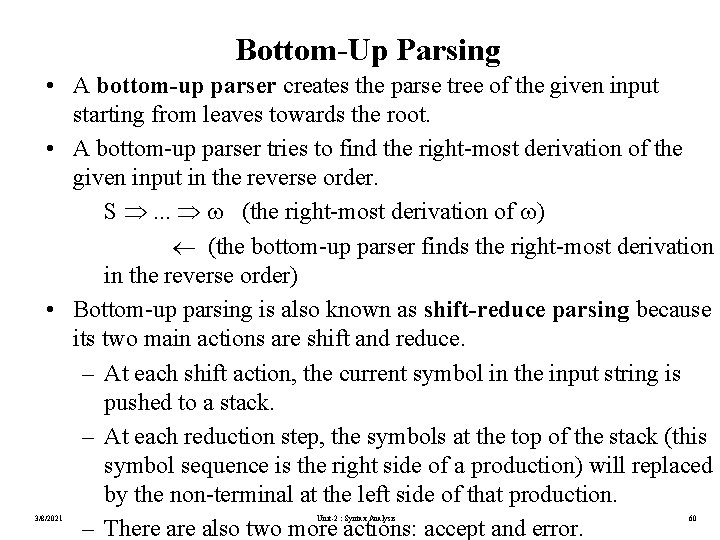
Bottom-Up Parsing • A bottom-up parser creates the parse tree of the given input starting from leaves towards the root. • A bottom-up parser tries to find the right-most derivation of the given input in the reverse order. S . . . (the right-most derivation of ) (the bottom-up parser finds the right-most derivation in the reverse order) • Bottom-up parsing is also known as shift-reduce parsing because its two main actions are shift and reduce. – At each shift action, the current symbol in the input string is pushed to a stack. – At each reduction step, the symbols at the top of the stack (this symbol sequence is the right side of a production) will replaced by the non-terminal at the left side of that production. – There also two more actions: accept and error. 3/8/2021 Unit-2 : Syntax Analysis 60
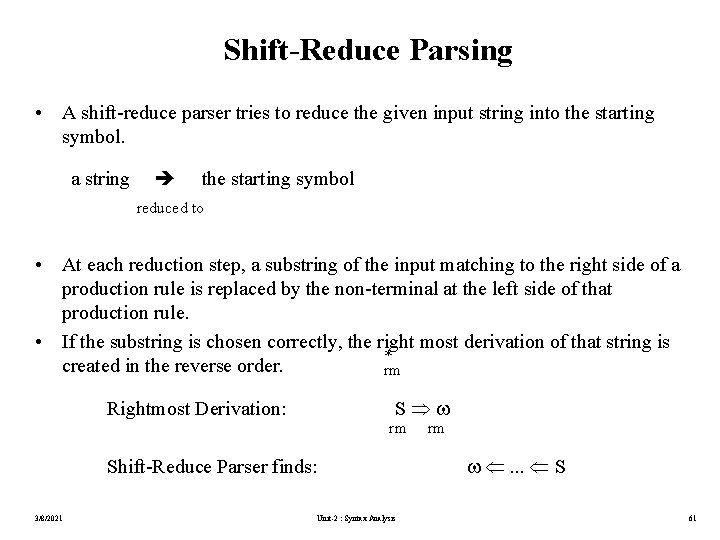
Shift-Reduce Parsing • A shift-reduce parser tries to reduce the given input string into the starting symbol. a string the starting symbol reduced to • At each reduction step, a substring of the input matching to the right side of a production rule is replaced by the non-terminal at the left side of that production rule. • If the substring is chosen correctly, the right most derivation of that string is * created in the reverse order. rm S Rightmost Derivation: rm Shift-Reduce Parser finds: 3/8/2021 Unit-2 : Syntax Analysis rm . . . S 61
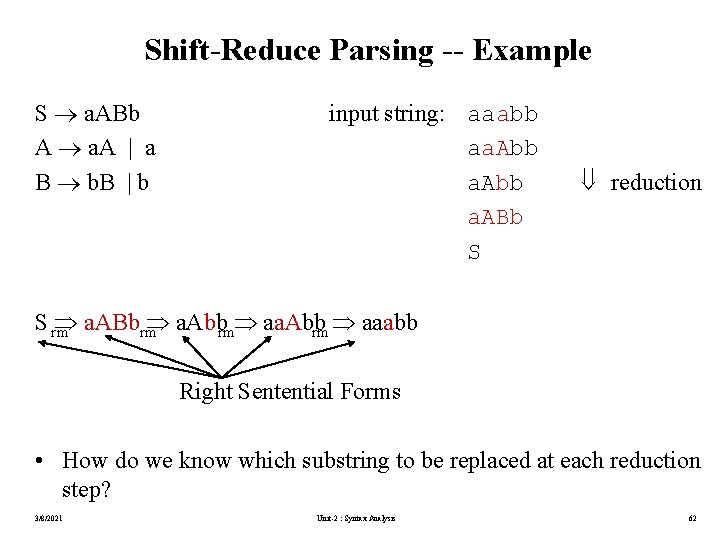
Shift-Reduce Parsing -- Example S a. ABb A a. A | a B b. B | b input string: aaabb aa. Abb a. ABb S reduction S rm a. ABbrm a. Abbrm aa. Abb rm aaabb Right Sentential Forms • How do we know which substring to be replaced at each reduction step? 3/8/2021 Unit-2 : Syntax Analysis 62
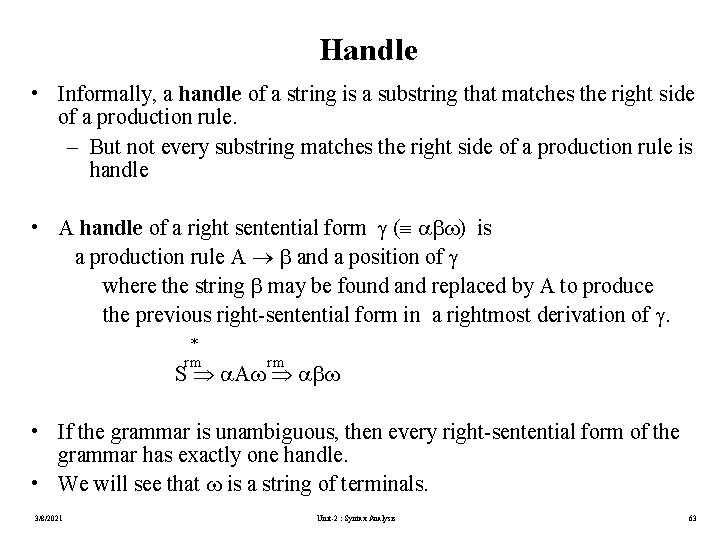
Handle • Informally, a handle of a string is a substring that matches the right side of a production rule. – But not every substring matches the right side of a production rule is handle • A handle of a right sentential form ( ) is a production rule A and a position of where the string may be found and replaced by A to produce the previous right-sentential form in a rightmost derivation of . * rm rm S A • If the grammar is unambiguous, then every right-sentential form of the grammar has exactly one handle. • We will see that is a string of terminals. 3/8/2021 Unit-2 : Syntax Analysis 63
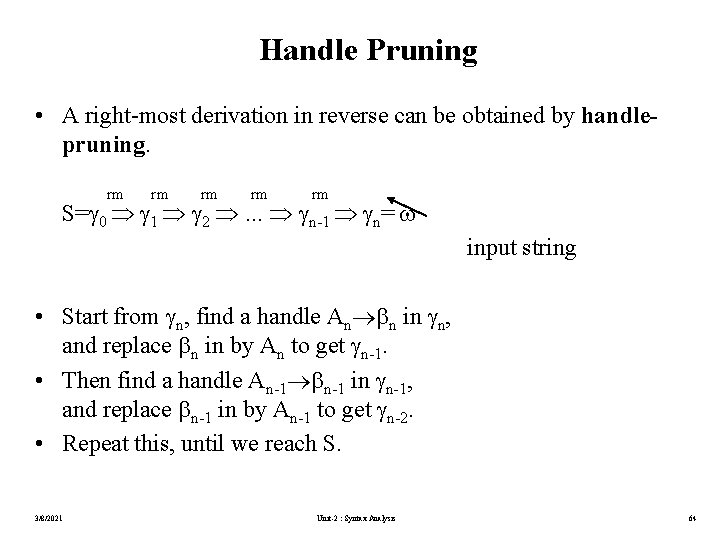
Handle Pruning • A right-most derivation in reverse can be obtained by handlepruning. rm rm rm S= 0 1 2 . . . n-1 n= input string • Start from n, find a handle An n in n, and replace n in by An to get n-1. • Then find a handle An-1 in n-1, and replace n-1 in by An-1 to get n-2. • Repeat this, until we reach S. 3/8/2021 Unit-2 : Syntax Analysis 64
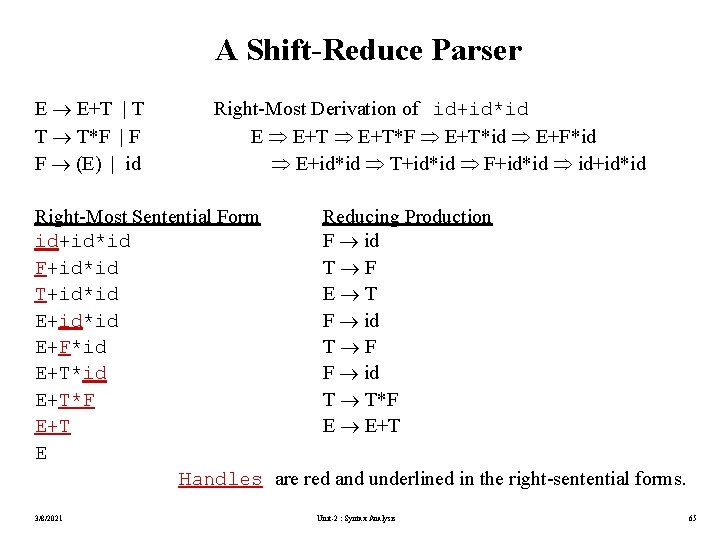
A Shift-Reduce Parser E E+T | T T T*F | F F (E) | id Right-Most Derivation of id+id*id E E+T*F E+T*id E+F*id E+id*id T+id*id F+id*id id+id*id Right-Most Sentential Form Reducing Production id+id*id F id F+id*id T F T+id*id E T E+id*id F id E+F*id T F E+T*id F id E+T*F T T*F E+T E Handles are red and underlined in the right-sentential forms. 3/8/2021 Unit-2 : Syntax Analysis 65
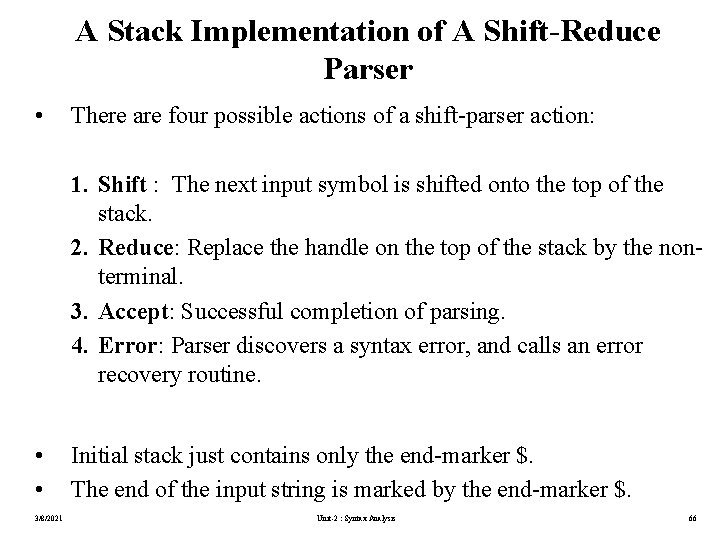
A Stack Implementation of A Shift-Reduce Parser • There are four possible actions of a shift-parser action: 1. Shift : The next input symbol is shifted onto the top of the stack. 2. Reduce: Replace the handle on the top of the stack by the nonterminal. 3. Accept: Successful completion of parsing. 4. Error: Parser discovers a syntax error, and calls an error recovery routine. • • 3/8/2021 Initial stack just contains only the end-marker $. The end of the input string is marked by the end-marker $. Unit-2 : Syntax Analysis 66
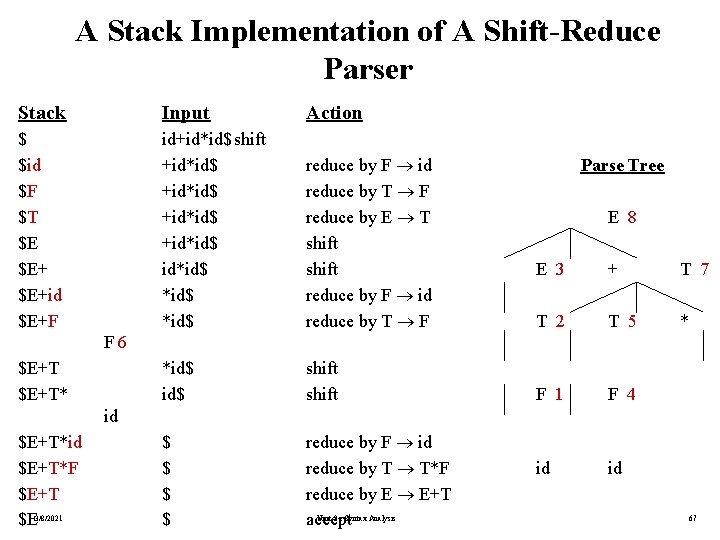
A Stack Implementation of A Shift-Reduce Parser Stack Input Action $ $id $F $T $E $E+id $E+F id+id*id$ shift +id*id$ id*id$ reduce by F id reduce by T F reduce by E T shift reduce by F id reduce by T F *id$ shift $ $ reduce by F id reduce by T T*F reduce by E E+T Unit-2 : Syntax Analysis accept Parse Tree E 8 E 3 + T 7 T 2 T 5 * F 1 F 4 id id F 6 $E+T* id $E+T*F $E+T $E 3/8/2021 67
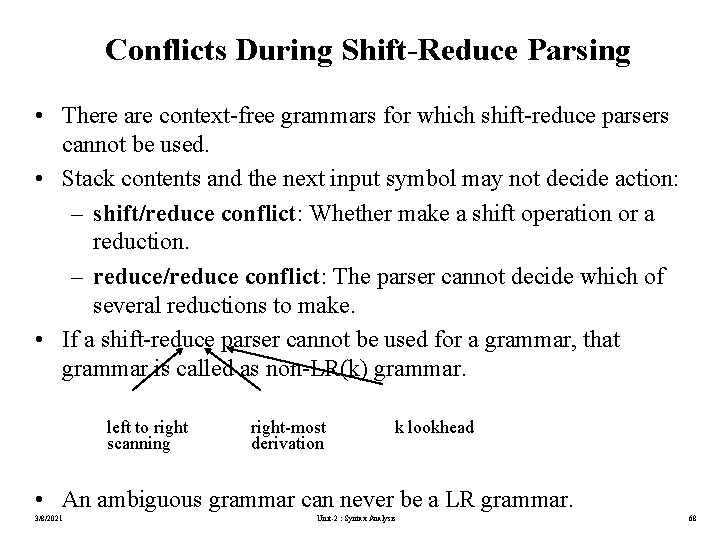
Conflicts During Shift-Reduce Parsing • There are context-free grammars for which shift-reduce parsers cannot be used. • Stack contents and the next input symbol may not decide action: – shift/reduce conflict: Whether make a shift operation or a reduction. – reduce/reduce conflict: The parser cannot decide which of several reductions to make. • If a shift-reduce parser cannot be used for a grammar, that grammar is called as non-LR(k) grammar. left to right scanning right-most derivation k lookhead • An ambiguous grammar can never be a LR grammar. 3/8/2021 Unit-2 : Syntax Analysis 68
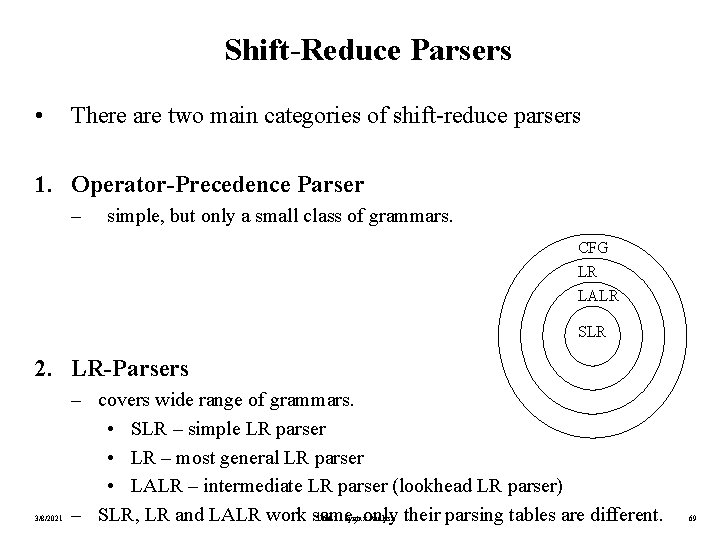
Shift-Reduce Parsers • There are two main categories of shift-reduce parsers 1. Operator-Precedence Parser – simple, but only a small class of grammars. CFG LR LALR SLR 2. LR-Parsers 3/8/2021 – covers wide range of grammars. • SLR – simple LR parser • LR – most general LR parser • LALR – intermediate LR parser (lookhead LR parser) – SLR, LR and LALR work same, only their parsing tables are different. Unit-2 : Syntax Analysis 69
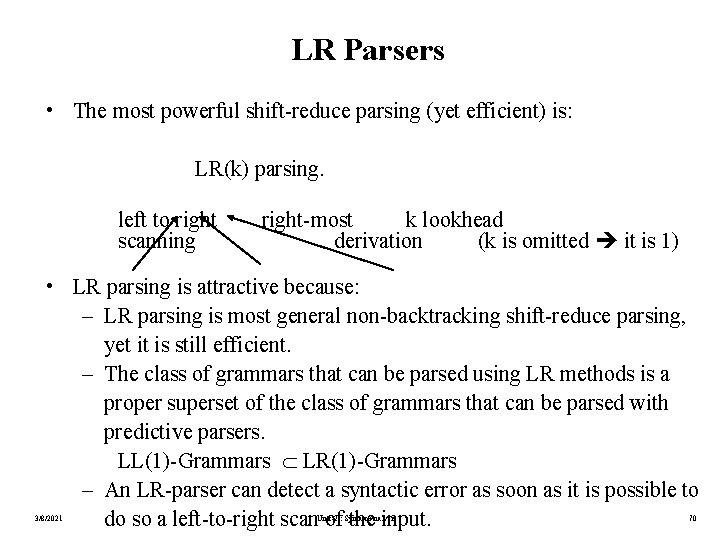
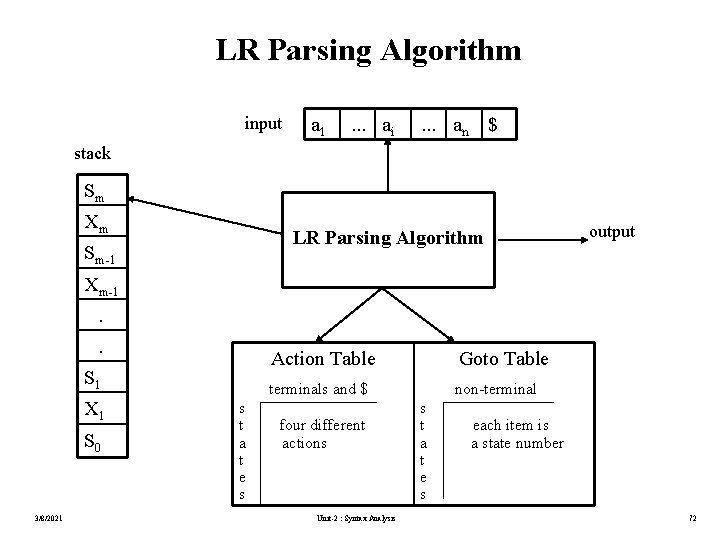
LR Parsers • The most powerful shift-reduce parsing (yet efficient) is: LR(k) parsing. left to right scanning right-most k lookhead derivation (k is omitted it is 1) • LR parsing is attractive because: – LR parsing is most general non-backtracking shift-reduce parsing, yet it is still efficient. – The class of grammars that can be parsed using LR methods is a proper superset of the class of grammars that can be parsed with predictive parsers. LL(1)-Grammars LR(1)-Grammars – An LR-parser can detect a syntactic error as soon as it is possible to do so a left-to-right scan of the input. 3/8/2021 Unit-2 : Syntax Analysis 70
LR Parsers • 3/8/2021 LR-Parsers – covers wide range of grammars. – SLR – simple LR parser – LR – most general LR parser – LALR – intermediate LR parser (look-head LR parser) – SLR, LR and LALR work same (they used the same algorithm), only their parsing tables are different. Unit-2 : Syntax Analysis 71
LR Parsing Algorithm input a 1 . . . ai . . . an $ stack Sm Xm LR Parsing Algorithm Sm-1 output Xm-1. . S 1 X 1 S 0 3/8/2021 s t a t e s Action Table Goto Table terminals and $ non-terminal four different actions Unit-2 : Syntax Analysis s t a t e s each item is a state number 72
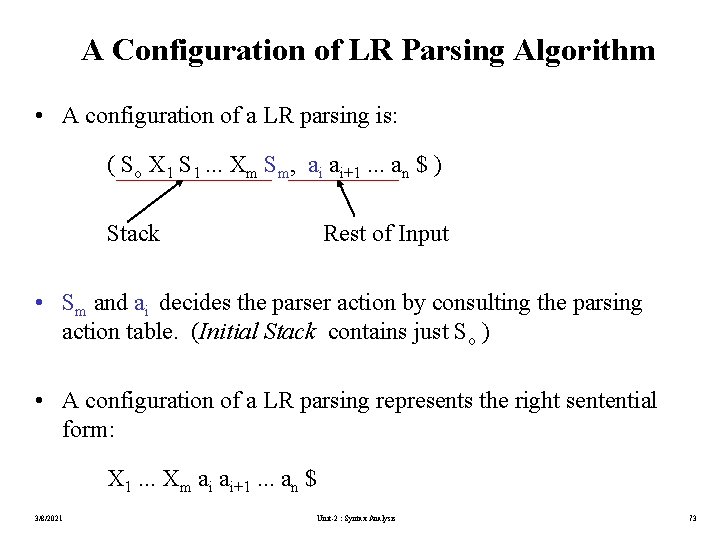
A Configuration of LR Parsing Algorithm • A configuration of a LR parsing is: ( So X 1 S 1. . . Xm Sm, ai ai+1. . . an $ ) Stack Rest of Input • Sm and ai decides the parser action by consulting the parsing action table. (Initial Stack contains just So ) • A configuration of a LR parsing represents the right sentential form: X 1. . . Xm ai ai+1. . . an $ 3/8/2021 Unit-2 : Syntax Analysis 73
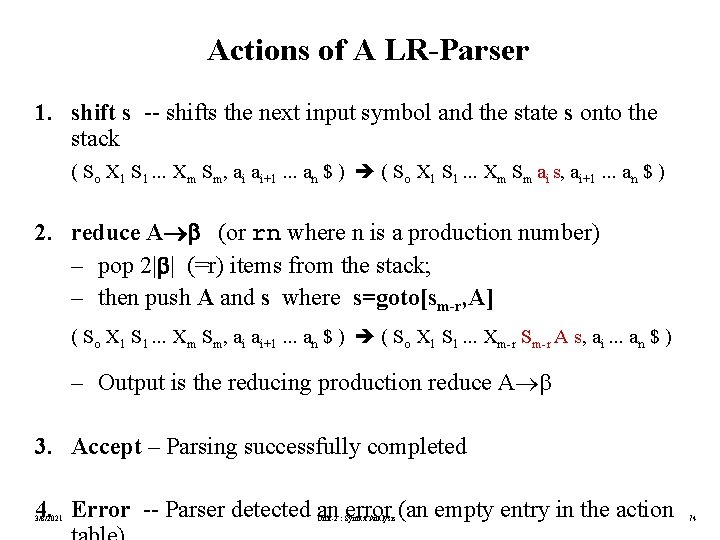
Actions of A LR-Parser 1. shift s -- shifts the next input symbol and the state s onto the stack ( So X 1 S 1. . . Xm Sm, ai ai+1. . . an $ ) ( So X 1 S 1. . . Xm Sm ai s, ai+1. . . an $ ) 2. reduce A (or rn where n is a production number) – pop 2| | (=r) items from the stack; – then push A and s where s=goto[sm-r, A] ( So X 1 S 1. . . Xm Sm, ai ai+1. . . an $ ) ( So X 1 S 1. . . Xm-r Sm-r A s, ai. . . an $ ) – Output is the reducing production reduce A 3. Accept – Parsing successfully completed 4. Error -- Parser detected an error (an empty entry in the action 3/8/2021 Unit-2 : Syntax Analysis 74
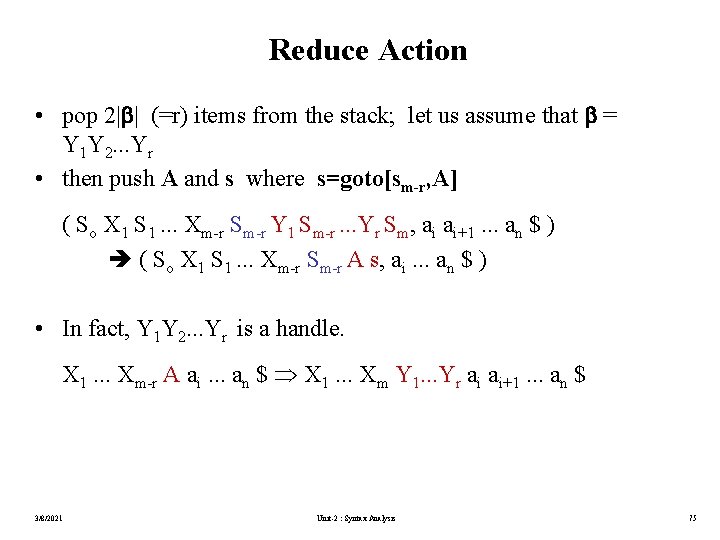
Reduce Action • pop 2| | (=r) items from the stack; let us assume that = Y 1 Y 2. . . Yr • then push A and s where s=goto[sm-r, A] ( So X 1 S 1. . . Xm-r Sm-r Y 1 Sm-r. . . Yr Sm, ai ai+1. . . an $ ) ( So X 1 S 1. . . Xm-r Sm-r A s, ai. . . an $ ) • In fact, Y 1 Y 2. . . Yr is a handle. X 1. . . Xm-r A ai. . . an $ X 1. . . Xm Y 1. . . Yr ai ai+1. . . an $ 3/8/2021 Unit-2 : Syntax Analysis 75
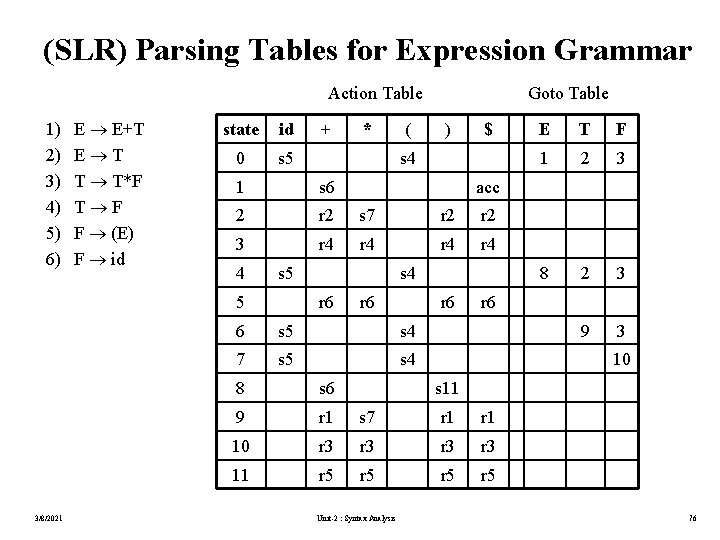
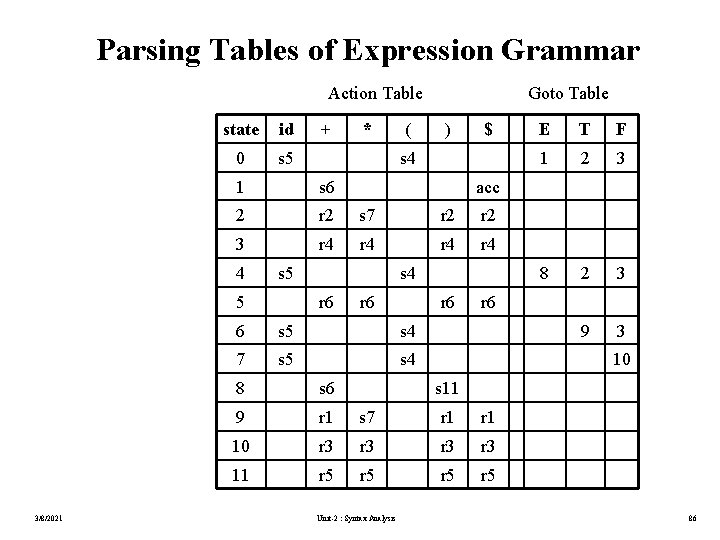
(SLR) Parsing Tables for Expression Grammar Action Table 1) 2) 3) 4) 5) 6) E E+T E T T T*F T F F (E) F id state id 0 s 5 * ( ) $ s 4 1 s 6 2 r 2 s 7 r 2 3 r 4 r 4 4 s 4 r 6 E T F 1 2 3 8 2 3 9 3 acc s 5 5 3/8/2021 + Goto Table r 6 6 s 5 s 4 7 s 5 s 4 r 6 10 8 s 6 s 11 9 r 1 s 7 r 1 10 r 3 r 3 11 r 5 r 5 Unit-2 : Syntax Analysis 76
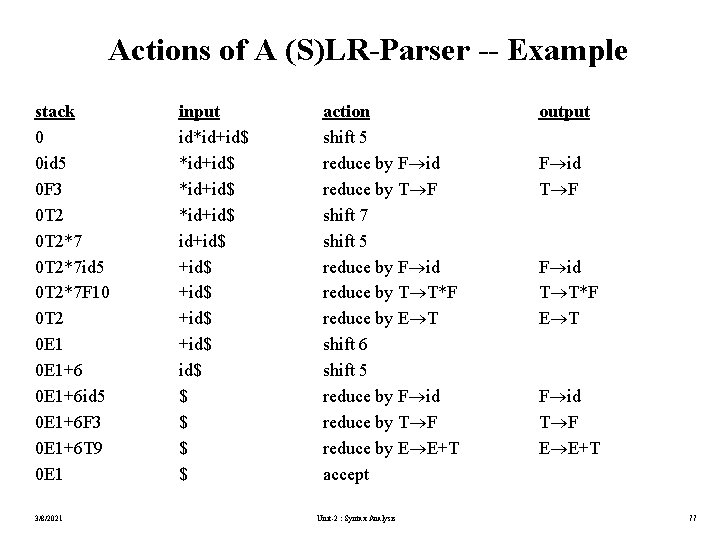
Actions of A (S)LR-Parser -- Example stack 0 0 id 5 0 F 3 0 T 2*7 id 5 0 T 2*7 F 10 0 T 2 0 E 1+6 id 5 0 E 1+6 F 3 0 E 1+6 T 9 0 E 1 3/8/2021 input id*id+id$ id+id$ +id$ $ $ action shift 5 reduce by F id reduce by T F shift 7 shift 5 reduce by F id reduce by T T*F reduce by E T shift 6 shift 5 reduce by F id reduce by T F reduce by E E+T accept Unit-2 : Syntax Analysis output F id T F F id T T*F E T F id T F E E+T 77
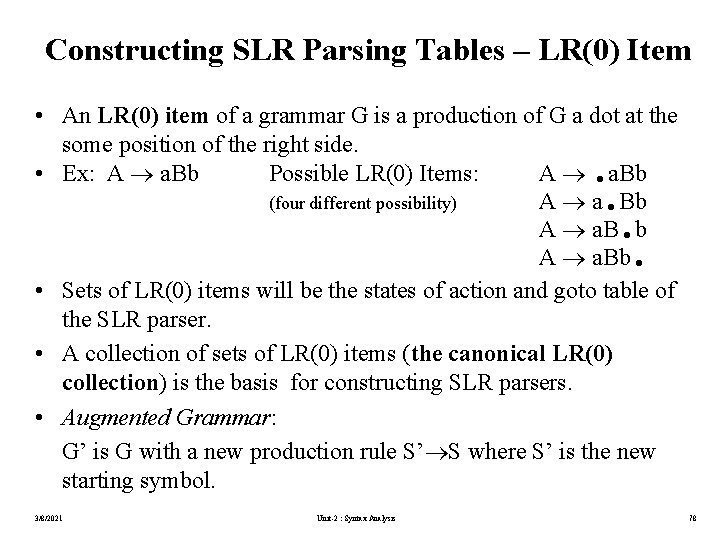
Constructing SLR Parsing Tables – LR(0) Item • An LR(0) item of a grammar G is a production of G a dot at the some position of the right side. • Ex: A a. Bb Possible LR(0) Items: A a. Bb (four different possibility) A a Bb A a. Bb • Sets of LR(0) items will be the states of action and goto table of the SLR parser. • A collection of sets of LR(0) items (the canonical LR(0) collection) is the basis for constructing SLR parsers. • Augmented Grammar: G’ is G with a new production rule S’ S where S’ is the new starting symbol. . . 3/8/2021 Unit-2 : Syntax Analysis 78
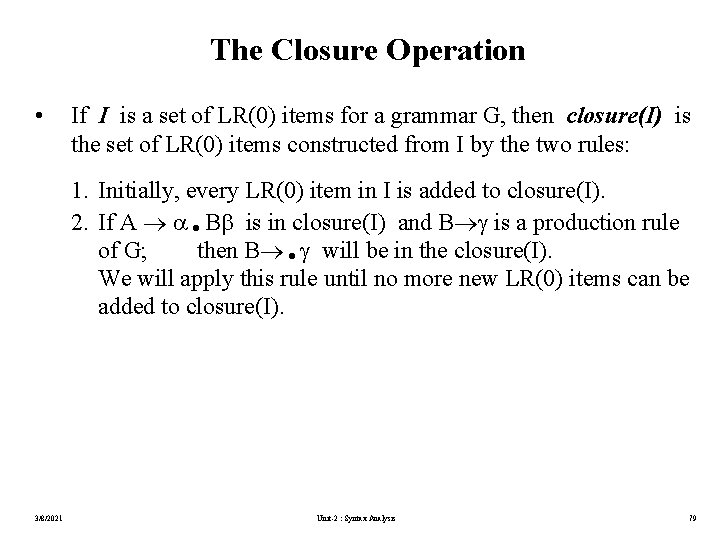
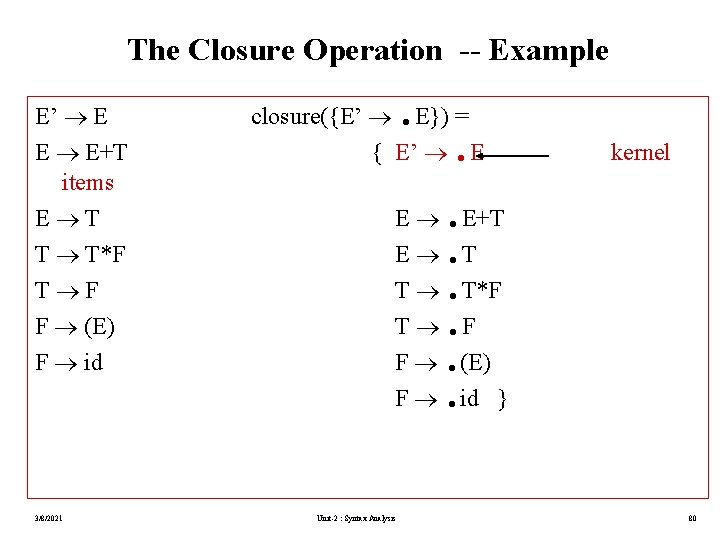
The Closure Operation • If I is a set of LR(0) items for a grammar G, then closure(I) is the set of LR(0) items constructed from I by the two rules: . 1. Initially, every LR(0) item in I is added to closure(I). 2. If A B is in closure(I) and B is a production rule of G; then B will be in the closure(I). We will apply this rule until no more new LR(0) items can be added to closure(I). 3/8/2021 . Unit-2 : Syntax Analysis 79
The Closure Operation -- Example E’ E E E+T items E T T T*F T F F (E) F id 3/8/2021 . closure({E’ E}) = { E’ E E E T T F F Unit-2 : Syntax Analysis . . . . kernel E+T T T*F F (E) id } 80
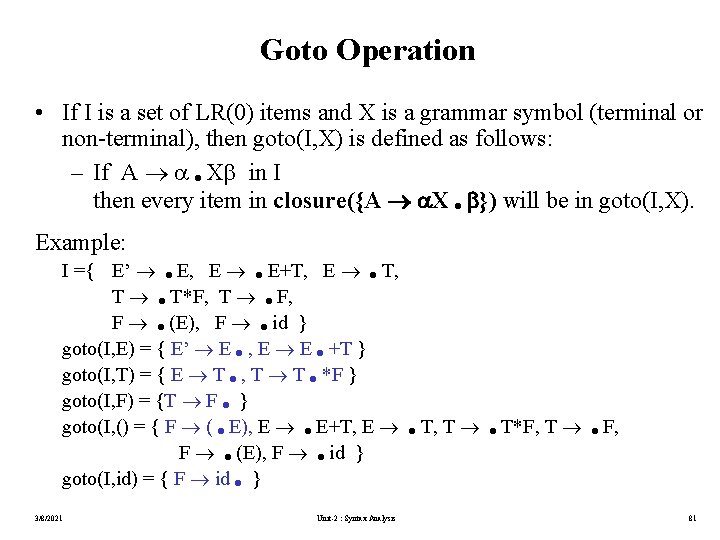
Goto Operation • If I is a set of LR(0) items and X is a grammar symbol (terminal or non-terminal), then goto(I, X) is defined as follows: – If A X in I then every item in closure({A X }) will be in goto(I, X). . Example: . . I ={ E’ E, E E+T, E T, T T*F, T F, F (E), F id } goto(I, E) = { E’ E , E E +T } goto(I, T) = { E T , T T *F } goto(I, F) = {T F } goto(I, () = { F ( E), E E+T, E F (E), F id } goto(I, id) = { F id } 3/8/2021 Unit-2 : Syntax Analysis T, T T*F, T . F, 81
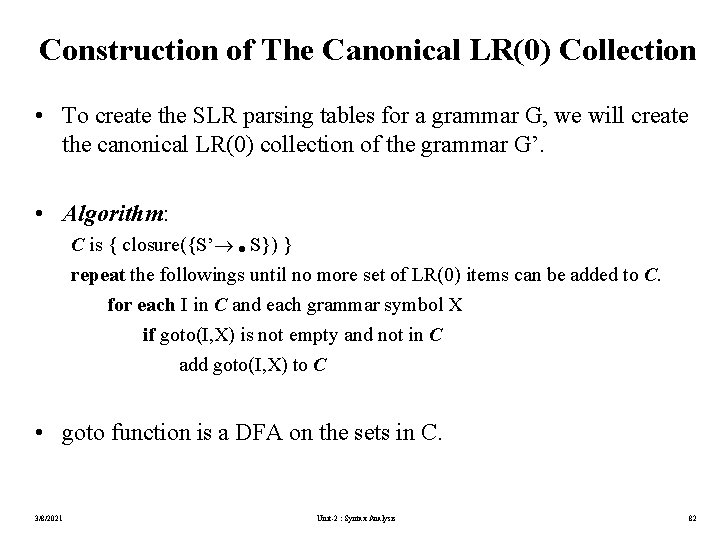
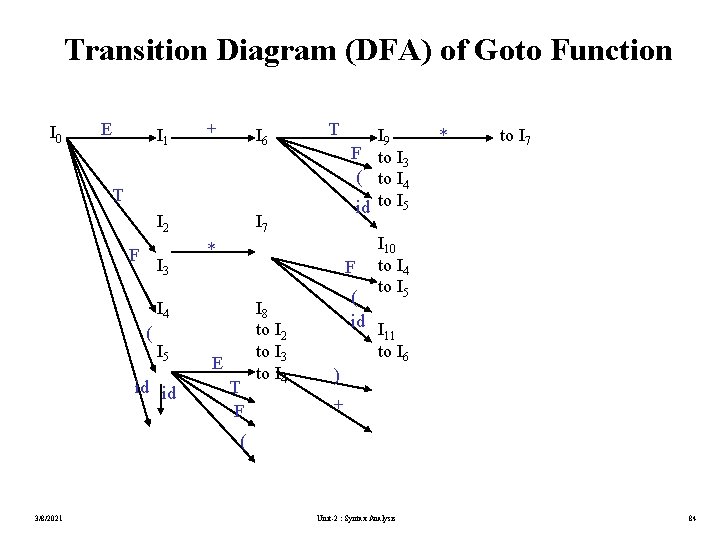
Construction of The Canonical LR(0) Collection • To create the SLR parsing tables for a grammar G, we will create the canonical LR(0) collection of the grammar G’. • Algorithm: . C is { closure({S’ S}) } repeat the followings until no more set of LR(0) items can be added to C. for each I in C and each grammar symbol X if goto(I, X) is not empty and not in C add goto(I, X) to C • goto function is a DFA on the sets in C. 3/8/2021 Unit-2 : Syntax Analysis 82
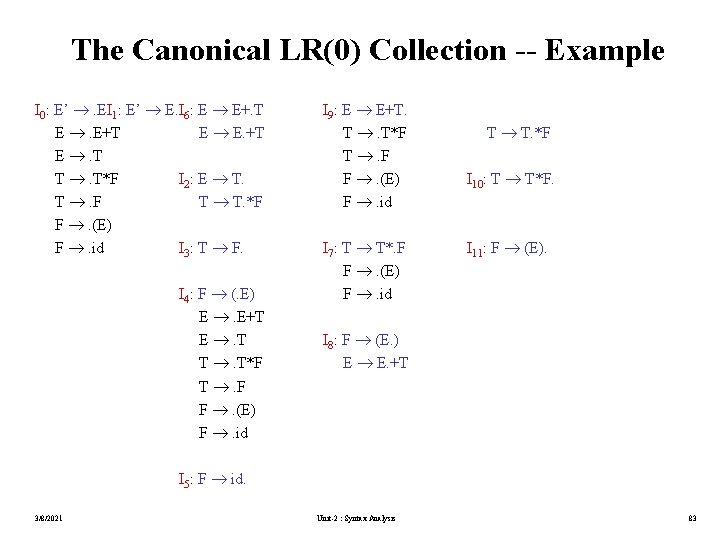
The Canonical LR(0) Collection -- Example I 0: E’ . EI 1: E’ E. I 6: E E+. T E . E+T E E. +T E . T T . T*F I 2: E T. T . F T T. *F F . (E) F . id I 3: T F. I 4: F (. E) E . E+T E . T T . T*F T . F F . (E) F . id I 9: E E+T. T . T*F T . F F . (E) F . id I 7: T T*. F F . (E) F . id T T. *F I 10: T T*F. I 11: F (E). I 8: F (E. ) E E. +T I 5: F id. 3/8/2021 Unit-2 : Syntax Analysis 83
Transition Diagram (DFA) of Goto Function I 0 E I 1 + I 6 T T I 2 F I 3 I 7 * F I 4 ( I 5 id id I 9 F to I 3 ( to I 4 id to I 5 E T F I 8 to I 2 to I 3 to I 4 * to I 7 I 10 to I 4 to I 5 ( id I 11 to I 6 ) + ( 3/8/2021 Unit-2 : Syntax Analysis 84
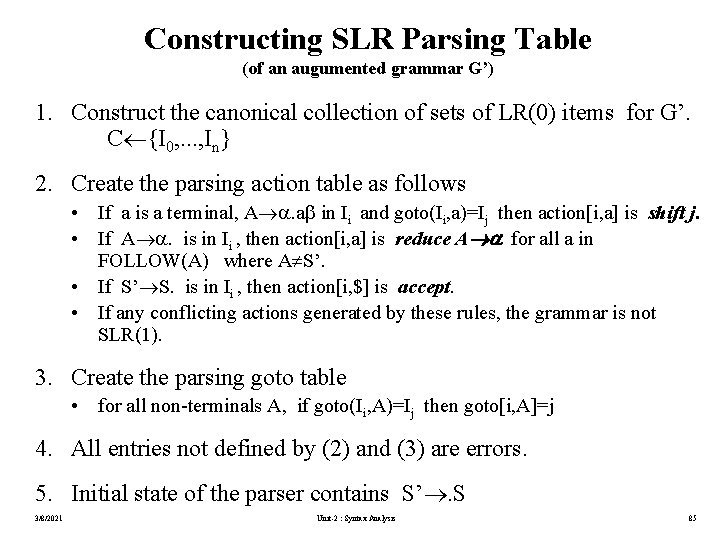
Constructing SLR Parsing Table (of an augumented grammar G’) 1. Construct the canonical collection of sets of LR(0) items for G’. C {I 0, . . . , In} 2. Create the parsing action table as follows • If a is a terminal, A . a in Ii and goto(Ii, a)=Ij then action[i, a] is shift j. • If A . is in Ii , then action[i, a] is reduce A for all a in FOLLOW(A) where A S’. • If S’ S. is in Ii , then action[i, $] is accept. • If any conflicting actions generated by these rules, the grammar is not SLR(1). 3. Create the parsing goto table • for all non-terminals A, if goto(Ii, A)=Ij then goto[i, A]=j 4. All entries not defined by (2) and (3) are errors. 5. Initial state of the parser contains S’. S 3/8/2021 Unit-2 : Syntax Analysis 85
Parsing Tables of Expression Grammar Action Table state id 0 s 5 * ( ) $ s 4 1 s 6 2 r 2 s 7 r 2 3 r 4 r 4 4 s 4 r 6 E T F 1 2 3 8 2 3 9 3 acc s 5 5 3/8/2021 + Goto Table r 6 6 s 5 s 4 7 s 5 s 4 r 6 10 8 s 6 s 11 9 r 1 s 7 r 1 10 r 3 r 3 11 r 5 r 5 Unit-2 : Syntax Analysis 86
SLR(1) Grammar • An LR parser using SLR(1) parsing tables for a grammar G is called as the SLR(1) parser for G. • If a grammar G has an SLR(1) parsing table, it is called SLR(1) grammar (or SLR grammar in short). • Every SLR grammar is unambiguous, but every unambiguous grammar is not a SLR grammar. 3/8/2021 Unit-2 : Syntax Analysis 87
shift/reduce and reduce/reduce conflicts • If a state does not know whether it will make a shift operation or reduction for a terminal, we say that there is a shift/reduce conflict. • If a state does not know whether it will make a reduction operation using the production rule i or j for a terminal, we say that there is a reduce/reduce conflict. • If the SLR parsing table of a grammar G has a conflict, we say that grammar is not SLR grammar. 3/8/2021 Unit-2 : Syntax Analysis 88
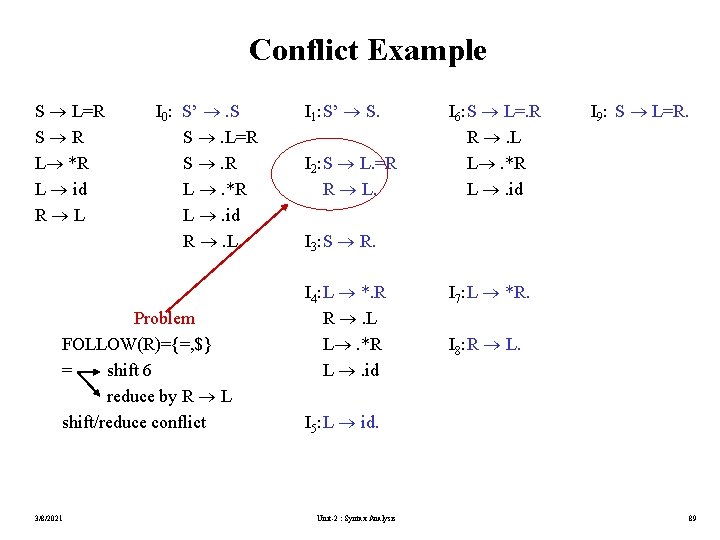
Conflict Example S L=R S R L *R L id R L I 0: S’ . S S . L=R S . R L . *R L . id R . L Problem FOLLOW(R)={=, $} = shift 6 reduce by R L shift/reduce conflict 3/8/2021 I 1: S’ S. I 2: S L. =R R L. I 6: S L=. R R . L L . *R L . id I 9: S L=R. I 3: S R. I 4: L *. R R . L L . *R L . id I 7: L *R. I 8: R L. I 5: L id. Unit-2 : Syntax Analysis 89
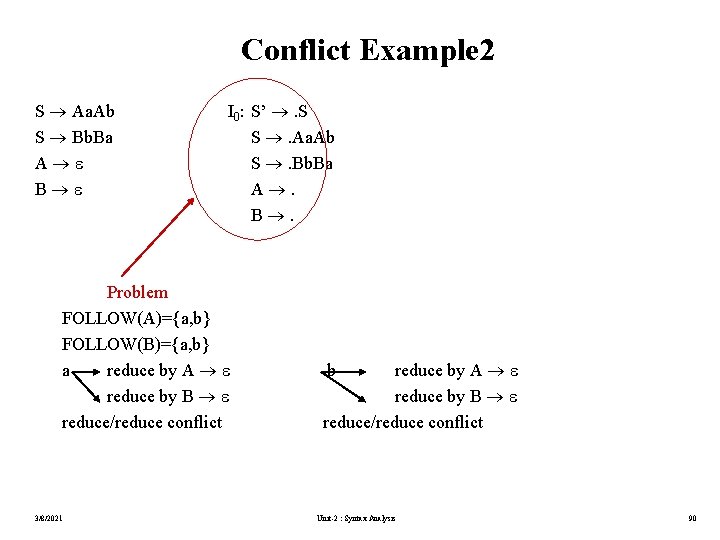
Conflict Example 2 S Aa. Ab S Bb. Ba A B I 0: S’ . S S . Aa. Ab S . Bb. Ba A. B. Problem FOLLOW(A)={a, b} FOLLOW(B)={a, b} a reduce by A reduce by B reduce/reduce conflict 3/8/2021 reduce by A reduce by B reduce/reduce conflict b Unit-2 : Syntax Analysis 90
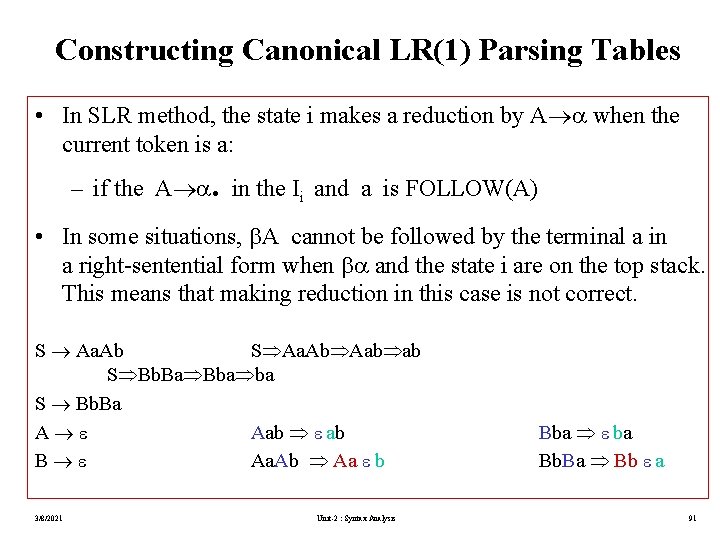
Constructing Canonical LR(1) Parsing Tables • In SLR method, the state i makes a reduction by A when the current token is a: – if the A . in the Ii and a is FOLLOW(A) • In some situations, A cannot be followed by the terminal a in a right-sentential form when and the state i are on the top stack. This means that making reduction in this case is not correct. S Aa. Ab S Aa. Ab Aab ab S Bb. Ba Bba ba S Bb. Ba A Aab ab B Aa. Ab Aa b 3/8/2021 Unit-2 : Syntax Analysis Bba ba Bb. Ba Bb a 91
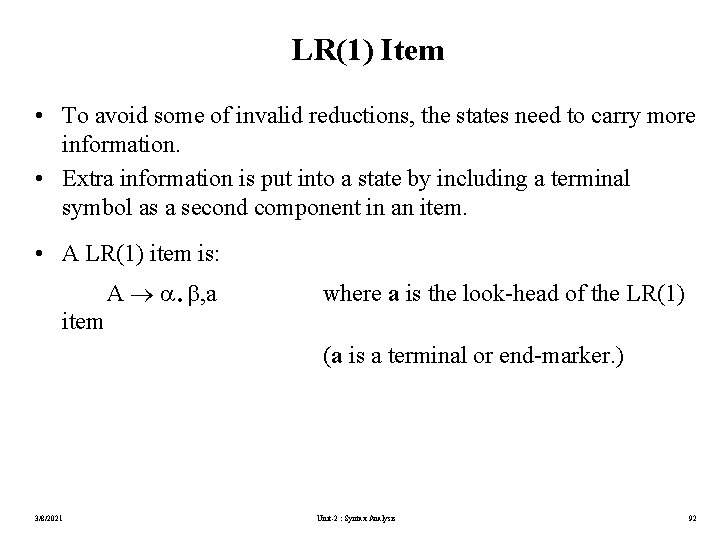
LR(1) Item • To avoid some of invalid reductions, the states need to carry more information. • Extra information is put into a state by including a terminal symbol as a second component in an item. • A LR(1) item is: . A , a item where a is the look-head of the LR(1) (a is a terminal or end-marker. ) 3/8/2021 Unit-2 : Syntax Analysis 92
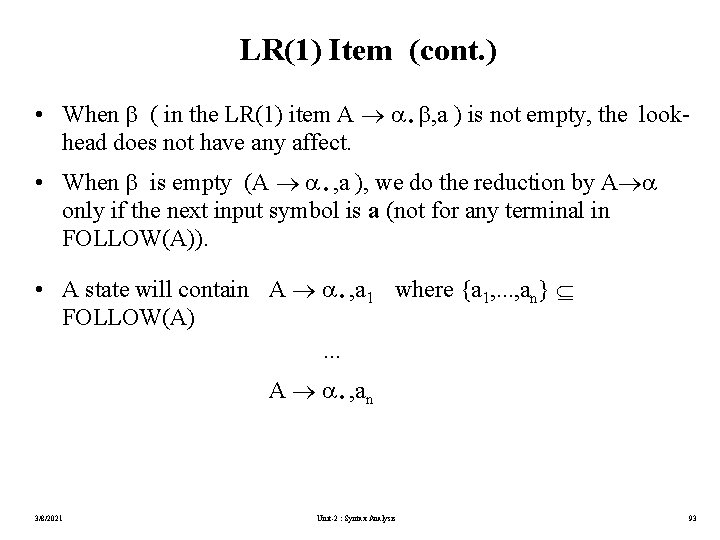
LR(1) Item (cont. ) . • When ( in the LR(1) item A , a ) is not empty, the lookhead does not have any affect. . • When is empty (A , a ), we do the reduction by A only if the next input symbol is a (not for any terminal in FOLLOW(A)). . • A state will contain A , a 1 where {a 1, . . . , an} FOLLOW(A). . A , an 3/8/2021 Unit-2 : Syntax Analysis 93
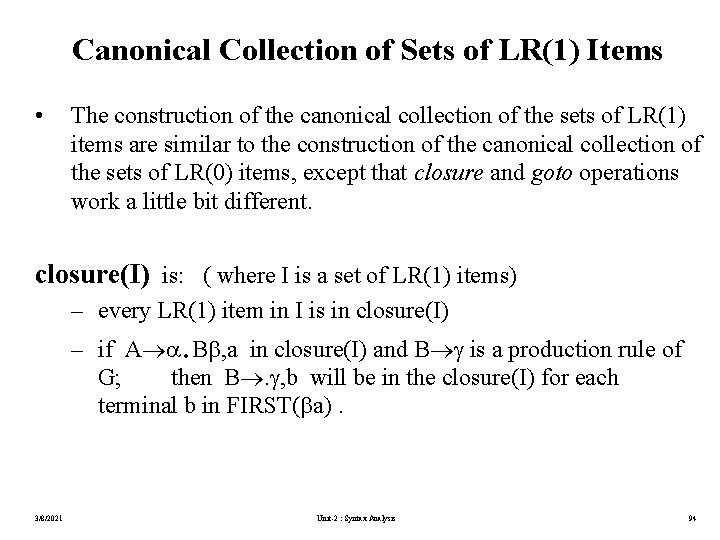
Canonical Collection of Sets of LR(1) Items • The construction of the canonical collection of the sets of LR(1) items are similar to the construction of the canonical collection of the sets of LR(0) items, except that closure and goto operations work a little bit different. closure(I) is: ( where I is a set of LR(1) items) – every LR(1) item in I is in closure(I) . – if A B , a in closure(I) and B is a production rule of G; then B. , b will be in the closure(I) for each terminal b in FIRST( a). 3/8/2021 Unit-2 : Syntax Analysis 94
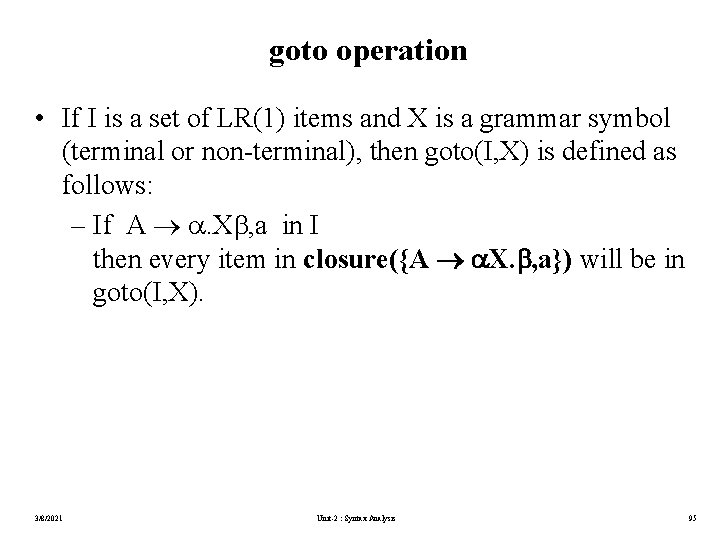
goto operation • If I is a set of LR(1) items and X is a grammar symbol (terminal or non-terminal), then goto(I, X) is defined as follows: – If A . X , a in I then every item in closure({A X. , a}) will be in goto(I, X). 3/8/2021 Unit-2 : Syntax Analysis 95
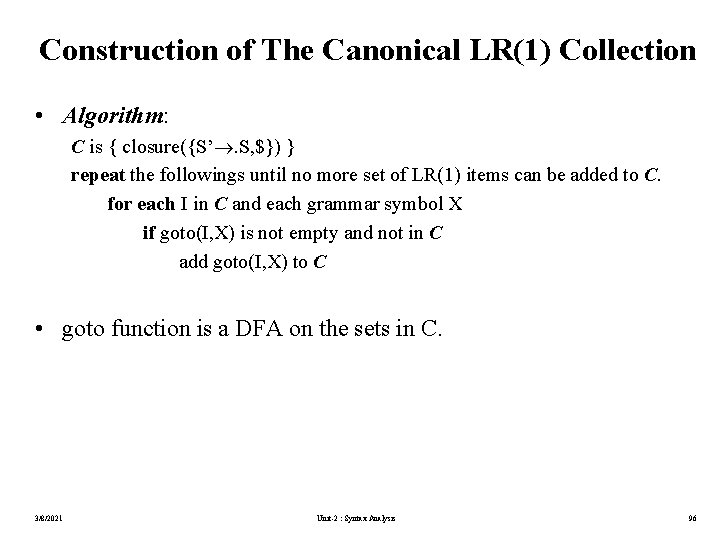
Construction of The Canonical LR(1) Collection • Algorithm: C is { closure({S’. S, $}) } repeat the followings until no more set of LR(1) items can be added to C. for each I in C and each grammar symbol X if goto(I, X) is not empty and not in C add goto(I, X) to C • goto function is a DFA on the sets in C. 3/8/2021 Unit-2 : Syntax Analysis 96
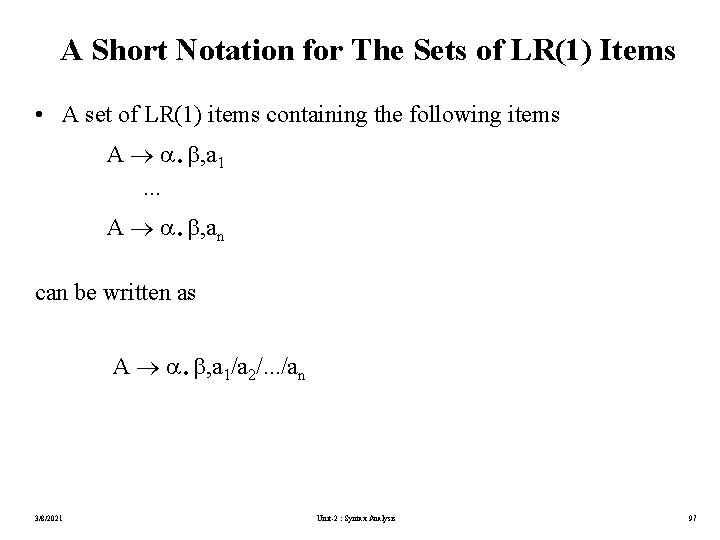
A Short Notation for The Sets of LR(1) Items • A set of LR(1) items containing the following items . A , a 1. . A , an can be written as . A , a 1/a 2/. . . /an 3/8/2021 Unit-2 : Syntax Analysis 97
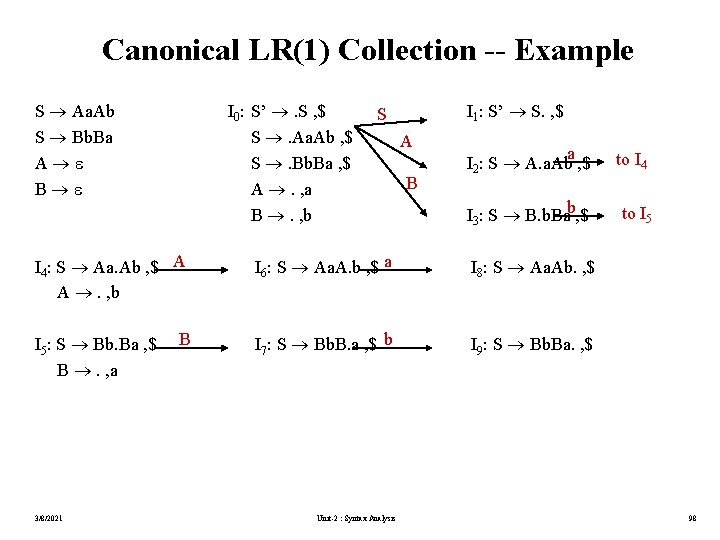
Canonical LR(1) Collection -- Example S Aa. Ab S Bb. Ba A B I 0: S’ . S , $ S . Aa. Ab , $ S . Bb. Ba , $ A . , a B . , b I 1: S’ S. , $ S A B a I 2: S A. a. Ab , $ I 3: S B. b. Bab, $ I 4: S Aa. Ab , $ A A . , b I 6: S Aa. A. b , $ a I 8: S Aa. Ab. , $ B I 7: S Bb. B. a , $ b I 9: S Bb. Ba. , $ I 5: S Bb. Ba , $ B . , a 3/8/2021 Unit-2 : Syntax Analysis to I 4 to I 5 98
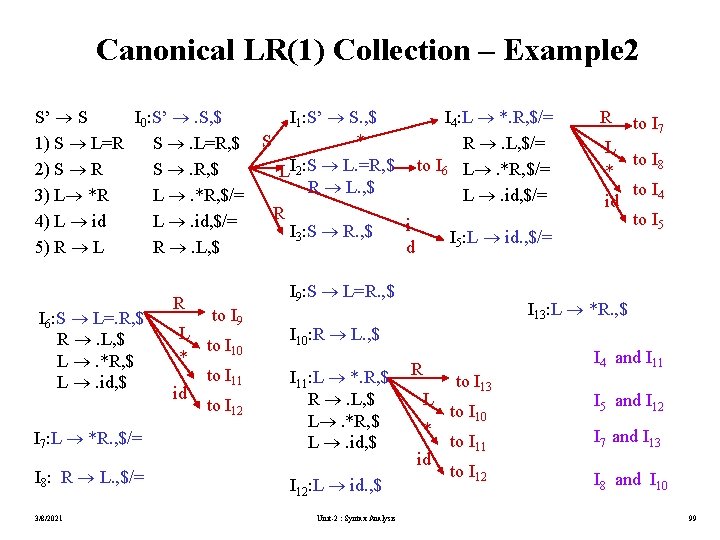
Canonical LR(1) Collection – Example 2 S’ S I 0: S’ . S, $ I 1: S’ S. , $ I 4: L *. R, $/= * 1) S L=R S . L=R, $ S R . L, $/= 2) S R S . R, $ LI 2: S L. =R, $ to I 6 L . *R, $/= R L. , $ 3) L *R L . *R, $/= L . id, $/= R 4) L id L . id, $/= i I 3: S R. , $ I 5: L id. , $/= 5) R L R . L, $ d I 6: S L=. R, $ R . L, $ L . *R, $ L . id, $ R I 9: S L=R. , $ to I 9 L to I 10 * to I 11 id to I 12 I 7: L *R. , $/= I 8: R L. , $/= I 12: L id. , $ 3/8/2021 Unit-2 : Syntax Analysis to I 7 L to I 8 * to I 4 id to I 5 I 13: L *R. , $ I 10: R L. , $ I 11: L *. R, $ R . L, $ L . *R, $ L . id, $ R R L * id I 4 and I 11 to I 13 to I 10 I 5 and I 12 to I 11 I 7 and I 13 to I 12 I 8 and I 10 99
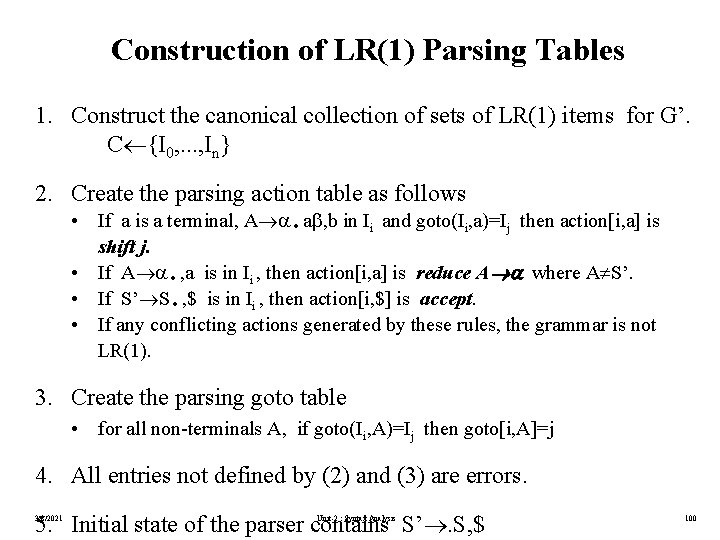
Construction of LR(1) Parsing Tables 1. Construct the canonical collection of sets of LR(1) items for G’. C {I 0, . . . , In} 2. Create the parsing action table as follows . • If a is a terminal, A a , b in Ii and goto(Ii, a)=Ij then action[i, a] is shift j. • If A , a is in Ii , then action[i, a] is reduce A where A S’. • If S’ S , $ is in Ii , then action[i, $] is accept. • If any conflicting actions generated by these rules, the grammar is not LR(1). . . 3. Create the parsing goto table • for all non-terminals A, if goto(Ii, A)=Ij then goto[i, A]=j 4. All entries not defined by (2) and (3) are errors. 5. Initial state of the parser contains S’. S, $ 3/8/2021 Unit-2 : Syntax Analysis 100
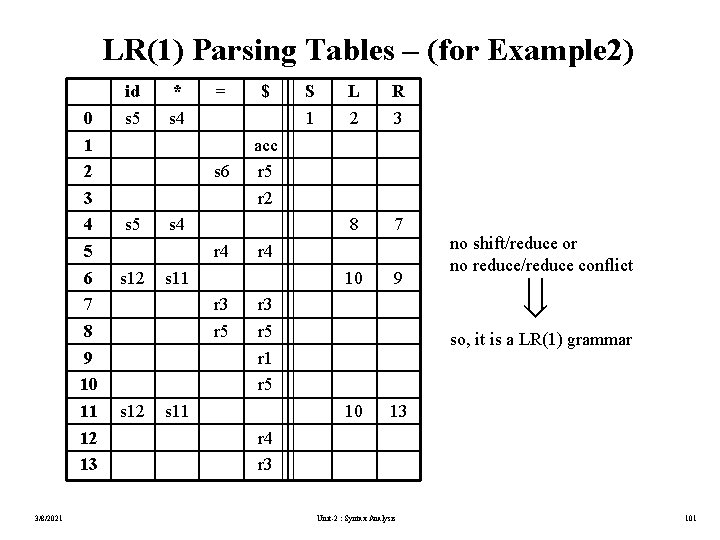
LR(1) Parsing Tables – (for Example 2) 0 1 2 3 4 5 6 7 8 9 10 11 12 13 3/8/2021 id s 5 * s 4 = $ s 6 acc r 5 r 2 s 4 r 4 s 12 L 2 R 3 8 7 10 9 r 4 s 11 r 3 r 5 S 1 r 3 r 5 r 1 r 5 s 11 no shift/reduce or no reduce/reduce conflict so, it is a LR(1) grammar 10 13 r 4 r 3 Unit-2 : Syntax Analysis 101
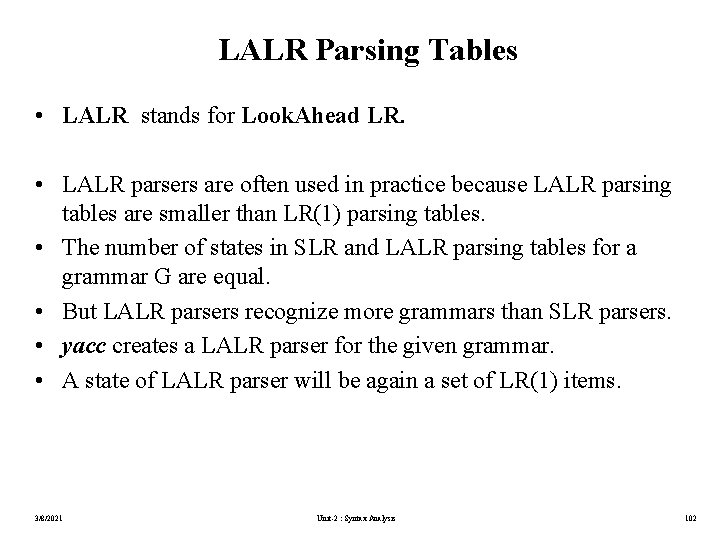
LALR Parsing Tables • LALR stands for Look. Ahead LR. • LALR parsers are often used in practice because LALR parsing tables are smaller than LR(1) parsing tables. • The number of states in SLR and LALR parsing tables for a grammar G are equal. • But LALR parsers recognize more grammars than SLR parsers. • yacc creates a LALR parser for the given grammar. • A state of LALR parser will be again a set of LR(1) items. 3/8/2021 Unit-2 : Syntax Analysis 102
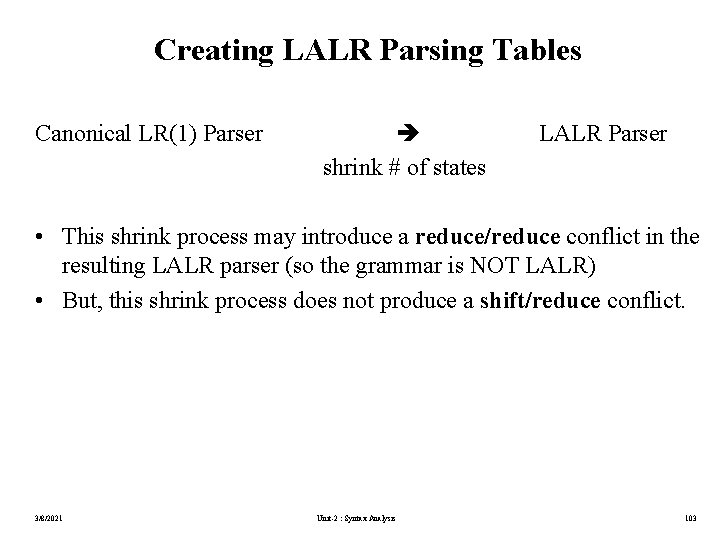
Creating LALR Parsing Tables Canonical LR(1) Parser shrink # of states LALR Parser • This shrink process may introduce a reduce/reduce conflict in the resulting LALR parser (so the grammar is NOT LALR) • But, this shrink process does not produce a shift/reduce conflict. 3/8/2021 Unit-2 : Syntax Analysis 103
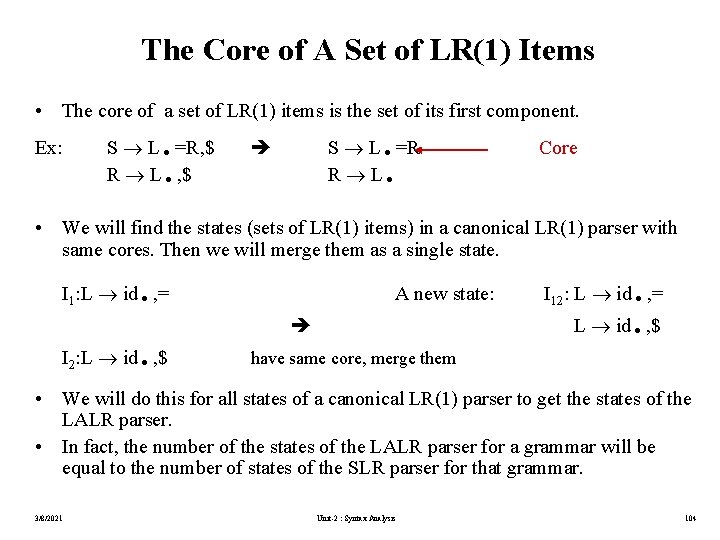
The Core of A Set of LR(1) Items • The core of a set of LR(1) items is the set of its first component. Ex: . . S L =R, $ R L , $ . . S L =R R L Core • We will find the states (sets of LR(1) items) in a canonical LR(1) parser with same cores. Then we will merge them as a single state. . . I 1: L id , = I 2: L id , $ A new state: . . I 12: L id , = L id , $ have same core, merge them • We will do this for all states of a canonical LR(1) parser to get the states of the LALR parser. • In fact, the number of the states of the LALR parser for a grammar will be equal to the number of states of the SLR parser for that grammar. 3/8/2021 Unit-2 : Syntax Analysis 104
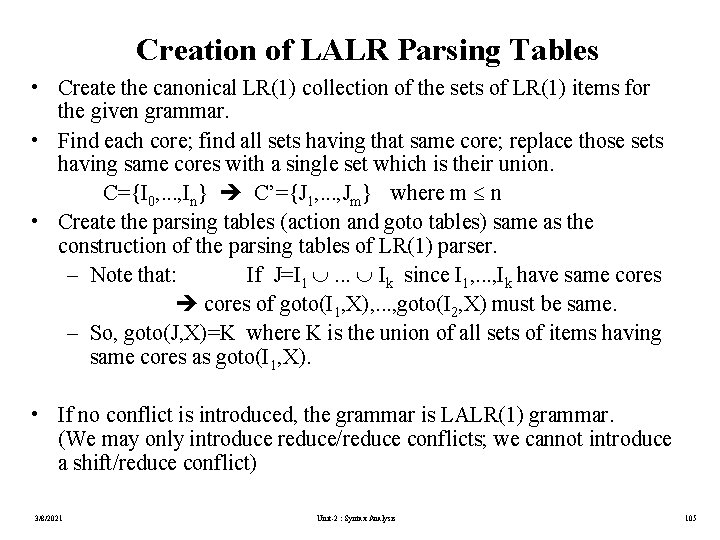
Creation of LALR Parsing Tables • Create the canonical LR(1) collection of the sets of LR(1) items for the given grammar. • Find each core; find all sets having that same core; replace those sets having same cores with a single set which is their union. C={I 0, . . . , In} C’={J 1, . . . , Jm} where m n • Create the parsing tables (action and goto tables) same as the construction of the parsing tables of LR(1) parser. – Note that: If J=I 1 . . . Ik since I 1, . . . , Ik have same cores of goto(I 1, X), . . . , goto(I 2, X) must be same. – So, goto(J, X)=K where K is the union of all sets of items having same cores as goto(I 1, X). • If no conflict is introduced, the grammar is LALR(1) grammar. (We may only introduce reduce/reduce conflicts; we cannot introduce a shift/reduce conflict) 3/8/2021 Unit-2 : Syntax Analysis 105
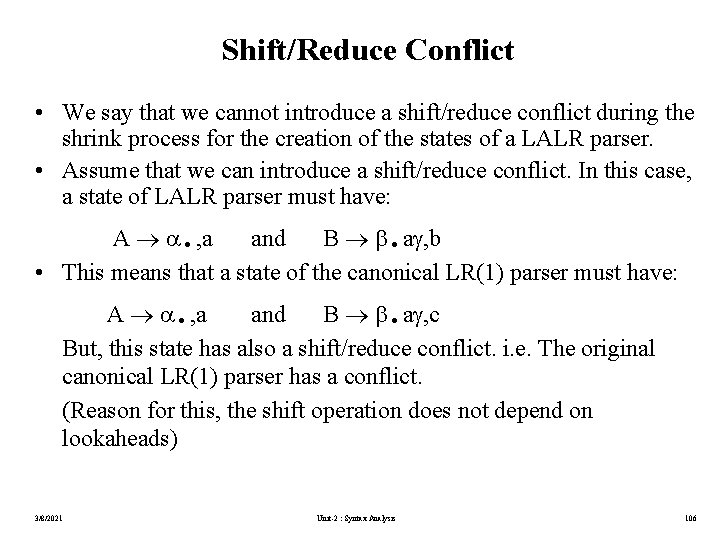
Shift/Reduce Conflict • We say that we cannot introduce a shift/reduce conflict during the shrink process for the creation of the states of a LALR parser. • Assume that we can introduce a shift/reduce conflict. In this case, a state of LALR parser must have: . . A , a and B a , b • This means that a state of the canonical LR(1) parser must have: A , a and B a , c But, this state has also a shift/reduce conflict. i. e. The original canonical LR(1) parser has a conflict. (Reason for this, the shift operation does not depend on lookaheads) 3/8/2021 Unit-2 : Syntax Analysis 106
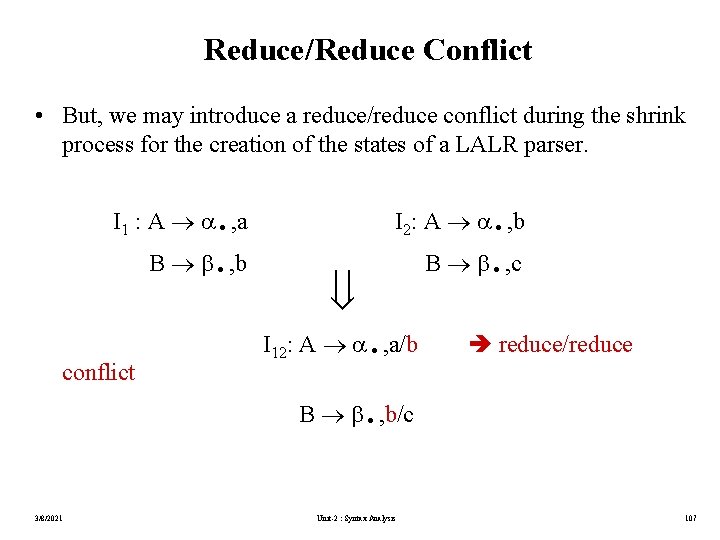
Reduce/Reduce Conflict • But, we may introduce a reduce/reduce conflict during the shrink process for the creation of the states of a LALR parser. . . I 1 : A , a I 2: A , b B , c conflict . . I 12: A , a/b reduce/reduce B , b/c 3/8/2021 Unit-2 : Syntax Analysis 107
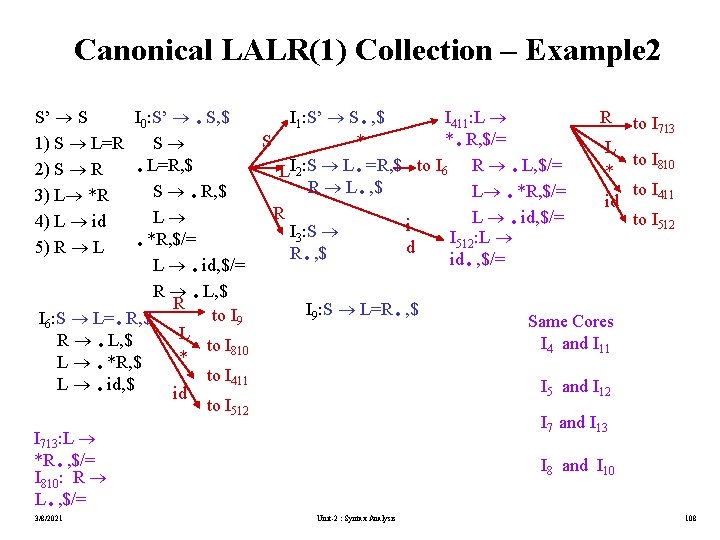
Canonical LALR(1) Collection – Example 2 . . . S’ S R I 0: S’ S, $ I 1: S’ S , $ I 411: L * R, $/= S * 1) S L=R S L L=R, $ 2) S R LI 2: S L =R, $ to I 6 R L, $/= * R L , $ S R, $ L *R, $/= 3) L *R id R L L id, $/= 4) L id i I 3: S I 512: L *R, $/= 5) R L d R , $ id , $/= L id, $/= R L, $ R I 9: S L=R , $ to I 9 I 6: S L= R, $ Same Cores L R L, $ I 4 and I 11 to I 810 * L *R, $ to I 411 L id, $ I 5 and I 12 id to I 512 I 7 and I 13 I 713: L *R , $/= I 8 and I 10 I 810: R L , $/= . . . . 3/8/2021 . . . Unit-2 : Syntax Analysis . . to I 713 to I 810 to I 411 to I 512 108
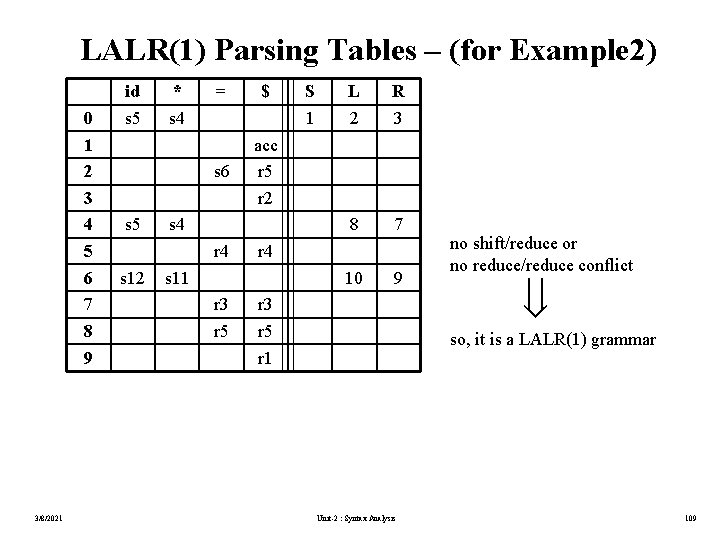
LALR(1) Parsing Tables – (for Example 2) 0 1 2 3 4 5 6 7 8 9 3/8/2021 id s 5 * s 4 = $ s 6 acc r 5 r 2 s 4 r 4 s 12 L 2 R 3 8 7 10 9 r 4 s 11 r 3 r 5 S 1 r 3 r 5 r 1 no shift/reduce or no reduce/reduce conflict so, it is a LALR(1) grammar Unit-2 : Syntax Analysis 109
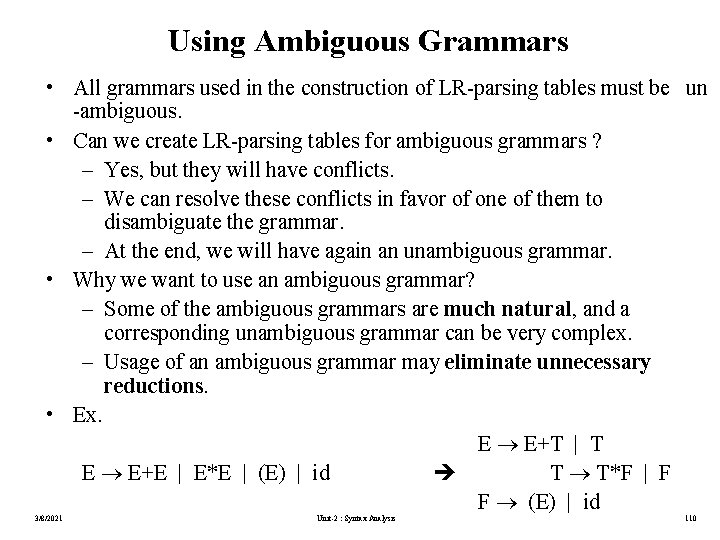
Using Ambiguous Grammars • All grammars used in the construction of LR-parsing tables must be un -ambiguous. • Can we create LR-parsing tables for ambiguous grammars ? – Yes, but they will have conflicts. – We can resolve these conflicts in favor of one of them to disambiguate the grammar. – At the end, we will have again an unambiguous grammar. • Why we want to use an ambiguous grammar? – Some of the ambiguous grammars are much natural, and a corresponding unambiguous grammar can be very complex. – Usage of an ambiguous grammar may eliminate unnecessary reductions. • Ex. E E+T | T E E+E | E*E | (E) | id T T*F | F F (E) | id 3/8/2021 Unit-2 : Syntax Analysis 110
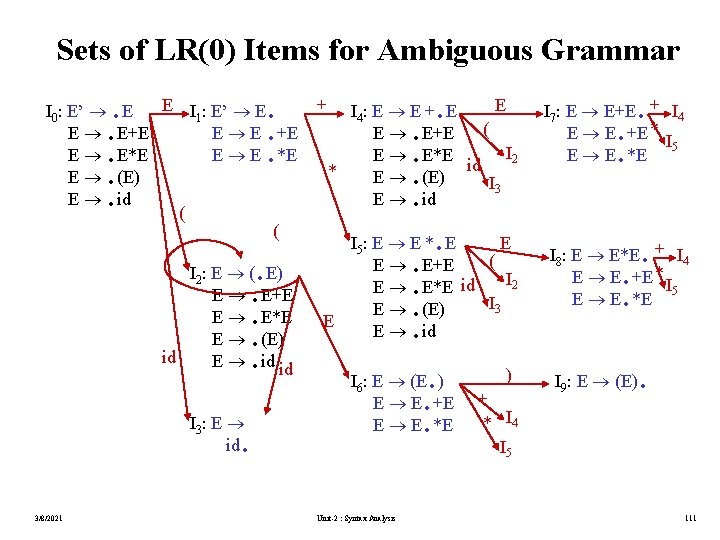
Sets of LR(0) Items for Ambiguous Grammar E. . E+E E. . E*E (E). id I 0: E’ E E . . . I 1: E’ E E E +E E E *E ( . . E+E E). . E*E (E). id I 3 : E id . . . I : E E *. E E . E+E E . E*E id E . (E) E . id E I 4 : E E + E ( E E+E I 2 E E*E id * E (E) I 3 E id ( I 2 : E ( E E E id E 3/8/2021 + 5 E . . . I 6: E (E ) E E +E E E *E Unit-2 : Syntax Analysis ( E I 2 I 3 ) + * I 4 I 5 . . . I 7: E E+E + I 4 E E +E * I 5 E E *E . . . I 8: E E*E + I 4 E E +E * I 5 E E *E I 9: E (E) . 111
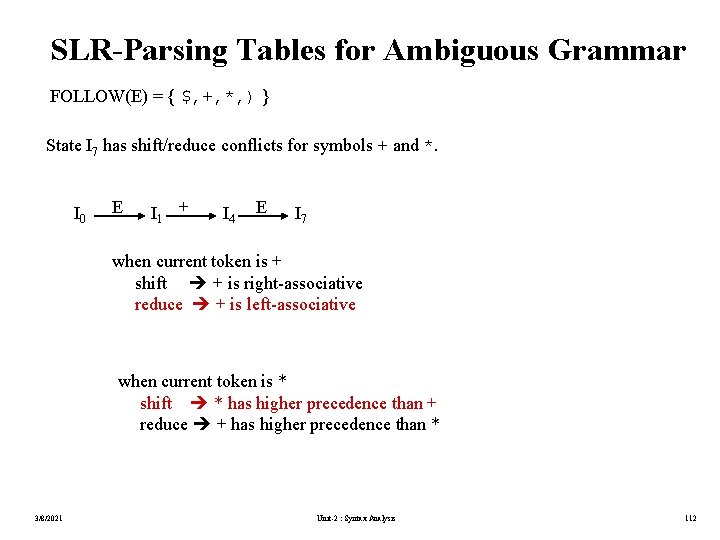
SLR-Parsing Tables for Ambiguous Grammar FOLLOW(E) = { $, +, *, ) } State I 7 has shift/reduce conflicts for symbols + and *. I 0 E I 1 + I 4 E I 7 when current token is + shift + is right-associative reduce + is left-associative when current token is * shift * has higher precedence than + reduce + has higher precedence than * 3/8/2021 Unit-2 : Syntax Analysis 112
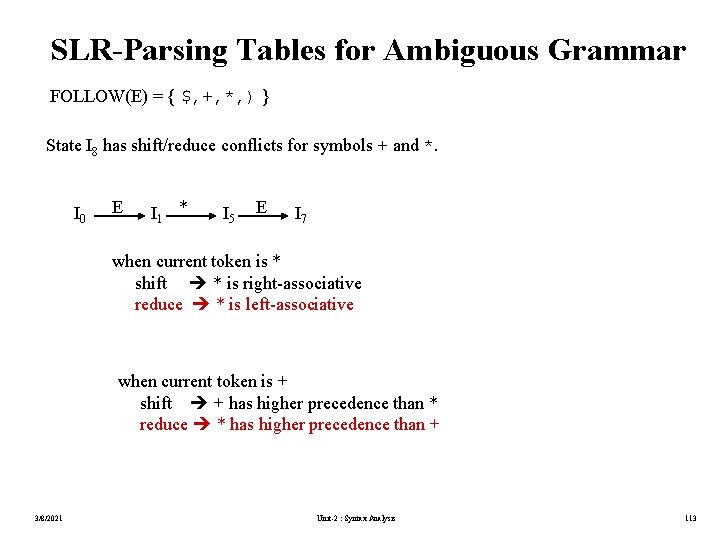
SLR-Parsing Tables for Ambiguous Grammar FOLLOW(E) = { $, +, *, ) } State I 8 has shift/reduce conflicts for symbols + and *. I 0 E I 1 * I 5 E I 7 when current token is * shift * is right-associative reduce * is left-associative when current token is + shift + has higher precedence than * reduce * has higher precedence than + 3/8/2021 Unit-2 : Syntax Analysis 113
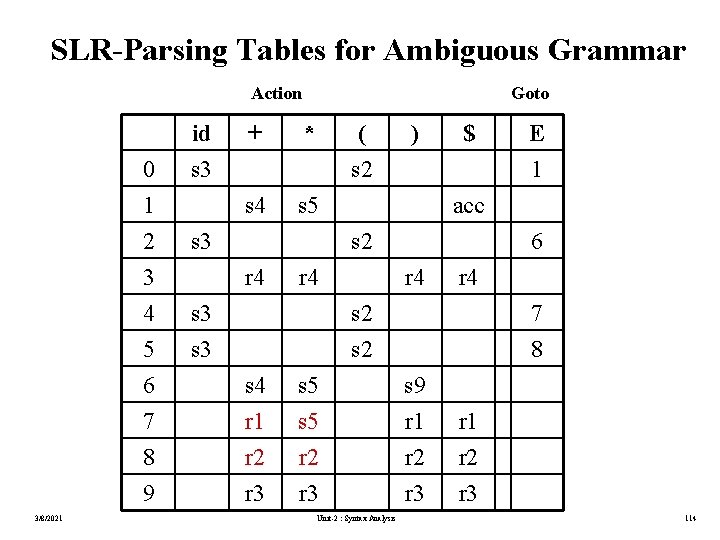
SLR-Parsing Tables for Ambiguous Grammar Action 0 1 2 3 4 5 6 7 8 9 3/8/2021 id s 3 Goto + * ( s 2 s 4 s 5 s 3 ) $ acc s 2 r 4 s 3 6 r 4 s 2 s 4 r 1 r 2 r 3 E 1 s 5 r 2 r 3 Unit-2 : Syntax Analysis 7 8 s 9 r 1 r 2 r 3 114
Error Recovery in LR Parsing • An LR parser will detect an error when it consults the parsing action table and finds an error entry. All empty entries in the action table are error entries. • Errors are never detected by consulting the goto table. • An LR parser will announce error as soon as there is no valid continuation for the scanned portion of the input. • A canonical LR parser (LR(1) parser) will never make even a single reduction before announcing an error. • The SLR and LALR parsers may make several reductions before announcing an error. • But, all LR parsers (LR(1), LALR and SLR parsers) will never shift an erroneous input symbol onto the stack. 3/8/2021 Unit-2 : Syntax Analysis 115
Panic Mode Error Recovery in LR Parsing • Scan down the stack until a state s with a goto on a particular nonterminal A is found. (Get rid of everything from the stack before this state s). • Discard zero or more input symbols until a symbol a is found that can legitimately follow A. – The symbol a is simply in FOLLOW(A), but this may not work for all situations. • The parser stacks the nonterminal A and the state goto[s, A], and it resumes the normal parsing. • This nonterminal A is normally is a basic programming block (there can be more than one choice for A). – stmt, expr, block, . . . 3/8/2021 Unit-2 : Syntax Analysis 116
Phrase-Level Error Recovery in LR Parsing • Each empty entry in the action table is marked with a specific error routine. • An error routine reflects the error that the user most likely will make in that case. • An error routine inserts the symbols into the stack or the input (or it deletes the symbols from the stack and the input, or it can do both insertion and deletion). – missing operand – unbalanced right parenthesis 3/8/2021 Unit-2 : Syntax Analysis 117