STATIC SINGLE ASSIGNMENT FORM PROGRAM ANALYSIS AND OPTIMIZATION

- Slides: 74
STATIC SINGLE ASSIGNMENT FORM PROGRAM ANALYSIS AND OPTIMIZATION – DCC 888 Fernando Magno Quintão Pereira The material in these slides have been taken from Chapter 19 – Static Single-Assignment Form – of "Modern Compiler Implementation in Java – Second Edition", by Andrew Appel and Jens Palsberg.
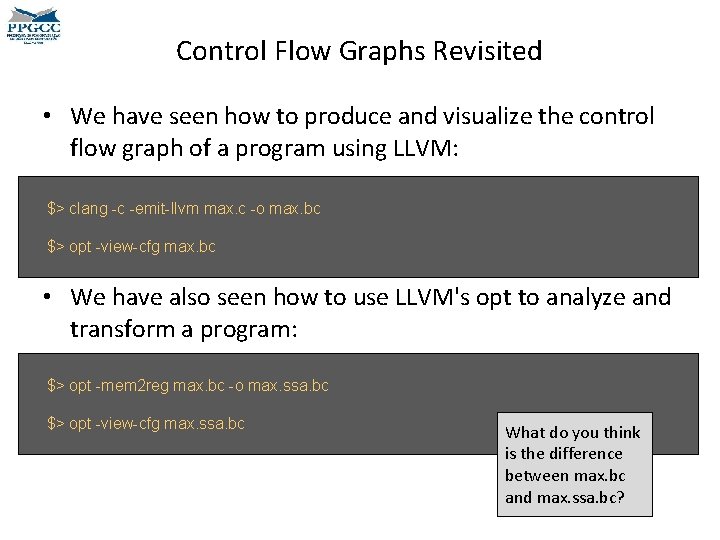
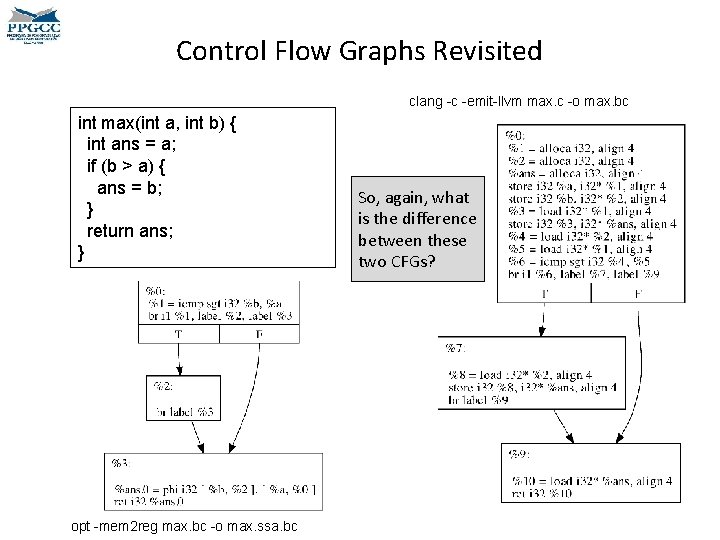
Control Flow Graphs Revisited • We have seen how to produce and visualize the control flow graph of a program using LLVM: $> clang -c -emit-llvm max. c -o max. bc $> opt -view-cfg max. bc • We have also seen how to use LLVM's opt to analyze and transform a program: $> opt -mem 2 reg max. bc -o max. ssa. bc $> opt -view-cfg max. ssa. bc What do you think is the difference between max. bc and max. ssa. bc?
Control Flow Graphs Revisited clang -c -emit-llvm max. c -o max. bc int max(int a, int b) { int ans = a; if (b > a) { ans = b; } return ans; } opt -mem 2 reg max. bc -o max. ssa. bc So, again, what is the difference between these two CFGs?
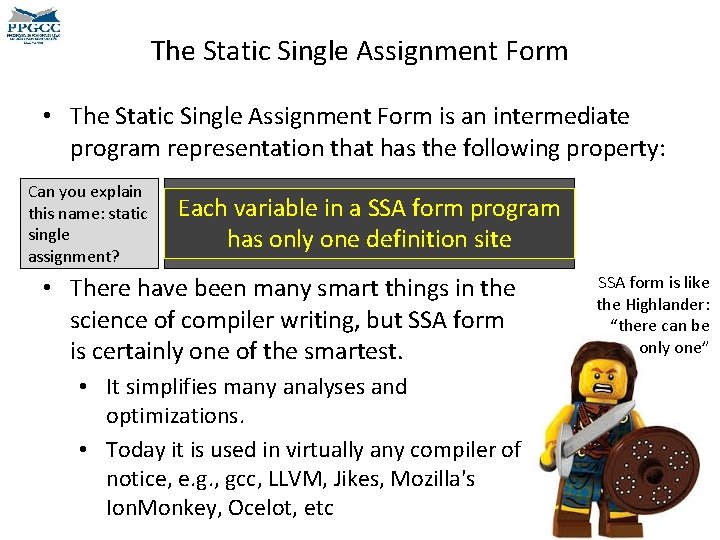
The Static Single Assignment Form • The Static Single Assignment Form is an intermediate program representation that has the following property: Can you explain this name: static single assignment? Each variable in a SSA form program has only one definition site • There have been many smart things in the science of compiler writing, but SSA form is certainly one of the smartest. • It simplifies many analyses and optimizations. • Today it is used in virtually any compiler of notice, e. g. , gcc, LLVM, Jikes, Mozilla's Ion. Monkey, Ocelot, etc SSA form is like the Highlander: “there can be only one”
The Importance of SSA Form • The seminal paper that describes the SSA intermediate program representation has over 2800 citations♧. • Almost every compiler text book talks about SSA form. • Google Scholar returns over five thousand results for the query "Static Single Assignment" The SSA Seminar, in 2011, celebrated the 20 th anniversary of the Static Single Assignment form (April 27 -30, Autrans, France) ♧: Data collected on April of 2019, about the paper "Efficiently computing static single assignment form and the control dependence graph", published in 1991 by Cytron et al.
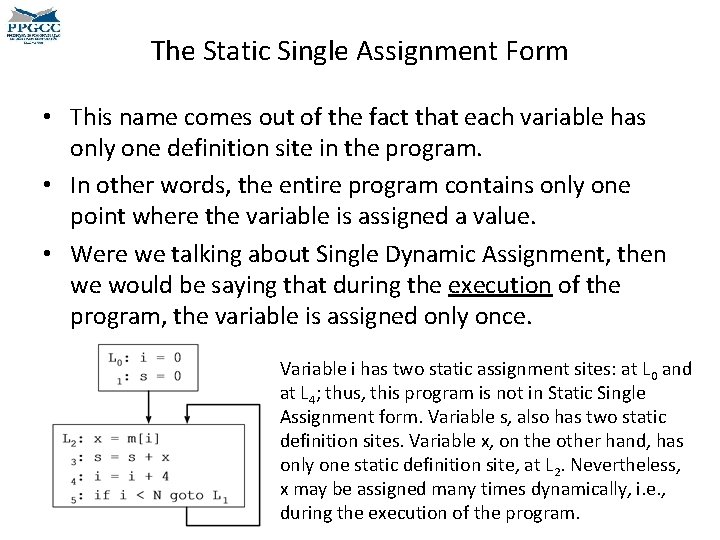
The Static Single Assignment Form • This name comes out of the fact that each variable has only one definition site in the program. • In other words, the entire program contains only one point where the variable is assigned a value. • Were we talking about Single Dynamic Assignment, then we would be saying that during the execution of the program, the variable is assigned only once. Variable i has two static assignment sites: at L 0 and at L 4; thus, this program is not in Static Single Assignment form. Variable s, also has two static definition sites. Variable x, on the other hand, has only one static definition site, at L 2. Nevertheless, x may be assigned many times dynamically, i. e. , during the execution of the program.
DEPARTMENT OF COMPUTER SCIENCE UNIVERSIDADE FEDERAL DE MINAS GERAIS FEDERAL UNIVERSITY OF MINAS GERAIS, BRAZIL TO AND FROM SSA FORM DCC 888
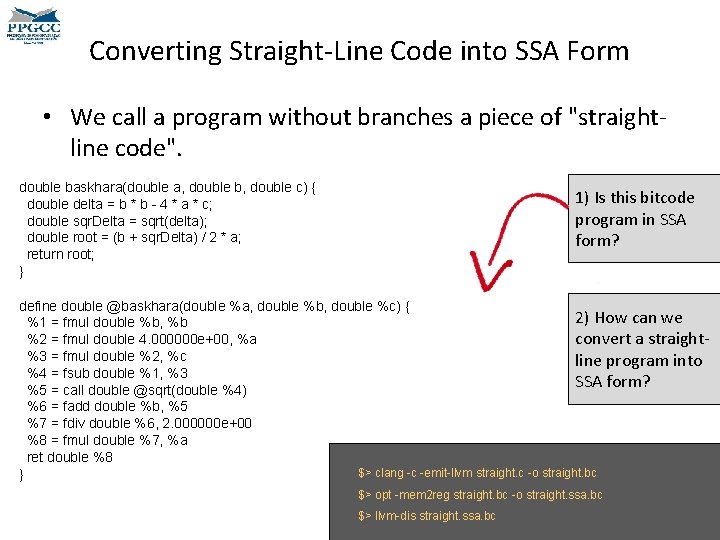
Converting Straight-Line Code into SSA Form • We call a program without branches a piece of "straightline code". double baskhara(double a, double b, double c) { double delta = b * b - 4 * a * c; double sqr. Delta = sqrt(delta); double root = (b + sqr. Delta) / 2 * a; return root; } 1) Is this bitcode program in SSA form? define double @baskhara(double %a, double %b, double %c) { 2) How can we %1 = fmul double %b, %b convert a straight%2 = fmul double 4. 000000 e+00, %a %3 = fmul double %2, %c line program into %4 = fsub double %1, %3 SSA form? %5 = call double @sqrt(double %4) %6 = fadd double %b, %5 %7 = fdiv double %6, 2. 000000 e+00 %8 = fmul double %7, %a ret double %8 $> clang -c -emit-llvm straight. c -o straight. bc } $> opt -mem 2 reg straight. bc -o straight. ssa. bc $> llvm-dis straight. ssa. bc
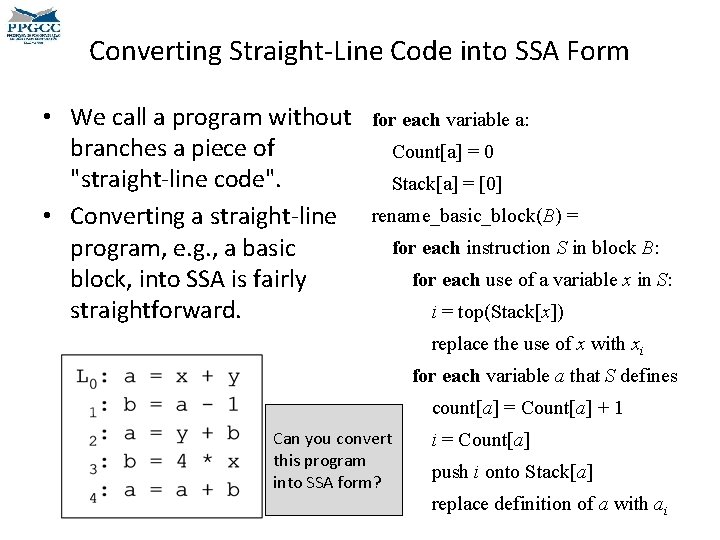
Converting Straight-Line Code into SSA Form • We call a program without branches a piece of "straight-line code". • Converting a straight-line program, e. g. , a basic block, into SSA is fairly straightforward. for each variable a: Count[a] = 0 Stack[a] = [0] rename_basic_block(B) = for each instruction S in block B: for each use of a variable x in S: i = top(Stack[x]) replace the use of x with xi for each variable a that S defines count[a] = Count[a] + 1 Can you convert this program into SSA form? i = Count[a] push i onto Stack[a] replace definition of a with ai
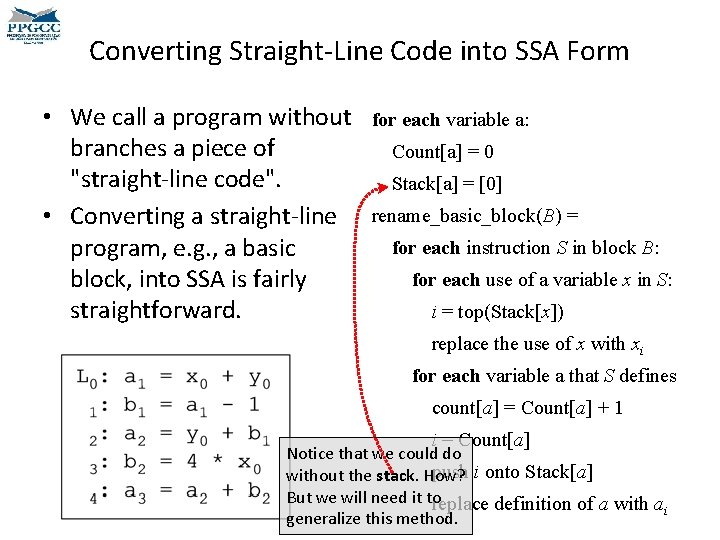
Converting Straight-Line Code into SSA Form • We call a program without branches a piece of "straight-line code". • Converting a straight-line program, e. g. , a basic block, into SSA is fairly straightforward. for each variable a: Count[a] = 0 Stack[a] = [0] rename_basic_block(B) = for each instruction S in block B: for each use of a variable x in S: i = top(Stack[x]) replace the use of x with xi for each variable a that S defines count[a] = Count[a] + 1 i = Count[a] Notice that we could do push i onto Stack[a] without the stack. How? But we will need it to replace definition of a with ai generalize this method.
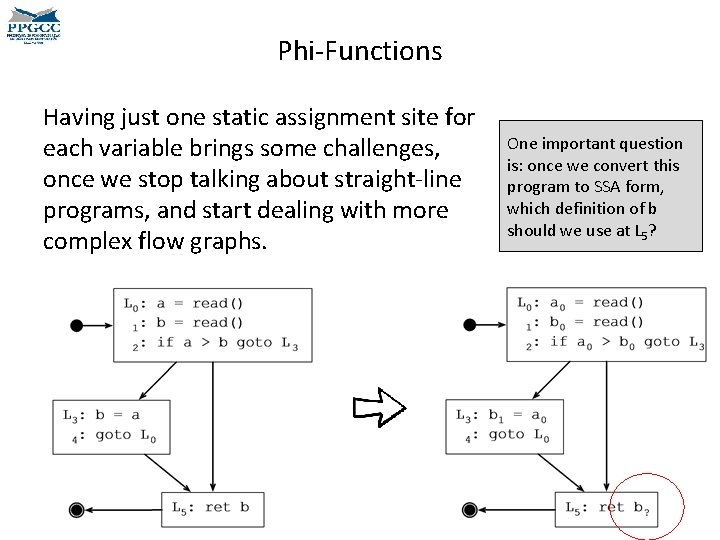
Phi-Functions Having just one static assignment site for each variable brings some challenges, once we stop talking about straight-line programs, and start dealing with more complex flow graphs. One important question is: once we convert this program to SSA form, which definition of b should we use at L 5?
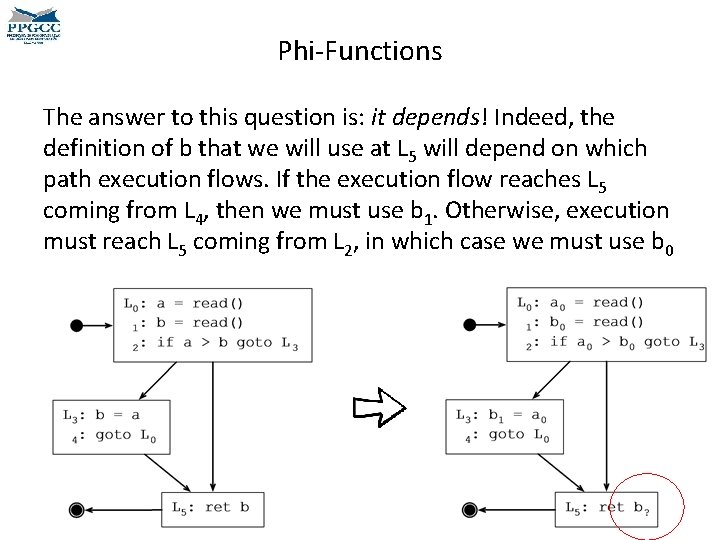
Phi-Functions The answer to this question is: it depends! Indeed, the definition of b that we will use at L 5 will depend on which path execution flows. If the execution flow reaches L 5 coming from L 4, then we must use b 1. Otherwise, execution must reach L 5 coming from L 2, in which case we must use b 0
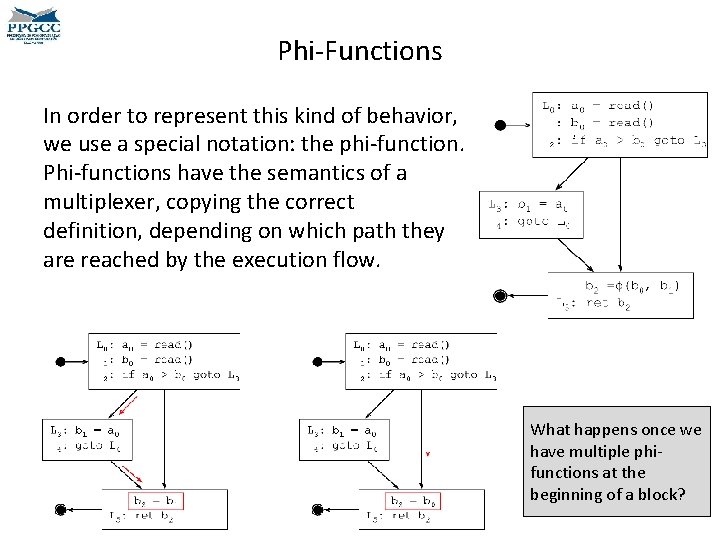
Phi-Functions In order to represent this kind of behavior, we use a special notation: the phi-function. Phi-functions have the semantics of a multiplexer, copying the correct definition, depending on which path they are reached by the execution flow. What happens once we have multiple phifunctions at the beginning of a block?
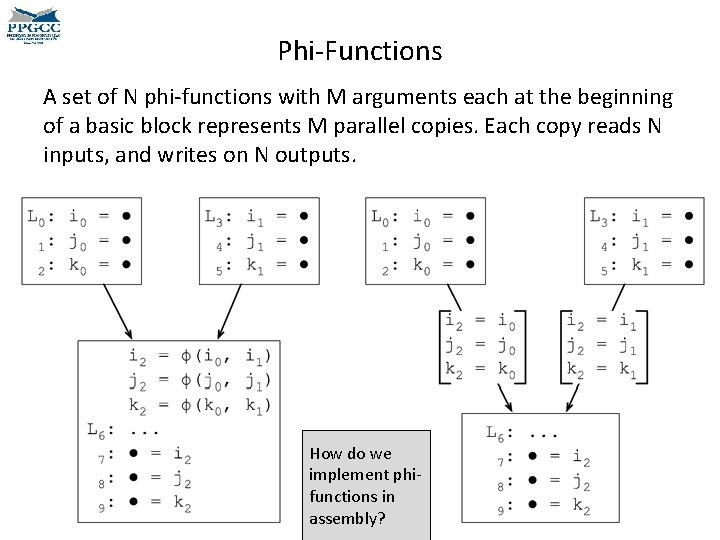
Phi-Functions A set of N phi-functions with M arguments each at the beginning of a basic block represents M parallel copies. Each copy reads N inputs, and writes on N outputs. How do we implement phifunctions in assembly?
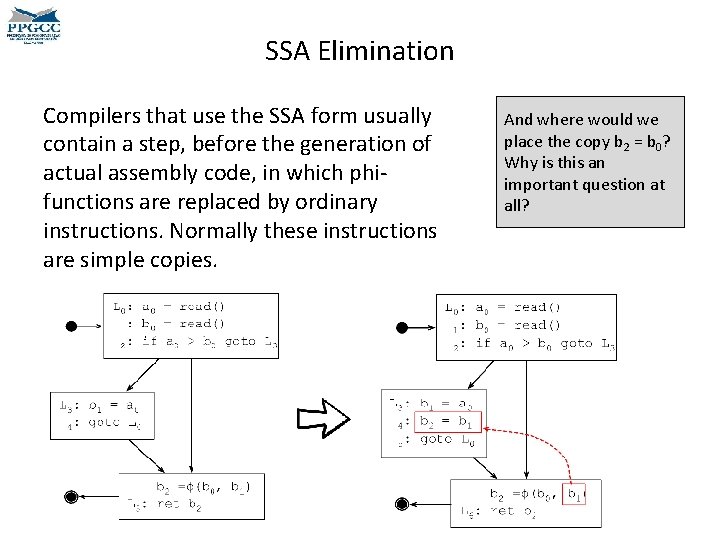
SSA Elimination Compilers that use the SSA form usually contain a step, before the generation of actual assembly code, in which phifunctions are replaced by ordinary instructions. Normally these instructions are simple copies. And where would we place the copy b 2 = b 0? Why is this an important question at all?
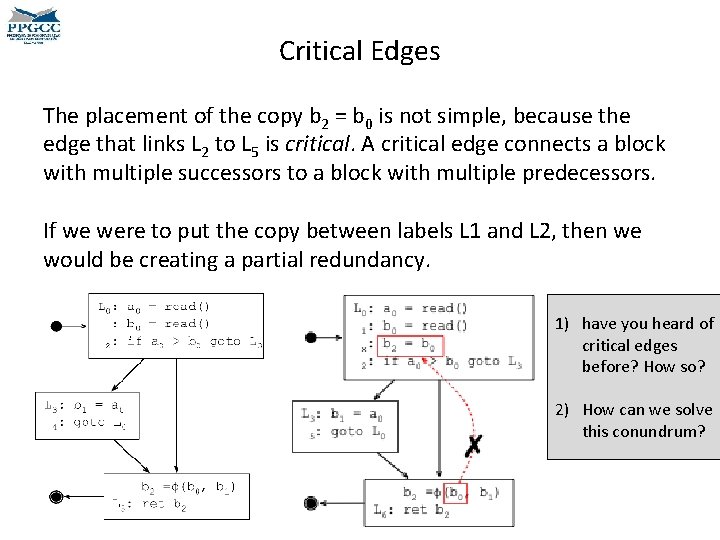
Critical Edges The placement of the copy b 2 = b 0 is not simple, because the edge that links L 2 to L 5 is critical. A critical edge connects a block with multiple successors to a block with multiple predecessors. If we were to put the copy between labels L 1 and L 2, then we would be creating a partial redundancy. 1) have you heard of critical edges before? How so? 2) How can we solve this conundrum?
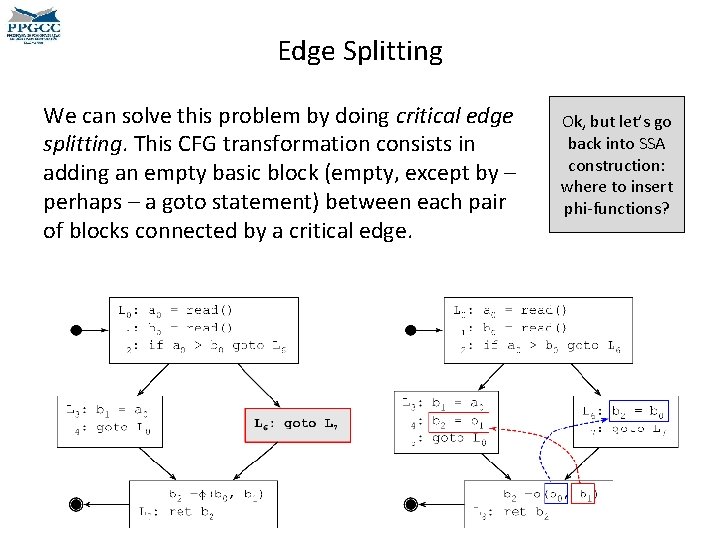
Edge Splitting We can solve this problem by doing critical edge splitting. This CFG transformation consists in adding an empty basic block (empty, except by – perhaps – a goto statement) between each pair of blocks connected by a critical edge. Ok, but let’s go back into SSA construction: where to insert phi-functions?
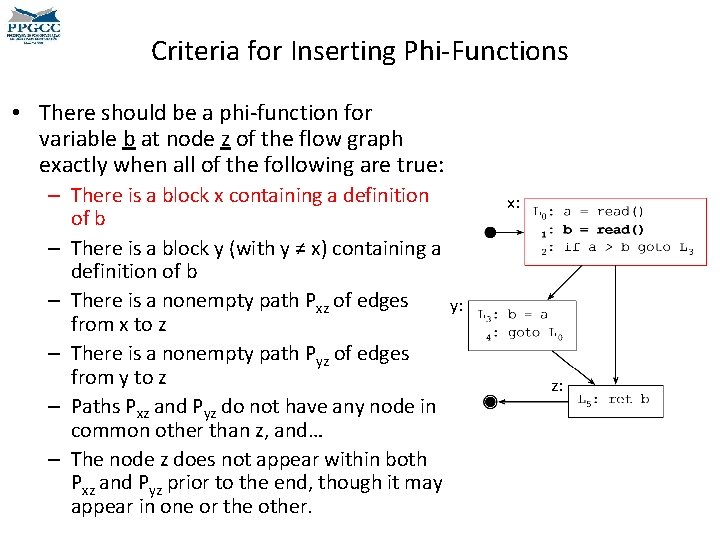
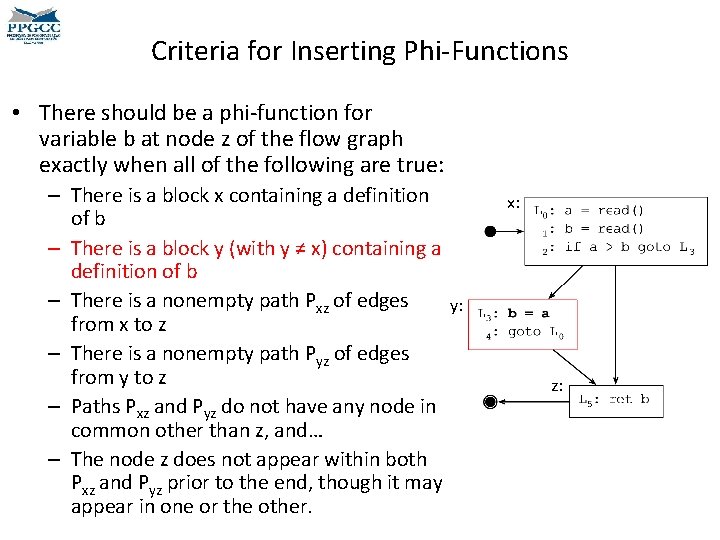
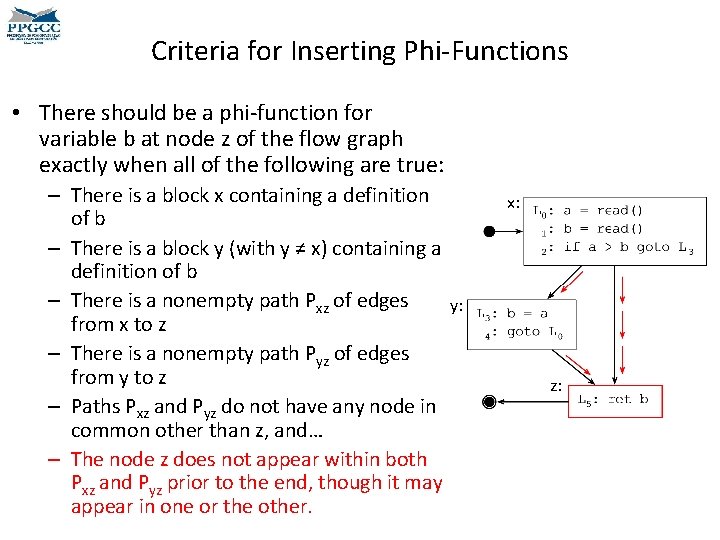
Criteria for Inserting Phi-Functions • There should be a phi-function for variable b at node z of the flow graph exactly when all of the following are true: – There is a block x containing a definition of b – There is a block y (with y ≠ x) containing a definition of b – There is a nonempty path Pxz of edges from x to z – There is a nonempty path Pyz of edges from y to z – Paths Pxz and Pyz do not have any node in common other than z, and… – The node z does not appear within both Pxz and Pyz prior to the end, though it may appear in one or the other. x: y: z:
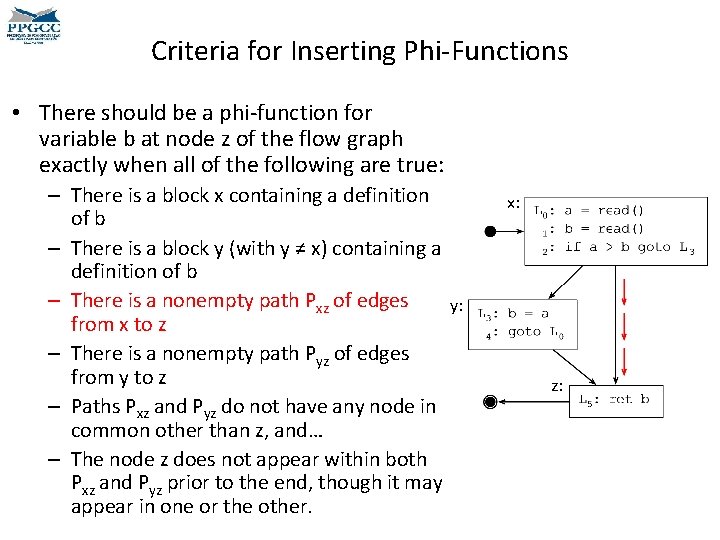
Criteria for Inserting Phi-Functions • There should be a phi-function for variable b at node z of the flow graph exactly when all of the following are true: – There is a block x containing a definition of b – There is a block y (with y ≠ x) containing a definition of b – There is a nonempty path Pxz of edges from x to z – There is a nonempty path Pyz of edges from y to z – Paths Pxz and Pyz do not have any node in common other than z, and… – The node z does not appear within both Pxz and Pyz prior to the end, though it may appear in one or the other. x: y: z:
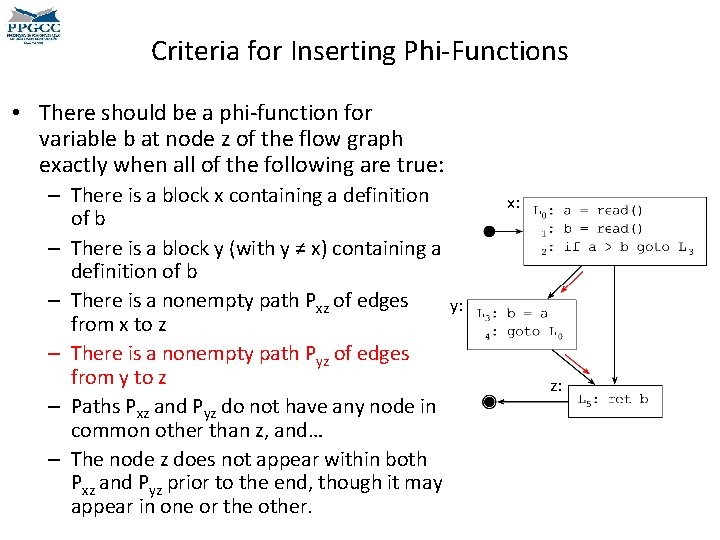
Criteria for Inserting Phi-Functions • There should be a phi-function for variable b at node z of the flow graph exactly when all of the following are true: – There is a block x containing a definition of b – There is a block y (with y ≠ x) containing a definition of b – There is a nonempty path Pxz of edges from x to z – There is a nonempty path Pyz of edges from y to z – Paths Pxz and Pyz do not have any node in common other than z, and… – The node z does not appear within both Pxz and Pyz prior to the end, though it may appear in one or the other. x: y: z:
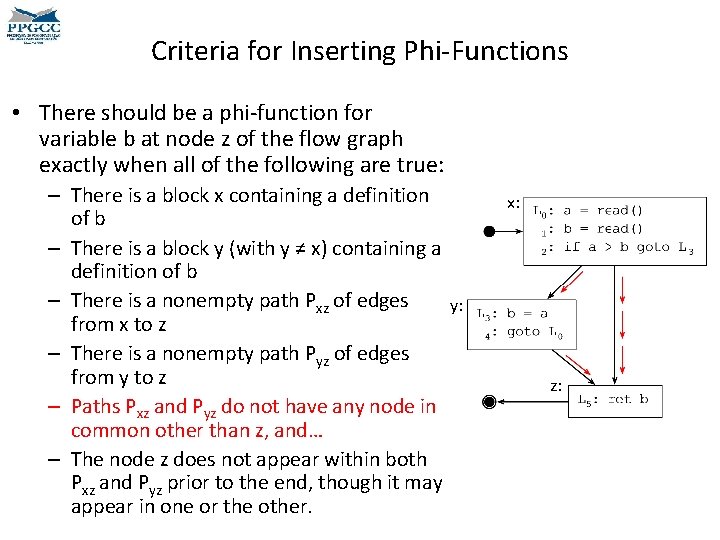
Criteria for Inserting Phi-Functions • There should be a phi-function for variable b at node z of the flow graph exactly when all of the following are true: – There is a block x containing a definition of b – There is a block y (with y ≠ x) containing a definition of b – There is a nonempty path Pxz of edges from x to z – There is a nonempty path Pyz of edges from y to z – Paths Pxz and Pyz do not have any node in common other than z, and… – The node z does not appear within both Pxz and Pyz prior to the end, though it may appear in one or the other. x: y: z:
Criteria for Inserting Phi-Functions • There should be a phi-function for variable b at node z of the flow graph exactly when all of the following are true: – There is a block x containing a definition of b – There is a block y (with y ≠ x) containing a definition of b – There is a nonempty path Pxz of edges from x to z – There is a nonempty path Pyz of edges from y to z – Paths Pxz and Pyz do not have any node in common other than z, and… – The node z does not appear within both Pxz and Pyz prior to the end, though it may appear in one or the other. x: y: z:
Criteria for Inserting Phi-Functions • There should be a phi-function for variable b at node z of the flow graph exactly when all of the following are true: – There is a block x containing a definition of b – There is a block y (with y ≠ x) containing a definition of b – There is a nonempty path Pxz of edges from x to z – There is a nonempty path Pyz of edges from y to z – Paths Pxz and Pyz do not have any node in common other than z, and… – The node z does not appear within both Pxz and Pyz prior to the end, though it may appear in one or the other. x: y: z:
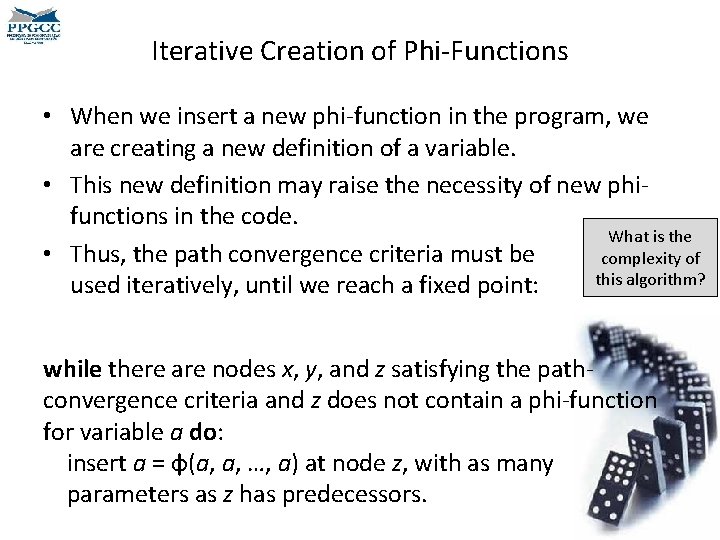
Iterative Creation of Phi-Functions • When we insert a new phi-function in the program, we are creating a new definition of a variable. • This new definition may raise the necessity of new phifunctions in the code. What is the • Thus, the path convergence criteria must be complexity of this algorithm? used iteratively, until we reach a fixed point: while there are nodes x, y, and z satisfying the pathconvergence criteria and z does not contain a phi-function for variable a do: insert a = φ(a, a, …, a) at node z, with as many parameters as z has predecessors.
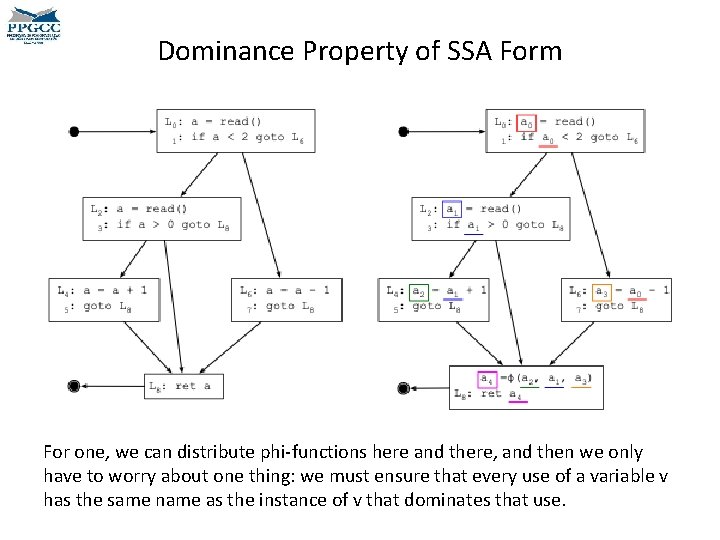
Dominance Property of SSA Form The previous algorithm is a bit too expensive. Let's see a faster one. But, to do it, we will need the notion of dominance frontier. • A node d of a rooted, directed graph dominates another node n if every path from the root node to n goes through d. • In Strict♤ SSA form programs, definitions of variables dominate their uses: – If x is the i-th argument of a phi-function in block n, then the definition of x dominates the i-th predecessor of n. – If x is used in a non-phi statement in block n, then the definition of x dominates node n. ♤: A program is strict if every variable is initialized before it is used. Where have we heard of dominance before?
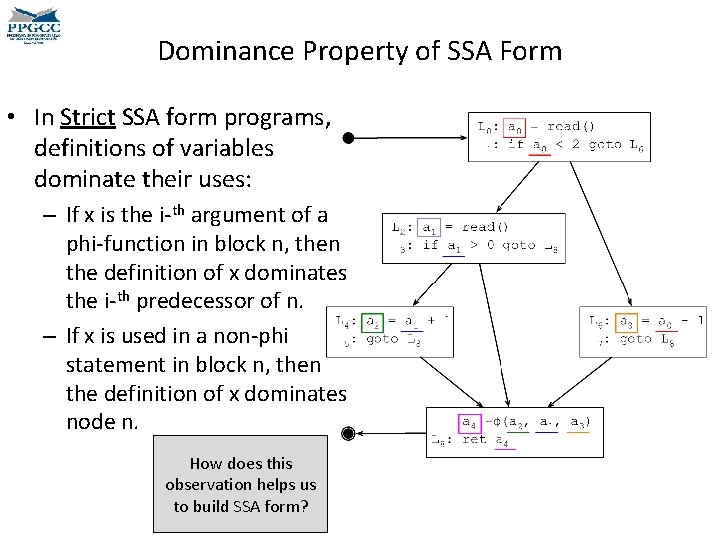
Dominance Property of SSA Form • In Strict SSA form programs, definitions of variables dominate their uses: – If x is the i-th argument of a phi-function in block n, then the definition of x dominates the i-th predecessor of n. – If x is used in a non-phi statement in block n, then the definition of x dominates node n. How does this observation helps us to build SSA form?
Dominance Property of SSA Form For one, we can distribute phi-functions here and there, and then we only have to worry about one thing: we must ensure that every use of a variable v has the same name as the instance of v that dominates that use.
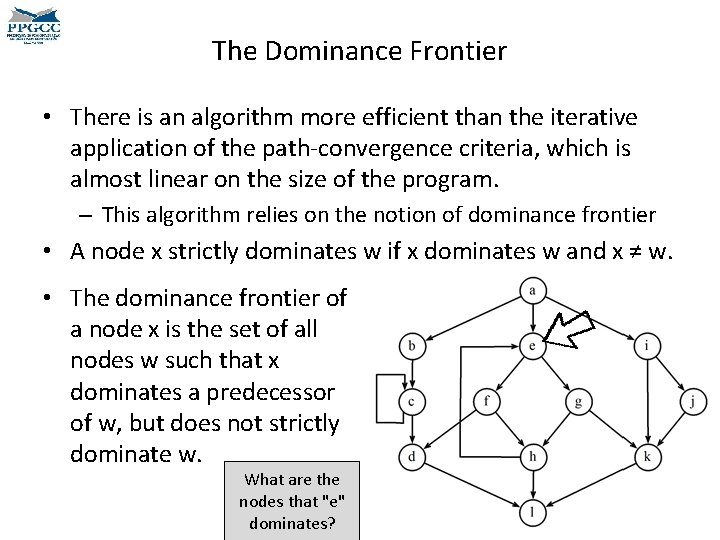
The Dominance Frontier • There is an algorithm more efficient than the iterative application of the path-convergence criteria, which is almost linear on the size of the program. – This algorithm relies on the notion of dominance frontier • A node x strictly dominates w if x dominates w and x ≠ w. • The dominance frontier of a node x is the set of all nodes w such that x dominates a predecessor of w, but does not strictly dominate w. What are the nodes that "e" dominates?
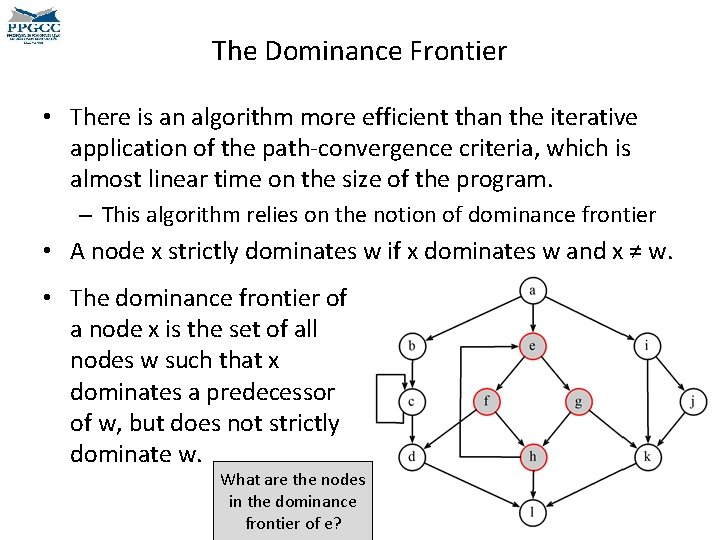
The Dominance Frontier • There is an algorithm more efficient than the iterative application of the path-convergence criteria, which is almost linear time on the size of the program. – This algorithm relies on the notion of dominance frontier • A node x strictly dominates w if x dominates w and x ≠ w. • The dominance frontier of a node x is the set of all nodes w such that x dominates a predecessor of w, but does not strictly dominate w. What are the nodes in the dominance frontier of e?
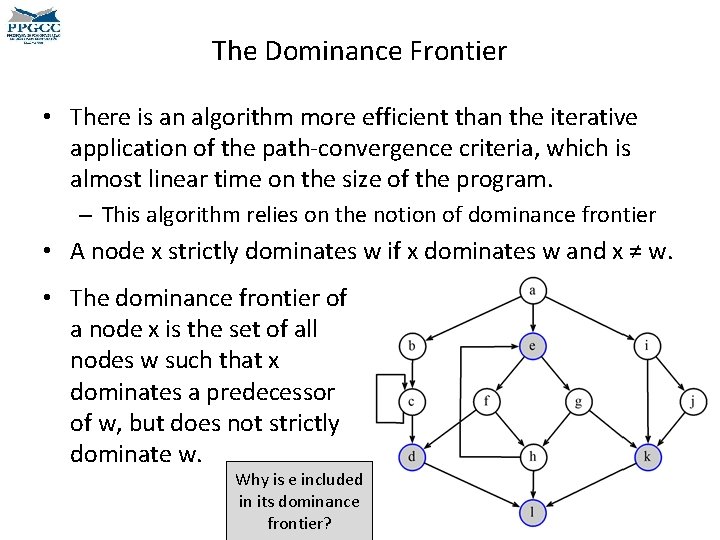
The Dominance Frontier • There is an algorithm more efficient than the iterative application of the path-convergence criteria, which is almost linear time on the size of the program. – This algorithm relies on the notion of dominance frontier • A node x strictly dominates w if x dominates w and x ≠ w. • The dominance frontier of a node x is the set of all nodes w such that x dominates a predecessor of w, but does not strictly dominate w. Why is e included in its dominance frontier?
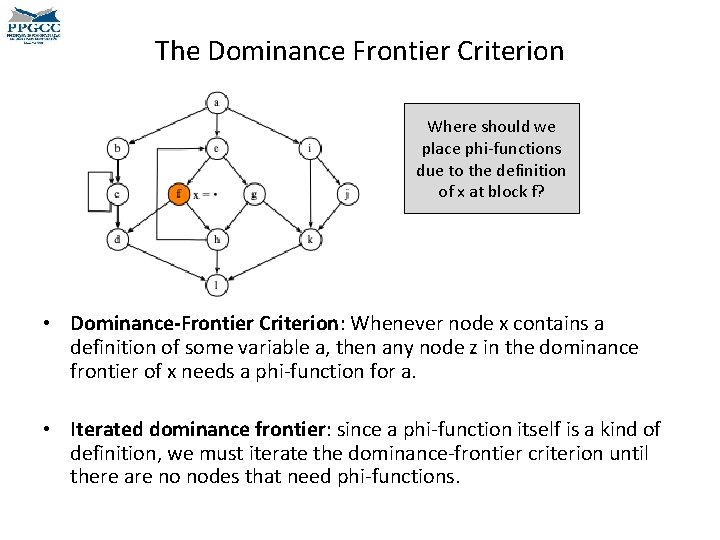
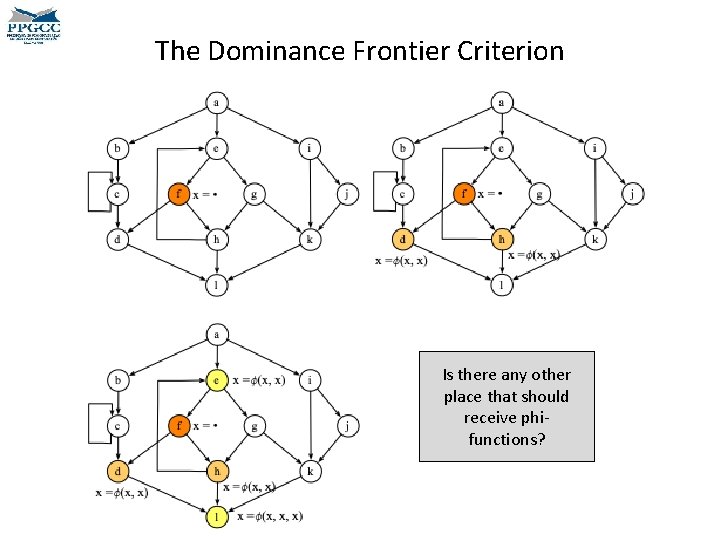
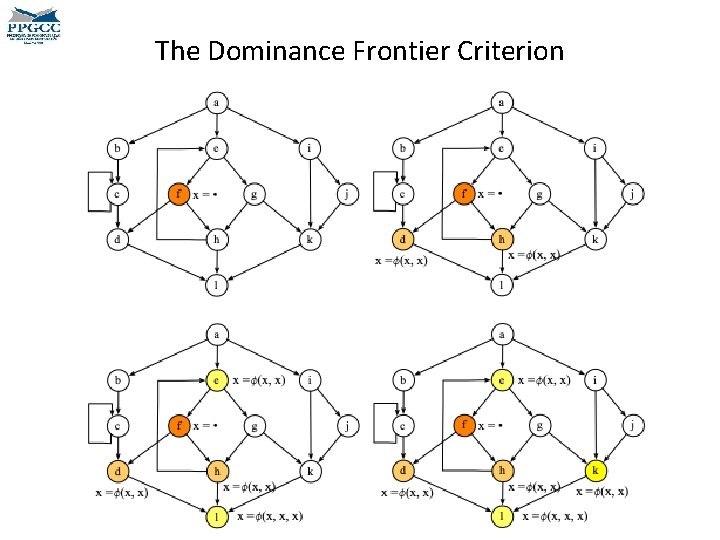
The Dominance Frontier Criterion • Dominance-Frontier Criterion: Whenever node x contains a definition of some variable a, then any node z in the dominance frontier of x needs a phi-function for a. • Iterated dominance frontier: since a phi-function itself is a kind of definition, we must iterate the dominancefrontier criterion until there are no nodes that need phifunctions. Theorem: the iterated dominance frontier criterion and the iterated path-convergence criterion specify exactly the same set of nodes at which to put phi-functions.
The Dominance Frontier Criterion Where should we place phi-functions due to the definition of x at block f? • Dominance-Frontier Criterion: Whenever node x contains a definition of some variable a, then any node z in the dominance frontier of x needs a phi-function for a. • Iterated dominance frontier: since a phi-function itself is a kind of definition, we must iterate the dominance-frontier criterion until there are no nodes that need phi-functions.
The Dominance Frontier Criterion Is there any other place that should receive phifunctions?
The Dominance Frontier Criterion
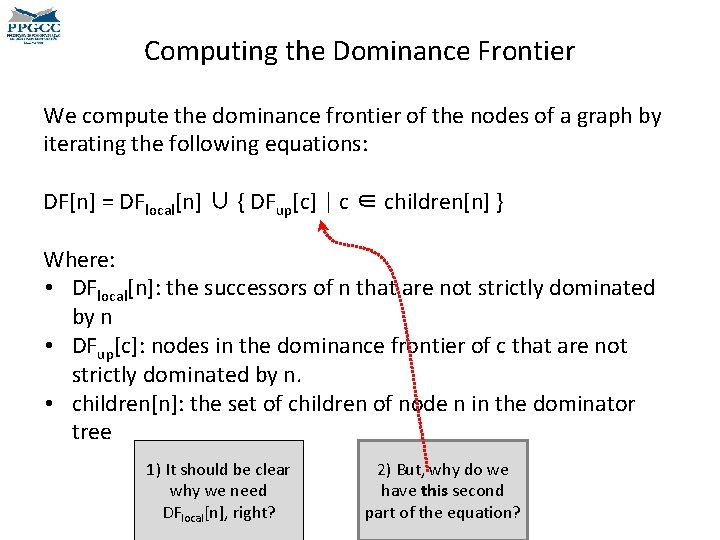
Computing the Dominance Frontier We compute the dominance frontier of the nodes of a graph by iterating the following equations: DF[n] = DFlocal[n] ∪ { DFup[c] | c ∈ children[n] } Where: • DFlocal[n]: the successors of n that are not strictly dominated by n • DFup[c]: nodes in the dominance frontier of c that are not strictly dominated by n. • children[n]: the set of children of node n in the dominator tree 1) It should be clear why we need DFlocal[n], right? 2) But, why do we have this second part of the equation?
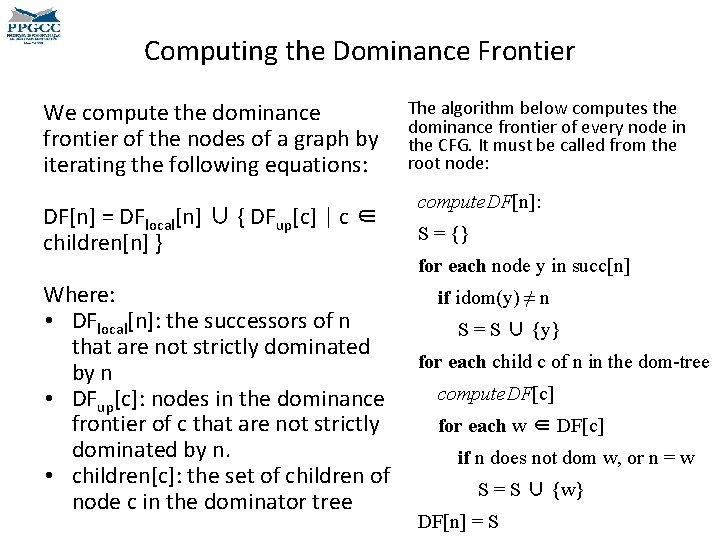
Computing the Dominance Frontier We compute the dominance frontier of the nodes of a graph by iterating the following equations: DF[n] = DFlocal[n] ∪ { DFup[c] | c ∈ children[n] } Where: • DFlocal[n]: the successors of n that are not strictly dominated by n • DFup[c]: nodes in the dominance frontier of c that are not strictly dominated by n. • children[c]: the set of children of node c in the dominator tree The algorithm below computes the dominance frontier of every node in the CFG. It must be called from the root node: compute. DF[n]: S = {} for each node y in succ[n] if idom(y) ≠ n S = S ∪ {y} for each child c of n in the dom-tree compute. DF[c] for each w ∈ DF[c] if n does not dom w, or n = w S = S ∪ {w} DF[n] = S
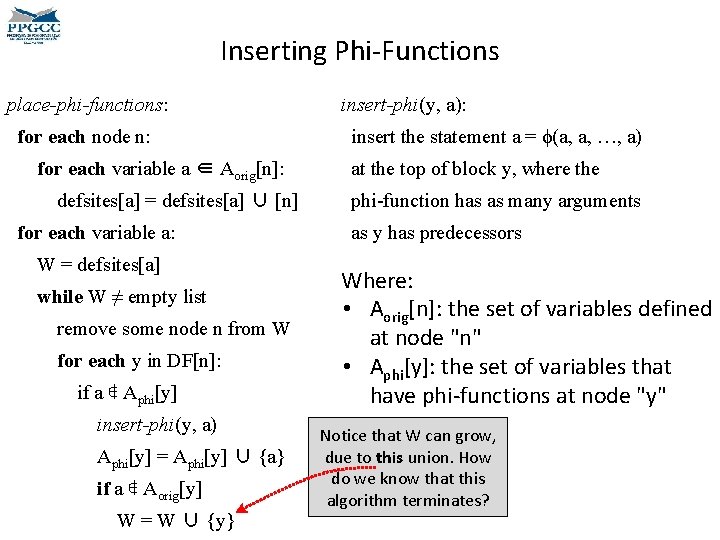
Inserting Phi-Functions place-phi-functions: for each node n: for each variable a ∈ Aorig[n]: defsites[a] = defsites[a] ∪ [n] for each variable a: W = defsites[a] while W ≠ empty list remove some node n from W for each y in DF[n]: if a ∉ Aphi[y] insert-phi(y, a) Aphi[y] = Aphi[y] ∪ {a} if a ∉ Aorig[y] W = W ∪ {y} insert-phi(y, a): insert the statement a = ϕ(a, a, …, a) at the top of block y, where the phi-function has as many arguments as y has predecessors Where: • Aorig[n]: the set of variables defined at node "n" • Aphi[y]: the set of variables that have phi-functions at node "y" Notice that W can grow, due to this union. How do we know that this algorithm terminates?
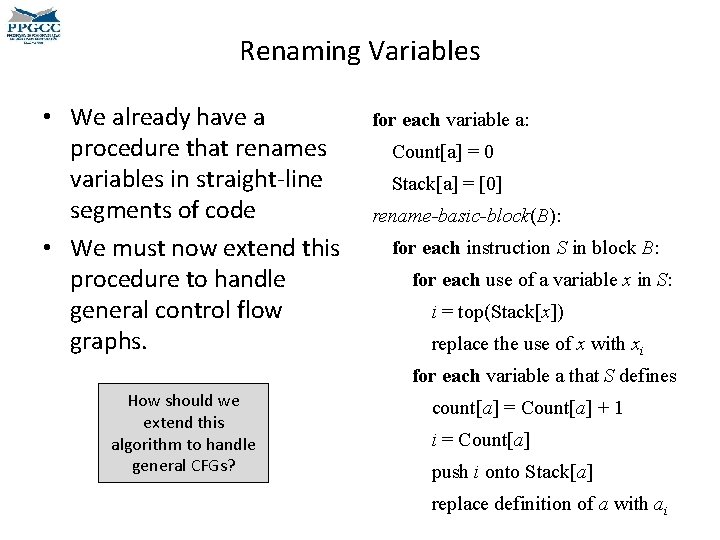
Renaming Variables • We already have a procedure that renames variables in straight-line segments of code • We must now extend this procedure to handle general control flow graphs. for each variable a: Count[a] = 0 Stack[a] = [0] rename-basic-block(B): for each instruction S in block B: for each use of a variable x in S: i = top(Stack[x]) replace the use of x with xi for each variable a that S defines How should we extend this algorithm to handle general CFGs? count[a] = Count[a] + 1 i = Count[a] push i onto Stack[a] replace definition of a with ai
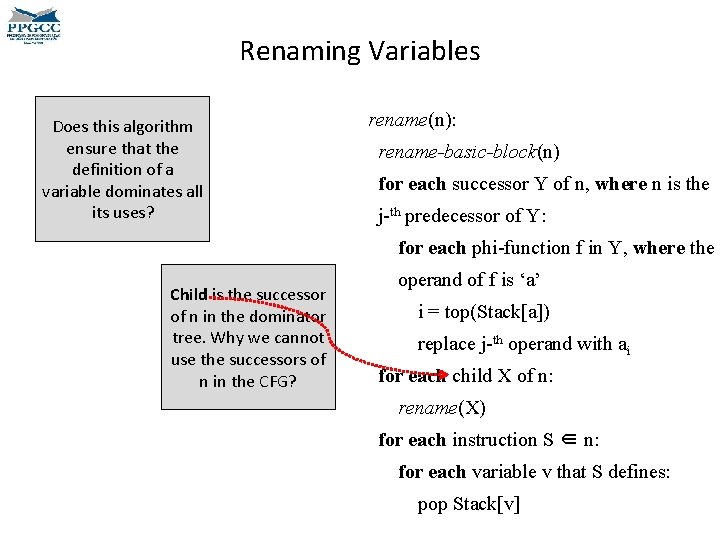
Renaming Variables Does this algorithm ensure that the definition of a variable dominates all its uses? rename(n): rename-basic-block(n) for each successor Y of n, where n is the j-th predecessor of Y: for each phi-function f in Y, where the Child is the successor of n in the dominator tree. Why we cannot use the successors of n in the CFG? operand of f is ‘a’ i = top(Stack[a]) replace j-th operand with ai for each child X of n: rename(X) for each instruction S ∈ n: for each variable v that S defines: pop Stack[v]
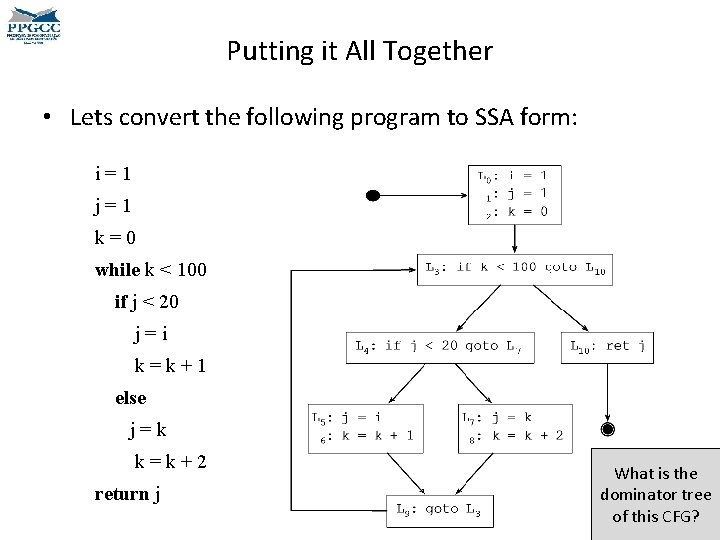
Putting it All Together • Lets convert the following program to SSA form: i=1 j=1 k=0 while k < 100 if j < 20 j=i k=k+1 else j=k k=k+2 return j What is the dominator tree of this CFG?
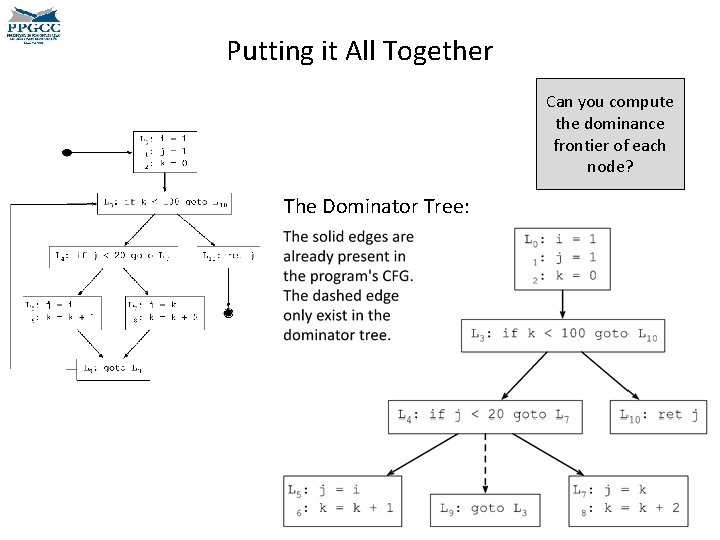
Putting it All Together Can you compute the dominance frontier of each node? The Dominator Tree:
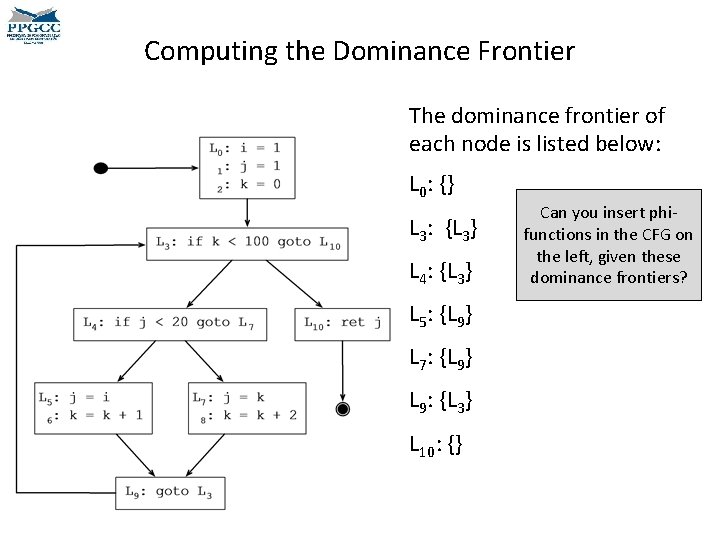
Computing the Dominance Frontier The dominance frontier of each node is listed below: L 0: {} L 3: {L 3} L 4: {L 3} L 5: {L 9} L 7: {L 9} L 9: {L 3} L 10: {} Can you insert phifunctions in the CFG on the left, given these dominance frontiers?
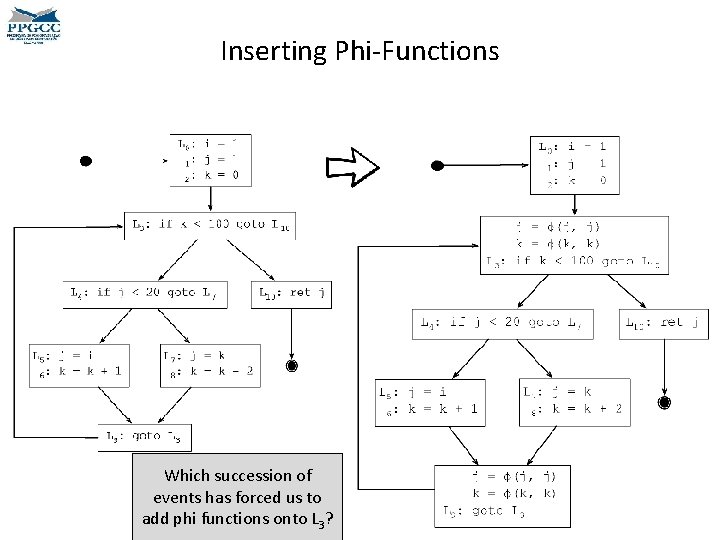
Inserting Phi-Functions Which succession of events has forced us to add phi functions onto L 3?
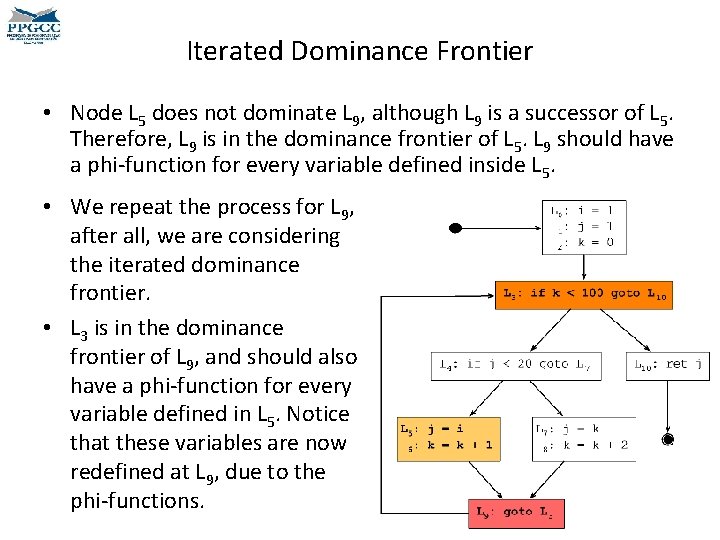
Iterated Dominance Frontier • Node L 5 does not dominate L 9, although L 9 is a successor of L 5. Therefore, L 9 is in the dominance frontier of L 5. L 9 should have a phi-function for every variable defined inside L 5. • We repeat the process for L 9, after all, we are considering the iterated dominance frontier. • L 3 is in the dominance frontier of L 9, and should also have a phi-function for every variable defined in L 5. Notice that these variables are now redefined at L 9, due to the phi-functions.
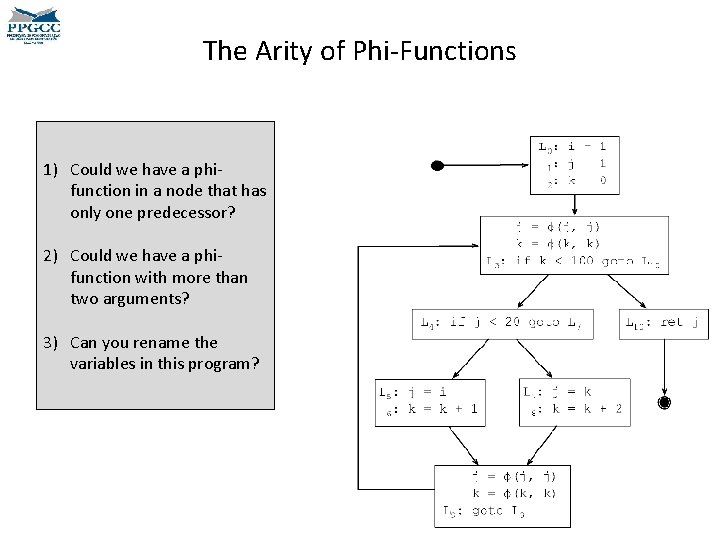
The Arity of Phi-Functions 1) Could we have a phifunction in a node that has only one predecessor? 2) Could we have a phifunction with more than two arguments? 3) Can you rename the variables in this program?
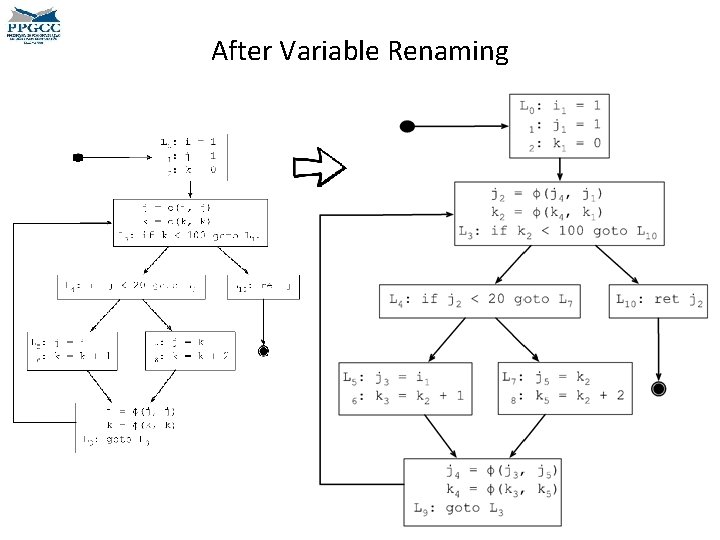
After Variable Renaming
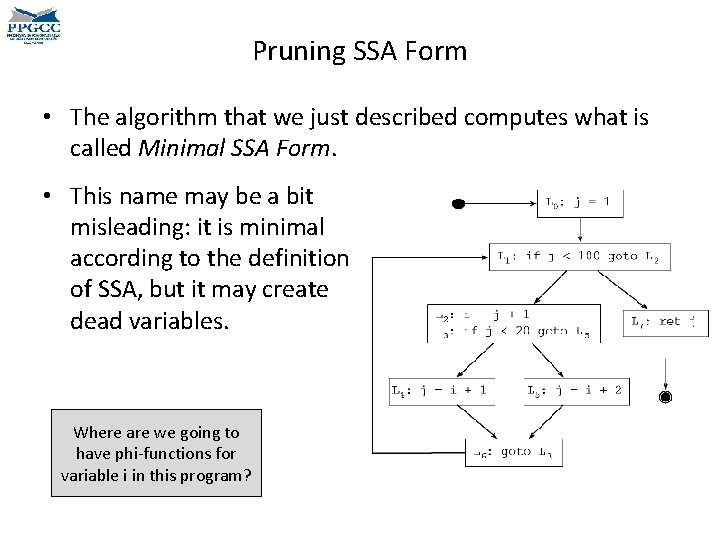
Pruning SSA Form • The algorithm that we just described computes what is called Minimal SSA Form. • This name may be a bit misleading: it is minimal according to the definition of SSA, but it may create dead variables. Where are we going to have phi-functions for variable i in this program?
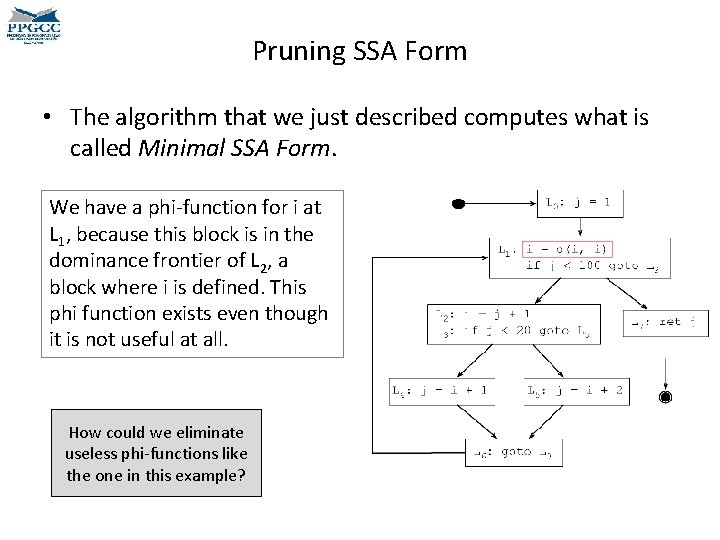
Pruning SSA Form • The algorithm that we just described computes what is called Minimal SSA Form. We have a phi-function for i at L 1, because this block is in the dominance frontier of L 2, a block where i is defined. This phi function exists even though it is not useful at all. How could we eliminate useless phi-functions like the one in this example?
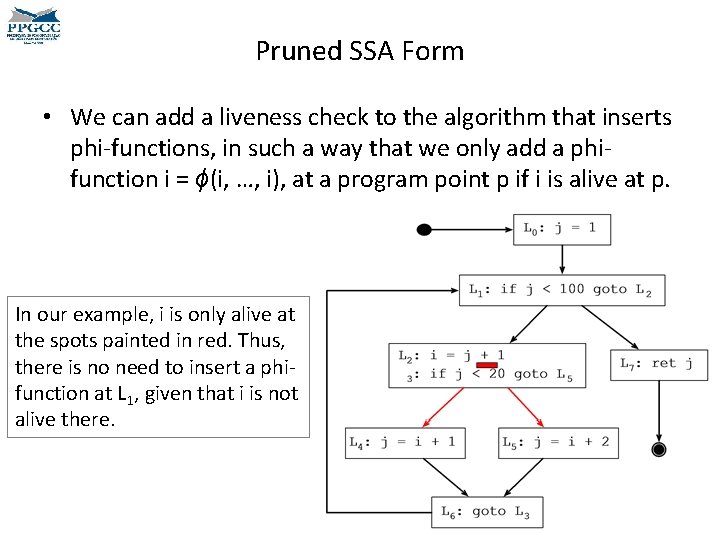
Pruned SSA Form • We can add a liveness check to the algorithm that inserts phi-functions, in such a way that we only add a phifunction i = ϕ(i, …, i), at a program point p if i is alive at p. In our example, i is only alive at the spots painted in red. Thus, there is no need to insert a phifunction at L 1, given that i is not alive there.
DEPARTMENT OF COMPUTER SCIENCE UNIVERSIDADE FEDERAL DE MINAS GERAIS FEDERAL UNIVERSITY OF MINAS GERAIS, BRAZIL SPARSE ANALYSES DCC 888
Sparse Analyses • The Static Single Assignment form "sparsifies" many dataflow analyses. • A sparse analysis associates information with the variable itself, instead of associating information with pairs formed by variables and program points. These analyses require an essential property to work correctly. What property?
Sparse Analyses • The Static Single Assignment form "sparsifies" many dataflow analyses. • A sparse analysis associates information with the variable itself, instead of associating information with pairs formed by variables and program points. • These analyses only work correctly if the information associated with a variable is invariant along the entire live range of that variable. Examples of information include: – The variable is a constant – The variable is used somewhere – etc
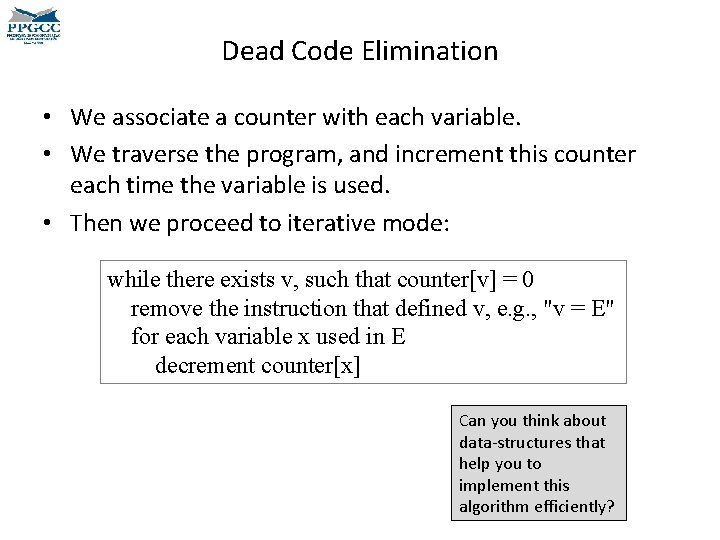
Dead Code Elimination • Dead code elimination is a code optimization that removes from the program instructions whose definitions have no uses. • This optimization has a fairly simplementation for SSA form programs: Dead Variables How can we implement dead-code elimination in SSAform programs?
Dead Code Elimination • Dead code elimination is a code optimization that removes from the program instructions whose definitions have no uses. • This optimization has a fairly simplementation for SSA form programs: while there is some variable v with no uses and the statement that defines v has no other side effects, delete the statement that defines v from the program. What is the asymptotic complexity of this algorithm?
Dead Code Elimination • We associate a counter with each variable. • We traverse the program, and increment this counter each time the variable is used. • Then we proceed to iterative mode: while there exists v, such that counter[v] = 0 remove the instruction that defined v, e. g. , "v = E" for each variable x used in E decrement counter[x] Can you think about data-structures that help you to implement this algorithm efficiently?
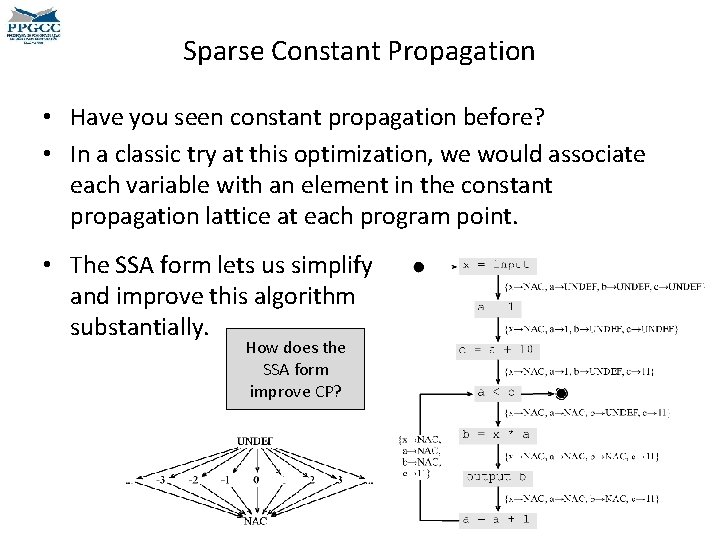
Sparse Constant Propagation • Have you seen constant propagation before? • In a classic try at this optimization, we would associate each variable with an element in the constant propagation lattice at each program point. • The SSA form lets us simplify and improve this algorithm substantially. How does the SSA form improve CP?
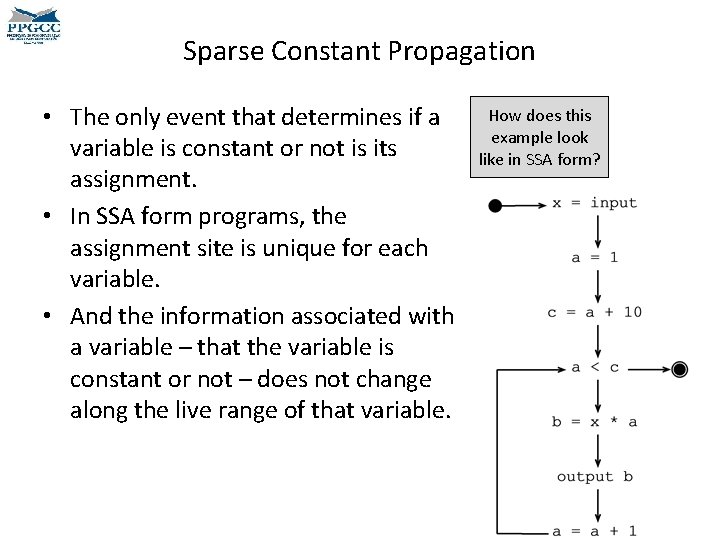
Sparse Constant Propagation • The only event that determines if a variable is constant or not is its assignment. • In SSA form programs, the assignment site is unique for each variable. • And the information associated with a variable – that the variable is constant or not – does not change along the live range of that variable. How does this example look like in SSA form?
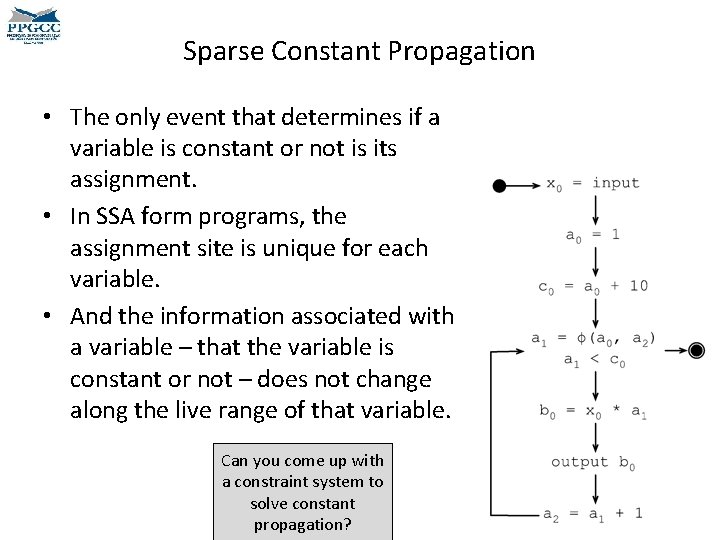
Sparse Constant Propagation • The only event that determines if a variable is constant or not is its assignment. • In SSA form programs, the assignment site is unique for each variable. • And the information associated with a variable – that the variable is constant or not – does not change along the live range of that variable. Can you come up with a constraint system to solve constant propagation?
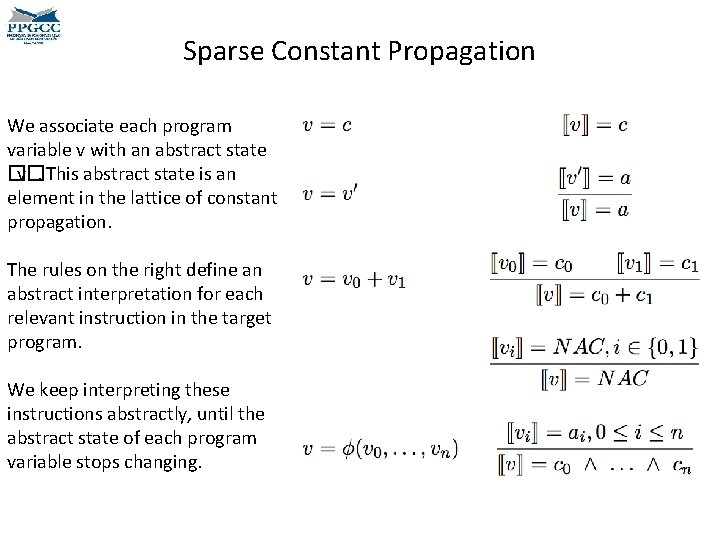
Sparse Constant Propagation We associate each program variable v with an abstract state �v�. This abstract state is an element in the lattice of constant propagation. The rules on the right define an abstract interpretation for each relevant instruction in the target program. We keep interpreting these instructions abstractly, until the abstract state of each program variable stops changing.
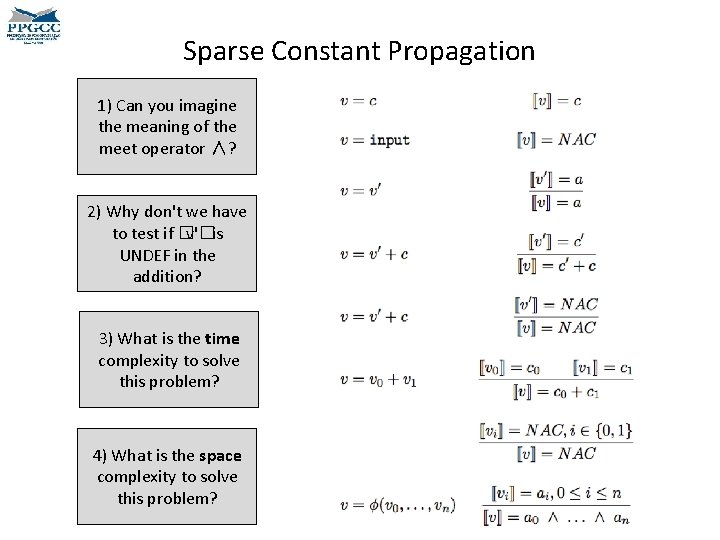
Sparse Constant Propagation 1) Can you imagine the meaning of the meet operator ∧? 2) Why don't we have to test if �v'�is UNDEF in the addition? 3) What is the time complexity to solve this problem? 4) What is the space complexity to solve this problem?
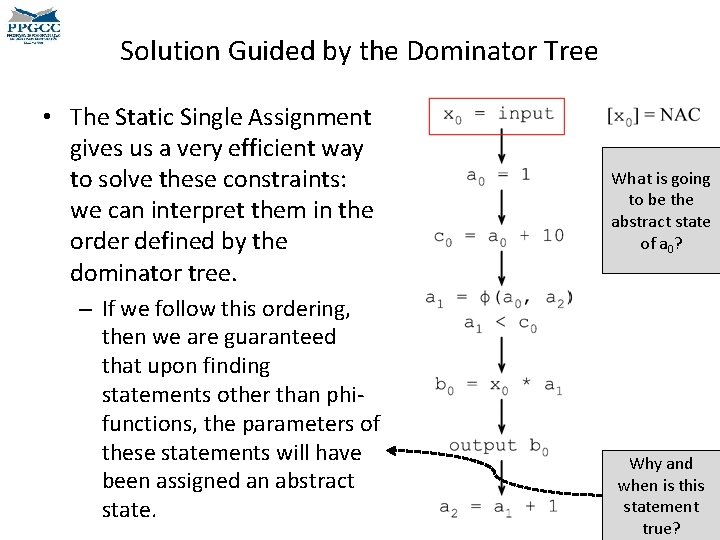
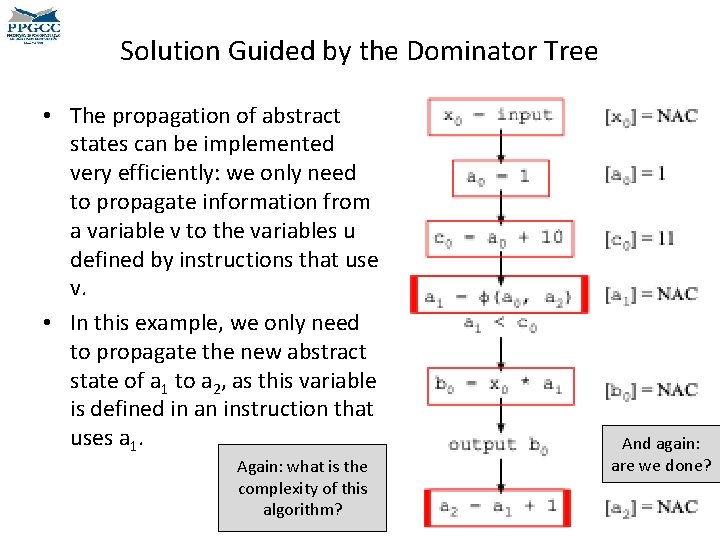
Solution Guided by the Dominator Tree • The Static Single Assignment gives us a very efficient way to solve these constraints: we can interpret them in the order defined by the dominator tree. – If we follow this ordering, then we are guaranteed that upon finding statements other than phifunctions, the parameters of these statements will have been assigned an abstract state. What is going to be the abstract state of a 0? Why and when is this statement true?
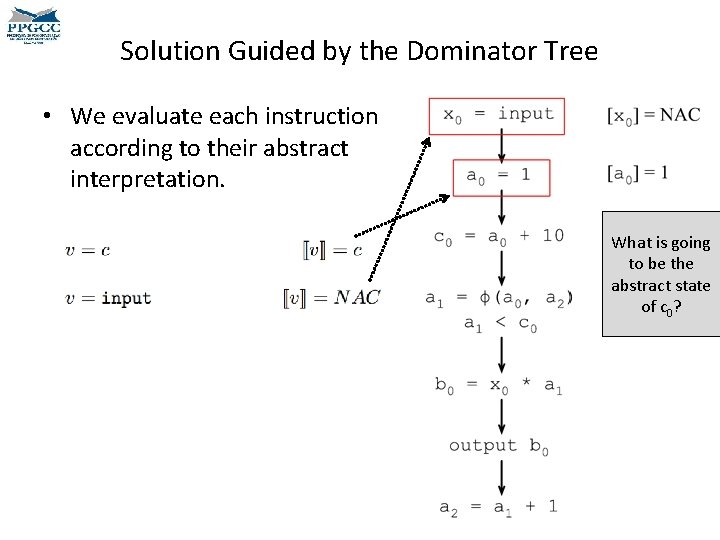
Solution Guided by the Dominator Tree • We evaluate each instruction according to their abstract interpretation. What is going to be the abstract state of c 0?
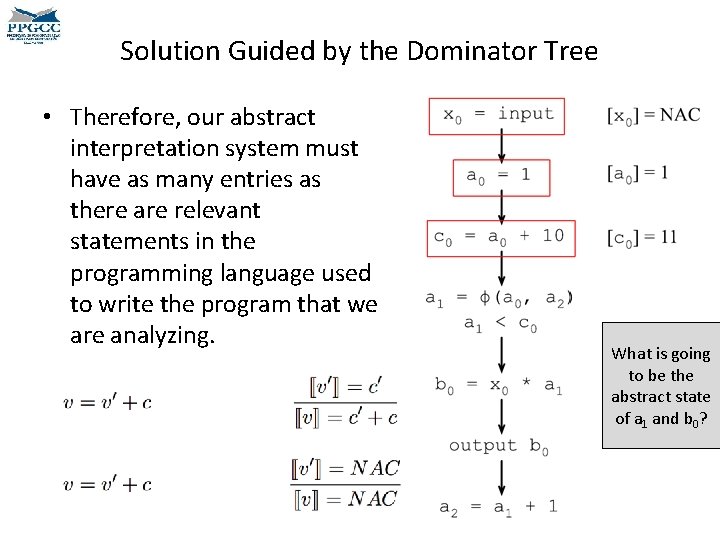
Solution Guided by the Dominator Tree • Therefore, our abstract interpretation system must have as many entries as there are relevant statements in the programming language used to write the program that we are analyzing. What is going to be the abstract state of a 1 and b 0?
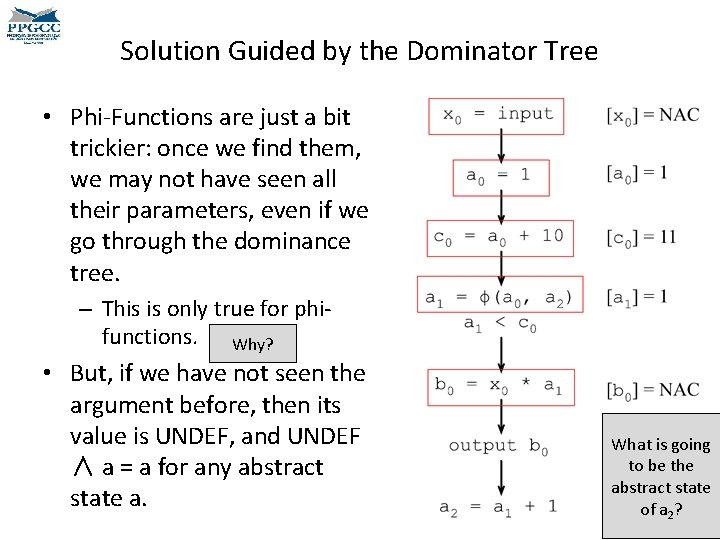
Solution Guided by the Dominator Tree • Phi-Functions are just a bit trickier: once we find them, we may not have seen all their parameters, even if we go through the dominance tree. – This is only true for phifunctions. Why? • But, if we have not seen the argument before, then its value is UNDEF, and UNDEF ∧ a = a for any abstract state a. What is going to be the abstract state of a 2?
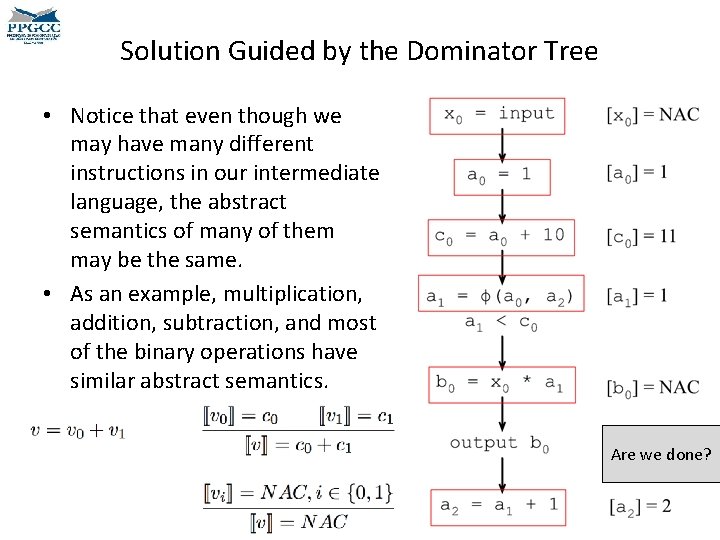
Solution Guided by the Dominator Tree • Notice that even though we may have many different instructions in our intermediate language, the abstract semantics of many of them may be the same. • As an example, multiplication, addition, subtraction, and most of the binary operations have similar abstract semantics. Are we done?
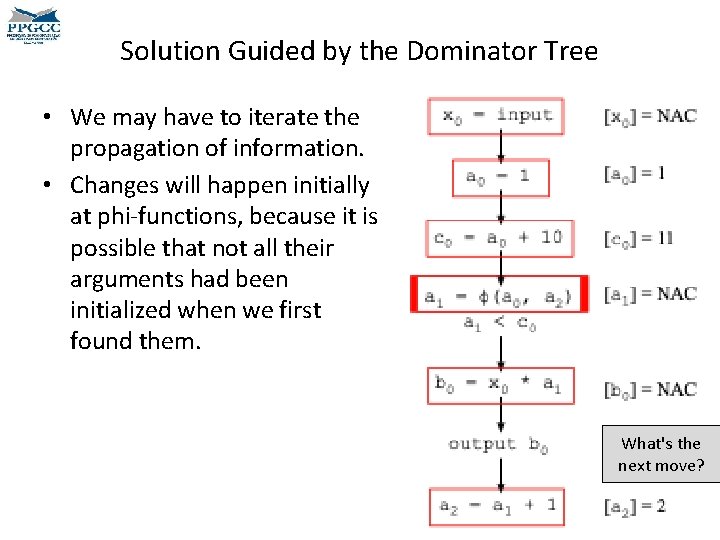
Solution Guided by the Dominator Tree • We may have to iterate the propagation of information. • Changes will happen initially at phi-functions, because it is possible that not all their arguments had been initialized when we first found them. What's the next move?
Solution Guided by the Dominator Tree • The propagation of abstract states can be implemented very efficiently: we only need to propagate information from a variable v to the variables u defined by instructions that use v. • In this example, we only need to propagate the new abstract state of a 1 to a 2, as this variable is defined in an instruction that uses a 1. Again: what is the complexity of this algorithm? And again: are we done?
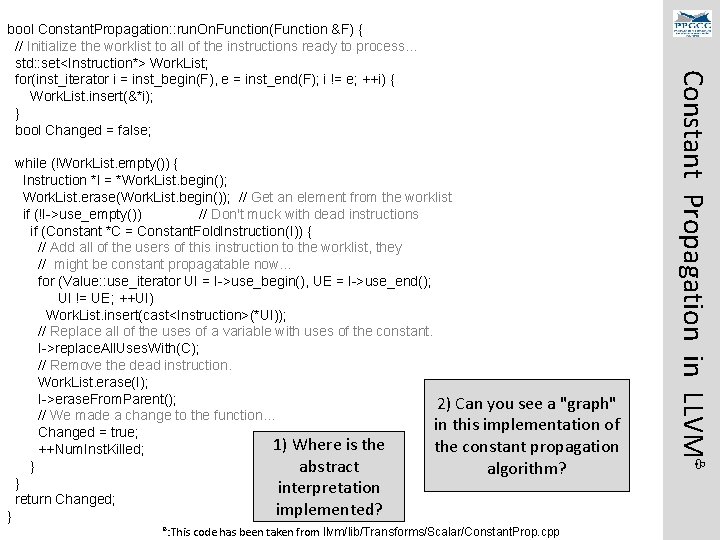
while (!Work. List. empty()) { Instruction *I = *Work. List. begin(); Work. List. erase(Work. List. begin()); // Get an element from the worklist if (!I->use_empty()) // Don't muck with dead instructions if (Constant *C = Constant. Fold. Instruction(I)) { // Add all of the users of this instruction to the worklist, they // might be constant propagatable now. . . for (Value: : use_iterator UI = I->use_begin(), UE = I->use_end(); UI != UE; ++UI) Work. List. insert(cast<Instruction>(*UI)); // Replace all of the uses of a variable with uses of the constant. I->replace. All. Uses. With(C); // Remove the dead instruction. Work. List. erase(I); I->erase. From. Parent(); 2) Can you see a "graph" // We made a change to the function. . . in this implementation of Changed = true; 1) Where is the constant propagation ++Num. Inst. Killed; } abstract algorithm? } interpretation return Changed; implemented? } ♧: This code has been taken from llvm/lib/Transforms/Scalar/Constant. Prop. cpp Constant Propagation in LLVM♧ bool Constant. Propagation: : run. On. Function(Function &F) { // Initialize the worklist to all of the instructions ready to process. . . std: : set<Instruction*> Work. List; for(inst_iterator i = inst_begin(F), e = inst_end(F); i != e; ++i) { Work. List. insert(&*i); } bool Changed = false;
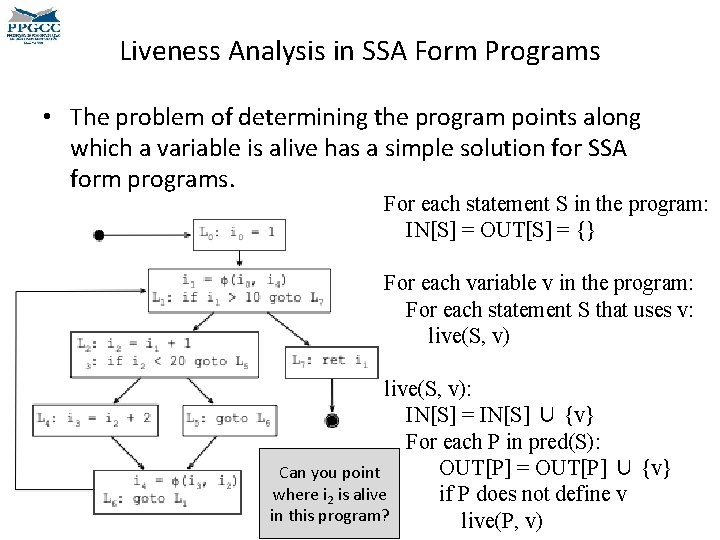
Liveness Analysis in SSA Form Programs • The problem of determining the program points along which a variable is alive has a simple solution for SSA form programs. For each statement S in the program: IN[S] = OUT[S] = {} For each variable v in the program: For each statement S that uses v: live(S, v): IN[S] = IN[S] ∪ {v} For each P in pred(S): OUT[P] = OUT[P] ∪ {v} Can you point where i 2 is alive if P does not define v in this program? live(P, v)
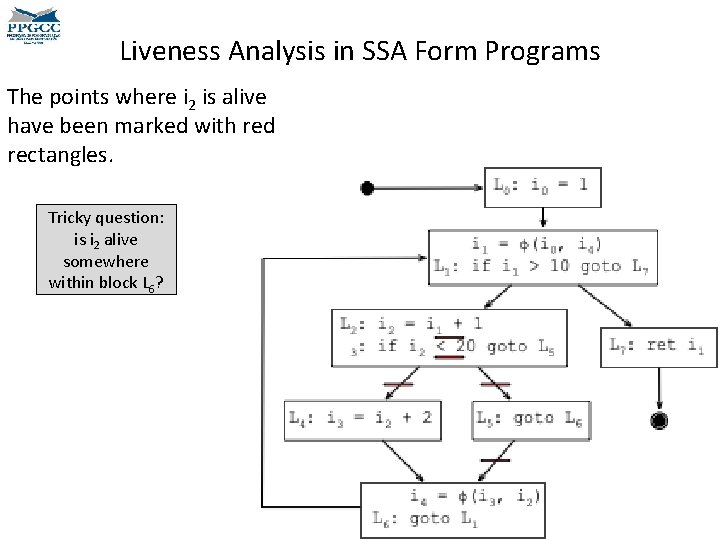
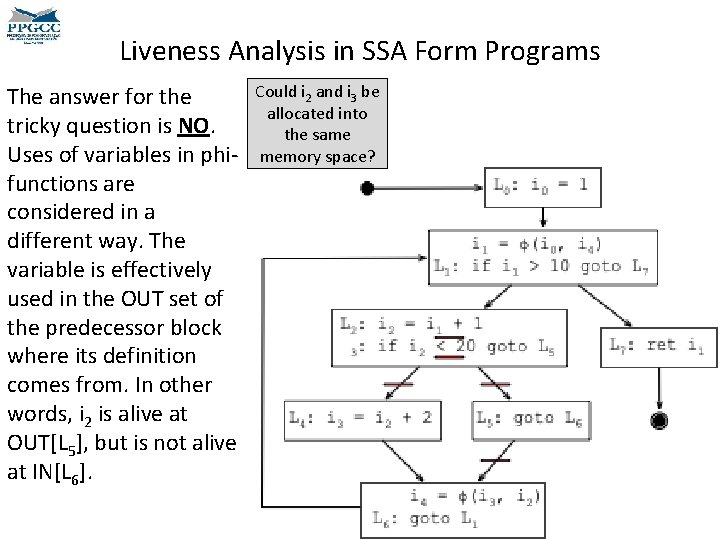
Liveness Analysis in SSA Form Programs The points where i 2 is alive have been marked with red rectangles. Tricky question: is i 2 alive somewhere within block L 6?
Liveness Analysis in SSA Form Programs The answer for the tricky question is NO. Uses of variables in phifunctions are considered in a different way. The variable is effectively used in the OUT set of the predecessor block where its definition comes from. In other words, i 2 is alive at OUT[L 5], but is not alive at IN[L 6]. Could i 2 and i 3 be allocated into the same memory space?
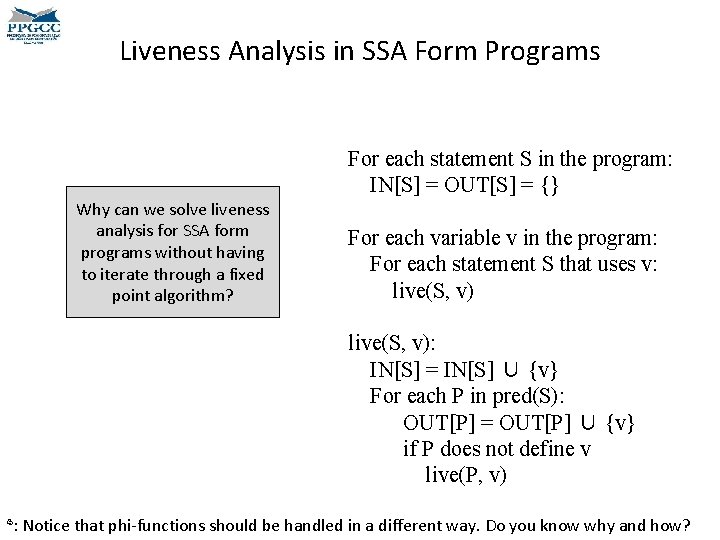
Liveness Analysis in SSA Form Programs For each statement S in the program: IN[S] = OUT[S] = {} Why can we solve liveness analysis for SSA form programs without having to iterate through a fixed point algorithm? For each variable v in the program: For each statement S that uses v: live(S, v): IN[S] = IN[S] ∪ {v} For each P in pred(S): OUT[P] = OUT[P] ∪ {v} if P does not define v live(P, v) ♧: Notice that phi-functions should be handled in a different way. Do you know why and how?
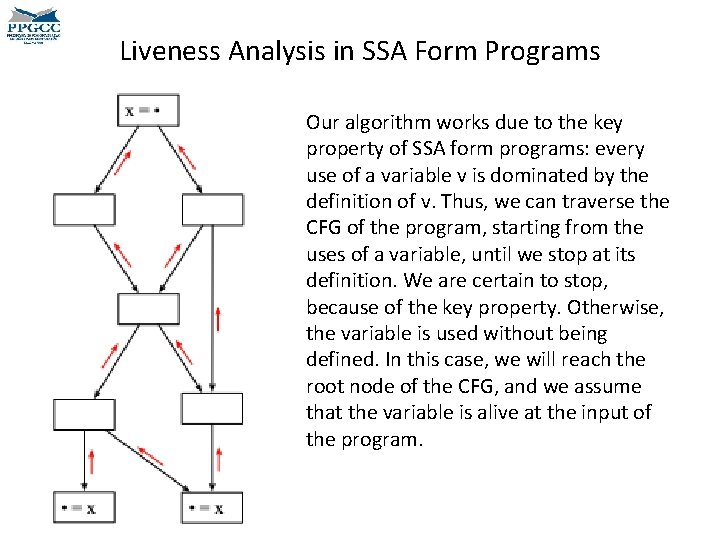
Liveness Analysis in SSA Form Programs Our algorithm works due to the key property of SSA form programs: every use of a variable v is dominated by the definition of v. Thus, we can traverse the CFG of the program, starting from the uses of a variable, until we stop at its definition. We are certain to stop, because of the key property. Otherwise, the variable is used without being defined. In this case, we will reach the root node of the CFG, and we assume that the variable is alive at the input of the program.
A Bit of History • The Static Single Assignment form was introduced by Ron Cytron, in 1989 • Compilers usually find dominators via Lengauer/Tarjan's algorithm. • There are many flavors of SSA form. One of the most common is the pruned SSA form, due to Briggs et al. • Cytron, R. and Ferrante, J. and Rosen, B. and Wegman, M. and Zadeck, F. "An Efficient Method of Computing Static Single Assignment Form", POPL, (1989) pp 25 -35 • Lengauer, T. and Tarjan, R. "A Fast Algorithm for Finding Dominators in a Flowgraph", TOPLAS, 1: 1 (1979) pp 121 -141 • Briggs, P. and Cooper, K. and Harvey, J. and Simpson, L. "Practical Improvements to the Construction and Destruction of Static Single Assignment Form", SP&E (28: 8), (1998) pp 859 -881