
Chapter 1 Cells the Basic Units of Life
Chapter 1 Cells the Basic Units of Life 1 -3 Organization of Living Things
Essential Questions/Learning Goals: l l l What are three advantages of being multicellular? Describe the four levels of organization. Explain the relationship between structure and function
Science Terms l l l Tissue Organ system Organism Structure Function
How do multicellular organisms grow larger? l Multicellular organisms grow larger by adding more small cells rather than making their cells larger.
What are the benefits of being multicellular l Larger Size: • Larger organisms are less likely to be preyed upon.
Multicellular Benefits Continued l Longer Life: • The lifespan of a multicellular organism is not limited to the lifespan of any single cell in its body.
Multicellular Benefits Continued l Specialization: • Each cell in a multicellular organism has a particular job. • Specialization makes the cell more efficient or better suited to perform their job. • Ex. Cardiac cells are specialized to never tire.
Cells Working Together: l Tissue: • A group of cells that work together to perform a specific task. • The material around and between the cells are part of that tissue.
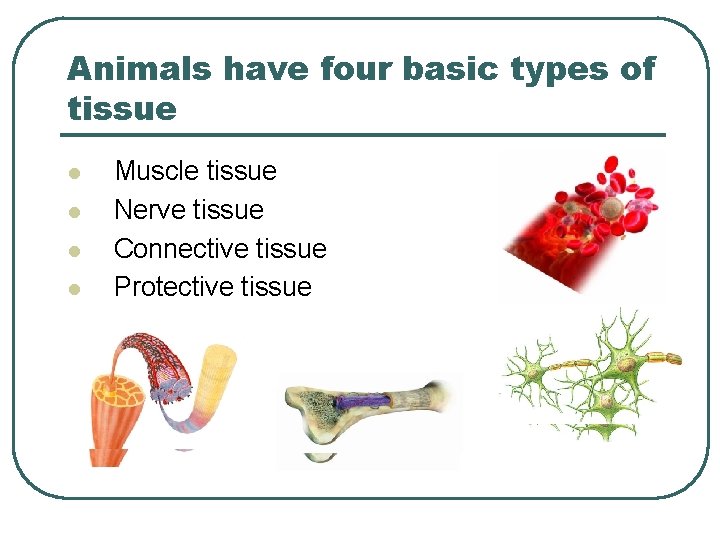
Animals have four basic types of tissue l l Muscle tissue Nerve tissue Connective tissue Protective tissue
Plants have three basic types of tissue. l l l Transport tissue: moves water and nutrients throughout the plant. Protective tissue: Covers the plant, retains water. Ground tissue: Photosynthesis occurs here.
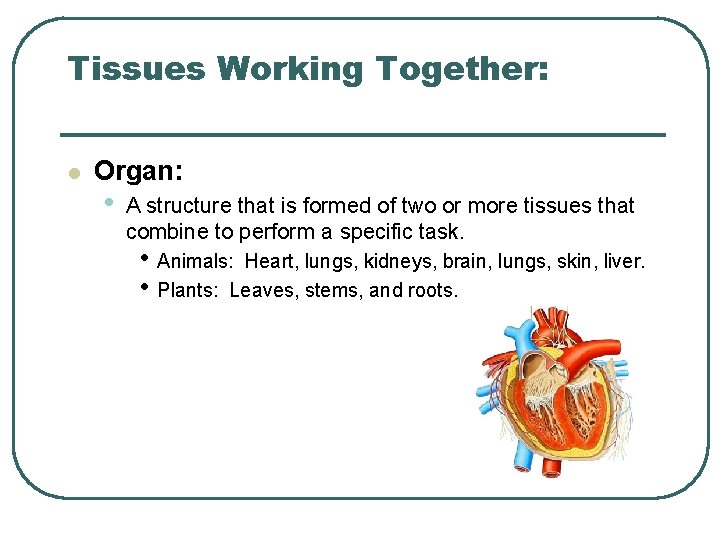
Tissues Working Together: l Organ: • A structure that is formed of two or more tissues that combine to perform a specific task. • Animals: Heart, lungs, kidneys, brain, lungs, skin, liver. • Plants: Leaves, stems, and roots.
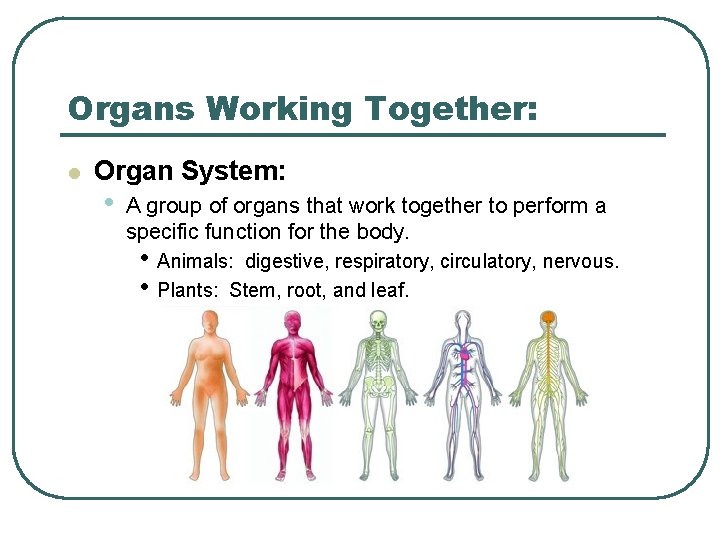
Organs Working Together: l Organ System: • A group of organs that work together to perform a specific function for the body. • Animals: digestive, respiratory, circulatory, nervous. • Plants: Stem, root, and leaf.
Organisms: l Anything that can perform all of life’s processes by itself.
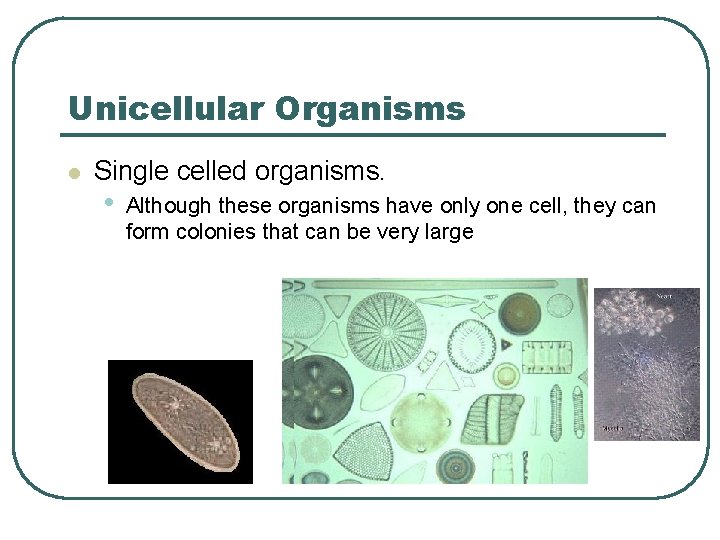
Unicellular Organisms l Single celled organisms. • Although these organisms have only one cell, they can form colonies that can be very large
Multicellular Organisms l Organisms with two or more cells. • Cells are specialized to perform specific functions.
Structure and Function: l Structure is… • the arrangement of parts in an organism • Its shape and what its made of. l Function is the… l The structure and function of organs and tissues allows them to perform their function. • job that the structure performs.
- Slides: 16