Network Configuration and Management via TwoPhase Online Optimization

- Slides: 27
Network Configuration and Management via Two-Phase Online Optimization Bilal Gonen University of Alaska Anchorage Murat Yuksel University of Nevada, Reno
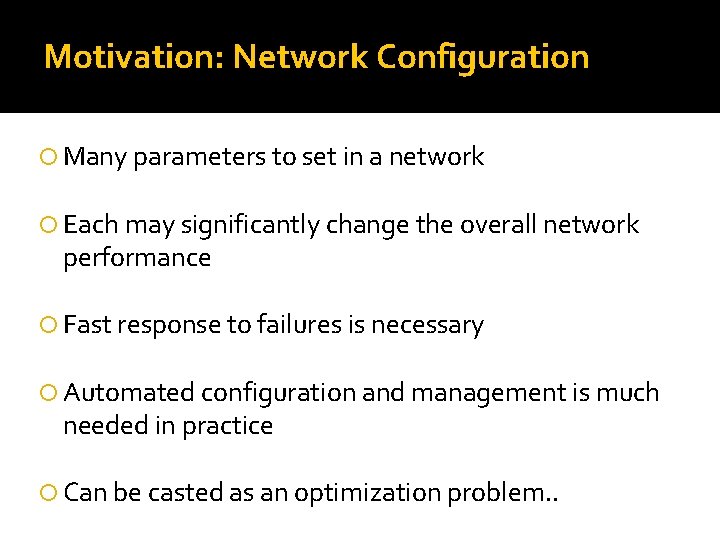
Motivation: Network Configuration Many parameters to set in a network Each may significantly change the overall network performance Fast response to failures is necessary Automated configuration and management is much needed in practice Can be casted as an optimization problem. .
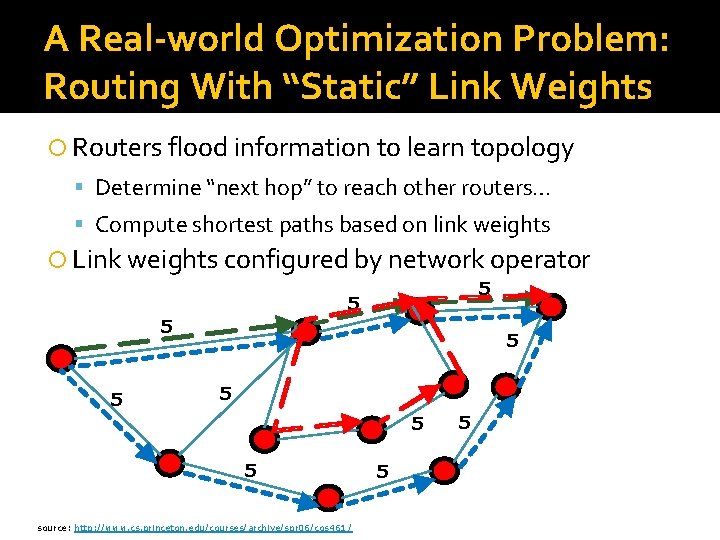
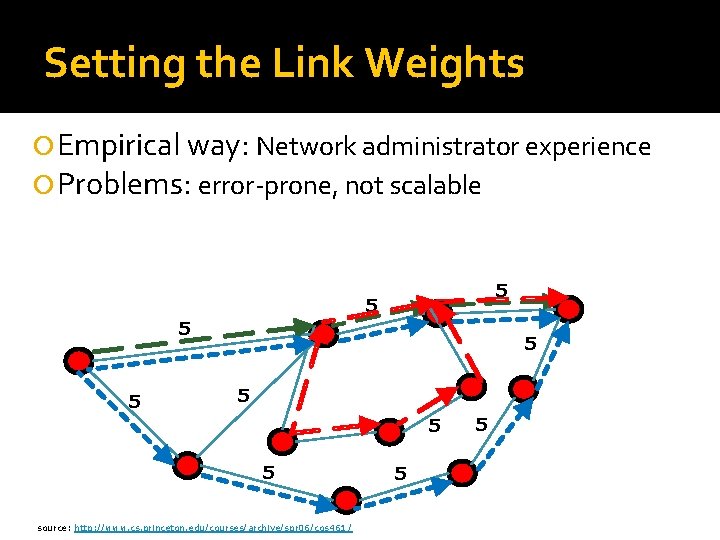
A Real-world Optimization Problem: Routing With “Static” Link Weights Routers flood information to learn topology Determine “next hop” to reach other routers… Compute shortest paths based on link weights Link weights configured by network operator 5 5 5 5 source: http: //www. cs. princeton. edu/courses/archive/spr 06/cos 461 / 5 5
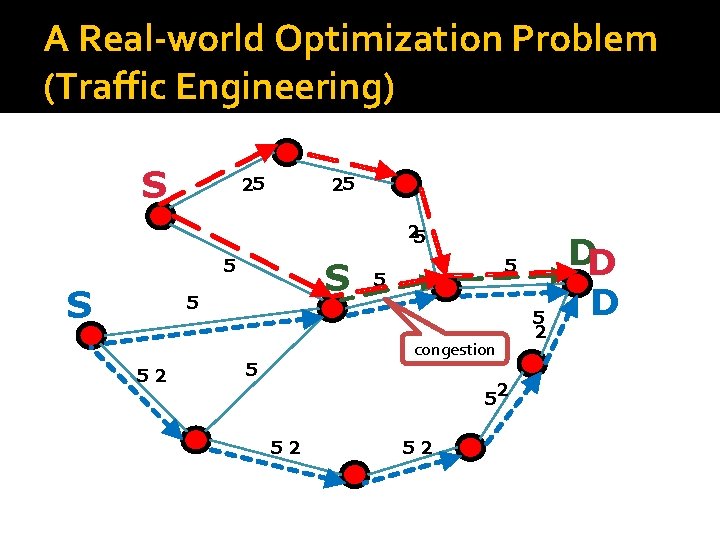
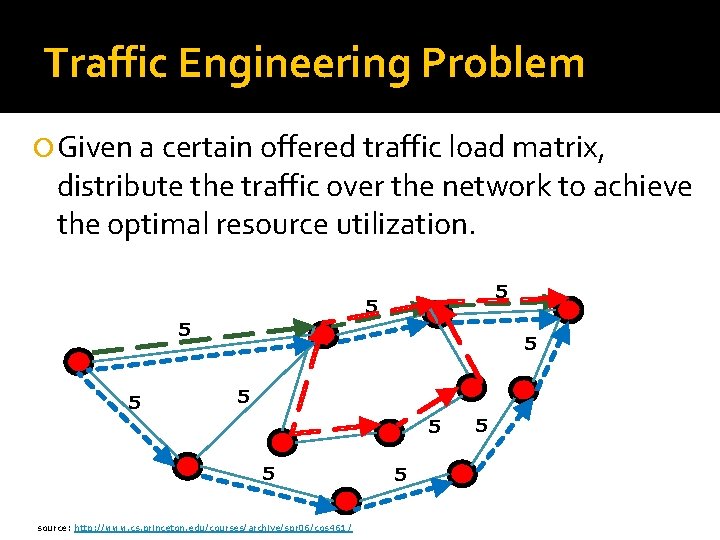
A Real-world Optimization Problem (Traffic Engineering) S 25 25 25 5 S S 5 52 5 5 congestion 5 2 5 52 52 5 2 DD D
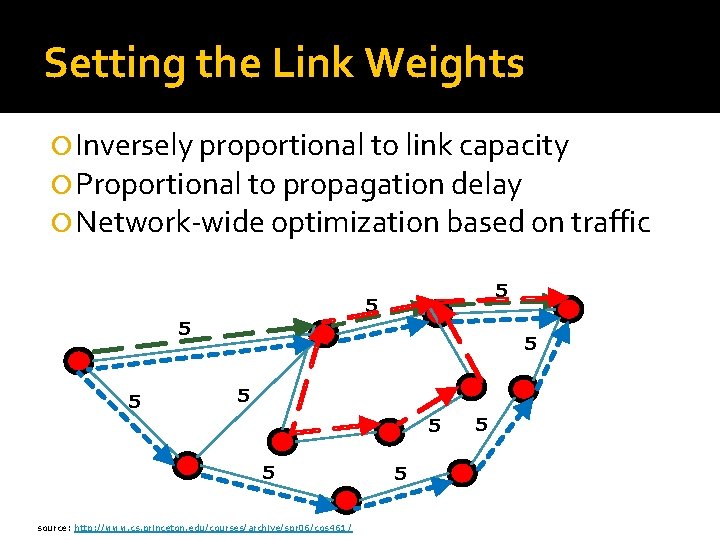
Setting the Link Weights Inversely proportional to link capacity Proportional to propagation delay Network-wide optimization based on traffic 5 5 5 5 source: http: //www. cs. princeton. edu/courses/archive/spr 06/cos 461 / 5 5
Setting the Link Weights Empirical way: Network administrator experience Problems: error-prone, not scalable 5 5 5 5 source: http: //www. cs. princeton. edu/courses/archive/spr 06/cos 461 / 5 5
Traffic Engineering Problem Given a certain offered traffic load matrix, distribute the traffic over the network to achieve the optimal resource utilization. 5 5 5 5 source: http: //www. cs. princeton. edu/courses/archive/spr 06/cos 461 / 5 5
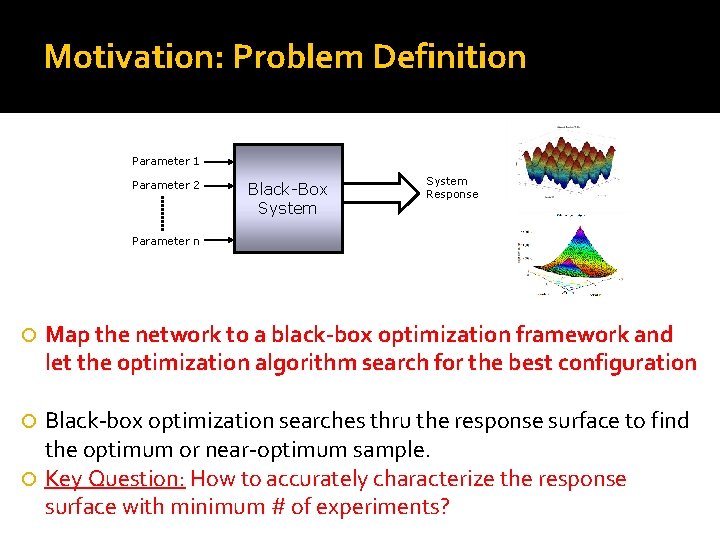
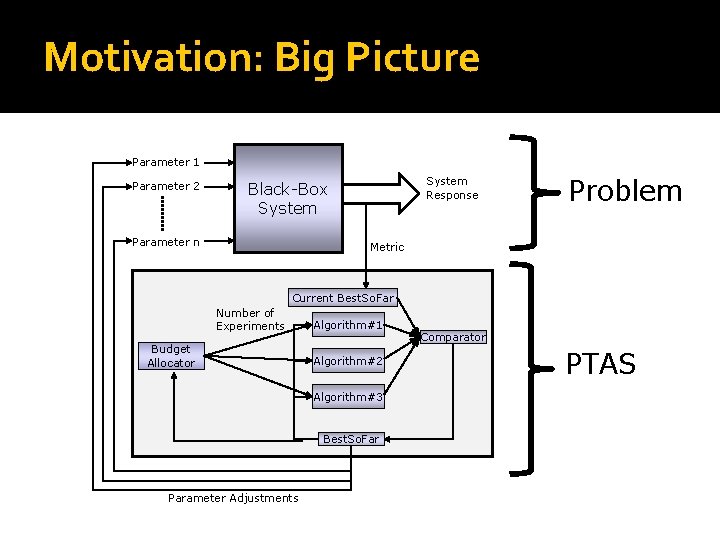
Motivation: Problem Definition Parameter 1 Parameter 2 Black-Box System Response Parameter n Map the network to a black-box optimization framework and let the optimization algorithm search for the best configuration Black-box optimization searches thru the response surface to find the optimum or near-optimum sample. Key Question: How to accurately characterize the response surface with minimum # of experiments?
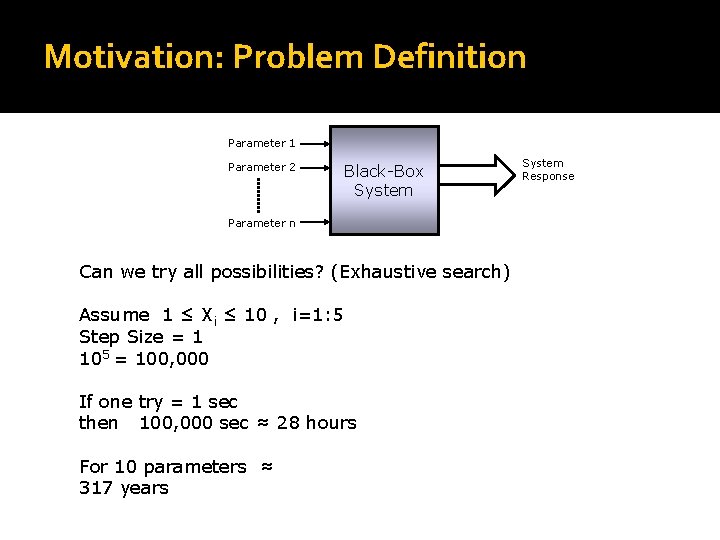
Motivation: Problem Definition Parameter 1 Parameter 2 Black-Box System Parameter n Can we try all possibilities? (Exhaustive search) Assume 1 ≤ Xi ≤ 10 , i=1: 5 Step Size = 1 105 = 100, 000 If one try = 1 sec then 100, 000 sec ≈ 28 hours For 10 parameters ≈ 317 years System Response
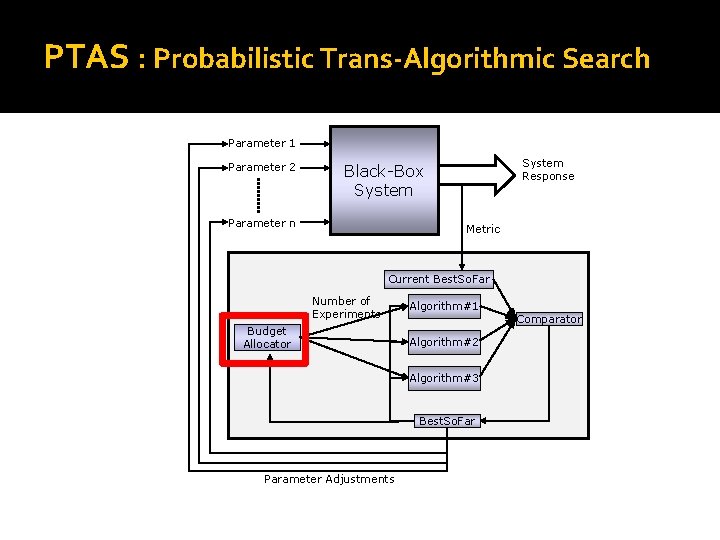
Motivation: Big Picture Parameter 1 Parameter 2 System Response Black-Box System Parameter n Problem Metric Current Best. So. Far Number of Experiments Budget Allocator Algorithm#1 Algorithm#2 Algorithm#3 Best. So. Far Parameter Adjustments Comparator PTAS
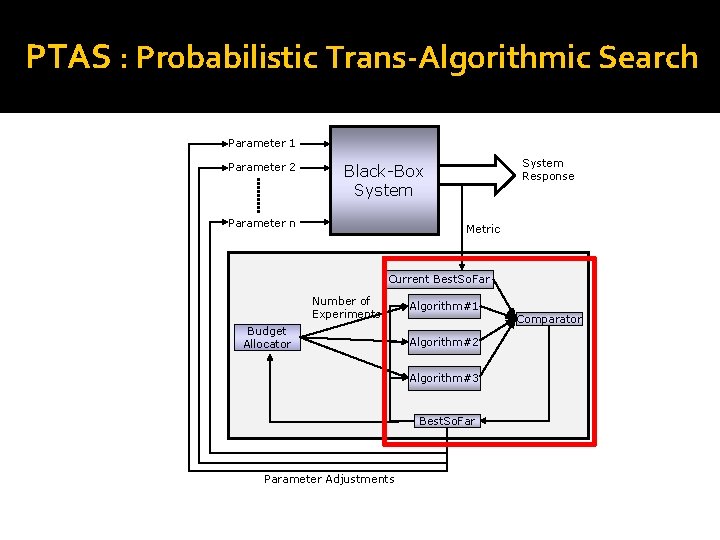
PTAS : Probabilistic Trans-Algorithmic Search Parameter 1 Parameter 2 System Response Black-Box System Parameter n Metric Current Best. So. Far Number of Experiments Budget Allocator Algorithm#1 Algorithm#2 Algorithm#3 Best. So. Far Parameter Adjustments Comparator
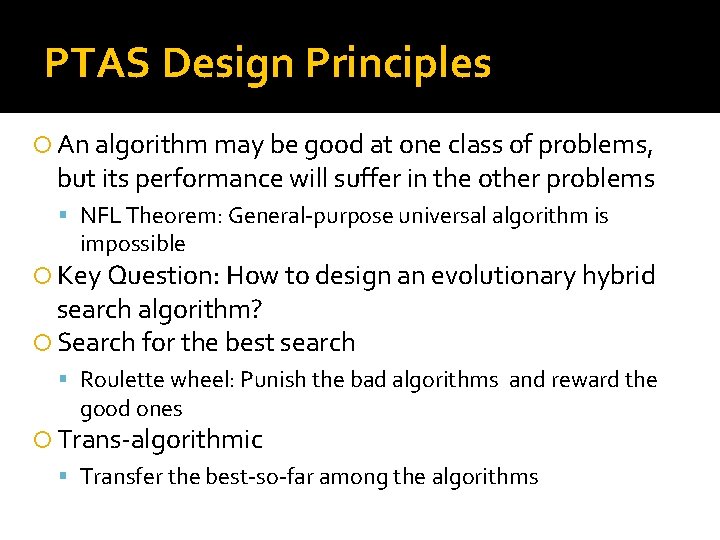
PTAS Design Principles An algorithm may be good at one class of problems, but its performance will suffer in the other problems NFL Theorem: General-purpose universal algorithm is impossible Key Question: How to design an evolutionary hybrid search algorithm? Search for the best search Roulette wheel: Punish the bad algorithms and reward the good ones Trans-algorithmic Transfer the best-so-far among the algorithms
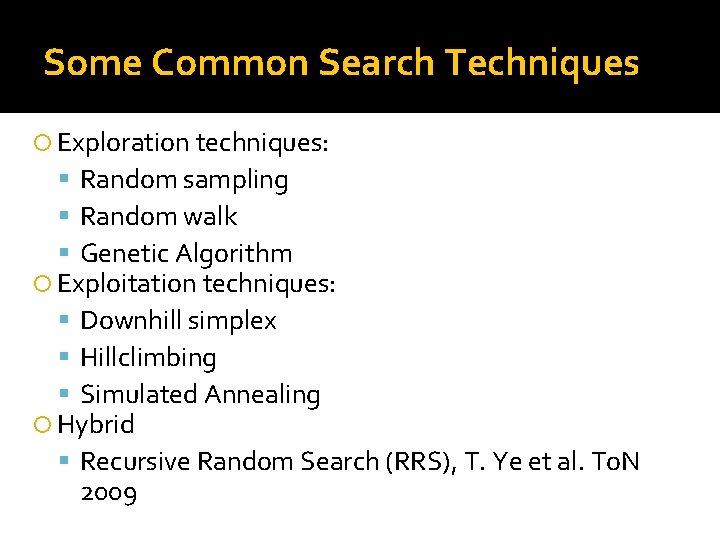
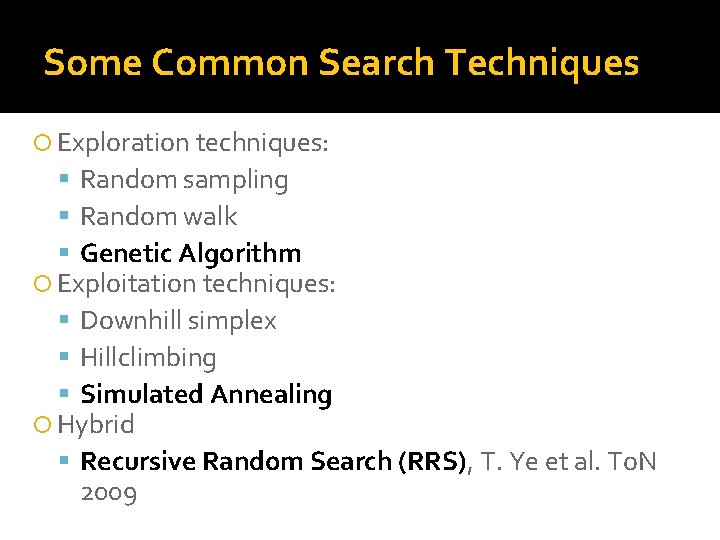
Some Common Search Techniques Exploration techniques: Random sampling Random walk Genetic Algorithm Exploitation techniques: Downhill simplex Hillclimbing Simulated Annealing Hybrid Recursive Random Search (RRS), T. Ye et al. To. N 2009
Some Common Search Techniques Exploration techniques: Random sampling Random walk Genetic Algorithm Exploitation techniques: Downhill simplex Hillclimbing Simulated Annealing Hybrid Recursive Random Search (RRS), T. Ye et al. To. N 2009
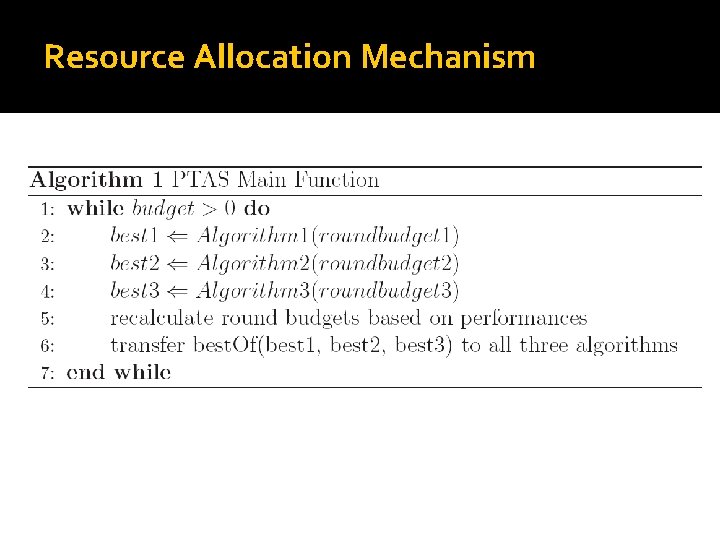
Resource Allocation Mechanism
PTAS : Probabilistic Trans-Algorithmic Search Parameter 1 Parameter 2 System Response Black-Box System Parameter n Metric Current Best. So. Far Number of Experiments Budget Allocator Algorithm#1 Algorithm#2 Algorithm#3 Best. So. Far Parameter Adjustments Comparator
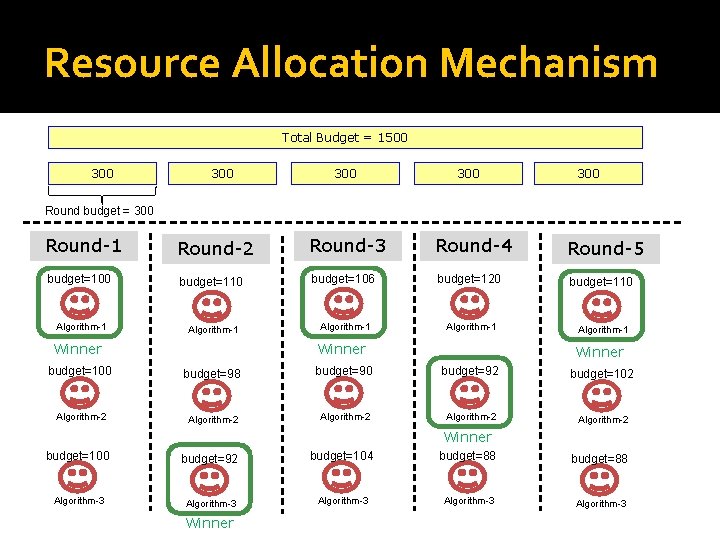
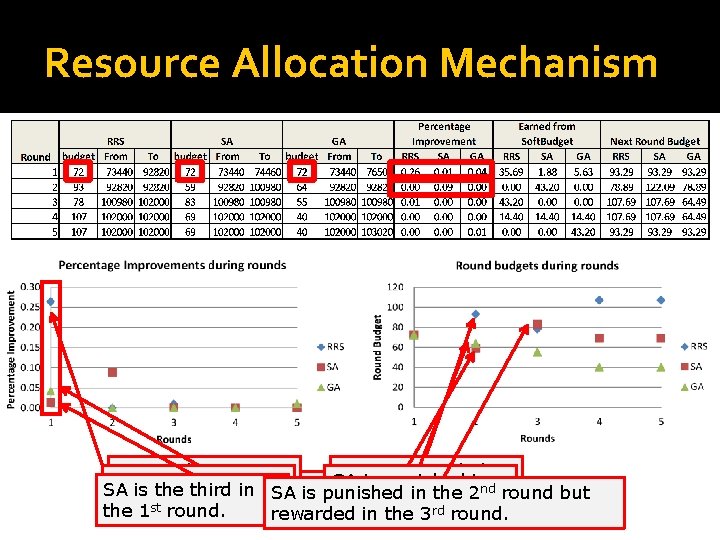
Resource Allocation Mechanism Total Budget = 1500 300 300 300 Round budget = 300 Round-1 Round-2 Round-3 Round-4 Round-5 budget=100 budget=110 budget=106 budget=120 budget=110 Algorithm-1 Algorithm-1 Winner budget=100 budget=98 budget=90 budget=92 budget=102 Algorithm-2 Algorithm-2 Winner budget=100 budget=92 budget=104 budget=88 Algorithm-3 Algorithm-3 Winner
Resource Allocation Mechanism RRS is the winner RRS is rewarded in GA is the second in GA is nd punished innd SA is punished more stthird SA the in SA is punished in the 2 round but in is the 1 round. the 2 round. st round. nd round. the 1 the 2 nd st in the in 2 the round. the 1 round. rewarded 3 rd round.
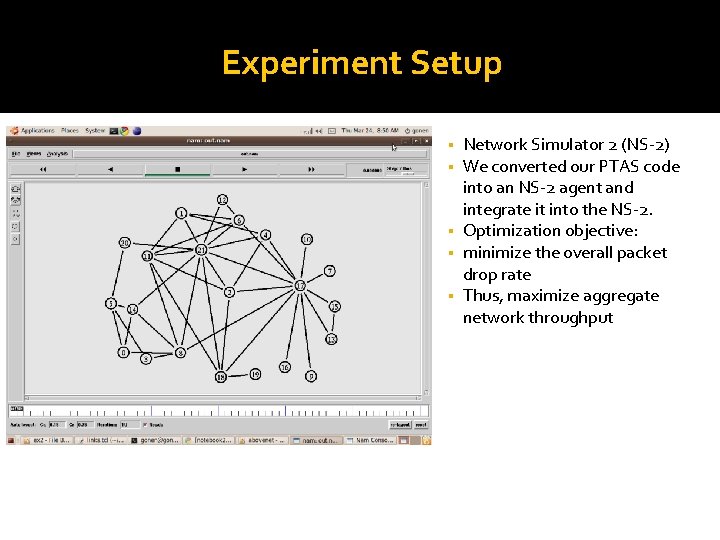
Experiment Setup Network Simulator 2 (NS-2) We converted our PTAS code into an NS-2 agent and integrate it into the NS-2. Optimization objective: minimize the overall packet drop rate Thus, maximize aggregate network throughput
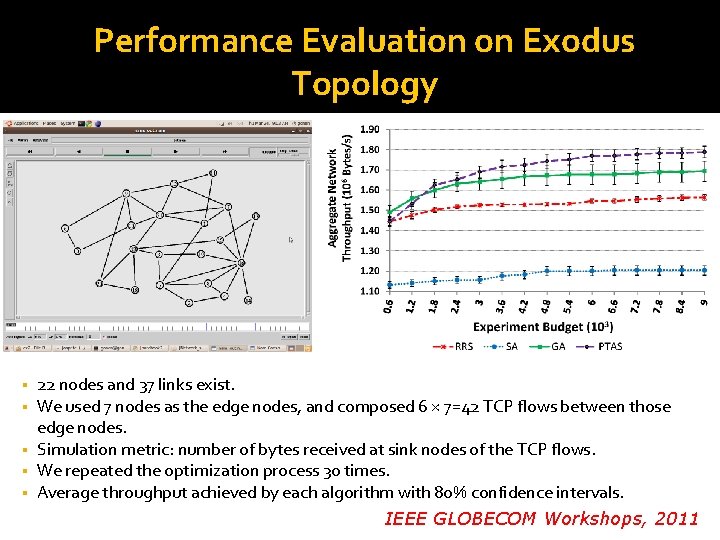
Performance Evaluation on Exodus Topology 22 nodes and 37 links exist. We used 7 nodes as the edge nodes, and composed 6 × 7=42 TCP flows between those edge nodes. Simulation metric: number of bytes received at sink nodes of the TCP flows. We repeated the optimization process 30 times. Average throughput achieved by each algorithm with 80% confidence intervals. IEEE GLOBECOM Workshops, 2011
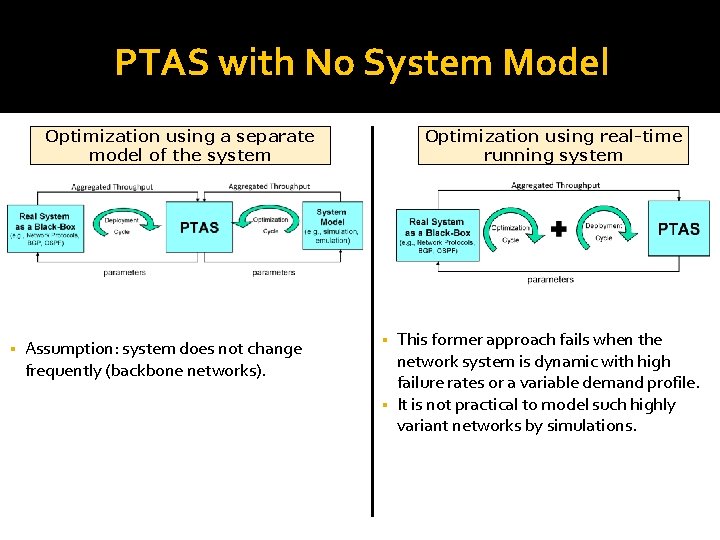
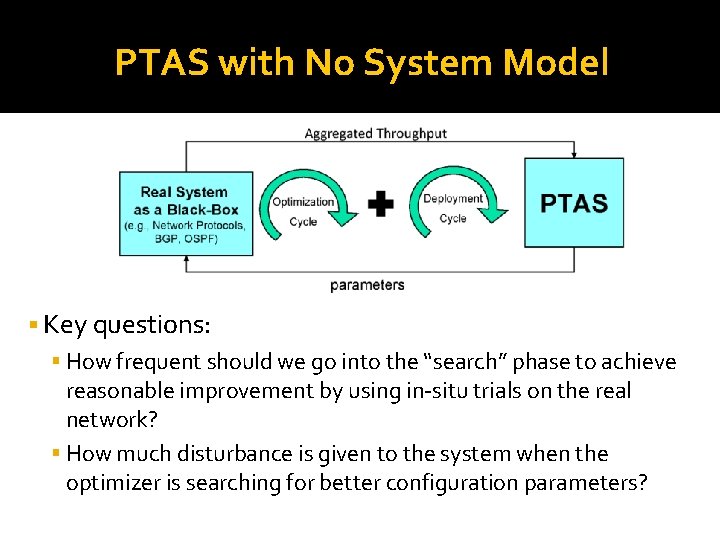
PTAS with No System Model Optimization using a separate model of the system Assumption: system does not change frequently (backbone networks). Optimization using real-time running system This former approach fails when the network system is dynamic with high failure rates or a variable demand profile. It is not practical to model such highly variant networks by simulations.
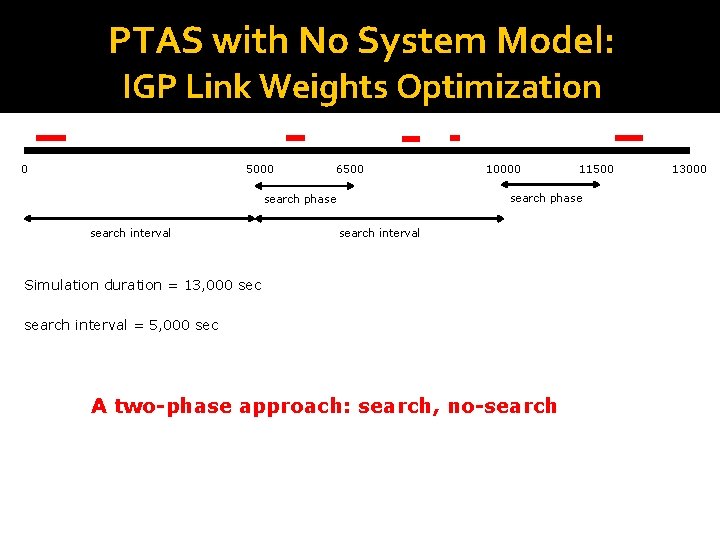
PTAS with No System Model: IGP Link Weights Optimization 5000 0 6500 11500 search phase search interval 10000 search interval Simulation duration = 13, 000 sec search interval = 5, 000 sec A two-phase approach: search, no-search 13000
PTAS with No System Model Key questions: How frequent should we go into the “search” phase to achieve reasonable improvement by using in-situ trials on the real network? How much disturbance is given to the system when the optimizer is searching for better configuration parameters?
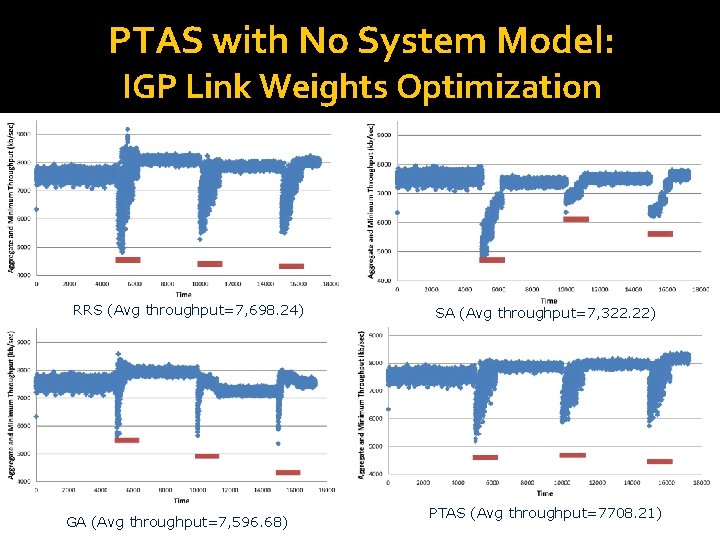
PTAS with No System Model: IGP Link Weights Optimization RRS (Avg throughput=7, 698. 24) GA (Avg throughput=7, 596. 68) SA (Avg throughput=7, 322. 22) PTAS (Avg throughput=7708. 21)
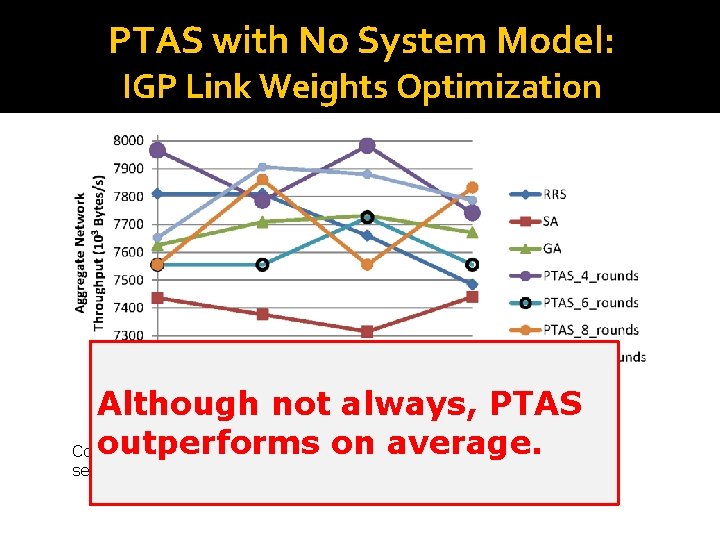
PTAS with No System Model: IGP Link Weights Optimization Although not always, PTAS outperforms on Comparison of PTAS with RRS, SA, andaverage. GA for using different search phase lengths and different number of rounds for PTAS
Summary Need for automated configuration and management of highly dynamic networks. PTAS with no system model and PTAS with separate system model. We explore some of the key tradeoffs: How frequent the search should be done How long should the search phase be How worse the search phase can temporarily make the system performance due to its trials. We apply PTAS and three other search algorithms on Six well-known objective functions A network problem on realistic ISP topologies Wireless ad hoc network
Questions, Comments