INTRODUCTION TO COMPILER professor Computer Science Department A

- Slides: 30
INTRODUCTION TO COMPILER <<professor>> Computer Science Department
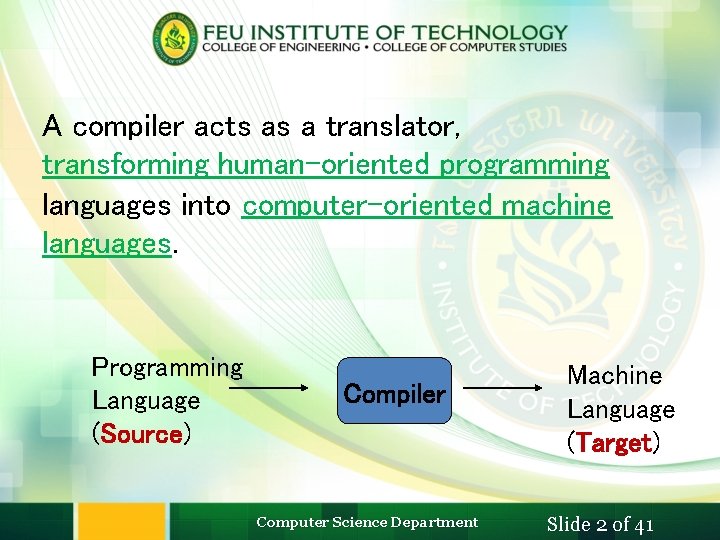
A compiler acts as a translator, transforming human-oriented programming languages into computer-oriented machine languages. Programming Language (Source) Compiler Computer Science Department Machine Language (Target) Slide 2 of 41
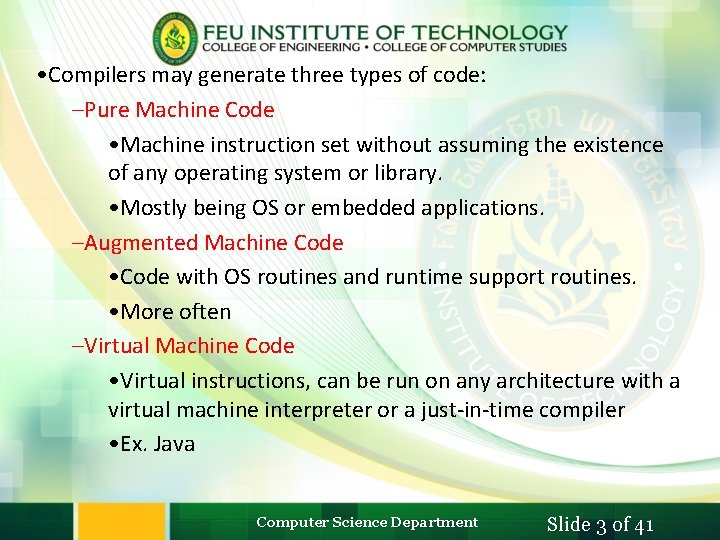
• Compilers may generate three types of code: –Pure Machine Code • Machine instruction set without assuming the existence of any operating system or library. • Mostly being OS or embedded applications. –Augmented Machine Code • Code with OS routines and runtime support routines. • More often –Virtual Machine Code • Virtual instructions, can be run on any architecture with a virtual machine interpreter or a just-in-time compiler • Ex. Java Computer Science Department Slide 3 of 41
INTRODUCTION TO COMPILER Compilers Analysis of the source program The phases of a compiler Cousins of the compiler The grouping of phases Compiler Construction tools Computer Science Department Slide 4 of 41
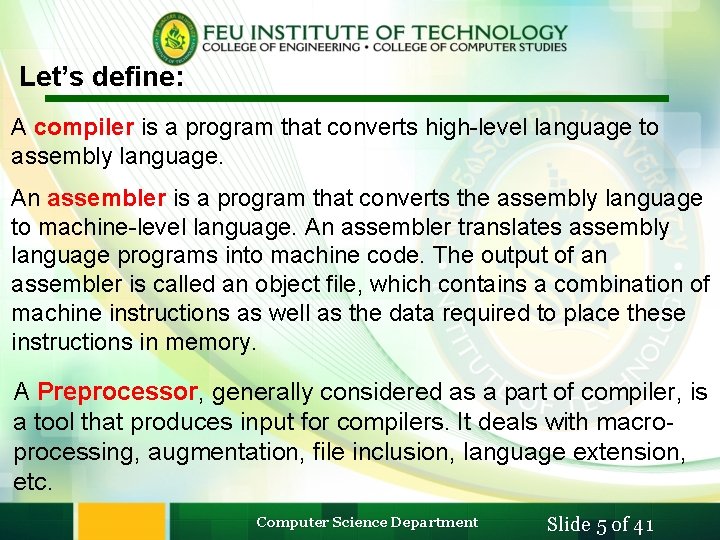
Let’s define: A compiler is a program that converts high-level language to assembly language. An assembler is a program that converts the assembly language to machine-level language. An assembler translates assembly language programs into machine code. The output of an assembler is called an object file, which contains a combination of machine instructions as well as the data required to place these instructions in memory. A Preprocessor, generally considered as a part of compiler, is a tool that produces input for compilers. It deals with macroprocessing, augmentation, file inclusion, language extension, etc. Computer Science Department Slide 5 of 41
Let’s define: An interpreter, like a compiler, translates high-level language into low-level machine language. The difference lies in the way they read the source code or input. A compiler reads the whole source code at once, creates tokens, checks semantics, generates intermediate code, executes the whole program and may involve many passes. In contrast, an interpreter reads a statement from the input, converts it to an intermediate code, executes it, then takes the next statement in sequence. If an error occurs, an interpreter stops execution and reports it; whereas a compiler reads the whole program even if it encounters several errors. Computer Science Department Slide 6 of 41
Linker is a computer program that links and merges various object files together in order to make an executable file. All these files might have been compiled by separate assemblers. The major task of a linker is to search and locate referenced module/routines in a program and to determine the memory location where these codes will be loaded, making the program instruction to have absolute references. Computer Science Department Slide 7 of 41
Machine Language a program for a computer must be built by combining these very simple commands into a program. Since this is a tedious and error prone process most programming is, instead, done using a high-level programming language. Computer Science Department Slide 8 of 41
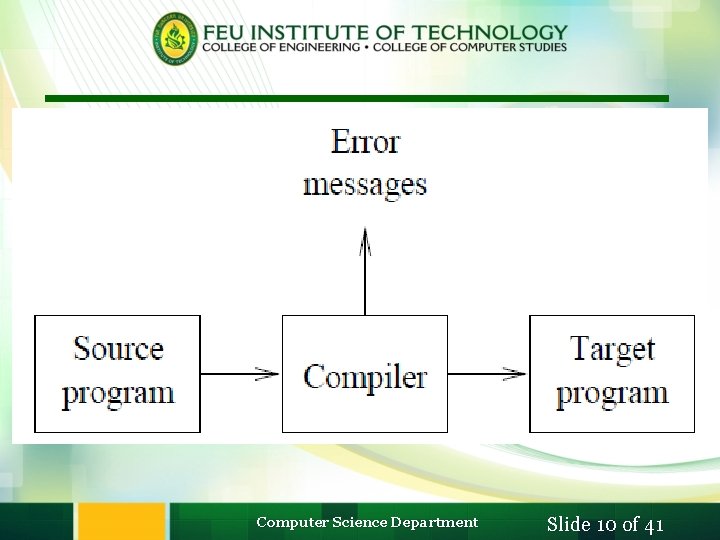
What is a COMPILER? Compilation is a process that translates a program in one language (the source language) into an equivalent program in another language (the object or target language). Compiler translates (or compiles) a program written in a high-level programming language that is suitable for human programmers into the low-level machine language that is required by computers. Computer Science Department Slide 9 of 41
Computer Science Department Slide 10 of 41
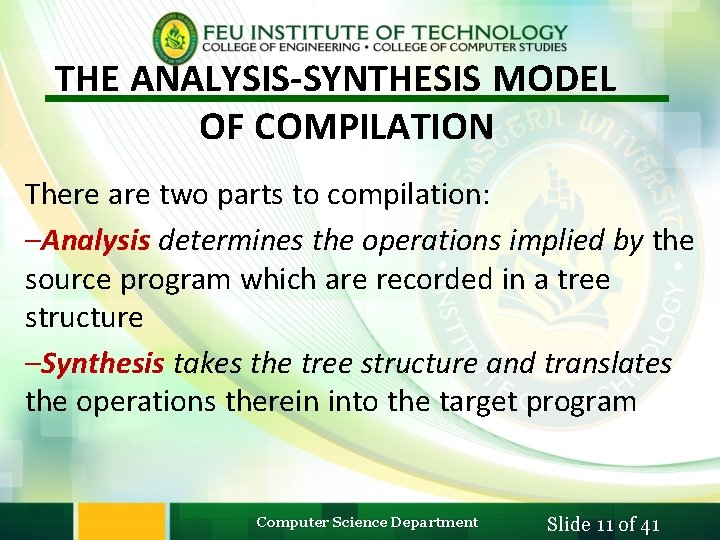
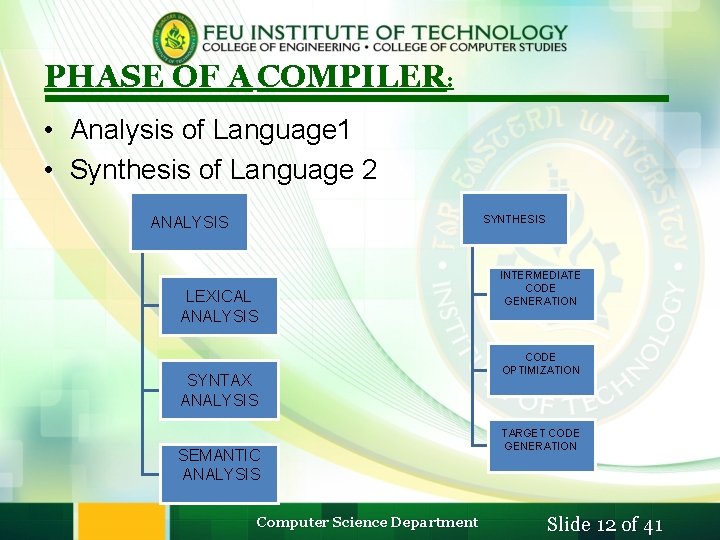
THE ANALYSIS-SYNTHESIS MODEL OF COMPILATION There are two parts to compilation: –Analysis determines the operations implied by the source program which are recorded in a tree structure –Synthesis takes the tree structure and translates the operations therein into the target program Computer Science Department Slide 11 of 41
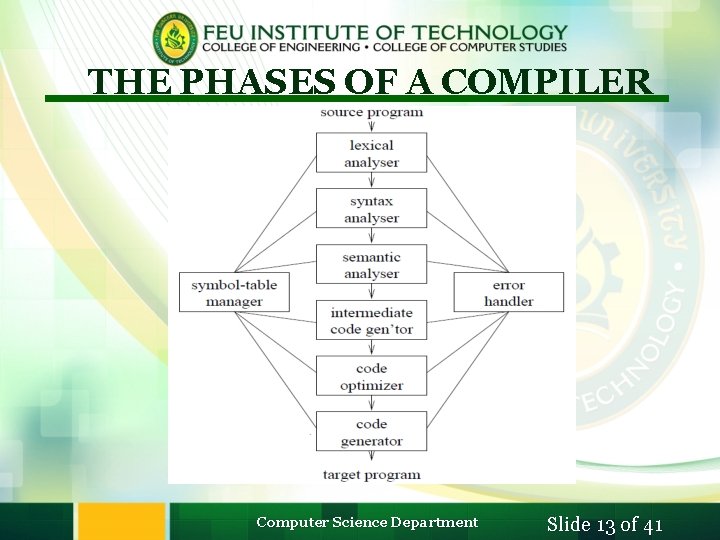
PHASE OF A COMPILER: • Analysis of Language 1 • Synthesis of Language 2 SYNTHESIS ANALYSIS LEXICAL ANALYSIS SYNTAX ANALYSIS SEMANTIC ANALYSIS Computer Science Department INTERMEDIATE CODE GENERATION CODE OPTIMIZATION TARGET CODE GENERATION Slide 12 of 41
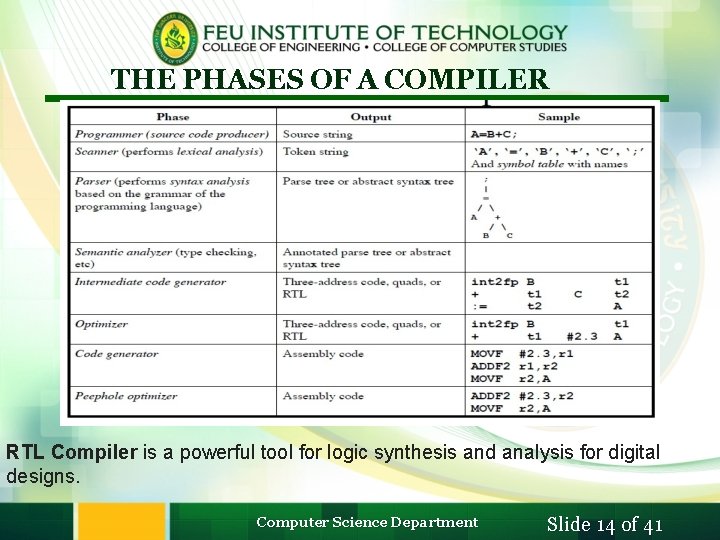
THE PHASES OF A COMPILER Computer Science Department Slide 13 of 41
THE PHASES OF A COMPILER RTL Compiler is a powerful tool for logic synthesis and analysis for digital designs. Computer Science Department Slide 14 of 41
THE PHASES OF A COMPILER LEXICAL ANALYSIS This is the initial part of reading and analysing the program text: • The text is read and divided into tokens, each of which corresponds to a symbol in the programming language, • e. g. , a variable name, keyword or number. Computer Science Department Slide 15 of 41
THE PHASES OF A COMPILER A lexical analyser or scanner is a program that groups sequences of characters into lexemes, and outputs (to the syntax analyser) a sequence of tokens. Here: (a)Tokens are symbolic names for the entities that make up the text of the program; (b)A pattern is a rule that specifies when a sequence of characters from the input constitutes a token; (c)A lexeme is a sequence of characters in the source program that matches the pattern for a token and is identified by the lexical analyzer as an instance of that token. Computer Science Department Slide 16 of 41
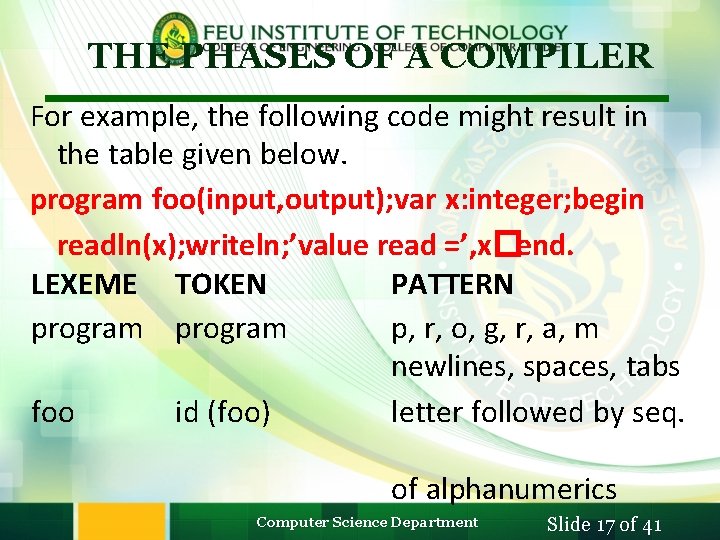
THE PHASES OF A COMPILER For example, the following code might result in the table given below. program foo(input, output); var x: integer; begin readln(x); writeln;’value read =’, x�end. LEXEME TOKEN PATTERN program p, r, o, g, r, a, m newlines, spaces, tabs foo id (foo) letter followed by seq. of alphanumerics Computer Science Department Slide 17 of 41
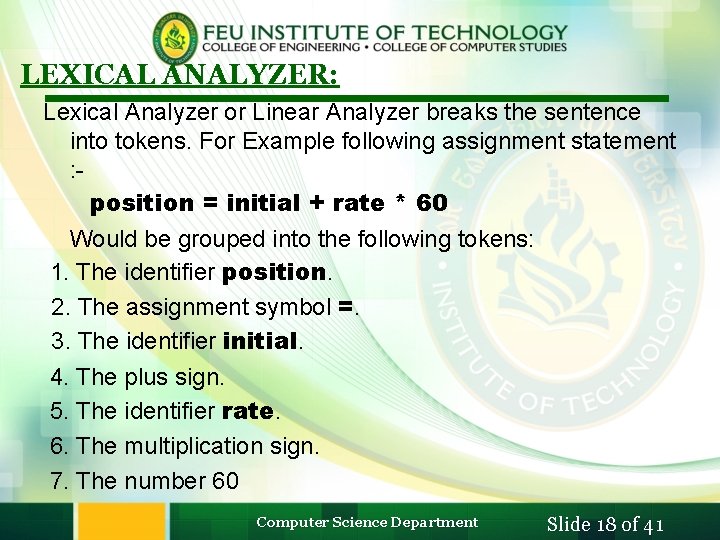
LEXICAL ANALYZER: Lexical Analyzer or Linear Analyzer breaks the sentence into tokens. For Example following assignment statement : position = initial + rate * 60 Would be grouped into the following tokens: 1. The identifier position. 2. The assignment symbol =. 3. The identifier initial. 4. The plus sign. 5. The identifier rate. 6. The multiplication sign. 7. The number 60 Computer Science Department Slide 18 of 41
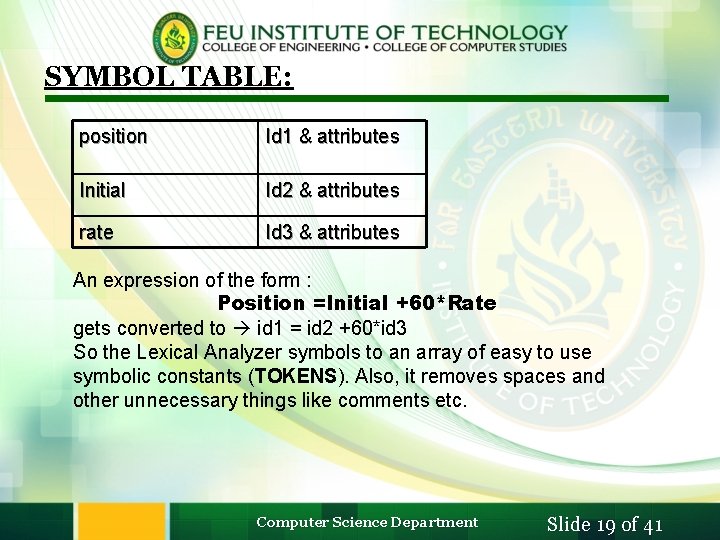
SYMBOL TABLE: position Id 1 & attributes Initial Id 2 & attributes rate Id 3 & attributes An expression of the form : Position =Initial +60*Rate gets converted to id 1 = id 2 +60*id 3 So the Lexical Analyzer symbols to an array of easy to use symbolic constants (TOKENS). Also, it removes spaces and other unnecessary things like comments etc. Computer Science Department Slide 19 of 41
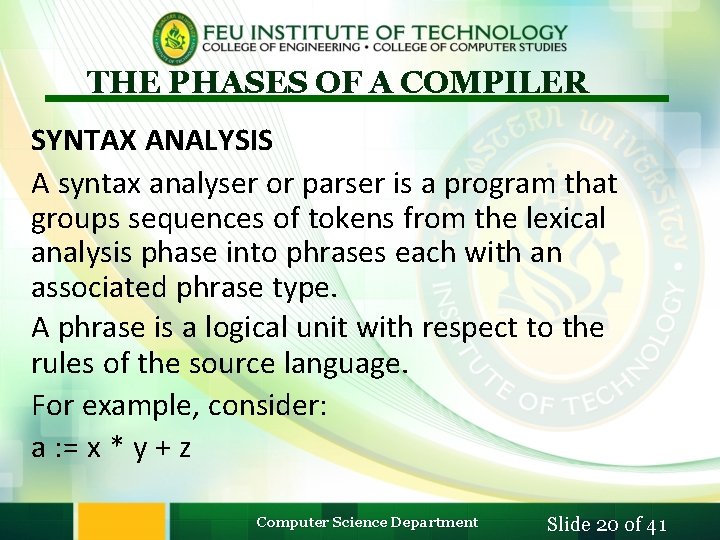
THE PHASES OF A COMPILER SYNTAX ANALYSIS A syntax analyser or parser is a program that groups sequences of tokens from the lexical analysis phase into phrases each with an associated phrase type. A phrase is a logical unit with respect to the rules of the source language. For example, consider: a : = x * y + z Computer Science Department Slide 20 of 41
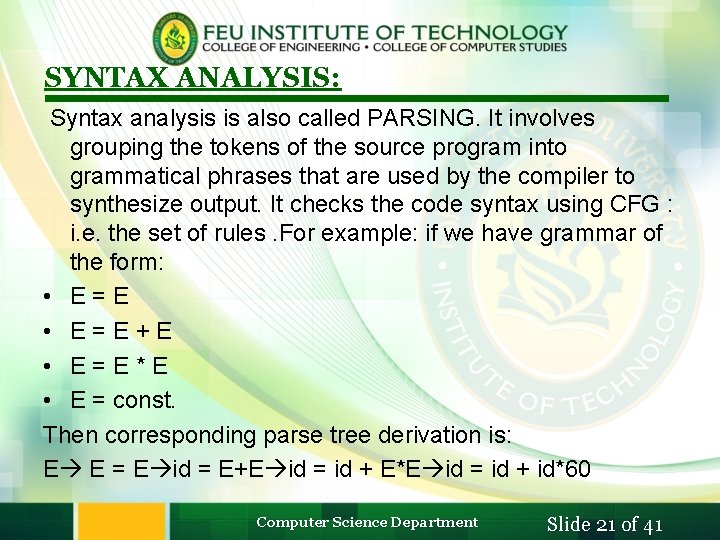
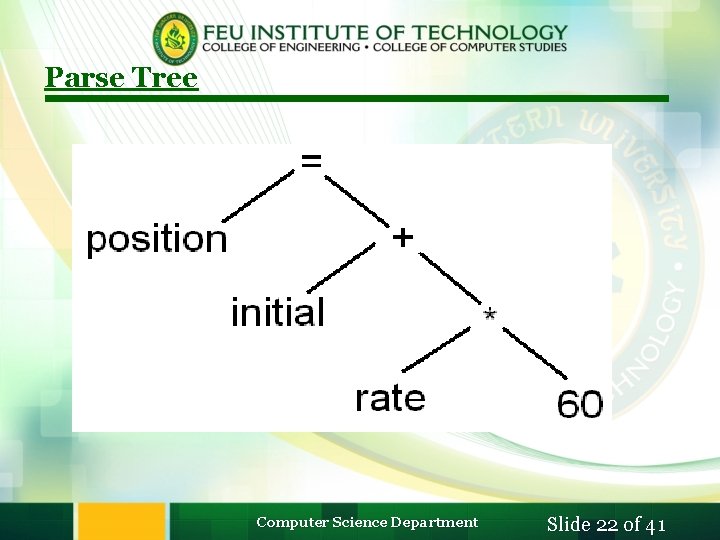
SYNTAX ANALYSIS: Syntax analysis is also called PARSING. It involves grouping the tokens of the source program into grammatical phrases that are used by the compiler to synthesize output. It checks the code syntax using CFG : i. e. the set of rules. For example: if we have grammar of the form: • E = E + E • E = E * E • E = const. Then corresponding parse tree derivation is: E E = E id = E+E id = id + E*E id = id + id*60 Computer Science Department Slide 21 of 41
Parse Tree Computer Science Department Slide 22 of 41
SEMANTIC ANALYSIS The semantic analysis phase checks source program for semantic errors and gathers type information for the subsequent code-generation phase. In this checks are performed to ensure that the components of a program fit together meaningfully. For example: we have a sample code: int a; int b; char c[ ]; a=b + c; (Type check is done) Computer Science Department Slide 23 of 41
SYNTHESIS PHASE OF COMPILATION: v INTERMEDIATE CODE GENERATION: We can think of this intermediate representation as a program for an abstract machine. For the example used in lexical analysis the intermediate representation will be: temp 1=initoreal(60) temp 2= id 3*temp 1 temp 3=id 2+temp 2 id 1=temp 3 Computer Science Department Slide 24 of 41
v. CODE OPTIMIZATION The code optimization phase attempts to improves the intermediate code, so that faster-running machine code result. Some optimization are trivial. So the final code for example above will be: temp 1=id 3*60 // removed unnecessary id 1=id 2+temp 1 //variables In “optimizing compilers” , a significant amount of time is spent on this phase. How-ever , there are simple optimizations that significantly improve the running time of the target program with out slowing down the compilation too much. Computer Science Department Slide 25 of 41
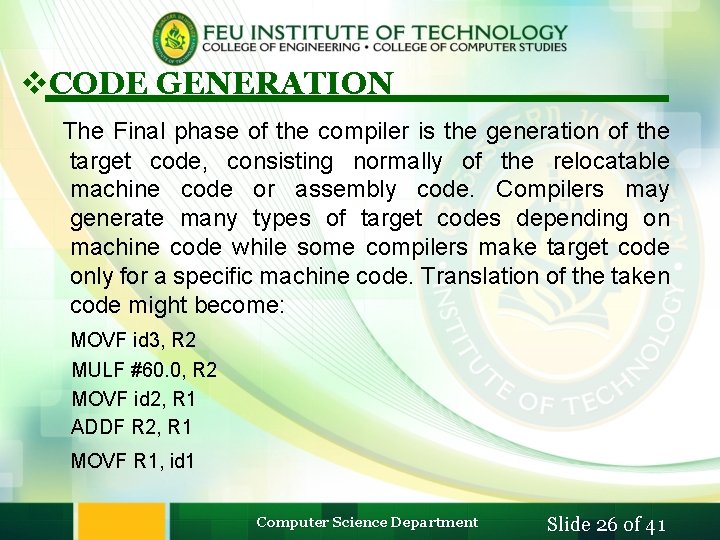
v. CODE GENERATION The Final phase of the compiler is the generation of the target code, consisting normally of the relocatable machine code or assembly code. Compilers may generate many types of target codes depending on machine code while some compilers make target code only for a specific machine code. Translation of the taken code might become: MOVF id 3, R 2 MULF #60. 0, R 2 MOVF id 2, R 1 ADDF R 2, R 1 MOVF R 1, id 1 Computer Science Department Slide 26 of 41
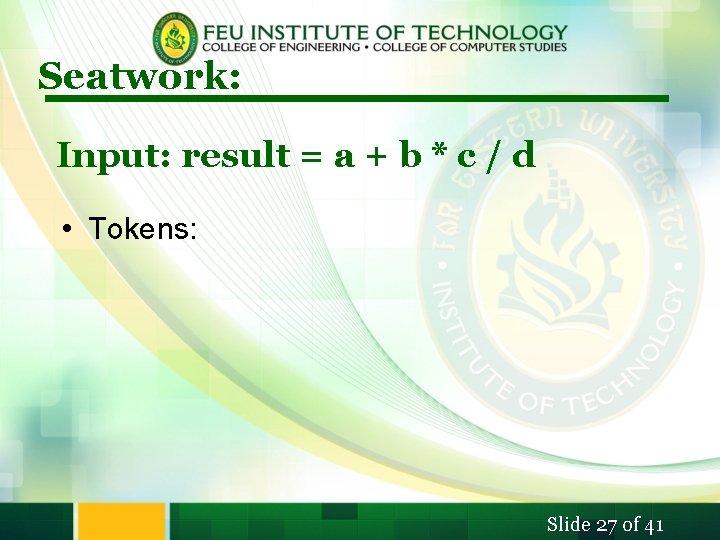
Seatwork: Input: result = a + b * c / d • Tokens: Slide 27 of 41
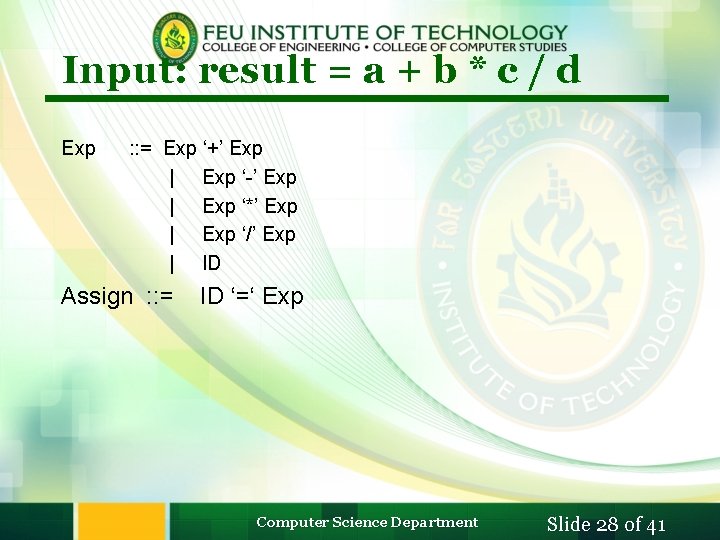
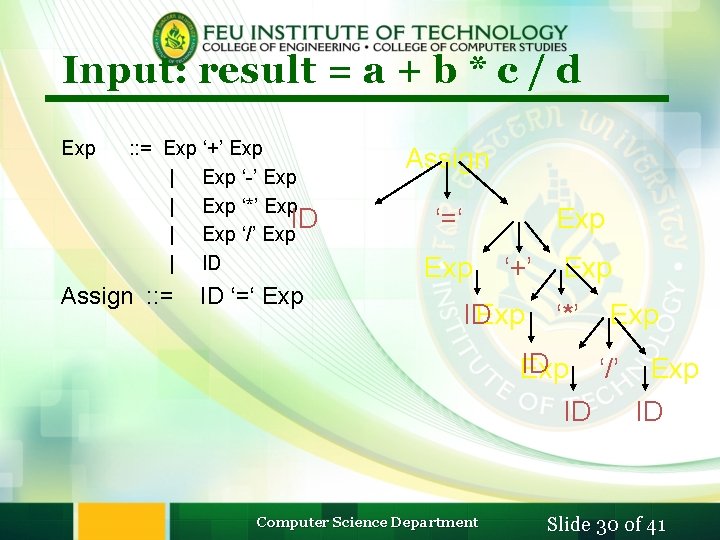
Input: result = a + b * c / d Exp : : = Exp ‘+’ Exp | Exp ‘-’ Exp | Exp ‘*’ Exp | Exp ‘/’ Exp | ID Assign : : = ID ‘=‘ Exp Computer Science Department Slide 28 of 41
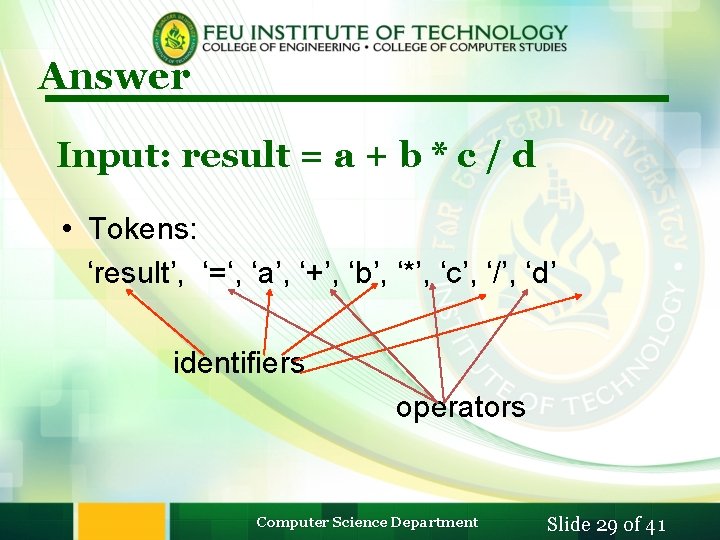
Answer Input: result = a + b * c / d • Tokens: ‘result’, ‘=‘, ‘a’, ‘+’, ‘b’, ‘*’, ‘c’, ‘/’, ‘d’ identifiers operators Computer Science Department Slide 29 of 41
Input: result = a + b * c / d Exp : : = Exp ‘+’ Exp Assign | Exp ‘-’ Exp | Exp ‘*’ Exp ID ‘=‘ Exp | Exp ‘/’ Exp | ID Exp ‘+’ Exp Assign : : = ID ‘=‘ Exp ID Exp ‘*’ Exp ID Exp ‘/’ Exp ID Computer Science Department ID Slide 30 of 41