RunTime Environments How do we allocate the space
- Slides: 25
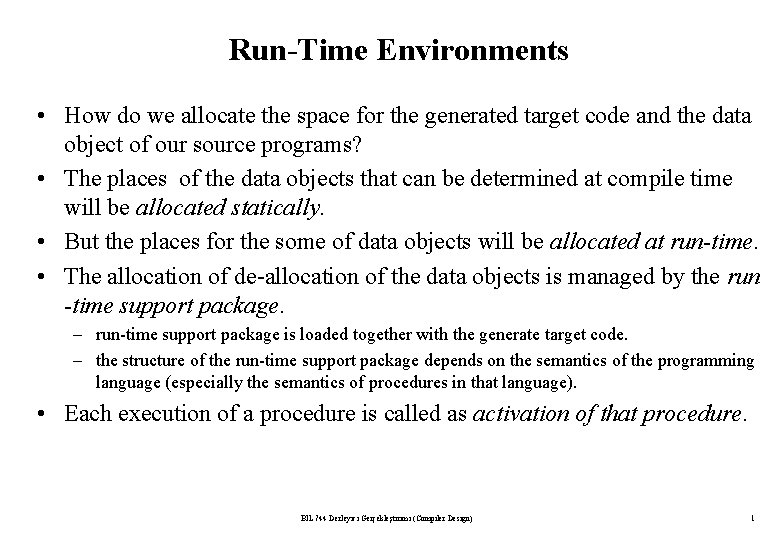
Run-Time Environments • How do we allocate the space for the generated target code and the data object of our source programs? • The places of the data objects that can be determined at compile time will be allocated statically. • But the places for the some of data objects will be allocated at run-time. • The allocation of de-allocation of the data objects is managed by the run -time support package. – run-time support package is loaded together with the generate target code. – the structure of the run-time support package depends on the semantics of the programming language (especially the semantics of procedures in that language). • Each execution of a procedure is called as activation of that procedure. BİL 744 Derleyici Gerçekleştirimi (Compiler Design) 1
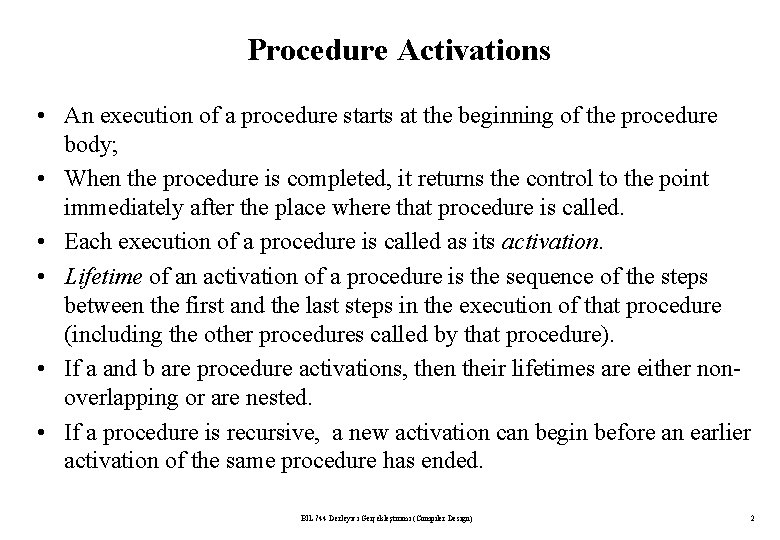
Procedure Activations • An execution of a procedure starts at the beginning of the procedure body; • When the procedure is completed, it returns the control to the point immediately after the place where that procedure is called. • Each execution of a procedure is called as its activation. • Lifetime of an activation of a procedure is the sequence of the steps between the first and the last steps in the execution of that procedure (including the other procedures called by that procedure). • If a and b are procedure activations, then their lifetimes are either nonoverlapping or are nested. • If a procedure is recursive, a new activation can begin before an earlier activation of the same procedure has ended. BİL 744 Derleyici Gerçekleştirimi (Compiler Design) 2
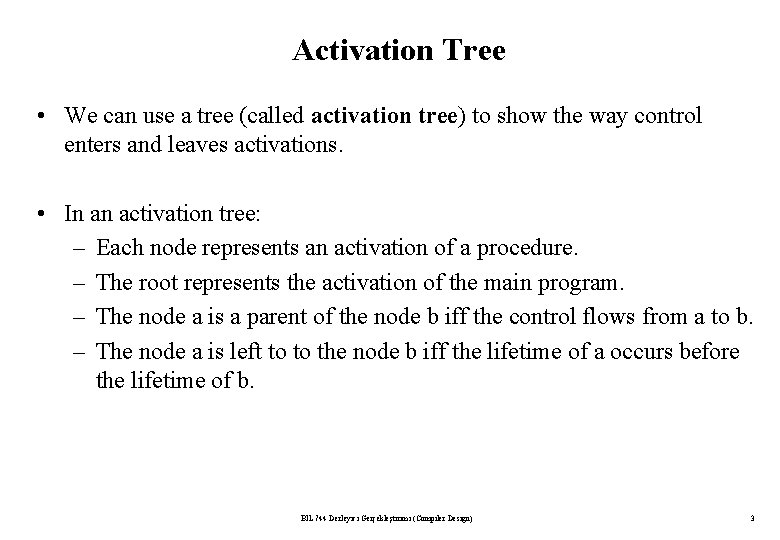
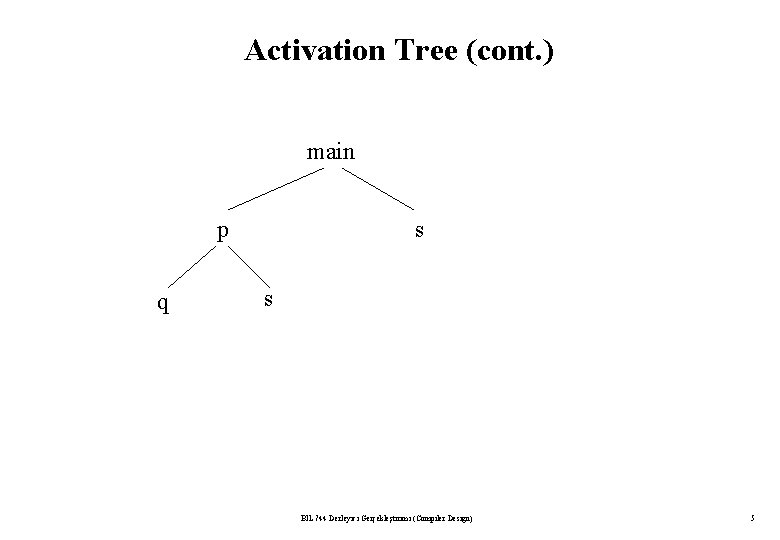
Activation Tree • We can use a tree (called activation tree) to show the way control enters and leaves activations. • In an activation tree: – Each node represents an activation of a procedure. – The root represents the activation of the main program. – The node a is a parent of the node b iff the control flows from a to b. – The node a is left to to the node b iff the lifetime of a occurs before the lifetime of b. BİL 744 Derleyici Gerçekleştirimi (Compiler Design) 3
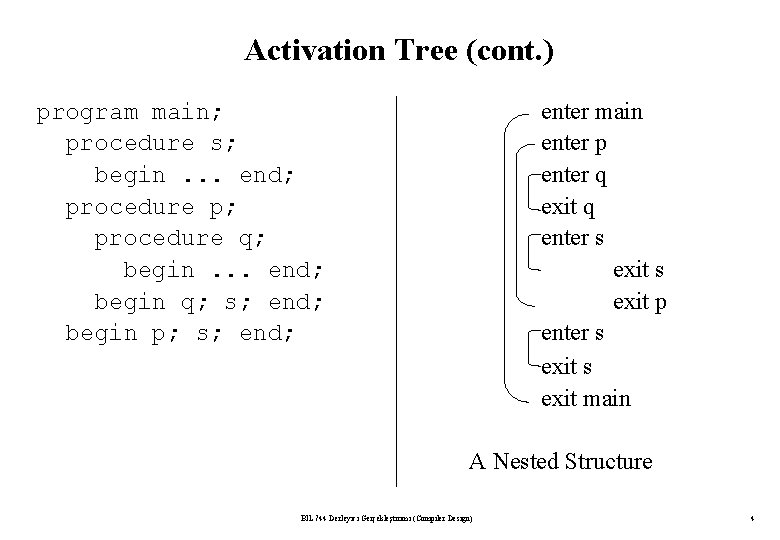
Activation Tree (cont. ) enter main enter p enter q exit q enter s exit p enter s exit main program main; procedure s; begin. . . end; procedure p; procedure q; begin. . . end; begin q; s; end; begin p; s; end; A Nested Structure BİL 744 Derleyici Gerçekleştirimi (Compiler Design) 4
Activation Tree (cont. ) main p q s s BİL 744 Derleyici Gerçekleştirimi (Compiler Design) 5
Control Stack • The flow of the control in a program corresponds to a depth-first traversal of the activation tree that: – starts at the root, – visits a node before its children, and – recursively visits children at each node an a left-to-right order. • A stack (called control stack) can be used to keep track of live procedure activations. – An activation record is pushed onto the control stack as the activation starts. – That activation record is popped when that activation ends. • When node n is at the top of the control stack, the stack contains the nodes along the path from n to the root. BİL 744 Derleyici Gerçekleştirimi (Compiler Design) 6
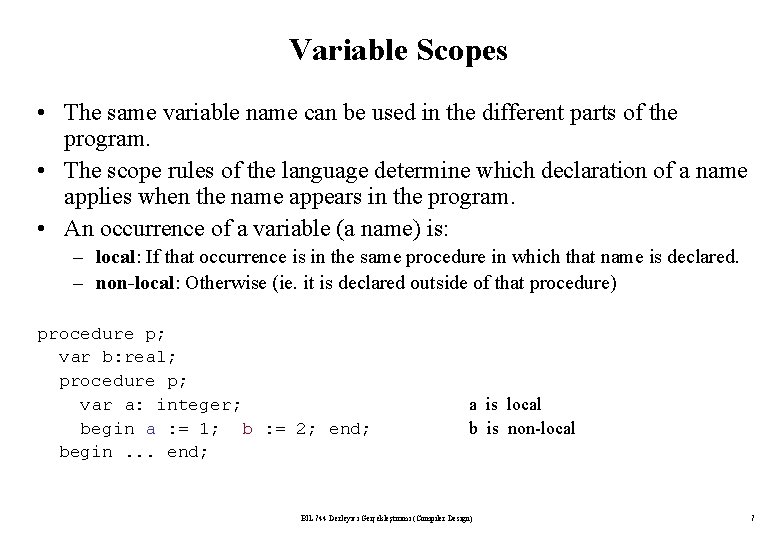
Variable Scopes • The same variable name can be used in the different parts of the program. • The scope rules of the language determine which declaration of a name applies when the name appears in the program. • An occurrence of a variable (a name) is: – local: If that occurrence is in the same procedure in which that name is declared. – non-local: Otherwise (ie. it is declared outside of that procedure) procedure p; var b: real; procedure p; var a: integer; begin a : = 1; b : = 2; end; begin. . . end; a is local b is non-local BİL 744 Derleyici Gerçekleştirimi (Compiler Design) 7
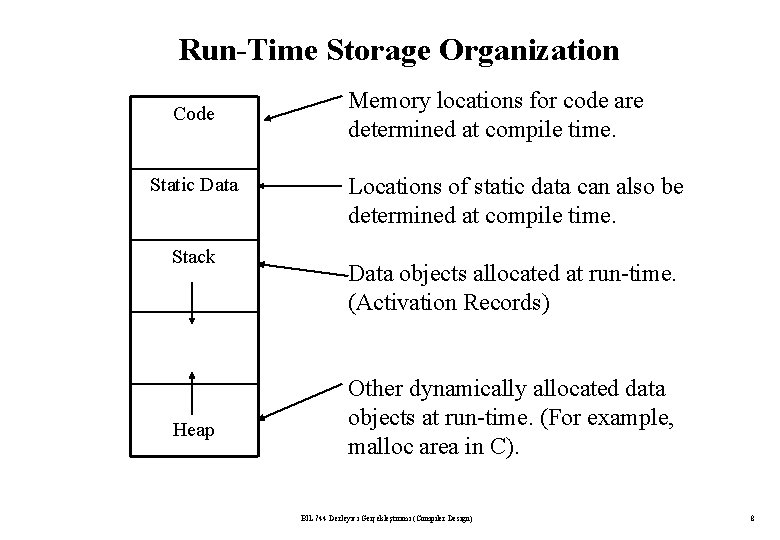
Run-Time Storage Organization Code Static Data Stack Heap Memory locations for code are determined at compile time. Locations of static data can also be determined at compile time. Data objects allocated at run-time. (Activation Records) Other dynamically allocated data objects at run-time. (For example, malloc area in C). BİL 744 Derleyici Gerçekleştirimi (Compiler Design) 8
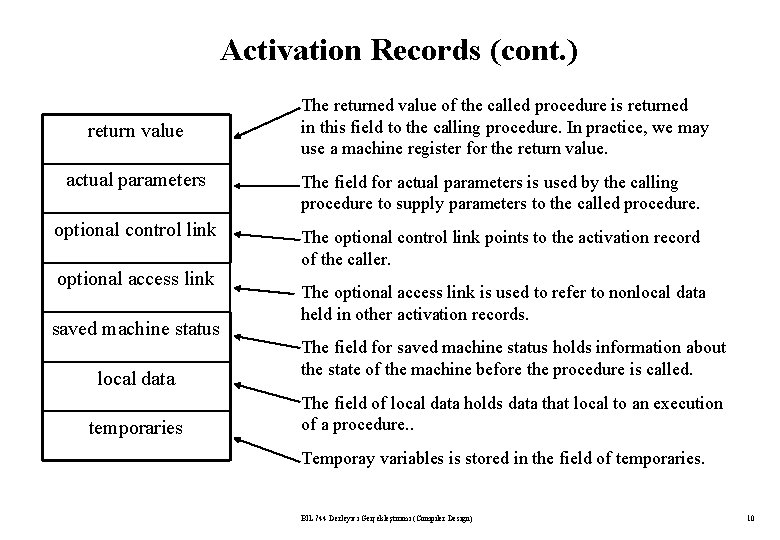
Activation Records • Information needed by a single execution of a procedure is managed using a contiguous block of storage called activation record. • An activation record is allocated when a procedure is entered, and it is de-allocated when that procedure exited. • Size of each field can be determined at compile time (Although actual location of the activation record is determined at run-time). – Except that if the procedure has a local variable and its size depends on a parameter, its size is determined at the run time. BİL 744 Derleyici Gerçekleştirimi (Compiler Design) 9
Activation Records (cont. ) return value The returned value of the called procedure is returned in this field to the calling procedure. In practice, we may use a machine register for the return value. actual parameters The field for actual parameters is used by the calling procedure to supply parameters to the called procedure. optional control link The optional control link points to the activation record of the caller. optional access link saved machine status local data temporaries The optional access link is used to refer to nonlocal data held in other activation records. The field for saved machine status holds information about the state of the machine before the procedure is called. The field of local data holds data that local to an execution of a procedure. . Temporay variables is stored in the field of temporaries. BİL 744 Derleyici Gerçekleştirimi (Compiler Design) 10
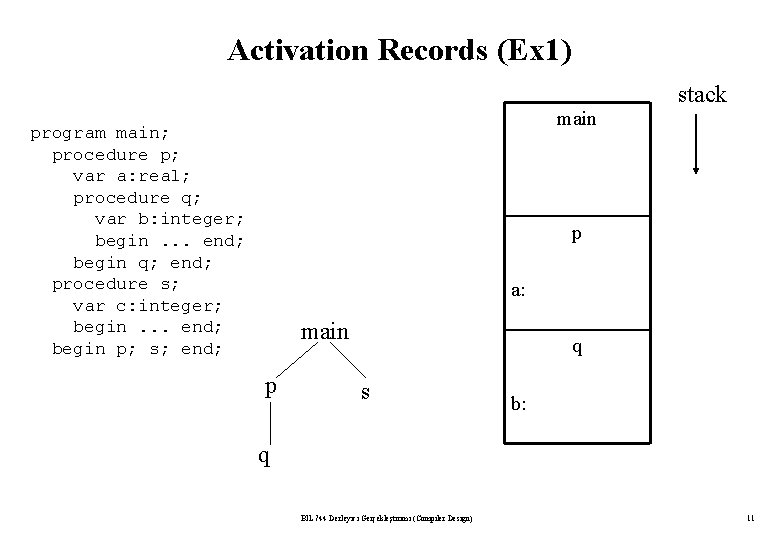
Activation Records (Ex 1) main program main; procedure p; var a: real; procedure q; var b: integer; begin. . . end; begin q; end; procedure s; var c: integer; begin. . . end; begin p; s; end; stack p a: main p q s b: q BİL 744 Derleyici Gerçekleştirimi (Compiler Design) 11
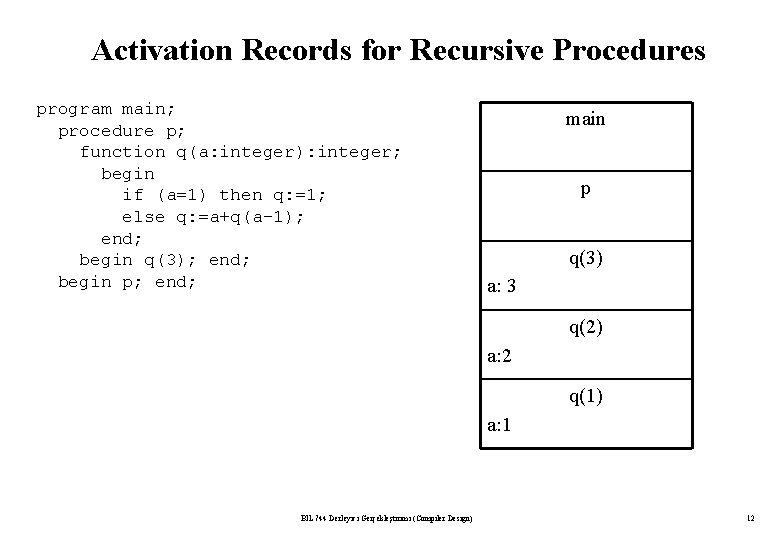
Activation Records for Recursive Procedures program main; procedure p; function q(a: integer): integer; begin if (a=1) then q: =1; else q: =a+q(a-1); end; begin q(3); end; begin p; end; main p q(3) a: 3 q(2) a: 2 q(1) a: 1 BİL 744 Derleyici Gerçekleştirimi (Compiler Design) 12
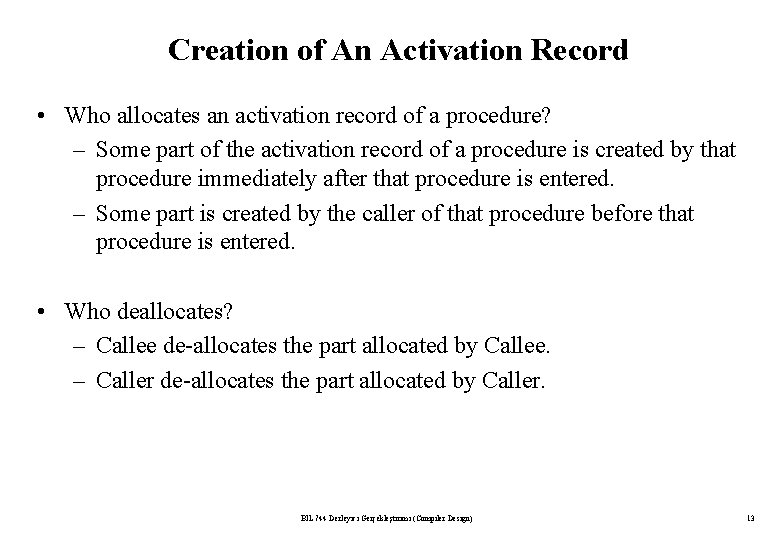
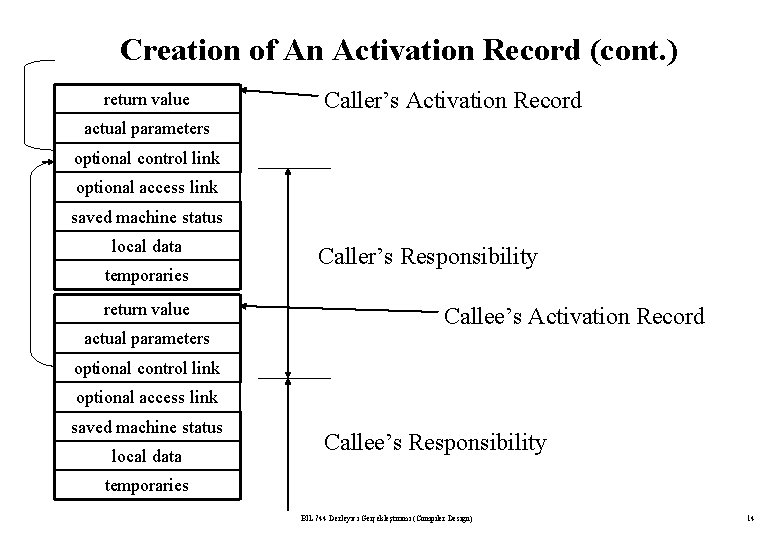
Creation of An Activation Record • Who allocates an activation record of a procedure? – Some part of the activation record of a procedure is created by that procedure immediately after that procedure is entered. – Some part is created by the caller of that procedure before that procedure is entered. • Who deallocates? – Callee de-allocates the part allocated by Callee. – Caller de-allocates the part allocated by Caller. BİL 744 Derleyici Gerçekleştirimi (Compiler Design) 13
Creation of An Activation Record (cont. ) return value Caller’s Activation Record actual parameters optional control link optional access link saved machine status local data temporaries return value actual parameters Caller’s Responsibility Callee’s Activation Record optional control link optional access link saved machine status local data Callee’s Responsibility temporaries BİL 744 Derleyici Gerçekleştirimi (Compiler Design) 14
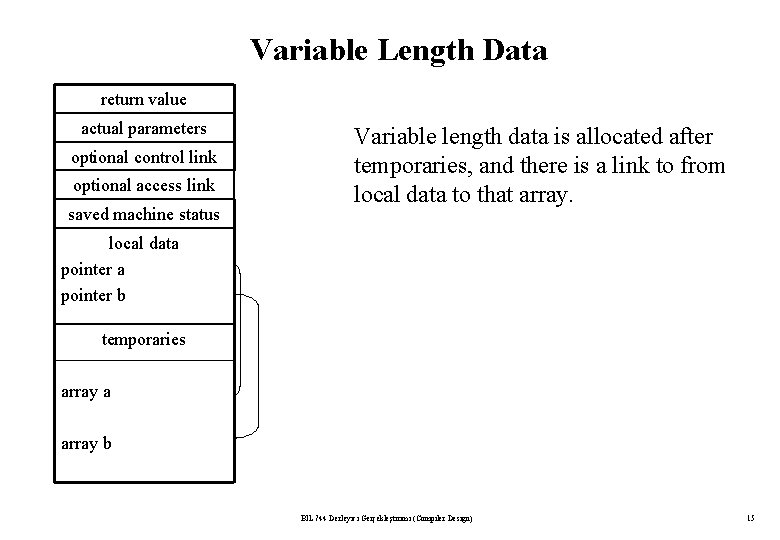
Variable Length Data return value actual parameters optional control link optional access link saved machine status Variable length data is allocated after temporaries, and there is a link to from local data to that array. local data pointer b temporaries array a array b BİL 744 Derleyici Gerçekleştirimi (Compiler Design) 15
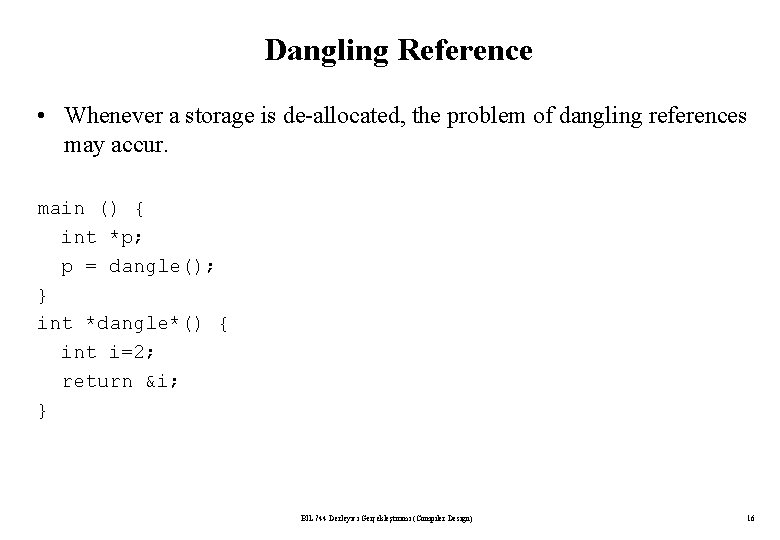
Dangling Reference • Whenever a storage is de-allocated, the problem of dangling references may accur. main () { int *p; p = dangle(); } int *dangle*() { int i=2; return &i; } BİL 744 Derleyici Gerçekleştirimi (Compiler Design) 16
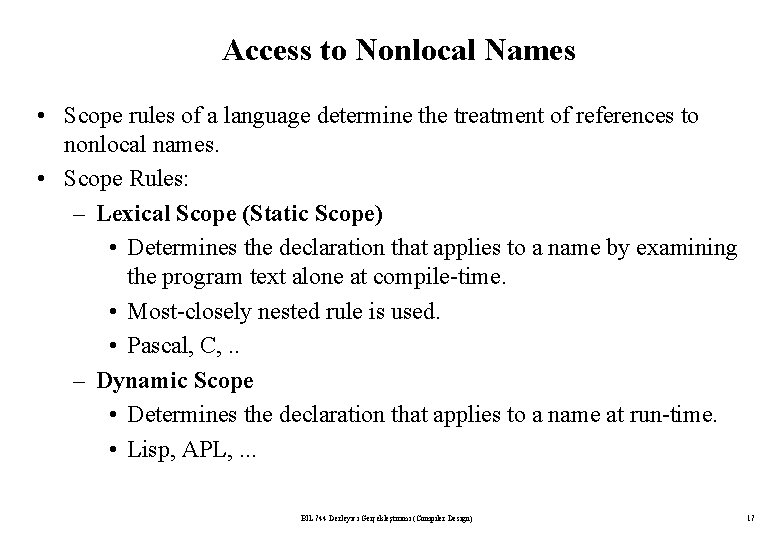
Access to Nonlocal Names • Scope rules of a language determine the treatment of references to nonlocal names. • Scope Rules: – Lexical Scope (Static Scope) • Determines the declaration that applies to a name by examining the program text alone at compile-time. • Most-closely nested rule is used. • Pascal, C, . . – Dynamic Scope • Determines the declaration that applies to a name at run-time. • Lisp, APL, . . . BİL 744 Derleyici Gerçekleştirimi (Compiler Design) 17
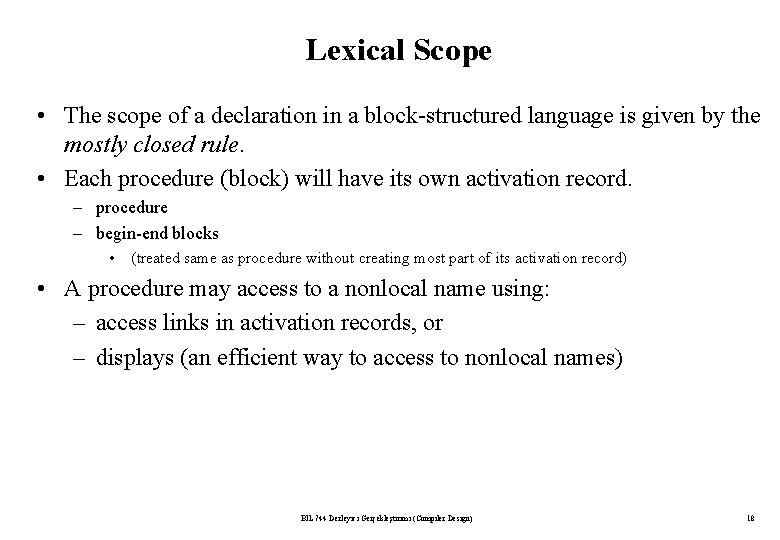
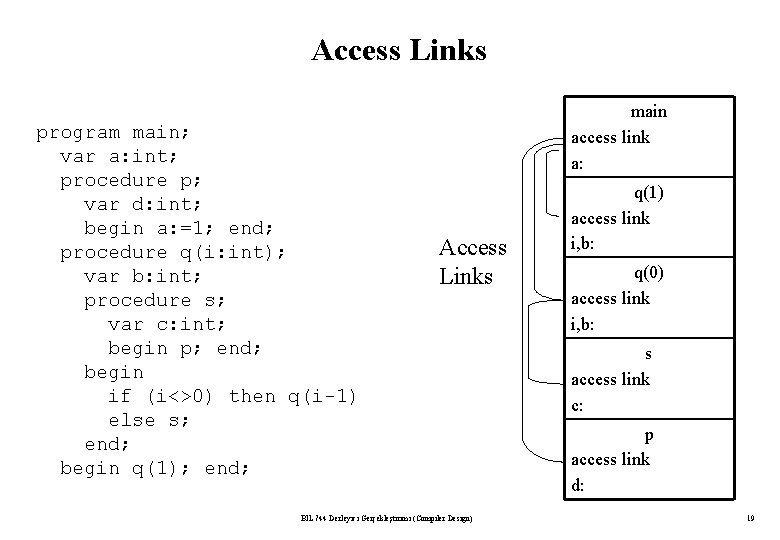
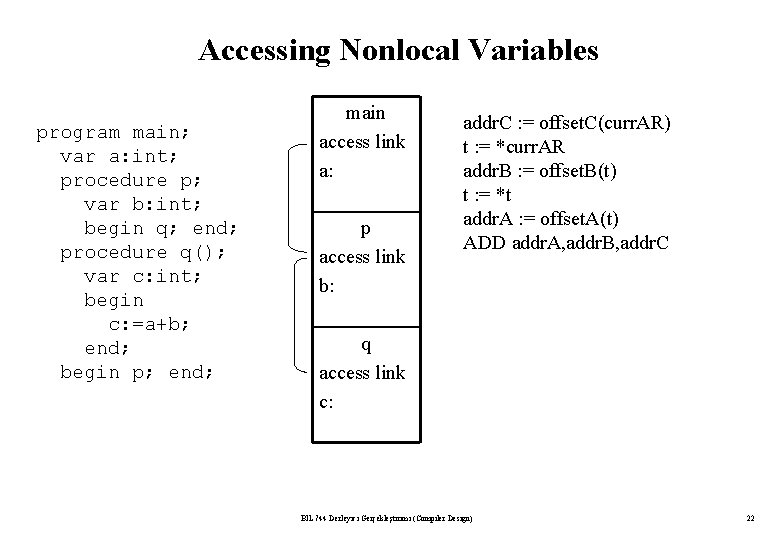
Lexical Scope • The scope of a declaration in a block-structured language is given by the mostly closed rule. • Each procedure (block) will have its own activation record. – procedure – begin-end blocks • (treated same as procedure without creating most part of its activation record) • A procedure may access to a nonlocal name using: – access links in activation records, or – displays (an efficient way to access to nonlocal names) BİL 744 Derleyici Gerçekleştirimi (Compiler Design) 18
Access Links program main; var a: int; procedure p; var d: int; begin a: =1; end; procedure q(i: int); var b: int; procedure s; var c: int; begin p; end; begin if (i<>0) then q(i-1) else s; end; begin q(1); end; main access link a: Access Links BİL 744 Derleyici Gerçekleştirimi (Compiler Design) q(1) access link i, b: q(0) access link i, b: s access link c: p access link d: 19
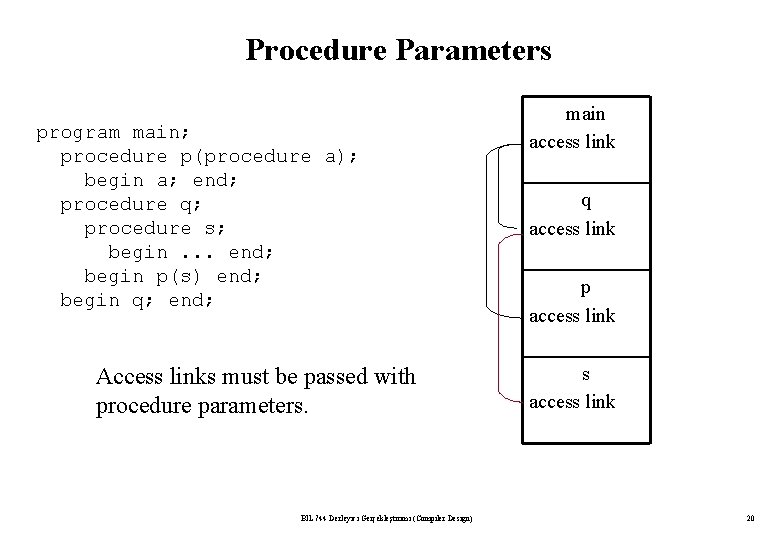
Procedure Parameters program main; procedure p(procedure a); begin a; end; procedure q; procedure s; begin. . . end; begin p(s) end; begin q; end; Access links must be passed with procedure parameters. BİL 744 Derleyici Gerçekleştirimi (Compiler Design) main access link q access link p access link s access link 20
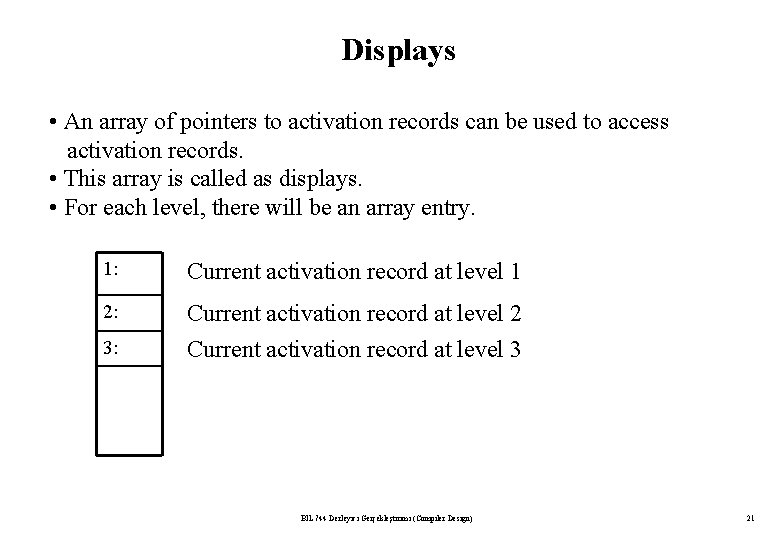
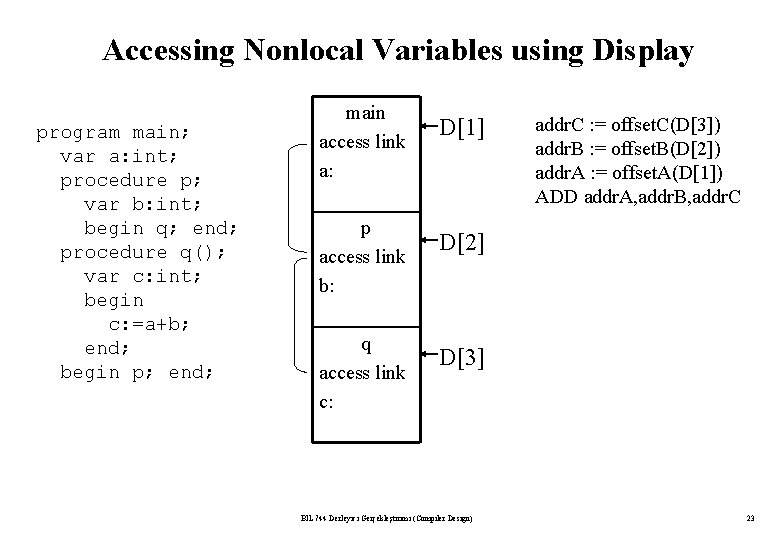
Displays • An array of pointers to activation records can be used to access activation records. • This array is called as displays. • For each level, there will be an array entry. 1: Current activation record at level 1 2: Current activation record at level 2 Current activation record at level 3 3: BİL 744 Derleyici Gerçekleştirimi (Compiler Design) 21
Accessing Nonlocal Variables program main; var a: int; procedure p; var b: int; begin q; end; procedure q(); var c: int; begin c: =a+b; end; begin p; end; main access link a: p access link b: addr. C : = offset. C(curr. AR) t : = *curr. AR addr. B : = offset. B(t) t : = *t addr. A : = offset. A(t) ADD addr. A, addr. B, addr. C q access link c: BİL 744 Derleyici Gerçekleştirimi (Compiler Design) 22
Accessing Nonlocal Variables using Display program main; var a: int; procedure p; var b: int; begin q; end; procedure q(); var c: int; begin c: =a+b; end; begin p; end; main access link a: p access link b: q access link c: D[1] addr. C : = offset. C(D[3]) addr. B : = offset. B(D[2]) addr. A : = offset. A(D[1]) ADD addr. A, addr. B, addr. C D[2] D[3] BİL 744 Derleyici Gerçekleştirimi (Compiler Design) 23
Parameter Passing Methods • Call-by-value • Call-by-reference • Call-by-name (used by Algol) BİL 744 Derleyici Gerçekleştirimi (Compiler Design) 24
SOME OTHER ISSUES • Symbol Tables hold scope information. • Dynamic Scope: – uses control link (similar to access links) • Dynamic Storage Allocation (Heap Management) – different allocation techniques BİL 744 Derleyici Gerçekleştirimi (Compiler Design) 25