
Chapter 6 Type Checking The compiler should report
- Slides: 12
Chapter 6 Type Checking
• The compiler should report an error if an operator is applied to an incompatible operand. • Type checking can be performed without running the program. It is a static check as opposed to a dynamic check which is performed during run time. • Examples: • Flow-of-Control: if control leaves a construct is there a place for it to go to? An example is a break statement in C not enclosed within a while, for, switch statement. • Uniqueness: Each variable should only be declared once. A function or procedure should only be defined once. Labels in a case statement should be unique.
• Basic types are atomic types with no internal structure visible to the programmer. Pascal examples are: boolean, character, integer and real. Subrange types like 1…. 10 and enumerated types, like (violet, indigo, blue, green, yellow, orange, red) are also basic types. • Constructed types built from other types. Pascal examples are arrays, records, sets and pointers. • The type of a language construct is denoted by a type expression. Type expressions are basic types or constructions of type expressions. • Basic type expressions: Includes the basic types of the language like boolean, character, integer and real. • A special basic type expression is type_error to signal the occurrence of a type check error.
• Statements have no values and are assigned the basic type expression of void. • Type names are basic type expressions. • Array(I, T) is a type expression denoting the type of an array with elements of type T and index set I. • Cartesian product: If T 1 and T 2 are type expressions then T 1 * T 2 is a type expression. • The type of a list is the Cartesian product of the types of its elements. • E. g. if a and b are of type real then a, b is of real * real type.
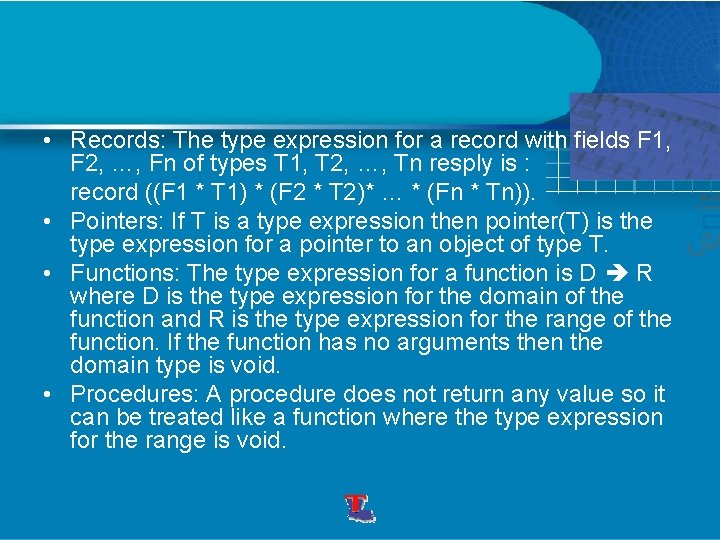
• Records: The type expression for a record with fields F 1, F 2, …, Fn of types T 1, T 2, …, Tn resply is : record ((F 1 * T 1) * (F 2 * T 2)* … * (Fn * Tn)). • Pointers: If T is a type expression then pointer(T) is the type expression for a pointer to an object of type T. • Functions: The type expression for a function is D R where D is the type expression for the domain of the function and R is the type expression for the range of the function. If the function has no arguments then the domain type is void. • Procedures: A procedure does not return any value so it can be treated like a function where the type expression for the range is void.
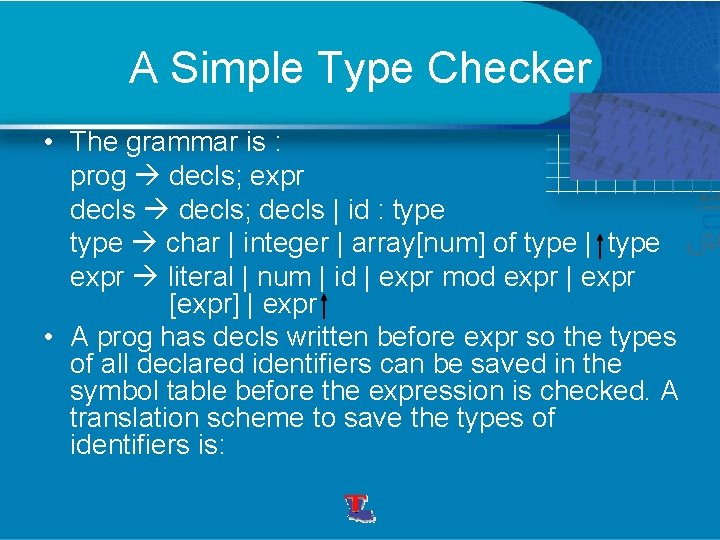
A Simple Type Checker • The grammar is : prog decls; expr decls; decls | id : type char | integer | array[num] of type | type expr literal | num | id | expr mod expr | expr [expr] | expr • A prog has decls written before expr so the types of all declared identifiers can be saved in the symbol table before the expression is checked. A translation scheme to save the types of identifiers is:
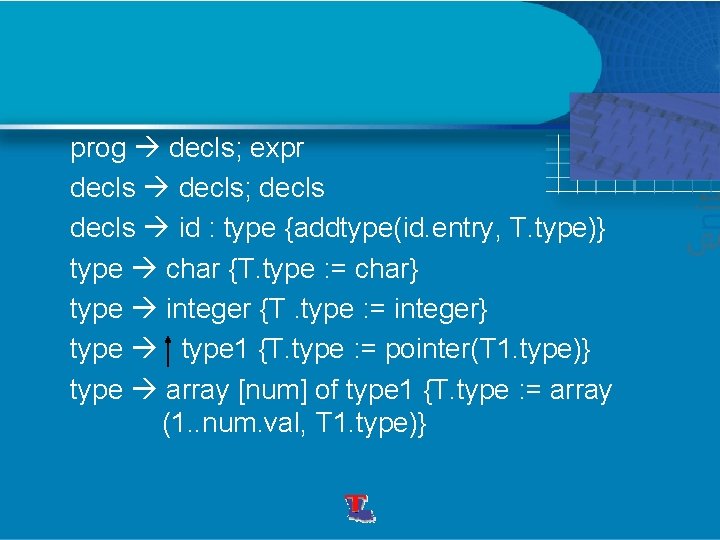
prog decls; expr decls; decls id : type {addtype(id. entry, T. type)} type char {T. type : = char} type integer {T. type : = integer} type 1 {T. type : = pointer(T 1. type)} type array [num] of type 1 {T. type : = array (1. . num. val, T 1. type)}
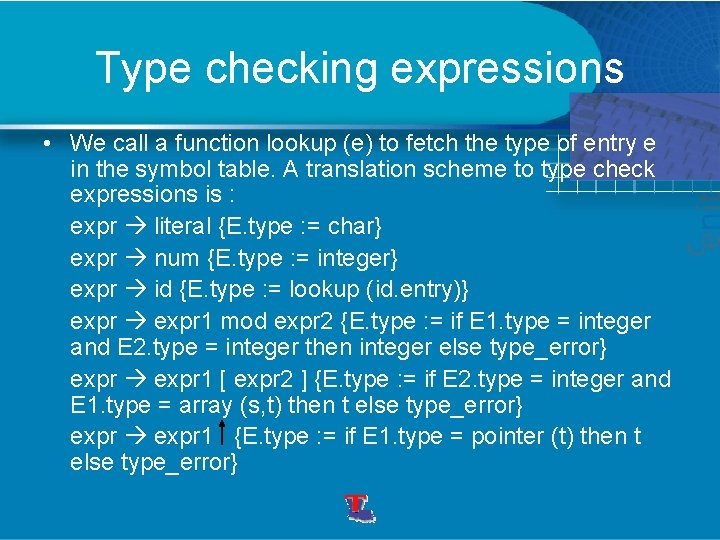
Type checking expressions • We call a function lookup (e) to fetch the type of entry e in the symbol table. A translation scheme to type check expressions is : expr literal {E. type : = char} expr num {E. type : = integer} expr id {E. type : = lookup (id. entry)} expr 1 mod expr 2 {E. type : = if E 1. type = integer and E 2. type = integer then integer else type_error} expr 1 [ expr 2 ] {E. type : = if E 2. type = integer and E 1. type = array (s, t) then t else type_error} expr 1 {E. type : = if E 1. type = pointer (t) then t else type_error}
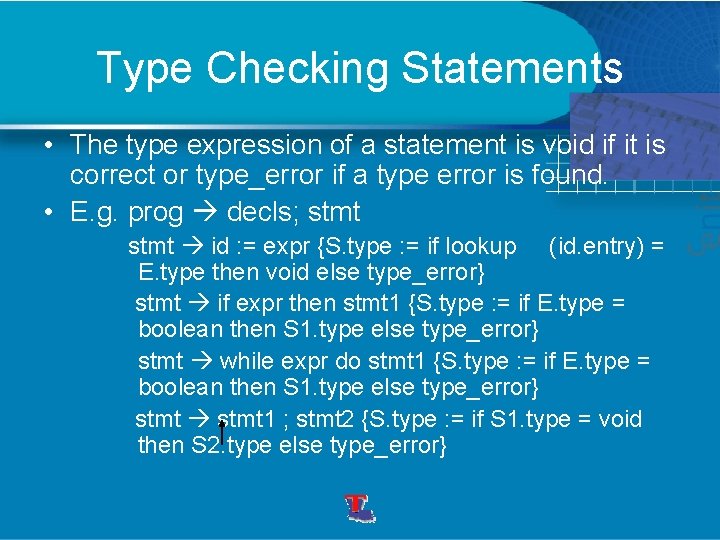
Type Checking Statements • The type expression of a statement is void if it is correct or type_error if a type error is found. • E. g. prog decls; stmt id : = expr {S. type : = if lookup (id. entry) = E. type then void else type_error} stmt if expr then stmt 1 {S. type : = if E. type = boolean then S 1. type else type_error} stmt while expr do stmt 1 {S. type : = if E. type = boolean then S 1. type else type_error} stmt 1 ; stmt 2 {S. type : = if S 1. type = void then S 2. type else type_error}
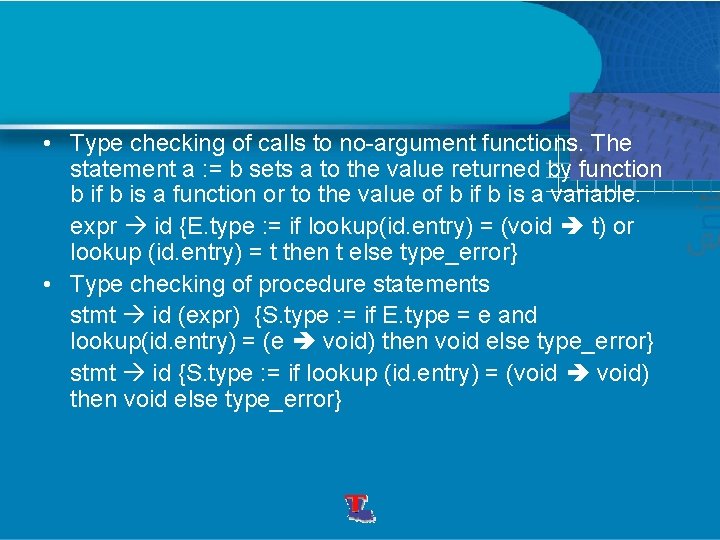
• Type checking of calls to no-argument functions. The statement a : = b sets a to the value returned by function b if b is a function or to the value of b is a variable. expr id {E. type : = if lookup(id. entry) = (void t) or lookup (id. entry) = t then t else type_error} • Type checking of procedure statements stmt id (expr) {S. type : = if E. type = e and lookup(id. entry) = (e void) then void else type_error} stmt id {S. type : = if lookup (id. entry) = (void void) then void else type_error}
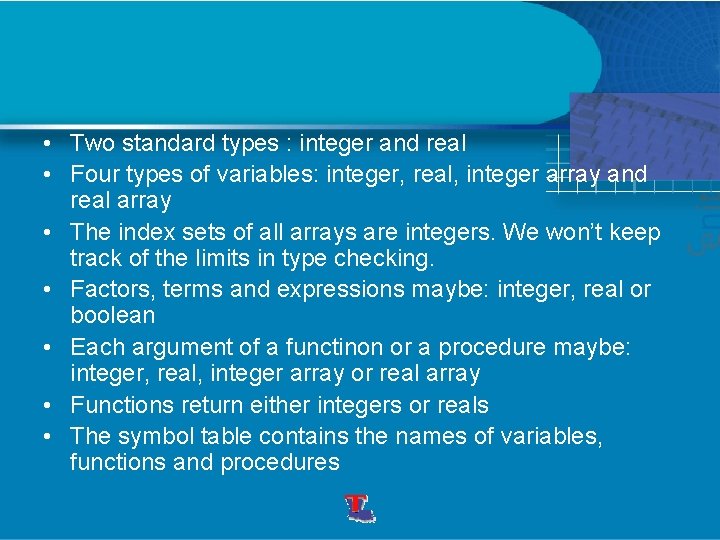
• Two standard types : integer and real • Four types of variables: integer, real, integer array and real array • The index sets of all arrays are integers. We won’t keep track of the limits in type checking. • Factors, terms and expressions maybe: integer, real or boolean • Each argument of a functinon or a procedure maybe: integer, real, integer array or real array • Functions return either integers or reals • The symbol table contains the names of variables, functions and procedures
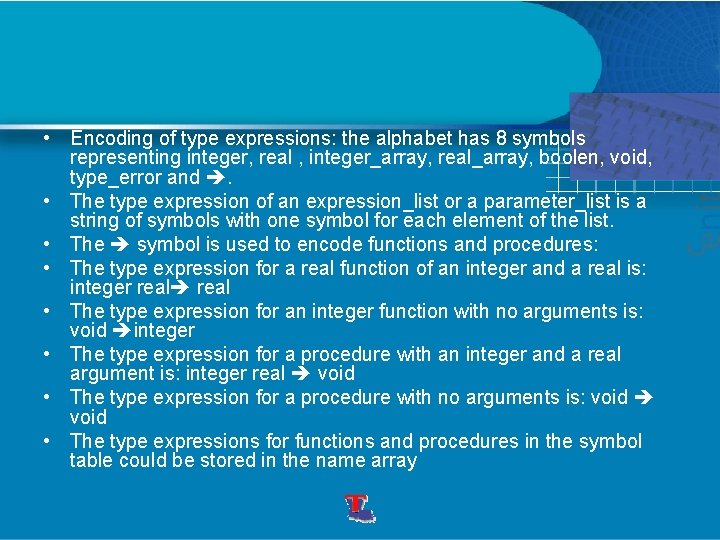
• Encoding of type expressions: the alphabet has 8 symbols representing integer, real , integer_array, real_array, boolen, void, type_error and . • The type expression of an expression_list or a parameter_list is a string of symbols with one symbol for each element of the list. • The symbol is used to encode functions and procedures: • The type expression for a real function of an integer and a real is: integer real • The type expression for an integer function with no arguments is: void integer • The type expression for a procedure with an integer and a real argument is: integer real void • The type expression for a procedure with no arguments is: void • The type expressions for functions and procedures in the symbol table could be stored in the name array