ONNX Support in the MLIR Compiler Approach and

- Slides: 10
ONNX Support in the MLIR Compiler Approach and Status Alexandre Eichenberger Collaborative effort from IBM Watson/Tokyo Research Labs and a growing number of external contributors.
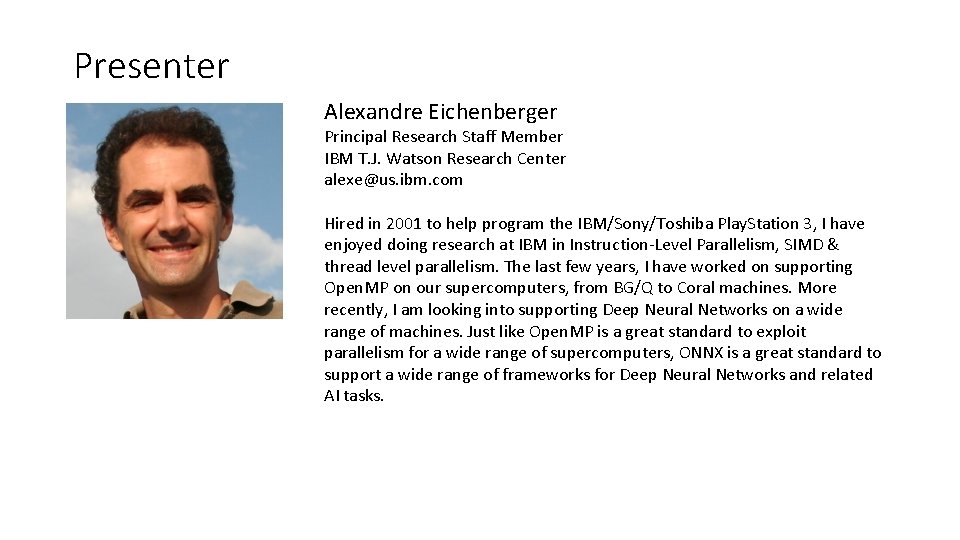
Presenter Alexandre Eichenberger Principal Research Staff Member IBM T. J. Watson Research Center alexe@us. ibm. com Hired in 2001 to help program the IBM/Sony/Toshiba Play. Station 3, I have enjoyed doing research at IBM in Instruction-Level Parallelism, SIMD & thread level parallelism. The last few years, I have worked on supporting Open. MP on our supercomputers, from BG/Q to Coral machines. More recently, I am looking into supporting Deep Neural Networks on a wide range of machines. Just like Open. MP is a great standard to exploit parallelism for a wide range of supercomputers, ONNX is a great standard to support a wide range of frameworks for Deep Neural Networks and related AI tasks.
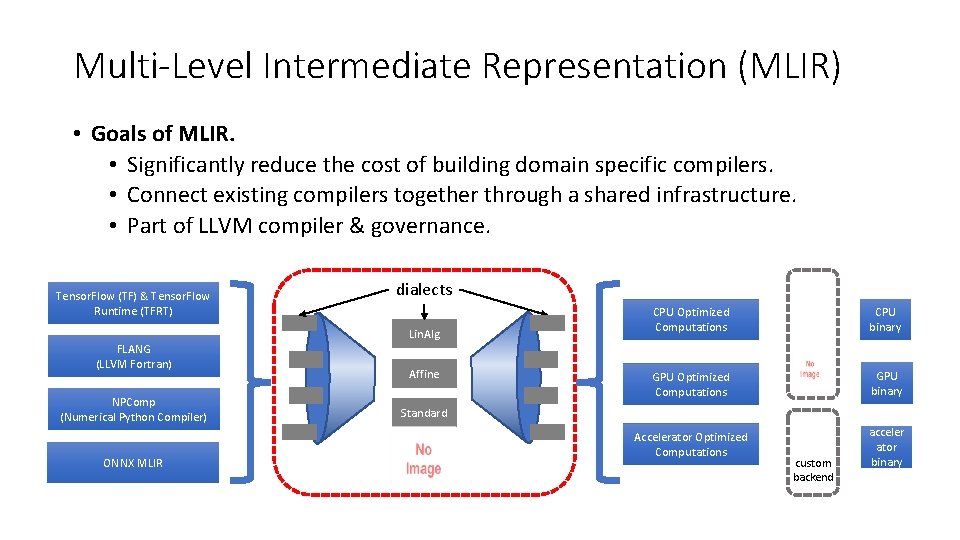
Multi-Level Intermediate Representation (MLIR) • Goals of MLIR. • Significantly reduce the cost of building domain specific compilers. • Connect existing compilers together through a shared infrastructure. • Part of LLVM compiler & governance. Tensor. Flow (TF) & Tensor. Flow Runtime (TFRT) dialects Lin. Alg FLANG (LLVM Fortran) NPComp (Numerical Python Compiler) ONNX MLIR Affine CPU Optimized Computations CPU binary GPU Optimized Computations GPU binary Accelerator Optimized Computations acceler ator binary Standard custom backend
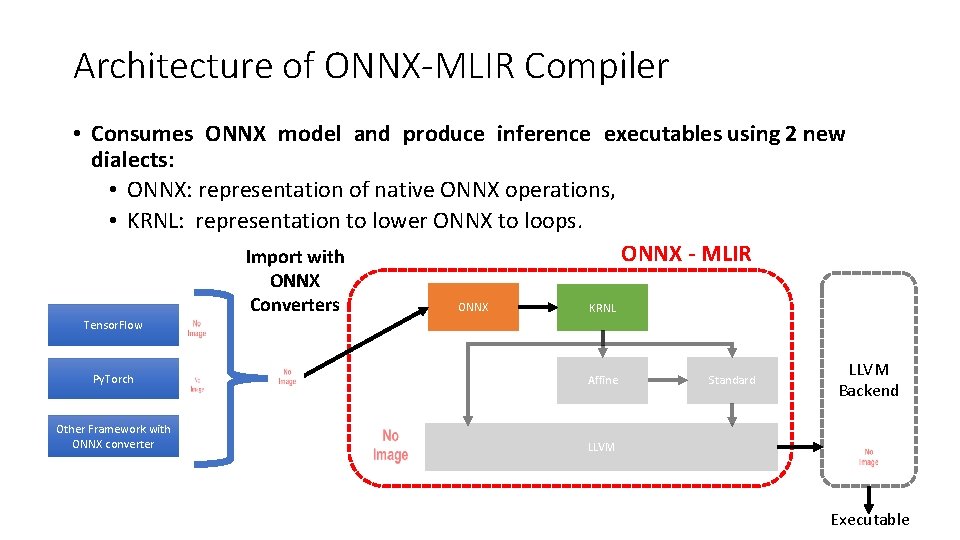
Architecture of ONNX-MLIR Compiler • Consumes ONNX model and produce inference executables using 2 new dialects: • ONNX: representation of native ONNX operations, • KRNL: representation to lower ONNX to loops. ONNX - MLIR Import with ONNX Converters ONNX KRNL Tensor. Flow Py. Torch Affine Other Framework with ONNX converter LLVM Standard LLVM Backend Executable
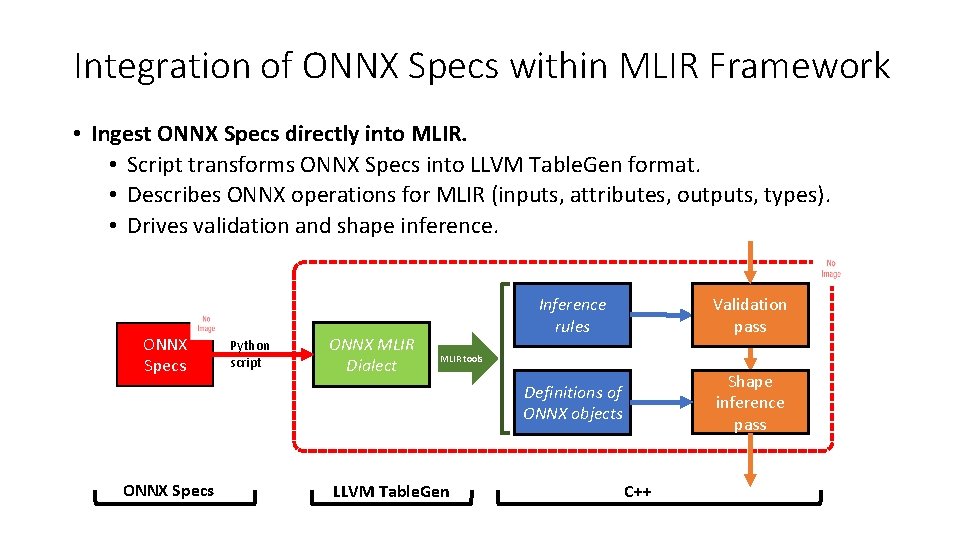
Integration of ONNX Specs within MLIR Framework • Ingest ONNX Specs directly into MLIR. • Script transforms ONNX Specs into LLVM Table. Gen format. • Describes ONNX operations for MLIR (inputs, attributes, outputs, types). • Drives validation and shape inference. ONNX Specs Python script ONNX MLIR Dialect Inference rules Validation pass Definitions of ONNX objects Shape inference pass MLIR tools LLVM Table. Gen C++
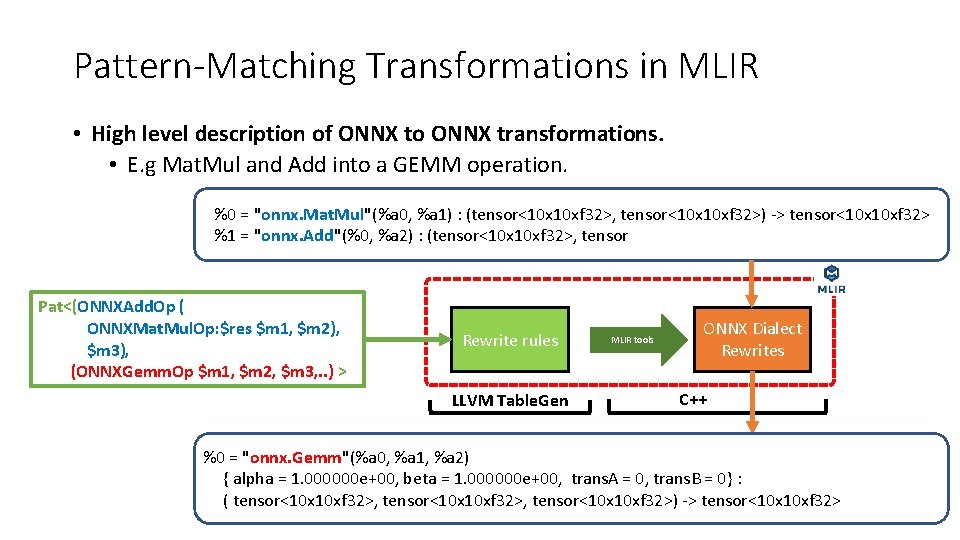
Pattern-Matching Transformations in MLIR • High level description of ONNX to ONNX transformations. • E. g Mat. Mul and Add into a GEMM operation. %0 = "onnx. Mat. Mul"(%a 0, %a 1) : (tensor<10 x 10 xf 32>, tensor<10 x 10 xf 32>) -> tensor<10 x 10 xf 32> %1 = "onnx. Add"(%0, %a 2) : (tensor<10 x 10 xf 32>, tensor Pat<(ONNXAdd. Op ( ONNXMat. Mul. Op: $res $m 1, $m 2), $m 3), (ONNXGemm. Op $m 1, $m 2, $m 3, . . ) > Rewrite rules LLVM Table. Gen MLIR tools ONNX Dialect Rewrites C++ %0 = "onnx. Gemm"(%a 0, %a 1, %a 2) { alpha = 1. 000000 e+00, beta = 1. 000000 e+00, trans. A = 0, trans. B = 0} : ( tensor<10 x 10 xf 32>, tensor<10 x 10 xf 32>) -> tensor<10 x 10 xf 32>
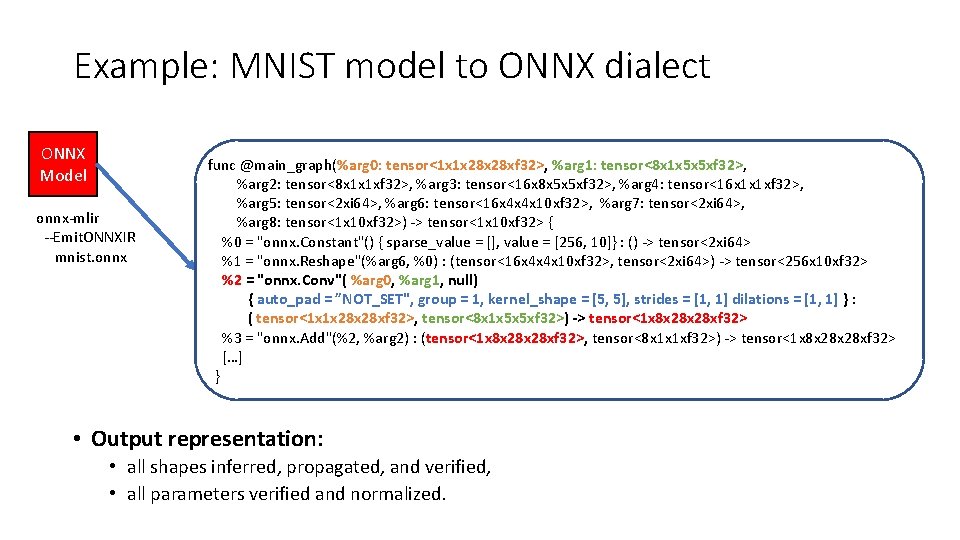
Example: MNIST model to ONNX dialect ONNX Model onnx-mlir --Emit. ONNXIR mnist. onnx func @main_graph(%arg 0: tensor<1 x 1 x 28 xf 32>, %arg 1: tensor<8 x 1 x 5 x 5 xf 32>, %arg 2: tensor<8 x 1 x 1 xf 32>, %arg 3: tensor<16 x 8 x 5 x 5 xf 32>, %arg 4: tensor<16 x 1 x 1 xf 32>, %arg 5: tensor<2 xi 64>, %arg 6: tensor<16 x 4 x 4 x 10 xf 32>, %arg 7: tensor<2 xi 64>, %arg 8: tensor<1 x 10 xf 32>) -> tensor<1 x 10 xf 32> { %0 = "onnx. Constant"() { sparse_value = [], value = [256, 10]} : () -> tensor<2 xi 64> %1 = "onnx. Reshape"(%arg 6, %0) : (tensor<16 x 4 x 4 x 10 xf 32>, tensor<2 xi 64>) -> tensor<256 x 10 xf 32> %2 = "onnx. Conv"( %arg 0, %arg 1, null) { auto_pad = ”NOT_SET", group = 1, kernel_shape = [5, 5], strides = [1, 1] dilations = [1, 1] } : ( tensor<1 x 1 x 28 xf 32>, tensor<8 x 1 x 5 x 5 xf 32>) -> tensor<1 x 8 x 28 xf 32> %3 = "onnx. Add"(%2, %arg 2) : (tensor<1 x 8 x 28 xf 32>, tensor<8 x 1 x 1 xf 32>) -> tensor<1 x 8 x 28 xf 32> […] } • Output representation: • all shapes inferred, propagated, and verified, • all parameters verified and normalized.
Motivation for KRNL Dialect • Dialect used to lower ONNX operations to loop code. • Designed for customizable optimizations such as tiling, fusion, parallelization. • It is hard to revert an optimization, except if… • Instead of performing the optimization, we just record it (i. e. build a recipe of optimizations). • And can alter it later as needed by other optimization. • Example: • Try to fuse 2 kernels that were tiled by different amount: A: blocks of 5 x 5 B: blocks of 2 x 2 • Make them compatible by simply edit B’s recipe from [2, 2] -> [5, 5] • Greater freedom and flexibility for compilers to traverse the schedule space!
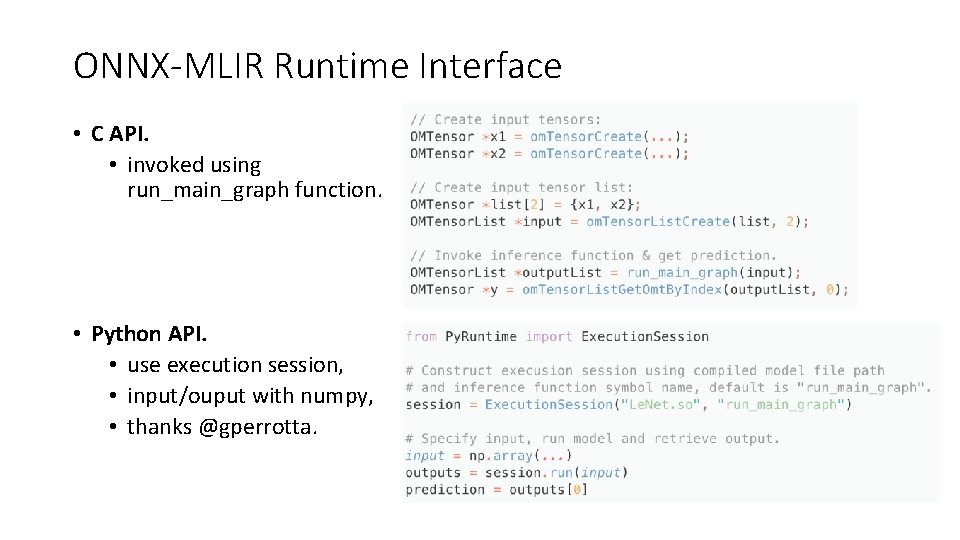
ONNX-MLIR Runtime Interface • C API. • invoked using run_main_graph function. • Python API. • use execution session, • input/ouput with numpy, • thanks @gperrotta.
Get Involved • Big thanks. • to the 15+ external contributors. • Learn more. • Code: https: //github. com/onnx-mlir • Additional documentation: http: //onnx. ai/onnx-mlir • Status. • Support 50+ commonly used ONNX operations. • Can compile mnist, resnet to LLVM. • Actively prototyping. • ONNX, KRNL & buffer optimizations. • ONNX-ML support.