Computer Graphics II Rendering CSE 168 Spr 20
- Slides: 47
Computer Graphics II: Rendering CSE 168 [Spr 20], Lecture 7: Monte Carlo Path Tracing Ravi Ramamoorthi http: //viscomp. ucsd. edu/classes/cse 168/sp 20
To Do § Homework 2 (direct lighting) due in a few days § Next assignment path tracing (on ed. X edge). This lecture covers much of that material
Motivation § General solution to rendering and global illumination § Suitable for a variety of general scenes § Based on Monte Carlo methods § Enumerate all paths of light transport
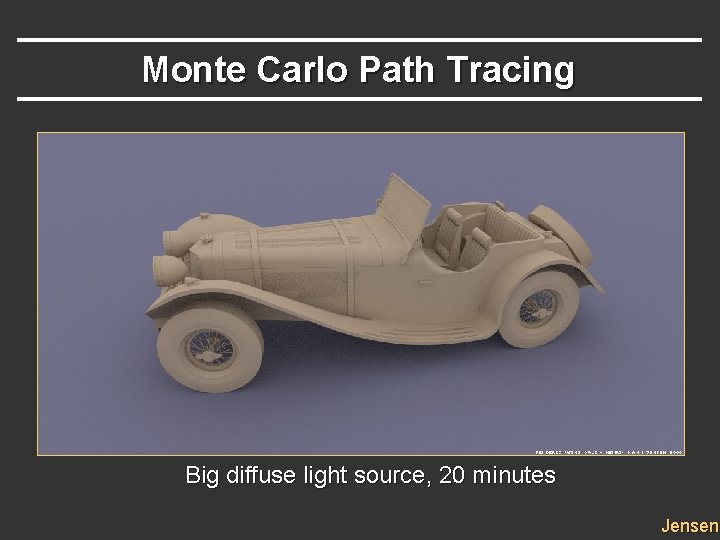
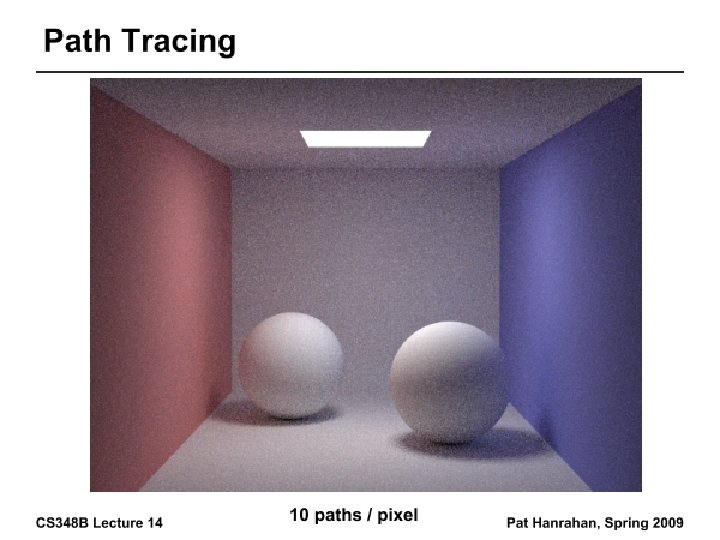
Monte Carlo Path Tracing Big diffuse light source, 20 minutes Jensen
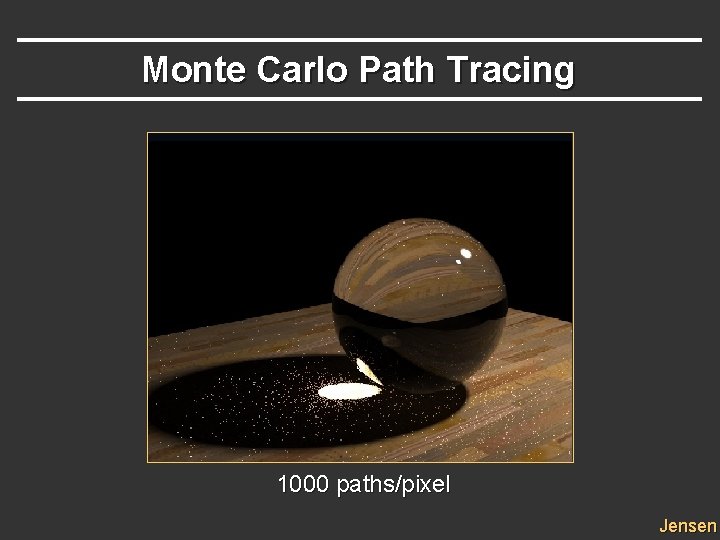
Monte Carlo Path Tracing 1000 paths/pixel Jensen
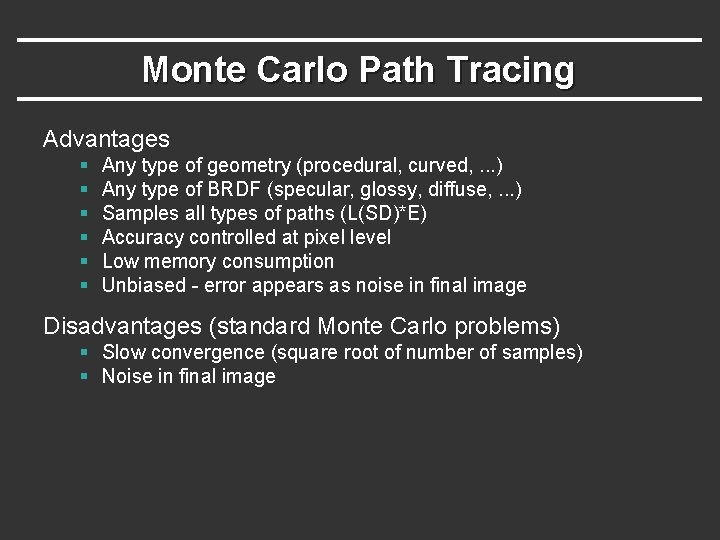
Monte Carlo Path Tracing Advantages § § § Any type of geometry (procedural, curved, . . . ) Any type of BRDF (specular, glossy, diffuse, . . . ) Samples all types of paths (L(SD)*E) Accuracy controlled at pixel level Low memory consumption Unbiased - error appears as noise in final image Disadvantages (standard Monte Carlo problems) § Slow convergence (square root of number of samples) § Noise in final image
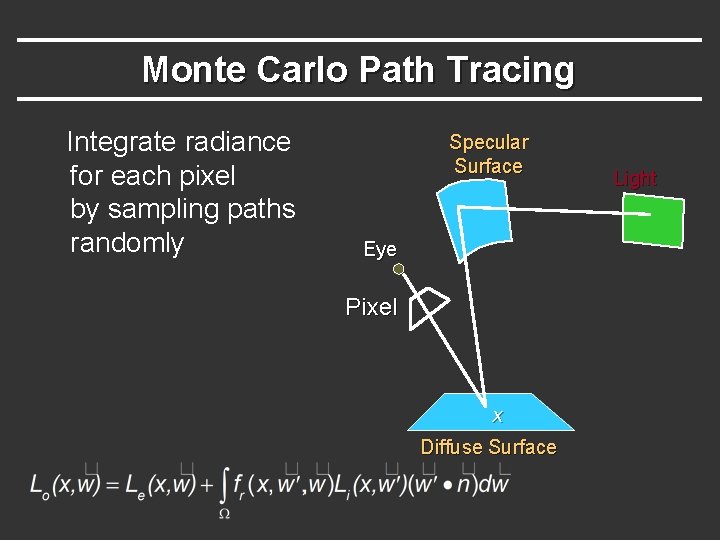
Monte Carlo Path Tracing Integrate radiance for each pixel by sampling paths randomly Specular Surface Eye Pixel x Diffuse Surface Light
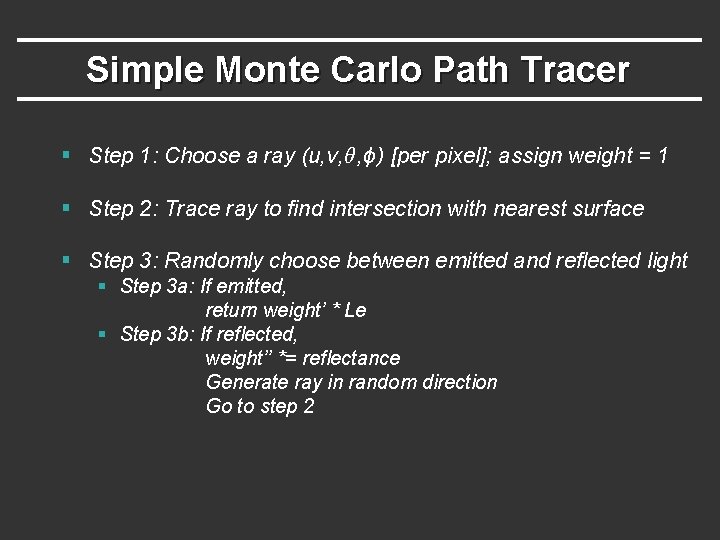
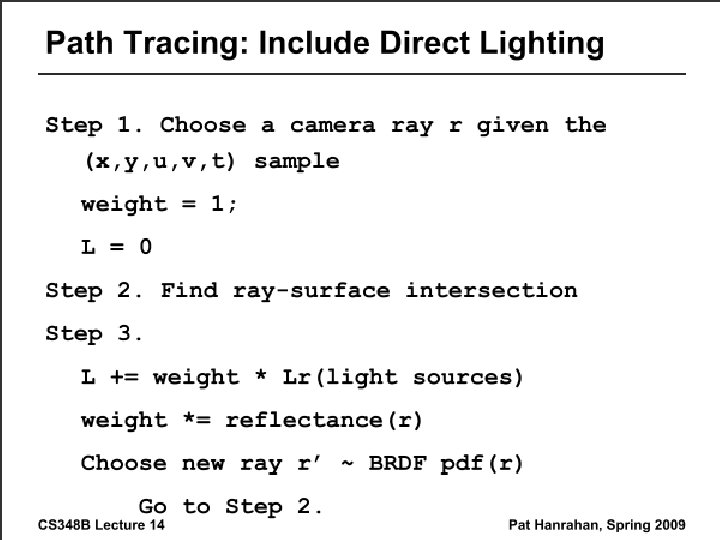
Simple Monte Carlo Path Tracer § Step 1: Choose a ray (u, v, θ , ϕ ) [per pixel]; assign weight = 1 § Step 2: Trace ray to find intersection with nearest surface § Step 3: Randomly choose between emitted and reflected light § Step 3 a: If emitted, return weight’ * Le § Step 3 b: If reflected, weight’’ *= reflectance Generate ray in random direction Go to step 2
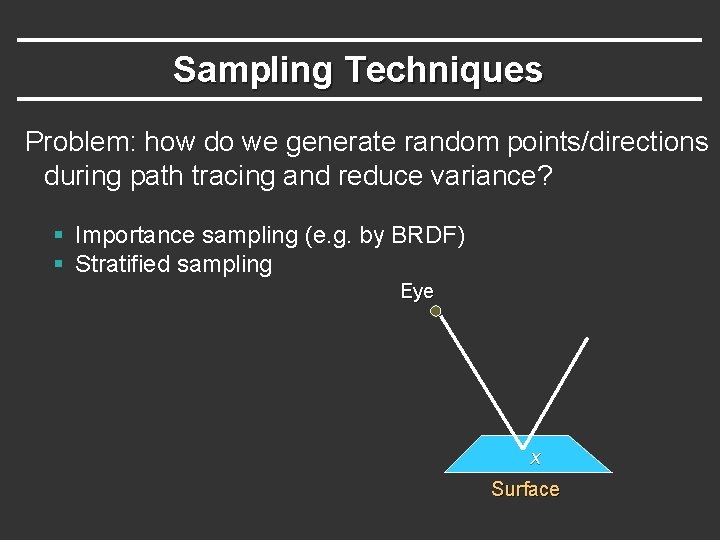
Sampling Techniques Problem: how do we generate random points/directions during path tracing and reduce variance? § Importance sampling (e. g. by BRDF) § Stratified sampling Eye x Surface
Outline § Motivation and Basic Idea § Implementation of simple path tracer § Variance Reduction: Importance sampling § Other variance reduction methods § Specific 2 D sampling techniques
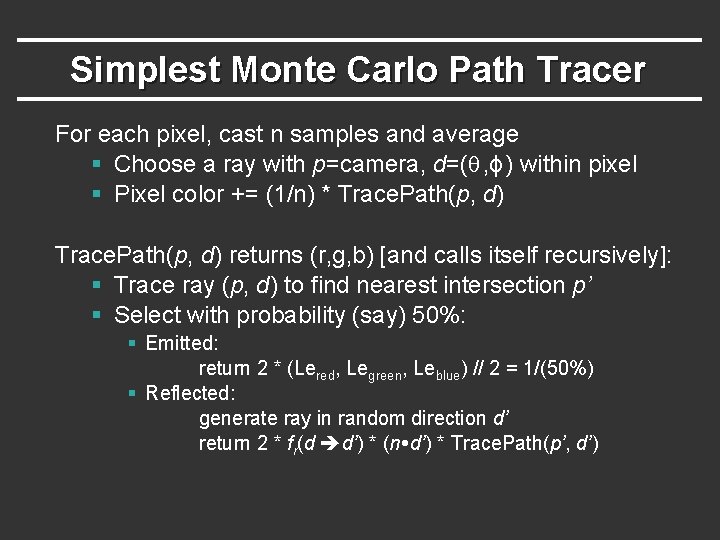
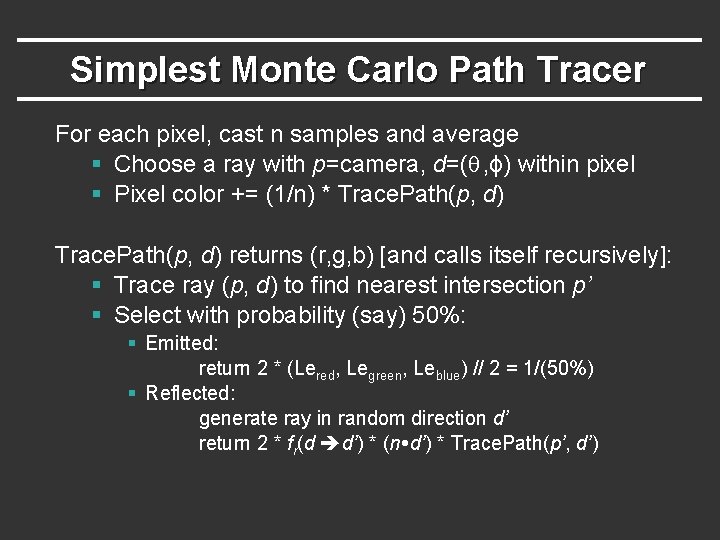
Simplest Monte Carlo Path Tracer For each pixel, cast n samples and average § Choose a ray with p=camera, d=(θ , ϕ ) within pixel § Pixel color += (1/n) * Trace. Path(p, d) returns (r, g, b) [and calls itself recursively]: § Trace ray (p, d) to find nearest intersection p’ § Select with probability (say) 50%: § Emitted: return 2 * (Lered, Legreen, Leblue) // 2 = 1/(50%) § Reflected: generate ray in random direction d’ return 2 * fr(d d’) * (n d’) * Trace. Path(p’, d’)
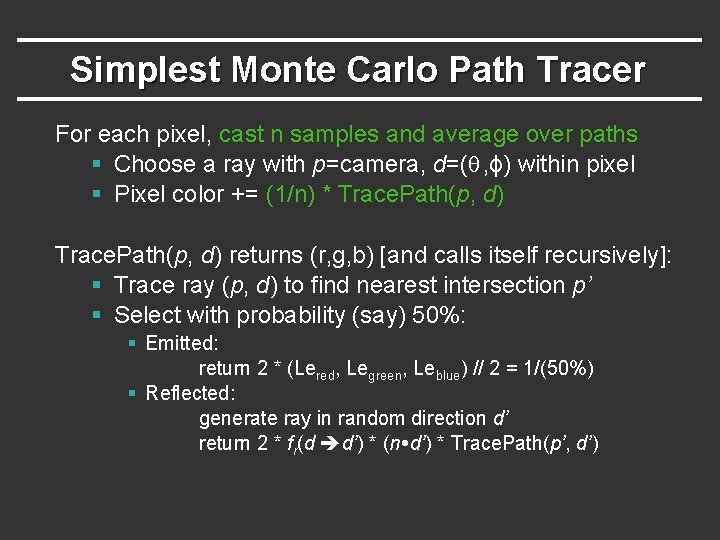
Simplest Monte Carlo Path Tracer For each pixel, cast n samples and average over paths § Choose a ray with p=camera, d=(θ , ϕ) within pixel § Pixel color += (1/n) * Trace. Path(p, d) returns (r, g, b) [and calls itself recursively]: § Trace ray (p, d) to find nearest intersection p’ § Select with probability (say) 50%: § Emitted: return 2 * (Lered, Legreen, Leblue) // 2 = 1/(50%) § Reflected: generate ray in random direction d’ return 2 * fr(d d’) * (n d’) * Trace. Path(p’, d’)
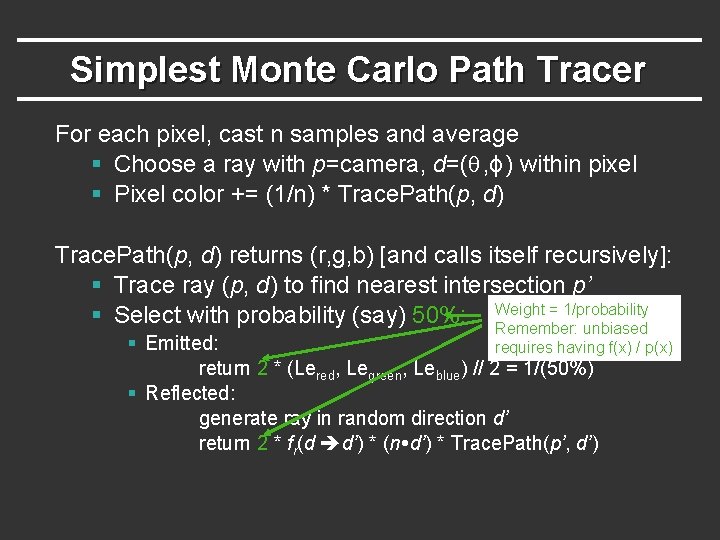
Simplest Monte Carlo Path Tracer For each pixel, cast n samples and average § Choose a ray with p=camera, d=(θ , ϕ ) within pixel § Pixel color += (1/n) * Trace. Path(p, d) returns (r, g, b) [and calls itself recursively]: § Trace ray (p, d) to find nearest intersection p’ = 1/probability § Select with probability (say) 50%: Weight Remember: unbiased § Emitted: requires having f(x) / p(x) return 2 * (Lered, Legreen, Leblue) // 2 = 1/(50%) § Reflected: generate ray in random direction d’ return 2 * fr(d d’) * (n d’) * Trace. Path(p’, d’)
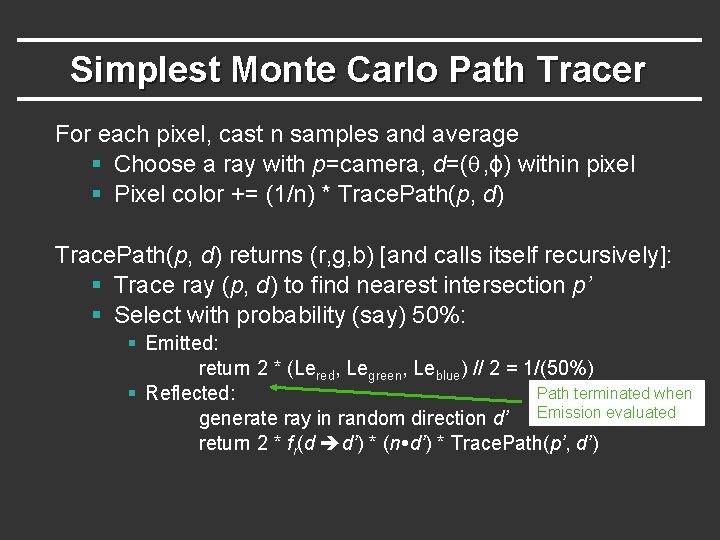
Simplest Monte Carlo Path Tracer For each pixel, cast n samples and average § Choose a ray with p=camera, d=(θ , ϕ) within pixel § Pixel color += (1/n) * Trace. Path(p, d) returns (r, g, b) [and calls itself recursively]: § Trace ray (p, d) to find nearest intersection p’ § Select with probability (say) 50%: § Emitted: return 2 * (Lered, Legreen, Leblue) // 2 = 1/(50%) Path terminated when § Reflected: generate ray in random direction d’ Emission evaluated return 2 * fr(d d’) * (n d’) * Trace. Path(p’, d’)
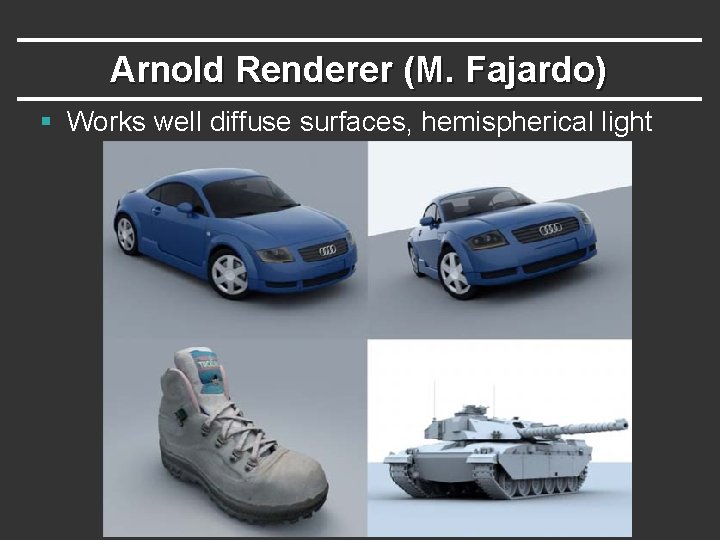
Arnold Renderer (M. Fajardo) § Works well diffuse surfaces, hemispherical light
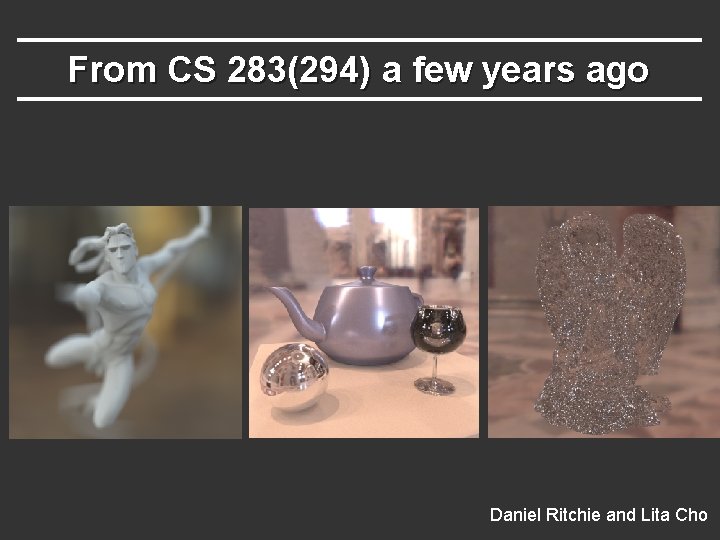
From CS 283(294) a few years ago Daniel Ritchie and Lita Cho
Advantages and Drawbacks § Advantage: general scenes, reflectance, so on § By contrast, standard recursive ray tracing only mirrors § This algorithm is unbiased, but horribly inefficient § Sample “emitted” 50% of the time, even if emitted=0 § Reflect rays in random directions, even if mirror § If light source is small, rarely hit it § Goal: improve efficiency without introducing bias § Variance reduction using many of the methods discussed for Monte Carlo integration last week § Subject of much interest in graphics in 90 s till today
Outline § Motivation and Basic Idea § Implementation of simple path tracer § Variance Reduction: Importance sampling § Other variance reduction methods § Specific 2 D sampling techniques
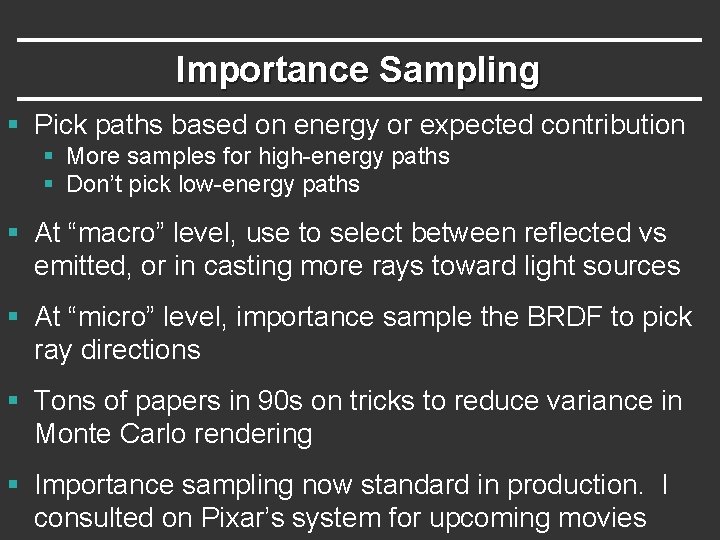
Importance Sampling § Pick paths based on energy or expected contribution § More samples for high-energy paths § Don’t pick low-energy paths § At “macro” level, use to select between reflected vs emitted, or in casting more rays toward light sources § At “micro” level, importance sample the BRDF to pick ray directions § Tons of papers in 90 s on tricks to reduce variance in Monte Carlo rendering § Importance sampling now standard in production. I consulted on Pixar’s system for upcoming movies
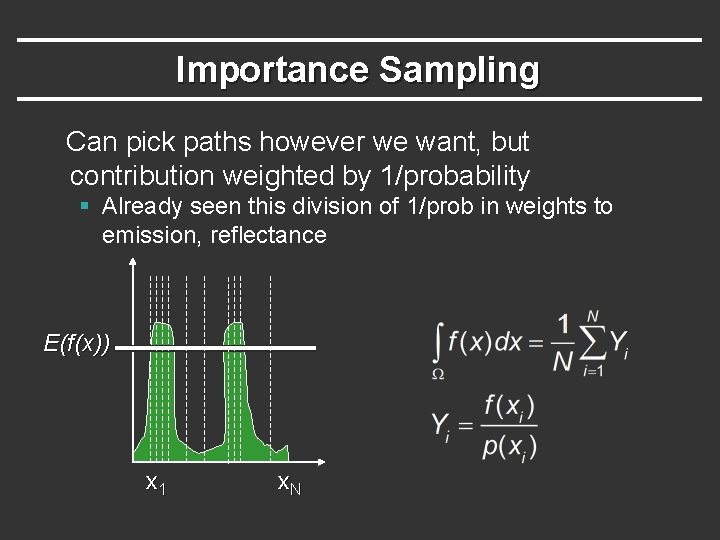
Importance Sampling Can pick paths however we want, but contribution weighted by 1/probability § Already seen this division of 1/prob in weights to emission, reflectance E(f(x)) x 1 x. N
Simplest Monte Carlo Path Tracer For each pixel, cast n samples and average § Choose a ray with p=camera, d=(θ , ϕ) within pixel § Pixel color += (1/n) * Trace. Path(p, d) returns (r, g, b) [and calls itself recursively]: § Trace ray (p, d) to find nearest intersection p’ § Select with probability (say) 50%: § Emitted: return 2 * (Lered, Legreen, Leblue) // 2 = 1/(50%) § Reflected: generate ray in random direction d’ return 2 * fr(d d’) * (n d’) * Trace. Path(p’, d’)
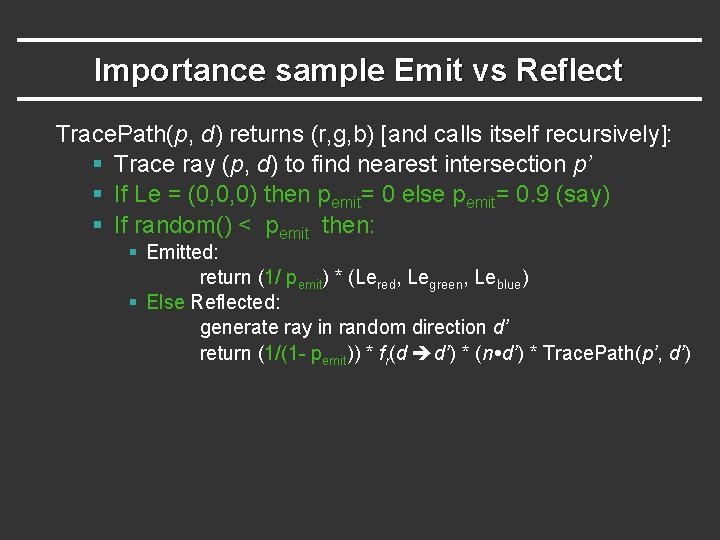
Importance sample Emit vs Reflect Trace. Path(p, d) returns (r, g, b) [and calls itself recursively]: § Trace ray (p, d) to find nearest intersection p’ § If Le = (0, 0, 0) then pemit= 0 else pemit= 0. 9 (say) § If random() < pemit then: § Emitted: return (1/ pemit) * (Lered, Legreen, Leblue) § Else Reflected: generate ray in random direction d’ return (1/(1 - pemit)) * fr(d d’) * (n d’) * Trace. Path(p’, d’)
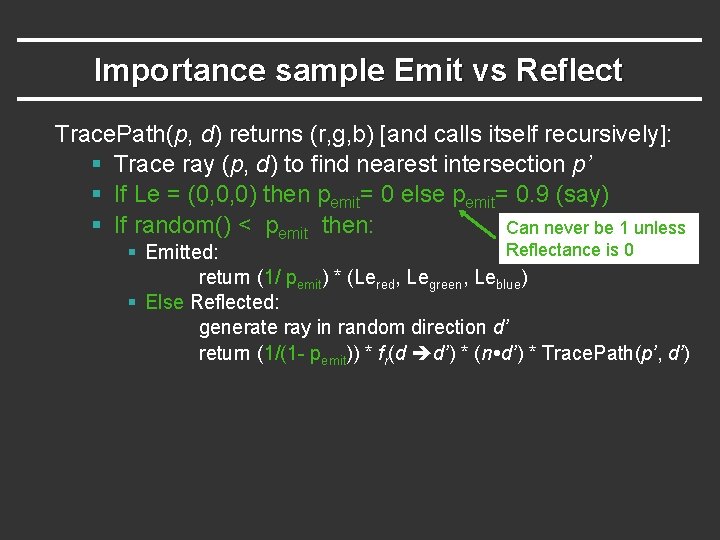
Importance sample Emit vs Reflect Trace. Path(p, d) returns (r, g, b) [and calls itself recursively]: § Trace ray (p, d) to find nearest intersection p’ § If Le = (0, 0, 0) then pemit= 0 else pemit= 0. 9 (say) § If random() < pemit then: Can never be 1 unless Reflectance is 0 § Emitted: return (1/ pemit) * (Lered, Legreen, Leblue) § Else Reflected: generate ray in random direction d’ return (1/(1 - pemit)) * fr(d d’) * (n d’) * Trace. Path(p’, d’)
Outline § Motivation and Basic Idea § Implementation of simple path tracer § Variance Reduction: Importance sampling § Other variance reduction methods § Specific 2 D sampling techniques
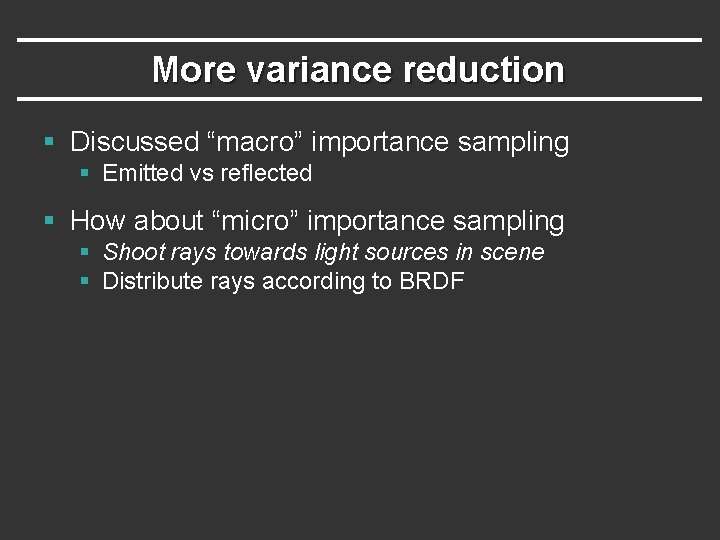
More variance reduction § Discussed “macro” importance sampling § Emitted vs reflected § How about “micro” importance sampling § Shoot rays towards light sources in scene § Distribute rays according to BRDF
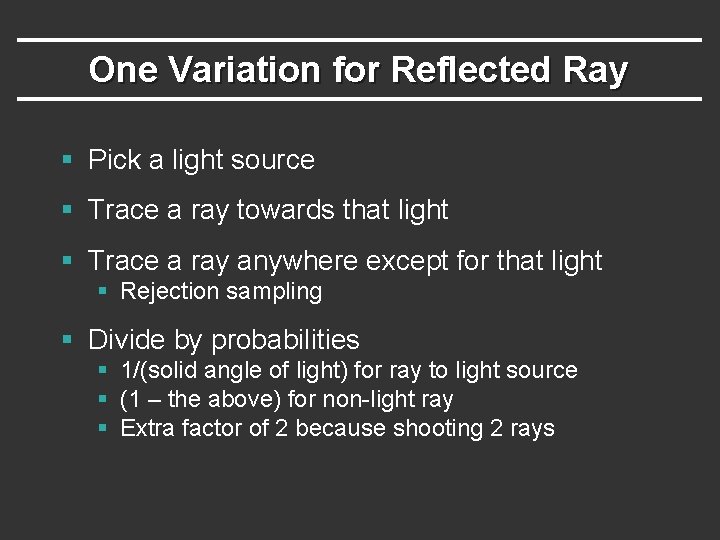
One Variation for Reflected Ray § Pick a light source § Trace a ray towards that light § Trace a ray anywhere except for that light § Rejection sampling § Divide by probabilities § 1/(solid angle of light) for ray to light source § (1 – the above) for non-light ray § Extra factor of 2 because shooting 2 rays
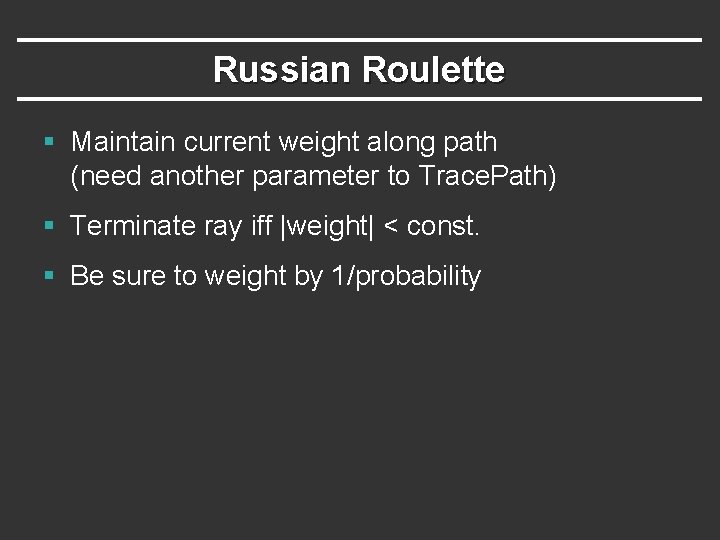
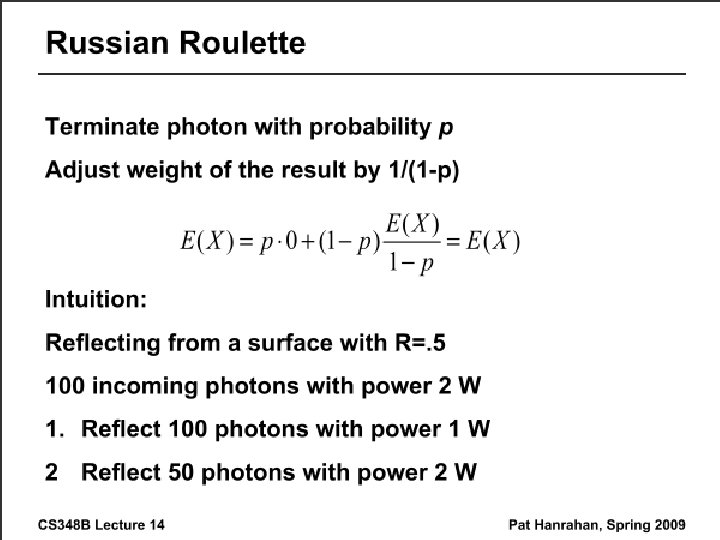
Russian Roulette § Maintain current weight along path (need another parameter to Trace. Path) § Terminate ray iff |weight| < const. § Be sure to weight by 1/probability
Monte Carlo Extensions Unbiased § Bidirectional path tracing § Metropolis light transport Biased, but consistent § Noise filtering § Adaptive sampling § Irradiance caching
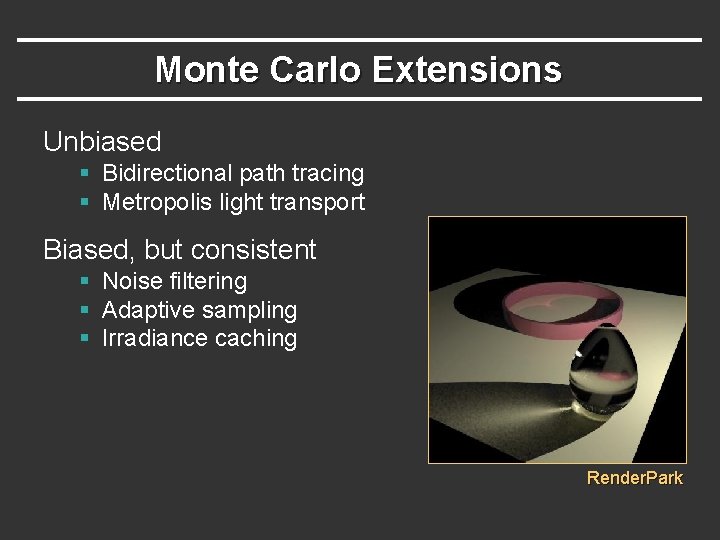
Monte Carlo Extensions Unbiased § Bidirectional path tracing § Metropolis light transport Biased, but consistent § Noise filtering § Adaptive sampling § Irradiance caching Render. Park
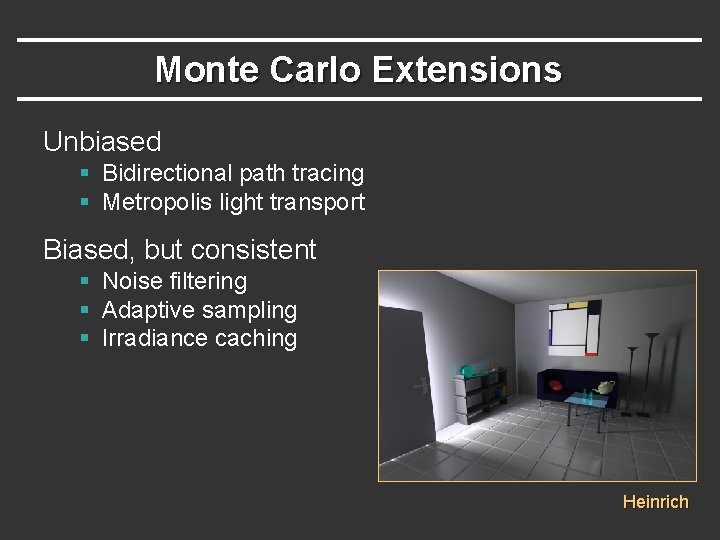
Monte Carlo Extensions Unbiased § Bidirectional path tracing § Metropolis light transport Biased, but consistent § Noise filtering § Adaptive sampling § Irradiance caching Heinrich
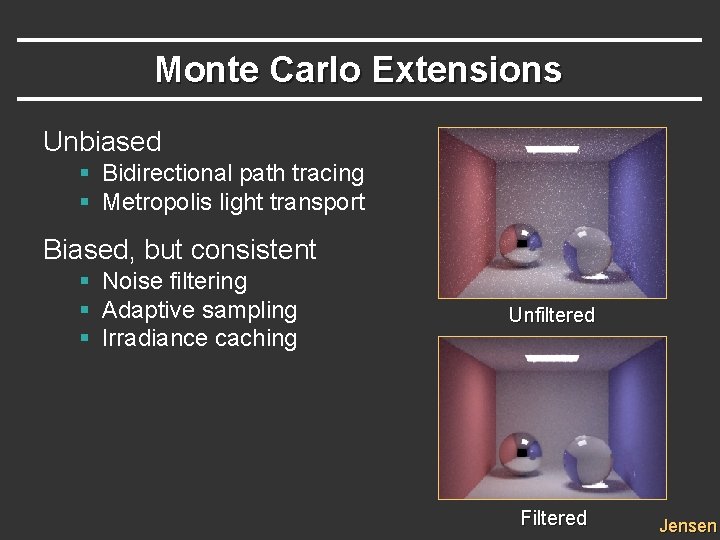
Monte Carlo Extensions Unbiased § Bidirectional path tracing § Metropolis light transport Biased, but consistent § Noise filtering § Adaptive sampling § Irradiance caching Unfiltered Filtered Jensen
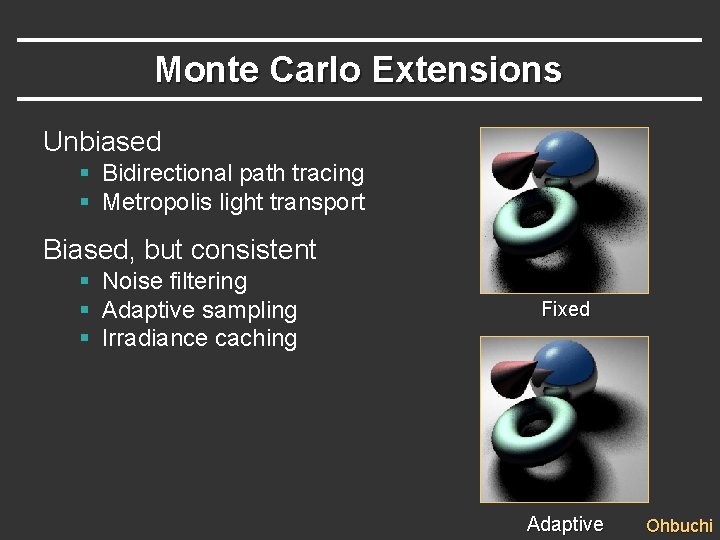
Monte Carlo Extensions Unbiased § Bidirectional path tracing § Metropolis light transport Biased, but consistent § Noise filtering § Adaptive sampling § Irradiance caching Fixed Adaptive Ohbuchi
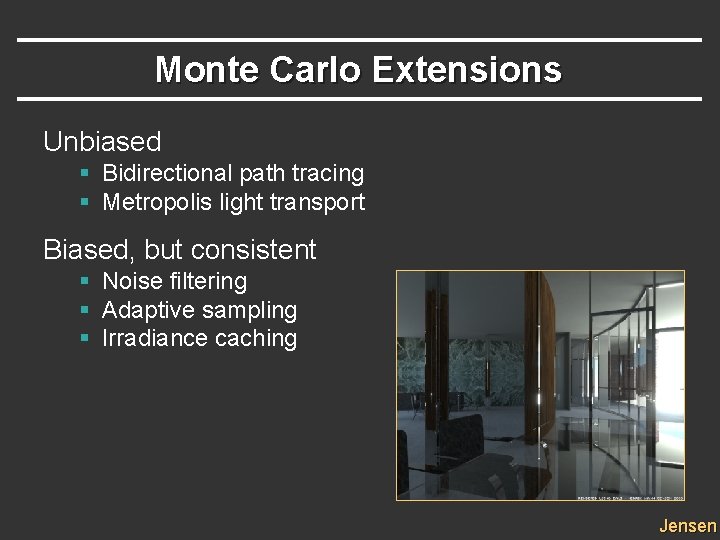
Monte Carlo Extensions Unbiased § Bidirectional path tracing § Metropolis light transport Biased, but consistent § Noise filtering § Adaptive sampling § Irradiance caching Jensen
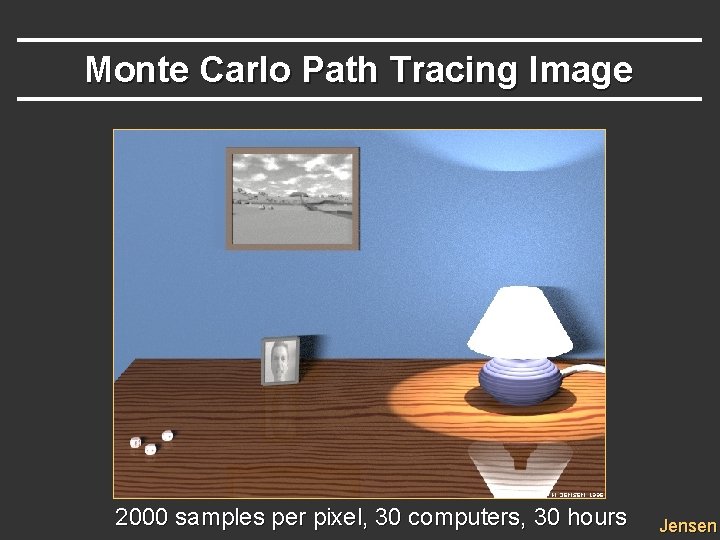
Monte Carlo Path Tracing Image 2000 samples per pixel, 30 computers, 30 hours Jensen
Outline § Motivation and Basic Idea § Implementation of simple path tracer § Variance Reduction: Importance sampling § Other variance reduction methods § Specific 2 D sampling techniques
2 D Sampling: Motivation § Final step in sending reflected ray: sample 2 D domain § According to projected solid angle § Or BRDF § Or area on light source § Or sampling of a triangle on geometry § Etc.
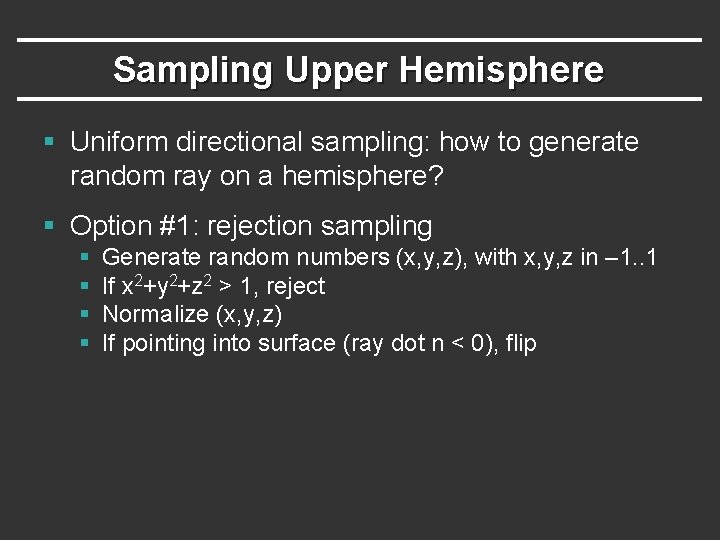
Sampling Upper Hemisphere § Uniform directional sampling: how to generate random ray on a hemisphere? § Option #1: rejection sampling § § Generate random numbers (x, y, z), with x, y, z in – 1. . 1 If x 2+y 2+z 2 > 1, reject Normalize (x, y, z) If pointing into surface (ray dot n < 0), flip
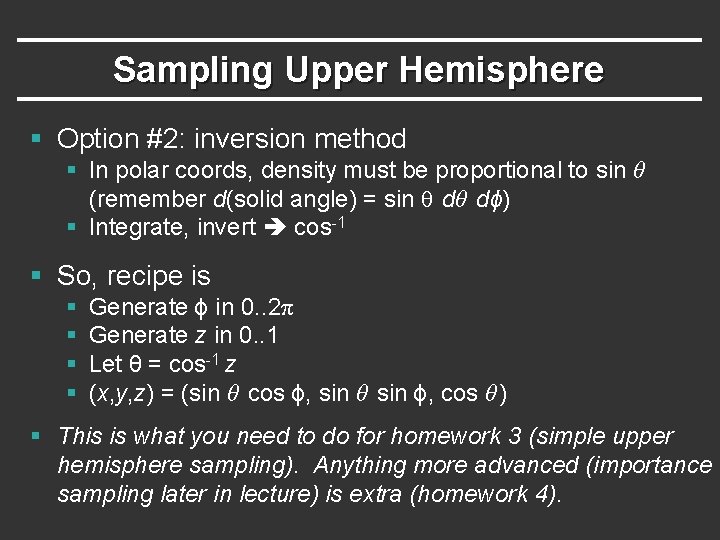
Sampling Upper Hemisphere § Option #2: inversion method § In polar coords, density must be proportional to sin θ (remember d(solid angle) = sin θ dθ dϕ) § Integrate, invert cos-1 § So, recipe is § § Generate ϕ in 0. . 2π Generate z in 0. . 1 Let θ = cos-1 z (x, y, z) = (sin θ cos ϕ, sin θ sin ϕ, cos θ ) § This is what you need to do for homework 3 (simple upper hemisphere sampling). Anything more advanced (importance sampling later in lecture) is extra (homework 4).
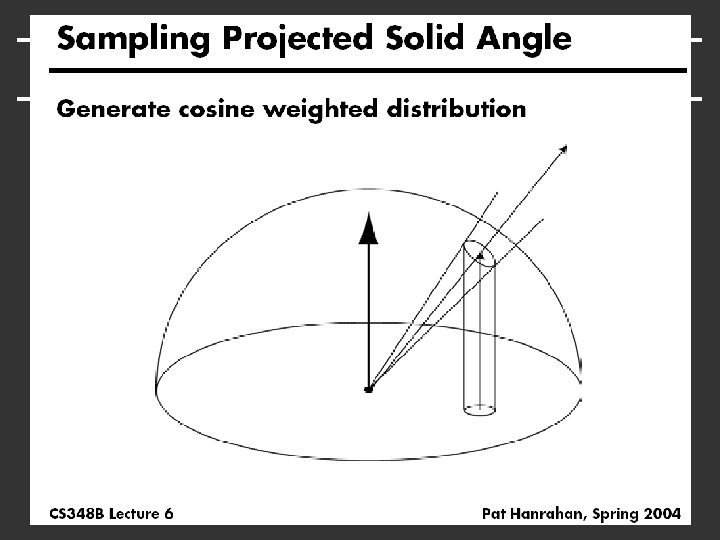
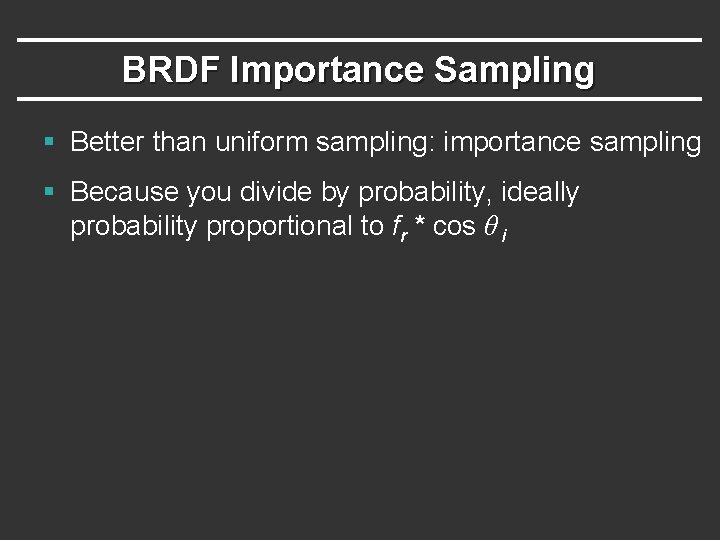
BRDF Importance Sampling § Better than uniform sampling: importance sampling § Because you divide by probability, ideally probability proportional to fr * cos θ i
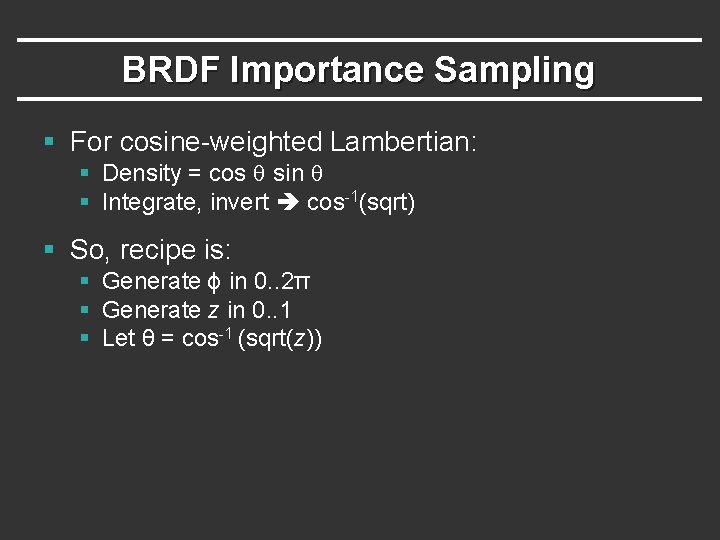
BRDF Importance Sampling § For cosine-weighted Lambertian: § Density = cos θ sin θ § Integrate, invert cos-1(sqrt) § So, recipe is: § Generate ϕ in 0. . 2π § Generate z in 0. . 1 § Let θ = cos-1 (sqrt(z))
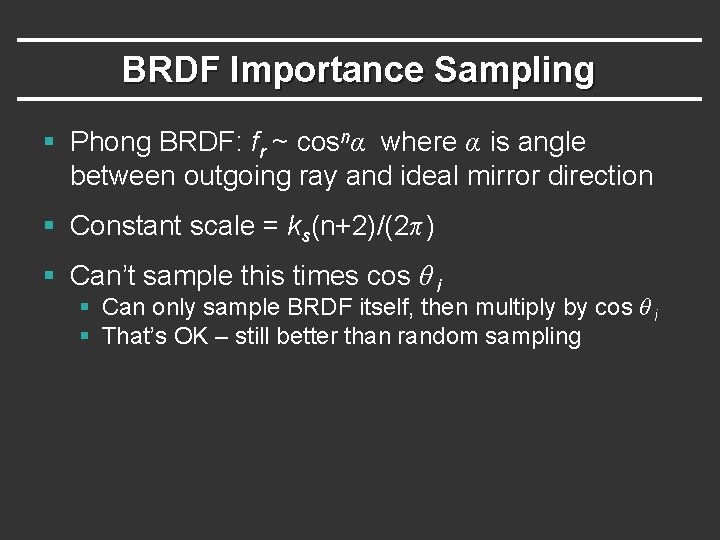
BRDF Importance Sampling § Phong BRDF: fr ~ cosnα where α is angle between outgoing ray and ideal mirror direction § Constant scale = ks(n+2)/(2π ) § Can’t sample this times cos θ i § Can only sample BRDF itself, then multiply by cos θ i § That’s OK – still better than random sampling
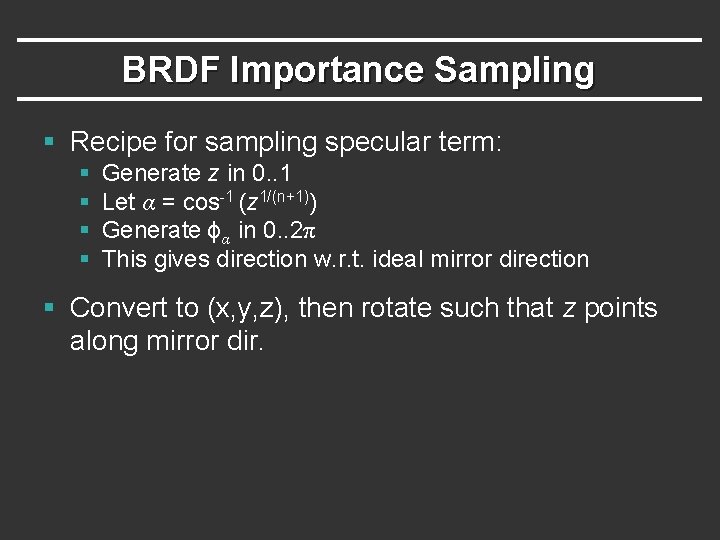
BRDF Importance Sampling § Recipe for sampling specular term: § § Generate z in 0. . 1 Let α = cos-1 (z 1/(n+1)) Generate ϕα in 0. . 2π This gives direction w. r. t. ideal mirror direction § Convert to (x, y, z), then rotate such that z points along mirror dir.
Summary § Monte Carlo methods robust and simple (at least until nitty gritty details) for global illumination § Must handle many variance reduction methods in practice § Importance sampling, Bidirectional path tracing, Russian roulette etc. § Rich field with many papers, systems researched over last 10 years