
PBRT core Digital Image Synthesis YungYu Chuang with
PBRT core Digital Image Synthesis Yung-Yu Chuang with slides by Pat Hanrahan
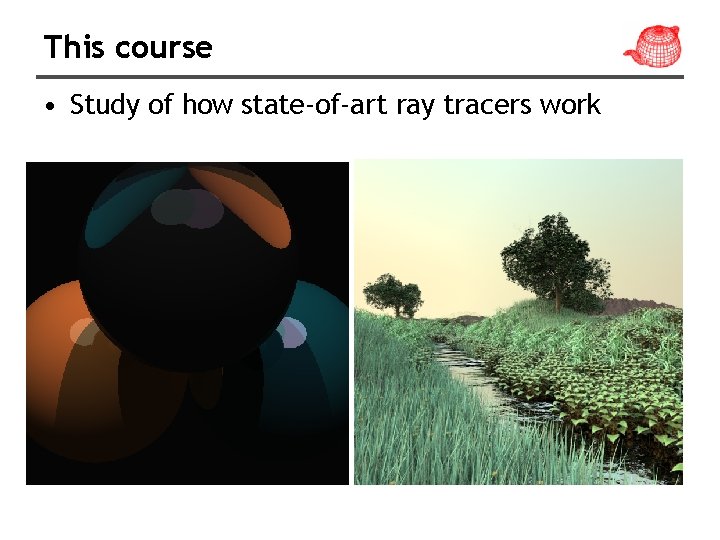
This course • Study of how state-of-art ray tracers work
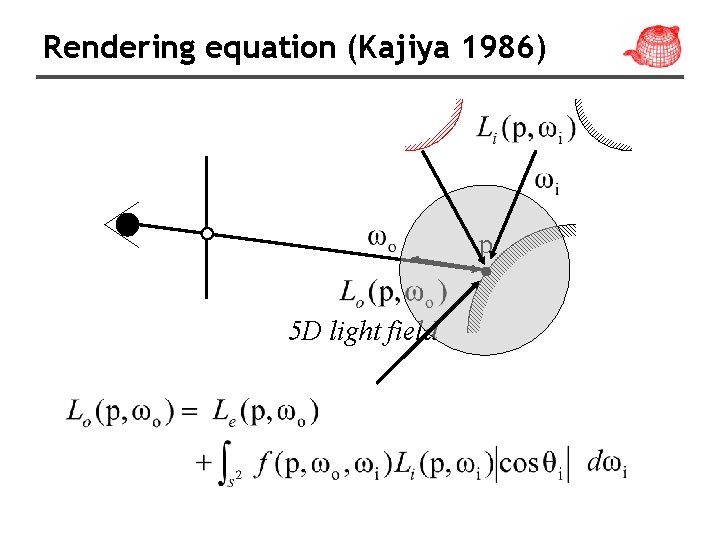
Rendering equation (Kajiya 1986) p 5 D light field
Basic components • • Cameras Ray-object intersection Light distribution Visibility Surface scattering Recursive ray tracing Ray propagation (in volume)
pbrt • pbrt (physically-based ray tracing) attempts to simulate physical interaction between light and matter based on ray tracing. • Structured using object-oriented paradigm: abstract base classes are defined for important entities and their interfaces • It is easy to extend the system. New types inherit from the appropriate base class, are compiled and linked into the system.
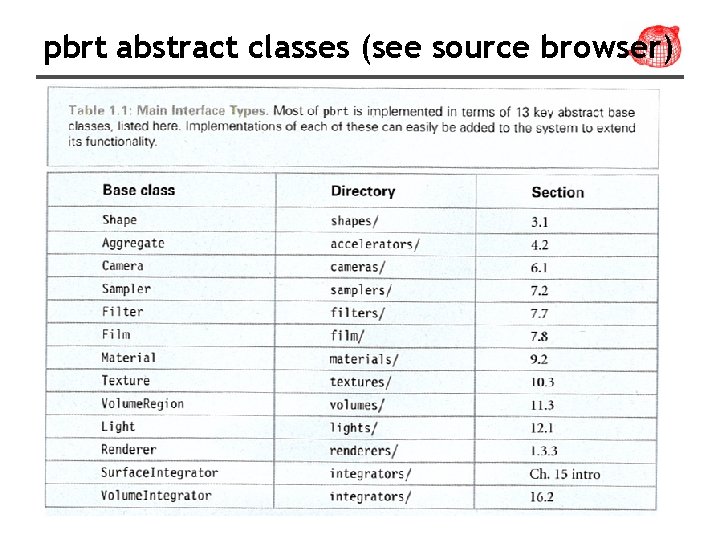
pbrt abstract classes (see source browser)
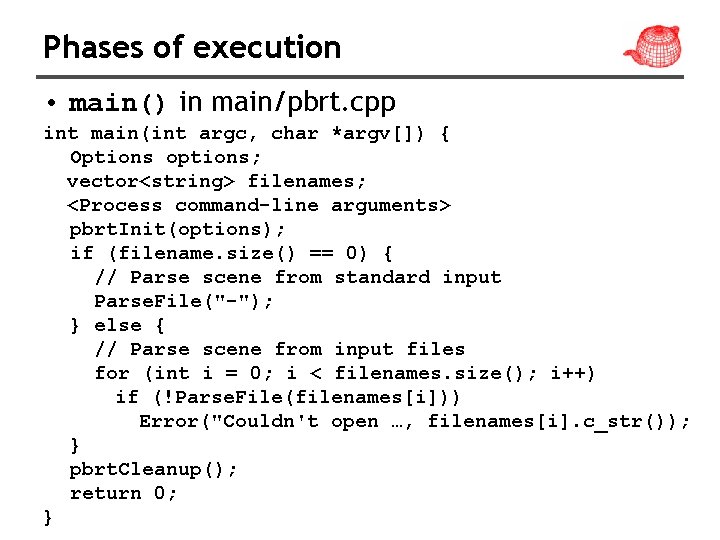
Phases of execution • main() in main/pbrt. cpp int main(int argc, char *argv[]) { Options options; vector<string> filenames; <Process command-line arguments> pbrt. Init(options); if (filename. size() == 0) { // Parse scene from standard input Parse. File("-"); } else { // Parse scene from input files for (int i = 0; i < filenames. size(); i++) if (!Parse. File(filenames[i])) Error("Couldn't open …, filenames[i]. c_str()); } pbrt. Cleanup(); return 0; }
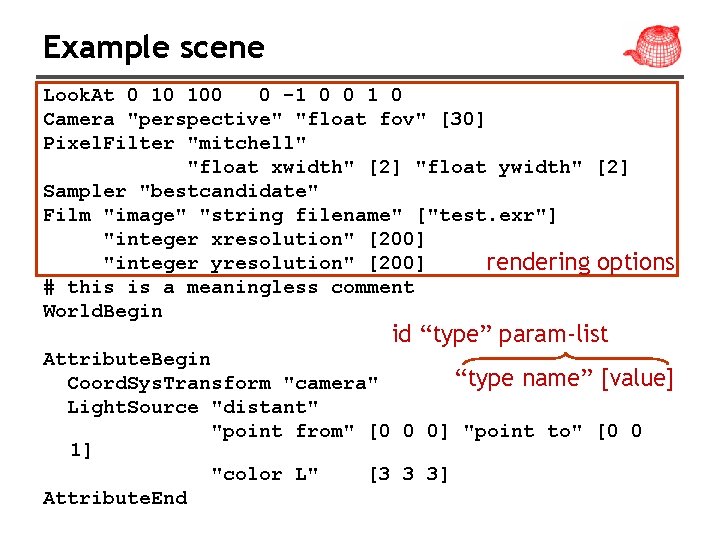
Example scene Look. At 0 10 100 0 -1 0 0 1 0 Camera "perspective" "float fov" [30] Pixel. Filter "mitchell" "float xwidth" [2] "float ywidth" [2] Sampler "bestcandidate" Film "image" "string filename" ["test. exr"] "integer xresolution" [200] "integer yresolution" [200] rendering options # this is a meaningless comment World. Begin id “type” param-list Attribute. Begin “type name” [value] Coord. Sys. Transform "camera" Light. Source "distant" "point from" [0 0 0] "point to" [0 0 1] "color L" [3 3 3] Attribute. End
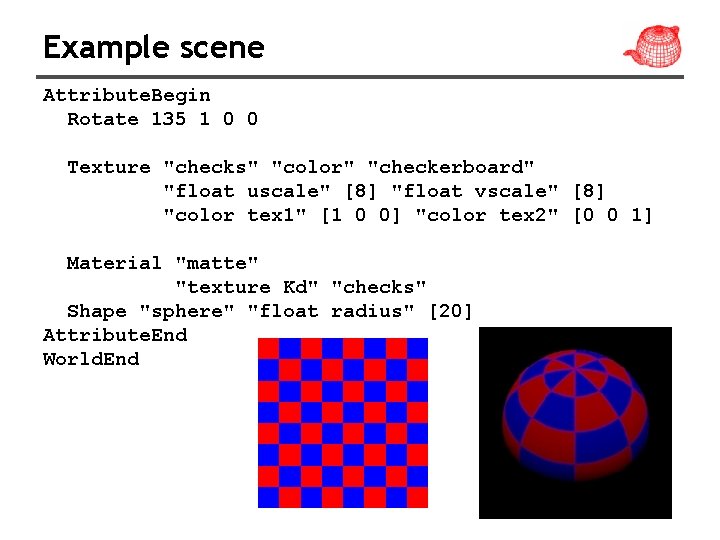
Example scene Attribute. Begin Rotate 135 1 0 0 Texture "checks" "color" "checkerboard" "float uscale" [8] "float vscale" [8] "color tex 1" [1 0 0] "color tex 2" [0 0 1] Material "matte" "texture Kd" "checks" Shape "sphere" "float radius" [20] Attribute. End World. End
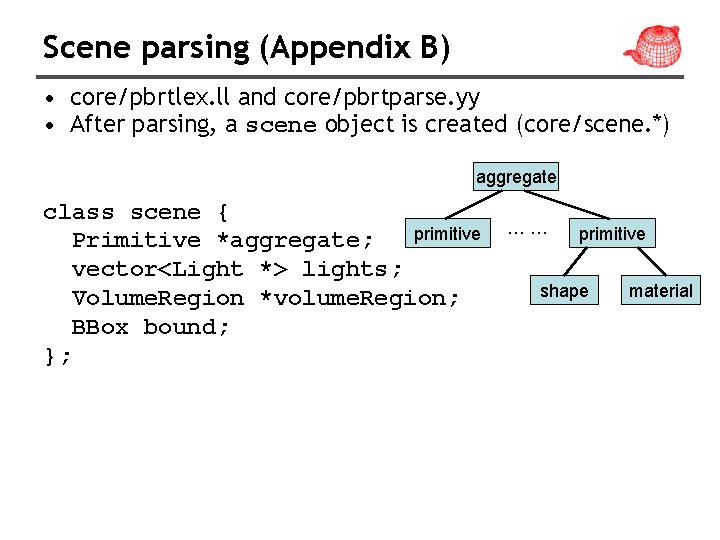
Scene parsing (Appendix B) • core/pbrtlex. ll and core/pbrtparse. yy • After parsing, a scene object is created (core/scene. *) aggregate class scene { primitive Primitive *aggregate; vector<Light *> lights; Volume. Region *volume. Region; BBox bound; }; …… primitive shape material
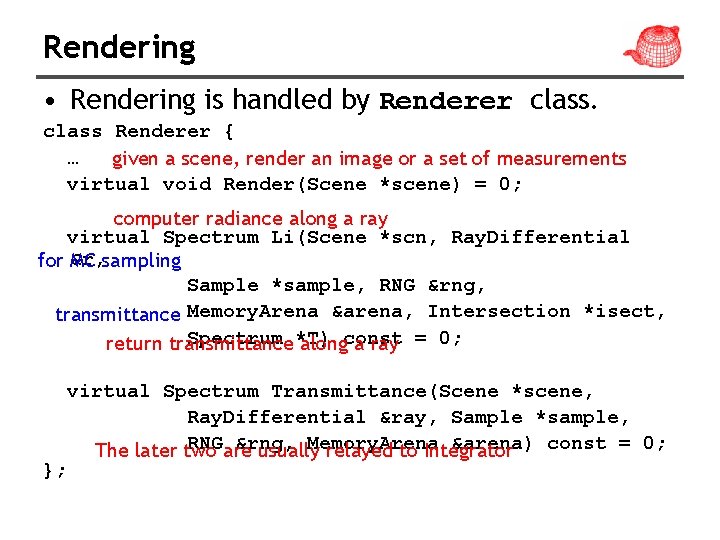
Rendering • Rendering is handled by Renderer class Renderer { … given a scene, render an image or a set of measurements virtual void Render(Scene *scene) = 0; computer radiance along a ray virtual Spectrum Li(Scene *scn, Ray. Differential for &r, MC sampling Sample *sample, RNG &rng, transmittance Memory. Arena &arena, Intersection *isect, Spectrum *T) return transmittance alongconst a ray = 0; }; virtual Spectrum Transmittance(Scene *scene, Ray. Differential &ray, Sample *sample, RNGare &rng, Memory. Arena &arena) const = 0; The later two usually relayed to Integrator
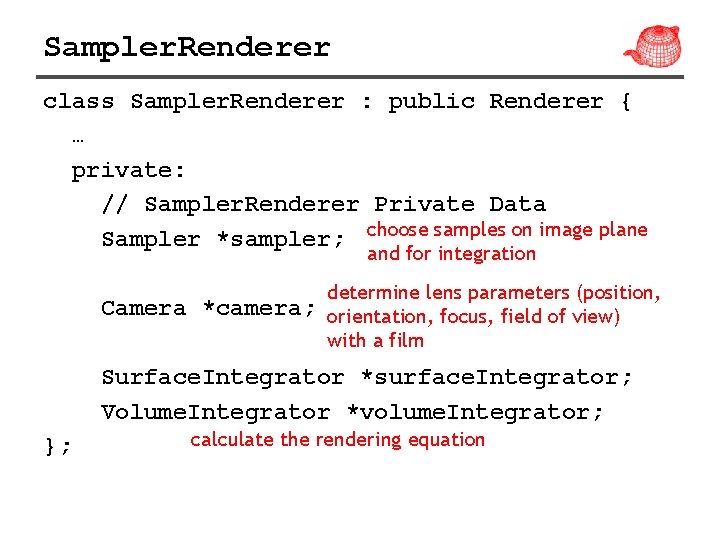
Sampler. Renderer class Sampler. Renderer : public Renderer { … private: // Sampler. Renderer Private Data Sampler *sampler; choose samples on image plane and for integration Camera *camera; determine lens parameters (position, orientation, focus, field of view) with a film Surface. Integrator *surface. Integrator; Volume. Integrator *volume. Integrator; }; calculate the rendering equation
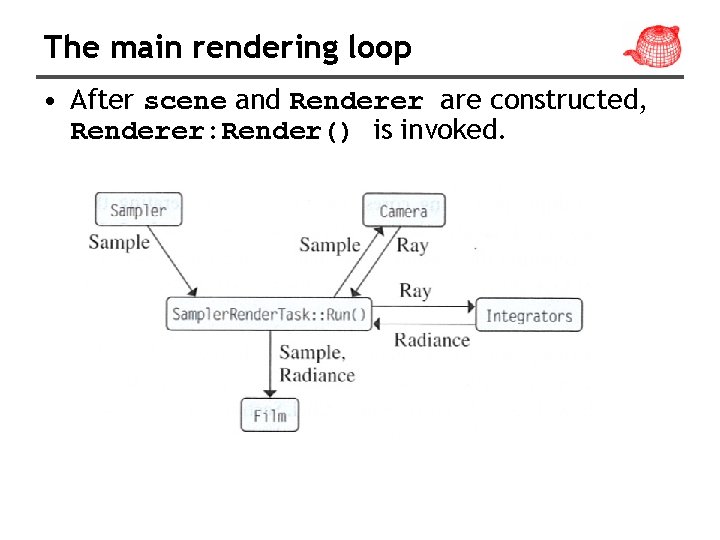
The main rendering loop • After scene and Renderer are constructed, Renderer: Render() is invoked.
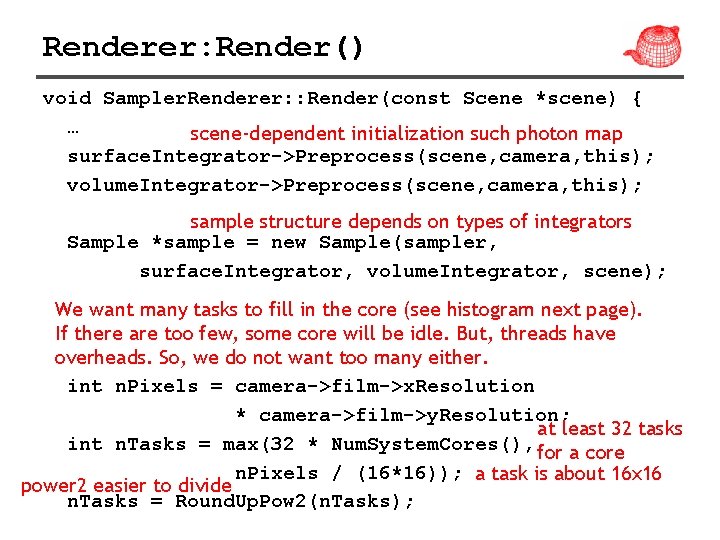
Renderer: Render() void Sampler. Renderer: : Render(const Scene *scene) { … scene-dependent initialization such photon map surface. Integrator->Preprocess(scene, camera, this); volume. Integrator->Preprocess(scene, camera, this); sample structure depends on types of integrators Sample *sample = new Sample(sampler, surface. Integrator, volume. Integrator, scene); We want many tasks to fill in the core (see histogram next page). If there are too few, some core will be idle. But, threads have overheads. So, we do not want too many either. int n. Pixels = camera->film->x. Resolution * camera->film->y. Resolution; at least 32 tasks int n. Tasks = max(32 * Num. System. Cores(), for a core n. Pixels / (16*16)); a task is about 16 x 16 power 2 easier to divide n. Tasks = Round. Up. Pow 2(n. Tasks);
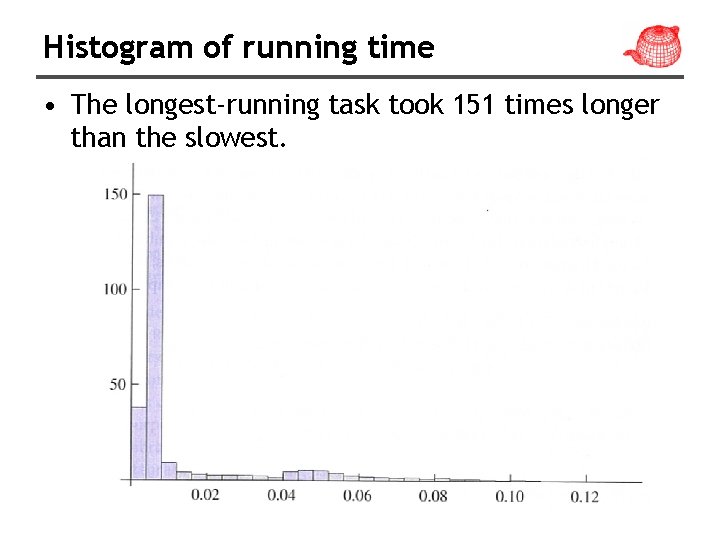
Histogram of running time • The longest-running task took 151 times longer than the slowest.
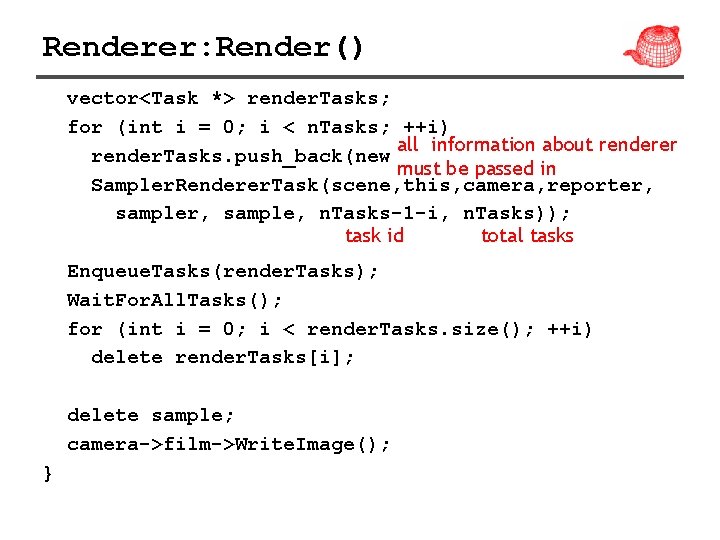
Renderer: Render() vector<Task *> render. Tasks; for (int i = 0; i < n. Tasks; ++i) all information about renderer render. Tasks. push_back(new must be passed in Sampler. Renderer. Task(scene, this, camera, reporter, sample, n. Tasks-1 -i, n. Tasks)); task id total tasks Enqueue. Tasks(render. Tasks); Wait. For. All. Tasks(); for (int i = 0; i < render. Tasks. size(); ++i) delete render. Tasks[i]; delete sample; camera->film->Write. Image(); }
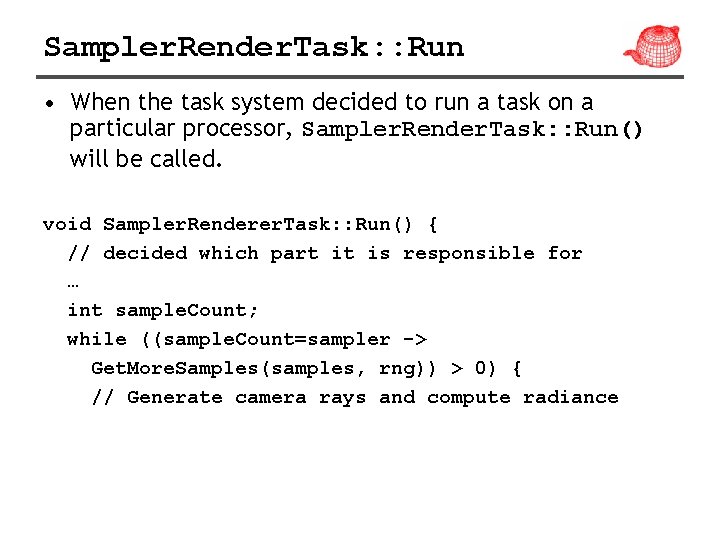
Sampler. Render. Task: : Run • When the task system decided to run a task on a particular processor, Sampler. Render. Task: : Run() will be called. void Sampler. Renderer. Task: : Run() { // decided which part it is responsible for … int sample. Count; while ((sample. Count=sampler -> Get. More. Samples(samples, rng)) > 0) { // Generate camera rays and compute radiance
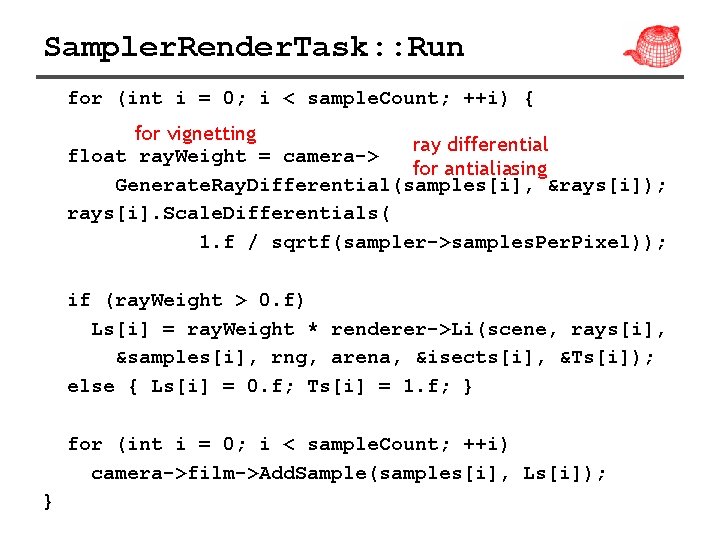
Sampler. Render. Task: : Run for (int i = 0; i < sample. Count; ++i) { for vignetting ray differential float ray. Weight = camera-> for antialiasing Generate. Ray. Differential(samples[i], &rays[i]); rays[i]. Scale. Differentials( 1. f / sqrtf(sampler->samples. Per. Pixel)); if (ray. Weight > 0. f) Ls[i] = ray. Weight * renderer->Li(scene, rays[i], &samples[i], rng, arena, &isects[i], &Ts[i]); else { Ls[i] = 0. f; Ts[i] = 1. f; } for (int i = 0; i < sample. Count; ++i) camera->film->Add. Sample(samples[i], Ls[i]); }
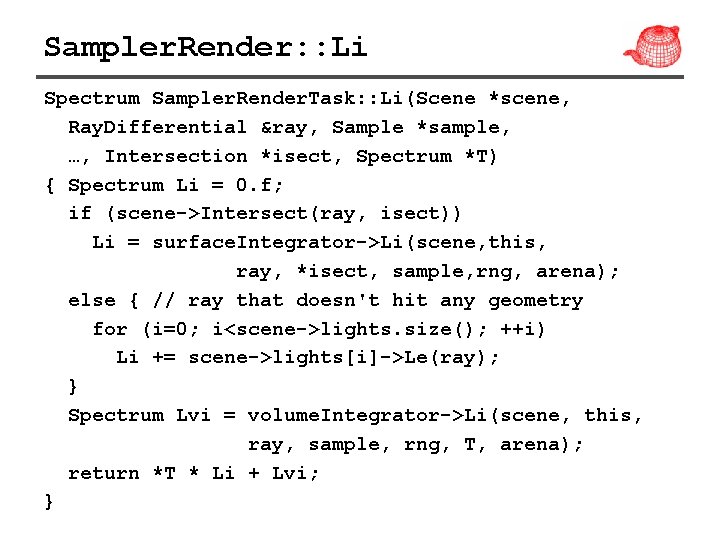
Sampler. Render: : Li Spectrum Sampler. Render. Task: : Li(Scene *scene, Ray. Differential &ray, Sample *sample, …, Intersection *isect, Spectrum *T) { Spectrum Li = 0. f; if (scene->Intersect(ray, isect)) Li = surface. Integrator->Li(scene, this, ray, *isect, sample, rng, arena); else { // ray that doesn't hit any geometry for (i=0; i<scene->lights. size(); ++i) Li += scene->lights[i]->Le(ray); } Spectrum Lvi = volume. Integrator->Li(scene, this, ray, sample, rng, T, arena); return *T * Li + Lvi; }
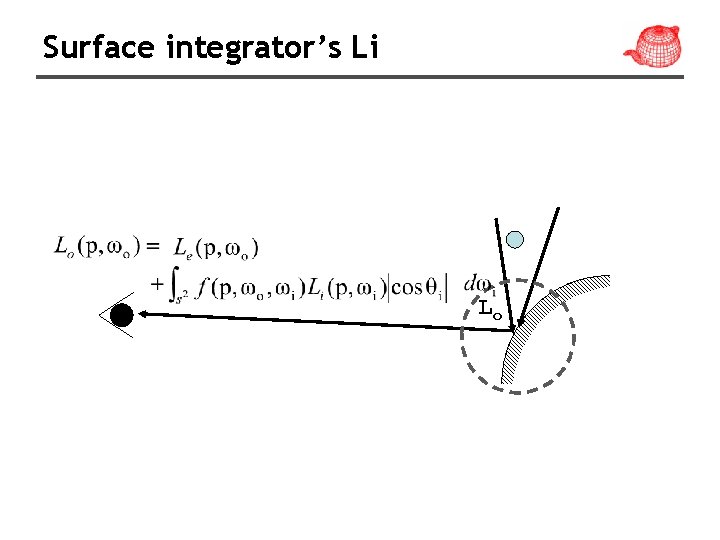
Surface integrator’s Li Lo
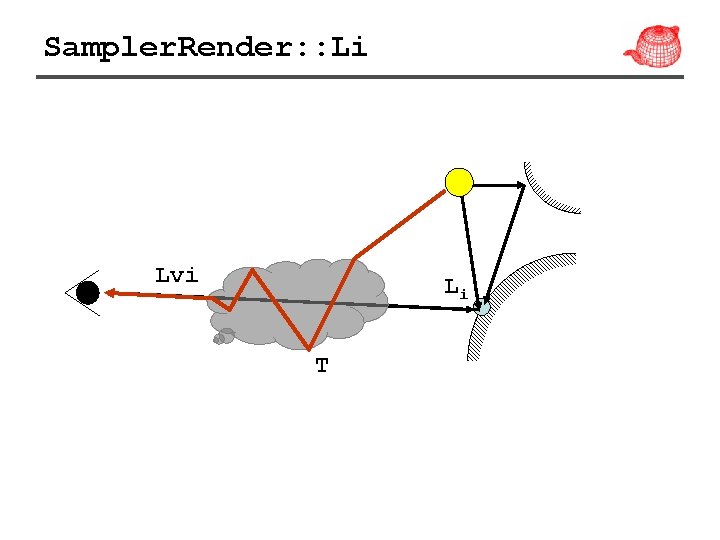
Sampler. Render: : Li Lvi Li T
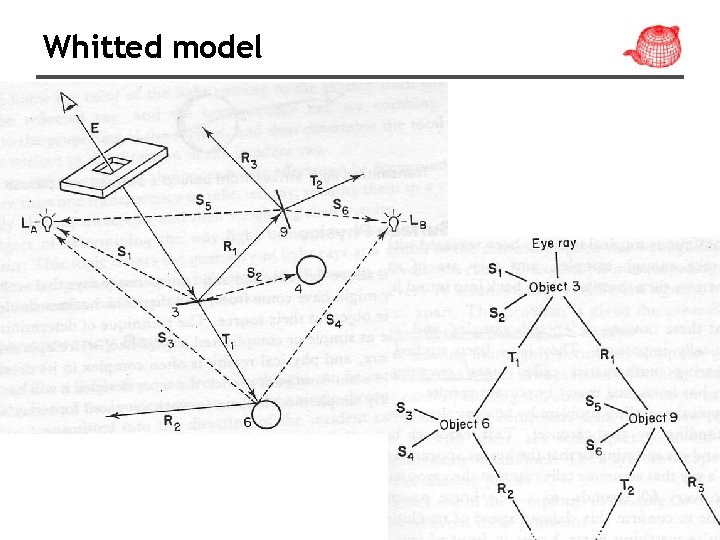
Whitted model
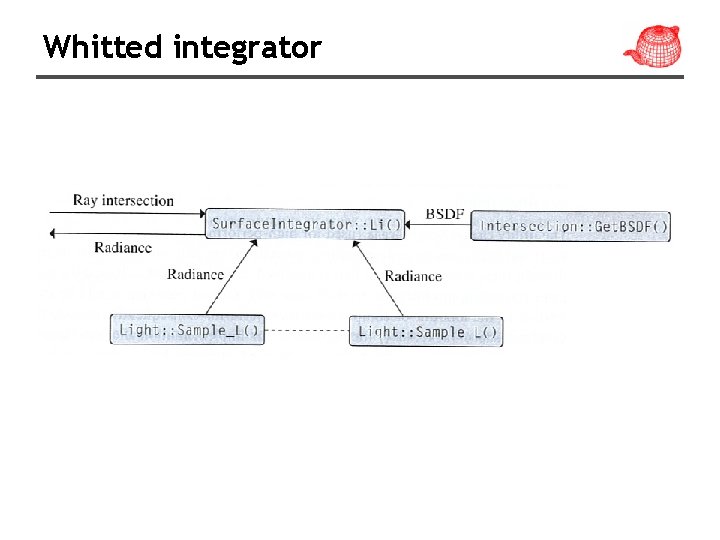
Whitted integrator
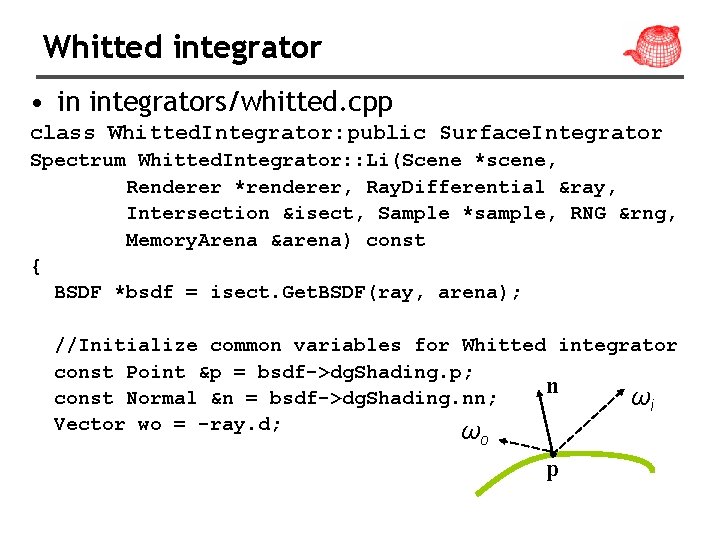
Whitted integrator • in integrators/whitted. cpp class Whitted. Integrator: public Surface. Integrator Spectrum Whitted. Integrator: : Li(Scene *scene, Renderer *renderer, Ray. Differential &ray, Intersection &isect, Sample *sample, RNG &rng, Memory. Arena &arena) const { BSDF *bsdf = isect. Get. BSDF(ray, arena); //Initialize common variables for Whitted integrator const Point &p = bsdf->dg. Shading. p; n const Normal &n = bsdf->dg. Shading. nn; ωi Vector wo = -ray. d; ω o p
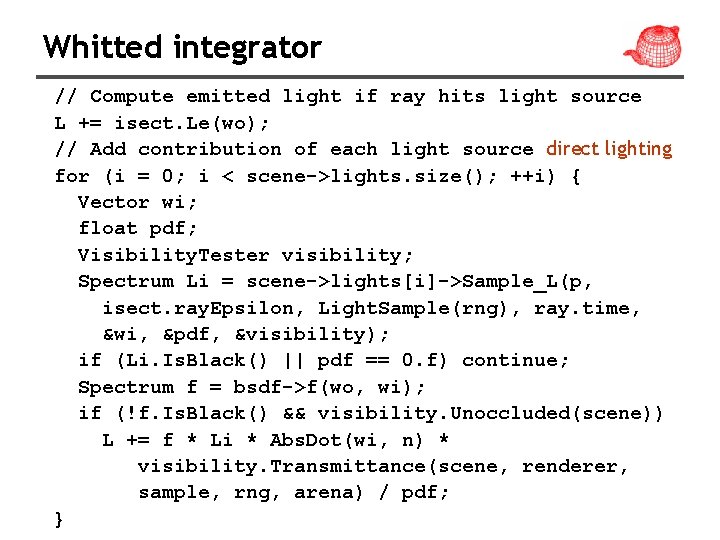
Whitted integrator // Compute emitted light if ray hits light source L += isect. Le(wo); // Add contribution of each light source direct lighting for (i = 0; i < scene->lights. size(); ++i) { Vector wi; float pdf; Visibility. Tester visibility; Spectrum Li = scene->lights[i]->Sample_L(p, isect. ray. Epsilon, Light. Sample(rng), ray. time, &wi, &pdf, &visibility); if (Li. Is. Black() || pdf == 0. f) continue; Spectrum f = bsdf->f(wo, wi); if (!f. Is. Black() && visibility. Unoccluded(scene)) L += f * Li * Abs. Dot(wi, n) * visibility. Transmittance(scene, renderer, sample, rng, arena) / pdf; }
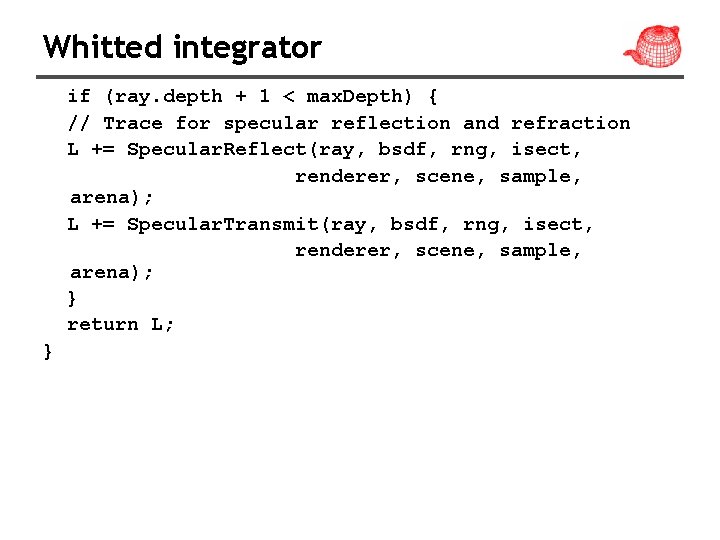
Whitted integrator if (ray. depth + 1 < max. Depth) { // Trace for specular reflection and refraction L += Specular. Reflect(ray, bsdf, rng, isect, renderer, scene, sample, arena); L += Specular. Transmit(ray, bsdf, rng, isect, renderer, scene, sample, arena); } return L; }
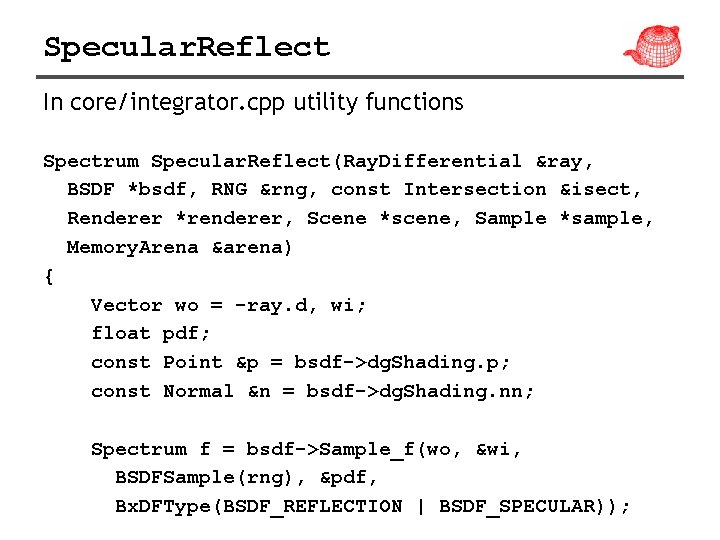
Specular. Reflect In core/integrator. cpp utility functions Spectrum Specular. Reflect(Ray. Differential &ray, BSDF *bsdf, RNG &rng, const Intersection &isect, Renderer *renderer, Scene *scene, Sample *sample, Memory. Arena &arena) { Vector wo = -ray. d, wi; float pdf; const Point &p = bsdf->dg. Shading. p; const Normal &n = bsdf->dg. Shading. nn; Spectrum f = bsdf->Sample_f(wo, &wi, BSDFSample(rng), &pdf, Bx. DFType(BSDF_REFLECTION | BSDF_SPECULAR));
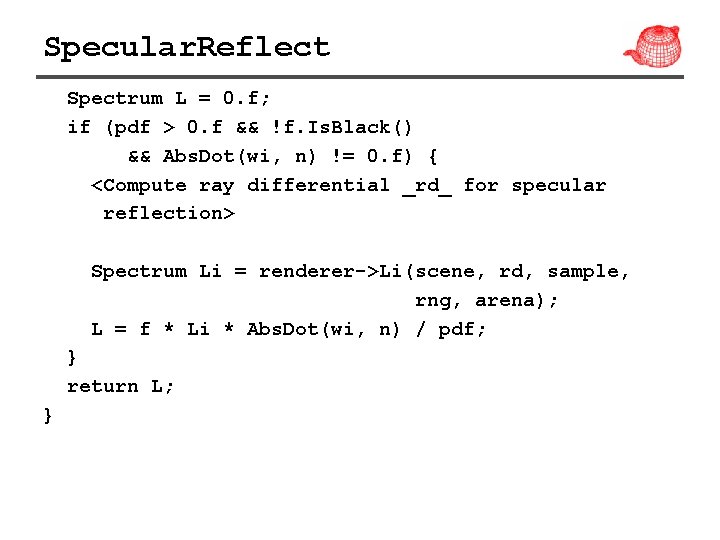
Specular. Reflect Spectrum L = 0. f; if (pdf > 0. f && !f. Is. Black() && Abs. Dot(wi, n) != 0. f) { <Compute ray differential _rd_ for specular reflection> Spectrum Li = renderer->Li(scene, rd, sample, rng, arena); L = f * Li * Abs. Dot(wi, n) / pdf; } return L; }
Code optimization • Two commonly used tips – Divide, square root and trigonometric are among the slowest (10 -50 times slower than +*). Multiplying 1/r for dividing r. – Being cache conscious
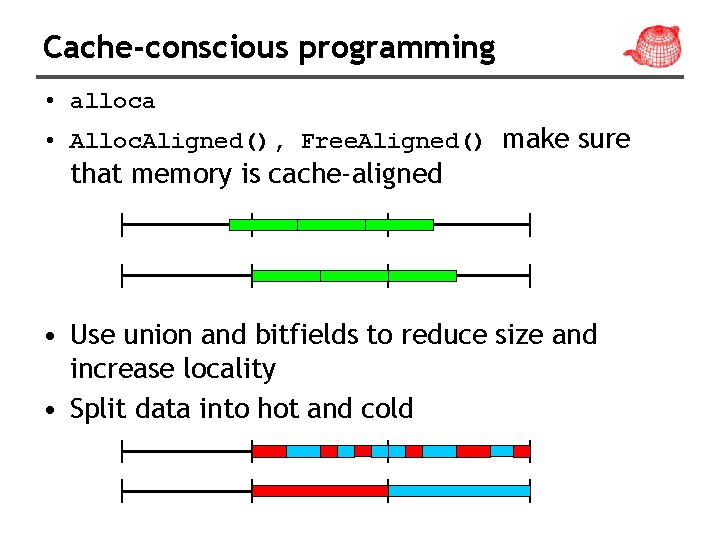
Cache-conscious programming • alloca • Alloc. Aligned(), Free. Aligned() make sure that memory is cache-aligned • Use union and bitfields to reduce size and increase locality • Split data into hot and cold
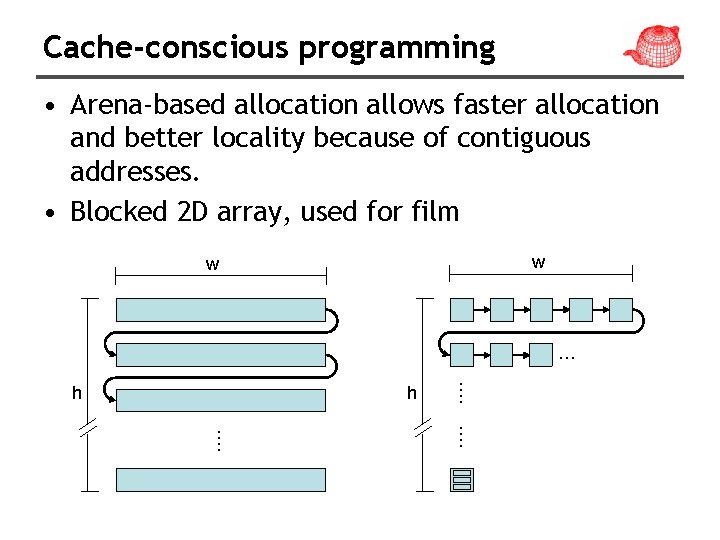
Cache-conscious programming • Arena-based allocation allows faster allocation and better locality because of contiguous addresses. • Blocked 2 D array, used for film w w … h …. ….
- Slides: 31