Clinical Governance MI An Introduction Mark Cheeseman Education












- Slides: 67
Clinical Governance & MI: An Introduction Mark Cheeseman Education & Training and Secondary Care Support Medicines Information Pharmacist East Anglia Medicines Information Service
Aims § Provide you with an introduction to the principles of clinical governance, risk management and quality assurance. § Describe the main tools used to ensure quality assurance in MI, including IRMIS. § Enable you to apply these principles and tools in your own workplace.
Learning Outcomes By the end of this session you should be able to: § Describe 15 of the UKMi standards. § Be able to peer review an enquiry and provide feedback.
Session § Background § Methods § Key tools for MI § Available support § Summary
What does Clinical Governance mean to you?
Definition “a framework through which NHS organisations are accountable for continuously improving the quality of the services and safeguarding high standards of care by creating an environment in which excellence in clinical care will flourish. ”
History § WHO. Principles of quality assurance; 1983. § DH. A First Class Service: Quality in the new NHS; 1998. § CMO/CNO. Supporting implementation of clinical governance. NHS Exec; 1999
How did this affect Pharmacy? § RPSGB published ‘Achieving excellence in pharmacy through practice’ (1999) 1. 2. 3. 4. Clear lines of responsibility Quality improvement activities Risk Management Poor Performance
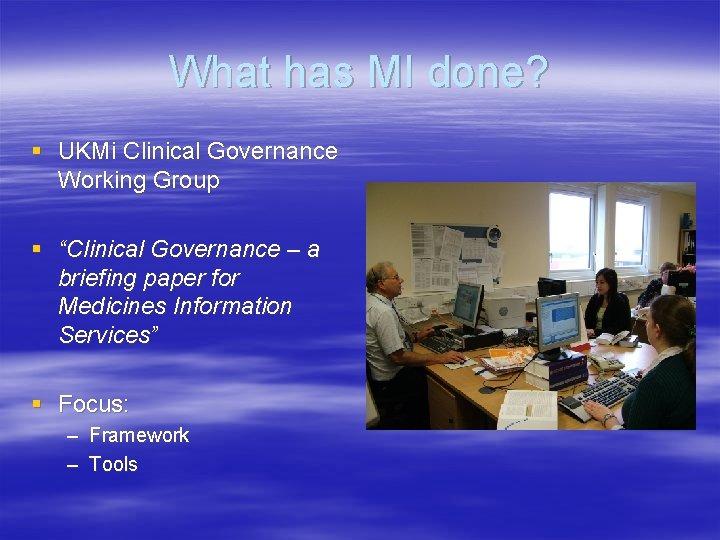
What has MI done? § UKMi Clinical Governance Working Group § “Clinical Governance – a briefing paper for Medicines Information Services” § Focus: – Framework – Tools
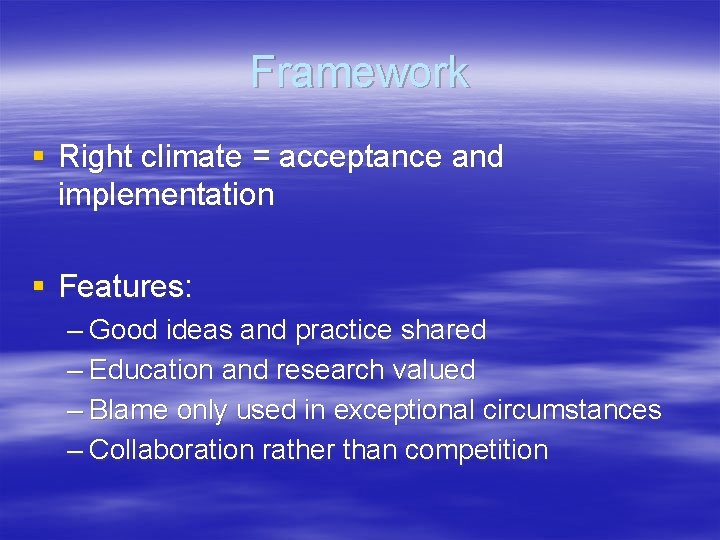
Framework § Right climate = acceptance and implementation § Features: – Good ideas and practice shared – Education and research valued – Blame only used in exceptional circumstances – Collaboration rather than competition
Does anyone have all these?
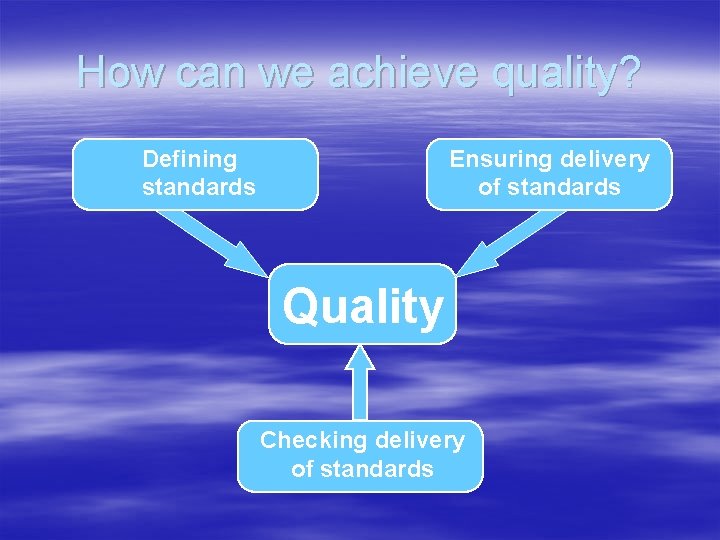
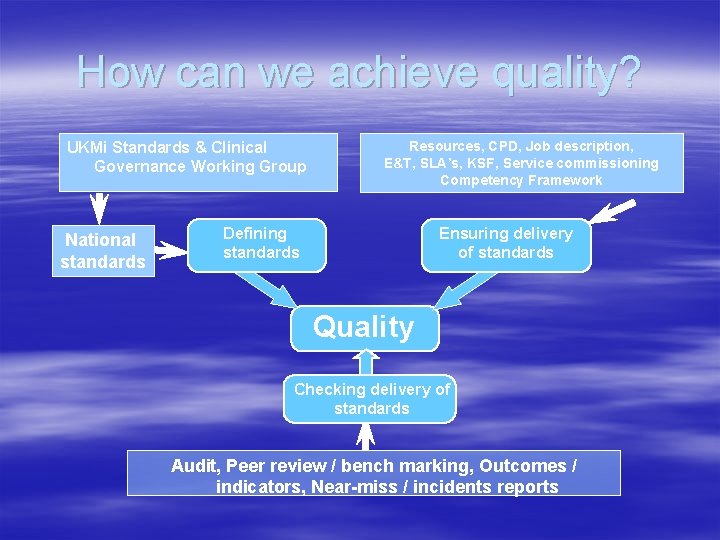
How can we achieve quality? Defining standards Ensuring delivery of standards Quality Checking delivery of standards
What tools can we use to ensure quality?
Tools for Quality § Standards § § § Audit programmes User satisfaction surveys Benchmarking schemes Evidence-based practice CPD Training programmes
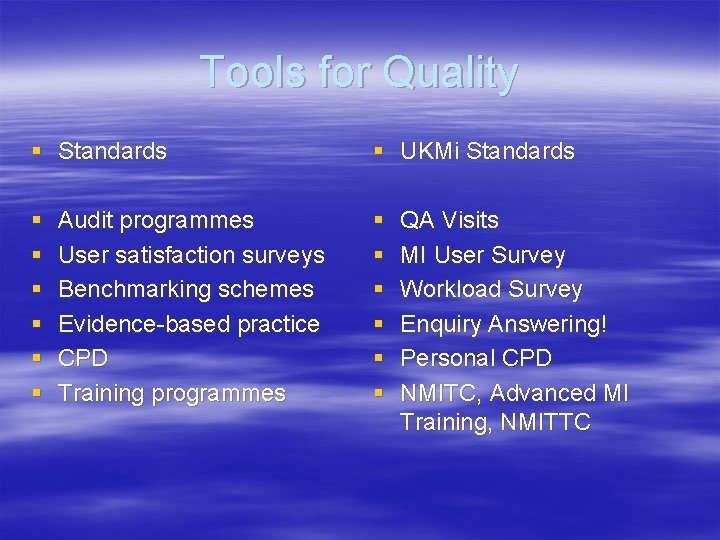
Tools for Quality § Standards § UKMi Standards § § § Audit programmes User satisfaction surveys Benchmarking schemes Evidence-based practice CPD Training programmes QA Visits MI User Survey Workload Survey Enquiry Answering! Personal CPD NMITC, Advanced MI Training, NMITTC
Tools for Quality § Risk Assessment/ Management Schemes § Appraisal schemes § Incident/near miss reporting schemes § Dialogue with principal stakeholders § Involvement with commissioning specialist services
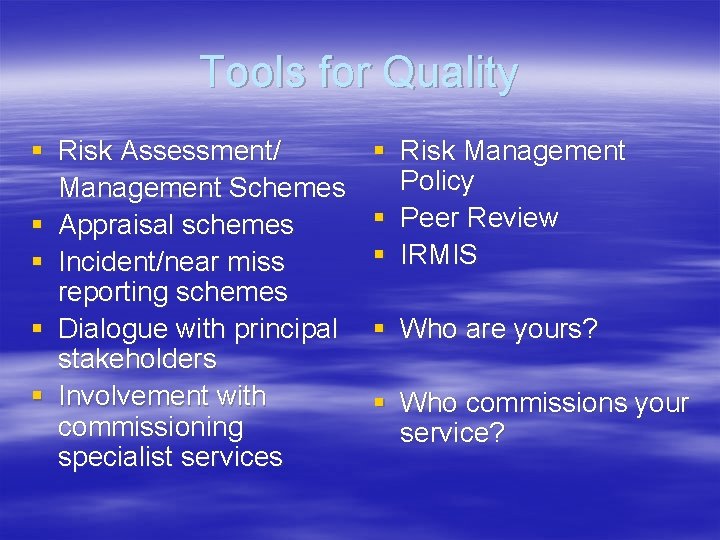
Tools for Quality § Risk Assessment/ Management Schemes § Appraisal schemes § Incident/near miss reporting schemes § Dialogue with principal stakeholders § Involvement with commissioning specialist services § Risk Management Policy § Peer Review § IRMIS § Who are yours? § Who commissions your service?
How can we achieve quality? UKMi Standards & Clinical Governance Working Group National standards Resources, CPD, Job description, E&T, SLA’s, KSF, Service commissioning Competency Framework Defining standards Ensuring delivery of standards Quality Checking delivery of standards Audit, Peer review / bench marking, Outcomes / indicators, Near-miss / incidents reports
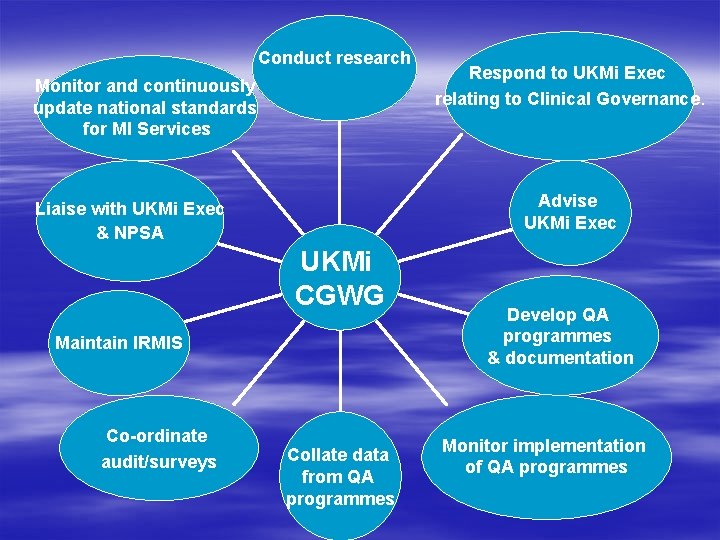
So what does the UKMi Clinical Governance Working Group do?
Conduct research Monitor and continuously update national standards for MI Services Advise UKMi Exec Liaise with UKMi Exec & NPSA UKMi CGWG Maintain IRMIS Co-ordinate audit/surveys Respond to UKMi Exec relating to Clinical Governance. Collate data from QA programmes Develop QA programmes & documentation Monitor implementation of QA programmes
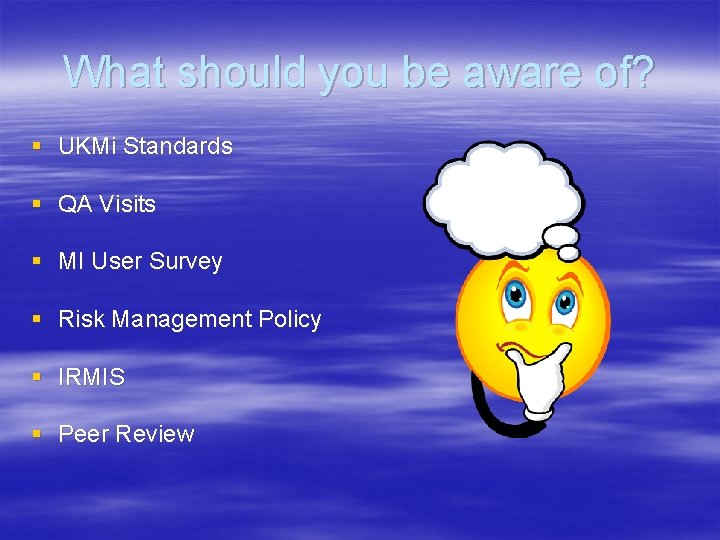
What should you be aware of? § UKMi Standards § QA Visits § MI User Survey § Risk Management Policy § IRMIS § Peer Review
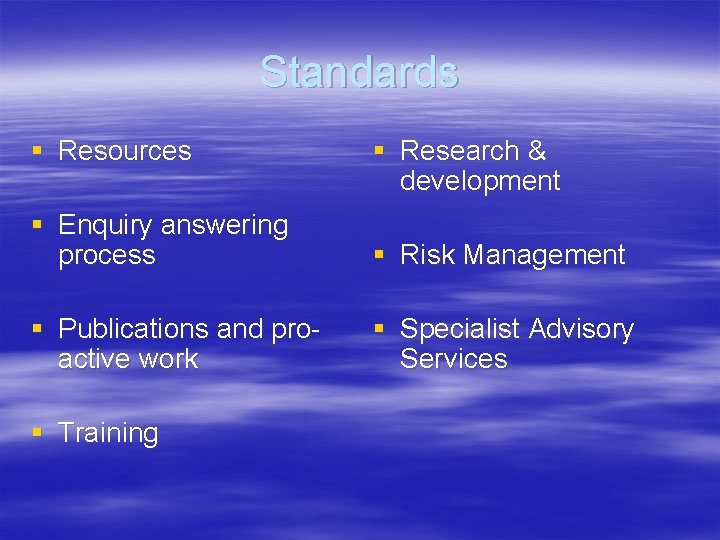
Standards § Resources § Research & development § Enquiry answering process § Risk Management § Publications and proactive work § Specialist Advisory Services § Training
Standards § Standard § Risks of non-Implementation § Potential outcomes if not implemented § Satisfactory § Commended
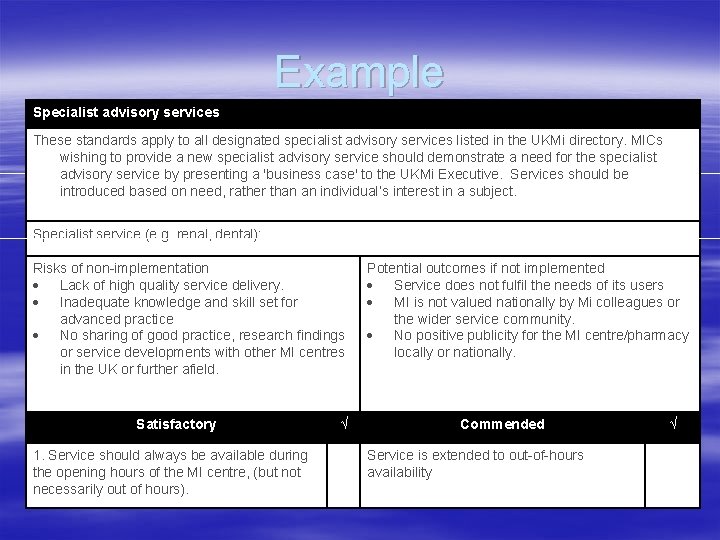
Example Specialist advisory services These standards apply to all designated specialist advisory services listed in the UKMi directory. MICs wishing to provide a new specialist advisory service should demonstrate a need for the specialist advisory service by presenting a 'business case' to the UKMi Executive. Services should be introduced based on need, rather than an individual’s interest in a subject. Specialist service (e. g. renal, dental): Risks of non-implementation Lack of high quality service delivery. Inadequate knowledge and skill set for advanced practice No sharing of good practice, research findings or service developments with other MI centres in the UK or further afield. Satisfactory 1. Service should always be available during the opening hours of the MI centre, (but not necessarily out of hours). √ Potential outcomes if not implemented Service does not fulfil the needs of its users MI is not valued nationally by Mi colleagues or the wider service community. No positive publicity for the MI centre/pharmacy locally or nationally. Commended Service is extended to out-of-hours availability √
Quiz
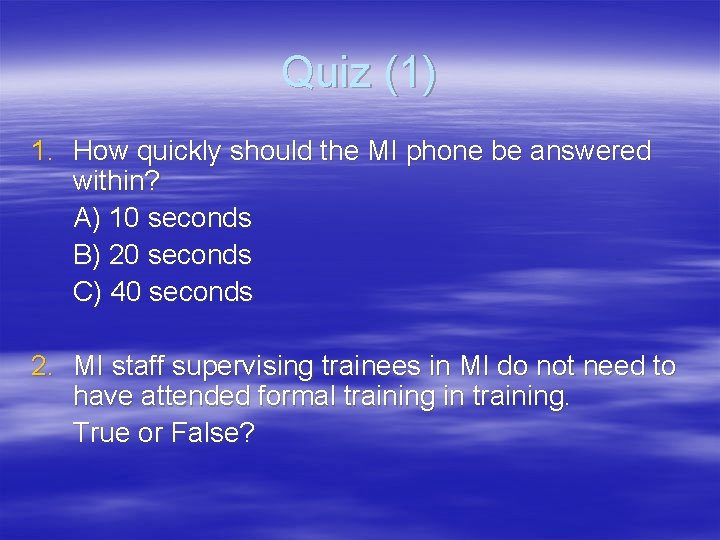
Quiz (1) 1. How quickly should the MI phone be answered within? A) 10 seconds B) 20 seconds C) 40 seconds 2. MI staff supervising trainees in MI do not need to have attended formal training in training. True or False?
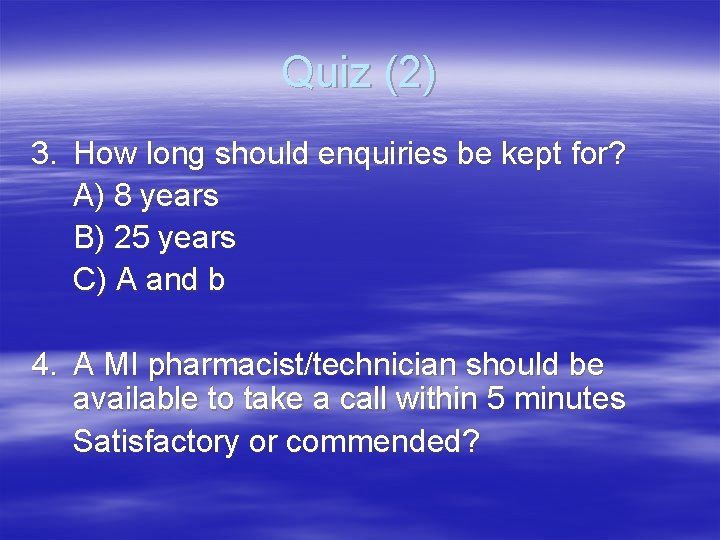
Quiz (2) 3. How long should enquiries be kept for? A) 8 years B) 25 years C) A and b 4. A MI pharmacist/technician should be available to take a call within 5 minutes Satisfactory or commended?
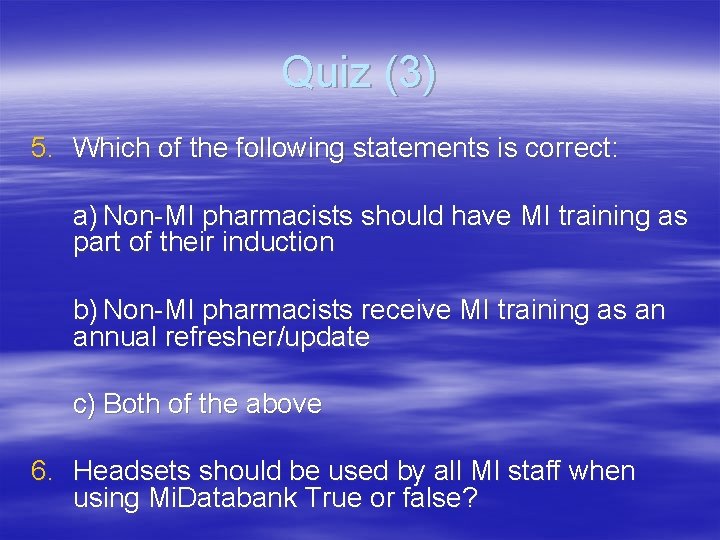
Quiz (3) 5. Which of the following statements is correct: a) Non-MI pharmacists should have MI training as part of their induction b) Non-MI pharmacists receive MI training as an annual refresher/update c) Both of the above 6. Headsets should be used by all MI staff when using Mi. Databank True or false?
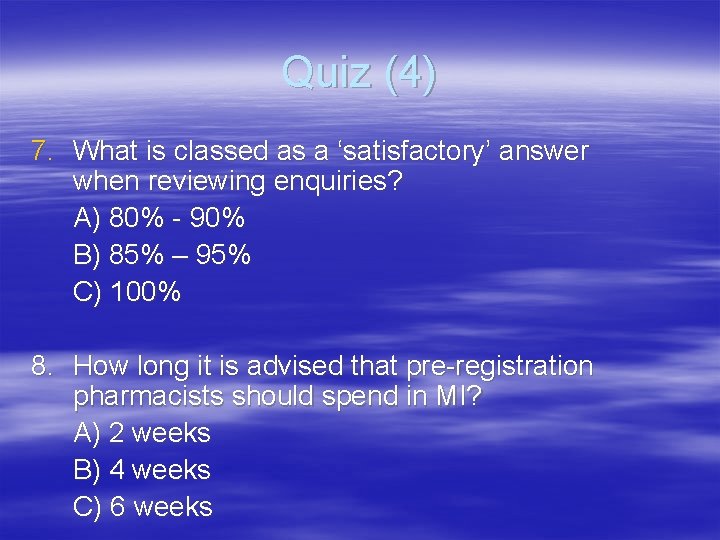
Quiz (4) 7. What is classed as a ‘satisfactory’ answer when reviewing enquiries? A) 80% - 90% B) 85% – 95% C) 100% 8. How long it is advised that pre-registration pharmacists should spend in MI? A) 2 weeks B) 4 weeks C) 6 weeks
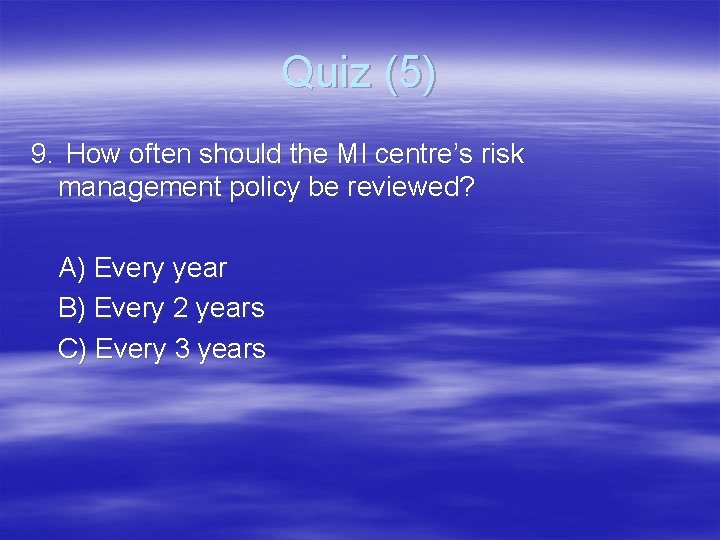
Quiz (5) 9. How often should the MI centre’s risk management policy be reviewed? A) Every year B) Every 2 years C) Every 3 years
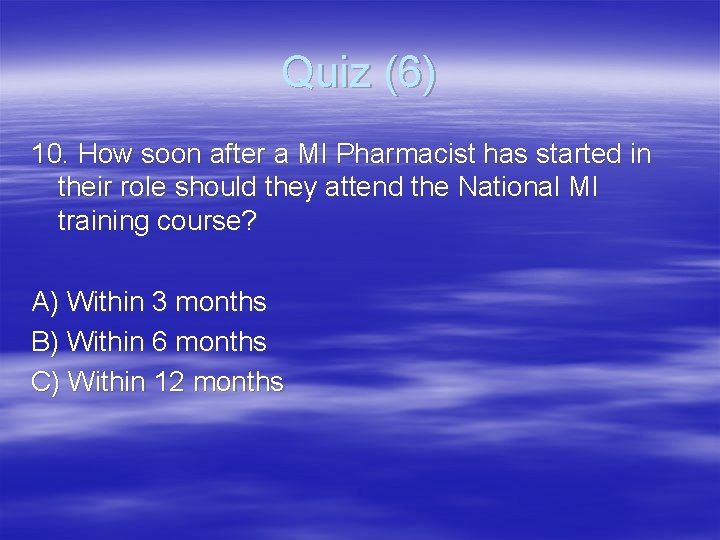
Quiz (6) 10. How soon after a MI Pharmacist has started in their role should they attend the National MI training course? A) Within 3 months B) Within 6 months C) Within 12 months
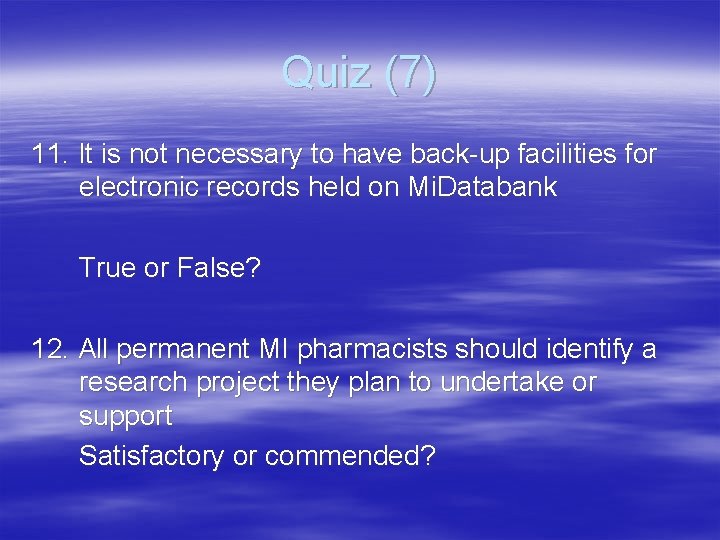
Quiz (7) 11. It is not necessary to have back-up facilities for electronic records held on Mi. Databank True or False? 12. All permanent MI pharmacists should identify a research project they plan to undertake or support Satisfactory or commended?
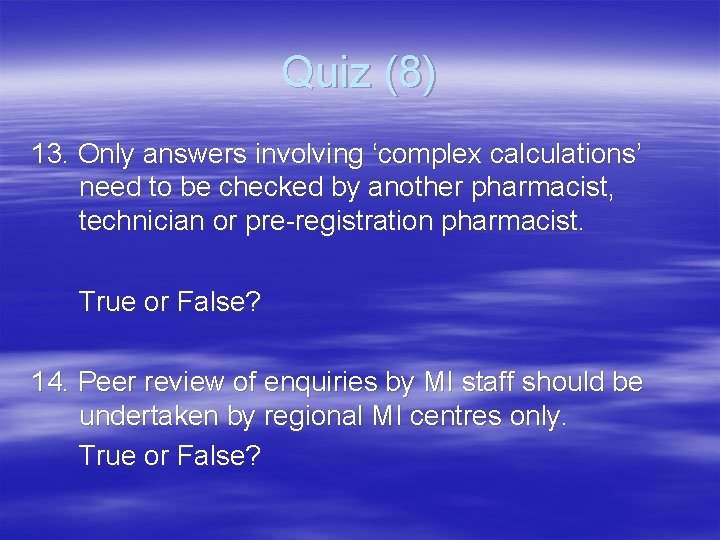
Quiz (8) 13. Only answers involving ‘complex calculations’ need to be checked by another pharmacist, technician or pre-registration pharmacist. True or False? 14. Peer review of enquiries by MI staff should be undertaken by regional MI centres only. True or False?
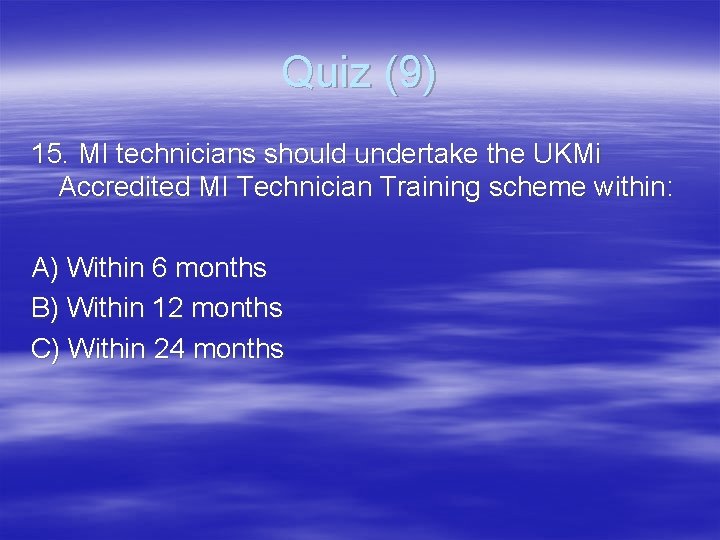
Quiz (9) 15. MI technicians should undertake the UKMi Accredited MI Technician Training scheme within: A) Within 6 months B) Within 12 months C) Within 24 months
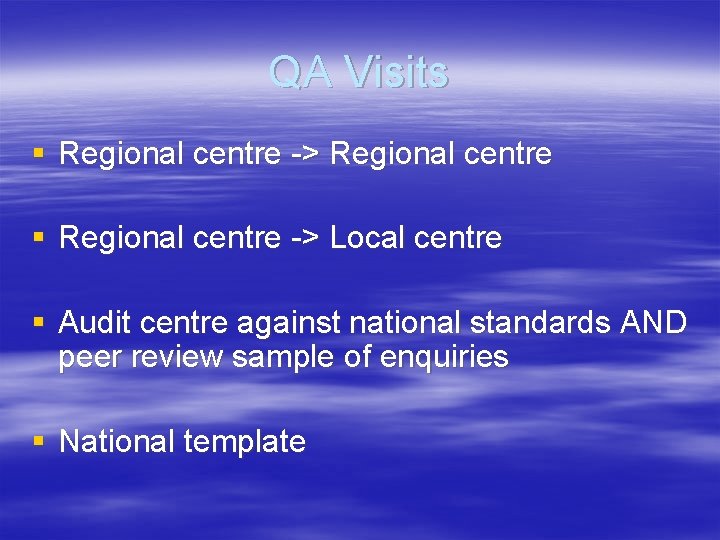
QA Visits § Regional centre -> Regional centre § Regional centre -> Local centre § Audit centre against national standards AND peer review sample of enquiries § National template
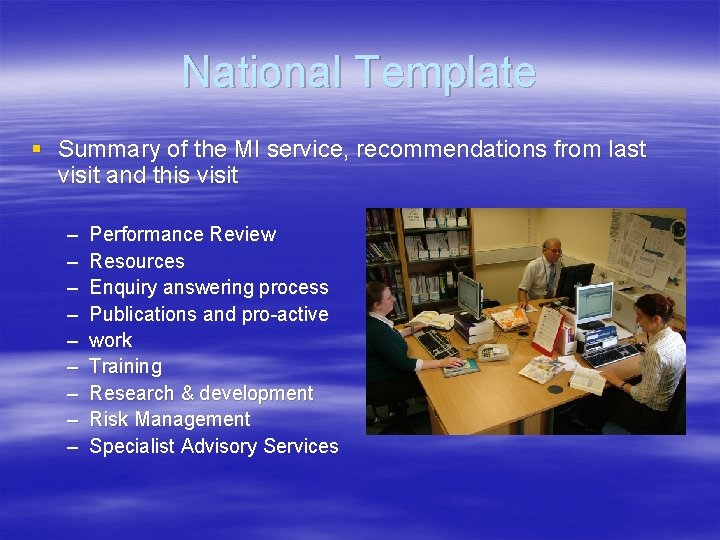
National Template § Summary of the MI service, recommendations from last visit and this visit – – – – – Performance Review Resources Enquiry answering process Publications and pro-active work Training Research & development Risk Management Specialist Advisory Services
Audit Standards
User Survey
What do you think is important to users of your MI service?
MI User Survey § Developed to provide statistically robust questionnaire. § Eleven questions linked to provide validity § Three categories measuring different aspects of user satisfaction: – Answer satisfaction – General Helpfulness/Time Satisfaction – Ease of Contact Satisfaction
MI User Survey § Conducted at least once per annum or more frequently or on an ongoing basis § No. of questionnaires sent out should be a suitable sample related to the no. of enquiries. § e. g. 0 -100 enquiries/month, 60 surveys per year
Examples of risk in your MI centre?
Risk Management Policy § Environment § Equipment & Information Resources § Outputs § People
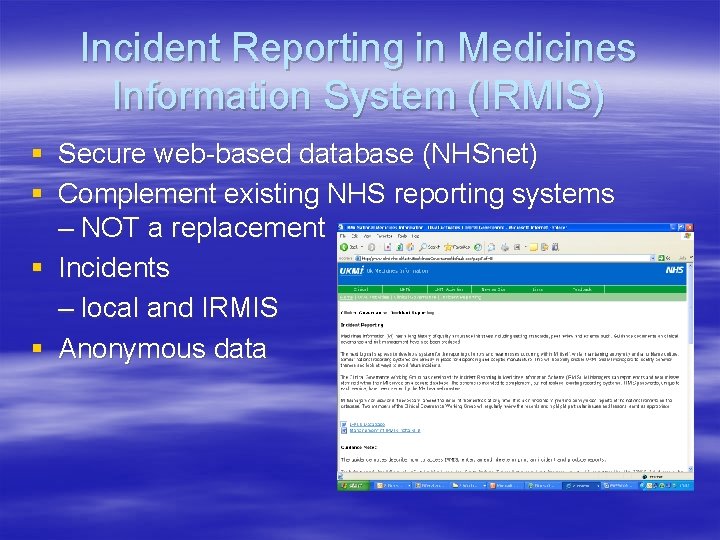
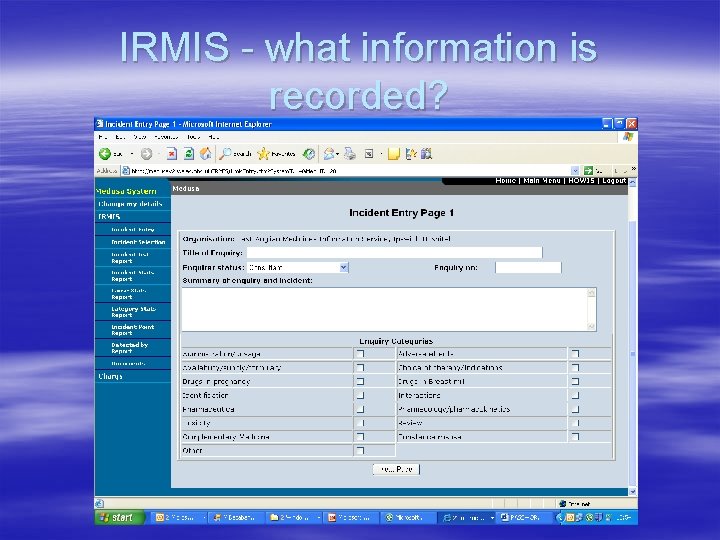
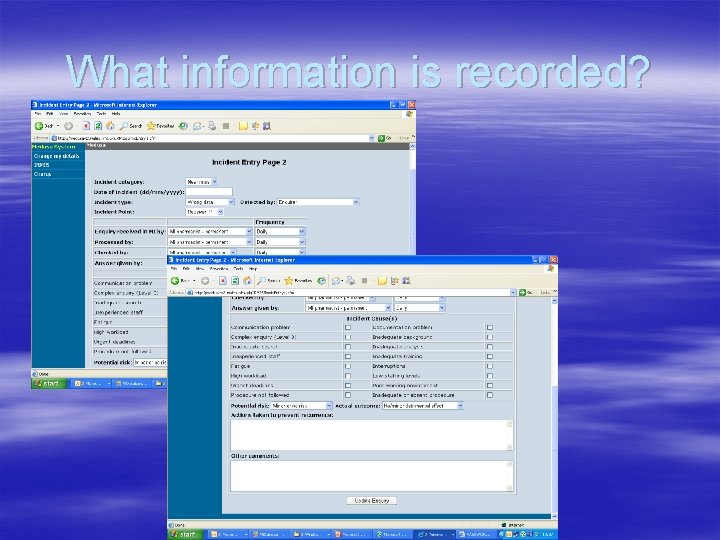
Incident Reporting in Medicines Information System (IRMIS) § Secure web-based database (NHSnet) § Complement existing NHS reporting systems – NOT a replacement § Incidents – local and IRMIS § Anonymous data
IRMIS - what information is recorded?
What information is recorded?
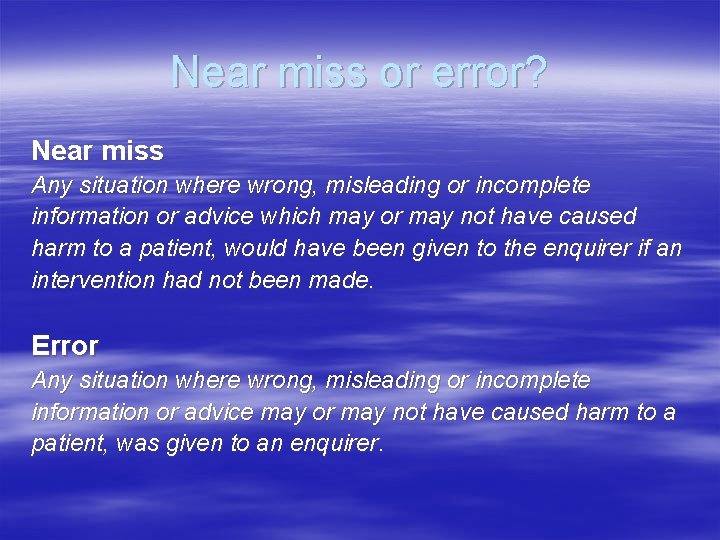
Near miss or error?
Near miss or error? Near miss Any situation where wrong, misleading or incomplete information or advice which may or may not have caused harm to a patient, would have been given to the enquirer if an intervention had not been made. Error Any situation where wrong, misleading or incomplete information or advice may or may not have caused harm to a patient, was given to an enquirer.
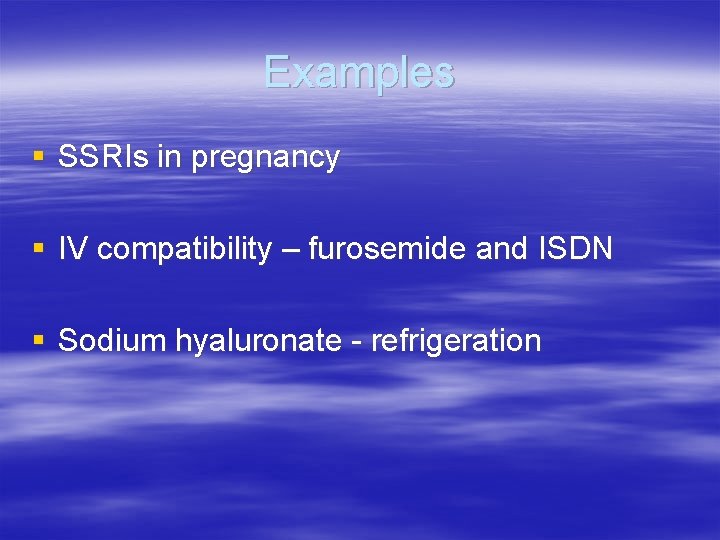
Examples § SSRIs in pregnancy § IV compatibility – furosemide and ISDN § Sodium hyaluronate - refrigeration
IRMIS- What happens to the data? § Serious incidents – – Notified to IRMIS monitor (electronic) Reporter consent Learning points circulated to Regional Directors Data used to compile quarterly report. § Above and routine incidents – – IRMIS monitor ensure report is completely anonymous Learning points highlighted Report presented to UKMi Exec Paper copy -> regional MI managers for discussion at local meetings – Summary posted on UKMi site
Peer Review § § § Monitor standard of enquiry answering All centres expected to undertake peer review Encourage sharing of: – Experience – Knowledge – Expertise § § Should be non-judgmental Provide professional support
Peer Review § Peer review allows: – Regular objective feedback on performance – Feedback and suggestions on improving the quality of the service – Sharing of ideas and learning from colleagues – Development of own practice and service – Identification of learning needs
Peer Review § UKMi provide: – Definition for ranking enquiries – Summary of criteria for grading answers to enquiries using documented evidence – Enquiry assessment form
Peer Review § Documentation § Analysis § Coverage § Answer
Peer Review § Internal – Sample enquiries (manager led) – Sample enquiries (team led) – Sample enquiries (user feedback) – Group discussion § External – Peer Review visits – Regional network meeting
Peer Review Workshop
Workshop § Group work § Peer Review enquiry § Use national documentation § Present findings to the group § What did you like about doing this? § What did you not like?
What about wider clinical governance issues? § § § § § Hospital clinical pharmacy services Formularies Medicines management programmes Prescribing advice MMC/Area Prescribing Committees Local guideline writing/protocols Dissemination of good practice Input into audit programmes and quality initiatives Training and CPD programmes Shared care support
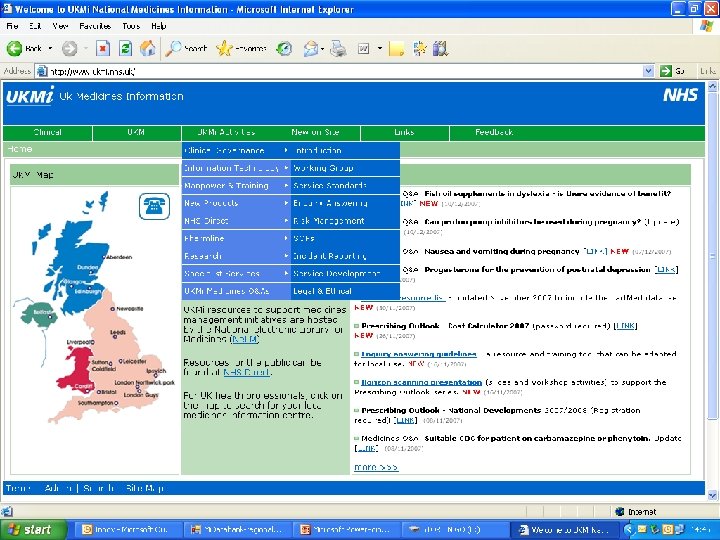
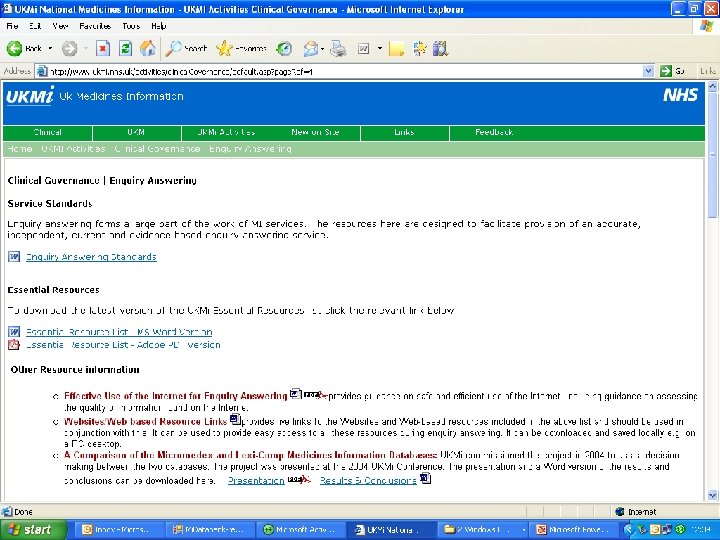
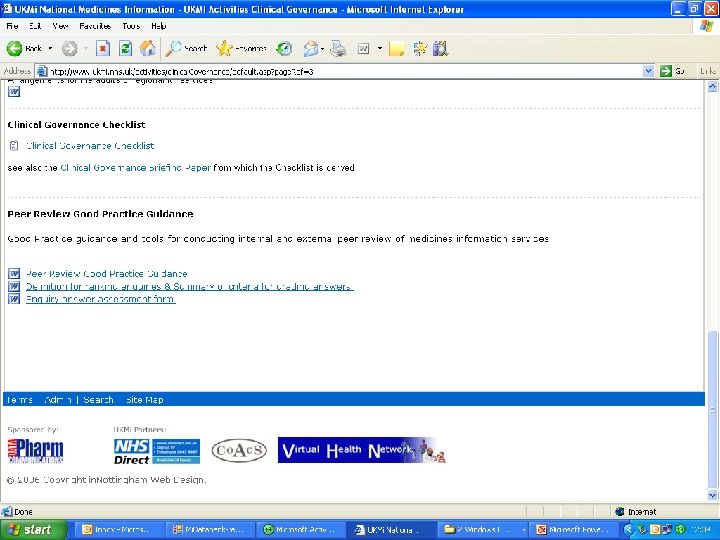
Where can you access Clinical Governance information for MI?
Summary § Provided you with an introduction to the principles of clinical governance, risk management and quality assurance. § Described the main tools used to ensure quality assurance in MI, including IRMIS. § Enabled you to apply these principles and tools in your own workplace.
Learning Outcomes You should now be able to: § Describe 15 of the UKMi standards. § Be able to peer review an enquiry and provide feedback.
Questions
Contact § Website http: //www. ipswichhospital. nhs. uk/microsites/pharmacy/information. asp § Tel No. 01473 704431 § Email mark. cheeseman@ipswichhospital. nhs. uk