
Theory and practices of Corporate Governance The concept







- Slides: 36
Theory and practices of Corporate Governance
The concept of corporation • • • Joint Stock Company Greater contribution of corporations in growth of market driven economies Also known as “ a nucleus of all business activities in modern market economies” Lawyers and economists describe the corporation as a “nexus of contracts”, Corporation is nothing more than the sum of all of the agreements leading to its creation
Different definitions of term “Corporation” • “The business corporation is an instrument through which capital is assembled for activities producing and distributing goods and services and making investments” ( Melvin Aron Eisonberg). • “A corporation is an artificial being, invisible, intangible, and existing only in the contemplation of laws. Being the mere creature of law, it possesses only those properties which the charter of its creation confers on it. , either expressly or as incidental to its very existence. These acts are supposedly best calculated to affect the object for which it was created. Among most important properties are immorality and if expression be allowed individuality ; which a perpetual succession of many persons are considered the same, and may act as a single individual” ( John Marshall).
Company Defined “By a company is meant an association of many persons , who contribute money or money’s worth to a common stock and invest it in some trade or business, and who share the profit and loss arising therefrom. The common stock so contributed is denoted in money and is the capital of company. The person who contribute to it, to whom it belongs, are members. The proportion of capital to which each member is entitled is his share. Shares are always transferable, although the right to transfer them is more or less restricted” ( Justice Lindlay).
ØThe What is a Corporate? ? ? corporations of today differs from individual capitalist in two important aspects: 1. The life span of corporation is much longer 2. It is more rationale in decision making by virtue of fact that it has benefit of collective wisdom of board of directors. ØCorporations take decisions using principals of cost accounting, budget analysis, data collection and processing, and managerial consulting. ØA corporation enjoys some privileges and is also bound by responsibilities. ØIt can Contract freely- It can also be fined, but it obviously cannot be sent to prison or incur penalties which can only be applied to individuals.
Characteristics of corporation • • Incorporated association Artificial legal existence Perpetual existence Common seal Extensive membership Separation of management from ownership Limited liability Transferability of shares
The concept of Governance ØIt means the process of decision making and the process by which decisions are implemented (or not implemented). ØAn analysis of governance focuses on formal and informal players involved in decision making and implementing the decision made. Ø Government Ø influential landlords, associations of peasant farmers, NGOs, cooperatives, research institutes, religious leaders, financial institutes etc.
The concept of Governance • • • In urban areas, situation is much more complex Governance at urban areas include elites, decision makers at different levels, government and private sector media, elected representatives, government officers, NGO and interested groups, small scale entrepreneurs etc. At national level, in addition to above players, international donors, lobbyists, multinational cooperation's etc. Play a critical role in decision making or influence the process of decision making. All players other than government and military are grouped together as part of civil society. Formal government structures are one of the means by which decisions are arrived at and implemented.
1. Agency Theory Fundamental theoretical basis of corporate governance • Shareholder are owners of any joint stock, limited liability company • Owners are principals and managers are agents • Principals define objectives of company • Management, directly or indirectly, peruse those objectives and act as agents • In may instances objectives of managers are at variance from those of shareholders i. e. a chief executive may want to increase his managerial empire or personal structure by using company funds to finance an unrelated diversification. It can reduce long term shareholders value •
Continued… Shareholders and other stakeholders cannot counteract this due to inadequate disclosure • Principals may be too scattered or even not motivated enough to effectively block such a move • Such mismatch of objectives is called “Agency Theory” • Cost inflicted by such dissonance is called “Agency Cost” • Agency theory specifies mechanisms which reduces agency loss • These includes incentives schemes for managers which reward them financially for maximizing shareholder’s wealth • Such schemes typically include plans whereby senior executive obtain shares at reduced price and thus aligning interests of shareholders with benefits of shareholders •
Problems with Agency Theory Total control of management is neither feasible nor required under this theory • The underlying tradeoff that shareholders make on employing agents is that they must accept a certain level of self interested behaviors in delegation responsibility to others • The objective of the agency theory is to check the abuse in this trade-off • Limited success of agency theory raises the question of its utility as a theoretical model to promote corporate governance • In agency theory, the assumption is with complexities of investor-board relationship in organizations • Shareholders should have correct and adequate information or wield effective control •
Continued… • • • Equity investors rarely get information and besides they rarely make clear their exact target returns, and yet delegate authority to meet target In terms of controls, equity investors hardly have sanctions over boards Instead they rely on self regulations to ensure that an orderly house is maintained
Reducing the Agency cost ØTwo broad mechanisms that help to reduce agency costs and improve corporate governance 1. 2. Fine and accurate financial disclosures Efficient and independent board of directors
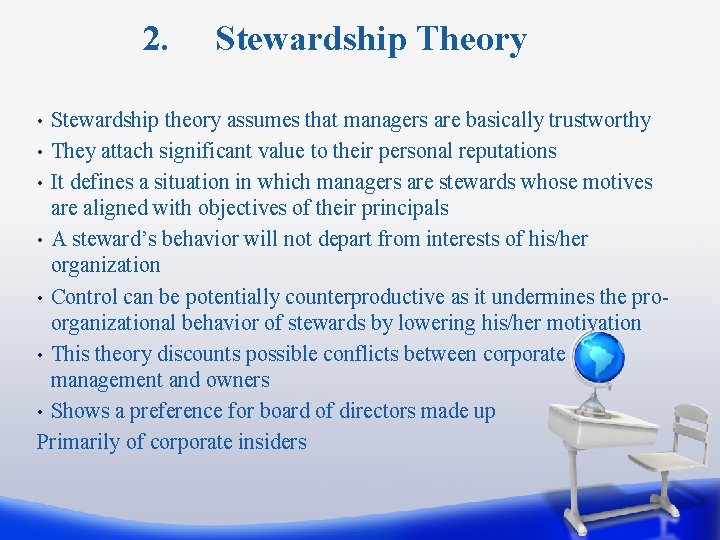
2. Stewardship Theory Stewardship theory assumes that managers are basically trustworthy • They attach significant value to their personal reputations • It defines a situation in which managers are stewards whose motives are aligned with objectives of their principals • A steward’s behavior will not depart from interests of his/her organization • Control can be potentially counterproductive as it undermines the proorganizational behavior of stewards by lowering his/her motivation • This theory discounts possible conflicts between corporate management and owners • Shows a preference for board of directors made up Primarily of corporate insiders •
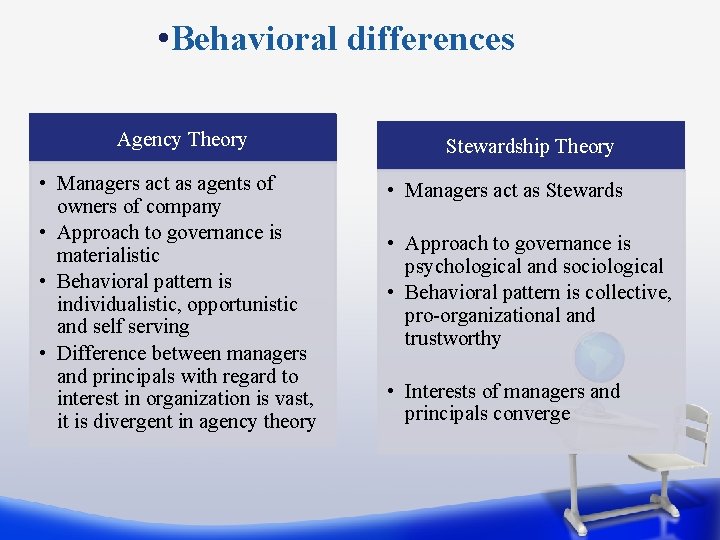
• Behavioral differences Agency Theory • Managers act as agents of owners of company • Approach to governance is materialistic • Behavioral pattern is individualistic, opportunistic and self serving • Difference between managers and principals with regard to interest in organization is vast, it is divergent in agency theory Stewardship Theory • Managers act as Stewards • Approach to governance is psychological and sociological • Behavioral pattern is collective, pro-organizational and trustworthy • Interests of managers and principals converge
Continued… Agency Theory • Managers are motivated purely by their own objectives • Role of manager in organization is to monitor and control them • Owner’s attitude is to avoid risk • Principal-manager relationship is merely based on control Stewardship Theory • Managers are motivated by principal’s objectives • Role of manager in organization is to facilitate and empower them • Owner’s attitude is risk taking • Principal-manager relationship is merely based on trust
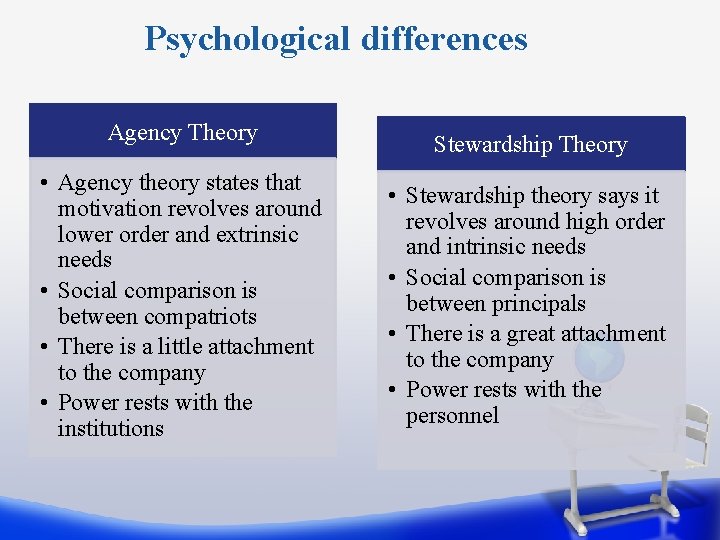
Psychological differences Agency Theory • Agency theory states that motivation revolves around lower order and extrinsic needs • Social comparison is between compatriots • There is a little attachment to the company • Power rests with the institutions Stewardship Theory • Stewardship theory says it revolves around high order and intrinsic needs • Social comparison is between principals • There is a great attachment to the company • Power rests with the personnel
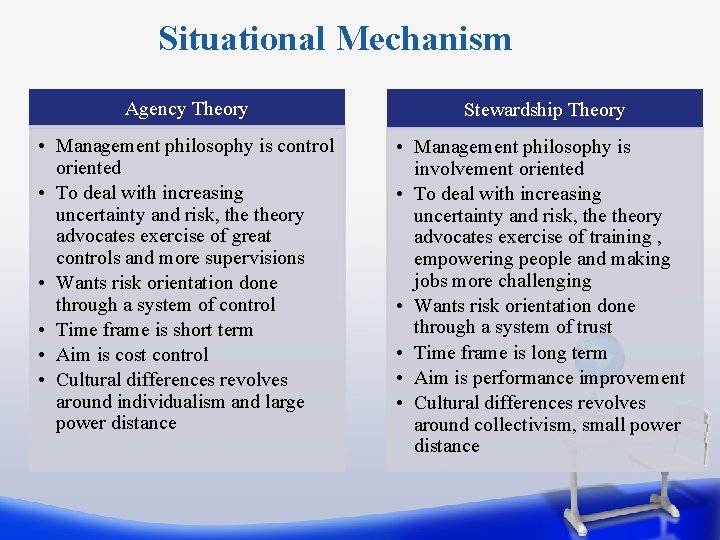
Situational Mechanism Agency Theory Stewardship Theory • Management philosophy is control oriented • To deal with increasing uncertainty and risk, theory advocates exercise of great controls and more supervisions • Wants risk orientation done through a system of control • Time frame is short term • Aim is cost control • Cultural differences revolves around individualism and large power distance • Management philosophy is involvement oriented • To deal with increasing uncertainty and risk, theory advocates exercise of training , empowering people and making jobs more challenging • Wants risk orientation done through a system of trust • Time frame is long term • Aim is performance improvement • Cultural differences revolves around collectivism, small power distance
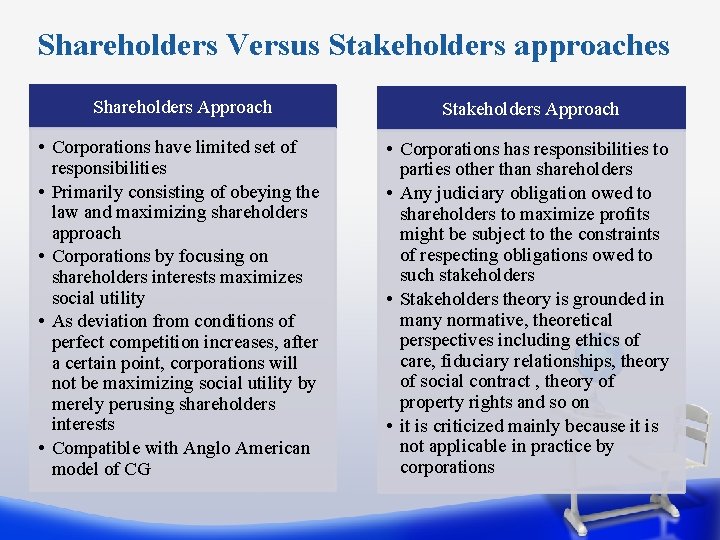
Shareholders Versus Stakeholders approaches Shareholders Approach Stakeholders Approach • Corporations have limited set of responsibilities • Primarily consisting of obeying the law and maximizing shareholders approach • Corporations by focusing on shareholders interests maximizes social utility • As deviation from conditions of perfect competition increases, after a certain point, corporations will not be maximizing social utility by merely perusing shareholders interests • Compatible with Anglo American model of CG • Corporations has responsibilities to parties other than shareholders • Any judiciary obligation owed to shareholders to maximize profits might be subject to the constraints of respecting obligations owed to such stakeholders • Stakeholders theory is grounded in many normative, theoretical perspectives including ethics of care, fiduciary relationships, theory of social contract , theory of property rights and so on • it is criticized mainly because it is not applicable in practice by corporations
3. ØSociological 1. 2. 3. 4. Sociological Theory theory has focused mostly on: Board composition Wealth distribution Financial reporting Disclosure and auditing
Contemporary Corporate Governance Situation • Shares of public companies are held now by diverse shareholders • Some shares are held by private individuals, some by institutional investors such as banks and insurance companies and other companies who might have business relationship with company • Ownership structure of contemporary organizations is complex
Growing Awareness And Social Response ØGrowing awareness about corporate governance round the world is reflected in plethora of official reports on the subject ØThese include 1. American Law Institute repost (1992) 2. Cadbury and Hampel Report ( 1998) from U. K 3. Hilmar report (1993) in Australia 4. The vienot report(1995) in France etc…. ØMany official reports include codes of best practices in CG ØDetailing expectations on matters such as board structure, audit and audit committees, transparency in financial reporting and director’s accountability ØCompany’s responsibility to stakeholder is increasing
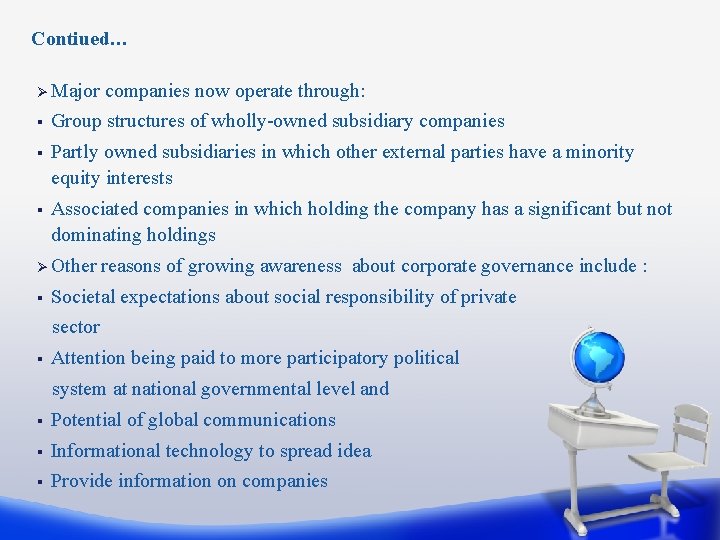
Contiued… Ø Major companies now operate through: § Group structures of wholly-owned subsidiary companies § Partly owned subsidiaries in which other external parties have a minority equity interests § Associated companies in which holding the company has a significant but not dominating holdings Ø Other § reasons of growing awareness about corporate governance include : Societal expectations about social responsibility of private sector § Attention being paid to more participatory political system at national governmental level and § Potential of global communications § Informational technology to spread idea § Provide information on companies
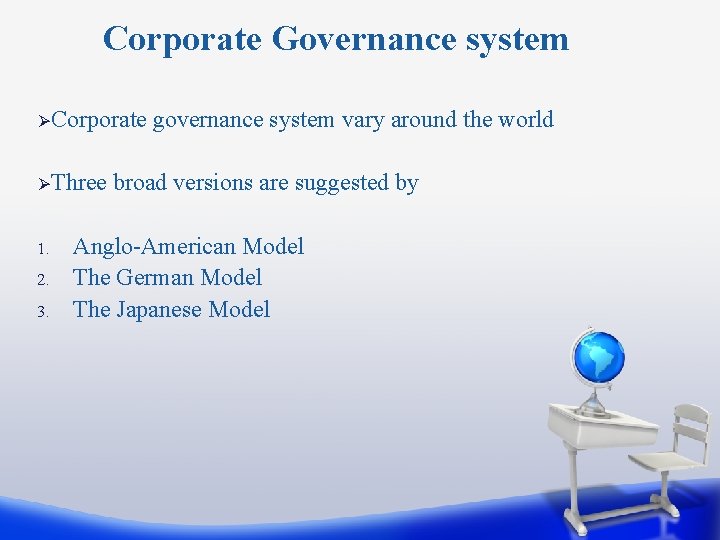
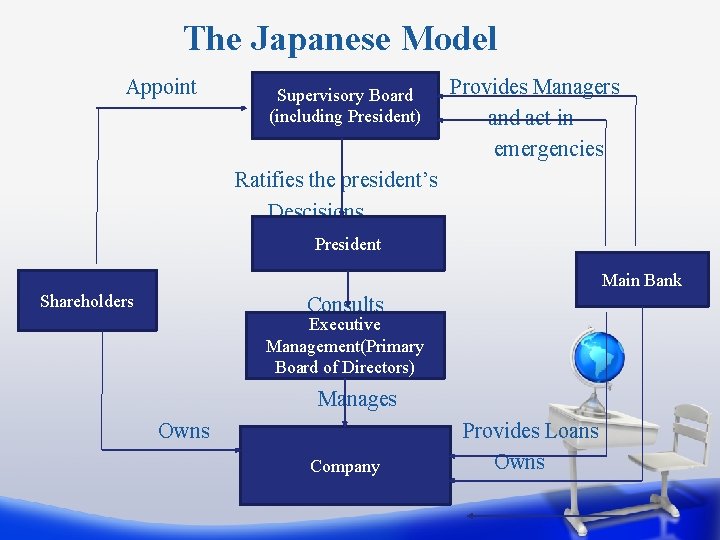
Corporate Governance system ØCorporate ØThree 1. 2. 3. governance system vary around the world broad versions are suggested by Anglo-American Model The German Model The Japanese Model
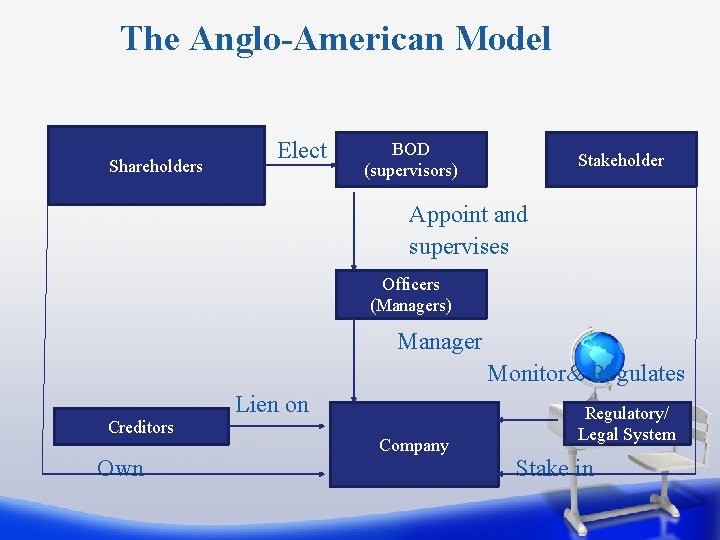
The Anglo-American Model Shareholders Elect BOD (supervisors) Stakeholder Appoint and supervises Officers (Managers) Manager Monitor& Regulates Creditors Own Lien on Company Regulatory/ Legal System Stake in
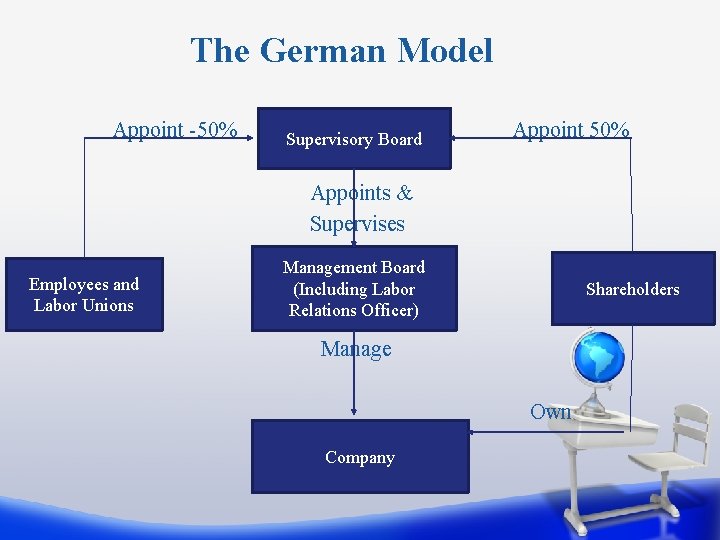
The German Model Appoint -50% Supervisory Board Appoint 50% Appoints & Supervises Employees and Labor Unions Management Board (Including Labor Relations Officer) Shareholders Manage Own Company
The Japanese Model Appoint Supervisory Board (including President) Provides Managers and act in emergencies Ratifies the president’s Descisions President Main Bank Shareholders Consults Executive Management(Primary Board of Directors) Manages Owns Company Provides Loans Owns
What is “Good "Corporate Governance? ? ØGood Corporate are not born, but are made by collective efforts of all Shareholders, Board of Directors, government and society at large ØLaw and regulations alone cannot bring about changes in corporate to behave better to benefit all concerned ØDirectors and management as guided by stakeholders and inspired by societal values, have a very important role to play ØCompany and its office, who, inter alia, include board of directors and officials, especially in senior management should strictly follow a code of conduct, which should have following desiderata:
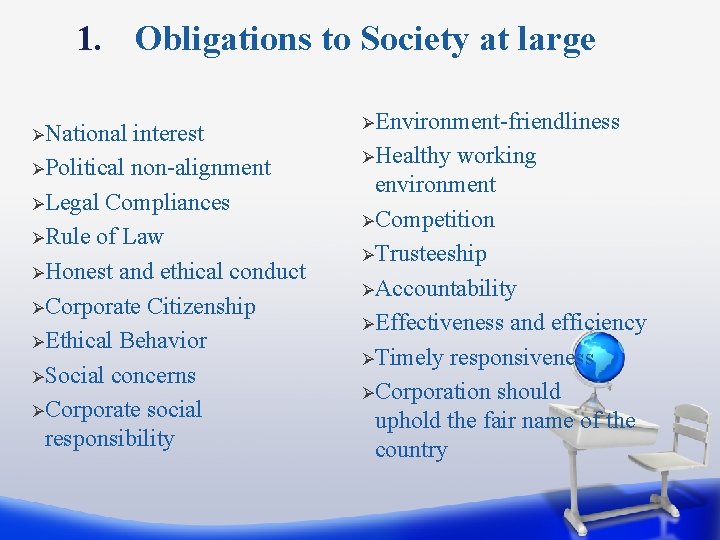
1. Obligations to Society at large ØNational interest ØPolitical non-alignment ØLegal Compliances ØRule of Law ØHonest and ethical conduct ØCorporate Citizenship ØEthical Behavior ØSocial concerns ØCorporate social responsibility ØEnvironment-friendliness ØHealthy working environment ØCompetition ØTrusteeship ØAccountability ØEffectiveness and efficiency ØTimely responsiveness ØCorporation should uphold the fair name of the country
2. ØTowards Obligations to Invest shareholders ØMeasures promoting transparency and informed shareholders participation ØTransparency ØFinancial reporting and records
3. ØFair Obligations Employees employment practices ØEqual opportunities employer ØEncouraging whistler blowing ØHumane treatment ØParticipation ØEmpowerment ØEquity and inclusiveness ØParticipative and collaborative environment
4. ØQuality Obligations to Customers of product and services ØProducts at affordable prices ØUnwavering commitment to customer satisfaction
5. ØProtecting Managerial obligations company’s assets ØBehavior towards government agencies ØControl ØConsensus oriented ØGifts and donations ØRole and responsibilities of corporate board and directors ØDirection and management must be distinguished
ØWith broadening vision of modern thinkers and opinion makers, and enhanced and heightened social values, it is now unacceptable proposition that corporations exists purely for the benefit of those who constituted it ØModern organizations re expected to be transparent, accountable, even beneficial to society at large ØStakeholders are now considered as important as shareholders ØCorporate social responsibility is increasing concern
Apply what you have learnt!!! Search for some examples of Agency Problem in real world. present At least ONE problem that you have searched individually. See and explain how Agency theory comes into the play for the problem you have decided to present.