VA Data Governance Council June 23 2020 2019
- Slides: 17
VA Data Governance Council June 23, 2020 2019
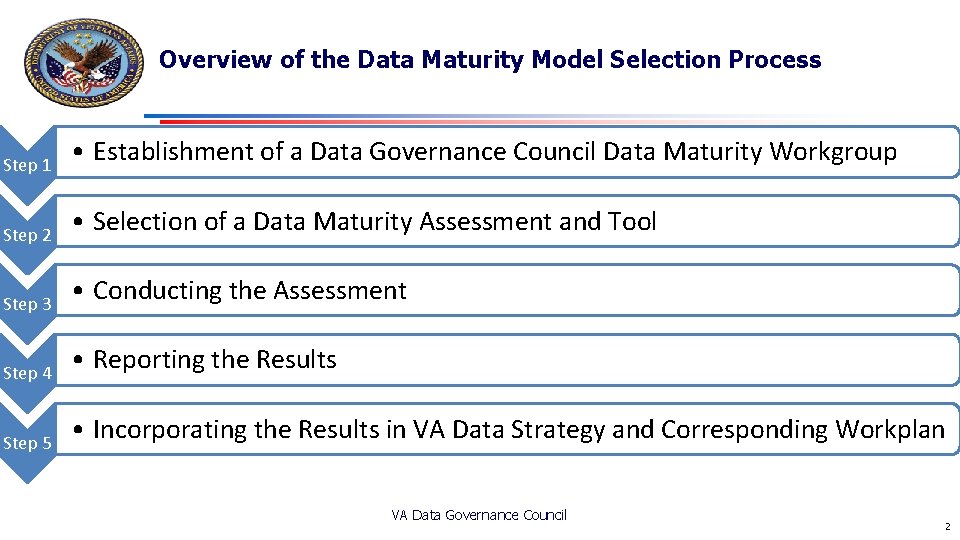
Overview of the Data Maturity Model Selection Process Step 1 • Establishment of a Data Governance Council Data Maturity Workgroup Step 2 • Selection of a Data Maturity Assessment and Tool Step 3 • Conducting the Assessment Step 4 • Reporting the Results Step 5 • Incorporating the Results in VA Data Strategy and Corresponding Workplan VA Data Governance Council 2
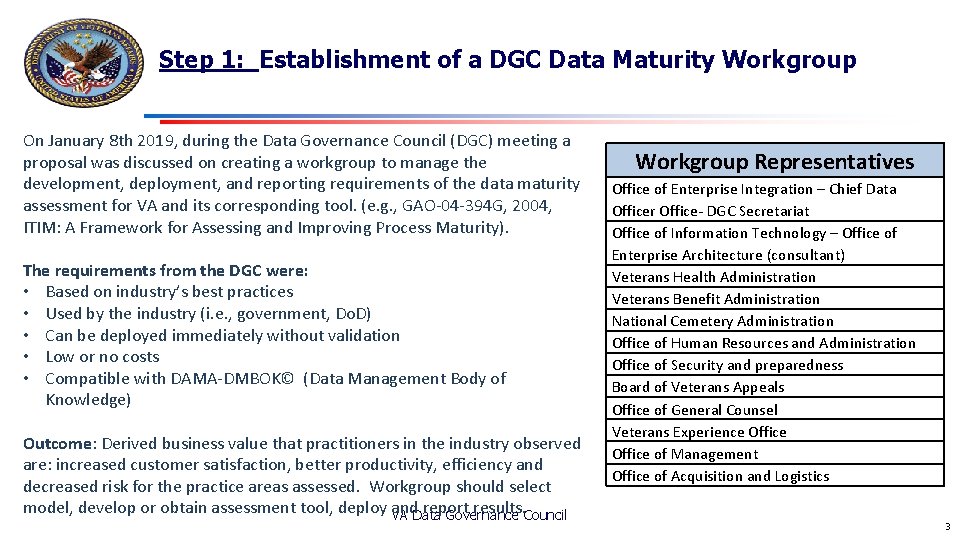
Step 1: Establishment of a DGC Data Maturity Workgroup On January 8 th 2019, during the Data Governance Council (DGC) meeting a proposal was discussed on creating a workgroup to manage the development, deployment, and reporting requirements of the data maturity assessment for VA and its corresponding tool. (e. g. , GAO-04 -394 G, 2004, ITIM: A Framework for Assessing and Improving Process Maturity). The requirements from the DGC were: • Based on industry’s best practices • Used by the industry (i. e. , government, Do. D) • Can be deployed immediately without validation • Low or no costs • Compatible with DAMA-DMBOK© (Data Management Body of Knowledge) Outcome: Derived business value that practitioners in the industry observed are: increased customer satisfaction, better productivity, efficiency and decreased risk for the practice areas assessed. Workgroup should select model, develop or obtain assessment tool, deploy and report results. Council VA Data Governance Workgroup Representatives Office of Enterprise Integration – Chief Data Officer Office- DGC Secretariat Office of Information Technology – Office of Enterprise Architecture (consultant) Veterans Health Administration Veterans Benefit Administration National Cemetery Administration Office of Human Resources and Administration Office of Security and preparedness Board of Veterans Appeals Office of General Counsel Veterans Experience Office of Management Office of Acquisition and Logistics 3
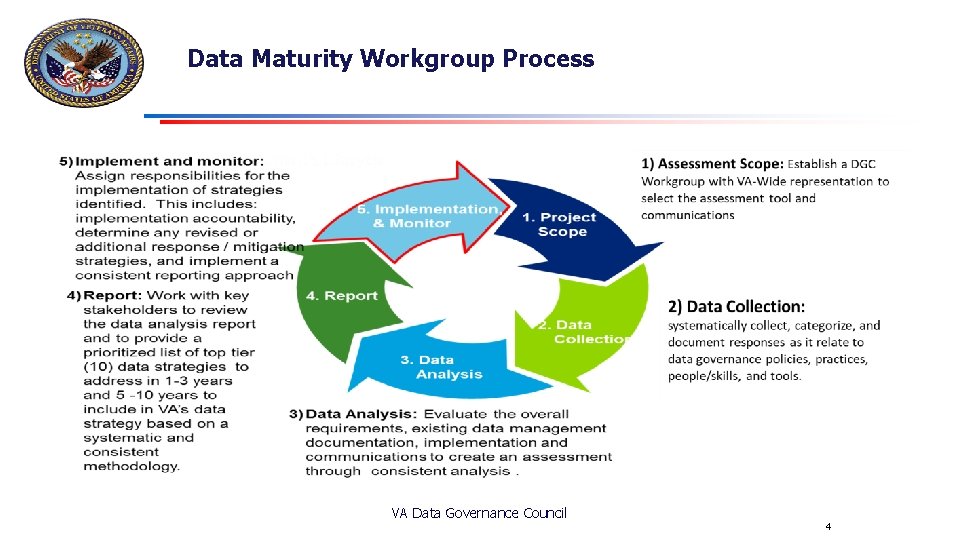
Data Maturity Workgroup Process VA Data Governance Council 4
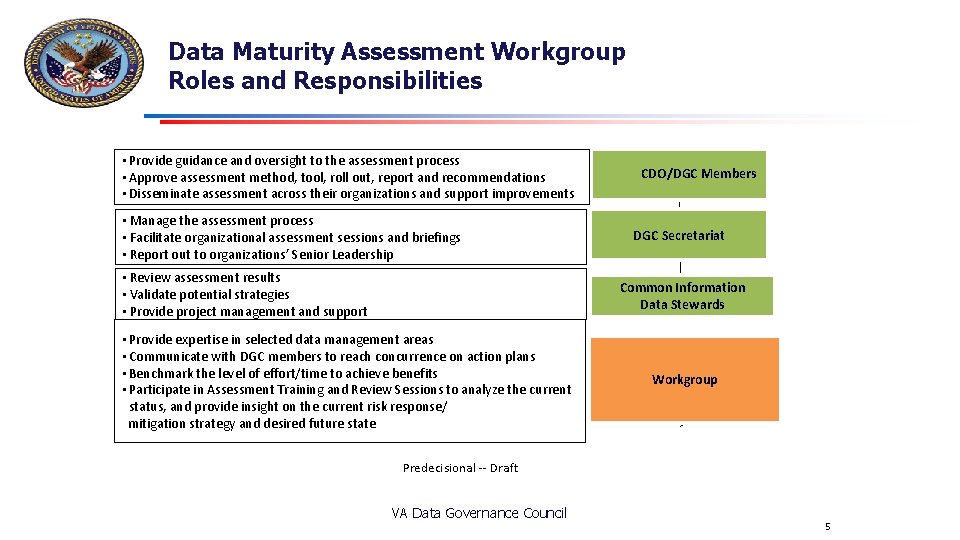
Data Maturity Assessment Workgroup Roles and Responsibilities Assessment Roles and Responsibilities • Provide guidance and oversight to the assessment process • Approve assessment method, tool, roll out, report and recommendations • Disseminate assessment across their organizations and support improvements • Manage the assessment process • Facilitate organizational assessment sessions and briefings • Report out to organizations’ Senior Leadership • Review assessment results • Validate potential strategies • Provide project management and support CDO/DGC Members DGC Secretariat Common Information Data Stewards • Provide expertise in selected data management areas • Communicate with DGC members to reach concurrence on action plans • Benchmark the level of effort/time to achieve benefits • Participate in Assessment Training and Review Sessions to analyze the current status, and provide insight on the current risk response/ mitigation strategy and desired future state Workgroup Predecisional -- Draft VA Data Governance Council 5
Step 2: Workgroup Selection of the Data Maturity Assessment Model and Tool
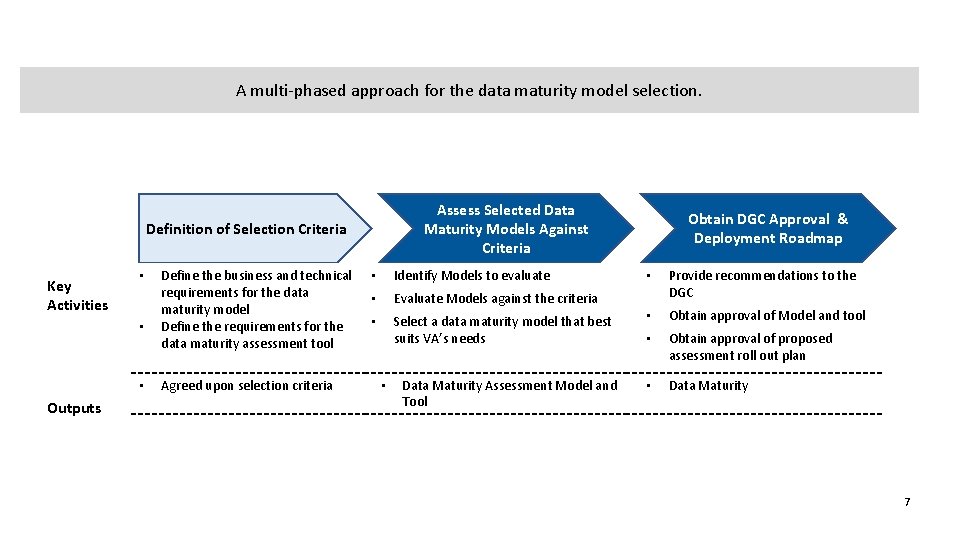
A multi-phased approach for the data maturity model selection. Assess Selected Data Maturity Models Against Criteria Definition of Selection Criteria Key Activities • • • Outputs Define the business and technical requirements for the data maturity model Define the requirements for the data maturity assessment tool Agreed upon selection criteria • Identify Models to evaluate • Evaluate Models against the criteria • Select a data maturity model that best suits VA’s needs • Data Maturity Assessment Model and Tool Obtain DGC Approval & Deployment Roadmap • Provide recommendations to the DGC • Obtain approval of Model and tool • Obtain approval of proposed assessment roll out plan • Data Maturity 7
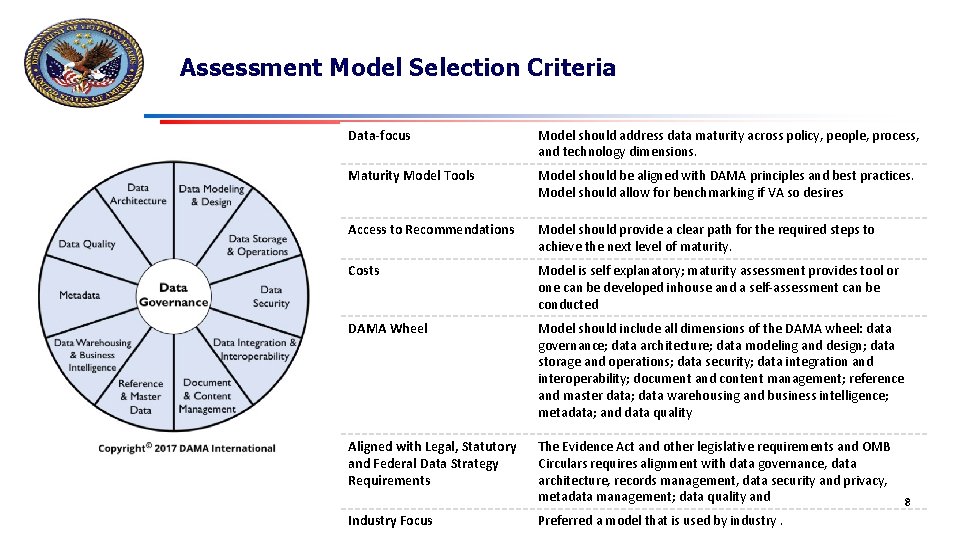
Assessment Model Selection Criteria Data-focus Model should address data maturity across policy, people, process, and technology dimensions. Maturity Model Tools Model should be aligned with DAMA principles and best practices. Model should allow for benchmarking if VA so desires Access to Recommendations Model should provide a clear path for the required steps to achieve the next level of maturity. Costs Model is self explanatory; maturity assessment provides tool or one can be developed inhouse and a self-assessment can be conducted DAMA Wheel Model should include all dimensions of the DAMA wheel: data governance; data architecture; data modeling and design; data storage and operations; data security; data integration and interoperability; document and content management; reference and master data; data warehousing and business intelligence; metadata; and data quality Aligned with Legal, Statutory and Federal Data Strategy Requirements The Evidence Act and other legislative requirements and OMB Circulars requires alignment with data governance, data architecture, records management, data security and privacy, metadata management; data quality and Industry Focus Preferred a model that is used by industry. 8
Model Assessment Results
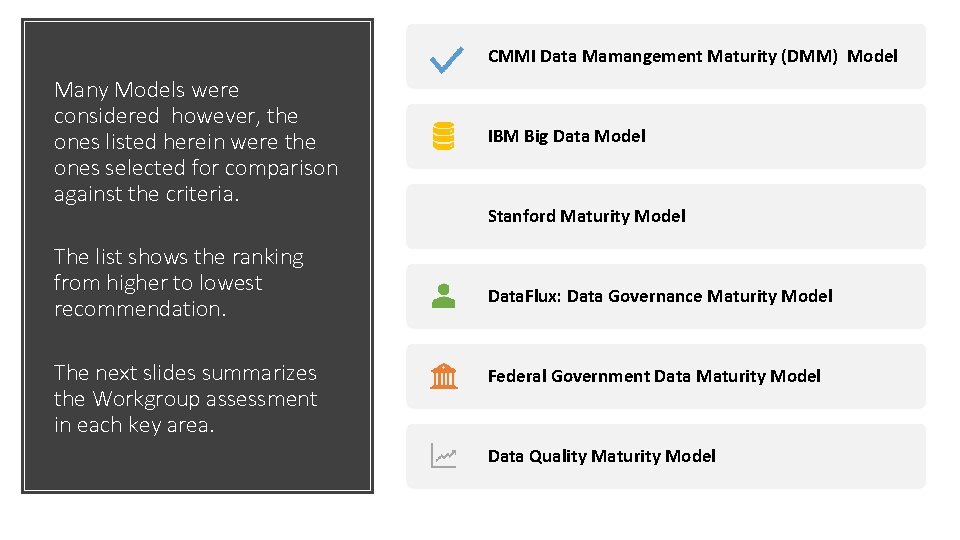
CMMI Data Mamangement Maturity (DMM) Model Many Models were considered however, the ones listed herein were the ones selected for comparison against the criteria. The list shows the ranking from higher to lowest recommendation. The next slides summarizes the Workgroup assessment in each key area. IBM Big Data Model Stanford Maturity Model Data. Flux: Data Governance Maturity Model Federal Government Data Maturity Model Data Quality Maturity Model
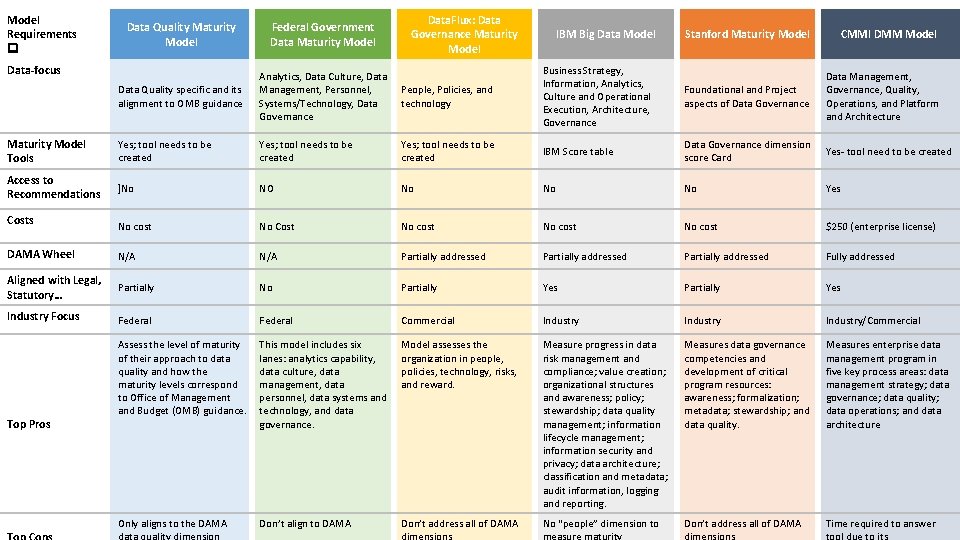
Model Requirements Data Quality Maturity Model Federal Government Data Maturity Model Data Quality specific and its alignment to OMB guidance Analytics, Data Culture, Data Management, Personnel, Systems/Technology, Data Governance Maturity Model Tools Yes; tool needs to be created Access to Recommendations Data. Flux: Data Governance Maturity Model Stanford Maturity Model CMMI DMM Model People, Policies, and technology Business Strategy, Information, Analytics, Culture and Operational Execution, Architecture, Governance Foundational and Project aspects of Data Governance Data Management, Governance, Quality, Operations, and Platform and Architecture Yes; tool needs to be created IBM Score table Data Governance dimension score Card Yes- tool need to be created ]No NO No No No Yes No cost No Cost No cost $250 (enterprise license) DAMA Wheel N/A Partially addressed Fully addressed Aligned with Legal, Statutory… Partially No Partially Yes Industry Focus Federal Commercial Industry/Commercial Assess the level of maturity of their approach to data quality and how the maturity levels correspond to Office of Management and Budget (OMB) guidance. This model includes six lanes: analytics capability, data culture, data management, data personnel, data systems and technology, and data governance. Model assesses the organization in people, policies, technology, risks, and reward. Measure progress in data risk management and compliance; value creation; organizational structures and awareness; policy; stewardship; data quality management; information lifecycle management; information security and privacy; data architecture; classification and metadata; audit information, logging and reporting. Measures data governance competencies and development of critical program resources: awareness; formalization; metadata; stewardship; and data quality. Measures enterprise data management program in five key process areas: data management strategy; data governance; data quality; data operations; and data architecture No “people” dimension to Don’t address all of DAMA Data-focus Costs Top Pros Only aligns to the DAMA Don’t align to DAMA Don’t address all of DAMA IBM Big Data Model 11 Time required to answer
Deep Dive into the CMMI Model
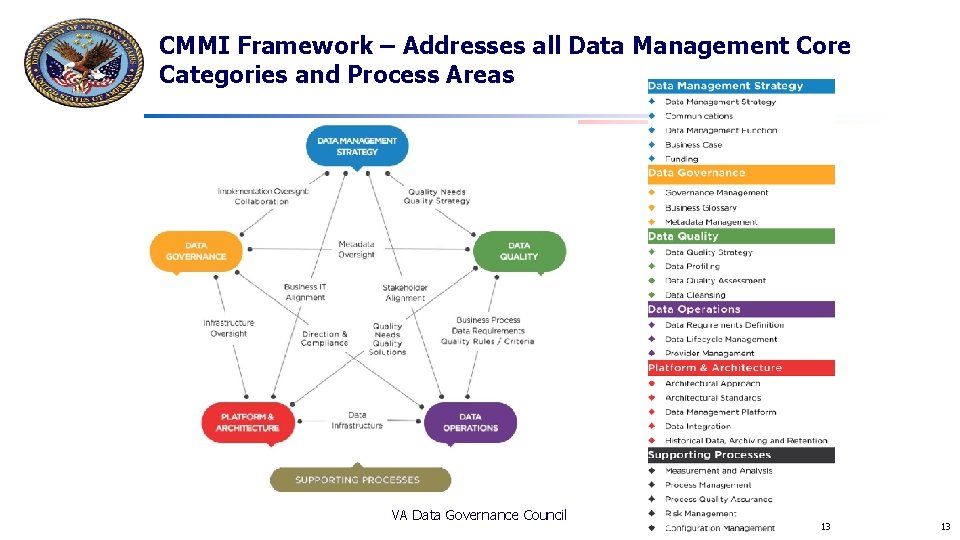
CMMI Framework – Addresses all Data Management Core Categories and Process Areas VA Data Governance Council 13 13
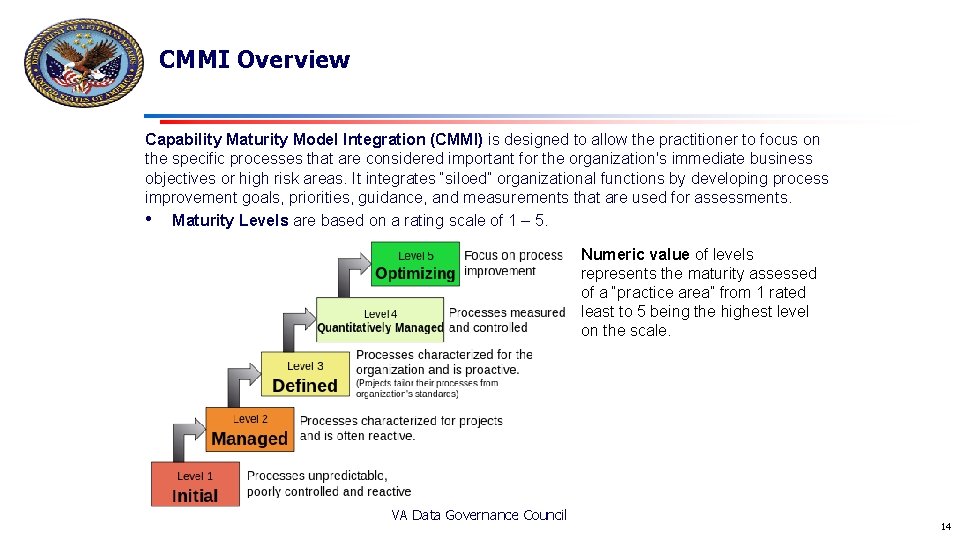
CMMI Overview Capability Maturity Model Integration (CMMI) is designed to allow the practitioner to focus on the specific processes that are considered important for the organization's immediate business objectives or high risk areas. It integrates “siloed” organizational functions by developing process improvement goals, priorities, guidance, and measurements that are used for assessments. • Maturity Levels are based on a rating scale of 1 – 5. Numeric value of levels represents the maturity assessed of a “practice area” from 1 rated least to 5 being the highest level on the scale. VA Data Governance Council 14
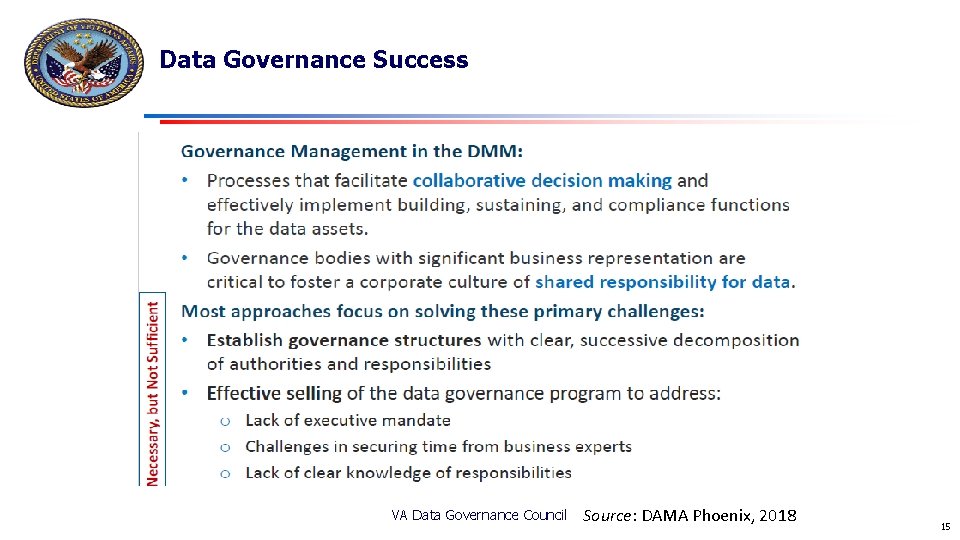
Data Governance Success VA Data Governance Council Source: DAMA Phoenix, 2018 15
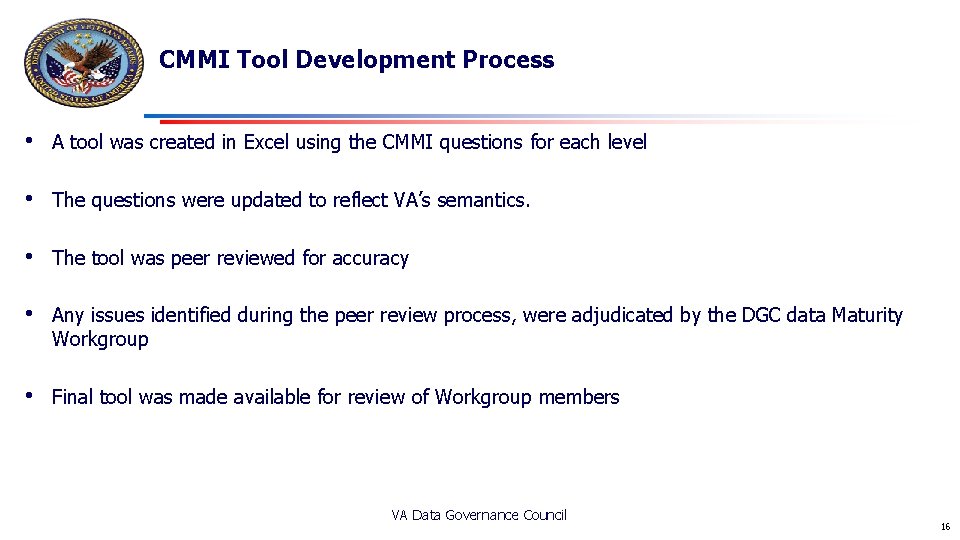
CMMI Tool Development Process • A tool was created in Excel using the CMMI questions for each level • The questions were updated to reflect VA’s semantics. • The tool was peer reviewed for accuracy • Any issues identified during the peer review process, were adjudicated by the DGC data Maturity Workgroup • Final tool was made available for review of Workgroup members VA Data Governance Council 16
Next steps • Provide training to DGC members in the CMMI Model and assessment tool • Deploy the Assessment Tool and gather results • Publish results VA Data Governance Council 17