Exceptional Children An Introduction to Special Education Eleventh
- Slides: 26
Exceptional Children: An Introduction to Special Education Eleventh Edition William Heward, Sheila Alber-Morgan, and Moira Konrad Chapter 10 Blindness and Low Vision Developed by: Blanche Jackson Glimps Tennessee State University Copyright © 2017, 2013, 2009 by Pearson Education, Inc. All Rights Reserved
Chapter Objectives • State and briefly describe the instructional implications of the three general classifications of visual impairments used by educators. • Describe how blindness and low vision affect learning, motor development, and social interaction. • Identify the estimated prevalence of children with visual impairments. Exceptional Children: An Introduction to Special Education 11 th Edition Heward, Alber-Morgan, and Konrad Copyright © 2017, 2013, 2009 by Pearson Education, Inc. All Rights Reserved
Chapter Objectives • Explain why it is important for teachers to know about the types of visual impairments affecting children in their classrooms. • Compare the educational goals and instructional methods for children with low vision and children who are blind. • Explain how the educational placement of a student with visual impairments can affect her opportunities to learn the expanded core curriculum of nonacademic skills necessary for overall success in life. Exceptional Children: An Introduction to Special Education 11 th Edition Heward, Alber-Morgan, and Konrad Copyright © 2017, 2013, 2009 by Pearson Education, Inc. All Rights Reserved
Legal Definitions • The legal definition is based on visual acuity and field of vision. § A person whose visual acuity is 20/200 in the better eye with the use of a corrective lens is considered blind. § A person whose visual acuity falls between 20/70 and 20/200 in the better eye after correction is considered partially sighted for legal purposes. Exceptional Children: An Introduction to Special Education 11 th Edition Heward, Alber-Morgan, and Konrad Copyright © 2017, 2013, 2009 by Pearson Education, Inc. All Rights Reserved
Educational Definitions IDEA definitions of visual impairments emphasizes the relationship between vision and learning. § Totally blind: Receives no useful information through the sense of vision and uses tactile and auditory senses for all learning. § Functionally blind: Learns primarily through the auditory and tactile senses. § Low vision: Uses vision as a primary means of learning but supplements by using tactile and auditory input. Exceptional Children: An Introduction to Special Education 11 th Edition Heward, Alber-Morgan, and Konrad Copyright © 2017, 2013, 2009 by Pearson Education, Inc. All Rights Reserved
Age of Onset • Congenitally Blind: visual impairment is present at birth; a background of learning through hearing, touch, and the other nonvisual senses • Adventitiously Blind: visual impairment is acquired; a visual memory of things is retained Exceptional Children: An Introduction to Special Education 11 th Edition Heward, Alber-Morgan, and Konrad Copyright © 2017, 2013, 2009 by Pearson Education, Inc. All Rights Reserved
Characteristics: Cognition and Language § Perform more poorly than sighted children on cognitive tasks requiring comprehension or relating different items of information. • Impaired or absent vision makes it difficult to see the connections between experiences. § Visual impairments precludes incidental learning. § Abstract concepts, analogies, and idiomatic expressions can be difficult to understand without sight. Exceptional Children: An Introduction to Special Education 11 th Edition Heward, Alber-Morgan, and Konrad Copyright © 2017, 2013, 2009 by Pearson Education, Inc. All Rights Reserved
Characteristics: Motor Development and Mobility • Visual impairment often leads to delays and deficits in motor development §Four functions of vision in the acquisition of motor skills • Motivation • Spatial awareness • Protection • Feedback • A child without clear vision may move less often because movement in the past resulted in painful contact with the environment. Exceptional Children: An Introduction to Special Education 11 th Edition Heward, Alber-Morgan, and Konrad Copyright © 2017, 2013, 2009 by Pearson Education, Inc. All Rights Reserved
Characteristics: Social Adjustment and Interaction § Children with visual impairments play and interact less during free time and are often delayed in social skills. Many struggle with • Social isolation • Inability to see and respond to others’ social signals • Stereotypic behavior § The inability to see and respond to the social signals of others reduces opportunities for reciprocal interactions. Exceptional Children: An Introduction to Special Education 11 th Edition Heward, Alber-Morgan, and Konrad Copyright © 2017, 2013, 2009 by Pearson Education, Inc. All Rights Reserved
Characteristics: Social Adjustment and Interaction • Some individuals with visual impairments engage in repetitive body movements or other stereotypic behaviors such as • body rocking, eye pressing and poking, hand flapping and hand weaving. • Many persons who have lost their sight report that the biggest difficulty socially is dealing with the attitudes and behavior of those around them. Exceptional Children: An Introduction to Special Education 11 th Edition Heward, Alber-Morgan, and Konrad Copyright © 2017, 2013, 2009 by Pearson Education, Inc. All Rights Reserved
Prevalence • Fewer than 2 children in 1000 have visual impairments. • Only about 1 in 200 to 250 of all schoolage children with IEPs are served under the category of visual impairments. • During the 2012 to 2013 school year, approximately 28, 000 children ages 3 to 21 years received special education services under the IDEA category of visual impairment. Exceptional Children: An Introduction to Special Education 11 th Edition Heward, Alber-Morgan, and Konrad Copyright © 2017, 2013, 2009 by Pearson Education, Inc. All Rights Reserved
Prevalence • Many school age children with visual impairments also have another disability and are served under other disability categories such as deaf-blindness. • The number is much larger than the data reported for IDEA. § The American Printing House for the Blind reported that 51, 974 children from birth to age 21 years were eligible for services for visual impairment in 2014. Exceptional Children: An Introduction to Special Education 11 th Edition Heward, Alber-Morgan, and Konrad Copyright © 2017, 2013, 2009 by Pearson Education, Inc. All Rights Reserved
How We See • Effective vision requires proper functioning of three anatomical systems of the eye: § The optical system collects and focuses light energy reflected from objects in the visual field. § The muscular system enables ocular motility. § The nervous system converts light energy into electrical impulses and transmits that information to the brain. Exceptional Children: An Introduction to Special Education 11 th Edition Heward, Alber-Morgan, and Konrad Copyright © 2017, 2013, 2009 by Pearson Education, Inc. All Rights Reserved
How We See • As light passes through the eye, several structures bend, or reflect, the light to produce a clear image. § Cornea § Aqueous Humor § Pupil § Lens § Vitreous Humor § Retina Exceptional Children: An Introduction to Special Education 11 th Edition Heward, Alber-Morgan, and Konrad Copyright © 2017, 2013, 2009 by Pearson Education, Inc. All Rights Reserved
Causes § Refractive Errors: Myopia (nearsightedness) and hyperopia (farsightedness) § Structural Impairments: Cataracts, glaucoma, nystagmus, strabismus § Cortical Visual Impairments: Suspected damage to parts of the brain that interpret visual information Exceptional Children: An Introduction to Special Education 11 th Edition Heward, Alber-Morgan, and Konrad Copyright © 2017, 2013, 2009 by Pearson Education, Inc. All Rights Reserved
Educational Approaches • Braille is the primary means of literacy for people who are blind. • Braille is a tactile system of reading and writing composed of raised dots. • Braille Technological Aids • Tactile Aids and Manipulatives • Technological Aids for Reading Print • Computer Access Exceptional Children: An Introduction to Special Education 11 th Edition Heward, Alber-Morgan, and Konrad Copyright © 2017, 2013, 2009 by Pearson Education, Inc. All Rights Reserved
Specialized Instructions for Students with Low Vision • 75% and 80% of school-age children, with visual impairments, have some potentially useful vision. Children with congenital low vision • view themselves as whole. • generally view the environment as stationary and clear. • may have a sense of visual beauty, enjoy their visual abilities, and use vision to learn. • Low vision offers a different aesthetic experience. • Vision is not always the most efficient or preferred method of functioning. Exceptional Children: An Introduction to Special Education 11 th Edition Heward, Alber-Morgan, and Konrad Copyright © 2017, 2013, 2009 by Pearson Education, Inc. All Rights Reserved
Visual Efficiency • Functional vision and visual efficiency teaches the use of remaining vision. • It encompasses the following skills: awareness, fixing or locating, scanning, tracking, gaze shifting, discriminating, and visual sequencing. • The fundamental premises underlying the development of visual efficiency is that functional vision is learned behavior and therefore teachable. Exceptional Children: An Introduction to Special Education 11 th Edition Heward, Alber-Morgan, and Konrad Copyright © 2017, 2013, 2009 by Pearson Education, Inc. All Rights Reserved
Optical Devices • Glasses and contact lenses • Handheld telescopes and magnifiers • Monocular vs. binocular aids • Prisms and fish-eye lenses • Closed-circuit television systems • Augmented reality systems Exceptional Children: An Introduction to Special Education 11 th Edition Heward, Alber-Morgan, and Konrad Copyright © 2017, 2013, 2009 by Pearson Education, Inc. All Rights Reserved
Reading Print • About 62% of students with vision impairments read printed text. Approaches for Reading Print for Children with Low Vision include: §Approach magnification §Lenses §Large print • Other factors to consider are the print quality of the material, the font or typeface, the contrast between print and page, the spacing between lines, and the illumination of the setting in which the child reads. Exceptional Children: An Introduction to Special Education 11 th Edition Heward, Alber-Morgan, and Konrad Copyright © 2017, 2013, 2009 by Pearson Education, Inc. All Rights Reserved
Classroom Adaptations • • • Proper Lighting Desks with Adjustable or Tilting Tops Writing Paper Modified Worksheets Chairs with Wheels Exceptional Children: An Introduction to Special Education 11 th Edition Heward, Alber-Morgan, and Konrad Copyright © 2017, 2013, 2009 by Pearson Education, Inc. All Rights Reserved
Reading Print • Strategies for accommodating the slower reading rates of most children with low vision include § Providing 1½ to 2 times as much time as sighted children need for reading § Ensuring sufficient time to study and use auditory reading aids § Allowing extra time on tests Exceptional Children: An Introduction to Special Education 11 th Edition Heward, Alber-Morgan, and Konrad Copyright © 2017, 2013, 2009 by Pearson Education, Inc. All Rights Reserved
Expanded Core Curriculum • Orientation and mobility training (O&M) § Cane Skills § Guide Dogs § Sighted Guides § Electronic Travel Aids • Listening skills §being aware of sounds, discriminating differences in sounds, identifying the source of sounds, and attaching meaning to sound • Functional life skills §daily living and career skills Exceptional Children: An Introduction to Special Education 11 th Edition Heward, Alber-Morgan, and Konrad Copyright © 2017, 2013, 2009 by Pearson Education, Inc. All Rights Reserved
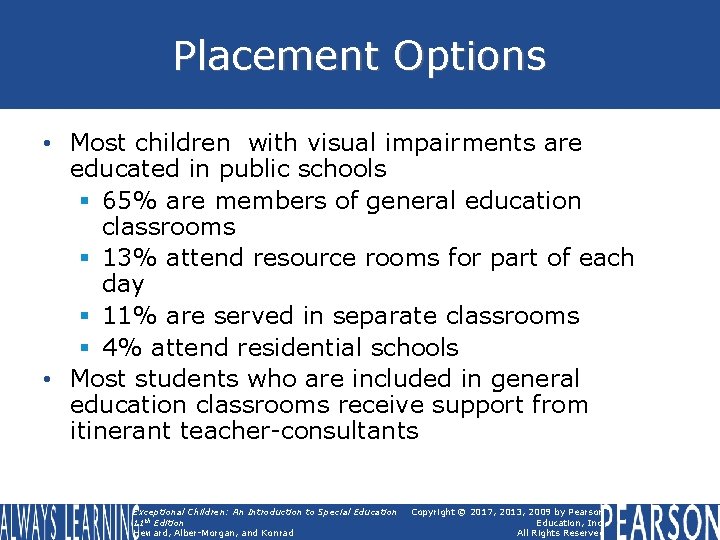
Placement Options • Most children with visual impairments are educated in public schools § 65% are members of general education classrooms § 13% attend resource rooms for part of each day § 11% are served in separate classrooms § 4% attend residential schools • Most students who are included in general education classrooms receive support from itinerant teacher-consultants Exceptional Children: An Introduction to Special Education 11 th Edition Heward, Alber-Morgan, and Konrad Copyright © 2017, 2013, 2009 by Pearson Education, Inc. All Rights Reserved
Support in the General Education Classroom • The most important factor to the successful inclusion of students with visual impairments is a skilled and supportive general education teacher. • Suggesting for supporting students with visual impairment include § Communicate with Clarity and Respect § Expect and Enable Independence Exceptional Children: An Introduction to Special Education 11 th Edition Heward, Alber-Morgan, and Konrad Copyright © 2017, 2013, 2009 by Pearson Education, Inc. All Rights Reserved
What Do Blind People Want From Society? • The opportunity to be equal and the right to be different! § Print and braille are equal but different § Need for independent travel is similar but skills are learned differently § Concepts and learning requires different experiences for blind persons Exceptional Children: An Introduction to Special Education 11 th Edition Heward, Alber-Morgan, and Konrad Copyright © 2017, 2013, 2009 by Pearson Education, Inc. All Rights Reserved