The Exceptional Manager Chapter 1 1 2 Six


- Slides: 11
The Exceptional Manager Chapter 1
1. 2 Six Challenges To Being A Star Manager CHALLENGE #1: MANAGING FOR COMPETITIVE ADVANTAGE—STAYING AHEAD OF RIVALS • Competitive advantage is the ability of an organization to produce goods or services more efficiently than competitors do, thereby outperforming them
1. 2 Six Challenges To Being A Star Manager CHALLENGE #2: MANAGING FOR DIVERSITY-THE FUTURE WON’T RESEMBLE THE PAST • In the future, managers will be challenged to maximize the contributions of employees that are diverse in gender, age, race, and ethnicity
1. 2 Six Challenges To Being A Star Manager CHALLENGE #3: MANAGING FOR GLOBALIZATION— THE EXPANDING MANAGEMENT UNIVERSE • Managing for globalization is a complex, ongoing challenge • It is important for managers to understand how cultural differences affect an organization
1. 2 Six Challenges To Being A Star Manager CHALLENGE #4: MANAGING FOR INFORMATION TECHNOLOGY • Managing the Internet (the global network of independently operating but interconnected computers, linking hundreds of thousands of smaller networks around the world) is perhaps the biggest information technology challenge for managers
1. 2 Six Challenges To Being A Star Manager CHALLENGE #5: MANAGING FOR ETHICAL STANDARDS • Pressure to meet sales, production, and other targets can create ethical dilemmas for managers CHALLENGE #6: MANAGING FOR YOUR OWN HAPPINESS AND LIFE GOALS • Managers need to consider whether meeting the organization’s challenges is also personally fulfilling
1. 5 Roles Managers Must Play Successfully To be successful, managers must be able to play three roles: v. Interpersonal roles (figurehead, leader, and liaison) involve managers interacting with people inside and outside their work units v. Informational roles (monitor, disseminator, and spokesperson) require managers to receive and communicate information v. Decisional roles (entrepreneur, disturbance handler, resource allocator, and negotiator) require managers to make decisions to solve problems or take advantage of opportunities Kinicki/Williams, Management: A Practical Introduction 3 e © 2008, Mc. Graw-Hill/Irwin 7
1. 6 The Entrepreneurial Spirit THE ENTREPRENEURIAL SPIRIT v. Entrepreneurship is the process of taking risks to create a new enterprise v. An entrepreneur is someone who sees a new opportunity for a product or service and launches a business to try to realize it v. An intrapreneur is someone who works inside an existing organization who sees an opportunity for a product or service and mobilizes the organization’s resources to try to realize it Kinicki/Williams, Management: A Practical Introduction 3 e © 2008, Mc. Graw-Hill/Irwin 8
1. 6 The Entrepreneurial Spirit How Do Entrepreneurs & Managers Differ? v. Entrepreneurs start businesses, managers grow or maintain businesses Both entrepreneurs and managers v-have a high need for achievement v-believe in personal control of destiny v-have high energy levels and an action orientation v-have a high tolerance for ambiguity Kinicki/Williams, Management: A Practical Introduction 3 e © 2008, Mc. Graw-Hill/Irwin 9
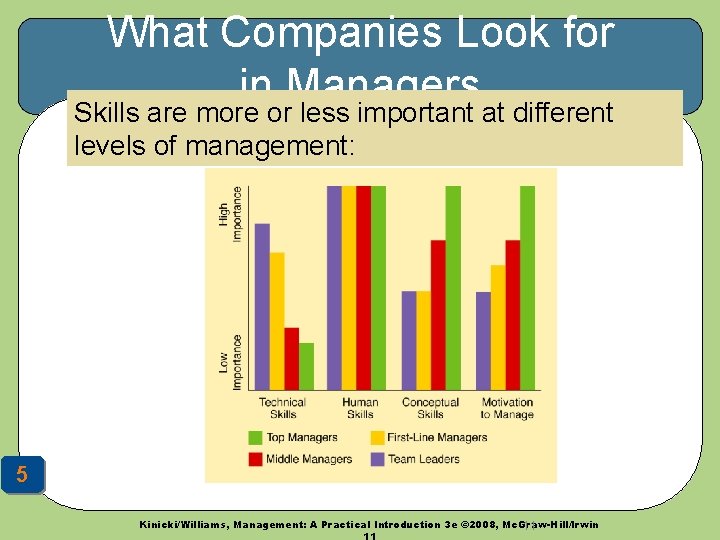
1. 7 The Skills Star Managers Need THE SKILLS STAR MANAGERS NEED Good managers need to have vtechnical skills -the ability to perform a specific job vconceptual skills -the ability to think analytically and vhuman skills -the ability to interact with others Today, companies want managers with v-the ability to motivate and engage others v-the ability to communicate v-work experience outside the U. S. v-the energy to meet the demands of global travel and a 24/7 world Kinicki/Williams, Management: A Practical Introduction 3 e © 2008, Mc. Graw-Hill/Irwin 10
What Companies Look for in Managers Skills are more or less important at different levels of management: 5 Kinicki/Williams, Management: A Practical Introduction 3 e © 2008, Mc. Graw-Hill/Irwin 11 11