
Junior Cycle Reform Information Thursday November 21 ST
Junior Cycle Reform Information Thursday November 21 ST 2019
Overview of Presentation ○ ○ ○ ○ Rationale Changes Junior Cycle Framework Principles/Skills/Statements of Learning Glossary of key terms Subject Specifications for students in 3 rd Year List of subjects to be assessed
Overview of Presentation o o o o Assessment Descriptors for Classroom Based Assessments and State Examinations Classroom Based Assessments SLAR meetings Assessment Tasks Reporting Junior Cycle Profile of Achievement
Rationale ○ ○ ○ ○ Link with Primary schools Settling in and making progress in First year A purposeful second year Student at the centre of the educational experience Active Learning and greater student ownership of learning Enable students to actively participate in their communities and society Students to problem solve and think critically
Changes ○ ○ ○ ○ Traditional Junior Certificate Fact and concept based Knowledge often without understanding Teacher lead Rote learning-student recall Student listening/answering Content based Preparation for examinations
Changes ○ ○ ○ New Junior Cycle More student engagement Student at the centre Student listening and speaking more Independent learning Critical thinking/problem solving/higher order thinking Emphasis on key skills and knowledge More discussion and greater understanding Learning to learn/self regulation of learning Enduring motivation to learn Physical/social and mental wellbeing Collaborating and taking responsibility
Junior Cycle Framework ○ Principles of Junior Cycle Education-the objectives used for planning ○ Statements of Learning -these describe the learning at the core of the Junior Cycle; example; the student communicates effectively using a variety of means in a range of contexts ○ Key Skills-required for successful learning by students across the curriculum and beyond school.
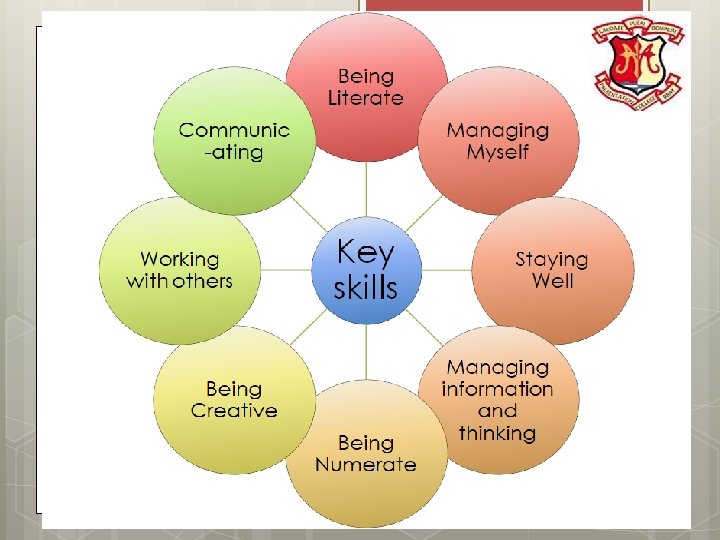
Key Skills
Glossary of key terms o Specifications o Classroom based assessments o SLAR meetings o Assessment tasks o JCPA o Descriptors
Subject specifications for students in current third year ○ English, Art, Craft & Design ○ Business, Gaeilge(Irish) ○ Science, MFL (French & German)
List of subjects to be assessed ○ ○ ○ ○ English Business Science Irish Maths Geography History ○ Art, Craft & Design ○ Woodwork ○ French ○ German ○ CSPE ○ RE
WELLBEING PROGRAMME ○ ○ ○ THREE YEARS OF JUNIOR CYCLE PE, SPHE, CSPE & GUIDANCE LINKED TO SIX WELLBEING INDUCTORS WELLBEING WILL BE REPORTED FOR FIRST TIME IN 2020 REPORTED ON IN JCPA USE OF DESCRIPTORS FOR STUDENT ACHIEVEMENT
Types of Assessment There are 2 categories of assessment documented on the JCPA for each subject in the Junior Cycle: ○ Classroom Based Assessments (CBA) ○ The Final Assessment (including the Assessment Task - AT)
What is a CBA? ○ A broad range of activities including oral, tasks, written, or practical work, e. g. reports, presentations, artistic performances, scientific experiments, projects or other suitable tasks depending on the subject in question. ○ CBAs will be assessed by the students’ teachers and reported on to students and parents/ guardians during junior cycle and in the JCPA. ○ Classroom-Based Assessments in all subjects will be specified at a common level.
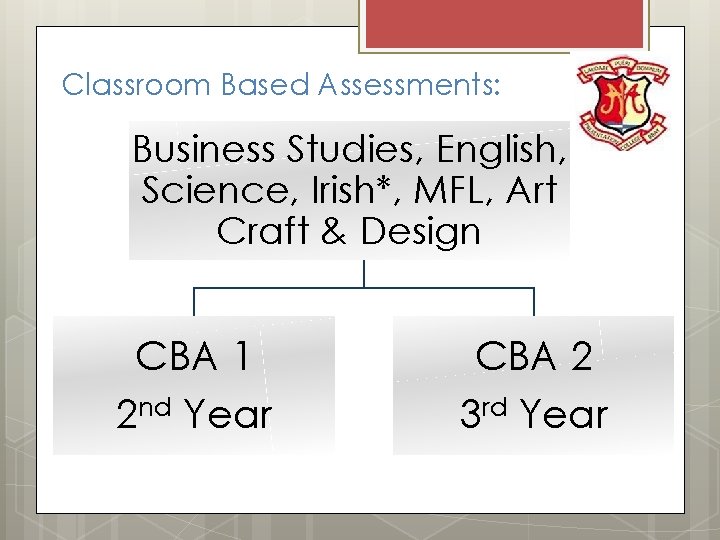
Classroom Based Assessments: Business Studies, English, Science, Irish*, MFL, Art Craft & Design CBA 1 2 nd Year CBA 2 3 rd Year
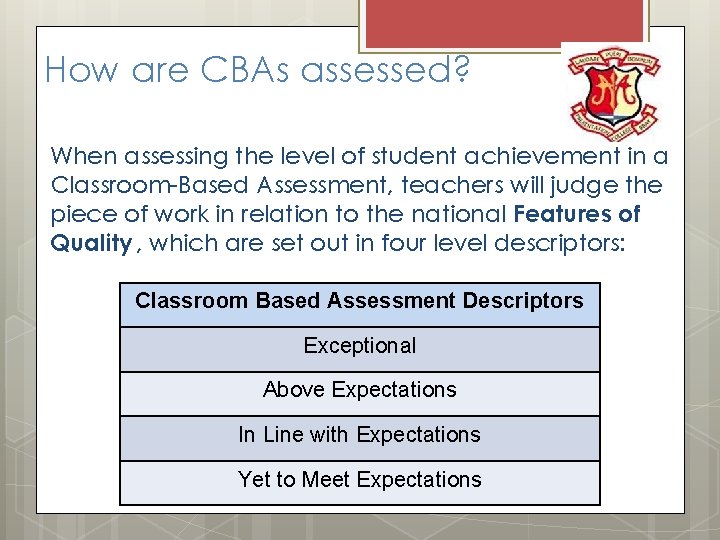
How are CBAs assessed? When assessing the level of student achievement in a Classroom-Based Assessment, teachers will judge the piece of work in relation to the national Features of Quality , which are set out in four level descriptors: Classroom Based Assessment Descriptors Exceptional Above Expectations In Line with Expectations Yet to Meet Expectations
How are CBAs assessed? ○ The teacher evaluates the student’s work according to the standards set out in the Features of Quality and the relevant NCCA annotated examples. ○ The teacher assigns a provisional descriptor to each piece of work. ○ They then choose a sample of each descriptor (where applicable) to bring to the SLAR meeting.
What is a SLAR meeting? A SLAR is a: Subject Learning and Review meeting.
What happens at a SLAR? Start with a sample of “Yet to meet expectations” and work through each descriptor in turn. Discuss the sample. (Features of Quality/NCCA samples) Decide on the final descriptor for that piece.
What happens after the SLAR? ○ Teachers will keep a note of the decisions made during the SLAR meeting. ○ Teachers then reappraise the descriptors they provisionally assigned to each students' work and where necessary make the appropriate adjustments to their provisional assessments. ○ The teacher will submit a final descriptor for the CBA which will be included in the student’s report.
What is the Assessment Task? ○ ○ ○ A written Assessment Task specified by the NCCA. Submitted to the State Examinations Commission (SEC) for marking as part of the state-certified examination for the relevant subject. It will be allocated 10% of the marks used to determine the grade awarded by the SEC. Directly related to the Learning Outcomes in CBA 2. The purpose of the Assessment Task is for students to undertake a focused reflection on their work. It will take place during two class periods (generally one for preparation and one for completion of the booklet issued by the SEC) during a specified week.
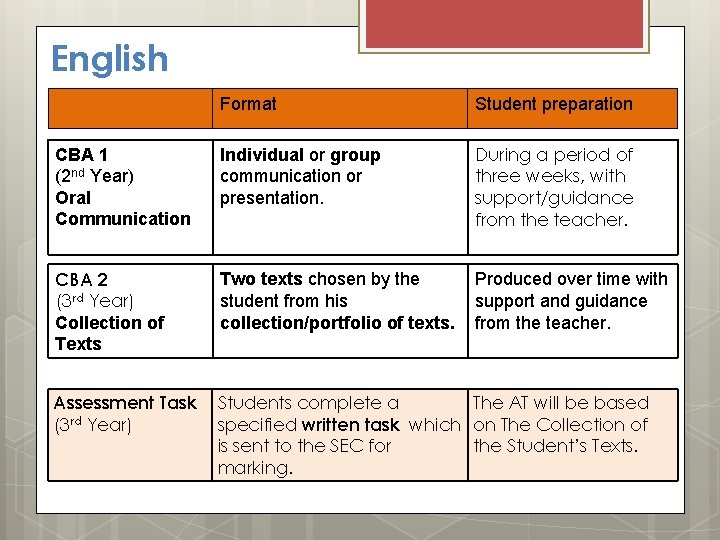
English Format Student preparation CBA 1 (2 nd Year) Oral Communication Individual or group communication or presentation. During a period of three weeks, with support/guidance from the teacher. CBA 2 (3 rd Year) Collection of Texts Two texts chosen by the student from his collection/portfolio of texts. Produced over time with support and guidance from the teacher. Assessment Task (3 rd Year) Students complete a The AT will be based specified written task which on The Collection of is sent to the SEC for the Student’s Texts. marking.
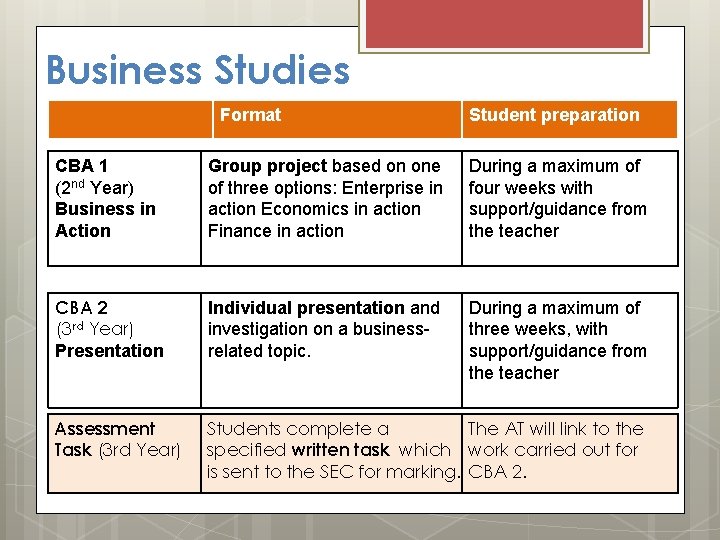
Business Studies Format Student preparation CBA 1 (2 nd Year) Business in Action Group project based on one of three options: Enterprise in action Economics in action Finance in action During a maximum of four weeks with support/guidance from the teacher CBA 2 (3 rd Year) Presentation Individual presentation and investigation on a businessrelated topic. During a maximum of three weeks, with support/guidance from the teacher Assessment Task (3 rd Year) Students complete a The AT will link to the specified written task which work carried out for is sent to the SEC for marking. CBA 2.
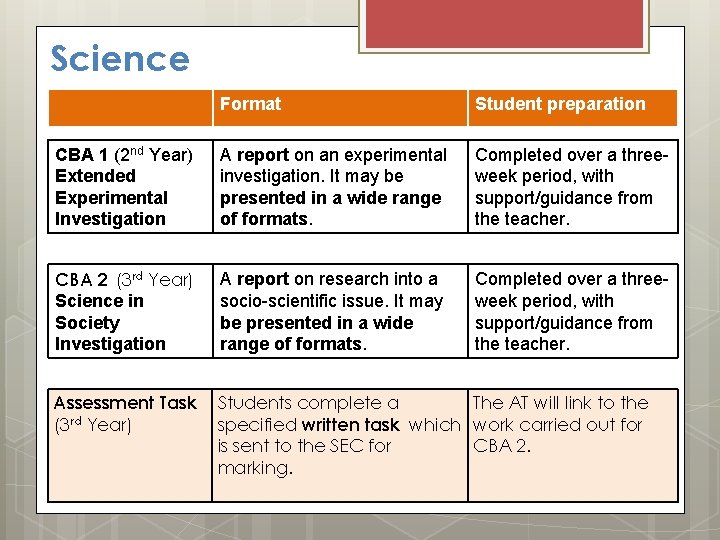
Science Format Student preparation CBA 1 (2 nd Year) Extended Experimental Investigation A report on an experimental investigation. It may be presented in a wide range of formats. Completed over a threeweek period, with support/guidance from the teacher. CBA 2 (3 rd Year) Science in Society Investigation A report on research into a socio-scientific issue. It may be presented in a wide range of formats. Completed over a threeweek period, with support/guidance from the teacher. Assessment Task (3 rd Year) The AT will link to the Students complete a specified written task which work carried out for is sent to the SEC for CBA 2. marking.
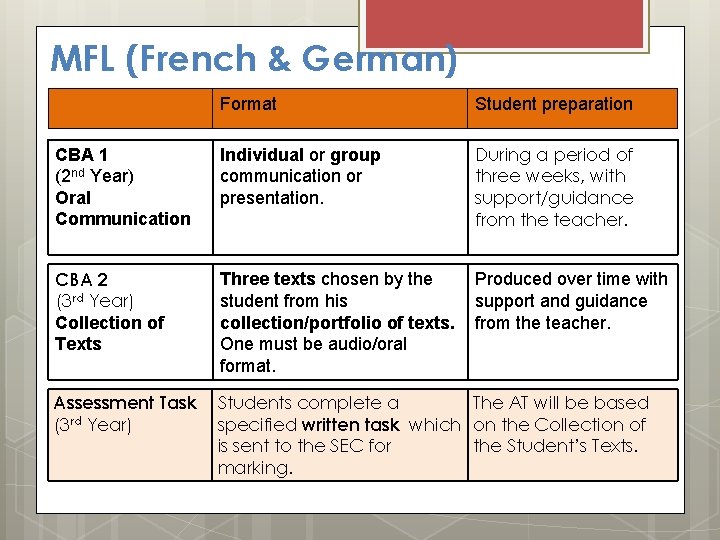
MFL (French & German) Format Student preparation CBA 1 (2 nd Year) Oral Communication Individual or group communication or presentation. During a period of three weeks, with support/guidance from the teacher. CBA 2 (3 rd Year) Collection of Texts Three texts chosen by the student from his collection/portfolio of texts. One must be audio/oral format. Produced over time with support and guidance from the teacher. Assessment Task (3 rd Year) Students complete a The AT will be based specified written task which on the Collection of is sent to the SEC for the Student’s Texts. marking.
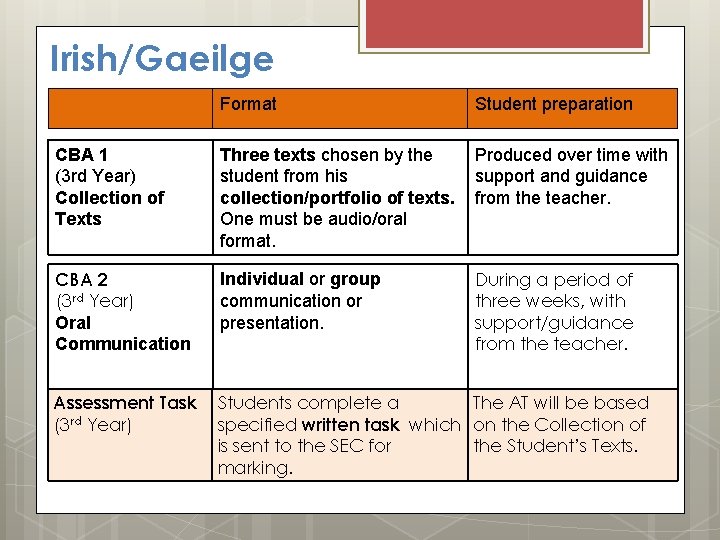
Irish/Gaeilge Format Student preparation CBA 1 (3 rd Year) Collection of Texts Three texts chosen by the student from his collection/portfolio of texts. One must be audio/oral format. Produced over time with support and guidance from the teacher. CBA 2 (3 rd Year) Oral Communication Individual or group communication or presentation. During a period of three weeks, with support/guidance from the teacher. Assessment Task (3 rd Year) Students complete a The AT will be based specified written task which on the Collection of is sent to the SEC for the Student’s Texts. marking.
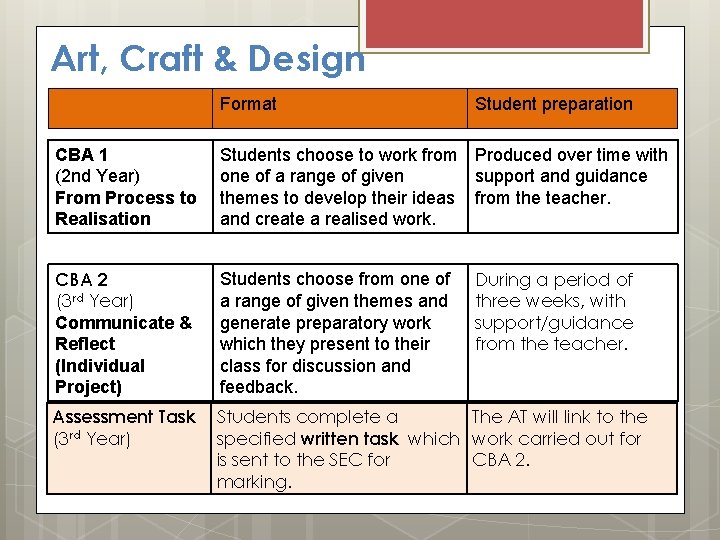
Art, Craft & Design Format Student preparation CBA 1 (2 nd Year) From Process to Realisation Students choose to work from Produced over time with one of a range of given support and guidance themes to develop their ideas from the teacher. and create a realised work. CBA 2 (3 rd Year) Communicate & Reflect (Individual Project) Students choose from one of a range of given themes and generate preparatory work which they present to their class for discussion and feedback. Assessment Task (3 rd Year) Students complete a The AT will link to the specified written task which work carried out for is sent to the SEC for CBA 2. marking. During a period of three weeks, with support/guidance from the teacher.
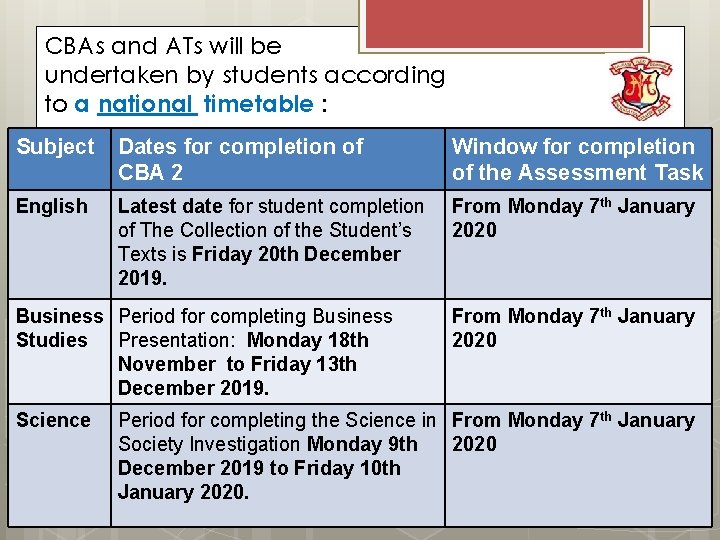
CBAs and ATs will be undertaken by students according to a national timetable : Subject Dates for completion of CBA 2 Window for completion of the Assessment Task English Latest date for student completion of The Collection of the Student’s Texts is Friday 20 th December 2019. From Monday 7 th January 2020 Business Period for completing Business Studies Presentation: Monday 18 th November to Friday 13 th December 2019. Science From Monday 7 th January 2020 Period for completing the Science in From Monday 7 th January Society Investigation Monday 9 th 2020 December 2019 to Friday 10 th January 2020.
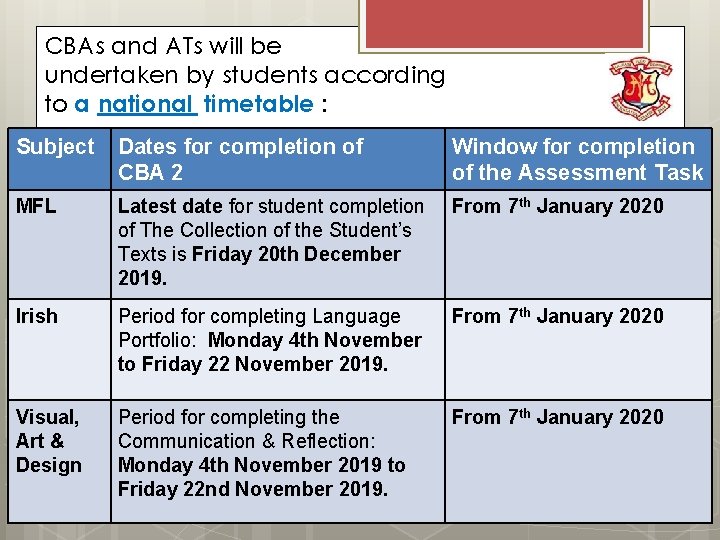
CBAs and ATs will be undertaken by students according to a national timetable : Subject Dates for completion of CBA 2 Window for completion of the Assessment Task MFL Latest date for student completion of The Collection of the Student’s Texts is Friday 20 th December 2019. From 7 th January 2020 Irish Period for completing Language Portfolio: Monday 4 th November to Friday 22 November 2019. From 7 th January 2020 Visual, Art & Design Period for completing the Communication & Reflection: Monday 4 th November 2019 to Friday 22 nd November 2019. From 7 th January 2020
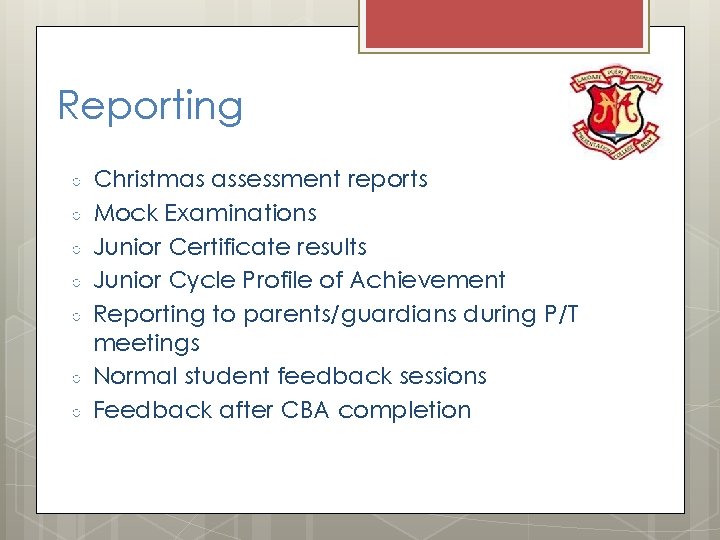
Reporting ○ ○ ○ ○ Christmas assessment reports Mock Examinations Junior Certificate results Junior Cycle Profile of Achievement Reporting to parents/guardians during P/T meetings Normal student feedback sessions Feedback after CBA completion
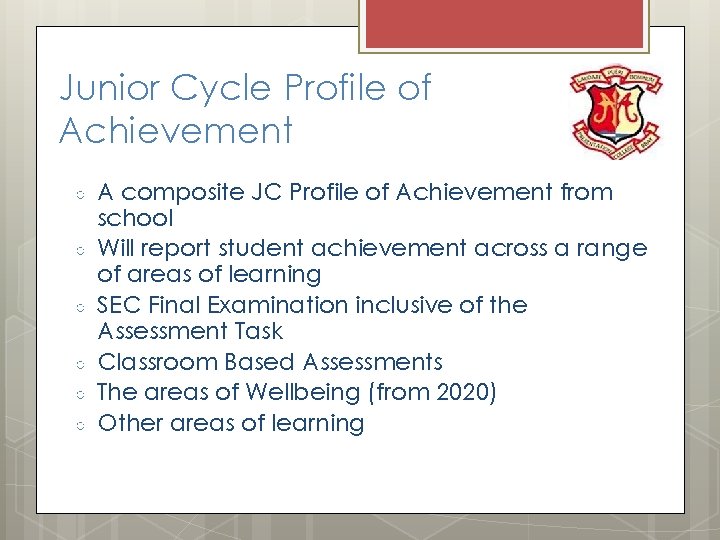
Junior Cycle Profile of Achievement ○ ○ ○ A composite JC Profile of Achievement from school Will report student achievement across a range of areas of learning SEC Final Examination inclusive of the Assessment Task Classroom Based Assessments The areas of Wellbeing (from 2020) Other areas of learning
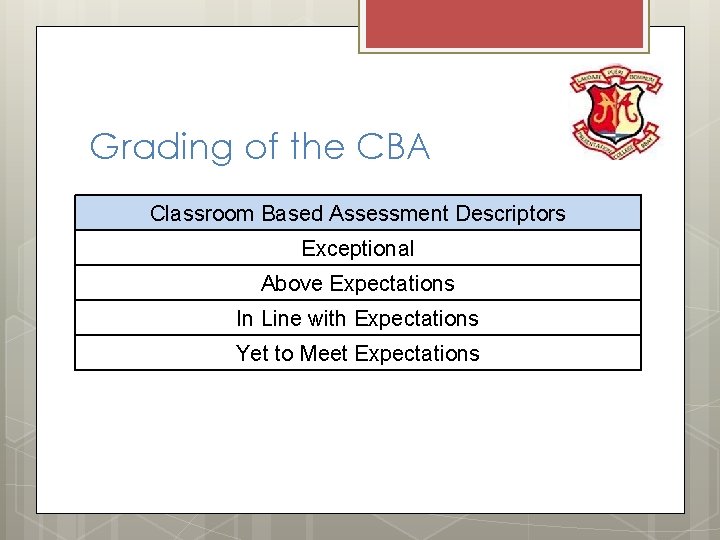
Grading of the CBA Classroom Based Assessment Descriptors Exceptional Above Expectations In Line with Expectations Yet to Meet Expectations
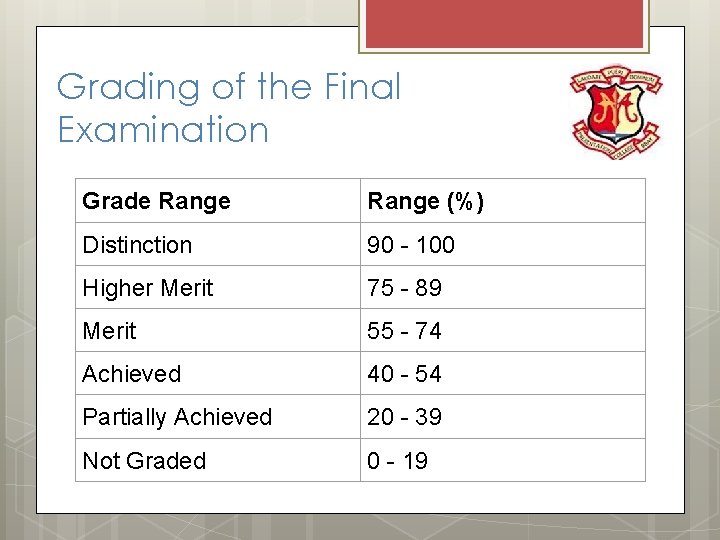
Grading of the Final Examination Grade Range (%) Distinction 90 - 100 Higher Merit 75 - 89 Merit 55 - 74 Achieved 40 - 54 Partially Achieved 20 - 39 Not Graded 0 - 19
- Slides: 33