Chapter 5 Corporate Financial Accounting 14 e Warren
- Slides: 118
Chapter 5 Corporate Financial Accounting 14 e Warren Reeve Duchac Accounting for Merchandising Businesses
Learning Objectives • Obj. 1: Distinguish between the activities and financial statements of service and merchandising businesses. • Obj. 2: Describe and illustrate the accounting for merchandise transactions. • Obj. 3: Describe and illustrate the financial statements of a merchandising business. • Obj. 4: Describe the adjusting and closing process for a merchandising business. • ADM: Describe and illustrate the use of the asset turnover ratio in evaluating a company’s operating performance. © 2017 Cengage Learning®. May not be scanned, copied or duplicated, or posted to a publicly accessible website, in whole or in part.
Nature of Merchandising Businesses • The activities of a service business differ from those of a merchandising business. o These differences are reflected in the operating cycles of a service and merchandising business as well as in their financial statements. © 2017 Cengage Learning®. May not be scanned, copied or duplicated, or posted to a publicly accessible website, in whole or in part.
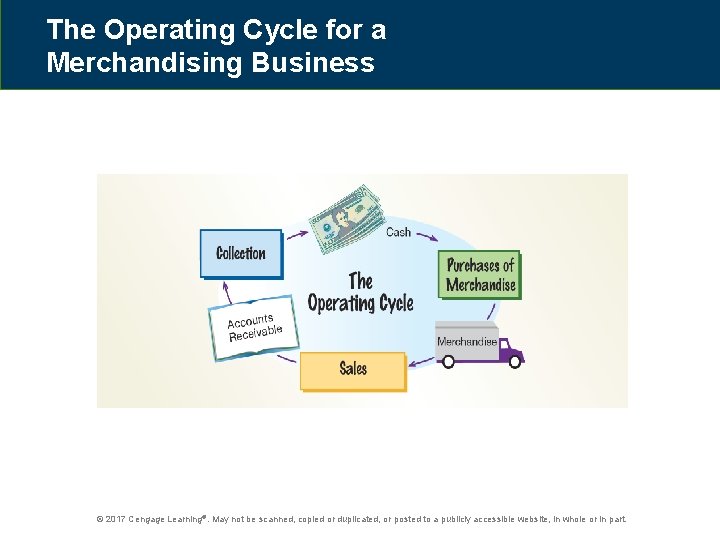
Operating Cycle (slide 1 of 2) • The operating cycle is the process by which a company spends cash, generates revenues, and receives cash either at the time the revenues are generated or later by collecting an accounts receivable. • The operating cycle of a service and merchandising business differs in that a merchandising business must purchase merchandise for sale to customers. © 2017 Cengage Learning®. May not be scanned, copied or duplicated, or posted to a publicly accessible website, in whole or in part.
The Operating Cycle for a Merchandising Business © 2017 Cengage Learning®. May not be scanned, copied or duplicated, or posted to a publicly accessible website, in whole or in part.
Operating Cycle (slide 2 of 2) • The time in days to complete an operating cycle differs significantly among merchandise businesses. o For example, many grocery items, such as milk, have a short operating cycle and must be sold within their expiration dates of a week or two. o In contrast, jewelry stores often carry expensive items that are often displayed months before being sold to customers. © 2017 Cengage Learning®. May not be scanned, copied or duplicated, or posted to a publicly accessible website, in whole or in part.
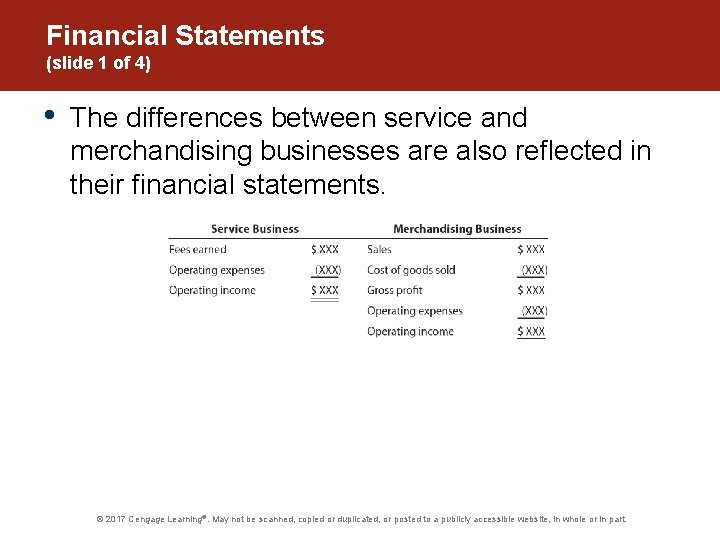
Financial Statements (slide 1 of 4) • The differences between service and merchandising businesses are also reflected in their financial statements. © 2017 Cengage Learning®. May not be scanned, copied or duplicated, or posted to a publicly accessible website, in whole or in part.
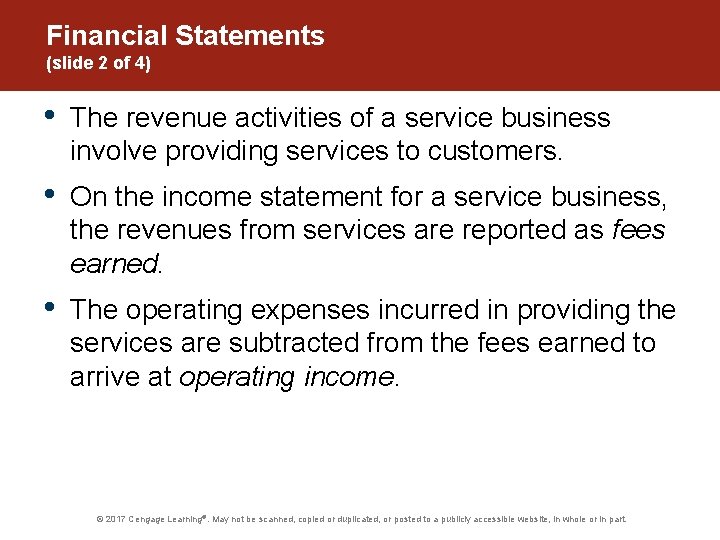
Financial Statements (slide 2 of 4) • The revenue activities of a service business involve providing services to customers. • On the income statement for a service business, the revenues from services are reported as fees earned. • The operating expenses incurred in providing the services are subtracted from the fees earned to arrive at operating income. © 2017 Cengage Learning®. May not be scanned, copied or duplicated, or posted to a publicly accessible website, in whole or in part.
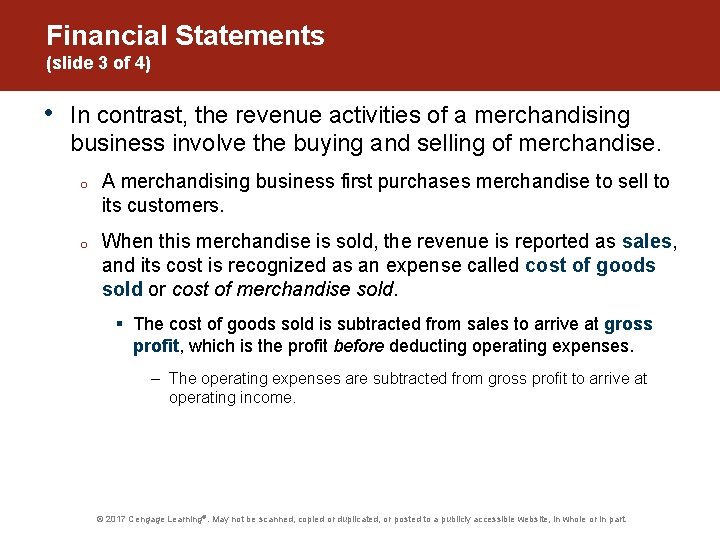
Financial Statements (slide 3 of 4) • In contrast, the revenue activities of a merchandising business involve the buying and selling of merchandise. o A merchandising business first purchases merchandise to sell to its customers. o When this merchandise is sold, the revenue is reported as sales, and its cost is recognized as an expense called cost of goods sold or cost of merchandise sold. § The cost of goods sold is subtracted from sales to arrive at gross profit, which is the profit before deducting operating expenses. – The operating expenses are subtracted from gross profit to arrive at operating income. © 2017 Cengage Learning®. May not be scanned, copied or duplicated, or posted to a publicly accessible website, in whole or in part.
Financial Statements (slide 4 of 4) • Merchandise on hand (not sold) at the end of an accounting period is called inventory or merchandise inventory. o Inventory is reported as a current asset on the balance sheet. © 2017 Cengage Learning®. May not be scanned, copied or duplicated, or posted to a publicly accessible website, in whole or in part.
Merchandising Transactions (slide 1 of 3) • Merchandise transactions are recorded in the accounts, using the rules of debit and credit; however, the accounting system for merchandising businesses is often modified to more efficiently record transactions. o A large number of individual accounts with a common characteristic can be grouped together in a separate ledger, called a subsidiary ledger. o The primary ledger, which contains all of the balance sheet and income statement accounts, is then called the general ledger. o Each subsidiary ledger is represented in the general ledger by a summarizing account, called a controlling account. © 2017 Cengage Learning®. May not be scanned, copied or duplicated, or posted to a publicly accessible website, in whole or in part.
Merchandising Transactions (slide 2 of 3) • Common subsidiary ledgers are the: o Accounts receivable subsidiary ledger § The accounts receivable subsidiary ledger, or customers ledger, lists the individual customer accounts in alphabetical order. § The controlling account in the general ledger is Accounts Receivable. o Accounts payable subsidiary ledger § The accounts payable subsidiary ledger, or creditors ledger, lists individual creditor accounts in alphabetical order. § The controlling account in the general ledger is Accounts Payable. o Inventory subsidiary ledger § The inventory subsidiary ledger, or inventory ledger, lists individual inventory by item (bar code) number. § The controlling account in the general ledger is Inventory. © 2017 Cengage Learning®. May not be scanned, copied or duplicated, or posted to a publicly accessible website, in whole or in part.
Merchandising Transactions (slide 3 of 3) • Most merchandising companies use computerized accounting systems that record similar transactions in separate journals called special journals. These journals generate purchase, sales, and inventory reports. © 2017 Cengage Learning®. May not be scanned, copied or duplicated, or posted to a publicly accessible website, in whole or in part.
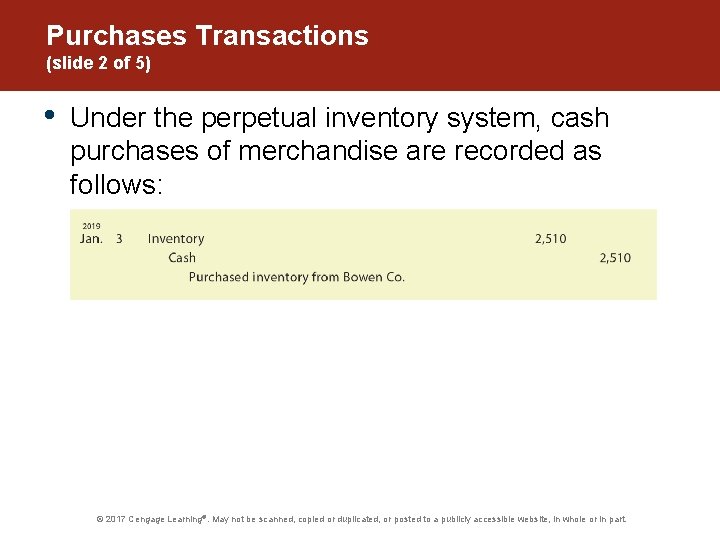
Purchases Transactions (slide 1 of 5) • There are two systems for accounting for merchandise transactions: perpetual and periodic. o In a perpetual inventory system, each purchase and sale of merchandise is recorded in the inventory account and related subsidiary ledger. § In this way, the amount of merchandise available for sale and the amount sold are continuously (perpetually) updated in the inventory records. o In a periodic inventory system, the inventory does not show the amount of merchandise available for sale and the amount sold. § Instead, a listing of inventory on hand, called a physical inventory, is prepared at the end of the accounting period. – This physical inventory is used to determine the cost of inventory on hand at the end of the period and calculate the cost of goods sold during the period. © 2017 Cengage Learning®. May not be scanned, copied or duplicated, or posted to a publicly accessible website, in whole or in part.
Purchases Transactions (slide 2 of 5) • Under the perpetual inventory system, cash purchases of merchandise are recorded as follows: © 2017 Cengage Learning®. May not be scanned, copied or duplicated, or posted to a publicly accessible website, in whole or in part.
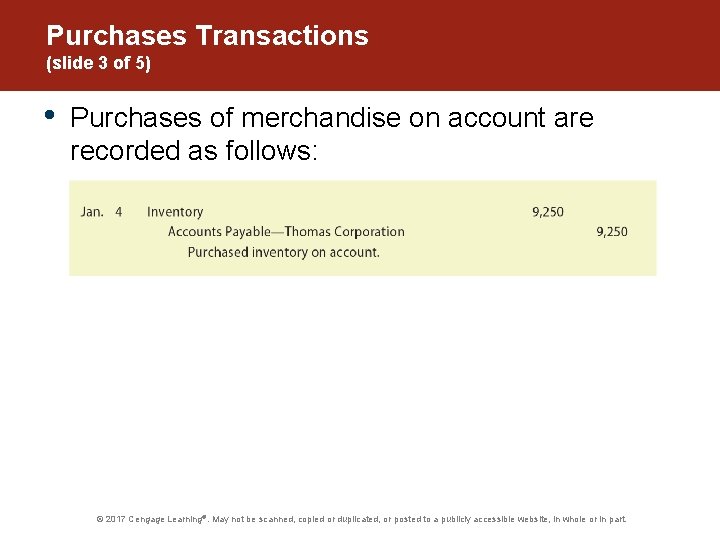
Purchases Transactions (slide 3 of 5) • Purchases of merchandise on account are recorded as follows: © 2017 Cengage Learning®. May not be scanned, copied or duplicated, or posted to a publicly accessible website, in whole or in part.
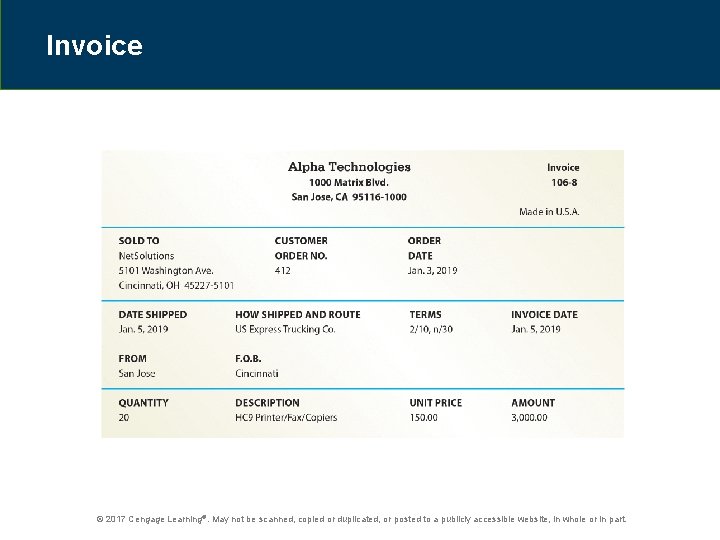
Purchases Transactions (slide 4 of 5) • The terms of purchases on account are normally indicated on the invoice or bill that the seller sends the buyer. © 2017 Cengage Learning®. May not be scanned, copied or duplicated, or posted to a publicly accessible website, in whole or in part.
Invoice © 2017 Cengage Learning®. May not be scanned, copied or duplicated, or posted to a publicly accessible website, in whole or in part.
Purchases Transactions (slide 5 of 5) • The terms for when payments for merchandise are to be made are called the credit terms. o If payment is required on delivery, the terms are cash or net cash. o Otherwise, the buyer is allowed an amount of time, known as the credit period, in which to pay. § The credit period usually begins with the date of the sale as shown on the invoice. © 2017 Cengage Learning®. May not be scanned, copied or duplicated, or posted to a publicly accessible website, in whole or in part.
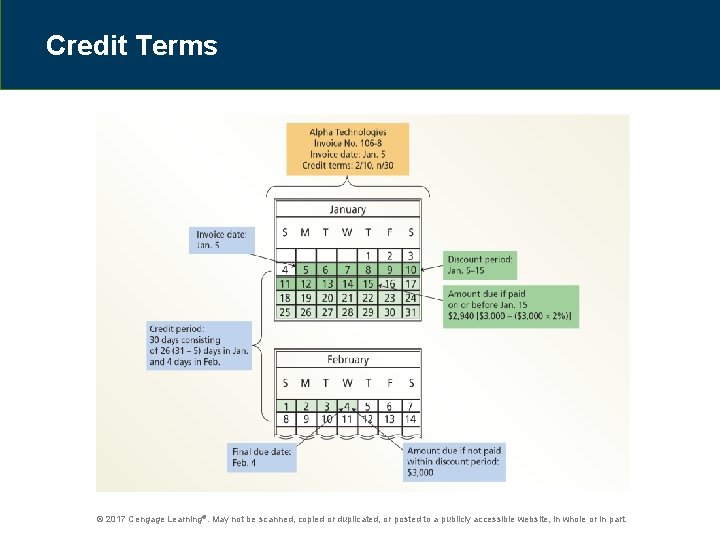
Purchases Discounts (slide 1 of 6) • To encourage the buyer to pay before the end of the credit period, the seller may offer a discount. o For example, a seller may offer a 2% discount if the buyer pays within 10 days of the invoice date. If the buyer does not take the discount, the total invoice amount is due within 30 days. § The terms are expressed as 2/10, n/30 and are read as “ 2% discount if paid within 10 days, net amount due within 30 days. ” © 2017 Cengage Learning®. May not be scanned, copied or duplicated, or posted to a publicly accessible website, in whole or in part.
Credit Terms © 2017 Cengage Learning®. May not be scanned, copied or duplicated, or posted to a publicly accessible website, in whole or in part.
Purchases Discounts (slide 2 of 6) • Discounts taken by the buyer for early payment of an invoice are called purchases discounts. o Purchases discounts taken by a buyer reduce the cost of the merchandise purchased. © 2017 Cengage Learning®. May not be scanned, copied or duplicated, or posted to a publicly accessible website, in whole or in part.
Purchases Discounts (slide 3 of 6) • Assume that Net. Solutions places an order from Alpha Technologies on January 5 with terms of 2/10, n/30. In order to pay the invoice on January 15 (the last day of the discount period), Net. Solutions borrows $2, 940, which is $3, 000 less the discount of $60 ($3, 000 × 2%). If an annual interest rate of 6% and a 360 -day year is assumed, the interest on the loan of $2, 940 for the remaining 20 days of the credit period is $9. 80 ($2, 940 × 6% × 20 ÷ 360). © 2017 Cengage Learning®. May not be scanned, copied or duplicated, or posted to a publicly accessible website, in whole or in part.
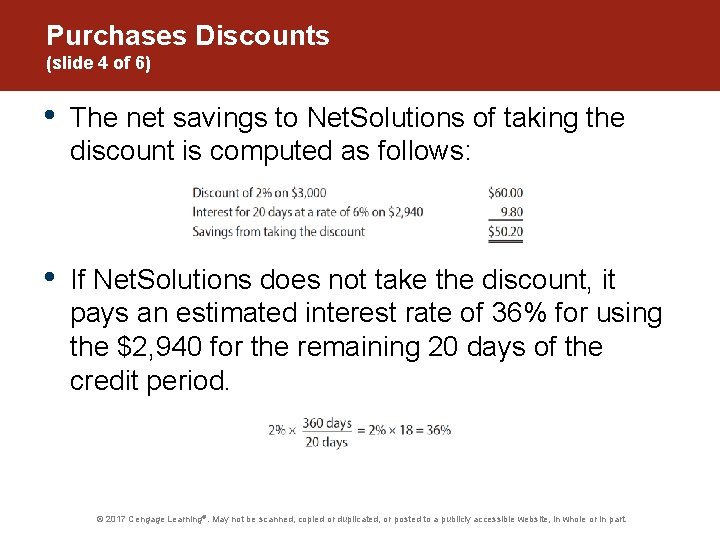
Purchases Discounts (slide 4 of 6) • The net savings to Net. Solutions of taking the discount is computed as follows: • If Net. Solutions does not take the discount, it pays an estimated interest rate of 36% for using the $2, 940 for the remaining 20 days of the credit period. © 2017 Cengage Learning®. May not be scanned, copied or duplicated, or posted to a publicly accessible website, in whole or in part.
Purchases Discounts (slide 5 of 6) • Since buyers normally take all purchases discounts, Inventory is debited for the net purchase price under the perpetual inventory system. o That is, the buyer debits Inventory for the amount of the invoice less the discount. © 2017 Cengage Learning®. May not be scanned, copied or duplicated, or posted to a publicly accessible website, in whole or in part.
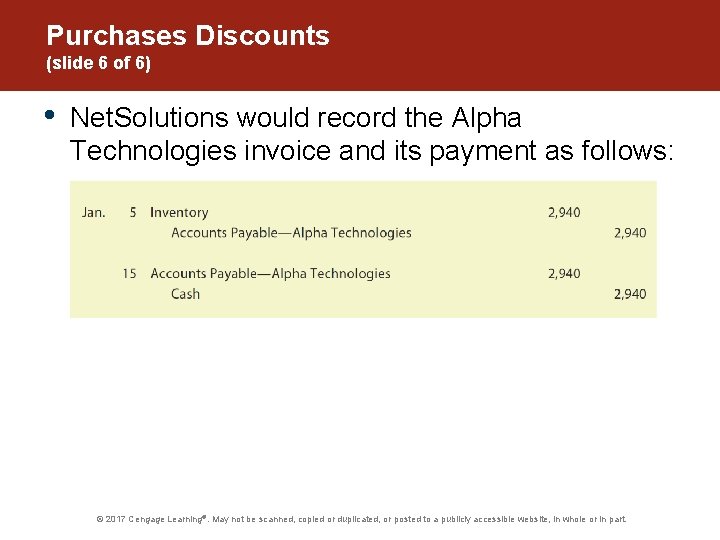
Purchases Discounts (slide 6 of 6) • Net. Solutions would record the Alpha Technologies invoice and its payment as follows: © 2017 Cengage Learning®. May not be scanned, copied or duplicated, or posted to a publicly accessible website, in whole or in part.
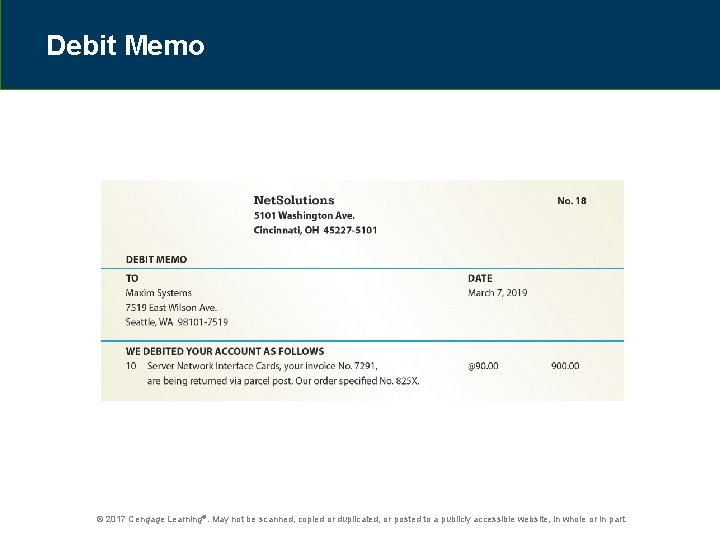
Purchases Returns and Allowances (slide 1 of 5) • A buyer may request an allowance for merchandise that is returned (purchases return) or a price allowance (purchases allowance) for damaged or defective merchandise. From a buyer’s perspective, such returns and allowances are called purchases returns and allowances. o In both cases, the buyer normally sends the seller a debit memorandum, often called a debit memo, to notify the seller of reasons for the return (purchase return) or to request a price reduction (purchase allowance). § A debit memo also informs the seller of the amount the buyer proposes to debit to the account payable due the seller and states the reasons for the return or the request for the price allowance. © 2017 Cengage Learning®. May not be scanned, copied or duplicated, or posted to a publicly accessible website, in whole or in part.
Debit Memo © 2017 Cengage Learning®. May not be scanned, copied or duplicated, or posted to a publicly accessible website, in whole or in part.
Purchases Returns and Allowances (slide 2 of 5) • The buyer may use the debit memo as the basis for recording the return or allowance or wait for approval from the seller (creditor). o In either case, the buyer debits Accounts Payable and credits Inventory. © 2017 Cengage Learning®. May not be scanned, copied or duplicated, or posted to a publicly accessible website, in whole or in part.
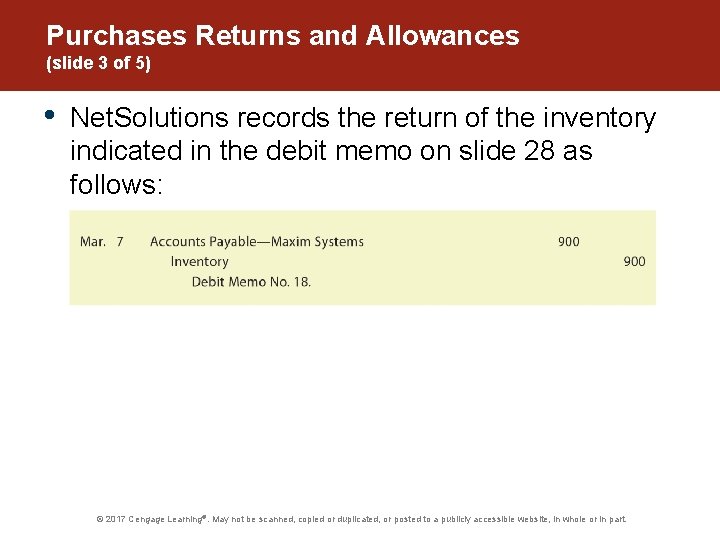
Purchases Returns and Allowances (slide 3 of 5) • Net. Solutions records the return of the inventory indicated in the debit memo on slide 28 as follows: © 2017 Cengage Learning®. May not be scanned, copied or duplicated, or posted to a publicly accessible website, in whole or in part.
Purchases Returns and Allowances (slide 4 of 5) • Before paying an invoice, a buyer may return inventory or be granted a price allowance for an invoice with a purchase discount. o In this case, the amount of the return is recorded at its invoice amount less the discount. © 2017 Cengage Learning®. May not be scanned, copied or duplicated, or posted to a publicly accessible website, in whole or in part.
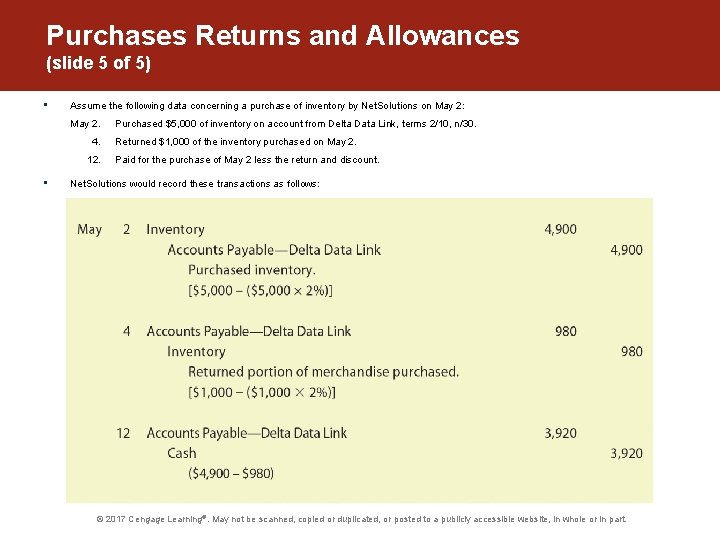
Purchases Returns and Allowances (slide 5 of 5) • Assume the following data concerning a purchase of inventory by Net. Solutions on May 2: May 2. 4. 12. • Purchased $5, 000 of inventory on account from Delta Data Link, terms 2/10, n/30. Returned $1, 000 of the inventory purchased on May 2. Paid for the purchase of May 2 less the return and discount. Net. Solutions would record these transactions as follows: © 2017 Cengage Learning®. May not be scanned, copied or duplicated, or posted to a publicly accessible website, in whole or in part.
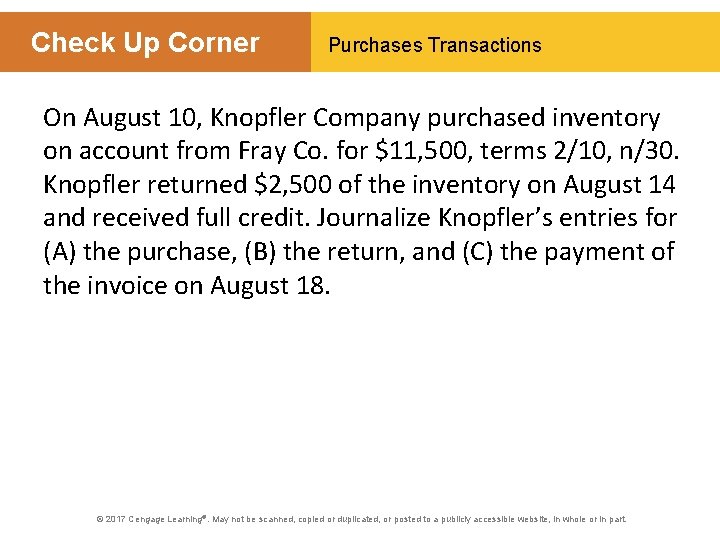
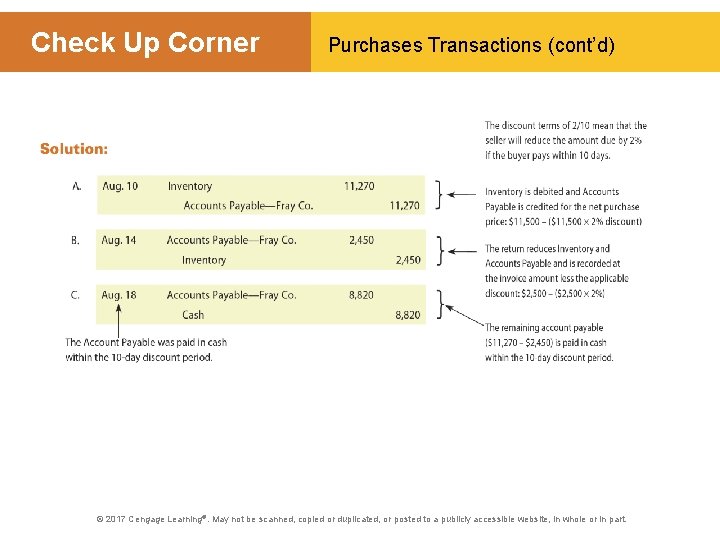
Check Up Corner Purchases Transactions On August 10, Knopfler Company purchased inventory on account from Fray Co. for $11, 500, terms 2/10, n/30. Knopfler returned $2, 500 of the inventory on August 14 and received full credit. Journalize Knopfler’s entries for (A) the purchase, (B) the return, and (C) the payment of the invoice on August 18. © 2017 Cengage Learning®. May not be scanned, copied or duplicated, or posted to a publicly accessible website, in whole or in part.
Check Up Corner Purchases Transactions (cont’d) © 2017 Cengage Learning®. May not be scanned, copied or duplicated, or posted to a publicly accessible website, in whole or in part.
Sales Transactions • Revenue from merchandise sales is usually recorded as Sales. o Sometimes a business may use the title Sales of Merchandise. © 2017 Cengage Learning®. May not be scanned, copied or duplicated, or posted to a publicly accessible website, in whole or in part.
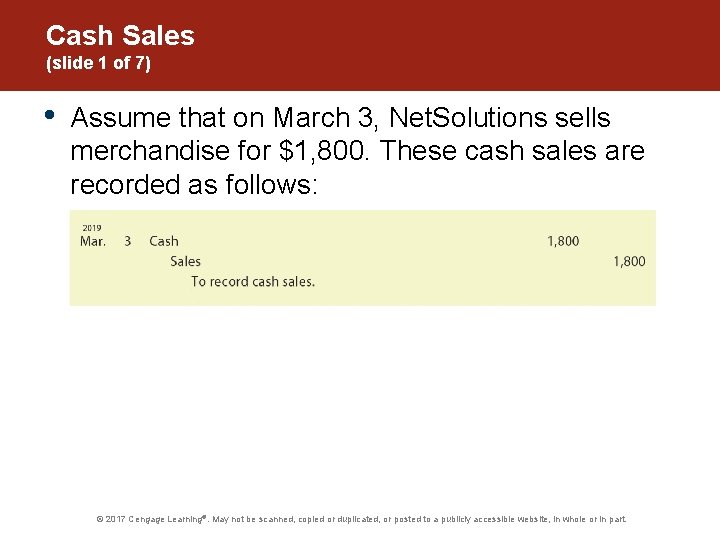
Cash Sales (slide 1 of 7) • Assume that on March 3, Net. Solutions sells merchandise for $1, 800. These cash sales are recorded as follows: © 2017 Cengage Learning®. May not be scanned, copied or duplicated, or posted to a publicly accessible website, in whole or in part.
Cash Sales (slide 2 of 7) • Using the perpetual inventory system, the cost of goods sold and the decrease in inventory are also recorded. o In this way, the inventory account indicates the amount of inventory on hand (not sold). © 2017 Cengage Learning®. May not be scanned, copied or duplicated, or posted to a publicly accessible website, in whole or in part.
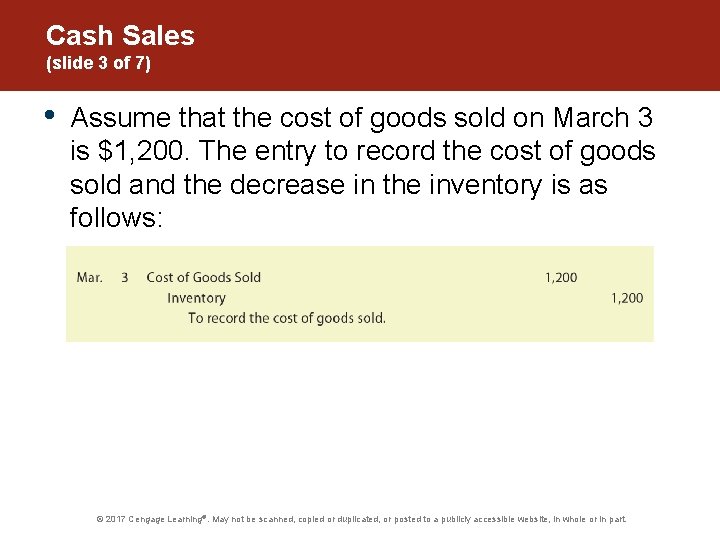
Cash Sales (slide 3 of 7) • Assume that the cost of goods sold on March 3 is $1, 200. The entry to record the cost of goods sold and the decrease in the inventory is as follows: © 2017 Cengage Learning®. May not be scanned, copied or duplicated, or posted to a publicly accessible website, in whole or in part.
Cash Sales (slide 4 of 7) • Sales may be made to customers using credit cards such as Master. Card or VISA. o Such sales are recorded as cash sales. § This is because these sales are normally processed by a clearinghouse that contacts the bank that issued the card. The issuing bank then electronically transfers cash directly to the retailer’s bank account. Thus, the retailer normally receives cash within a few days of making the credit card sale. © 2017 Cengage Learning®. May not be scanned, copied or duplicated, or posted to a publicly accessible website, in whole or in part.
Cash Sales (slide 5 of 7) • If customers use Master. Cards to pay for their purchases, the sales would be recorded as shown in the March 3 entry on slide 36. © 2017 Cengage Learning®. May not be scanned, copied or duplicated, or posted to a publicly accessible website, in whole or in part.
Cash Sales (slide 6 of 7) • Any processing fees charged by the clearinghouse or issuing bank are periodically recorded as an expense. o This expense is normally reported on the income statement as an administrative expense. © 2017 Cengage Learning®. May not be scanned, copied or duplicated, or posted to a publicly accessible website, in whole or in part.
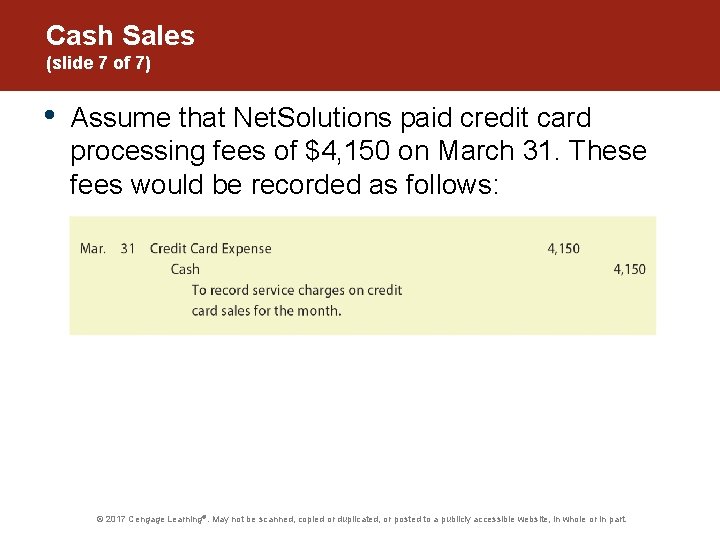
Cash Sales (slide 7 of 7) • Assume that Net. Solutions paid credit card processing fees of $4, 150 on March 31. These fees would be recorded as follows: © 2017 Cengage Learning®. May not be scanned, copied or duplicated, or posted to a publicly accessible website, in whole or in part.
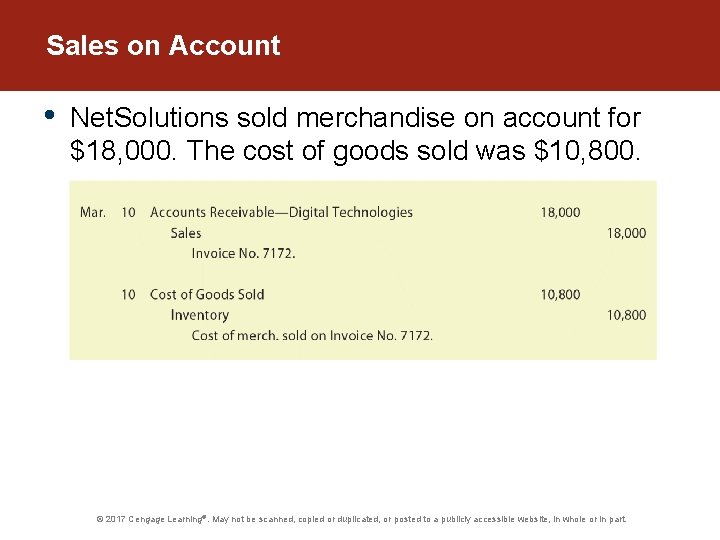
Sales on Account • Net. Solutions sold merchandise on account for $18, 000. The cost of goods sold was $10, 800. © 2017 Cengage Learning®. May not be scanned, copied or duplicated, or posted to a publicly accessible website, in whole or in part.
Customer Discounts (slide 1 of 3) • A seller may grant customers a variety of discounts, called customer discounts, as incentives to encourage customers to act in a way benefiting the seller. o For example, a seller may offer customer discounts to encourage customers to purchase in volume or order early. © 2017 Cengage Learning®. May not be scanned, copied or duplicated, or posted to a publicly accessible website, in whole or in part.
Customer Discounts (slide 2 of 3) • A sales discount encourages customers to pay their invoice early. o For example, a seller may offer credit terms of 2/10, n/30, which provides a 2% sales discount if the invoice is paid within 10 days. © 2017 Cengage Learning®. May not be scanned, copied or duplicated, or posted to a publicly accessible website, in whole or in part.
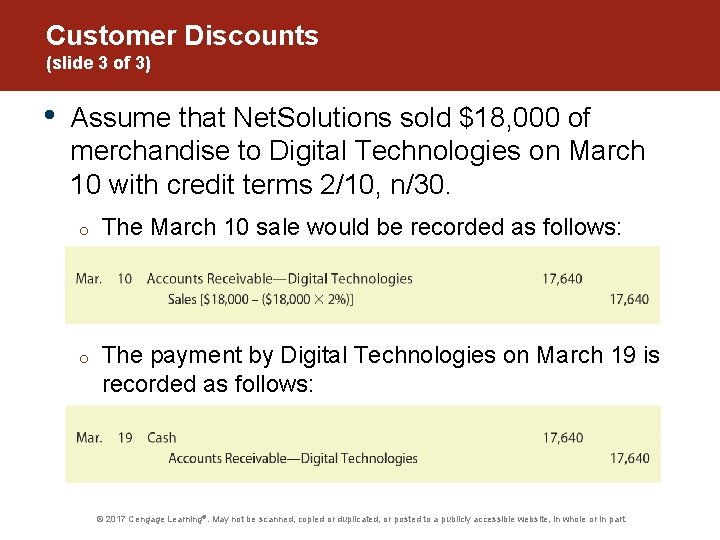
Customer Discounts (slide 3 of 3) • Assume that Net. Solutions sold $18, 000 of merchandise to Digital Technologies on March 10 with credit terms 2/10, n/30. o The March 10 sale would be recorded as follows: o The payment by Digital Technologies on March 19 is recorded as follows: © 2017 Cengage Learning®. May not be scanned, copied or duplicated, or posted to a publicly accessible website, in whole or in part.
Cash Refunds and Allowances (slide 1 of 6) • When a buyer receives merchandise that is defective, damaged during shipment, or does not meet the buyer’s expectations, the seller may pay the buyer a cash refund or grant a customer allowance that reduces the accounts receivable owed on the original selling price. © 2017 Cengage Learning®. May not be scanned, copied or duplicated, or posted to a publicly accessible website, in whole or in part.
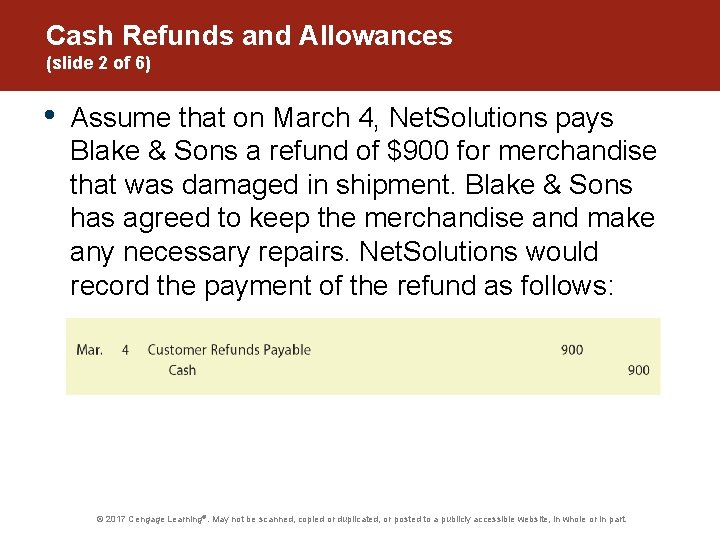
Cash Refunds and Allowances (slide 2 of 6) • Assume that on March 4, Net. Solutions pays Blake & Sons a refund of $900 for merchandise that was damaged in shipment. Blake & Sons has agreed to keep the merchandise and make any necessary repairs. Net. Solutions would record the payment of the refund as follows: © 2017 Cengage Learning®. May not be scanned, copied or duplicated, or posted to a publicly accessible website, in whole or in part.
Cash Refunds and Allowances (slide 3 of 6) • Customer refunds payable is a liability account for estimated refunds and allowances that will be paid or granted customers in the future. o It is recorded at the end of the accounting period as part of the adjusting process. © 2017 Cengage Learning®. May not be scanned, copied or duplicated, or posted to a publicly accessible website, in whole or in part.
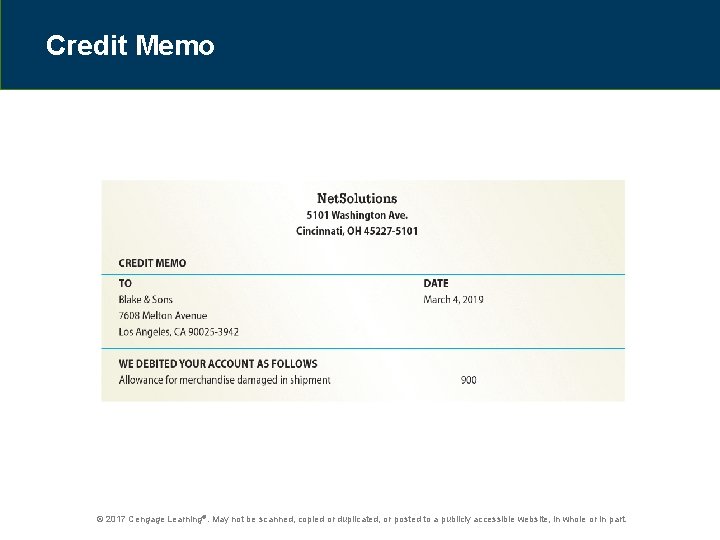
Cash Refunds and Allowances (slide 4 of 6) • In some cases, a customer who is due a refund has an outstanding account receivable balance. o Instead of paying a cash refund, the seller may grant the customer an allowance against the customer’s account receivable. § When this is done, the seller normally sends the buyer a credit memorandum, or credit memo, indicating its intent to credit the customer’s account receivable. © 2017 Cengage Learning®. May not be scanned, copied or duplicated, or posted to a publicly accessible website, in whole or in part.
Cash Refunds and Allowances (slide 5 of 6) • Assume that instead of paying a cash refund to Blake & Sons, Net. Solutions granted Blake & Sons a customer allowance of $900. Net. Solutions notifies Blake & Sons of the allowance by issuing the credit memo shown on the next slide. © 2017 Cengage Learning®. May not be scanned, copied or duplicated, or posted to a publicly accessible website, in whole or in part.
Credit Memo © 2017 Cengage Learning®. May not be scanned, copied or duplicated, or posted to a publicly accessible website, in whole or in part.
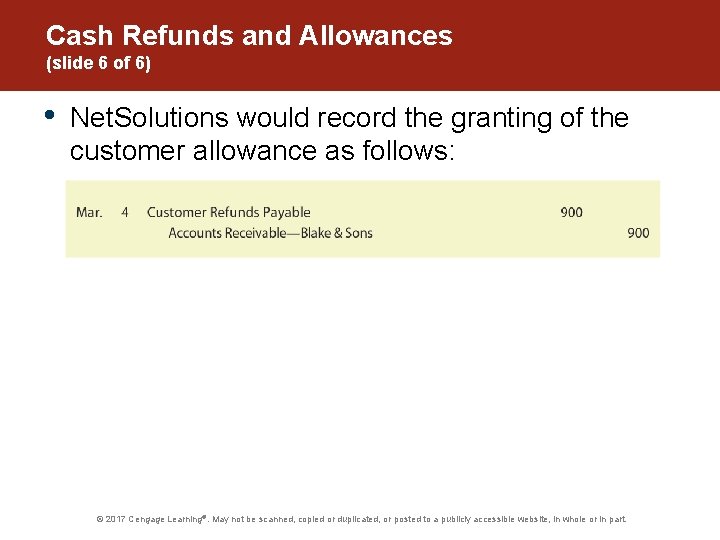
Cash Refunds and Allowances (slide 6 of 6) • Net. Solutions would record the granting of the customer allowance as follows: © 2017 Cengage Learning®. May not be scanned, copied or duplicated, or posted to a publicly accessible website, in whole or in part.
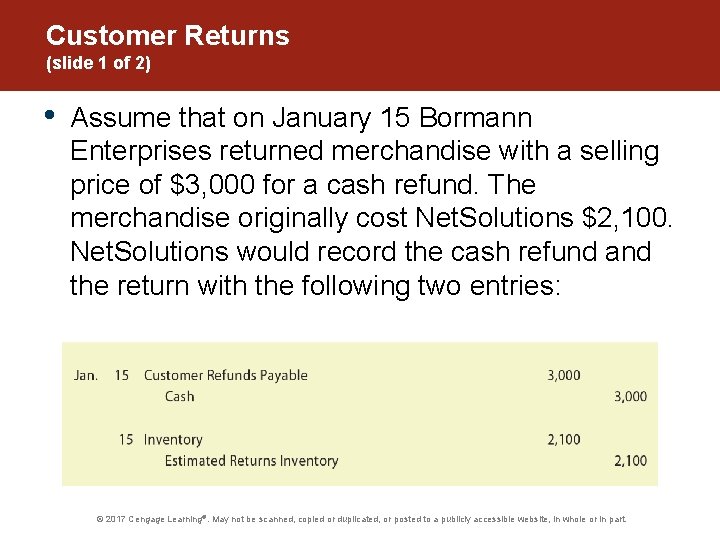
Customer Returns (slide 1 of 2) • Assume that on January 15 Bormann Enterprises returned merchandise with a selling price of $3, 000 for a cash refund. The merchandise originally cost Net. Solutions $2, 100. Net. Solutions would record the cash refund and the return with the following two entries: © 2017 Cengage Learning®. May not be scanned, copied or duplicated, or posted to a publicly accessible website, in whole or in part.
Customer Returns (slide 2 of 2) • Estimated returns inventory is a current asset that is reported on the balance sheet after Inventory. o It represents an estimate of merchandise that will be returned by customers. o It is recorded at the end of the accounting period as part of the adjusting process. © 2017 Cengage Learning®. May not be scanned, copied or duplicated, or posted to a publicly accessible website, in whole or in part.
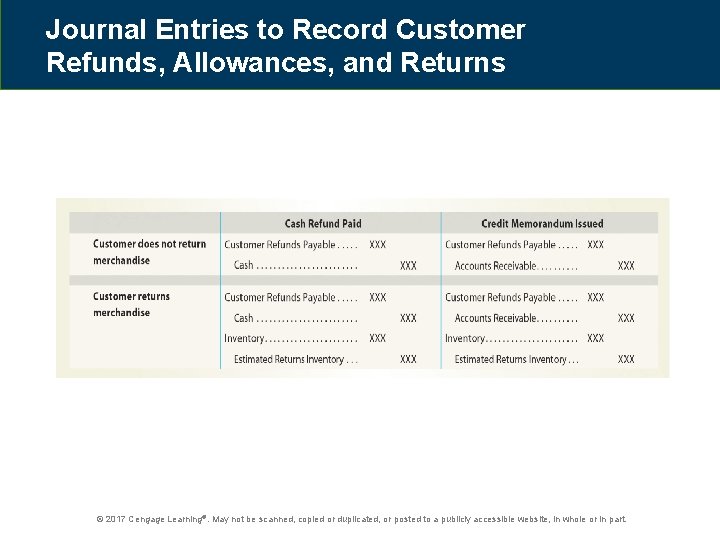
Journal Entries to Record Customer Refunds, Allowances, and Returns © 2017 Cengage Learning®. May not be scanned, copied or duplicated, or posted to a publicly accessible website, in whole or in part.
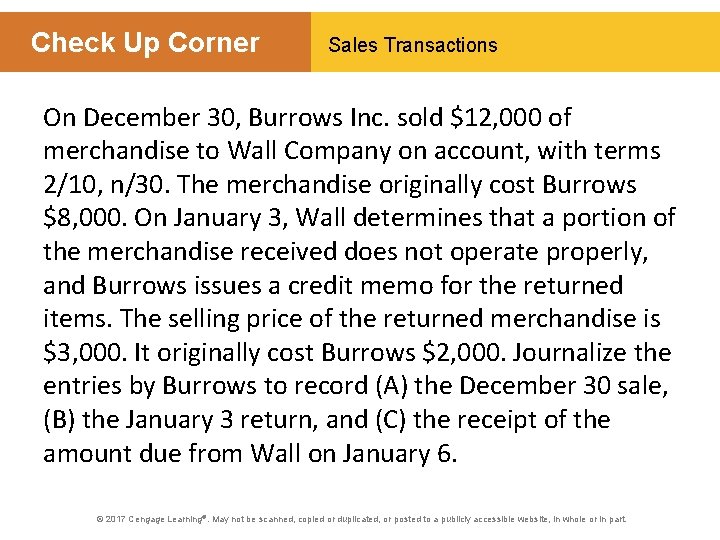
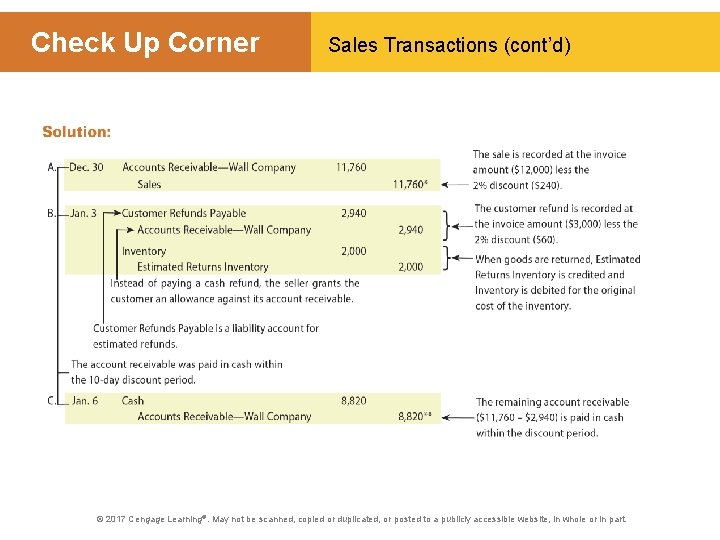
Check Up Corner Sales Transactions On December 30, Burrows Inc. sold $12, 000 of merchandise to Wall Company on account, with terms 2/10, n/30. The merchandise originally cost Burrows $8, 000. On January 3, Wall determines that a portion of the merchandise received does not operate properly, and Burrows issues a credit memo for the returned items. The selling price of the returned merchandise is $3, 000. It originally cost Burrows $2, 000. Journalize the entries by Burrows to record (A) the December 30 sale, (B) the January 3 return, and (C) the receipt of the amount due from Wall on January 6. © 2017 Cengage Learning®. May not be scanned, copied or duplicated, or posted to a publicly accessible website, in whole or in part.
Check Up Corner Sales Transactions (cont’d) © 2017 Cengage Learning®. May not be scanned, copied or duplicated, or posted to a publicly accessible website, in whole or in part.
Freight (slide 1 of 7) • Purchases and sales of merchandise often involve freight. • The terms of a sale indicate when ownership (title and control) of the merchandise passes from the seller to the buyer. o This point determines whether the buyer or the seller pays the freight costs. © 2017 Cengage Learning®. May not be scanned, copied or duplicated, or posted to a publicly accessible website, in whole or in part.
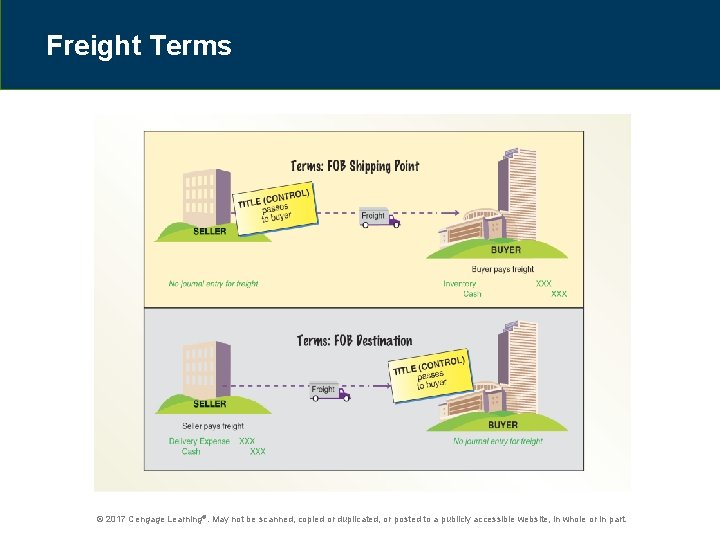
Freight (slide 2 of 7) • The ownership of the merchandise may pass to the buyer when the seller delivers the merchandise to the freight carrier. o In this case, the terms are said to be FOB (free on board) shipping point. § This term means that the buyer pays the freight costs from the shipping point to the final destination. – Such costs are part of the buyer’s total cost of purchasing inventory and are added to the cost of the inventory by debiting Inventory. © 2017 Cengage Learning®. May not be scanned, copied or duplicated, or posted to a publicly accessible website, in whole or in part.
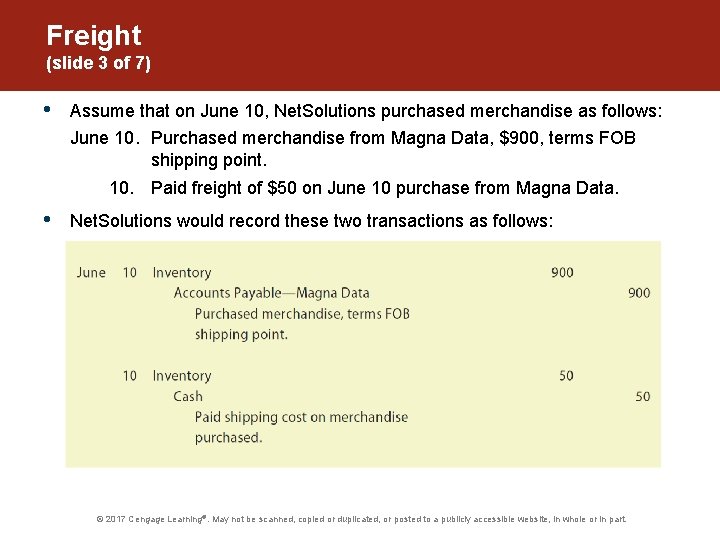
Freight (slide 3 of 7) • Assume that on June 10, Net. Solutions purchased merchandise as follows: June 10. Purchased merchandise from Magna Data, $900, terms FOB shipping point. 10. Paid freight of $50 on June 10 purchase from Magna Data. • Net. Solutions would record these two transactions as follows: © 2017 Cengage Learning®. May not be scanned, copied or duplicated, or posted to a publicly accessible website, in whole or in part.
Freight (slide 4 of 7) • The ownership of the merchandise may pass to the buyer when the buyer receives the merchandise. o In this case, the terms are said to be FOB (free on board) destination. § This term means that the seller pays the freight costs from the shipping point to the buyer’s final destination. – When the seller pays the delivery charges, the seller debits Delivery Expense or Freight Out. § Delivery Expense is reported on the seller’s income statement as a selling expense. © 2017 Cengage Learning®. May not be scanned, copied or duplicated, or posted to a publicly accessible website, in whole or in part.
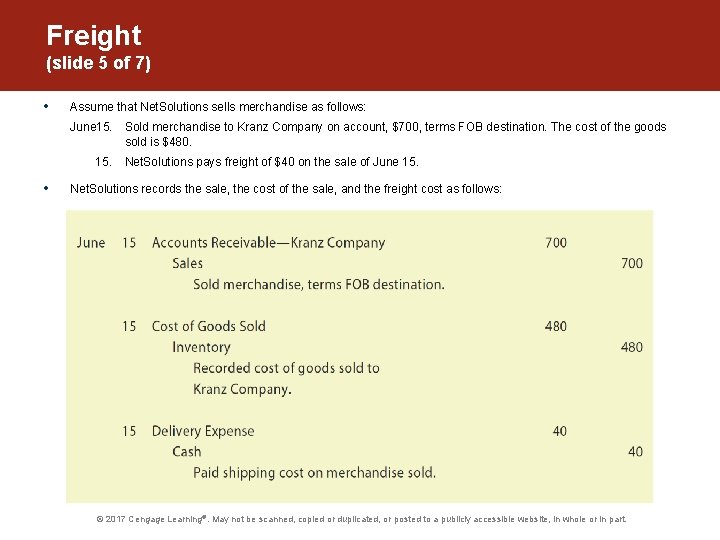
Freight (slide 5 of 7) • Assume that Net. Solutions sells merchandise as follows: June 15. Sold merchandise to Kranz Company on account, $700, terms FOB destination. The cost of the goods sold is $480. 15. • Net. Solutions pays freight of $40 on the sale of June 15. Net. Solutions records the sale, the cost of the sale, and the freight cost as follows: © 2017 Cengage Learning®. May not be scanned, copied or duplicated, or posted to a publicly accessible website, in whole or in part.
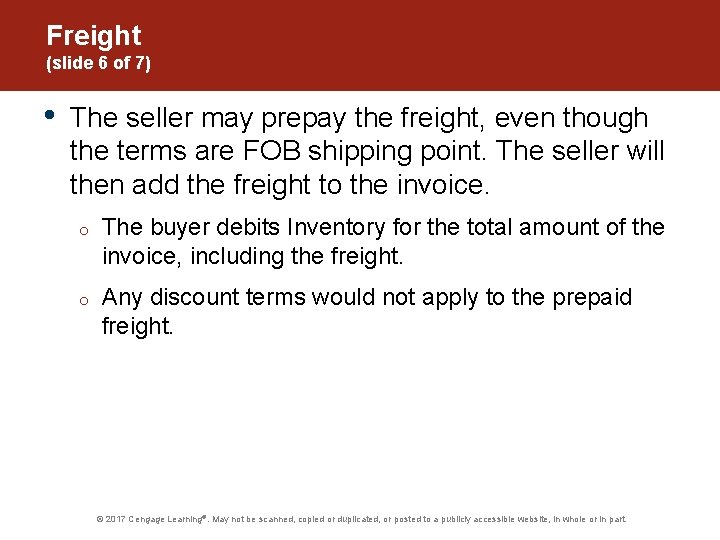
Freight (slide 6 of 7) • The seller may prepay the freight, even though the terms are FOB shipping point. The seller will then add the freight to the invoice. o The buyer debits Inventory for the total amount of the invoice, including the freight. o Any discount terms would not apply to the prepaid freight. © 2017 Cengage Learning®. May not be scanned, copied or duplicated, or posted to a publicly accessible website, in whole or in part.
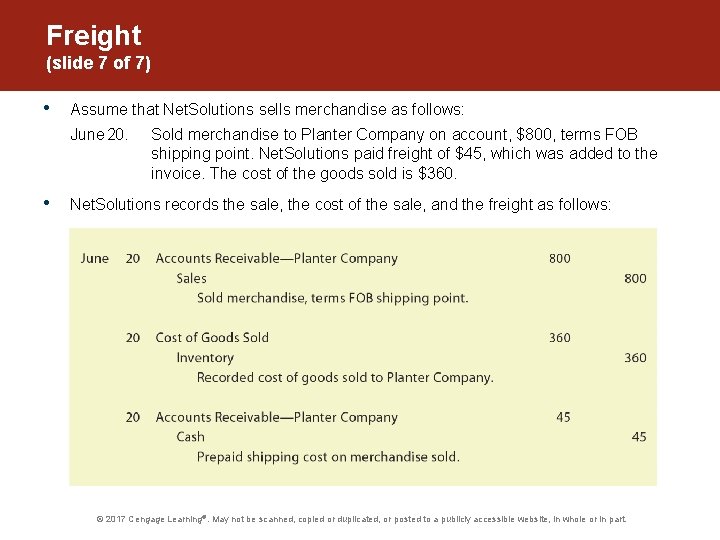
Freight (slide 7 of 7) • Assume that Net. Solutions sells merchandise as follows: June 20. • Sold merchandise to Planter Company on account, $800, terms FOB shipping point. Net. Solutions paid freight of $45, which was added to the invoice. The cost of the goods sold is $360. Net. Solutions records the sale, the cost of the sale, and the freight as follows: © 2017 Cengage Learning®. May not be scanned, copied or duplicated, or posted to a publicly accessible website, in whole or in part.
Freight Terms © 2017 Cengage Learning®. May not be scanned, copied or duplicated, or posted to a publicly accessible website, in whole or in part.
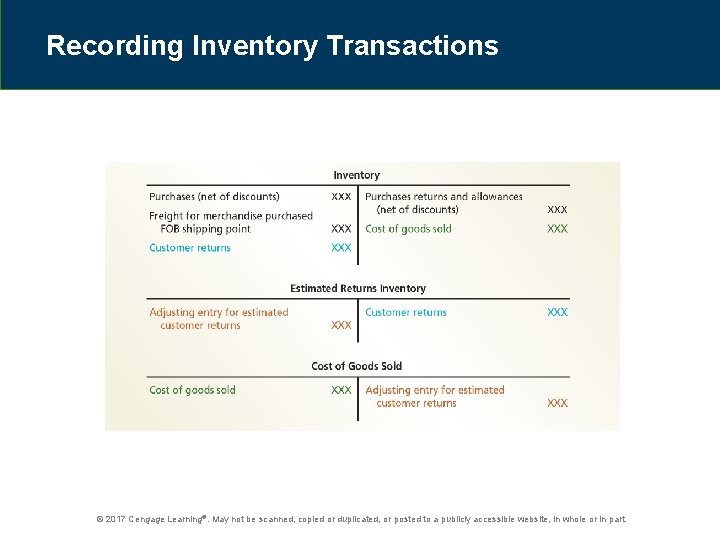
Recording Inventory Transactions © 2017 Cengage Learning®. May not be scanned, copied or duplicated, or posted to a publicly accessible website, in whole or in part.
Dual Nature of Merchandise Transactions • Each merchandising transaction affects a buyer and a seller. © 2017 Cengage Learning®. May not be scanned, copied or duplicated, or posted to a publicly accessible website, in whole or in part.
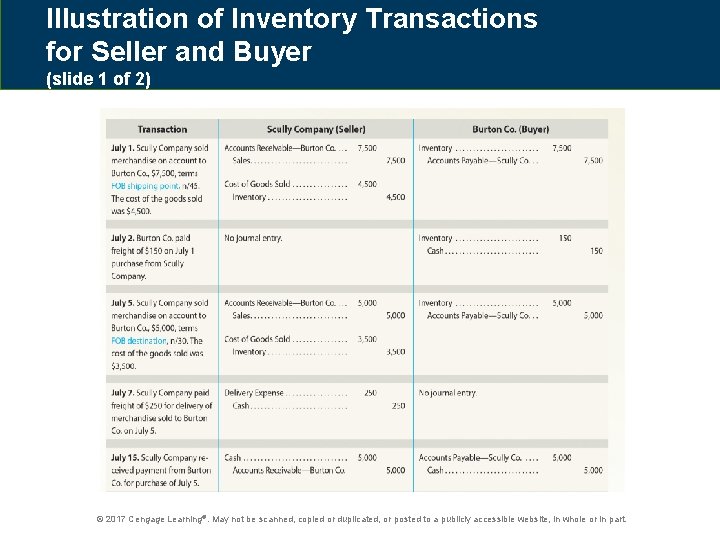
Illustration of Inventory Transactions for Seller and Buyer (slide 1 of 2) © 2017 Cengage Learning®. May not be scanned, copied or duplicated, or posted to a publicly accessible website, in whole or in part.
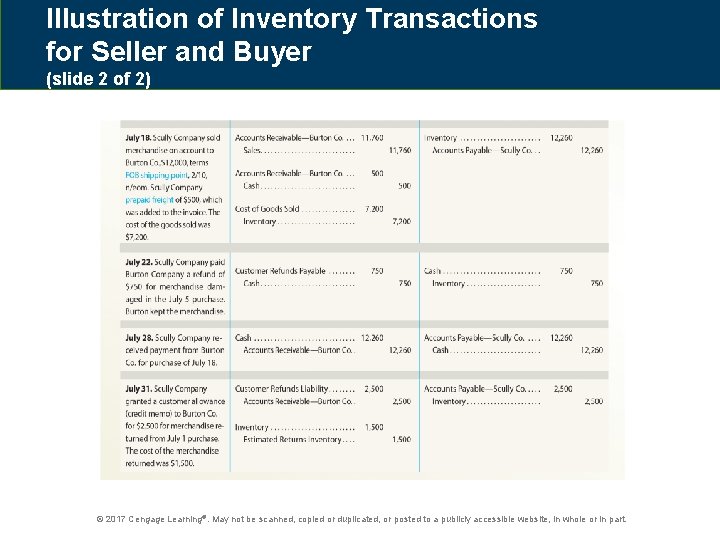
Illustration of Inventory Transactions for Seller and Buyer (slide 2 of 2) © 2017 Cengage Learning®. May not be scanned, copied or duplicated, or posted to a publicly accessible website, in whole or in part.
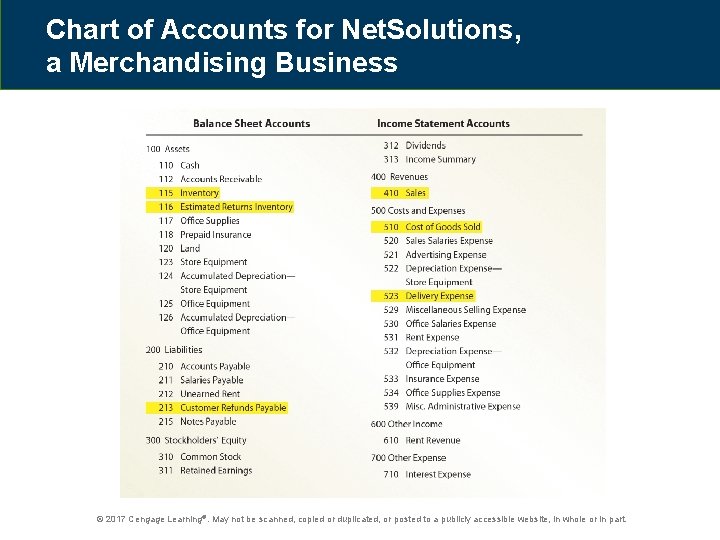
Chart of Accounts for Net. Solutions, a Merchandising Business © 2017 Cengage Learning®. May not be scanned, copied or duplicated, or posted to a publicly accessible website, in whole or in part.
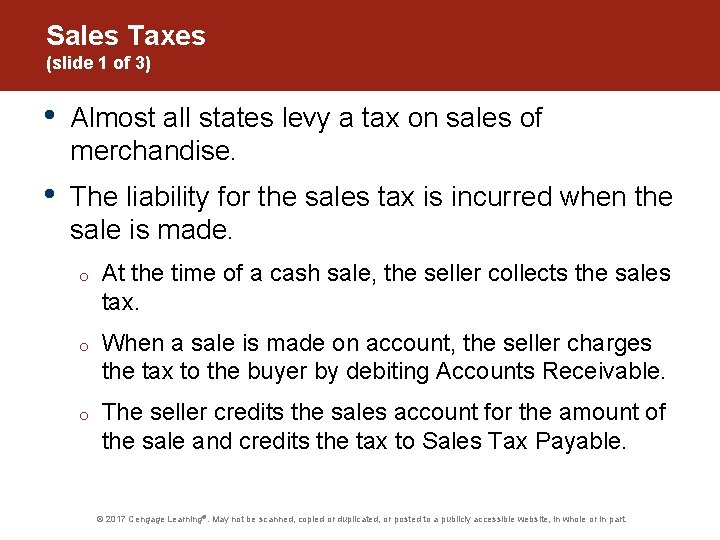
Sales Taxes (slide 1 of 3) • Almost all states levy a tax on sales of merchandise. • The liability for the sales tax is incurred when the sale is made. o At the time of a cash sale, the seller collects the sales tax. o When a sale is made on account, the seller charges the tax to the buyer by debiting Accounts Receivable. o The seller credits the sales account for the amount of the sale and credits the tax to Sales Tax Payable. © 2017 Cengage Learning®. May not be scanned, copied or duplicated, or posted to a publicly accessible website, in whole or in part.
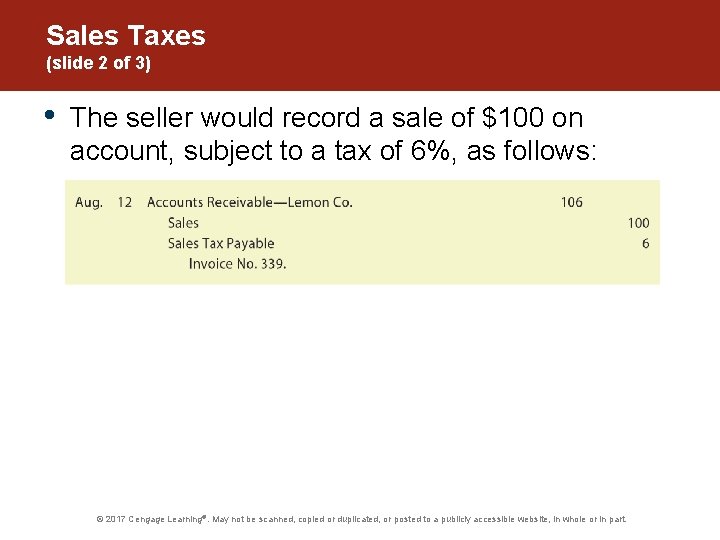
Sales Taxes (slide 2 of 3) • The seller would record a sale of $100 on account, subject to a tax of 6%, as follows: © 2017 Cengage Learning®. May not be scanned, copied or duplicated, or posted to a publicly accessible website, in whole or in part.
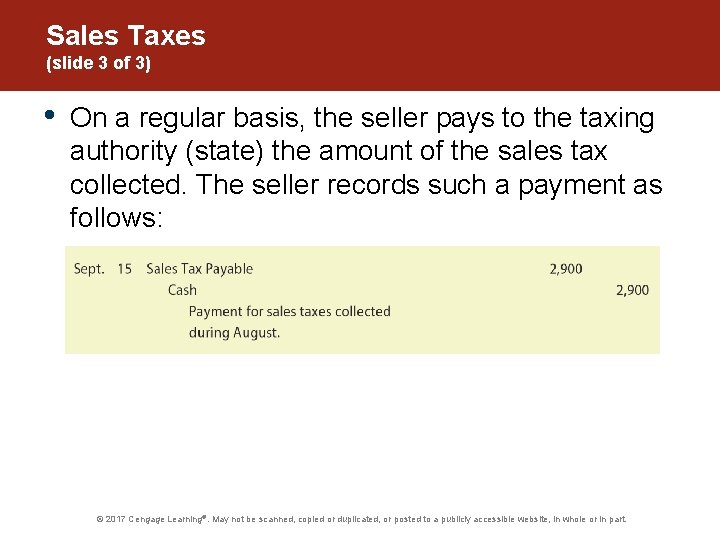
Sales Taxes (slide 3 of 3) • On a regular basis, the seller pays to the taxing authority (state) the amount of the sales tax collected. The seller records such a payment as follows: © 2017 Cengage Learning®. May not be scanned, copied or duplicated, or posted to a publicly accessible website, in whole or in part.
Trade Discounts (slide 1 of 2) • Wholesalers are companies that sell merchandise to other businesses rather than to the public. o Many wholesalers publish or upload sales catalogs online. o Wholesalers often offer special discounts to government agencies or businesses that order large quantities. § Such discounts are called trade discounts. © 2017 Cengage Learning®. May not be scanned, copied or duplicated, or posted to a publicly accessible website, in whole or in part.
Trade Discounts (slide 2 of 2) • Sellers and buyers do not normally record the list prices of merchandise and trade discounts in their accounts. o For example, assume that an item has a list price of $1, 000 and a 40% trade discount. The seller records the sale of the item at $600 [$1, 000 less the trade discount of $400 ($1, 000 × 40%)]. Likewise, the buyer records the purchase at $600. © 2017 Cengage Learning®. May not be scanned, copied or duplicated, or posted to a publicly accessible website, in whole or in part.
Financial Statements for a Merchandising Business • Although merchandising transactions affect the balance sheet in reporting inventory, they primarily affect the income statement. • An income statement for a merchandising business is normally prepared using either a multiple-step or single-step format. © 2017 Cengage Learning®. May not be scanned, copied or duplicated, or posted to a publicly accessible website, in whole or in part.
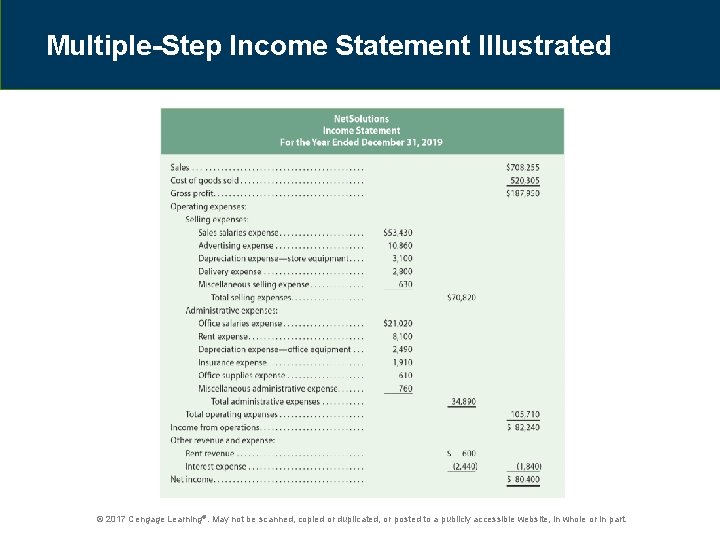
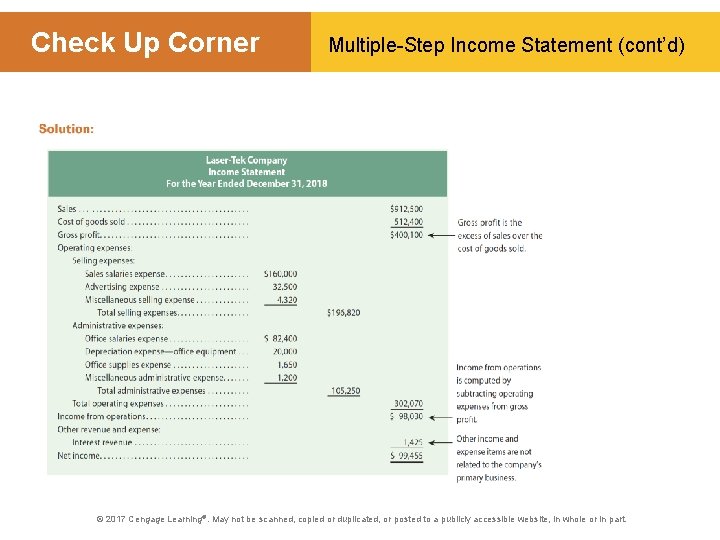
Multiple-Step Income Statement • The multiple-step income statement contains several sections, subsections, and subtotals, including the following: o Sales o Cost of Goods Sold o Gross Profit o Income from Operations o Other Revenue and Expense © 2017 Cengage Learning®. May not be scanned, copied or duplicated, or posted to a publicly accessible website, in whole or in part.
Multiple-Step Income Statement—Sales • The total amount of sales to customers for cash and on account is reported in this section. © 2017 Cengage Learning®. May not be scanned, copied or duplicated, or posted to a publicly accessible website, in whole or in part.
Multiple-Step Income Statement— Cost of Goods Sold • The amount of cost of goods sold to customers is reported in this section. • Cost of goods sold may also be reported as cost of merchandise sold or cost of sales. © 2017 Cengage Learning®. May not be scanned, copied or duplicated, or posted to a publicly accessible website, in whole or in part.
Multiple-Step Income Statement—Gross Profit • The excess of sales over cost of goods sold is gross profit. © 2017 Cengage Learning®. May not be scanned, copied or duplicated, or posted to a publicly accessible website, in whole or in part.
Multiple-Step Income Statement— Income from Operations • Income from operations, sometimes called operating income, is determined by subtracting operating expenses from gross profit. o Operating expenses are normally classified as either selling expenses or administrative expenses. § Selling expenses are incurred directly in the selling of merchandise. – Examples of selling expenses include: § Sales salaries § Store supplies used § Depreciation of store equipment § Delivery expense § Advertising § Administrative expenses, sometimes called general expenses, are incurred in the administration or general operations of the business. – Examples of administrative expenses include: § Office salaries § Depreciation of office equipment § Office supplies used © 2017 Cengage Learning®. May not be scanned, copied or duplicated, or posted to a publicly accessible website, in whole or in part.
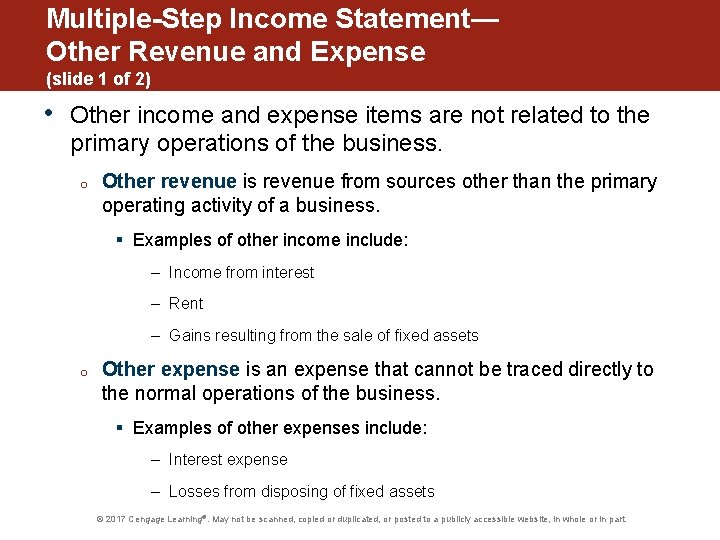
Multiple-Step Income Statement— Other Revenue and Expense (slide 1 of 2) • Other income and expense items are not related to the primary operations of the business. o Other revenue is revenue from sources other than the primary operating activity of a business. § Examples of other income include: – Income from interest – Rent – Gains resulting from the sale of fixed assets o Other expense is an expense that cannot be traced directly to the normal operations of the business. § Examples of other expenses include: – Interest expense – Losses from disposing of fixed assets © 2017 Cengage Learning®. May not be scanned, copied or duplicated, or posted to a publicly accessible website, in whole or in part.
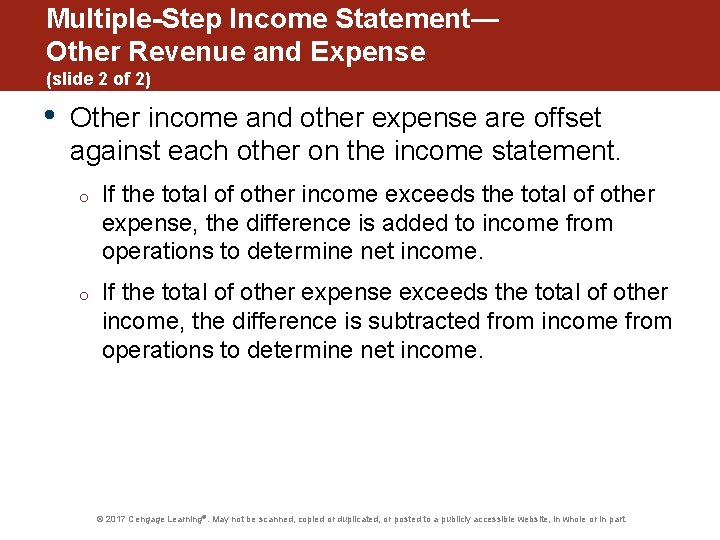
Multiple-Step Income Statement— Other Revenue and Expense (slide 2 of 2) • Other income and other expense are offset against each other on the income statement. o If the total of other income exceeds the total of other expense, the difference is added to income from operations to determine net income. o If the total of other expense exceeds the total of other income, the difference is subtracted from income from operations to determine net income. © 2017 Cengage Learning®. May not be scanned, copied or duplicated, or posted to a publicly accessible website, in whole or in part.
Multiple-Step Income Statement Illustrated © 2017 Cengage Learning®. May not be scanned, copied or duplicated, or posted to a publicly accessible website, in whole or in part.
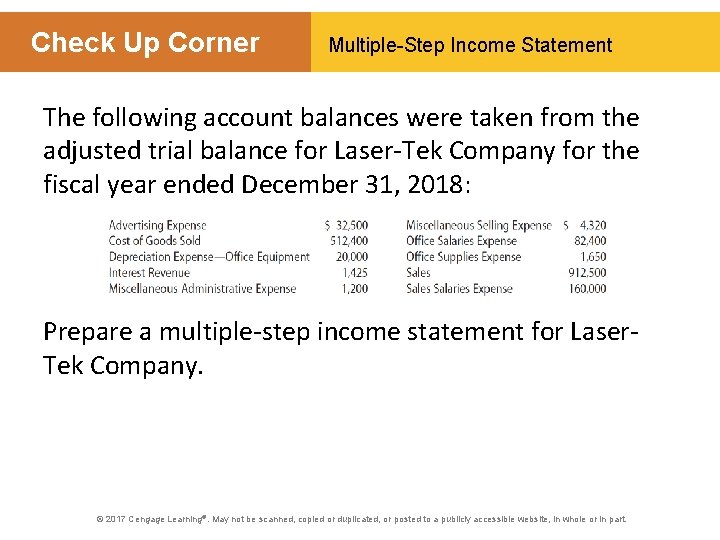
Check Up Corner Multiple-Step Income Statement The following account balances were taken from the adjusted trial balance for Laser-Tek Company for the fiscal year ended December 31, 2018: Prepare a multiple-step income statement for Laser. Tek Company. © 2017 Cengage Learning®. May not be scanned, copied or duplicated, or posted to a publicly accessible website, in whole or in part.
Check Up Corner Multiple-Step Income Statement (cont’d) © 2017 Cengage Learning®. May not be scanned, copied or duplicated, or posted to a publicly accessible website, in whole or in part.
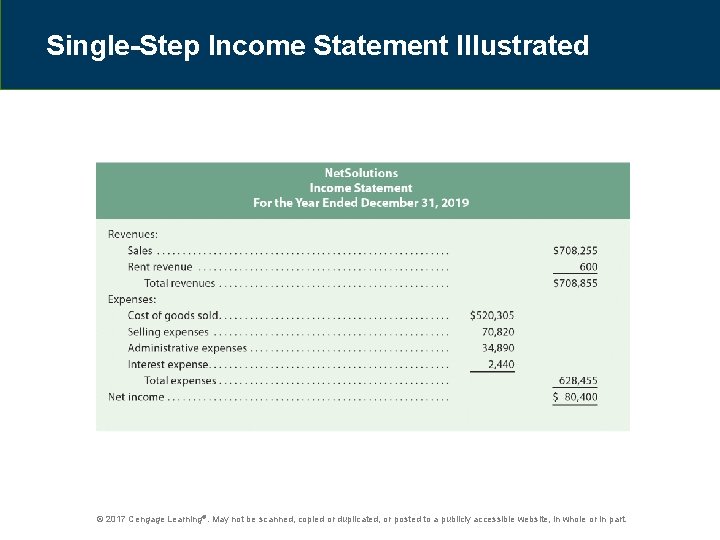
Single-Step Income Statement • An alternative form of income statement is the single-step income statement. • The single-step form deducts the total of all expenses in one step from the total of all revenues. • The single-step form emphasizes total revenues and total expenses in determining net income. • A criticism of the single-step form is that gross profit and income from operations are not reported. © 2017 Cengage Learning®. May not be scanned, copied or duplicated, or posted to a publicly accessible website, in whole or in part.
Single-Step Income Statement Illustrated © 2017 Cengage Learning®. May not be scanned, copied or duplicated, or posted to a publicly accessible website, in whole or in part.
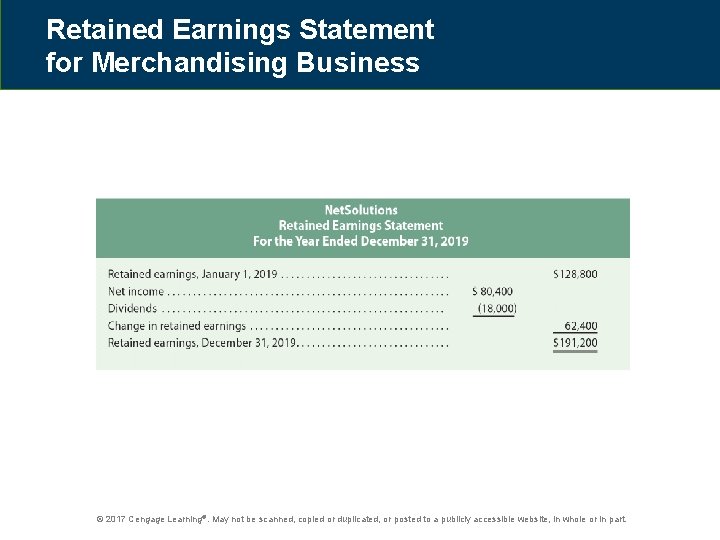
Retained Earnings Statement for Merchandising Business © 2017 Cengage Learning®. May not be scanned, copied or duplicated, or posted to a publicly accessible website, in whole or in part.
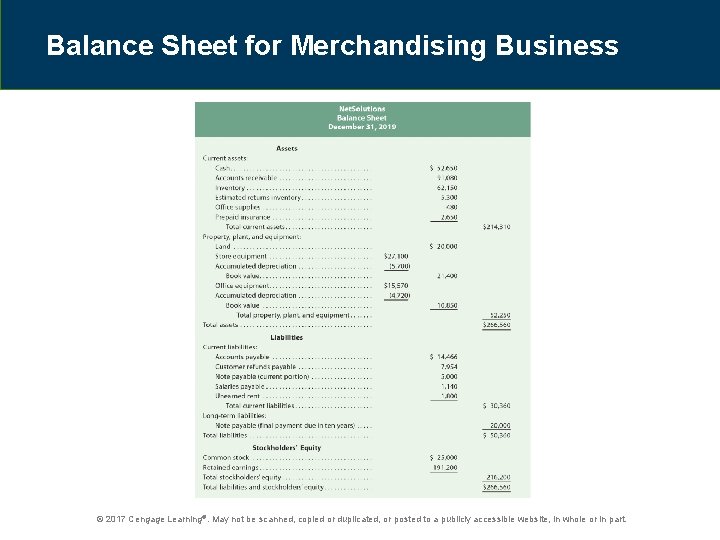
Balance Sheet for Merchandising Business © 2017 Cengage Learning®. May not be scanned, copied or duplicated, or posted to a publicly accessible website, in whole or in part.
Adjusting Entries for Customer Returns and Allowances (slide 1 of 3) • Sellers are required to estimate returns and allowances at the end of an accounting period and prepare two adjusting entries: 1. The first adjusting entry reduces the sale account and creates a customer refund liability account. 2. The second adjusting entry creates an estimated returns inventory account for merchandise that is expected to be returned and reduces cost of goods sold. © 2017 Cengage Learning®. May not be scanned, copied or duplicated, or posted to a publicly accessible website, in whole or in part.
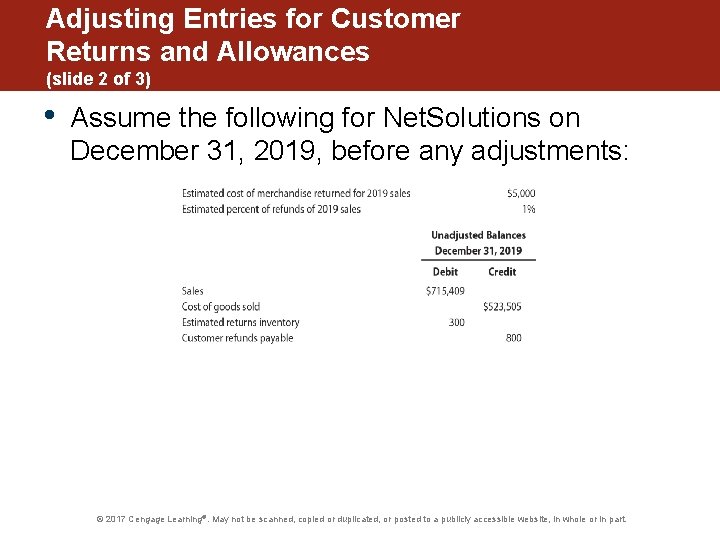
Adjusting Entries for Customer Returns and Allowances (slide 2 of 3) • Assume the following for Net. Solutions on December 31, 2019, before any adjustments: © 2017 Cengage Learning®. May not be scanned, copied or duplicated, or posted to a publicly accessible website, in whole or in part.
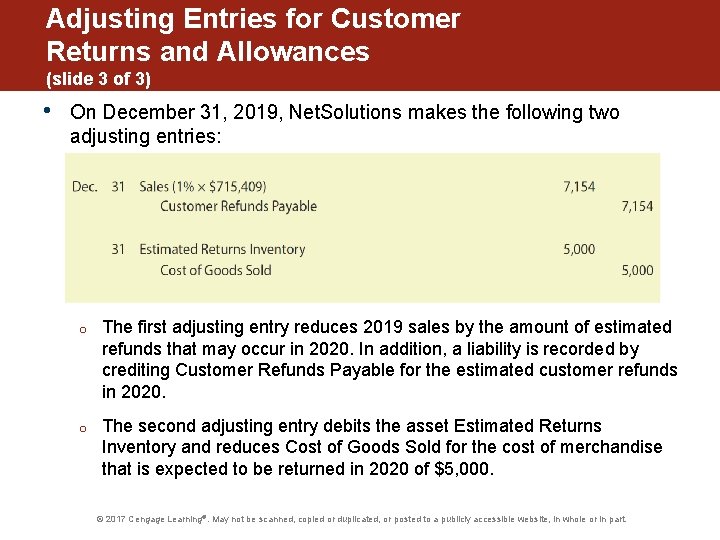
Adjusting Entries for Customer Returns and Allowances (slide 3 of 3) • On December 31, 2019, Net. Solutions makes the following two adjusting entries: o The first adjusting entry reduces 2019 sales by the amount of estimated refunds that may occur in 2020. In addition, a liability is recorded by crediting Customer Refunds Payable for the estimated customer refunds in 2020. o The second adjusting entry debits the asset Estimated Returns Inventory and reduces Cost of Goods Sold for the cost of merchandise that is expected to be returned in 2020 of $5, 000. © 2017 Cengage Learning®. May not be scanned, copied or duplicated, or posted to a publicly accessible website, in whole or in part.
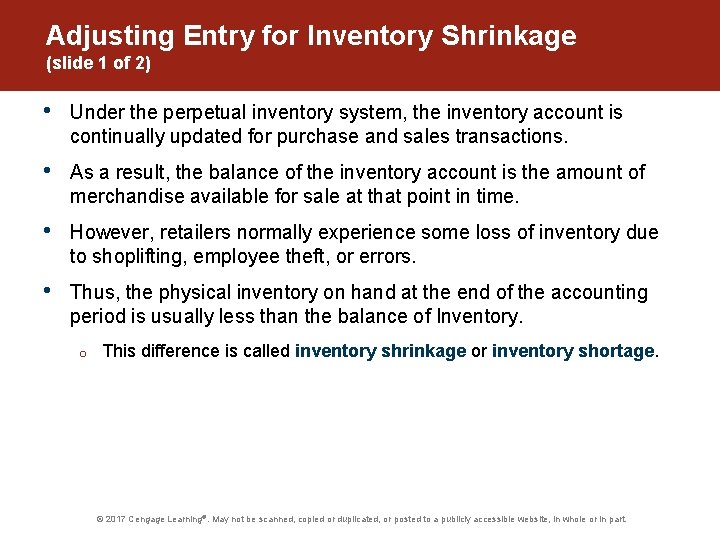
Adjusting Entry for Inventory Shrinkage (slide 1 of 2) • Under the perpetual inventory system, the inventory account is continually updated for purchase and sales transactions. • As a result, the balance of the inventory account is the amount of merchandise available for sale at that point in time. • However, retailers normally experience some loss of inventory due to shoplifting, employee theft, or errors. • Thus, the physical inventory on hand at the end of the accounting period is usually less than the balance of Inventory. o This difference is called inventory shrinkage or inventory shortage. © 2017 Cengage Learning®. May not be scanned, copied or duplicated, or posted to a publicly accessible website, in whole or in part.
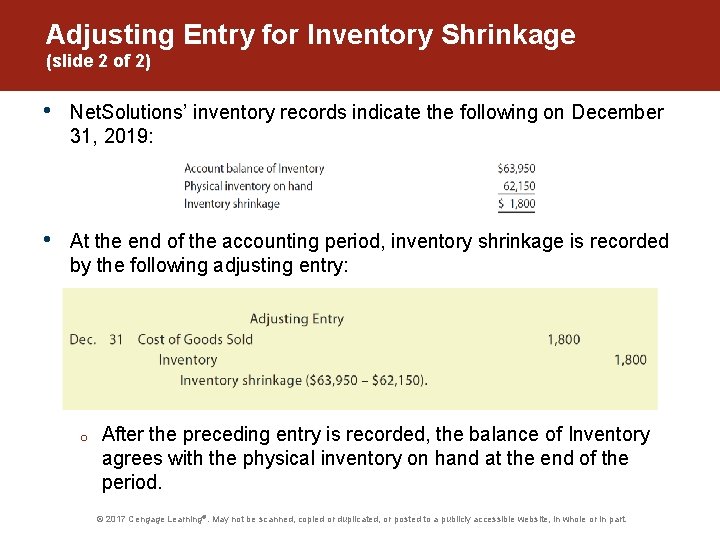
Adjusting Entry for Inventory Shrinkage (slide 2 of 2) • Net. Solutions’ inventory records indicate the following on December 31, 2019: • At the end of the accounting period, inventory shrinkage is recorded by the following adjusting entry: o After the preceding entry is recorded, the balance of Inventory agrees with the physical inventory on hand at the end of the period. © 2017 Cengage Learning®. May not be scanned, copied or duplicated, or posted to a publicly accessible website, in whole or in part.
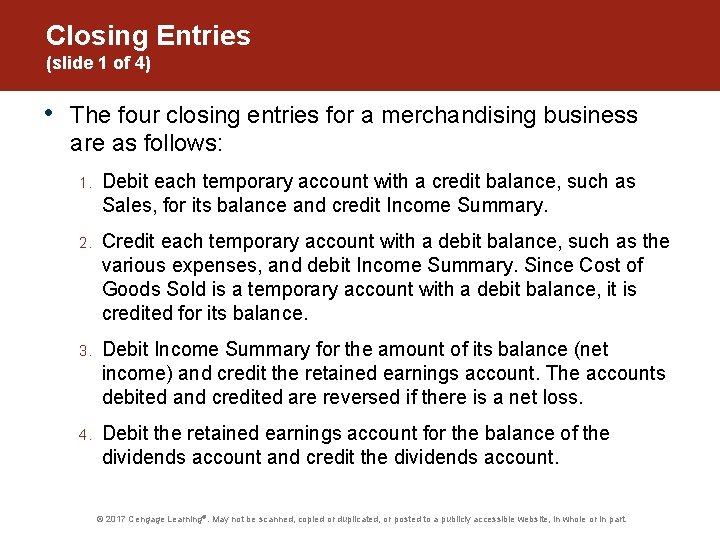
Closing Entries (slide 1 of 4) • The four closing entries for a merchandising business are as follows: 1. Debit each temporary account with a credit balance, such as Sales, for its balance and credit Income Summary. 2. Credit each temporary account with a debit balance, such as the various expenses, and debit Income Summary. Since Cost of Goods Sold is a temporary account with a debit balance, it is credited for its balance. 3. Debit Income Summary for the amount of its balance (net income) and credit the retained earnings account. The accounts debited and credited are reversed if there is a net loss. 4. Debit the retained earnings account for the balance of the dividends account and credit the dividends account. © 2017 Cengage Learning®. May not be scanned, copied or duplicated, or posted to a publicly accessible website, in whole or in part.
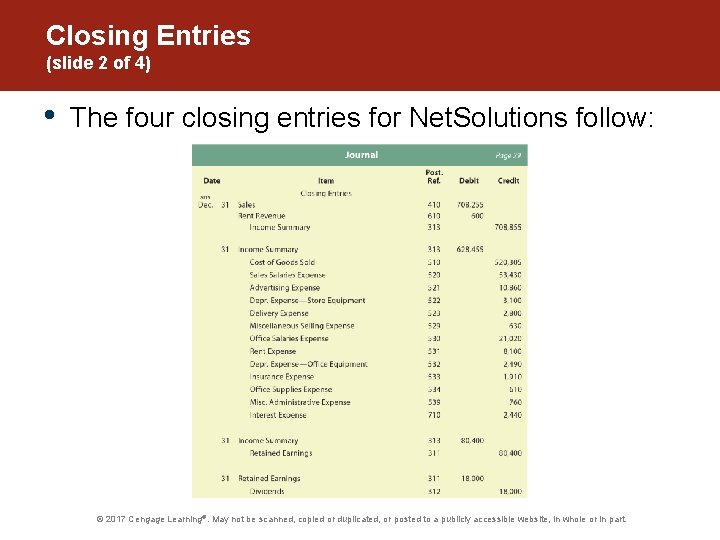
Closing Entries (slide 2 of 4) • The four closing entries for Net. Solutions follow: © 2017 Cengage Learning®. May not be scanned, copied or duplicated, or posted to a publicly accessible website, in whole or in part.
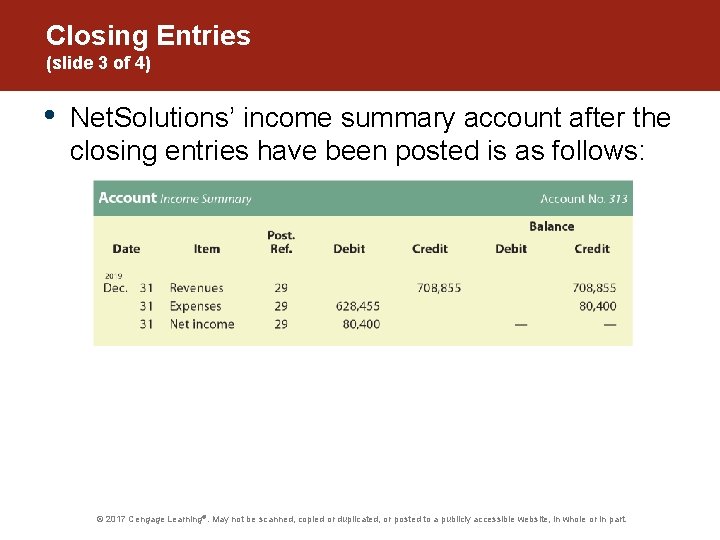
Closing Entries (slide 3 of 4) • Net. Solutions’ income summary account after the closing entries have been posted is as follows: © 2017 Cengage Learning®. May not be scanned, copied or duplicated, or posted to a publicly accessible website, in whole or in part.
Closing Entries (slide 4 of 4) • After the closing entries are posted to the accounts, a post-closing trial balance is prepared. o The only accounts that should appear on the postclosing trial balance are the asset, contra asset, liability, and stockholders’ equity accounts with balances. § These are the same accounts that appear on the end-ofperiod balance sheet. o If the two totals of the trial balance columns are not equal, an error has occurred that must be found and corrected. © 2017 Cengage Learning®. May not be scanned, copied or duplicated, or posted to a publicly accessible website, in whole or in part.
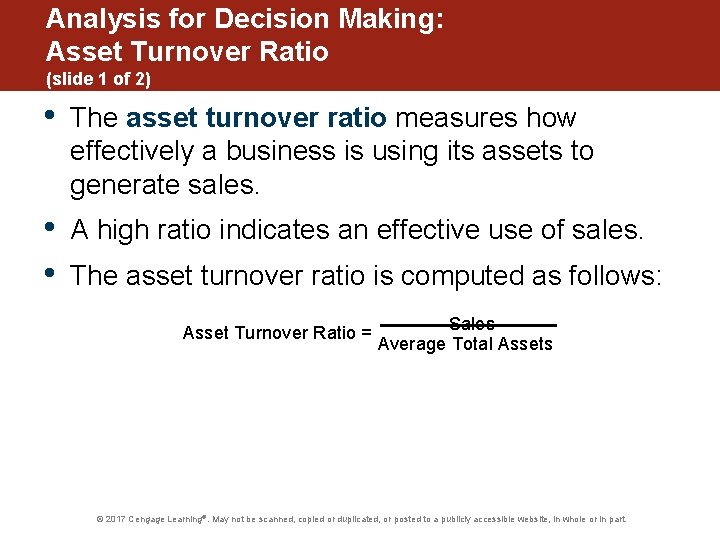
Analysis for Decision Making: Asset Turnover Ratio (slide 1 of 2) • The asset turnover ratio measures how effectively a business is using its assets to generate sales. • • A high ratio indicates an effective use of sales. The asset turnover ratio is computed as follows: Asset Turnover Ratio = Sales Average Total Assets © 2017 Cengage Learning®. May not be scanned, copied or duplicated, or posted to a publicly accessible website, in whole or in part.
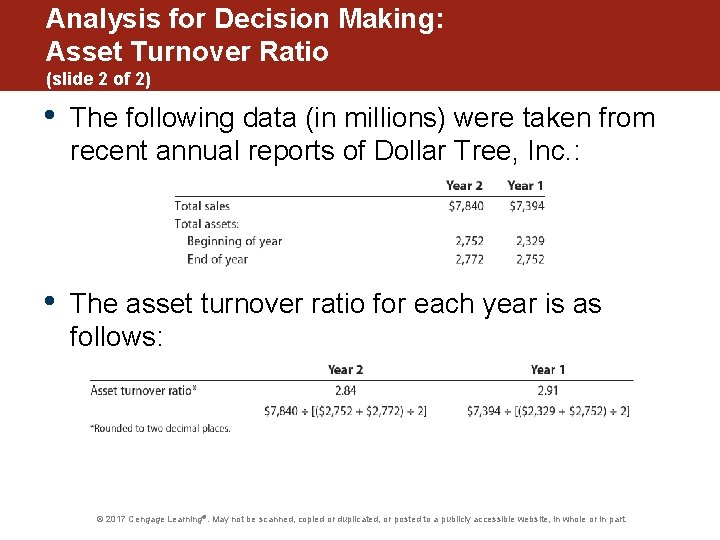
Analysis for Decision Making: Asset Turnover Ratio (slide 2 of 2) • The following data (in millions) were taken from recent annual reports of Dollar Tree, Inc. : • The asset turnover ratio for each year is as follows: © 2017 Cengage Learning®. May not be scanned, copied or duplicated, or posted to a publicly accessible website, in whole or in part.
Appendix: The Periodic Inventory System (slide 1 of 2) • Small merchandise businesses, such as a local hardware store, may use a manual accounting system. • A manual perpetual inventory system is time consuming and costly to maintain. • In this case, the periodic inventory system may be used. © 2017 Cengage Learning®. May not be scanned, copied or duplicated, or posted to a publicly accessible website, in whole or in part.
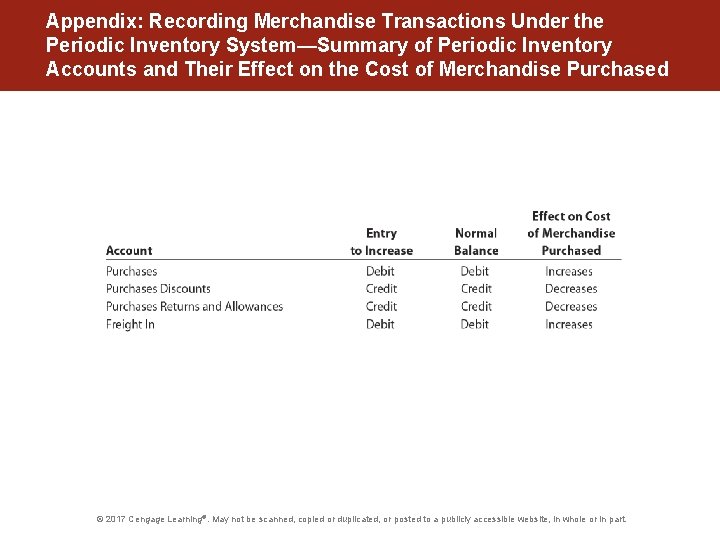
Appendix: The Periodic Inventory System (slide 2 of 2) • Under the periodic inventory system, purchases are normally recorded at their invoice amount as a debit to Purchases. o If the invoice is paid within the discount period, the discount is recorded as a credit in a separate account called Purchases Discounts. o Likewise, purchase returns are recorded as a credit in a separate account called Purchase Returns and Allowances. © 2017 Cengage Learning®. May not be scanned, copied or duplicated, or posted to a publicly accessible website, in whole or in part.
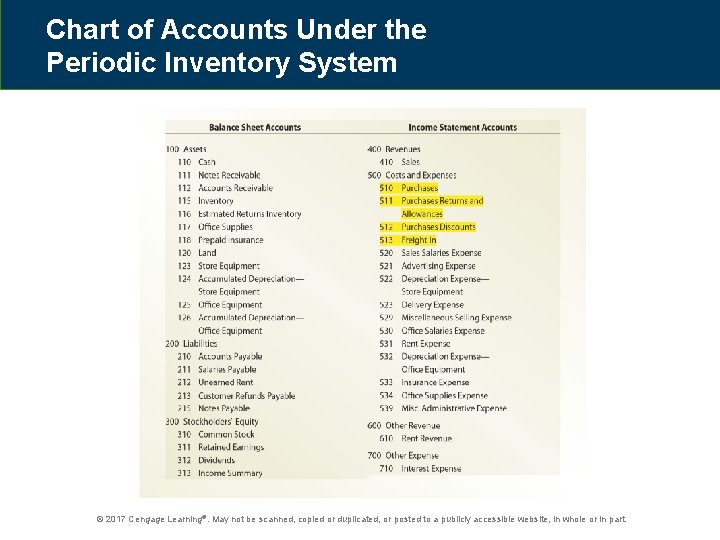
Chart of Accounts Under the Periodic Inventory System © 2017 Cengage Learning®. May not be scanned, copied or duplicated, or posted to a publicly accessible website, in whole or in part.
Appendix: Recording Merchandise Transactions Under the Periodic Inventory System • Using the periodic inventory system, purchases of inventory are not recorded in the inventory account. o Instead, purchases discounts, and purchases returns and allowances accounts are used. • In addition, the sales of merchandise are not recorded in the inventory account. • Thus, there is no detailed record of the amount of inventory on hand at any given time. • At the end of the period, a physical count of inventory on hand is taken. o This physical count is used to determine the cost of goods sold. © 2017 Cengage Learning®. May not be scanned, copied or duplicated, or posted to a publicly accessible website, in whole or in part.
Appendix: Recording Merchandise Transactions Under the Periodic Inventory System—Purchases • Purchases of inventory are recorded in a purchases account rather than in the inventory account. • Purchases is debited for the invoice amount of a purchase. © 2017 Cengage Learning®. May not be scanned, copied or duplicated, or posted to a publicly accessible website, in whole or in part.
Appendix: Recording Merchandise Transactions Under the Periodic Inventory System—Purchases Discounts • Purchases discounts are normally recorded in a separate purchases discounts account. • The balance of the purchases discounts account is reported as a deduction from Purchases for the period. • Thus, Purchases Discounts is a contra (or offsetting) account to Purchases. © 2017 Cengage Learning®. May not be scanned, copied or duplicated, or posted to a publicly accessible website, in whole or in part.
Appendix: Recording Merchandise Transactions Under the Periodic Inventory System—Purchases Returns and Allowances • A separate purchases returns and allowances account is used to record returns and allowances. • Purchases returns and allowances are reported as a deduction from Purchases for the period. • Thus, Purchases Returns and Allowances is a contra (or offsetting) account to Purchases. © 2017 Cengage Learning®. May not be scanned, copied or duplicated, or posted to a publicly accessible website, in whole or in part.
Appendix: Recording Merchandise Transactions Under the Periodic Inventory System—Freight In • Under the periodic inventory system, freight paid when purchasing merchandise FOB shipping point is debited to Freight In, Transportation In, or a similar account. © 2017 Cengage Learning®. May not be scanned, copied or duplicated, or posted to a publicly accessible website, in whole or in part.
Appendix: Recording Merchandise Transactions Under the Periodic Inventory System—Summary of Periodic Inventory Accounts and Their Effect on the Cost of Merchandise Purchased © 2017 Cengage Learning®. May not be scanned, copied or duplicated, or posted to a publicly accessible website, in whole or in part.
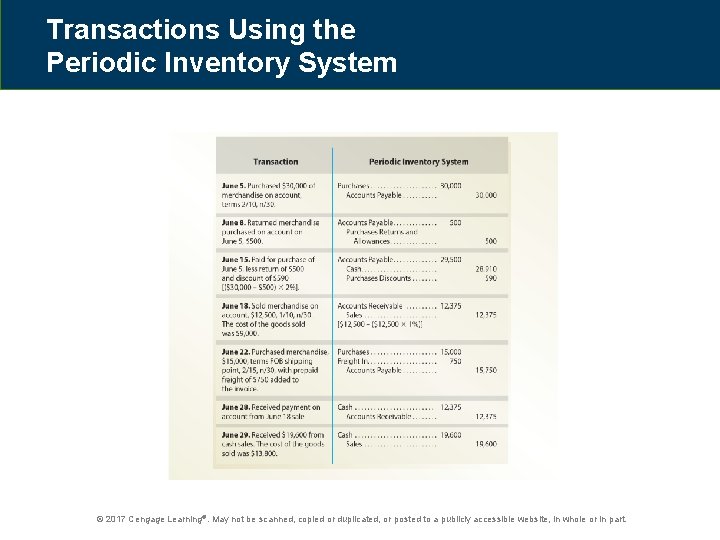
Transactions Using the Periodic Inventory System © 2017 Cengage Learning®. May not be scanned, copied or duplicated, or posted to a publicly accessible website, in whole or in part.
Appendix: Adjusting Process Under the Periodic Inventory System • The adjusting process is the same under the periodic and perpetual inventory systems except for the inventory shrinkage adjustment and customer refunds and allowances. • The ending inventory is determined by a physical count under both systems. o Under the perpetual inventory system, the ending inventory physical count is compared to the balance of Inventory. § The difference is the amount of inventory shrinkage. § The inventory shrinkage is then recorded as a debit to Cost of Goods Sold and a credit to Inventory. o Under the periodic inventory system, the inventory account is not kept up to date for purchases and sales. § As a result, the inventory shrinkage cannot be directly determined. § Instead, any inventory shrinkage is included indirectly in the computation of the cost of goods sold. © 2017 Cengage Learning®. May not be scanned, copied or duplicated, or posted to a publicly accessible website, in whole or in part.
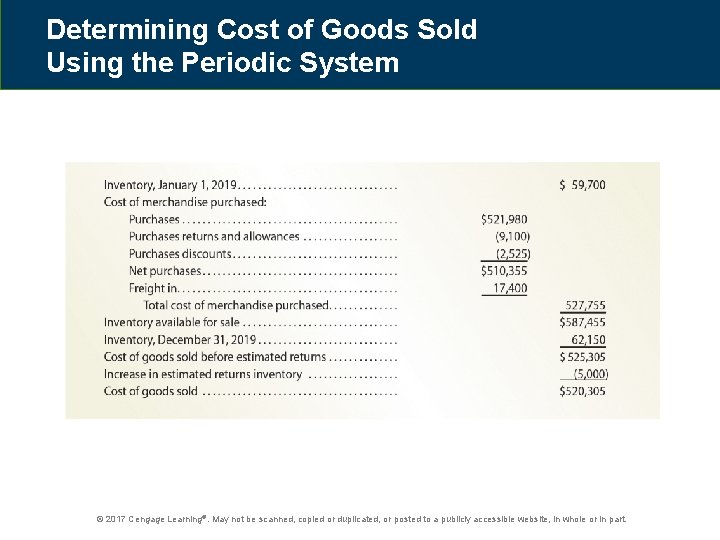
Appendix: Financial Statements Under the Periodic Inventory System • The financial statements are similar under the perpetual and periodic inventory systems. • When the multiple-step format of income statement is used, the cost of goods sold may be reported. © 2017 Cengage Learning®. May not be scanned, copied or duplicated, or posted to a publicly accessible website, in whole or in part.
Determining Cost of Goods Sold Using the Periodic System © 2017 Cengage Learning®. May not be scanned, copied or duplicated, or posted to a publicly accessible website, in whole or in part.
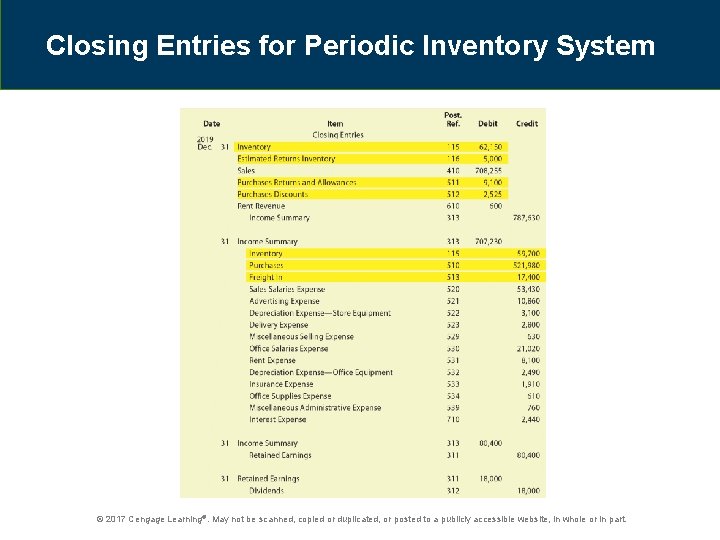
Appendix: Closing Entries Under the Periodic Inventory System (slide 1 of 2) • The closing entries differ in the periodic inventory system in that there is no cost of goods sold account to close to Income Summary. • Instead, the purchases, purchases discounts, purchases returns and allowances, and freight in accounts are closed to Income Summary. • In addition, the inventory account is adjusted to the endof-period physical inventory count during the closing process. • The estimated returns inventory account is also adjusted for the estimated returns from the current period’s sales. © 2017 Cengage Learning®. May not be scanned, copied or duplicated, or posted to a publicly accessible website, in whole or in part.
Appendix: Closing Entries Under the Periodic Inventory System (slide 2 of 2) • The four closing entries under the periodic inventory system are as follows: 1. Debit each temporary account with a credit balance, such as Sales, for its balance and credit Income Summary. Since Purchases Discounts and Purchases Returns and Allowances are temporary accounts with credit balances, they are debited for their balances. In addition, debit the estimated returns inventory account for the cost of the future estimated returns of the current period’s sales. Finally, Inventory is debited for its end-of-period balance based on the end-ofperiod physical inventory. 2. Credit each temporary account with a debit balance, such as the various expenses, and debit Income Summary. Since Freight In is a temporary account with a debit balance, it is credited for its balance. In addition, Inventory is credited for its balance as of the beginning of the period. 3. Debit Income Summary for the amount of its balance (net income) and credit the retained earnings account. The accounts debited and credited are reversed if there is a net loss. 4. Debit the retained earnings account for the balance of the dividends account and credit the dividends account. © 2017 Cengage Learning®. May not be scanned, copied or duplicated, or posted to a publicly accessible website, in whole or in part.
Closing Entries for Periodic Inventory System © 2017 Cengage Learning®. May not be scanned, copied or duplicated, or posted to a publicly accessible website, in whole or in part.