
Accounting Principles 7 th Edition Weygandt Kieso Kimmel










- Slides: 30
Accounting Principles, 7 th Edition Weygandt • Kieso • Kimmel Chapter 7 Accounting Information Systems Prepared by Naomi Karolinski Monroe Community College and Marianne Bradford Bryant College John Wiley & Sons, Inc. © 2005
CHAPTER 7 ACCOUNTING INFORMATION SYSTEMS After studying this chapter, you should be able to: 1 Identify basic principles of accounting information systems. 2 Explain the major phases in the development of an accounting system. 3 Describe the nature and purpose of a subsidiary ledger. 4 Explain how special journals are used in journalizing. 5 Indicate how a multi-column journal is posted.
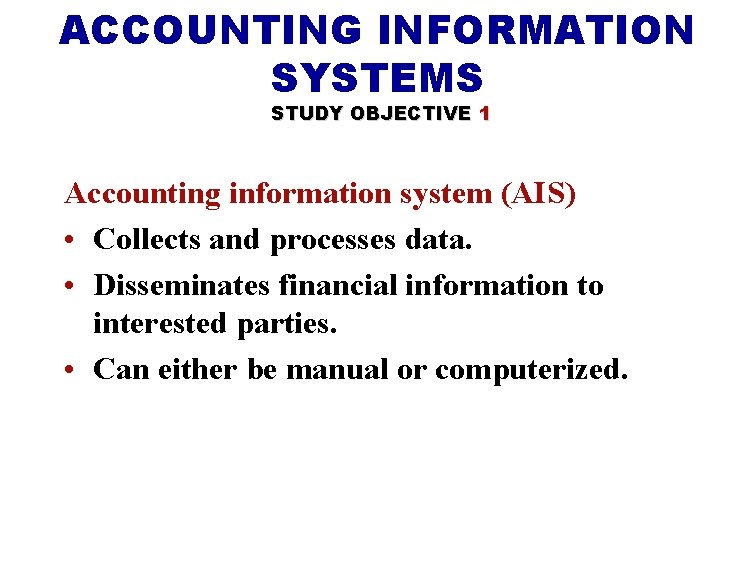
ACCOUNTING INFORMATION SYSTEMS STUDY OBJECTIVE 1 Accounting information system (AIS) • Collects and processes data. • Disseminates financial information to interested parties. • Can either be manual or computerized.
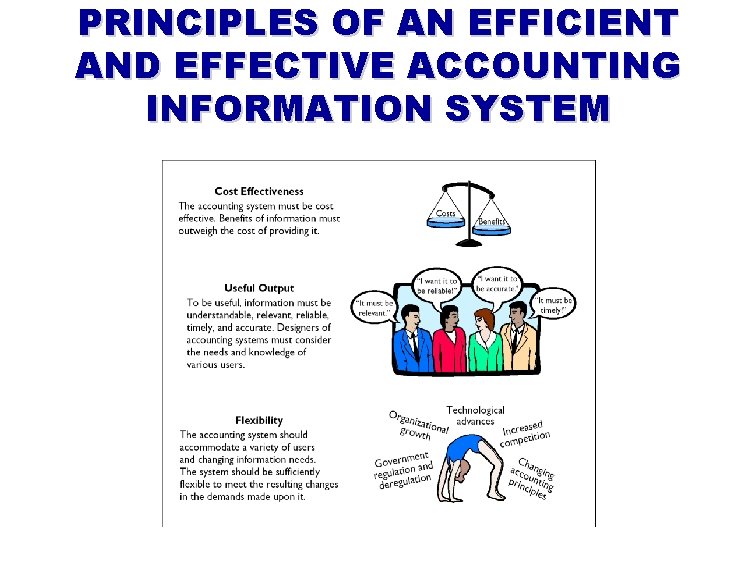
PRINCIPLES OF AN EFFICIENT AND EFFECTIVE ACCOUNTING INFORMATION SYSTEM
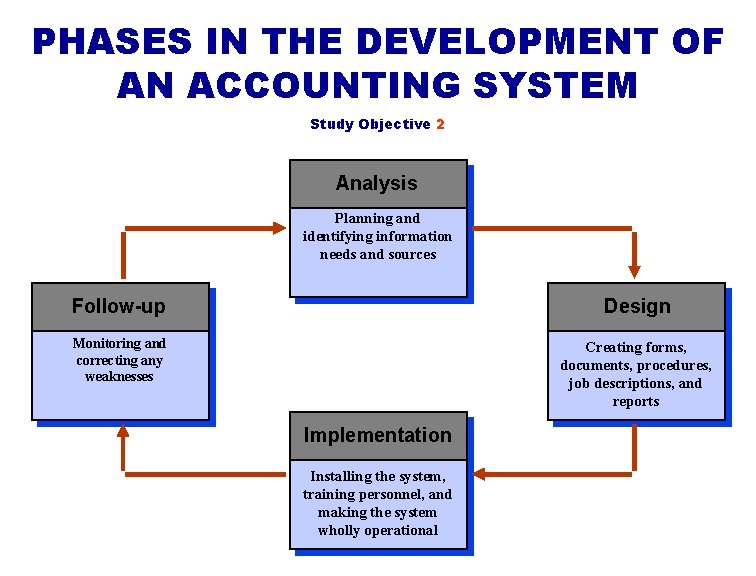
PHASES IN THE DEVELOPMENT OF AN ACCOUNTING SYSTEM Study Objective 2 Analysis Planning and identifying information needs and sources Follow-up Design Monitoring and correcting any weaknesses Creating forms, documents, procedures, job descriptions, and reports Implementation Installing the system, training personnel, and making the system wholly operational
MANUAL VS. COMPUTERIZED SYSTEMS • Small businesses– begin operations with manual accounting systems and convert to computerized systems as business grows • To understand computerized accounting systems– one must understand how manual accounting systems work
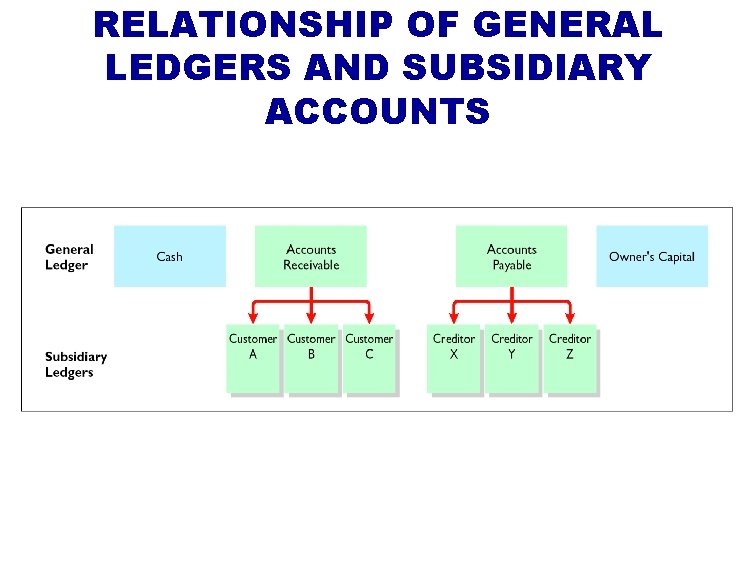
SUBSIDIARY LEDGERS STUDY OBJECTIVE 3 • A group of accounts – With a common characteristic for example, all accounts receivable – Facilitates the recording process freeing the general ledger from details concerning individual balances • Two common subsidiary ledgers – Accounts Receivable Ledger – Accounts Payable Ledger
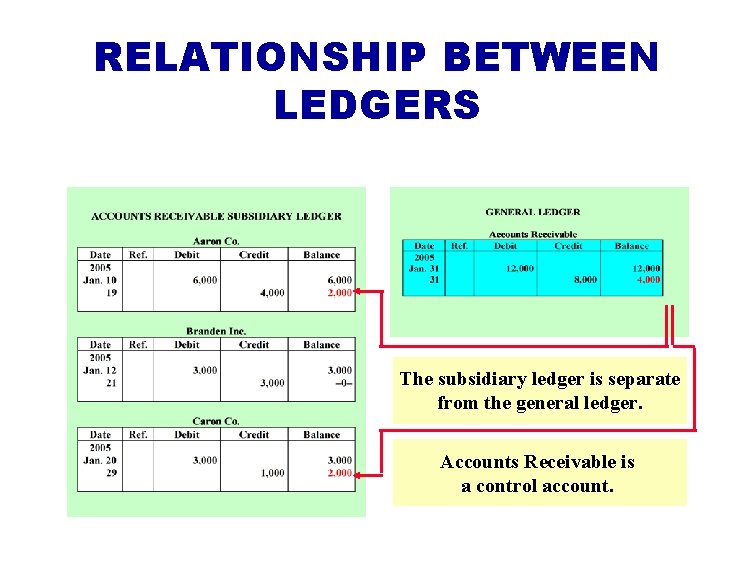
CONTROL ACCOUNT • Control account – General Ledger account which summarizes subsidiary ledger data • Subsidiary Ledger – general ledger control account balance equals the composite balance of the individual accounts in the subsidiary ledger
RELATIONSHIP OF GENERAL LEDGERS AND SUBSIDIARY ACCOUNTS
RELATIONSHIP BETWEEN LEDGERS The subsidiary ledger is separate from the general ledger. Accounts Receivable is a control account.
SUBSIDIARY LEDGERS Advantages 1 Shows transactions affecting one customer or one creditor in a single account 2 Frees the general ledger of excessive details 3 Helps locate errors in individual accounts 4 Reduces the number of accounts in one ledger and by using control accounts 5 Division of labor in posting – One employee posts to the general ledger – Another employee posts to the subsidiary ledger
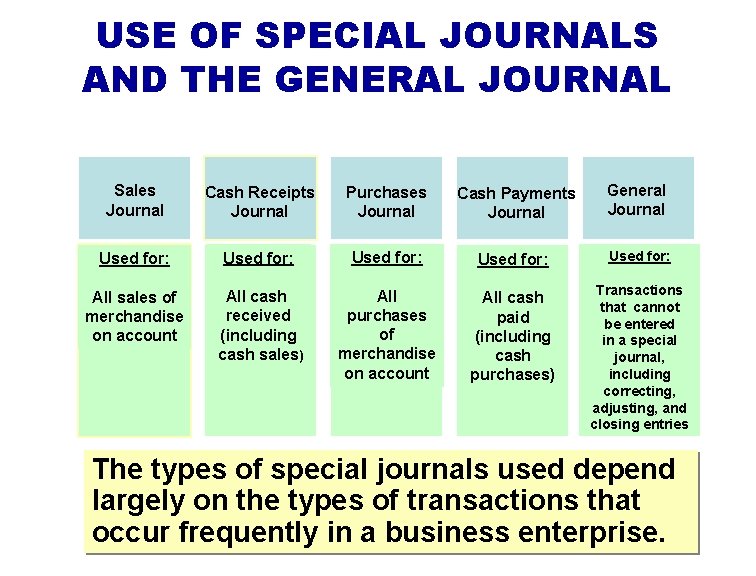
SPECIAL JOURNALS STUDY OBJECTIVE 4 • Special journals – used to group similar types of transactions – permits greater division of labor and reduces time needed to complete the posting process • If a transaction cannot be recorded in a special journal, it is recorded in the general journal.
USE OF SPECIAL JOURNALS AND THE GENERAL JOURNAL Sales Journal Cash Receipts Journal Purchases Journal Cash Payments Journal General Journal Used for: Used for: All sales of merchandise on account All cash received (including cash sales) All purchases of merchandise on account All cash paid (including cash purchases) Transactions that cannot be entered in a special journal, including correcting, adjusting, and closing entries The types of special journals used depend largely on the types of transactions that occur frequently in a business enterprise.
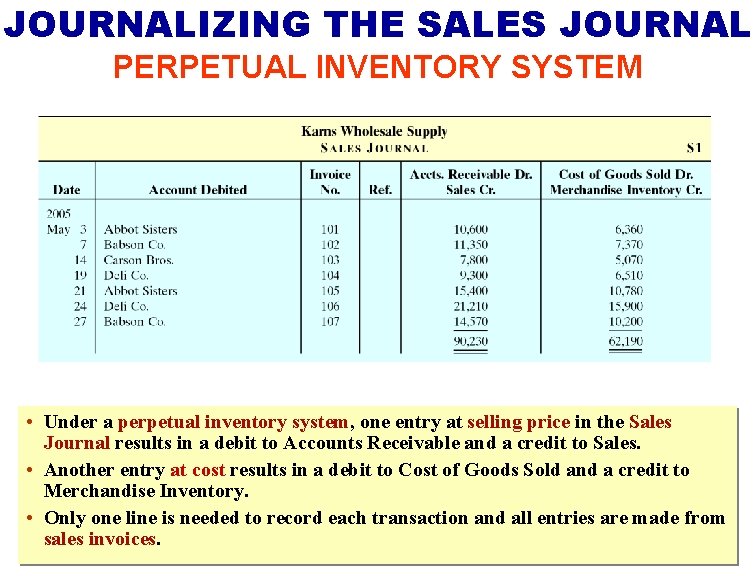
JOURNALIZING THE SALES JOURNAL PERPETUAL INVENTORY SYSTEM • Under a perpetual inventory system, one entry at selling price in the Sales Journal results in a debit to Accounts Receivable and a credit to Sales. • Another entry at cost results in a debit to Cost of Goods Sold and a credit to Merchandise Inventory. • Only one line is needed to record each transaction and all entries are made from sales invoices.
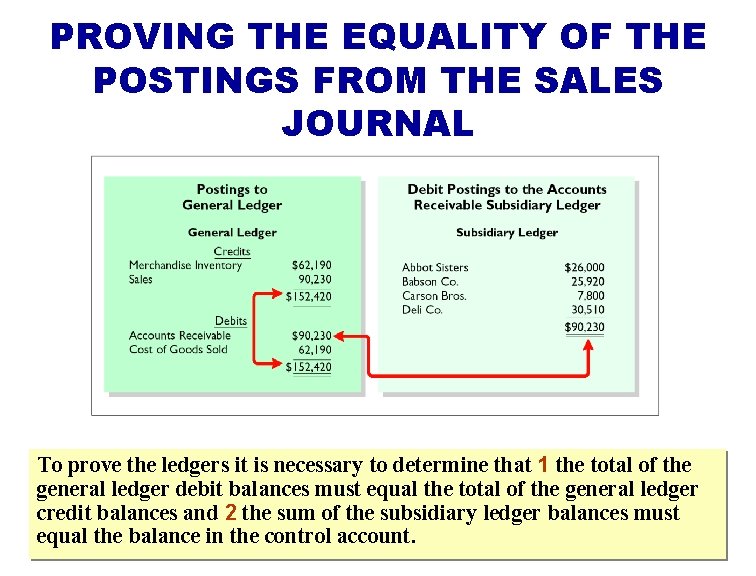
PROVING THE EQUALITY OF THE POSTINGS FROM THE SALES JOURNAL To prove the ledgers it is necessary to determine that 1 the total of the general ledger debit balances must equal the total of the general ledger credit balances and 2 the sum of the subsidiary ledger balances must equal the balance in the control account.
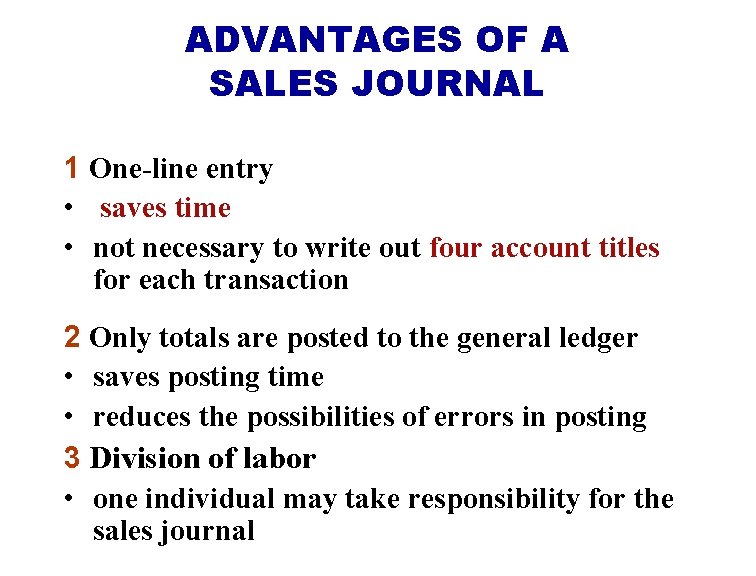
ADVANTAGES OF A SALES JOURNAL 1 One-line entry • saves time • not necessary to write out four account titles for each transaction 2 Only totals are posted to the general ledger • saves posting time • reduces the possibilities of errors in posting 3 Division of labor • one individual may take responsibility for the sales journal
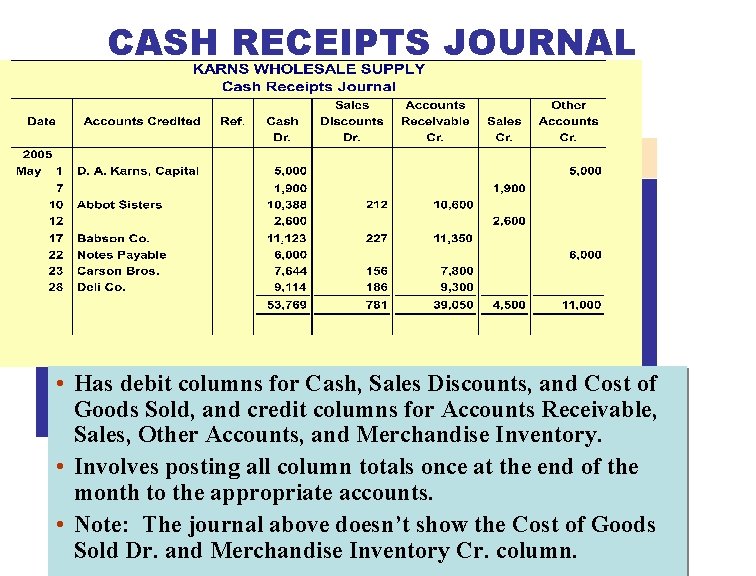
CASH RECEIPTS JOURNAL • Has debit columns for Cash, Sales Discounts, and Cost of Goods Sold, and credit columns for Accounts Receivable, Sales, Other Accounts, and Merchandise Inventory. • Involves posting all column totals once at the end of the month to the appropriate accounts. • Note: The journal above doesn’t show the Cost of Goods Sold Dr. and Merchandise Inventory Cr. column.
If a customer returns goods for credit, an entry is normally made in the: a. cash payments journal. b. sales journal. c. general journal. d. cash receipts journal.
If a customer returns goods for credit, an entry is normally made in the: a. cash payments journal. b. sales journal. c. general journal. d. cash receipts journal.
CASH RECEIPTS JOURNAL – The total of the Other Accounts column is not posted. The individual amounts comprising the total are posted separately to the general ledger accounts specified in the Accounts Credited column. – The individual amounts in a column are posted daily to the subsidiary ledger account specified in the Accounts Credited column.
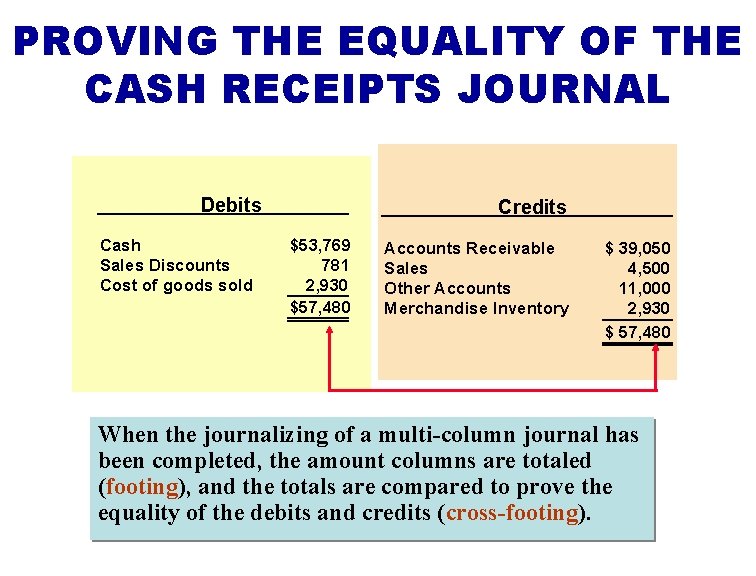
PROVING THE EQUALITY OF THE CASH RECEIPTS JOURNAL Debits Cash Sales Discounts Cost of goods sold Credits $53, 769 781 2, 930 $57, 480 Accounts Receivable Sales Other Accounts Merchandise Inventory $ 39, 050 4, 500 11, 000 2, 930 $ 57, 480 When the journalizing of a multi-column journal has been completed, the amount columns are totaled (footing), and the totals are compared to prove the equality of the debits and credits (cross-footing).
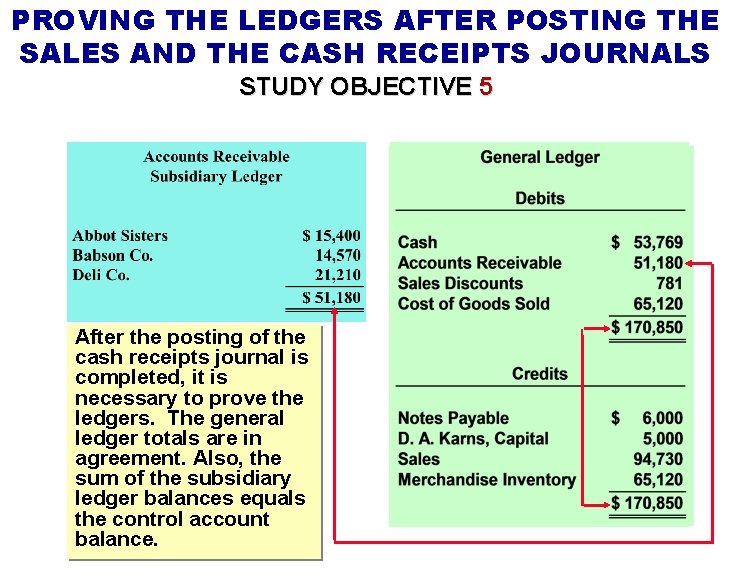
PROVING THE LEDGERS AFTER POSTING THE SALES AND THE CASH RECEIPTS JOURNALS STUDY OBJECTIVE 5 After the posting of the cash receipts journal is completed, it is necessary to prove the ledgers. The general ledger totals are in agreement. Also, the sum of the subsidiary ledger balances equals the control account balance.
PURCHASES JOURNAL KARNS WHOLESALE SUPPLY Purchases Journal Date 2005 May 6 10 14 19 26 29 Account Credited Jasper Manufacturing Inc. Eaton and Howe Inc. Fabor and Son Jasper Manufacturing Inc. Fabor and Son Eaton and Howe Inc. Terms 2/10, n/30 3/10, n/30 1/10, n/30 2/10, n/30 1/10, n/30 3/10, n/30 Ref. Merchandise Inventory Dr. Accounts Payable Cr. 11, 000 7, 200 6, 900 17, 500 8, 700 12, 600 63, 900 • Each entry results in a debit to Merchandise Inventory and a credit to Accounts Payable. • All entries are made from purchase invoices. • Postings are made daily to the accounts payable subsidiary journal and monthly to the general ledger.
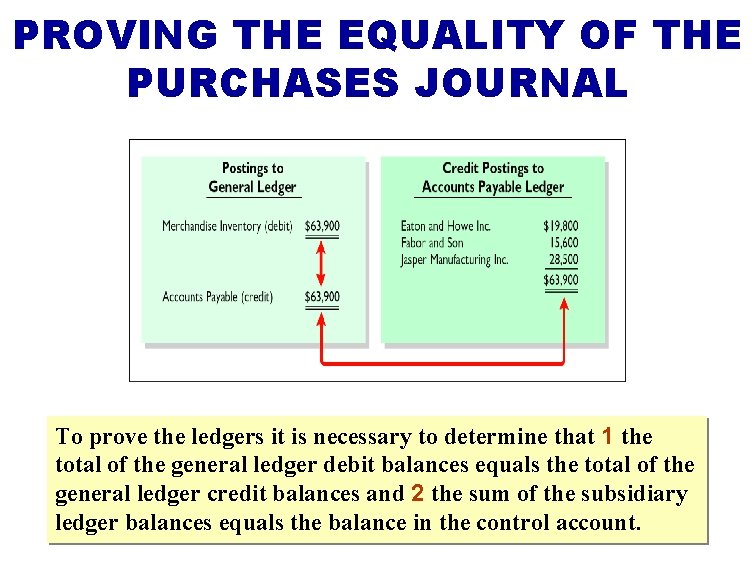
PROVING THE EQUALITY OF THE PURCHASES JOURNAL To prove the ledgers it is necessary to determine that 1 the total of the general ledger debit balances equals the total of the general ledger credit balances and 2 the sum of the subsidiary ledger balances equals the balance in the control account.
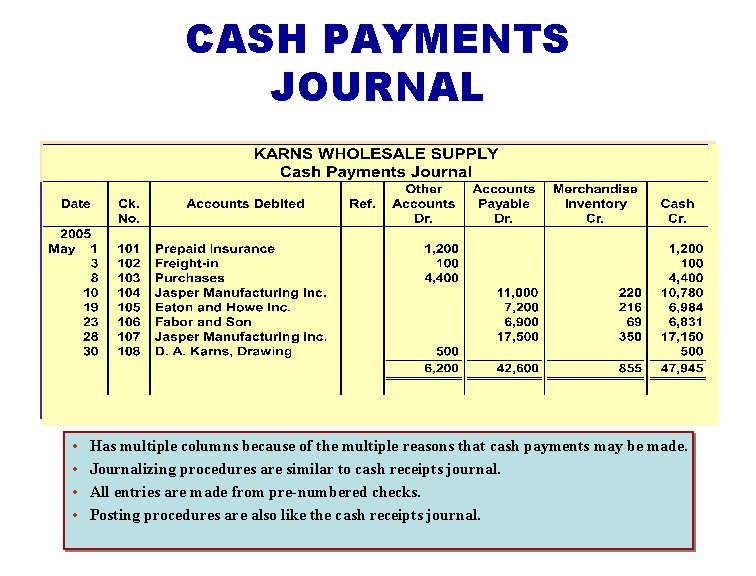
CASH PAYMENTS JOURNAL • • Has multiple columns because of the multiple reasons that cash payments may be made. Journalizing procedures are similar to cash receipts journal. All entries are made from pre-numbered checks. Posting procedures are also like the cash receipts journal.
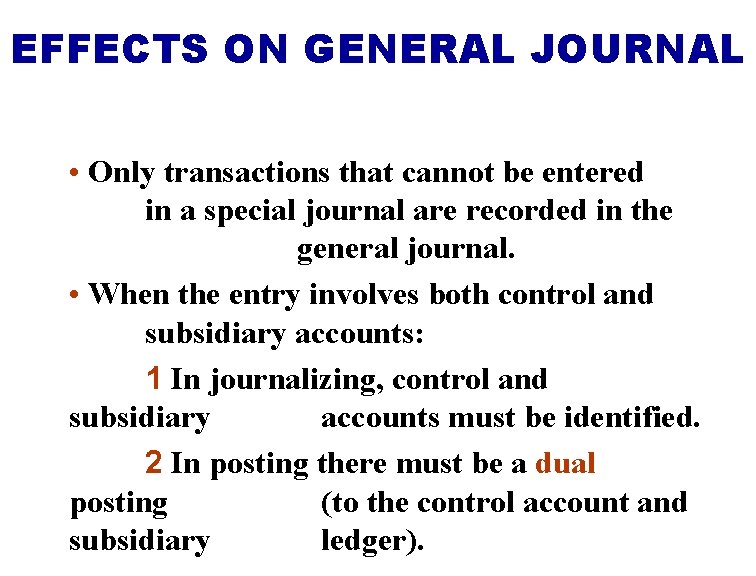
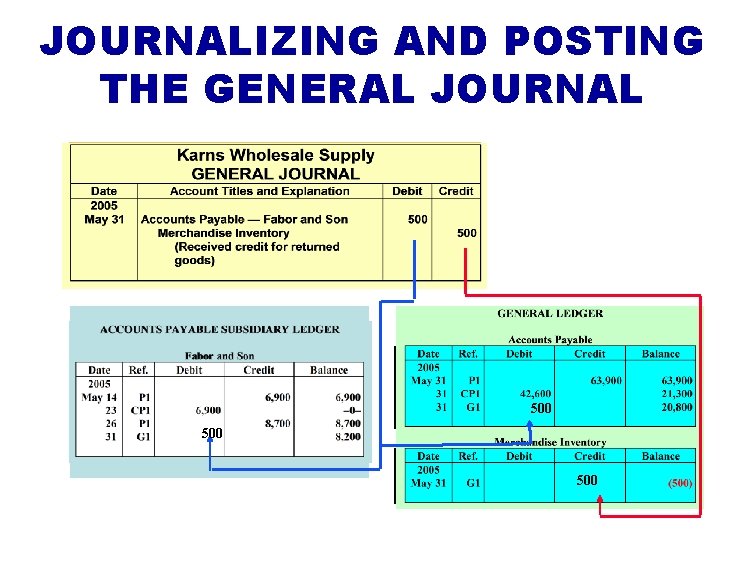
EFFECTS ON GENERAL JOURNAL • Only transactions that cannot be entered in a special journal are recorded in the general journal. • When the entry involves both control and subsidiary accounts: 1 In journalizing, control and subsidiary accounts must be identified. 2 In posting there must be a dual posting (to the control account and subsidiary ledger).
JOURNALIZING AND POSTING THE GENERAL JOURNAL 500 500
COPYRIGHT Copyright © 2005 John Wiley & Sons, Inc. All rights reserved. Reproduction or translation of this work beyond that permitted in Section 117 of the 1976 United States Copyright Act without the express written consent of the copyright owner is unlawful. Request for further information should be addressed to the Permissions Department, John Wiley & Sons, Inc. The purchaser may make back-up copies for his/her own use only and not for distribution or resale. The Publisher assumes no responsibility for errors, omissions, or damages, caused by the use of these programs or from the use of the information contained herein.
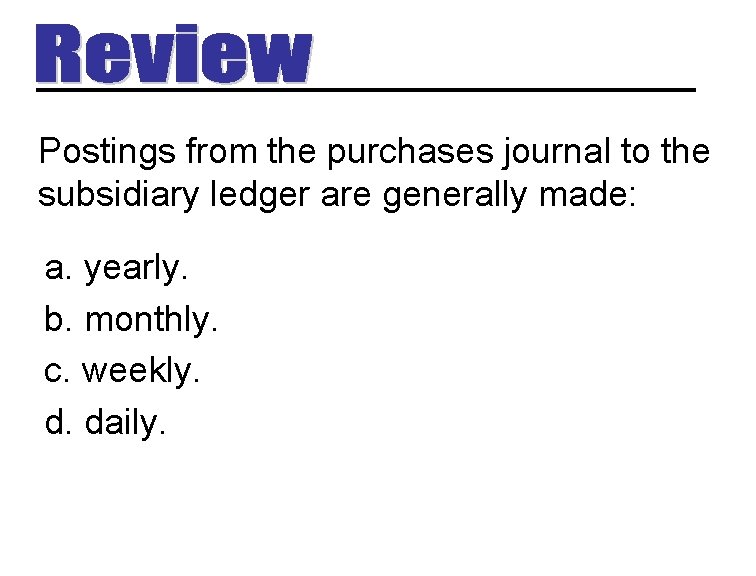
Postings from the purchases journal to the subsidiary ledger are generally made: a. yearly. b. monthly. c. weekly. d. daily.
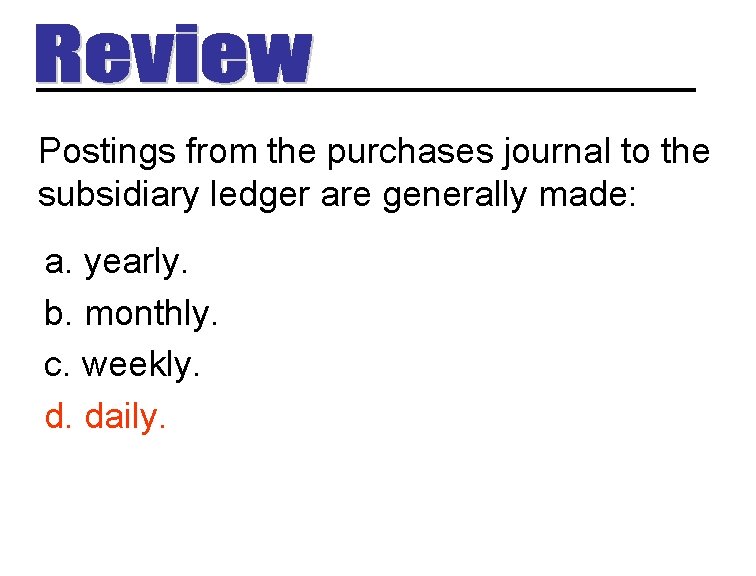
Postings from the purchases journal to the subsidiary ledger are generally made: a. yearly. b. monthly. c. weekly. d. daily.