
DAC 511 CORPORATE FINANCIAL REPORTING ANALYSIS BY GROUP

DAC 511: CORPORATE FINANCIAL REPORTING & ANALYSIS BY GROUP 5 CASH FLOW ANALYSIS
CASH FLOW ANALYSIS q INTRODUCTION q STATEMENT OF CASH FLOW q ANALYSIS IMPLICATIONS OF CASHFLOWS q ANALYSIS OF CASH FLOWS q SPECIALISED CASH FLOW RATIOS q ANALYSTICAL CASH FLOW WORKSHEET
INTRODUCTION OBJECTIVES Provide users of financial statements the basis for assessing the co. ability to generate cash and cash equivalents and needs of the company to utilize those cash flows. Used to make economic decisions. Provide historical movements in cash and cash equivalents.
INTRODUCTION DEFINITIONS Cash comprises of cash on hand, and demand deposits (including those in foreign currencies) net of bank overdrafts. Cash equivalents are short-term, highly liquid investments that are readily convertible to known amounts of cash and which are not subject to any significant risk of changes in value. They include short-term securities; investments that have a short maturity of three months or less from the specified redemption date
INTRODUCTION DEFINITIONS, CONT’D Cash flows: Net cash flows, or simply cash flows, refers to the current period's cash inflows less cash outflows Cash flows are different from accrual income measures of performance Cash flow measures recognize inflows when cash is received but not necessarily earned, and they recognize outflows when cash is paid but the expenses not necessarily incurred
INTRODUCTION SCOPE Unlike the statement of financial position and the statement of comprehensive income, which are required by the Companies Act Cap 486 The statement of cash flows is a requirement of the International Financial Reporting Standards (IFRSs), in particular IAS No. 7 ISA 7 requires the presentation of information about the historical changes in cash and cash equivalents of an entity by means of a statement of cash flows, which classifies cash flows during the period according to operating, investing, and financing activities.
INTRODUCTION Questions addressed by users of cash flow statements • How much cash is generated from/ used in operations? • What expenses are made with cash from ops? • How are dividends paid when confronting an operating loss? • What’s the source for cash for debt payments? • How is increase in investments financed? • What’s the source of cash for new plant assets? • What’s the use of cash received from new financing.
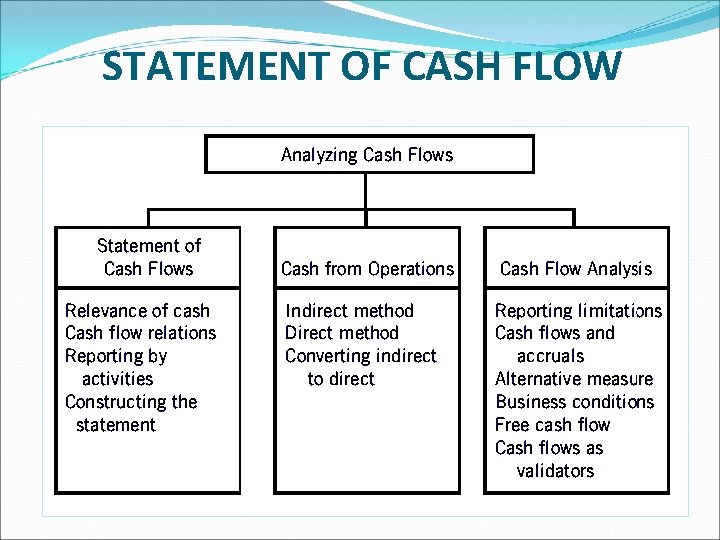
STATEMENT OF CASH FLOW § PURPOSE OF STATEMENT OF CASH FLOW § RELEVANCE OF CASH § REPORTING BY ACTIVITIES DETAILED § CONSTRUCTING THE STATEMENT OF CASH FLOW § SPECIAL TOPICS
STATEMENT OF CASH FLOW
STATEMENT OF CASH FLOW PURPOSE OF STATEMENT OF CASH FLOW Provide information about the sources and application of cash inflows and outflows for a given accounting period by separating them into three main business activities Operating Investing Financing It presents the changes in cash resulting from the business activities. It communicates information about the financial adaptability of an enterprise for a given period of time.
STATEMENT OF CASH FLOW RELEVANCE OF CASH Cash is the most liquid of assets and offers a company both liquidity and flexibility It is both the beginning and the end of a company's operating cycle Contrast: Accrual accounting and Cash Basis Accounting Recognize revenue when earned and expenses when incurred, Recognize revenues when cash is received and expenses when paid in cash; yet, net cash flow is the end measure of profitability
STATEMENT OF CASH FLOW RELEVANCE OF CASH It is cash, not income, that ultimately repays loans, replaces equipment, expands facilities, and pays dividends Cash flow analysis helps in assessing liquidity, solvency, and financial flexibility. Liquidity is the nearness to cash of assets and liabilities Solvency is the ability to pay liabilities when they mature Financial flexibility is the ability to react and adjust to opportunities and adversities
STATEMENT OF CASH FLOW REPORTING BY ACTIVITIES Operating activities are the main revenue-producing activities that are not investing or financing activities. They include: Cash receipts from sale of goods. Cash payments to and on behalf of employees. Cash receipts from royalties, fees, commissions & other revenue. Cash receipts and payments under contracts held for dealing/ trading purposes. Cash receipts and payments of insurance premium and benefits, annuities and other liabilities arising from policies underwritten. Cash payments/ refunds of income taxes, unless they can specifically be classified within the investment/financing activities.
STATEMENT OF CASH FLOW REPORTING BY ACTIVITIES Investing activities are those that represent expenditures that have been made for resources intended to generate future income and cash flows. E. gs Cash advances & loans to 3 rd parties. Charges arising from loan repayment and advances to 3 rd parties Payments for purchase of tangible fixed assets, intangible assets & payments to capitalized development costs & work performed by the company for its property, plant & equipment. Payments under forward contracts, futures, options & swap transactions except contracts held on grounds of dealing/ trading routine.
STATEMENT OF CASH FLOW REPORTING BY ACTIVITIES Financing activities are means of contributing, withdrawing, and servicing funds to support business activities. They include: Cash reimbursements for funds borrowed. Cash receipts for issuance of shares/equity instruments. Payments to owners for the purchase / redeem of shares Cash receipts from issuing debentures, loans, bonds, mortgage ballots and other funds borrowed.
STATEMENT OF CASH FLOW CONSTRUCTING THE Statement of Cash Flow Indirect Method Net income is adjusted for non-cash income (expense) items and accruals to yield cash flow from operations Direct Method Each income item is adjusted for its related accruals
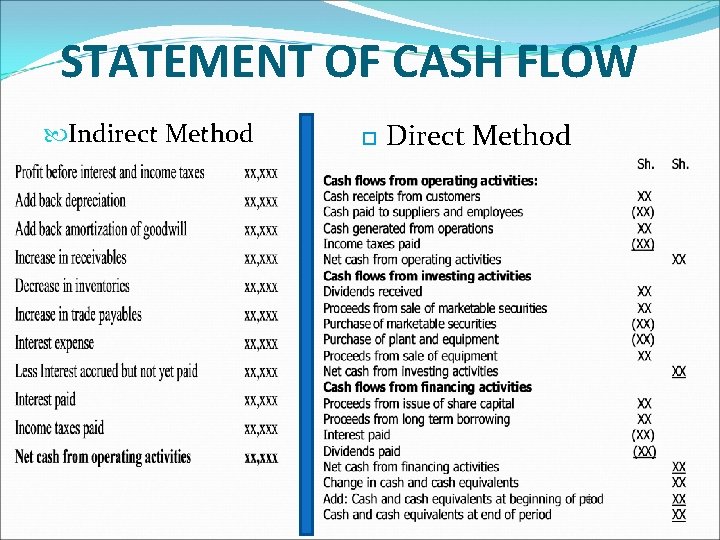
STATEMENT OF CASH FLOW Indirect Method Direct Method
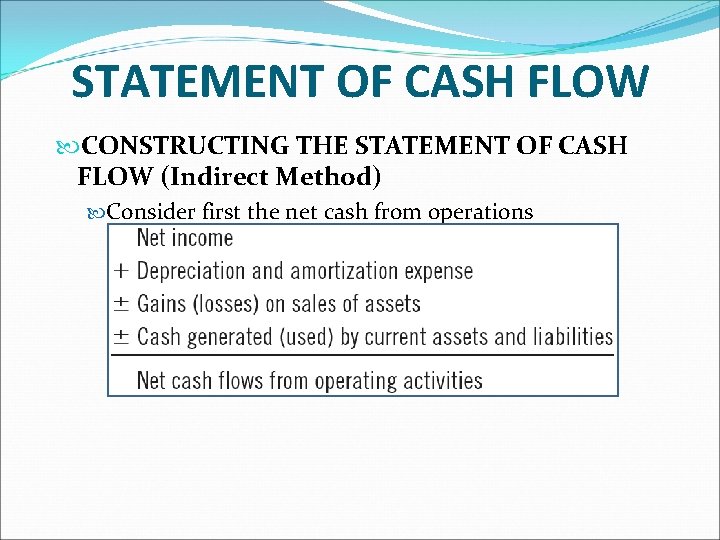
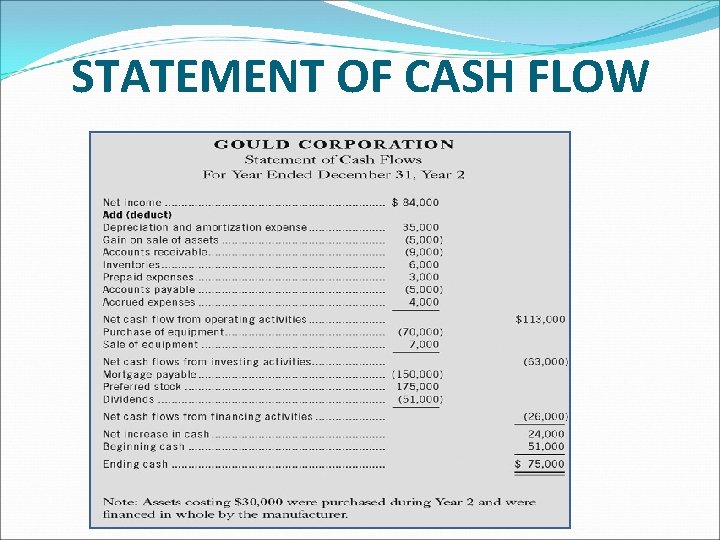
STATEMENT OF CASH FLOW CONSTRUCTING THE STATEMENT OF CASH FLOW (Indirect Method) Consider first the net cash from operations

STATEMENT OF CASH FLOW CONSTRUCTING THE CASH FLOW STATEMENT (Indirect Method) Depreciation and amortization add-back.
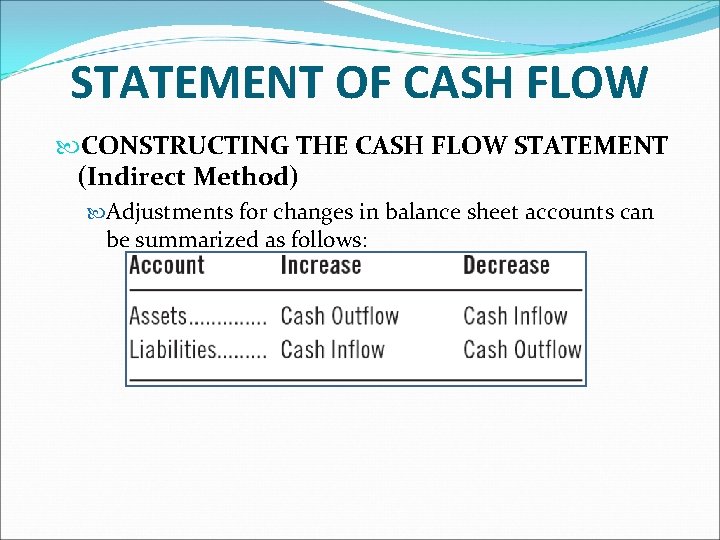
STATEMENT OF CASH FLOW CONSTRUCTING THE CASH FLOW STATEMENT (Indirect Method) Adjustments for changes in balance sheet accounts can be summarized as follows:
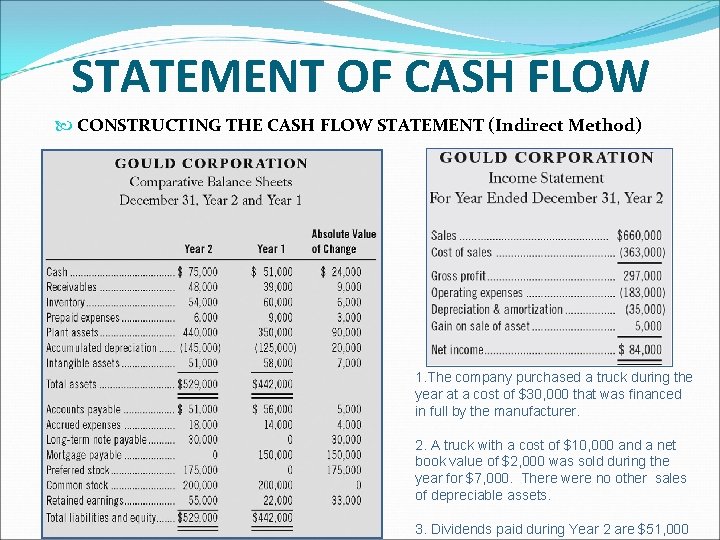
STATEMENT OF CASH FLOW CONSTRUCTING THE CASH FLOW STATEMENT (Indirect Method) 1. The company purchased a truck during the year at a cost of $30, 000 that was financed in full by the manufacturer. 2. A truck with a cost of $10, 000 and a net book value of $2, 000 was sold during the year for $7, 000. There were no other sales of depreciable assets. 3. Dividends paid during Year 2 are $51, 000
STATEMENT OF CASH FLOW STEPS IN CONSTRUCTING THE CASH FLOW STATEMENT q Start with Net Income q Adjust Net Income for non-cash expenses and gains q Recognize cash inflows (outflows) from changes in current assets and liabilities q Sum to yield net cash flows from operations q Changes in long-term assets yield net cash flows from investing activities q Changes in long-term liabilities and equity accounts yield net cash flows from financing activities q Sum cash flows from operations, investing, and financing activities to yield net change in cash q Add net change in cash to the beginning cash balance to yield ending
STATEMENT OF CASH FLOW
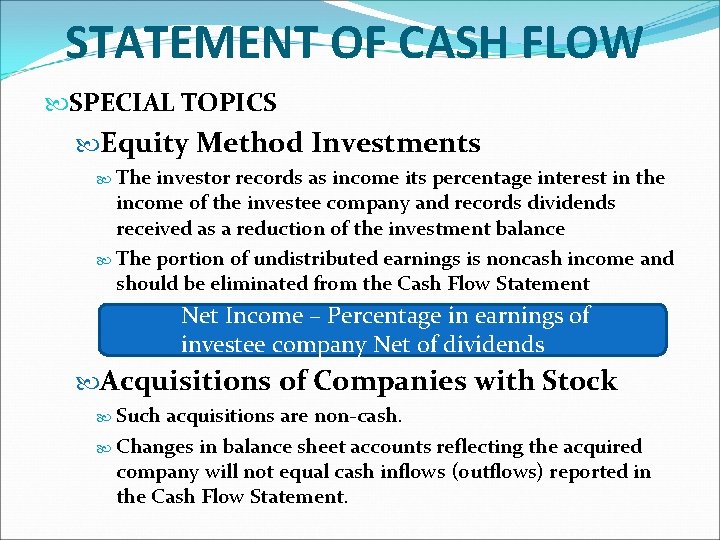
STATEMENT OF CASH FLOW SPECIAL TOPICS Equity Method Investments The investor records as income its percentage interest in the income of the investee company and records dividends received as a reduction of the investment balance The portion of undistributed earnings is noncash income and should be eliminated from the Cash Flow Statement Net Income – Percentage in earnings of investee company Net of dividends Acquisitions of Companies with Stock Such acquisitions are non-cash. Changes in balance sheet accounts reflecting the acquired company will not equal cash inflows (outflows) reported in the Cash Flow Statement.
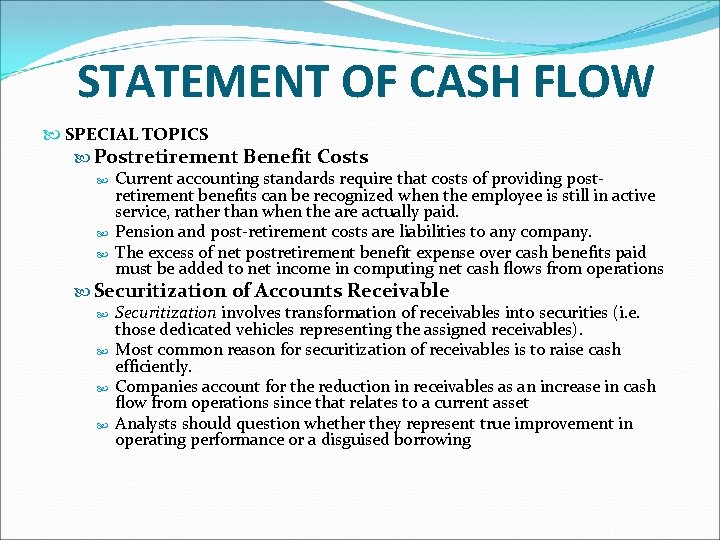
STATEMENT OF CASH FLOW SPECIAL TOPICS Postretirement Benefit Costs Current accounting standards require that costs of providing postretirement benefits can be recognized when the employee is still in active service, rather than when the are actually paid. Pension and post-retirement costs are liabilities to any company. The excess of net postretirement benefit expense over cash benefits paid must be added to net income in computing net cash flows from operations Securitization of Accounts Receivable Securitization involves transformation of receivables into securities (i. e. those dedicated vehicles representing the assigned receivables). Most common reason for securitization of receivables is to raise cash efficiently. Companies account for the reduction in receivables as an increase in cash flow from operations since that relates to a current asset Analysts should question whether they represent true improvement in operating performance or a disguised borrowing
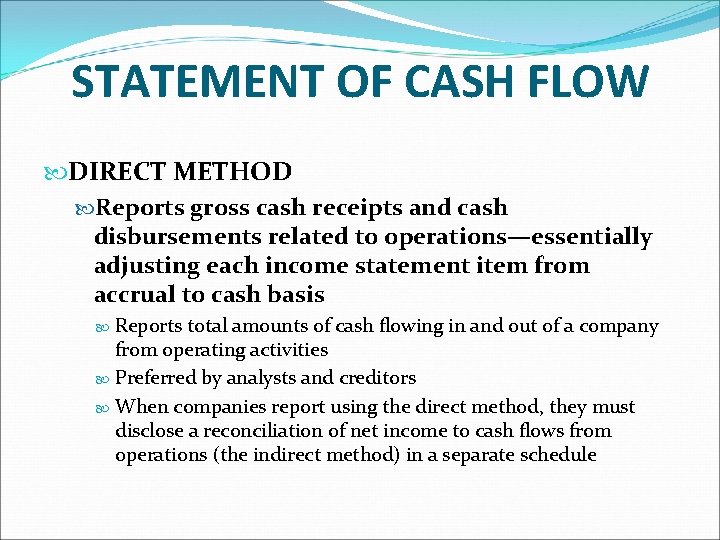
STATEMENT OF CASH FLOW DIRECT METHOD Reports gross cash receipts and cash disbursements related to operations—essentially adjusting each income statement item from accrual to cash basis Reports total amounts of cash flowing in and out of a company from operating activities Preferred by analysts and creditors When companies report using the direct method, they must disclose a reconciliation of net income to cash flows from operations (the indirect method) in a separate schedule
ANALYSIS IMPLICATIONS q LIMITATION OF CASH FLOWS q INTEPRETING CASH FLOW NET INCOME
ANALYSIS IMPLICATION LIMITATION OF CASH FLOWS Practice does not require separate disclosure of cash flows pertaining to either extraordinary items or discontinued operations. Interest and dividends received and interest paid are classified as operating cash flows Income taxes are classified as operating cash flows Removal of pretax (rather than after-tax) gains or losses on sale of plant or investments from operating activities distorts our analysis of both operating and investing activities
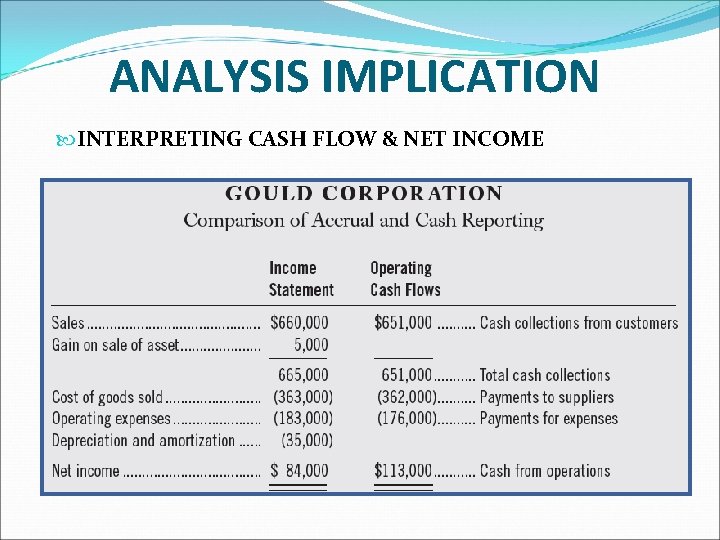
ANALYSIS IMPLICATION INTERPRETING CASH FLOW & NET INCOME
ANALYSIS IMPLICATION INTERPRETING CASH FLOW & NET INCOME Accounting accruals determining net income rely on estimates, deferrals, allocations, and valuations- Subjectivity CFO effectively serve as a check on net income, but not a substitute for net income. CFO exclude elements of revenues and expenses not currently affecting cash
ANALYSIS OF CASH FLOW q CASE ANALYSIS q INFERENCES FROM ANALYSIS OF CASH FLOW q ALTERNATIVE CASH FLOW MEASURES q COMPANY AND ECONOMIC CONDITIONS q FREE CASH FLOW q. CASH FLOWS AS VALIDATORS
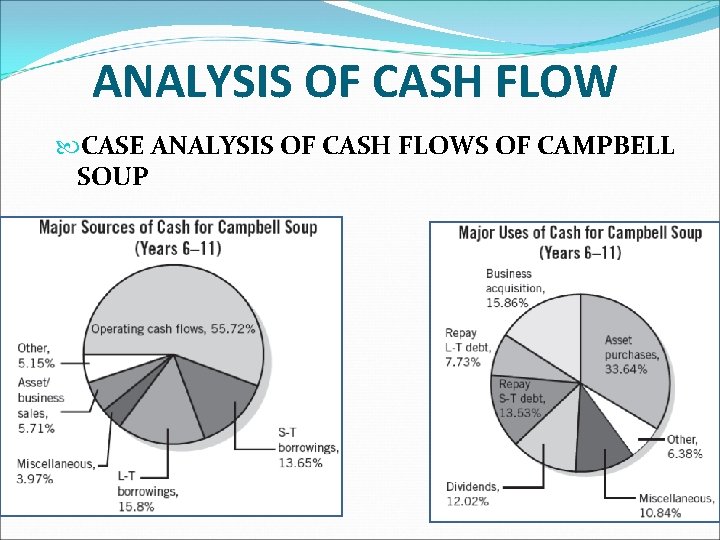
ANALYSIS OF CASH FLOW CASE ANALYSIS OF CASH FLOWS OF CAMPBELL SOUP
ANALYSIS OF CASH FLOW INFERENCES Where management committed its resources Where it reduced investments Where additional cash was derived from Where claims against the company were reduced Disposition of earnings and the investment of discretionary cash flows The size, composition, pattern, and stability of operating cash flows
ANALYSIS OF CASH FLOW ALTERNATIVE CASH FLOW MEASURES Net income plus depreciation and amortization EBITDA (earnings before interest, taxes, depreciation, and amortization The using up of long-term depreciable assets is a real expense that must not be ignored. The add-back of depreciation expense does not generate cash. It merely zeros out the noncash expense from net income as discussed above Net income plus depreciation ignores changes in working capital accounts that comprise the remainder of net cash flows from operating activities. Yet changes in working capital accounts often comprise a large portion of cash flows from operating activities
ANALYSIS OF CASH FLOW COMPANY AND ECONOMIC CONDITIONS While both successful and unsuccessful companies can experience problems with cash flows from operations, the reasons are markedly different. We must interpret changes in operating working capital items in light of economic circumstances. Inflationary conditions add to the financial burdens of companies and challenges for analysis.
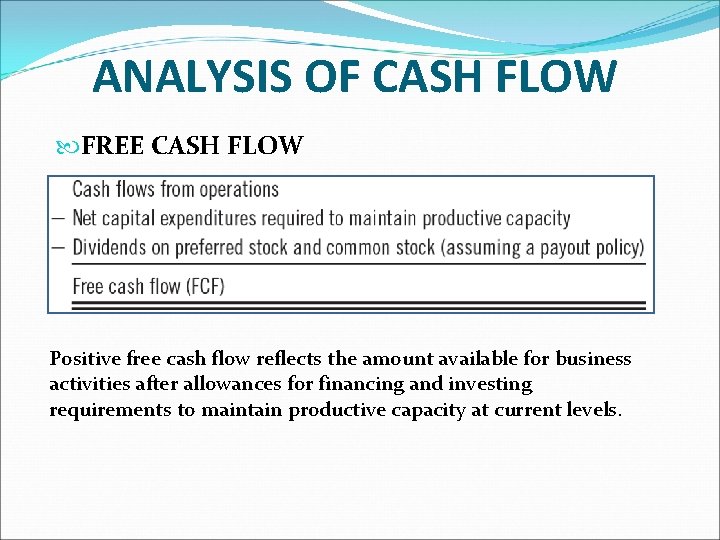
ANALYSIS OF CASH FLOW FREE CASH FLOW Positive free cash flow reflects the amount available for business activities after allowances for financing and investing requirements to maintain productive capacity at current levels.
ANALYSIS OF CASH FLOW AS VALIDATORS Cash Flow Statement provides us with important clues on: Feasibility of financing capital expenditures. Cash sources in financing expansion. Dependence on external financing. Future dividend policies. Ability in meeting debt service requirements. Financial flexibility to unanticipated needs/opportunities. Financial practices of management. Quality of earnings.
SPECIALISED CASH FLOW RATIO q VARIOUS RATIOS

SPECIALISED CASH FLOW RATIO Cash Flow Adequacy Ratio Three year sum of cash from operations Three year sum of capital expenditures, inventory additions and cash dividends Cash Reinvestment Ratio Operating cash flow- Dividends Goss Plant + investment +other assets+ working capital Operating Cash Flow Ratio Cash flow from operations Current liabilities
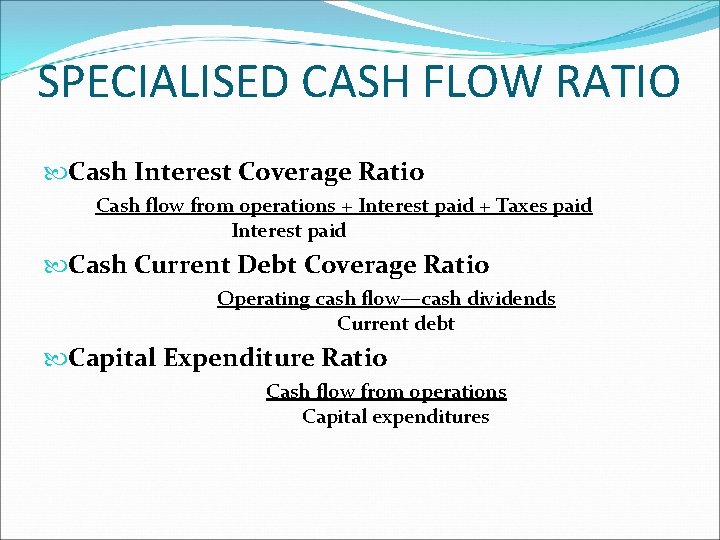
SPECIALISED CASH FLOW RATIO Cash Interest Coverage Ratio Cash flow from operations + Interest paid + Taxes paid Interest paid Cash Current Debt Coverage Ratio Operating cash flow—cash dividends Current debt Capital Expenditure Ratio Cash flow from operations Capital expenditures
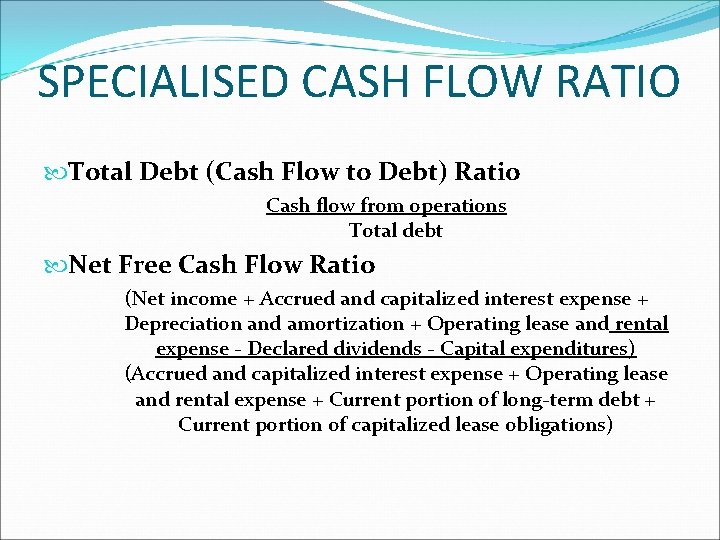
SPECIALISED CASH FLOW RATIO Total Debt (Cash Flow to Debt) Ratio Cash flow from operations Total debt Net Free Cash Flow Ratio (Net income + Accrued and capitalized interest expense + Depreciation and amortization + Operating lease and rental expense - Declared dividends - Capital expenditures) (Accrued and capitalized interest expense + Operating lease and rental expense + Current portion of long-term debt + Current portion of capitalized lease obligations)
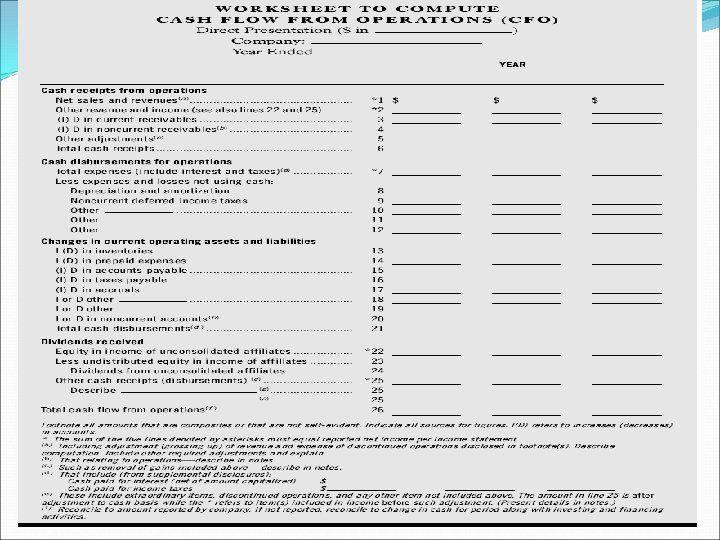
ANALYTICAL CASHFLOW WORK SHEET q SAMPLE WORKSHEET

THE END……. .
- Slides: 44