Warren Hills Regional Middle School Gifted and Talented
- Slides: 33
Warren Hills Regional Middle School Gifted and Talented Program Dawn A. Moore District Director of Curriculum and Instruction; -------Lee Turkowski, WHRMS Principal; -------Michael Perruso, WHRMS Gifted and Talented Teacher; and -------Special Guest: Nicole Waicunas, Schoolwide Enrichment Model Outreach Coordinator, University of
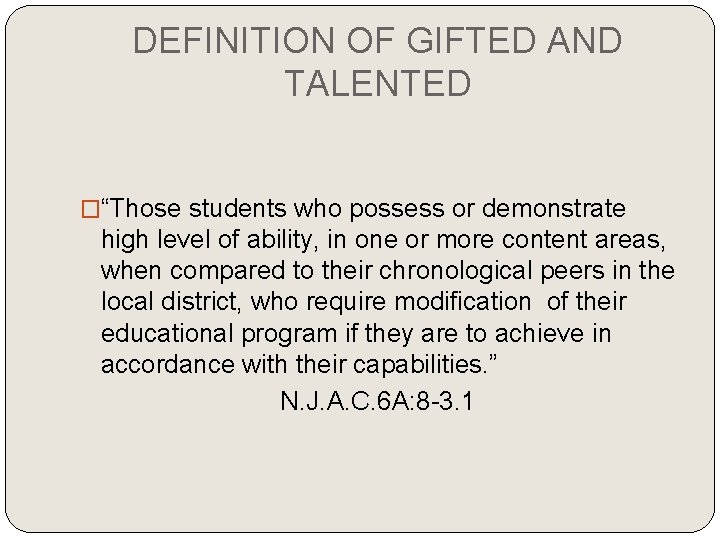
DEFINITION OF GIFTED AND TALENTED �“Those students who possess or demonstrate high level of ability, in one or more content areas, when compared to their chronological peers in the local district, who require modification of their educational program if they are to achieve in accordance with their capabilities. ” N. J. A. C. 6 A: 8 -3. 1
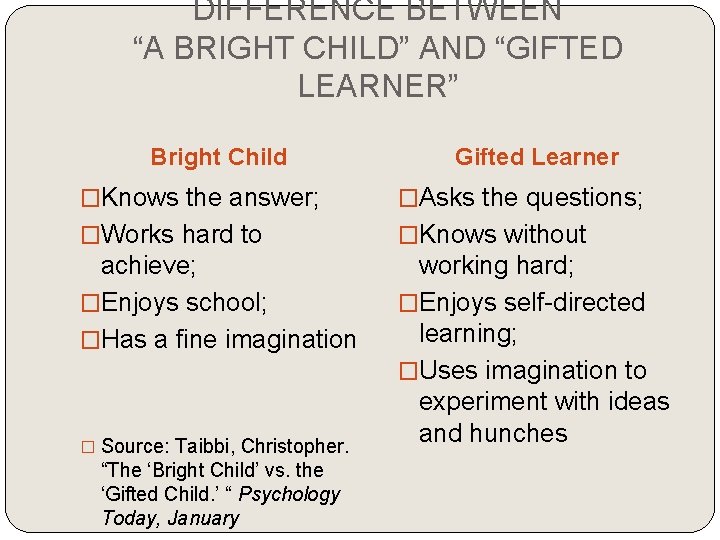
DIFFERENCE BETWEEN “A BRIGHT CHILD” AND “GIFTED LEARNER” Bright Child Gifted Learner �Knows the answer; �Asks the questions; �Works hard to �Knows without achieve; �Enjoys school; �Has a fine imagination working hard; �Enjoys self-directed learning; �Uses imagination to experiment with ideas and hunches � Source: Taibbi, Christopher. “The ‘Bright Child’ vs. the ‘Gifted Child. ’ “ Psychology Today, January
THE GIFTED AND TALENTED MODEL SCHOOLWIDE ENRICHMENT MODEL (SEM) By Joseph S. Renzulli, Ed. D. and Sally M. Reis, Ph. D http: //gifted. uconn. edu/schoolwideenrichment-model/sem 3 rd/
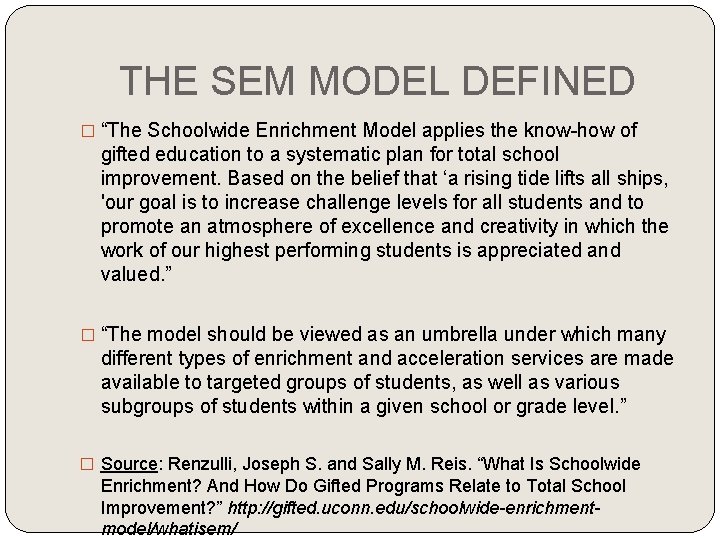
THE SEM MODEL DEFINED � “The Schoolwide Enrichment Model applies the know-how of gifted education to a systematic plan for total school improvement. Based on the belief that ‘a rising tide lifts all ships, 'our goal is to increase challenge levels for all students and to promote an atmosphere of excellence and creativity in which the work of our highest performing students is appreciated and valued. ” � “The model should be viewed as an umbrella under which many different types of enrichment and acceleration services are made available to targeted groups of students, as well as various subgroups of students within a given school or grade level. ” � Source: Renzulli, Joseph S. and Sally M. Reis. “What Is Schoolwide Enrichment? And How Do Gifted Programs Relate to Total School Improvement? ” http: //gifted. uconn. edu/schoolwide-enrichmentmodel/whatisem/
GIFTED AND TALENTED IDENTIFICATION PROCESS AND CREATING AN ELIGIBILITY PROFILE
Determination of Gifted and Talented Status— Multiple Measures � 1. Nomination Form with Narrative and Specific Examples—parent/guardian, teacher, student, self � 2. Measurement of Academic Progress (MAP) —Computerized Achievement Test Data from the MAP assessments is included as part of the placement review process along with other multiple measures. Students are asked to apply their knowledge of the learning standards in a performance-based design, similar to the college and career assessments, such as PARCC.
Determination of Gifted and Talented Status— Multiple Measures (continued) � 3. Slocumb-Payne Teacher Perception Inventory— Two content area teachers, trained in the use of this instrument, complete the inventory. The items in the inventory are derived from the research literature dealing with characteristics of gifted and creative persons. � 4. Student Interviews— Questions revolving around Knowledge, Task Commitment, and Creativity
SCHOOLWIDE ENRICHMENT MODEL (SEM) TYPES OF ENRICHMENT– I, II, AND III
TYPE I ENRICHMENT �Designed to expose students to a wide variety of discipline, topics, occupations, hobbies, persons, places and events not typically covered in the regular curriculum, and therefore, stimulating new interests leading to Type II Enrichment.
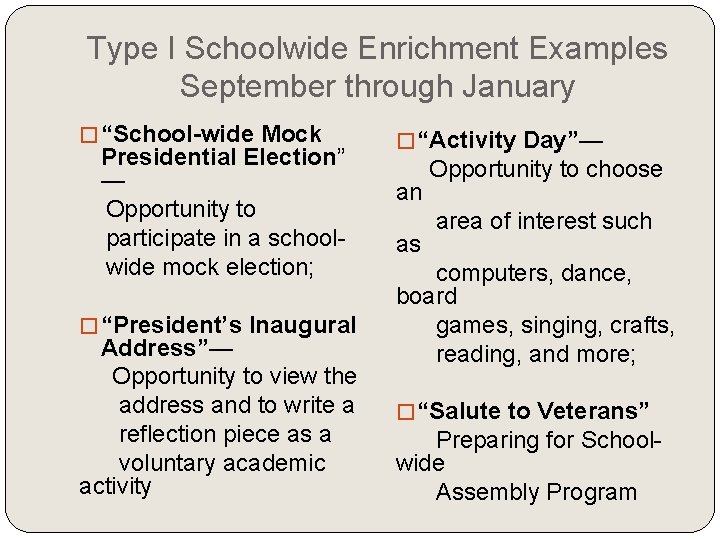
Type I Schoolwide Enrichment Examples September through January � “School-wide Mock Presidential Election” — Opportunity to participate in a schoolwide mock election; � “President’s Inaugural Address”— Opportunity to view the address and to write a reflection piece as a voluntary academic activity � “Activity Day”— an as Opportunity to choose area of interest such computers, dance, board games, singing, crafts, reading, and more; � “Salute to Veterans” Preparing for Schoolwide Assembly Program
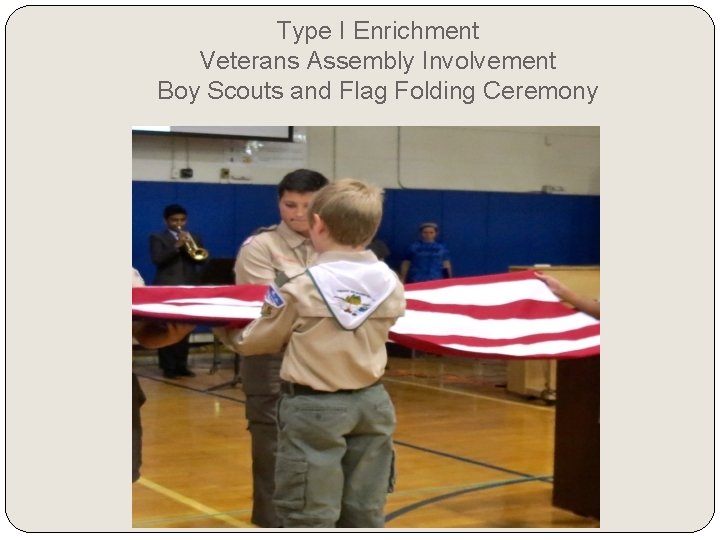
Type I Enrichment Veterans Assembly Involvement Boy Scouts and Flag Folding Ceremony
GIFTED AND TALENTED STANDARDS CONNECTING TO TYPE I, II, AND II ENRICHMENT
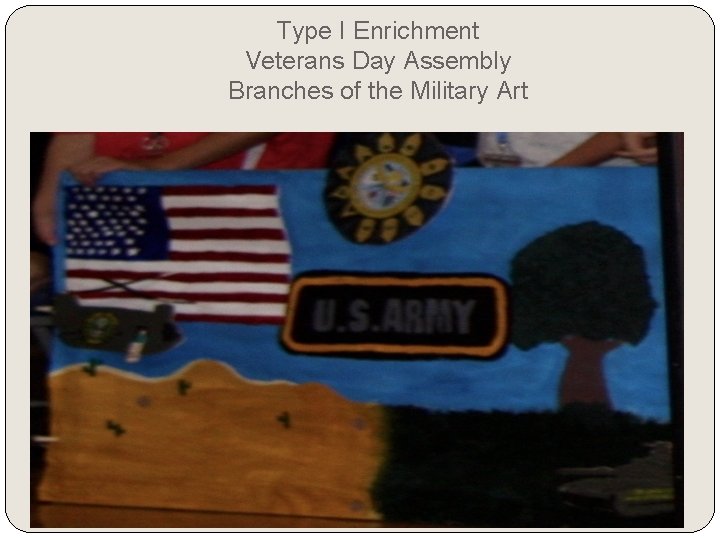
Type I Enrichment Veterans Day Assembly Branches of the Military Art
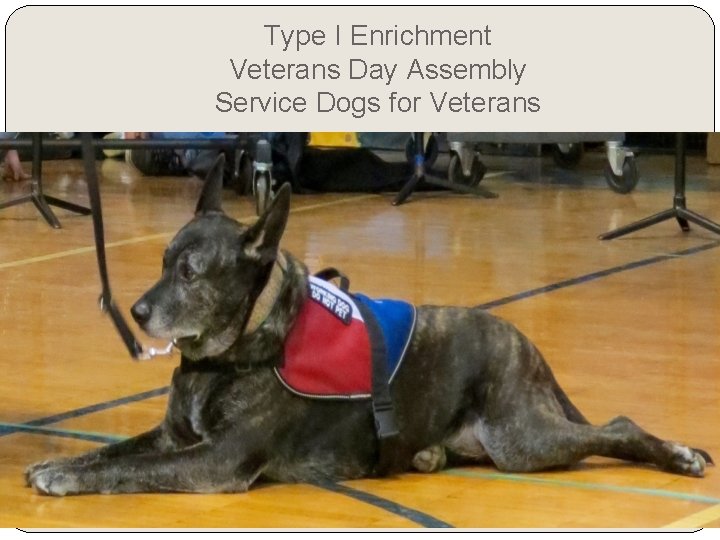
Type I Enrichment Veterans Day Assembly Service Dogs for Veterans
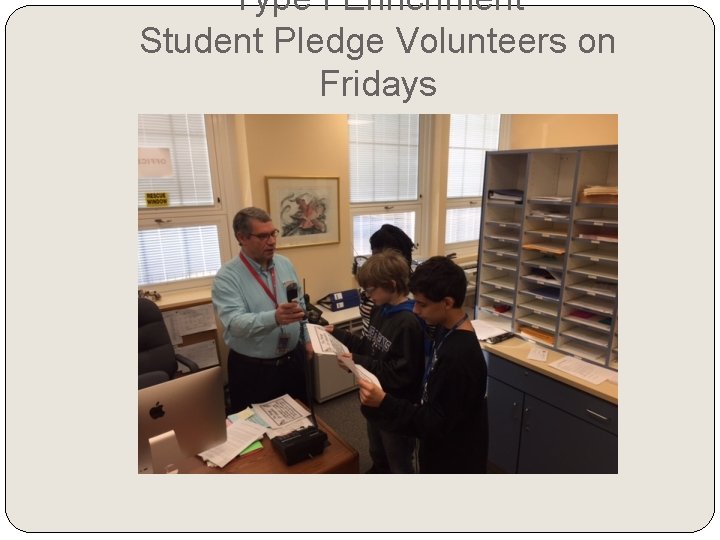
Type I Enrichment Student Pledge Volunteers on Fridays
Type II Enrichment �Designed to promote the development of thinking and feeling processes and usually provided to groups of students in their classroom or in enrichment programs.
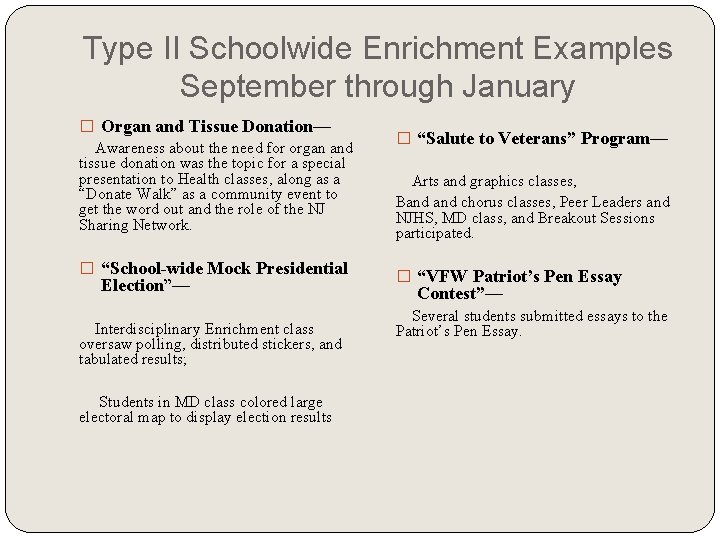
Type II Schoolwide Enrichment Examples September through January � Organ and Tissue Donation— Awareness about the need for organ and tissue donation was the topic for a special presentation to Health classes, along as a “Donate Walk” as a community event to get the word out and the role of the NJ Sharing Network. � “School-wide Mock Presidential Election”— Interdisciplinary Enrichment class oversaw polling, distributed stickers, and tabulated results; Students in MD class colored large electoral map to display election results � “Salute to Veterans” Program— Arts and graphics classes, Band chorus classes, Peer Leaders and NJHS, MD class, and Breakout Sessions participated. � “VFW Patriot’s Pen Essay Contest”— Several students submitted essays to the Patriot’s Pen Essay.
Type III Enrichment �Involves students becoming interested in pursuing a self-selected area and committing the time necessary for advanced content acquisition
Type III Examples �“School-wide Activity Day— Students selected enrichment activities based on their interest be it music, sports, dance, Pillars of Character related movies, computers, reading, arts and craft, and more. �“Independent Interest Project”— The identified Gifted and Talented Group completed an interest inventory to gather input about their specific interests in order to progress towards an independent project.
STANDARDS CONNECTING TO GIFTED AND TALENTED STANDARDS
National Gifted Program Standards Developed by the NATIONAL ASSOCIATION FOR GIFTED CHILDREN— [NAGC] �URL: https: //www. nagc. org/ �Examples: 4. 3. 2 Educators provide opportunities for interaction with intellectual and artistic/creative peers as well as with chronological-age peers; 5. 1. 2 Educators regularly use enrichment options to extend and deepen learning opportunities within and outside of the school setting;
THE 2016 -2017 IDENTIFIED GIFTED AND TALENTED GROUP DIMENSIONS OF LEARNING FRAMEWORK AND MOVING TOWARDS INDEPENDENT INQUIRY AND INVESTIGATION
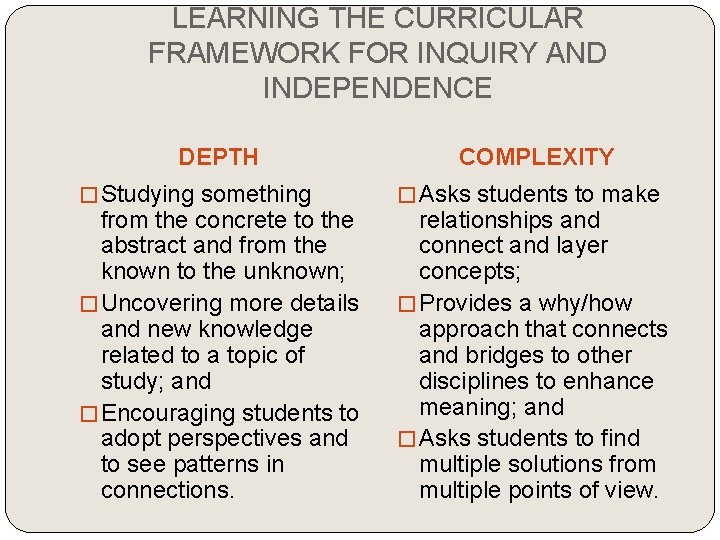
LEARNING THE CURRICULAR FRAMEWORK FOR INQUIRY AND INDEPENDENCE DEPTH � Studying something from the concrete to the abstract and from the known to the unknown; � Uncovering more details and new knowledge related to a topic of study; and � Encouraging students to adopt perspectives and to see patterns in connections. COMPLEXITY � Asks students to make relationships and connect and layer concepts; � Provides a why/how approach that connects and bridges to other disciplines to enhance meaning; and � Asks students to find multiple solutions from multiple points of view.
Student Interest Inventory �Helps identified students become more familiar with their interest and potential interests; �Example: Imagine that you have been assigned to a space station for your next school year. You are permitted to take a few personal possessions, such as digital devices, books, games, hobbies, projects, sketching pads, etc. , with you to help you spend your free time. List the things you would take.
Facilitating the Gifted and Talented Group The times to meet with the gifted and talented teacher varies and may take several forms, including, but not limited to: �Mini-convocations �Floating “lunch date” �Small groups �Pull-out from various elective classes �Individual time �Push-in with the English Language Arts, Grade 8 Pilot Team for curricular extensions
THE 2017 -2018 GIFTED AND TALENTED PROGRAM IDENTIFICATION PROCESS
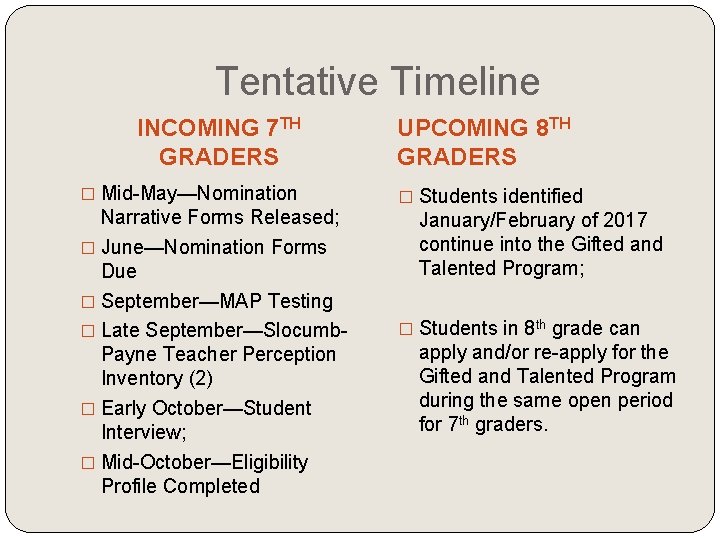
Tentative Timeline INCOMING 7 TH GRADERS � Mid-May—Nomination Narrative Forms Released; � June—Nomination Forms Due � September—MAP Testing � Late September—Slocumb. Payne Teacher Perception Inventory (2) � Early October—Student Interview; � Mid-October—Eligibility Profile Completed UPCOMING 8 TH GRADERS � Students identified January/February of 2017 continue into the Gifted and Talented Program; � Students in 8 th grade can apply and/or re-apply for the Gifted and Talented Program during the same open period for 7 th graders.
OTHER ENRICHMENT OPPORTUNITIES HORIZONS PROGRAM, MAGGIE DEVINE COORDINATOR; INTERDISCIPLINARY ENRICHMENT SEMESTER CLASS
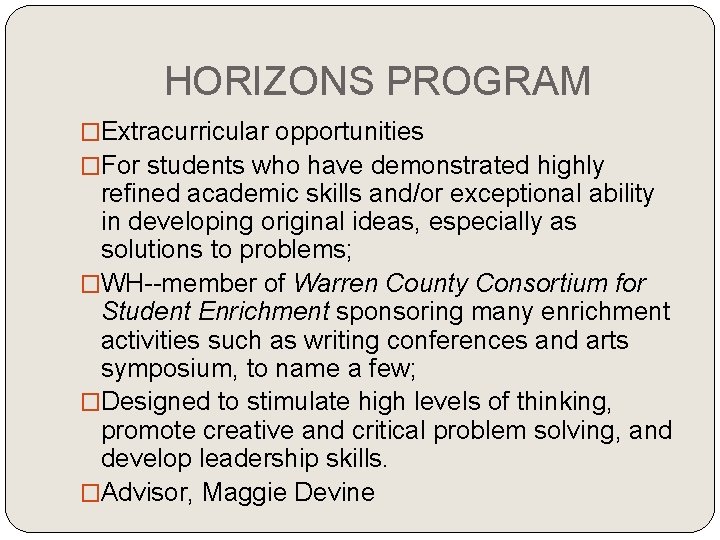
HORIZONS PROGRAM �Extracurricular opportunities �For students who have demonstrated highly refined academic skills and/or exceptional ability in developing original ideas, especially as solutions to problems; �WH--member of Warren County Consortium for Student Enrichment sponsoring many enrichment activities such as writing conferences and arts symposium, to name a few; �Designed to stimulate high levels of thinking, promote creative and critical problem solving, and develop leadership skills. �Advisor, Maggie Devine
Elective for Students Interdisciplinary Enrichment Class �Is NOT only for identified gifted and talented students; �Designed to provide high-level academic experiences utilizing topical themes combined with technology; �Qualified students identified through multiple measures such as grades, standardized test scores, and teacher recommendations; �Limited space in course; �Half-year course and scheduled as a class; and �If taken in 7 th grade, may not be repeated in 8 th grade.
RESOURCES WHRSD CONTACT PERSONNEL AND INFORMATIVE MATERIALS
FOR MORE INFORMATION CONTACTS � Dawn A. Moore, Program Director-moored@warrenhills. org � Lee Turkowski, Program Implementation-turkowskil@warrenhills. org � Mike Perruso, Gifted and Talented Teacher-perrusom@warrenhills. org RESOURCES �www. warrenhills. org �https: //www. nagc. org/ resourcespublications/resources -parents �http: //gifted. uconn. edu / �https: //www. giftedstud y. org/resources/