Reading and Phonics Lickey Hills Primary School and
- Slides: 77
Reading and Phonics Lickey Hills Primary School and Nursery November 2017
Aims: ● ● ● ● Reading at our school Phonics at our school How we teach reading in Key Stage One and EYFS The expectations at end of Key Stage One How we teach reading in Key Stage Two The expectations at end of Key Stage Two How parents can help at home
Reading at LHPSN At LHPSN we understand that reading is a fundamental skill that underpins almost everything that we do. We also know that reading for pleasure makes a big difference to your children’s educational performance. We believe that reading should be an enjoyable experience where children are able to enjoy a wide variety of genres, discover new learning and stimulate their imagination and curiosity. Reading is one of the main key areas we teach daily alongside writing and maths.
Phonics at LHPSN
Daily Phonics • Every day, across KS 1 and EYFS, the children have a 20 minute session of phonics. • Children work in groups at the appropriate phase for them. • In KS 2 some children continue to learn phonics. • We use a fast paced approach. • Lessons encompass a range of games, songs and rhymes. • We use the Letters and Sounds planning document to support the teaching of phonics. • There are 5 phonics phases which the children work through at their own pace, before moving onto spelling rules.
Phonics is all about using skills for reading and spelling + knowledge of the alphabet Learning phonics will help your child to become a good reader and writer.
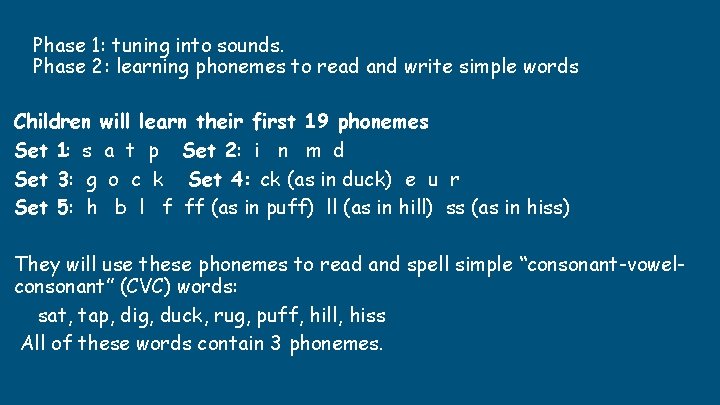
Phase 1: tuning into sounds. Phase 2: learning phonemes to read and write simple words Children will learn their first 19 phonemes: Set 1: s a t p Set 2: i n m d Set 3: g o c k Set 4: ck (as in duck) e u r Set 5: h b l f ff (as in puff) ll (as in hill) ss (as in hiss) They will use these phonemes to read and spell simple “consonant-vowelconsonant” (CVC) words: sat, tap, dig, duck, rug, puff, hill, hiss All of these words contain 3 phonemes.
Saying the sounds Sounds should be articulated clearly and precisely. We use ‘soft sounds’ or ‘pure sounds’ and discourage the use of ‘Schwa’ (adding ‘uh’ onto the end of a sound).
Phonics Glossary Your child will learn to use the term: Blending Putting the sounds together to read a word. Children need to be able to hear the separate sounds in a word and then blend them together to say the whole word.
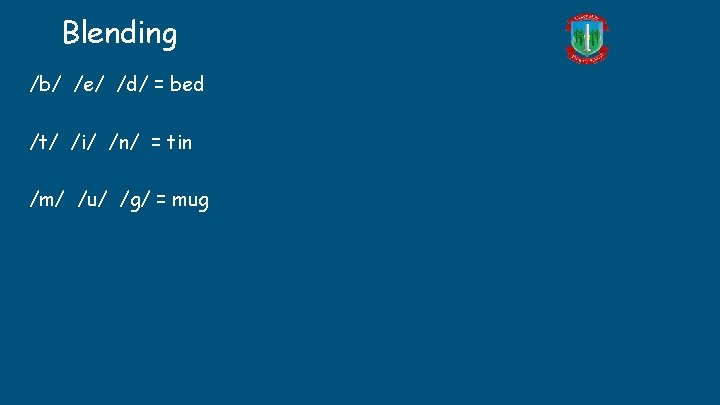
Blending /b/ /e/ /d/ = bed /t/ /i/ /n/ = tin /m/ /u/ /g/ = mug
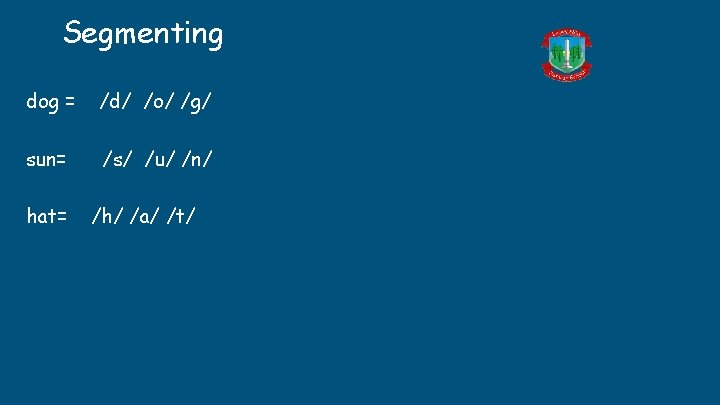
Phonics Glossary Your child will learn to use the term: Segmenting Breaking up a word into its sounds. Children need to be able to hear a whole word and say every sound that they hear.
Segmenting dog = /d/ /o/ /g/ sun= /s/ /u/ /n/ hat= /h/ /a/ /t/
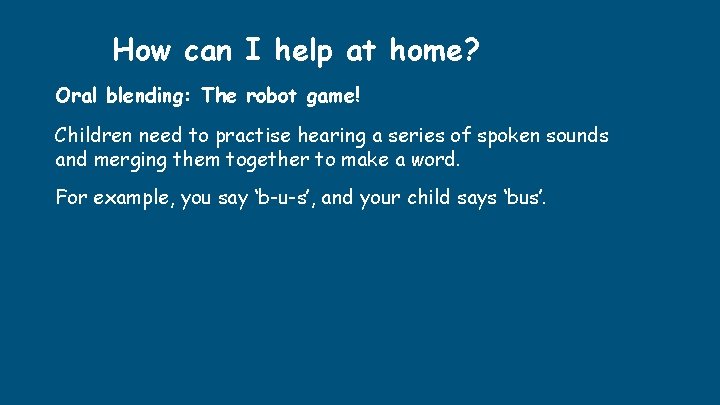
How can I help at home? Oral blending: The robot game! Children need to practise hearing a series of spoken sounds and merging them together to make a word. For example, you say ‘b-u-s’, and your child says ‘bus’.
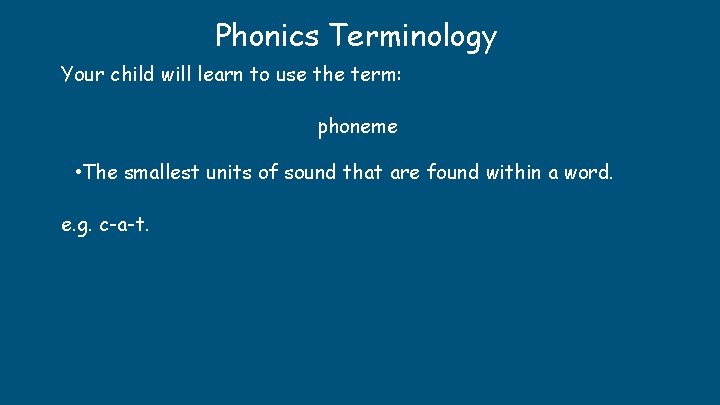
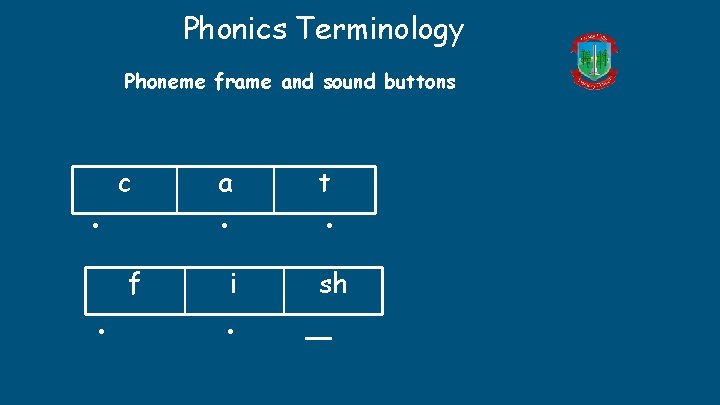
Phonics Terminology Your child will learn to use the term: phoneme • The smallest units of sound that are found within a word. e. g. c-a-t.
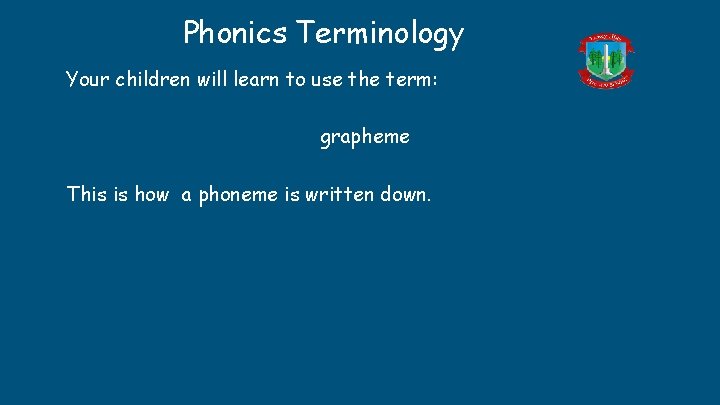
Phonics Terminology Your children will learn to use the term: grapheme This is how a phoneme is written down.
Phonics Terminology Phoneme frame and sound buttons . . c f a . i . t . sh _
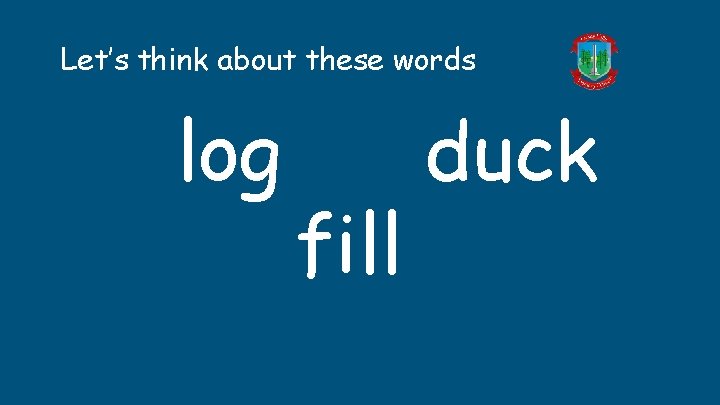
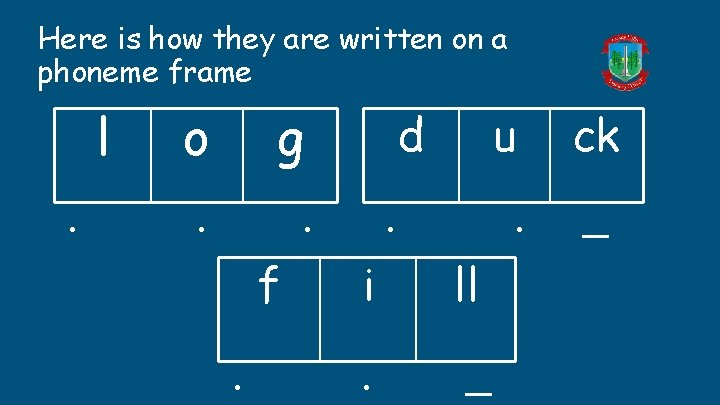
Let’s think about these words log fill duck
Here is how they are written on a phoneme frame l. o g . . f. d. i. ll _ u ck . _
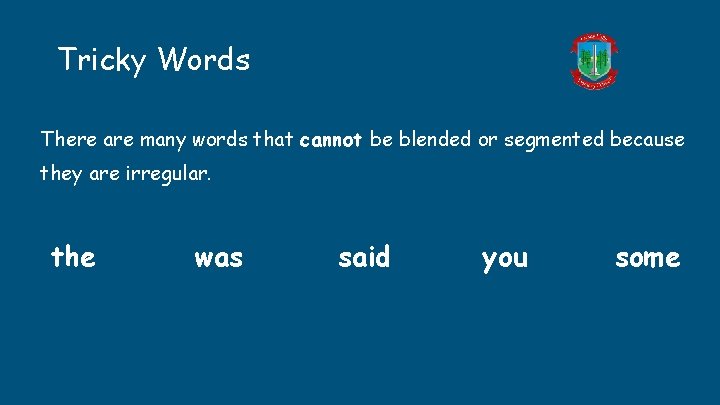
Tricky Words There are many words that cannot be blended or segmented because they are irregular. the was said you some
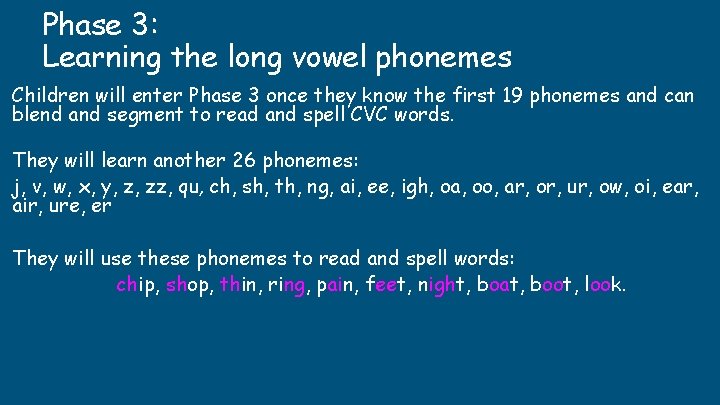
Phase 3: Learning the long vowel phonemes Children will enter Phase 3 once they know the first 19 phonemes and can blend and segment to read and spell CVC words. They will learn another 26 phonemes: j, v, w, x, y, z, zz, qu, ch, sh, th, ng, ai, ee, igh, oa, oo, ar, or, ur, ow, oi, ear, air, ure, er They will use these phonemes to read and spell words: chip, shop, thin, ring, pain, feet, night, boat, boot, look.
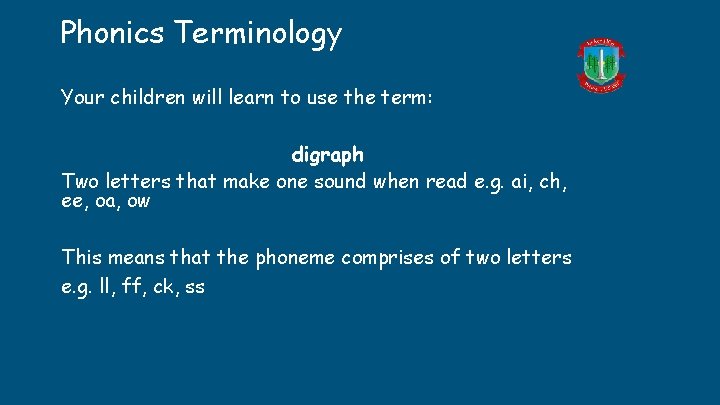
Phonics Terminology Your children will learn to use the term: digraph Two letters that make one sound when read e. g. ai, ch, ee, oa, ow This means that the phoneme comprises of two letters e. g. ll, ff, ck, ss
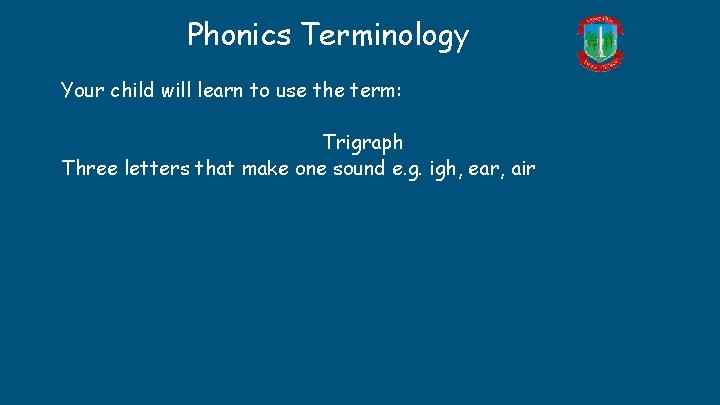
Phonics Terminology Your child will learn to use the term: Trigraph Three letters that make one sound e. g. igh, ear, air
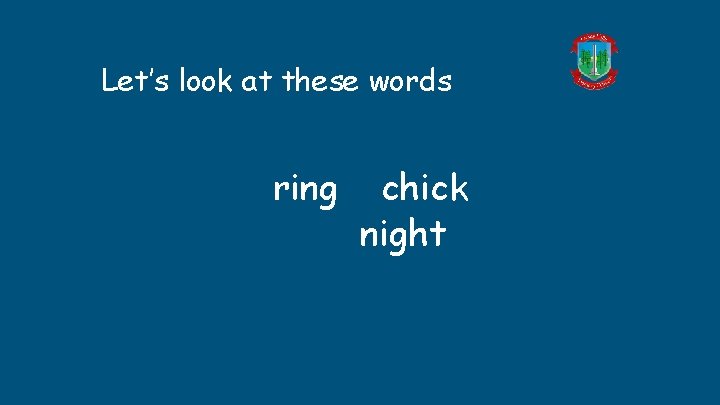
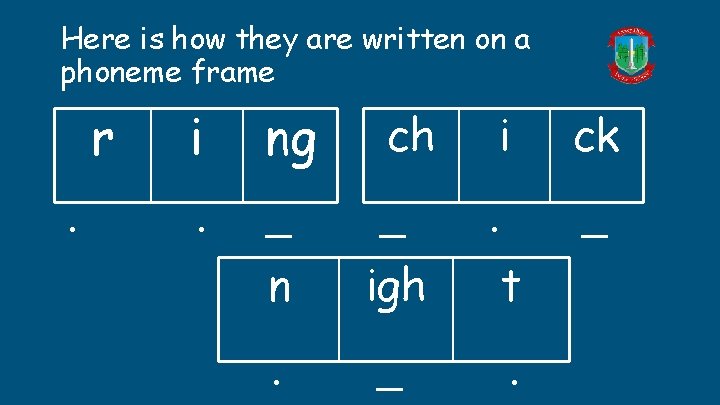
Let’s look at these words ring chick night
Here is how they are written on a phoneme frame r. i ng ch i ck . _ _ . _ n igh t . _ .
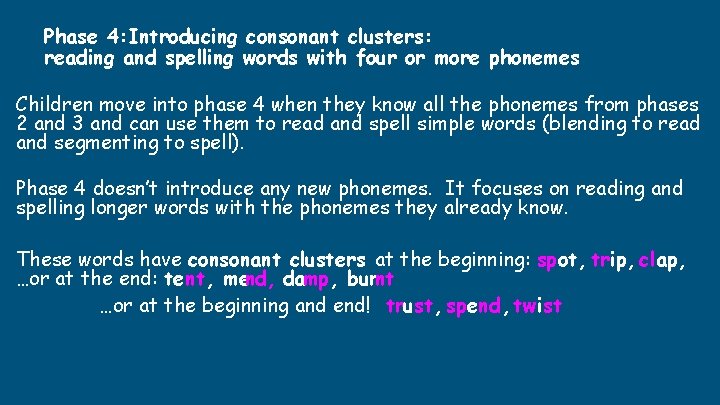
Phase 4: Introducing consonant clusters: reading and spelling words with four or more phonemes Children move into phase 4 when they know all the phonemes from phases 2 and 3 and can use them to read and spell simple words (blending to read and segmenting to spell). Phase 4 doesn’t introduce any new phonemes. It focuses on reading and spelling longer words with the phonemes they already know. These words have consonant clusters at the beginning: spot, trip, clap, …or at the end: tent, mend, damp, burnt …or at the beginning and end! trust, spend, twist
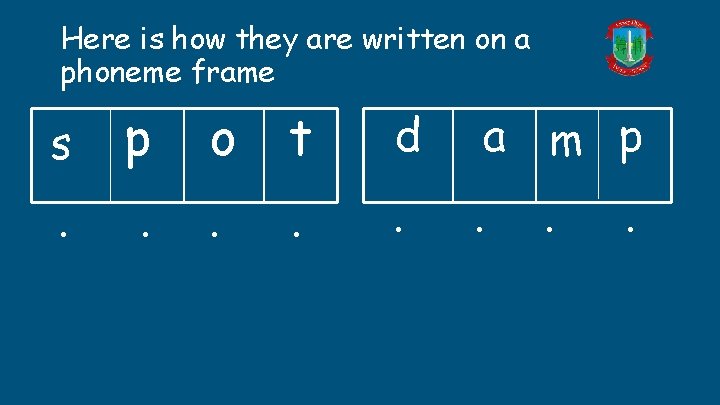
Let’s look at these words spot damp
Here is how they are written on a phoneme frame s p o t d a m p . . . .
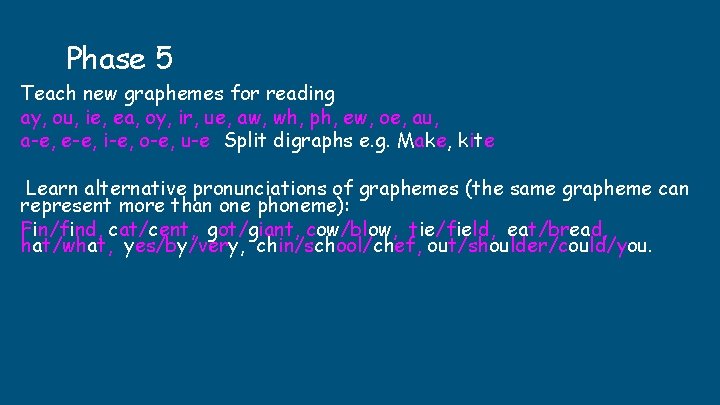
Phase 5 Teach new graphemes for reading ay, ou, ie, ea, oy, ir, ue, aw, wh, ph, ew, oe, au, a-e, e-e, i-e, o-e, u-e Split digraphs e. g. Make, kite Learn alternative pronunciations of graphemes (the same grapheme can represent more than one phoneme): Fin/find, cat/cent, got/giant, cow/blow, tie/field, eat/bread, hat/what, yes/by/very, chin/school/chef, out/shoulder/could/you.
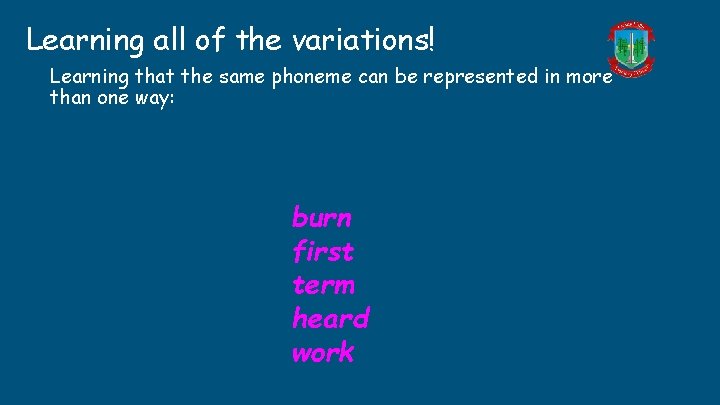
Learning all of the variations! Learning that the same phoneme can be represented in more than one way: burn first term heard work
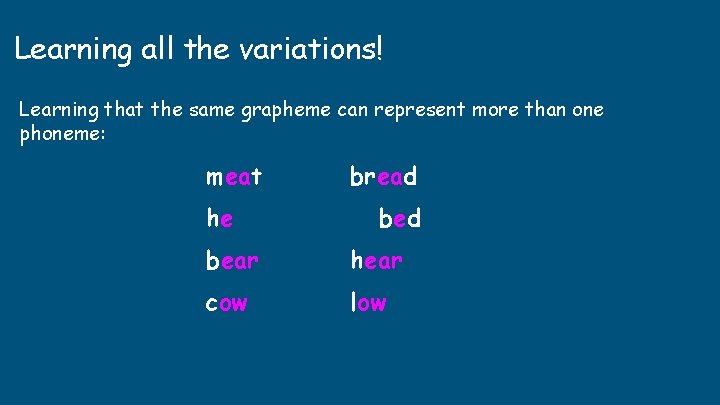
Learning all the variations! Learning that the same grapheme can represent more than one phoneme: meat he bread bear hear cow low
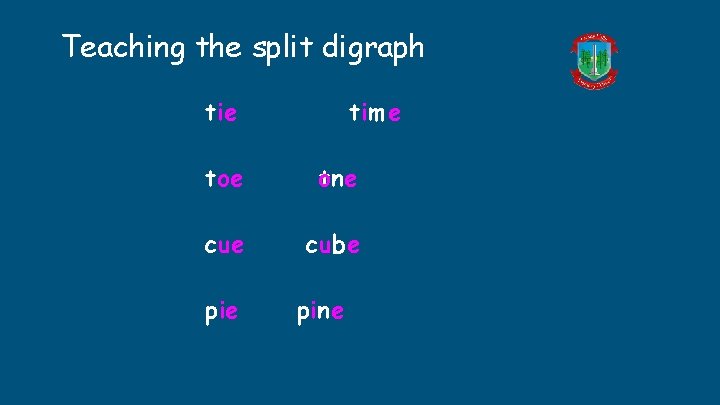
Teaching the split digraph tie time toe otne cube pine
After phase 5 - spelling rules Children look at syllables, base words, and mnemonics. Children will learn about past tense, rules for adding prefixes and suffixes.
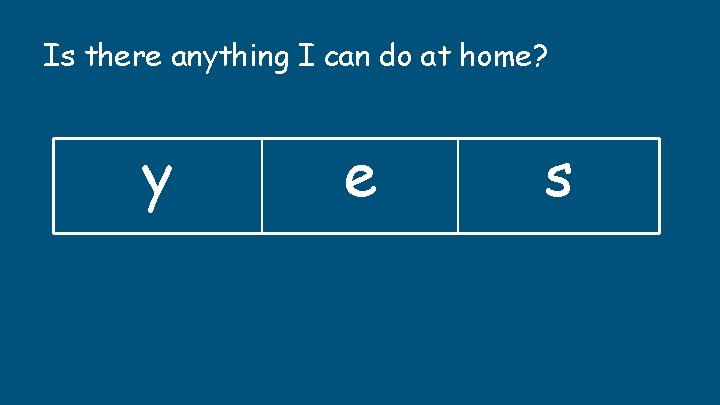
Is there anything I can do at home? y e s
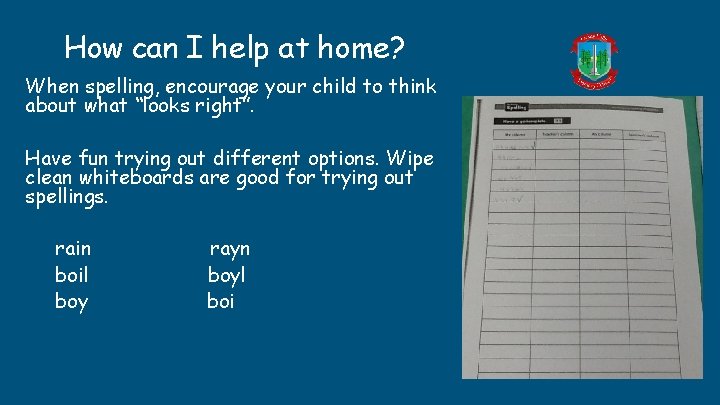
How can I help at home? When spelling, encourage your child to think about what “looks right”. Have fun trying out different options. Wipe clean whiteboards are good for trying out spellings. rain boil boy rayn boyl boi
At home Help your child practise their phonemes. Encourage the ‘soft sounds’. Play games in the car – what sound does that start with? Can we segment and blend the word? Useful websites: www. phonicsplay. co. uk www. letters-and-sounds. com
This is a typical game that we would use as a warm up in our phonics lessons.
Thank you! Please do come and see us if you need further guidance with phonics.
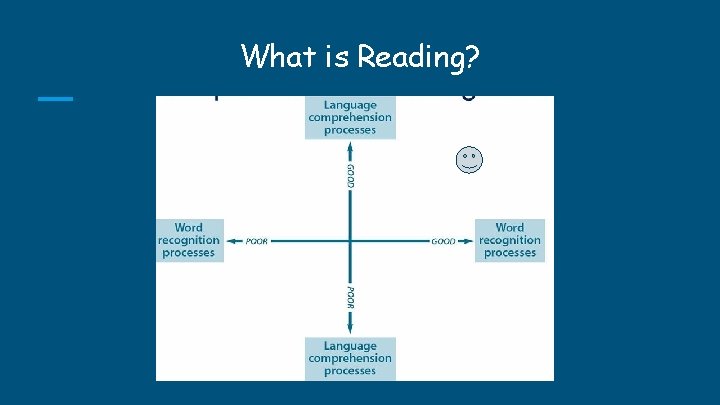
What is Reading?
How we teach reading in EYFS In Nursery children begin to learn phonics from Phase 1. During the week there are two sharing sessions where children read with a friend and choose a book to take home. Each week, children read in a guided group with the teacher.
How we teach reading in EYFS In Reception children read 1: 1 with an adult each week. They focus on their understanding of the story and sound recognition. The theme each week is based on a whole class story. Through this, comprehension is taught.
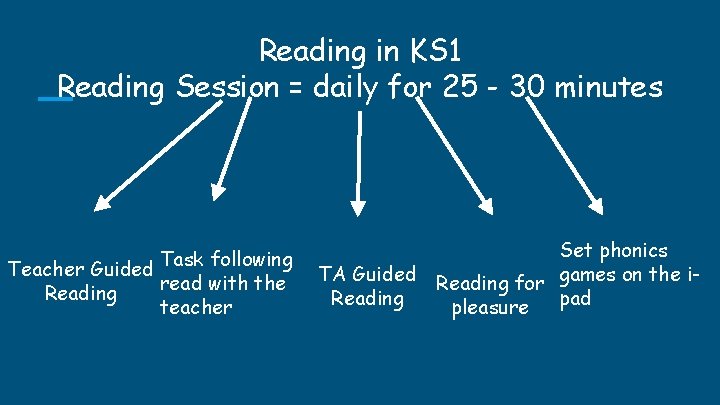
Reading in KS 1 Reading Session = daily for 25 - 30 minutes Teacher Guided Task following read with the Reading teacher Set phonics TA Guided Reading for games on the i. Reading pleasure pad
Teacher and TA Guided Reading Please welcome our special guests.
Teacher and TA Guided Reading In each session a specific learning objective is chosen from the curriculum. E. G. To make a prediction based on what has been read so far. This will become the focus of the session.
Teacher and TA Guided Reading The children will read parts of the book and work on developing towards the learning objective of the session. Each child will read aloud to the group, while the other pupils follow with their finger. Throughout the session, the teacher is making ongoing assessments and supporting the child to progress.
Pre and Post Guided Reading Activities These are completed independently. Pre-reading may include: looking at the cover and blurb, or practising the sounds that will appear in the book. Post-reading may include: comprehension questions about the book, reviewing the book, or creating an alternative ending.
The Reading for Pleasure Book Nook The aim is for children to choose their own books from a range of high quality texts. We are currently enhancing this area with new book shelves and chairs designed to support comfortable reading.
What are the books that come home for? These books have been explored in the Guided Reading sessions. We record this in the Reading Record. They are for you and your child to share as often as possible. Another book is issued at the next Guided Reading session. Please try to ensure that the book is always in the book bag.
How can I help at home? Promote a love of reading - books, comics, websites. Provide a range of books for your child. The library is free to join! Ask your child to read aloud to you. Record your comments in the Reading Record to share your observations with us. Ask comprehension questions.
Common Queries Q. My child can read much longer words than those in the book that comes home. A. Thank you for raising this point. Conversation between school and home is vital! Sometimes, the reason for this is that we are working on comprehension and deduction. We are also working on the objectives surrounding discussion with peers.
Common Queries Q. Why are the children grouped? Can the children move groups? A. The children are grouped to allow learning through discussion with peers. They listen to others of the same age reading and work together to improve. Grouping allows focused teaching for pupils with similar needs. Small groups also allow more personal feedback for younger children than whole class teaching. All grouping is flexible. Due to our ongoing assessment, we can move pupils whenever we feel that it will be beneficial.
How is reading assessed? 1. Ongoing assessment in the guided reading sessions and during lessons. 1. Tracked through the online tracking system. 1. PIRA reading tests each term to support our teacher judgements. All of the assessments inform our teaching and grouping.
End of Key Stage 1 Expectations There are three categories: working towards the expected standard, working at greater depth within the expected standard. Please refer to your pack for more details.
Thank you Please do come and see us if you need further guidance with early reading.
How we teach reading in KS 2 ● A daily, extended literacy lesson within which the children read a high quality text specifically chosen to compliment the literacy curriculum and themes. ● Time is given to analyse the text in-depth, exploring the use of language, the structure and its themes and will often include close oral questioning by the teacher to further children’s understanding. ● Every child during the week will be invited to read aloud. If a text is particularly challenging, children may also be given a ‘preread’ or chance to read in smaller group with support prior to the
How we teach reading in KS 2 ● Each school day starts with a 15 -minute ‘feed the read’ session. This is a time for children to independently read a text of their choice, and is intended to encourage a love of reading in all children. ● All children bring a book home to read – a book of their choosing from a range that are age/ ability appropriate. ● All children can choose to use the ‘story walls’ to borrow a book of their choice from a continually-changing range of selected children’s books - both new books and classics. The children themselves have played a massive part in the choices of books we have bought.
For children who need extra support: ● Some children may need to continue a small group reading session, this is led by the teacher or teaching assistant. ● For some children, specific skills (e. g. comprehension) are targeted and addressed through additional one-to-one or small group sessions lead by either the teacher or teaching assistant. ● ‘Toe by toe’ is a programme that we use to help children who find decoding and reading fluently difficult.
The expectations at end of KS 2 ● Read age-appropriate books with confidence and fluency (including whole novels). ● Read aloud with intonation that shows understanding. ● Work out the meaning of words from the context. ● Explain and discuss their understanding of what they have read, drawing inferences and justifying these with evidence. ● Predict what might happen from details stated and implied. ● Retrieve information from non-fiction. ● Summarise main ideas, identifying key details and using quotations for illustration. ● Evaluate how authors use language, including figurative language, considering the impact on the reader. ● Make comparisons within and across books
The expectations at end of KS 2 Example 1
The expectations at end of KS 2 ● Read age-appropriate books with confidence and fluency (including whole novels). ● Read aloud with intonation that shows understanding. ● Work out the meaning of words from the context. ● Explain and discuss their understanding of what they have read, drawing inferences and justifying these with evidence. ● Predict what might happen from details stated and implied. ● Retrieve information from non-fiction. ● Summarise main ideas, identifying key details and using quotations for illustration. ● Evaluate how authors use language, including figurative language, considering the impact on the reader. ● Make comparisons within and across books
The expectations at end of KS 2 https: //www. youtube. com/watch? v=1 t 1 P 4 Mftavw&feature=youtu. be KS 2 Reading - Working at the Expected Standard - The Executioner's Daughter educationgovuk
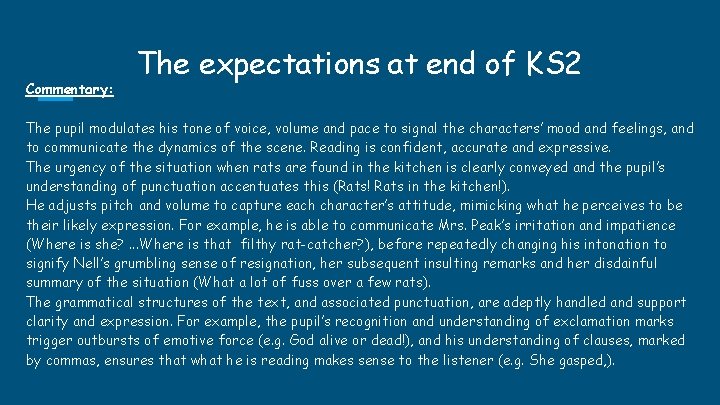
Commentary: The expectations at end of KS 2 The pupil modulates his tone of voice, volume and pace to signal the characters’ mood and feelings, and to communicate the dynamics of the scene. Reading is confident, accurate and expressive. The urgency of the situation when rats are found in the kitchen is clearly conveyed and the pupil’s understanding of punctuation accentuates this (Rats! Rats in the kitchen!). He adjusts pitch and volume to capture each character’s attitude, mimicking what he perceives to be their likely expression. For example, he is able to communicate Mrs. Peak’s irritation and impatience (Where is she? . . . Where is that filthy rat-catcher? ), before repeatedly changing his intonation to signify Nell’s grumbling sense of resignation, her subsequent insulting remarks and her disdainful summary of the situation (What a lot of fuss over a few rats). The grammatical structures of the text, and associated punctuation, are adeptly handled and support clarity and expression. For example, the pupil’s recognition and understanding of exclamation marks trigger outbursts of emotive force (e. g. God alive or dead!), and his understanding of clauses, marked by commas, ensures that what he is reading makes sense to the listener (e. g. She gasped, ).
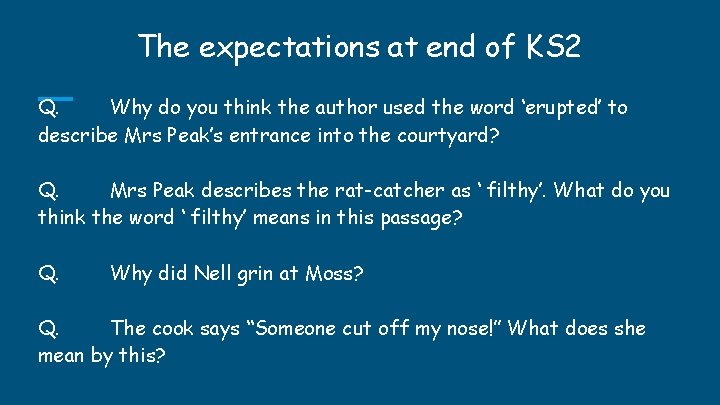
The expectations at end of KS 2 Q. Why do you think the author used the word ‘erupted’ to describe Mrs Peak’s entrance into the courtyard? Q. Mrs Peak describes the rat-catcher as ‘ filthy’. What do you think the word ‘ filthy’ means in this passage? Q. Why did Nell grin at Moss? Q. The cook says “Someone cut off my nose!” What does she mean by this?
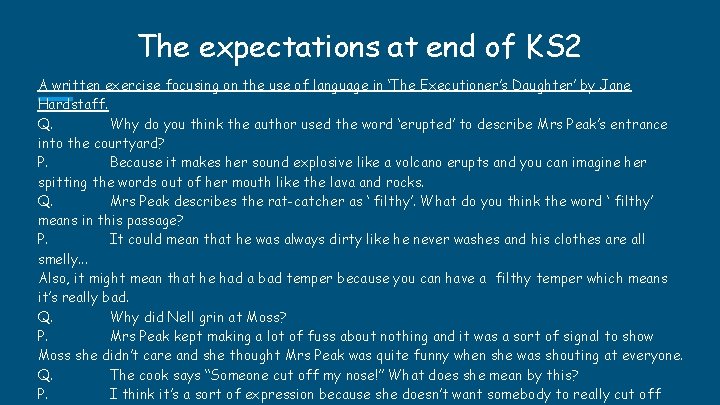
The expectations at end of KS 2 A written exercise focusing on the use of language in ‘The Executioner’s Daughter’ by Jane Hardstaff. Q. Why do you think the author used the word ‘erupted’ to describe Mrs Peak’s entrance into the courtyard? P. Because it makes her sound explosive like a volcano erupts and you can imagine her spitting the words out of her mouth like the lava and rocks. Q. Mrs Peak describes the rat-catcher as ‘ filthy’. What do you think the word ‘ filthy’ means in this passage? P. It could mean that he was always dirty like he never washes and his clothes are all smelly. . . Also, it might mean that he had a bad temper because you can have a filthy temper which means it’s really bad. Q. Why did Nell grin at Moss? P. Mrs Peak kept making a lot of fuss about nothing and it was a sort of signal to show Moss she didn’t care and she thought Mrs Peak was quite funny when she was shouting at everyone. Q. The cook says “Someone cut off my nose!” What does she mean by this? P. I think it’s a sort of expression because she doesn’t want somebody to really cut off
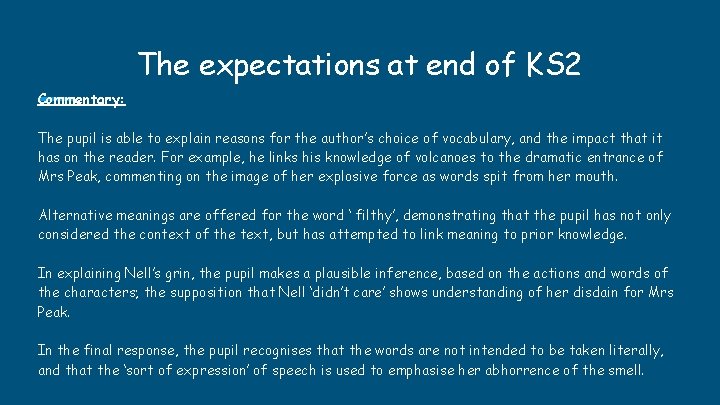
The expectations at end of KS 2 Commentary: The pupil is able to explain reasons for the author’s choice of vocabulary, and the impact that it has on the reader. For example, he links his knowledge of volcanoes to the dramatic entrance of Mrs Peak, commenting on the image of her explosive force as words spit from her mouth. Alternative meanings are offered for the word ‘ filthy’, demonstrating that the pupil has not only considered the context of the text, but has attempted to link meaning to prior knowledge. In explaining Nell’s grin, the pupil makes a plausible inference, based on the actions and words of the characters; the supposition that Nell ‘didn’t care’ shows understanding of her disdain for Mrs Peak. In the final response, the pupil recognises that the words are not intended to be taken literally, and that the ‘sort of expression’ of speech is used to emphasise her abhorrence of the smell.
The expectations at end of KS 2 ● Read age-appropriate books with confidence and fluency (including whole novels). ● Read aloud with intonation that shows understanding. ● Work out the meaning of words from the context. ● Explain and discuss their understanding of what they have read, drawing inferences and justifying these with evidence. ● Predict what might happen from details stated and implied. ● Retrieve information from non-fiction. ● Summarise main ideas, identifying key details and using quotations for illustration. ● Evaluate how authors use language, including figurative language, considering the impact on the reader. ● Make comparisons within and across books
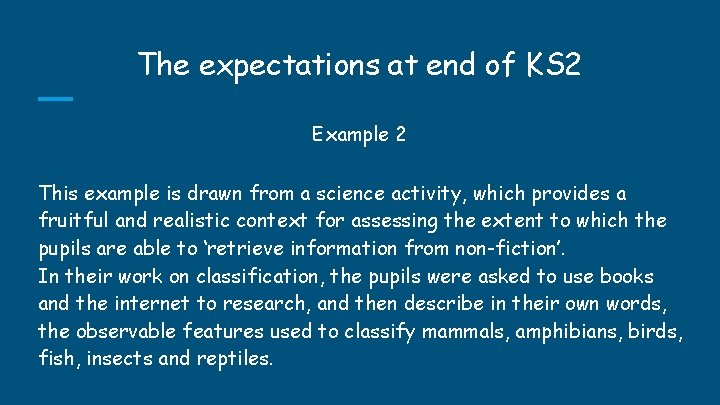
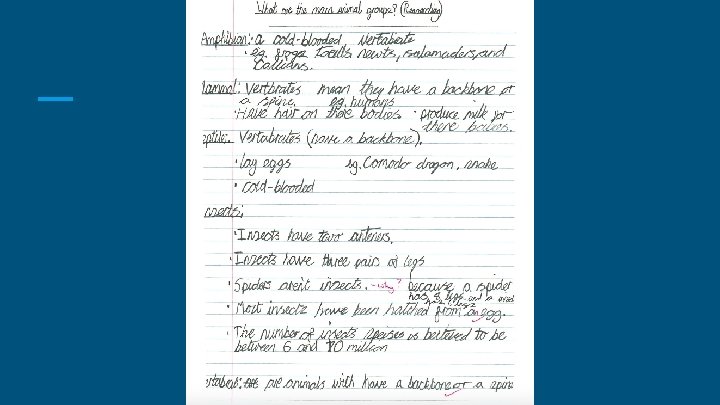
The expectations at end of KS 2 Example 2 This example is drawn from a science activity, which provides a fruitful and realistic context for assessing the extent to which the pupils are able to ‘retrieve information from non-fiction’. In their work on classification, the pupils were asked to use books and the internet to research, and then describe in their own words, the observable features used to classify mammals, amphibians, birds, fish, insects and reptiles.
The expectations at end of KS 2 ● Read age-appropriate books with confidence and fluency (including whole novels). ● Read aloud with intonation that shows understanding. ● Work out the meaning of words from the context. ● Explain and discuss their understanding of what they have read, drawing inferences and justifying these with evidence. ● Predict what might happen from details stated and implied. ● Retrieve information from non-fiction. ● Summarise main ideas, identifying key details and using quotations for illustration. ● Evaluate how authors use language, including figurative language, considering the impact on the reader. ● Make comparisons within and across books
The expectations at end of KS 2 Commentary: The pupil whose work is illustrated has used non-fiction sources independently to: – locate the sources of the information they need – retrieve information about the main animal groups – provide a definition in their own words – record some of the features used for classification (e. g. that vertebrates lay eggs) – organise and present the information in an accessible format, using underlining and bullet points.
How is reading assessed? 1. Ongoing assessment of reading in literacy lessons and across the curriculum. 1. Tracked through the online tracking system. 1. PIRA reading tests each term to support our teacher judgements.
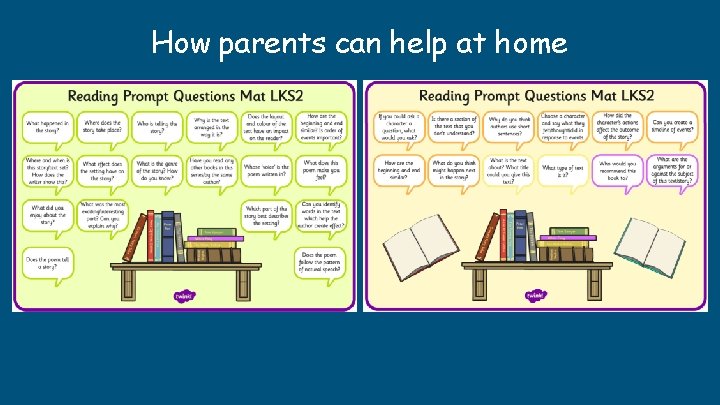
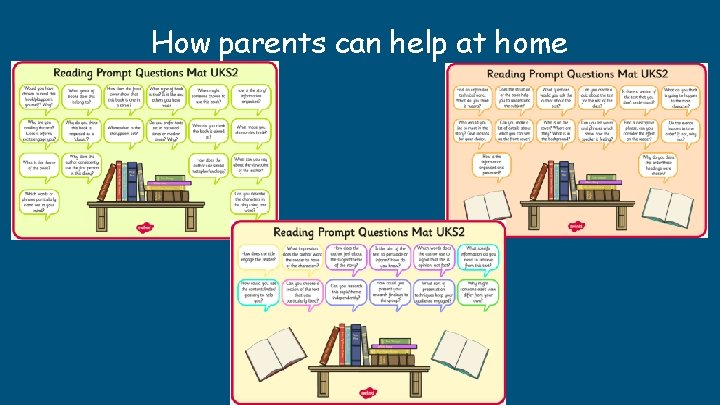
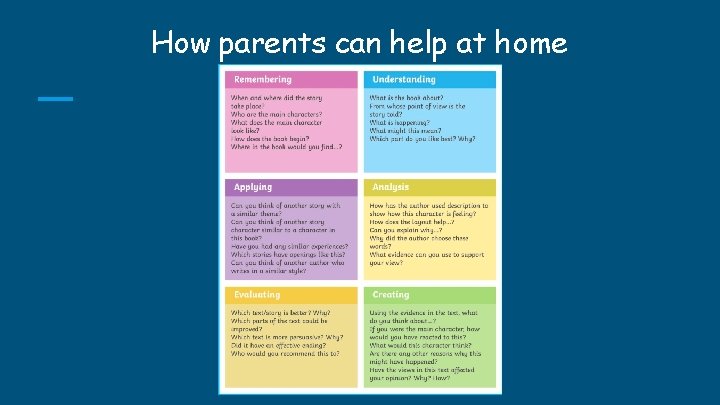
How parents can help at home Reading with your child is vital! It’s best to read little and often, so try to put aside some time for it every day. Give lots of encouragement and expand the reading experience to keep your child switched on. Focus on encouraging your child to read fluently and with expression, understanding more complex plots and broadening their vocabulary as well as building an understanding of how punctuation and grammar are used.
How parents can help at home
How parents can help at home
How parents can help at home
How parents can help at home Use these websites for some inspiration… ● Books For Keeps ● Booktrust ● Chatterbooks ● First News ● Guardian Children’s Books ● Just Imagine ● The National Literacy Trust ● Love. Reading 4 Kids ● Reading Zone ● Summer Reading Challenge ● World Book Day
How parents can help at home https: //www. booktrust. org. uk/supporting-you/families/readingtips/examples-of-how-to-read-with-your-child/ http: //www. worldbookday. com/ideas/from-the-experts/
Thank you for attending We greatly appreciate your interest and support in championing reading in our school.