
Intermediate Financial Accounting I The Accounting Information System

- Slides: 68
Intermediate Financial Accounting I The Accounting Information System
Objectives of the Chapter I. Learning the accounting process in preparing financial statements. II. Introduce the accrual accounting concept and the adjusting entries. III. Introduce the worksheet (including the trial balance, the adjustments and the adjusted trial balance, the I/S and the B/S columns), the preparation of financial statements from the worksheet and the closing entries. Accounting Cycle 2
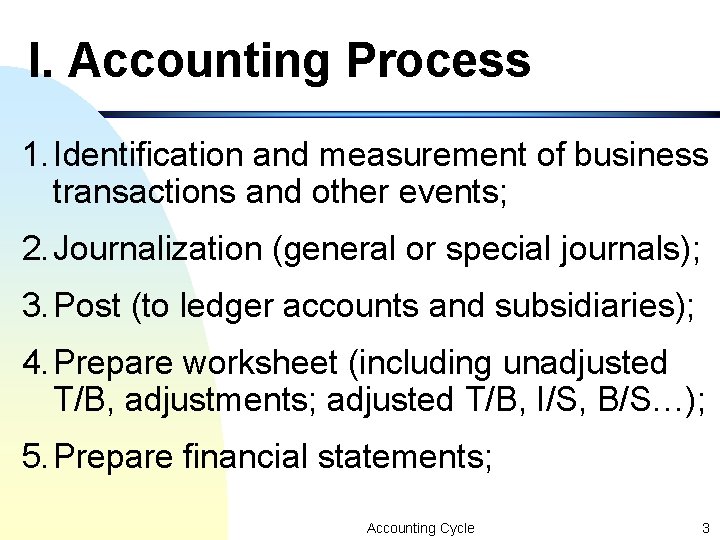
I. Accounting Process 1. Identification and measurement of business transactions and other events; 2. Journalization (general or special journals); 3. Post (to ledger accounts and subsidiaries); 4. Prepare worksheet (including unadjusted T/B, adjustments; adjusted T/B, I/S, B/S…); 5. Prepare financial statements; Accounting Cycle 3
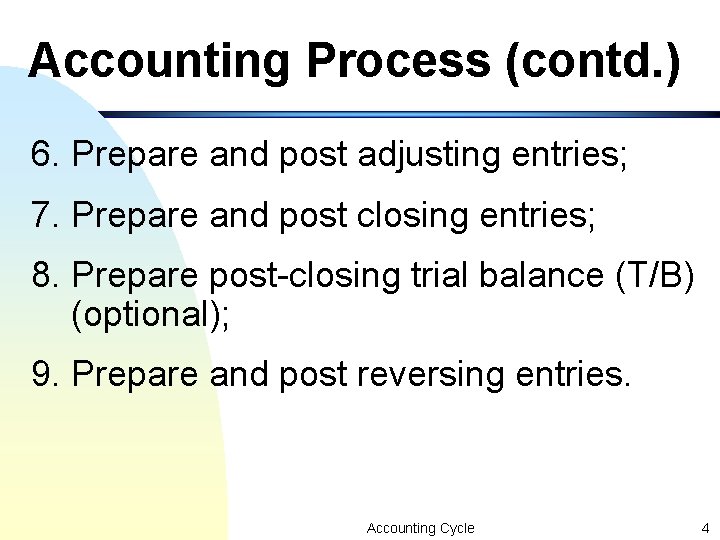
Accounting Process (contd. ) 6. Prepare and post adjusting entries; 7. Prepare and post closing entries; 8. Prepare post-closing trial balance (T/B) (optional); 9. Prepare and post reversing entries. Accounting Cycle 4
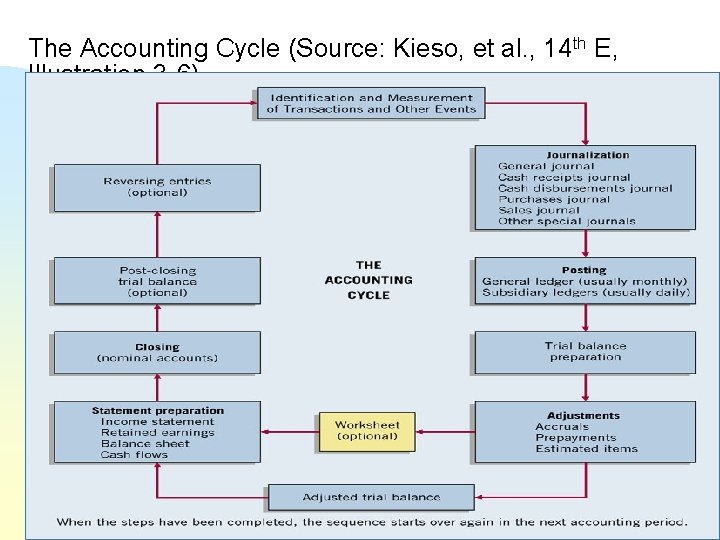
The Accounting Cycle (Source: Kieso, et al. , 14 th E, Illustration 3 -6) Accounting Cycle 5
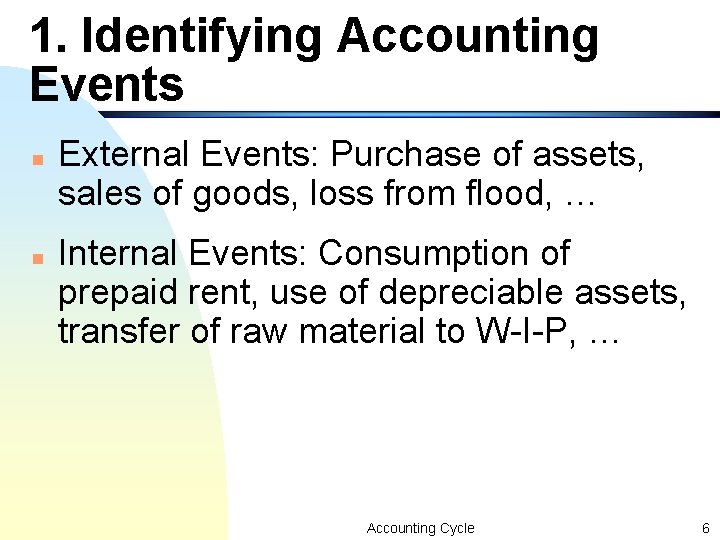
1. Identifying Accounting Events n n External Events: Purchase of assets, sales of goods, loss from flood, … Internal Events: Consumption of prepaid rent, use of depreciable assets, transfer of raw material to W-I-P, … Accounting Cycle 6
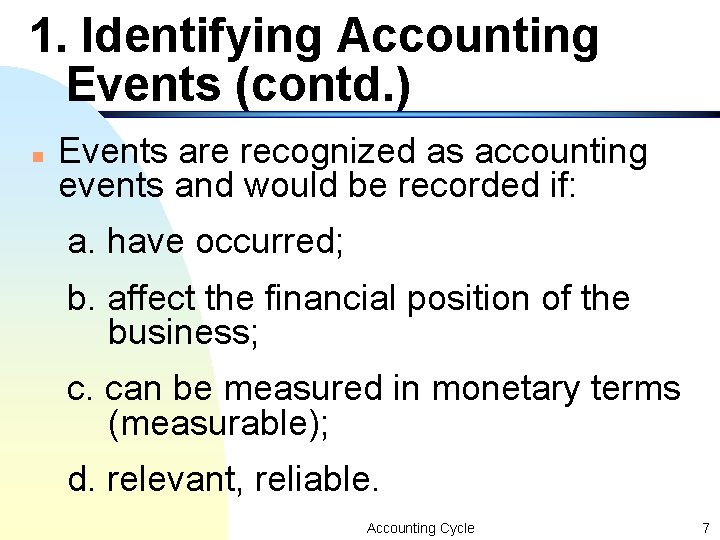
1. Identifying Accounting Events (contd. ) n Events are recognized as accounting events and would be recorded if: a. have occurred; b. affect the financial position of the business; c. can be measured in monetary terms (measurable); d. relevant, reliable. Accounting Cycle 7
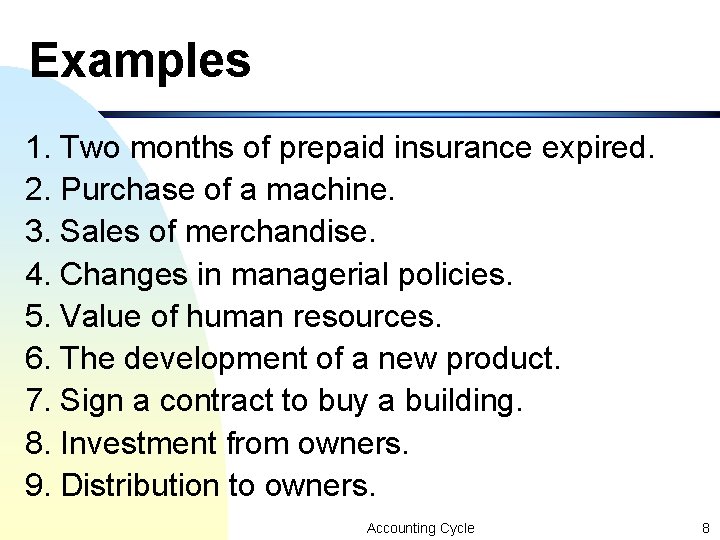
Examples 1. Two months of prepaid insurance expired. 2. Purchase of a machine. 3. Sales of merchandise. 4. Changes in managerial policies. 5. Value of human resources. 6. The development of a new product. 7. Sign a contract to buy a building. 8. Investment from owners. 9. Distribution to owners. Accounting Cycle 8
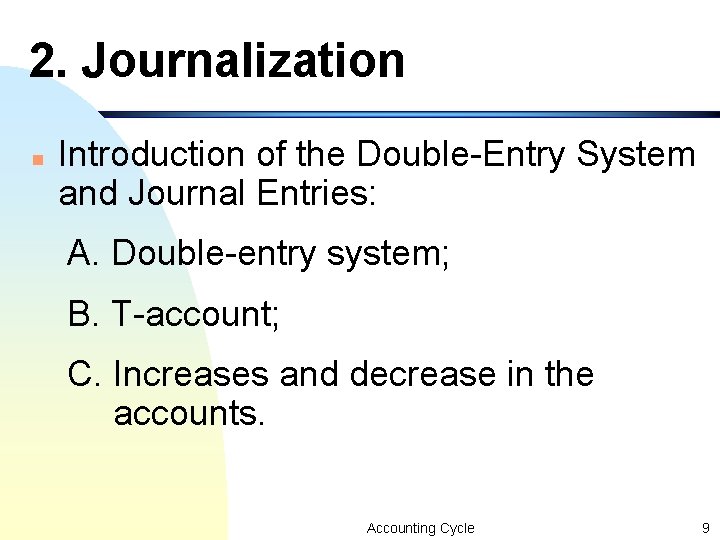
2. Journalization n Introduction of the Double-Entry System and Journal Entries: A. Double-entry system; B. T-account; C. Increases and decrease in the accounts. Accounting Cycle 9
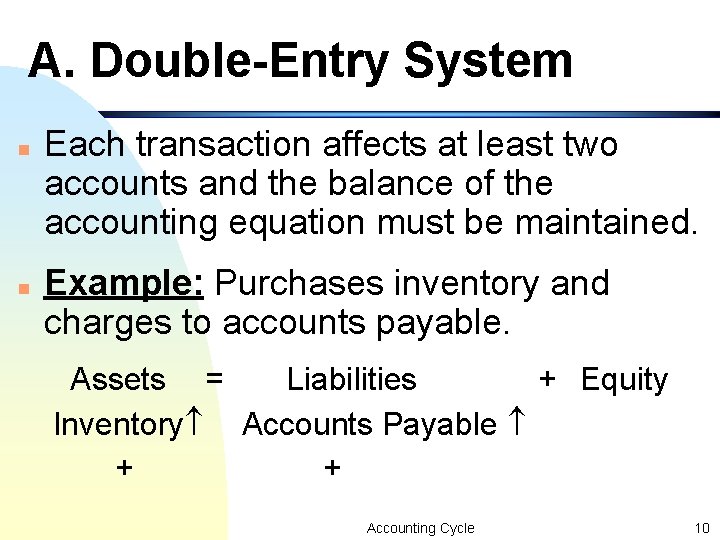
A. Double-Entry System n n Each transaction affects at least two accounts and the balance of the accounting equation must be maintained. Example: Purchases inventory and charges to accounts payable. Assets = Liabilities + Equity Inventory Accounts Payable + + Accounting Cycle 10
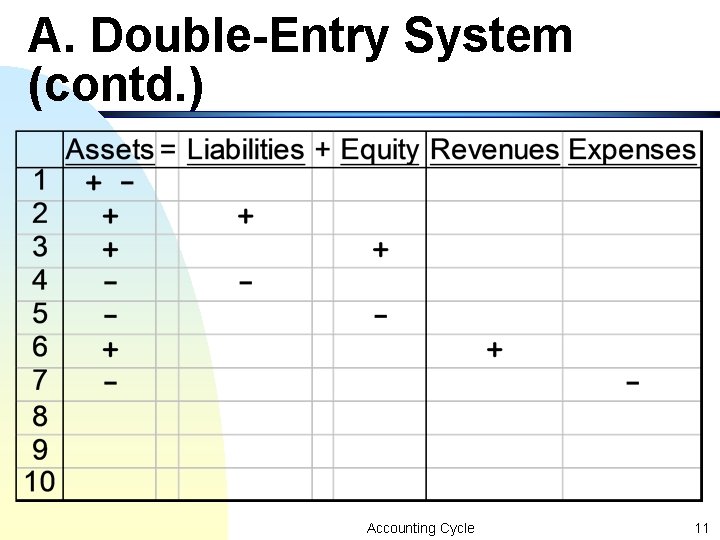
A. Double-Entry System (contd. ) Accounting Cycle 11
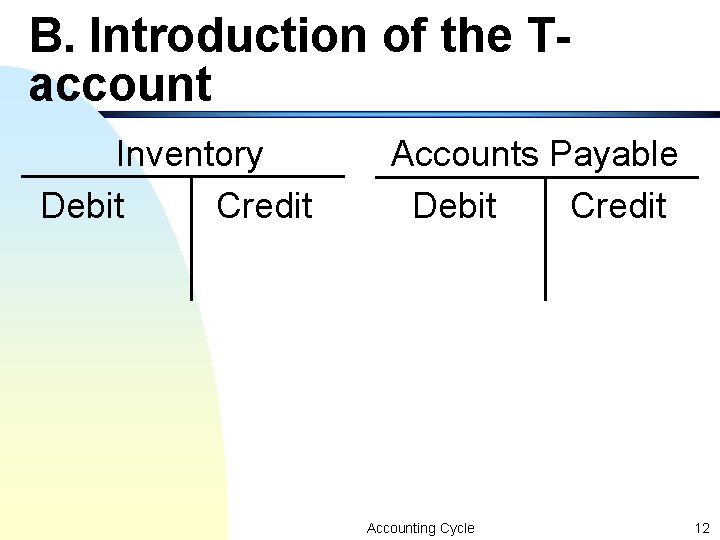
B. Introduction of the Taccount Inventory Debit Credit Accounts Payable Debit Credit Accounting Cycle 12
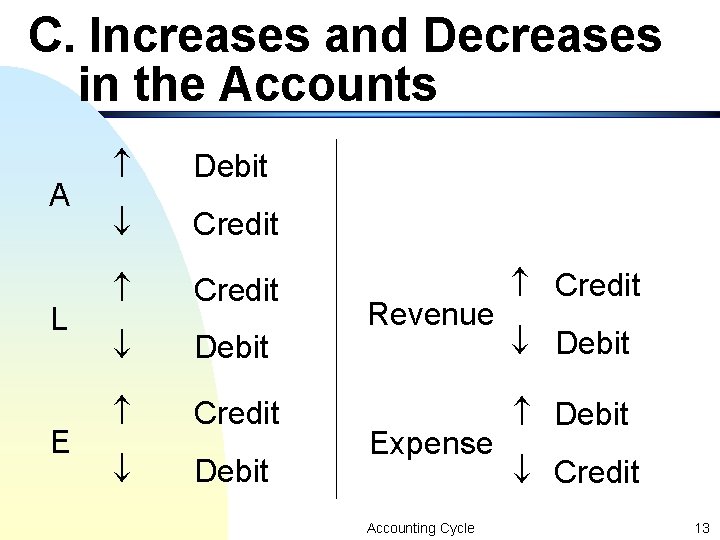
C. Increases and Decreases in the Accounts A L E Debit Credit Debit Revenue Expense Accounting Cycle Credit Debit Credit 13
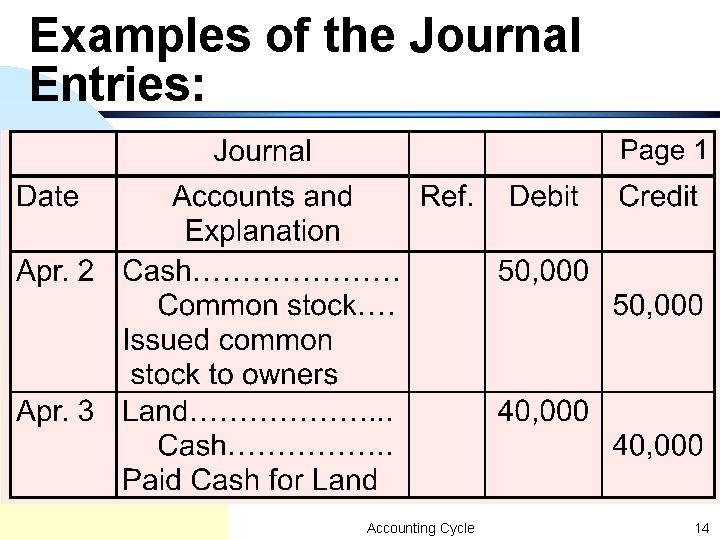
Examples of the Journal Entries: Accounting Cycle 14
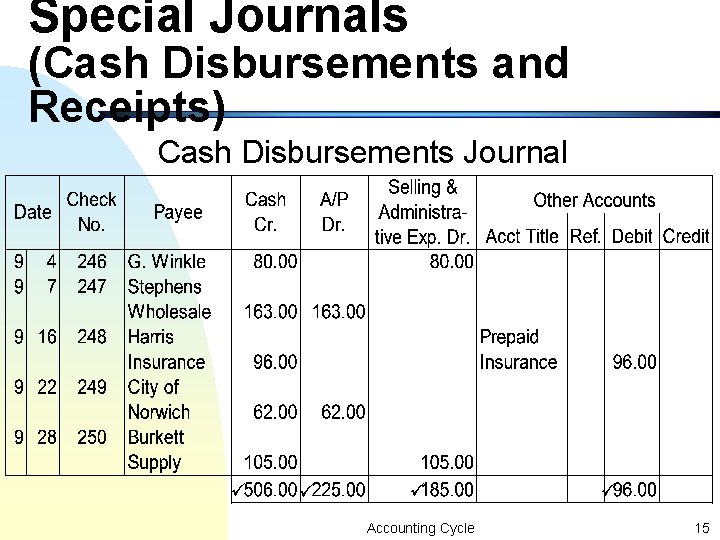
Special Journals (Cash Disbursements and Receipts) Cash Disbursements Journal Accounting Cycle 15
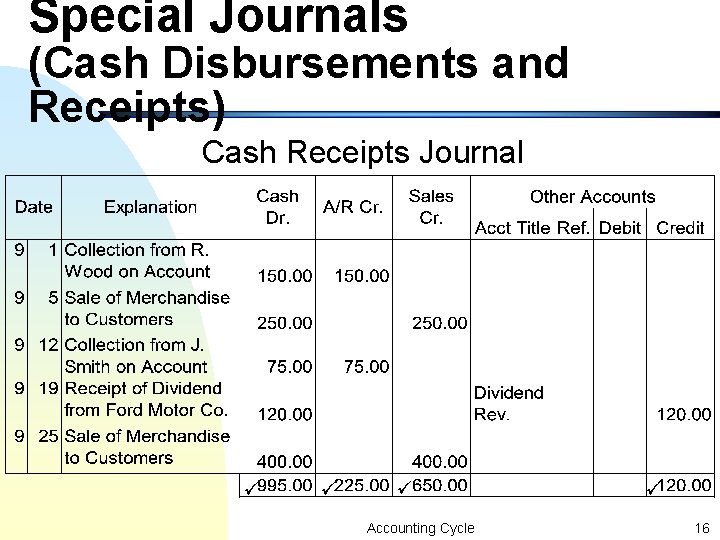
Special Journals (Cash Disbursements and Receipts) Cash Receipts Journal Accounting Cycle 16
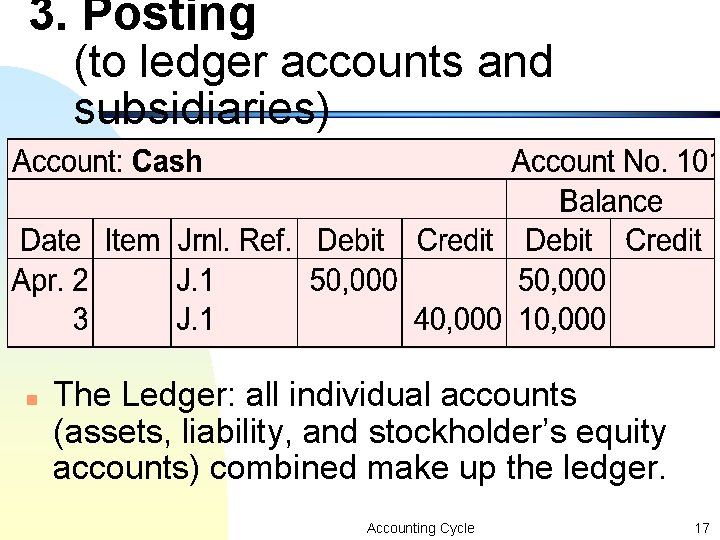
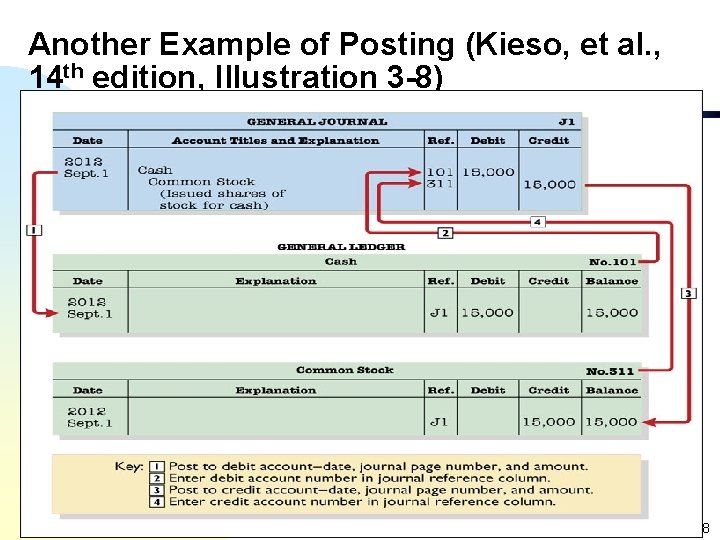
3. Posting (to ledger accounts and subsidiaries) n The Ledger: all individual accounts (assets, liability, and stockholder’s equity accounts) combined make up the ledger. Accounting Cycle 17
Another Example of Posting (Kieso, et al. , 14 th edition, Illustration 3 -8) Accounting Cycle 18
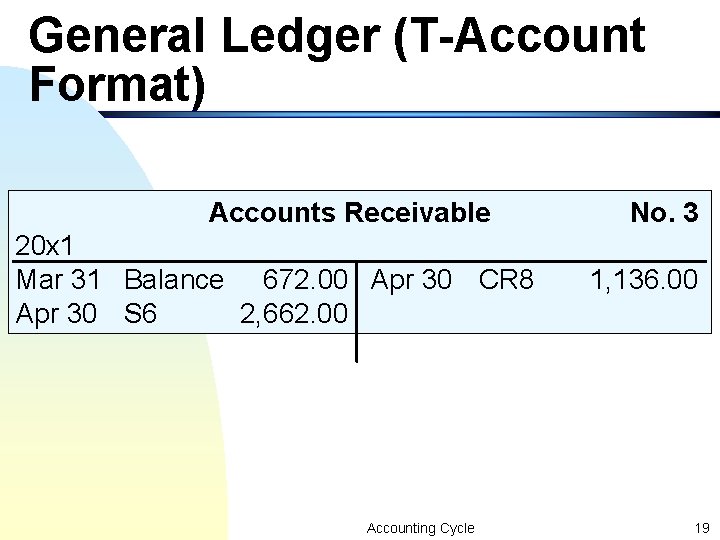
General Ledger (T-Account Format) Accounts Receivable 20 x 1 Mar 31 Balance 672. 00 Apr 30 CR 8 Apr 30 S 6 2, 662. 00 Accounting Cycle No. 3 1, 136. 00 19
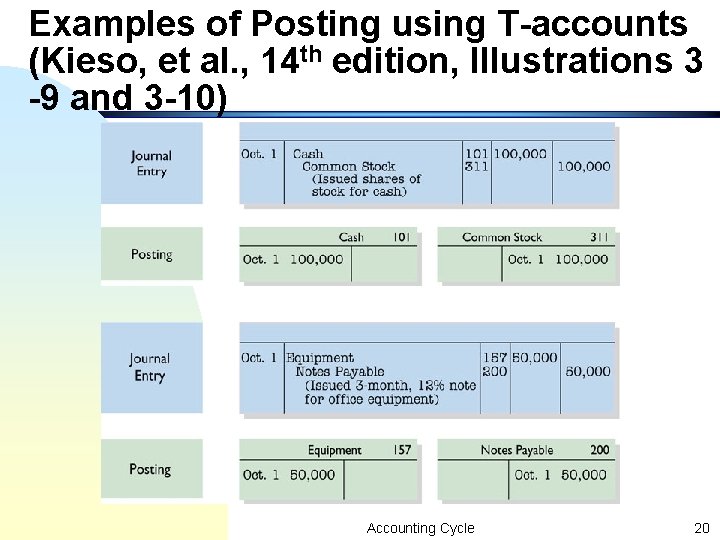
Examples of Posting using T-accounts (Kieso, et al. , 14 th edition, Illustrations 3 -9 and 3 -10) Accounting Cycle 20
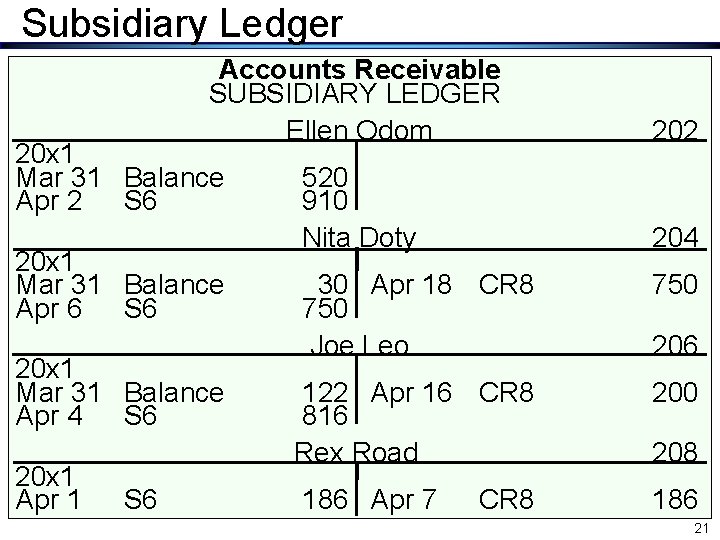
Subsidiary Ledger Accounts Receivable SUBSIDIARY LEDGER Ellen Odom 202 520 910 Nita Doty 204 20 x 1 Mar 31 Balance Apr 2 S 6 20 x 1 Mar 31 Balance Apr 6 S 6 20 x 1 Mar 31 Balance Apr 4 S 6 20 x 1 Apr 1 S 6 30 Apr 18 CR 8 750 Joe Leo 750 122 Apr 16 CR 8 816 Rex Road 200 186 Apr 7 186 Accounting Cycle CR 8 206 208 21
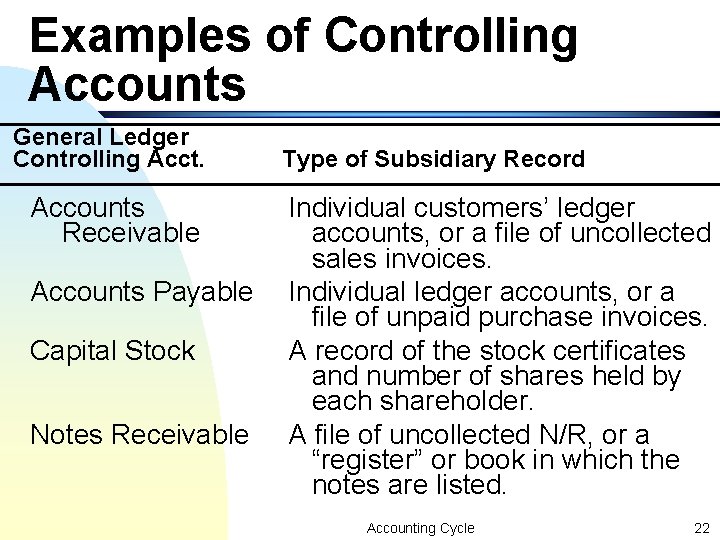
Examples of Controlling Accounts General Ledger Controlling Acct. Accounts Receivable Accounts Payable Capital Stock Notes Receivable Type of Subsidiary Record Individual customers’ ledger accounts, or a file of uncollected sales invoices. Individual ledger accounts, or a file of unpaid purchase invoices. A record of the stock certificates and number of shares held by each shareholder. A file of uncollected N/R, or a “register” or book in which the notes are listed. Accounting Cycle 22
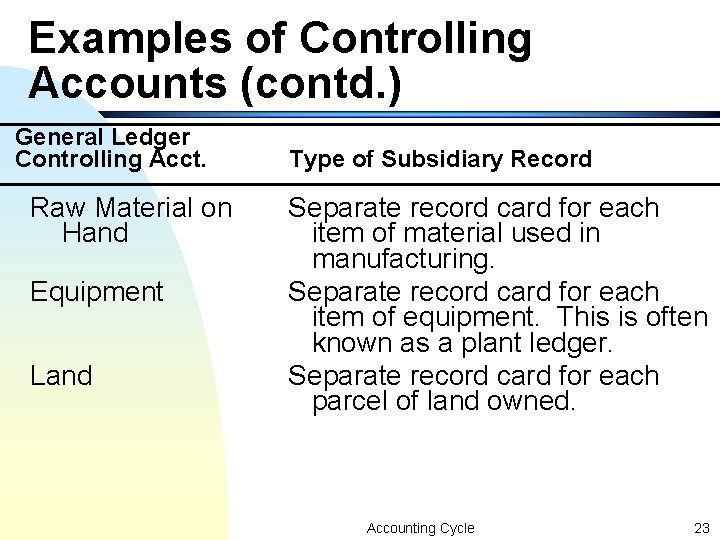
Examples of Controlling Accounts (contd. ) General Ledger Controlling Acct. Raw Material on Hand Equipment Land Type of Subsidiary Record Separate record card for each item of material used in manufacturing. Separate record card for each item of equipment. This is often known as a plant ledger. Separate record card for each parcel of land owned. Accounting Cycle 23
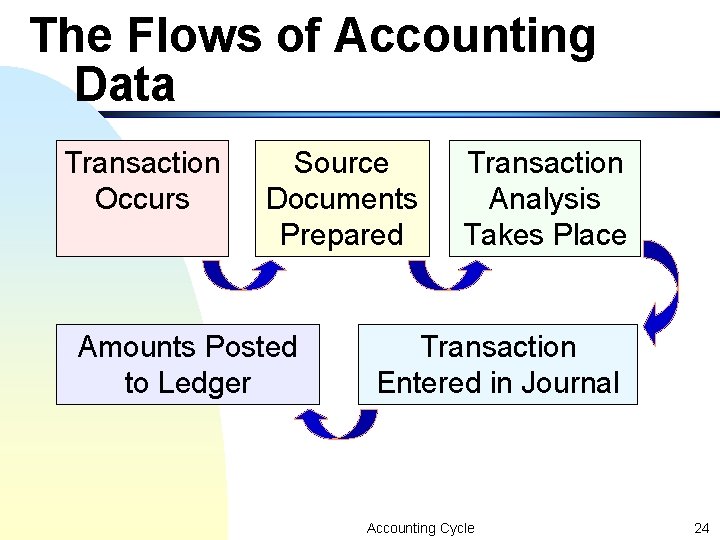
The Flows of Accounting Data Transaction Occurs Source Documents Prepared Amounts Posted to Ledger Transaction Analysis Takes Place Transaction Entered in Journal Accounting Cycle 24
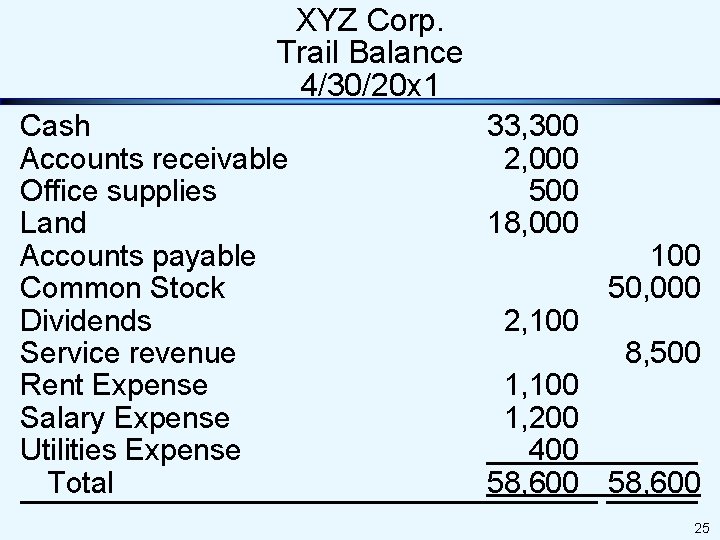
XYZ Corp. Trail Balance 4/30/20 x 1 Cash Accounts receivable Office supplies Land Accounts payable Common Stock Dividends Service revenue Rent Expense Salary Expense Utilities Expense Total 33, 300 2, 000 500 18, 000 2, 100 50, 000 8, 500 1, 100 1, 200 400 58, 600 . . Accounting Cycle 25
II. Accrual Accounting § The time-period concept, the revenue recognition and matching principles. § Accrual versus cash basis accounting. § Adjusting entries. Accounting Cycle 26
The Time-Period Concept, the Revenue Recognition & Matching Principles n n The time-period concept: Income and financial position of a business are reported periodically, not until the end of life of a business. Accounting Cycle 27
Revenue Recognition Principle (SFAS No. 5) (-An Accrual Basis) n n n Revenue is recognized when it is earned and realized or realizable (SFAC 5, par. 83). Earned : the entity has substantially accomplished what it must do to be entitled to compensation. Realized: goods are exchanged for cash or claims. Realizable: assets received as compensation are readily convertible into cash or claims to cash. In general, these conditions are met at time of sale (delivery) or when services are rendered regardless whether cash is collected or not (SFAC 5, par. 84). . Income Measurement And Profit Analysis 28
Revenue Recognition Principle Other conditions for revenue recognition (Staff Accounting Bulletin No. 101(1999)): n Persuasive evidence of a sale. n Price is fixed or determinable. n Collectibility is reasonably assured. n Delivery has occurred or services have been rendered. n Income Measurement And Profit Analysis 29
The Expense Recognition (Matching) Principle n n If revenues are recognized in a period, all related expenses should be recognized in the same period regardless whether expenses are paid or not. The related expenses include traceable costs (e. g. product costs), period costs, (e. g. interest and rent expenses) and estimated expenses (e. g. depreciation expense and bad debt expense). Accrual Accounting and the Financial Statements 30
Accrual vs. Cash Basis Accounting Accrual-basis accounting: Revenues are recognized based on revenue recognition principle (i. e. , recognized when realized and earned regardless whether cash is collected or not). Expenses are recognized based on matching principle (i. e. , recognized when incur regardless whether they are paid or not). Note: revenue and expense recognize before cash settlement. Accrual. Accounting and the Financial Statements 31 n
Accrual vs. Cash Basis Accounting (contd. ) • Cash-basis accounting: The accountant does not record a transaction until cash is received or paid. Cash-basis accounting is NOT acceptable for financial reporting. Accrual Accounting and the Financial Statements 32
Adjusting Entries n n Due to the periodicity concept, financial reports are prepared periodically. Based on revenue recognition principle, adjusting entries are prepared at the end of a period to recognize revenues earned during the period but not yet recorded (i. e. , accrued revenues). Accrual Accounting and the Financial Statements 33
Adjusting Entries (contd. ) n Based on the matching principle, the accrued expenses (i. e. , expenses incurred but not yet paid/recorded) and estimated expenses (i. e. , depreciation expense and bad debt expense) are recorded at the end of a period. Accrual Accounting and the Financial Statements 34
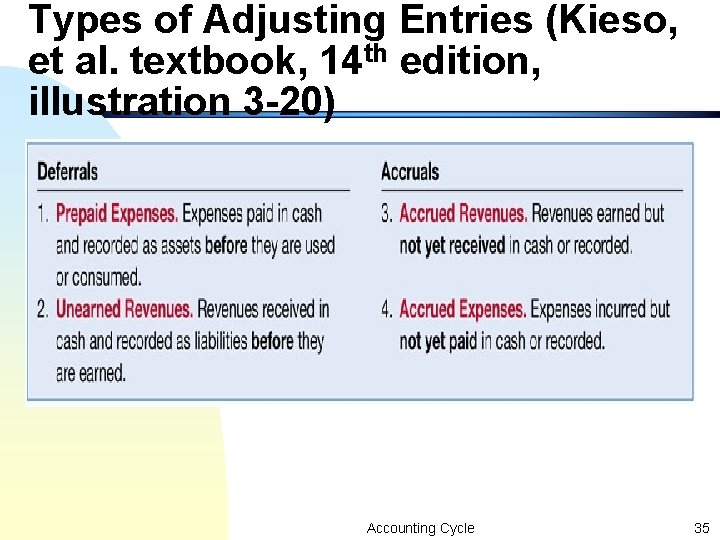
Types of Adjusting Entries (Kieso, et al. textbook, 14 th edition, illustration 3 -20) Accounting Cycle 35
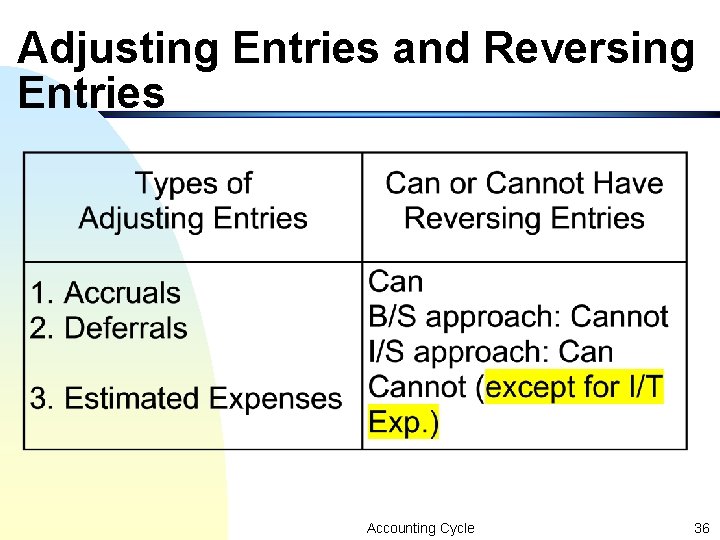
Adjusting Entries and Reversing Entries Accounting Cycle 36
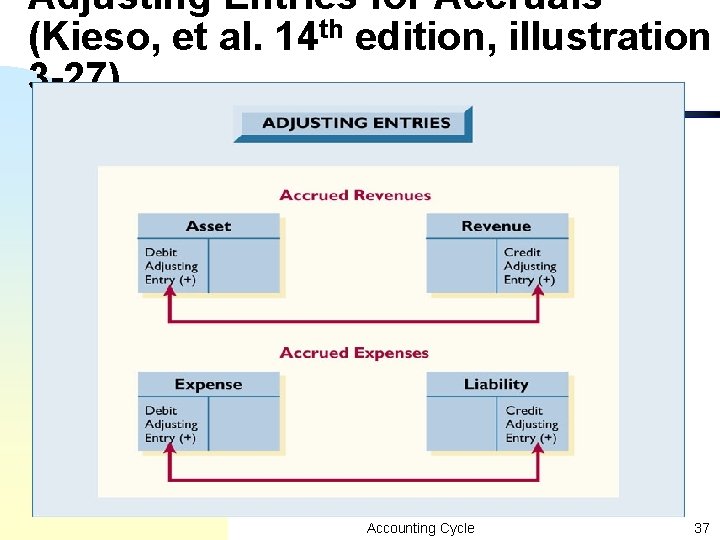
Adjusting Entries for Accruals (Kieso, et al. 14 th edition, illustration 3 -27) Accounting Cycle 37
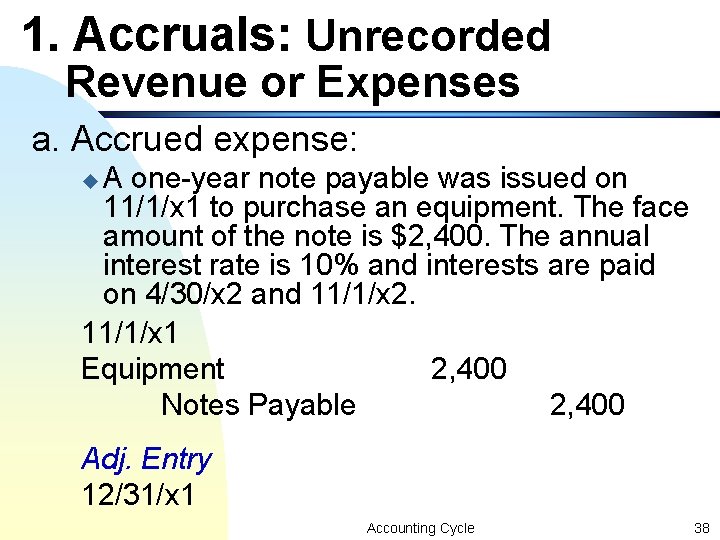
1. Accruals: Unrecorded Revenue or Expenses a. Accrued expense: A one-year note payable was issued on 11/1/x 1 to purchase an equipment. The face amount of the note is $2, 400. The annual interest rate is 10% and interests are paid on 4/30/x 2 and 11/1/x 2. 11/1/x 1 Equipment 2, 400 Notes Payable 2, 400 u Adj. Entry 12/31/x 1 Accounting Cycle 38
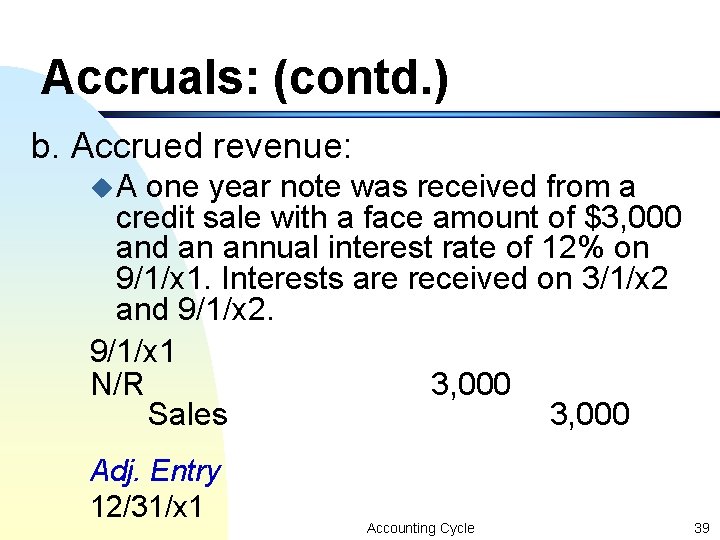
Accruals: (contd. ) b. Accrued revenue: u. A one year note was received from a credit sale with a face amount of $3, 000 and an annual interest rate of 12% on 9/1/x 1. Interests are received on 3/1/x 2 and 9/1/x 2. 9/1/x 1 N/R 3, 000 Sales 3, 000 Adj. Entry 12/31/x 1 Accounting Cycle 39
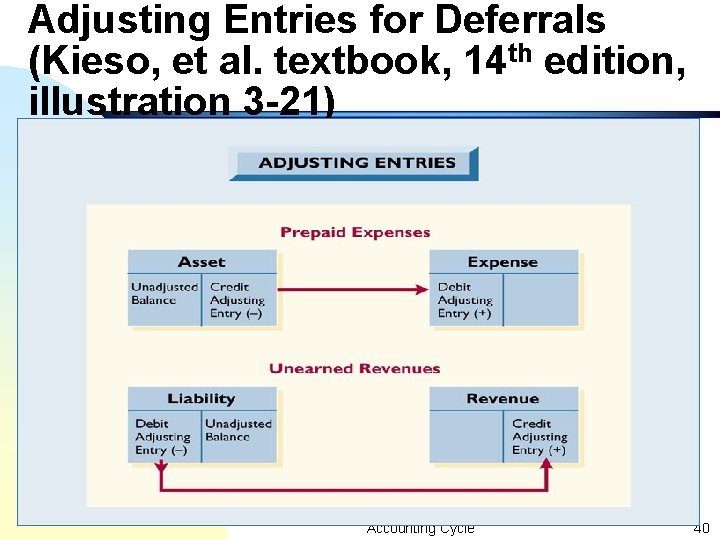
Adjusting Entries for Deferrals (Kieso, et al. textbook, 14 th edition, illustration 3 -21) Accounting Cycle 40
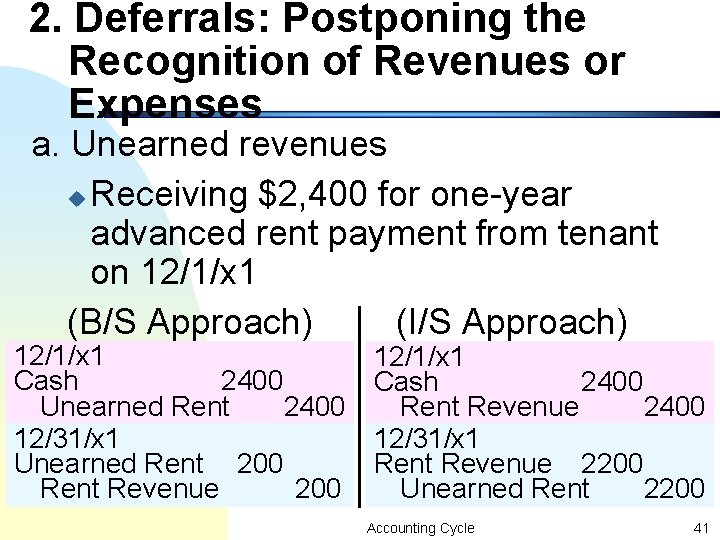
2. Deferrals: Postponing the Recognition of Revenues or Expenses a. Unearned revenues u Receiving $2, 400 for one-year advanced rent payment from tenant on 12/1/x 1 (B/S Approach) (I/S Approach) 12/1/x 1 Cash 2400 Unearned Rent 2400 12/31/x 1 Unearned Rent 200 Rent Revenue 200 12/1/x 1 Cash 2400 Rent Revenue 2400 12/31/x 1 Rent Revenue 2200 Unearned Rent 2200 Accounting Cycle 41
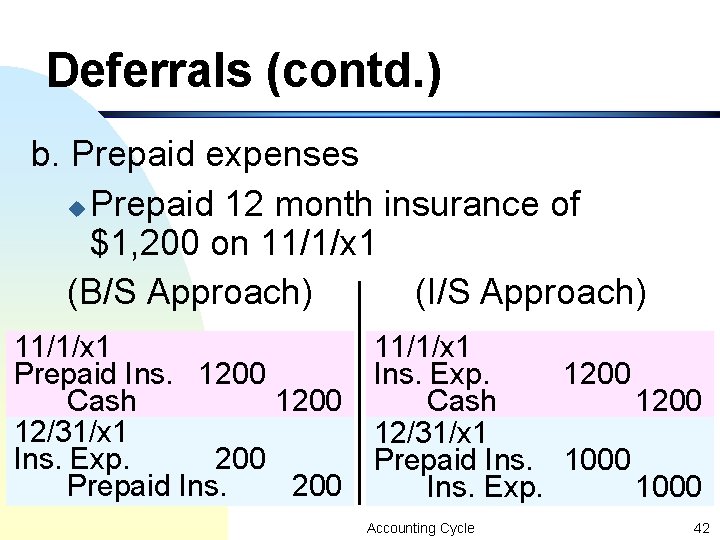
Deferrals (contd. ) b. Prepaid expenses u Prepaid 12 month insurance of $1, 200 on 11/1/x 1 (B/S Approach) (I/S Approach) 11/1/x 1 Prepaid Ins. 1200 Cash 1200 12/31/x 1 Ins. Exp. 200 Prepaid Ins. 200 11/1/x 1 Ins. Exp. 1200 Cash 1200 12/31/x 1 Prepaid Ins. 1000 Ins. Exp. 1000 Accounting Cycle 42
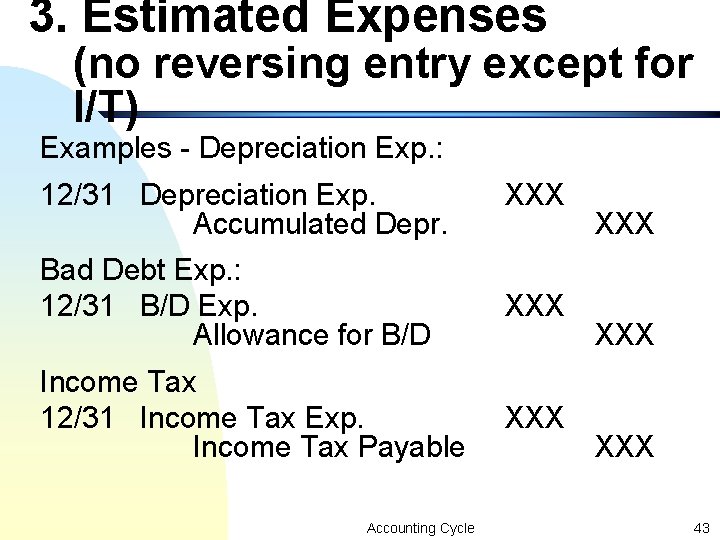
3. Estimated Expenses (no reversing entry except for I/T) Examples - Depreciation Exp. : 12/31 Depreciation Exp. Accumulated Depr. XXX Bad Debt Exp. : 12/31 B/D Exp. Allowance for B/D XXX Income Tax 12/31 Income Tax Exp. Income Tax Payable XXX Accounting Cycle XXX XXX 43
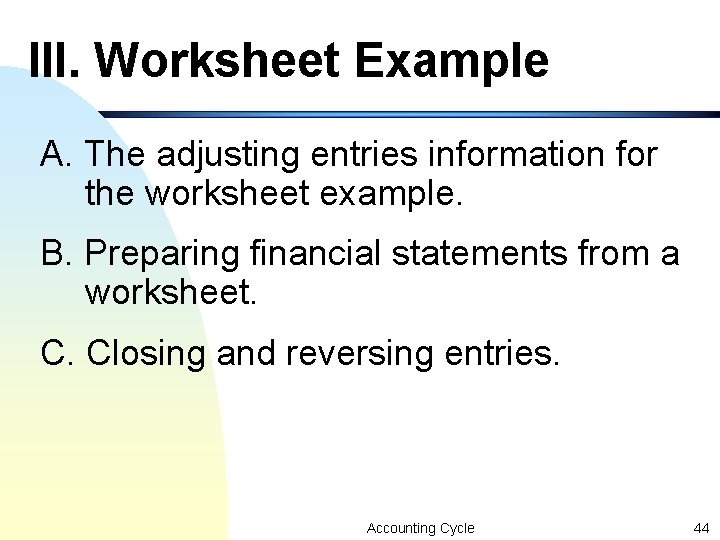
III. Worksheet Example A. The adjusting entries information for the worksheet example. B. Preparing financial statements from a worksheet. C. Closing and reversing entries. Accounting Cycle 44
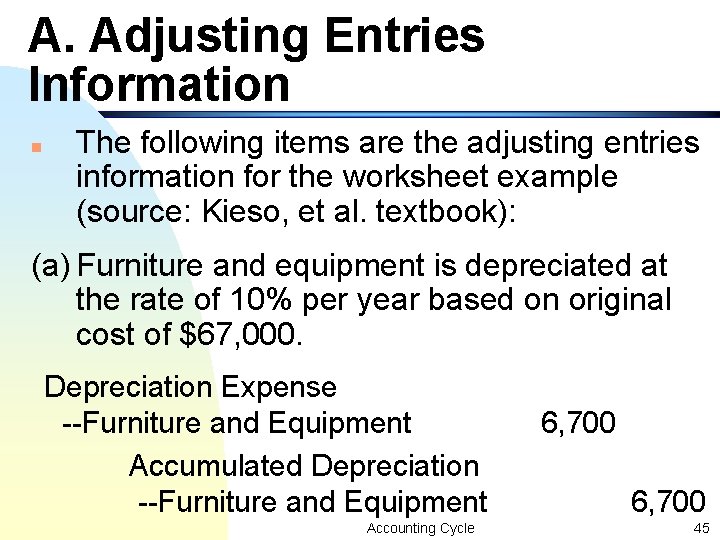
A. Adjusting Entries Information n The following items are the adjusting entries information for the worksheet example (source: Kieso, et al. textbook): (a) Furniture and equipment is depreciated at the rate of 10% per year based on original cost of $67, 000. Depreciation Expense --Furniture and Equipment Accumulated Depreciation --Furniture and Equipment Accounting Cycle 6, 700 45
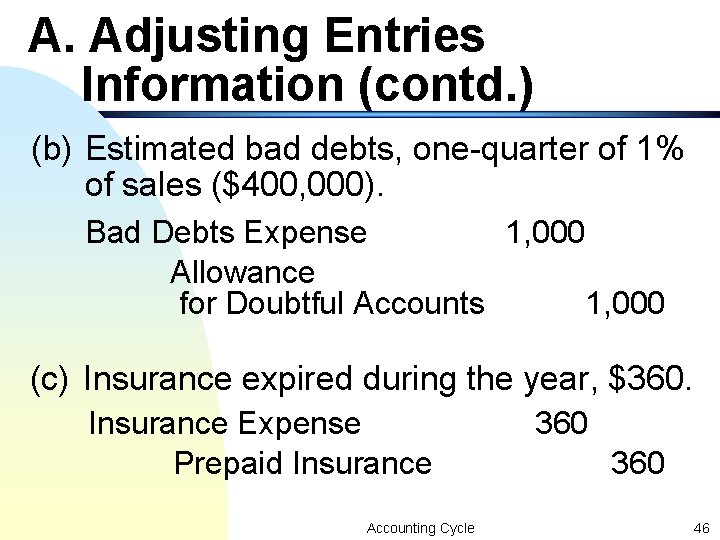
A. Adjusting Entries Information (contd. ) (b) Estimated bad debts, one-quarter of 1% of sales ($400, 000). Bad Debts Expense 1, 000 Allowance for Doubtful Accounts 1, 000 (c) Insurance expired during the year, $360. Insurance Expense Prepaid Insurance Accounting Cycle 360 46
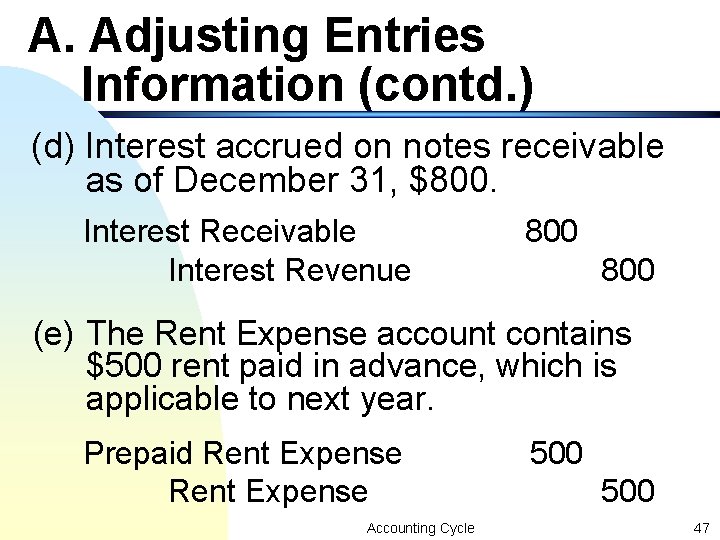
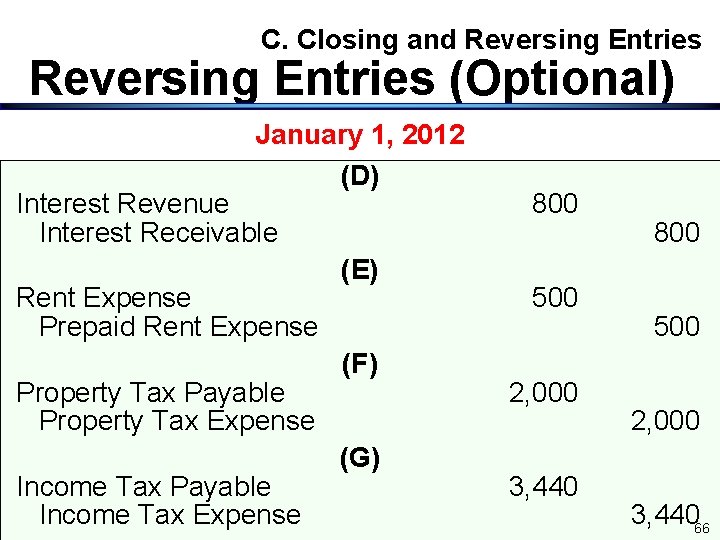
A. Adjusting Entries Information (contd. ) (d) Interest accrued on notes receivable as of December 31, $800. Interest Receivable Interest Revenue 800 (e) The Rent Expense account contains $500 rent paid in advance, which is applicable to next year. Prepaid Rent Expense Accounting Cycle 500 47
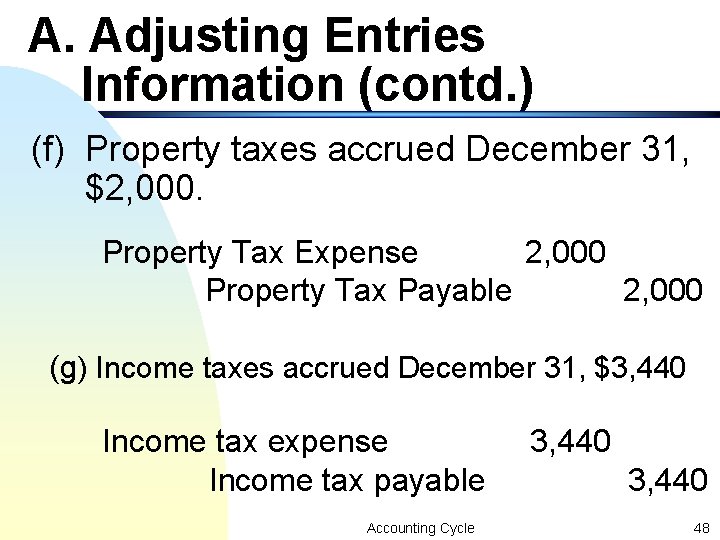
A. Adjusting Entries Information (contd. ) (f) Property taxes accrued December 31, $2, 000. Property Tax Expense 2, 000 Property Tax Payable 2, 000 (g) Income taxes accrued December 31, $3, 440 Income tax expense Income tax payable Accounting Cycle 3, 440 48
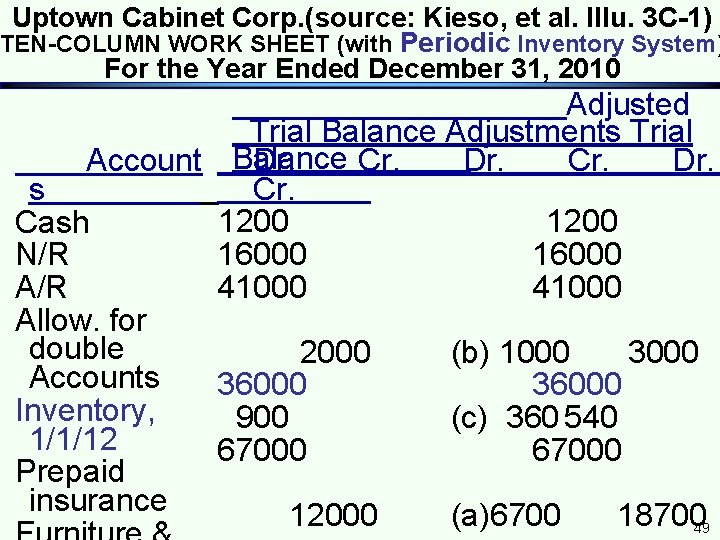
Uptown Cabinet Corp. (source: Kieso, et al. Illu. 3 C-1) TEN-COLUMN WORK SHEET (with Periodic Inventory System) For the Year Ended December 31, 2010 Adjusted Trial Balance Adjustments Trial Dr. Cr. Dr. Account Balance Cr. s 1200 Cash 16000 N/R 41000 A/R Allow. for double 2000 (b) 1000 3000 Accounts 36000 Inventory, 900 (c) 360 540 1/1/12 67000 Prepaid insurance 12000 Accounting Cycle (a)6700 1870049
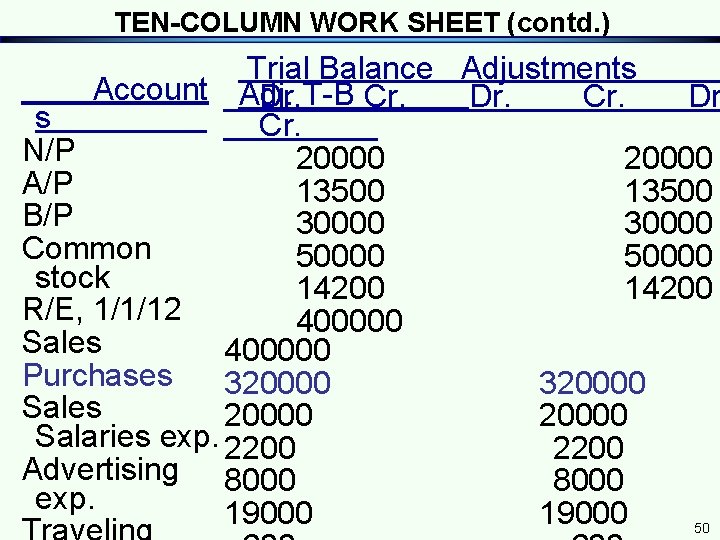
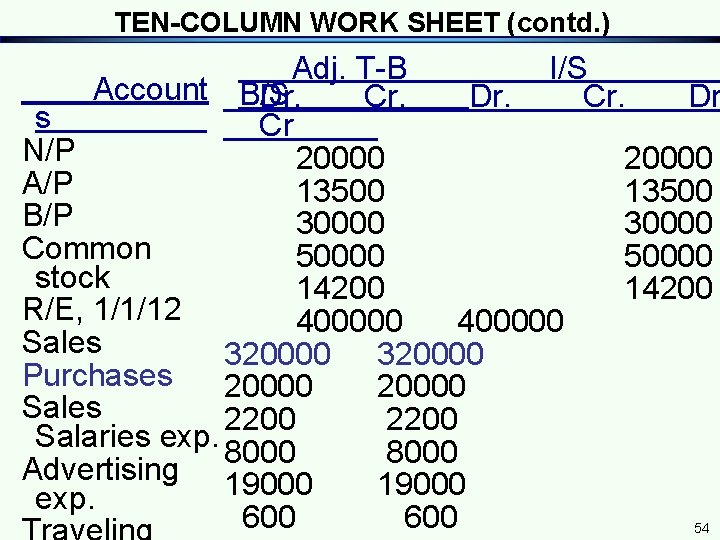
TEN-COLUMN WORK SHEET (contd. ) Trial Balance Adjustments Account Adj. Dr. T-B Cr. Dr s Cr. N/P 20000 A/P 13500 B/P 30000 Common 50000 stock 14200 R/E, 1/1/12 400000 Sales 400000 Purchases 320000 Sales 20000 Salaries exp. 2200 Advertising 8000 exp. 19000 Accounting Cycle 50
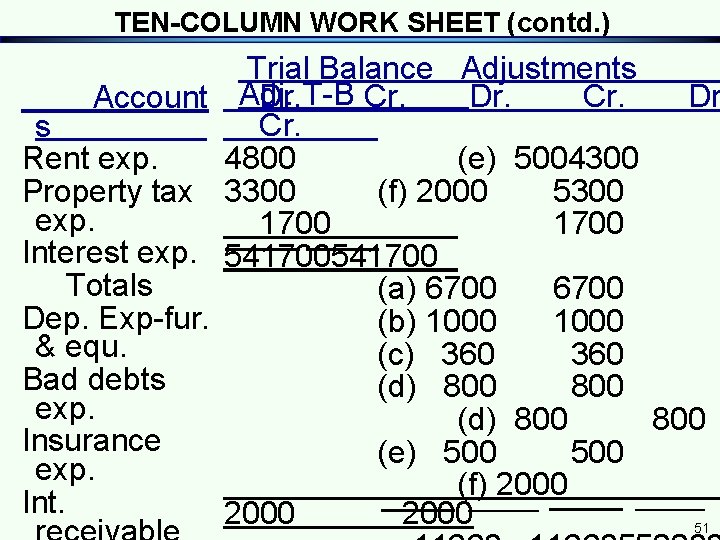
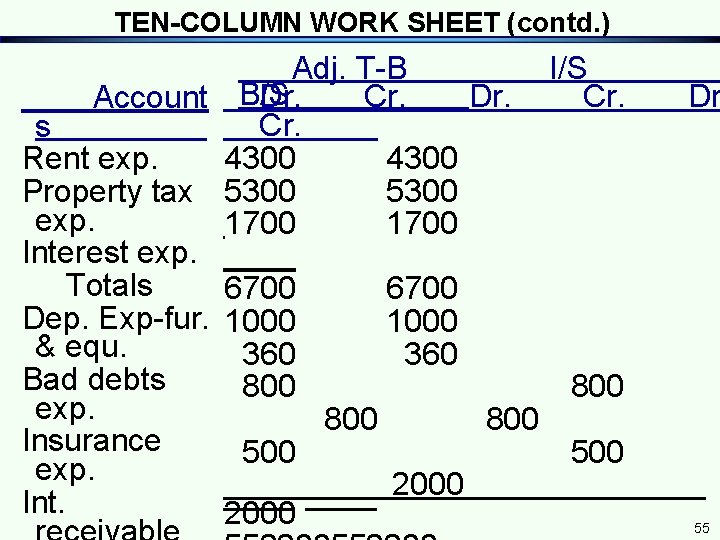
TEN-COLUMN WORK SHEET (contd. ) Account s Rent exp. Property tax exp. Interest exp. Totals Dep. Exp-fur. & equ. Bad debts exp. Insurance exp. Int. Trial Balance Adjustments Adj. Dr. T-B Cr. Dr Cr. 4800 (e) 5004300 3300 (f) 2000 5300 1700 541700 (a) 6700 (b) 1000 (c) 360 (d) 800 800 (e) 500 (f) 2000 Accounting Cycle 51
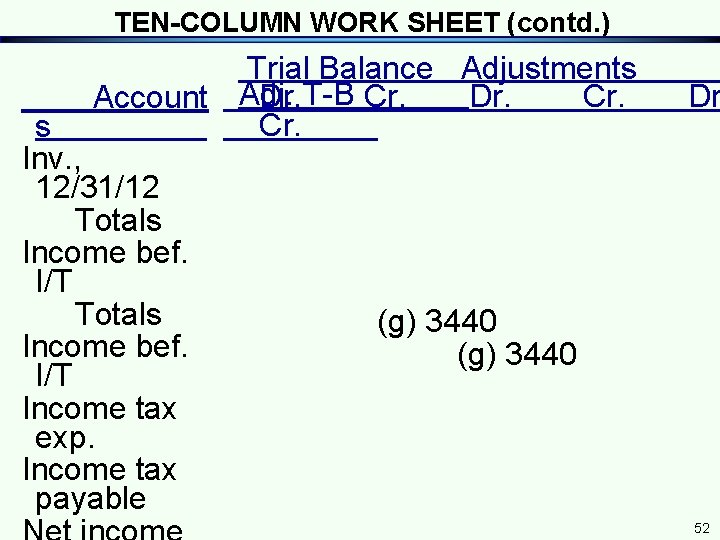
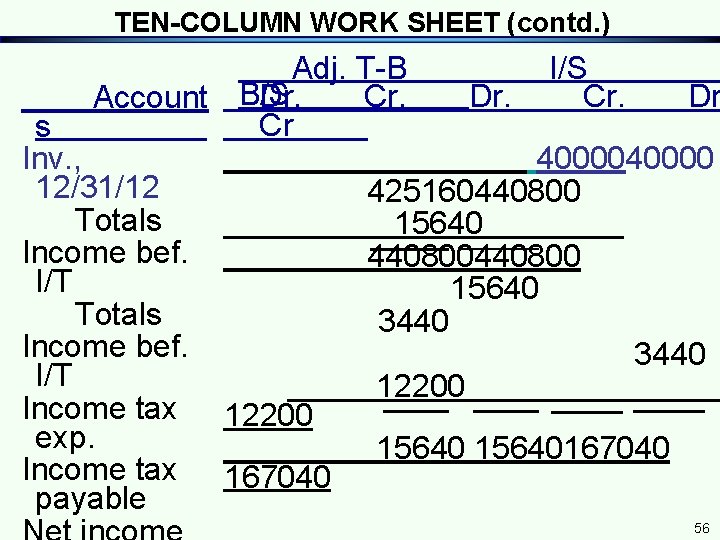
TEN-COLUMN WORK SHEET (contd. ) Trial Balance Adjustments Dr. T-B Cr. Dr. Cr. Account Adj. Cr. s Inv. , 12/31/12 Totals Income bef. I/T Income tax exp. Income tax payable Dr (g) 3440 Accounting Cycle 52
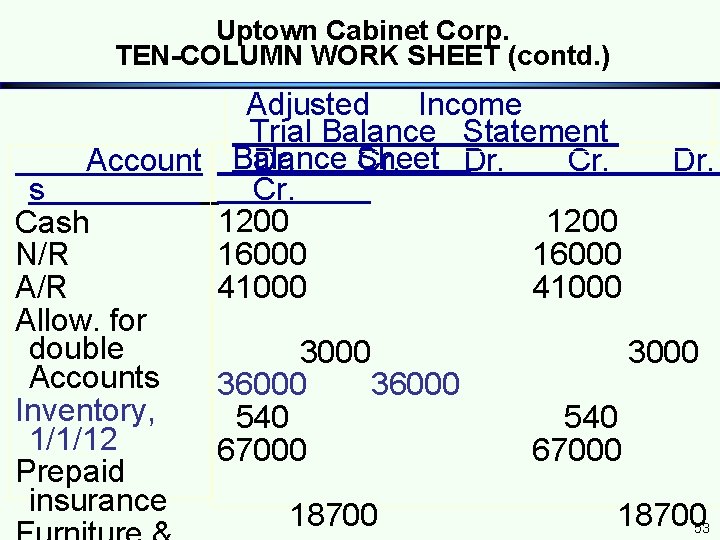
Uptown Cabinet Corp. TEN-COLUMN WORK SHEET (contd. ) Adjusted Income Trial Balance Statement Sheet Dr. Cr. Dr. Account Balance Cr. s 1200 Cash 16000 N/R 41000 A/R Allow. for double 3000 Accounts 36000 Inventory, 540 1/1/12 67000 Prepaid insurance 18700 Accounting Cycle 1870053
TEN-COLUMN WORK SHEET (contd. ) Adj. T-B I/S Account B/S Dr. Cr. Dr s Cr N/P 20000 A/P 13500 B/P 30000 Common 50000 stock 14200 R/E, 1/1/12 400000 Sales 320000 Purchases 20000 Sales 2200 Salaries exp. 8000 Advertising 19000 exp. 600 Accounting Cycle 54
TEN-COLUMN WORK SHEET (contd. ) Adj. T-B I/S Dr. Cr. Account B/S Cr. s 4300 Rent exp. 5300 Property tax 5300 exp. 1700 Interest exp. Totals 6700 Dep. Exp-fur. 1000 & equ. 360 Bad debts 800 exp. 800 Insurance 500 exp. 2000 Int. 2000 Accounting Cycle Dr 55
TEN-COLUMN WORK SHEET (contd. ) Adj. T-B Dr. Cr. Account B/S Cr s Inv. , 12/31/12 Totals Income bef. I/T Income tax exp. Income tax payable 12200 167040 Dr. I/S Cr. Dr 40000 425160440800 15640 3440 12200 15640167040 Accounting Cycle 56
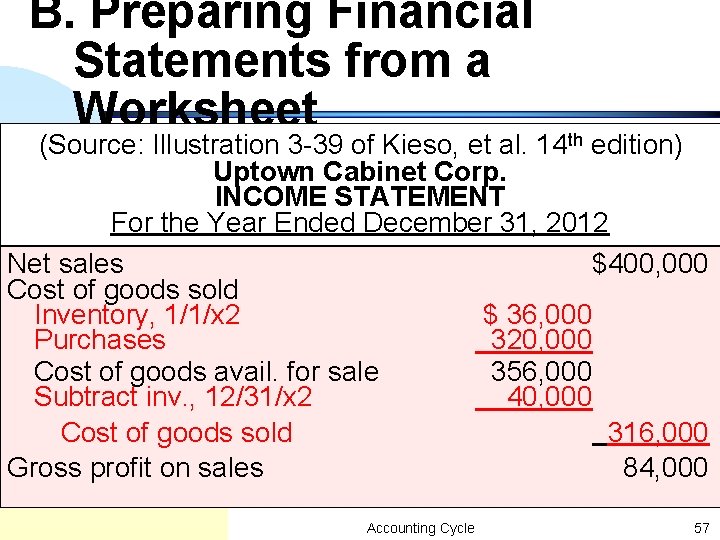
B. Preparing Financial Statements from a Worksheet (Source: Illustration 3 -39 of Kieso, et al. 14 th edition) Uptown Cabinet Corp. INCOME STATEMENT For the Year Ended December 31, 2012 Net sales $400, 000 Cost of goods sold Inventory, 1/1/x 2 $ 36, 000 Purchases 320, 000 Cost of goods avail. for sale 356, 000 Subtract inv. , 12/31/x 2 40, 000 Cost of goods sold 316, 000 Gross profit on sales 84, 000 Accounting Cycle 57
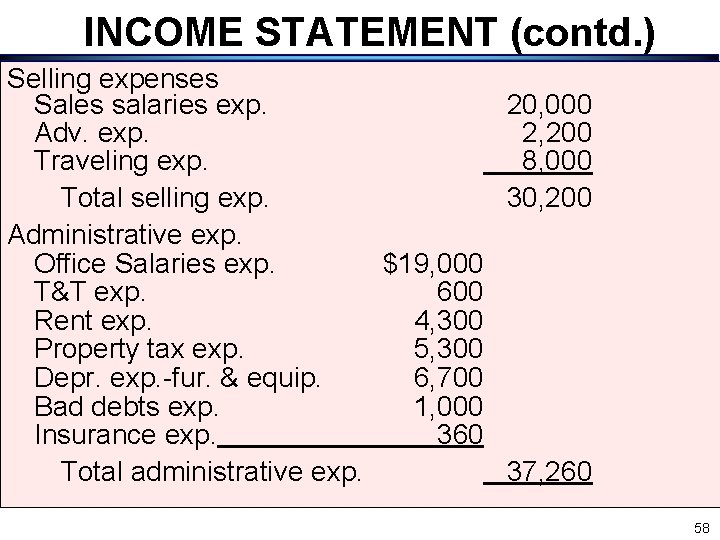
INCOME STATEMENT (contd. ) Selling expenses Sales salaries exp. 20, 000 Adv. exp. 2, 200 Traveling exp. 8, 000 Total selling exp. 30, 200 Administrative exp. Office Salaries exp. $19, 000 T&T exp. 600 Rent exp. 4, 300 Property tax exp. 5, 300 Depr. exp. -fur. & equip. 6, 700 Bad debts exp. 1, 000 Insurance exp. 360 Total administrative exp. 37, 260 Accounting Cycle 58
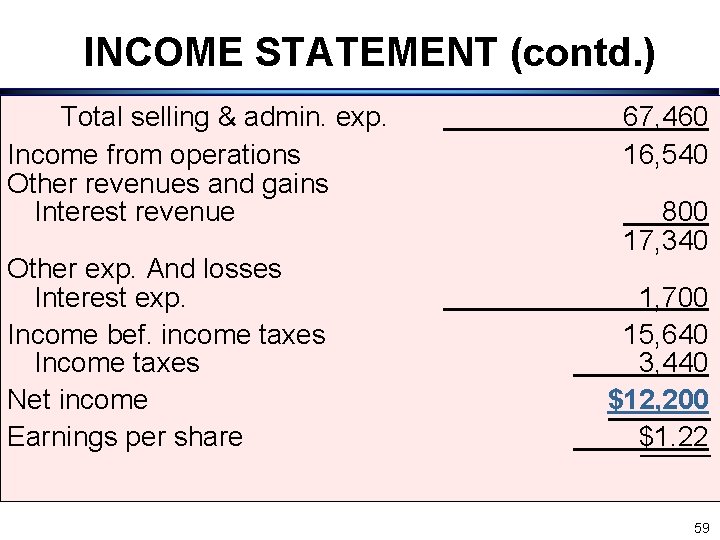
INCOME STATEMENT (contd. ) Total selling & admin. exp. Income from operations Other revenues and gains Interest revenue Other exp. And losses Interest exp. Income bef. income taxes Income taxes Net income Earnings per share 67, 460 16, 540 800 17, 340 1, 700 15, 640 3, 440 $12, 200 $1. 22 Accounting Cycle 59
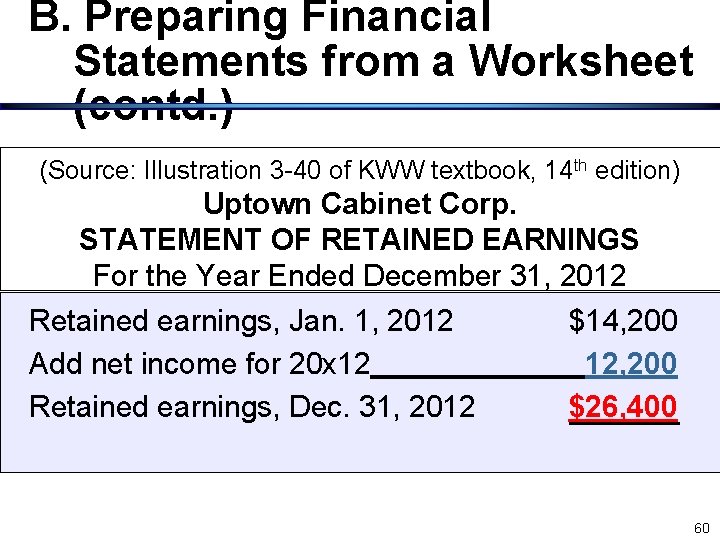
B. Preparing Financial Statements from a Worksheet (contd. ) (Source: Illustration 3 -40 of KWW textbook, 14 th edition) Uptown Cabinet Corp. STATEMENT OF RETAINED EARNINGS For the Year Ended December 31, 2012 Retained earnings, Jan. 1, 2012 $14, 200 Add net income for 20 x 12 12, 200 Retained earnings, Dec. 31, 2012 $26, 400 Accounting Cycle 60
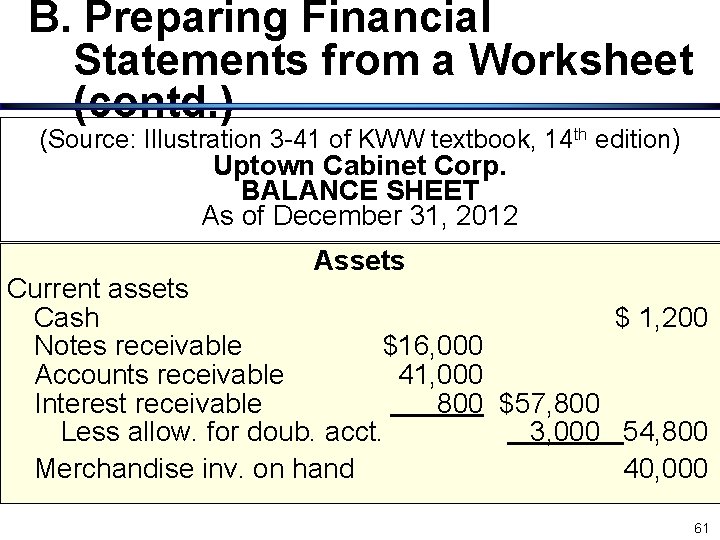
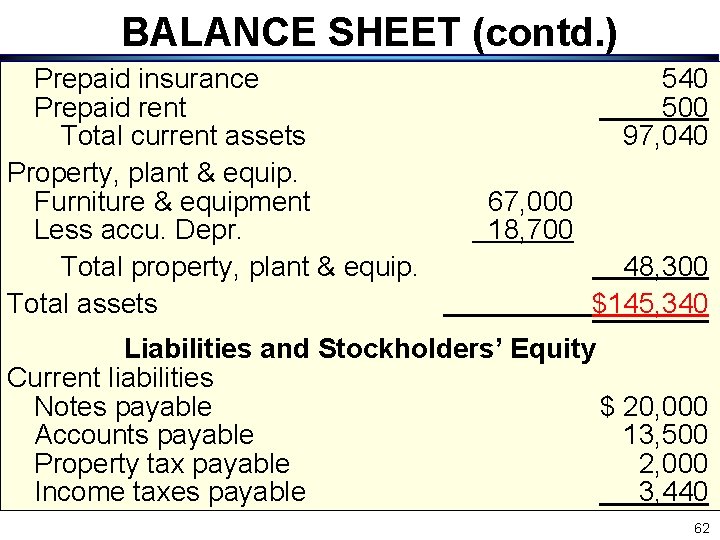
B. Preparing Financial Statements from a Worksheet (contd. ) (Source: Illustration 3 -41 of KWW textbook, 14 th edition) Uptown Cabinet Corp. BALANCE SHEET As of December 31, 2012 Assets Current assets Cash $ 1, 200 Notes receivable $16, 000 Accounts receivable 41, 000 Interest receivable 800 $57, 800 Less allow. for doub. acct. 3, 000 54, 800 Merchandise inv. on hand 40, 000 Accounting Cycle 61
BALANCE SHEET (contd. ) Prepaid insurance Prepaid rent Total current assets Property, plant & equip. Furniture & equipment Less accu. Depr. Total property, plant & equip. Total assets 540 500 97, 040 67, 000 18, 700 48, 300 $145, 340 Liabilities and Stockholders’ Equity Current liabilities Notes payable $ 20, 000 Accounts payable 13, 500 Property tax payable 2, 000 Income taxes payable 3, 440 Accounting Cycle 62
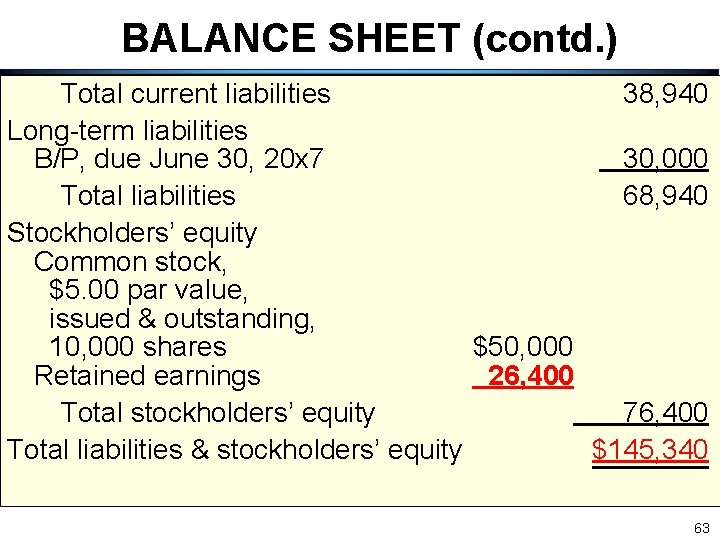
BALANCE SHEET (contd. ) Total current liabilities 38, 940 Long-term liabilities B/P, due June 30, 20 x 7 30, 000 Total liabilities 68, 940 Stockholders’ equity Common stock, $5. 00 par value, issued & outstanding, 10, 000 shares $50, 000 Retained earnings 26, 400 Total stockholders’ equity 76, 400 Total liabilities & stockholders’ equity $145, 340 Accounting Cycle 63
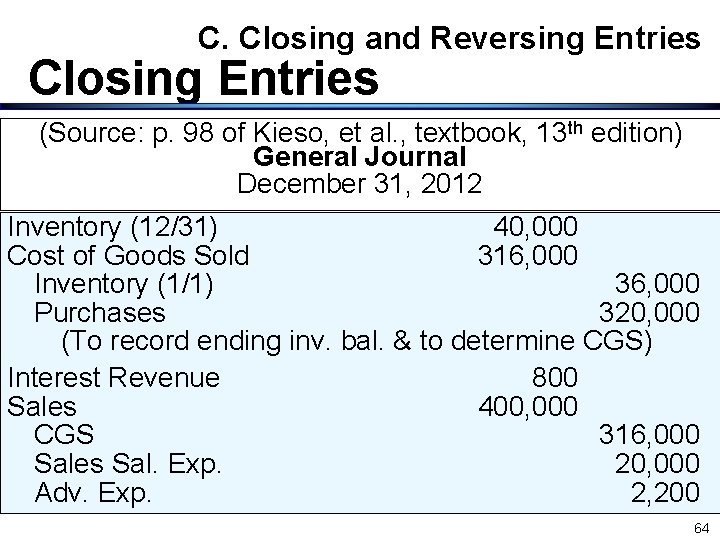
C. Closing and Reversing Entries Closing Entries (Source: p. 98 of Kieso, et al. , textbook, 13 th edition) General Journal December 31, 2012 Inventory (12/31) 40, 000 Cost of Goods Sold 316, 000 Inventory (1/1) 36, 000 Purchases 320, 000 (To record ending inv. bal. & to determine CGS) Interest Revenue 800 Sales 400, 000 CGS 316, 000 Sales Sal. Exp. 20, 000 Adv. Exp. 2, 200 Accounting Cycle 64
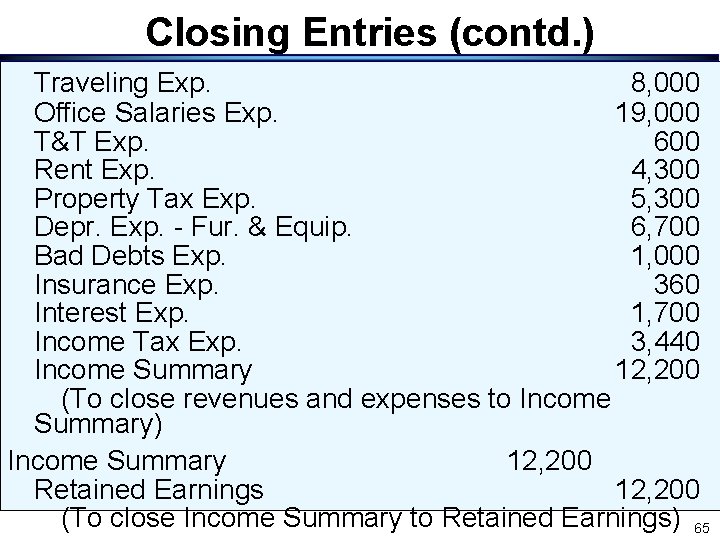
Closing Entries (contd. ) Traveling Exp. 8, 000 Office Salaries Exp. 19, 000 T&T Exp. 600 Rent Exp. 4, 300 Property Tax Exp. 5, 300 Depr. Exp. - Fur. & Equip. 6, 700 Bad Debts Exp. 1, 000 Insurance Exp. 360 Interest Exp. 1, 700 Income Tax Exp. 3, 440 Income Summary 12, 200 (To close revenues and expenses to Income Summary) Income Summary 12, 200 Retained Earnings 12, 200 (To close Income Summary to Cycle Retained Earnings) 65 Accounting
C. Closing and Reversing Entries (Optional) January 1, 2012 (D) Interest Revenue Interest Receivable Rent Expense Prepaid Rent Expense Property Tax Payable Property Tax Expense Income Tax Payable Income Tax Expense (E) (F) (G) Accounting Cycle 800 500 2, 000 3, 44066
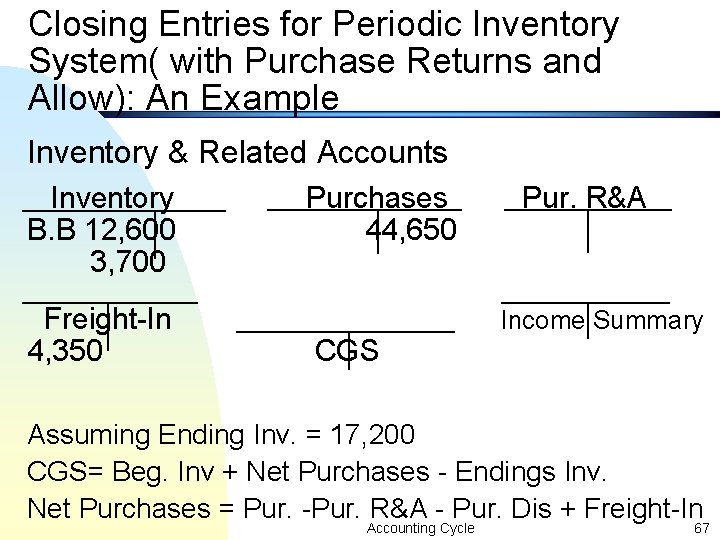
Closing Entries for Periodic Inventory System( with Purchase Returns and Allow): An Example Inventory & Related Accounts Inventory B. B 12, 600 3, 700 Freight-In 4, 350 Purchases 44, 650 CGS Pur. R&A Income Summary Assuming Ending Inv. = 17, 200 CGS= Beg. Inv + Net Purchases - Endings Inv. Net Purchases = Pur. -Pur. R&A - Pur. Dis + Freight-In Accounting Cycle 67
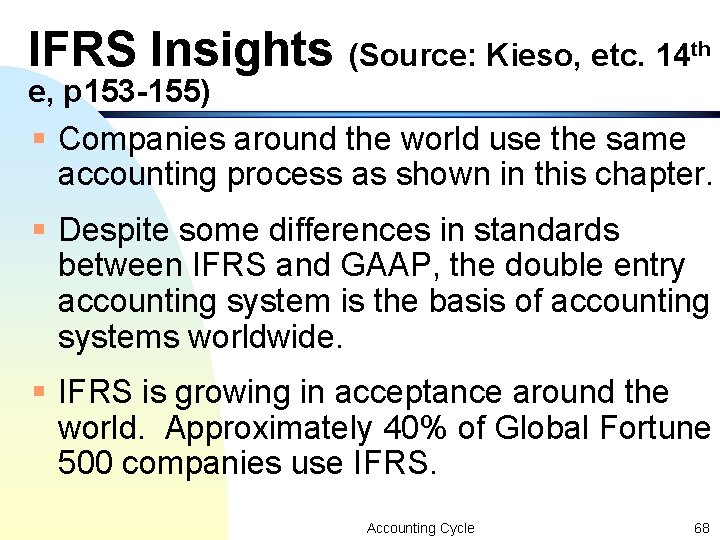
IFRS Insights (Source: Kieso, etc. 14 th e, p 153 -155) § Companies around the world use the same accounting process as shown in this chapter. § Despite some differences in standards between IFRS and GAAP, the double entry accounting system is the basis of accounting systems worldwide. § IFRS is growing in acceptance around the world. Approximately 40% of Global Fortune 500 companies use IFRS. Accounting Cycle 68